
A holey theory
Moliere 2021-06-22
To be is to be the value of a variable.
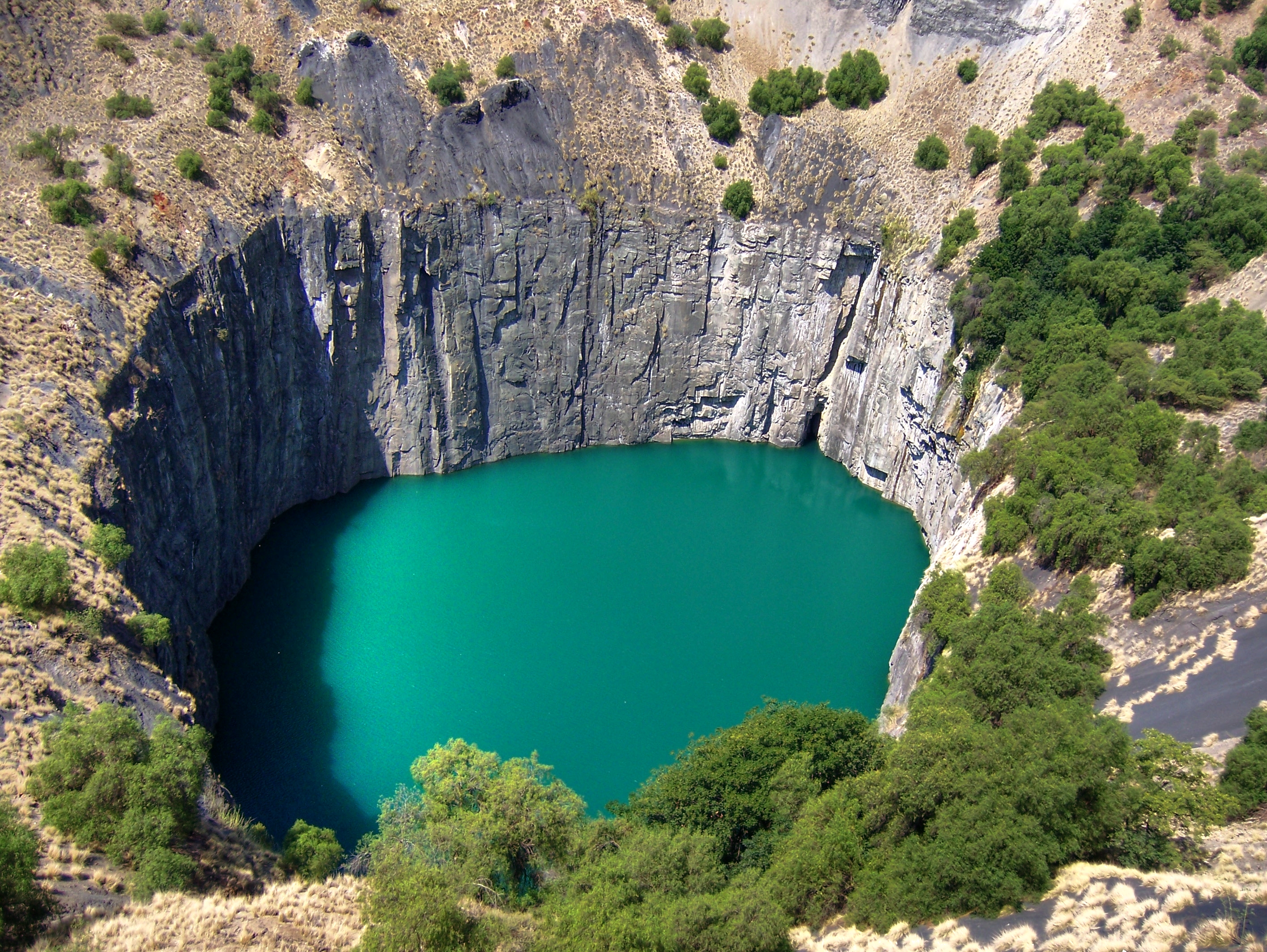
There is a big hole in Kimberly.
The above sentence is true, and "hole" is the value of its variable.
Therefore, holes exist.
Do
There is a big hole in Kimberly.
The above sentence is true, and "hole" is the value of its variable.
Therefore, holes exist.
Do
Comments (118)
I confess I have never understood this in the least. Bound variables are part of symbolic representations, not the things themselves. A cat is the value of a bound variable as in "Exists(x) such that x is a cat," but I find this very unconvincing. The cat is a cat long before there are logicians to invent quantified logic. I just don't understand this kind of thinking. Must be me. A lot of this kind of philosophical discourse just goes right over my head.
Is the question whether holes exist? They most definitely do. Mathematically, if you poke a hole in the x-y plane, then loops around the can no longer be contracted to a point. The hole has changed the topology of the plane. Holes are a huge area of study in math. In algebraic topology they try to find clever ways to count the number of holes in an object. Holes are a thing, not just an absence of a thing.
And of course we have the great scene in Cool Hand Luke.
Holes are things. They have existence.
Hmmm. I will have to think about that, it's a good point. SEP has an article on the subject.
https://plato.stanford.edu/entries/holes/
They even made your point: "Holes are ontologically parasitic: they are always in something else and cannot exist in isolation. (‘There is no such thing as a hole by itself’, Tucholsky 1931.)"
Trying to think of other things that are ontologically parasitic. Shadows, say. Shadows definitely exist but never without a thing to block the light. What kind of existence do shadows have? They're a lot like holes. Here's an article on the philosophy of shadows.
https://www.3ammagazine.com/3am/the-philosophy-of-shadows/
It's a review of a book, Seeing Dark Things: The Philosophy of Shadows.
https://www.goodreads.com/book/show/12858037-seeing-dark-things
What other things are like shadows and holes, things with a tenuous claim on existence, things that are ontologically parasitic?
I'm just leaping from that point, more than anything. Similarly so with the argument I'm presenting -- I think it's an interesting puzzle. I don't mean to dig into Quine.
Quoting fishfry
Yes, exactly. I'll try to edit it to make that clearer.
It seems you've changed your stance after your exchange with Wayfarer?
So it's an unexpectedly deep question, I think (although maybe you did expect it!)
Yes I understand that. It's just that I've heard that particular saying before, and I genuinely don't understand it.
Quoting Moliere
No, I think holes exist, and so do shadows. There are things that exist and that only appear along with more substantial things. Holes and shadows being the two that come to mind. Ontologically parasitic, what a great phrase.
I think holes exist though. I haven't had a chance to read the SEP article yet. But there's too much math around the question of identifying and counting holes for me to doubt their existence. But it's a tricky question. Also the question raised by Cool Hand Luke is a good one. Before you dug a hole in the ground, was that hole already there, waiting to be dug out? If not, and you dig it out, you end up with a hole and a pile of dirt. You can't say the pile exists but not the hole. They're sort of like the electron/positron pairs that get spontaneously created in quantum physics. They come into existence in pairs. Piles and holes. You can't say one exists and not the other, can you?
Yes, this is the sense in which I am asking.
I suspected it :D
I heard some philosopher talking about it once, and once they did (i forget who it was....) I began to see the contours of a philosophical puzzle.
Quoting fishfry
Oh, it comes from Quine's On What There Is, if you haven't read it. I have a hand-wavey understanding of it in the sense that I've read a bit of and about Quine.
Quoting fishfry
See, for me at least, the mathematical part is a little less convincing. That would mean that holes exist in the same way that numbers do, and I am less confident when it comes to my beliefs about the ontology of abstract objects.
But the things I see, so I believe, exist.
But, like you said, holes are weird in that they are an absence -- there's not really a property of holes, is there? Maybe size, for any individual hole. But you can make a hole out of anything. And it certainly isn't a thing.
How about shapes? Shapes can't exist in isolation. They must be molded from something.
Holes are properly thought of as shapes. Their only distinction is concavity.
Shapes seem more like qualities or attributes. Color, temperature, mass, don't exist in isolation. They are attributes of objects. As is shape. I think shape would fall into the category of an attribute or quality. I'm sure there must be some standard philosophical terminology for this.
Quoting hypericin
Well a hole is not an attribute of an object, unless you look at it that way ... there's a rock of mass such and so, and color such and so, with a hole in it.
I'm not enough of a philosopher to go down this rabbit hole. I'm in over my head ... in a hole, as it were.
Quoting Moliere
I gave it a skim, very entertaining and interesting. One thing that jumped out at me right away is that Quine is quite a lively and present writer, not a turgid bore like so many philosophical writers are. He entertains you with his narrative, then when you're not looking he makes his highly insightful points. And he's clear. You can understand what he's saying even as he takes you into the murky depths of ontology. Glad you pointed me to it.
Or no?
If holes exist, then there exists at least one entity which does not have a material basis -- rather, a hole is something of a relational entity that exists because of the shape of material things. Therefore, not everything that exists is material.
So, if we admit holes exist, we must reject materialism.
EDIT: And so the sciences fall to the humble hole, and not the grandiose plans of the religious ;)
So do holes exist? As much as "being drunk" does.
"The hole is five feet wide"
if we wanted to be literally rather than metaphorically true we should instead say
"The ground is holey"
?
For what it's worth, I just woke up early.
If language is fine as it is, then "this hole is 3/4 inch in diameter" is true.
Which would indicate, linguistically at least, that "hole" is not a predicate -- but a subject.
So we'd be in the queer position of believing true sentences that refer to things that don't exist if that were the case.
It's not space itself in question, though. It's not a space that's there -- it's a hole!
Texture strikes me as a little funny, but it's not so in the same way. If I say that a pipe feels smooth, then that is in the predicate position -- thus linguistically indicating that there is something predicated of an object, the pipe.
Hence why I thought you were making an argument about natural language meaning -- that when we say "hole", in the subject position of the sentence, we actually are referring to a property of the pipe, rather than saying the hole itself has a property.
It might turn out that stuff is an arrangement of weirdness (another arrangement). Try not to panic.
That's how it starts. Next thing you know you have a gigantic hole that people fall into every year and you can make a tourist attraction out of it.
:rofl: Last I checked, you had a sense of humor. So...
On a more serious note, can you have a look at what I think is going on with the "to be is to be the value of a variable" idea. It's rather simplistic I suppose but it's my best shot.
To be is the value of a variable
There is a big hole in Kimberly (Sounds dirty but that's a topic for another thread)
1. Non-mathematical interpretation
A hole = nothing in (surrounded by) something which I will simplify as hole = nothing and something. This can be treated as a general definition of a hole.
If I define a die as die = red and plastic and then say there is a die then what I mean is there is red and there is plastic.
Does this simple rule work for a hole?
There is a hole = There is nothing and there is something. I detect no issues with there is something but what about there is nothing?
Nothing, I'm told, is also nonexistence i.e. nonbeing as it were. So, to say there is nothing amounts to saying nonexistence exists. Contradiction!
In other words, there is a hole (in Kimberly) is nonsensical for it contains a contradiction viz. nonexistence exists!
2. Mathematical interpretation
I think this point of view is closer to the meaning of to be is to be the value of a variable.
Mathematical variables, most common symbol for them being x, can take on any value mathematically defined, including, this is key, zero which is the numerical version of nothing.
So, there is a hole in Kimberly simply means the variable x = 0 where x is a certain geological feature in Kimberly.
Make sense? Probably not! Well, you can't say I didn't try! :rofl:
This Quinean criterion for [url=https://en.m.wikipedia.org/wiki/Ontological_commitment]
'ontological commitment'[/url] only refers to objects that 'exist' within given discourses (e.g. geometry, topology, etc) and does not refer to matters of fact (e.g. donut & sphincters)
I would interpret you, within the idiom I'm attempting to phrase this in at the moment, as believing that there is no real hole in the ground. Rather, there is the ground, and we predicate of the ground a shape -- in this case a hole. So in ordinary language we say "the hole is deep", but through analysis we'd translate this as "the ground is shaped hole-wise" or something like that. It's clunky to read, but it fits within the framework between subject and predicate.
So in the first we'd formalize as ?xL(x) ^ (x = "hole"), I think.
And in the second we'd formalize as ~?(x)L(x) ^ (x = "hole"), and H(x) ^ (x = "ground")
Hopefully I'm doing that right. The important thing, from my perspective, is that you are asserting that there is no such thing as a hole unto itself, but rather, there are material things (the ground) which are placed into a hole-wise relation.
I'll follow up with individual responses, but I want to keep this post general for now just to share where my mind is moving.
Well, because we can see the hole, and the hole has properties such as depth, width, and location -- and those properties differ from the properties of the ground, since the ground spreads out, and is certainly not shaped like a hole anywhere else. Would we call Africa a hole just because this one hole exists?
Quoting unenlightened
I think there's a difference here... I agree that relation is important, but I'd say the relation is between the donut (a shape) and the hole. A donut can be represented, topologically, in a two dimensional space that wraps around -- if you imagine walking on a piece of paper, as you get to the top you immediately appear on the bottom. Were you in such a space -- which we don't empirically witness in our world, but is easily imaginable -- there would be no hole, but the shape would remain the same -- at least from a topological perspective.
But there be a hole I see, and I certainly don't deny its existence -- only noting that its existence is curious.
Quoting 180 Proof
Now you're tempting me with my true bait -- exegesis.
But I'm going to use all of my willpower and not debate the meaning of Quine -- and just note that I'm using some of his words as a conceptual jumping off point, not exploring a consequence or a reductio of his philosophy.
To my understanding, at least, "to be is to be the value of a variable" is in reference to objects and predicates. Insofar that you can truthfully predicate of some object therein will you find what it means to exist.
So if "The hole is 3/4 of an inch in diameter" is true, then we can certainly conclude that there exists such a hole.
Quoting tim wood
Welllll... did he ever really propose what it means to be? He kind of got stuck in his own interpretative circle looking for how one could possibly understand the very question "what is the meaning of being?" -- how on Earth would he know if a hole exists? ;)
But by all means, you can be the one to bring in the ontology of Heidegger, rather than Quine, and bring us illumination on the topic. I'd love to read it! That is why I started the thread.
Whoops! I missed you in my responses.
I don't think I'm arguing that. What I'm arguing is that the materialist is committed to the hole not existing -- it's the ground that exists arranged hole-wise.
Is Africa yellow just because the sand in the Sahara is? I really have trouble finding what your argument is so far. The immediate matter surrounding a hole is clearly not a hole.
I think the question is, do properties exist? If so, then holes exist. I'm not committed one way or another because it depends on language use and definitions. Holes are a specific topographic feature such that an area without solid matter is surrounded by solid matter. If defined that way, the question arises do circles and squares exist? It's not particular to holes unless you insist holes ought to be defined by the absence of something. I don't like such a definition though, because I can't take a hole out of the context of the matter defining it because if I remove that matter I'm left with nothing. And this is the same with a square, if you take away the matter, I'm not left with a square but if I remove the square, I still have (amorphous) matter.
Not at all. Fall down the hole to discover its reality. The confusion of reality with materiality is where we're at here. Space (and/or time) is real and it is the relation that material has to itself. Stuff and structure - not two things, but the dual aspects of reality. If you want me to deny something it would be stuff, not structure - the ground, not the hole. The ground is nothing but a stubborn refusal to let you fall.
I think we're closer in belief, then, actually -- and I misgrouped you.
I am of the belief that holes exist. It seems less queer to me than the alternative.
Keeping with my idiom, you'd simply agree that the hole exists, and that relations have a reality.
One thing that's queer about relations is that I wonder what can be predicated of them?
At least, this is where I'd be stuck in how I started...
Also, I want to know -- what is the relationship involved?
The difference between us, right now at least, is that I think there is a hole and some background material, and there is a relationship between these two entities -- and I posit an entity because shape is not adequate to address the hole in a donut, as a donut shape can be represented without a hole.
So I would say "The hole is in the ground", where the relationship is indicated by "in" -- not that this indicates being, since we're talking about relationships here, and I am not quantifying over a predicate here.
EDIT: Also, I want to note that I'm open to other approaches with respect to "to be" -- while I'm using a notion of Quine, I'd like other notions put forward and used to analyze or have a better understanding of holes. If you have such a notion aside from quantification I'm all ears.
Hrrm, probably just misreading you. I'll try and restate in a different way to see if it clicks:
The hole is in Kimberley, South Africa.
Kimberley is 164.3 km2
The big hole is 0.17 km2
Let's just say that "Kimberley" designates the matter surrounding the hole. So Kimberley is clearly not the hole. And we can truthfully predicate of Kimberley that it is 164.3 km square, whereas we can truthfully predicate of the big hole -- its surface -- that it is 0.17 km2.
So, there are two different properties between the surrounding matter and the hole. We might go so far as to say that Kimberley is enholed, thereby indicating that there is a property of Kimberley, but that wouldn't change the fact that we can truthfully predicate of the hole a size different from Kimberley -- thereby indicating that they have different properties, and are separate from one another.
This all follows from the notion of "to be" I opened with.
If we can quantify over a predicate and create a true statement from said quantification, then whatever said statement uses to bound the variable exists -- in this case, the hole.
Quoting Benkei
I agree that if you take away the matter the hole does not exist -- were an asteroid to smash the Earth apart then, within the reference frame of the sun, the hole in Kimberley, South Africa will not be floating there in space without Kimberley being there.
I am not defining holes or arguing from definition in the sense of providing necessary and sufficient conditions -- I am using an ostensive definition, instead. This is a hole! So in your case we'll have to talk about pipes and 3/4" holes, or indentations in place of holes ;).
I am skeptical of holes being a typographic feature, however, given the ability to represent a donut on a plane without a hole in a topologically identical manner.
Do you have a picture of a donut without a hole for me?
Imagine you're in the middle of the page of this graph paper. Choose any direction to go in, and go straight. When you reach the edge of the paper, place yourself on the opposite side of the page. Continue walking.
This, topologically, is identical to a donut. It's not too hard to imagine either -- just think about what a donut looks like, and then mentally cut through exactly once so that you don't split it in half -- you'll have a cylindrical shape. Then cut down one edge of the cylinder and spread out the cylinder -- you'll have a plane.
A donut is a plane which is connected in the manner I'm describing. Were space donut shaped, rather than what we happen to experience, then this would just be common sense -- to get back to where you started all you need to do is keep walking.
In a way our Earth isn't so far off, it's just so large that we don't notice that it's actually spherical.
Now, if we lived on a donut within the space with which we were familiar -- empirical space as we know it -- we'd be able to look up, sometimes, and see the other side of the donut. But that's a donut in space as we know it, rather than a donut shaped space without a hole.
(EDIT: Just to avoid confusion, the holes in the paper are not what I'm talking about here)
A hole is the surroundingness of a doughnut; a row is the alignment of ducks; a marriage is the joining of two matched parts. If you treat the doughnut as single material object, then the hole is the way the nut relates to itself. Or the way Pacman's world joins up. Or the way the ground of Kimberly relates to itself.
I don't know where predicates and variables sit though they seem like linguistic affairs...
Incidentally, the topology of Pacman's world is rather odd, the corners all join together as if they were all bent round as in a sphere, but the way they join up is backwards, as if one were on the inside of the sphere. Hence the hole/no hole that doesn't know whether it runs one way or the other.
Interesting. Not 100% on this, but what about: that which is is that which stands out as a whole, and thereby stands out as an entirety which is other than its context, else other relating to that which is in relation to it, such as its parts. A hole stands out as an entirety which is other than its ground, and thereby is. There are parts to a hole (e.g. its left or right boundary or quadrant) but it nevertheless is cognized as an entirety and thereby stands out. Fairly confident there will be drawbacks to this approach - which, acknowledgedly, assimilates being with existence - but its an idea.
Edit: Maybe obviously, this approach to a hole's being does not however preclude quantification. The quantity of "one" would abstractly represent that which stands out as an entirety.
Without valleys there would be no mountains.
My head just literally exploded.
But you just kept typing and then you went to work and stood around at the water cooler with no head.
Then you said screw this and you got in the car and drove to Mexico and rented a boat with six other people and it crashed into a deserted island and everyone was calling you "Skipper"
Do we? How's that?
If we know it by definition, then we're simply defining what we mean -- it's a stipulation. Which can work if we have something else we're arguing about, but when that's the very assertion under dispute I dare say we are begging the question.
So you would say that there is a hole in pacman's world, because the hole is a relation -- one which changes description depending on the donut. Do I understand you correctly?
They are! But the approach I'm using puts emphasis on linguistic affairs :D
If we can truthfully predicate of some subject, then we are justified in inferring that there is such a subject. So the form of the statement is very important. Now, clearly we understand that there are things like gerunds and such, so we have to have a way of understanding subjects that aren't actually existent things. For that we analyze ordinary expressions into a clear statement.
Hence why I was asking about the relation you'd posit specifically -- but I think you're using a different idiom.
Also, I think it's important to note here that there are some statements which do not predicate of a subject -- statements that deal with relationship between entities are often like this. So the hole is in Kimberley. I know I started out like that, but I was being sloppy. I should have dealt with a property of the hole, i.e., its surface area, rather than its relationship -- though its curiosity is just that it is, as @fishfry pointed out from the SEP, a parasitic entity that does not exist unless there is something like "Kimberley" to be a hole within.
So it is quantification which indicates existence. We quantify over a predicate, and if said quantification produces a true statement, then we can say the subject of said sentence exists.
Also, this is why I tried to translate sentences into philosophically clear ones. That's all I mean by analysis here.
I think that might just be an artifact of it being a donut designed for 2-dimenional space. Like, if you imagine pulling pac-man's world into our space where the edges of the screen are are where they reconnect -- and that corner is just the place where we opened up the donut in two direction -- but we could have chosen to cut in the middle of the screen, so the speak -- it just would be very confusing for the player to play then :D
Sounds good to me. Reading the SEP article the cognitive aspect of holes is part of why people think they exist -- as you say, they stand out as a whole.
I think that we're assuming a lot in making an assertion about atomic structure. Also, even granting their reality, I'm a little uncertain about calling the particle in a box a hole -- quantum stuff is weird, and doesn't really match up with things like chairs and holes and stars.
If a hole is an aspect of reality, then what is that aspect? What are the other aspects? Wouldn't everything that is real share in this aspect?
:D
It's right there, of course.
I don't think it works like that. Consider that you can make a doughnut from the plane in two ways; make a horizontal cylinder and bend it round, or make a vertical cylinder and bend it round.
So I make a horizontal cylinder, but standing at the back of flat Pac-world, and the 'corners are now left and right middle facing me. Now I bend the cylinder around, and the corners are on the inside of the hole facing away from me. Or I can do the same thing with the vertical cylinder. So is the hole N-S or E-W? Or to put it another way, one pair of edges forms the inner ring around the hole, and the other pair goes through the hole. But which is which?
Quoting Moliere
Hmm. Unicorns have a single horn. Harry Potter has a scar. ??? This seems a dangerous way round to put things, even if there is some way it makes sense. The danger is that one might think one can talk things into existence, and that is the essence of magic. I'd be much happier if you turned it around - 'if there is such a subject, then we are justified in inferring we can truthfully predicate.' Make the truth depend on the world rather than the world depend on truth.
I'm comfortable with that. Still thinking on your first paragraph.
But apparently it was wrong.
I don't think I'd say that any void is a hole, then -- as you appear to be saying. Or perhaps you're just saying that there are no holes?
Btw, that Feyerabend quote in your profile recall the pleasure I've had reading that book. Maybe time for another reread. :smirk:
Ok, I got a piece of paper out to simulate these movements and I think I'm following, now. Please correct me if I'm not :D.
I think I would agree with you if Pac-man's world were a Taurus within our space. So if we pulled pac-man's world off the screen and bent it into a donut in our space then yes, I agree.
However I think I'd say that Pac-man's world's space is shaped like a Taurus, in the same way our space resembles Euclidean geometry at the scales we're used to. So there isn't a hole at all or edges at all, and if Pac-man stands at the origin of our screen, where he'd be in four places at once, this is just because we are projecting the Taurus shape onto a 2-dimensional representation so that we, in the empirical space we're used to operating within, can see it easily.
After all, it's donut shape isn't obvious -- I got this from somebody else, I didn't make it up :D.
So for Pacman, at least, there is no through the hole or outside the hole -- rather, it is a Taurus without a hole.
So the aspect you're referencing is void -- there is stuff and void, though void is more present than stuff.
So you agree that holes exist because materiality has void, and there's nothing unusual in admitting that void has being? Does that sound like a fair inference of your take?
https://thephilosophyforum.com/discussion/comment/555628
I contend that this is an epistemological issue since breaching ontological commitment beyond anthropomorphism is rife with nonsense and gibberish.
Objects do not exist "on their own" any more than holes do. Naive realism.
Hell yeah. :D
Still my favorite philosopher of science.
Quoting 180 Proof
Do you think you could give it another go?
What about if this hole is on an airless asteroid in outer space - in a vacuum? There's no air. But there are still countless atomic and subatomic particles flying through, not to mention the quantum foam and energy fields that permeate even the deepest vacuum in space.
So I have no problem saying that holes exists. Not sure about shadows, tho. Will have to think about that some more.
A torus in 3D is not topologically equivalent to a rectangle: you cannot continuously transform one into the other. In your demonstration you had to make cuts. You might as well "prove" that a solid rectangle has a hole in the middle... by taking scissors to it :)
In any case, finding one way to fail to detect a hole as a topological feature does not establish your general thesis, which I take to be that a hole cannot be conceptualized solely as a property of the entity that encompasses it. I think you are straining too hard to deny the obvious. Of course you can conceptualize holes in solid objects by focusing on the objects themselves, rather than the holes, and mathematics has the tools to do that precisely (if mathematical precision is what you are after), although it's a bit trickier than one might imagine, as simple topological criteria can detect some types of holes but miss others. A donut is an eminently holey object though: it's not even simply connected (unlike a shell, for example).
The question is not whether you can conceptualize holes that way, but whether you must, as a matter of principle. I don't think so, but then I have a loosey-goosey attitude towards metaphysics. Our language and our conceptual faculties are flexible and diverse; why should we dogmatically limit them? Must there be a fact of the matter about what holes Really Are (or Really Aren't)? In this case, the insistence that holes do not exist probably comes from seeing the world as a collection of self-sufficient individuals. Which is, admittedly, a handy concept that we employ in our everyday lives, mostly unconsciously. But it's not the only possibly concept, and sometimes not the best suited one.
I think it's a mix of wholism and pragmatism. There's one world. Any way we might subdivide it is dependent on our needs (which are also a part of the world). For example, if there's a banana on the table we can pick it up and move it to the right. We can't do the same to a hole that's on the table (and we can use that for comic effect in fiction, such as the movie Yellow Submarine). The defference doesn't strike me as one of existent, but as one of relations: what we can do with the object.
A hole's existence is wholly dependent on the thing it's in.
A ceiling's existence is dependent on walls, though it's contstituent parts will continue to exist when the wall comes down. There's a lot of room for discussion here.
A box exists "on its own" in a prototypical sense, i.e. this tells us more about "on its own" than it does about boxes. However, a box has constituent parts, and if too many of them go missing the box ceases to be box, though the constituent parts being else where (or even assembled differently) still exist.
***
On the linguistics side, my take of reference is not:
Words refer to things. It's Words refer to concepts, and a certain class of objects evoke the same concepts. It's only in that way that we can say words refer to things. Change within a person can start on any end here, and its all embedded in how we live, and we live with others.
Concepts have to do with how we divvy up the world, but the world exists even if we don't divvy it up at all. So what we call "a hole" exists regardless of whether we interact with it or not, except that if we don't interact with it it's not a "hole". What's missing is the interaction. Any act of naming is interaction, and asking of a hole if it exists is a form of interaction (though if it's done in abstract no actual "holes" have to be involved, only the types of concepts that holes or the word "hole" usually evoke.)
***
All of this is a lot more complicated, but that's pretty much where I stand.
The story is there to help understand why I'd say such a thing. Strictly speaking the torus is not in 3D, but rather space itself is a torus in Pacman's world, and in our perspective we represent that space as a rectangle that teleports to the other side -- it's the surface of a torus which is the shape of the space, not the whole donut itself.
Now, I'll fully grant that this, mathematically, is a bit beyond my ken and I'm making some guesswork. The topology of pacman's world was pointed out to me in an unrelated conversation I had some time ago, and it just occurred to me here. I believe they are correct, but I couldn't demonstrate it or prove it in a manner more rigorous than the story I've told.
(EDIT: Also this leads to the deliciousiously abstract and totally silly but still interesting question: Are there such things as 2-dimensional holes? lol)
Quoting SophistiCat
At first I was uncertain about whether I'd posit that holes exist, but now I'm leaning towards the belief that holes exist. So, mostly, I think my thesis is just that holes exist, and I'm asking how you countenance that -- also, it's a question that gets at some of the popular topics 'round here without invoking the usual suspects ;)
I don't know if I'd say that it cannot be conceptualized that way... that's a bit more a priori than my approach has been so far. If the pacman example is wrong, consider the argument from predicates that I put towards Benkie here.
So my thesis is this: There exists a hole such that the hole is 0.17 km2, and it is in Kimberley.
And the question is: How's that work, on your view?
I pulled up some notional thoughts on Quine to jump from. What would you say about the existence of the hole?
Quoting SophistiCat
I believe my question is a little broader -- upon accepting that holes exist, how do we then countenance our beliefs about inferring what exists?
I only needed one example because it was a direct response to @Benkei'sinquiry of a donut without a hole, which he seemed to believe was impossible.
But if it's analytic, then I'd say my charge of begging the question still holds: it's a knowledge of self-definition.
If you happen to come up with a conclusion, please share it with me.
If all donuts have holes
And this shape doesn't have a hole
Then it cannot be a donut
If all donuts have holes
And this shape has a hole
Then it could be a donut
We'll note the premise does not assume the truth of the conclusion so no begging of questions here. We'll also note that "a 2-dimensional representation of a donut" is not a "donut" for rather obvious reasons.
How do we know that?
By the definition of what a donut is.
Hence the charge.
I understand that you're not convinced by the example, so I won't continue on with it with you. But this charge doesn't change from dropping the example with you.
Seems Quine doesn't honor/accept that distinction.
I posted this in the "independent Existence" thread. Basically the same issue , so I copy it here:
I would count as an object of awareness or consciousness anything that stands out, whether that be a hole, a surface, a mountain, a tree, an animal, a thought, a feeling and so on endlessly. Ontological democracy and interdependence; the individual stands out but nothing stands alone.
Quoting Moliere
Now, I'm moved to ask you for further exposition.
And maybe it's not the right way of putting it, but I've noticed I'm entertaining beliefs I would not have before, at least.
Holes provide a good example -- in another life I would have made a division between ordinary and philosophical speech (as I have here, but different), but would have favored a more scientific ontology that probably doesn't look at holes as really existing things but rather as artifacts of our cognitive apparatus -- so that statements like "The hole in Kimberley is 0.17 km2" would be true, but the background in which they were true is more like the Manifest Image rather than the Scientific Image.
Something along those lines. This is all very much an exploration for me still, even if I'm beginning to have some opinions on the matter.
(EDIT: A sort of naturalized Kantianism that I find myself no longer believing)
Just to make sure we're not delving into exegesis, as I also refused to with @180 Proof , let's just drop the name Quine and say "this account", if that's ok with you.
However, I certainly did not introduce anything like that. To exist is to be the value of a variable -- which is to say that first order predicate logic's existential operator is in use. So insofar that an entity is able to truthfully have something predicated of it, then we are justified in believing that it exists. And, I imagine we'd agree, that whether we speak about something doesn't influence its existence either, so sure things exist before we give accounts of them. I'm just not making a distinction really.
https://plato.stanford.edu/entries/analytic-synthetic/
https://www.logicalfallacies.info/begging-the-question-2/
I am aware of these things, Benkei. It could just be that we disagree, you know?
We can repeat ourselves if you want.
"All donuts have holes" is false because there exists a donut without a hole. Where? Right there! Pacman's world is donut shaped, unless the surface of a donut is somehow not the shape of a donut, or unless we assume that donuts must have holes simply because that's how we define them.
Now perhaps you're just not convinced -- you're like, hey, no, this is definitely a rectangle. OK, no problem. I disagree that "donut" is analytic or a priori -- it's a word that denotes a shape, denotes a pastry, denotes tires, denotes the motion that things move in. . . and even the denotation of a shape need not be analytic. We can, upon coming to see some other feature of the world -- such as 2-dimensional space which behaves like the surface of a donut -- think that it might be OK to call this thing a donut cuz it's close enough.
But I gather you don't want to. I'm alright with that. It's not really a logical point -- it's just the way we're looking at the problem. To you "All donuts have holes" is true, because that's what it means to be a donut, which means that it'd be impossible -- by the very criteria you're spelling out -- to give you an example. But only because there are specific criteria -- that is asserting "All donuts have holes" is true because of a definition is simply stipulating the boundaries that you're willing to accept when using the word "donut".
No worries. We can agree to disagree. It's not going to collapse the foundations of logic as we know it.
So let's go ahead and skip to the argument from predicates.
The hole in Kimberley is 0.17 km2
Kimberley is 164.3 km2
Both denoted entities have different predicates, so they are distinct from one another. And the hole has true predicates, so we are justified in inferring that the hole exists.
The simple fact remains that, like the definition and understanding of bachelor, a donut always has a hole - a hole is a necessary condition for something to be a donut. You like to pretend it's my definition but like the bachelor definition, I didn't make it up, it's a definition I learned and which is the agreed mathematical meaning. It's not that I'm forcing a boundary on meaning here, I'm insisting you use words with their proper meaning instead of making shit up because it's convenient for your argument. You want to reject donuts have holes but there are no definitions of donuts without holes because it's a necessary topological feature for a shape to be a donut.
And since you're the one invoking a logical fallacy, it's on you to demonstrate where I commit a fallacy. All you have is "I don't like the definition of donut because it results in conclusions I don't want to commit to". Well tough fucking luck really.
Quoting Moliere
No you can't. Unicorns have horns is true but I can't infer they exist from that fact.
I've thought such things before, too, but now i'm going to ask you:
If Unicorns have horns, where are they?
The other thought I had was simply to accept their truth but translate the sentence, but it's not as interesting I don't think -- and I think the above response gets at a strength to the approach I'm using.
On the top of their head. Here's a picture:
I don't mean where are the horns, but where are the unicorns.
That's clearly just a representation of a unicorn, and not a unicorn.
:D
I've already dropped the point. Do you want me to give you a button that says "winner"?
If so, then here it is: You are the winner. I was wrong and you were right.
I won't dwell on donuts any more (never liked them anyway, or bagels for that matter), but I am a bit puzzled by this. Why not 2-dimensional holes? A hole in a plane, for example, would be 2D (or even 1D if it's just one point). Or did I misunderstand you?
Quoting Moliere
Well, one way out of the predication argument, for someone who doesn't want to admit holes into their ontology, would be to claim that any talk about a hole can be translated into talk about stuff (similarly to how, according to Russell, names can be eliminated by replacing them with definite descriptions). For instance, a hole in the ground can be described solely in terms of topography. (This is where you came in with your flat torus counterexample, but I don't think it works.)
This isn't wrong, but as I alluded to above, I take a looser, more pluralistic stance on ontology and am willing to go along with your/Quinean reasoning. Things exist by virtue of playing a role in our conceptual schemes. Or to put it a slightly different way, each thing exists within the context of those schemes in which it has a role to play - and that's good enough, as far as being and non-being are concerned.
(Interestingly, in solid state physics holes can be very active players indeed: they can pop in and out, move around, attract, repel, scatter and be scattered...)
Fine by me.
To exist is to be the value of a variable
things exist before we give accounts of them
My issue with Quine's account was posed to you. My issue with the account you're offering is that those two claims directly above are mutually exclusive. If the one is true, the other cannot be, and vice-versa.
I agree with the first claim(although I'm not sure of the significance of saying something "truthful"), disagree with the claim that speaking doesn't influence(some things') existence, and agree with the last claim... (some)things exist before we give accounts of them.
I suspect our ontologies/taxonomies will differ in a few remarkable ways. Quine's maxim, which you've borrowed here in this account, had an agenda. Namely to target the superfluous nature of the terms "existence" and "exists" and the nature of abstract objects.
You understood me fine.
Is it fair to call a gap in a number line a hole?
I think it has some similar problems to holes we see in the ground, except that it has the disadvantage of being yet even more abstract. At the very least with holes I can plant trees into them, fall into them, and so forth -- there's a causal interactive network. I'm not as confident when it comes to describing two-dimensional holes because it seems that for any series or function, if there is a hole in it, then that section is simply not defined or is said to not exist.
But perhaps we don't mean all the rest when we say "hole" and simply just mean this gap -- so that the natural number line is filled with holes (and if we can say the space between numbers exists, there would even be more hole than there are numbers)
Quoting SophistiCat
Definitely! That was what my attempt was at saying the hole in Kimberley is Kimberley arranged hole-wise (so that the relationship is not named, but is instead a predicate, and of course we can also get rid of names if we wish and then even Quine the description so that the hole is not a hole but is holing and existing ;)) -- I think that's what the materialist would have to do, is translate the sentence into something more philosophically rigorous.
Quoting SophistiCat
No worries. I'm fine with dropping it if it's not persuasive.
Quoting SophistiCat
How would you answer @creativesoul's charge of things not existing prior to conceptual schemes, then?
Cool.
For me I'm not trying to delve into scientific descriptions here because I think such descriptions assumes too much.
Rather, I would like to build up to things like scientific knowledge than take scientific knowledge as my ontology.
Can something be the value of a variable prior to a speaker?
Well, it seems so to me.
Water had a density prior to naming mass and volume. We didn't have the conceptual tools to measure it at one point, but our conceptual tools -- so I think at least -- don't effect things like water.
@Banno had a picture somewhere... here it is:
It's not that predicating something truthful of an entity is the criteria of existence -- rather, this is just a good inference. If we're saying true things of something, then that thing exists. It's not the predication that makes it exist, it's the predication that justifies our inference.
Quoting creativesoul
So we agree on the first account, then.
For the second and third, let's say that these are at odds with one another. In one account we're asked to demonstrate how it is possible for us to make something exist through language -- something like a promise or a marriage, is what I imagine you have in mind -- and in the other we're asked how things exist in spite of our speech. One is dependent upon speech and the other is resilient to speech. For now let's restrict ourselves to the class of entities which we'd call resilient, because I suspect that accounts of these two types of entities will not be consistent.
What do you think of that?
Here be dragons.
Notice that existential generalisation takes Q(a) and concludes that there are things which have the property Q. You want to take Q(a) and conclude that (a) exists. It's not the same.
(a) is assumed in setting up the domain... (a, b, c,...)
SO that (a) exists is an assumption of the system, not a conclusion.
Ok, yes, I see the difference.
It's not the same.
Quoting Moliere
was my first attempt at a formalization, but it doesn't get at the inference I was attempting to lay out -- it's just a statement of my position.
Perhaps it'd be better for me to simply point -- by finger, by name, by weblink. The variable is part of language, but the hole is not.
How come it is the more you learn of philosophy, the less you really know?
But I see what you mean clearly. Give it a few months and I'm liable to make the mistake again :)
A few minutes before you posted I wrote a piece making exactly that error, but realised my mistake just before pressing "Post"...
Shadows exist physically - they can be observed and measured.
Yes, I think the primary concept of a hole is that of a gap, an absence in the middle of something. As such, we can very well think of holes in 2D or 1D. When we think of real, three-dimensional things, like a pair of pants or a fence for example, we can conceptualize them geometrically as surfaces or lines, wherein a hole will also assume an idealized 2D or 1D form in our mind.
A hole in the ground can be thought of as a gap in the surface (2D) or a missing volume of matter (3D), but when you are thinking about planting trees in it or falling to its bottom, you are shifting attention from the hole to the ground.
Quoting Moliere
Quoting creativesoul
A specious charge. It comes for free with any definition:
"X is Y."
"Well, Y is a human concept. Are you saying that there were no X before anyone thought of Y?"
Quine's deflationary analysis of existence is a conceptual analysis, not a causal account of it, which would be an oxymoron anyway.
How can you express a hole in 1D? I would think a hole appears as part of a relationship with other things so 2D is the lowest you can go?
I agree with this idea of a hole -- a gap, an absence in the middle of something.
But it seems to me that the set of natural numbers, for instance, aren't missing anything between the numbers. If we were to compare the set of natural numbers to the reals then we could say that there's something in one set that is not in the other set. But there's not a gap in the set of natural numbers unless we were to take out 3 or something like that.
Analogically, we could take the set of all polygons, and order them in accordance with their sides and the natural numbers excluding 1 and 2. There isn't a hole in between triangles and squares.
I realize I didn't specify which set I was thinking of before, but just set "number line" -- what do you think of this?
Are you? consider the ground before you have a hole. Where do you plant the tree? In order to plant it firmly in the ground one must make a hole.
The hole is defined extensionally rather than intensionally, so there's no need to focus on either the 2D surface of the hole or the volume of matter missing, right?
Or does that seem funny to you?
So it sounds like you're giving existential equality to holes and surfaces, and agreeing with me that there is such a thing?