
A hybrid philosophy of mind
Pfhorrest 2020-10-14
In this thread I will lay out a hybrid philosophy of mind: one that is eliminativist (nothing has a “mind”) in one sense, panpsychist (everything has a “mind“) in another sense, and emergentist (only some things have a “mind”) in another sense.
In a previous thread I have already laid out my physicalist ontology, which straightforwardly rules out the possibility of mental substances, and it is only in that sense that my philosophy of mind is “eliminativist”: nothing has a “mind” if (and only if) by “mind” you mean an associated mental substance separate from the physical substance (such as there is) of its body. But there are other senses of the word “mind”, or “consciousness”, about which I am definitely not eliminativist.
It is useful to distinguish between different things that we might mean by "consciousness" to be clear exactly which of several questions on the topic we wish to address. There is a sense of the word "consciousness" that simply means wakefulness, the opposite of being unconscious or asleep; that sense is not of much philosophical interest. There is another sense of the word that means awareness of something, or knowledge of it; that topic is not directly relevant to philosophy of mind, but rather to epistemology. Of more interest in philosophy of mind are two other sense of the word.
One of them is what Ned Block calls "access consciousness", which is the sense of the word that means self-awareness or self-knowledge, and is the topic of what David Chalmers calls the "easy problem of consciousness"; though I find that topic more substantial, and in a sense harder, and will cover it last. The other of them is what Block calls "phenomenal consciousness", which is the difficult-to-define capacity for experience itself, of any sort, and is the topic of what Chalmers calls the "hard problem of consciousness"; though I find that topic significantly less substantial, and in a sense easier, and will cover it first.
—
On Phenomenal Consciousness
Phenomenal consciousness is perhaps best defined in distinction from what it is not. It is not anything to do with any behavioral properties of a thing. If we stipulate the existence of some being, like a computer artificial intelligence, that behaves identically to a human being, but isn't one, some would still ask whether such a being would actually have the thoughts and feelings, the internal experience, that a real human being would have, or whether it would be merely simulating the external behavior of a being with such thoughts and feelings, such as uttering statements claiming that it feels some way or another.
Philosophers such as David Chalmers have raised the question of whether it is conceivable for there to be a being in every way physically identical to a human being, and so identical in all of its external behavior as well, that nevertheless does not have the internal experience that humans supposedly have, a so-called "philosophical zombie". That kind of experience, independent from anything to do with behavior, is what is meant by "phenomenal consciousness".
There are generally three possibilities when it comes to what kinds of beings have phenomenal consciousness in a physicalist ontology: either nothing has it, not even human beings, because the concept is simply confused nonsense (eliminativism); some beings, like humans, have it, but not all beings, because it only arises from certain complex interactions between physical parts (emergentism); or all beings, not just humans but everything down to trees and rocks and electrons, have it (panpsychism). When it comes to phenomenal consciousness like this, I find both eliminativism and emergentism have fatal flaws, leaving only the possibility of panpsychism — but only with regard to this phenomenal consciousness, not access consciousness, where I am an emergentist, as I’ll cover later.
—
Against Eliminativism
I am against eliminativism for the simple reason that I am directly aware of my own conscious experience, and whatever the nature of that may be, it seems that any philosophical argument that concludes that I am not actually having any conscious experience must have made some misstep somewhere and at best proven that something else mistakenly called "conscious experience" doesn't exist. But beyond my own personal experience, I find arguments put forth by other philosophers, such as Frank Jackson's "Mary's room" thought experiment, to convincingly defeat eliminativism, though not to defeat physicalism itself as they are intended to do.
In the "Mary's room" thought experiment, we imagine a woman named Mary who has been raised her entire life in a black-and-white room experiencing the world only through a black-and-white TV screen, but who has extensively studied and become an expert on the topic of color. She knows everything there is to know about the frequencies of electromagnetic radiation produced by various physical processes, how those interact with nerves in the eye and create signals that are processed by the brain, even the cultural significances of various colors, but she has never herself actually experienced color. We then imagine Mary leaving her room and seeing the color red for the first time, and in doing so, learning something new, despite supposedly knowing everything there was to know about color already: what the color red looks like.
This thought experiment was originally put forth to argue that there is something non-physical involved in the experience of color that Mary could not have learned about by studying the physical science of color, and I don't think it succeeds at all in establishing that, but I do think that it conclusively establishes that there is a difference between knowing, in a third-person fashion, how physical systems behave in various circumstances, and knowing, in the first person, what it's like to be such a physical system in such circumstances. In essence, I think it succeeds merely in showing that we are not philosophical zombies.
A more visceral analogous thought experiment I like to think of is that no amount of studying the physics, biology, psychology, or sociology of sex will ever suffice to answer the question "what's it like to have sex?" Actually doing it yourself is the only way to have that first-person experience; at best, that third-person knowledge of the way things behave can be instrumentally useful to recreating a first-person experience. But even then, you have to actually subject yourself to the experience to experience it, and that experience that can only be known in the first person is all that's meant by phenomenal consciousness.
—
Against Emergentism
I am also against emergentism, regarding phenomenal consciousness at least, on the grounds that it must draw some arbitrary line somewhere, the line between things that are held to be entirely without anything at all like phenomenal consciousness and things that suddenly have it in full, and thus violates my previously established position against fideism. There are two different senses of "emergentism" sometimes distinguished from each other.
One of them, the kind I am not against, is called "weak" emergentism. That merely holds that there are useful aggregate properties to speak of at some larger scales, that ignore irrelevant details at smaller scales; but it doesn't hold than anything genuinely new starts to happen when the larger-scale systems are constructed out of smaller parts. An example of this is temperature, which is a (weakly) emergent property of the motion of molecules in a substance: if you modeled the motion of all the molecules in a substance, you would end up modeling something that exhibited temperature for free, and if that was the scale you were interested in, you could usefully model just that aggregate property of temperature instead and ignore the details of the motion of individual molecules. I have no objection to such "weak" emergentism.
On the other hand, "strong" emergentism holds some wholes to be truly greater than the sums of their parts, and thus that when certain things are arranged in certain ways, wholly new properties apply to the whole that are not mere aggregates or composites of the properties of the parts. Specifically, as regards philosophy of mind, it holds that when physical objects are arranged into the right relations with each other, wholly new mental properties apply to the composite object they create, mental properties that cannot be decomposed into aggregates of the physical properties of the physical objects that went into making the composite object that has these new mental properties.
I do agree with what I think is the intended thrust of the general emergentist position, that consciousness as we ordinarily speak of it is something that just comes about when physical things are arranged in the right way. But I think that consciousness as we ordinarily speak of it is access consciousness, to be addressed later, and that access consciousness is a purely functional, basically mechanistic property that is built up out of, or weakly emerges from, the ordinary physical properties of the physical things that compose an access-conscious being. I think nothing wholly new emerges out of nothing like magic when physical things are arranged in the right way, only abstractions away from the lower-level, smaller-sccale physical properties that ignore the many details that are irrelevant on a higher level or larger scale.
So when it comes to phenomenal consciousness, either it is wholly absent from the most fundamental building blocks of physical things and so is still absent from anything built out of them, including humans — which I've already rejected above — or else it is present at least in humans, as concluded above, and so at least some precursor of it must be present in the stuff out of which humans are built, and the stuff out of which that stuff is built, and so on so that at least something prototypical of phenomenal consciousness as humans experience it is already present in everything, to serve as the building blocks of more advanced kinds of phenomenal consciousness like humans experience.
—
Panpsychism
That latter position is a kind of panpsychism, more specifically the narrower position called pan-proto-experientialism. Panpsychism most broadly defined says that everything has a mind, whatever "mind" may be taken to mean. Pan-experientialism is a form of panpsychism that says everything is at least the subject of mental experience, without making any broader claims about everything having higher mental functions like sentience, intelligence, or sapience. Pan-proto-experientialism is a subform of that, in turn, that says that everything at least has something prototypical of mental experience as we mean it regarding human consciousness, without making any broader claims to the depth or richness of that experience. That is the position that I hold.
But in saying that everything has phenomenal consciousness, I'm not really saying very much of substance. It's a bit akin to how in quantum mechanics, one physical system can be said to "observe" another physical system and in doing so collapse the "observed" system from a state of probabilistic superposition into a definite classical state, but that doesn't really imply anything substantial about the "observer"; it doesn't require something like a human being to do the observation, it just requires any kind of object to interact with the other object. I would even go so far as to say that that quantum-mechanical "observation" can reasonably be equated with the kind of "experience" that I hold to constitute phenomenal consciousness, for as elaborated in my previous thread on the web of reality, I hold experience to be but one perspective on what is really more fundamental, interaction, and likewise quantum mechanical "observation" really just means "interaction".
I'm only really saying that in addition to there being the third-person experience of observing a thing as an object of experience, there is also the first-person experience of being that thing as the subject of experience — because we each know first-hand that there is such a first-person experience of what it's like to be ourselves, which is different from the third-person experiences we have of each other — but that first-person experience needn't amount to much if the thing having the experience is so simple as a rock or atom or electron.
This panpsychism about phenomenal consciousness is not in any way meant to contradict the physicalism I espoused earlier. I think there are only physical things, and that physical things consist only of their empirical properties, which are actually just functional dispositions to interact with observers (who are just other physical things) in particular ways. A subject's phenomenal experience of an object is, on my account, the same event as that object's behavior upon the subject, and the web of such events is what reality is made out of, with the nodes in that web being the objects of reality, each defined by its function in that web of interactions, how it observably behaves in response to what it experiences, or in other words what it does in response to what is done to it.
My only trivial point of agreement with philosophers like Jackson, who fashion themselves to be against physicalism, could be summed up as simply agreeing that we are not philosophical zombies. By definition philosophical zombies could not be discerned from non-zombies from the third person, as only in the first person can one know that oneself is not a philosophical zombie; and the only trivial thing I think Jackson proves is that there is such a first-person experience that we have, the likes of which philosophical zombies would not have, and that, by the rejection of emergentism, everything else must also have.
I don't think philosophical zombies are actually possible or even coherent, but then I also don't think supernatural things are possible or even coherent, so I don't think the predicates "is natural" or "is not a philosophical zombie" really communicate much of interest — they are complete trivialisms when properly understood. (Supernatural beings and philosophical zombies are ontologically quite similar on my account, as for something to be supernatural would be for it to have no observable behavior, and for something to be a philosophical zombie would be for it to have no phenomenal experience. Both of those are just different perspectives on the thing in question being completely cut off from the web of interactions that is reality, and therefore unreal.)
So only in an extremely trivial and useless sense does everything thus "have a mind", inasmuch as everything is subject to the behavior of other things and so has an experience of them. But "minds" in a more useful and robust sense are particular types of complex self-interacting objects, and therefore as subjects have an experience that is heavily of themselves as much as it is of the rest of the world. Everything has awareness of some sort, in that it reacts to things that are done to it — otherwise they would not appear to exist at all, and so not be real at all on my empirical realist account of ontology — but only some things have self-awareness, and that is what the rest of this post will discuss.
—
On Access Consciousness
I hold the experience that a thing has to be a product of that thing's function, just as it's behavior is also a product of function. The mere having of first-person experience is not really anything of note: it is the nature of that experience, as a consequence of the function of the thing having it, that may or may not be worth considering "conscious" in the ordinary sense that we use that word, which I hold, as mentioned above, to be what philosophers call access consciousness.
When it comes to access consciousness, I hold a view called functionalism, which holds that a mental state is not strictly identical to any particular physical state, but rather to the functional role that a physical state holds in the physical system of which it is a part. Mental states are therefore multiply-realizable: different physical systems can instantiate the same functionality, and therefore the same mental states. For instance, if it is possible in principle (as I hold it to be) to build an artificially intelligent computer, that computer could be built using semiconductors, or vacuum tubes, or pneumatic or hydraulic valves, or any other physical substrate of switching signals down different paths, and so long as it still maps the same inputs into it to the same outputs, it still instantiates the same function, and so will still have the same mental states no matter whether they are instantiated in voltages in electric current flowing through wires, pressures in water flowing through pipes, or anything else.
I call this combination of panpsychism about phenomenal consciousness and functionalism about access consciousness "functionalist panpsychism".
As already detailed in my previous thread, I hold that the function of an object, the mapping of the inputs it experiences to the behaviors it outputs, defines every kind of object, not just minds as we ordinarily mean that word. Inasmuch as being a subject of phenomenal experience might make something worth calling "a mind", we might thus considered everything to be "a mind", which is why this position can be considered a form of panpsychism. But in ordinary usage, something being a mind means more than just being some kind of prototypical subject of phenomenal experience, or instantiating any old function or another. It means instantiating some specific kinds of functions that we recognize as mental.
Defining exactly what those functions are in full detail is more the work of psychology (mapping the functions of naturally evolved minds) and computer science (developing functions for artificially created minds) than it is the proper domain of philosophy, but for the rest of this post I will outline a brief sketch of the kinds of functions that I think are important to qualify something as a mind, in the ordinary sense by which we would say that a human definitely has a mind, and a dog probably has a mind, but a tree probably does not, and a rock definitely does not.
—
On Sensations and Perceptions
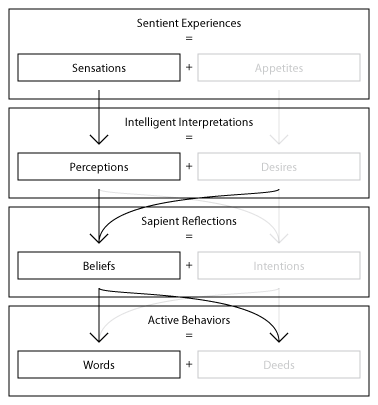
The first of these important functions, which I call "sentience", is to differentiate experiences toward the construction of two separate models, one of them a model of the world as it is, and the other a model of the world as it ought to be. These differentiate aspects of an experience, which, as outlined in my thread on the web of reality, is an interaction between oneself and the world, into those that inform about about the world, including what kind of things are most suited to it, which form the sensitive aspect of the experience; and those that inform about oneself, and what kind of world would be most suited to oneself, which form is the appetitive aspect of the experience.
From these two models we then derive the output behavior from a comparison of the two, so as to attempt to make the world that is into the world that ought to be. This is in distinction from the simpler function of most primitive objects, where experiences directly provoke behaviors in a much simpler stimulus-response mechanism, and no experience is merely indicative of the nature of the world, but all are directly imperative on the next behavior of the object.
Those experiences that are channelled into the model of the world as it ought to be I call "appetites", and I will discuss more on them, their interpretations into desires, and the reflection upon desires to arrive at intentions, in a later thread.
Meanwhile, those experiences that are channelled into the model of the world as it is I call "sensations". Sensations are the raw, uninterpreted experiences, like the seeing of a color, or the hearing of a pitch. When those sensations are then interpreted, pattens in them detected, identified as abstractions, that can then be related to each other symbolically, analytically, that is part of the function that I call "intelligence" (the other part of intelligence handling the equivalent process with appetites), and those interpreted, abstracted sensations output by intelligence are what I call "perceptions", or "intuitions".
—
On Beliefs
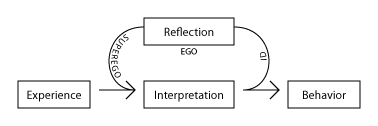
None of this is yet sufficient to call something a mind in our ordinary sense of the word. For that, we need all of the above plus also another function, a reflexive function that turns that sentient intelligence back upon the being in question itself, and forms perceptions and desires about its own process of interpreting experiences, and then acts upon itself to critique and judge itself and then filter the conclusions it has come to, accepting or rejecting them as either soundly concluded or not. That reflexive function in general I call "sapience", and the aspect of it concerned with critiquing and judging and filtering perceptions I call "consciousness" proper.
(I see the concepts of "id", "ego", and "superego" as put forward by Sigmund Freud arising out of this reflexive judgement as well, with the third-person view of oneself that one is casting judgement upon being the "id", the third-person view of oneself casting judgement down on one being the "superego", and the first-person view of oneself, being judged by the superego while in turn judging the id, being the "ego"; an illusory tripartite self, as though in a mental hall of mirrors).
And the output of that function — an experience taken as indicative, interpreted into a perception, and accepted by sapient reflection — is what I call a "belief".
In a previous thread I have already laid out my physicalist ontology, which straightforwardly rules out the possibility of mental substances, and it is only in that sense that my philosophy of mind is “eliminativist”: nothing has a “mind” if (and only if) by “mind” you mean an associated mental substance separate from the physical substance (such as there is) of its body. But there are other senses of the word “mind”, or “consciousness”, about which I am definitely not eliminativist.
It is useful to distinguish between different things that we might mean by "consciousness" to be clear exactly which of several questions on the topic we wish to address. There is a sense of the word "consciousness" that simply means wakefulness, the opposite of being unconscious or asleep; that sense is not of much philosophical interest. There is another sense of the word that means awareness of something, or knowledge of it; that topic is not directly relevant to philosophy of mind, but rather to epistemology. Of more interest in philosophy of mind are two other sense of the word.
One of them is what Ned Block calls "access consciousness", which is the sense of the word that means self-awareness or self-knowledge, and is the topic of what David Chalmers calls the "easy problem of consciousness"; though I find that topic more substantial, and in a sense harder, and will cover it last. The other of them is what Block calls "phenomenal consciousness", which is the difficult-to-define capacity for experience itself, of any sort, and is the topic of what Chalmers calls the "hard problem of consciousness"; though I find that topic significantly less substantial, and in a sense easier, and will cover it first.
—
On Phenomenal Consciousness
Phenomenal consciousness is perhaps best defined in distinction from what it is not. It is not anything to do with any behavioral properties of a thing. If we stipulate the existence of some being, like a computer artificial intelligence, that behaves identically to a human being, but isn't one, some would still ask whether such a being would actually have the thoughts and feelings, the internal experience, that a real human being would have, or whether it would be merely simulating the external behavior of a being with such thoughts and feelings, such as uttering statements claiming that it feels some way or another.
Philosophers such as David Chalmers have raised the question of whether it is conceivable for there to be a being in every way physically identical to a human being, and so identical in all of its external behavior as well, that nevertheless does not have the internal experience that humans supposedly have, a so-called "philosophical zombie". That kind of experience, independent from anything to do with behavior, is what is meant by "phenomenal consciousness".
There are generally three possibilities when it comes to what kinds of beings have phenomenal consciousness in a physicalist ontology: either nothing has it, not even human beings, because the concept is simply confused nonsense (eliminativism); some beings, like humans, have it, but not all beings, because it only arises from certain complex interactions between physical parts (emergentism); or all beings, not just humans but everything down to trees and rocks and electrons, have it (panpsychism). When it comes to phenomenal consciousness like this, I find both eliminativism and emergentism have fatal flaws, leaving only the possibility of panpsychism — but only with regard to this phenomenal consciousness, not access consciousness, where I am an emergentist, as I’ll cover later.
—
Against Eliminativism
I am against eliminativism for the simple reason that I am directly aware of my own conscious experience, and whatever the nature of that may be, it seems that any philosophical argument that concludes that I am not actually having any conscious experience must have made some misstep somewhere and at best proven that something else mistakenly called "conscious experience" doesn't exist. But beyond my own personal experience, I find arguments put forth by other philosophers, such as Frank Jackson's "Mary's room" thought experiment, to convincingly defeat eliminativism, though not to defeat physicalism itself as they are intended to do.
In the "Mary's room" thought experiment, we imagine a woman named Mary who has been raised her entire life in a black-and-white room experiencing the world only through a black-and-white TV screen, but who has extensively studied and become an expert on the topic of color. She knows everything there is to know about the frequencies of electromagnetic radiation produced by various physical processes, how those interact with nerves in the eye and create signals that are processed by the brain, even the cultural significances of various colors, but she has never herself actually experienced color. We then imagine Mary leaving her room and seeing the color red for the first time, and in doing so, learning something new, despite supposedly knowing everything there was to know about color already: what the color red looks like.
This thought experiment was originally put forth to argue that there is something non-physical involved in the experience of color that Mary could not have learned about by studying the physical science of color, and I don't think it succeeds at all in establishing that, but I do think that it conclusively establishes that there is a difference between knowing, in a third-person fashion, how physical systems behave in various circumstances, and knowing, in the first person, what it's like to be such a physical system in such circumstances. In essence, I think it succeeds merely in showing that we are not philosophical zombies.
A more visceral analogous thought experiment I like to think of is that no amount of studying the physics, biology, psychology, or sociology of sex will ever suffice to answer the question "what's it like to have sex?" Actually doing it yourself is the only way to have that first-person experience; at best, that third-person knowledge of the way things behave can be instrumentally useful to recreating a first-person experience. But even then, you have to actually subject yourself to the experience to experience it, and that experience that can only be known in the first person is all that's meant by phenomenal consciousness.
—
Against Emergentism
I am also against emergentism, regarding phenomenal consciousness at least, on the grounds that it must draw some arbitrary line somewhere, the line between things that are held to be entirely without anything at all like phenomenal consciousness and things that suddenly have it in full, and thus violates my previously established position against fideism. There are two different senses of "emergentism" sometimes distinguished from each other.
One of them, the kind I am not against, is called "weak" emergentism. That merely holds that there are useful aggregate properties to speak of at some larger scales, that ignore irrelevant details at smaller scales; but it doesn't hold than anything genuinely new starts to happen when the larger-scale systems are constructed out of smaller parts. An example of this is temperature, which is a (weakly) emergent property of the motion of molecules in a substance: if you modeled the motion of all the molecules in a substance, you would end up modeling something that exhibited temperature for free, and if that was the scale you were interested in, you could usefully model just that aggregate property of temperature instead and ignore the details of the motion of individual molecules. I have no objection to such "weak" emergentism.
On the other hand, "strong" emergentism holds some wholes to be truly greater than the sums of their parts, and thus that when certain things are arranged in certain ways, wholly new properties apply to the whole that are not mere aggregates or composites of the properties of the parts. Specifically, as regards philosophy of mind, it holds that when physical objects are arranged into the right relations with each other, wholly new mental properties apply to the composite object they create, mental properties that cannot be decomposed into aggregates of the physical properties of the physical objects that went into making the composite object that has these new mental properties.
I do agree with what I think is the intended thrust of the general emergentist position, that consciousness as we ordinarily speak of it is something that just comes about when physical things are arranged in the right way. But I think that consciousness as we ordinarily speak of it is access consciousness, to be addressed later, and that access consciousness is a purely functional, basically mechanistic property that is built up out of, or weakly emerges from, the ordinary physical properties of the physical things that compose an access-conscious being. I think nothing wholly new emerges out of nothing like magic when physical things are arranged in the right way, only abstractions away from the lower-level, smaller-sccale physical properties that ignore the many details that are irrelevant on a higher level or larger scale.
So when it comes to phenomenal consciousness, either it is wholly absent from the most fundamental building blocks of physical things and so is still absent from anything built out of them, including humans — which I've already rejected above — or else it is present at least in humans, as concluded above, and so at least some precursor of it must be present in the stuff out of which humans are built, and the stuff out of which that stuff is built, and so on so that at least something prototypical of phenomenal consciousness as humans experience it is already present in everything, to serve as the building blocks of more advanced kinds of phenomenal consciousness like humans experience.
—
Panpsychism
That latter position is a kind of panpsychism, more specifically the narrower position called pan-proto-experientialism. Panpsychism most broadly defined says that everything has a mind, whatever "mind" may be taken to mean. Pan-experientialism is a form of panpsychism that says everything is at least the subject of mental experience, without making any broader claims about everything having higher mental functions like sentience, intelligence, or sapience. Pan-proto-experientialism is a subform of that, in turn, that says that everything at least has something prototypical of mental experience as we mean it regarding human consciousness, without making any broader claims to the depth or richness of that experience. That is the position that I hold.
But in saying that everything has phenomenal consciousness, I'm not really saying very much of substance. It's a bit akin to how in quantum mechanics, one physical system can be said to "observe" another physical system and in doing so collapse the "observed" system from a state of probabilistic superposition into a definite classical state, but that doesn't really imply anything substantial about the "observer"; it doesn't require something like a human being to do the observation, it just requires any kind of object to interact with the other object. I would even go so far as to say that that quantum-mechanical "observation" can reasonably be equated with the kind of "experience" that I hold to constitute phenomenal consciousness, for as elaborated in my previous thread on the web of reality, I hold experience to be but one perspective on what is really more fundamental, interaction, and likewise quantum mechanical "observation" really just means "interaction".
I'm only really saying that in addition to there being the third-person experience of observing a thing as an object of experience, there is also the first-person experience of being that thing as the subject of experience — because we each know first-hand that there is such a first-person experience of what it's like to be ourselves, which is different from the third-person experiences we have of each other — but that first-person experience needn't amount to much if the thing having the experience is so simple as a rock or atom or electron.
This panpsychism about phenomenal consciousness is not in any way meant to contradict the physicalism I espoused earlier. I think there are only physical things, and that physical things consist only of their empirical properties, which are actually just functional dispositions to interact with observers (who are just other physical things) in particular ways. A subject's phenomenal experience of an object is, on my account, the same event as that object's behavior upon the subject, and the web of such events is what reality is made out of, with the nodes in that web being the objects of reality, each defined by its function in that web of interactions, how it observably behaves in response to what it experiences, or in other words what it does in response to what is done to it.
My only trivial point of agreement with philosophers like Jackson, who fashion themselves to be against physicalism, could be summed up as simply agreeing that we are not philosophical zombies. By definition philosophical zombies could not be discerned from non-zombies from the third person, as only in the first person can one know that oneself is not a philosophical zombie; and the only trivial thing I think Jackson proves is that there is such a first-person experience that we have, the likes of which philosophical zombies would not have, and that, by the rejection of emergentism, everything else must also have.
I don't think philosophical zombies are actually possible or even coherent, but then I also don't think supernatural things are possible or even coherent, so I don't think the predicates "is natural" or "is not a philosophical zombie" really communicate much of interest — they are complete trivialisms when properly understood. (Supernatural beings and philosophical zombies are ontologically quite similar on my account, as for something to be supernatural would be for it to have no observable behavior, and for something to be a philosophical zombie would be for it to have no phenomenal experience. Both of those are just different perspectives on the thing in question being completely cut off from the web of interactions that is reality, and therefore unreal.)
So only in an extremely trivial and useless sense does everything thus "have a mind", inasmuch as everything is subject to the behavior of other things and so has an experience of them. But "minds" in a more useful and robust sense are particular types of complex self-interacting objects, and therefore as subjects have an experience that is heavily of themselves as much as it is of the rest of the world. Everything has awareness of some sort, in that it reacts to things that are done to it — otherwise they would not appear to exist at all, and so not be real at all on my empirical realist account of ontology — but only some things have self-awareness, and that is what the rest of this post will discuss.
—
On Access Consciousness
I hold the experience that a thing has to be a product of that thing's function, just as it's behavior is also a product of function. The mere having of first-person experience is not really anything of note: it is the nature of that experience, as a consequence of the function of the thing having it, that may or may not be worth considering "conscious" in the ordinary sense that we use that word, which I hold, as mentioned above, to be what philosophers call access consciousness.
When it comes to access consciousness, I hold a view called functionalism, which holds that a mental state is not strictly identical to any particular physical state, but rather to the functional role that a physical state holds in the physical system of which it is a part. Mental states are therefore multiply-realizable: different physical systems can instantiate the same functionality, and therefore the same mental states. For instance, if it is possible in principle (as I hold it to be) to build an artificially intelligent computer, that computer could be built using semiconductors, or vacuum tubes, or pneumatic or hydraulic valves, or any other physical substrate of switching signals down different paths, and so long as it still maps the same inputs into it to the same outputs, it still instantiates the same function, and so will still have the same mental states no matter whether they are instantiated in voltages in electric current flowing through wires, pressures in water flowing through pipes, or anything else.
I call this combination of panpsychism about phenomenal consciousness and functionalism about access consciousness "functionalist panpsychism".
As already detailed in my previous thread, I hold that the function of an object, the mapping of the inputs it experiences to the behaviors it outputs, defines every kind of object, not just minds as we ordinarily mean that word. Inasmuch as being a subject of phenomenal experience might make something worth calling "a mind", we might thus considered everything to be "a mind", which is why this position can be considered a form of panpsychism. But in ordinary usage, something being a mind means more than just being some kind of prototypical subject of phenomenal experience, or instantiating any old function or another. It means instantiating some specific kinds of functions that we recognize as mental.
Defining exactly what those functions are in full detail is more the work of psychology (mapping the functions of naturally evolved minds) and computer science (developing functions for artificially created minds) than it is the proper domain of philosophy, but for the rest of this post I will outline a brief sketch of the kinds of functions that I think are important to qualify something as a mind, in the ordinary sense by which we would say that a human definitely has a mind, and a dog probably has a mind, but a tree probably does not, and a rock definitely does not.
—
On Sensations and Perceptions
The first of these important functions, which I call "sentience", is to differentiate experiences toward the construction of two separate models, one of them a model of the world as it is, and the other a model of the world as it ought to be. These differentiate aspects of an experience, which, as outlined in my thread on the web of reality, is an interaction between oneself and the world, into those that inform about about the world, including what kind of things are most suited to it, which form the sensitive aspect of the experience; and those that inform about oneself, and what kind of world would be most suited to oneself, which form is the appetitive aspect of the experience.
From these two models we then derive the output behavior from a comparison of the two, so as to attempt to make the world that is into the world that ought to be. This is in distinction from the simpler function of most primitive objects, where experiences directly provoke behaviors in a much simpler stimulus-response mechanism, and no experience is merely indicative of the nature of the world, but all are directly imperative on the next behavior of the object.
Those experiences that are channelled into the model of the world as it ought to be I call "appetites", and I will discuss more on them, their interpretations into desires, and the reflection upon desires to arrive at intentions, in a later thread.
Meanwhile, those experiences that are channelled into the model of the world as it is I call "sensations". Sensations are the raw, uninterpreted experiences, like the seeing of a color, or the hearing of a pitch. When those sensations are then interpreted, pattens in them detected, identified as abstractions, that can then be related to each other symbolically, analytically, that is part of the function that I call "intelligence" (the other part of intelligence handling the equivalent process with appetites), and those interpreted, abstracted sensations output by intelligence are what I call "perceptions", or "intuitions".
—
On Beliefs
None of this is yet sufficient to call something a mind in our ordinary sense of the word. For that, we need all of the above plus also another function, a reflexive function that turns that sentient intelligence back upon the being in question itself, and forms perceptions and desires about its own process of interpreting experiences, and then acts upon itself to critique and judge itself and then filter the conclusions it has come to, accepting or rejecting them as either soundly concluded or not. That reflexive function in general I call "sapience", and the aspect of it concerned with critiquing and judging and filtering perceptions I call "consciousness" proper.
(I see the concepts of "id", "ego", and "superego" as put forward by Sigmund Freud arising out of this reflexive judgement as well, with the third-person view of oneself that one is casting judgement upon being the "id", the third-person view of oneself casting judgement down on one being the "superego", and the first-person view of oneself, being judged by the superego while in turn judging the id, being the "ego"; an illusory tripartite self, as though in a mental hall of mirrors).
And the output of that function — an experience taken as indicative, interpreted into a perception, and accepted by sapient reflection — is what I call a "belief".
Comments (173)
I agree with much of your thinking here! It is especially helpful that you make a distinction between the different senses of the word consciousness. When discussing consciousness, people are often talking past one another since they have different things in mind.
There are a couple of things I would like to hear your thoughts on. The first is something I often puzzle over and which might pose a challenge for your view. Supposing that we do have phenomenal consciousness, that we aren't just talking nonsense, how is it that we are able to form thoughts about it and report it through behavior? If I understand your position correctly, it would seem that this phenomenal consciousness would have to be epiphenomenal. The only causes here are the physical causes. There are no mental causes over and above these. So behavior is fully accounted for by the physical causes. Any mental causation would involve overdetermination.
Imagine that there are two kinds of dominoes, sensitive ones, or S-dominoes, which subjectively experience the impacts, and zombie dominoes, or Z-dominoes, which have no phenomenal aspects at all. These two kinds of dominoes are otherwise identical. All their physical properties are the same. If arranged in a certain way, both kinds will impact and fall in the same way. There is no possible way of arranging them and knocking them down that would reveal whether or not they are S-dominoes, even if you arrange them as a complex computer using very large numbers of dominoes. Their behavior, in other words, contains no information about any phenomenal aspects they might have.
It seems to me that this phenomenal consciousness that all physical things are said to have doesn't do any causal work. If the very phenomenality here doesn't have any causal power, how does our brain state come to refer to it? How do we come to have thoughts about our phenomenality? How do we come to talk about it? It is, after all, the underlying micro-physical causes that determine the brain states and therefore the structure of our experiential states. Adding a phenomenal aspect to physical interactions doesn't seem like it would alter the world structurally.
Quoting Pfhorrest
How then do we have thoughts about it and behavior that refers to it, your post for example?
The second thing I am curious to hear your thoughts on is the binding or combination problem. Our brains are very complex arrangements of matter, seemingly with many small parts. But our conscious experience is bound together into a single whole. Notice, for example, that the experience of depth in visual perception requires that something going on in the right hemisphere is bound together with something going on in the left hemisphere.
To see the color red, it must be that you are detecting red light AND NOT green light AND NOT blue light. This requires a number of cone cells and neurons. It is not enough that red-sensitive cones are activated, since they are also activated when you see white, in which case all three cone types are activated. To see yellow, you must be detecting red AND green AND NOT blue. It is not enough that red and green are both activated, as it must be that blue is also NOT activated. Integration is required.
I once built a virtual logic circuit to model RGB color distinctions. The output of each logic gate is only a 1 or a 0. It is never redness or greenness. Similarly, in the brain, it is just neurons firing. And action potentials don't carry color. Even if everything going on in the brain were to somehow ultimately feed to a single neuron, it would only be a matter of that one neuron firing or not firing. The signals coming into that one neuron wouldn't be qualitatively different from those coming into a neuron receiving a signal directly from a cone cell in the retina.
Somehow, what is going on in a bunch of seemingly separate physical objects across different regions of the brain and even maybe parts of the environment must come together as one thing.
From a Chalmers paper:
How is this possible? How do all the little "observations" that are all the microphysical interactions add up to such a bound-together experiential whole, even if it is just a momentary whole?
This kind of wholeness is puzzling. I intuitively tend to think that if something is to have complex structure, it must have parts, and those parts must be separable. In other words, it is a collection of many smaller things. What makes it possible to shape clay also makes it possible to cut it into many tiny pieces. This seems to be a case not of many things being one thing, but of many things simply being near each other and in a certain arrangement. And if something is to be truly whole, truly one thing, it seems to me that it should be a mereological simple. Mereological nihilism seems intuitive to me. But our conscious states seem to be a single whole and yet also have complex structure.
How would this pan-proto-experientialism deal with the combination problem?
I think the short answer to both of your questions lies in the ontology of my web of reality, wherein it's explained how I view experience and behavior as two ways of looking at the exact same thing, interaction.
Experience only "is not anything to do with any behavioral properties of a thing" in the sense that you can't tell whether a thing has phenomenal consciousness or not based on what behavior it exhibits. But on my account, experience plays a definite causal role in every behavior of everything: the experience of each thing is the input into its function which prompts its behavior as output. Of course, even non-panpsychists accept that there is some input into things that prompts their behavior; the only novelty on my account, so far as that goes, is to identify that input that nobody denies the existence of with phenomenal experience itself.
Every domino experiences the forces that prompt it to fall over, in one sense or another of "experiences"; I'm just saying that that sense in which a domino can be said to experience the force of another domino hitting it is the same sense, or at least a part of the same sense, in which we experience the force of things hitting us. The difference between the domino and us is that we do a lot more than just absorb the momentum of a thing that hits us and change our bulk motion in response; we're complicated things that have a bunch of complicated internal reactions to things hitting us.
And those complicated internal reactions build up to our unified experience in the same way that our behaviors build up from the behaviors of our constituent atoms, etc, because experiences and behaviors are two ways of looking at the same thing, on my account. I don't see any combination problem in philosophy of mind, at least no more than one could posit a combination problem in ordinary physics: electrons do certain things, sure, but how is it that the behavior of a bunch of electrons adds up to the behavior of the solid-state electronics with which I am composing this message? The actual answer to that is a complicated one, but it's not a philosophical one; it's just an account of how signals pass into one thing as its experience and out of it as its behavior which is in turn the experience of another thing that has another behavior in response, and the aggregate inputs and outputs from the aggregate of those things are their experiences and behaviors. We generally see no problem with this on the behavior side of things -- the behavior of my computer is the aggregate of the behavior of a bunch of electrons, etc -- and I see experiences as literally the same events as behaviors, just viewed from a different perspective, and so no more problematic than the behaviors are.
A problem completely avoided by not using terminology regarding psychological phenomena to describe non-psychological phenomena. Put it this way: a horse is just a bunch of physical stuff reacting to and acting on a bunch of other physical stuff, and everything is like this. So everything is a horse? No. Psychological phenomena regard brains. It doesn't matter if there's no fundamental difference between a brain and a bowl of soup: it's a classification for specific kinds of things (or behaviours: to be is to do).
Quoting Pfhorrest
Being itself is purely functional though, isn't it? You went to pains in previous threads to establish that there is no real distinction between to be (i.e. to have a bundle of properties) and to do (i.e. to have the potential to behave a certain way). Seems odd now to insist on a distinction between emergent properties and emergent function.
Quoting Pfhorrest
There's stuff in between this and strong emergence. Thermodynamic properties of gases in a box are just statistical, large-scale descriptions of fundamental particulate behaviour. However, there is such a thing as collective behaviour. A phonon is an example of this. While phononic behaviour is just motion, you need at least two interacting bodies for these particular modes of motion to emerge. Likewise, while chemical bonds are just modes of electrostatic attraction, they are only possible when you have two or more atoms. There's important stuff between statistics and magic (strong emergentism). So the difference between the thermodynamics of gases, liquids, and solids is derivable but not comprehensible in terms of the dynamics of individual atoms: you have to consider at least two (often more) of something before some behaviours are possible.
:100: :up:
Why are you assuming physicalism to be the case?
I’m mostly using psychological terminology for phenomenal consciousness just because that’s the terminology already used for it, but I can see the historical reasons for its use, just like I can see why quantum mechanics talks about “observers” that can just be inert objects with no brains. It’s talking about things in their capacity to fill a role that we also can fill, and which we tend to associate with our minds. Extending “mind” (or “consciousness” or “observation”) in that sense to everything, even things without brains, is just acknowledging that this capacity that we initially thought was special to us brainy things is not so special; that it’s something else about us brainy things that makes our version of that common feature special.
Quoting Kenosha Kid
I’m not trying to do that, and I don’t see how you can read that in to the passage you responded to.
Quoting Kenosha Kid
Okay, I have no objection to that. That is still weak emergence, in that if you modeled the underlying system that that behavior emerges from, you would automatically model the emergent behavior (as in see that behavior emerge in your model; not that you would have a higher-level model of it). I don’t see what bearing that has on phenomenal conscience.
Quoting RogueAI
Because this thread is a followup to another thread where I argue for a kind of physicalism.
What's your objection to strong emergence?
No objection to that, but using the same terminology to describe the response of an electron to a photon, say, is much like saying everything is a horse. Sometimes metaphor is useful, such as in the talk of "the perspective of a photon" that Mr Bee so objected to earlier. It ceases to be metaphor and becomes misspeaking if you start taking it seriously though. Yes, psychology is ultimately just physical stuff reacting to physical stuff, but so is neurology, biology, chemistry and physics. What makes it psychology is that it is to do with animal minds, neurology: animal brains, biology: living systems, chemistry: structures of atoms, and physics: everything. It just seems like a category error to call physics 'psychology'.
Quoting Pfhorrest
My misunderstanding then. I read your previous threads in this series as establishing an equivalence between being and doing, one I agree with. What is a 'purely functional' thing, then?
Quoting Pfhorrest
Yes. I think perhaps it was just not a very illustrative example since it was just the statistical character of pretty much independent parts, whereas emergence really regards collective behaviour: new modes of elementary behaviour not possible with elementary systems.
Quoting Pfhorrest
Basically, it's magic. Weakly emergent phenomena build up out of more fundamental phenomena. The kinds of emergent phenomena that Kenosha lists are things that build up out of the phenomena exhibited by basic physical particles: if you model their motion, mass, charge, etc, and model an appropriate aggregate of them just in terms of their motion, mass, charge, etc, you get the emergent phenomena in the model for free. Nothing wholly new suddenly springs into being in the real phenomena that you have to add into the model; the "new" things are all reducible to "old" (more fundamental) things. Strong emergence, on the other hand, would have something wholly new just pop into being suddenly at some point, for no apparent reason (because any reason would tell you what it was about the more fundamental properties that when combined in such a way give rise to this new property, and so would make the "new" phenomenon reducible to the old, and thus only weakly emergent).
Quoting Kenosha Kid
Agreed, and that's why I wouldn't do that. But saying "everything is phenomenally conscious" isn't doing that, any more than saying "anything can be a quantum mechanical observer" is; "phenomenally conscious" and "quantum mechanical observer" are terms of art divorced from actual psychology, despite having psychological-sounding words in them.
Quoting Kenosha Kid
I meant that in the sense that access conscious has only to do with the particulars of the function of a thing, and is not any kind of metaphysical difference the way that phenomenal consciousness is held to be by non-panpsychists. My overall position is saying that whatever metaphysics is going on with human beings that may be required for our having of a subjective experience, that metaphysics is going on with everything and is not special to humans; the important difference between humans and e.g. rocks, that makes us conscious in the ordinary sense (access conscious), is only the difference in the function of a human vs a rock, not anything metaphysically different.
(Of course, on my account, the only differences there ever are between things are functional differences, but I'm distinguishing my account from views that say otherwise, e.g. views that say there is something metaphysically different about humans, not just functionally different).
Quoting RogueAI
That depends on which sense of "consciousness" you mean. If you mean phenomenal consciousness, then I think everything has that, and that doesn't go against physicalism, because "phenomenal consciousness" on my account is just an ordinary facet of every physical thing, and is not what we actually normally mean by "consciousness". If you mean access consciousness, then I think there are lots and lots of things (most things) that are not access conscious, and our access consciousness, "consciousness" in the sense that we ordinarily mean it, is built up out of that stuff.
You're back to the Hard Problem: how does "active consciousness" emerge from "non-active consciousness" stuff?
I think you're misreading "access" as "active" here.
In any case, access consciousness is the topic of the easy problem. There is no mystery there. Access consciousness is just a kind of functionality. How does the function of my computer emerge from the function of the atoms it's built out of? Very carefully, but not philosophically mysteriously. Likewise, the function of brains emerges from the function of atoms in a similar fashion.
Whatever there is besides that function, whatever metaphysically special thing there also needs to be, that is phenomenal consciousness, which is the subject of the hard problem, and my solution to that is that everything has it, so nothing (phenomenally-)conscious emerges from anything non-(phenomenally-)conscious, because there is nothing non-(phenomenally-)conscious.
By describing it as panpsychism (everything is conscious), you are doing that. Yes, you are demoting consciousness in this context to any physical response function, but that itself is a result of poor choice of terminology. We already have terminology for this. It seems logical to apply the general terminology to the special case. The other way round is, well, back to front.
Quoting Pfhorrest
Ah okay, 'purely functional' as opposed to fundamentally metaphysical, not as in divorced from its properties. Yeah, with you on that. I forget that people want to insist we humans are a bit magic, so the distinction went by me.
:up:
Yeah.
You sound like a panpsychist idealist. That's a contradiction, so, do you believe non-mental stuff exists? If no, then you're an idealist, if yes, what kind of stuff is it and how does consciousness emerge from it?
You should really read that previous thread on the web of reality. I'm not an idealist, but I am a phenomenalist. Things exist independent of minds, but they're all made of the kind of stuff that can exist in minds: information, observabilia, whatever you want to call it. There is no contradiction there, but yeah, it is a little bit like "everything is in the mind" and "everything is a mind".
The analogy I like to clear that up is: all programs are data, and all data is executable (though most of it does nothing of interest when executed). "Material" stuff is "data"; "minds" are "programs". "Minds" are made of "matter", and all "matter" is metaphysically "mind-like" (though most of it has no interesting "mental activity"). It's only particular data structures (material objects) that do interesting things when executed (that have interesting conscious experience). But everything is still data, that is executable in principle.
That's the terminology that the philosophers discussing the issue are using though, so if I want to communicate with them I need to talk about the same terms they are. They coined "phenomenal consciousness" as whatever the difference is between a real human and a philosophical zombie, two things that are by definition functionally equivalent.
To deny that there can be any such thing as a philosophical zombie that's different from a real human (as you and I do), we either have to say that real humans just are what they claim philosophical zombies would be like (we have no first-person, subjective, phenomenal experience at all), or else that anything that is functionally identical to a human (like a philosophical zombie is supposed to be) must have the same metaphysical nature as a real human.
The latter can either be because metaphysically boring material stuff, arranged the right way, magically gives rise to something metaphysically novel (strong emergence); or else that whatever it is that a real human is supposed to have that a philosophical zombie wouldn't -- which is not anything functional, because a zombie is functionally identical to a human -- is just something that everything has.
So either:
- we're zombies ourselves,
- magic happens, or
- everything "has a mind" in the sense that these people are talking about.
The last seems the least absurd option to me.
That's pretty much where I've ended up.
You mean this theoretically, or you think it is actually possible and done? Because the cases where it's actually doable are rare. The statistical reduction of temperature to Brownian movement in a perfect gas is the only case that comes to mind, and even this implies all sorts of simplifications (a perfect gas does not actually exist, it's a theoretical simplification of a physical reality). So defined as you do, 'weak emergence' is more a theoretical than proven.
Quoting Pfhorrest
LOL. Says the guy who thinks that electron have a micro dose of consciousness... Thanks for the laugh! You can't beat this place for entertainment.
Have you ever heard of sexual reproduction? It is a universal property of living systems, and you can't find it anywhere in non living stuff. Stones and stars don't copulate. QED here is a strongly emerging phenomenon.
Quoting Pfhorrest
I draw the line at life. More precisely, as far as stuff with consciousness are concerned, I include any living species that need to sleep, and that includes quite a few.
Why sleep as a cut-off point? Sleep is near universal among birds and mammals and yet it represents a risky behavior re. predators, a behavior that would not have been selected without a very strong darwinian advantage. It is thought to be a way to refresh the brain and it's information management capacity. Eg memory is affected by lack of sleep in many species, including insects. Thus it seems that sleep as a behavior is connected to learning through complex neuronal systems.
Note that stars and planets and stones and electron don't sleep, other than in the occasional figure of speech, and that one cannot explain sleep as a 'weakly emerging' phenomenon. It's like the example of sex given above...
I finally read you OP. The gross mistake in it, is to assume that human being are made of atoms. It may be what their matter is made of, but in practice human beings are not produced by chemical synthesis. They are made by sexual reproduction, which means that the production of a human being involved copying, random sampling and mixing the genomes of two other human beings (the parents). It is information-intensive.
You and I are made of information, essentially.
You think you're made of your atoms because you don't understand biology. It's a misconception. Let me try and explain.
You must know that our body is composed of water, 75% of the whole weight or so. This water is constantly flowing through our bodies, like water flows in a river. We drink, we urinate, we sweat. Our body manages water as a flow, not as a static reservoir. There is not a single molecule of water inside you right now that has been with you for more than a few weeks. The same applies to proteins that tend to decay and get eliminated and resynthetised all the time.
Life is information bossing matter around. It uses matter, it builds upon it, but it is not defined by any closed set of atoms. It manages matter and energy as fluxes, as pipelines that help maintain a structure, a shape, an in-formation, which is what you are really made of.
If one thinks (as you seem to) that one is made of atoms, then one must see oneself like the river of Heraclitus: always different, inexistent as a stable entity. Because the matter composing your body is constantly 'flowing' through your body like a river flows in its bed.
Do you think sexual reproduction involves any processes that are not built up out of the processes of the cells that are built up out of molecules that are built up out of atoms that are built up out of quarks etc? Is there some magic that happens somewhere in there? If not, then that's not strong emergence.
Stones and stars are built out of the same stuff as humans, but they are different things built out of that same stuff. That you can arrange that stuff into a way that will sexually reproduce doesn't mean that everything made of that stuff has to sexually reproduce.
I think you don't understand the difference between strong and weak emergence. Sexual reproduction is a textbook case of weak emergence.
Quoting Olivier5
...which involves a lot of chemical synthesis.
Quoting Olivier5
If you had read the web of reality thread, you'd see I already agree that everything is made of information. Atoms are made of information. Humans are nothing special in that regard.
No single electron, nor any massive particle at all -- nothing that experiences time, in other words -- goes unchanged. They are all like Heraclitus' river: they are constantly being destroyed and re-created by the Higgs field.
Now you are changing the goal post. Initially you defined 'strong emergentism' as such:
Quoting Pfhorrest
Atoms don't reproduce, and molecules don't reproduce. They don't have any 'elementary reproduction', so I don't see any reason to assume they have any 'elementary consciousness' as a way to explain our consciousness... Both are just behaviors that emerged through life.
The act of reproduction is not something that you can summon by simply putting atoms together in a big unstructured heap or soup. The structure holding those atoms together is what makes it alive, and it is what gets reproduced. And by definition this structure is not contained in its elements. It's more than the sum of its parts.
Quoting Pfhorrest
If you wrote more succinctly, I would read your posts.
Try and understand what I am saying about the Heraclitus river. What is a river? It is not actually defined by the specific molecules of water flowing through it. Otherwise you wouldn't see the same river twice. Likewise your body is not defined by the atoms flowing through it.
No, but sexual reproduction is not anything more than a complicated process of atoms interacting in the way that atoms do. Nowhere in that process is it required to suddenly invoke some elan vital or such to make the reproduced organism alive like its parents.
Quoting Olivier5
Access consciousness sure is, and that is what I take consciousness in the ordinary way we use the word to be.
But other philosophers ask about “consciousness” in a different sense, something wholly unrelated to behaviors like that, such that something could conceivably, so they say, behave in an access-consciousness way, so far as we can tell in the third person, but not actually experience anything at all in the first person. That having of a first person experience at all, not being any kind of behavior but rather some essential metaphysical difference, either:
- doesn’t happen at all (except we each know first hand that it does happen, at least for ourselves),
- only happens for some things (and since it’s definitionally not anything behavioral, it can’t be built out of the behaviors of the parts it’s made out of, but just suddenly gets added like magic, like some elan vital),
- or happens for everything (but to a degree and in a manner that can vary with the behavior of the thing too, such that only something that behaves like a human has a human-like first-person experience, but a rock with its much simpler behavior still has some first-person experience, just a much simpler one).
Quoting Olivier5
Right, I get that, and I’m saying that is true of everything that experiences time (i.e. everything with mass, that moves slower than light); everything is constantly changing, swapping out its constituents, and the only persisting thing is the pattern of information. For anything, even a single electron; even the quarks that make up a proton are constantly changing, blinking out of existence only to be immediately replaced by similar but different particles. Atoms themselves are like rivers.
But that is all an aside, because my underlying point with regard to emergence is that a river can’t do anything that a bunch of water molecules can’t do, because there is nothing to a river but a bunch of water molecules, even though the particular molecules are always changing. For a river to do anything, the water molecules it’s made up of at that moment must do that thing.
I never said it was magic, but it's an emerging phenomenon in the sense that it cannot happen outside of life. It has no meaning at the atomic level. No precursor, nothing that compares. It only means something at the cellular level. Below that level, it makes no sense at all.
Sometimes, the whole is more than the sum of its parts.
Quoting Pfhorrest
And yet there's such a thing as a dry river.
You're not talking about strong emergence. Strong emergence is definitionally "like magic". If you can take constituent parts, and the things they do, and get them to do something like that together, then that's only weak emergence.
I can't use a single atom as a lever, but I can use a bunch of atoms stuck together as a lever. Leverage "is an emergent phenomenon" in that sense, single atoms have no leverage, but leverage is still just an aggregate of things atoms can do. You don't need something besides just a bunch of atoms stuck together the right way to get a lever: it's not like you need to stick a bunch of atoms together, and add some "essence of lever" to them to make them have leverage. A bunch of atoms just doing what atoms do, in the right configuration, end up doing the work of a lever, with nothing extra required.
That's the defining difference between weak and strong emergence.
You have a source for this assertion?
And I replied:
I don't think a rock ever thinks anything, and it doesn't even feel anything in the way that a human does. It's more like... if you think of it in terms of diminishing degrees of conscious, that's probably the clearest thing.
A human gets kicked and has a whole complicated process of brain activity that they experience, feelings they have, decisions they make about those feelings, and then behavior that they do on account of those decisions.
Other times, even with a human, something can trigger a pure reflex response, and with a lot of lower animals they are entirely reflex response; but we know as humans that we still experience the reflex response, even though it's bypassing our higher thought processes, and it's reasonable to expect that e.g. a sea anemone experiences something like that when its tentacles are touched and it retracts them all by reflex, even though it doesn't have any higher thought processes.
Even a sunflower has a means of detecting light and moving to point toward it, though it has no nervous system at all, and it seems reasonable to think that it has some sort of even more primitive experience of that light, even though it's not even capable of feeling the way an anemone is.
All the way down to rocks, where when you kick it, it still reacts -- it moves, in accordance with the force you applied to it -- but its experience is so diminished that there's practically nothing to speak of at that point.
Still, for the reasons described in the thread you've probably been reading, there's reason to think that something prototypical of human experience still happens to a rock. The major difference between a human experiencing being kicked and a rock experiencing being kicked is that humans have lots of complex reflective (bent-back-upon-ourselves) processes, so we don't just experience the force of being kicked, we experience our nerves firing in response to that force, and all the complicated neurological processes that the activation of those nerves kick off.
I like to think of it as like a modified version of the Cartesian theater. We are mentally seated in the enormous theater that is our brain. Instead of a screen on which we see the outside world, there are only a bunch of tiny pinholes around the theater that let in light from what's happening outside. The theater itself reacts to the light coming through the pinholes, and does a bunch of spectacular things, and that's the show that we're watching.
Most of our experience is experience of ourselves reacting to things. Less complicated subjects, who don't have that complicated mind-theater, only get a pinhole's worth of experience, if that. (And this whole metaphor is on the same shaky ground as the original Cartesian theater anyway, so don't take it too literally; it's just to illustrate the difference between human experience and e.g. a rock's experience).
My take is that the distinction between weak and strong emergence is confusing a quantitative difference for a qualitative one. Many small 'weakly emergent' phenomenon would presumably add up to a 'strongly emergent' phenomenon. That would easily solve your conendrum.
That's magic thinking alright... :-) And anthropomorphism to boot.
Did you even read the rest of that wikilink? There is a definitional difference between strong and weak emergentism that you’re ignoring. See the part about simulability and analyzabulity especially. It’s nothing to do with self-organization. That is not mysterious.
Why would you be surprised at the sudden emergence of something metaphysically interesting? What's metaphysically interesting is just a function of human minds giving it meaning. If I randomly threw Scrabble tiles onto a board some of them would spontaneously become linguistically interesting, but that's nothing to do with the tiles, but rather the observer of them.
@Kenosha Kid, please back me up here.
This whole subtopic is a huge waste of time anyway. All the examples of emergence you give are what I would count as weakly emergent and do not object to. Access consciousness, which is the thing that I think people normally mean by consciousness, is weakly emergent like all those other things, on my account. So we have substantive agreement everywhere it matters.
Where we disagree is that I acknowledge that other philosophers mean something different by “consciousness” than we do, something distinguished from the thing we mean as “phenomenal consciousness”. They define that in a way that it could not possibly weakly emerge from non-mental properties. So either it strongly emerges, in a way completely unlikely any of the examples you’ve given, a magic-like anti-physical way; or else nothing, including us, has anything like what they’re talking about; or else everything has something like what they’re talking about, from which our form of it can weakly emerge.
In counter to that, you just deny that anyone is talking about anything besides the weak emergence of access consciously. It’s fine if that’s all you want to talk about, because that’s the important part, but if we’re going to dismiss these other people who think human consciousness is magical, we have to address the other stuff they’re talking about: phenomenal consciousness, and strong emergence, which like it or not are different topics than access consciousness and weak emergence.
Quoting Isaac
It’s not the interesting part, it’s the novel part.
From your link:
What is so difficult to fathom about "the direct causal action of a system upon its components"? Why do you see that as magic, pray tell?
Same thing. Metaphysical novelty is just a human construct. We don't bring a thing into existence by our treatment of it. The idea of the Scrabble tiles is that a new thing 'a word' has arisen randomly from the casting of the tiles, but this 'thing' is a human construct, words don't exist outside of human minds, so the casting process hasn't done anything we should find unexpected, or odd.
Likewise with first-person experience. The fact that we find some cellular interactions significant enough to provide them with their own language game does not mean in doing so we've brought anything into existence. We don't need to answer the question of how this arose because we put it there.
Yep! The examples I gave earlier are where emergent properties of a system are modes of interaction that are inaccessible to individual components, but still qualitatively the same thing. Like solidity from certain atomic structures but is nonetheless just modes of electrostatic interaction, itself manifest in atoms.
Strong emergence describes new qualitative properties that are present in a system that are not present at all in its components, not just new modes but a new kind of thing. An example is consciousness as described by dualists who dip a toe in materialism but don't commit. Their idea of consciousness is not modes of neurological behaviour, but an entirely new thing that emerges when atoms are configured into brains. There's no explanation for it, no evidence to support it, it makes no logical sense, but it is essential to them because they need the universe to be anthropocentric: we cannot be an accident.
, since you see no difference between weak and strong emergence, the two things are one and Pfhorrest and I call this 'weak emergence'. Since you see no emergence as being like magic, weak emergence is non-magic. Magic emergence isn't real, obviously, so if anyone proposes a new kind of emergence that is magic, you know this isn't real. Pfhorrest and I call this nonexistent magic emergence 'strong emergence'. It doesn't matter what it is, because it doesn't exist.
The Scrabble metaphor can be pushed a bit further.
Imagine a game with the following rules:
1. Scrabble tiles get thrown randomly on a surface or board. When they land closely enough to one another, they tend to bind with each other to form strings of 2 or more tiles. Let's call these strings "words". When a tile lands far away from others, it just stays as an individual tile, that can also be seen as a "word" composed of only one tile.
2. A selection rule cranks in, by which any "word" created by the procedure above and not listed in a given dictionary is eliminated from the board, dismantled and returned to the status of mere tiles, to be thrown again randomly on the board at stage 3 below. Only the strings of tiles that do correspond to an entry in the dictionary stay on the board. For instance "phenelat" dies, but "elephant" lives.
3. Repeat processes 1 and 2 for a large number of times, say 10^100 times, and you should get a certain finite number of selected "words" (strings of tiles randomly created and yet corresponding to dictionary entries) on the board.
4. The next step is to take the "words" as an input in processes 1 and 2 above; that is to say, to throw whole strings of tiles randomly on the board. Strings that land closely to one another can form "sentences", aka strings of stings of tiles. If a "sentence" syntax is correct as per a given English grammar book, then the sentence stays on the board, but if it is not a correct sentence from a grammatical view point, it gets dismantled: its elements ("words") are returned to the status of mere detached "words", to be thrown again on the board. For instance: "Colorless green ideas sleep furiously." lives, but "Furiously sleep ideas green colorless" dies out of purely grammatical ground.
5. Repeat process 4 a large number of times, say 10^1000000 times, and you should get some "sentences" on the board that happen to be grammatically correct.
6. Now apply another selection process on your random yet grammatically correct sentences: only those sentences that have some sort of meaning (as asserted by a random guy or panel) would live, while nonsensical sentences are eliminated. So "Colorless green ideas sleep furiously" is eliminated (dismantled into words) but "I can't believe the tediousness of this argument" lives.
7. Now repeat the process at the level of full sentences. Select the strings of sentences that appear to make some sense to an average reader.
At the end of all this you would supposedly get a few randomly produced texts in English that make some sense to an average reader. One could legitimately say that these meaningful texts have "emerged" from the application of the random-cum-selection processes 1 to 7 above. These texts would mean things to a reader that no amount of analysis of the property of individual Scrabble tiles will ever be able to tell you.
Therefore, by a succession of small steps that one could described as "weak emergence", one can arrive at something that could be described as "strong emergence".
And yet it looks exactly like you don't understand and he does. Weird how these things go.
You don’t get a dictionary by randomly combining scrabble tiles; if you did, that would be weak emergence. But if the act if randomly combining scrabble tiles somehow invokes a premade dictionary out of nowhere which then acts upon the tiles, you no longer have something just emerging (weakly) from the behavior of the tiles, but something wholly new popping into being in response to the tiles... like magic.
Good question. The Scrabble game is only a metaphor. In the reality of how matter emerged from the Big Biggy, and how life could (must?) have emerged from inanimate matter, it's a bit more complicated. As you righty pointed out, the rules themselves are emerging too, progressively, as the game evolves. For instance, predation.
The objective behavior of predation (one living organism using another as a source of rich metabolites) could only emerge after the reduction of CO2 into biomass was made a large scale reality by photosynthetic blue algae and other primitive life forms, because before that, there was not enough biomass out there to eat from. But once it appeared as an objective behavior (circa 1 Gya) -- and we must assume that it did appear through random mutations à la Scrabble game -- then predation soon became a rule: eat or be eaten, because it is a great shortcut to energy acquisition so it was very successful... This rule shaped living organisms further, for instance with capacities to catch and escape being progressively selected. Hence mobility as a survival strategy, hence animals (animals are by definition mobile predators of other animals or of plants), hence senses and brains (being able to move from A to B is more useful when you can 'see' what's in B than when you can't 'see' it), hence minds.
I posit that we and quite a few other animal species have minds because we eat other lifeforms, something which requires mobility and a capacity to spot other lifeforms. Plants don't have minds because they eat carbon dioxide and sun rays, which requires immobility to save energy. And no, rocks don't have minds either.
Yes.
The whole point is that many 'weak emergences' add up to a 'strong emergence'. There's just one form of emergence, continuously emerging. And yes, it leads to structures that are far more than the sum of their parts, in the sense that a living organism's behaviors cannot be understood at the lower, elemental level, e.g. in terms of its atoms trying to eat or copulate with other atoms. These behaviors only make sense at the level of organization at which they appear: at the level of a living organism in a competitive environment.
Except they don’t. All you’ve described here is weak emergence. Strong emergence is something beyond that. Something that doesn’t happen, but we have to acknowledge that it’s a thing people talk about to even deny that it happens.
I suspect this is what you cannot get: the capacity of structures to be causal. For you, causes are all elemental, for some strange reason.
Quoting Pfhorrest
Quoting Pfhorrest
This is a cool idea.
An electric circuit with a gap is just a bunch of touching inanimate objects. At the moment that the circuit is completed, then suddenly the system is changed. From that moment it can react to inputs and produce outputs (lights, for example), whereas previously it was as dormant as a rock.
I don't hold a strong view either way on whether the reality of consciousness is strong emergence or weak emergence of pan-proto-experientialism, but personally I do feel that the example of the electrical circuit shows that it is as least plausible that some things can undergo a discrete step-change from 'non' to 'is'. And it means that I can't rule out the possibility of strong emergence (though what the mechanics behind it could be seems most mysterious).
True, because its configuration now enables all of those inanimate objects to interact in a certain way. But the kind of actions they do to each other are still actions that their constituent parts were capable of all along. Every copper atom is already capable of exchanging electrons with neighboring atoms; a closed circuit just gives a bunch of them motive and opportunity to pass electrons around with each other in a circle.
Yup. I thought you might answer something like that. So, the suggestion is that this is their proto-circuit nature. And in the same way, independent matter also exhibits a proto-experience.
But it is only once that proto-circuit is arranged in a particular way that it transitions from proto- to actual. So there is still a kind of discrete step-change in force here....exactly the sort that distinguishes strong from weak emergence.
I'm not sure that this is correct, but I'm also thinking of a crystal as an example -- a crystal requires a certain state, and then once in that state it holds to it strongly, but outside of that state it disintegrates to a liquid or whatever...It's another example in nature of a discrete step-change.
All kinds of physical behavior are, so far as we know, reducible to combinations of the behaviors of their parts. But phenomenal consciousness is stipulated to be something independent of behavior, such that it could not be reduced to the behaviors of its constituent parts. Which leaves it either not existing at all, springing into existence from nothing (strong emergence), or existing in some form everywhere (from which more sophisticated forms can weakly emerge).
I don't see that you've accounted for qualia. Consider Mary, who is the world's foremost expert on color, but has never experienced redness. She learns to associate her intellectual knowledge with the experience only after she actually has the experience.
One way I look it physicalism, is that if true, it should be possible, in principle, to construct a machine that operates identically to human consciousness. How would a machine experience qualia, in a non-zombie way?
I mentioned that in the OP:
Quoting Pfhorrest
Quoting Relativist
I agree, and thing it is possible.
Quoting Relativist
The same way a human does: by instantiating the same function as a human, and so having its phenomenal experience (which correlates with function, in all things) be like that of all things that instantiate such a function, like humans.
Instantiating the function isn't enough - a zombie could record the frequency of reflected light and proceed to function appropriately. I'll go a little further:
Redness begins as sensory perception, producing a sensory memory that neurally connects with the other quales concurrent at the time. e.g. the first perception of redness is the site of blood from one's painful injury. Those neural connections are activated in future experiences of redness. Qualia like this do not seem problematic.
On the other hand, the pain quale seems problematic. I know its function, but I can't envision a physicalist accounting of it. Redness is, at its core, a passive experience that gets associated with other memories. On the other hand, pain isn't like that - it's more basic. Its function is clear: to induce us to seek relief. But there needs to be more to it than that, because that's a zombie-like account.
That’s the part where my panpsychism comes in. Whatever it is besides mere function that human consciousness involves, I hold that EVERYTHING already has that in some form or another, and the specific form of it becomes more sophisticated along with the functionality, because it is the other half of functionality besides the behavioral output.
The input into any function of any thing is some kind of phenomenal experience, on my
account, and the specific qualities of that experience will vary with the function, such that something that functions like a human can’t help but have a human-like experience — and things that function differently also have different experiences. There can be no philosophical zombies, because there cannot be anything that does not have any qualitative, phenomenal experience.
It’s just that most things, like rocks, whose function exhibits no noteworthy behavior to speak of, also undergo no noteworthy experiences to speak of, for the exact same reason. But inasmuch as they technically do do something, they also technically do experience something.
Oops. Sorry bout that. (although it does have something to do with philosophy of mind).
Jaegwon Kim's answer is more appealing to me: he considers qualia to be epiphenomenal, a causally effete byproduct of minds. It's still not entirely satisfactory, but it makes more sense to me to consider it to be something that only minds have. The notion that rocks experience qualia makes no sense to me.
Other than that, I'm fine with the rest of your views.
Earlier parts of this conversation with you tangentially got me to thinking of a concise, mock-dialogue way of summarizing my view on this topic and my reasons for it. Let M = me and N = some other interlocutor.
M: "...and that's why I don't believe in anything supernatural or otherwise non-physical."
N: "So you don't believe in minds then? Minds are non-physical things."
M: "No, I believe in minds, I just believe that they're functions of our physical brains."
N: "But functionality isn't everything! Qualia are separate from physical behavior! Consider Mary's Room."
M: "That just shows that there is a first-person, experiential perspective to account for, as well as the third-person, behavioral perspective."
N: "So you admit that there's something non-physical! This first-person experience."
M: "No, I think there's a first-person account that can be given for anything. That's an ordinary aspect of all ordinary physical things, and so not anything non-physical."
N: "That's absurd! Rocks don't have minds! Only things that are functionally like humans can have that first-person, mental experience. Other things obviously don't have it. It must emerge somewhere in the development from rocks to humans."
M: "Only things that are like humans can have a first-person experience that is genuinely mental in the way we normally mean of humans, sure. But other more elementary things must have some kind of experience out of which that human-like experience can emerge. Otherwise it could only spring into being from nothing, like magic... which is supernatural, and not physical."
N: "So your solution to preserving minds in a physicalist account is to grant everything some magical non-physical capacity for experience."
M: "Capacity for experience is not necessarily magical or non-physical. And granting it to everything is the only reasonable way of preserving the existence of minds in a physicalist account, since the only logical alternatives are that either nothing, not even humans, have any first-person experience (and so minds in the normal sense don't really exist); or else some things, like humans, magically get it from nothing (and so something non-physical happens)."
Well done on the dialog, but it needs to continue. As defined so far, the capacity for experience is inherent in anything we consider to have a persisting identity.
Consider some particular boulder. It was "born" when a metamorphic outcrop collapsed due to a stress fracture. This is the boulder's first experience, and that experience gave it its shape. Our boulder sits on a slope for a few thousand years where it gets rained upon, which gradually starts to cause some erosion. Other rocks fall on it from upslope, chipping off pieces here and there. Each of these experiences changes the rock. This boulder has the capacity for experience, but it differs in two important ways from us: 1) it lacks self-reflection on those experiences; 2) it does not experience qualia.
You can easily accommodate self-reflection, even self-reflection of qualia (thinking about the pains of the past). But this still does not account for the pain itself. I can write a hundred sentences describing the pain, but nothing I say will be equivalent to the raw experience.
Not all matter is (phenomenally, of course) conscious, even in the slightest degree, but animals able to play a social game of pointing symbols at things usually are.
Quoting Pfhorrest
No need.
Minds existed in their entirety prior to our taking them into account. The approach is crucial.
M: "Only things that are like humans can have a first-person experience that is genuinely mental in the way we normally mean of humans, sure. But other more elementary things must have some kind of experience out of which that human-like experience can emerge. Otherwise it could only spring into being from nothing, like magic... which is supernatural, and not physical."
This is one of panpsychism's biggest problems: rocks don't have experiences. What is it like to be an electron? is a nonsensical question. If the claim is that things like rocks have experiences, you're so close to idealism, just go whole hog and ditch the physical.
Sure, but you have the burden of showing that minds are things, not just a reified abstraction, and that these things have non-physical parts.
The physicalism project is to account for mental activity, not some incompatible, abstract concept of "mind". IMO, the one thing physicalism has a problem with is certain qualia, like pain. If that is fatal, then all accounts of mental activity are also dead - because they all have things they don't account for.
I agree, with the correction that that is but one challenge for physicalism, not the entire physicalism project. Redefining 'mind' to be any response function simply leaves us in want of a new word to describe what used to be called mind. This does not mean that mind is a different kind of thing, e.g. irreducible or strongly emergent. It is simply what unifies a category for study that includes humans, horses and fish but not rocks, trees or electrons, namely those things with central nervous systems and sense apparatus, irrespective of whether they have access consciousness.
Minds consist entirely of thought and belief. Thought and belief... correlations between different things. Correlations are not physical. Not much of a burden really.
Agreed on point 1, but completely disagreed on point 2. The capacity for experience is exactly the capacity to experience qualia. Qualia just are are occasions of experience. (And on my ontology, if you read that web of reality thread too, absolutely everything is made out of such occasions of experience, which I hold are identical to physical interactions: to be is to do, to be is to be perceived*, so to do is to be perceived*, and conversely to perceive* is to be done-unto).
*(I'd say "experience" rather than "perceive", but Berkeley's adage uses "perceive").
Quoting Relativist
Agreed. But that says nothing at all about what kinds of things can have such experiences.
Quoting bongo fury
Sure, but wetness is an aggregate product of particles interacting in the normal ways all particles interact, so there's nothing new about wetness above and beyond the stuff all matter could already do; being wet is just one of the kinds of things matter was already capable of doing.
Phenomenal consciousness is defined in opposition to that kind of process. Nothing that the ordinary mechanical properties of matter can build up to, including the full complex and nuanced behavior of a human being, can constitute phenomenal consciousness by itself, as it is defined by the people who came up with the idea.
So if we want to say that everything that does instantiate that fully complex and nuanced behavior of a human being must have phenomenal consciousness like a human being (i.e. that philosophical zombies are not possible), then we either have to say that something wholly new pops into existence from nothing like magic, or say that there was something already there for it to be built up out of, something besides behavior -- a first-person experience.
Quoting RogueAI
You're just arguing by assertion here. It sounds absurd to you to think that this could be the case, so you insist that it is not... but then if you follow through on that back through the chain of implications it ends up requiring even more absurd things. Basically: Rocks have some kind of experience, or else humans don't, or else magic happens. Saying humans don't have experiences or that magic happens are far more absurd than saying there is some trivial prototypical first-person perspective of a rock that's not even worth speaking of.
What is is like to be an electron? Well, let's start with a human and go from there. What's it like to be a human brain disconnected from a body? What's it like to be such a brain that's asleep, or heavily sedated on drugs? Basically, take what it's like to be a normal able-bodied awake adult human being and start stripping aspects of that away. Well before you get down to the level of an inert hunk of matter that used to be part of a brain, you've gotten something so distant from ordinary human experience that we don't have the words to describe it.
It's something we're already experiencing right now, underneath everything else we're experiencing right now, but it's such a trivial part of our experience that we never need speak of it. It's a little like the sound of your own heartbeat, or the sight of your own nose: it's technically always there in your experience but you never need take note of it because it's always there. Except, in this case, far more so than that.
Likewise, I think that what it's like to be a rock, or an electron, is such a trivial experience that there's no need to ever say what it's like. But for reasons I've already gone over many times here, we have to affirm that there is something to it, something trivial and non-noteworthy and leave it at that, or else we end up having to affirm even crazier things.
Quoting RogueAI
If you followed the previous thread that this is a successor to, you'll see that my ontology is a kind of phenomenalism, as well as a kind of physicalism. Physical stuff is empirical stuff, and empirical stuff is phenomenal stuff. Phenomenal stuff is "mental" stuff, except it doesn't require that there actually be minds (in the normal, substantive, functional sense) to experience it, only that it be the kind of stuff that minds could experience, e.g. empirical. Any minds that do exist are physical things themselves, and therefore empirical things, and therefore phenomenal things, and therefore "mental" things in the floofy sense just described.
Minds are programs, matter is data, all programs are just made of data, data is all that feeds into and comes out of a program, and all data can be run as a program, but most of it just does nothing interesting when you do.
And correlation occurs all the way down. What is referred to as ‘consciousness’ or ‘experience’ at the level of inanimate matter such as rocks is the extent to which this correlation is manifest in the physical, not the extent to which thought and belief can be identified as ‘mind’. After all, we identify thought and belief only through correlation between different things...
Let's talk about the kinds of things that experience pain.
Start with its function: it alerts us to damage, induces us to seek remediation, and to avoid the behavior that caused it. So only objects that can function in this way can have it: complex, living organisms. Maybe they don't all experience pain (do grapevines experience pain?), but this at least narrows it a good bit.
This doesn't get us any closer to understanding how to reproduce the experience in a robot.
No. Correlation is existentially dependent upon a creature capable of drawing correlations between different things. So...
I'm glad it's not going to be much of a burden, si make the case. Assertions don't do it. Show that the mind is a non-physical thing. I will then have a number of additional questions.
"Show", as in... ???
Thoughts draw on memories. Aren't memories stored in the brain? Memories become lost, or at least inaccessible, when the brain is damaged by trauma or disease. How do you account for that? If memories are in the brain, how does an immaterial mind access them? If my mind can access my memories, why can't it access yours?
Have you heard the theory that the memory is stored in the tissue of the body, analogous to tape recording, and the brain merely acts as the processor for accessing those memories? I think there is a name for it but I can't recall. ironic huh?
How does an immaterial mind extract the data in a physical medium? The mind also stores data into the brain: we can remember past thoughts, so it can't just be a passive reading.
By mediating the content into a negative form
Maybe the data that is recorded in brain tissue is thought, afterall, the brain is a strange organ, being that it is incapable of physical sensuousness
What becomes of the mind when the brain is dead? Did it exist before my body? If not, when did it come to exist? Did it pop into existence all at once, or did it slowly develop, like the brain?
Quoting Relativist
If by access, you mean what is available to and can become accessible by the "brain", I might say through sensuality. But that wouldn't exactly be a single point, since there are five known senses.
Quoting Relativist
The mind: viz. what is known, or perhaps what could be apprehended through consciousness, knows very little about how the brain functions, especially in humans. So, this is yet to be determined by those scientist who entertain the notion that there is a correlation between mind and brain.
My opinion is "no", but if I have to speculate I might say that any component data in the brain, which could be hypothetically accessed by mind, would be experienced as memory.
Quoting Relativist
Again, mind is a very cool metaphysical concept. I could only hope things like telekinesis and teleportation were a reality. So I would answer here, based on the course of inquiry, that mind only has access to the organism to which it is fixed.
Quoting Relativist
It definitely becomes brain dead. But I don't even know what the mind is, so I can't tell you what happens to it afterwards. If it is some type of ethereal medium which is somehow capable of assimilating corporeal substance, perhaps it has an autonomous existence independent of the body.
Quoting Relativist
I'm not sure. But I know my mind came to be through a gradual development that in some way seems to recapitulate the historical consciousness of mankind as as species.
Not the way I see it. Correlation is existentially dependent upon a physical system capable of structurally manifesting evidence of that correlation.
Rock molecules manifest correlations with each other, transferring temperature changes, electrons, etc. If you break a rock, those molecules suddenly exposed to the air manifest a correlation with interacting oxygen molecules instead. The correlation may exist only in each instant of interaction, but there is physical evidence of its existence, nonetheless.
That evidence is relevant information to a creature capable of extrapolating the potential existence of correlations between different things.
That is a bit of a tautology. It makes more sense to say "Correlation is existentially dependent upon a creature capable of distinction of determinate forms."
Minds are existentially dependent upon brains. Brains are one elemental constituent of minds.
Quoting Relativist
I do not say that minds are immaterial. Minds do not have a spatiotemporal location, at least not in the way that we usually mean that. Correlations between different things often include things that are light years away or thousands of miles apart.
Quoting Relativist
They can. Imagine a classroom setting.
Quoting Relativist
Memories are thought and belief. Thought and belief, consisting of correlations between different things that are not in the brain cannot be said to be stored in the brain.
Quoting Relativist
Certain brain structures are necessary for certain kinds of correlations. When such structures are damaged those correlations can no longer be drawn.
Quoting Relativist
Memories are not in the brain.
Quoting Relativist
It can. Imagine a conversation.
On my account, reproducing the function will necessarily reproduce the experience, because the experience of anything correlates completely with its function.
That's not the same as saying that describing the behavioral output of that function in the 3rd person is all there is to say about it. There's also the 1st person experience of being a thing with that function yourself.
But if you make something with that function, it will both exhibit that behavior, and undergo that experience.
Seems to me that you're conflating causal physical systems/interactions with correlations, or more directly, conflating causality and meaning. The former is not existentially dependent upon a mind. To quite the contrary, minds are existentially dependent upon causality.
Fire causes pain when touched. The pain is the result of physical interactions between fire and body. It is not the result of correlations. When a creature draws correlations between it's own behaviour(touching fire) and the ensuing pain, it has rightly attributed and/or recognized causality. The experience of touching fire becomes meaningful to the creature as a result of those correlations. The creature will no longer touch fire as a result of drawing correlations between the behaviour and the pain, and that holds good regardless of whether or it it is capable of taking it's own experience into account. Contrary to Hume and those who hold his problem of induction so dear, such recognition/attribution of causality does not require repeated experience. Once is enough.
All attribution of meaning requires a mind capable of drawing correlations between different things. Purely physical causal relationships do not. All meaning is existentially dependent upon a plurality of things and a creature capable of drawing correlations between them. So, minds are existentially dependent upon both physical and non physical things.
I do not mind working from a statement/premiss that is so obviously true. Distinguishing between things seems to me to require quite a bit more than just drawing a correlation between things. The former takes note of and/or sets out the differences between things, whereas the latter does not.
Causal physical systems/interactions ARE correlations. It seems to me that you’re conflating correlation and meaning.
Quoting creativesoul
Pain is the result of correlation between fire and the body’s pain receptors, and between these pain receptors and the interoceptive network, which locates the pain in the body and the body in proximity to other sensory information, and enables the system to develop correlations between this pain and the body’s relative proximity to fire, regardless of whether or not it is aware of its own behaviour as such. Proximity to fire (as a sensory information pattern) develops a negative value for the creature as a result of those correlations, but the creature need not be aware of either meaning nor experience.
Quoting creativesoul
I agree with your first sentence, in the sense that ‘meaning’ is distinct from value/potential, action/change, substance, shape and distance. But purely ‘physical causal’ relationships DO correlate within their limited capacity to interact - they’re just not capable of doing much with it, except to manifest the correlation. Correlations between different structures, however, are not dependent upon a mind capable of extrapolating their potential existence - only a plurality of structures capable of correlation.
I want to be clear that I am not arguing for the existence of ‘mind’ in animate matter, only for the existence of correlation, as a proto-conscious aspect of existence.
https://en.wikipedia.org/wiki/Begging_the_question?wprov=sfla1
Obvs.
Correlation is dependent on distinction. Before we can draw any correlation between one thing and another, we must distinguish one thing from another, otherwise there would be no content to correlate.
Seems you're using the term "correlation" as a synonym for any and all connections, including physical causal chains(causality) whereas I'm not. I do not think we're too far apart, but it's hard to tell. I cannot perform substitution without difficulty.
I'm gathering that correlation is not the result of a creature's drawing correlations on your view.
It's said that an unborn child becomes familiar with the sound of it's own mother's voice. That familiarity is the result of correlations draw between it's own contentment/discontentment and the mother's voice. I see no reason to say that that unborn child has distinguished between it's own physiological and biological processes and the sound of it's mother's voice.
That said...
A plurality of things presupposes spatiotemporal distinction. Perceiving different things is not the same as perceiving them as different things. I'm not sure the latter is required for all correlation between different things. I would say that it's not, at least not at a basic level.
You see, you've proven my point. You are incapable of even speaking of any correlation between things without first making a distinction: viz. child and mother. The child may not be able to articulate it, but he definitely feels himself as distinct and separate from his mother. The correlations might (arguably) occur coincidentally with distinction, but they definitely do not precede it.
Quoting creativesoul
How is it possible to perceive different things without perceiving those different things as different things?
That is clearly not true: it fails the zombie test. A zombie could respond to pain as we do: noting damage, seeking remediation, future avoidance, shouting "ouch" but this omits the feeling.
Edit to elaborate: Take whatever the supposed difference is between a real human and a philosophical zombie. On my account, everything has that. Because the alternative is either that nothing has that, and we're all zombies; or that some magic happens such that that only we have that, and other things don't. Both of those are more absurd than admitting that there's a first-person perspective to every thing, it's just not of note for most things.
If your point is that I must distinguish between the child and mother when talking about the child and mother, then I must say that I agree, but it's totally irrelevant to what I've been claiming here. There is an actual distinction between what my report of the unborn child's thought and belief takes(is existentially dependent upon ans/or consists of) and what the unborn child's thought and belief takes. You're now focused upon the former for some reason. The focus was on the latter.
I work from the premiss that at conception, there is no thought or belief of any kind. If there is no thought or belief, there can be no mind. At conception, there is no mind. Feeling oneself as distinct seems to require a sense of self, right? I find no reason to believe that an unborn child has any notion of self; no self worth; no self wants; no self identity; no self love; no self hate; no thoughts of that kind whatsoever.
These are the contentious matters at hand, yes? I mean, when it comes to an adequate criterion for what counts as a mind, our proposed criterion - if it is to be considered acceptable - must be a basic minimalist outline amenable to evolutionary progression. The criterion must be rightly applicable to any and all minds, from the simplest to the most complex. In addition, I strongly suggest that it must be capable of explaining the emergence of minds as well.
Are we capable of acquiring knowledge of what language less creatures' minds consist of, and/or knowing how they work?
Quoting Merkwurdichliebe
My issue involves the all too common use of "perception" which conflates simple thought and belief with thought and belief that is informed by language. Perceiving a computer is not the same as perceiving a computer as a computer, and that sort of talk is to be avoided on my view. My cats perceive the ducks outside, and there are many of them, but I think it quite wrong to claim that they perceive the ducks as ducks.
Perceiving different things requires physiological sensory perception. Different things exist prior to being perceived by a capable creature. As I noted earlier, but you neglected to discuss, drawing a distinction between different things amounts to becoming aware of the differences between them. One must first perceive them prior to any comparison between them. That said, I do not think it's that important, and for the most part I probably will have no issue with granting the simultaneity of spatiotemporal distinction and perception. Both are required for minds.
The Pitcher Plant and Venus Flytrap are interesting examples. I would grant basic perception, but not the ability to draw distinctions between different things perceived. As far as I know, they'll 'behave' the same way regardless of the source of stimulus. I would not say that they have minds.
Isn’t the third alternative that only we (or things like us) have that, but without some magic happening?
If it could happen without “magic”, that would mean it was something that could be built up from non-conscious processes, and so would not be whatever the supposed difference is between a philosophical zombie and a real person.
Philosophical Zombies are no different than Santa Claus.
:lol:
So, where does the problem arise with them? Or.. how?
Get human thought and belief right, and it will go a long way towards clarifying the problems of other minds. That's actually a good litmus test for ones theory of mind.
I disagree. Most zombies I know ARE right about pan-psychism.
Panpsychists can't believe in zombies. So if you think they're wrong about that, then you think there are zombies? (Or could be, at least).
https://en.wikipedia.org/wiki/Begging_the_question?wprov=sfla1
No?
Edit: Yes, I see.
Yes, but it doesn't have to be that specious and spurious difference. It only has to be the difference between an ordinary zombie such as a smart phone and a conscious machine such as one of us.
Your definition seems circular to me, but I understand the language difficulty. Correlation, as I see it, is the process of establishing a mutual relationship or connection between two things. That you refer to the resulting connection as a ‘correlation’ is a conceptual consolidation. The process as a structural relation exists without any resulting ‘correlation’ being manifest as such. When one is manifest, it informs the system’s most complex organisational structure, whether it’s as a causal correlation or a conceptual one.
It’s been so long since I read any philosophy of mind that I’d actually forgotten p-zombies were intended as an argument against physicalism.
Anyway, I’d almost lost sight of my original reason for wanting to post here, which was to ask you: what reason is there to attribute minds or experience to things, such as rocks, that show absolutely no signs of having minds or experience?
In the ordinary sense by which rocks and such don’t seem to have minds or experience (but a philosophical zombie does at least SEEM to), I don’t say that rocks and such have them. I hold that that ordinary sense is access consciousness, and it’s entirely about function, so philosophical zombies who function like real humans have that, and rocks don’t.
But then other philosophers say “yes but what about the thing that the philosophical zombie lacks, phenomenal consciousness?”, and I say “oh, that’s trivial, everything has that, even rocks”. And I say that because either everything has it, or nothing has it (and we ourselves are all zombies), or else some things don’t have it but humans somehow do, in a way that has nothing to do with our functionality (else philosophical zombies would have it too), which would thus be like magic.
And between magic happening, us being zombies, or everything “having a mind” in some trivial way that has no bearing on their function in the real world, the last seems least absurd.
I'm a bit disappointed. I was looking forward to reading your answer to the question I posed. Now, it seems that there are more pressing issues rearing their ugly heads...
Quoting Possibility
Quoting Possibility
The above doesn't work(it's incoherent, self contradictory, and/or an equivocation fallacy). It also presupposes meaning at the subatomic level of existence, or it presupposes that not all information is meaningful.
Why do you prefer panpsychism to emergentism (leaving aside the issue of weak vs strong)?
I would think that given what we already know about the evolutionary progression of life on earth, minds would slowly emerge. The manifestation of the human mind has been happening all along the timeline of human evolutionary progression.
If we want to talk in terms of a light switch, the light bulb of our mind did not suddenly go from no power to full power. Much better described with a dimmer switch, and a very long time frame between our being content, comfortable, and/or safe(r) in certain circumstances than we are in others, and our making it a common practice to talk about our own thought and belief.
Philosophical Zombies can do neither of those things.
The issue of weak vs strong is precisely the issue, so we can't leave it aside. Well, strong vs weak, and access vs phenomenal consciousness.
I think access consciousness does emerge, weakly. And the specific content of our phenomenal consciousness emerges, weakly, along with it.
The mere having of any phenomenal consciousness at all is the kind of thing that, by the way it's defined, could only emerge strongly. And strong emergence is like magic, so a no go.
Quoting creativesoul
Access consciousness does, certainly.
And that, I think, is what we ordinarily mean by consciousness.
It really feels like I'm talking around in circles here, and I think it's because people refuse to keep the concepts of access consciousness and phenomenal consciousness separate. They're not at all the same topic, and confusing them for each other is, I think, the root of all the trouble in philosophy of mind. So maybe let's taboo those terms entirely, and speak instead of:
"reflexive awareness and control"
(as opposed to simpler e.g. stimulus-response throughput)
which is a kind of functionality
and is what's meant by "access consciousness"
and
"first-person perspective"
(as opposed to third-person perspective)
which is a kind of metaphysical status
and is what's meant by "phenomenal consciousness"
My position is that:
not everything has reflexive awareness and control, not everything even has any awareness or control, most things just respond to stimuli, or less than even that, react when acted upon in an inert Newtonian way. Out of that simple action-reaction can be built up, or can weakly emerge, stimulus-response, first-order awareness and control, and eventually reflexive awareness and control.
but
everything has a first-person perspective, because the alternative is either that even we do not, or that something is metaphysically special about us.
Merely having a first-person perspective is not supposed to be a substantial thing to claim about something. It's a boring, utterly trivial, mundane thing, that's nothing special. Only the functionality of reflexive awareness and control is special.
I still don’t understand why you prefer panpsychism to emergentism.
Also, you claim that phenomenal consciousness can "only emerge strongly" and is "like magic", so is impossible. Yet, you also define phenomenal consciousness as having a first-person perspective. Having a first-person perspective is impossible?
Quoting Pfhorrest
I think you are defining “first-person perspective” in such a way that it has nothing to do with minds.
I suggest that our ability to talk about our own thought and belief as well as other people's is special enough. I've no idea what "metaphysically special" is supposed to mean. I've a good idea that rocks cannot think about their own thought and belief as well as other rocks'.
Given that minds consist entirely of thought and belief, and all knowledge consists of belief, I would think that anything directly relevant to knowledge is directly relevant to minds.
Rocks have none.
Quoting Pfhorrest
Quoting Luke
No, I claim that strong emergence is like magic, and so impossible.
So phenomenal consciousness (like anything else) cannot strongly emerge.
But if it emerges at all, it must emerge strongly, by the way it is defined (as something that no combination of the ordinary behavior of physical stuff can equate to, and therefore not something that can weakly emerge from ordinary physical stuff that completely lacks anything like it).
Therefore it must not emerge at all.
So either it does not exist at all (and we ourselves are zombies), or else it is omnipresent.
We are not zombies, so it must be omnipresent.
Quoting Luke
In a way that is completely insufficient for mind as we usually mean it, sure. But that is a way that some philosophers speak of as "mind". So to address their arguments, I need to address this thing that they call "mind", even if it's not the thing I think we ordinarily mean by "mind".
They talk about the concept of philosophical zombies who behave in every way like a human, so there's nothing behavioral, no test we can do from the third person, to tell if they are zombies. They say these things that certainly act in every way like they have minds could conceivable lack "minds", in the sense of lacking a first-person perspective: though from the outside they seem exactly like humans, from the inside nothing seems like anything because there is no seeming-from-the-inside to them.
And I just say that there's a seeming-from-the-inside (a first person perspective) to anything, and that's completely trivial and nothing special at all for most things, because most things don't have any complicated sensory apparatuses and interpretive intelligence and reflexive awareness and control, and those are the things that make our first-person perspective interesting the way it is.
A rock both doesn't appear to do any of that interesting stuff as seen from the outside, and also doesn't experience what it's like to do any of that interesting stuff from the inside, because it's not doing any of that interesting stuff. But there is still a from-the-inside first-person perspective to a rock, it's just completely without note, like the from-the-outside third-person perspective on the behavior of a rock is.
A rock "doesn't do anything" in a casual sense, it just sits there. But technically it is still doing something, because to be at all just is to do something. It's doing a bunch of boring inert low-level physics stuff (its particles interacting with each other and the air and light and the Higgs field and so on), but nothing we would normally call "doing something". Likewise, a rock "doesn't experience anything" in that casual sense; but in the same boring sense that it technically is doing something, I hold that it's technically experiencing something, just nothing of any note to us, something as dull as the low-level physics behaviors it's doing.
Because its experiences correlate precisely with its behaviors, just like everything's experiences correlate with their behaviors. And only things that behave like our brains do have the kind of experiences that our brains do, which is the important thing for "mind" in the sense that we ordinarily mean it.
"Mind" in the sense that people who talk about zombies mean it is something so trivial, it can't even distinguish a human from a rock. Saying that everything has it is basically a way of insulting the significance of it. It's not something special.
Quoting creativesoul
Indeed, but that's a functional ability, and so not the thing that people talking about philosophical zombies are talking about.
Quoting creativesoul
That there is something "magical" about human beings. That the thing that differentiates us from rocks is not just the things we're capable of doing, but some kind of "soul" or something. (NB that that is the position I am against).
Quoting creativesoul
So you literally cannot experience anything unless you tell someone about it? Wow, maybe something like philosophical zombies exist after all, and you're one of them! If I'm to believe your self-report, at least.
Joking aside, self-reports are things we observe about other people in the third person. They're not the same thing as the experiences being reported.
Yet you've not explained why you have an issue with there being something metaphysically special about us. We are perhaps the only species to engage in metaphysics. Why on earth would you be surprised to find that it becomes anthropocentric in it's constructs?
I'm surprised to hear you of all people asking for a justification to physicalism. Aren't you hard-core all-there-is-to-the-mind-is-the-brain?
In any case, you've already seen my arguments against the supernatural, as you were engaged extensively in the thread where I presented them. And by "metaphysically special" I mean pretty much "supernatural": that there's something going on with the fundamental ontological status of human beings that is not the same as all of the other stuff in the universe, not the kind of thing we could do empirical science to.
But I'll quote some other writings here to briefly justify that physicalism:
Ah, then we have crossed wires somewhere. Here's what I get thus far from your argument...
1. There exists a metaphysical construct called 'phenomenal consciousness' or 'first-person experience'.
2. This appears to be unique to humans (or sentient life)
3. It cannot not be there because otherwise we'd be philosophical zombies
4. It cannot appear out of nowhere simply by the action of some cells coming together otherwise that would require supernatural intervention.
So it must have been present feature of the cells (and other objects?) all along, just weakly expressed.
What I don't get (and I think this is @Luke's question as well). Is why you're concerned about a metaphysical construct emerging out of nowhere. It has no implications for physicalism at all. Metaphysical constructs are aspects of the human minds which hold them, they can be attached to absolutely anything by any rules whatsoever. If we want to attach 'first person perspective' to only humans, then what is preventing us from doing so? We made it up after all, we can attach it to whatever we like, surely?
That sounds pretty much right.
Quoting Isaac
It sounds like we have different understandings of what a metaphysical claim means. As I understand it, a metaphysical claim -- the predication of a metaphysical construct to something, to say that something is or has a metaphysical construct, or that there exists some metaphysical construct -- is a claim about the thing of which that construct is predicated, not a claim about any human's thoughts. Like, saying "minds are immaterial mental substances" isn't just saying "some people think about minds in terms of immaterial mental substances", it's saying that way of thinking is the right way of thinking about minds.
Saying that only humans have a first-person perspective isn't saying that we (or someone) only think of first-person perspectives when humans are involved, it's saying that there's something incorrect about considering the first-person perspective of anything else. Conversely, when I say that there's a first-person perspective to everything, I'm not saying that people do or ought to think about the first-person perspectives of everything -- most of the time there'd be no point, because the first-person perspectives of most things are dull as rocks -- just that you can consider anything from its first-person perspective.
The only two options for phenomenal consciousness are either strong emergence (i.e. magic/supernatural, so impossible) or else panpsychism? Surely there's another option.
Quoting Pfhorrest
I don't follow your leap in reasoning from your first paragraph to your second. Wouldn't a better response be - as you say elsewhere - that the idea of p-zombies is simply incoherent?
Why take the extreme position that everything must have a first-person perspective? I view this as diminishing the usual meaning of the word "mind" to the point that it evaporates entirely. You are no longer talking about the "mind" at that point (in the non-trivial sense), because not everything has one, unless you are a panpsychist. Correct me if I misunderstand you, but I think your position is not that everything has a mind - according to the usual meaning of the word "mind". And therefore, you also aren't using the word "panpsychism" in its typical sense, which I understand to mean that everything does have a mind - according to the usual meaning of the word "mind".
Quoting Isaac
Yes, I agree about the (lack of) implications for physicalism.
Or else we are zombies ourselves (which eliminativists would say), but yes basically.
Quoting Luke
I only say it's incoherent because I hold that you can't have something without a first-person perspective, and the first-person perspective of anything matches its third-person-observable function, so any "zombie" that's functionally identical to a human must have the same experience as a human and so not actually be a zombie.
Quoting Luke
I did clarify in the OP that my view is specifically pan-proto-experientialism, and not the old-fashioned kind of panpsychism. It's pan"psych"ism about phenomenal "consciousness", which I hold is just the prototypical capacity for experience, not fully fledged actual mind/psyche/consciousness in the usual sense.
Other philosophers talk about "mind" in that other sense though, the sense I think is trivial and not the usual sense, and they seem to find plenty of traction with lay people. So rather than tell people that they're using words incorrectly -- because words just mean whatever we agree to mean by them -- I just distinguish between the different senses of those words that different people mean.
Why can't phenomenal consciousness emerge weakly?
Quoting Pfhorrest
Yes, which I consider to be a better response than resorting to the extreme position of panpsychism.
Quoting Pfhorrest
I don't see what this has to do with phenomenal consciousness or minds in the usual sense, so it seems irrelevant to philosophy of mind.
Quoting Pfhorrest
Is this the same sense of "mind" you are talking about when you say that a rock has a first-person perspective? Which philosophers talk about "mind" in this other sense?
Saying “you can't have something without a first-person perspective” is exactly my kind of panpsychism. If you can’t have something without it, everything has it; and it’s a thing some people call “mind”.
Quoting Luke
Phenomenal conscious is not about minds in the usual sense, it’s about whatever it is that zombies indistinguishable from humans in the third person could supposedly lack. A zombie world have a mind in the ordinary sense: it would say it has a mind and report on its contents just like you do.
But we’re supposed to suppose it’s conceivable that it might not have the first-person experience it claims to have. That difference between behaving in every way like a human and actually having the same experience as a human is just having a first-person perspective correlating with its behavior. I think that’s such a trivial thing to ask for that it can even be ascribed to rocks, so it’s not actually conceivable that something otherwise indistinguishable from a human would somehow lack it.
Quoting Luke
The ones who think there could be some difference between a philosophical zombie and a human. Since the zombie they stipulate is behaviorally identical to a human, indistinguishable in the 3rd person, the only supposed difference they’re on about has to be the trivial having-of-first-person-experience like I’m talking about here.
That's not how I understand it. Zombies lack our first-person experience of the world in the non-trivial sense: they lack the sense experiences normal humans have of sight, sound, taste, etc, but they outwardly act the same as humans. It seems that you want to diminish these experiences to almost nothingness in order to accomodate zombies and rocks being able to have them. You don't need to do that. Simply say that zombies can't be without sense experiences (in the non-trivial sense) because it's incoherent that a zombie could outwardly act the same while having no sense experiences. This will save you ascribing your diluted notion of first-person experience to rocks.
Which requires that they have brains and sense organs that function just the same as ours, and so can “see”, “hear”, etc, in every functional way — a zombie could explain over the phone a scene it is witnessing, for example. The only thing lacking is whether they “really experience” all of those fully functional senses. That is the trivial difference that I ascribe to everything.
Experience is not equivalent to first person perspective. The latter is a kind of the former; experience from a human's point of view. More pointedly, not all human experience is on equal footing either. Language acquisition and use quite literally changes how humans experience the world. First person perspectives are descriptions, first hand accounts, of one's own experience. Thus, first person perspectives consist in part at least of naming and descriptive practices. They are certainly existentially dependent upon language use.
All joking aside.
Zombies have no inner experience or phenomenal consciousness, by definition. What is it you think you are ascribing to everything? The absence of phenomenal consciousness?
The trivial thing that zombies still lack, after all of their functionality that gives every appearance of them being conscious to a 3rd person observer has already been accounted for.
What is this “trivial thing”? It is an absence of inner experience. You even refer to it as a “lack” of something. How can you ascribe this as some sort of positive quality to everything? The first-person experience which you define as being synonymous with phenomenal experience is the thing humans have that zombies do not have, by definition. You seem to be trying to ascribe this lack of phenomenal consciousness to everything and calling it panpsychism. This is the antithesis of panpsychism.
Take a human being, in concept. Subtract everything about them that a philosophical zombie also has going on -- which is just about everything, because zombies are definitionally indistinguishable from humans, at least in the third person.
Whatever you have left is the difference between a human being and a philosophical zombie; that's the thing that the zombie is missing, which if it had it, it would be a real human.
In other words it's the only thing a human has that a zombie lacks, completely separate from all of the things that humans and zombies have in common.
NB that things they have in common include talking about their favorite music, complaining about bad days at work, and sharing the fears for the future of humanity. Whatever it is that is different about them, it's unrelated to any of that kind of stuff.
And whatever that is, that's what I ascribe to everything.
In that case, I fail to understand why you consider it trivial. Having a perspective on the world via sight, sound and touch; being able to taste strawberries and smell perfumes. These things are far from trivial to me.
What reason do you have to assume that rocks might have this same kind of first-person experience? And how might a zombie conceivably function without them?
A zombie can do all those things, but supposedly it's conceivable that despite doing all that it would not actually experience the things that it does. It's that actually experiencing the things that we do that makes a humans different from a zombie.
A zombie can put a strawberry in his mouth and describe to you its complex palette and the similarity of its taste to other foods, and those comparisons can even be accurate since it has all the same olfactory sensors as a real human. But, supposedly, it "doesn't actually taste", despite giving every appearance of seeming to taste.
Quoting Luke
I don't think rocks can see, or taste, or smell, or anything like that, because they don't actually do the things that humans do when we see, taste, smell, etc. But I think a rock has the same capacity to experience what it does that humans have -- and that "actually experiencing the things that we do" is the difference between a human and a zombie.
A rock just doesn't really do much, so there isn't really much there to experience. Its experience is as trivial as its behavior, but just as its behavior is technically there, just in a super pedantic sense, so too is its experience.
Quoting Luke
I don't think a zombie could function without them, because I don't think anything can be without them, which is why I think zombies can't exist.
Right, so why do you consider “actually experiencing the things that we do” to be trivial?
Quoting Pfhorrest
We might say that humans have the capacity to perceive and experience the world because we have - among other things - sensory organs. What gives rocks “the same capacity to experience what it does”?
Quoting Pfhorrest
I’m not sure whether you’re just conflating a rock’s (outward) behaviour with its experience here, but I doubt that you are talking about a rock’s perceptions, or that ‘inner’ perspective which distinguishes humans from zombies. If you think a rock has this, then please explain why.
Because in comparison to all of the functional differences between a human and a rock, that difference between a human and a zombie is tiny.
Take the concept of a rock without phenomenal consciousness. Now add the concept of phenomenal consciousness to it and you still have... a rock. Nothing really notable has changed: it doesn’t have any perception, memory, feelings, thoughts, dreams, anything like that.
Now take that original rock without phenomenal consciousness concept, and make all of the many, many, many changes it would take to instead have a concept of a philosophical zombie: you have to build up the chemical processes needed to built the cellular processed needed to build the biological processes needed to build the neurological processes needed to convincingly “pretend” all of the perception, memory, feelings, thoughts, dreams, etc, of a human being.
Take the concept of the rock with phenomenal consciousness and make all those same many changes to it, and you now have the concept of a real human.
Take that real human and somehow make that functionality “just pretend“, and you’re back to a philosophy zombie.
Quoting Luke
Perception is not the same thing as experience in the senses being used here. A philosophical zombie has sense organs and can use them in all the ways a real human can, they just don't “really experience” using them.
Quoting Luke
You’re not distinguishing the functionality of brain processes from the kind of metaphysical having of a first person perspective that the zombie people are on about. All of the stuff happening in our brains is still behavior. You seem to imagine that only
gross bodily movements count as behavior. You could easily tell a zombie from a human if zombies had no brain activity; but because zombies are stipulated to be indistinguishable from humans, they must have that same brain activity. But somehow they “don’t really experience” it.
A rock doesn’t have a brain to be active, so it can’t experience what it’s like to have that kind of brain activity. But it can experience what it’s like to be a rock, which is... not much.
Yet this tiny, trivial difference leads you to believe that zombies cannot exist.
Quoting Pfhorrest
Then in what sense have you “added” phenomenal consciousness to a rock? In what sense does it have phenomenal consciousness at all if it “doesn’t have any perception, memory, feelings, thoughts, dreams, anything like that”?
Quoting Pfhorrest
I think we already agree that humans and zombies are functionally equivalent but that zombies lack phenomenal consciousness, so I’m not sure of your point here. Is it that there’s a large functional difference between rocks and humans? I don’t see how it’s relevant to phenomenal consciousness.
Quoting Pfhorrest
The only way I can make sense of this is if you think that our phenomenal consciousness has no causal influence, or that it is an unnecessary appendage to human function. In that case, why do you believe that zombies cannot exist?
Quoting Pfhorrest
Not much or nothing? It makes all the difference between having and not having phenomenal consciousness.
In one the papers that Apokrisis cites, Howard Pattee's Physics and Metaphysics of Biosemiosis, we read the following:
Copy available here.
Note he says 'Even in the most detailed physical description of matter there is no hint of any function or meaning.' And this applies to physicalism, including yours. So your physicalist model doesn't offer any actual explanation of the nature of mind. Instead, what I think you do is take the ability of the mind to make rational judgements as a given - indeed as it must be, in order for you to produce an argument of such a kind. But if 'the nature of mind' is what is at issue, then your argument throughout assumes what it is supposed to be proving - that is, it begs the question! You could not, after all, set aside the power of rational judgement, and then approach it in an objective way, as an object of perception, as something apart from one's cognition, as reason is always required to make such a judgement in the first place. So generally speaking what is likely to happen is that one uses it, without recognising that one is doing so.
Quoting Pfhorrest
This too is a contested point. Whether a physical measurement, or the effect of an object on a recording device, constitutes 'an observation' is not at all obvious nor a matter of consensus.
What you're not seeing throughout is the role that the observing mind plays in orchestrating experience, coming to conclusions, and making judgements. You write as if this is something that is simply an inevitable corollary of what is understood about physics, but that is the precise error of physicalism:
So - there is an implicit dualism in my argument, as you might notice. But it's important to note that I don't adhere to the Cartesian notion of 'res cogitans' - there is no 'spiritual substance' in the sense that this has come to be interpreted. But neither is there 'res extensia' - the supposed 'physical substance' which constitutes all extended bodies. I think the duality is not between mind and matter in that sense, but that instead intelligence, or reason, or what was known in the earlier philosophical tradition as nous, is 'that which perceives things as they truly are'. But, taking a leaf from nondualist philosophy of mind, this faculty is itself never the object of perception, and as today's empiricism wishes to ground itself wholly in objects of perception, then as far as it is concerned, this is a faculty that can't be accounted for, or doesn't really exist. There are of course many open questions left by that account, but considering the nature of the subject, this is preferable to settling for an apparent answer that doesn't really account for what it is trying to explain.
What I'm having trouble figuring out is why you place so much importance upon the notion of philosophical zombies, and Mary's Room, and(I suspect) what it's like to be a bat... These are all thought experiments, and while some have proven very helpful in expanding human knowledge about the world and/or ourselves, most result from gross misunderstandings of what human thought and belief is and how it works.
Brains in vats do not do anything.
The difference between the human and a zombie is wholly determined by an imaginary and stipulated entity called a "philosophical zombie"(which we cannot get wrong, aside from an accounting malpractices of earlier and/or current conventional standards) and human experience(which we can get wrong because that existed in it's entirety prior to our awareness of it). The differences between humans and philosophical zombies are established solely by virtue of comparison/contrast; a comparative analysis of both. That requires knowing enough about them first.
As previously mentioned:Humans existed in their entirety prior to our talking about it. I find no reason at all to believe that the same holds good for philosophical zombies. Rather they are an idea that rests it's laurels upon logical possibility alone. Logical possibility alone does not warrant belief.
Aside from that more than adequate rejection, if one already knows enough about human thought and belief, one can also know that A.)being indistinguishable from a human and B.)not having first person experience is an impossible combination. It's like proposing an apple pie and a zombie apple pie and further claiming that they are indistinguishable aside from the zombie having neither filling nor crust. The difference between the two would be blatantly obvious. Those two things are mutually exclusive.
There is no such set of actual circumstances. Being indistinguishable from a human means that we cannot perceive any difference. The problem, of course, is that a creature without a mind does not do anything, and as a direct result, and we would take note of the differences immediately. Our apple pie would be devoid of crust and filling.
Swap "recognizes" with "presupposes".
Not because such circumstances are actually possible, but rather simply because we can assert that they are.
Because that’s how philosophical zombies are defined.
Nice! I'm never disappointed.
To add...the modern view (so to speak), was attempting to comprehend the existence of other minds. In my opinion, it can be correlated directly to the nature of modern doubt. The classic view seems to have taken for granteed the assumption that nous was universal to species, and in need of no extrapolation. Of course, classic doubt was more dialectical (less reductionist and eliminativist). Anyways, "fly in a bottle", the question of "objective minds" is one of the funniest board games ever invented.
Describing differences that we cannot distinguish between....
:meh:
Fair enough.
Quoting creativesoul
I don’t recall you posing a question to me - did I miss something?
Quoting creativesoul
I’m not all that capable of spotting incoherences, so you’ll have to help me with this. I consider all information to be meaningful, but only insofar as ‘all possible information’ is both meaningful/meaningless. This I consider to be a self-contradiction at the core of existence.
So, yes - you could say that I do presuppose meaning at the sub-atomic level of existence, but not with any certain or objective sense of definability. There is no distinction at the sub-atomic level between meaning, value/potential, action/change, substance, shape or distance. An electron correlates with a proton at a probabilistic distance, which may result in atomic structure. Meaning for a sub-atomic particle, though (in my view), is an arbitrary binary relation between existence and non-existence: matter/anti-matter.
A: ‘Ask it “How are you?” ‘
No, that's backwards again. That tiny, trivial difference is the entirety of the supposed difference between humans and zombies. Eliminating the supposed problem of philosophical zombies is why I believe everything has that tiny, trivial thing: because if they didn't, then zombies are possible, and if zombies are possible then either we are zombies, or we're only not because magic.
Quoting Luke
In what sense does a philosophical zombie lack phenomenal consciousness even though it functionally has perception, memory, feelings, thoughts, dreams, etc?
The whole point of this exercise is to get to a place where we can say function determines experience, so anything that does those functions has those experiences. Whatever the people who postulate the possibility of philosophical zombies think is missing, that's the thing that I think everything has; and it's also the only thing I think Mary's Room demonstrates. (Namely, that there is a difference between first and third person perspectives, even though those perspectives are of the exact same thing).
Quoting Luke
The point is that the difference between a rock without phenomenal consciousness and a rock with phenomenal consciousness is tiny, as is the difference between a philosophical zombie and a human, while the difference between a rock without phenomenal consciousness and a philosophical zombie, or a rock with phenomenal consciousness and a real human, is enormous. So the having of phenomenal consciousness or not is a trivial philosophical detail compared to the enormous functional differences between humans and rocks.
Quoting Luke
That's backwards again. The people supposing that philosophical zombies could exist are the ones talking as though phenomenal consciousness has no causal effect. They suppose you could have something that functions exactly like a human but "isn't conscious" in some way.
On my account, phenomenal consciousness is absolutely essential to all causation, because on my account phenomenal consciousness is identical to the input into the function of a physical thing -- any input into any function of any physical thing, while the specifics of that function are what matters for whether or not the thing really has a mind in the ordinary sense.
On my account, the only way something could possibly lack phenomenal consciousness would be if it received no input at all -- in which case, not only could it not do all the mental things humans do, but it would effectively vanish from existence, no longer interacting via any of the physical forces.
Quoting Luke
Not much. I made this point already about the behavior of a rock.
In a colloquial sense we say a rock just sitting there is "doing nothing". But if it was truly doing absolutely nothing, it would be undetectable, and seem not to exist (just like the zombies above): it would not be reflecting or emitting any light, so it would not be visible; it would not be pushing back on any molecules that tried to intersect it, so it would not be touchable; etc. So technically the rock is "doing something", it's just not much in our colloquial way of speaking.
Likewise, technically the rock is "experiencing something" -- whatever it's like to do just that boring physics stuff and nothing else -- but that's just not much in our colloquial way of speaking.
Quoting Wayfarer
If you'd followed the two threads that preceded this one (the one on mathematicism and the one on the web of reality -- skipping one on Kant-like "categories" that got little response, but you might like), you'd see that my kind of physicalism is all about function, and not exactly meaning per se, but information.
On my account all of reality is an informational structure -- the concrete physical universe is an abstract object, and all other abstract objects are concrete physical universes to any persons that may exist as substructures within them -- and particular physical objects are nodes in the web of signals that constitutes the function of the abstract object which is our concrete universe, which signals are the input into and output from those functions. Those signals are both the occasions of our phenomenal experience (the input into our functions), and the literal force of our behaviors upon other things (they are literally the force-carrying particles, mostly photons, that mediate our interactions with all other things, and so the only real output of our functions).
Physicalism on my account boils down to a kind of phenomenalism, a radical empiricism, where empiricism in turn is entirely about phenomenal experience. On my account physical stuff is "mental" in that sense, the sense that people who think zombies are possible mean by "mental", both in that it is the object of experience (half the point of the thread on the web of reality), and in that it is the subject of experience (half the point of this thread). But meanwhile, minds, actual minds functionally like human ones, are all made of physical stuff... which in turn is all "mental" stuff as above.
In that metaphysical sense of "mental", I don't think there is any distinction between the "mental" and the physical. The only real distinctions are between the function of one thing vs another. There is no substrate of one kind or the other that those functions are instantiated in. Function is everything.
Besides by definition, you mean? You tell me. You're the one claiming that the difference between having and lacking phenomenal consciousness is tiny and trivial. I consider the difference to be non-trivial.
Quoting Pfhorrest
Can you state what this difference is? You've told us that the difference is not "any perception, memory, feelings, thoughts, dreams, anything like that”, but this is exactly the type of thing that I would say that phenomenal consciousness is. So, what does a rock with phenomenal consciousness have that a rock without phenomenal consciousness doesn't?
Quoting Pfhorrest
Aren't you conflating phenomenal consciousness with physics more generally?
I see. Then the problem is prior to this stage, as this stage already assumes there exists a coherent, well-defined metaphysical constructed set 'first-person perspective' and that the only task is determining which objects satisfy its membership criteria. I think the problem is that such a set is ill-defined, possibly even incoherent and that is the cause of the confusion.
:point: I'll leave you to that...
On my account, a rock with phenomenal consciousness is just an ordinary rock, and a rock without phenomenal consciousness would thereby cease to exist, or else be some kind of phantom rock that’s unresponsive to anything that’s done to it.
(Not that I think that’s actually possible, because every action is an interaction so any means it would have of making a phantom appearance would also be some means of acting upon it and so giving it something to experience).
On the account of people who think zombies are possible, a rock without phenomenal consciousness is just an ordinary rock, and a rock with phenomenal consciousness is ... also just an ordinary day rock, so far as we could tell, indistinguishable from a “zombie rock”.
Quoting Luke
It seems to me like you just can't manage to separate the concepts of access consciousness and phenomenal consciousness. Those things you list are all functional, access-consciousness things. And that is what I think consciousness in the ordinary sense of the word is all about.
Phenomenal consciousness is just some philosophical nitpicking that's completely beside all of that.
Quoting Luke
Metaphysics, but yes that’s the point, phenomenal consciousness is some metaphysical thing, nothing to do with the functional capabilities that define conscience as we ordinarily mean it.
I have also noticed the overlapping meanings of ‘information’ and ‘meaning’. But there are many thorny issues here. ‘Information’ is nowadays used as if it were a ‘metaphysical primitive’, that is, something properly basic, as an alternative to matter (or matter-energy). After all, the reasoning goes, if the properties and actions of sub-atomic particles can all be described mathematically, then it seems obvious that everything consists of ‘information’.
My problem with that is that ‘information’ is a polysemic term - it has many meanings and different uses in different contexts. The original concept of ‘the atom’ was indeed properly basic - it was an indivisible point-particle; all that existed, said Democritus, were atoms and the void (atom = 1, void = 0, if you like). But if you attempt to assign ‘information’ to the foundational role that was previously accorded to the atom, then all of that conceptual simplicity is lost. ‘What information?’, or 'what do you mean by information?' ought to be the question when ‘information’ is pointed to as being fundamental or basic.
‘Meaning’, however, in the sense implied by that passage I quoted from Pattee, is a different matter altogether. To quote him again: 'All signs, symbols, and codes, all languages including formal mathematics are embodied as material physical structures and therefore must obey all the inexorable laws of physics.'
This simply means that if you take the symbol itself, the actual physical letter, like the pieces of a scrabble board, then they will obviously 'obey the inexorable laws of physics', because they're physical objects; they will burn, fall, decay, etc. But, he says:
'At the same time, the symbol vehicles like the bases in DNA, voltages representing bits in a computer, the text on this page, and the neuron firings in the brain do not appear to be limited by, or clearly related to, the very laws they must obey. Even the mathematical symbols that express these inexorable physical laws seem to be entirely free of these same laws.'
And that's because they operate in terms of semantic rules, not physical causation. Logic and reason operates on a different level to physical causation. Hence Pattee's appeal to dualism, albeit of an indeterminate nature.
But one example I give is this: that you can encode the same meaning, or intelligible content, in a variety of different forms such as different languages, different systems (binary, analog etc), different media (electronic, physical). Say you have a very specific piece of information - a formula or recipe - that has to specify an exact outcome. This information can be transformed and translated across many systems and languages, yet still retain the same information. Mistranslate it, and the information is lost. So the information is separable from its physical expression. This implies dualism (although as stated before, not in the Cartesian sense, but closer to that of 'form and matter' or hylomorphic dualism).
It's not to say that information and matter are entirely separate, as information can only be represented by material form. But then, ask yourself, in the domain of pure mathematics, what are the objects of analysis? They are purely abstract, and yet, they are determined in accordance with rules. I cannot see how such rules are physical in any way, shape or form.
Quoting Pfhorrest
This is very close to something Steve Pinker says:
(Steve Pinker, How the Mind Works Penguin: London, 1998)
I find Pinker's attempt to explain the nature of logic here simple-minded; it's materialist philosophy of mind 101. But I still think it's how a lot of people intuitively feel about it, and I think it's close to your account. After all, we say, the brain is a product of evolution; it has come about through an unguided series of fortuitous physical causes (a la 'blind watchmaker') and yet it's capable of rational understanding - that must be how it works, right? But the whole point of Pattee's argument is that the order of symbols operate according to completely different rules to those that govern how 'things bump into each other'. Physicalism simply assumes that this must be what is happening, because only physical things exist. (This is the subject of the well-known 'argument from reason' which happens to be a favourite of mine.)
The fundamental issue with the panpsychist model is that it treats 'conscious experience' as an attribute of objects, some really-existing property or feature which humans apparently possess and which needs to be explained. But all of this, the entire edifice, is built around an implied perspective, which is that 'conscious experience' is itself objectively real, when it's not. You're looking at conscious experience from the outside - but what is looking? What role does the observer have in that? On the one hand, the observer is making all these judgements about what 'conscious experience' must be, but on the other hand, when you try and empirically demonstrate what 'the observer' is, you can't, because 'the observer' is never an object of experience. Instead, conscious experience is that within which the whole concept of 'objectivity' arises.
So basically, panpychism is an attempt to treat 'conscious experience' as an elemental attribute of matter itself, meaning that physicalism can dissolve the knotty problems of the relationship of mind and matter. But I see it as form of 'scientism' nonetheless, because it's operating within the subject-object duality which is inherent in the naturalist mind-set. But grasping that requires a gestalt shift, a reversal of the 'field and background' perspective from within which the realist model is constructed.
All the ways that humans use sense organs includes "really experiencing" using them. If philosophical zombies do not use sense organs to really experience using them, then they cannot use sense organs in all the ways a real human can.
At least Santa is coherent.
Sorry, ambiguous sentence. I didn’t mean “use them to really experience”, but “really experience what it is like to use them”.
On your account, then, phenomenal consciousness is simply physical existence? So, p-zombies are functionally identical to humans except they lack...physical existence? That's a very broad take on phenomenal consciousness.
Quoting Pfhorrest
And you can't seem to separate the concepts of phenomenal consciousness and physical existence. Phenomenal consciousness is about what it is like to have a particular experience from a first-person perspective. There is no qualitative aspect of experience (or qualia) for a rock. Unless rocks are somehow conscious - in the normal sense of that word (which is not synonymous with bare existence) - then there is nothing it is like to be a rock. Rocks don't have any awareness of their experience or any first-person perspective, so there is no "what it is like" for a rock (e.g. from a rock's perspective). At least, rocks certainly don't exhibit any perspective or awareness that is typically associated with, and often defined as, consciousness.
I've not failed to separate the concepts, I've intentionally drawn a connection between them: the only thing that phenomenal consciousness could be if it's truly separate from all functional aspects like the zombie-people stipulate, is something without which anything would in effect not exist.
I agree that rocks aren't conscious, in the normal sense of that word. The normal sense of that word is the thing called access consciousness, it's a purely functional thing, and even philosophical zombies are stipulated to have it. The only thing I think rocks have is whatever's left after that is accounted for, which gets called "phenomenal consciousness", but I think has nothing to do with consciousness in the ordinary sense of the word, and is something that is just a fundamental part of what it means for anything to exist: the capacity to receive input from other things, not just to act upon other things.
Maybe that's the only way you're able to make sense of it, or to make it fit with your worldview, but that's not what phenomenal consciousness means.
Do you often talk to rocks?
I just think that it's best to talk these things over. So as to avoid unecessary human-rocks violence.
That doesn't help.
The notion of "what it's like to use sense organs" is fraught. There is no description adequate enough to exhaust all actual answers to a question formulated about that notion when and if posed to different individual humans. There are a whole slew of different things that most all humans have in common, but what it's like to be human, and/or what it's like to use one's own sensory organs are not a part of what most all humans have in common. Ask a thousand different people what it's like to use their senses and you'll soon enough see precisely what I mean here.
Again, the notion of a philosophical zombie is a consequence of not having gotten human thought and belief right to begin with.
Humans 'use' physiological sensory perception(sense organs) to detect, perceive, distinguish, and draw correlations between different things. All correlation presupposes the existence of it's own content. That's how consciousness emerges within capable creatures... via correlations drawn between different things:Via thought and belief formation. We do this(draw correlations;form thought and belief) prior to, during, and long after language use begins in earnest:From before birth until death. The correlations drawn by the individual ARE individual experience. There is no "what it's like to really experience using sensory perception" aside from a saying borne of language use displaying an emaciated understanding of human thought and belief(human minds) hard at work.
Which presupposes that the material or physical 'world' is not a necessary elemental part of all meaning. That's a false presupposition.
Sorry I'm late to the party. Looks like you are being unfairly accused of Magic & Mysticism. I can relate.
Your hybrid theory pretty much sums up my view. You and I are coming at this question from different directions, but seem to have met in the middle. We use different terminology, but come to similar conclusions. My custom coinages and usages are defined in the Enformationism Glossary.
http://blog-glossary.enformationism.info/
Quoting Pfhorrest
Mind is a “substance” only in the sense of Spinoza's "Universal Substance", and Aristotle's notion of "Hylomorphism" : Matter + Form (Essence). Hence, Brain + Mind.
Quoting Pfhorrest
Strong Emergentism sounds like Holism, as defined by Jan Smuts. And the mechanism of that seemingly “sudden” emergence is the topic of physical Phase Transition. We know it happens, but not the intermediate steps, from water molecules to ice crystals.
"Holistic thinking (in a broad sense) is currently aligned with systems theory in opposition to reductionist approaches, " https://www.tandfonline.com/doi/abs/10.1080/00359198709520121?journalCode=ttrs20
Quoting Pfhorrest
“Arranged in the right way” is what I call "Enformed". The “many details” are stages of enformation that occur as Energy causes physical patterns to change. Some of those changes are thermal, as in thermodynamics. But some result in different physical forms, as in liquid to solid transitions. The “magic” is simply the flow of enforming energy from one pattern of relationships to another. That pattern (form) change is what we call "Causation".
Quoting Pfhorrest
Yes. The "precursor" of Consciousness is Universal (general) Information which begins as amorphous mental concepts (Plato's Forms) and then becomes physical Enformation in the process of Creation (Big Bang). Since I am not aware of any plausible scientific theory to explain the pre-creation source of Information, I adopted the Religious notion of an eternal BEING with the power to create new beings (G*D). I have no personal experience with that abstract Potential, so it's just a hypothesis to explain the data of the Real World. Enformation (e.g. DNA) is present in the "stuff" (matter) of which humans are built.
Quoting Pfhorrest
I find the notion of sub-atomic particles possessing the attribute of human-like Consciousness, to be absurd. So I prefer to call that proto-mind, simply the "power to Enform" -- to cause Change (energy) -- which causes Emergence (significant change), which ultimately results in suitably complex physical formations as, A> Living Organisms (biological behavior); B> single-cell Experience of environment (touch, proto-experience); C> gradually increasing scope of Awareness (sentience): D> the extension of Aboutness (meaning), and E> finally producing the feedback loop of Self-Awareness, that we know as animal Consciousness. When that level is reached, it gradually expands its sphere of awareness to include Abstractions, which is a key feature of Human Consciousness.
Quoting Pfhorrest
"Phenomenal Consciousness" (inter-relations between phenomena) may be prefigured in the mathematical “relationships” or “links” between imaginary “nodes” in a mathematical field, or between actual physical objects.
Quoting Pfhorrest
Yes. A rock is impacted by energy from the environment, and is changed slightly in response, for example, absorbing heat. But that kind of enformation is fleeting and trivial, unless it melts the rock into magma ( a phase transition; a new form or state). By contrast, a human experience is recorded as a memory (en-forms, engrams), which is translated into "first-person" meaning (knowledge), and may then be exported to other humans in words (symbolic information).
Quoting Pfhorrest
I too, think of Reality as a universal Information network, with physical objects at the nodes, and inter-relationships (energy, forces) as the links. But each object (holon) is a network in itself.
Quoting Pfhorrest
The only “supernatural thing” in my worldview is whatever preceded the Big Bang as the First Cause, which is literally, and by definition, super-natural. The Cause of something new cannot be its own Effect.
Quoting Pfhorrest
Yes, but it's hard to draw a hard line between primitive “experience” and sophisticated “awareness”. Presumably a single-cell organism is defined by having some distinguishing membrane between Self and Environment. But that would be the extent of its self-awareness. Humans, on the other hand, can picture themselves in relation to a much larger context, even a cosmic stage.
Quoting Pfhorrest
Yes. That's the problem for those who identify Mind with brain states. Mind is a function of brain states, but a function is the product, not the mechanism itself. The map is not the territory.
Quoting Pfhorrest
In my thesis, I call that universal functionalism EnFormAction : the act of Enforming (verb), and the state of being Informed (noun).
Quoting Pfhorrest
Yes. A function is described in a map as a set of relations between This and That (ordered pairs). The relationship pattern is the meaning of the map.
"A function is a relation for which each value from the set . . . the first components of the ordered pairs is associated with exactly one value from the set of second components of the ordered pair."
Quoting Pfhorrest
I would limit “sentience” to the physical senses, one of which is the sensation of Pain. But the ability to differentiate Reality (as-is) from Ideality (as-if) is a later development of Mind, probably following the emergence of Self-consciousness.
Quoting Pfhorrest
Those abstract “patterns” are what is known as Information. The ability to interpret those abstractions into personal meanings, and to use that knowledge for self-interest is the beginning of Intelligence. To use that knowledge for broader interests is the beginning of Wisdom.
"An information pattern is a structure of information units like e.g. a vector or matrix of numbers, a stream of video frames, or a distribution of probabilities. "
Quoting Pfhorrest
Sapience = Wisdom. Self-reflective awareness : to put the Self into a larger context.
Note -- The kind of discriminating judgment that few animals possess, and even few homo sapiens exercise to its full extent.
Quoting Pfhorrest
Indicative = symbolic; semiotic.
Interpretation = convert abstract information into pertinent personal meaning
Belief = acceptance of interpretation as useful to Self, or as part of personal Worldview