
Age of Annihilation
xraymike79 2020-09-07
“We must now understand that our own well-being can be achieved only through the well-being of the entire natural world around us.” ~ Thomas Berry
As governments stared glass-eyed at what was unfolding in China earlier this year, the fragility of modern life’s interconnectedness was soon to be laid bare by a microscopic organism. Within a couple months of the onset of the coronavirus pandemic, airline travel from China had spread the novel virus to more than 60 countries. Despite decades of warnings about the inevitability of such an event, politicians had paid about as much lip service to preventing the next pandemic as they had to dealing with climate change. As has been warned by health experts, the best we can hope for is to blunt the effects of the COVID-19 disease on the global population; eradicating it will be futile. Something similar could be said of the legacy effects of our CO2 emissions which will haunt life on Earth for time immemorial.
A study from 2014 found the total number of infectious disease outbreaks has more than quadrupled between 1980 and 2010. Approximately 75% of all emerging infectious diseases originate from animals and chances for pandemics are increasing as humanity’s growing assault on the natural world disrupts what remains of the planet’s ecosystems. If you need further evidence that we are annihilating life on Earth, consider that the microscopic mite, among the oldest and most plentiful invertebrates on the planet and a keystone species in many ecosystems, is disappearing at least 1,000 times the natural rate. More novel zoonotic diseases will eventually be unleashed into the bloodstream of the globalized economy as corporations revive parasitic growth at the expense of a habitable planet. The coronavirus pandemic is a symptom of our unfolding Anthropocene Mass Extinction which is accelerating.
The current pandemic may well mark the beginning of the end for growth as we knew it. In the U.S. right now, there are 29 million unemployed and tens of thousands of small businesses that have closed during the pandemic will never reopen. In the Age of Environmental Breakdown, there can never be a return to normal. For the normal that industrial civilization has become accustomed to is the very thing ripping to pieces those white picket-fenced lives in suburbia. A Biden presidency may bring back some sense of sanity and order to those pursuing the illusion of the American Dream, but it won’t alter global civilization’s current trajectory toward an increasingly chaotic world of never-ending disasters. The synergistic effects of biodiversity collapse, climate change, and industrial pollution will act as a growing weight on the economy.
We just learned that Greenland’s ice sheets crossed a tipping point two decades ago and will never recover, as far as human timescales are concerned. Nothing will bring them back except another ice age, and humans have managed to erase the next one scheduled to have occurred some 50,000 years hence. 100,000 years will have past before the planet completely rids itself of the CO2 humans have loaded into the atmosphere. Second only to Antarctica in terms of ice volume, Greenland’s melt-off could eventually contribute 23 feet of global sea level rise. Antarctica’s ice sheets have also been found to be much more vulnerable to collapse than previously known, as rising atmospheric temperatures melt their surface and a warming ocean destabilizes them from below. Coastal erosion, flooding, and soil salinization from sea level rise are growing drags on the economy. About 40% of the global population lives near the coast and will account for the largest mass migration in human history. Indeed, billions of U.S. tax dollars are now being used in a new strategy to relocate entire neighborhoods from coastal regions persistently hit by flooding in recent years.

With the meltdown of the Earth’s cryosphere, we are witnessing a large-scale catastrophic disruption to a critical part of the Earth system under which all life has adapted. In particular, the relatively stable climate of the Holocene is what allowed for the development of agriculture and human civilization. We no longer live in that era; We have entered the chaos of the Anthropocene, a time of deadly climate disruption, social upheaval, mass extinction, and ultimately collapse of industrial civilization. With arctic amplification weakening jet streams, larger and more intense heat domes now form over geographic regions to help spark megafires, power grid blackouts, and heat-related deaths. In Phoenix AZ, a heatwave just obliterated a previous record of most days over 110°F (50 plus), and another record-breaking heatwave is on its way as I speak. California’s Death Valley just recorded the highest temperature on Earth since reliable records began. The six most recent years (2014-2019) and 2020 have been the hottest ever recorded, with each decade since 1980 being hotter than the previous.
The recent heatwave that thawed Siberia’s tundra, set it on fire, and caused an ecological disaster by collapsing a diesel fuel reservoir, could never have happened without the massive spike in CO2 emissions from mankind’s fossil-fuel binge. Summer wildfires in the Arctic set a record this year, emitting 34% more CO2 than in the prior year. Fires in the Amazon jungle are the worst in a decade. Wildfires in Arizona this year have already scarred more land than in the prior two years. Colorado just logged the biggest fire in its history and California’s wildfires are already on track to break records even though the fire season has just begun. Globally, wildfires have increased 13% over the prior record-breaking year of 2019. A more apt name for the Anthropocene might be the Pyrocene – Age of Fire.
Heatwaves aren’t just striking on land; they are also cooking the oceans. Increasingly severe and frequent marine heatwaves(MHWs) have surged by?more than?50% in recent decades. Warming oceans help create more destructive and more frequent hurricanes and typhoons. They also threaten biodiversity and ecosystem function on a global scale. Scientists have observed that stony corals around the world are hunkering down into survival mode, exhibiting the same traits as they did prior to the last great extinction. Let that sink in for a moment…Yes, a relatively primitive organism with a rudimentary nervous system is actually preparing for a mass extinction while the so-called ‘Wise Ape’ blissfully carries on destroying his very own life-support systems.
“It was incredibly spooky to witness how corals are now exhibiting the same traits as they did at the last major extinction event,” said Professor David Gruber, a researcher and marine biologist with The Graduate Center, CUNY and Baruch College. “Corals seem to be preparing to jump across an extinction boundary, while we are putting our foot further on the pedal.”
Apparently, coral are not hampered by politics in their decision-making processes. These creatures of the primordial seas will likely outsurvive the Self-Absorbed Ape who has insulated himself in a technological cocoon of false security, oblivious to the harsh physical laws of nature indifferently working to take him down. Hell, scientists are now finding microplastics in every human tissue they examine, and the health effects are unknown. How’s that for forethought?
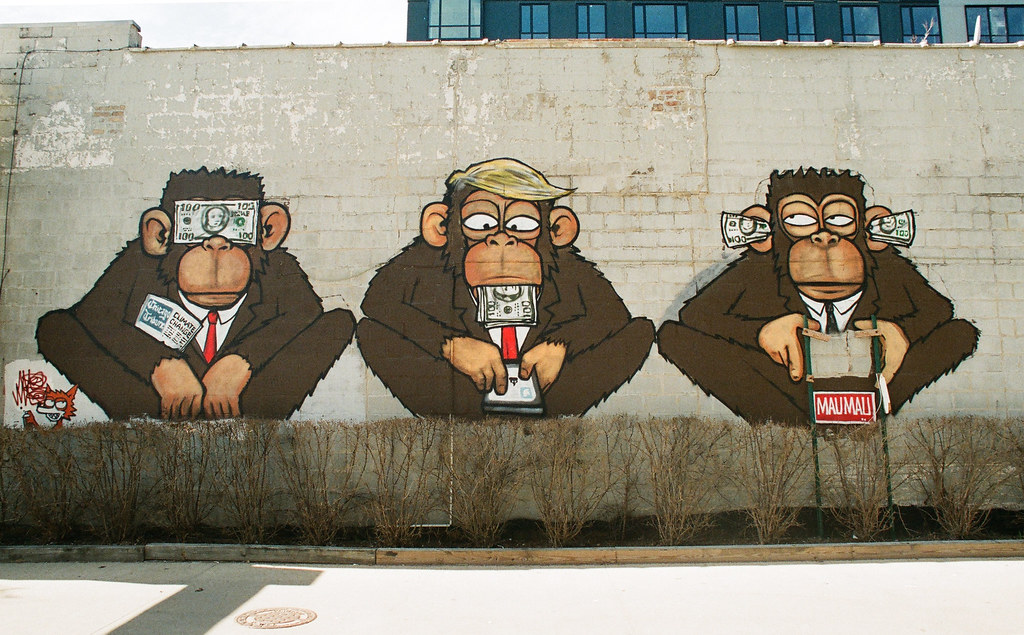
Scientists can issue warnings about our impending demise until they are blue in the face, and they have, but they and the public are at the mercy of economic, financial, and political forces beyond anyone’s power. Couple that with the fact that the average person on the street has a Trump-level of comprehension about these existential crises and is being bombarded on social media by fake news that plays on emotions and deep-rooted inter-group distrust. Cheap energy and the individualistic consumer culture have created an illusion of abundance and destroyed any sort of communal cooperation which was once the basis of everyday life. I’ve walked this Earth for over five decades and have seen a steady and continuous degradation of the natural world; corporate greenwashing is rampant. The growth in ‘green energy’ has not displaced fossil fuel fuel consumption to any great degree; fossil fuels still supply 84% of global energy consumption. Worse yet, just to maintain our current growth in energy consumption would require an unattainable expansion in alternative energies. If one connects all the dots on our current state, then there is no refuting this most clear-eyed of scientific assessments:
“Given the momentum in both the Earth and human systems, and the growing difference between the ‘reaction time’ needed to steer humanity towards a more sustainable future, and the ‘intervention time’ left to avert a range of catastrophes in both the physical climate system (e.g., melting of Arctic sea ice) and the biosphere (e.g., loss of the Great Barrier Reef), we are already deep into the trajectory towards collapse.”
The end of the world is the ‘cha-ching’ of a cash register as the last vestiges of nature are converted to dollars. Lest we forget, 71% of global emissions come from just 100 companies and more than half of global industrial emissions since 1988 originated from 25 corporate and state-owned entities. While the ultra-wealthy reap the profits of a poisoned ecology, the rest of the world is left to take the brunt of consequences from a world that grows more dangerous by the day. Those living on the edge who lost their livelihood during this pandemic are the collateral damage of an out-of-control socio-economic system whose incompatibility with life on Earth becomes more evident with each passing year. There’s nowhere to escape for most people because, to one degree or another, we are all entrapped in this system. The immutable laws of biology, physics, and chemistry have set an expiration date on America’s non-negotiable way of life, ensuring that many more will soon fall victim to the short-term greed of capitalism. As Stephen Hawking warned, “Stupidity and greed will kill off humans.”

For hyperlinks in this essay, go here:
https://medium.com/@xraymike79/age-of-annihilation-f2629d3bc08b
Comments (70)
"The life of the species, both in man and in animals, consists physically in the fact that man (like the animal) lives on organic nature; and the more universal man (or the animal) is, the more universal is the sphere of inorganic nature on which he lives. Just as plants, animals, stones, air, light, etc., constitute theoretically a part of human consciousness, partly as objects of natural science, partly as objects of art – his spiritual inorganic nature, spiritual nourishment which he must first prepare to make palatable and digestible – so also in the realm of practice they constitute a part of human life and human activity. Physically man lives only on these products of nature, whether they appear in the form of food, heating, clothes, a dwelling, etc. The universality of man appears in practice precisely in the universality which makes all nature his inorganic body – both inasmuch as nature is (1) his direct means of life, and (2) the material, the object, and the instrument of his life activity. Nature is man’s inorganic body – nature, that is, insofar as it is not itself human body. Man lives on nature – means that nature is his body, with which he must remain in continuous interchange if he is not to die. That man’s physical and spiritual life is linked to nature means simply that nature is linked to itself, for man is a part of nature." Karl Marx, Economic and Philosophical Manuscripts of 1844, from First Manuscript, Estranged Labour
The reason Marx was able to have this consciousness in 1844, which is truly astounding, is because he escaped the errors of idealism, which allowed him to comprehend reality in concrete terms.
I've been here before, personally. Back in the cold war, people were dreaming of being one of the few survivors, I decided then to be for preference an early casualty of WW3. Now I'm unexpectedly old, and humanity is if anything more fuck-witted than back in the 60's. Sorry kids, I tried to live green, I didn't go flying, or buy cars, I stopped eating meat. I preached and practiced as best I could. Nobody was listening and not many are still.
We're fuck'd then.
I find myself increasingly incline towards misanthropy. It's the form of Humanism that realises that all we have is each other, then looks around in despair.
"If there is any way out of this hellish circle—and I would not wish to exaggerate that possibility, being well aware of the weakness and susceptibility of such consciousness—it is probably the ability of mind to assimilate, to think the last extreme of horror and, in face of this spiritual experience, to gain mastery over it. That is little enough. For, obviously, such an imagination, such an ability to think extreme negativity, is not comparable to what one undergoes if one is oneself caught up in such situations. Nevertheless, I would think that in the ability not to feel manipulated, but to feel that one has gone relentlessly to the furthest extreme, there lies the only respect which is fitting: a respect for the possibility of the mind, despite everything, to raise itself however slightly above that which is. And I think that it really gives more courage (if I can use that formulation) if one is not given courage, and does not feel bamboozled, but has the feeling that even the worst is something which can be thought and, because it falls within reflection, does not confront me as something absolutely alien and different. I imagine that such a thought is probably more comforting than any solace, whereas solace itself is desolate, since it is always attended by its own untruth."
If one does not uphold fundamental human rights, mere survival has no merit. :roll:
This is the real disaster, I fear, that untrue solace has swept the field. "Let's get armageddon done." "Make America uninhabited again." Etc, etc.
Serious questions are thrust on the table in the probability of civilization's twilight. What happens to intellectual responsibility? Of course, it is strange to ask this question, because there has never been much of it in the world. It is the socially responsible intellectual who is also the most rare. Can one fight off hedonism at this level of awareness? What becomes of our discourse? (And it should be noted that the religious cannot even enter into this conversation, they do not live in the real world). This matters because they try to pontificate with authority here, claiming that a return to error holds the key to the world's salvation. Nonsense, when the adults enter the room we must think about our plight in terms of concrete circumstances. We do not have time to play these kind of games. Can intelligence still proceed forward though it perceives the negation of history? At which point does revolutionary resistance find itself negated by material impossibilities? The thinker can think until his last breath, but this doesn't make it wise.
Do you think so? Perhaps your experience is with exploiters of religion, or perhaps you are fundamentalist yourself. In any case, the conversations I have been having for many years with anyone who cared to engage have been singularly unfruitful, or so it seems to me. If not religion, do you imagine that science can solve the problems it has created?. I laugh that impossible idea to scorn! What else do you have then?
Why do I say this? Because religion is based on the denial of reality. Let me repeat: religion is based on the denial of reality. One cannot rightly discuss the potential end of the world with people who believe there is a magical world they will be carried to after. One cannot discuss the death of a planet whose vitality they believe lies in the hands of God. These are not adult conversations, these are confusions.
You asked about solving problems? You get me wrong, I am all about concrete and contextual questions that strive in this direction. We must begin having adult conversations, not conversations about phantoms and afterworlds. These only get in the way, they waste time.
If a general belief in religion yields a more harmonious, stable, integrated and better-intentioned populace, then where is the harm in such beliefs, as long as they are not manipulated by the plutocrats?
I think it is naive to imagine that all, or even most, or even many, of us are cut out to be intellectuals. The other thing is that it is arguable that most people wish to be led rather than to lead. With leadership (or at least decent leadership) comes great responsibility.
No. I agree with you. Denial is not just confined to religion, it is the normative process of human psychology.
Quoting Janus
I should simply be able to say to a person like yourself, that you know better than to ask a question like this. Seriously, come on. Religion keeps people enslaved to power structures. You already know this. There are many many other problems with the innocent notion of "general belief." Now I suspect you are talking in the context of life at the end of the world? If that is the case, then your question is not a religious one, but a philosophical one, it has to do with hedonism, which I mentioned earlier. It is a serious question and one that must be addressed.
Quoting Janus
I agree with this. Thinking is the most psychologically difficult and painful act a person can do. To be a thinker one must be capable of suffering.
Quoting Janus
We are back to the axiom of education.
As can be seen in this chart wildlife made a small comeback around the time of the Second Summer of Love.
Maybe it's time for a Third Summer of Love next year, as opposed to a Third World War.
Oh, Well if you won't discuss, then you won't discuss. I'll leave the thread and saving the world to you. I have enough environmental threads already.
Over 140 years ago, Friedrich Engels noted how the private ownership of the land, the drive for profit and the degradation of nature go hand in hand. “To make earth an object of huckstering — the earth which is our one and all, the first condition of our existence — was the last step towards making oneself an object of huckstering. It was and is to this very day an immorality surpassed only by the immorality of self-alienation. And the original appropriation — the monopolization of the earth by a few, the exclusion of the rest from that which is the condition of their life — yields nothing in immorality to the subsequent huckstering of the earth.” Once the earth becomes commodified by capital, it is subject to just as much exploitation as labour.
Yes, science helps us to understand what is happening. As Engels said, “ with every day that passes we are learning to understand these laws more correctly and getting to know both the more immediate and the more remote consequences of our interference with the traditional course of nature. … But the more this happens, the more will men not only feel, but also know, their unity with nature, and thus the more impossible will become the senseless and antinatural idea of a contradiction between mind and matter, man and nature, soul and body.”
https://thenextrecession.wordpress.com/2020/09/06/pandemics-prevention-before-cure/
A commentator on my blog some time back...
"I don’t think humanity in general will adopt any kind of remediation practices until long after they are actually needed (i.e. after the population and consumption rates have begun to crash). I don’t think it is possible for a a group as large as 7 billion people to agree that such proactive measures is necessary. After the crisis has begun, yes we’ll do all kinds of things, but remember that by then we will be hampered by the climate crisis and severe shortages of both resources and the technology needed to use them. I have given up speculating on possible outcomes, because they are so inherently unpredictable. But what I’m discovering about the way life works at a deep level makes me continually less optimistic....We can’t manage de-growth, the recognition of limits, or even the application of the Precautionary Principle, because as a collective organism humanity doesn’t have free will. Instead we have an emergent behavior that is entirely oriented towards growth. The game is pretty well over."
And we have a president who has never read the bible, much less anything else, holding the book up as a prop for the evangelical vote. And they believe he is the chosen, but imperfect, vessel of God's will. Keep in mind Trump used tear gas and state police to suppress lawful protestors and clear a path to said church. The irony, hypocrisy, and fakery in all this is too much to fathom.
I find myself wondering why we bother saying it? There are things that could be done in partial mitigation; preparations could be made to clean up the many cities that are going to become ocean, for instance. There are people doing what they can, and other people grabbing what they can. Personally I think it is a fundamental failure of philosophy to defend itself from a mechanistic moral nihilism that has come so to dominate, that humanity has lost sight of the immense value of truth, and prefers comfortable lies. It is the Tower of Babel story re-enacted. Our leaders are unbelievable, the media are unbelievable, and even scientists can be be bought and sold, and cannot be trusted.
Communication is dead, because there is no trust and therefore no truth. Words no longer communicate a meaning; we carry on talking in so many different ways, but no one is listening.
I take that to mean a few people are trying to be sustainable (while the vast majority are not), and those in power are, for the most part, extracting what wealth they can get their hands on. Looters, you could say, but at a much more vaulted and protected place in society. Certainly there are things that can be done, but governments need to step up and level with the public.
We have had politicians level with the public, and they lost the elections. the people voted for populists liars and charlatans.
Quoting JerseyFlight
I would say that religion does not inherently consist in enslavement to power structures. People, the great majority of people, who do not want to think for themselves, who do not want to lead but would rather be led, are not necessarily enslaved by their act of following. Of course they may be coerced, their desire to be entertained, to consume, manipulated, by all kinds of corruption, but that is something else.
When you say you "suspect I am talking in the context of the end of the world", I can't decipher your meaning, and nor do I understand what you had in mind when you introduced the question of hedonism. More explanation may help.
Concretely, it is belief in delusion, fake being that is projected for reasons of comfort and control. You are free to project your own fake ideals about it.
For me the problem with what you seem to be proposing is that it would require everyone to be a highly critical thinker. I just don't believe most people have the capacity for that; it is not merely a matter of lack of education. And even if it were that, how would you ever convince power to engineer its own undoing?
And even if you could do that, how would all this be done in time to save the biosphere? It is arguable that only a small proportion of the current population could be fed by non-industrial farming methods. We desperately need to stop industrial agricultural practice if we want to halt catastrophic destruction of the soil, deforestation, salination, depletion of aquifers, pollution of the oceans, species extinctions etc, etc, etc.
But we can't stop industrial farming if we want to end, or at least minimize, human starvation. This is a choice conundrum, or is it merely a dilemma? Do you have an answer?
You gotta be adapted to the unreality that is killing us all to live a successful life.
I take it that successful adaptation to being killed is to die? I'm working on it.
:sad:
:smile: Who's not dying?
I think what @fdrake had in mind with his comment is something like 'you have to work within the system to live a successful life' where "successful life" means something like contributing to the overall betterment of human life.
No, I am referring to the fact that God-belief is a human psychological delusion, a projection.
Quoting Janus
What's this? Your argument is that people should be deluded? Have you even thought about this? This is pure resignation. It is also a form of elitism. You are indeed special, so special that you know other people cannot be like you, where you have awareness there they should be consigned to error?
Quoting Janus
In disbelief. ??? You know what?
Sure it is, and surely not the only one! Much of human life is projected illusion. Do you believe you are free from it?
Quoting JerseyFlight
No, it is elitist to suppose that you can pontificate as to what is and what is not delusion for others.
Quoting JerseyFlight
There are natural variations in degrees of intelligence; this can be observed even in animals (obviously across, but also within species). And it is not just a matter of intelligence, either; not everyone has the disposition to become an intellectual, even if they have the native intelligence. You seem naive and idealistic in these matters.
I believe that all humans, including myself, are tragically prone to error, that is why we make use of intellectual standards.
You are changing the topic here. You said my position only applied to fundamentalism, this is not the case. The fact that you validate my premise means you agree with my position.
Quoting Janus
Pardon me, you just agreed with my first premise regarding the God delusion. I reject your self-contradictory subjectivity which states we cannot tell the difference between truth and error. It is not elitist to refute and condemn error. It is elitist to say that people should be fed on a diet of delusion because they do not have the resources for critical thinking. No doubt, there is some truth to this, but not for the fatalistic reasons you seem to portray here. If they lack the resources it is because their social experience was one of poverty.
Quoting Janus
The variation you speak of is not a genetic predetermination, it is created by environment and psychological care. By god you are an Elitist! It is thinkers like yourself that weary me most of all, because you have all the benefits of society and you use your own privileged position to construct tyrannical, normative categories, all the while ignoring the material fact that your quality is the result of greater social resources. Every homie born into the projects ought to join me is thrashing your privilege. My family is Native American, genocided and socially alienated. You want to tell me that my father and grandfather were genetically inferior to you? Wrong cowboy, they didn't have your social privileges!
Where did you grow up?
Did you have both parents?
Were they home or gone most of the time?
Did they have any substance use dependence?
Were you abused?
Did you face adversity in your social life?
What color is your skin?
Were you born into a working house family or inherited wealth?
Did you have quality mentors?
Did you have quality reading material?
Did you have a nutrient rich diet?
Did you suffer any trauma in the development of your brain?
Was your community experience one of calm or anxiety?
You are a material being, and ALL of your quality originates not from yourself but from your experience of collective community.
I don't play your abstract, idealistic privilege that seeks to separate its quality from every material fact that accounts for its being.
If you have intelligence it's not because you are special, it's because you are lucky.
Alas, I don't think it is possible for a group as small as 1000 or maybe 100 to not only see the necessity of proactive measures, but to actually implement the proactive measures in advance of dire consequences.
We don't seem to be able to see possible or probable disasters 25, 50, or 100 years in the future and actually do something about it in the present time. It's less a moral failing (which virtue could overcome) and more a failure of our species' nature, which we may have the wherewithal to overcome.
Apart from that, we have (most likely) started the unstoppable cascade of events which will lead to ever-worsening conditions. EVEN IF we 8 billion people, woke up and decided to start acting right now, it would be very hard work to prevent the cascade.
I conclude that we are totally screwed.
This brings us to interesting questions. What happens to philosophy in light of this awareness? How should a wise person proceed in light of such negativity? If these premises are correct then philosophy must take a new course, it must revise itself in the consciousness, of what appears to be, the most profound negation of being.
I stopped the procreational process in my lineage. That's the best I could do for the world. I hope many others will take my lead.
You misunderstand religion if you think it is a matter of truth or falsity, of being correct or being mistaken.
Quoting JerseyFlight
Right and who decides the standards?
Quoting JerseyFlight
No you are failing to make the crucial distinction between fundamentalist and non-fundamentalist religion. The former consists in quasi-empiricist reification of spiritual metaphors. Of course fundamentalism is erroneous, consisting as it does in errors of misplaced concreteness.
Quoting JerseyFlight
It would be elitist if I had said that, but I haven't. You seem to be highly skilled at imputing claims to others, which they have not made. It's much easier to argue against a position you have distorted to suit your own refutations. If you deny that there is any natural variation in intelligence in humans and other "higher" species, then I can only wonder where you have been living. It is not an elitist claim, but merely a realist observation.
Quoting JerseyFlight
It is not a matter of "either/ or" but "both/ and". Nature and human life are not as simplistic as you would seem to like to paint them.
Quoting JerseyFlight
I don't deny any of this except for you claim that I am being idealistic. The reverse is true, it is you being idealistic if you think that there are no such things as material differences between people. Of course we are all material beings, part of nature, and we are naturally variant in our gifts, both mental, emotional and physical. Of course those gifts can be amplified, or suppressed by our upbringing, and enculturation; where have I denied that?
I haven't said that anyone ought to be treated any differently on account of their natural gifts, though, and if I had that would be elitist. I uphold the idea that we should all be equal before the law, and should all have equal opportunities for education. Of course the possession of intelligence is not a reason for any special treatment, but talented individuals are special insofar as their natural gifts exceed the average, and this is the same in the visual arts, in music, in sports, in regard to physical strength and mental acuity. Whether those gifts are cultivated and developed is an entirely different matter.
You come across as an ideologue, and the last thing humanity needs is more of those, in my opinion. You also come across as an elitist, insofar as you talk down to others and don't listen to what they are saying to you.
This delusion is not confined to fundamentalism. If you believe in the existence of unicorns it doesn't matter whether you classify the belief as extreme or moderate, it is false. The status of delusion doesn't change just because you say "the former consists in quasi-empiricist reification of spiritual metaphors." I am not surprised just disappointed that you think delusion is somehow more preferable, just because it is not classified as fundamentalist delusion.
Quoting Janus
---->
"...it would require everyone to be a highly critical thinker. I just don't believe most people have the capacity for that..."
Then, I guess I fail to understand what you are advocating as an alternative? I saw you mention Spinoza believing that people had to have religion because they were too stupid for reason. (This is a paraphrase, I don't remember your exact wording). The direction and implication of what you are saying is that delusion is okay because society makes it hard for people to obtain skills in critical thinking. Of course you would never state your position this way because it makes it obvious that the position is absurd.
Quoting Janus
That is, what accounts for intelligence? Why do you have it, for example, while millions of people born into abject poverty don't? Please do explain.
I deny that the natural variation you speak of is what accounts for the quality in intelligence.
Quoting Janus
I agree with this, but this is not an equivalence. Environment, psychological as well as physical, is the dominant feature of determinism when it comes to the health of human beings.
Quoting Janus
I don't think nature is simple, but I also don't think every detail of its complexity comprises relevance.
Quoting Janus
You mean material advantage makes the difference? Yes, I agree.
Quoting Janus
Gifts? You mean superior genes? Even so this doesn't matter, if you gave any human the greatest genetic advantage, if his genes are subjected to an impoverished environment, they will yield no "gifts." You are a body. Your mind is material. Suffering impoverishment in these areas will destroy your intellectual qualities and any other so-called "gifts" you might have. Further, the passing on of genes is itself based on the qualitative historical experience of your parents and grandparents. You make it sound like God is dishing out magic genes to people, as opposed to them being shaped by a material, historical process.
Quoting Janus
No, that would be a direct form of elitism, you have offered a sly, backdoor, I'm better than you approach because I have a "natural variant of gifts." (It's hard to hold my tongue here, I despise intellectuals like yourself). Ignorantly you go about leading with your social privilege, discoursing from it as though the world were divided in terms of it, all the while oblivious to the fact that you are simply luckier. It's hard to respect, and no philosopher should be naive in this sense. Men like you crushed people like my grandfather and father, pounded them into dust with your privilege.
Quoting Janus
More disbelief and a pain in holding my tongue. There is no such thing as a "natural gift," as you speak of it here. Bobby Fisher had to practice chess for 10,000 hours to become a master. Beethoven made thousands of corrections to his symphonies. The development of mastery in any field presupposes a vital chain of material resources, opportunity, historical development, remove these and your category doesn't exist!
Quoting Janus
Wrong. What you are saying here would then mean, a person's skill is a matter of genetic inheritance. False. Subtract the material and you have nothing left but an empty category. This is the exact opposite of idealism!
Any one alive to the possibility that we may be bringing about our final act and scenes on the world's stage, must revise their consciousness to account for not only their own death, but the death of the human enterprise. It is a grievous thought.
The death of the human enterprise will not be as swift as a heart attack; it will likely be slow in the manner of degenerative diseases, so there may be several generations of thinkers whose reality will be dominated by the certainty of our species demise. There will be a steadily deteriorating situation at the end of which large scale Civilization will cease, and our smaller scale communal lives fall apart.
Grim.
I schizophrenically view the future as a certain end to the human enterprise on the one hand, and on the other hand hold out for a future in which human kind, and as many other species as possible, pull through to a bright and long future. The former seems inevitable and the latter seems impossible.
So very well said, though tragic. It's quite hard to fight off hedonism from this vantage.
Indeed, I agree with you although I wonder if there'll be any avenues for positive change in a system that seems specifically designed to cause catastrophes. Quite possibly, the system isn't about energy per se but actually about cheap energy. If it's all got do with money, I see a silver lining. Greed got us into this mess, greed will get us out of it.
Is it? I find that the end of the world pretty much quashes my desire for pleasure.
By hedonism I am not necessarily referring to a philosophy of pleasure, I am referring to the pursuit of subjectivity over that of social responsibility.
When I said "who's not dying?" I meant that death itself could be an adaptive response. Lebensraum is at a premium - has been, is, always will be. Dying then is an act that frees up precious living space for others with the added advantage of creating a new population that's better equipped to tackle changes in the environment, changes that, for all we know, would've been fatal for the older generation.
It's not a question of how I'm speaking of it; it's very straightforward, it's just natural variation. Are you seriously claiming that some people are not more naturally talented than others in the various fields of human endeavor? If you genuinely believe that, then I can only conclude that you are too deluded to bother responding to further.
It seems to me you won't get far on this site, seeing as how you are apparently just another proselytizer, who would rather distort what your interlocutors say, because engaging with what they are actually saying would make it too difficult to for you to deal with.
If you can't see the obvious pattern emerging in your interactions that, along with your tendency to distort the words of others and to very quickly resort to ad hominem attacks, seems to indicate that despite your apparent pretensions to be open-mindedly seeking truth, you are actually a closed-minded ideologue, and thus also a self-deluding hypocrite.
I think it's time for a reality-check, dude.
Out of courtesy and respect for the discourse I was trying to simply presume your terms. This is often the more mature way to discourse. Asking for a justification of every last term, though one can do it, is really the mark of a novice dialectician. However, you have forced the issue here, so you must explain what you mean by, "natural variation," that some people are "more naturally talented?"
What I suspect is that you are equivocating. A natural variation can only mean that a person has some kind of genetic advantage, but once again, this genetic advantage is not a "natural variation" in any magic sense, genes form through historical process, further, the existence of talent is a matter of privileged conditions. I have already refuted what you say, 'Subtract the material and you have nothing left but an empty category.' You can be given all the natural advantage in the world, but if you pass through an impoverished environment your advantage will be negated. Would you rather have the greatest genetic, natural advantage and grow up in Syria, or have one that is only moderate and grow up in wealth and the stability of a healthy home and society? The answer is obvious, and it refutes your emphasis on "natural talent."
What you are trying to do is argue with abstract, empty categories, when I call you out and demand that you substantiate the category, we find that material reality doesn't match up with the presumptions of your ideals. Talent is not an attribute without a history, remove the concrete and it doesn't exist. (There is no Michael Jordan without the basketball court and hoop he had access to as a boy).
Quoting Janus
No, I will not play by your privileged rules. Like I said, it was people like you, specifically with this kind of self-righteous attitude of superiority, that crushed people like my grandfather and father. You need to be knocked off your perch, all the social benefits you received from society, that's what accounts for your quality, remove this and there is nothing left.
I have not been attacking you personally but drawing out brutal, material contradictions of your idealist position.
Quoting Janus
Quoting Janus
Quoting Janus
Quoting Janus
Quoting Janus
Yes, this is how privilege responds and usually works. This kind of authoritarian reply would have crushed my grandfather and father, because they could not defend themselves from people like you. Not I little man. I am calling out your privilege and will continue to do so. It signifies what is wrong with so many intellectuals. You are not alone in this, it is the common disposition.
I am simply stating the obvious fact that people and other animals are born with varying potentialities and attributes.
I haven't anywhere denied that natural abilities can be fostered or suppressed by cultural conditions. And yet it seems that is what you would like to impute to me.
Here's an example:
Quoting JerseyFlight
I haven't anywhere denied that talents have histories and rely on concrete circumstances to reach fruition. That is all just bleeding obvious, and is the same for everything. For example the seed will not grow into a tree unless the conditions are right.
Michael Jordan is a tall, powerfully constituted athletic type of person, and would be so even if he never played basketball. If he hadn't had that opportunity he might have excelled in some other field, or he might have become a drug addict, alcoholic or criminal. Wherever he might have done in counterfactual circumstances, the fact of his inherent physical attributes remains.
So, you don't seem to actually be saying anything of substance; that is what I am waiting to hear, some new insight.
Quoting JerseyFlight
And here it is again! The presumptuous bullshit! I am not speaking about, or from privilege. You know nothing about me or my life. You don't know what sex I am, how old I am, what I look like, or what I do for a living.
Quoting JerseyFlight
Quote one example of anything I have said that would reasonably count as a "brutal, material contradiction" or show that my "position" is "idealist".
It's true that I responded to you with some ad hominen remarks; but it was not me that started down that path in this "conversation"; I was merely giving like for like. I also think my ad hominem remarks are much more reasonable and founded upon what you have actually been saying than yours are.
Now if you want to continue then quote something I have actually said, and tell me just what you think is wrong with it, without distorting it or reading into it what suits only your polemic purposes.
No you are emphasizing a vague category to the detriment of concrete reality.
Quoting Janus
These are not talents now are they? These are physical attributes. And without the right resources and environment these would not only lead to nothing, but they wouldn't' even exist! Refuted, again.
Quoting Janus
I know what you have asserted about natural talent and the like, and it's false. You tried to claim that talent is an attribute that pops into existence as a magical genetic structure. This is false. Even the genes you are referencing are themselves contingent on qualitative historical development. The fact that you tried to posit this category, that some people are just magically superior to others, this is why you have been charged with elitism and privilege, not because I know the details of your life, but because you are arguing for privilege!
Quoting Janus
"...it would require everyone to be a highly critical thinker. I just don't believe most people have the capacity for that..."*
And you do? Why?
Where did you grow up?
Did you have both parents?
Were they home or gone most of the time?
Did they have any substance use dependence?
Were you abused?
Did you face adversity in your social life?
What color is your skin?
Were you born into a working house family or inherited wealth?
Did you have quality mentors?
Did you have quality reading material?
Did you have a nutrient rich diet?
Did you suffer any trauma in the development of your brain?
Was your community experience one of calm or anxiety?
*There is another way to approach this, "most" does not mean "all," which means "some" people do have this capacity, the question is why? You tried to posit genetic inheritance as the reason, this is false, so I repeat myself: 'You are a material being, and ALL of your quality originates not from yourself but from your experience of collective community.'
No I didn't; I haven't said anything about "magical genetic structure" or attributes "popping into existence"; those words are yours and you are trying very hard to impute them to me. This is intellectually dishonest.
I said that the physical attributes which enable talents of various kinds are inherent. Someone who is short will be unlikely to become a great basketball player. Someone who is tall and very lanky will be unlikely to become a great gymnast or weightlifter. Etc, etc...
It's just ridiculous to say that there are not inherent physical (including brain) attributes which contribute to or detract from the likelihood that people will excel at the various endeavours. And of course I have acknowledged that the right upbringing, luck in finding mentors, etc, etc. in other words environmental, social and cultural factors contribute to the likelihood that someone will excel.
Quoting JerseyFlight
I don't know; I've just always been interested in ideas since early teens, but I come from a background most would consider lacking in much culture. I'm not even claiming to be a thinker on the highest level in any case. I'm just an amateur interested in philosophy like most of the folk on this forum. I'm actually something of a dilettante.
I'm not going to tell you all the details of my background, but I will tell you I had a poor relationship with my father all my life, ran away from home twice, I was rebellious and got into hallucinogenic drugs and philosophy, mostly Eastern but some Western too (Nietzsche and Schopenhauer) in the last two years of high school, came last in the year in the final exams, did not hold a steady job, but did casual work like gardening for people, tree-lopping, taxi-driving and cleaning and I often hitchhiked around the state I live in and an adjacent state, lived in the bush from time to time, until I was about 27, and then started my own business as a builder and landscape designer which I carried on for about 38 years.
During that time I also pursued interests which included drawing and painting (I dropped out of art school 3 times), have been writing and reading poetry and philosophy since I was 16, and also playing around with music. Everything I own I earned myself; I have never been a full-time employee. My father ran a motor repair business and my mother was a housewife.
The point is that there is such variation among people that it is impossible to predict whether natural talents will be developed by looking just at background. You also have to possess the attributes in the first place order to become good at anything. For another example, not every horse can become a champion no matter how much training they receive.
So, I can't see where you have refuted anything at all I have said. You have created strawmen and imagined that you have refuted those. That is all you have managed to do.
Ignorance needs to die. When horses get the proper training they fluctuation on and off from winning. The horses that do not get the proper training would not stand a chance against those who do.
"New scientific research shows that environmental influences can actually affect whether and how genes are expressed. In fact, scientists have discovered that early experiences can determine how genes are turned on and off and even whether some are expressed at all. Thus, the old ideas that genes are “set in stone” or that they alone determine development have been disproven."
Source: https://developingchild.harvard.edu/resources/what-is-epigenetics-and-how-does-it-relate-to-child-development/
As with any suggestive one liner, I meant a few things by it. In the context of the plausible threat of collapse of our civilisation in the next 100 years, and the by-and-large institutional indifference to that risk.
(1) If you're a reasonable human being like Greta Thunberg, and you're simultaneously attuned to the severity the risk and the indifference towards it (and the fact that indifference makes it worse), you'll feel like you're strapped to tracks and there's an oncoming train in the distance. Worse, people around you act like the train doesn't exist despite driving it. Worse still, the more responsibility someone has to mitigate the risk, the more they seem invested in pretending it doesn't exist. If that doesn't make you extremely uncomfortable, if not peaking in moments of outright despair, then I dunno who taught you how to feel things. That's a lot of cognitive dissonance to shoulder.
(2) People feel on a gut level that it's really a risk but don't wanna feel helpless and complicit at the same time, so they turn the climate issue into an act of emotional homeostasis. Making it about their feelings rather than the facts. This is an avoidance of cognitive dissonance through either replacing the enormity of the problem with a smaller one (an alluring cognitive bias accentuated by individual centric ideology), externalising the threat (climate change "doomsayers", "apocalypse cult" blah blah you know the drill). Be that through dissonance reducing individual level consumption strategies (which are benign but largely as effective as prayer), or treating those who have it on their mind like dirt, or forgetting it ever exists and going on with life.
So you can adapt to the threat by absolving yourself of responsibility through heavy emotional investment in largely ineffective strategies and Kantian prayers, or minimising the threat by shooting its messengers, or you can ignore it. All three bottom out in adjusted coping strategies for the emotional impact of the problem that let you live as normal, but are completely unadjusted for mitigating the risk of collapse. If you can behave as if everything is normal and shut yourself off from the burning skylines, rising tides, floods, record weather every year and the beginning of climate change induced diaspora... It doesn't exist. Clap your hands if you believe!
But indeed, that is what is required of you to behave normally in response to the threat. To live life as if it doesn't exist. And if you're unfortunate enough of an individual to take systemic risks seriously - sucks for you I guess? See you at the next largely ineffective collective symbolic-political act.
If I was cynical, I'd say that instead of the institutional indifference being the main culprit, at least in some, perhaps even many, cases, it is instead active complicity with those who really don't care, and who see life just as a profiteering game where the only aim is to win at all costs.
I can relate to Thunberg, and her outrage; it is outrageous that we seem to be, by and large, governed by reptiles. And the common person seems to be sleepwalking into catastrophe. It is outrageous that the people could overthrow or undermine the elites with ease if only they had the intelligence and collective will, but that this seems impossible to bring about.
I also think your characterization of the emo response is apt.
And then, as you say, we can just ignore it and live day to day. None of these are coping strategies, as you note, fitted to purpose, if the purpose is the preservation of civilization.
There is also (at least) one other category of copers; those who opt for a return to rural life; to the sense of community which has been mostly lost in the cities. Those who prepare for a long (hopefully!) decline, a slow return to a predominately sustainable agrarian life, and (hopefully again) a whole new kind of civilization.
Who knows what we'll be able to retain and what will be lost (beyond the obvious things which depend entirely on fossil fuel use)? Will medical science and technology be able to continue to develop for example?
One estimate I have come across is that organic framing (which must return and completely displace industrial framing if we, and many other species and habitats are to survive) can sustain only about 200,000,000 people. If this is right then there must be a drastic reduction of population over the next 50 years if we are to avoid total collapse of our ecosystems.
How will this come about? Will it be the result of increasing poverty, resource depletion, famine and pandemics we cannot control or will we engineer it out of desperation? This seems to be the question that very few people even want to entertain, let alone seriously think about. It's simply unacceptable!
Personally I don't see how civilization, as it currently exists (or until recently has existed; global and prosperous for many with prosperity growing) is possible to sustain, given that it has been a one-off bonanza of growth enabled by fossil fuels. De-growth now seems inevitable as resources wane.
So, I see the problem as not just being that we are being farmed by financial elites, or that there is institutional indifference, or lack of coordinated thought and action within the masses, but that no one knows what could be done, because all alternatives seem intolerable, and we simply don't know what would work anyway. We have heavily invested in a particular trajectory of growth, and no one knows which brake to apply, because there are too many brakes to choose from, and none of them palatable.
Anyway your responses have been so inapt and disengaged that I'm done with this conversation.
The extremely annoying thing is that greening production of electricity works - solar and wind are just as efficient now, electric trains and buses and cars are a thing (though large passenger aeroplanes still look a while off); stuff of that size being feasible makes it agriculture at scale feasible I think. Most petrochemicals are recyclable - though under 10% are recycled by our current production strategies.
Quoting Janus
Sustainable agriculture looks workable at scale? Long term resources except electricity are finite, though.
Quoting Janus
I don't think it's inevitable, it's a question of coordination and those with power taking the problem seriously (or being forced to take it seriously :P). Or rather, taking it seriously and realising the consequences, the story of Margaret Thatcher is instructive here. A passionate advocate for climate change transformation on a global scale in the 1990's based on her understanding of chemistry , she switched to a climate change denier based on the partisan output of free-market think tanks. She's a microcosm of the pattern. Our liberty now, your death later!
Edit: I want to clarify that I can imagine a capitalism that is actually green, it just seems unlikely to emerge.
I don't pretend to be an authority on this, but from what I've read, wind and solar, due to their intermittency and fluctuating energy production require some form of so-called "base load", which can be quickly ramped up and down, to stabilize the grid. Apparently coal is not great for this, and neither is nuclear. Natural gas is better, but it, although better than coal, is still far from carbon neutral.
When it come to wind turbines there are those who claim that if all the energy taken to mine, transport and process the materials they are constructed form, install them, maintain them, deconstruct them and dispose of the waste is taken into account, they are not carbon neutral by any means.
Now I don't know if this is true; such views may be politically motivated, but views to the contrary may also be politically motivated. The truth in these disputes is not so easy to discern, apparently even for the experts, let alone for us amateurs.
Quoting fdrake
I'll be honest and admit I didn't have the time to read that article thoroughly. I would love it if it were true that organic farming can be as productive per hectare as industrial agriculture. But, even if it were, would we not still be reliant on fossil fuels for the large-scale transportation required to feed the global population?
Electric vehicles are a long way from being able to travel great distances without recharging, and recharging relies upon electricity produced predominately by fossil fuels. Since at every step due to entropy energy is lost, it would seem that at the moment running electric vehicles would be less green than running them directly on fossil fuels, and particularly so since coal generated power is less "carbon-friendly" than oil-power, as far as I am aware.
Complex infrastructure takes many decades to transition to new technologies, and I'm not convinced that there are enough of the minerals and rare earth metals that are required for batteries to make the transition in any case, and even if there were, all that extra mining is currently being done with machinery that runs on fossil fuels, as far as I am aware.
I would love to be shown to be wrong about all this. I may well be wrong, and what I say is based just on the casual reading I have done. I have searched, but am yet to find anything compelling to convince me otherwise.
:up:
One of the profound epiphanies that Covid gave us is that people will claim to believe anything, no matter how utterly, insanely stupid, in order to minimise the impact of social responsibility on their personal lives. In the UK, a significant proportion of people have taken to coughing and spitting on anyone who asks them to wear face masks or observe social distancing. The justification is that Covid is a hoax designed to, I don't know, create a market for face masks or something. Given the economic and political harm Covid inevitably inflicted, it's a mind-boggingly stupid idea that cannot stand on its own merits. It is adopted because of its utility, not it's sanity.
This does not bode well for environmental conscientiousness. Currently, what environmental measures we have in place are minimal, hypocritical and enforced punitively. I have little doubt now that any serious attempt to reverse climate change would be interpreted as an equally insane conspiracy as soon as it impacted people's daily lives. They'd probably hold fossil fuel burning parties in protest. :o
So rather than stupidity, it seem to me it's more a case of wilful defiance. There is no trust whatsoever in what authorities say, and a sense of living in a world that is only out to get you... which has led to a deep cynicism and instinctive reactions to try to repel manipulation.
This is I think maybe the biggest problem we have, because it leads to a lack of collective agency.... and without that you can't even begin to try to implement any sort of societal change.
My comment was not against accusing governments of bad faith generally. It was pretty clear to me that Iraq had nothing to do with national security or human rights, and everything to do with oil, for instance. I don't think this is a "stupid" accusation on the grounds that the governments involved denied it; on the contrary one can see why the US would want to implement a friendly Iraq government and one can see why they'd like about it. And it had precedent.
This is not an excuse for insane conspiracy theory. The idea that world governments all over are harming their own economies and political credit for an arbitrary exercise in control is not only unprecedented, it is outright stupid
There is a difference.
Oh, I wasn't saying that they're motivated by stupidity. The people themselves might not even be stupid. But I don't think it's an arbitrary manifestation of defiance either. In almost every example I can think of where obviously outrageous claims are made in defence of such defiance, it corresponds to an impact on someone's personal life or beliefs, from insane anti-Semitic 9-11 theories and "teach the controversy", through Pizzagate, to the Covid hoax and postal voter fraud. It's rarely difficult to see why someone is adopting or defending a batshit crazy theory.
Defiance for defiance sake doesn't require or justify idiotic conspiracy theories.
Right, there's certainly some self-serving going on too.
Still I can't help but think there is something more to it. Take the protest against wearing masks for instance. I have to wear a mask as soon as I leave my house, and I don't feel that it impacts my 'quality of life' in any meaningful way... and find it hard to believe that it would bother other people that much. So why is it that something that innocuous would be met with that much protest, especially considering what is at stake? It seems as if even the slightest concession to some collective goal is to much to ask. One might point to ideologies that put an emphasis on individual liberties, and look for an explanation in people wanting to rationalize their ideologically inspired beliefs. But that seems to be merely pushing the question a bit further to why do these ideologies find so much support in the first place, especially when faced with a world that clearly demands collective action on a number of levels.
Anyway, you're right that this does not bode well for solving the climate crisis. Question is what would be a solution, if there is any? I don't think the solution is more information about the end times, like this type of OP seem to assume, because as I said, it seems more a matter of not wanting to believe (for whatever reason), than a matter of ignorance, incorrect information or stupidity.
That is true, but distinct. The liberty objection has been put, and I think this also weighs in on the question. But that just highlights the madness of reaching for a conspiracy theory among those who apparently find the ideological challenge insufficient.
I do think, though, that libertarianism is enough of a barrier to climate change action, even without crazed conspiracy theories. We cannot be free to do as we please and take responsibility for the world, since we have demonstrated that, given the former, we do not act on the latter.
Constructing win farms isn't carbon neutral, but neither is constructing fossil fuel plants. They take less to construct now AFAIK - they're much lighter and more efficient than they used to be! Fossil fuel plants take a lot more carbon to keep going - they need to be supplied with coal, the coal needs to be transported. Obviously the benefits of windfarms are only relative in construction, but (again AFAIK) they don't need anywhere near as much upkeep carbon.
Quoting Janus
I read a few papers a while ago showing that poly-cultural sustainable crops can have more yield than mono-cultural non-sustainable ones. I have to say I wasn't particularly critical when I was reading them.
What I'm gonna call the Master Doom Argument goes like this:
( 1 ) We need an immediate (enough) transition to carbon neutral or carbon negative global production of electricity, water and food otherwise civilisation will collapse.
( 2 ) Every intervention towards a carbon neutral or negative transition is a huge coordination problem and requires fossil fuels to get it going.
( 3 ) Both elements of ( 2 ) mean no transition will be immediate (enough).
( 4 ) Civilisation will collapse.
I think the Master Doom Argument is very persuasive. But the bolded "every" and the bolded "enough" are doing a lot of work in evincing the severity of the conclusion in (4). Since neither of us are experts, and I doubt either of us are sitting on a long pdf document analysing the trajectory of civilisation, going into the specifics of what might help is likely pointless between us. However, the overall argument structure is something we can talk about.
So the severity of the conclusion; civilisation's collapse; depends a lot on how much damage climate change will do to global society. I think it's plausible that a lot of damage can be done, but civilisation will not collapse. There's a burden of proof in establishing the positive claim (civilisation will collapse) that isn't there in establishing the plausibility or (sufficient) risk of the positive claim being true (civilisation might collapse/we are exposed to the risk of civilisation's collapse through climate change). Though that "sufficient" will do a lot of work there and people have different risk tolerances blah blah (insert whole literature (or two) here).
There are two things that weaken the argument for me, one undermines (without strictly refuting) the "every" in ( 2 ), one undermines (without strictly refuting) the "enough" in (2). I think we've got to start by biting the bullet that massive changes are required on a global scale. Even in addressing it, the institutional coordination required to address the coordination problem in ( 2 ) is huge... But, notice that there's an implicit dependence on an index that ( 2 ) glosses over (hiding it in "Every"). It says that every transition towards sustainable global production is a huge coordination problem; but what if that's not true? It could well be that the transitions get easier as more happen. EG:
This next paragraph is heavily inspired by climate science journalist Potholer54's Youtube video on climate change solutions at scale. If we were in a position that about 1% of the Sahara desert was covered in up-to-date solar cells, that would provide approximately the required electricity for the whole world (I have heard, but can dig up a citation for you if required). If we were in a position where hydrogen could be split from water at scale using that electricity - that would provide a green alternative fuel to fossil fuel which can do everything it can (though there's obviously costs seeing as hydrogen fuels are so volatile). If we were in a position where pipelines and logistics for (maybe safer) hydrogen fuel were widespread, the switch to hydrogen would be relatively painless. Transcontinental power grids are possible too. If you had transcontinental power grids and hydrogen pipelines+logistics, you have aeroplanes and industry and stuff can be green into the future.
So I think ( 2 ) as stated is undermined a bit; it's plausible that the transitions get easier as they accumulate. But steel-manning it gives something like:
( 2a ) There are some PRE-REQUISITE transitions towards a sustainable global production strategy required for any other transition to take place and those PRE-REQUISITE transitions cannot be completed immediately enough to prevent the collapse of civilisation.
( 2a ) might as well be "we're all fucked" the premise, but there's still the ambiguity about the nature of the collapse after it's granted.
I think that's where the "enough" comes in - it does a lot of legwork, if you leave it vague its meaning can be tailored to the severity of the consequences. If stuff isn't done immediately enough, there will be societal damage that scales with how immediately, with some thresh-hold on immediately that leads to extinction events... And that vagueness itself is pretty scary.
The perpetual survival of religion in every time and place for thousands of years argues to the contrary. If religion was a creature we'd have to say it's very well adapted to it's environment.
Would you give a shotgun to a 6 year old boy for his birthday? Probably not. You'd easily recognize that such a gap between maturity and power could be very dangerous, and that due to the power of shotguns a single mistake could be a game over event. This is just simple common sense.
But when the boy becomes an adult we throw common sense out the window and assume without questioning that adult humans should have as much power as the knowledge explosion can provide, and as fast as possible. And so the gap between incremental maturity growth and exponential power development widens at an ever accelerating pace.
This is the first time we've attempted to create something as complex as globalized technological civilization, so it should be no surprise if we don't get it right on the first try. The Roman Empire came and went, and we will too, just like every civilization to come before. It could take tens of thousands of years before we figure out how to make this work.
If this is the peak of this cycle of civilization, we should be grateful that we got to be here to experience it.
I also feel a sense of reluctance: on the one hand I do want to look at these issues as dispassionately and truthfully as possible, and on the other I don't wish to promulgate any sense of resignation or hopelessness. It's an incredibly complex set of issues, and writing about it is a delicate balancing act; especially since we really don't know what the future will bring.
Hopefully later...
There is no end of life for religion. Therefore they cannot even comprehend what's at stake. Further, apocalyptic events are contained within the hand of God, therefore they cannot comprehend the reality of what is occurring here.
It is very likely that this will be humanity's last civilizatory cycle. If we destroy ourselves - and it is almost certain that we will - I very much doubt that another human civilization based on fossil fuels will emerge again. With the easiest roots to reach depleted, and without the current technology capable of reaching the deepest and most difficult, we will probably never leave a medieval proto-modern state of technology again. Unless we develop some other way of producing energy other than with fossil fuel. Humanity may surprise us, but I still believe it will be the end.
You could be right, and of course I don't know. But unless humanity goes extinct, such as in a giant asteroid strike, then I'd guess civilization would emerge again in some form, just as it always has. You know, after the Roman Empire collapsed it took Europe a thousand years to get back on track, but it did eventually happen. But the time scales involved may be geologic. The earth could be covered in ice a couple more times before we finally figure it out.
Anyway, we don't really care that much, so perhaps discussing it is pointless.