
Greta Thunberg Speaks the Horrific Truth of Humanity’s Fate
xraymike79 2019-10-02When a 16-year-old girl named Greta Thunberg spoke with trembling anger of the unspeakable crimes today’s adults are committing against her and future generations, a chill ran down my spine. She will be alive to see the pulses of rapid sea level rise, the unraveling of industrial agriculture, the mass migration of hundreds of millions of climate refugees, and the disintegration of Earth’s biosphere. Today’s world with the ever-worsening breakdown of the biosphere is much more dangerous than during the Cold War when the threat of imminent nuclear annihilation hung in the air like the sword of Damocles, as expressed by President Kennedy: “Every man, woman and child lives under a nuclear sword of Damocles, hanging by the slenderest of threads, capable of being cut at any moment by accident or miscalculation or by madness.” Not only does the threat of nuclear war persist, the sword of abrupt climate breakdown now looms ever larger as governments are rendered impotent.
Scientists and the Red Cross recently warned the world is currently suffering at least one climate catastrophe per week and nearly two million people per week are needing humanitarian assistance. A UN global assessment confirms the planet is currently experiencing 2,500 conflicts over fossil fuel, water, food and land — conflicts directly related to the ongoing collapse of the earth’s biodiversity. No civilization in history has faced a complete reshuffling of the planet’s biosphere, let alone the ecological armageddon brought on by a Pandora’s box of pollutants from industrial civilization. Microplastics are literally raining from the sky. Irrevocably out-of-step with the natural world, modern civilization is destroying its host ecosystem by altering the geochemistry of the planet. A mass extinction event unlike any in Earth’s history is underway. Even if a small fraction of the global population survives this overshoot, it will take 10 million years for biodiversity to bounce back. Since atmospheric CO2 will ultimately be drawn down through a very slow natural process called sedimentation, the Earth will not reach pre-industrial CO2 levels again for more than 100,000 years. The last time CO2 levels were this high was 3 millions years ago during the Pliocene when temperatures were 3-4°C(5-7°F) higher globally than today, and sea levels were 15-20 meters(50-65 feet) higher. It was too warm for glacial ice sheets to even exist in the northern hemisphere.
At 412 ppm and rising, experts said temperature rises of 3-4C are likely now locked in.
What does any honest scientist have to say about mankind’s prospects in a 4°C world:
“There is a widespread view that a +4ºC future is incompatible with an organized global community, is likely to be beyond adaptation, is devastating to the majority of ecosystems and has a high probability of not being stable.”
Professor Kevin Anderson, Tyndall Centre for Climate Change Research (Video, 58:00)
“We have already observed impacts of climate change on agriculture. We have assessed the amount of climate change we can adapt to. There’s a lot we can’t adapt to even at 2C. At 4C the impacts are very high and we cannot adapt to them.”
Rachel Warren, University of East Anglia
“There is a growing sense of panic in those who really understand what a 4°C world might be like.”
Prof. Will Steffan, Director of the Australian National University Climate Change Institute
“Thinking through the implications of 4 degrees of warming shows that the impacts are so significant that the only real adaptation strategy is to avoid that at all cost because of the pain and suffering that is going to cost.”
Prof. Neil Adger, University of Exeter
“…there is also no certainty that adaptation to a 4°C world is possible. A 4°C world is likely to be one in which communities, cities and countries would experience severe disruptions, damage, and dislocation, with many of these risks spread unequally. It is likely that the poor will suffer most and the global community could become more fractured, and unequal than today. The projected 4°C warming simply must not be allowed to occur.”
World Bank report (2012) Turn down the heat: why a 4°C warmer world must be avoided
“If we don’t reduce greenhouse gas emissions and ultimately stabilize CO2 — and we also have to draw down a lot of carbon out of the atmosphere. If we don’t achieve that, there’s no real prospect for a stable society or even a governable society…”
Jason Box, Prof in glaciology at the Geological Survey of Denmark and Greenland
People are completely oblivious to our dependence on the complex adaptive systems that allow humans to exist and persist. To be clear, when the global temperature rises by 4°C within this century it will be faster than the blink of a geological eye, and we, along with 80% or more of the planet’s species are finished. 96% of all marine species and more than two-thirds of terrestrial species perished during the Great Dying at the Permian-Triassic interface. Global mean temperature at that time rose an estimated 5-8°C over a timespan of 3,000-20,000 years. A 4°C rise over just two centuries will be a rate of warming 15 to 100 times faster than that past extinction event. At this speed of warming, regions would experience temperature spikes of 10-15 degrees above normal in some months. Ecosystems would implode and the services they provide that sustain us would be obliterated. Virtually every vertebrate species on Earth would disappear, along with most plants and many invertebrates.
At just 1°C of warming we are already seeing major ecosystems such as coral reefs unraveling. Hurricanes so powerful that they require a new category now barrel across the Atlantic ocean and completely decimate islands; the cataclysmic Storms of our Grandchildren that Hansen warned about have only just begun. Arctic permafrost melt has already exceeded 2090 projections. It was economist William Nordhaus that set the 2°C warming target in 1975, not scientists. What did he get for this dangerous speculation, divorced from empirics? The Nobel, naturally. These days he is saying 3.5°C is just fine. John Kerry says we cannot leave the climate emergency in the hands of the neanderthals in power, but I dare say that anyone promoting mainstream economic theory is guilty of omnicide. Capitalism’s “extractivism” has turned the entire planet into a sacrifice zone.
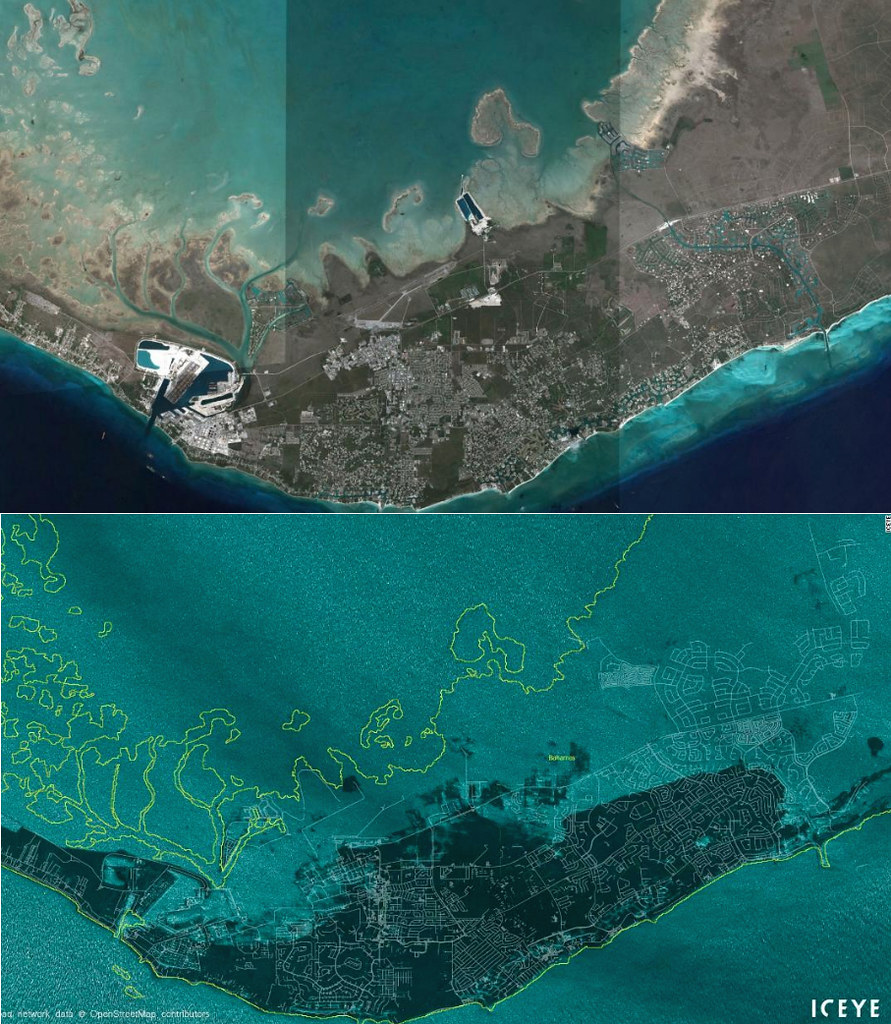
Grand Bahama island before/after Hurricane Dorian made landfall, Sept 1, 2019
Humanity has essentially documented its own demise for the last half century while the Keeling curve inexorably rises faster than ever. As MIT Prof Daniel Rothman says, “When carbon levels in the atmosphere spike dramatically, the web of life collapses.” We are now seeing a record 10ppm of CO2 rise every four years and have have failed to curb emissions growth let alone move towards any sort of carbon neutral world. Alternative energies remain a sliver of total global energy consumption. In fact, “the annual increase in global energy use is greater than the increase in renewable energy, meaning fossil fuel use continues to grow.”
The rise of political ‘populism’ and the election of reactionary politicians in the U.S. and abroad has thrown yet another monkey wrench into any possibility of tackling the climate crisis. The demagogic Trump administration is simply burying any scientific evidence and ignoring its government’s own research on such things as the recent surge in climate refugees from Latin America due to climate-induced food insecurity. Russia and Brazil have both encouraged and precipitated the wildfire infernos raging in their countries. The catastrophe unfolding in the Amazon is a direct result of President Bolsonaro’s neoliberal policies designed to plunder the Amazon much like Trump’s dismantling of the EPA and deregulation of corporations. Both ignore the science of climate change and the reality of ecological collapse. In the case of Russia’s Putin, it was a cold economic calculus: “If the cost of putting out these remote fires is greater than the profit that could be made from selling the timber, they can decide to let it burn.”

And then there’s the global debt bomb of $250 trillion waiting to explode, not to mention the $200-250 trillion global carbon debt which increases by 16 trillion every year. Meanwhile, banks are quietly shielding themselves from climate catastrophe at taxpayers’ expense by shifting risky coastal mortgages off their books and onto the federal government’s Fannie and Freddie programs. Just as the U.S. government is leaving vulnerable countries to fend for themselves, so are private institutions unloading the risks onto the public. For those at the very top of our economic pyramid scheme who control public policy, dwindling resources will be kept first and foremost for them while everyone else is treated as collateral damage. This dereliction of responsibility, this cutting and running, is how the deteriorating conditions of the world are being handled. Throughout history, society’s elite have shown the same arrogance and hubris in the face of impending calamity. For example, the Fall of the Roman Empire:
If you read the chronicles of the early 5th century AD, you get the impression of total mayhem, with barbarian armies crisscrossing Europe and few, if any, Roman nobles and commanders trying to defend the Empire. Most of them seemed to be maneuvering to find a safe place where they could find safety for themselves. We don’t know what was the final destiny of Rutilius Namatianus but, since he had the time to finish his poem, we may imagine that he could build himself a castle in Southern France and his descendants may have become feudal lords. But not everyone made it. For instance, Paulinus of Pella, another rich Roman, contemporary of Namatianus, desperately tried to hold on his possessions in Europe, eventually considering himself happy just for having been able of surviving to old age.
We see a pattern here: when the rich Romans saw that things were going really out of control, they scrambled to save themselves while, at the same time, denying that things were so bad as they looked. We can see that clearly in Namatianus’ poem: he never ever hints that Rome was doomed. At most, he says, it was a temporary setback and soon Rome will be great again.
Thunberg’s speech alluded to such behavior by the polluting nations:
For more than 30 years, the science has been crystal clear. How dare you continue to look away and come here saying that you’re doing enough, when the politics and solutions needed are still nowhere in sight. You say you hear us and that you understand the urgency. But no matter how sad and angry I am, I do not want to believe that. Because if you really understood the situation and still kept on failing to act, then you would be evil. And that I refuse to believe.
Yes, Greta, they are evil; they have access to every expert on the seriousness of the crisis and they are building walls and saving their own skin while continuing business-as-usual. Lest we forget, the fossil fuel industry’s own scientists accurately predicted the life-threatening effects of its product decades ago and not only did they do nothing to stop it, they funded and orchestrated a vast network of climate denial propaganda which continues to this day and have raced to exploit even more fossil fuels from the melting Arctic. When you consider that billions of people are going to die as a result, their actions become by far the greatest crimes against humanity ever committed. Make no mistake, our society is trading a livable planet for an unsustainable way of life that is irreparably depleting finite resources and altering the earth for eons, making it uninhabitable for organized human societies. Each day of business-as-usual further degrades the planet’s biodiversity.
“As the temperature rises, the patricians will seek refuge as polar migrants, or set sail on heavily armed ocean liners. Millions more will live in underground cities, anywhere to escape the sun. Dazzling reports of new methods for sopping up the gigatons of carbon dioxide will create ripples of enthusiasm and then fade in the next news cycle. Fisheries and agriculture will collapse, drugs will provide little solace, and everyone will curl up in a foetal position in the end, like the ash-entombed victims at Pompeii, whimpering in the inescapable heat. The likelihood of this outcome increases as the years pass and the smoke rises.”
~ Nicholas P. Money, THE SELFISH APE: Human Nature and Our Path to Extinction

Originally published at https://collapseofindustrialcivilization.com/2019/09/28/greta-thunberg-speaks-the-horrific-truth-of-humanitys-fate/
Comments (108)
Fascinating post. I'm not an expert on such matters, but I find it believable that we humans will face some crises of our own creation. Never pay today for what you can pay double for tomorrow. Even better, never pay today for what someone else can pay quadruple for 100 years from now.
Given our crazy human response so far, it is easy to just suspect that we're just fucked. Maybe it's too late. And people are eaten up with lots of other issues too. The sirens go off every ten minutes. Phantasmagoria. That doesn't mean I don't believe this particular siren, but it does mean that I'm desensitized. That girl is right enough in her outrage, I guess, but she's got the same DNA as the creeps who let it all happen. She's a member of the lucky generation for whom the abstract doom is no longer so abstract.
If humans were just animals (and I think they were), then it's hard to judge them. They were just too clever with tools and at the same time not tuned to think far enough into the future. They had a good run with a greedy algorithm. Their genius (adapting the environment to them) was their downfall. They were their own predators, but even this didn't keep their population small enough.
I can accept this as generally true.
Do you have any suggested courses of action? Or are we all aware of this, but due to the status quo, can do nothing but sit back and watch the planet burn?
My only idea would be a MASSIVE protest where citizens of all nations (well the developed ones anyway) refuse to pay taxes until new climate policies are enacted (do the masses have ANY other power over government? - sure we could vote, but that hasn't worked so well so far). But if there are not huge numbers involved, the tax dodgers will just be arrested.
Massive social mobilization would probably be required. Because of the economic impact of the policies that are now required, we're looking at the equivalent of a global communist revolution.
Social mobilization over the topic is increasing, the question is whether it will increase fast enough.
Otherwise our only hope is practical fusion soon, so we can sequester CO2 back out of the atmosphere.
Any opinion on why many right-wing factions deny the very serious danger and refuse to do anything about it?
And they like living in polar climates, I suppose.
Ah, so your strategy is denial, is it?
Climate activism is a good little racket. We throw them money, power and fame because we fear the apocalypse, but when the apocalypse doesn’t arrive they can say they prevented it.
Prophets should be judged guilty until they are proven innocent.
But all this doomsday rhetoric? Pure nonsense. Wasn't the end of the world through rapid climate change already scheduled to happen once in 2008 and then in 2012 as well?
Quoting NOS4A2
Exactly this.
Right. So to clarify your position, do you think that
a) CO2 does not have the physical characteristics that cause it to trap solar radiation in the earth's atmosphere.
b) An increased concentration of CO2 in the atmosphere does not strengthen the effect a)
or c) CO2 concentrations are not increasing?
Quoting Tzeentch
No, it wasn't. No idea where you got that from.
Quoting Tzeentch
And are you claiming that there are no powerful, wealthy people who'd rather deny climate change if it were real?
Anything that further increases the power or even just the credibility of the ruling political class is not desirable. I don't trust them, climate change or not.
Or you deny that the climate changes this is causing are cause for concern?
I'm saying there will be no doomsday.
It may result in difficulties, the scale of which is probably nowhere near what people are currently claiming. (mass extinction, the end of the world, etc.)
I think you may have misunderstood. I am not calling for the institution of 20th century communism. I am saying the amount of social mobilization required is equivalent to that of a global economic revolution.
Quoting Tzeentch
Because you don't believe there is significant anthropogenic climate change, correct? That's what that comment of yours usually implies.
Are you afraid to state your exact position?
Quoting Tzeentch
No-one (well maybe a few hardcore denialists) disagrees with that. Do you agree that anthropogenic climate change has a significant impact on the climate, i.e. that it could lead, within a century, to a rise of average temperatures by several degrees?
Hmm. SO this is based on - hope?
Quoting Tzeentch
You are of course sufficiently erudite to be aware that we are already in throws of a mass extinction?
It's highly questionable whether such a rise in temperature would be caused by man, considering the world has been steadily warming up long before man started burning fossil fuels and we are currently living in a cold period in the Earth's history, making a rises in temperature not just likely, but also inevitable.
Quoting Banno
Healthy skepticism more like. People have been making wild predictions about the climate for a while now. What I find worrying is the rate at which people forget the last charlatan and jump on the new bandwagon.
Quoting Banno
And the cause of this; climate change?
Puh-lease.
So you agree that we are presently enjoying a mass extinction?
Why not?
Because we do not know how to change our collective behavior fast enough. EVEN IF everyone agrees that we should make massive changes in the way we live, EVEN IF we know we should do this within 10 years, we don't know how to impose that much sudden and dramatic change on ourselves.
I can picture us all riding on buses, trains, bikes and our own two feet. I can picture us all being vegetarians; I can picture us all being energy thrifty. What I can't picture is getting us FROM where we are EVEN HALF WAY TO successful survival behavior.
Does anybody know how to trigger major simultaneous and coordinated behavior changes in several billion people -- within 10 years? Within 50? Never mind, 50 years will be too late to begin changing.
If we had a century to carry out change, we would still have problems doing so. We don't have a century. What will defeat us is the synergistic sword of Damocles causing too many challenges, one after another.
The threat, real as I think it is, isn't a near and present enough danger that get's people moving fast. Here it's 50F tonight, with frost likely in the next week or two. That's reasonably normal. On the other hand, Minnesota received 60 inches of rain this past year -- about twice normal. That's more like New Orleans annual rainfall. The last record rainfall was in 2016. not good.
In the long run we'll survive in small numbers, but in a culturally stunted milieu.
The climate is not changing fast enough for you? It should just get on with it, in order to convince you - scientific evidence taking too much time and patience?
So, bringing me back to my three questions:
a) CO2 does not have the physical characteristics that cause it to trap solar radiation in the earth's atmosphere.
b) An increased concentration of CO2 in the atmosphere does not strengthen the effect.
or c) CO2 concentrations are not increasing?
What do you think isn't happening?
It's a open-and-shut matter: the earth's climate is being radically effected by the addition of greenhouse gases to the atmosphere, caused by industrial activity. There are not 'two sides to the story', there is no doubt about the issue. It's being measured and observed, and the observations validate the theory. Questioning it is a simple denial of the facts.
That said, whether modern culture adapts or not is not such a simple matter. So the consequences are not straightforward, but the basic problem is.
Quoting Tzeentch
Ehh... Maybe? What does it have to do with climate change?
Quoting Echarmion
I've already answered those questions. Our views differ on whether it causes the end of the world or not.
There are plenty of different views about your use of the word "radically".
How dare you, Tzeentch, fly in the face of us doomsayers. Elvis Perkins sings in one of his songs, "I don't let doomsday bother me; does it bother you?"
Though I forget your name
I remember your sweet face
'Til Doomsday, fiddle-aye
Man, I went wild last night
Oh I went feelin' alright
I don't let Doomsday bother me
Do you let it bother you?
No you haven't. You sidestepped them.
You said:
Quoting Tzeentch
If you believe it's questionable, you ought to be able to point out what step in the physical process you think gives rise to the question.
If you can't do that, that suggests that you are either trying to fool us or yourself.
Oh, nothing... nothing at all. I'm not sure why you bought it up...
Quoting Tzeentch (my italics).
So you are now saying the notable drop in biodiversity is not a mass extinction? Ot that it is a mass extinction, but that's not cause for concern? I'm just trying to make sense of your position.
Quoting Tzeentch
Highly questionable to who? You, obviously; but perhaps you are just unwilling to be convinced? Others - those with a handle on such things - say otherwise. And they show us disconcerting facts, damn them; correlations, chemistry, physics and all that stuff.
Better you go on ignoring them.
But I suspect that even after it has, @Tzeentch will still be mumbling some excuse.
The species are fucking dying off, that's what it has to do with climate change. Most species evolved to fit a specific environmental niche. When the niche disappears, the species often goes with it. Environmental change like early or late arrival of blossoming dates or migratory bird arrivals can be curtains. in North America and Europe bird and insect populations are falling. This is really, really bad news.
Quoting Tzeentch
Ah. It's all in out heads. Perhaps cannot directly experience climate change; perhasp if we all ignore it, it will go away.
I don't agree.
But this doesn't matter, does it? If you're saying some prediction is wrong, you must be able to identify just where the prediction fails. If you can't do that, at best you're suffering from cognitive dissonance.
Two things;
- The conclusion that man's Co2 emissions are the primary cause of changes in the Earth's climate and average temperature.
- The conclusion that man-made climate change causes the end of the world.
There's something in this, perhaps, about bad faith. About being overwhelmed for the consequences for yourself rather than grief at your brother's death. About denying the evidence until it is too late.
Quoting Tzeentch
It seems that our interlocutor will not be convinced.
graph of co2 and temperature
But this, of course, is not evidence...
We have physical models telling us roughly how much of an effect how much CO2 in the atmosphere has. According to these models, CO2 is the primary cause. Do you disagree with the physics?
Other factors have also been conclusively ruled out by studies. What factor was overlooked or wrongly assessed according to you?
Quoting Tzeentch
I agree it will not cause the end of the world. It might cause a whole lot of death though. How many lifes are you willing to risk, and to what end?
The CO2 emissions by themselves aren't the primary cause, it's all the emissions from earth outwards - in due to fossil fuel sondages. Simply not burning coal or oil will do little in comparison to the stop of their exhumation which is public enemy number one.
Secondly, the end of the world as in the end of the established routine is an imminent and unavoidable reality. This is precisely Titanic gazing out at the tip of the iceberg, and one either takes heed or nonchalantly sinks the ship.
If mankind keeps pushing well past their boundary, it's obvious that the recoil will fling it off the planet.
See this language is what fuels skepticism about taking radical action to avert climate catastrophe. It comes off sounding like an excuse to implement a preferred system by certain leftists. If you read any of the comments on Reddit related to climate change, you will see all sorts of things about eating the rich, destroying capitalism, and forcing a one world government on everyone.
It will also sound potentially threatening to the mainstream. Who wants to be forced to drastically reduce their lifestyle? Do the developing countries want to be told they can't continue developing by the developed countries?
And how do we know that such radical economic and political polices won't be the wrong action? Maybe the only way forward is to adapt with technological innovation and encourage the markets to transition, instead of trying to force everyone to consume less, which would likely cause a worldwide depression, which means less innovation.
Nope. It won't happen. Also, we'll be adding a couple more billion while large parts of Asia and Africa finish catching up. Add to that the majority of the world's population who probably don't want to go along with making major sacrifices. It's nice and all if people who agree with Greta do that, but that will be offset by 7 billion people just living their lives. A few million protesting and riding their bicycles while going vegan is a drop in the bucket.
The only way is to adapt. But I also don't believe it will end civilization. Humans are very good generalists, and we have technology. We survived an ice age with stone-aged tools and migrated all over the planet thousands of years ago.
The climate and temperature are complicated systems; much more complicated than most people realize. The idea that CO2 is the primary factor in either of them is questionable. I would be surprised to find a scientist make such a claim, and there are certainly scientists who would dispute such claims (and I'd be happy to link them).
Quoting Echarmion
Humanity has coped with a changing climate since its inception. Nothing we do can stop the climate from changing, since it's a natural phenomenon. Whether we like it or not, there will be ice ages, warm-ups, droughts etc. in the future. If that reality hasn't sunk in, we best get used to it sooner rather than later.
https://www.carbonbrief.org/factcheck-what-greenland-ice-cores-say-about-past-and-present-climate-change
"Conclusion
Greenland ice cores provide a high-quality high-resolution estimate of past changes in temperatures, allowing more precise comparisons with observed temperature records than most other climate proxies. While current temperatures are likely still below the highs in the early Holocene around 7,000 years ago, they are clearly higher than any temperatures experienced in Greenland over the past 2,000 years.
Greenland is just one location and temperature variations seen in ice core records may not be characteristic of global temperatures. However, global proxy reconstructions have tended to show similar patterns, with current temperatures lower than the early Holocene maximum."
But of course you know you did.
Your data does not address that.
You're right. I confused you with Echarmion.
Quoting StreetlightX
There was no bigger point, other than
Quoting Tzeentch
And I think the source supports that.
Stupidest argument against climate change I've heard so far: "if climate change was real why are banks giving out 30+ year mortgages if there isn't going to be anyone alive to pay it back DUH"
At least this debate is bringing to light the mass ignorance and indoctrination of the world's global population..."Ignorance is the most violent element of society" -Emma Goldmam
Agreed!
Important to note that individualistic actions (as has been promoted for the last twenty years by neoliberal agendas) that places the onus solely on the individual (like turning off the lights!) is not only ineffective but false, and hides the true evils responsible at the centre of our economic and cultural systems, not just ~capitalism~ as it contemporarily it is, but the Judeo-Christian concepts of environmental domination, extractivism, and accumulation of resources beyond that merely needed for sustenance...culminating in modern day consumerism
Quoting Grre
Yep. I despise the way in which individuals are made to bear the brunt of climate change when the biggest polluters and the worst offenders are cooperations and factories. The little micro efforts - take a shorter shower, use less plastic bags, use the recycling bin - are so many distractions from the real locus of environmental destruction. That it disproportionally hurts the underprivileged and the disabled by driving up prices and making unavailable useful goods is environmental injustice in the extreme.
I'll lend you my support in geoengineering given a classical economic cost-benefit analysis. But, you have to reach a consensus on who stands to benefit the most out of climate change and who stands to lose the most. As it stands, given my memory, China, Russia, and some other countries stand to, yes, actually benefit from climate change. Agriculture will be dramatically changed by increased CO2 in the atmosphere.
Yet, as per @Banno's tragedy of the commons thread, a consensus on the net effects of climate change on the wealth of nations will never be ascertained:
Cheers; and as per that thread, the answer is not political, nor economic, neither can provide a solution. The issue is ethical.
Here you go: https://science2017.globalchange.gov/chapter/executive-summary/
Links for further reading are included. I'll also suggest https://en.m.wikipedia.org/wiki/Scientific_consensus_on_climate_change with several further links.
Quoting Tzeentch
So, how will we adapt to global average temperatures rising by 4 degrees? Any substantive ideas?
Yes, just another false narrative to justify our power structures and institutions...funny also how the loudest regressive right people are usually those who stand to lose the most by the deconstruction of these systems...ie. Donald Trump and his wealthy empire...or even a trend I'm noticing in my age cohort, youth-particularly white, male, upper middle class youth, feeling threatened by climate change, not because it affects the planet, but because in order to address it (ie. deconstruct current economic/social systems) means that it threatens what they perceive as their entitlement or birth right...by virtue of being rich white boys; they all seem themselves as the next millionaire, and don't like when women, POC/Indigenous, the poor, disabled are beginning to rock that particular boat...
If I recall we have agreed on a few things in the past :yum:
For some reason this comes to mind:
Yes, that was my second point. I don't believe climate change will lead to the end of the world.
https://www.coralcoe.org.au/media-releases/squid-could-thrive-under-climate-change
That a girl with Asperger's and an IQ to match her candor and concern over the environment has been chosen by the masses to represent the will and fortitude of the coming generation, which we (collectively or not) have essentially handed a no-win situation.
Let that sink in.
I'll admit I haven't read through the whole thing, but I've given the summary and some of its chapters an honest look.
One of the graphs that is used (in Ch. 1) to depict the increase in temperature is the following one:
The summary also claims the following:
"Many lines of evidence demonstrate that it is extremely likely that human influence has been the dominant cause of the observed warming since the mid-20th century."
Yet we see a steady upward trend from where the graphs start (~1880), including several spikes, which would question the anomalous nature of what we observe today. I'm curious how one would account for that.
Also, how would one account for some major criticisms of the climate change narrative, some of which are addressed here:
Global Warming: Fact or Fiction?
I don't necessarily believe everything that is said by 'climate skeptics'. Similarly I don't necessarily believe everything I'm told by 'climate hysterics'. I observe a narrative and a counter-narrative, both of which are quite likely fueled by political agenda.
Yea, but this isn't due to climate change, this is due to overconsumption, intensive farming, deforestation, heavy use of pesticides.
https://www.theguardian.com/environment/2018/oct/30/humanity-wiped-out-animals-since-1970-major-report-finds
https://www.bbc.com/news/science-environment-47441292
https://www.theguardian.com/environment/2019/feb/10/plummeting-insect-numbers-threaten-collapse-of-nature
For some reason people want to believe that CO2 emissions are the source of all those problems, they aren't, reducing CO2 emissions without addressing all the other problems won't save the environment, we are destroying it because we're consuming too much and destroying too much.
The focus shouldn't be on the CO2, it should be on those things. Even if the CO2 is as big a problem as some people make it out to be (let's remind ourselves that plants breathe it), we would emit much less CO2 if we addressed these problems (and absorb more CO2 without the deforestation), while we could develop technology to emit much less CO2 and still not address these problems.
There is a growing concern that there is a political agenda behind presenting CO2 emissions as driving us towards extinction, I don't have a definitive opinion on that but I wouldn't be surprised. And I wouldn't be surprised either if the climate models that are presented as "true" today and on which there is a "scientific consensus" turn out to be seen as flawed a few decades from now.
The real debate is whether the squid are orchestrating climate change on their own, or are being aided by extra-terrestrial allies. https://www.theguardian.com/lifeandstyle/2016/apr/07/conspiracy-theory-paranoia-aliens-illuminati-beyonce-vaccines-cliven-bundy-jfk
Homo retrogradia will return to a stone age existence for a while and eventually even lose that, as the intelligence its ancestors enjoyed becomes further and further beyond its grasp. By 120,020 CE, when anthropogenic global warming has long since resolved, retrogradia will clearly be a different species.
Who actually benefits from the hysteria raised by some kids with signs? The assassinated or the assassins?
It's not a no-win situation, it's an all in at the flop.
Not to mention that she's not an authority on the topic, and her frontal lobe isn't fully developed yet. But kids are great pawns to use to influence the masses.
I don't understand why we don't see climatologists marching in the streets or see them on the news explaining to everyone the crisis, if it is a crisis.
I don't disagree that CO2 has increased and human activity can be a partial cause. The spike is both a combination of human activity AND other natural causes. The problem is that we don't know how much is the result of human activity, and we only have records (that aren't exact) that go back to when the recent ice age cycle started (that we are still in).
Then it would be subjective.
The issue is scientific.
Yes, I've heard this somewhere before, that we are actually just entering a new cooldown period of the climate. Can you provide some links to this or is this just my imagination playing tricks on me?
I'm trying to look for it but I saw something where before the Industrial Revolution the trend was cooling, but the current rise could offset the next cooling. There are several factors that could lead to a new ice age that could offset the current warming though. Solar activity and slight deviations in Earth's orbit are something that we can't predict to far into the future that can have a larger impact than what human's are doing.
Should we have clean air and water? Sure. Absolutely. Should we study new sources of energy. Absolutely. But we shouldn't be promoting this idea as a crisis in order to raise taxes, which just get passed down to the consumer and hurts the lower and middle classes. We shouldn't be hearing about this mostly from one political party but from a-political, objective, scientists. Why is the media putting their cameras and microphones in the faces of politicians and asking them about climate change rather than asking the scientists themselves? Why are they using children instead of scientists?
Really? When the dinosaurs evolved, the CO2 in the atmosphere was six times what it was now, and it didn't result in the planet being uninhabitable for animals or plants. Granted, this happened over millions of years, so lots of time to adapt (and no doubt plenty of species went extinct), but animals also didn't have technology. We humans inhabit every climate on Earth from the desert to the arctic. We can pump water form hundreds of miles of way, we can desalanitize ocean water, and we can create climate controlled enclosures. We can also make new hybrid crops. And we can relocate farmlands to Canada and Siberia as needed.
Is climate change really going to make the entire planet uninhabitable? Is there any sort of scientific consensus that we're facing extinction, or just that it's best to mitigate the worst effects?
None.
“The story of its ruin is simple and obvious; and, instead of inquiring why humanity was destroyed, we should rather be surprised that it had subsisted so long.” - Nicholas P. Money
Right, climate models aren't civilization models, and the idea that the entire Earth will become uninhabitable for humans is absurd. Earth isn't Venus. As already mentioned in this thread, some places will probably fare better as more CO2 and warmer conditions benefit plant growth in northern latitudes. But anyway, we have geological history to know that Earth won't become uninhabitable. Fossils of prehistoric crocodiles and palm trees have been found in the arctic region. The question is what sort of difficulties civilization will have to deal with at different levels of warming, and what the time frame is.
If I wanted to subtly cull the populace, I'd produce 'climate change' as it'd be pretty hard to trace disasters to me while people are still dazed and recovering.
The Earth is not roasting, it's in the process of warming up a by a few degrees. The Earth has been warmer in the past, and colder. And warmer. Venus is roasting. Yes, the current trend is mainly because of human activity. No, that doesn't mean we will roast like Venus.
Hyperbole doesn't help. Life will adapt as it always has and so will humans. We just want to avoid the more difficult scenarios.
Roasts are slow, so come and remind me again in three years.
The warming is about 0.05-0.07 degrees celsius every three years. So a slow roast indeed. Climate scientists would like for emissions to drop to zero by 2050, or have that amount removed from the atmosphere to stay under a 2 degree warming since pre-industrial times to avoid more severe weather and greater sea level rise. Plus it's harder on some species or biomes like coral reefs.
But realistically, we will probably have to contend with a 2-3 degree warming, unless we can offset it with lots of trees and carbon sequestering.
Also realistically, we will have to accept that a certain loss of biodiversity is inevitable. EO Wilson put it at up to 50% by the end of the century. He called it the bottleneck before population peaks and starts to decline, and technology becomes more sustainable.
On a positive note, NASA recently revealed that the Earth is on a greening trend. We actually have more plant cover than in the recent past.
My point there was easy to misunderstand, apologies for that. To clarify, I don't advocate we Institute global communism to stop climate change. I just think that stopping climate change before a lot of significant damage has already happened will require a social mobilization on that scale. Otherwise, governments will keep appeasing the powers that be until either the damage becomes too great to ignore, or they collapse.
Quoting Marchesk
No-one wants that, obviously, but at this point it's necessary to prevent very serious damage to the biosphere, the consequences of which are hard to predict.
Quoting Marchesk
That's kinda what moderates are trying to do, but even relatively modest, market based approaches like taxing green house gasses are mostly failing because the political will isn't there.
Relying on innovation to prevent disaster is hugely risky. The more we do right now, the less fucked we are if innovation doesn't show up on time.
Okay, but what does that look like?
Quoting Echarmion
The problem is that if nobody wants their lifestyle drastically altered, then there won't be political will to implement those policies. Let's imagine the greenest democrat wins 2020 and tries to implement some serious CO2 and consumption reduction measures. How do you see that going?
Quoting Echarmion
Then it won't be there for anything more extreme. Politicians will simply lose elections and fail to convince their colleagues.
I don't see how the spikes, that is the fluctuation which is normal in complex systems, "question the anomalous nature". You can clearly see the trend. That is your answer - the trend is anomalous (and dangerous).
Quoting Tzeentch
Haven't had time to watch that yet, but the obvious first question is why we, as laymen, feel qualified to question the overwhelming scientific consensus based on watching a YouTube video? If we're basing our views about empirical questions on evidence, an overwhelming scientific consensus ought to be extremely good evidence, no?
Quoting Tzeentch
I don't really understand this position. The agenda of the climate change deniers is pretty obvious. They want to make more money. What do the "hysterics" stand to gain?
I have an inkling you're going to say "governments wanting more power", but the majority of governments is either indifferent or openly hostile to the "hysterics". You'd think that if China, the US, Russia or India thought they could control people with the fear of climate change, they'd push for action.
The trend, including the spikes, has started to occur before global carbon emissions were anywhere near the levels they are today. That undermines the assertion that mankind's carbon emissions are the primary cause.
Quoting Echarmion
The video features scientists that explain why they question the common narrative, using facts, graphs, etc. And there are tons like it. There is no shortage of scientists disputing the common climate change narrative.
What further fuels my skepticism is cases where climate skeptics are silenced and/or lose their jobs because of their concerns. Or how the fact that Michael Mann and his "icehockey graph" was exposed as being a fraud (in court), is kept almost completely silent.
Quoting Echarmion
Heck if I know. What I do know is that it isn't the large powers who are paying the bill for their own pollution. It's mostly small countries and toothless nations like the EU who do.
Yes: adaptable humans will make it IF they are located in northern climates, are not too numerous, have lots of resources, and have viable economies to produce the machinery to survive. The number of people fitting those specs are small, in relation to the rest of the planet.
There are definite limits to adaptation. Take the "wet-bulb-temperature": it's a measure of how much heat a human can lose at a given temperature and humidity level. When the wet-bulb-temperature exceeds our capacity to lose heat, we die--quickly, from heat stroke. It will become increasingly difficult to perform agricultural work in tropic and sub-tropical areas--in this century, in 30 years.
Most crops do not do well in high heat. Heavier rain makes it difficult to till soil, plant, and harvest. Beneficial and harmful insect populations are falling. A lot of food is dependent on pollinating by bees, a group not doing too well (and not just domesticated honey bees). Plant breeding is an option, of course, and one we had better hope works, but it's difficult to breed adaptable plants for rapidly changing conditions.
Good weather for growing cereals is being pushed northward; there is a lot of land not currently being used for crops that will become available. Unfortunately, most recently thawed northern land is going to be altogether unsuitable for growing much of anything. Thawed tundra will need thousands of years to turn into soil.
Adaptation will require a lot of energy use which will probably come from coal and oil, which will aggravate global warming. Cooling already uses around 10% of world energy production.
IF we were going to make it through ingenious adaptation, we would already be installing the massive new technology. I don't see that happening. Major technological system changes usually take around 50 years to invent, design, develop, and deploy.
The mobilization? Or the measures? The former, as I said, would probably look like a global revolution, people going on strike and electing "green" parties with absolute majorities.
Quoting Marchesk
It will only work if there is enough social cohesion and agreement about the necessity of the measures. Societies, including democratic ones, have made all kinds of sacrifices for war in the past. If we manage to treat climate change like a war, or some religious conflict, psychologically, people will do things they would otherwise not want to do for the cause.
Quoting Marchesk
Exactly. Hence why I say significant social mobilisation is required for anything to move. Humans in general are conservative, institutions are more conservative, and there is a lot of power behind fossil fuels to abuse that conservatism.
Pick a pesticide or herbicide and it's probably screwing things up. Neonicotinoids, a newer pesticide, is a known bee killer. Of course! That's what pesticides do. Kill insects. So, we should not be surprised.
But global warming plays a role. Insects and birds are affected by heat, as are their food sources. But I agree with your list of primary contributors -- overconsumption, intensive farming, deforestation, and heavy use of pesticides.
That doesn't follow. The trend on the graphs is visible from the 1970s onwards, well after humanity had started significant carbon emissions. That at the time, the concentration was still lower than it is today does not undermine the assertion that carbon emissions are the primary cause.
What would undermine it is if the trend started in, say, 1750. But it didn't.
Quoting Tzeentch
What is "no shortage" supposed to mean here? That there are more than 5, 10, 100? In relative terms, there absolutely is a "shortage", as various meta studies have shown.
Anyways, the video: The first scientist featured in the video is an aeronautics engineer with no formal training or background in a related subject. So, why should I listen to him concerning the topic of climate change?
Well I did anyways. The first 5 Minutes were a bunch of ad-hominems and self-congratulation about standing up to "the system".
So then we get to another borderline ad-hominem about the forest fire graph. Even without looking it up, it seems pretty likely that up to 1950, a lot more forest area was burned intentionally, something that would not have happened since. But regardless, it's obvious that the purpose of the argument is to undermine the credibility of the scientist that made it, even though Mr. Soon told us just minutes before that credibility doesn't matter, only the facts.
After that, more ad-hominem. An unjustified assertion that you only get awards for doing bad science. The graph at around 14:00 minutes is wildly misinterpreted. Then a non-sequitur about expecting more extreme cold weather (I suppose Soon thinks that this contradicts global warming, but of course that's nonsense). And more ad-hominem.
Well that was 10 minutes. Let's look at the next guy.
So now we have a professor for particle astorphysics and comsology. At least it's a professor, though I struggle to see how he has any qualification in the field. He starts talking about how politically independent his work about particle physics is. But of course, right now he isn't actually talking about his work in that field. And he goes on and on about that. Also he is not an expert in the field of climate science, as expected.
Eventually, he gets to the point: The politically charged nature of the field is sending the science "off the rails". Ok, interesting thesis. What does that mean exactly? Let's see some points.
- Many experimental results contradict the worst-case predictions of the IPCC. Ignoring for the moment that none of these results is mentioned, I would expect this to be the case for a worst-case prediction.
- Then, a book plug. Ok.
- This paper mentions that it's likely we get temperature data from the tropics wrong. Ok. What does that mean for climate science in general? Have we rechecked the numbers with that new info?
- Now the only actually interesting part is the chart about how baloon data doesn't agree with any of the predictions. Aaand we immediately use this to poison the well because we are going by insinuating someone tried to kill the author of the graph because of his views.
I did look up the graph though. Turns out there are a few problems with it. It uses a non-standard basline. It averages together the different satellite data sets and ignores the uncertainity in their measurements (these are not simple thermometers). It also uses the one dataset - that of the middle troposphere - that climate models are worst at predicting.
So, to summarize, I found one salient point, though that one point already has a bad rep. It also is not evidence against anthropogenic climate change, but merely that the rate of warming might be smaller that models currently predict.
The rest has, to put it mildly, not been encouraging.
Quoting Tzeentch
Can you give some examples for people "silenced"? And what do you mean that the "hokey stick" fiasco was "kept silent"? It was a hughe scandal. It was all over the media. It is, however, in the past, and newer models also show a "hockey-stick" curve without similar problems. Would you like every prediction to come with a disclaimer about how one previous model was publicly disgraced?
Quoting Tzeentch
And what does that tell you?
I am not saying that there is a right or a wrong answer in this scenario, what I am trying to explain is that your tone in the way you deliver your speech has a high impact within your audience's reaction.
We all know, or should know by now, that climate change is a big threat to our planet and the environment where we live in, and that it is not a joke that could actually end the period of humanity and make our planet collapse their ecosystems making it unliveable for us human beings.
However, the way Greta Thunderbeg deliver her ideas in her speech is a to an extent very aggressive and harsh, accusing people that actually have no power over this fundamental problem.
First of all, Greta Thunberg uses social media platforms as a principal form of delivering her ideas and campaign or advocate for climate change; which we know digital platforms abuse the consumption of fossil fuels that harm and prejudice our environment, this shows an inconsistency with her views and advocating for actions to solve and help climate change.As she could be doing his movement with other campaign or platforms alternatives that would not harm the environment.
Second of all, the way in which her shows her graphic in correlation of growth economies and growth of climate change are very subjective and that is not actually the way our world works. Her being an eleven year old, it is not hard to see why she may not grasp certain concepts of statistics and data.
I'm confused...like what platforms? Social media is paper-less, resource-less, and if I'm not mistaken Greta used wind power to travel across the ocean and fuel her basic necessities, ie. like internet...
She's sixteen, not eleven, and while I agree she is not a qualified climatologist, she is an outspoken public speaker with a huge following; have you ever considered the reason "real" scientists have not publicly come out with science change (though thousands have, its just that common people can't be arsed to read their papers/discoveries/understand what the jargon means) is that scientists with direct data on climate change are under persecution by regressive right political groups? The Trump administration has fired dozens of scientists I read, regarding this very issue, including cutting government funding to universities studying climate change...didn't the head scientist of climate at NASA quit because no one would believe him?? A sixteen year old in comparison, has no risk of career to lose, is not risking her livelihood because she is still supported by her parents, and in my opinion, is a brilliant writer and speaker; much better than some of the 40+ year old politicians we have quacking on and on
It should probably be noted that this was not her only speech, and it was by far the harshest one.
Quoting Seneca Advocate
Wait, the world governments have no power? Who does, then?
Quoting Seneca Advocate
That just seems to be an "argument from hypocrisy", but being a hypocrite doesn't make you wrong. So, ultimately, it's just a veiled ad-hominem.
There are several plots in there. Here is a projection based on the three UN population growth estimates where the red line is the highest population growth.
The threshold of 2 degrees or 1 trillion tons of additional cumulative CO2 would be exceeded somewhere in the 2050-2055 for all three population growth scenarios. This is while factoring in the increase of renewable energy from 6% to 15% since 1965.
The author concludes:
So unless crashing the economy long term is a solution people are willing to go along with, or there is some technological breakthrough reversing the trend, we're heading for the 2-3 degree warming, at least.
You are just not very good at the understandings, Harry.