
Why is the Hard Problem of Consciousness so hard?
Art48 2023-01-01
In a nutshell: because correlation doesn’t explain consciousness.
Consider a simple mouse trap. When the trap is set, the spring has more potential energy; after the trap is triggered, the spring has less potential energy.Suppose we knew the mouse trap was consciousness. Suppose we knew when set, the mouse trap experiences feelings of excitement and anticipation. And suppose after being triggered, the mouse trap experiences feelings of release and relaxation. The physical correlates are obvious: higher potential energy corresponds with feelings of excitement and anticipation; lower potential energy corresponds with feelings of release and relaxation. But correspondences utterly fail to explain how a mouse trap could be consciousness and experience feelings of any sort.

The situation is much the same with us. Rather than the simple potential energy of a spring, we have about 1.4 kg of grey brain tissue in a body which has all sorts of biological, chemical, and electrical properties. We can add quantum properties if anyone insists. But just as the wood and spring of the mouse trap in no way explain how a mouse trap could be consciousness, the laws of biology, chemistry, electricity, and quantum mechanics in no way explain consciousness—or even hint that consciousness is possible.
Imagine I’m walking on a garden path and see a branch lying across the path. I pick up the branch and place it to the side. Suppose we have complete knowledge of all the physical activities—all the biological, chemical, electrical, and quantum events—that occurred in my body. That knowledge does not explain my consciousness, no more than if a conscious robot moved the branch and we had complete knowledge of all the physical activities that occurred in the robot. Nothing in the four fundamental forces (gravity, electromagnetism, the strong and weak nuclear forces) explain consciousness, or even hint that consciousness exists. If consciousness somehow emerges from the fundamental forces, we have yet to understand how.
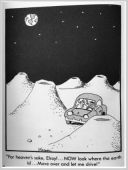
There’s a great Far Side comic where Elroy and wife are driving on the moon. Says the wife, “For heaven’s sake, Elroy! . . . NOW look where the earth is! . . . Move over and let me drive!” No amount of driving on the moon will take you to Earth. We seem to be in a similar situation: no understanding of physical processes, however complete, explains consciousness.
Consider a simple mouse trap. When the trap is set, the spring has more potential energy; after the trap is triggered, the spring has less potential energy.Suppose we knew the mouse trap was consciousness. Suppose we knew when set, the mouse trap experiences feelings of excitement and anticipation. And suppose after being triggered, the mouse trap experiences feelings of release and relaxation. The physical correlates are obvious: higher potential energy corresponds with feelings of excitement and anticipation; lower potential energy corresponds with feelings of release and relaxation. But correspondences utterly fail to explain how a mouse trap could be consciousness and experience feelings of any sort.
The situation is much the same with us. Rather than the simple potential energy of a spring, we have about 1.4 kg of grey brain tissue in a body which has all sorts of biological, chemical, and electrical properties. We can add quantum properties if anyone insists. But just as the wood and spring of the mouse trap in no way explain how a mouse trap could be consciousness, the laws of biology, chemistry, electricity, and quantum mechanics in no way explain consciousness—or even hint that consciousness is possible.
Imagine I’m walking on a garden path and see a branch lying across the path. I pick up the branch and place it to the side. Suppose we have complete knowledge of all the physical activities—all the biological, chemical, electrical, and quantum events—that occurred in my body. That knowledge does not explain my consciousness, no more than if a conscious robot moved the branch and we had complete knowledge of all the physical activities that occurred in the robot. Nothing in the four fundamental forces (gravity, electromagnetism, the strong and weak nuclear forces) explain consciousness, or even hint that consciousness exists. If consciousness somehow emerges from the fundamental forces, we have yet to understand how.
There’s a great Far Side comic where Elroy and wife are driving on the moon. Says the wife, “For heaven’s sake, Elroy! . . . NOW look where the earth is! . . . Move over and let me drive!” No amount of driving on the moon will take you to Earth. We seem to be in a similar situation: no understanding of physical processes, however complete, explains consciousness.
Comments (1674)
Another in a tiresome series of posts confusing the poster's personal inability to understand neuroscience with there being no facts of neuroscience to understand.
But confusion might.
https://thephilosophyforum.com/discussion/comment/433444
I'm always eager to correct my beliefs so if consciousness has been explained, please post some links to relevant papers and/or tell me who has succeeded in explaining it in terms of physical processes.
That would be much appreciated.
Your claim was not merely that it has not been, but that it could not be, explained (likened to trying to reach the earth from the moon by car).
We have not yet explained irritable bowel syndrome either. I don't hear much talk about the workings of the gut being ineffable.
Do you ever question why gravity exists? Or why pi is 3.14 and not some other number? Questions like "How can consciousness exist" seem to be in a similar vein to those.
And even if we answer it, what practical difference does it make? Or is it just pure curiousity?
Also, the Hard problem of consciousness presumes a dualist standpoint which comes loaded with plenty of problems (this being one). Perhaps then the issue is in dualism.
Yea, I see how that could mislead. My bad.
I am NOT saying that consciousness positively cannot be explained in terms of physical processes. (I don't think anyone can say that with certainty.)
In my defense, in addition to the moon comic, I do write “If consciousness somehow emerges from the fundamental forces, we have yet to understand how” and “We SEEM to be in a similar situation: no understanding of physical processes, however complete, explains consciousness.”
This is exactly what I disagree with. Look at the mouse trap thought experiment. The spring has 2 physical states which perfectly correspond to 2 mental states (1. excitement/anticipation and 2. release/relaxation). But such correspondence in no way explains how a mouse trap could be conscious.I'd say there are important questions unanswered.
That's the target of my criticism. We are closer to understanding consciousness, it's just very complicated. Consciousness is no more special an issue in neuroscience than gut motility is in gastroentorology. It's just one of the investigations people are working on where we know some things but questions remain about others. Just like virtually every other field in science.
OK, but doesn't neuroscience presume a physical explanation is possible? Before the Michelson-Morley experiment, it was presumed light traveled in the luminiferous aether. Physics texts of the time discussed the luminiferous aether as if it were a real thing and presumed the physics of the day could eventually explain its properties. The closest I've seen to a physical explanation is the quantum microtuble explanation but that explanation is still hypothesis and not universally accepted.
Come to think of it, we also don't know what mass or electrical charge is. We just know that it is something that behaves in a certain way, for example it is attracted to other things with mass or attracted to or repelled from other things with electrical charge. So there is a correlation (or association) between mass or electrical charge and a certain kind of attracting/repelling behavior. The problem with consciousness seems similar but more complicated: a conscious brain behaves in a certain way that is different than how an unconscious brain behaves but the behavior is more complex and sometimes so subtle that there seems to be no difference between the behavior of a conscious brain and the behavior of an unconscious brain. Also, consciousness doesn't seem localized on the level of elementary particles but on the level of very complex wholes. But in all these cases we can see that if there is a behavior then there must also be something that behaves. I think this is a special case of a more general truth: if there are relations then there must also be something (a non-relation) that stands in those relations.
I said that all the important questions are answered.
Quoting Art48
Such as?
Also do you consider "Why is pi 3.14 and not another number" an important question?
However, take a look at a fact that's analogous but doesn't elicit a similar woo-woo like response. According to Hubble the universe is expanding in such a way that the farthest objects (galaxies) from us are receding away the fastest. Scientists say that at some particular distance/time, the light from far, far away galaxies won't be able to reach us because space is expanding at a tremendous rate. These galaxies too, like the first-person, subjective facet of consciousness, are forever beyond science. This, however, doesn't imply these galaxies are nonphysical.
What justification is there then to conclude nonphysicalism from the hard problem of consciousness? I see none at all.
There is no causal explanation. (There is also no agreed upon definition of consciousness)
Also physical explanations are ruled out because mind or the mental are defined against the physical.
Pointing out which brain regions activate when I am seeing red does tell us anything about the colour nor do the light/EM wavelengths. Knut Nordby an achromatic colour scientist who learnt a lot about the physiology and psychology of colour vision but never experienced the colour red or anything beyond achromaticism.
All this is heavily discussed in the philosophy of mind and to some extent in neuro science.
"Knut was called the most famous rod monochromat in the world, but he was also a scientist. Having this condition gave him great understanding of both sides of achromatopsia, the scientific and the personal experience. When Francis Futterman connected Knut Nordby with Oliver Sacks, neuroscientist and writer, the result was the amazing trip to the Island of the Color Blind and the book that not only chronicled their trip but brought an understanding of achromatopsia to the world.
“My first clear memories seem all to be connected with nights and evenings, or they occur indoors in subdued lighting. As far back as I can remember, I have always avoided bright light and direct sunlight as much as possible. Photographs taken of me, and my siblings, during our childhood normally show us with nearly shut eyes, usually looking away from the sun, except when photographers demanded that we look towards the sun for the pictures. As a child I preferred playing indoors with the curtains drawn, in cellars, attics and barns or outdoors when it was overcast, in the evenings, or at night.”
Knut Nordby Vision of a Complete Achromat, A personal Account, Night Vision R.F. Hess, L.T. & K. Nordby
Knut Nordby passed away April 19, 2005 from Amyotrophic lateral sclerosis, ALS. Knut continued to work to the very end when he lost his courageous battle with ALS. He faced his situation with great courage."
http://www.achromatopsia.info/knut-nordby-achromatopsia-p/
Without some basic philosophy of consciousness they are just wasting everyone's time and putting others in life or death situations.
Here in Minnesota the prime example is the Dan Markingson case, who they assumed was suffering from a biological condition and enrolled him in a drug study. A few months later Mr Markingson was dead.
Because of the many ethical issues involved in Markingson's story, it is now used as a case study in many university bioethics courses.[14]"
https://en.wikipedia.org/wiki/Death_of_Dan_Markingson
You have provided no justification for this statement, because there isn't any beyond "Seems to me."
As Isaac wrote:
Quoting Isaac
Quoting Art48
As others have pointed out, it may be the particular organizational terms ( reductive causality) in which the sciences of physics and chemistry are rendered that has limited an empirical description of consciousness. Neuroscience believes it is beginning to make headway, and this is due in large part to an enrichment of the language of empirical causality. As dynamical, reciprocal forms of causation are adopted consciousness becomes amenable to modelling. So it seems that it is not an unbridgeable divide between subjective experience and the physical world that has been responsible for science’s difficulties in explaining consciousness. Rather, it is the restrictive ways we have chosen to render physical processes that is the culprit.
I would be fascinated to read about this.
Antonio Damasio is a neuroscientist who studies the biological foundations of mental processes, including consciousness. The book I have is "The Feeling of What Happens."
There is one question that this will not answer. What does is the experience of being conscious as that person? Its not really even necessarily consciousness depending on your definition. Its being. An apple is a group of living cells. What is it like to be an apple? To exist and realize you are an apple? Or a dog? Another human being?
To my understanding it is answering what it is like to experience being something that is the hard problem of consciousness. It is an impossible question to answer with our current understanding of the world. Does that mean that consciousness isn't biological or cannot be measured accurately by science? Not at all.
Thanks! Got it just now on Kindle. I'll give it a good read, but the prospects are dim for this kind of thing. As i see it, if one goes by a physicalist model, there can be nothing but brain awareness of brain awareness, and, of course, all of this is NOT brain awareness at all, because the very idea of brain awareness is itself lost in the reductive process to the "impossible". Rorty thought like this. To break with this requires an entirely different paradigm of knowledge relations; radically different. Can't imagine a neurological approach finding this. Talk about brain cells, axonal fibers and so on, begs a question that, not only has not been addressed, but cannot be addressed in any concept I can imagine in the closed systems neurological functions.
It still amazes me that almost anyone, almost anywhere can get almost any book, movie, or music just by pushing a couple of buttons.
Quoting Constance
I disagree with this. Scientists don't generally say that biology is nothing but chemistry. In the same way, mental processes, including consciousness, are not nothing but biology. But they are bound by biology in the same way that recorded music is bound by a CD or MP3 reader or radio. Music is not nothing but electronic equipment and electrical processes.
What does green sound like? How much does love weigh?
Just being able to string words together in question format doesn't imply an answer is wanting.
Anyone, here of all places, that cannot grasp this reality will miss the core feature of consciousness and our mental existence.
If it can't be known by science, how can it be known. How do you know it?... You don't.
In these cases, yes, they are nonsense questions. And in my case, using an apple as feeling was nonsense as well. I hope you didn't ignore the point to focus on one loose example. Can you know what it will feel like to be a bat without being a bat yourself? No.
The difficulty is not that we lack a theory (we have theories, but none are widely accepted or even compelling, afaik), but that we lack a theory of a theory: not only do we not know how material processes lead to consciousness, but we don't even know what a theory which explains it would look like. In other words, we cannot conceive it.
Quoting Isaac
The comparison is not apt. Even if it is not explained, we understand what a theory of IBS would look like: a cascade of biological processes, in one form or another, lead to and explain the observed symptoms. This is readily conceivable.
But we cannot conceive how a cascade of biological processes can lead to the observed symptoms of consciousness, because we cannot conceive how any physical process can lead to consciousness. There is an explanatory gap.
The difference here is that compact disk's relation to musical sounds is clearly explained by the science. Here, it is precisely this relation that science cannot explain.
:fire:
Quoting T Clark
:100:
You seem certain of this. Is this an article of faith? Or do you have evidence for this? Is that evidence conclusive?
Maybe. But not for this reason:
Quoting Mark Nyquist
Presumably there is a lot more you could say to substantiate this. By itself this is not enough.
Intuitively I agree. The answer to the question "Why can't all that happen without consciousness?" is rarely forthcoming. Yet that is what is needed for a plausible theory of consciousness in terms of physical processes.
As far as I can see, there's no reason to think that consciousness can't be understood in terms of principles we already are aware of. I don't see any hard problem.
That science has not explained. I see no reason to believe it can't.
Not faith, confidence. Could I be wrong? Of course. But the fact that many people cannot conceive that consciousness might have a physical basis is not evidence that it doesn't.
In order for science to do this, there must be in place at least some working concept of epistemic relations that is grounded in observational discovery. I can't imagine.
:up:
:100:
Quoting T Clark
:fire:
Integrated information theory is a stab at creating a theory grounded in direct experience. It's a beginning.
Okay, I'll look into it, but it would have to be something like an alternative to causality. The only way this can work would be two very radical ideas: S knows P is the issue. One cannot disentangle P from justification, and it really looks like P and the justification are the same thing, that is, the nexus of the epistemic connection is not to be separated from P itself. Causality (perhaps you've read some of the proffered solutions/failures to those Gettier problems, the severed head, the barn facsimile, e.g.s) does not, of course, carry P to S, to put it plainly. P is lost instantly in the causal sequence describing the knowledge connection. One radical solution is to say S and P are bound in identity: In some describable way, P is part of S's identity, and the brain/object separation has to be dismissed. Another way is come up with the magical connectivity that allows S and P to be altogether independent entities, yet epistemically joined.
The former is in the bounds of what a phenomenologist might defend. All things I witness are witnessed in sphere of my personal totality. I suppose we are in Kant's world here, or some derivation. Husserl had to address the issue of solipsism. For clearly when I know P, P cannot be foreign to my powers of apprehension; it has to be IN this somehow. For objects to be MY objects justifying my knowledge claims, there must be a "belonging" that intimates P AS P, and not P as something that is not P. If P belongs to my own epistemic constitution, then the intimation is possible.
Then, working with a physical model seems hopeless. I actually suspect that the brain does not produce conscious experience, but rather conditions it. Experience exceeds the physical delimitations of the physical object, the brain. Call it spirit??
The beginning of a theory of consciousness would just start with guessing at what kind of system could produce the experience of gazing straight ahead, being aware of sights and sounds in a seamless unity.
I think you're focusing more on the philosophy of propositions?
Quoting Constance
You're basically describing the hard problem, the point of which is that science needs to grow conceptually in order to have the tools to create a theory of consciousness.
The trouble is that on a physicalist model, and talk about nervous systems and axonally connected systems, neurochemistry, and the like, one is supposed to first get beyond a universal physical reduction. Of course, you can say, well, we just have to live with this and empirical science is the only heel that rolls, but I would disagree: A scientific idea has to have something to observe, and here, this would be self's interiority. This is not objective and empirical and science can't touch it.
Now Husserl called what he did a science because he was flowing the scientific method: observing descriptive features of thoughts, relations, phenomenal intuitions and so forth. Perhaps on the cutting edge of discovery is this century ago phenomenologist.
I certainly agree. I am coming to believe phenomenology holds the key.
"I can't imagine" is a pretty pitiful argument.
And worse, simply not true. I can imagine it. It is just far away from empirical science.
It's not complicated. Science (or at least a lot of it) begins with the presumption of objectivity, that it is studying something that really so, independently of your or my opinions. It assumes the separation of subject and object, and attempts to arrive at objective descriptions of measurable entities. And the mind is not among those entities. The hardline eliminative materialists will insist that the mind nevertheless can be described completely in third-person terms without omission. That is the target of David Chalmer's original formulation of 'the hard problem', for instance, when he says:
Quoting David Chalmers, Facing Up to the Hard Problem
My paraphrase of this is simply that experience is first-person. It cannot be fully described in third-person terms, as there must always be a subject to whom the experience occurs. What I think Chalmers is awkwardly trying to describe is actually just being, as in human being. And what I think the 'eliminativists' exemplify is what is criticized by philosophers as 'the forgetfulness of being'.
Husserl, as @Constance points out, anticipated this in his criticism of naturalism.
I don't want to get into a long discussion about how science has to proceed. I will say that there is no reason the mind would not be among entities amenable for study by science. You and @Constance are just waving your arms and promoting a ghost in the machine with no basis except that you can't imagine anything else.
From where I sit, there's no need to take this discussion any further. We clearly aren't going to get anywhere. I'll give you the last word if you want it.
Well, pack it and send it, and I'll check it out.
It's an interesting one, isn't it? I think at this point in history there are a few key issues left to people who wish to find support for higher consciousness/idealism/theism worldviews - the nature of consciousness, and the mysteries of QM, being the most commonly referenced. I don't know if consciousness is a hard problem or not. It seems to depend on what presuppositions one brings to it. Nothing new there. But I do know that it has become a 'god of the gaps' style argument, a kind of prophylactic against naturalism and a putative limitation on science and rationalism and their questionable role generating Weberian disenchantment in our world. I'm suspicious of the arguments and I'm not sure the matter will be resolved in my lifetime.
https://thephilosophyforum.com/discussion/comment/699384 :smirk:
The question simply makes no sense. What could an answer possibly be? "It feels like...?" What words could possibly fill the blank?
Quoting hypericin
Again, the fact that you don't personally understand the neuroscience of consciousness is not an indication that there's nothing there to be understood. Dozens of researchers in consciousness think they know exactly what a good theory would look like and they've constructed their experiments closely around those models. The fact that you don't grasp them is not a flaw in the model.
Quoting hypericin
I can. It's simple. Some collection of biological processes leads to the observed symptoms of consciousness. Why wouldn't they? What's in the way? What compelling physical law prevents biological processes from causing whatever symptoms they so happen to cause?
It really is not possible to prove what consciousness is, not free from assumptions, anyway.
Quoting Isaac
You were the one arguing that perceptions were effable. So you would eff whatever their perceptions are like to them.
Quoting Isaac
Cite one you think is satisfactory.
Quoting Isaac
"Why wouldn't they?" possesses exactly zero explanatory power. The question is rather "why would they?". Why would some neurological processes engender consciousness, and not others? What are the relevant mechanisms?
The Hard problem should not be regarded as a deficiency or bug of the natural sciences, but as a positive feature of the natural sciences; the semantics of the natural sciences should be understood as being deliberately restricted to the a-perspectival Lockean primary qualities of objects and events (for example, as demonstrated by the naturalised concept of optical redness) so as to leave the correlated experiential or 'private' concepts undefined (e.g phenomenal redness). This semantic incompleteness of the natural sciences means that the definitions of natural kinds can be used and communicated in an observer-independent and situation-independent fashion, analogously to how computer source-code is distributed and used in a machine independent fashion.
If instead the semantics of scientific concepts were perspectival and grounded in the phenomenology and cognition of first-person experience, for example in the way in which each of us informally uses our common natural language, then inter-communication of the structure of scientific discoveries would be impossible, because everyone's concepts would refer only to the Lockean secondary qualities constituting their personal private experiences, which would lead to the appearance of inconsistent communication and the serious problem of inter-translation. In which case, we would have substituted the "hard problem" of consciousness" that is associated with the semantics of realism , for a hard problem of inter-personal communication that can be associated with solipsism and idealism.
Then the last word would be this: It's not my last word. All analytic philosophers know this. The distance between objects in the world and our knowledge claims about them given a physicalist model simply cannot be bridged through empirical science unless there is a dramatic change of thinking here. The first move will have to be an abandonment of an ontology of physical substance, for this pulls all things toward Dewey/Quine's (and obviously others I haven't read) and science's naturalism, and this simply does not work. Just ask Quine:
[i]"When . . . I begin to think about my own verbal behavior in theoretical or semantical terms, I am
forced to admit that, here too, indeterminacy reigns. Philosophical reflection upon my own
verbal behavior, concerned with hunting out semantical rules and ontological commitments,
requires me to make use of translational notions. I then recognize that the intentional content of
my own psychological states is subject to indeterminacy: semantical and intentional phenomena
cannot be incorporated within the science of nature as I would wish.[/i]
From Quine (though he does remain true to his naturalism throughout, I have read) and others I am led to believe that an ontology of physical substance has to be replaced by one of radical indeterminacy. This frees our doxastic affairs dramatically, for at every turn we are not led to those absurd physicalist delimitations, as if "semantical phenomena" has its final vocabulary, as Rorty put it, in this primitive idea. At the most basic level everything is indeterminate, so we are left with what is given, and givenness is basis of Husserl's phenomenological ontology. The distance is bridged by concepts like 'proximity' and 'intuition' as there is no epistemic distance between me and this cup simply because the cup's being there appears without distance. Being IS what appears.
Of course, there is interpretative "distance" and this is a big issue. But then, distance, in the way it is talked about here, implies a distance from something, and one would have to posit that something to make sense of it. So, this implies our knowledge claims, the sound ones, intimate something of whatever-it-is that is there, undisclosed. THIS is where very interesting philosophy begins, in my thoughts: how to enunciate the appearances of the world to see if "Truth" possibilities of our propositions have any purport beyond their explicit propositional content.
I think there is a case to be made for a theistic worldview. I actually have an OP on the subject half-written. I'll finish it eventually.
But phenomenology is not about first person experience. This is a notion that issues from the very scientific perspective in question: here is a perceiving agent, there is a stone, and if phenomenology rules our thinking in this, the perceiving agent never leaves her private phenomenal space. Phenomenology does not think like this. It takes appearance as Being. I am there and stones are there and their existence is fully acknowledged as other than myself. My scientific conceptual relations with them do not change at all. All that has changed is now we are freed from the absurd ontology of physical materialism that makes it, not hard, but impossible to describe epistemic relations, which are THE biggest embarrassment of analytic's naturalism. What is left for philosophy is clearer analysis of what makes appearance possible.
Chalmers proposes that things like neutral monism or the extended mind would help us get closer to a theory of consciousness. He's flexible. But strictly speaking, he's part of the analytical tradition, so the physicalism you're speaking of is not essential to analytical philosophy.
Thanks for that. Then I will have to read Chalmers on the extended mind. But the more one speaks of such things, the more one leans phenomenology. After all, what is it that is "extended"?
That's what we want to know. Chalmers is a good start if you're interested in the philosophy behind developing a scientific theory of consciousness. He explains the difference between functional consciousness (the easy problem) and phenomenal consciousness (the hard problem.). He's very well versed in theory of mind and the amazing success science has had so far in explaining functionality.
How does this differ to idealism?
What does it mean for a perception to be 'like' something?
Quoting hypericin
I really don't think this is the format for discussion of neuroscience in detail (I've been there, without positive outcome). If you're interested, my preferred approach starts from Tulving's concepts on autonoesis, which were first identified in neurological terms by Emrah Duzel back at the turn of century (love saying that, it sounds ages ago), and Fergus Craik in an unrelated PET study.
You can look them all up, but without a basic understanding of the principles they're working from it's unlikely it'll make much sense.
Quoting hypericin
Why?
Is there a question as to why glutamate exists, why bones have the structure they do, why atoms are small, why stars are far away, why the sea is wet...
The correct view is that information exists as our neurons containing and manipulating mental content. This two part form is the physical reality of how information can exist.
Don't fool yourself into believing that the first thing about the environment of consciousness is understood.
Can you link a paper or article?
Quoting Isaac
Are you really suggesting that "why not? What's stopping them?" is an adequate answer to any of these?
I'm not a nihilist. I'm just a realist. The facts of humanity just aren't that optimistic.
We are so, so dumb. It's always the final paradigm.
If we are so stupid, how do you know this? With what mechanism can you establish the clever things we do not know but should? Does this imply you are smarter than most? Or is this more of a Socratic position?
Yes, no shortage of dumb at every human level. How do we avoid it? We are tiny specks in an endless ocean of matter that is oblivious to us. Maybe I'm a nihilist in some ways.
I have seen many things. Things "smart" people have never seen. So, just trust me? Haha. That'd be a first.
The blind lead the blind. We trust the blind because they're like us, blind. It'll probably take centuries, but the more the proliferation of truth, the more bizarre we will become. That's nature, not cowardly conformity
I find your statements unconvincing.
Our pride should come from our ability to persevere. Not our success, because we haven't succeeded. As it is, the cart is way out in front of the horse.
We think paradigms have shifted towards ultimate wisdom, but, just like our ancestors, human beings will eventually look back and call us fools.
Oh, really? Because I had my hopes on you being convinced.
Let's face it: The only things you find convincing are mundanities.
Isn't this what they call the hard problem - How does manipulating information turn into our experience of the world? The touch, taste, sight, sound, smell?
Isn't being aware of our ignorance the beginnings of wisdom (Socrates) and isn't ignorance quite different to being 'so, so dumb'? That latter seems a celebration of hopelessness.
No.
Idealism affirms that everything in the we encounter is idea. Phenomenology affirms it as reality.
Phenomenal consciousness and metacognition constitute the hard problem. There is something it is like to be you (or me) what is this? (And no, I'm not looking for an answer.)
Phenomenology affirms that idealism is accurate? So phenomenology is a monist view which dissolves the dualistic fallacy of mind and body?
How does phenomenology affirm the above?
Oh, are we highly aware or our ignorance? Or do we have so much pride we can't believe we're asinine?
I feel it's the latter. We are so satisfied with our progress -- we think so ridiculously highly of it -- that every fool is a wise man by virtue of possessing the human form.
We can't get to truth due to pride that denies reality.
This from "Facing Up to the Problem of Consciousness."
Quoting David Chalmers
I'm not sure how that is different from what I wrote. And no, I'm not looking for an answer either.
He's not suggesting that information processing gives rise to subjectivity. He's point out that it's two different things. There's functional consciousness such as seeing, and there's the experience of seeing.
Computers can see and process visual information. There's no accompanying awareness, though. Providing a scientific explanation for the experience that accompanies function: that's the hard problem.
I just don't see what the big deal is. I think it's just one more case, perhaps the only one left, where people can scratch and claw to hold onto the idea that people are somehow exceptional.
Since Chalmers imagines that once we have a working theory of consciousness, we'll be able to predict what it's like to be a bee, this clearly has nothing to do with human exceptionalism.
Chalmers is one of the most influential philosophers of our time. Seems like you'd be more interested to discover what his views actually are.
:100:
There's been very little discussion of the actual issue.
True. It's good to see you. Hope you're doing well!
Sounds like you are running some kind of back story with those cryptic references of pride. Why pride? Do you have some citations, or is this just some opinion?
There is no there there. Nothing about gray matter that is ever going to seem like consciousness.
And that's right.
Even though you've quoted the salient passage, you're not demonstrating insight into what the issue purports to be. The argument is about the first-person nature of experience - 'what it is like' is an awkward way of describing simply the nature of 'being'. Chalmers is pointing out that 'experience' or 'state of being' must always elude third-person description, because it's third person.
Whereas Daniel Dennett, who is Chalmer's antagonist in such debates, says straight out:
Quoting Daniel Dennett, The Fantasy of First-Person Science
So, Dennett is claiming that science can arrive at a complete, objective understanding of the human from a scientific point of view. There are many philosophers who have claimed this is preposterous - (Galen Strawson has said that he ought to be sued under Trade Practices for false advertising.) Among other things, this leads to Dennett's insistence that humans really are no different to robots, and that what we perceive as intelligence is really the consequence of the 'mindless' activities of billions of cellular connections that generate the illusion of intelligence (never mind that even an illusion requires a subject capable of suffering illusion).
Dennett's book Consciousness Explained was parodied as 'Consciousness Explained Away' or 'Consciousness Ignored' by many of his peers - not by your proverbial man-in-the-street but other philosophers, one of whom said that Dennett's claims were so preposterous as to verge on the deranged.
Nagel's review of Dennett's last book says:
Dennett is situated squarely in the middle of 'the blind spot of science' - there is something fundamental to philosophy that he is incapable of comprehending. So while I don't agree with Galen Strawson's solution, I certainly agree with his assessment of Daniel Dennett.
Quoting frank
Well, thanks! (although one of the reasons I had stopped posting for six months was because of this debate, I am continually mystified as to why people can't see through Dennett.)
Ok. He's popular so he must be right.
I do understand that. I even understand why it's hard to imagine that that experience could be explainable in terms of biology and neurology. It's just so immediate and intimate. I can feel that, but I just don't get why people think that is any different from how all the other phenomena whirling around us come to be.
The dilemma resides I'm humanity's pride
And people on the other side think the same about Chalmers. It's not an argument, it's name calling. I know you are, but what am I?
Quoting Wayfarer
I'm really glad you're back, but but I know you don't think things have changed in the past 6 months.
Dennett has a minority viewpoint. Don't sweat it. :grin:
So we vote to determine the truth now? Majority wins?
You only need an excuse for being wrong.
Oh, wait. I have a better one:
You have fallen prey to the Who gives a shit logical fallacy.
:lol: You said a mouthful, Cuz!
Your points remains opaque - the sentences are incomplete, seem to be constructed around some unstated presuppositions and do not argue a case with evidence or references.
What, for instance does this mean? "If you're not speaking as an aside to the ineffable, you're confused and wrong.' What do you mean by speaking? What is an aside to the ineffable? What do you mean by ineffable? What is confused? What is wrong?
Maybe I'm wrong, but it sounds like you are just saying: "Reality's a mystery, man."
Oh, and how are things 'ultimately their own finest definitions?'
You might as well have never lived as suffer the indignity of being you.
Not seeing the point of an argument is not a rebuttal, but flogging dead horses is also not productive.
I think it might be because many of the issues are conceptual and not empirical.
As I see it, all it takes is the removal of the word representation and using presentation or givenness instead. Michel Henry puts it like this:
Let us begin with indeterminacy. The first principle [i](of phenomenology) establishes a decisive correlation between appearance and being. This correlation impresses itself upon us with the strongest force because it is wholly immediate: when something appears, it happens to exist at the same time. This correlation is so powerful that it seems to be reduced [ramener] to an identity: to appear is thereby identically to be. When the principle says “so much appearing, so much being,” it intends neither the extension, nor in any fashion the intensity of phenomenological and ontological determinations that it brings together, but rather the common identity of their essence. It is to the extent that appearing appears that being thereby “is.”[/i]
There is no privileging of something unseen that is that which appears through the appearance, or that the appearance is a representation of. I observe the cup on the table and there before me in the appearance is the reality.
As to the dualistic fallacy, body, as opposed to mind, is nothing beyond what the appearance yields. All ontologies are reduced to the one status of what is simply there, before one's witnessing, analytic gaze. It is not "of" anything; but this does not mean the world is complete to the gaze. Taking the world up as it appears takes on a whole new set of analytical priorities. There is this indeterminacy and time is at the center of this: we are always on the cusp of an unmade future that calls for constant renewal, and seeing this is the what freedom is about. There are moods and fears and caring and all that is left out of science's paradigms are here given priority, for Being is not measured by quantifications on a space-time grid, but is measured phenomenologically, and here I follow Kierkegaard: qualitatively.
Science has never addressed the most salient feature of our existence, value. Phenomenology, I would argue, has this front and center.
Anyway, phenomenologists do say different things, but I think the above is a rough generalization.
I think it's because many of the issues are so personal. Our experiences are what is most who we are.
Whatever you're going on about, it has nothing to do with the hard problem.
In relation to the mind body problem it seems to be a problem for idealists but not naturalists. A problem in as much as 'physicalism' seems to be its target. The ontology held seems to generate the type of argument and its resolution. Which may partly be your point.
Quoting Constance
But you are only able to say this from the perspective you have chosen. For many philosophers there remains a Kantian distinction between appearance and reality as it is in itself. Can we just make this go away simply by using different words or concepts? How is this different to saying that we can solve the problem of the origin of life just by saying God created it? It's only solved if God is 1) real and 2) God created life.
If I say from now on I am a monist, that very act does not do away with the hard question even if it satisfies me, right?
But maybe I've missed something in your response?
There is one fundamental premise that really should preside over the entire inquiry: all one has ever experienced, every can experience, and hence ever know, is phenomena. It reminds me of an issue I came across regarding Freud and the unconscious: The unconscious was considered to be a metaphysical concept entirely, and I thought, no, for there is an evidential basis for it. But the response was quick, pointing out that it was not that the unconscious had never been directly experienced, but rather that it was impossible for it to every be experienced, encountered, and this is why it belonged to metaphysics. Not just unknown but impossible to know. Why? Because the moment it comes to mind to consider at all, it is conscious, and references to the unconscious are only references to conscious events, which in turn were the same. The unconscious cannot be even conceived as a concept. It is nonsense.
Here, anything that can ever be conceived, even in the most compelling argument imaginable, simply cannot be anything but a phenomenological event, for to conceive at all is inherently phenomenological. Nonsense to think otherwise. Consciousness is inherently phenomenological.
There is no way out of this, for the moment the effort is made, one is already IN the problem; unless, that is, Husserl was right, and that it is possible to achieve an awareness of the intuited landscape of all things that is pure and absolute. This, then, is not a matter for science as we know it. It lies with the "science" of phenomenology. Which leads me to reaffirm that philosophy is going to end up one place, and it is here, in phenomenology. There is quite literally no where else to go.
I can put something out there, but you won't like it. One has to understand that there is a whole other philosophical world that continues in Germany and France that is not popular in Anglo-American philosophy. I read this, often enough with genuine understanding I would say, but it is an acquired ability. Joshs seems pretty solid on this.
It is not a matter of just rearranging words. One has to argue. What is that Kantian distinction really about? Always one must go to the things that are given to see what there is that can provide justification. Kant had to talk about noumena; why? Either it is nonsense, or there is something in the witnessable, phenomenological (empirical) world that insists. This is where we have to look: what is it in the world we know that intimates noumena? What is there in the presence of things that is the threshold for metaphysics? How does one talk about such a threshold? One cannot say it, for it is an absence, and yet it is an absence that is in the presence of the world.
Of course, this sounds confusing, but metaphysics is not just nothing at all, like an empty set. This absence is intimated in the world, so it is part of the structure of our existence, and so, it is not outside of our identifiable existence as Kant would have it, but in it, saturating it, if you will, and it is staring you right in the face in everything you encounter. In the analysis of what it is to experience the world, it is clear that the language used to "say" what the world is is radically distinct from the existence that is being talked about. The cup is smooth to the touch, and warm, and resists being lifted, and so on, but all this language I use to describe the cup takes the actual givenness of sensation up IN a language setting. I call it a cup, but the calling does not, if you will, totalize what is there in the language possibilities because there is something that is not language in the "there" of it. It is an impossible other-than-language, and because language and propositional knowledge is what knowing is about, the understanding encounters in the familiar day to dayness of our lives something utterly transcendental. The cup is both clearly defined as long as I can keep it contained within familiar language, and, utterly impossible, because it is there, radically unknowable, for to know is to be able to say. Wittgenstein put it simply: It is not how things are that is mystical; but THAT is exists.
This is a hard idea to simply throw out there and expect to be well received. Nor do phenomenologists all agree with this. Heidegger held that language and existence were of a piece, and our existence is language, and I think this is right; but I argue (have read it argued, too) that IN this matrix of language-in-the-world, a transcendental affirmation is possible, and this affirmation occurs in-the-midst-of everyday affairs.
But the effort is worth it, reading phenomenology, that is. In this issue, the hard problem of consciousness, phenomenology is not just an alternative view; it is necessary and inevitable.
God is another issue, a metaethical issue. I hold that the impossible, the mystical Wittgenstein mentioned, is, as Witt agrees, is really about value, or meta-value.
This is something I've struggled with a bit. I know you can't talk about noumena. As Lao Tzu says, the Tao that can be spoken is not the eternal Tao. But I'm not sure you can't experience it.
Quoting Constance
This surprises me. Did Freud consider the unconscious to be a metaphysical concept? Seems unlikely. Not everything I am not aware of is metaphysical.
Quoting Constance
As I noted, I suspect this isn't true, but I'm not sure.
Quoting Constance
I've read a little about phenomenology and I don't get it. Wikipedia says
Quoting Wikipedia
But when I go to read about it, it is just a bunch of jargon and convoluted language. As if I need someone to tell me how to understand something I am intimately familiar with.
This lays out the question pretty well, although in different language than I would use. One thing I disagree with is equating the world of experience with the empirical world. As I noted in my previous post, I think it's possible to directly experience noumena, the Tao. It's just not possible to speak about it. When I start talking, then it becomes phenomena. Then I can measure it, name it, and conceptualize it.
Quoting Constance
This sounds as if you're agreeing with at least some of what I'm saying.
Quoting Constance
You already know I disagree with this.
Perhaps. Again, thank you.
Quoting Constance
I'm aware of the work of Husserl, Heidegger, Merleau-Ponty, Dan Zahavi and the alleged split in traditions. Good thing is, I am from neither.
Quoting Constance
I wouldn't presume to disagree with Kant and I have no commitments to naive realism - other than that's the world we 'appear' to play in.
Quoting Constance
I'm not sure I can say much of anything about the potentiality of such a threshold myself. They say talk is cheap.
Quoting Constance
This is unclear. Are you saying, as I do, that any philosophical worldview we can hold rests upon some metaphysical presuppositions? The 'saturating' part sounds a bit dramatic.
Quoting Constance
Yes - many philosophers have said that (which is ironic). This is a point which is debated endlessly of course and we arrive back at the nature of the ineffable and probably soon talk of beetles in boxes. I have no firm commitments in this space. I really don't know what langauge does or doesn't do. But I do accept language is not the real world, that it helps 'create' it and I have read enough Richard Rorty to be sympathetic to some of his ideas here (the decadent scoundrel!)
Quoting Constance
I used to hold pretty much this view when I was a boy. I was always struck by the multiplicity of possibilities present in ordinary objects - both familiar and strange simultaneously. Not sure what this brings us. Humans are meaning making creatures. We see faces in clouds too.
Quoting Constance
Sounds like we would need an entire thread on how transcendental affirmation may be possible in such cases. Perhaps, but it is not a given (if you'll forgive my use of that word).
I was stuck by this from Rorty:
We need to make a distinction between the claim that the world is out there and the claim that truth is out there. To say that the world is out there, that is not our creation, is to say, with common sense, that most things in space and time are the effects of causes which do not include human mental states. To say that truth is not out there is simply to say that where there are no sentences there is no truth, that sentences are elements of human languages, and that human languages are human creations.
Truth cannot be out there—cannot exist independently of the human mind—because sentences cannot so exist, or be out there. The world is out there, but descriptions of the world are not. Only descriptions of the world can be true or false.
Quoting Constance
I'm not sure I can see the connection, or how it would assist us with mind/body. Unless you are saying that all there is is experience - a monist ontology - and that phenomenology is our only pathway out of the badlands of Cartesianism.
Quoting Constance
Turns out I didn't dislike it. :wink:
Well, Tulving's paper is here https://psycnet.apa.org/doiLanding?doi=10.1037%2F0003-066X.40.4.385 but it won't give you much of an insight into how it's used in theories of consciousness without seeing also https://journals.sagepub.com/doi/abs/10.1111/1467-9280.00102 and https://www.pnas.org/doi/abs/10.1073/pnas.94.11.5973
Quoting hypericin
I don't think the question makes any sense at all. We don't ask why the speed of light is 299,792,458 metres per second, we don't ask why protein channels block certain molecules, we don't ask why water boils at 100C. Why would we expect an answer to the question of why these neurological functions result in consciousness. They just do.
We could give an evolutionary account, some natural advantage to consciousness. Random changes in neurological activity one time resulted in proto-consciousness which gave an evolutionary advantage to the creature and so it passed on that genetic mutation. There...is that satisfactory, and if not, why not?
Mainly because functional consciousness would serve all those purposes adequately. What evolutionary advantage is there to having the experience of hunger when all that's needed is some adrenaline here, some dopamine there, and voila.
"Some adrenaline here, some dopamine there" is the experience of hunger. there's not the mechanisms and then something else. The car isn't an additional thing on top of the engine, the wheels, the chassis, etc..
I approach the "first-person nature of experience" from the perspective of the difference between "inner and outer". If we allow the fundamental empirical principle that some things are experienced to come from inside oneself, and others from outside oneself, we can understand that the third-person perspective cannot give us any observation of the inside.
So in the sciences for example, we are always breaking physical objects down into parts, analyzing, and using instruments like microscopes, Xray, CT-scans, MRI, and spectrometers, in an attempt to get a glimpse at the inside of physical objects. However, no matter how far we break down these objects in analysis, and whatever we do with these instruments we are always looking from the outside inward. That is unavoidable, as the nature of what is called scientific 'objective' observation.
Now the first-person 'subjective experience' gives us the capacity for a true glimpse at the inside of an object, thereby providing us with true observations of the inside of an object (human being in this case). Therefore, when it comes to observing the inside of an object, first-person observations, rather than third-person observations must be considered as the true observations, therefore the basis for any real science of the inside of objects.
Why is the inside/outside differentiation important? The importance is demonstrated to us by developments in modern cosmology which reveal a process called spatial expansion. The cosmological evidence is very strong, such that spatial expansion cannot be ignored in any credible ontology. The reality of spatial expansion demonstrates to us that there is necessarily a real difference between the inside and outside of space itself, which manifests as time passes.
Therefore it is very important to differentiate between the inside perspective, and the outside perspective, and work with true observations from each of these, comparing the two, if we intend to get a true understanding of the active nature of space itself.
How do you know that?
Whenever our sciences leave us with an arbitrary starting point , this should be an impetus to start asking ‘why’ questions. Asking why a physical constant happens to be what it is is part of what led to the hypothesis that our universe with its constants may not be the only one , that perhaps an evolutionary development of universes produced a series of constants linked to each other via a genesis. Thus, ‘dont ask why’ was transformed into ‘this may be why’.
Quoting Isaac
To be fair to hypericin, the recent ambitions to explain consciousness were only possible as a result of innovations in thinking about biological processes which
removed the basis of those processes from traditional
accounts of physical causality. One cannot derive consciousness from a conceptually impoverished physicalist account.
Scientific explanations are grounded in empirical evidence, so it is nonsensical to demand of science an explanatory account of what empirical evidence is, which is what asking for a scientific explanation of consciousness amounts to.
If you're saying that the eye can't see itself, yes, that's a concern.
This makes a lot of sense to me, by which I mean I agree. This is why the hard problem may be hard, but it's not really a problem, just a question.
I'm with @Isaac on this one. There doesn't have to be a why. The speed of light has to be something. Why does there have to be a reason? Sometimes "just because" is a good answer to a question.
As for the multiverse, well, let's not get started on that.
I agree with this, but I don't see why it is a problem. Science is looking in from the outside. That's how it works. If we can look at every other phenomenon in the universe with science, why would we not be able to look at consciousness that way? Apples taste good, but we can learn most of what we need to know about apples without considering that.
Agree with this.
Quoting sime
Don't agree with this.
Rorty did understand this. you will find in a footnote in this book an emphatic denial of non prepositional knowledge, and I take this as simply the same thing I am saying here: once you put something out there in a statement, a thesis, you have, and this is really what Wittgenstein was on about in the Tractatus, you commit it to the finitude of language. I take issue where it is flatly denied that we can, through the understanding's conceptual pragmatic architectonics acknowledge the world as meaningful. Rorty decided to teach literature instead of philosophy for just this reason, for literature "shows" us the world rather than explaining it. But on the other hand, phenomenology is descriptive/analytic, and what I talked about is an actual part of our existence. After all, language never could exhaust the the world's presentative content.
That's a novel interpretation of Witt, isn't it? I think he was pointing out that when we propose to know transcendent facts, we're positing a vantage point that we don't have.
‘Why’ questions have to do with the fact that explanations in science aren't just about what works, they are about coming up with different ways of construing how things might work. The why questions the frame within which the ‘how’ works A reductive stimulus -response account of human behavior works, but only when we ask why it works can we begin to see alternative ways of modeling behavior that also work, but according to a different ‘why’. It is via a ‘why’ that we can turn an arbitrary mechanistic explanation into one that transforms the arbitrary and seemingly random into a patterned regularity.
‘Just because’ ignores the fact that facts are what they are because of their role within paradigms( the ‘how’) , and paradigms are upended ( the why) on a regular basis.
Science fiction has been calling for a theory of consciousness since Capek's RUR. Those who aren't interested, don't know why anyone would ask, and are irritated because philosophical texts aren't dumbed down enough for them, should leave those who are interested in peace.
Oh Frankie, Frankie, Frankie. Here, let me make some cocoa for you. I put in a marshmallow the way you like it. Now come over here and sit in your nice chair, drink you nice warm cocoa, and shut the fuck up.
Go back to the shoutbox where you belong, bub.
But to say it's arbitrary is to already frame it as requiring a reason (but lacking one). 'Arbitrary' doesn't make any sense in the context of things not even requiring a reason.
Quoting Joshs
I don't see how. In a multi-verse theory (which I make no claims to understand I should point out), we would have one speed and other universes would have another speed. That doesn't in the slightest answer the question why we have the speed we have, it only says that others don't.
Quoting Joshs
I don't see why not. I mean, I don't personally favour the reductionist accounts, but I don't see anything in them that somehow fails to account for consciousness. There's no fixed reason why consciousness can't be a direct physical result of chemical interactions. We only need allow such a narrative. Personally, it's not the narrative I find most appealing, but it's not ruled out in any way.
Quoting Joshs
Again, I think you're really forcing the question 'why?' into a paradigm-shifting role which is it only very tangentially involved in. alternative mechanisms don't require even a question of 'why?' let alone an answer. One can simply say 'it needn't be that way'. All it takes to shift paradigm is an understanding that things need not be looked at the way they are, that grounding assumptions can be questioned. none of those questions need be 'why?' they could be 'is it?'
Quoting Isaac
What circumstances do you think require a reason via those that do not? Some are perfectly happy with the current status of quantum theory , and others think it is lacking a deeper reason , or as Lee Smolen says, a deeper ‘why’, and so is incomplete.
What would we be saying about the nature of an event or fact such that it would be exempted from requiring a reason? Put differently, what kind of reality is it that cannot be potentially construed in an alternate way, so that we come to see it’s role within an order that did not exist to us previously?
Quoting Isaac
I’m not saying that placing the constants of our universe on an evolutionary spectrum removes all traces of arbitrariness in their numeric values. What it does is diminish the arbitrariness by placing these values within a larger order. This is analogous to the origin of species before and after Darwin. Pre-Darwin, the answer to the question ‘Why are there different species’ was , because God made them arbitrarily unique in themselves. Beyond this, no deeper inquiry was attempted. After Darwin, the deeper ‘why’ question could be answered ‘ because each is the product of an overarching process that allows us to relate one to the other via temporal genesis. Are there still arbitrary differences from one species to another? Of course, but the concept of species in itself is , since Darwin , much less arbitrary than prior to Darwin.
Quoting Isaac
What youre describing doesn’t sound like paradigm change so much as minor adjustments with an ongoing theory, which deals with questions of ‘how’ rather than ‘why’.
‘Is it’ suggests to me invalidation or disproof. We ask ‘is it true’ and answer yes or no. But for Kuhn , there need be no invalidation in order to investigate new orientations. The question isn’t ‘is it right’ or ‘does it work’ but ‘how does it work’ ? Don’t we choose one paradigm over other because changing the way we look at things ‘solves more puzzles’, as Kuhn put it? It seems to be that choosing the way that works by solving more puzzles, albeit differently, amounts to finding a why where there was none before. One cannot solve more puzzles without making correlations, connections and unities where they did not exist before. This is what a why question does, it is a ‘meta’ -how question .
That's what Bernardo Kastrup says. I think it's right, although I hadn't considered it from the perspective you suggest regarding the expansion of space. :chin:
It baffles me that you think any of these questions are unaskable, that they "just are". What a strange, pre-scientific mindset, like answering a question with "because god willed it". A few simple google searches will disabuse you. Sure, the physical constants may well be beyond our ken, but that doesn't stop us from asking.
Quoting Isaac
It is not satisfactory, because it answers the wrong question. The question is not, "why did consciousness arise in evolutionary history?" Rather, "by what mechanism does specific neurological activity give rise to consciousness?". Similar to how you can ask "By what mechanism does an engine, carburetor, wheels, etc, assembled as a car, drive?" "It just does", "God wills it", does not answer either.
True.
That's one way to get rid of a "hard" problem.
What exactly do you think the so-called "hard problem" is asking for?
Quoting Metaphysician Undercover
You mean inside and outside the body, no? My experience of anything internal to the body is not accessible to others. to be sure, so there is no possibility of identifying common objects of "inner" experience, as we would do with "external" objects. Is that what you mean?
That said, my experience of "external" objects is not accessible to others either; there is just the possibility of identifying, via reportage, common features between the experiences of different people.
The "easy problem" refers to explaining functions of consciousness like how memory is laid down, how the visual cortex works, stuff like that.
The "hard problem" refers to explaining the experiences that accompany function. Why is there an experience that accompanies sight? Why aren't we like computers that see, process visual data, and respond per protocols, but without any accompanying experience?
Science has the conceptual framework to address the easy problem. It lacks that framework to address the hard problem. To make progress, the realm of the physical will have to expand to include subjectivity. At first, the addition will be along the lines of what gravity originally was: just a name for something we know about. Adding gravity as a thing to be explained by science was the first step in creating theories about it. At the time, some people objected to including gravity because it was thought that this was an injection of mysticism into science. Fortunately, flexible minds prevailed and progress began. Same thing here (one hopes).
Right, I've read Chalmers (although years ago when at University) and I understand the basic distinction between functional and experiential consciousness, but that's not what I'm asking.
I'm asking what proponents of the "hard problem' think an explanation of why, for example, "there (is) an experience that accompanies sight", could possibly look like.
The problem as I see it, is that consciousness is (primordially) non-dual, and it is only our models and explanations of it that are inevitably dualistic, given as they are in language which is necessarily dualistic (i.e. couched in terms of subject and object).
So, I am yet to be convinced there is a coherent question there.
Doesn't sound like you're likely to be.
Are you? Do you believe a question should be considered to be coherent if we have no idea what an answer might look like?
That's what we did with gravity.
Alternately, we could say that to make progress, the realm of the physical will have to be rethought such that we recognize that the subjective was always baked into the very structure of physical science, but in such a thoroughgoing manner that it was never noticed. We artificially split it off it and now are trying to append it back on like a new object.
:rofl:
Nice. I've been pondering lately the notion that there's some quantum shenanigans at the heart of consciousness.
What do you think about the "eye can't see itself" issue? Is it ultimately futile to look for a theory of consciousness?
:clap:
Do you see any relationship with this and Heidegger's 'forgetfulness of being'?
Quoting frank
See The Blind Spot of Science:
Yes, exactly. Do you agree with that?
What I gathered from Chalmer's argument is that no amount of science can approach why consciousness is possible as whatever it is. The assumption that such a possibility can be directly associated with our experience assumes that they must be connected. And that assumption is what Chalmers is directly challenging.
:100: It's what I've been trying to argue for all along. The problem is one of perspective. Naturalism starts from the presumption of the separation of subject and object. From a methodological point of view, that is perfectly sound - when you are indeed studying objects. But humans are not objects - they're subjects of experience. That is precisely the distinction which the 'eliminativists' seek to get rid of - hence the attempt to describe human subjects as 'robots' or as 'aggregatations of biomolecular structures', and not as beings per se.
Yes, but that's not what the hard problem is about. It's about identifying phenomenal consciousness as a thing to be explained. Does the blind spot extend to that as well?
When Chalmers said 'Facing Up to the Hard Problem', what he's saying is that science can't describe 'being' (or 'what it is like to be' something) because it only deals with objects that can be understood in third-person terms. His paper is explicitly about what can't be described in those terms, namely, subjective experience. Whereas, as I said before, the eliminative materialists argue as follows:
Quoting Daniel Dennett, The Fantasy of First-Person Science
So, from Chalmers' perspective, there is something that the eliminativists are not seeing. And I'm saying, what it is that they are not seeing corresponds with 'the blind spot of science'. It's another aspect of the same basic issue.
(Incidentally, this also means that 'the hard problem' is not a problem at all outside that particular context. It's simply a kind of rhetorical device.)
I see.
It's a problem because we can never truly see the inside of an object. So sense observations of an object are always observations of the outside of things. No matter how we divide the object into parts, or peer at those parts through Xray or MIR, we are always looking at the parts as objects themselves, and we are looking at them from the outside. However, with subjective first-person experience, we actually get real observations of the inside of an object, oneself. Therefore, unlike the usual scientific observations which cannot observe the inside of an object, first-person conscious experience gives us real observational information from the inside of an object.
So, sure we can look at any phenomenon in the universe with the scientific method, but we cannot see the inside of any object that we look at with the scientific method. However, we can directly experience the inside of an object through subjective first-person experience, so this is the route we need to take toward understanding the inside of things. And, as I mentioned, with the discovery of phenomena like spatial expansion it becomes very clear that we need to understand the inside in order to get a grip on reality.
Quoting Wayfarer
The expansion of space is a difficult issue to wrap one's head around. I think it calls for a two dimensional time. But consider that if space expands, it must expand from every point outward. This means that there must be a multitude of such points with an expansion around each. And since the structures we know exist in the expanded space, the points must be connected somehow through the inside, in order to support coherent structures in the outwardly expanded space.
Quoting Janus
The point was that the only way to observe the inside of an object is through the first-person conscious experience. The methods of science cannot observe the inside of objects. Then I gave the reason why I think it is important to develop an understanding of the inside of objects, in our quest for understanding reality
Yes. Perhaps one's head would need to expand correspondingly.
It's not clear how what you say here relates to what was being discussed. We can't see the inside of objects unless we break them open, then we can. We can observe the cellular and/ or molecular structures of wood, stone or steel and so on, and it is science that has given us the instruments that enable us to do that more comprehensively than the unassisted eye will allow.
Quoting Wayfarer
Language itself is based on this presumption. All our discursive understandings of the world, and even of ourselves, are dualistic. "Subject and object", "cause and effect", "substance and attribute", "mind and matter" and so on.
This is true of many things science studies. We don't see electrons, protons, quarks. We look at them by smashing them together and watching the parts spin off. We can't see the inside the sun, but we look at neutrinos and the results of spectroscopic analysis. We can't see inside black hole and neutron star collisions, but we can look at gravity waves. We can't see much more than a couple of miles into the Earth, but we can look at seismic and gravimetric data. We learn about things by looking inside them all the time - x-rays, cat scans, mri. There's no reason our minds should be any different.
Quoting Metaphysician Undercover
I'm not sure if this is what you're getting at, but it is my understanding that the expansion of the universe leads to galaxies moving apart, but features within galaxies, e.g. stars, do not. The Earth is not moving away from the sun.
Quoting Metaphysician Undercover
As I've noted, this is clearly not true.
No, that's the problem, breaking an object in two allows us to see the outsides of two objects, not the inside of one. Every time we take something apart, we remove the parts from their proper place as a part of a whole, such that they are no longer parts of a whole, but are each a separate object, a whole.
Therefore we have two distinct perspectives. A part receives its function, and its being, its very nature as a "part" by existing as a part of a unity. Therefore there is a relation of necessity between the part and the whole, the part has no being without the whole. But a whole is not necessarily a part of anything. So the necessity is a one way street. Because of this, every time we take apart an object to look inside it, and look at a part of it as if it is an object itself, a whole itself, we do not see the relation of necessity which the part had with the whole, prior to being dismantled, because the newly formed object (whole), now has no necessary relation as part of a larger unity. So we don't see it properly as a part, we see it as a whole. And something is missing from what we see, that is what makes the whole greater than the sum of the parts. This inclines us to misunderstand the order of necessity, and the nature of causation in general. On the other hand, when we look inward at the first-person experience we see the causation more correctly, by the cause of our own actions as an outward process towards an external necessity.
Quoting T Clark
But what you describe is not "looking inside" things. It is looking at the outside of things and making inferences about what is happening on the inside through theories and logical inference. We see effects on the outside and make inferences about the internal causes. So you claim that we look inside objects, and you give examples, but your examples obviously do not support your claim.
Quoting T Clark
This is how spatial expansion is commonly modeled, but it's very problematic. How could we create a boundary, even in principle, between the space which is inside a galaxy and not expanding, and the space which is between galaxies and is expanding. There would have to be two different types of space, the space with massive objects in it, which doesn't expand, and the space without massive objects in it which does expand, along with an obvious boundary between the two. But that's really just a poor representation, and what is really the case is that physicists do not at all understand the relationship between space and massive objects. I think that's what the famous Michelson-Morley experiments demonstrated to us.
Problematic or not, astronomers have measured the red and blue shifts of stars and even planets within the Milky Way, our galaxy. They are not moving toward or away from each other. According to what I've read, gravity between parts of an individual galaxy is strong enough to overcome any local expansion.
Quoting Metaphysician Undercover
The Michelson-Morley experiments measured the speed of light in different directions. They didn't have anything to do with gravity or the expansion of the universe.
No. I take a picture of with an x-ray that I can look at and see what is inside the person. How is that different from taking a picture of that person and seeing what their outside looks like. They can insert a thin camera attached to a fiber-optic cable and take pictures of what is inside me either by making a small hole or going in through one of my natural orifices. I'm scheduled to have one of them stuck up my butt in a few months.
You are making an artificial, unsupportable distinction in an effort to hold your argument together.
I think some philosophy has been concerned with that. Heidegger tried to achieve an understanding of being with discursive analysis in his earlier philosophy, but after the "Kehre" (turning) he saw the only possibility as being in allusive poetic language as I understand it.
I think philosophy can realize its limitations, but I can't see how discursive knowledge or understanding of non-dual reality, being, consciousness, is possible.
Quoting Metaphysician Undercover
I think you're being pedantic. If I want to see the structure of the inside of a stone or a piece of wood I can break it open to reveal it. I could also use xray or some other imaging technology to "see inside" the object if it isn't practical to break it open.
It's compelling that thinkers like Chomsky are mysterians on the basis that we don't have a coherent theory of materialism in the first place. Metacognition suddenly seems more readily explicable than the existence of a material 'reality'. What's Chomsky's marvelous quote? "Newton exorcised the machine, leaving the ghost intact..."
Do you hold a view that science in its conventional mode will resolve this matter, or will this one need a paradigm shift?
that is the inside of their body, not the inside of their experience.
I gather your question is about the latter, and my standpoint is that consciousness, being non-dual. cannot be explained or understood in dualistic terms, and that via meditation it may be understood, but not in discursive terms.
Phenomenology, insofar as it understands consciousness to be intentional, is still working in dualistic terms, and I see it as helping to understand how things seem to us in our everyday dualistic mindset; I don't see how it it can offer anything beyond that.
This is exactly what eliminative materialism does. It literally forgets or neglects its own role in the construction or construal of 'the world', instead trying to eliminate the very faculty by which the world is construed or 'realised' in the first place. (This is why critics of Daniel Dennett's first book parodied the title as 'Consciousness Ignored'.)
Also see this blog post on Husserl's concept of 'the natural attitude':
*In the idiom of Zen Buddhism. this is the stage of 'first there is a mountain' i.e. unreflective realism. Heidegger would go on to enlarge on all of his themes in his later work but even though he differed with Husserl, they have some elements in common. (I'm only just starting to study Being and Time but you can see how that 'everyday attitude' is reflected in Heidegger's comments on 'das man'.)
:up:
Reasons are human-related (when distinguished from mechanics). If ask "why did you smash that vase?" I'm not expecting "because my arm raised, my hand released it and that caused it to smash". I'm asking about your motives.
In Physics, chemistry, neurosciences...etc, the distinction doesn't make any sense. There are no motives, to 'why?' and 'how?' are the same question. As I alluded to earlier, about the closest we could get to a distinction is in evolutionary sciences where 'why?' refers to the evolutionary advantage, and 'how?' refers to the genetics, but even there it's just convention. we could ask 'how?' of evolution too and get a good set of theoretical answers.
Equally, if I asked a physicist 'why did the vase smash?', he might say 'because gravity pulls objects toward the earth and brittle things like vases smash on impact'. That's considered an answer. I could ask why both those laws are the case, but all I'd get is further, more fundamental, rules. At the end of my questioning there'd always be 'it just is'.
What the proponents of the 'hard' problem' seem to want is to forever maintain a type of answer which, by definition, will not be satisfied by mechanics or 'it just is', but since we have no such answer in any other field of human inquiry I cannot think of a reason why it's odd that we don't have one in neuroscience. I can't think what such an answer would even look like and neither, it seems, can any proponent of the problem.
Quoting Joshs
Roles within previously hidden orders are just more mechanics though (unless you're implying teleology). Say we found an entirely new function of the brain, something we didn't even know it did (let's say it taps into morphological fields) and we discover that consciousness plays an essential role in that. Does that answer the 'hard problem'? Apparently not, because if I theorise it plays an important role in survival (evolutionary advantage) that's not an answer apparently. So why would another role in another system be any more of an answer?
Quoting Joshs
Exactly. Darwin found a mechanism for producing multiple species. The answer to the question 'why are there so many species?' was 'species evolve by natural selection and this process produces many species as a consequence of its mechanisms'. The answer to the question 'why doe we have consciousness?' is 'our experiences are produced by the brain activity and the mechanisms of the brain are such that experience is a consequence'... only apparently that isn't an answer either.
Quoting Joshs
Yes, I agree, but you can't have your cake an eat it. Kuhn shows us how paradigms are discontinuous, they are not answers to the questions left by the previous one (that would merely be a continuation of the investigation within the previous paradigm) they a new ways of framing the problem such that those question become meaningless. So the mere possibility of a new paradigm doesn't mean the questions in the prior paradigm are unanswered, just that they might, in future become obsolete, or meaningless.
We don't go around saying that physics hasn't answered the question of acceleration due to gravity simply because a new paradigm might one day make that question obsolete. It has answered it (9.8 m/s/s) and a new paradigm might one day make that answer obsolete.
You're asking for the cause of a description, not an event or state. 'Experience' is the description we give to the neuronal activity, it's not another thing on top of the neuronal activity which needs further causal explanation. Neuronal activity doesn't cause experience, it is experience. 'Experience' is a word we use to describe it. Only there's a disconnect because of the anomalous monism inherent in our linguistic practices relating to the world that language brings into being.
It's like asking how all the individual horses cause the category {horse} to exist. They don't. horses are things, the category {horse} is a human linguistic convention.
Likewise neuronal activity is within neuroscience, 'experience' is within human linguistic conventions. the one doesn't cause the other in any way other than the way in which we choose to relate the two (or conceptual models). 'Experience' simply isn't in the same conceptual model as 'neurons' so we can't derive one from the other without some act of translation and that act will just be made up, it's not a fact we discover.
Quoting hypericin
A car driving is a physical act, it's within the same conceptual framework as the levers and gears that work the car. 'Experience' is a description, not a thing. It's not in the same conceptual framework.
An x-ray does not allow you to see the inside of a person. It allows you to see the outside of specific internal parts. The fact that the x-ray goes right through some parts and not others indicates that it is not really showing us the inside of a person. It simply makes some parts appear transparent. Seeing through some parts for the purpose of looking at other parts is not a matter seeing the inside of anything, because some parts are unseen and other parts are seen from the outside.
You are clearly not understanding what I am saying. Do you think that when you see a fish in a body of water, you are seeing the inside of the water? And it is the same thing for the fiber-camera, it as well, shows the outside of some internal parts, by passing around others.
Quoting Janus
Making oneself appear as a pedant is what is required if one is trying to understand the intricacies of nature. Have you read how Plato portrays Socrates? Being pedantic is a requirement of good logical process. As they say, "the devil is in the details". When our theories fail in accounting for the details, the theories are flawed. That's plain, simple, and obvious. Why deny the existence of flaws, just because they appear to be minor?
The fact is very clear, that these methods you propose do not adequately show us the inside of any physical objects. And this is because we have no proper theory which distinguishes the inside of an object from the outside, therefore any proposed definition is ambiguous or arbitrary. This is the biggest problem with systems theory, it assumes objects called "systems", but employs arbitrary principles to distinguish inside the system from outside the system. Until we have real ontological principles whereby we can make a justified distinction between inside and outside, knowledge produced by such theories will be fraught with unreliability.
Quoting T Clark
Actually, I am just stating what is very obvious, the obvious deficiencies of the modern scientific method. Scientists proceed as if there is no real difference between the inside and the outside of physical objects, so if such boundaries are employed they can be placed wherever they want. (This is what the examples of you and Janus show, an arbitrary "inside".) Yet conscious experience gives clear evidence that there is a very substantial difference between the inside and the outside. You, being a proponent of scientism, simply deny that reality, and dismiss the evidence with the prejudiced claim of "unsupportable", implying that you already presume that there cannot be any evidence. Or, in the case of Janus, there is a dismissal of people who try to point such details out, as being pedantic.
Quoting Wayfarer
Absolutely, and Husserl’s natural attitude.
When this started, that is what I thought we were talking about, but @Metaphysician Undercover didn't seem to be making that distinction.
I think I understand, but I disagree. As far as I'm concerned, we can leave it at that unless you have more to say.
I think that is an interesting way to put it because it identifies this historical ontological distinction as hermeneutical, merely. And I think this is close to right. Wrong thinking is interpretative error, and it can construct imposing towers of meaning that become internalized in a culture and its history, and when you are in it, it is second nature, so to speak. Phenomena, by this thinking, is a term that is part of a construct created by philosophizing subsets in our cultural. Heidegger thought like this: We make truth, and the importance of things along with the "measuring, naming ,conceptualizing" rests with historical possibilities. I think I am aligned with you in that I think these historical possibilities cover up "something" that is revealed in a reduction that removes implicit knowledge claims from the "moment" of encounter. This something is inherently, what could you call it, value-cognitive, where the cognitive part refers to the fact that the understanding is engaged.
But you know there are problems with this: Is the self's phenomenality really so removable from "noumenality"?; if language's categories are responsible for this division only, and to think at all is to think categorically (in a finite totality of meanings), then it is thought that holds us captive to this illusory separation and the method chosen to remedy and redeem has to be one that ultimately removes us from the bounds of thought. But what of the self? Hasn't the self been reduced to a Jamesian infantile "blooming and buzzing"? And what of experience as a self-belonging set of affairs? What happens when the strictures of thought are removed and the self is truly decentered; is it not thereby dissolved altogether?
When I think of the meditative "method", the allowing of thought content to fall away from consciousness, while sitting quietly, I am struck by its annihilative nature. It really is the most radical thing a person can do, one could argue, this annihilation of the world. But if language falls away, so does understanding and knowledge, and agency is lost, and one is no longer "there" to witness anything. Perhaps the "direct experience of noumena" should not be so radically conceived. This term 'noumena' I am not that comfortable with because of its Kantian association. I prefer "pure phenomenon" for the act of reducing what is there, in our midst to what is strikingly "other" than the language that conceives it, but the what-is-there doesn't go anywhere. As I apperceive a rock, the "noumenal" rises to awareness as the language falls away, but that singular event is still your event. The purity of the perception occurs IN the historically embodied apperceiving, and it was there all along (like the Buddhists say when they claim the "Buddha nature" is never absent).
Or better, one that cannot be had at all, which makes the difference.
Analytic philosophers like to say that that which must be passed over in silence is really nothing at all, and the entire mistake lies with language going where it has no business, because there is no business to be had. The Tractatus does not agree. I don't want to labor the point, because I am well aware this book does not exhaust his thinking, but then, if the question is about the "hard problem of consciousness" one has to go where the issue is met, and what makes consciousness a hard problem is its encounter with, call it, the "other side" of language. I talk about my cat, but the talk about cats, their size, dispositions, and all of that ignores something that underlies all of this: its existence. Witt calls this mystical, not nothing. And he holds the same regard for ethics and aesthetics and their "value" dimension. Russell called him a mystic not because he was just disagreeing, but because Wittgenstein actually called himself this, implicitly.
I agree with all of that. I think the quest for a theory of consciousness will be a grand adventure. It's fed by a lust to know. Maybe it will generate technologies that allow some aspect of subjectivity to be recorded and that could be used for medicinal or artistic purposes.
Every step of the way, someone will be pointing out that we're fooling ourselves and the truth we're finding is relative to a particular culture? That's ok. That's always how it is, right?
I'm a bit lost with this kind of language. In a previous post, I wrote that I didn't hold much with phenomenology. Since then, I've decided to put some effort into learning at least the basics so I can participate in these types of discussions more productively. What would recommend as Phenomenology for Dummies?
Quoting Constance
I am not a meditator, at least not in any formal way, but I think this misrepresents the meditative process, although I've heard this type of criticism before. Awareness without words is possible without any kind of annihilation. I come to this from my interest in the Tao Te Ching. Lao Tzu talks about "wu wei", which means "inaction," acting without intention. Actions come directly from our true selves, our hearts I guess you'd say. Lao Tzu might say our "te," our virtue. Without words or concepts. I have experienced this. It's no kind of exotic mystical state. It's just everyday, meat and potatoes, although it can sometimes be hard to accomplish.
Quoting Constance
I use the Kantian "noumena" instead of the Taoist "Tao" just because it is more familiar to western philosophers with the hope it might make my way of seeing things seem less foreign and mystical.
Quoting Isaac
Aren’t we talking about different epistemological accounts of causation? For conscious actions we use an intentional motivational account , and for physical processes we use an objective causative account ( or a variety of them). We might even talk of an intermediate epistemic account pertaining to living systems that we could call biosemiological. You seems to suggest earlier that we could reduce consciousness to a physical account , but it would seem that biosemiotic thinkers like Howard Pattee would disagree. “…all of our models are based on epistemological assumptions and limited by our modes of thought…. if biosemiotics is not primarily the study of symbolic matter but the study of symbolic meaning, then as I have emphasized (Pattee 2008), this requires a different epistemological principle than does the study of physics and biology.”
So it seems your approach , reducing biological and psychological phenomena to the epistemological domain of physics and chemistry, is one of a number of positions that have been put forth(Btw, I would argue that free energy approaches in neuroscience, even though they borrow from physics, depend on a novel epistemic account. Without this , their model consciousness would look like Penorse’s). Another , which I believe Searle endorses, is to acknowledge that psychological and physical phenomena belong to separate accounts , but that these cannot and need not be reducible one to the other. They coexist for the different purposes they serve. Hermeneutisticts like Wilhelm Dilthey advocated something similar He divided the human sciences from the natural sciences based on their different epistemic organizing principles.
Another approach argues that we can and must reduce one of these accounts to the other , not by reducing psychological to physical but the other way around.
According to Husserl and Heidegger, objectively causal accounts as in physics are naive forms of naturalism. Put differently, objective physical causation is derived from intersubjective intentional processes. This does not mean that conscious subjectivity precedes the world, only that there are fundamental organizing principles uniting the physical, biological and psychological domains. As Piaget argued , “physics is far from complete , having been unable to integrate biology and the behavioral sciences within itself”.
Quoting Isaac
If all mechanisms are alike in their fundamental condition of possibility, then I agree that they cannot not answer ‘why’ questions, because they simply replace one arbitrary ordering scheme with another. We can only say ‘so it was not this way, it was that way’. It is only if we see changes in mechanism in a dialectical sense, as in some sense subsuming previous modes of representation, that they answer ‘why’ questions.
There are mechanisms like clocks or car engines , and there are mechanisms like evolutionary, organic and ecological processes. In the broadest sense, yes, we can call all of these mechanisms. But don’t you see a difference in the nature of the ordering system involved in these two domains? What about the difference between a hardware and a software description of a computer? What I am suggesting is that if we study the history of the empirical understanding of mechanism and causation , we find a parallel to its evolving philosophical understanding. Mechanical causation was understood differently by Newton than by Leibnitz and later thinkers. Causes were certain and absolute for Newton , but after Hume the history of a cause could not guarantee it’s future. More recently, dynamical , reciprocal and gestalt causation are further transformations of the concept of ‘mechanism’ that in some respect encompass and subsume the earlier models.
Quoting Isaac
The prior questions don’t become completely meaningless. If that were the case, Kuhn would not be able to claim that there are reasons to choose one paradigm over another , that one solves more puzzles
than another. One can be perfectly satisfied that , even though the specific meanings of concepts used in one paradigm change in the alternative paradigm, enough remains stable in the general domain of relevance pursued by the competing paradigms that it can appear almost as if the new paradigm were being appended to the old.
The proof of this is that this is exactly how many sciences still think of the relation between Newton and Einstein, and progress of science in general. If it were so obvious that new paradigms “are not answers to the questions left by the previous one”. and that the previous questions become “meaningless” , Kuhn wouldn’t have needed to write his book.
It should be kept in mind that concepts are elastic: the meaning of a scientific term can gradually morph via paradigm shift without scientists being aware of it.
Of course consciousness is a state. At any time you may be either conscious or unconscious. The point of general anesthesia is to change your state of consciousness to off. An anesthetic works if it changes your conscious state, and doesn't work if it does not. If consciousness is somehow merely a description, how does an anesthetic have causal efficacy?
Quoting T Clark
Try this:
https://plato.stanford.edu/entries/self-consciousness-phenomenological/
That's simply not true. With the naked eye, I cannot see inside a human body, but with X-ray, MRI, Ultrasound and other imaging technologies I can see different parts of the body.
I can also cut a body open and see the heart, the lungs and other organs and parts. I can dissect muscle and bone and see inside them. I can use a microscope to see the cellular strucure of body tissues and even inside the cells themselves.
Quoting Metaphysician Undercover
Again, not true. Inside and outside are relative. The surface of the heart is inside the body but is the outside of the heart. What is "adequately" supposed to mean there?
In any case, this is a distraction from the actual topic of the thread, so it is pointless pursuing it further here.
Quoting T Clark
Although only on one aspect, try this. (Amended link.)
@Joshs - I read in the above blog post 'Hence, any individual object necessarily belongs to multiple “essential species,” or essential structures of consciousness, and “everything belonging to the essence of the individuum another individuum can have too…”
Do I not detect the echo of hylomorphism in these kinds of sentiments from Husserl? Where 'forms' or 'ideas' are now transposed as 'essential structures of consciousness'?
I don't agree with that article regarding pre-reflective self-awareness. I think pre-reflective awareness is prior to self and other; prior to subject and object.
Quoting Janus
Interesting. How would that work? Kind of like meditative awareness?
I think the aim of meditation is to consciously be in the way we primordially are. I wouldn't even call it being-in-the world, which is still a dualistic notion, but rather simply being with no distinction. The awareness of self arises 'later' as a thought.
Quoting Janus
You refer to the being of a ‘we’. In what sense is it a being if there is no distinction? Isn’t pure absence of differentiation non-being?
Strictly there is no differentiation between being and non-being, but of course as soon as a distinction is made we have being, since non-being cannot be anything, much less a distinction. Whatever we say we will fall into dualism, as Derrida points out, but it does not follow that all is text. Experience is prior to what is said, to any text, but once we have said that, well...you get the picture...
Quoting Wayfarer
I took a look at both of these sources. I finished Wayfarer's and about halfway through Josh's. I will read the rest. They were exactly what I was looking for. Thanks. Probably the most interesting aspect of the readings for me is how the views presented are closely parallel my own which I've presented here often. This from the blog post Wayfarer linked to:
Quoting Marc Applebaum
As the text indicates, we don't find our everyday world waiting for us, we create it, i.e. the idea of objective reality is not necessary to account for the world we find ourselves in. From Verse 1 of Stephen Mitchell's translation of the Tao Te Ching:
[i]The unnamable is the eternally real.
Naming is the origin
of all particular things.[/i]
This from the Stanford Encyclopedia of Philosophy article Joshs linked to:
Quoting SEP - Phenomenological Approaches to Self-Consciousness
The idea of pre-reflective self-consciousness is one I've thought a lot about, although not in those terms. It's one of the primary questions I have about Lao Tzu's way of seeing the world - is it possible to experience the Tao directly without words. My intuition tells me it is, but I've struggling with it. A lot of the issues raised in the SEP article echo ones I've been working on and I got some new ways of looking at the questions from the article. I'm not as sour on phenomenology as I was before I read this stuff.
Which brings us to the bottom line, as the cliche goes - I don't see how anything I've read here is inconsistent with the idea that the experience of consciousness is a manifestation of biological and neurological processes.
The distinction is that biology and neurology are conducted at arms length, to to speak. They’re objective disciplines, as distinct from immediate awareness of first-person experience. I think it’s a pretty easy distinction to draw. That quote I provided before from Dennett is from a post of his called ‘The Fantasy of First-Person Science’ so clearly it’s a distinction that he (one of the protagonists in the debate) recognizes.
I wasn't questioning that people, including well-known philosophers, have made the distinction. But I think the important line of distinction is located elsewhere. Not between inside and outside science, but between a science that recognizes that reality is inextricably tangled with human cognition and one that doesn't.
The authors of the Stanford Encyclopedia article would agree with you. They are among those who believe that a ‘mutual enlightenment’ between cognitive science and phenomenology is desirable and attainable. Husserl himself believed that trying to ground phenomenology in empirical science was putting the cart before the horse. I believe that it can eventually be possible to naturalize phenomenology , but this will require innovations in thinking within the psychological sciences that haven't taken place yet. Using current models within biology, neuroscience and cognitive psychology to underpin Husserl’s transcendental phenomenology would completely misrepresent the subject matter.
Any examples come to mind of sciences or scientists that do?
You seem to be understanding ‘dualism’ in an odd sort of way. When phenomenologists claim to be transcending dualism what they mean is the splitting of the subjective aspect of experience from the objective. Their solution is to be make the subjective and the objective indissociable poles of all experience
This is what intentionality means. It does not mean a subject aiming at an object. There is no pre-constituted, or ‘ inner’ subject for Husserl. There is only the interaction, which precedes both subject and object. Your solution to dualism , by contrast, seems to assume an inner feeling or experience of some sort that just subsists in itself, outside of time and interaction. This sounds like something like Michel Henry’s view of self-awareness. Dualism depends on the idea of a pure in-itself outside of relation to something else. Both the subject and the object have their own in-itself, interiority, intrinsicality, from out of which they encounter each other . That’s what your ‘non-dualistic’ awareness seems to consist in.
I don’t fully agree with the way that blogpost characterizes how Husserl conceived of the constitution of spatial objects. I’m not denying that for Husserl form or morphe is an essential aspect of intentional constitution of objects , along with the hyle or ‘stuffs’.
But an individual object is general for Husserl not because a particular car belongs to a general category of cats, but because the unity of an object is an intentional achievement produced by a synthetic act uniting memory , anticipation and actual presence. The self-same object is an objectivating idealization concocted out of a changing flow of senses , and thus a generalization.
There is no light switch. No "on" and "off". Consciousness - as we know it - emerges via biological mutations and time. It begins with avoiding danger and gathering resources and grows in it's complexity over enough time and mutation. We know that consciousness - as we know it - is existentially dependent upon certain brain structures as well as all sorts of other biological machinery.
There is no "aha there it is!" moment. The "hard problem" is all in the name and the purported criterion of consciousness that is being taken into consideration.
This gets at something I've been thinking about as I read the SEP article. Phenomenology isn't really philosophy at all. It's psychology. So much of it makes definitive statements about phenomena and processes that can be verified or falsified using empirical methods. It's making scientific statements without providing evidence. Maybe I just haven't read enough to find it.
This is something I've thought a lot about, with much frustration. I'll try to come up with a response tomorrow.
I agree that the subjectivr and objective are "indissociable poles of all experience" as experience is modeled. I think experience itself is prior to this conception of it.
I don't disagree with much of what you say here, but you've switched from opposing frames to alternate frames, which is why I don't find much to disagree with.
It's true that one way of looking at this is dualist. Or is in some ways more constructivist than perhaps I would prefer. Or that there are some useful and valid paradigms which provide a neat frame for many of the discussions around consciousness. But none of them are necessary, and that's the position I originally argued against. The notion that neuroscience and its approaches fail in some way to answer a question. I'm not arguing that alternative answers are not out there, nor am I arguing that they are less useful, or less accurate. I'm arguing that the answers given in the reductionist framework (which I don't even subscribe to by the way) are no less valid within their paradigm than phenomenological answers are within theirs.
Quoting hypericin
Anaesthetics work on neurological signals. They work entirely because we directly identify consciousness with certain neurological activity. If consciousness were something in addition to that activity then anaesthetics would not work since they only act on chemical activity, not 'the realm of consciousness'. 'conscious' is, in this frame, our name for certain neurological activity. We don't need to further explain why we named it thus.
As I said earlier, the component parts of a car are the same as 'the car'. There's not an additional thing on top of the components. The sort of consciousness dealt with by anaesthetics just is a particular set of neurons acting in a particular way. the answer to the question "why do they do that" is that they are stimulated to do so by preceding neurological activity. The answer to "why do they do that" in teleological terms is "because there's some evolutionary advantage to doing so and we're evolved creates". there's no sense to any other 'why?' question.
Just because you aren't a dualist about consciousness doesn't mean the question just disappears.
Consider a DVD. Is the movie "on" the DVD something in addition to the physical layout of the DVD platter? No, the movie is that layout. Nonetheless, one has to ask, how is it that, when some DVDs are inserted into the proper device, video plays. Whereas if other DVDs, blanks say, are inserted, there is no video.
Imagine a technologically naive culture, cut off from the rest of the world, or maybe part of a multi-generational dystopian experiment, where DVDs and DVD players are a given. There would eventually arise a hard problem of DVDs. You can't answer that problem by saying "movies are just a name we give to certain DVD microstructures". You have to explain how it is that the material DVD "contains" audio and video.
We are in a culture where consciousness are a given, and the hard problem of consciousness has arisen. We have to explain how it is that neural activity "contains", "instantiates", "embodies", "is", whatever you prefer, the features of consciousness.
This works with the inside/outside relation, if we take process ontology, and make all of reality activity. Then we have no real boundaries between inside and outside, just two directions of activity or causation, inward directional and outward directional. There must be interaction between the two, reversal of direction, which could be represented with circles, or biofeedback loops, etc..
The problem with this type of metaphysics is that it really has nothing solid, no substance to account for the reality of homoeostasis, balanced activity, being. Then the speculators get a hold of this process ontology and make proposals like symmetries to account for balance, but these are just ideals produced from the mathematical axioms, which are not supported by real evidence.
So this perspective really does nothing to bridge the gap between the two incompatible descriptive formats of "being" and "becoming". The scientific (empirical) approach leads us toward the conclusion that all is "becoming", while philosophy and logic require a substantial "being". Plato and Aristotle demonstrated that the two are fundamentally incompatible. So when science describes everything as processes, becoming, and it cannot account for the reality of "being", mathematicians simply produce the required axioms and being appears, in the form of mathematical equilibriums.
Quoting Joshs
This is exactly what happens with such an ontology, there is no such thing as an object, therefore no such thing as being, or beings. However, in practise the existence of objects is very real, so the appearance of them (though it's only an appearance from this ontology) needs to be accounted for. This requires positing principles of balance, homoeostasis, symmetry. So a mathematics of equilibrium is produced. But the reality, and cause of such balance cannot really be accounted for, it's just represented by this math.
Simply put, the result here is that the classical boundaries of an object (separating the supposed internal from external of the empirical object) are replaced with a balance of activity, and this balance becomes the new representation of the object. The problem though is that this balance of activity is commonly represented by systems theory which requires boundaries distinguishing the inside from the outside of the system. So the science minded people who take hold of this philosophy and speculate, bring us right back to the old standard, boundaries between inside and outside. Therefore this philosophy has not really gotten us away from internal/external boundaries. it just allows more freedom to arbitrarily place such boundaries, and employ vague or undefined boundaries which are simply assumed to be somewhere. This renders objects, beings, and being in general, as unintelligible.
The result of making the subjective and objective into two extremes of one scale, rather than keeping them separate by dualist principles, is that the subjective principles are now allowed to corrupt the objective science. This is due to the one-way directional nature of time, causation, and necessity. If we look from the inside outward, the way of philosophy, we look from the realm of possibility, potential, so there is no necessary boundaries. Boundaries are something to be created for one's purposes. But if we look from the outside inward, we only see parts, and these have necessary boundaries. Without the boundaries the parts would not be seen.
So when the science of observation, looking from the outside inward, takes principles from the philosophical observations of looking from the inside outward, it is corrupted by those principles. From the inside looking outward it appears like there are no real boundaries, just potential boundaries to be produced at will. But looking from the outside inward, in the way of science, the boundaries are very real and necessary, because if they were not there, the internal parts could not be seen. To allow the scientist looking inward to place the boundaries arbitrarily, in the way that the philosopher does looking outward, allows the scientist to disregard the empirical data, therefore corrupting the scientific enterprise.
I am suspect that, like @Art48 and some others in this discussion, you are not clear on what the Hard Problem of Consciousness is supposed to be. It is not about describing in detail how consciousness works - that is supposed to be the Easy problem (hah!) The Hard problem is explaining "qualia" - first-person experience, what-it-is-likeness - in an objective, third-person scientific framework. So the framing already assumes a certain kind of dualism in the world: objective vs subjective, first-person vs third-person.
To compound the problem, those engaged in this discussion often aren't clear on just what they are looking for in an explanation. The complaint from the consciousness-can't-be-explained camp often comes down to nothing more specific than "consciousness can't be explained to my satisfaction." But what would satisfy them?
Great. So given that we know the answer to this one, in your own words, what type of answer would this yield? What's the answer to "how does a DVD contain audio and video?"
How does a DVD player work?
Philosophers have talked themselves into believing experience isn't "really happening" by framing the claim that something is happening in metaphysics. Of course, this is a very loose way to speak, but I am not trying build an argument. One has to "close in" on the existential foundation of existence by, in the long run, ignoring language and culture (see Kierkegaard on this, his Concept of Anxiety) and allowing the disentangled gravitas if just being here to announce itself. Then one realizes that terms like being, existence, and reality are just abstractions of what is there, and shouldn't be discussed like this (and Wittgenstein would agree). Being is always already some impossible "value-being" and the primordial self is a value entity first and foremost. I see the cup on the table, and the question for epistemological interest is not about S knows P. It is about S values P and knowing is value-knowing. It is the interest in P, the fascination, the adoration, the loathing, the desire, and so on. Language is inherently analytical, that is, it takes the world apart, dividing what is, again, some impossible primordial unity; but it is always an interested analysis, curious, seeking consummation, affirmation, and it is this desire dimension that seeks fulfillment that rules here. The purely cognitive end of this is like Wittgenstein's "states of affairs", entirely absent of "the good" as he called it.
I think following Husserl's reductive method closes in on something genuinely revelatory. Ask Siddhartha Gautama, the master of the reduction. This grand enterprise called philosophy is not looking for, heh, heh, "propositional knowledge". It has to realize this. The proposition is almost incidental. Language is tool, says Quine.
Cool.
How does the brain work?
Job done then. Thread closed.
Fine. Have a good day. :razz:
What trips people up is conflating an understanding of consciousness with understanding the NCCs (neural correlates of consciousness). You can imagine in the future that we might have a complete accounting of the NCCs, a complete description of all the relevant brain structures and how they interact with one another. But nonetheless, we still can't conceptually make the leap from this description to the first person features of consciousness: qualia, what-is-it-like, etc. On the one side, in the third person, is the objective description of neural structure and activity. On the other side, in the first person, is the consciousness stuff. Unifying this dualism is the task of the hard problem.
I think we are in basic agreement here?
My understanding:
The audio and video of a movie is encoded as a set of 0s and 1s, which is one enormous base-2 number. This binary number is encoded on the DVD platter as tiny unreflective pits on a thin mirror, in a spiral pattern, which most of the material of the DVD simply protects. The laser of the DVD player shines on the spinning mirror, and a sensor interprets interruptions of the laser's reflected light as 0s, and their absence as 1s (or the reverse). These 0s and 1s are then translated on the player into a format amenable to the display device, which produces audio and video.
This is a very rough and broad account, but there are no mysteries here, every one of these steps can be explained in arbitrary, excruciating detail. This is a story which unifies two seemingly irreconcilable domains: the gross matter of the dvd, and the ethereal images and sounds coming from the TV. The hard problem asks for a similar account, unifying the seemingly irreconcilable domains of third person neural activity and first person consciousness.
Consciousness is encoded as a set of neural signals, which is one enormous dynamic network of continual signals. This flow of data is encoded on the brain as axon potentials and neurotransmitter concentrations, which most of the brain is not involved in most of the time. The working memory of the brain receives some of these signals, and the network of logic gates created by forward and backward acting signal propagation interprets signals as something to pass on. These signals are then translated by our language cortices and conceptual recognition neural clusters as suiting the term 'consciousness'.
I would include here all scientific and scientifically informed studies of consciousness, including psychology and some philosophy of mind.
Quoting hypericin
Well, this gets me back to what I said about explanations. We have a good idea of what a scientific explanation is (neuroscience, psychology, etc.) But you say: No, that's not it, that's just such-and-such "correlates" of consciousness. OK, but do you have an idea of what it is that you are looking for in an explanation of "the first person features of consciousness"? How would it differ from the other kind? How would you recognize a successful explanation?
And I don't mean to say that scientific explanations are the only explanations that deserve the name. But to even have a discussion about this, we should understand what it is that we are looking for. And that seems to be the one thing that is conspicuously missing in most such discussions.
Is brain conditioning of conscious experience similar to modulation as, for example, a parallel to frequency modulation of radio waves?
Quoting Constance
Does this hypothesis assume a duality of physical delimitations/that which exceeds physical delimitations?
Is the latter what you suggest might be called spirit, thereby attributing to you belief in a physical/spirit duality?
This sentence appears to my understanding as a confusion of declaration and question.
(Please forgive the following apparent non sequitur) consider that S and P are bound by action-at-a- distance. Can we assume that such binding of identity nonetheless preserves much of the autonomy and self-determination of each correspondent?
Can we hypothesize the brain/object junction is a complex surface with some topology of invariance?
This is revolutionary!
Machine consciousness has long been a holy grail of AI research. Nobody realized how simple it has been all along! All you have to do is arrange a bunch of signals, filter some of them, then have other modules categorize some of these signals as 'consciousness'. When this happens, we can even have a speaker box pronounce, "I AM CONSCIOUS!" Voila!
Are you seeing the problem here?
Are you not evading an essential problem science (unwittingly) created for itself vis-a-vis study of first person experience when it defined itself as objective examination of entities, phenomena and facts, thus cordoning off itself from the personal mind, a something inherently subjective?
Quoting T Clark
Is this declaration not made possible only by the previous evasion?
Quoting Tom Storm
With your statements above, it's my impression you're assuming the role of historian, declaring that non-physicalist world views have entered their "last hurrah" (or echo of "last hurrah") phase.
If, as my per my perception, you see science crowding non-physicalist world views off the legitimate stage of public opinion, then I better understand why Joshs sometimes inveighs against scientism, which one should be careful not to confuse with science.
Subjective mind might not be out of bounds of effective scientific examination, but it shows promise as a good axis for pivoting into examination of scientific boundaries.
No evasion. I don't see it as relevant.
Quoting ucarr
I have no problem with this view at the present time and it can generate an interesting discussion.
If I can suppose my personal point of view is modulated by the collective of attributes of my brain-mind, then I have a practical explanation of my personal point of view.
If, moreover, I can simulate the collective of attributes of an individual bat's brain-mind, and if I can immerse myself within that modulating collective, then I can walk a mile in the shoes of that individual bat's brain-mind experience and thus I can know what it feels like to be a particular, individual bat.
I make no commentary upon the accuracy of your reflection.
I think your reflection invokes the historian, in spite of your self-perception as non-historian.
You're claiming the objectivism of science does not handicap its examination of subjective mind?
OK. I'm nor sure what this gives us.
Truly, I am not trying to be confusing. This is the way thinkers I read talk. There is a good reason why these authors are ignored: it takes a solid education in continental philosophy to even begin understanding them. The foundation for analytic philosophy, on the other hand, is already there, in the basic education we all receive growing up. Reading someone like Galen Strawson is like reading an rigorous extension of "common sense" that doesn't rely on the historical contexts of philosophy). If you really want to start somewhere, and you don't want to read Kant, then try Husserl's Cartesian Meditations. Then his Ideas I.
Quoting T Clark
It is not for me to pry into and argue about what people experience. Wu wei is as exotic or mysterious as the person already is. Some are born off the charts. To me, this aligns with the world, which is, when subjected to a close inspection of what is going on in common perception, utterly foreign to understanding. Meditation is like a recovery of something lost, a metaphysical nostalgia.
We should do a reading of Heidegger's [I]What is Metaphysics?[/I] It's so good.
How is it a question of meaning? It's about a theory of consciousness.
Better to stay away from analogies. Any attempt to describe epistemic connectivity would encounter the same problem it attempts to solve, for whatever the metaphor might be put in play, one would still have to explain how epistemic transmission is possible. I mean, in a straight causal description, we might begin with the way portions of the electromagnetic spectrum are reflected or absorbed, and the former enter the eye, where they are received by cones and rods, etc. But the object "itself" (whatever that means) is already left far behind. Causality of any medium cannot be conceived as knowledge bearing. The only thing I can imagine that would bridge the distance is identity, that is, one's knowing-self itself receives direct intimation of the presence of an object.
Husserl thought something like this, but he wasn't thinking about physical objects that way science does. the object was phenomenologically conceived, and the direct intimation was intuition. Of course, this is a big issue, but I think his Cartesian approach has merit, after all, pulling back from the technical issues, when I see my cat, it is impossible that nothing at all is happening. This impossibility is interesting and should be taken seriously when thinking about grounding knowledge claims.
Quoting ucarr
I think a term like physical substance is just an extension of the way science thinks about the world, into metaphysics. No one has ever witnessed it, nor can they. All one witnesses is phenomena. My couch is a phenomenal event and its "out thereness" is clearly evident, but how does its existence get into mine? Perhaps perceptual fields are more inclusive than imagined. "Spirit" is not a term taken seriously. I wonder.
As I noted, I've thought about this a lot and I'm not at all satisfied with what I've come up with. I'll just throw out some ideas.
Kant says time and space are “pure intuition.”
Quoting Kant - Critique of Pure Reason
“Project Hail Mary” is a good book by Andy Weir, who wrote “The Martian.” In it, an Earth man travels to another star system and meets and befriends an alien who is also a space traveler from a different star system. The non-carbon based alien evolved on a planet with an atmosphere so dense no light can penetrate it. Organisms there never developed sight. The alien was perplexed because its trip took much less time than had been predicted. The Earth man had to explain to him about the speed of light and special relativity.
Our brains and minds have evolved for a special purpose - to figure out what actions we should take to stay alive and have offspring even when we have limited data. That’s where our tendency to analyze events by cutting them up, allowing us to simplify them. This works really well when we’re dealing with situations where we can isolate events from outside interaction, e.g. the large hadron collider or the James Webb telescope. When we get closer to human scale, especially in situations that actually involve people, it becomes much harder to separate events from their environment. We can no longer treat conditions as systems of regular geometric shapes and points. This is something I have experience with as a civil engineer. This is why the idea of studying biological systems as interconnected organisms interacting in symbiosis, ecology, was so revolutionary.
This is Ellen Marie Chen’s translation of Verse 1 of the Tao Te Ching:
Quoting Lao Tzu
As Lao Tzu sees it, or at least as I see Lao Tzu seeing it, when something is nameless, unspoken, it doesn’t really exist. It is a formless, nameless unity - the Tao. When it is named, it is brought into existence as the multiplicity of the world as we experience it - the ten thousand things. I think this is similar to Kant’s idea of noumena and phenomena. I’ve always thought that it would be possible to experience the unspoken unity without words, although I have never been certain. In the article from the Stanford Encyclopedia of Philosophy on the phenomenology of self-consciousness that Joshs linked for me, the author identifies a similar kind of wordless experience as “pre-reflective self-consciousness.”
As I noted, I’m not really satisfied with any of these. I do like the Kant quote. At least I can say “Because Kant says so” to my detractors.
Your tone in your role as historian of (certain) ideas has importance because in my view you're sounding the imminent death knell of non-physicalist ideologies.
Quoting Tom Storm
I understand from the above you're saying consciousness studies and QM provide defenders of discredited ideologies with grasping, eleventh-hour attempts at redemption of their beliefs.
Is your appraisal of the science-guided zeitgeist correct?
Science is one way of looking at the world. It's a good way, but not the only way. Subjective experience is not something magical or exotic. We all sit here in the whirling swirl of it all day every day. Why would something so common and familiar be different from all the other aspects of the world? I just don't see what the big deal is.
I think I am dealing more in reason than history. Is it not the case that the focus of current discussions about the viability of physicalism is focused on the nature of consciousness- esp the hard question? QM is playing a similar role. If this is incorrect please show me. Happy to change my view.
The sources that @Joshs and @Wayfarer linked me to, which were written in mostly plain English, were interesting and helpful. As I noted in a previous post, they seem like psychology to me more than they do philosophy.
Quoting Constance
I just don't get this. There is a lot that is not understood, but I can't see why it would be "foreign to understanding."
Husserl devoted considerable energy to rejecting charges of ‘psychologism’ i.e. that phenomenology was a form of psychology or could be reduced to it. Too great a task to try and explain, besides I’m not expert in it.
Quoting frank
It’s about whether consciousness has any intrinsic meaning, what is the meaning of being. The mechanistic analysis never noticed that.
Given the limits of my understanding of phenomenology, it would be silly to take my statements as anything more than a first impression.
Again, how does this span the epistemic distance?
Ah, the nothing. It is such a great, disturbing read. What thoughts have you here?
Have you perhaps made epistemic transmission problematical by conceiving of consciousness and its learning process as being predicated upon a discrete self/other bifurcation? Have you contemplated a self/other complex surface semi-symmetrical in its continuity?
Quoting Constance
Quoting Constance
Here again I see instances of an assumption of self/other bifurcation. If you're committed to bifurcation, why?
Can the action-at-a-distance of the gravitational field elevate our conjecture (re:epistemic connectivity) above the simple self/other bifurcation?
I too am a newbie in this area but for whatever reason, I find that Husserl really resonates with me. Incidentally there’s another good online resource here
https://iep.utm.edu/phenom/
Your statement implies the belief commonplace subjective experiences should be easily accessible to the objectivist methodologies of science. It also implies the subjective/objective distinction is a trivial matter and should therefore be no problem for science. Scientists examining "the hard problem" indicate how, regarding this question, the division between subjective/objective is deep and treacherous. Why do you disagree with them?
Quoting ucarr
Your above observations do not answer my question. Are you unwilling to answer it?
My conjecture about a complex surface with some topology of invariance assumes a unity of subjective self and observed world (of material objects) so, what epistemic distance?
Neither of these statements is true.
Quoting ucarr
You haven't provided any evidence that "Scientists examining "the hard problem" indicate how, regarding this question, the division between subjective/objective is deep and treacherous."
Quoting ucarr
You're kind of a dick.
May I then offer you something that I found very helpful? It is here:
Hope I linked this properly. Derrida is saying language's relation to the world is indeterminate. References to dogs and cats and whatever really issue from a kind of associative field of meanings formed by regions of related ideas. Bennington is wonderful in this.
Also, an essay very accessible is Structure, Sign and Play.
So when I say foreign to understanding, I am saying that the idea that a tree is referred to, has some singularity in the thought of the tree (implicitly there in the familiarity I feel when I encounter tree) and that there is some directness of apprehension of what is before me as I witness the tree--all of this is wrong, because my direct encounter is really a diffuse meaning created out of the aggregate of many meanings. Ever since Kierkegaard argued that the world of actualities is qualitatively different from the language and the logic that the understanding clings to, I have tried to deal with this impossible relationship between me and the tree. This world is an astounding imposition on us, filled with powerful intuitions and dimensions of affectivity. I am reminded of Wittgenstein who wanted, and petitioned until was allowed, to face death in WWI. You may think he was out of his mind for wanting to go the the front, but this is what strikes me: He wanted true intimacy with a world that transcended the complacencies of thought and its categories. Sure, he was suicidal, but it was the passion of engagement I admire. He felt the world's impossible gravitas; why impossible? Because language brings the world to heel! And in doing so, we lose something profound about being here (qua being here).
I am a bit on the outside of philosophy, quite frankly. I am far less interested in understanding Husserl or Heidegger than I am interested in understanding the world. That is one way to put it. They are useful to my attempt to understand what is means to be thrown into a world that is utterly foreign to the formal structures of thought's attempts to address actuality.
Eckhart wrote, I pray to God to be rid of God. He understood that the self-in-language thereby rises up in thought, but finds itself bound and limited by it once it reaches a terminal point of indeterminacy in which meanings simply "run out" as Hillary Putnam once put it.
Keep in mind that even if Derrida is right, it changes nothing regarding the quality of what the world in its givenness yields. It does help us see that language does not speak the world.
The things you are saying are very alien to my understanding of the world. I will watch the video.
No, I've never thought of it. Tell me briefly how a "surface semi-symmetrical in its continuity" would do what needs to be done here.
Quoting ucarr
Because the assumption of a non-bifurcated world simply needs explaining. That is all. I am not saying such a bifurcation is indeed the way the world is. You are invited to tell me why it isn't, of you can do so plainly.
Quoting ucarr
You suggest gravity is inherently epistemic?
Quoting ucarr
You assume a unity. Is this a mathematical/geometrical unity?
I think the following list of your statements within this conversation support my interpretation above. In my opinion, they intend to show objectivist science is well on its way to explaining the subjective mind.
Quoting T Clark
Quoting T Clark
Quoting T Clark
Quoting T Clark
Quoting T Clark
Quoting T Clark
Wayfarer has already done this on our behalf.
Quoting Wayfarer
Quoting T Clark
Was the above ad hominem incited by,
Quoting ucarr
I think your answer to this question is the essence of our debate. Why does the issue of this question enrage you? If I've enraged you by some other means, cite an example. If you're not enraged, why the hate speech?
I don't think I'd say "well on its way," but I think cognitive scientists and psychologists have made significant progress. Either way, that's not what you said I said. You said:
Quoting ucarr
I didn't say or imply either of those things.
Quoting ucarr
It was not an ad hominem argument, it was an insult. The fact you don't recognize the difference tells me everything I need to know about whether or not to take you seriously.
I often wonder just how much of what we believe is arrived at through such personal processes - some ideas seem to neatly complement our existing aesthetics and values. I find Husserl, such as I have read, engaging too.
Nicely put. I suspect this inadvertently summarises my position of not needing to disagree with those grand skeptics of grand narratives in philosophy, whilst simultaneously accepting that none of this makes a skerrick of difference to my actual life.
Quoting Constance
This sounds quite old fashioned and perhaps seven quasi religious. I'm not sure I have ever thought the world could be understood. The more time I spend on this site, the more this seems reasonable. :wink:
Let me call it Scientific Logos.
Consider the following parallel,
As a crystal chandelier is a workup (constructive metabolism) from a handful of sand, so a conversation between two humans is a workup (constructive metabolism) from a moon orbiting its planet (earth_moon).
Under the implications of the above parallel, consciousness is an emergent property of two (or more) interacting gravitational fields. Thus a conversation, such as the one we're having, is the deluxe version
(replete with all of the bells and whistles) of the moon orbiting the earth and causing the tides and global air currents that shape earth's weather.
Language, being the collective of the systemic boundary permutations of a context or medium, cognitively parallels the phenomena animating the material universe.
That we humans have language suggests in our being we are integral to a complex surface of animate phenomena via intersection of gravitational fields. Action-at-a-distance elevates the self/other, subject/object bifurcation to a living history with unified, internally consistent and stable points-of-view better known as the selves of human (and animal) society.
Under constraint of brevity, a good thing, let me close with a short excerpt from my short essay on the great triumvirate of gravity-consciousness-language.
There is a direct connection between human consciousness and the gravitational field.
Gravitation is the medium of consciousness.
One can say that the gravitational attraction between two material bodies is physical evidence that those material bodies are aware of each other.
Under this construction, consciousness is an emergent phenomenon arising from the gravitational field.
This tells us that the study of consciousness (and especially the hard problem of consciousness) begins with the work of the physicist.
Gravity waves, the existence of which has been established, can also be called waves of consciousness.
Since matter is the substrate of consciousness, one can infer that the material universe is fundamentally configured to support and sustain consciousness.
Just as there can be geometrization of gravitation through relativity, there can be geometrization of consciousness through gravitation. This is a claim held by astrologers dating back to antiquity.
The (material) universe itself is a conscious being.
Don't confuse "easily accessible to the objectivist methodologies of science." with "easily solvable with the objectivist methodologies of science." I know you know neuroscience is hard work.
Quoting T Clark
By my account, you trivialize the subjective/objective distinction when, firstly you declare the (objectivist) "principles we already are aware of" are good enough to cover both the objective and the subjective and secondly when you deny without argument the hard problem.
ad ho·mi·nem | ?ad ?häm?n?m |
adjective
(of an argument or reaction) directed against a person rather than the position they are maintaining: vicious ad hominem attacks.
Your insult, as I said, was directed against me, not against my argument. Your confirm the truth of this with your following statement,
Quoting T Clark
Well, an insult is a personal attack having nothing to do with a debate about ideas.
Quoting T Clark
You make a lot of declarations unsupported by arguments. In this conversation you refuse to answer a central question about your assumptions. I always support my declarations with arguments. Usually I answer honestly tough questions that threaten my argument with implosion. By these standards, I'm much more serious than your are.
:up:
Quoting Tom Storm
In my case, the affinity I discovered with Husserl had a lot to do with the convergences between phenomenology and Buddhist abhidharma (philosophical psychology) which I learned about through Buddhist studies. That seminal book "The Embodied Mind: Cognitive Science and Human Experience" by Varela, Thompson and Rosch, draws many parallels between them.
One is that both place a strong emphasis on the role of perception in our experience of the world. In Abhidharma, perception is seen as an active process of constructing meaning out of sensory data, and it is understood as being a fundamental aspect of the way that we make sense of experience. Likewise in phenomenology, perception is seen as foundational to experience, and the meaning that we attribute to the things that we perceive is central to our understanding. This ties in with the phenomenological idea of the 'lebenswelt' (life-world) and 'umwelt' (meaning-world), which is very different to the idea of the objective domain completely separate from the observer. It recognises the sense in which we 'construct', rather than simply observe, the world (which is also the understanding behind constructivism in philosophy.)
There's also a subtle convergence between the Buddhist principle of ??nyat? (emptiness) and the Husserlian epoché (suspension of judgement):
Quoting Thanissaro Bhikkhu, What is Emptiness
Epoché, or "suspension of judgment" likewise involves setting aside one's preconceptions and assumptions, and simply observing and describing phenomena as they present themselves to consciousness, without attempting to interpret or rationalise.
There are some similarities between these: both involve a type of detachment or non-attachment, and a willingness to suspend judgment and simply observe without trying to interpret or explain with the caveat that the two practices have developed within different philosophical traditions and have very different connotations and implications. (And it actually goes even further back, to the legendary origins of Pyrrhonian scepticism and it's purportedly Buddhist origins in Pyrrho of Elis' voyage to India).
Similar notions have long resonated with me too.
There is something here. but the language has to change. First, remove the science-speak, for you have stepped beyond this, for keep in mind that when consciousness and its epistemic reach is achieved by identifying object relations as gravitational in nature, and then placing the epistemic agency in this, as you call it, logos, you are redefining gravity as a universal, not law of attraction, but connectivity and identity, and I do remember thinking something like this was a way to account for knowledge relationships: identity. The distance is closed because there is no distance between objects that are not separated. And I mentioned that Husserl did hold something like this, but the "logos" was not scientific, it was a phenomenological nexus of intentionality. And since gravity is at this level of inquiry a strictly naturalistic term (to talk like Husserl), the description of what this unity is about has to go to a more fundamental order of thought, phenomenology. Gravity is now a phenomenon, an appearing presence. Ask a phenomenologist what a force is, what the curviture of space is, and you will first have see that these are conceived in theory and they are terms of contingency. One doesn't witness space or forces, but only effects from which forces are inferred and the names only serve to ground such things in a scientific vocabulary.
Not gravity, with its connotative baggage, but phenomena, for this is all that is ever witnessed, ever can be witnessed. If it is going to be a universal connectivity of all things, I do think you are right to note that there is this term gravity that abides in everything and binds everything. I would remove the term and realize this connectivity does not belong to a scientific logos. It must be a term that is inclusive of the consciousness in which the whole affair is conceived and the epistemic properties are intended to explain. And this consciousness is inherently affective, ethical, aesthetic, and so on. For the nexus that connects me to my lamp and intimates knowing-in-identity is always already one that cares, in interested, fascinated, repulsed, and so on. A connection of epistemology not only cannot be conceived apart from these, it must have then as their principle feature, because these are the most salient things in all of existence.
Of course, gravity sounds a lot like God, then. For God is, sans the troublesome history and narratives, a metaethical, meta aesthetic metavalue grounding of the world.
You may not agree with the above, but for me, I think you are on to something. Gravity, I will repeat, never really was "gravity", for this is a term of contingency, See Rorty's Contingency, Irony and Solidarity for a nice account of this. When the matter goes to some grand foundation of connectivity, are we not in metaphysics? Or on its threshold?
Curious. Did you really think philosophy was just talking about itself? What is responsible for this is analytic philosophy, which has gotten lost, endlessly trying to squeeze new meanings out of familiar mundane thinking. They have, as Kierkegaard put is, forgotten they exist. Philosophy should begin with encounter, not some entangled string of thought. This comes afterward.
Quoting Constance
I'm very grateful to you, Constance. Thank-you for you time, attention, knowledge and wisdom as applied to my thoughts about the mode of the phenomenon of consciousness.
I can see, in an early state of understanding, not yet in sharp focus, some of the truth of your claim consciousness is more at metaphysics than at physics. I therefore see value in developing my thinking towards effecting the transition suggested.
I'm supposing, tentatively, that physically grounded consciousness as metaphysics has for one of its essentials the phenomenon/noumenon relationship. This directs my research towards Husserl and, before him, Kant.
Encouragement such as you've given me motivates my presence here.
When you add up the masses of all elementary particles that make up a neuron, their total mass is the mass of the "neuron"; there is no additional mass provided by the "neuron" as a collection, as a whole. The absence of an additional mass provided by the "neuron" is the result of the fact that the locus of the gravitational force is only at the level of elementary particles, not at the level of their collections.
The locus of all known physical forces is at the level of elementary particles, and when you add up the forces of all elementary particles that make up a neuron, their total force is the force of the "neuron"; there is no additional force provided by the "neuron" as a collection, as a whole.
So it seems that a neuron doesn't really exist. And the same applies to collections of neurons. Consciousness seems to be somehow "generated" by collections of neurons, or seems to "emerge" somehow from collections of neurons. But what if consciousness actually is collections of neurons? What if qualia are collections of neurons? That would rid the metaphysical picture of mysterious "generation" or "emergence". But the fact remains that qualia as collections of neurons (or perhaps even as neurons themselves, which are collections of elementary particles) don't contribute their own mass and forces in addition to the masses and forces of their constituent elementary particles, and so qualia seem to be causally inert, epiphenomenal. Yet, if qualia are collections of elementary particles then qualia can exert causal influence indirectly, via their constituent elementary particles.
My point is that collections of elementary particles are not just useful fictions but real things, different from and additional to the elementary particles, even though the collections don't have a direct causal influence, only an indirect one via their parts. That may explain how qualia are seemingly nonexistent although we all know them to exist as contents of our own consciousness or parts of our own brain.
And by the way, elementary particles themselves may actually be collections of even more fundamental parts, which we have not discovered yet, or which cannot be physically probed even in principle. If collections are not real things and elementary particles are collections then even elementary particles are not real things. Then, are there any real things at all or is everything a fiction? Are only empty collections (non-composite things) real things - or would that be an arbitrary assumption?
I've been rethinking this. Strikes me that if what I say here is true, Taoism as presented in the Tao Te Ching is also psychology. Which it is, of course, but that doesn't stop it from being philosophy too.
It's not just the question of meaning, nor just how it works. It's the question of how these two domains could ever be bridged. "How does it work, so that it gives rise to meaning?" But, I think this asks too much at once. You only need to answer, "How does it work, so that it gives rise to audio and video." And from there, you can answer "How does audio and video give rise to meaning?".
Similarly, "How does the brain give rise to qualia?" And "How do qualia give rise to the full features of the mind?"
No. It seems you're saying that mechanisms cannot possibly bring about consciousness, but without giving any reason why not.
I've been reading up on biosemiotics and noticed this paragraph about intentionality at a cellular level:
Quoting Marcello Barbieri, A Short History of Biosemiosis
It makes the point that living beings are intrinsically interpretive, even on the most basic level, long before language and rationality have entered the picture. Whereas the strict mechanist/materialist view is that living beings can be understood simply as the sum of cellular transactions on a physical or biochemical level. This also seems to be the gist of your disagreement with Isaac.
Quoting litewave
Isn't it just lumpen materialism? You still haven't allowed for intentionality other than as a byproduct or epiphenomenon of these essentially unintentional relations.
Intentionality? That seems like an easy problem, not the hard one: a machine following a goal. For example a self-driving car is "intending" to get to a destination (without running over pedestrians). Or a killer robot is "intending" to kill someone.
It's not analytic philosophy that's responsible for my view. It's the net product of reading all contributions. :wink:
For organisms evolved by random mutations and natural selection, many goals seem to be derived from the primary goal of survival and replication. This primary goal originated when some purely unintentional (goalless) entities happened to have (by random strokes of luck) properties that sustained them in their environment, which resulted in the unsurprising fact that... they kept surviving and thus became more prevalent in the environment. And so it started to seem like they were following a "goal" of survival. Later some of these entities happened to replicate and thus kept on "surviving" in their offspring. After some time the environment was filled with entities that seemed to have the "goal" of not only surviving but also replicating. And as time went by and the surviving and replicating entities happened to acquire additional properties that made them do various things, the entities seemed to acquire additional goals, many of them supporting the primary goal of survival and replication while goals that hindered survival or replication tended to cause their unlucky carriers to die out. Sure enough, some of the new goals were more or less neutral with respect to survival or replication, and such goals were carried forward in the entities that survived and replicated.
You do see how the assertion that 'something just happened' does not actually amount to any kind of rationale?
But things do happen, and this particular thing (survival) then tended to repeat itself and become more prevalent, simply because that is what surviving entities do.
I've absorbed quite a bit of his work in the last few months but from experience this forum is generally hostile to his orientation.
Kudos for that! I only encountered them tangentially in Comparative Religion, Jung was anathema in the psych department. (I’m listening to the audio book of Kastrup’s Idea of the World whilst working out. It’s pretty dry but all grist to the mill.)
You were talking about being. It's a twin of the nothing.
You asked me a question and I spent significant time and effort providing a respectful response. You did not respond to that.
Quoting T Clark
The argument I was making was specifically about the assumptions behind modern scientific method, and how it tends to construe the world in certain terms - namely as something mind-independent and inherently existent (sorry for the jargon). The hard problem then arises because despite the astonishing reach of modern science, it can't really find, or account for, the nature of mind. And then, that 'eliminativism', typified by Daniel Dennett and his colleagues, tries to explain this away by positing the mind as an illusion (regardless that illusions themselves can only occur in minds.)
Now, if scientists generally were more aware of Kant, then the whole situation might be different. But I think awareness of Kant's philosophy is pretty minimal amongst mainstream scientists. On the whole they tend to favour cognitive realism.
As for the Tao Te Ching, it is a statement from that particular source of the perennial philosophy - you could find comparable aphorisms in Christian mystical theology, but again, for those who understand the world that way, there is no hard problem (or any problem :-) )
Daniel Dennett is 'Professor Scientism'. His book Darwin's Dangerous Idea lays it all out. He says that Darwinian evolution is a 'universal acid' that eats through everything it touches. And the very first thing it touches is philosophy!
This is the topic of my two first (and possibly only) essays on Medium.
I have every confidence you will be better at this than I am.
Consider, if you will, the one abiding thought that dominates my thinking: The world is phenomena. Once this is simply acknowledged, axiomatically so, then things fall into place. The brain is no longer the birth of phenomena, phenomena issue forth from phenomena, and what phenomena are is an open concept. Conscious open brain surgery shows a connection between brain and experiences, thoughts, emotions, memories, but does not show generative causality. Indeed, and this is an extraordinary point: If the brain were the generative source of experience, every occasion of witnessing a brain would be itself brain generated. This is the paradox of physicalism. What is being considered here, in your claim about gravity and its phenomenal universality (keeping in mind that gravity is not, of course, used in phenomenology's lexicon. But the attempt to bridge phenomenology with knowledge claims about the world of objects that are "out there" and "not me" is permitted {is it not?} to lend and borrow vocabularies with science. An interesting point to consider) is a "third perspective". Recall how Wittgenstein argued that we cannot discuss what logic is, for logic would be presupposed in the discussing. You would need some third perspective that would be removed from that which is being analyzed; but then, this itself would need the same, and so forth. This is the paradox of metaphysics, I guess you could call it, the endless positing of a knowledge perspective that itself, to be known, would require the same accounting as that which is being explained. An infinite regression.
But if you follow, in a qualified way, Husserl's basic claim that what we call appearances are really an ontology of intuition (though I don't recall he ever put it like this), whereby the givenness of the world IS the foundation we seek, the "third perspective" which is a stand alone, unassailable reality, then, while the "what is it?" remains indeterminate, for language just cannot "speak" this (see above), we can allow the scientific term "gravity" to be science's counterpart to the apparent need for an accounting of a transcendental ego in order to close the epistemic distance between objects and knowledge.
Just a thought.
Are you referring to Wilder Penfield's research here?
But how is this to be taken? I remember reading Hegel once, and he, as I recall, placed the nothing in dialectical opposition to being, thereby producing becoming, which God works out through our historical progress. That is pretty out there, but I have to look again to see how he spells it out.
I guess calling it the "twin" of being lies here: For Heidegger, being is not just entangled with language; rather, language is being, part and parcel of human dasein, so when we talk about what we are, our existence, we face language constructions, open to interpretative historical conditions, and there is no finality to interpretation. I like the way he puts it in The Origin of the Work of Art as he acknowledges that art can only be defined by the artwork, but the art work needs a definition to do the defining: He writes:
[i]Thus we are compelled to follow the circle. This is neither a makeshift nor a defect.
To enter upon this path is the strength of thought, to continue on it is the feast of
thought, assuming that thinking is a craft. Not only is the main step from work to art a
circle like the step from art to work, but every separate step that we attempt circles in
this circle.[/i]
the strength of thought and a feast of thought, this is where the nothing comes in, for there is this impossible "outside" of the "unhiddenness" of what we deal with that we face when we encounter a creative moment: the nothing of an unmade future possibility. Our freedom is the nothing.
Your question was "Any examples come to mind of sciences or scientists that do?" I can see I didn't answer that question very well, although I think my answers were relevant to how science might examine consciousness effectively. As I said in a previous post:
Quoting T Clark
I wouldn't be surprised if psychologists have completed studies that are relevant to those questions, but I can't name any. I have set a new task for myself. On the other hand, if I'm right that the phenomena phenomenologists describe are subject to empirical verification or falsification, phenomenologists have made factual statements without evidence. I've been wondering whether the insights they describe are based on introspection, but I haven't seen acknowledgement that that is the case. I consider introspection a valid form of evidence, at least potentially.
Quoting Wayfarer
I think the Tao Te Ching, as well as Kant and Heidegger, make statements that are, at least potentially, empirically verifiable.
I think he is fascinating. And one must, I think, though this is something philosophers would find insulting to their dignity, consider near death experiences. Now, I am a committed skeptic, and it is hard for me to be impressed by personal narratives that tend to be careless and wandering and ridiculous. But I have taken the time to listen to these nde accounts and I must say they are not liars. Nor are they mistaken in the intuitive encounters they talk about. Some are simply astounding.
Of course, I'm looking for trouble bringing something like this up here.
Not with me, you're not. :wink:
Quoting T Clark
I think you're stretching the definition of empiricism. [s]Heidegger[/s] Heisenberg is an especially interesting case, though, because he was an atomic physicist, not just a philosopher, but, you know, his philosophical stance was very much influence by Plato. But then you're getting into the whole 'philosophical interpretations of quantum mechanics', which is a whole other rabbit hole. That book I often mention, Quantum, by Manjit Kumar, is an excellent source, though, with a lot about Heidegger.
But anyway, I think if you judge the original Chalmer's essay on its merits, it makes a pretty clear-cut case. It's about something very specific - without having to refer to Taoism or Kant or quantum physics.
//amended to reflect misreading in my first response.//
I've read it, but I'll read it again. You say "without having to refer to Taoism or Kant or quantum physics." I don't have to refer to Taoism or Kant. I refer to them because I think they are relevant. As for quantum mechanics, I have often said the so called "weirdness" of QM has nothing to do with consciousness.
BTW the mention of the Dao De Ching reminded me of a book I'm currently reading, which I've found to be the closest thing to my own preoccupations and ways of thinking I think I've ever come across. It deals primarily with different aspects of non-dualism in Advaita Vedanta, Daoism and Buddhism and also gives some consideration to Heidegger and Derrida in that context..
You've probably heard of it or even read it (if not, I highly recommend it, it brings together strands of thought I've been pondering for years): it's titled Non-Dualism by David Loy.
Yes silly me. I was just reading something about him. :yikes:
I don't see any paradox here. Can you explain?
Quoting Wayfarer
Then your challenge is self-immunised. If you define a 'machine' as human-made and then declare that anything human-made, by definition, has in it the intention of the human manufacturer, you couldn't possibly identify such a machine.
If I built a machine which genuinely had intention, there'd be no way to tell since, by your definition, it would always have my intention too.
Do I have my parent's intention? Or does the 'building' have to take place in a workshop?
"Machine: an apparatus using mechanical power and having several parts, each with a definite function and together performing a particular task."
Are there machines that are not made by humans?
You yourself, and humans generally, are not machines, but organisms, and also intentional agents, I would have thought.
You can define 'machine' however you like. The point was that you can't, in the same breath, say that machines have no intention empirically (we haven't found any which do yet) and say that machines can't have their own intention by definition.
If you're defining 'machine' such that it cannot, by definition, have its own intention, then the failure to find any such machine in the real world carries no epistemic weight. Of course there aren't any, you just defined 'machine' as being those things without intention of their own.
Its like me saying that Jabberwockies are monsters with red fangs and then saying "if you think I'm wrong, find me a Jabberwocky without red fangs" whatever you find, I'll just say "that's not a Jabberwocky, I said Jabberwockies were monsters with red fangs"
No I can't. A machine is not bucket of water, or a fruit-bearing plant, or an animal. I'm not going to engage in pointless arguments.
I meant within reason, obviously. The definition (using the one you provided) does not specify whether such an object has intentions, must be created by humans, must be non-organic,... All these nuances are what's meant by the colloquial expression 'you can define X however you want', as well you know.
When was the last time you responded to someone who says "you can be whatever you want" with "no I can't, I can't be a zebra"?
Deliberately uncharitable readings are a poor substitute for actual argument.
So, within the range of possible definitions of 'machine' (if that's clearer) it remains the case that you've chosen to define it in such a way as to self-immunise any response against your argument.
If you define 'machine' as something made by humans and as such containing human intention, then every example given meeting your definition will, by definition, contain human intention. It's therefore not evidence that we haven't yet found any 'machines' with intents of their own. By your own definition, any such object would automatically cease to qualify as a 'machine'.
We prepare to point appropriate symbols at the stimulus: pictures of just the right shade, words selecting the right pictures. And we prepare to point other symbols at the biological activity that we infer effects the process of preparation. We find it useful, and generally harmless, to equivocate (in talk and in thought) between word, picture, stimulus, associated stimuli, and neural process. Unsurprisingly we often have to unpick an apparently reliable (because habitual) account alleging that a picture glows, somewhere inside our head.
Quoting Nagel/Chalmers
The need to prepare to select pictures having the right luminosity when illuminated, so as to associate the stimulus with an appropriate range of stimuli, and of words and of objects.
Quoting Nagel/Chalmers
Pictures satisfying learnt pictorial conventions of perspective.
Quoting Nagel/Chalmers
Not another experience in the sense of another wonderful ghostly correlate of neural activity, but another (wonderful) physical process of readying to select among sounds to associate with the presented sound, thereby contributing to an ongoing classification and ordering of the world of sound events. A process soaked in the same multiple confusion of use with mention: reference to stimulus with reference to symbol; symbol with neural readying for use of symbol; stimulus with neural readying for use of symbol.
Quoting Nagel/Chalmers
Where the associations may be especially deep and cross-modally disruptive.
Quoting Nagel/Chalmers
There is physiological trauma and convulsions, and there is interpretation of these through language and other symbol systems. And with the interpretation, endemic intellectual confusion, and habitual implication of an internal observer.
Quoting Nagel/Chalmers
In a manner of speaking, which benefits from translation into literal analysis, in terms of preparation to manipulate and interpret diagrams and visual talk.
Quoting Nagel/Chalmers
The physiological turbulence, and then the interpreting it through language and other symbol systems, especially (and usefully and often truly) with respect to social and physical threats and opportunities.
Quoting Nagel/Chalmers
The tendency to confuse the continuity of actual scenery with the continuity of an internal picture show.
Quoting Nagel/Chalmers
There is a topography of more and less appropriate linguistic (and otherwise symbolic) interpretations and reactions to the situation in which the organism finds itself.
Quoting Nagel/Chalmers
But not of a ghost in the machine.
Do you think that's what Chalmers and Nagel are suggesting? That a picture glows in the head?
I'm not saying that mechanisms can't bring about consciousness. I'm saying that the mere classification of signals is, obviously, not consciousness.
Maybe so. But the first awareness of the concept of being accompanies recognition of nothingness. Nothingness is the background that allows being to appear to the intellect.
Quoting Constance
I thought Hagel said becoming is primal and being and nothing emerge from it on analysis.
In your DVD example you ended...
Quoting hypericin
It doesn't. It produces changes in the state and momentum of fundamental particles. We just 'classify' those particular states and momentums as 'audio' and 'video'.
Pretty much. Do I slander them?
Quoting Nagel/Chalmers
Like those, but delivered from outside.
How would you paraphrase
Quoting Nagel/Chalmers
?
They're talking about experience. Remember that pan-psychism is on the table as a possible explanation. I've never heard of the glowing picture theory.
Quoting bongo fury
I wouldn't. I'd say that if you aren't willing to read an essay or book by Chalmers, you probably aren't really interested in the issue.
Rather than saying "the world is phenomena", I say "the world is noumena" and phenomena, via the agency of the brain, is a higher-order feedback loop i.e., a two-tiered construction.
The world as noumena entails the axiom plane, a parallel to the critical line of Riemann's zeta function.
Later for these things. Let me return to some basics of gravity_consciousness_language.
Note - cons = consciousness
The trick of cons might be that it's permanently inter-relational. I can't be fully reified.
Subjective mind with its sustainable personal POV is higher order feedback looping with vertical stacking. Let me elaborate.
Consider the world of the story in a printed novel. As we travel about with the book, does the world of the story travel about with us?
The world of the book examples insuperable context. Where is that world?
It’s not in the black ink marking the letters, nor in the words imaging the letters, nor in the white spaces of the pages contrasting the words-sentences-paragraphs-chapters of the novel, nor in the neural networks of the memory circuits and other cognitive circuits of the reader’s brain-mind, nor in the interplay of the reader’s life amidst the circumambient material universe, but rather in the vast micro-synchro-mesh of all of these things.
Where is the world of our conscious experience?
Just as a material object perceived through the lens of relativity presses down upon the stretchy fabric of spacetime, creating a gravity well of curved space, likewise a sentient being presses down upon the stretchy fabric of physically real inter-relatedness.
Inter-relatedness perceived through the lens of gravity-based cons becomes the curved space around the presence of a sentient being. In everyday language we call this personality and the influence of personality. Picture the super-fine linen of inter-relatedness of the everyday world of material things and human society, for example.
A person like you, Constance, or a person like me, or any person, exhibits being (to use some language of Heidegger) as a gravity well pressing down upon the micro-synchro-mesh of (physically real) inter-relatedness, thus making your presence felt as a warpage of the physical inter-relatedness. This is a kind of fluid dynamics, but the flowing is of physical-gravitational cons, instead of water.
The trick to understanding how sentience connects to its physical substrate, in this case, gravity, might be understanding that sentience is permanently interstitial. An interstice is a gap of empty space separating two material things. As an example, superfine linen is a mesh of cotton fibers separated by empty spaces. Well, the linen is no less empty space than it is cotton fibers. Where is the empty space of the linen? It’s defined by the cotton fibers as the interstices. Importantly, the interstices only exist inter-relationally. Remove the cotton fibers, arranged precisely, and the interstices cease to exist.
In parallel, remove the gravity-based micro-synchro-mesh of sentience grounded in the physical, and POV, the self of sentience, vanishes.
This is why the radiant presence of sentience is wholly missed by reductive materialism.
This is what David Chalmers, in different words, refers to in his exposition of the hard problem. The hard problem is all about the extreme softness, or subtlety of the physical presence of sentience.
Let’s take a look at the soft physicality of sentience.
The feedback looping of a memory circuit contains subjective-mind, POV-of-the-self content. Its presence, however, is not simply in the electro-magnetic current flow of the feedback loop, the gravitationally-modulated physical medium of cons. It’s a feedback loop precisely because the first pass of the cognitive circuit is the noumenal part, the thing-in-itself of physical cons. Noumenal cons is the collective cons of the sentient universe. Once noumenal cons feeds back upon itself as a memory loop, the phenomenal part of physical cons propagates. Memory resides in the echo or interstices separating noumenal cons from phenomenal cons. The feedback process is the second pass wherein a sampling rate via comparison captures some (not all) of the noumenal part of cons as memory.
Phenomenal cons is rooted in memory, or the sampling rate of the second pass. Intuition = low sampling rate (gut reaction). Full cognition = high sampling rate (reflection).
The trick of understanding cons is that it is an echo of what has already happened in the noumenal part. Our cons experience of our existence is a memory.
Where is the world of existence? We must ask ourselves “Where is memory?”
Memory resides in the interstices of the modulations of higher-order cognition i.e., first pass_second pass EM current. It’s the ghostly memory within the mesh of inter-relatedness. It’s a cloud-like distribution of the modulations of interwoven empty spaces.
It’s the ghost misting within the feedback looping of memory.
So am I.
Quoting frank
So experience has to mean a ghostly extra layer, in the first place? Seems presumptuous.
Quoting frank
Really? Dennett's Cartesian picture show?
Quoting frank
I imagine they would be disappointed. Negotiating paraphrases is an obvious tool of constructive debate.
Quoting frank
Oh, you.
Chalmers is pretty rigorous. Check him out.
There's a big difference between saying that introspection is potentially a valid form of evidence, and having actually accepted any incidences of introspection as valid evidence. The former is a statement meant to imply an open mind, the latter provides proof as to whether the person's mind really is open.
If you actually read his stuff and you're still this confused about what he's talking about, I don't know what to tell you. You may have something akin to aphantasia so that you have no frame of reference for understanding qualia.
I've heard some pretty sycophantic stuff on this thread, but this one takes the biscuit.
"If you disagree with Chalmers you must have brain damage"
We can't get to the question of whether Chalmers' view is true or false because there's no agreement about what his view is.
See, I told you that without resorting to insults, so I'm the better man. Obviously.
....is not the same as...
Quoting frank
Although I'd say that if you're still confused about the difference the only explanation I can think of is that you have some damage to your posterior medial frontal cortex, which has been shown to regulate the degree to which we take opposing viewpoints seriously.
It's either agree with me, or pop off to your nearest quack, I'm afraid.
Go Somalia! :rofl:
If you accept the brain as the generative source of consciousness and its phenomena, you are also a brain doing the accepting, so the question goes to where the authority of the accepting lies, for one simply can't get beyond the brain-itself-as-phenomenon, for to affirm a brain as not a phenomenon, one would have to stand apart from a phenomena. Or: How can consciousness position itself to "see" consciousness in order to discuss what it is? It's like explaining logic: explanations are inherently logical. This is a complaint waged toward Kant: "pure reason" is itself constructed of, if you will, the impurities of conceiving and naming it. Also against Husserl: there can be no reasonable talk about "pure phenomena" unless you can escape the language used to talk about it, which is no more pure than anything else.
I am not following your argument. I am stuck at "one simply can't get beyond the brain-itself-as-phenomenon, for to affirm a brain as not a phenomenon, one would have to stand apart from a phenomena." Can you expand on this?
Is it that you are committed to the idea that "everything is a phenomenon," and therefore there is no such "thing" as a brain? If so, then you are merely denying the premise. The only contradiction here is between the premise "the brain is the generative source of consciousness" and your commitment to phenomenology.
I don't see a problem here. Is it self-reference that is giving you difficulty? Self-reference is not necessarily paradoxical.
Much of what I know about how the mind works is based on paying attention to how my mind works. I think introspection is the source of a lot of psychology and probably most of philosophy of mind.
I have a friend who has, as she puts it, no minds eye. That doesn't mean she doesn't have visual experience, i.e. qualia. She sees things the way we do but can't create visual images in her memory or imagination.
I said "kin to." That means similar to, but not the same as.
By the way, people with aphantasia have a statistically significant higher IQ. Weird, huh?
She is one of the smartest people I know.
Sounds right. Ask her about how she found out she has aphantasia and her surprise at discovering that anybody has a "mind's eye."
This is an obstacle to creating a theory of consciousness: we're not all the same. Cognition can vary radically from one human to the next.
I think it's a real possibility that people who favor Dennett's view really are different somehow.
Quoting Isaac
Your brain classifies all sorts of things. But you are only aware of a few. That is proof that awareness involves something more, or other, than just classification.
You can build a simple neural network that classifies images of glyphs into the symbols they represent. Is such a system aware of the symbols?
This is an excellent point. Not only is it different, but everyone presumes that their own cognitive makeup is universal. Which leads to some incredibly frustrating discussions on consciousness.
I think it is important to see that he is called a rational realist for a good reason: What is determinative as to being is the semantic embeddedness of conflict in concepts. I think of Hegel, then I think of Derrida, argued that there is no singularity of a concept as in some direct reference to a thing. Rather, terms are inherently other that what they "are", meaning a cup on the table is, as a cup, deeply contextual, such that one thinks of the cup and there is, always, already there, what is not a cup. Husserl referred to regions of ideas that gather when something is brought up, like when you observe a man on the street, implicit to this singularity is latent, associated thoughts about people, streets, and so on. There is a lot that implicitly "attends" seeing the man on the street, and this is part of the structure of the seeing.
Being and nothingness have to understood like this, is my understanding. On the one hand look at the world as palpable existence that is present, and you really get none of this, says Kierkegaard. But look at it as a rational real, like Hegel, and concepts are now real, and meaning is real, and meanings are, like the cup above, not singular, but possess inherent "self sublations" that are divergent, agreeing, contradicting, preserving, and so on. Becoming is this inner dialectic of self sublating meaning.
I did have to look this up for the details. I see how becoming can be primal in that we are in our current historical setting, all we can conceive of is "of" becoming because we are, after all, in the middle of this dialectical sublation. Becoming, being and nothing are a unity, the "beginning" of which is not historical, but real/conceptual (though, of course, historical processes are the dialectical becoming, crudely put, I guess). Slavog Zizek is a Hegelian, and he puts it sort of like this, defending Hegel as one who cannot be held accountable for all he says because he is saying it IN a cultural historical frame, which is becoming, and therefore indeterminate. One can see from this where Heidegger gets his concept of historicity. Then Derrida comes along and says these contexts of historical constructs, they never really leave the "text". Derrida takes the stuffing out of metaphysics, but in doing so, makes the whole damn thing metaphysics, I think.
Still, as ever, working on this. Derrida is a very interesting way to consummate this Hegel-Heidegger evolvement of thought.
The meaning of "noumena" is complex, especially because it is now generally associated with Kant's usage, which was very much his own. Schopenhauer accused Kant of appopriating the term for his purposes without proper regard to its prior meaning for Greek and Scholastic philosophy (ref, and a criticism which I think is justified). The original meaning of "noumenal" was derived from the root "nous" (intellect) - hence "the noumenal" was an "object of intellect" - something directly grasped by reason, as distinct from by sensory apprehension. It ultimately goes back to the supposed "higher" reality of the intelligible Forms in Platonism.
In traditional philosophy, this manifested as the distinction between "how things truly are", which was discernable by the intellect, and "how they appear". This was the major subject of idealist philosophy (e.g. F. H. Bradley's famous Appearance and Reality). In this context, "appearance" was invariably deprecated as "the shadows on the wall of Plato's cave".
The emphasis on "phenomena" in phenomenology begins with the focus on the lived experience of the subject as distinct from the conceptual abstractions and emphasis on the object which was typical of scientific analysis and positivism. "Phenomenology is...a particular approach which was adopted and subsequently modified by writers, beginning with Husserl, who wanted to reaffirm and describe their ‘being in the world’ as an alternative way to human knowledge, rather than objectification of so-called positivist science. Paul Ricoeur referred to phenomenological research as “the descriptive study of the essential features of experience taken as a whole” and a little later, stated that it “has always been an investigation into the structures of experience which precede connected expression in language. (ref)”
This emphasis on the subject (not on "subjectivity"!) eventually gives rise to Heidegger's 'dasein' and to the school of embodied cognition and enactivism which is still very prominent. You could paraphrase it as "naturalism is the study of what you see looking out the window. Phenomenology is a study of you looking out the window."
@Constance - in respect of the 'reflexive paradox' you might have a look at It Is Never Known but it is the Knower (.pdf) by Michel Bitbol. He is also French but his work is much more relevant to 'the hard problem of consciousness' than Jacques Derrida in my opinion. ;-)
I thought the analogy of logic clear. Tell me, what is logic? Note that whatever you say is going to have its meaning framed in logic. It would be question begging: if your conclusion is a logical entity, then you have simply assumed to be true, statements about the nature of logic, the very thing your are inquiring about. Of course, there is the alternative that you are simply accepting logic as what it is, and see, as, say, Rorty did, that there is no "outside" of this matrix of logic that can be conceived, and therefore one has to pass over this in silence, and I qualifiedly agree. But one would have to get by Heidegger: logic is a term, a taking up the world "as", and as such it faces foundational indeterminacy, which is what I defend. This is metaphysics.
Is it that you are committed to the idea that "everything is a phenomenon," and therefore there is no such "thing" as a brain? If so, then you are merely denying the premise. The only contradiction here is between the premise "the brain is the generative source of consciousness" and your commitment to phenomenology.
I don't see how, at the level of basic questions, anything can be posited that is not phenomena. How does one step out of, in a broad sense of the term, experience? Tell me this, and perhaps I will change my mind.
Or: How can consciousness position itself to "see" consciousness in order to discuss what it is?
I don't see a problem here. Is it self-reference that is giving you difficulty? Self-reference is not necessarily paradoxical.
Not self referencing, but a brain setting of self referencing. Phenomenology simply notes that all there is to refer to is phenomena, that referring, believing, anticipating, wondering, and the rest are all phenomenologically encountered. That encountering is phenomenological. What isn't? And don't get me wrong, I really want to know how this works.
I did rather ?!@#$ up the quotes. Thought it would work, but it didn't.
Quoting Constance
Simple arithmetic would do. That doesn't belong in the phenomenal domain.
That a concept is a package of opposites goes back to Plato. It shows up in a lot of philosophy including Schopenhauer and Kant. Good stuff.
Exactly. People flat out won't believe it until they see proof. Note that some of the posters in this thread thought they were being insulted.
Doesn't it? Not clear. Why not?
Because it doesn't belong to the domain of appearance. When you perform an arithmetical calculation, you're not utilising the senses through which you grasp appearances. Again, the phenomenal domain is 'what appears' as per this post.
I believe that the principal difference between Kant and Plato on this matter is that Plato believed that the human mind could have direct unmediated access to these independent intelligible objects (what Kant calls noumena), but Kant denied that the human mind could have any direct knowledge of the noumena. So for Kant all knowledge of the independent Forms is necessarily mediated through the sense appearances, phenomena, while Plato thought that the human mind could know the independent Forms directly.
Philosophical naturalism is the study of the window.
:cool:
No, that would be philosophy of science.
Quoting Metaphysician Undercover
The point I was labouring to make was simply that 'phenomenal' was one term in a pair, the other term being 'noumenal', similar to the pair of 'immanent-transcendent' and other such pairs of complementarities, and that Kant appropriated the term for his own uses in his philosophy.
As a philodophical naturalist myself, I'm sure you're wrong about thst, sir
Non sequitur. Physicalism is a paradigm for generating conjectures or models and not a theoretical explanation of phenomena. Also, non-physicalism (e.g. panpsychism, mind-body dualism, idealism) accounts for "consciousness" (or anything) even less so than physicalism.
Some people have suggested that the recent machine learning models exhibit conscious behavior. I have serious doubts, and most researchers would probably disagree. But at some point it's likely we will create a machine that's convincing enough where we can't tell. The movies Ex Machina and Her would be good examples of this.
Chalmers espoused a property dualism in one of his books where any informationally rich system would be conscious. He's more predisposed to finding a universal law connecting consciousness to the physical than just identifying it with certain biological creatures.
Yes, and my point is that with physicalism, the question of whether x is conscious will always be open-ended. That suggests the physicalism framework is a dead-end.
We certainly have problems drawing the line on which life forms are conscious. And we can't say what sort of sensations animals with different sensory abilities from us would have. In the far future, there could be Boltzmann brains fluctuating into existence with bizarre mental states that we can't even imagine.
I and many Kant scholars think Schopenhauer was wrong about that. At the very least his reading is unfair and simplistic.
Quoting Wayfarer
This is also how Kant used the term. The noumenon for Kant is an object of intellectual intuition (non-sensible representation of reality).
The difference is that Kant argued that such intuition is a faculty we do not have.
(Perhaps this ought to be a separate thread, but I'm more than happy to participate in one.)
Remember that intuition for Kant means very roughly perception, the representation of things in the world. Mathematical concepts, in contrast, are pure a priori products of human faculties (reason) that don’t depend on experience.
Noumena are purported objects of a non-sensible grasping of the world, possible examples being Platonic forms. Thus noumena are the elements of the metaphysics that Kant is critiquing.
So mathematical concepts are objects of reason, but not objects of intuition, meaning perception. Under this scheme, which is not so far from the pre-Kantian, they’re not noumenal.
Yes. If it classifies them, it has to be aware of them at some level. How else would it classify them.
You're right. I hadn't considered the possibility that people who believe in this phenomena are just mentally different in some way. Something akin to schizophrenic delusion could be a possibility, where you become convinced of the presence of something which isn't there.
Quoting RogueAI
So, let me get this straight. The phenomena you're proposing we investigate is one which is undetectable and has no impact on anything (objects with it are indistinguishable in their action from objects without it). Why exactly would we investigate that?
Is Kant saying we reason that the real world responsible for our senses is beyond our perceptions and reason? There is a real world responsible for us reasoning and perceiving, but it's unknowable and we can't say anything meaningful about it, only the one of appearances our minds shape from our sensory manifold?
I wonder what Kant would make of the modern consciousness debate. I suspect he would think it's beside the point with both sides making a fundamental error of mistaking the phenomenal physical for the noumenal. There's no point in arguing whether there's a hard problem if it's all phenomenal anyway.
My own answer is no, not quite, but this is a big topic that doesn’t belong in this discussion. I poked my head in to challenge Wayfarer’s scurrilous accusation. When you’ve read Kant, doing so is irresistible.
His idea of transcendental apperception could be the key. There is consciousness of oneself as a phenomenal object, and there is a consciousness of oneself as the subject of experience. Off the top of my head I can speculate that the what it’s like emerges here as a consequence (although this is hand-waving).
But I’d have to think about it, and you could be right.
I would rather address the original question directly.
No, I don't find the analogy with logic any more clear. Anything can be the subject of a discourse, including logic. At the same time, as you note, logic structures discourse. But I don't see a vicious circularity here, if that is what you are leading to. You cannot ground or justify logic with more logic - that much is clear. But you are talking about the very possibility of discoursing (logically) about logic, and I don't see a problem with that.
Quoting Constance
Well, then you do deny the premise, and that's that. You cannot make an argument against a contrary position without first taking it on its own terms. If you deny the position outright, or, as you admit, don't even understand it, then there is no argument to be made.
Quoting Constance
Indeed, especially if you understand "phenomena" and "encountering" as one and the same, or one being a species of the other. But I don't see where that gets us.
Quoting Wayfarer
Quoting Wayfarer
I'd be interested to read what people think and ask a question or two.
Ahem, SCHOPENHAUER'S criticism of Kant's use of the term 'noumenal', to wit...
If Kant is interpreted to be an identity phenomenalist, meaning that he considered the concept of noumena to ultimately be ontologically reducible to "appearances" when appearances are taken in the holistic sense of the entirety of one's experiences, then he would, like other empirically minded philosophers such as Berkeley , Hume and Wittgenstein, have regarded the metaphysical Hard problem as a misconceived pseudo-problem that results from mistakenly reifying the concept of "mental representations" as being a literal bridge between two qualitatively different worlds. But this would say nothing of Kant's views regarding the semantically 'hard problem' of translating noumena into appearances.
In Kantian terminology, the natural sciences do not make a distinction between noumena and appearances; for any physical entity describable in any SI units can be treated as either a hidden variable or as an observation term at the discretion of the scientist in relation to his experimental context. This doesn't imply that the sciences are committed to one world (whether phenomenal or physical) or both; it only implies the practical usefulness of ignoring the semantic relationship between theory and phenomena, which has been the case so far for the majority of scientific purposes that fall outside of epistemology.
If Kant was astute, he would in my opinion have regarded his phenomena/noumena distinction as being a practical distinction made for the purposes of epistemology, as opposed to a metaphysical distinction, for obvious reasons pertaining to the creation of philosophical pseudo-problems.
I don't think that materialist folks are wired much differently than idealistic types. Dennetists are not p-zombies -- in fact they keep wondering why they are NOT p-zombies.
I suspect we are all pretty much the same soul, the same thing, the same mental structure, with better or worse abilities here or there. Like two diesel cars are essentially the same thing, even if one can drive faster than the other.
I agree that this is an assumption, a belief. It cannot be proven empirically, at least not yet.
I didn't suggest that idealists and materialists experience the world differently. Idealism vs materialism is a mischaracterization of the issue.
How would you describe the issue, then?
The idea of the "hard problem" is that in order to make a thorough theory of consciousness, we need to explain phenomenal consciousness, otherwise known as experience.
In answer to the assertion that explaining functions of consciousness also explains experience, Chalmers is the source of several well known thought experiments that show that phenomenal consciousness and functionality are not identical, so proponents of aforementioned "function equals phenomenal" carry a burden of justifying that.
Chalmers doesn't believe that's possible and asserts that science needs to expand it's conceptual framework to include experience. His focus is on inviting creativity. He doesn't propose to offer a final answer
But...
Dennett is the source of several well known thought experiments that show that phenomenal consciousness and functionality are identical, so proponents of aforementioned "function doesn't equal phenomenal" carry a burden of justifying that.
Have you got anything more to offer than Burden-of-proof tennis?
Really? Care to justify that statement?
Why? You didn't bother.
Uh huh.
Don't let me disrupt your flow, you're on a roll.
So far we've got "anything Chalmers says is true by default unless it can be proven otherwise", and "anyone who disagrees with Chalmers probably has some form of brain damage".
Some suggestions...
"people who disagree with Chalmers are more likely to be fascists"
"Chalmers has nice hair"
"Chalmers is an anagram for 'les charm' which is French for 'The Charms' an American garage rock band who produced a song called 'I believe', which is instructive"
"Chalmers.com pay me £50 each time I promote his stuff"
I find this surprising, because generally in biology, function determines form. So I would think that conscious experience exists for a reason, that it has a function, such as putting in one space various sources of data (visual, audio, but also goals, fears etc.) for coherent decision making, or something like that.
I'm also not a fan of labeling "hard" or "easy" problems that are yet unresolved. For all we know, the solution might be very simple. Remember the story of Christopher Columbus' egg: it was a very easy solution, all what one needed to do is to think of it, yet nobody did...
It should be noted though that Chalmers has proposed property dualism on information systems, so he's fine with functionalism as long as there's something additional that connects it to consciousness.
I have sympathy for Chalmers pushing back against the reductionists and simplistic materialists like Dennet, but I tend to be puzzled by his arguments. Maybe one day the state of our science will allow us to read the minds of bats, for instance.
I would then expect us to find out that bats aren't that different from humans, that all animal mental worlds are variations on a common theme, just like all animals use the same genetic code, and tend to share vast amounts of DNA. Your hemoglobin is quite similar to bats'. We're all cousins.
Well, yes and no. Everything belongs there because that is all that is given, but this doesn't mean all that is given is interpretatively clear. Givenness has a transcendental horizon, an "openness", and its interpretative values are not governed by an extraneous idea, a metaphysics like material substance.
When one does arithmetic, and stops to observe what is there, not referring to neuronal activity, evolutionary modeling of adaptive functions, and the rest, one is being a phenomenological "scientist". Kant was the grandfather of phenomenology, they say.
And there is none. What you talk about is the very reason why we have the discipline called logic. the point I am making is that this field is question begging in the same way physics is question begging when it talks about, say, force. They talk about and use this term freely and make perfect sense, usually, but ask what a force is, and you will get blank stares; well, at first you will get explanatory attempts that contextualize the meaning, by when you get to "where the ideas run out" as Putnam put it, it has to be acknowledged that physics hasn't a clue as to the "true nature" of force. Go to something like Plato's Timaeus and you find some intriguing inroads, but mostly pretty useless.
Anyway, logic is what it is, and if you don't ask pesky foundational questions, then you will not encounter the issue. But regarding the hard problem of consciousness, this IS the hard part. Perhaps not the way Chalmers puts it, but so what. Explaining conscious philosophically takes you all the way down the rabbit hole, right to the language embeddedness of the term, and if you can't ground language, you can't ground logic in a non question begging way. Derrida argues that the whole lot of it is question begging, at the level of foundational discussion. Philosophy "ends" here, at language and its existential counterpart, existence.
Quoting SophistiCat
The contrary position here appears at the most basic level of analysis, and this would be the interpretative foundation provided by a phenomenological pov. All things are in play, but one has to find the context of play. Wittgenstein very seriously (he was pathologically serious) said that ethics, being, aesthetics, logic are mystical., but he refused to elaborate because as he saw, language has no business doing this. He was wrong and right: Wrong because there is a LOT one can say, and right because obviously, one cannot speak what lies outside the totality of language possibilities. He, by inference, believed what I believe, that the world IS metaphysics. My cat and my morning coffee.
There is nothing in this post that suggests arithmetic is outside phenomenology's purview, that i can find. And Bitboll is not entirely right in his thinking. Michel Henry is much more rigorous:
Phenomenology rests on four principles which it explicitly claims as its foundations. The first—“so much appearance, so much being”—is borrowed from the Marburg School. Over against this ambiguous proposition, owing to the double signification of the term “appearance,” we prefer this strict wording: “so much appearing, so much being.”1 The second is the principle of principles. Formulated by Husserl himself in §24 of Ideen I, it sets forth intuition or, more precisely, “that every originary presentive intuition is a legitimizing source of cognition”2 and thus for any particularly rational statement. In the third principle, the claim is so vehement that it clothes itself in the allure of an exhortation, even a cry: “zu den Sachen selbst!” The fourth principle was defined considerably later by Jean-Luc Marion in his work Reduction and Givenness, but its importance hits upon the entirety of phenomenological development as a hidden presupposition that is always already at work. It is formulated thus: “so much reduction, so much givenness.”
Notice how phenomenology is a method of discovery and analysis. It provides a foundational position for doing philosophy: the givenness of the world, vis a vis being.
But that doesn't mean bats or other animals have the exact same set of sensations. We know that can't be true because many birds can see more than three primary colors, and presumably bats have a sonar sensation. Maybe it's a kind of color or sound, but it could be something altogether different as well. And what would it be like as an octopus, where the nervous system is as much distributed in the tentacles, which act semi-independently, as it is in the head?
I have heard of experiments using MRIs to correlate specific brain patterns with specific words. The claim is that this may someday allow reading minds. Here's a link to a 60 Minutes program discussing this. I have not watched this since it was originally on the air.
https://www.cbsnews.com/news/60-minutes-rewind-mind-reading-2020-09-04/
Plus they don't have hemoglobin. They have hemocyanin.
Computationally.
Agreed. There would be variations. A new sense such as bats' sonar would theoretically imply a whole new set of qualia specific to that sense, of if you prefer, a typology of sensations specific to that sense. I agree that as of now, there's no way for us to even imagine what these theoretical sonar qualia would feel like. But this doesn't prove that we will never be able to do so. We obviously cannot tell in advance what discoveries science will make in the future, otherwise we would make them now... (Popper)
Another huge difference between humans and other animals is in the use of and dependency on symbolic language. We cannot think without language (though a human baby supposedly can).
The case of octopuses is interesting because bats are mammals, and hence very close to us humans in the darwinian tree. Cephalopods (squids, octopuses etc.) are invertebrate and thus very far from us. And their nervous system, as you say, is much more scattered than ours.
Nevertheless, invertebrate nervous systems use the same basic element than ours: neurons that appear similar to mammals' except that the cephalopod ones are larger in size. Octopuses have bigger neurons than we do, for some yet unknown reason.
An interesting consequence is that for a long time, we knew more about octopuses neurons that we did about our own, because it is far easier to stick electrodes into a big cell than into a small one. Studying cephalopod neurons was just easier. Of course the assumption was that we would learn something about neurons in general, including our own, by studying squids'. Just like we study genetics in mice or drosophilia because it's easier than on humans, but the results are supposedly applicable to humans.
So the assumption was, and still is, that at neuronal level at least, what happens in a squid is comparable to what happens in you and me.
Now, my argument here is that, if indeed the neurons of squids and ours function in a similar way, then we should expect their mental world and ours to not be so very different. It might be less of this or more of that; some variations would apply, but all using a common basic material.
Computing what? If it's not aware of any data, then how can it process it?
You are misusing the word "aware". A camera receives light, but it is not aware of it. A camera taking a picture is not an instance of "awareness".
Ah, I see. So what exactly is it to be 'aware' of some data? How do we measure awareness?
Quoting Constance
An argument or a justification can beg the question, but logic* as a field does not present an argument or a justification of itself. I already acknowledged that logic cannot be grounded in more logic, but that is in no way controversial, nor does it present a challenge for its study.
* Or rather, rationality, which includes informal logic, as well as other standards of reasoning and decision-making.
(I don't want to derail this conversation further, but if you are interested, Feynman (who rather disparaged philosophy as a discipline) has a good philosophical discussion of the nature of force and its treatment in physics in his Lectures: Characteristics of Force. (I dare say, this is more useful than Timaeus.) He sort of agrees with you.)
Anyway, I still don't see how this addresses the thesis that started this conversation:
Quoting Constance
What paradox?
Your suspicion is understandable but wrong, though the subject has not received nearly the attention it deserves. Here is one blog post by a guy with aphantasia.
https://www.facebook.com/notes/2862324277332876/
There was a better post, that I also read from here, that I can't find right now. It is not just can/can't visualize. There are people who have no inner monologue at all, and think by entirely other means. They were astounded to learn people think like this, and found the idea kind of psychotic. I for one cannot "visualize" tastes and smells, others have no problem with this.
Yes, my experience is the same as yours. I read other posts from people with aphantasia and they make the same mistake. They think we are walking around with HD movies in our heads. some people do, but I guess they are at least as rare as people with aphantasia.
This would be true if logic were, magically, its own interpretative base, as if the intuitive apociticity of modus ponens or De Morgan's theorum were what it is AS it is presented to us in language. But language is not, itself, apodictic. Like causality: there is an intuition that is absolute regarding objects moving spontaneously which says, no. But then, the language and its terms is a historical construct. One would have to show how terms themselves are absolutes.
Quoting SophistiCat
Perhaps I will look it up. But the argument I am pressing here comes from general thinking inspired by Husserl, Heidegger, Derrida and others.
Quoting SophistiCat
I first put this out there to show how physicalism as a naive thesis, lacks epistemic essence. That is, there is nothing in it that allows for anyone to know anything at all. I see my cat and I am thereby forced to admit I am reductively seeing brain states only. Only brains states are no longer brains states, for language itself, including expressions like 'brain states' is "something else" which is unnamable, and this is not all wrong, of course, because, physicalist model aside, all analytic avenues lead to this radical indeterminacy (as with Wittgenstein). It is just that here, there can be no "out there" IN the model. Phenomenology takes the "out there" of objects (or the "otherness" of what is outside of myself) and leaves this openness as a feature of our existence. Where Kant thought noumena as an impossible "other" and simply a postulatory necessity, phenomenology can see this as In the presence of the being of the world.
Ideas about physical brains are fine in contexts of the everydayness and sciences where they meaningfully are found. But take this to basic philosophical questions, and there is no way to reconcile knowledge claims about the world with foundational physicalist descriptions. One ends up with the paradox of having an encounter with things out there, like trees and fence posts, and having no way to epistemically reach them: the tree is out, not me; and yet, it isn't, for all out thereness is confined to physicality. Rorty put it like this: One no more has knowledge of an outside world (in the context of basic assumptions discussed here) than a dented car fender has knowledge of the offending guard rail.
Phenomenology remedies this matter, I argue.
Imagine a blue circle next to yellow circle.
Move the two circles closer an closer until they overlap.
What colour is the overlapping region?
...
You've no idea have you? Because you're not really seeing a blue circle and a yellow circle, so their combined colour does not occur. In fact you could make their combined colour anything you like. I'm currently imagining a blue circle and a yellow circle combining to make a deep burgundy, which is impossible.
I doubt it very much. There's no such thing as "mental furniture", ie some stable, solid mental representation of anything. Our minds are always in flux, like a torrent, or a calmer river. But there isn't any furniture in that river. It's all 'constructed', cheaply but aptly so in a way. That is to say, the system cannot do everything. The system is geared to do certain things and not others, specifically it is focused on tasks that have survival values. For instance, recognition of sensations, ie their interpretation, as fast as possible. When you see a tiger, you can classify it as such really fast, faster than you can imagine a tiger, perhaps because spotting a real tiger nearby is an ability that is more useful to survival than imagining one.
To the degree that it might be useful to imagine a tiger (or anything else), this value is exhausted when I just put some place holder somewhere saying "big striped cat - who will kill you if given a chance". I don't really need the mental canvas, with the tiger painted on it. What would I do with that? Nor even a mental movie would serve any purpose, because if you ask me to imagine a tiger, it's probably because you will then tell me a story about it, or some further detail, so I need my imagining to remain open and fluid.
Speak for yourself. In everyday thinking concerned with what do do, what I have to do, where to go, how to get there and so on, I think in images, not words. Obviously abstract or complex discursive thought is couched in symbolic language.
Quoting Isaac
Obviously there is no way of objectively measuring awareness, but its intensity can be felt, so we have a sense of its "measure".
Quoting Constance
That's why I introduced the distinction between 'phenomena' and 'noumena', and pointing out that there's a fundamental distinction made in philosophy between the sensory and rational faculties, which I understand still exists in Husserl, although I'm not conversant with the details. But your statement basically seems to state that the world is as it appears, on face value, which I'm sure is not what you mean.
Quoting T Clark
You want to be careful, many of those studies have been called into question. See Do you believe in God, or is that a Software Glitch?
Husserl’s distinction is not between phenomenon and noumenon , but between the subjective ( noetic) and objective (noematic) poles of an intentional act. When we see a chair , the object wee see simply as an enduring self-same thing is the noema , and the synthesizing of memory, presentation and anticipation that allows us to produce this idealization we call ‘chair’ ( or any natural empiricalobject) is the noetic contribution to the intentional experience. There is no noumenon behind phenomena, there is nothing but appearances.
Quoting Constance
The reason I mentioned Bitbol, and this paper in particular, is because this analysis is specifically relevant to the question of the 'hard problem', and also because it directly addresses this point you raised earlier about the paradox of the brain knowing itself.
I was thinking of something more radical, like some science-induced telepathy, which would then allow us to feel what it is to be a bat. There's no telling if we will ever reach that point but I can't see why it would be technically or logically impossible.
The sensory is never treated as having a component absolutely independent of rational processes.
“But does each thing (or, what is equivalent here: does any thing at all) have such an essence of its own in the first place? Or is the thing, as it were, always underway, not at all graspable therefore in pure Objectivity, but rather, in virtue of its relation to subjectivity, in principle only a relatively identical something, which does not have its essence in advance or graspable once and for all, but instead has an open essence, one that can always take on new properties according to the constitutive circumstances of givenness?”
“Certainly the world that is in being for me, the world about which I have always had ideas and spoken about meaningfully, has meaning and is accepted as valid by me because of my own apperceptive performances because of these experiences that run their course and are combined precisely in those performances—as well as other functions of consciousness, such as thinking. But is it not a piece of foolishness to suppose that world has being because of some performance of mine? Clearly, I must make my formulation more precise. In my Ego there is formed, from out of the proper sources of transcendental passivity and activity, my “representation of the world, ” my “picture of the world, ” whereas outside of me, naturally enough, there is the world itself. But is this really a good way of putting it? Does this talk about outer and inner, if it makes any sense at all, receive its meaning from anywhere else than from my formation and my preservation of meaning? Should I forget that the totality of everything that I can ever think of as in being resides within the universal realm of consciousness, within my realm, that of the Ego, and indeed within what is for me real or possible?” (Phenomenology and Anthropology)
Who is claiming you "really" seeing in your mind? Brain activity will be similar whether you are seeing or imagining. But this doesn't mean the logic of color combination will be implemented faithfully by the brain.
To have a first-person experience of it.
Quoting Isaac
By report, or by measuring at the neural correlates.
What about when you dream? I would put it more in terms of a VR headset kind of experience, particularly for lucid dreaming.
Some people are really good visualizers. Others can compose music in my head. I have a regular stream of inner dialog. I wonder what you make of Temple Grandin's claims that for autists like herself, their imagination is like the Star Trek Holodeck.
Of course in all this I'm reminded of the certain scientific and philosophical skeptics who mistake their lack of visualization or lucid dreaming for those abilities not existing in other people. That's a kind of logical error whose name escapes me.
Makes perfect sense. Thanks again.
I don't know if that would be a logical error. I'm guessing the strong bias towards believing that we're all the same has to do with communication.
Aphantasiacs report that they always thought that when people talked about visualizing things, they didn't mean it literally. It's that charity thing?
To some extent, was not part of Kant's project to meet Hume's challenge regarding the pursuit of causes? The idea being that we could pursue them as significant agents worth the effort rather than dismissing them as stories we tell ourselves that accidentally get confirmed by experiences.
I don't doubt this at all, nor any of the neurodiversity you point out. I just don't think it is the norm. From what I have read of people who cannot visualize, they believe it is an all or nothing ability that they lack, they don't seem to conceive of in-between states.
It's obviously not the case if you've aware of savants or various neurological abnormalities, which you would hope educated people like philosophers and scientists would be aware of when making claims about the mind.
Well, yes.
That'd be a neat trick. :wink:
Seriously? You've never cited a study that's been 'called into question'? Sheldrake's work, for example... ever 'called into question'?
Then how do we know the machine isn't?
Then in what sense are we 'aware' of a yellow disk and a blue disk? We clearly are not experiencing their actual properties.
Quoting hypericin
What neural correlates? And how do we know they are the neural correlates? If "by report" then how do we know the camera's circuits aren't 'aware' of the light?
We don't, but we also have no reason to think it is. We think others are aware because they insist that they are, and become offended when it is suggested that they might be deluded. This doesn't happen with machines.
So. I look at my tea cup, and the claim is that in addition to the circuits processing the sensations I get from it, I also have this other thing called 'being aware' of it, which isn't simply the word we give to those circuits doing their job, but something else (which correlates with them). We assume bats have it (what 'it's like' to be a bat) even though they don't insist they do, but cameras don't have it (there's nothing it's like to be a camera)...because bats would be... offended?
When you dream, the world 'around' has that dreamlike quality: people are not who they seem, objects and folks evolve into other things. It's usually quite foggy and unstable.
We are a very good public for our own visualizations. We forgive a lot, we convince ourselves of their beauty, even if in truth they are barely there at all.
I believe there is actually an empiric proof of that, of the fact that we cannot visualize very well, even though we convince ourselves that we do visualize really well. I discovered it in primary school. There was this girl I was very found of. She liked my drawings and asked me for one. I decided that instead of drawing Mickey Mouse or Lucky Luke as usual, for her I would draw something nicer, more original: a horse. I thought I knew exactly how it would be, for I had this picture in my mind of a splendid horse. Then I started to draw.
Try as I may, I could not replicate on paper the splendid image I thought I had in my head. I had to find a photo of a horse and draw from it. The result was somewhat ok but I wondered: how come I needed an external picture to copy? Why couldn't I simply copy my mental image?
Introspectingly, I realized that this image was not actually 'there' in my mind.
What was there was an idea of a picture, a dream of it, a mere shadow of a sketch, but I had easily convinced myself that it was the real deal, the full canvas.
If you don't believe me, do your own experiment: chose a person you know well and can recognize easily, then imagine her face, then try and draw it. You might find that you are better at imagining that you can imagine her face, than at producing an actual stable image of her face.
If our dreams were giving us the same rich, full experience that we get from reality, then we would spend all our lives in dreams...
Dennett has very interesting lines of thought on that... well worth watching. The gulf between the purported complex complete picture of something people believe they have in their mind('visual thinkers' and all that) with what they can describe when asked a few questions about it.
The awareness is prior to any understanding of "circuits", the "circuits" which may or may not be objective correlates to subjective awareness.
We assume animals are aware because we see them spontaneously responding to things as we would. We see them, some of them at least, playing and seeming to enjoy and desire certain activities, if their body language is any indication, which it plausibly is since it is not so different from ours.
We don't observe anything close to that in machines. If they never manifest body language, similar enough to be recognizable and readable by us, then how would we ever know they were aware? That said, personally I wouldn't care if machines turned out to be conscious entities, I have nothing to protect that such a revelation would threaten.
That's generally true of me as well. In my teens i realized that, although I was very good at drawing and painting, I could not evoke an image of even familiar things, such that I could look at it like I would a photograph and note all the fine details.But back then I asked friends about their experience and some claimed they could visualize like that.
Also I've many times experienced the ability to do it, when under the influence of psychedelics, so I believe the capacity is there. Also I can draw a likeness of the face of someone I know well, even if I can't "see" a stable mental picture of it. Same with the human figure; I can draw a very accurate, proportionally and muscularly speaking, image of the human body, male or female.
I'm just trying to pin down what this thing 'awareness' is that neuroscience has apparently failed to explain.
People seem absolutely concrete about what it isn't (neurons firing), but somewhat evasive about what it is.
You seem to be suggesting here some kind of temporal identity (comes before neural activity), but then suggest it has something to do with spontenity, and then pleasure? I'm not following I'm afraid.
It isn't anything objective, and we should not expect it to be, but it is, by all reports something we all (or most of us at least) experience. Neuroscience cannot directly examine experience, but it doesn't follow from that that experience is an illusion, a "folk" delusion or is nothing. It might be, but again, how would we ever know, since such a thing cannot be empirically confirmed. What could it even mean for something that seems so obvious to most people to be a delusion?
Quoting Constance
That's the opposite of what I said.
Quoting Constance
What do you think the thesis of physicalism is? I don't think there is a single generally recognized physicalist doctrine. It is more of a family resemblance among philosophical treatments of certain subjects.
Quoting Constance
That's hardly even a caricature of physicalism. No one would say that you are "seeing brain states" when you look at something.
Quoting Constance
Well, I was hoping to find out more about "this matter" (not so much about phenomenology), but I am making no progress in teasing it out.
I'm not seeing the problem you're seeing here. History is littered with understandings and entities which seemed 'so obvious' to people at the time, but later societies consider them nothing but misunderstandings or superstition. I can't see how "everyone thinks it's obvious" presents any major barrier to neurological theories.
For example, my perceptual judgement that this apple in front of me is "green" isn't part of any public neurological theory of colour perception. Rather, my perceptual judgements constitute my personal semantic foundation for interpreting public neurological theories of colour perception.
A scientist who fails to acknowledge that a-perspectivalized naturalised science has a 'hard problem' conflates their private interpretations of science with the public theories of science. These aren't the same thing. For instance, Einstein's understanding of General Relativity isn't part of the theory of General relativity; The theory of relativity isn't defined in terms of Einstein's thoughts and observations and the theory doesn't even define observation terms. So Einstein would not be at liberty to use the public definition of Relativity to explain the existence of his frame of reference. Rather, he is at liberty to apply the public definition of relativity to his frame of reference as he sees fit.
Yes, because you've already done it again and again based on a real human body. But if at age 6 or 7, someone had asked you to draw a human body from memory alone, you might have drawn something less accurate... in spite of being perfectly capable already of recognizing a human being when you saw one.
Read somewhere:
Breaking news: Philosophers give up on hard problem of consciousness -- "it's just too hard!"
It's equivalent to the concept of consciousness.
That's of no help because 'consciousness' is an equally vague and slippery notion defined, it seems, by exactly the same list of things it definitely isn't, but nothing it actually is.
If so, then the 'hard problem' seems to be defing what the problem is.
So far, it seems there's this 'feeling' people have that there's something there that isn't just neuronal activity, but it's not actually detectable in any way (other than this 'feeling' that it's there), and that neuroscience's failure to match its empirical models with this vague feeling is somehow a problem for neuroscience.
Why don't you give it a try then? Make the concept less slippery, if you can.
Me, I consider it perfectly normal to lack a precise definition for a philosophical concept. You probably could not define the word "definition" in a way that isn't vague and slippery.... and yet you keep asking for definitions. :-)
There are several definitions of consciousness I'm happy with. None of them result in a 'hard problem'. It's those definitions I'm trying to pin down.
Quoting Olivier5
Indeed, but its not simultaneously considered a failing of some empirical science to not then account for this vague philosophical concept in its models. We don't consider physics to have failed because it can't capture the sense of 'nearby'. There's no 'hard problem' of maths because it can't do 'quite a bit' multiplied by 'loads'.
I think it is possible to precisely define, but not using words that don't already contain the concept. The definition is ostensive. Ostensive definitions typically point to some public object. But with consciousness the 'pointing' is reflexive and 'internal'. It's turning awareness in on itself. Some people can do it, I think you can. Oddly some people seem to struggle with it, almost as if they are zombies. I hesitate to say that as it seems so insulting - people lacking a basic concept of what, in part, they are. Even people like 180 Proof and Banno, who are well educated and sophistacated thinkers in many ways, genuinely don't seem to have the concept. I don't really understand it though, I don't know how people can not have it. Some people seem to have it and then say it's a 'folk concept' like elan vital or something, which seems to show that they don't have it after all. I can list people on this forum who do and don't seem to have the concept.
EDIT: I'm acutely aware this sounds like the tailors in the emperor's new clothes. It's most dissatisfactory. I hate that there is, in philopsophy, a divide between those who have a concept and those who don't. We should all share the same concepts, and then proceed to argue about what they tell us about the world and consciousness, and have genuinely competing theories. But if we don't share concepts, it's hard to even get a conversation started in which people are not missing each others points.
You mind mentioning a few of them?
Why assume the those who don't 'have it' are flawed and those that 'have it' not?
Would you also assume those who hear voices to be possessed of an insight others lack?
Would you say of those who just feel strongly in their gut that they can see the future, they really can see the future?
I don't see why this 'feeling' that there's something there is treated any differently to any other folk-notion. People feel strongly about all sorts of things that have later turned out to be nothing.
I don't think it will progress the discussion, but...
The Grady Coma Scale is instrumental.
The Glasgow Coma Scale contains more nuanced data.
Simple pupillary patterns if you want to go really super-defined.
Lets take the hearing voices example. The analogy is not apt, because with hearing voices, there is content to the experience, and the theory that the voices are spirits possessing the body admits of being false. What doesn't admit of being false is that the person is experiencing something-or-other, in other words, they are having an experience. And a fortiori, if they are having an experience of something, they are aware, or conscious.
These are perfectly good definitions of one sense of consciousness. but not the sense involved in the hard problem. They are two different concepts. Your clarity is helpful.
You mean "Even people like @180 Proof and @Banno, who are well educated and sophistacated thinkers in many ways, genuinely don't seem to have the concept."
Nothing about me without me (@Banno's done me this courtesy a few times, so I thought I'd return it)
Thank you for being more conscientious than I can be bothered to be. :)
I've had lengthy conversations with both of them on this.
Why not? I don't see any prima facie reason why someone ought be 'having an experience' just because they say they are.
Some people say they don't use foundational concept X, for instance the concept of "truth", and they truly believe that they do not use the concept, while actually using it just like anybody else. They just use it while remaining unaware that they do. IOW, they simply lie to themselves.
Quoting bert1
Yes, and in fact, isn't it exactly what we are seeing here, on this and all the other threads on the same subject?
Understood.@Olivier5 asked so I gave them. I don't think it helps much, it is, as you say, this other sense I'm trying to pin down.
OK, of course, they could theoretically be a zombie, reporting an experience that they're not having because they don't have experiences. We can only properly talk about this is the first person, because that is what the concept entails. So I will talk about me. If I hear voices in my head and I think they are spirits possessing me, I could be wrong. What I can't be wrong about is that I'm having an experience.
Why not?
Yes, I think you may well be right about that.
Quoting Olivier5
Broadly, yes, I agree
Neither of those scales are particularly vague or slippery, they're used to good effect clinically.
Because I'm not specifying any particular content. There nothing to be wrong about.
Your claim (as I understand it) is that something is going on in (or around) you, called 'an experience' which is not just neural activity. Something else. It's possible you're wrong. That no such thing is going on.
That's not what I intend to claim. My claim is (I allege) theory-neutral. It may be that experiences just are neuronal activity, or whatever. But for the person, the subject, (whatever that turns out to be physically or metaphysically), the fact of their subjectivity is a given, otherwise we don't even have an example to talk about. As soon as we speak about consciousness, in this phenomonlogical sense, we have a subject of an experience. We can argue about what they are experiencing is, but not about the presence of the subject.
Take you, right now. You are talking to bert1 on a philosophy forum. But are you though? I could be a bot pretending to be bert1. I might be Banno, who has killed me and is using my computer because he's insane. You might be dreaming. So all of that content you think you are experiencing might be wrong. But the fact that something is happening, you are aware of something happening, whatever it turns out to be, can't be wrong, can it? Is it possible, from your point of view, that you are not really having an experience of any sort at all at the moment? Even if you are experiencing an illusion, you are still experiencing that, no?
It's been like pulling a teeth.
I conclude that such a definition simply does not exist. Which is perfectly normal for a foundational concept. You cannot define "time", "space", or even "life" in a way that everyone will agree. And yet we rely on these concepts every single day.
I think it can be. It could be that I receive data, respond to it, then later rationalise that whole event chain as 'an experience' which could be nothing more than a post hoc story about what happened, not an accurate account of what really happened.
This is really interesting. Could you flesh out what this 'post hoc' rationalisation is entailed by the word 'experience'? You clearly think that saying something has an experience is theory-laden. What am I committed to do you think? What would show that someone who thought they had an experience, didn't really?
Consciousness - The property of scoring 4:5:6 on the Glasgow coma scale.
That's consistent with not having an experience. Is that right?
Alright. Would you happen to know if some computers are able to achieve a scoring of 4:5:6 on the Glasgow coma scale, as of today?
So, take the concept of a P-zombie. It's identified as being indistinguishable externally from a person with 'experiences', right?
Now, when you reflect on your own mental events, you're not doing so real time, you're doing so milliseconds (sometimes more) after they happened. So you, in reflection, are just like the third party looking at a P-zombie. You don't know for sure what just happened and could be wrong about it. You tell a story.
Other way round 4:5:6 is good (if memory serves - not a clinician!)
Quoting Olivier5
Possibly. They'd need to have eyes, but I don't see any reason they couldn't.
Ok, so if 'experience' is the word we're using to describe the post hoc storytelling, then neuroscience has a few quite good models for that. There doesn't seem to be a hard problem there.
OK, so this clearly separates two concepts of consciousness. One in which experience is not part of the concept. One in which it is.
One way to solve the hard problem of consciousness is simply to say experiences are illusions, ad-hoc rationalisations, not real, don't exist. That's a genuine solution.
That's great! So what is it about the neuronal models that explain how it is that I feel like I'm having an experience, when I'm not? Why can't all the neuronal stuff happen without me thinking I'm having an experience?
Because some of the neuronal stuff is you thinking you're having an experience. 'Having an experience' is the term we use to describe that particular set of neuronal stuff*.
*more like a family resemblance of neuronal happenings, there's no one-to-one correspondence.
I think the correct term for...
Quoting Isaac
...is Anomalous Monism. @Banno taught me the term, so will kindly correct me if I'm wrong.
'Experience' is a word we use to describe a set of happenings we learn through our culture belong to that word. Because our culture is embedded in a real world which science studies, there'll be some overlap with the objects of science (neurons in this case), but the overlap isn't necessarily direct because the concept 'experience' is constrained by the world science studies, it's not defined by it.
By the same token, there's no proper one-to-one causal relationship because 'experience' is just a word we have, used in a variety of social contexts. It doesn't necessarily describe any object of science, nor is the fact that there's no direct causal link surprising or 'a problem' (hard or not). We simply wouldn't expect there to be.
None of the computers I know have eyes. Can I conclude that they are definitely not self-aware?
What about people without eyes? Can we classify them as unconscious zombies based on your definition?
Probably because there is some survival or reproductive value in you having an experience. Our consciousness exists for a reason. That reason may be God, or it may be the Devil, but my guess is that it was shaped by natural selection like the rest of us, and that the reason why we have experiences must be that it gave our distant ancestors some Darwinian advantage over animals lacking it.
You're pretty well versed on the topic, what would you say is the best argument against the hard problem?
Yes, we are very good at lying to ourselves.
You asked about consciousness (my definition of), not self-awareness.
Quoting Olivier5
The pupillary reaction score is just left off in blind people, and those with potential eye damage.
Face value begs the question, what is there on its "face"?
Husserl's "Ideas" is all about, of course, ideas. Eidetic seeing is his first order of business. Do universals exist? I am reminded of Hegel: when I say, the boat is over there! "there" is a universal, and the over-there-ness is literally IN the reference. But is this "seen" empirically? Obviously no; but the object/affairs before you are not merely empirical. What is there Husserl calls "essences". He implicitly invites one to stare at an object, and pay attention to what is there that is in the structure of being there, and claims a kind of "seeing" is possible regarding essences. If you think this is hard to do, you're not alone. But this is the only way to responsibly approach what is before you. One has to look "away' from the physical presence, and toward the inwardness where the understanding is engaged, and this is an important part of this thinking: Essences are "intuitively objective", says Husserl, and they can be "seen" as intuitive presences. Two difference colors cannot occupy the same space and you know this through intuition of what is intimated in "space," "the same," and so forth. Clearly, Husserl is following through on Hegel's "rational realism" as is Heidegger: rationality, concepts, cognition, understanding, and the like, simply cannot be conceived independently of the actualities of the world. To do so makes for an ontology of abstraction. But, just to make a point, concepts are "open", determinative in their being part of the structure of what is there, but open to possibilities. The question then is, what is it that is THERE. Can one really "see" thought? One can only address this by going to the only place one can go, to the presence of thought, and this is a phenomenological move.
And noumena is there, baldly stated. Where else could the term be grounded? It is, and the Buddhist or Hindu would put it, always, already in the "there"; "palpable" metaphysics is the palpable indeterminacy of our existence that is made clear "through" the pragmatic discursivity of thought and phenomenology in its commitment to a being-appearance identity. This is where, I argue, Husserl's (and his progeny's) epoche takes inquiry.
This is the way I ground all philosophical questions. What is God? Reduce the term to its material grounding. What is there, in the world, that makes this term at all meaningful? The indeterminacy of ethics. What is ethics? This goes to a phenomenological analysis of the essence of ethics-in-the-world.
So you have a special definition of consciousness for blind folks. Good for them I guess...
Apologies for that.
Quoting SophistiCat
I think of Quine's naturalism, and then this simple notion: where is the epistemic connectivity? The more a theory moves to make this happen, the more one moves into things that compromise the essential idea. I am open to the way this might work, but I can't imagine any defensible physicalist epistemology that hasn't redefined what the physical is. It would have to be a compromise toward phenomenology, and then, such a compromise must lean, with emphasis, toward the phenomenon: after all, all one ever witnesses, and all that is possible to witness, is phenomena.
Quoting SophistiCat
Then I am gratified you are here to disabuse me. I won't ask for a thesis, just the essential idea you have in mind.
Quoting SophistiCat
I referred to that quote of Rorty's. The "matter" is getting over the problem of epistemic distance between an agency with knowledge claims and the world that these knowledge claims are about. Phenomenology closes this distance by makes the object an intuitive presence, leaving the matter of the nature of intuition in play, that is, debatable. To go further than this would require a great deal of writing, but it suffices here to say, what I call the bottom line of all philosophical inquiry is what is given in the world. To move beyond this closes in on bad metaphysics.
Same definition - maximum score on the Glasgow coma scale. The scale already takes blindness into account. If you tested pupillary response in a fully blind person you'd be doing it wrong. You'd be doing some other test.
But regardless, you're speaking as if you don't understand the concept of family resemblance. Perhaps a little reading might help. https://www.cambridge.org/core/books/wittgenstein/wittgenstein-on-family-resemblance/831CEAF5C3B78D4CA94927F367979B0C
Depends on what kind of blindness they have. The GCS is a quick way to communicate clinical signs. It's not a definition of anything. There might be recommendations, like intubate if the GCS is 8 or lower, but that's not a hard rule.
In a Neuro ICU, you'll see cool attempts to rouse people. There's lots of screaming and physical assaults. For instance, I do sternal rubs to see if I can rouse people, but neuro intensivists cause bruising. They dig their thumbs into pinky nail beds and all sorts of other things in order to assess if there's withdrawal to pain.
But after that, they still don't know if the patient is conscious or not because they could be locked in.
Agreed. I did not intend to imply that it was an established fact.
It is a fairly common science fiction storyline. If such a technology were ever to be developed, I imagine it would start very simply with something like what has been studied with the MRI.
On the other hand, I think the potential for a mind reading device is pretty radical all by itself.
I would tend to disagree. MRI monitors the intensity of the biological effort made in various places of the brain, but it won't tell you what the result of this biological effort is.
It's a bit like trying to reconstruct a symphony by monitoring the bodily heat of individual orchestra members while they play it. The more effort they put into playing, the more heat their body ooses out. So bodily heat is a good indicator of the level of effort, but not a good indicator of the output of the effort: the actual music.
My money is on listening to brain waves. I believe they are the stuff our consciousness is made of.
Chalmers has said that if there is a dissolution of the hard problem, the meta-problem of explaining why we think there's a hard problem has to first be addressed. Frankish attempts to do that. I just don't know whether it seems like I'm phenomenally conscious is different than actually being conscious in the hard sense.
Seeming to be conscious is equivalent to being conscious, no? Just as a matter of definition.
So he's saying there is a magic show or illusion, but it's missing something that would make it qualify as phenomenal consciousness.
I think Dennett does something similar, where he says there is experience, but it doesn't meet certain criteria often assigned to experience.
I'll check out Frankish, thanks.
Yep.
You may well be right.
We are aware of an imaginary yellow and blue disks, which is just an awkward way of saying we are imagining them. Why should imaginary and real things share all their properties?
Quoting Isaac
We can measure neural activity that correlates with reported states of awareness, and which are absent when the subject is not aware.
We don't definitely know that the camera is not aware, just as we don't know the camera is not inhabited by a malignant spirit. We just have no evidence pointing to either case.
Just to conclude on the orchestra metaphor, if one trained an infrared camera tied to a computer on an symphonic orchestra, and asked the orchestra to play its repertoire of say, 10 pieces of classical music a number of times, soon enough the computer would be able to tell pieces apart based on the bodily temperature patterns of each player. Like in Vivaldi, the cymbals and the brass stay silent so the respective players are at rest, cool, while the violin players go all heated up. The temperature signature of Bethoven pieces are all ups and downs, while Bach is much more regular and stable in its temperature patterns... But at no time would the computer hear the actual music.
Similarly, an MRI experiment monitoring the energy consumption of various places in the brain of a patient can recognize A from B, or blue from red, when the patient's mind focuses on A or B or blue or red, if it has been trained previously to do so on the patient. But the MRI is not accessing the real thoughts themselves, of an A or a B. It just can tell that the energy consumption signature of an A is different from that of a B in that patient.
So if we want to read people's minds one day, we need a way to listen qualitatively to their music -- the thoughts themselves in whatever materiality they take, be it brainwaves or something else. Not just measure quantitatively the level of effort spent in producing thoughts.
All this to say it's high time neuroscience takes thinking as seriously as musicologists take music. No musicologist worth the name would use orchestra heat scans to explore Mozart.
That makes sense.
Quoting Constance
We started this discussion with the thesis "The brain is the generative source of experience," which was presented as an essential physicalist commitment. I won't dispute that, though I personally think that physicalism is not so much about specific scientific commitments. With that in mind, a physicalist should be committed to the idea that what we call "seeing" is generated (in some sense) by the activity of the brain.
In what sense is seeing "generated" by the brain? I would say that the weakest physicalist commitment would be the supervenience relationship between seeing and brain activity (that is to say, no difference in what we see without a corresponding difference in brain activity). Some would go further than that, asserting a stronger reductive relationship between the folk-psychological concept of "seeing" and its physical realization.
This is not just "some theory" this is central to human experience and self-understanding, and it's not a question of that understanding being right or wrong. Humans generally experience themselves as being aware, and they are not at all aware of purported neural correlates, which are thus entirely irrelevant to their experience and self-understanding.
If you are not able to be conscious of your own awareness, then that says something about you, not about others or humans in general.
Quoting Olivier5
Practice only enables, and thus explains being able to, acquire the motor skills involved in getting proportions right which of course comes from training. Likeness, recognizability, is something else. Even if I can't visualize a familiar face I know if even small details of a familiar face have been changed.
Anyway, my own experience has shown me that even though I usually cannot hold a stable image in mind, that I do have the ability to do it in some altered states.
And again I would pick you up on assuming that everyone is the same. What you find yourself able to do is not necessarily representative of human capacities in general.
As Descartes pointed out, who would be doing the "you" part, then? The doubter cannot doubt his own existence.
:up: Although I'm a bit more modest than Descartes; I would say we know that thinking (and feeling and awareness) are going on; the self is a more problematic proposition. But the devil is in the details (of definition) as to what the self is thought to be.
Thanks for the heads up
I gather from
Quoting bert1
that the issue is about the self? I haven't been following this discussion.
Quoting bert1
With the self in the place of the fine garment of nothing. Pretty much.
Quoting Isaac
Sounds about right, and for want of a better term.
What is generally disagreeable hereabouts is the thinking that begins with subject or introspection or private sensations.
Yes, the machine men do seem to find that disagreeable, and that should not be surprising.
That seems like a good analogy.
Some of us "don't have the concept" of what?Quoting Isaac
:fire: :up:
:up: (i.e. metacognitive confabulists!)
All discourse is just stories; so what? You have your story and I mine, correctness doesn't enter into it; it's a matter of presuppositions, preferences and prejudices, not correctness.
Edit: this is meant for @Isaac
It's about David Chalmer's 1996 essay, Facing Up to the Hard Problem of Consciousness (which, by the way, made him a famous philosopher with academic tenure, no mean feat) - although you'd never know that from reading most of the contributions (with notable exceptions.) Actually rather a good collection of Chalmer's essays including this one here https://consc.net/consciousness/
:chin: :smirk:
No, phenomenal consciousness. The subject of the thread.
Quoting bert1
What's that , then? Responding to phenomena? A thermostat can do that.
Is this the concept you say I don't have? But here I am, responding to your phenomenal post.
At a quick glance, I'd say involving phenomenology with consciousness was a step up the garden path. But what would I know.
https://personal.lse.ac.uk/ROBERT49/teaching/ph103/pdf/chalmers1995.pdf
Should we examine it in detail?
What would you need in order to see justification for an idea like qualia or an idea there there is something to experience consciousness/metacognition? What is missing in the discussion?
And of course being conscious is different to being unconscious.
I've been both and I can attest to this.
See
While conscious, yes, but curiously, not while you are unconscious. Doubtless there are those hereabouts who will claim that this inability renders your corroboration valueless.
You obviously have no idea what you are talking about, but blather on regardless...
I’ve been attempting that, but the thread keeps being diverted into various tangents (including by me I will admit).
The article might need its own thread, to keep it on topic.
The plain text version of the original paper is here.
Why this topic still generates so much discussion is beyond me. The long and short is that David Chalmers has made a career out of stating, and Daniel Dennett denying, the obvious fact that first-person consciousness cannot be captured by third-person science. I think you can argue for a general resemblance between Chalmer's argument and the earlier Cogito arguments of both Descartes and Augustine.
... which is only a "problem" for philosophers and not for neuroscientists.
Thanks for mentioning dual aspect theory. I've never run across the term before. I looked it up and am trying to understand it. I'm okay with it up until the part that the underlying reality is neither mental or physical. That just leaves me hanging...so what is it? Can anyone familiar with it give a little insight?
It's looks like a theory that's been around since 1902 but I missed it and haven't seen it before on this forum.
There's the odd phrasing that there is "a direct isomorphism between certain physically embodied information spaces and certain phenomenal (or experiential) information spaces... we can find the same abstract information space embedded in physical processing and in conscious experience." (in the article in 7.3)
What ever is going on here is more than 's difference between first and third person.
Then it's unclear what 'aware of' could possibly mean here. We know nothing of their properties, but are 'aware of' them?
Quoting hypericin
Can we?
Quoting hypericin
Then why did you say that the camera wasn't aware. We're trying to pin down the meaning of 'aware' here. So if a camera might be aware, is there anything which definitely isn't? Or is 'awareness' a property literally anything might have, or might not have?
Quoting Janus
So? Again, I'm not seeing how that prevents us from being mistaken about it. Deities (of various sorts) were equally central at one point, we're clearly wrong about (at least some of) them.
Quoting Janus
I don't even know what that means. What kind of experience is 'experiencing myself as being aware'. What would experiencing myself as being unaware consist of?
Quoting Janus
Ah. Back to the "If you disagree with Chalmers you must have a brain defect" argument. I appreciate your concern, rest assured I will get the possibility checked out forthwith.
Quoting Banno
Yes. The same people who consider their qualia to be private and ineffable seem to be no less adamant that neuroscience's failure to 'eff' them in a public unitary theory is a mortal blow to the field.
Quoting Janus
It's not about discourse. The 'story-telling' is a mental event prior to rendering it into any discourse. The point I'm making is that your own understanding of what's happening in your mental world is...
a) constructed after the event and so no less prone to error than any other third party trying to reconstruct it.
b) constructed from socially mediated concepts, a joint effort between you and the rest of your language community, not private, not fixed.
c) therefore not something which one would ever expect any physical science to show a one-to-one causal correspondence with the objects of that field. Neuronal activity and 'objects of conversation' are in two different worlds. The latter is constrained by the former, but not dictated by it.
"We" means a collection of "I"... It's telling that you couldn't express your idea here without using a personnal pronoun.
If one doubts that there is a self, who is doing the doubting? A doubt implies a person having it, a "mind" rejecting a belief. It can't be an independent doubt, free-floating in the universe.
Quoting Janus
Thanks for bringing us back to the original point.
We could both be right, because in life, great diversity can emerge from a very severe economy of means.
There is amazing diversity in life. Millions of species and plenty of genetic variability within species. However when biologists study the anatomy and biochemistry of different species, they find astonishing sameness: the same DNA code, the same fundamental proteins and processes eg respiration and the cycle of Kreps, etc.
All the bright and shinny feathers of all the birds in the world are composed of the same material as your hair and your nails: keratin.
So life produces an explosion of diversity out of a very severe economy of means. Life recycles constantly. This is one of its fundamental characteristics.
It's probably similar in the biological process of thinking: we all use the same basic elements of thoughts. My "I" and your "I" cannot be very different. What you do with it, where you invest your neuronal power, is up to you though.
Just because our language is a certain way, doesn't provide cause to believe the world must conform to it. The fact that we use words like "I" and "we" means that we have these concepts as foundational parts of our communication. It doesn't tell us anything about the way things 'must be', only how things are.
You've no grounds to say "It can't be an independent doubt, free-floating in the universe", just because we don't use words that way. We could. We just don't.
I don't mind how things must be, I care for how they are.
That's the essence of the cogito as I understand it.
Husserl's version goes a bit like this:
There's no view without a viewer and something being viewed. No knowledge without a knower and something being known. No doubt free floating in the universe, without a doubter and something being doubted.
We are persons, selves, agencies and we are at the world. In the world, busy working on it. That's the given, the fundamental intuition defining our being, our existence, and the point of departure of any philosophy of life. Anything else is escapism.
Who said we know nothing of their properties? Their properties just do not match their physical counterparts. In fact, we know everything of their properties, since unlike physical objects their properties exactly match what is subjectively disclosed. They are yellow and blue, they are round, their shape and size do not hold steady in my case. That is all. You cannot peer behind an imaginary object to examine additional properties you were not aware of initially; this is confabulation, not examination.
Quoting Isaac
Can't we?
Quoting Isaac
Not according to the theory that awareness is a property of brains, a consequence of a certain kind of information processing that is definitely absent in a camera. Of course that is just a theory, panpsychism in principle might be true. Awareness is only "observed" directly by an aware subject of itself, all other observations of it are inferred. Since there is no observation that can conclusively disprove awareness, anything in principle might be aware. But, lacking any compelling evidence that they are aware, these claims can be discarded, just like I can discard the claim that there is a bearded giant living on a planet orbiting alpha centauri.
Quoting Banno
If you don't understand that qualia are private and ineffable, then you don't understand qualia.
Yes
Quoting hypericin
I quite agree. I don't understand qualia.
Quoting Banno
If qualia are private and ineffable, then how can they have a place in the discussion?
I'm not sure. I don't really know why some people have the concept and some don't.
Awareness
Equivalently:
- sentience
- the capacity to feel
- the capacity to know
- that in X whereby there is 'something it is like' to be X
These are all abiguous though, they can be construed in a way that avoids the concept. And sure enough, that's what you have done many times. I don't think that's you being deliberately obtuse, I think you genuinely don't get it.
The issue is that consciousness can only be defined by appeal to someone's consciousness of their own consciousness.
But I am aware of your post; so that's not right.
What is it that you think I am missing?
Quoting bert1
Are you saying @180 proof and I lack awareness, or lack the concept of awareness, or what? And how do you know this? What basis do you have for your claim?
Because it doesn't seem right.
Well, knowing and feeling and sentience are not each equivalent to the others.
That last one... what is it?
I'm saying, reluctantly, that you lack the concept of awareness. But I don't know this for sure. I think you are aware. You both seem to avoid the concept. One explanation for this is that you don't have it. You don't avoid the word, but you seem to construe it in its non-phenomenal senses, at least when going into detail.
My old tutor at university, Stephen Priest, once said to me "Some of my colleagues haven't noticed they are conscious." I didn't take him seriously at the time. I thought it was absurd, these guys were smart guys. But I'm reluctantly coming to the view that he was right. It seems like the only realistic explanation for what is happening. There has been some papers on this. Off the top of my head, I think it's Max Velmans who wrote "How not to define consciousness", if I remember correctly. It might be interesting to do a thread on one of these papers about definition.
Probably an unhelpful addition, it causes a lot of confusion
They can be equivalent, in this sense I'm trying to talk about.
You said...
Quoting Olivier5
That's a claim about how things must be (or this this case, must not be). It uses the term 'can't'.
If all you're interested in is how things are then the the claim is "A doubt implies a person having it, a "mind" rejecting a belief. It isn't an independent doubt, free-floating in the universe.
Disclosed to whom, from where? This terminology is obtuse. If we are making up the properties, then in what way can they possibly be 'disclosed'. They were never 'closed' in the first place.
Quoting hypericin
They aren't. If they were yellow and blue they would make either green or black when passed over one another (depending on additive or subtractive mixing). Since they don't, they aren't blue and yellow.
Quoting hypericin
The article is about neural correlates of consciousness. You were referring to awareness.
Quoting hypericin
What? So we're aware of being aware? Are we aware of being aware of being aware?
If there are, as you say, neural correlates of awareness, then what system is involved in being aware of our being aware?
Quoting hypericin
But the compelling evidence that you're aware is only that you think you are. So if I think the camera is aware, that's exactly the same quality of evidence.
Fair enough.
You're misrtaken, bert. I don't avoid the concept when it's relevant to clarifying or examining another concept. Unlike you, bert, folk psychological terms like "awareness" or "consciousness" are neither fundamental nor a priori in my understand of myself, others or nature; such concepts refer to emergent properties or processes. An example from an old post that just popped-up in a TPF search. A definitional sketch to somewhat disambiguate these fuzzy folk concepts:
Quoting 180 Proof
We are embodied phenomenal-selves (i.e. metacognitive agents), riders on the storm :fire:
What do you think I mean by the word 'consciousness'?
If so, then in what sense is the concept necessarily so?
You seem quite adamant that the concept is there, but some are 'missing' it, yet you don't seem to be able to provide the necessity that would set it apart from, say, ether, or humours, or phlem...loads of concepts which we made use of at one time, but turned out just not to refer to anything at all.
If that's what you mean, bert, I admitted that I don't. in the preface to that old post where I disuss my understanding of awareness. So what I or @Banno don't "have the same" conceotion of awareness as you – probably because we find "your concept" unsatisfactory for one reason or another. If that's all you're saying, it's a fairly trivial, unphilosophical statement. I'm prepared to make the most reasonable case I can for my concept of awareness. Are you prepared to do tthe same? It doesn't seem to me you are, bert. :chin:
Quoting bert1
I'm not a mind reader. Spell it out, sir.
I'm not a mind reader. Spell it out, sir.
yea, didn't think you knew.
I'd say that's exactly why it's a problem, because they don't see it as a problem. If a person notices one's own deficiencies and incapability's, the person will have a healthy respect for those weaknesses, and work around them, knowing that they are weaknesses (blind spots). But when a person does not recognize one's own weaknesses, that person will forge ahead in blind confidence toward inevitable mishap.
Of course there is no appearance of a problem for the person forging ahead in blindness, at that time of forging ahead in blindness, the problem is only apprehended by the observer who understands what's going on.
I explained in the last post. The problem is when the incapacities (blind-spots, to use the term introduced by Wayfarer) of the science are not recognized by the scientist. So for instance, a neuroscientist who believes that neuroscience is giving a representation of consciousness, such that the neurological activity being studied is equivalent (or something like that) to consciousness, would be a problem. Look back to this analogy:
Can you give me an example of a neuroscientist you think is committing this error?
What we have is different theories. I'm a panpsychist. You, at various times have been a functionalist, enactivist, probably one or two other things I forget. The question is, do our theories compete? Are they theories of the same thing? That's what I'm trying to get at.
I'll put the question another way that doesn't involve you reading my mind, or even reading any of my posts (I gave my definitions a few posts ago in reply to Banno).
Please state, in your own words, what the hard problem is. I know you think it's nonsense, but that doesn't stop you stating it. I think that the flat-earth theory is wrong, but I can still state what it is.
That's a good question. Ether was proposed to solve a problem, namely a medium to carry electromagnetic radiation, or something. Humours were a way of explaining illness. These were crappy scientific theories, but scientific and somewhat testable, so were eventually abandoned for better theories. Consciousness isn't like that. It's just a name for something we know exists, namely whatever it is in us by virtue of which we can have experiences. And this definitely exists, unless you want to deny that we have experiences, which you might. The concept of consciousness in this sense is non-committal. It might turn out to be a ghostly ectoplasm. Or it might turn out to be a brain state. It might turn out to be a brain function. It might turn out to be integrated information. It might turn out to be a soul. It might turn out to be space. It might turn out to be a property of the quantum field. It might be an illusion caused by how we use language. Whatever. The point is, before we can start disagreeing about these theories, we have to agree on what it is these theories are theories of. That's the definition part. That's what, as usual, we are stuck on.
Concepts, unhelpfully, often contain a mixture of theory and definition, which makes things harder. It's helps if we ca separate them out.
Ahem...
This is my theory: we have a worldview that says individual humans possess qualities like creativity, initiative, depression, joy, etc. This developed out of an ancient worldview which populated the universe with living, conscious beings who expressed themselves through human action, as in the Homeric myths. It was like the psyche turned inside out
Some people have a double dose of our present worldview in which all the elements of the psyche are squashed into individual humans heads.
The fact that this worldview doesn't work in the extreme version of hyperindividualism, was pointed out by various philosophers including Wittgenstein.
Yet some people, like Dennett and Frankish, think that everyone looks at the world this way. I'm guessing that's because they look at themselves that way. They don't realize that some people don't really understand what it means to say that phenomenal consciousness is internal. It's not an object that has a location, so how could it be internal to something?
See what I mean?
Do we know there's something by virtue of which we have experiences? Can't we just have them, does some additional factor need to 'allow' it?
Quoting bert1
I wouldn't want to deny we have experiences, but this doesn't touch on the 'hard problem'. The hard problem has, as a foundational axiom, the notion that the things we talk about - experiences, awareness,... - ought to be causally connected to the objects of empirical sciences. That it's in some way odd that there's no direct connection. I reject that premise. It seems to me that we can talk of all sorts of things from consciousness, to god, to pixie dust... We all know what each other is talking about to some extent in each case (enough to get by) but it doesn't require any of those objects to correlate with something empirical science might reify.
Like 'Orange'. It's definitely a colour, and it's constrained in some ways by the actions of photons (objects of empirical science), but nothing in empirical science could ever say where orange ends and red begins, not because of some deficiency on empirical science, but because 'orange' just isn't that kind of a thing.
No particularly, I was just trying to relate the words 'consciousness' and 'experience' in a sentence such that they are linked in meaning, which I think they clearly are.
Quoting Isaac
Yes, I think that's sort of right. Of course, people who like to go on about the hard problem (me for instance) tend to use this a sort of reductio:
1) Assume that consciousness is caused/realised/instantiated/whatever by some physical processes
2) Figuring out exactly how seems impossibly hard
therefore 3) It's probably not the case that consciousness is caused/realised/instantiated/whatever by some physical processes
But this only has any force if we have a particular definition of 'consciousness'. If we define consciousness as a physical function, for example, the hard problem disappears. That's why definitions are absolutely crucial.
Sure, that';s true with things except consciousness. To put it in Cartesian terms, it is coherent to doubt the existence of pixies, God and phlogiston, but it is incoherent to doubt consciousness. Because doubting itself (arguably, I guess) entails consciousness. To doubt is the act of a conscious thing. So there is certainty attached to consciousness in a way that doesn't attach to invisible unicorns.
Yeah, which we can, of course. Hence my invoking the Glasgow coma scale earlier. We can (and do) use the term sometimes in a perfectly 'physical function' kind of way. There's no one thing 'consciousness' is. It's just a word. Like most words, it's used in all sorts of ways with all sorts of degrees of success.
Indeed. Banno insists the Glagow coma scale is the only definition. Or at least all definitions are really aspects of one sense of consciusness, and that is a public, functional one.
This only works if you define consciousness circularly as 'that without which its impossible to do things like doubt'.
The thing is, consciousness, in this sense, is not an empirical object which means we're not 'discovering' facts about it, were determining them. We don't 'find out' consciousness is required for doubting, we declare it to be so.
Does he? What a twit. :roll:
I was just saying this same thing. Worldview comes into play in the assumptions people make about it.
Quoting Banno
It's sounding and playing out a bit like a discussion about religious faith from where I am sitting.
Which renders the 'hard problem' meaningless. Why would empirical objects like neurons match some use of a word embedded in a certain culture? If we're not describing some.empirical object (or event) then it would be weird if some empirical objects matched up with it exactly. The 'hard problem' would emerge if there was a one-to-one correspondence. Then we'd have something odd to explain. That it doesn't is exactly what we'd expect. It's not even an easy problem, its not a problem at all.
has yet to provide us with anything like a definition of consciousness. But he says he is a panpsyhist, (), so if he thinks rocks are conscious then it would be best for him not to provide such a definition.
This is a futile thread, flopping around all over the place.
I've offered synonyms. That qualifies as a definition. I have invited you to be aware of your awareness, which you haven't yet done. If you had, that would be a kind of ostensive definition. Unfortunately I don't think it is possible to provide a definition in terms of things other than the thing defined. That's just how it is with foundational concepts.
Note that people who already have the concept have no trouble at all knowing what I'm talking about.
EDIT: can you make sens of my claim: "Rocks have experiences". Does that sentence have any intelligible meaning for you (regardless of whether you think it is true or false)?
Does it? Remember that when gravity was first introduced into physics as a thing to be explained, no one imagined that it's a matter of curved space. The worldview of the time wouldn't allow that.
So as we go to explain phenomenal consciousness, couldn't the same problem exist? That we don't have a worldview that allows the explanation to appear yet? Why not?
But gravity was a word for the effect of empirical observations. We'd expect it to have an empirical explanation. Objects we measure seem to be drawn by some force (which we can also measure) so we need an empirical theory for what's going on. There's a gap there to fill.
With 'consciousness' (in the non-coma sense), there's no empirical objects being effected by a measurable force. They just don't share the same worlds at all, there's no gap to fill, no problem to solve.
Some people use 'consciousness' to talk about a possibly loosely connected set of vague feelings they've got. Why would we even want a neurological theory as to why, let alone expect one?
There's no direct neural correlate of angry either, nor fear, nor memory, nor 'idea'... These are all terms which do a job in human cultural interaction. It would be a miracle if they all happen to describe exact brain activities.
What things don't share the same world? I don't know what you mean.
https://thephilosophyforum.com/discussion/comment/771417
These?
Quoting bert1
Then:
Quoting bert1
Presumably sentience, knowledge and feeling are synonymous for rocks. Quoting bert1
What utter rubbish:
Quoting Banno
I'm also aware that I am aware of your posts... that's how I can post about them.
Your account is appallingly poor.
Edit: You have a notion that you want to put into words, but when you try, you trip over the expression. Perhaps it's because the notion cannot be made coherent.
That a person needs to hold a doubt for there to be a doubt, is implicit in the definition of doubt: "a feeling of not being certain about something, especially about how good or true it is."
Because folk bring their baggage with them.
Rather, because it's about the very baggage they bring into the analysis: their capacity of analysis is the object of the analysis. The reflexiveness of the problem is what makes it so wicked.
Consciousness is the capacity to feel.
What is the hard problem, in your own words?
Firstly, how do you know "we" (was it us?) were "clearly wrong about (at least some of) them? Anyway the story at issue here is the human notion of self-awareness, of being aware. What does it mean to be aware? Why is it said that we are aware? One answer is that we have ideas about ourselves and can spontaneously come up with stories about ourselves. I haven't heard of any machines that do that, have you?
Quoting Isaac
I know what experiencing myself as being aware is, it is simply being aware of being aware. If you don't know that experience I can't help you beyond what I've just said. I'll warrant that if you asked almost anyone in the street if they have ever been aware of being aware, they'll say of course they have. It's not something you could be mistaken about. What could it even mean to be mistaken about it? Perhaps you should try some meditation or mind-altering drugs to free up your thinking.
Quoting Isaac
Don't put words in my mouth. I said nothing about Chalmers. I said that if you don't have a certain kind of experience that says something about you, not about others who do have that kind of experience.
Quoting Isaac
We agree on that much at least, and that's the very reason I say that neuroscientist findings are not relevant to phenomenological understandings of human experience; they are two very different and incommensurate domains of discourse.
Quoting Olivier5
If all we needed to demonstrate the existence of some substantial self in the Cartesian sense was the fact that we speak of "I" and "we" and so on, then it would have been proven long ago and no longer controversial.
Quoting Olivier5
Sure, I haven't said there are not structural physical commonalities to be found everywhere in nature; that is obviously well known. But the human body/brain/mind is the most complex system known and the potential for diversity is enormous. That said, of course the commonalities are enormous too.
These days I'm not as confident as I once was in such claims, but not because of the problem or how its stated but more general concerns.
I think I have a coherent notion of Chalmer's description of the hard problem. I'd say the inverted spectrum argument is probably my favorite because it demonstrates how while it's surely advantageous in a functional sense to be able to "feel" the world around you, it doesn't really matter that my red is your red -- the old "my red could be your blue" line of thought. As long as we are able to distinguish the world similarly enough to use language together that's all that's functionally needed. Yet I have a fairly clear idea about what it would mean for my red to be your blue. So, whatever that is -- why my red is my red -- that's what the hard problem of consciousness is about. It's the feeliness of the world. And the thought, so my memory of what I was lead to believe at least, is that there is as yet no scientific explanation for why my red is my red (or, perhaps another way to put it, there's no scientific way to tell what my red is -- whether it is your blue or not -- yet I certainly see red)
If consciousness is the capacity to analyse, this thread is somnolent.
Analysis requires detailed, close work. It's not going to happen on a free-for-all such as this.
It's oddly specific to sight.
Imagine applying it to other sense. As if your smooth could be my rough, your sour, my sweet, your loud, my quiet.
The swap would soon be seen as incoherent.
Much the same thing happens with an inverted spectrum; it could not be consistently maintained. But that this is so is not as obvious with sight as with the other senses. It's a classic case of philosophers considering only a limited example so that it supports their invalid observation.
The analogy with the other, simpler senses, doesn't tell us much, if anything. For example the rough/ smooth example is silly simply because a rough surface can do actual work that a smooth surface cannot. Likewise with the loud/soft example; a loud enough sound can cause objects to vibrate and even break. A better sight analog would be 'dark/light'.
It's that sense which is under attack in Chalmer's set up, at least as I remember understanding it.
When I imagine applying the notion to the other sense, I'll admit the loud-quiet one doesn't seem to fit (except in a mundane sense). The others I could see, though that probably says more about what I'm willing to entertain than reality.
Either way, though, I hope the above makes sense: the attack is on the set up of a functionalist, physicalist account of all reality, or whatever, and noting how here's a phenomena -- the feeliness of the world -- that doesn't really seem to fit into that picture.
Or would you say that this still falls to the philosopher's habit of overgeneralizing?
The inversion thought experiment seeks to show that they are private. It doesn't work with the other sense, (as @Janus agrees) and it doesn't work with colours, although some philosophers have more difficulty seeing this.
They are public distinctions, of course. But I'm not sure that the inverted spectrum argument attempts to argue they are private.
Different between people, perhaps. But we both understand this, so it's not private.
... and to observe, and to know, and to doubt. To be confused, to argue, to imagine. And we are doing all of that here.
The tool we bring to the discussion are the subject being discussed. It's like using a wrench to work on a wrench. Hence the bloody mess.
It never was controversial, and it was proven by Descartes a long time ago.
The point I was making is that folk are bringing their views on god, society, spirituality, ontology, and even politics into the discussion. That's what messes it up.
So while the thread is amusing, it is not going to achieve anything like a consensus. It might be more productive to break it into multiple threads on the seperate topics - sense, cognition, neuroscience and so on.
Am I right in thinking that there's also a modal angle to Chalmer's argument? I vaguely recall there being a link from the inverted spectrum to conceivability of the difference, to the metaphysical possibility of the difference, which negates the metaphysical necessity of their identity. So the motive force in the argument is largely establishing entailments between modality concepts (conceivability=metaphysical possibility), then using the inverted spectrum as a conceivability premise? Is my limited recollection anyway.
Again - the point of Chalmer's essay was the audience he has in mind, namely, those who claim that the whole question is basically one for science. It's a 'hard problem' for those who think the nature of consciousness (or being) can be given in purely objective terms. But as per your usual practice, you're seeking to steer the debate in a way that allows you to dismiss it, but without actually ever having indicated that you're addressing it.
So again, for the sake of the debate, the key paragraph from Chalmer's original paper:
Quoting David Chalmers, Facing Up to the Hard Problem of Consciousness
States of experience inhere in subjects of experience, and the subject of experience is never found amongst the objects of scientific analysis - hence, according to the 'eliminative materialists', cannot be considered real. (If I missed anything, let me know.)
But, in terms of being more specific than "yes, there's a modal angle" -- I'd have to actually commit to something. :D
I just noticed the conversation kinda got into a lull and was still thinking about the hard problem so I thought I'd throw my 2 cents in.
I don't think it's an ontological argument. It's just that functionalists will have to prove that there's nothing more to phenomenal consciousness than function. We can't just assume that.
There's a reason for that, also. And the reason is, it's difficult to accomodate the basic fact of Chalmer's argument in the context of today's culture. Here's a snippet from an encylopedia article on Adorno's diagnosis of moral philosophy in capitalist culture:
For 'instrumental reasoning', read 'scientific analysis'. So the dichotomy is, that if you question the ability of science to properly examine and explain the individual subject, then you're relegating the matter to 'the subjective realm' - because the culture no longer has any sense of shared moral values or principles, beyond those dictated by secular prudence and liberal political philosophy. So bringing this in is not 'messing it up', it is making clear the implications of the whole argument.
I think there are important differences between Chalmer's approach and these two philosophers. The experience of being oneself is given as a necessity that must be accepted before attending to what else exists in the Cartesian mode. Chalmers starts from a different direction:
The explanatory gap Chalmers discusses is not an impassable barrier by definition. This is not a polemic against attempts to use reduction to find causes for events. The need to introduce complexity is a stepping back from assuming the 'first person' is synonymous with 'consciousness':
Works for me. As we've talked about previously, we agree that there is some sort of duality here, that you have characterised as first/third person (something I've also done previously), I've described as intentional vs causal, and Chalmers describes in terms of information.
But that doesn't render Chalmers argument here cogent. He might reach the right conclusion for the wrong reason.
I'm happy to have talk of sensations and perceptions and so on, but I'll continue to point out that claims that such things are ineffable, private or spiritual; are hokum.
So an interesting discussion here might involve working out where we agree, rather than where we disagree.
I think that this is an odd tactic.
You can state what the hard problem is. And others find it unsatisfying. What are you hoping to get out of these repeated questions?
Chalmers is not Adorno. That's an example of baggage from outside the discussion.
So while unconscious one "lacks the capacity to feel"?
Btw, is it even possible for a panpsychist to be unconscious?
My charitable reading of Chalmer's notion is, in my own words, 'the difficulty of scientifically demonstrating that human beings are n o t zombies'.
It's not a game. This is a thread about the hard problem. Banno and 180 think it's bollocks. But I'm not sure if they even know what it is.
OK, thank you.
"How are my perceptual and cognitive judgements that i express using my mother tongue, correlated with the public conventions that define my language"?
Once these two concepts are distinguished, the hard problem ought to evaporate, regardless of whether the two concepts can be put into correspondence. For there isn't a meaningful public answer as to whether or not Mary 'learns' new information about the concept of colour when leaving her black and white world; for none of Mary's perceptual judgements bear any analytic relation to public physical theories about colour .
Of course, Mary is likely to decide to associate her perceptual judgements with said physical theories as part of a private-dialect we might call "Mary's personal physical colour theory"
It's called 'reframing'. You should try it!
Just a rhetorical ploy.
Now 's thrown Mary into the cauldron as well.
I think I'll try to bow out of this thread. It might be worth starting a thread on the specifics of Charmers article, or on some of the other topics covered, but i can't see this thread achieving anything.
Agree. I only said there is a general resemblance.
Yes. But this never obtains.
No. It's not possible for anything to be unconscious in my view.
Would you believe me in saying @Banno and @180 Proof understand the problem?
At least, such is my belief. I think their contentions come from another philosophical perspective, is all. Both worth considering in thinking about consciousness philosophically.
Might as well note that Marxism can lazily take care of this problem through the dialectic. But the solution might be considered worse than the original problem. (still makes me giggle though, even though I shouldn't)
Where's the metaphysics of humor angle. :D
Maybe they do. 180 seems to having asked him.
I see the resemblance. Part of my bringing it up was to separate the issue from a 'ghost in the machine' matter that you have been charged with introducing.
In the sense of asleep or under anaesthetic, yes. What's happening there is that bert1 as a coherent subject ceases to exist. It's not that bert1 remains a constant that gains and loses consciousness, although that is how we ordinarily speak. It's that bert1 as a coherent functional identity, with memories, desires, beliefs etc ceases to exist. what is lost is identity, not consciousness.
How did you feel when you were unconscious?
This is also the case with @Banno or anyone -- just start typing the person's name in the field, and eventually you'll have an option to click on them.
So, would you believe me? I'm certain @Banno understands.
From what you've said so far, I don't think you do. It's just a call a theory of consciousness that includes an explanation for phenomenal consciousness. Is that your understanding?
Of course I believe that you think that @Banno understands the problem. It's just not evident to me that he, nor even @180 Proof does most of the time. However @180 Proof's recent gloss on it seems apt, so maybe I'm wrong.
'Unconsciousness' is a deceptively named concept, given that its conditions of assertibility are identical to the empirical concept of amnesia.
E.g, " I know I was unconscious last night" ,means something like "When contemplating what happened last night, I associate my experiences with the present, as opposed to the previous night."
So if you aren't sure what the hard problem is, why would you vouch for someone else's understanding? I don't understand.
The "identity" of what is "lost"? And if this is the case, then what function does "consciousness" serve? What does it do (or what do we do with it)?
I do not remember.
In my terms of consciousness being 'awareness of self-awareness', being unconscious is not to be aware of being self-aware or not to be self-aware.
I just didn't know how to answer your question.
I thought I set out my best understanding of the hard problem in my opening post. But you're saying you're not convinced I understand. And your rephrasing of my position was just confusing to me -- that's what I meant.
This was your understanding:
Quoting Moliere
I see where these speculations are coming from, but the hard problem is more basic. It's: why do you experience orgasms? Why doesn't that neural activity happen without any associated experience of it?
It's not about why your orgasms are your own and not someone else's. See the difference?
Quoting Isaac
Gods and pixie dust don't exist, so no account is necessary. But you agree that we have experiences, and therefore some scientific accounting for them is necessary, to have a complete understanding of the world. If a pixie were to materialize in front of you, you would have to account for it somehow, either as a supernatural manifestation, a hologram, etc. But you can't close your eyes and pretend it's not there, or just say "well, that happened.", and still fully understand the world.
What you're saying is experience causes neural activity.
The inverted spectrum argument is meant to show how experience can be different between persons, and so it's a legitimate reference. When talking about "my blue", I am making a public distinction. "blue" after all, and "my" for that matter, are public meanings. And I'm noting how our experience of the world could be somewhat different, from a functional perspective. Would it really matter that my orgasm is the same as your orgasm, from the Darwinian perspective? No, it'd just have to be good enough to keep the species alive. And some people's orgasms might be somewhat sub-par, and hence that might be why they aren't as motivated by them.
There's no doubt that experience and neural activity go hand in hand. It could be that neural and other CNS materials give rise to experience. We don't know that, though, and we can't assume it.
The inverted spectrum argument is one of the many reasons we can't assume it.
That argument doesn't require two people. It goes:
One day you wake up and your spectrum is inverted, but no physical changes happened to your brain. Is that conceivable? Sure.
Therefore, brain function and experience are not logically identical. In order to claim that one explains the other, we'll need evidence of that.
Assuming you reject dualism then I don't see how that is conceivable.
How so?
I described the conditions which would qualify as an error. I have not intent to judge any particular individual unless you bring the person here to take part in the discussion so we could make that judgement. Sorry if this disappoints you.
Quoting 180 Proof
No not really, because the specific problem I stated is not explicitly "the hard problem". To tell you the truth, I still don't really understand the supposed "hard problem". I'm dualist so I don't see "the hard problem", it appears to be the consequence of unreasonable premises and poor ontology. I see a lot of hard headed people though.
Every event must have a cause. If consciousness isn't supernatural, and the physical state of the brain remains constant, then the inversion would be left without any possible cause.
Yes. This is metaphysical possibility. We can have a god do whatever we want as long as it's not a contradiction. The test is for conceivability, that's all.
https://thephilosophyforum.com/discussion/comment/771468
and actually that it is only a "hard problem" for idealist (or subjectivist) philosophers '. I agree.
You seem to misunderstand. Neuroscience has a blind spot, I think that's obvious, as described by the analogy of @Olivier5. Having a blind spot, what I described as having a weakness, is not necessarily a problem though. So long as we all recognize our own weaknesses and we work around them, the weakness is not a problem.
When someone does not recognize one's own weakness, that will be a problem because the weakness will manifest in a mistake when unexpected. This is not "the hard problem" explicitly. The hard problem is something more like the difficulty of recognizing the weakness, seeing the blind spot.
Quoting Metaphysician Undercover
then your point about a "blindspot" is merely a tendentious non sequitur, MU.
Actually it's your conclusion which is non-sequitur. The scientist, just like everyone else in the world is confronted with problems which are not scientific problems. I.e., many problems we face cannot be solved with the scientific method. So, that the problem is not a scientific problem does not mean that scientists are not confronted with it.
I guess I don't think whether you phrase it with one or two people it matters too much. But that probably goes some way to explain why I don't believe experience is private, ala the private language argument.
Is it intrinsic to this particular blind spot that its enactors are often blind to it being a blind spot? Is this when a blind spot bites? When it is not recognized as a limitation?
Quoting Metaphysician Undercover
That's true and unless you're unremittingly scientistic, that would be well understood. Not many actual scientists seem to be members here, but there are a number of folk who consider science to be a more reliable pathway to understanding 'reality' than many other approaches. Where is the line drawn? Seems to be about where you think reality begins and ends.
When it comes to the hard problem of consciousness it seems to me difficult to determine who's territory this really is. And whether it is an actual thing. I am somewhat ambivalent and I recognize that like most I have no specialized knowledge with which to enhance my intuitive understanding of the matter.
It does seem to me that this problem either clicks with people or does not click. What exactly is the difference? Is it world view or experience or an actual blind spot?
This is among the reasons why enactivism makes more sense to me than any other account of 'experience'. :up:
LOL. God forbid!
I fail to see how experience itself is not private, even thought or the telling or acting out of it obviously is not, and the experience itself is mediated by socially acquired conceptions.
:up: Ergo my enactivist outlook.
Flowery vague ambiguities all packaged up nicely into a name. It's all in the name. It's all about the name. What's the name picking out to the exclusion of all else?
There is nothing it is like to be me.
"Felt" quality of redness??? The redness of the apple feels...
Gibberish.
It's qualia because the felt quality of the redness is private and unique to each individual...
,,,colors are not the sort of thing that we feel.
What unites each of these is that some folk call them "states of experience" not that there is something it is like to be a conscious organism.
As if all conscious organisms who been burnt were/are conscious to the same degree about the same things in all the same ways? Gibberish. As if all people share one and only one set of characteristics or features of and/or within experience such that it makes sense to say that there is something it is like to be a person or a bat or a cat or whatever?
The hard problem of consciousness is nothing more than self-imposed bewitchment.
:smirk: :up:
"Share the same world", It's a colloquial expression - thought it was more universal, but apparently not. It means to be involved in the same activities. The use of the word 'consciousness' as it's used here and the study of neurons are not 'in the same world' they don't overlap in their activities. There's no need for one to explain the other, it wouldn't even make sense it'd be like expecting physics to explain what a googly is in cricket.
Quoting Olivier5
Exactly. And unless you want to argue that the dictionary was given to us by God or created by an act of nature, then nothing in it is 'discovered'. We declare definitions to be what they are, we could have declared otherwise.
So your idea of a discussion forum is that someone posts a claim and everyone who disagrees with it should refrain from posting in that thread.
That explains a lot about your approach to this forum.
No. That's exactly the notion I'm disagreeing with. Us being able to use a word in conversation is not an indicator that that word picks out some empirical object or event in need of a scientific explanation. I gave the example of 'orange'. A perfectly useful word. There's no scientific explanation for the boundaries of the colour, nor is there any need for one. We just find 'orange' a useful level of distinction, not too fine to be cumbersome, not too broad to be useless. Nothing in the physics of photons explains 'orange' as a category, nor should it.
The OP...
Quoting Art48
If the OP wanted a within-paradigm discussion, then drawing in biology, chemistry, electricity, and quantum mechanics mightn't be the best way to go about that.
As usual, a claim is made against science, then when a scientific paradigm is invoked in the defense of that claim, the argument shifts to a non-overlapping magesteria one.
Well, if a scientific paradigm has no place in discussions about consciousness, then will everyone please stop going on about neuroscience (the failings thereof) in relation to it.
I’m in agreement with a lot of what you’ve said in this discussion, but I think it’s worth pointing out why people do this. I think it’s an understandable reaction to the claims in popular science to the effect that consciousness has been, or will soon be, explained away by neuroscience. That is, a scientism that thereby devalues our stories. Do you recognise that this is a thing?
You are welcome to produce an alternative definition of "doubt" if you think it useful, but the meaning of the word "doubt" in standard English is a sort of feeling, felt by a human being. It's not about something free-floating in the universe, somewhere between Saturn and Neptune.
Defined conventionally, a doubt without a person holding it is simply a logical impossibility. It makes no sense whatsoever, like "colorless green ideas sleeping furiously".
Yes.
I think there's two separate questions here. The first is whether neuroscience explains this 'phenomenological' use of the term consciousness. I think the answer to that is no (mainly because I can't see how it possibly could).
The second is the question of whether the 'phenomenological' use of the term consciousness makes coherent sense, is a useful term. I also happen to think the answer to that question is no. But it's a different question and the fact that the answer is 'no' doesn't, in my view, justify a claim that neuroscience has 'explained' it.
Why would I do that? Pointing out that the definition is an arbitrary cultural artifact is not the same as saying I want it replaced with another one. It's simply pointing out that we didn't 'discover' doubting needed a doubter. It's how we defined the word 'doubt'. It's not a fact of nature, it's a fact about how we speak.
That's good, because I am not speaking about nature. I am speaking about a sentence that I find illogical, the sentence: "I doubt that I exist as a sentient, self-conscious entity". That sentence is logically absurd because a doubt implies some sentient, self-conscious entity holding it.
How does doubt logically imply a sentient, self-conscious entity holding it? What logical steps form that implication? Perhaps you could render it in classical notation, that might help.
I think you're broadly in agreement with Chalmers here.
Gibberish.
But don't stop there, you've left us hanging.
I would say that blind spots are intrinsic to the nature of theoretical knowledge. Theoretical knowledge has limitations, and when the knowledge is put into practise the limitations may become a problem. The issue with being blind to the blind spot is that often the limitations cannot be known in advance, they only become evident as a result of practise.
So scientists use the scientific method to experiment and observe, and this helps to determine the strengths and weaknesses of the various theories, as a sort of practise. But experimentation occurs in a very controlled environment which doesn't properly represent the natural environment where free practise occurs.
Quoting Tom Storm
This points to the issue I mentioned near the beginning of the thread, the difference between the inside of an object and the outside of an object. Science is always looking from the outside in. That is the scientific way, to observe through the senses, and this is to put oneself outside the thing being observed, thereby producing objective observations. On the other hand, the subjective "introspection" gives one a look at what is going on inside an object. So we can come to understand that these two ways of looking at an object give us very distinct and different understandings of what an object is.
Now, what I must insist on, and what is so difficult to get across to the hard headed scientistic people who claim "science to be a more reliable pathway to understanding 'reality'", is that this is 'reality'. So it is completely incorrect to assume that science is the more reliable path towards understanding reality because it only has a method toward understanding a part of reality. The true reality is that there is such a difference between inside and outside, and that is why dualism has been the principal ontology for thousands of years.
Scientism tells us that science has brought us beyond dualism, and that there is no longer a need for dualist ontology because science is the only method required for understanding reality, as you imply with that statement. But the true reality is that science alone, by its current method, cannot deliver to us adequate principles for drawing a line between where the outside ends and the inside begins. It looks at everything from the one direction, and cannot give us the principles required to designate properties of "the inside". And without adequate principles for what constitutes the inside, science cannot make an accurate differentiation between inside and outside.
On the other hand, dualism starts with a much more accurate description of reality, the fundamental difference between inside and outside, thereby providing us with the basic premise required for the differentiation, and a true understanding of reality. That's why dualism has been the standard ontology for thousands of years, and has only recently gone on the decline due to the increase of scientism.
Quoting Tom Storm
So I would say that the difference is a difference of "world view". Science takes from the inside (theory), and applies what is taken from the inside, to the outside (practise). The application effectively proves and disproves what has been given by the inside, and this is the scientific method. Scientism denies the importance of the inside, insisting that the scientific method is all that is required for the existence of knowledge, thereby creating a blind spot for itself, its reliance on the inside. So science does not create the blind spot, nor does science reject dualism, it's the scientistic philosophy which rejects dualism, dissolving the difference between inside and outside, thereby producing a philosophical (not a scientific) blind spot.
I don't see how. Chalmers famously labelled it the 'hard problem', didn't he? I'm suggesting it isn't a problem at all. I can't think of any way we could be much farther apart than that.
Regardless, your view is similar to his.
Your argument is interesting but I'm not sure I properly understand it - perhaps because it doesn't entirely mesh with my innate skeptical pragmatism. But differences of opinion don't phase me too much.
Science has limitations - as do most approaches. I wouldn't recommend prayer to manage diabetes or science to mend a broken heart - although there might be evidence based therapeutic modalities that can assist. :wink:
Quoting Metaphysician Undercover
I agree to some extent, but most of the folk I know who privilege science would say it allows us to understand the aspects of reality humans have capability to understand, (or access to) not 'ultimate reality' - which is a different speculative metaphysical postulate. And science is an approach which develops and morphs.
What do you propose to be kinds of knowledge about reality we can attain without science? How would this apply to the hard question proposed here? Can you provide any examples? I'm assuming (from your description of inside derived knowledge) you are referring to higher awareness type directions.
Quoting hypericin
Understanding of the world, not word. Experiences are events, whether or not they are somehow illusory. As such they require an explanation.
The boundary between two words that designate regions of a continuous phenomenon is very clearly not a event or property of the world. But our capacity to use such words as 'orange' to conceptually discretize continuities is subject to scientific explanation.
Quoting Isaac
Suppose you lost your ability to experience sight (assuming you have it), even though you can still clearly respond to visual events. In what "world" would you look for an explanation of your plight?
Quoting Isaac
For once I agree with @Isaac. For Chalmers there is an explanatory gap, for Isaac there is no gap, since consciousness is somehow a purely human construct, requiring no explanation.
I'm not looking to do a deep dive on what Isaac thinks because I'd probably bump my head on the bottom of the pool. But he said:
Quoting Isaac
The last sentence is not too far from Chalmers' view.
Quoting Isaac
There is absolutely a need for one to explain the other, if there was no need there would be no hard problem.
Chalmers doesn't think that science, in it's present state, is capable of addressing the hard problem. He thinks it will probably take some sort of paradigm shift.
It's best to untangle the language first, at least to figure out what we're trying to talk about.
The word is an obvious nominalization, as evident by the suffix "-ness". Nominalizing adjectives and verbs is a natural and sometimes perilous part of language. So we'll have to look at the root word to gain any understanding here.
The word “conscious” (or "unconscious") has typically been applied to describe organisms, the body, the "physical correlates". In fact, there is little else on Earth the word can be applied to without raising serious absurdities. But, for whatever reason, the word has been nominalized along the way.
Knowing that "conscious-ness" is a nominalization, and "conscious" invariably describes conscious things, it follows that what we're speaking about is any number of conscious things considered in abstracto, that is, removed of every other physical properties for the purposes of analysis.
Unfortunately, having mentally excised the physical properties we're left with nothing to think about or even to apply the term. When the language turns a description of an object into its own "quality" or "essence", it makes it its own object, worthy of its own descriptions and so on. The problem is, the moment we look around, there isn't any extant object or substance or event or place upon which we can pin the word. So the "hard problem" is so difficult because you're trying to explain essentially nothing.
Yes, but Chalmers hasn't opined on what science should do, has he? Just on what it would have to do to address the hard problem.
There are. It’s easy to describe someone as happy simply by looking at them. But how does one describe happiness, when we are no longer describing anything else?
The biological reality and the first person reality are one and the same thing. All we need do is answer the easy problems in order to answer the hard problem.
This may be, but you'd need to provide evidence for it. It's not a logical truth.
There is a difference between thinking that findings within science have absolutely no bearing on our phenomenological self-understandings, which, if you were familiar with the phenomenological tradition, you would know is certainly not true, and thinking that findings within science trump our self-understandings when there appears to be a conflict between them.
So, ideas such as "non-overlapping magisteria", "forms of life", "fields of sense" and so on, are themselves subject to interpretation ranging from the idea that each "magisteria", "form" or "field" is hermetically sealed from the others, to recognizing that there is cross-fertilization, but that the imagined priority of any magisteria over any others is a matter of personal presupposition, preference and oftentimes, prejudice.
So, no claim is being made (by me at least) against science, against neuroscientific findings, I just question the notion that those findings trump our everyday self-understandings. And that notion itself is not something that could ever be established or refuted by empirical evidence. In that sense this discussion is already outside the magisteria we call science.
Take a look. That which is giving its first-person account is the exact same being to which we give a biological account.
The problem is that science consistently employs speculative metaphysical propositions, in the form of the hypotheses which it tests. The scientific method is to test hypotheses, but it dictates nothing about where these hypotheses are derived from. So, science plays a role in helping us to understand the aspects of reality which we are capable of understanding, but it does not provide that understanding by itself.
Now, consider your claim that science develops and morphs. Isn't it true that the directions which science goes in are greatly formed by the metaphysical hypotheses which are presented to it, to be tested. Your proclaimed "skeptical pragmatism" ought to help you to understand this. There is always reasons why the hypotheses which are drawn up, are drawn up, and this is what gives direction to the morphing and development of science. But what happens if science starts to get its direction from bad ontology, and bad metaphysics?
Quoting Tom Storm
I'm dualist, and I believe that all human knowledge requires both aspects, theory and practise. Science, as a method is a form of practise which validates theories. Theory without practise is not knowledge, nor is practise without theory. There is however a special type of knowledge described in Aristotle's Nichomachean Ethics, which is called intuitive knowledge, and I believe it involves the relationship between practise and theory. I would not say that this type of knowledge is necessarily "about reality" but it is necessarily prior to science, and it is necessary in order to have any understanding of reality.
And you take this to show that phenomenal consciousness is equivalent to biological states? Could you explain how? Because I'm not seeing it.
I get that. I don't think truth outside of human experience (in the Greek or Christian sense) is accessible so for me everything boils down to presuppositions you prefer to hold, which are usually based upon a worldview (theism/idealism/skepticism). For me science makes attempts at building testable knowledge and for the most part it delivers in was prayer or mediation can only dream of. I am comfortable with it's limitations which I think are the limitations of the human perspective.
Quoting Metaphysician Undercover
This is an example of one such presupposition I mentioned. Not one I personally subscribe to.
Quoting Metaphysician Undercover
This is interesting to me. Even though don't think I can incorporate it into my worldview.
Quoting Metaphysician Undercover
Interesting. I think I'm a monist - I just do things and rarely reflect (no doubt I am the unremarkable product of enculturation). :razz: The advantage I have found is that I am almost always content and in positive relationship with others. :wink:
Quoting Metaphysician Undercover
I may explore this idea with you more later if that's ok. I tend to be more sympathetic to Feyerabendian views on science (what little I understand of his project) and do not consider myself in the scientific method worship business. Personally I think metaphysics and ontology mostly come down to personal preferences (again those presuppositions you hold) and some of these are more useful in certain contexts than others. I really only care what people believe if they want to execute gay people, chop down our last trees or stack the supreme court with Methodists.
For the simple reason that phenomenal consciousness is not equivalent to anything else. There is no other entity in the universe onto which we can affix the label "phenomenal consciousness" but the biology. The biology is speaking about itself, as we can observe and by its own admission. "I'm hurt", "I feel pain", "I'm hungry" says the biology. So we mend the biological state, console the biological state, feed the biological state. At no point need we concern with anything else.
So what would you take to show that they are not equivalent?
How do you know that?
Quoting NOS4A2
Chalmers has a couple of thought experiments that show that the two are logically distinct. One is the p-zombie. This shows that we don't know apriori that the two are equivalent. We need evidence to show that.
The physical brain and consciousness aren't parallels. There's no way in which matter ever will "seem" like a sufficient explanation. It just can't happen.
I think that the vast majority of knowledge is not "about reality". Knowledge mostly consists of how to do things. You being pragmatist must recognize this. But this gives moral philosophy a supreme position on the epistemic hierarchy, because it deals with what we should and should not do. But then we must go even higher than this, to ground our moral principles, so we turn toward understanding reality, and this is metaphysics.
Quoting Tom Storm
Contentment is not always good. We ought not be content in a bad situation. And one cannot judge the situation by one's contentment, saying if I am content, then the situation is good, because we need to base goodness in a view toward the future. Understanding what "the future" is, is a subject of metaphysics, and this is why we need accurate metaphysics for a good moral philosophy.
Quoting Tom Storm
I perceive a little inconsistency between this (metaphysics and ontology are just personal preferences), and your earlier statement, that you are the "product of enculturation". How do you suppose that one's metaphysics and ontology could escape one's enculturation, to acquire the status of personal preference? See "personal preference" points to taste, but "metaphysics" points to an understanding of reality. So how could one's understanding of reality be more like the product of taste than the product of enculturation?
I've always assumed that one's personal preferences are derived by enculturation. But I should have also said that there are likely to biological factors. I'm not really trying to nail down a totalizing explanation for all things.
Quoting Metaphysician Undercover
Nicely argued. There's a lot unpack there. First take: I generally hold that my morality is based on preferences - derived from upbringing, culture, society, biology and aesthetics. I don't like the aesthetics of violence, abuse or 'will' being forced upon others. It's terribly ugly and unpleasant. For me morality is in the doing not in the theory. I generally hold to human flourishing as a key guide. Does it harm or help? This is not a science and should be an open, ongoing conversation.
I think the common standard is to attribute personal preferences to genetic predisposition. This predisposition may get amplified through practise and enculturation.
Quoting Tom Storm
Well, we surely need some theory to be able to judge the doing as good or bad. Whether or not "human flourishing" makes an acceptable principle is debatable. I suppose we'd need to start with a good definition of "flourishing".
Quoting Tom Storm
I agree with this.
Quoting Metaphysician Undercover
Suffering bad. I can take each case as it comes, I don't need to write a paper on it. :wink:
We’ve looked.
Do you find p-zombies convincing? I don’t even find them conceivable. I can’t even think about how such a being could be possible.
Among the many accounts of gravity on the table is that our gravity is bleeding into our universe from another bigger one. Some scientists noticed that the big bang has some of the characteristics of black hole, leading them to wonder if we're actually in one.
This is the way science works. We don't settle on a conclusion because it seems like the last resort, exclaiming, "We looked."
Quoting NOS4A2
This is metaphysical possibility, not physical possibility. An evil demon or a god could have done it. It's just a test for conceivability. Santa Claus is conceivable, though we would all struggle to explain how reindeer could act as an engine.
I am willing to change my mind upon further evidence, but there isn’t any. I can only observe and conceive of what it is that you are talking about, and all I can see and all I can conceive of is the biology. I try to find anything else upon which I can pin the phrase “phenomenological consciousness” and come up empty. If you can only pin it on nothing than nothing is what you are talking about. If p-zombies are missing nothing then they are not p-zombies.
No 'Experience' is a word it's felicitous use in conversation is not empirical evidence, Scientists perfectly cogently used to use the word 'ether' too. turned it it referred to noting whatsoever.
Quoting hypericin
It is, yes. It has nothing whatsoever to do with photons, It has to do with culture, that's why colour words are different in different languages, use different breaks and continuities - because it's just a word, and words don't magically identify empirical objects with scientific accuracy.
Quoting hypericin
There already is a very good explanation for Blindsight. What is it you think the explanation is lacking?
I'm thinking you saw Pinocchio as a child and said, "This is inconceivable!"
But this is what leads to misunderstanding and confusion. That's what Plato showed in his dialogues. Different people all 'know how to use' the same word. But when you ask each of them what they mean when they use that word, they come up with different answers. This is clear evidence that there is misunderstanding when that word is being used, and knowledge of the subject is elusive.
Quoting Tom Storm
"Suffering is bad" is theory. It doesn't require a long statement to be a theory. In fact, it appears like the theories which people hold as being the most important (like 'God exists' for example), are the simplest, short and sweet.
Who exactly is arguing from its felicitous use as a word? Only you, for me.
Quoting Isaac
I think it is just fine. It is a biological explanation for a change (loss) of phenomenal experience. The explanation is not floating off in some other world, as you would have it. .
I think you don’t have any evidence and are holding out for some odd reason.
I don't play dirty. I'm telling it straight. If you follow Chalmers' and Dennett's works, you'll find that both are pretty heavily preoccupied with who has the burden of proof.
The point of the p-zombie and other thought experiments is not about proving a difference between experience and biological function. They only prove that we can't assume they're the same. It's a subtle, but ultimately slam dunk point regarding the hard problem.
You have to face the fact that we don't know what causes phenomenal consciousness. You can insist that it's equivalent to biological function, but you'll need to provide evidence, ideally of a type that would be published in Nature. You can't just assume it. Do you see why?
You are. Your only evidence Dir the existence of an entity/event in need of explanation is that we use the word 'experience'. Other than that, you can't point to it, you can't specify it, you can't identify it in any way other than saying the word.
Quoting hypericin
Then you have your answer. The cause of phenomenological consciousness is the striate cortex, since you find lesions there to be an adequate explanation for blindsight.
I don’t see it—that’s the problem. I’m aware of the arguments. I’ve just never found them in any way convincing. But I’m hindered from the get-go. I have yet to understand what “phenomenal consciousness” is, I’m afraid, so I draw a blank upon hearing it. Nothing is caused, nothing arises, nothing emerges, that is worthy of the term. And that we can have two distinct accounts of one phenomenon does not suggest to me that there are two distinct phenomenon occurring in there.
Gotcha. Maybe someday down the road you'll return to it and it will all click into place, but not now. :up:
But wait, I thought:
Quoting Isaac
Have you reverted back to p-zombiehood? How exactly does your conscious mind (if it is) receive information about the world, if it doesn't experience? If there is no experience, what exactly are sufferers of blindsight complaining about?
Quoting Isaac
Again, the question is not what is responsible for consciousness. It's the brain, everyone knows it. The question is how the brain is responsible for consciousness.
Yes. I wouldn't want to deny a Bishop moves diagonally in chess either. Doesn't mean there's a scientific explanation lacking for why. Human cultures create facon de parler. It doesn't magically bring into being some entity. We're not gods.
Quoting hypericin
Through dendrites.
Quoting hypericin
Neuronal activity. But that doesn't seem to satisfy because you switch definition of 'consciousness'. People with blind sight are 'unaware' of the message from their retinas. They're unaware because to be aware we need the message to reach the working memory and the lesions in the striate cortex prevent that. Awareness just is messages in the working memory, nothing more. It's this form of awareness people with blind sight lack. There's a pretty full explanation of how.
Why waste our time demanding evidence for something you wouldn't deny?
Bishops move diagonally for historical reasons. History and science are both necessary for understanding the world. Bishops don't move diagonally "just because". If someone claimed that I would require a better explanation for that as well.
Quoting Isaac
Exactly, unlike chess experience does not strike me as something we can whisk into being from nothingness. If we can, I want to know how.
Quoting Isaac
How is your conscious brain interface with something it is unconscious of? "The ball is red" is information, when confronted by a red ball does this proposition pop into your head unbidden?
Quoting Isaac
Where have I done so?
I am puzzled by your puzzlement. Your life is different from mine. That comes from you being stuck with your set of experiences instead of mine. It does not take the invention of a 'ghost in the machine' to notice that is an inescapable fact.
It is also surprising to see you object to this quality of privacy after arguing in so many other places that all restrictions upon persons are a violation of their rights. I am not sure if you have thought this all through.
Something odd I've recently noticed is that I don't really understand why people say phenomenal consciousness is private, internal, and ineffable. I really believed Dennett was being disingenuous when he assigned those properties to it.
Now I'm starting to realize that many people actually do experience things that way. I think now that Dennett was being honest, so it's easier for me to believe now that NOS is being honest.
I think maybe all the people who say they don't know what phenomenal consciousness are telling the truth. They really don't.
I understand the folk psychology of “experiences”, but I don’t actually imagine I carry a “set of experiences” with me wherever I go, so I never need to appeal to them. All I have is my body. You have one too, I wager.
I object only to postulating something within us that isn’t there. I bestow rights upon what is there, not on what isn’t.
How do you experience it? I don't ask that as a trick question. I am not accusing anybody of misrepresenting their experiences.
The element of Chalmers' challenge that I don't see well represented in this thread is that he focused upon how the conflict of methods developed to establish facts beyond personal experience came to be used to explain that phenomena itself. Something deliberately built to avoid a problem was turned upon the potato deemed too hot to pass around. Observing that problem is different than insisting upon the existence of a being beyond what 'science' can establish.
You probably remember what you did and what has happened to you in the past. That 'set of experiences' is probably the closest you will get to what your body can report.
I just meant that I don't grasp what it means to call experience internal. I'm not trying to be a pain in the ass when I say that. I just really don't.
Quoting Paine
Could you expand on that?
Most of it I do not remember. Memories are fleeting.
I will give it a shot.
Science, as a practice, developed through a lot of discussion about separating causality from coincidence. Given that we are creatures who base much of our knowledge upon lining up what happened at the same time as evidence of a cause, it was only through suppressing this tendency that we became aware of systems that were not simply extensions of our assumptions. Establishing what is happening and building models for why it did was the beginning of looking for functions rather than accepting we have been shown what there is to know.
After some time of doing this, the method starts to consider what it dismissed at the beginning of its enterprise; The inclusion of observations made isolated from other people.
Memories are fleeting, as mortal as we are.
So do you experience them as public, external, effable?
Im confused how much all these disagreements are due to conceptual differences and how much are due to differences in ways of experiencing.
I believe experience is all three, for reasons that are more conceptual than experiential:
Private and internal: experiences are not public, a third party will never be able to access them, they are available to you and you alone, because experience cannot be experienced in the third person, only lived in the first person. Experience is your first person interface to the world. It is what it is like to be you, and no one else.
Ineffable: Experiences are incommunicable. The best you can do to describe them is to use other experience words. Red is like orange, feels hot, and so on. But ultimately any description must be circular. If my experience words map to your experience words in totally different ways, we will never find out. We can never know if humanity all experiences in the same way, if is it is divided into experiential groups, or if we all experience uniquely. This follows from the privacy of experience, which is absolute, there is no way out of it.
I doubt this will convince you. But this is my view, and it is quite hard for me to think outside of it. Especially the denialists, they are incomprehensible to me.
I'm not. Not once have I 'demanded evidence' for phenomenal consciousness' If you can't follow a simple argument there's little point continuing. try reading what I've written rather than arguing against what you think I probably wrote. I'm sure you've got a nice stack of stock arguments against your imaginary standard reductionist scientism acolyte, but I'm not him, so if you want to argue against me you'll have to first try to understand what I'm saying.
Have you read the stuff on Anomalous Monism I posted earlier? Does the concept make any sense to you?
It's as if we started creating a documentary film, then forgot about the guy behind the camera. We wanted to remove personal bias from the account, and we ended up removing the person altogether.
Now we want to put the cameraman in the documentary?
Are you familiar with Meno's paradox? It basically concludes that communication is always a matter of pointing to facets of your audience's experience. You can't really communicate something that's outside their available data because communication is a matter of pointing. Explanation is a matter of channelling focus.
In short, communication requires a common experiential ground. There could be cases where experience varies significantly, as with people with aphantasia, but knowledge of that implies some commonality in order to communicate it.
So if experience is truly private, there's no way we could know that. See what I mean?
As for "internal". I just don't understand what it's supposed to be internal to. My skull?
Quoting hypericin
And that's what's interesting to me. When we scrub the conversation of animosity and distrust, we come up on the ways that we differ in terms of conception.
Weird how those most dogmatic about the unquestionable 'truth' of sciences known full well to be biased are the same ones adamant about the bias in sciences not particularly known for such.
Those posting in this thread against the 'truth' capturing capabilities of neuroscience, arguing for 'bias' and 'blindspots' there, are the same cohort of people who argued with Covid and Ukraine that the medical establishment and intelligence establishment respectively represent unimpeachable truths without bias or blind spots. That to question them was conspiracy.
Replication rates in the woefully corrupt pharmaceutical industry are half what they are in neuroscience. Yet you'd want us to believe their grasp on 'truth' is unquestionable, yet that of neuroscience is riddled with bias and blindspots.
So does science have biases and blindspots or not? Are scientists biased by their fundamental metaphysical ideologies but miraculously unaffected by any other ideology (political, social, etc).
Your picture of the dogmatic, biased, blinded scientists when it comes to consciousness seems at odds with your faith in the unbiased, detached scientist of public health, or the dedicated non-political, intelligence officer.
Is it just neuroscientists who are so weak?
Science is ok. :up:
That is an interesting analogy. I read Chalmers as breaking from the Cartesian theater where the duality of a first person being separated from the rest of the movie is the explanation itself.:
The question is not whether we are only physical beings but whether the methods to establish what is only physical will explain experience. Chalmers is introducing a duality that is recognized through the exclusion of a phenomena instead of accepting the necessity for an agency beyond phenomena.
To that point, we don't know enough to say what consciousness does to understand how it may relate to the specific event of being a 'first' person. Compare this circumspection to the boldness of Identity Theory where that aspect of the 'physical' self is the first order of business.
Quoting Paine
I like Zahavi’s critique of Chalmers’ position:
“Chalmers's discussion of the hard problem has identified and labeled an aspect of consciousness that cannot be ignored. However, his way of defining and distinguishing the hard problem from the easy problems seems in many ways indebted to the very reductionism that he is out to oppose. If one thinks that cognition and intentionality is basically a matter of information processing and causal co-variation that could in principle just as well go on in a mindless computer–or to use Chalmers' own favored example, in an experienceless zombie–then one is left with the impression that all that is really distinctive about consciousness is its qualitative or phenomenal aspect. But this seems to suggest that with the exception of some evanescent qualia everything about consciousness including intentionality can be explained in reductive (computational or neural) terms; and in this case, epiphenomenalism threatens.
To put it differently, Chalmers's distinction between the hard and the easy problems of consciousness shares a common feature with many other recent analytical attempts to defend consciousness against the onslaught of reductionism: They all grant far too much to the other side. Reductionism has typically proceeded with a classical divide and rule strategy. There are basically two sides to consciousness: Intentionality and phenomenality. We don't currently know how to reduce the latter aspect, so let us separate the two sides, and concentrate on the first. If we then succeed in explaining intentionality reductively, the aspect of phenomenality cannot be all that significant. Many non-reductive materialists have uncritically adopted the very same strategy. They have marginalized subjectivity by identifying it with epiphenomenal qualia and have then claimed that it is this aspect which eludes reductionism.
But is this partition really acceptable, are we really dealing with two separate problems, or is experience and intentionality on the contrary intimately connected? Is it really possible to investigate intentionality properly without taking experience, the first-person perspective, semantics, etc., into account? And vice versa, is it possible to understand the nature of subjectivity and experience if we ignore intentionality. Or do we not then run the risk of reinstating a Cartesian subject-world dualism that ignores everything captured by the phrase “being-in-the-world”?”
I'm a hard determinist, so I don't share that concern.
Quoting frank
Hard determinism has worked well for the natural sciences , but it isn’t such a great fit for elucidating psychological processes such as intentionality, mental illness, motivation, affectivity, empathy and learning.
If I'm not understanding you correctly, maybe it would help if your "argument" was the least bit coherent.
On the one hand, we "have" experiences, yet whatever they are, they are a pale, ghostly thing, a not "an entity/event in need of explanation", it is a mere "felicitous word", that exists somewhere in it's "own world".
At times you have likened experience to fictional entities (gods, pixie dust, the ether), at other times human convention (the boundary between red and orange, the movement of chess pieces), at other times you declared the simple identity of experience and neural activity. Which is it? And all this without, as far as I can tell, the slightest shred of evidence or argument that experience is any of these, or even that it is possible for experience to be any of these. You just baldly insist on it.
Are you just waving around your (no doubt flawed) interpretation of the results of the Anomalous Monism argument as if they were self evident truths?
If there is an argument somewhere, it seems to be this "killer".
Quoting Isaac
Which is garbage. If memory does not have a one-to-one correspondence with neural activity (as you have asserted), does that imply that there is no neural basis for memory? That memory too has no need for explanation, existing in its own shadowy world? No, it just means that the relationship between memory and neural activity is irreducibly complex. Do I need to waste time providing evidence of the neural basis of memory?
No, forgive me if I'm not willing to spend another iota of my precious time picking over your opinions on this matter. They are just not that interesting. As a far wiser man than me said,
Quoting frank
PS no one is attacking your precious neuroscience, so quit whining about it as if they were.
So what if Quoting Joshs? Are we supposed to reason towards what elevates our self esteem and makes us feel good? Rather than towards the truth?
Quoting Joshs
I think I agree with this, but in the sense that explaining cognition without experience is hopeless, in the same way that explaining biology without cells is hopeless. Sure, all biology is ultimately reducible to molecules bouncing around, but you won't get anywhere trying to describe it in those terms. It is the wrong level of description. Similarly, neural activity is the wrong level of description to explain "higher" (that is, conscious) cognition. It (we) treats phenomenal experience as if it were elemental, and thinks in terms of them, even if they are ultimately reducible to neural activity (in ways yet to be elucidated).
Doubt necessarily implies a sentient, self-conscious entity holding it. Doubt is a thinking process. If you do not agree with this, then what is doubt to you?
Thinking is not just a convention or an agreement that humans hold on to. I, for example, do not need your approval or some other form of acknowledgment in order for me to claim that I am thinking or doubting. And if you tell me that you are doubting the validity of my claim, then you prove my point.
If communication requires common experiential ground, this seems to rather imply the privacy of experience. If experience were communicable, then the relevant experiential background could be communicated.
Quoting frank
Aphantasia is kind of a special case. Our experience of our inner world echoes our experience of the outer world. Our inner monologue echoes the sound of us (or someone) talking, and our inner visualization echo (faintly,to be sure, for most) the experience of seeing. And so it is possible to understand one in terms of the other. Since those with aphantasia can still see, they can imagine visualization as a movie playing inside the head. But if they lacked both inner and outer sight, then it is impossible to communicate vision to that person.
Quoting frank
Internality to me is close to privacy: from the external, third-person perspective, the organism's experience is not evident. Experience is only revealed from the internal, first-person perspective. That is, to the organism.
Well they set it out. Set out the logical implication in one of the standard forms of logical notation so we can check its validity.
The scientific method of natural sciences may be said to go "beyond personal experience" but not "beyond experience". Indeed, "experience" is key in empirical research (including any empirical research about "experience"!) as much as the notions of "spacetime", "mass", "charge" are key in physics.
It makes no sense for me to interpret science as analyzing a first-person subject, therefore it makes no sense for me to interpret science as saying anything either for or against phenomenality.
Well... it's that we couldn't communicate all without any preceding common ground. There may be little nuances about your experience of say, seeing the stars at night, that I don't and possibly couldn't know about, but I must largely know what that experience is like in order to talk to you about it, right?
Quoting hypericin
I see what you mean. I think Chalmers is including all of that as phenomenal consciousness, of the outer world and the realm of imagination.
Quoting hypericin
Would you agree that the third person view is a construction?
What part of the psyche doesn't fit with epiphenomenalism? I mean, when does freedom of the will become necessary to understanding?
I agree. The emphasis has been on what can be confirmed by shared and repeatable experiences. The point Chalmers is making about the use of reductive means to discover functions is echoed by the early cheerleader of modern science, Francis Bacon:
Quoting hypericin
Epiphenomenalism asserts that mental events are caused by physical events in the brain, which they have no effect on. It can also apply to a distinction between conscious subjective awareness and subpersonal, computational cognition. The former has been assumed as epiphenomenal with respect to the latter by computational approaches in cognitive psychology.
As Evan Thompson explains, “The mind was divided into two radically different regions, with an unbridgeable chasm between them—the subjective mental states of the person and the subpersonal cognitive routines implemented in the brain. The radically nonconscious, subpersonal region, the so-called cognitive un-conscious, is where the action of thought really happens; personal awareness has access merely to a few results or epiphenomenal mani-festations of subpersonal processing.
This radical separation of cognitive processes from consciousness created a peculiar "explanatory gap" in scientific theorizing about the mind. Cartesian dualism had long ago created an explanatory gap between mind and matter, consciousness and nature. Cognitivism, far from closing this gap, perpetuated it in a materialist form by opening a new gap between subpersonal, computational cognition and subjective mental phenomena. Simply put, cognitivism offered no account whatsoever of mentality in the sense of subjective experience. Some theorists even went so far as to claim that subjectivity and consciousness do not fall within the province of cognitive science.”
Enactivist approaches to cognition informed by phenomenological philosophy reject this ‘mind-mind’
split.
“The theory of autopoiesis and developmental systems theory to-gether provide a different view of the organism. Autopoietic systems (and autonomous systems generally) are unified networks of many in-terdependent processes. Organisms are accordingly not the sort of sys-tems that have atomistic traits as their proper parts; such traits are the products of theoretical abstraction.
Awareness, according to this model, far from being epiphenomenal, plays an important causal role. Its role is not as an internal agent or ho-munculus that issues commands, but as an order parameter that or-ganizes and regulates dynamic activity. Freeman and Varela thus agree that consciousness is neurally embodied as a global dynamic activity pattern that organizes activity throughout the brain.”
I agree with this, big time. Even reducing intentionality or consciousness to brain activity is a step too far. In every single case, Intentionality and consciousness is the activity of the organism as a whole. Physicalism has done itself a disservice by looking for some amorphous locus inside the head.
I don't need to. Go ahead if you could do so. I'm asking if you had any doubts as to what I just said, then you were already demonstrating what you purported to deny. Simple. It's not hard to understand this.
Epiphenomenonalism appeared in the 19th Century before we clearly understood that physics is unfinished. I don't think it violates the spirit of epiphenomenonalism to allow the explanation for consciousness to stray from the little spot between our ears. We can still call that cause, whatever it may be, physical, if that's important to someone. The point is that we end up with property dualism. The only question is whether an individual human has the power to alter the course of the universe, or if the universe is an unchanging block. I think I know your view on that.
Quoting Joshs
That's their prerogative, but I don't think their view is the only workable one. Do you?
What? If I have doubts that proves that having doubt implies a thinking being? How? What is the process of logical implication?
This, I think, is "I(I) have a doubt (D)" in Russell's notation.
[math]\exists x(Ix \wedge \forall y(Iy \to y = x) \wedge Dx)[/math]
I see the existence of 'I' being declared, not logically implied.
How do you render it such that it is logically implied?
The fact that we share a common experiential ground stems from the fact that we share a common world, as well as a common neurology. Nonetheless I cannot look through your eyes, as you cannot mine. We can never know what it would actually be like, if we could.
Quoting frank
Yup
Quoting frank
In what sense? When we observe anything in the world, we are observing it from a third person perspective. That is a component of our first person perspective, what it is like to be us.
There isn't any phenomenal aspect to the third person account. It's the God's eye view. If you read a novel that's in third person, it's from a POV that no individual could have. Like:
They all knew that sooner or later the aliens would come back. What none of them realized was that the aliens were already among them, having shed their exoskeletons and invaded the local chickens.
That's third person.
In the literary sense it doesn't have to be free of phenomenal content. It just means that the point of view is not tied to any one character:
Philosophers don't generally use the 1st/3rd person distinction in the strict literary sense however, the usage is more by analogy. The third person perspective is that of the detached observer, while the first is the perspective of the conscious individual. In this sense everybody takes on both perspectives, and when looking in the mirror, simultaneously, on the same object.
We have very different views of that issue. :chin:
To some extent (currently in dispute), the desire to find out how Nature works is the desire to learn something beyond the aim of accounts given merely to tell a story.
When you say: "There isn't any phenomenal aspect to the third person account, that is to ignore the role of paying attention to phenomena has in moving toward that prize of objectivity. One can recognize the difference without pitting them against each other in a zero-sum game.
I wasn't pitting them against one another. Hyperion was saying that when you look out at the world, this is third person data. It's not. It's first person.
Third person data has no POV per se. It's usually thought of as a construct.
What role does science play from that perspective?
I don't understand the question.
"Implies" as in strongly suggest the truth of.
This should not be hard to understand.
You are trying to challenge that doubting implies that that there is a human being thinking or doubting. Why? Where do you think doubt comes from? Let's talk normal language.
Quoting Isaac
Sorry, I don't do Russell's notation. Please try again.
Or please expound on the Aristotelian account of thinking or Descartes's cogito.
You seem to be confusing empirical and absolute truth. Since thinking is only known to be practiced by (some) entities it is a plausible conclusion that wherever thinking is occuring there will be an entity doing it.
But this is a truth of dualistic thinking. Since entities are formal collective representations of dualistic thinking and since we can say that reality is not beholden to suvh thinking, from the 'perspective ' of non-duality there is no thinking and there are no entities.
That's clever.
I find myself less engaged in this matter as the pages pile up. The options seem to be:
1) There is a hard question. Insert explanation - generally something about metacognition and qualia.
2) There is not a hard question. Insert explanation - generally something about a category mistake or eliminativism.
Why does it matter? Is it mainly down to the role each perspective plays in supporting a contested ontology? Either 1) a physicalist monism (therefore keeping atheism safe from woo OR 2) an ontological dualism allowing for more traditional forms of Western theism OR 3) a non-physicalist monism (idealism), mysticism and the East? 4)?
Is this ever just about consciousness?
I'm afraid incredulity isn't an argument.
Quoting Caldwell
Doubt is quite a complex state of mind, I think, but it usually seems to come from a having less data about a future prediction, or assessment than you feel you ought to have. I don't know how that's relevant to the discussion though.
Quoting Caldwell
I am. Normal language is made up. We invented it. We didn't discover it. When we use a word 'doubt' in conversation, it work because the other language users all know how to respond to its use. so if the word 'doubt' is used to refer to the mental state of a thinking being, it has not 'implied' one exists. We have not 'discovered' that one must exist simply by using the word. we've declared that one exists by using the word.
The plain English of Russell's notation for "I am doubting" is (something like) "there exists a thing "I" such that it has the property of "doubting"". It declares that "I" exists. It doesn't 'discover' or 'imply' it.
'Thinking' is not only known to be practised by these certain entities. we didn't discover 'thinking' and then look around for anything which had it. we made up the word 'thinking' as being 'that thing which these entities do'.
So we haven't discovered a truth of any sort. we just use a word a certain way and people know what to do with it when we do.
Se my response above. We declare there to be an "I" by using the term in the sentence "I doubt". We don't discover the truth therein.
4) Anomalous Monism
I don't see the point you're making. Wittgenstein here seems to be supporting anomalous monism if anything. He's pointing out what it "makes sense" to say - the internal coherence of the language. Still nothing has been discovered. We did not possess two facts and thereby deduce a third.
He's saying that if one looks at the way 'doubt' is used, it would not make sense to say "I doubt I'm in pain".
He's not saying if one looks at the way 'doubt' is used one can thereby deduce the necessary existence of the subject of that doubt.
This suggests that the origin of the explanatory gap is theoretical, if only the wrong theory wasn't chosen there wouldn't be one.. I can't see how this is so. One of these two propositions must be shown to be false to resolve the hard problem:
1. The existence of mental events is conditional on the right kinds of physical events taking place. (note that this does not imply epiphenomenalism).
2. We can't conceive how physical events can engender mental events, as an exhaustive inventory of physical events does not seem to imply mental events.
Does the choice of theory as described here impact either?
Quoting Joshs
Does this mean something?
I don't see that he's only talking about "the internal coherence of the language". It does not seem to be by definition that it makes no sense for me to doubt whether I am in pain.
Consciousness demystified: A Wittgensteinian critique of Dennett's project
That’s a great article. Thanks for sharing! :up:
In what way? I'm trying to get how a fact about reality is supposed to be implied by a fact about language. The word 'doubt' is used in such a way as makes "I doubt I'm in pain" nonsensical, makes "I doubt I'm thinking" garbage... But these are facts about the use of the word 'doubt', they're not about logical necessity.
If, for example, I declare that 'whatsits' have 5 arms and 'thingamabobs' have 2 it is logically implied that 'whatsits' have more arms. But this says nothing about the necessary existence of either.
If I use a word 'doubt' and it's sensible use requires also an 'I' to do the doubting, this likewise says nothing about the necessary existence of either.
I think this would be a good topic for a thread. Don't have time to start one.
In my view, it's the essence of the confusion here. We use words 'consciousness', 'I', 'thinking', 'redness', 'experience'... And there's an expectation that the objects of science have to match up causally with those words.
I cannot see, nor have been yet presented with, any reason at all why they should. Human language can contain any word at all and those words can be used successfully without any necessity for there to be a scientific object or event matching that word.
As I gave the example of earlier, early scientists used to refer to 'ether' and each would know what the other meant. Their use of the word didn't create a necessity for science to explain what 'ether' was. It doesn't exist, there's no such thing.
Why is "I doubt I'm in pain" nonsensical?
Quoting Isaac
If "the internal coherence of language" is about logic or logical necessity, then so is the use of the word "doubt".
Quoting Isaac
Right, it's logically implied.
Quoting Isaac
I agree that the use of a word does not necessarily imply the existence of something. But do you deny that people have pains, doubts, thoughts, etc?
Because the word 'doubt' has no meaning in that context. Doubt is used when the data is lacking, but the data can't be lacking about pain because we treat the data as being already given. It's part of the definition.
Again, all this might not actually be the case (where by 'actually the case' I mean scientifically demonstrated in some way). It's just the way we declare things to be when we use the words that way.
Quoting Luke
It isn't. Necessity is a modal concept. That which must exist. The only way I can see it entering into logic is modally - if X then Y. So we could say "if the word doubt refers to a scientific object/event, then it implies there's a thinking subject also as a scientific object", but simply using the word doesn't cash out that modality.
Quoting Luke
Indeed, as above. If there are 'whatsits' with 5 arms and 'thingamabobs' with 2 then it is logically implied that 'whatsits' have more arms. But since there might not be either, the existence of either and the truth of the statement "'whatsits' have more arms than 'thingamabobs'" is undecidable.
Quoting Luke
No. Hence anomalous monism. I'm denying that our calling these entities into being with our language creates a necessity for science to explain them.
Consider the 'path of the stars through the heavens'. Such a folk notion is well understood and very few people would be confused by it. A thousand years ago, it would have been the only understanding of the night sky. But science cannot explain the path of stars through the heavens. There's no scientific explanation for their trajectory and momentum. The don't move. We do. Science showed that our folk notion was just wrong. It didn't explain the movement, it showed there was no such movement. Someone, nowadays asking "but how do the stars move across the sky, what propels them?" would never get an answer from science, which satisfied them.
I see no reason why our folk notions of our psychology should exist as scientific objects in need of explanation any more that the apparent propulsion of the stars stands in need of explanation.
It's like asking for a scientific explanation of "2", or of "horses (the category)". There isn't one, they're part of folk psychology, they don't necessarily need to be part of scientific ontology.
From the article...
Exactly the same as the challenge I'm using.
I agree with you that if the only options were 1 though 3 this topic would not be very interesting to me. A 4th option , on the other hand, offers an empirically articulated model of brain, mind , body and environment and their interaction that allows is to understand many aspects of psychological functioning in a more satisfying way than option 1, 2 or 3.
I don’t care so much about whether we end up with a monistic or dualistic, a physicalist or idealist explanation. What interests me is how we can most effectively and harmoniously makes sense of phenomena such as memory, emotion, mood, perception, empathy, depression, ptsd, autism, language and social interaction.
For my money enactivist approaches in cognitive psychology do a better job of this than the alternatives, via a monism that avoids the kind of idealism championed by Wayfarer, Kastrup,, Hoffman, Kant and others.
To be fair, there are important differences between say, Kant, Hoffman and Kastrup. Sure, they could be called "idealists", but that's a bit like saying that Strawson and Dennett are both materialists, which they are, but vastly different in what the word entails.
These are perhaps heuristics, but they need not signal agreement in terms of entailment.
I know it was aimed at me at all, but I cannot resist making but some comments, as your post is quite useful.
1) I think there are many hard questions, we just happen to live in a time in which one problem appears to be the central focus of attention, and not others, which were "hard problems" that were never solved, but accepted: the nature of motion, for instance.
2) Yes - a category error. Eliminitavism like Dennett or Churchland is cute, but fruitless.
What's the difference between a physicalist monism and a non-physical one? Is consciousness not physical? Or alternatively, if consciousness is not physical, why isn't the rest of the universe non-physical? There seems to be a lot of "empty space" - very far removed from any ordinary notions of physical stuff we have in everyday life.
Not to mention "dark matter" and "dark energy", which constitute a combined 95% of the universe - the vast majority. Is that physical or not? What consequences follow from proclaiming one term instead of another one?
The substantial issue here, I think, is that of mind independence or no mind-independence...
We need to add a third option.
3. The existence of mental events is conditional on the right kinds of natural events taking place, but to understand how this naturalist account unites the mental and the non-mental, we have to jettison physicalism.
Evan Thompson argues:
“One way of formulating the hard problem is to ask: if we had a complete, canonical, objective, physicalist account of the natural world, including all the physical facts of the brain and the organism, would it conceptually or logically entail the subjective facts of consciousness? If this account would not entail these facts, then consciousness must be an additional, non-natural property of the world.
One problem with this whole way of setting up the issue, however, is that it presupposes we can make sense of the very notion of a single, canonical, physicalist description of the world, which is highly doubtful, and that in arriving (or at any rate approaching) such a description, we are attaining a viewpoint that does not in any way presuppose our own cognition and lived experience. In other words, the hard problem seems to depend for its very formulation on the philosophical position known as transcendental or metaphysical realism. From the phenomenological perspective explored here, however — but also from the perspective of pragmatism à la Charles Saunders Peirce, William James, and John Dewey, as well as its contemporary inheritors such as Hilary Putnam (1999) — this transcendental or metaphysical realist position is the paradigm of a nonsensical or incoherent metaphysical viewpoint, for (among other problems) it fails to acknowledge its own reflexive dependence on the intersubjectivity and reciprocal empathy of the human life-world.
…we can see historically how the concept of nature as physical being got constructed in an objectivist way, while at the same time we can begin to conceive of the possibility of a different kind of construction that would be post-physicalist and post-dualist–that is, beyond the divide between the “mental” (understood as not conceptually involving the physical) and the “physical” (understood as not conceptually involving the mental).”
Quoting hypericin
Yes, and to understand this you might start by googling ‘Enactivism’. Then I recommend The Embodied Mind by Varela, Thompson and Rosch and Mind in Life: Biology, Phenomenology and the Sciences of Mind, by Evan Thompson.
I agree that Kastrup and Hoffman have points of disagreement with Kantian Idealism. Kastrup, as I read him, is closer to Hegel , and even more so to Schelling. This is still a fair distance from the phenomenological form of idealism that motivates much enactivist thinking.
In so far as you believe than enactivism is the correct approach to these issues, can it be said that it is "a fair distance" from it.
But if one takes a kind of idealism to be true - say a variety of innatist idealism -then one could argue that enactivism is a fair distance away from it.
But that in turn depends on the strand of enactivism being elaborated, I would assume. And then there would remain only a difference in emphasis between one view and another.
You can only say that because you have the advantage of the 20th century knowledge that the ether doesn't exist..
In the 19th century there were very good reasons for believing in the ether, we would have too if we lived then (if we were lucky enough to be educated). You didn't get to just say, "hey guys, ether is just a felicitous word, that doesn't imply it exists." That's because no one was arguing from it's use in language. You had to actually demonstrate the ether doesn't exist, that the good reasons were not good enough, which is not a trivial thing.
It's nothing but a reflection of intelligence, as much intelligence is there that much consciousness can be seen, for example a plant, a dog they both are conscious, and the human being (homo sapiens) are the highest tool of that intelligence who gain that much intelligence during the course of evolution that their consciousness reflects onto itself and say "Who Am I", Intelligence is everywhere, from the RNA to Human, from a carbon atom, nucleus to a mountain or in the nuclear fusion of hydrogen atoms in sun, that's why we say, our planet is concious itself and we are the highest state of consciousness for now, we can access higher stages of consciousness through self reflection and can be vertically evolved, or we can wait for another 1000+ years so that human intelligence increases and so is the level of their consciousness, but witnessing the contemporary reality, I personally feel homo sapiens would try to evolve horizontally as cyborgs, increasing their capabilities through AI, that would take them away from the actual gateway of knowing the reality and they would be more entangled in material world, they can only realise true consciousness when their bodies and they themselves remain pure to access true consciousness, but are they ready for that?
Cool. Thanks.
I think from the perspective of non-duality the activity (thinking) and the entity (the thinker) are one in the same. There is no difference between a backflip and the one that performs it, for instance. The entity is the backflip. It's entity all the way down and any action is just the movements and contortions of that entity. So it is with consciousness.
Indeed. I guess idealists Like Kastrup would say that physicalism is itself a kind illusion and the universe is entirely mentation - material objects are what mental processes look like when seen from a particular perspective. Sometimes this strikes me as just the opposite of Dennett - instead of consciousness being a type of illusory phenomenon, the body is the illusion.
Quoting Manuel
Good question - in the scientific realm of quantum fields what does physical even mean? The consequences of idealism vs materialism make little difference in practice to how one lives it would seem to me, except that idealism makes room for a reboot of the idea of the supernatural.
That's a fascinating point.
Ahh, Dennett. I'm not a fan of his views at all and in fact, seem to rather distort very elementary experience, so let's use someone else, if you don't mind.
Let's take, say, Rovelli, who says calls himself a physicalist, and he tends to allow for physicalism to encompass quite a lot.
Quoting Tom Storm
I think you are on to something here. Though I don't see why one couldn't be a physicalist and allow for God to be physical and be agnostic about things like real intuitions (if they exist) and similar phenomena. Though they may be less likely to argue for this.
Now, if you include talk about ghosts and astrology, then I don't think that neither idealist nor physicalists (in as much as one can form a coherent distinction) would defend such view that much.
Quoting Tom Storm
I think you’re a natural-born Pragmatist.
Thankyou for my inclusion in such exalted company :up:
Quoting Wayfarer
And you’re first on the list.
So what? The same could be said for running, or in fact for any aspect of our common knowledge. That all our knowledge is relative to the collective representation we call "the world" does nothing to diminish its significance as a shared understanding which is obviously reflected in linguistic usages. So, from the perspective of dualistic thinking (our collective representation of a world of objects, entities, processes and so on) it is indeed true to say that where thinking is found a thinker will also be found.
Since I've acknowledged that none of our dualistic thinking has any absolute ontological significance, or at least cannot be shown to have such, I'm unclear as to what you think you are disagreeing with.
Quoting NOS4A2
Yes, I think that's kind of right, except I wouldn't say "it's entity all the way down" since that would be to privilege substance over mode, process, attribute; in other words to favour just one side of the duaiistic equation. So, I would say that from a nondual perspective there is no entity and no activity (in this case "thinking" or consciousness).
In other words, the activity of that entity.
Then it is not only about the use of words; it is also about actually having pain and being unable to doubt it. Whether or not this implies a "thinking being", it at least implies a being that has the capacity for having pains, certainties and doubts.
Also, I strongly doubt that you could produce a dictionary definition of "pain" that includes any mention of certainty or "data".
Quoting Isaac
As I said earlier, I'm not arguing that using a word necessarily implies the existence of anything. However, I would say that if you agree with Wittgenstein's statement that it makes no sense for one to doubt they are in pain, then it follows that there are things/people which exist that can have pains and doubts (among other things).
Moreover, if to have a doubt is to have a lack of certainty with regards to some proposition, then there must be someone to doubt it. And it seems reasonable that in order to doubt it, one must have given it some thought.
Quoting Isaac
Also from the article:
It seems to me that you also equate "consciousness" with talk of the outer behaviour of bodies.
However we're not a cup when we see a cup, nor a mountain when we see a mountain.
A footnote on Aristotlean-Thomist epistemology.
My interpretation - the senses receive the material form - color, dimensions, texture, and so on - while the intellect "receives" the intelligible species which is the type, which allows us to know what it is. "Knowing what [x] is" is the point.
(this is a footnote, not intended to divert the thread.)
One method of observation is agreed on by everyone because it can be replicated and is consistent.
The other method of observation by its very nature is not replicable (individualism/personhood/"selfness").
Trying to uncover what consciousness arises out of is like trying to "precisely measure (objectify) what makes the measuring device imprecise (subjective)".
At some point the precision definition for conscious experience/awareness fails, and the vague, generalised and more intuitive intricacies of feelings, emotions, beliefs etc takeover (the subject).
Part of the difficulty with the problem is an inability of subjects to unanimously defined what their collective subjectivity fundamentally is.
This is why human understanding of sense objects is always deficient. The intellect understands a form which is distinct from the form of the sense object, it understands a universal form, while the sense object is a particular form. This leaves a gap between the understanding of the intellect, by means of universal forms, and what is present to the senses, particular forms. And it appears like the gap cannot be closed, hence a duality of forms is called for.
To relate this to the topic of the thread, through the internal process, introspection, the intellect can be seen to have direct access to the form of a particular, the individual human person. In this way we can break down the gap. If the intellect grasps "forms", then it might grasp a particular form if it is present to it, despite its habitual process of employing universals toward what is present to the senses. But the gap can only be broken if we allow for the reality that the intellect can actually grasp the form of a particular in this way, and allow that this is a valid procedure of understanding. Otherwise we are stuck with the gap that cannot be closed, and we can never properly understand the particular.
In my interpretation the intellect doesn’t receive it so much as it generates it, like a caricature, by including some properties and excluding others. It isn’t able to grasp the entirety nor the particularity of any one thing so it makes do with what little resources it can offer.
'Pain' is a word.
Quoting Luke
Yet...
Quoting Luke
...is a direct claim about existence resulting from the use of a word.Quoting Luke
Exactly. "If..." The existence is not given by the use.
Quoting Luke
Does it? From which particular comments?
Yes, a word that is often defined as a feeling or sensation.
Quoting Isaac
The full quote may help:
Quoting Luke
You have agreed that it makes no sense for one to doubt that they are in pain. Therefore, are you arguing that people don't exist? Or that they don't have pains and doubts? Or that people are only words?
Quoting Isaac
You seem to be accusing me of talking people and/or doubts into existence. But you've already agreed that people have doubts and pains, and you've already agreed with Wittgenstein's statement that it makes no sense for a person to doubt they are in pain. So I don't see what your point is. Are you arguing that only words exist?
Quoting Isaac
From everything I've read of yours on this site. You claim either that consciousness is nothing more than a human fiction, or else it's not a fiction but there's no need to explain it. In short, that human experiences are make believe and there's nothing more to consciousness but language use and other behaviour. On the other hand, you've recently told me you do not deny that people have pains, doubts, thoughts, etc, so it's unclear.
A word can't be defined as a thing. That's the whole point of Wittgenstein's argument against reference. We use the word pain, it does a job, it's not pointing at a thing.
Quoting Luke
None. I'm a competent user of English, so I can agree that people have pains and doubts since I know how to use both of those words. Nothing in my use of the words commits me to the existence of some scientifically relevant entity to which they point. Words don't point at things.
Quoting Luke
That none of that agreement brings an entity into existence to which those words must refer. Knowing how words are used is clearly not the same as knowing what sensible entities exist
Quoting Luke
I'm not claiming to be an expert on the matter, but if there's something you don't understand about anomalous monism it might be more profitable to explore that first rather than assume I'm being unclear in my use of it. If you have a clear understanding of the notion, but my position remains unclear, then there'd be some matter to resolve, but as it stands I'm not seeing where your issue is with my holding those two positions. One is a matter of psychology, the other a matter of neuroscience. Anomalous monism clearly sets out how the two are not sharing the same ontology, so there'd be no reason to see any lack of clarity in those two positions.
Exactly. Depending on how one conceives of God, God could be physical. For example, God as the self-perceiving, omniscient universe experiencing itself, something that comes into effect immanently (e.g. a hive brain organism that encompasses all the mass energy in the universe into itself after having started as one of many intelligent species), is totally conceivable in physical terms.
The other thing to consider is that the "conservative" position in modern physics has generally been to embrace eternal, timeless laws of physics that exist outside of reality and are unchanged by anything physical. This conception itself comes from Newton and Liebnitz' religious intuitions, but is now perhaps more associated with militant atheism than religion. The thing is, this supposes the existent of eternal Platonic laws, something that seems at odds with physicalism.
I'm also not sure that idealism necessarily opens the door to the supernatural anymore than physicalism. There are plenty of naturalist flavors of idealism. Idealism simply entails that mentation is fundemental. The natural sciences can still be said to describe all that can be known about that mentation.
It's tricky. I mean we can say that Newton and Leibniz were wrong in terms of specifics, though oddly now physics may be giving Leibniz the edge in terms of considering what constitutes the universe, Leibniz did not think atoms exist or if they did, were fundamental.
The ontology of mathematics. Can it be said that 2+2=4 was true prior to the universe and after its predicted collapse? That's difficult, but, the truth of this claim appears to be independent of the universe.
But I agree generally, that such views are at odds with mainstream physicalism.
Quoting Count Timothy von Icarus
You said it: "naturalist flavors" of idealism, but in general, idealism can also be used by Deepak Chopra, or some current guru-of-the-moment in India, where they seem to appear with frequency. In that respect, these idealists are liable to say incoherent things.
I don't know of any spiritualist or mystic who would call themselves a materialist.
But if you stick to naturalistic idealism, then yes, claims made would be much more sober.
Quoting Joshs
I am a mathematician, and have worked in machine learning and (the maths of) evolutionary biology. From a distance, an enactivist approach seems attractive to me and has a lot in common with the branch of machine learning known as reinforcement learning. But I have looked at the first 3 chapters of Mind in Life available on Amazon, and close up, I do not like it. Also, I don't think it helps with the hard problem.
It is disappointing that Evan Thompson does not mention reinforcement learning. Surely he would have mentioned it alongside connectionism if he knew about it, so I guess he didn't know about it. Yikes.
It seem to me that humans are fundamentally similar to reinforcement learning systems in what they are trying to achieve. In human terms you might say reinforcement learning is about learning how you should make decisions so as to maximise the amount of pleasure you experience in the long-term. (Could you choose to make decisions on some other basis?)
I found nothing to suggest that Thompson's model separates the reward (=negative or positive reinforcement) that an agent receives from the environment, from other sensations which provide information about the state of the environment. I consider this separation vital. In order to make good decisions, the agent must learn the map from states to rewards, and learn to predict the environment, that is, learn the map from (states and actions) to new states. Instead Thompson has (figure 3.2) a set of vague concepts - 'perturbations' from the environment go to a 'sensorimotor coupling' which 'modulate the dynamics of' the nervous system. This looks like an incompetent stab at reinforcement learning.
The hard problem for me is that negative and positive reinforcement perform the function of pain and pleasure, but negative and positive reinforcement are just numbers, and we have no clue about how a number can become a feeling. In stating the hard problem this way, have I unwittingly signed up for transcendental or metaphysical realism?
Pleasure isnt such a simple concept from an enactivist perspective. What constitutes a reinforcement is not determinable independently of the normative sense-making goals of the organism.
I am confident that Thompson is familiar with concepts of reinforcement learning, but it is too far removed from
the enactivist model he champions for him to bother with it. If you are interested in a comparison of reinforcement learning approaches with enactivist ones, here’s one link you can check out.
https://arxiv.org/pdf/1810.04535.pdf
Do you mean, that hedonism is the only basis you see for an ethical philosophy? That there are no ends beyond pleasure?
Quoting GrahamJ
Based on what you've said, I think 'metaphysical realism' with a strong side-order of Skinnerian behaviourism.
If someone says they are in pain they are, if they are not lying, referring to a pain that they feel.
Quoting Manuel
It's true in virtue of the meaning of the words "two", "plus", "equals" and "four". It can be empirically tested: select any two pairs of objects, put them together and count to see if the result is four. It always seems to come out that way. Perhaps when the laws of nature change and objects start spontaneously disappearing, then it will no longer hold. Then we will say two plus two would have equaled four if one or more of the objects had not disappeared. :wink:
i.e. 'true in all possible worlds'.
It's hard to imagine a possible world in which this wouldn't be the case, we can change the symbol "2" to "II" or something else, but it's still a mathematical fact.
Not that I take you to be saying the opposite, but, the ontology of math is pretty crazy.
Absolutely. And that it doesn't seem to depend on the universe, somehow. Utterly baffling.
But math doesn't depend on objects.
You agreed that people have pains. Did you mean only that people have words?
Quoting Isaac
Your "agreement" that people have pains seems to be no more than that people know how to use the word "pain"; that there is never any feeling of pain involved.
Quoting Isaac
Ah, "scientifically relevant". Is it not scientifically relevant to investigate mental events?
Quoting Isaac
Only fingers point at things?
Quoting Isaac
As far as I know, anomalous monism does not deny that there are mental events.
"Davidson restricts the class of mental events with which Anomalous Monism is concerned to that of the propositional attitudes—states and events with psychological verbs such as ‘believes’, ‘desires’, ‘intends’ and others that subtend ‘that-’ clauses, which relate subjects to propositional contents such as ‘it is raining outside’. Anomalous Monism thus does not address the status of mental events such as pains, tickles and the like—‘conscious’ or sentient mental events. It is concerned exclusively with sapient mental events—thoughts with propositional content that appear to lack any distinctive ‘feel’."
https://plato.stanford.edu/entries/anomalous-monism/
The "conscious events" that AM doesn't address are those that correspond with our private use of language as indexicals, as in the cry " owww toothache!!" - an occasion that constitutes a bespoke use of language, that in spite of appearances isn't justified by, nor needs to be justified by, a priori established linguistic conventions regarding the public meaning of "toothache"in the referential or functional sense of a noun or verb.
If I cry "owww toothache!!" , although the noun "toothache" has (many) public definitions that a dentist might use to assess the physical state of my mouth, my cry of "toothache!" bears no semantic relation to the dental definition of toothache, for I am privately using "toothache" as an indexical, rather than publicly using it in the dental sense of a noun. So regardless of whether or not I 'actually' have "toothache" in the sense of a dysfunctional dental property, my cry of "toothache!!" still stands as a fact, even if outsiders are puzzled as to what it could relate to from their perspective.
Although indexicals are excluded as objects of Davidson's analysis, given that indexicals a) serve to ground public definitions in the minds of each and every individual and b) that people use the nouns and verbs of their public language as indexicals in an unpredictable bespoke fashion, indexicals contribute to the indeterminancy of translation and reference that Davidson appeals to in the context of the propositional attitudes he analyses.
I don't think here is a sensible place to rehash Wittgenstein's arguments. Suffice to say a bland assertion that words do refer doesn't suffice as a counterargument to the claim that they don't.
Quoting Luke
That's how we use the word. I'm separating out how we use a word from that which needs scientific explanation. I don't see any argument that us using a word somehow automatically means there's an object/event there in need of explanation. How are we always right? Are you claiming we have some kind of deep intuitive insight into the workings of the universe? I'm just not seeing the link.
I use the word 'pain' same as everyone else because I've been taught how to use it. One of the ways to use it is to say (of someone saying "ouch!") "he's in pain". Nothing in that use reifies 'pain'.
Quoting Luke
That's right.
Quoting Luke
Investigate, yes. But it's not a problem for the science that it can't find anything which correlates to the folk notion. It's not its job to match everything up. Some things won't match. To suggest that everything will match up is to imply we already know all the fundamental objects of the universe somehow.
Quoting Luke
Nor am I.
Sure, one use it to say that he - someone else - is in pain. And Wittgenstein says you can doubt that. But you can't doubt it when you're in pain. Therefore:
Quoting Isaac
If you agree with Wittgenstein's statement that when you have pain you cannot doubt that you have pain, then it doesn't make any sense to be wrong (or right) about it.
Quoting Isaac
If there is never any feeling of pain involved with people's expressions of pain, then in what sense do they have pain(s)? What is the difference between pain-behaviour with pain and pain-behaviour without pain? Or can there be no pretence of pain?
Quoting Isaac
I don't know what you mean by "match up" or why we would need to "know all the fundamental objects of the universe" in order to do so.
Even if it isn't a scientific problem, it is a philosophical one.
Quoting Isaac
Yet you admit there is never any feeling of pain involved with the use of the word "pain". That sounds like logical behaviourism to me. What feelings or mental events do you allow for then?
Of course it does, because the thing it makes no sense to doubt is that I'm in pain. The word. I couldn't possibly know I'm in pain unless someone had taught me the word.
Quoting Luke
You keep using the word 'pain' in your discussion of pain. Obviously that whole discussion is going to be internally consistent. We're talking here about the extent to which it ought to match up to the objects of physical science (in this case brains). If you ask "do people have a pain when they say (truthfully) 'I have a pain?" then obviously the answer is yes. That's the definition of 'pain', it's felicitous use.
The question here is whether that use refers to an object of science (here neuroscience) and whether it's odd, in need of explanation, if it doesn't. Is it odd that we can't find a consistent brain function associated with our folk notion 'pain'?
So pressing the issue solely within our folk notions doesn't get us anywhere. Yes, they're pretty consistent internally. They've been around for thousands of years, it would indeed be odd if we found out they weren't.
Quoting Luke
There is always a feeling of pain associated with the (felicitous use of the) word pain. It's the definition of the word. It has no bearing at all on whether there's an object of scientific enquiry that matches up with it. There need not be any physical manifestation associated with using the term.
The word 'pain' might be associated with some amorphous, family-resemblance collection of physical stimuli - ever-changing with cultural mores and linguistic convention. It might be hanging in space like the word 'ether'. It might be associated one-to-one with some brain state. There's nothing about its use that implies any of these options over any other.
In your previous post you said the opposite:
Quoting Isaac
Therefore, it's difficult to get clear on your position.
Did I, or did I not use the word 'pain' in the sentence "There is always a feeling of pain associated with the (felicitous use of the) word pain"?
You did. And in your previous post you indicated that there is never any feeling of pain involved with the use of the word 'pain', as I quoted.
Is there always a feeling of pain involved or never a feeling of pain involved?
Ah! My apologies. I missed the last bit. I was answering affirmatively to...
Quoting Isaac
...the last bit ("that there is never any feeling of pain involved") doesn't make sense. There cannot not be a feeling 'pain' associated with the felicitous use of the word 'pain'. It's what the word means. The question here is not about whether people are using the folk notion felicitously. Of course they are. It's whether the folk notion refers to any object of science (or should).
You keep asking the equivalent of "when people say 'pain' do they mean pain?" That has no bearing on the question of the hard problem.
We're asking rather "is it odd that our use of the concept 'pain' doesn't have a physical referent. Is it a 'problem' for neuroscience?"
I don't follow why there cannot be a feeling of pain associated. What is "what the word means"?
If I tell someone that I'm in pain, there's no feeling involved?
The quote was "... cannot not be a feeling of pain associated."
We're not doing well are we?
I'll try and clarify...
All we have is that the word (sound) came out of my mouth (or was formed in my Broca's area, if not actually verbalised). Nothing else.
There's then two options...
1) there's some state of my brain or body which consistently is associated with that word, which is present every time I felicitously use it. We can call this state 'pain' too.
2) I use the word 'pain' for a variety of reasons which might change from day to day, depending on how I'm feeling, what is going on around me. My reasons might differ from yours. Some interocepted signal from my nociception circuits might be involved, but might not. There's no one-to-one correspondence with any state of my body or brain, there's no physical manifestation of the word 'pain'.
I'm arguing something like (2) for both 'pain' and 'consciousness'.
Quoting sime
Except that Davidson’s anomalous monism is a non-reductive physicalism, leaving open an explanatory gap between mental events and the physical properties they depend on.
“… a non-reductionist physicalist like Davidson does not claim that everything is physical; rather she claims that everything depends on the physical. She allows that there are mental properties at a higher level of complexity but mental properties supervene on physical properties at a micro-structural level. Hence, any alterations at the level of mental can be physically explained by some alterations at the level of micro structures.
The difference between a Davidsonian non-reductive physicalist and a Rortyan naturalistic pragmatist is that the former does not deny that there really are physical properties at the micro-structural level, because the efficiency of a physical vocabulary is a sufficient reason to extend its claims to ontology. In contrast, the latter thinks that Davidsonian "physical properties" and "the micro-structural level" are just theoretical suppositions that are meaningful only within a description or vocabulary. They think that it is sufficient for a denial of the existence of physical properties at the level of ontology, precisely because they are still description-dependent.” (ELIMINATIVE MATERIALISM ELIMINATED:
RORTY AND DAVIDSON ON THE MIND-WORLD RELATION, Istvan Danka)
My mistake. However, you've been saying for a few pages that the use of the word cannot give us any reified object, but now you say that there is always a feeling of pain associated with the felicitous use of the word?
Incidentally, I don't agree that there is always a feeling of pain associated with felicitous use of the word; perhaps only with felicitous expressions of pain that include the use of the word "pain". Hopefully neither of us are in too much pain while felicitously using the word in this discussion.
Quoting Isaac
Then how could we ever learn to use the word?
Quoting Isaac
Yes, and I view your 1) and 2) as basically designating what may sometimes be referred to as "internal" (feeling) and "external" (behavioural) notions of pain, respectively. According to Wittgenstein, linguistic meaning is all 2), while 1) is his beetle in the box: not a something, but not a nothing either.
This is probably why you find 1) scientifically uninteresting, but I find it philosophically interesting.
Yes, that's right. The 'feeling of pain' is not a reified object. It's a folk notion. It exists in that sense (like the category 'horses' exists), but there's no physical manifestation of it.
Quoting Luke
By trying it out and it's having a useful and predictable effect.
Quoting Luke
Yes. I find it philosophically interesting too. What I'm arguing against here is there being any kind of 'problem' with the fact that neuroscience (dealing with physically instantiated entities) cannot give a one-to-one correspondence account connecting these entities to the folk notions 'pain' and 'consciousness' (as well as 'feeling', 'it's like...', 'aware', etc).
It's not a problem because it's neither the task, nor expected of science to explain all such folk notions in terms of physically instantiated objects and their interactions.
Basically, because (2) is at least possible, there's no 'hard problem' of consciousness because neuroscience's failure to account for it in terms of one-to-one correspondence with physically instantiated objects may be simply because there is no such correspondence to be found.
Quoting Isaac
Nice cop-out!
Quoting Manuel
It starts with objects, but once you have an abstract symbolic system it, like language, no longer does.
I'm not getting notifications for your posts. Weird.
I mean, you are speaking about objects, things in the world. Mathematics is rather different, I wouldn't say it's an object in any sense of that word. I mean, where are the numbers? Nobody can point them out in the sense an ordinary object could be pointed out, or maybe even a particle or atom.
2+2 and much, much more difficult formulations are still true, absent anything else. Though of course, to make this explicit, you need a conscious agent.
Number is perceived as multiplicity. We also perceive similarity and difference, although none of these are concrete objects, obviously.
Sure - to the extent you describe it, I think that's on track.
But I think we should be cautious in thinking that because they share these similarities, that they are more or less the same thing. Like a mathematician, who doesn't speak Japanese, will perfectly well understand the formula of another mathematician who is Japanese.
What math describes - to the extremely limited sense I understand this - is related to structures of rather simple things. The structure can become quite complex, but easy compared to the complexity of virtually any object in the perceived human world.
Language on the other hand, is used for all sorts of things, "communication" being one among the many things it is used for.
Then there's also the issue of representation. We represent the objects in the world in a human way, knowing of no other way to represent things.
It's not at all clear that mathematics is a representation which would significantly vary from species to species. It could, but I'd be quite skeptical.
That said at least the basic operations can be expressed in ordinary language. For example "two time two equals four".
I'm not too sure about your point that languages are human-based whereas math is not. I think the logic of existence, identity, difference, similarity, multiplicity, form, matter and object, just to give a few examples, would be just as universal as the logic of mathematics for any symbolic language competent species
Let's take a few examples. Take a dog for instance, most of the time, they don't pass the "mirror test" of self-awareness, which implies (but does not prove) that they either lack a distinct sense of identity, or the identity they have, is rather different than ours.
Or take the example of the mantis shrimp, they have 16 light cones, as opposed to our three. This suggests they see many, many more colours than what we could even imagine. And it's hard to attribute to them, say, the same capacity of multiplicity we have. Whereas we take a tree to be one object, a mantis shrimp, lacking concepts (most likely), might see several objects.
The point is not so much that math isn't human based, it's that it attaches itself to the universe, in a way language does not - the words we use are arbitrary, the numbers we use, though we can change the symbol 3 to "III", give us the same answer.
And we don't even need to apply numbers to the universe, we can use them "by themselves" to solve a problem internal to math.
The biggest issue is, where are the numbers? And why do they work so well in physics?
This is because the other animals we are familiar with are not symbolic language users.
Quoting Manuel
Why should we think that numbers must be somewhere? As to why they work so well in physics, who knows? How could we ever know the answer to a question like that? We do know that nature appears to possess quantity and multiplicity, but does that say anything about nature beyond how it appears to us?
Thank you for the reference to the article. They manage to describe in a few pages what Thompson fails to decribe in many. The enactive approach still looks like a more or less incompetent attempt at RL, but of course the decision-making of biological organisms might be just that. We will not, however, find the solution to the hard problem in our inefficiencies.
I do not understand "normative sense-making goals", but I'm not very interested in what it might mean.
You should be if you want to understand feelings and the dissolution of the hard problem.
With a sample of one, it's hard to say. Some things may be the same, others not. The identity we ascribe say, to bodies of water, or trees, could be quite different - they may conceptualize such things to encompass far more (or less) than we do. It's a reasonable possibility.
I mean, having an intelligent symbolic creature like us, possessing exactly the same cognitive framework would be pretty wild. Which doesn't imply that it would be impossible.
Quoting Janus
Are they nowhere? Language is in us, that's true. Numbers too, otherwise, we wouldn't know about them. The difference here being that math applies to the nature of things - physics, chemistry and so forth - which suggests strong elements of mind independence. We can't say the same thing about language use, I don't think.
Multiplicity and numbers are different, though they have some elements in common.
As to nature, agreed: nothing beyond what it appear to us, of course. Attaching to mind independent aspects of the world, does not imply something being beyond us, it implies mind independence.
Apart from anthropology showing that intra-species diversity even regarding ontology is going strong, sociology shows this intra-nation. -religion, -etc. Just think of the ontology of gender/sex
Between human beings? Maybe, but the differences are superficial. Like some tribes may believe in an extreme form of animism, while another tribe believes in one true God. But the general themes are not too different: the good, evil, the bountiful, the beautiful and so on, with different specifications.
Between species, the differences are quite pronounced. They likely have very different ontologies, although lacking language, it would be impossible to say what form such an ontology may look like.
You have quite different versions of time, identity, afterlife, objects. In the Maori what we might call a gift includes both some thing and part of the giver's soul. The gift is both a subject and an object. Even the range of deities is enormous, I mean in terms of kind. You have people ridden by gods. You have cultures where assemblages and networks replace out subjects and objects and they are not the same kinds of 'things'. You mention animism which is radically different from both the secular West and the religious West. You have very different ideas about causation. You have cultures where dreams are considered more real than waking life.
It would be pretty wild and I agree it may not be impossible. The thing is that I was suggesting that any intelligent symbolic creature would think in terms of identity, materiality, multiplicity, diversity, number, form, pattern, similarity, difference and so on, not that they would see, for example, the same entities we do, or describe them as having exactly the same boundaries. (We are not that definite if we are asked to define the exact boundaries of things, in any case).
Quoting Manuel
We think in and of numbers, just as we think in and of words, but both numbers and words are collective phenomena. As you seem to suggest the difference is that numbers enjoy a rule-based relationship with phenomena, whereas words do no obviously do so. On the other hand nouns, for example, denote entities of various kinds, and I think that grammar reflects the logic of experience. The obvious ostensible difference is that numbers can be used to calculate, but language can also be used to deduce. Things may not be as straightforward as they seem and there's maybe a huge subject there to inquire into.
Multiplicity and numbers are different, but is multiplicity and number different? We can say the world consists in a multiplicity of things or in a number of things; is there a difference in the two statements? We can talk about specific numbers. I guess.
Quoting Manuel
I'm not quite sure what you mean here.
What the god(s) command may be quite different, say requiring sacrifice of some kind, maybe even murder in certain cults or we can metaphorically speak of Westen culture under the guise of the god of money.
Although the commands and rules may be different, the resultant actions and moral intuitions will be shared by all human beings. Any person can understand what it means to be exploited, even if they don't work in a factory setting.
Quoting Bylaw
I'm not denying there are differences between cultures, and to us as a species, they do look radically different. It's kind of like when we look at a whole range of dogs, we tend to notice they are different in terms of skill, sociability, loyalty and so forth. At the end of the day though, they are dogs - one species.
A theoretically "smarter" - in terms of having more powerful cognitive capacities than we do, would look at people at consider us as we consider other creatures, we are by and large the same, but the differences we see between us, look considerable.
So the fact that some cultures take dreams to be more real than a culture which doesn't focus on dreams isn't as drastic as it looks, in my opinion.
I don't know. I think that identity makes sense as does similarity and of course, number, but materiality or form are a bit more dubious. I don't see why a thinking being must have these specific terms: some are more plausible than others.
Quoting Janus
I'm not clear on that. You can say that we use nouns to loosely denote what, say, a city or a house is, or who is a teacher or a plumber - but I don't see a necessity. I don't see why, say, a city would have to be a part of the cognitive architecture of another creature. A house? Maybe - at least territory, based on examples we see here on Earth.
Quoting Janus
Take a look out your window, or next time you're out in a park, with plenty of trees and bushes around. Ask yourself, "how many objects are there here?" It soon becomes evident that we have a problem, we have a multiplicity of objects, but do we know how many?
Is a tree necessarily the root along with the trunk up to the stem and then the leaves? Do we count the leaves as one object or one by one? What about the branches, how many are there? I don't think you'll get a clear cut answer.
Quoting Janus
The universe is 13.7 billion years old. Even when we all die, that fact will remain. That's the age of the universe, before we arose (maybe new theories will change this estimate or render it obsolete).
The Sun is 93 million miles away from Earth, the distance remains a fact, irrespective of us.
Now the colour of the sun, us seeing it rising in the East and setting in the West, the warmth we feel form it, and so on, these things will not hold up, absent us.
I've been fluent in my wife's language for 21 years. I live in her country. The languages are quite close. The cultures are quite close. I've worked with communciation in a diverse set of roles and have been used professionally for crosscultural communication roles also, and not just between her culture and mine, but there also.
And still we discover differences and confusions, some having to do with identity and and perception, to this day. Not the man woman stuff (though with that also), but cultural models. Throw me in with an Amazonian tribe with a still living shamanic tradition...and we'd be having to come back again and again to basic ontological investigations to undertand each other.
I think form or shape is an inevitable category of understanding. Materiality refers to constitution, which also seems to be an inevitable concept if different materials are encountered.
Quoting Manuel
Perhaps not, unless it was a creature that builds cities, I guess. Again though, I'm not claiming that the same entities we conceive would be conceived by all symbolic species.
Quoting Manuel
Yes, I agree, we have a multiplicity or number of objects, but we don't know how many. Apart from the practical problem of actually counting them what do we count as an object or entity? (Note the word 'count' here as also meaning 'to qualify').
With the example of the tree, we understand it to be a wholistic self-organizing organism, so I think roots, truck, branches and leaves all count as parts of the tree. But what about the Mycorrhiza (fungi) that attach to the roots symbiotically? They are generally not counted as part of the tree, even though they might die along with the rest of the tree if you poisoned the tree.
I have to go out now, so I'll try to respond to the rest of your post later, Manuel.
Realism assumes that the world is just so, irrespective of whether or not it is observed. It may be a sound methodological assumption but it doesn't take into account the role of the observing mind in the establishment of scale, duration, perspective, and so on.
So, I question the notion that there are facts that stand 'irrespective of us'. We can establish distances, durations, and so on, across a huge range of scales, from the microscopic to the cosmic, which we can be confident will remain just so even in the absence of an observer. But even that imagined absence is a mental construct. There is an implied viewpoint in all such calculations. This is thrown into relief in quantum physics, but it's true across the scale. We're used to thinking of what is real as 'out there', independent of us, separate from us, but in saying that, we don't acknowledge the fact that reality comprises the assimilation of perceptions with judgements synthesised into the experience-of-the-world.
When you say "the feeling of pain is not a reified object", it sounds like you're denying that people really have pains. The feeling of pain is not merely a learned concept, because pain hurts. Animals without linguistic concepts can be in pain, and we can sympathise with those in pain. Pains exist in the world, are real and are therefore 'reified', as much as horses are. The physical manifestations of pain are found in the behaviours of people and other animals.
Quoting Isaac
That might be the case if you had to learn language without anybody's help. A more common scenario is that, when first learning the language, others see you in pain (i.e. see your physical manifestations of pain) and teach you the meaning of the word when you experience it. "Oh did you hurt yourself?" "Where does it hurt?" "Do you have a tummy ache?" "Is your knee sore?" "Is it painful?"
As Wittgenstein suggests: [i]"How does a human being learn the meaning of names of sensations? For example, of the word “pain”. Here is one possibility: words are connected with the primitive, natural, expressions of sensation and used in their place. A child has hurt himself and he cries; then adults talk to him and teach him exclamations and, later, sentences. They teach the child new pain-behaviour.
“So you are saying that the word ‘pain’ really means crying?” — On the contrary: the verbal expression of pain replaces crying, it does not describe it."[/i] (PI 244)
Quoting Isaac
Assuming there isn't a one-to-one correspondence - and it seems likely there isn't - I don't see that the problem of subjective experience therefore disappears. Neither do I consider subjective experience to be merely a "folk notion" - again, pain hurts. Therefore, it seems to me that the lack of one-to-one correspondence only makes neuroscience's task of explaining subjective experience more difficult (assuming that it is a task for neuroscience, rather than some other branch of science).
I mean, there are many, many versions of realism. The realism I think holds up is something akin to Russell's "epistemic structural realism": the notion that science captures only the structures of things in the universe, without telling us about its "internal constitution", to borrow Locke's phrase. It's a view which wouldn't deviate much from Kantianism.
Quoting Wayfarer
I can't deny that, because it's true. It is a mental construct, but something about mathematics, mediated by mind, when applied to certain aspects of the universe, tells us something that is not mental "only". If it were mental only, we would not be able to do Astronomy or tell how old the Earth is and so forth.
This is all mediated by mind, but there are glimmers that we are seeing something extra-mental. Having a degree of confidence is the best we can do, given the circumstances.
Quoting Wayfarer
No disagreement. By saying that math tells us something about the world absent us, I'm only echoing what Russell says, which you often quote. It's because we know so little about the world that we turn to math, it's not because we know a lot about it.
No rush at all Janus, it's all a fun exercise for the sake of thinking about how you view these things, which often helps me think more clearly too. I'll reply when you finish, which needn't be today, nor tomorrow, that way we don't break up the conversation. :up:
Quoting Bylaw
That's the thing, I think you are describing epistemic differences, not ontological ones. Differences in the way we approach our views of the world, it's not a difference in the world itself. To put is simply, take a baby from anywhere in the world - your pick: place it in the most "far removed" culture you can think of in terms of beliefs and practices from the babies original culture, and that baby will grow up with the beliefs
of the "far removed" culture.
Let the baby grow, bring it back to it's birthplace - let it stay there a few months, maybe longer, they will be able to understand the differences quite well. It may initially seem like that person is experiencing "two different worlds", but it's not literally true. If it were, we wouldn't be able to do translation, or talk to each other in different languages, for instance.
Quoting Bylaw
I'm not denying these things - they are big differences in terms of how we view the world, that doesn't take away from my original claim: it's all within the human species.
Since we can't know anything "above" our species, so to speak, these differences will look (and feel) like substantial differences to us, we can't help feeling that way. But a more intelligent being would look at us as if we are the same species, with minor variations in behavior.
So I think our only point of potential disagreement is one of ontology vs epistemology. I think you're claims aim to be ontological, I think they are epistemological.
After what, 100 posts on this topic? You demonstrate you have no clue what the hard problem is.
At least read this: https://iep.utm.edu/hard-problem-of-conciousness/#:~:text=The%20hard%20problem%20of%20consciousness%20is%20the%20problem%20of%20explaining,directly%20appear%20to%20the%20subject.
Well, that's by definition, regardless of the closeness or vastness of the differences. I am not arguing that the differences between beliefs between human groups arenot []within the human species. That would be foolish. I was responding to
We are dealing with vague evaluations like 'superficial' but since the beliefs lead to such a vast range of behavior, I don't know how this can be claimed. You then went on, in the original post I responded to saying that other species must have a greater difference in ontology. This too seems beyond our know precisely as you mention we do not have language, but since the behaviors of these animals tend to fall into categories of behavior that humans also exhibit, but humans engage in categories of behavior and in a great range of diverse way, precisely to do language, inherited culture, opposable thumbs, etc., we can have, at least possibly or even probably a greater range of ontologies.
You mentioned diversity amongst deities...
We don't have any reason to believe animals, say, think there are deities., let alone that sacrificing to them or abstaining from sex or letting the deity take over their bodies or eating their deity or wearing certain clothes when one is being sacred as opposed to profane and so on are good things to do.
My sense of the cognitve abilities and varitation within other species is probably on the fringe end that assumes we have long radically underestimated this, especially in the scientific community, but I still think that human ontologies include and go beyond the ontological categories animals have. Not because we are so great, but because we have the need, given the goals we have set up (based on some of our abilities).
If we are thinking of extra terrestrial life forms, perhaps one of the core attributes of advanced sentient primates is imagination and play. So we generate more diversity than this or that specific species or even sentient species in general. Perhaps it's mostly insect like hive group intelligences out there, with diversity seen as only a problem or not even quite conceivable. I don't know. I don't know how we could know.
Quoting ManuelAgain, I don't know how you can know this. Two, they might be much more monocultural than us and find the diversity striking, obscene, confusing. I see no reason to rule that out. Also, there might be tendencies within sentient species and that sentient species might recognize a similar vast diversity to the one that they have in their own species.
One of the current trends in anthropology is called the ontological turn. They have realized that categories have been projected onto other cultures and that anthropogists actually need to work on their own categories much more completely because they are not able to conceptualize what they are encountering. Their categories fail, but don't seem to. There are seeds of the change in older anthropology but this issue has become central. For example the descriptions of animism have been presented in categories that match the Western models, even if they deviate from them. Anthropologists have realized that they need to, often, create new categories, more or less black box ontology to even describe the other culture's beliefs and categories. And the focus is on ontology. Not just epistemological issues of how to understand what they mean.
But if your point is that all the variations of ontology, say, we find in humans is within the human species, well, I agree.Quoting ManuelI am not sure what this would mean.
I think various groups have quite different ontologies and these lead to a wide range of behavioral differences. I don't see these differences as superficial. Yes, there is also a diversity of epistemologies.
I guess the question here for me is how meaningful is the idea that facts, which are given in anthropomorphic terms, will remain when we are gone. Where will they remain? This is a little like your question about where numbers are, except I think I'm coming from the opposite angle, so to speak. Your question seemed to assume that numbers must "be somewhere", since they don't seem to be mind-dependent.
I want to question the idea that they really are mind-independent, or even that time, change, diversity, identity and so on, are mind-independent. But the flip-side would be also to question the idea that the mind and mental phenomena are matter-independent, and further, to question the idea that there is any distinction between matter and mind apart from our human dualistic mode of thinking.
So, in short, I want to question the idea that anything "holds up, absent us". This would be to say that there is no-thing absent the conception of thing, but that what remains would not be nothing at all. This is in line with the idea that the real is neither something nor nothing, that those categories pertain only to our thinking, not to human-independent "reality". That's about as clear as I can make it, I'm afraid. I agree with Kant in that I'm not confident that it can be made any clearer.
I don't think the glimmer of the extra-mental is seen anywhere. It's part of the structure of our worldview that we look out at a non-mental world. A few thousand years ago that would have sounded absurd. So the ground of your claim is cultural, right?
:clap: This is very much the point I've been labouring (subject of my Medium essays.)
I will also re-iterate that I think the 'hard problem of consciousness' is not about consciousness, per se, but about the nature of being. Recall that David Chalmer's example in the 1996 paper that launched this whole debate talked about 'what it is like to be' something. And I think he's rather awkwardly actually asking: what does it mean, 'to be'?
(I've finally started reading some of Heidegger, and whilst I have not yet acquired a lot of knowledge about him, I do now know that his over-arching theme throughout his writings was 'the investigation of the meaning of being', and that he thinks this is something that we, as a culture, have generally forgotten, even though every person-in-the-street thinks it obvious. )
Anyway, Chalmer's selection of title is perhaps unfortunate, because it is quite possible to study consciousness scientifically, through the perspectives of cognitive science, experimental psychology, biology, neurology and other disciplines. But we can't study the nature of being that way, because it's never something we're apart from or outside of (another insight from existentialism.) In the case of the actual 'experience of consciousness', we are at once the subject and the object of investigation, and so, not tractable to the powerful methods of the objective sciences that have been developed since the 17th century.
I read Chalmers to be saying that consciousness could be investigated as a scientific phenomenon if the 'powerful methods' stopped insisting upon reducing it into a mechanism that excludes the need for a 'subject.'. Chalmers says the only way to avoid the problem is to include consciousness.as a fundamental property like mass, space, time, etcetera. To that extent, he is arguing against a 'scientism' that accepts the Descartes/Kant divisions as a final word on what can be investigated.
I understand the viewpoints stated by many in this thread that dismiss his framework as philosophically suspect. I just don't want to lose sight of what he thought he was doing as a point of departure.
But I agree - that's a different way of making the same point. What is the name for the human subject? Why, that is 'a being'. And the failure to grasp this fundamental fact is an aspect of what Heidegger describes as 'the forgetting of being'. I've had many a debate on this forum, some of them very bitter and acrimonious, because I claim that beings are fundamentally different from objects.
Elsewhere, Chalmers advocates, and Dennett dismisses as fantasy, the idea of a 'first-person science'. But, as has been pointed out, phenomenology was originally conceived by Husserl as a first-person science of consciousness.
So I disagree that my post 'looses sight' of Chalmer's point of departure. I'm simply saying that what he describes as 'the hard problem of consciousness' could be better depicted as the problem of the meaning of being.
I don't mean to accuse you of losing sight of something but to suggest there is a gap between Husserl, for example, and Chalmers in regard to how the 'first person' is understood as the source of phenomena.
Chalmers is fighting for accepting methods of the first person as evidence in the face of the thinking/practice that has excluded them. Husserl is taking those experiences as given to him without qualification.
Heidegger is a voice of opposition to the 'scientism' he sees in society. Chalmers is militating against that view when he does not accept that science has nothing more to do with the matter of subjectivity.
From here https://consc.net/pics/tucson2014.html)
I completely agree.
I don't understand. What is extra mental, when we look at the world?
No, culture has nothing to do with my view.
The alternative would be to say that the only intelligent species that could develop, must be like us in almost all respects - that seems to me quite unlikely.
I think the issue here is the scope of what you take ontology to be. I take ontology to be about the world - what's in the world. It's not what we take there to be in the world. Different forms of animism, or ways of thinking about time or relationships or ways to think about the identity of objects and community, are not things about the world, these are things we postulate on the world, hence epistemic. Epistemology is not limited to questions of, how do we know what we do? It also includes what we believe there is in the world, and in this respect, most of us have been quite wrong (literally wrong - not applicable to the world, but still valuable) for thousands of years.
So I take epistemology to be quite broader than issues concerning justification. And I try to make ontology about the world - this includes physics, for instance aspects of chemistry and perhaps biology. Anything beyond that would be closer to a "folk psychology" - a term I deeply dislike, because it makes it sound not serious, when it is very serious and important. Nevertheless, that's how the issue looks like to me.
I just meant "not mental stuff."
I think your worldview is the basis for your belief that the world existed before there was anything mental.
Sure, I do think something existed prior to us. We know a few facts about it - not too too much, but not trivial information either.
Ok, so we have the same meaning of terms. So what's extra mental, like, if you look outside your window or go woods or something - what's extra mental in this environment?
"Extra mental" would be anything that's beyond mental. It's an idea, not something you witness with your eyeballs.
So you think the stuff physics describes wouldn't exist if we were absent? That is, there would be no such thing as an age of the universe, nor would there be things we call planets (after we arise and call them this) and events that led us to our evolving?
How do we account for these facts?
Notice that in your previous comment, you added the caveat that our theories may have to be revised. Physics is in such a state that we really don't know how far from reality our intuitions are.
That means your claim pretty much reduces to: there is non-mental stuff that preceded us. That's not a conclusion drawn from any facts. It's an interpretation that's rooted in our present worldview.
I have in mind post-Newtonian physics. They weren't proved wrong, they were shown to be inadequate to explain certain phenomena: the orbit of Neptune and a few other oddities.
So far as we know, spacetime has not been shown to be wrong, but it has not been able to be combined with quantum theory, which has also not been shown wrong.
When I say revisions, I have more in mind what kind of stuff may lie beneath quantum theory, or what is it that combines General Relativity with Quantum Mechanics.
I don't think these theories will be shown to be wrong (as was the case with Newton's theories), but obviously incomplete.
All I'm saying is that I don't think the universe depended on us for it to happen, it just is, and we manage to capture a little bit about it.
The alternative is that we created everything, including the world and that all we know are our ideas and nothing else. That's an extreme form of Berkelyianism.
We might be in a black hole. Physics isn't slightly incomplete. It's very incomplete. Physics doesn't indicate any particular ontology.
Quoting Manuel
Plato would say we forget most of the Soul's wisdom when we're born. There are all sorts of alternatives. There's nothing wrong with our present worldview. It works well for us. But there's no telling what people will believe in a thousand years.
That's true, we don't know what 95% of the universe is made of, "only" 5% of it - which, given the species we are, is still a tremendous achievement.
Since the birth of modern science, with Galileo, Copernicus, Descartes and Newton we have been on a path of ever more precise identification of the structures of the universe: planets, asteroids, starts and so on.
Since Newton at least, physics has not been wrong, it has been improved. How far will that go? We don't know. Maybe we will stay stuck where we are, given practical limitations of technology and the vast distances involved between galaxies.
But if we are in black hole, then black holes exist, absent us. Planets do too. That doesn't depend on mind, though it was discovered by it. So planets and stars, are part of the ontology of Astronomy, subject to refinement, such as the case with Pluto.
Quoting frank
If we get that far. Yes, we don't know. But we are not too far from reaching the practical limitations I mentioned.
But that we create the manifest properties, when say, we look at images of James Webb, can only leave one in utter awe, at the power of our minds and the beauty they reveal (to us) about how the universe looks to us. So yes, we know very, very little. But not nothing, I wouldn't argue.
The ontologies on earth have a greater range than those supported here on this forum and the other two philosophy forums I participate in. IOW the range of -isms is more diverse than the members have, and the struggles in defense and critique of these -isms is not taken as superficial by most of the participants. Many are considered foolish and dangerous or societally problematic and so the discussion is important to the members. The only players involved in these discussions tend not to think the differences are superficial and they're not enountering the diversity out there in the world. The only player to have subjective reactions like the sense these are profound or superficial differences.
Superficial is a subjective term, but it more or less entails a comparative assertion. The world's range of ontologies is superficial, despite the fact that experts in the field of discovering what this range is have decided that too often they have placed the ontologies they encountered in boxes that were not suitable for them. Projecting their own culture's ontology on those they encountered and already the diversity was enormous.
So, what is the comparison to. What isn't superficial? The ontologies of an alien race that we have not encountered. The vast range of that group's ontologies makes our range superficial or the differences are superficial. Maybe. Maybe not. I don't make an assumption about that. I don't know if sentient species, if they are separated into subgroups and also if some subgroups allow for those sentient beings to come up with their own ontologies and allow for very diverse lifestyles and experiences, will tend to come up with ranges of similar magnitude to other sentient species. I don't know if one of the characteristics of our minds makes us more likely to create and imagine a wide range of ontologies (and other stuff) whereas other species, tend to be more conservative with such things. I don't know. Which I've said a few times.
You seem to know. You found your assessment that the differences are superficial on something you don't know. It's not an unreasonable speculation on your part. But it's using as evidence something that you also don't know.
I notice myself repeating points that haven't been responded to, and also being told I am assuming things I'm not, so, I think we've probably reached an impasse. It's also a tangent from the main theme of the thread, so I'll leave the issue here.
:up: The only issue I see with Chalmers proposal regarding a "new kind of science"; and that the subjective nature of consciousness might be understood and explained scientifically is that there doesn't seem to be the remotest idea of what such a science could look like.
I mean since scientific observations are publicly available whereas consciousness is not publicly observable it's hard to see how it could work. And you seem to be making pretty much the same point. So, I see the whole notion of pursuing a scientific investigation of first person experience as being a fool's errand. I think it should be renamed "the impossible problem" because the idea that it is a problem is a category error. We shouldn't expect science to be able to investigate and understand everything about human life, so it's not a failing of science so much as a failure to understand the limitations of science.
The more serious issue is that of explanatory frameworks. You and I have often discussed that, and I seem to recall you often saying that science is really the only credible public framework for such discussion, with other perspectives being designated 'poetic' - noble and edifying but essentially personal. But then, I guess that's part of the cultural dilemma of modernity, of which Chalmers and Dennett are two protagonists.
I've just been perusing the book from which the oft-quoted expression of 'Cartesian anxiety' is drawn. It is a 1986 book 'Beyond Objectivism and Relativism: Science, Hermeneutics and Praxis', by Richard J Bernstein (only died July last, see this touching obituary). It's a hell of a slog, but I think I'll persist with it, as it addresses just these themes from a cosmopolitan point of view - his main foils include Gadamer, Habermas and Hannah Arendt so he's not solely focussed on the Anglosphere (which is by and large a philosophical wasteland in my view.)
Yes. My point was just that since it's incomplete, the claim you're making isn't really about science. It's a philosophical bias that's common during the time in which you live.
There's weight to scientific findings. You can't really borrow that weight to say there's a mind independent world.
To some extent it's a hinge proposition that there are mind independent things, but I don't know how much of your behavior really revolves around that hinge. I don't know how differently people behaved 5000 years ago.
What? We can use the James Webb, land on the moon, calculate the age of the universe and the distance of galaxies all on the basis of the little we do know. Is this not real knowledge of the universe even if the science is incomplete?
Quoting frank
So is there mind-independence in your view, or no? Like, do you believe all these is to the world and the universe are our thoughts about it? That's perfectly fine if it is your view.
I'm saying these are epistemological differences, not ontological ones.
I'll even grant the point about the alien.
Telescopes and moon landings are engineering feats and it's a pet peeve of mine to assign their victories entirely to scientific knowledge. It's doesn't actually work that way, but that's beside the point. :smile:
There's no scientific findings published by Nature that address mind independence. This is an assumption arising from your worldview. I've said this several times now. I'm not sure why it's unclear.
Quoting Manuel
I have the same worldview you do. I'm just clearer on the arbitrariness of it than I think you might be.
I'm mostly talking about physics and aspects of astronomy. Not biology or stuff that's even more complex than that. I'd say that there are parts of astronomy that are arbitrary, sure. With physics, much less so.
From what I can see, most physicist take themselves to be talking about the world irrespective of our beliefs, desires, everyday concepts and so on.
Everything else becomes much muddier and more difficult very quickly. Which doesn't render it less valuable or interesting, but arbitrariness and our ways of thinking about them do enter much more clearly, imo.
Quoting frank
That's quite possible. :)
The question that comes up for me is whether "explanatory frameworks" can be true or false or merely "edifying". Even in the case of science where what would count as an "explanatory framework" would be theories and disciplines like Darwinian Evolution, Relativity, Quantum Mechanics, Organic and inorganic Chemistry, Microbiology. Biology, Geology and so on, the intelligent claim seems to be, not that they are necessarily or proven true, but they are workable and provide the best explanations for observed phenomena to date.
Then you have "soft sciences" like Psychology, Economics, Political Science, Sociology, Anthropology, Ethnology and so on. These too can be more or less workable, so it's not just a matter of them being "poetic". And the epithet 'poetic' in my view is not at all deprecatory, because I think poetry and the arts in general, at their best are profound expressions of the human imagination, and are much truer to subjective experience than science could ever be. Remember the etymological genesis of 'poetry' is poesis, which means 'making'.
So, for me poetry and the arts, which would include the writings of mystics and sages, are the most important expressions of human thought and imagination, while science, although it also has a creative, poetic side, is largely driven by instrumental concerns.
Nice obituary; I haven't explored Richard Bernstein's work at all, but it sounds interesting.
There is no basic problem here. All that is required is good honest observations, and this is fundamental to science anyway. So, in the same way that a person copies another person's scientific procedures to verify the honesty of the reported observations, we can verify another person's internal observations by making our own in a similar way.
The issue is not that internal observations of consciousness are fundamentally unscientific, the issue is that the scientific community has been mostly disinterested in internal observations. So these forms of science are pushed to the fringes. The scientists are motivated to produce more and more creature comforts into higher and higher levels of luxury, because that's where the money is. There is no money in learning about the true internal nature of consciousness and the intellect so view scientists will work on these observations.
It seems to me that if consciousness wasn't publicly observable, then what in the world would it mean to say that someone is conscious? You seem to imply that consciousness is only that which I alone can access. It would have to be at the very least both private and public. The public part being that which allows us to access the concepts and ideas associated with what's happening to us privately. Without the public part there would be no talking about consciousness, period. Even the idea of what it's like to experience the color red, or to experience the bitterness of dark chocolate, is both private and public. It's the public part of consciousness that allows us to say that rocks aren't conscious.
If you mean there is no scientific avenue of investigation into these private experiences, that too, seems false to me. We investigate these private experiences all the time in science. To investigate the person (their private experiences) is to investigate consciousness. We can easily collect data on such an investigation, and have collected data.
There is no invisible thing associated with consciousness. There is no soul, as some envision, that is the essence of consciousness. There are only the outward signs associated with being you or me, and that is what is meant by consciousness, as I see it. Even in my investigation into NDEs, it's still the same thing, i.e., you can ask the same questions, and the answers would still be the same.
It is when we move from the question of what is consciousness, to the question of why is there consciousness, i.e. ask for the cause, that we are incline to conclude that there must be something like a soul. And, seeking causes is a scientific endeavour.
The problem is that observations alone can only take us so far and we want to know about things outside the range of direct sense contact. So we take a collection of observations, apply inductive reasoning to make general principles, and we employ those principles as premises for deductive logic.
In this way we proceed toward understanding things outside the range of immediate sensation.
There appears to be two principle ways that things can be "outside" the range of sense contact, spatially and temporally. But already we can apprehend a fault in this premise. Spatially, we can see a need to allow for things which are out of range of sense contact by being spatially "inside". So the use of "outside" is prone to misleading us. And when we relate space to time, and we look for the cause of change, we look to the outside of the thing which is changing (in the Newtonian way of being acted on by a force). This inclination renders our minds blind to causation from inside.
We can see this problem quite clearly in the application of systems theory. There is stipulated a within the system, and an outside the system, therefore a proposed boundary between the system and other, its environment.. The system itself (within the system), will continue its existence according to Newtonian laws, unless acted on by something outside the system. But this provides no principle for distinction or separation, between an external boundary and an internal boundary. So all causes of change to the system are from external sources. This is due to our conventional conceptions of space which only allow for space which is external to a point, and do not allow for space which is internal to a point. We have no principle to allow for changes to the system which come across the internal boundary. So these are commonly represented as unknowns coming across the external boundary.
The difference between "good honest observations" of subjective experience and scienitifc observation of the external world is that the latter can be checked and corroborated, while the former cannot. How could I know your observations of your own experience are "good and honest"? That would involve a leap of faith. How can I know that even my own introspection is accurate? What could it be accurate in relation to? Accuracy is an inter-subjective idea. A similar issue arises for empirical observations when attempts are made to render them absolute.
Quoting Sam26
The behaviors we associate with being conscious are of course public, no argument there. On the other hand, only I know what I am conscious of at any time, unless I tell others. But then they have no way of knowing whether I am being honest.
Of course, since we all privately experience being conscious, talk about being conscious is manifest publicly. I'm also not denying that there is scientific investigation of consciousness in terms of brain imaging to find out what parts of the brain are active when people are asleep, eating chocolate, viewing various kinds of images, or what people report when certain areas of the brain are electrically stimulated, and so on. But none of that captures the subjective qualities of experience; they are private. cannot be adequately described and are perhaps unique to each of us in their living particularity.
So, I disagree with you when you say there are only the outward signs of being consciousness, which by implication suggests that there is not inner experience. You might know that in your own case, but how could you possibly know that in the case of others? And I'm here to tell you that my own experience says you are wrong about that. Of course, for you to believe me will be a leap of faith: I could be lying to you.
I think it may be useful to separate the private from the public: on the one hand, an individual's private experience(s) - "what's happening to us privately" - and on the other hand, our public behaviour, including our public language/concepts about consciousness. I agree that "without the public part there would be no talking about consciousness", but I think it is questionable whether our public language/concepts can ever exhaust/capture every nuance of every person's private experience.
Quoting Sam26
Again, I agree. However, scientific investigations depend on our public language/concepts which, again, may not exhaust/capture every nuance of every person's private experience.
Quoting Sam26
Given that consciousness has both public and private aspects, I disagree. There is only no invisible thing associated with our public behaviour, including our talk about consciousness.
This is incorrect. You tell me your observations of your internal self, and I compare them with mine. There is nothing more problematic then scientific observations here. The idea that scientific observations can be corroborated by a number of people, presupposes consistency between your observational capacities and mine. So, by that same presupposed consistency, we may corroborate our internal observations just as well.
Quoting Janus
How is this different from sense observations. How can you know that your senses are accurate? Description is simply a matter of putting words to what is noticed. We commonly make mistakes, regardless of whether the described things are internal or external.
It's simply the case that words have been used far more for the purpose of referring to external things than internal, for pragmatic purposes. So language has developed further that way. All we need to do is properly develop our use of words for referring to internal things, to give us a similar degree of knowledge of the inside. Look, you think that we can corroborate between us concerning descriptions of external things, assuming consistency between us. So you assume that we sense external things in a similar way as each other. Sensing is carried out by organs and the nervous system, which also provide internal feelings. So, why wouldn't there be similar consistency between internal things, such that we can corroborate internal observations?
Problem is your and my "internal self" are different "objects", whereas our observations of say an apple can be confirmed down to the minutest details.
Quoting Metaphysician Undercover
As I said earlier accuracy is only measurable within a context where all observations can be compared in detail.
I don't say that the fact that we can see whether our "internal" observations match up in kind is trivial: that is what enables phenomenology, and I have respect for that discipline. But there is a difference between phenomenology and the empirical sciences because in the case of the latter the objects of observation are publicly available,
Yes, so the fact that our observations of external things can be confirmed down to the "minutest details" only proves that your and my internal self are the same down to the minutest details. That we are actually distinct is not very relevant to this purpose, because we are the same down to the minutest details. And when we produce general principles through inductive reasoning, as is the practise of science, differences in the minutest details are not relevant.
Quoting Janus
Again, you are incorrect here. When a scientist performs an experiment, only those present have access to observe the "objects" which are observed. Scientific experiments are not publicly available. Yet the scientists establish conclusions and principles which can be applied publicly, to many other objects, and other experiments, which may be different, by way of minute details. These minute differences are deemed by us to be irrelevant when applying these principles. And so the minute differences between your and my internal self ought to be deemed irrelevant in a similar way.
Phenomenology is an empirical science, as "empirical" means from observation, or experience. It is just a different field of science, distinct from most other fields, and not nearly as far developed. It is not as developed because the pragmatic forces which motivate the human being's inclination to study, have not inclined vast numbers of people toward studying this field.
Not at all; it speaks to the fact that our perceptual organizations are similar enough, and that the minutest details of external objects do not depend on who is observing them.
Quoting Metaphysician Undercover
Some observations may be available only to those who are trained to know what to look for and what they are looking at, but all scientific observations are publicly available in principle.
I think you argue just for the sake of it or for the sake of winning; you don't seem to be interested in what is the case..
So what's your argument then? A bit of rock in the ground here is "similar enough" to a bit of rock in the ground on the other side of the world, that we can make conclusions and state "scientific" principles which apply to both. And, our "perceptual organizations" must be "similar enough" in order that a multitude of us can agree on these details. On what basis do you conclude that we can make valid scientific conclusions about the similarity in the rocks but not about the similarity in the internal perceptual organizations?
Quoting Janus
You are missing the point. The observations are only made by those participating in the performance of the experiment. Therefore the observations are not publicly available. You can read someone else's observations, but to assume that the other person's observations are the same as yours would be in that situation, is to presuppose the principle you stated above, that "our perceptual organizations are similar enough". And if that presupposition is true then there is no problem for me to make scientific conclusions about your internal perceptual organizations based on an analysis of my own internal disposition.
The other possible way that observations are available to the public is if we follow the stated method to replicate, and do our own experimentation. If you've ever done this though, you likely have found out that we commonly do not really notice the same "minutest details". That's a faulty assumption on your part, and correcting it is what leads to the hard problem.
The similarities in objects of the sense can be pointed to as can the observable structural similarities in perceptual organizations: the structure of eyes, of optic nerves, of brains.
Quoting Metaphysician Undercover
Empirical observations in general, any observation concerning the characteristics of objects of the senses are publicly available. These observations are definitely confirmable. If I am with ten people, looking at a red apple with a yellow stripe, I can ask all those people what unusual feature they see on that apple and predictably they will most likely all agree it is the yellow stripe.
If I am entertaining a particular thought and I ask you what I am thinking you cannot tell me. That's the difference between private thoughts, feelings and sensations and publicly available objects of the senses. I shouldn't have to point this out to you since it is obviously the case, as attested by everyday experience.
I think we agree on these points.
Quoting Luke
I'm not so sure we disagree here. There are private experiences going on all the time, but in order to talk about these private experiences there has to be the public component. I'm referring to the use of the word soul. The religious idea that there is some private thing that represents the soul, i.e., that gives meaning to the concept, is problematic. The use of the word apart from the religious use, is associated with that which animates the body, or the actions of the body. There are obviously unseen things going on.
I disagreed with what you said earlier: "There is no invisible thing associated with consciousness." However, now you say "There are obviously unseen things going on"...?
As I said earlier, we need to distinguish public behaviour - including language use - from an individual's private experience. Both aspects are involved in consciousness.
What the human mind does - uniquely well, as far as we can ascertain - is grasp abstract ideas and see causal relations (among other things) which are foundational for the ability to speak and reason. Consider for example the ‘imperfection argument’ from the Phaedo - that there is no physical or empirically existent instance of what is denoted by “=“. No two things are exactly the same (other than numbers, which are not things). And yet we rely on the concept of equals (and other like concepts) for all manner of rational thought. Rational thinking relies on such abilities, which have no physical equivalent, but without which there would be no science or mathematics. That is an attribute of the faculty of reason. That is a far cry from an ‘invisible thing’ yet it is a unique characteristic of the rational mind. Nor is it an ability for which there could feasibly be a scientific explanation, as any scientific explanation will of necessity rely on the very faculty which it would be here seeking to explain.
Shaming. Pride.
The examples are far too plentiful to enumerate.
So, there's that...
Carry on folks. Just running through.
:wink:
This is a category mistake. Characteristics of objects "in general" are not publicly available. What is publicly available is particular instances or circumstances. And, we each observe these from a different contextual perspective. The generalizations which you refer to are produced from inductive reasoning. There is a problem with inductive reasoning, known as "the problem of induction". This means that your claim that these "observations in general .. are definitely confirmable" is definitely false.
Quoting Janus
All that you are showing me is a good example of a category mistake. I really don't think you properly grasp your own proposed division between publicly available objects of the private sensations, thoughts, and feelings.
You portray "observations" as publicly available, when they need to be classed as "private thoughts, feelings, and sensations". If you would take the time to classify things correctly, according to your own proposed categories, you would see that "observations" ought to be classed as private. Therefore "observations" are only confirmable in the same way that any other private sensations, thoughts, or feelings are confirmable, (i.e. without certainty). And your proposed division between science of the external and knowledge of the internal cannot be supported in the way that you propose.
If you propose a separation between external objects which are public, and internal feelings, thoughts and sensations which are private, then all observations, (which are thoughts), must be classed as internal, regardless of whether they are observations of external features or of internal features. And, all we have as the means for confirming or validating observations is other internal, private things. Reference to "external objects" does absolutely nothing for validation or confirmation of these observations (which are internal) because all we have to work with is an internal representation of what an "external object" is.
So a person might produce an internal, private idea as to what an external public object is, and proceed to use this idea in an effort to validate or confirm observations (as other internal private ideas), but this is just an idea of an external object. Therefore the assumed real, external, public objects, if they really exist, do nothing for the validation or confirmation of the ideas. And the idea which you hold, that somehow the real existence of real external, public objects, is making the science of external features somehow more reliable than the science of internal features, is actually the opposite of what is really the case. This idea, this internal feature of you, is actually misleading you. So your assumption about how these real external things serve to confirm your internal thoughts and feelings, as science of the external, is a false premise, which produces within your internal thoughts and feelings a false confidence. And false confidence produces unreliable actions and unreliable science.
Furthermore, there are numerous other internal dispositions and inflictions which will taint and influence the science of the assumed external public objects, in many other ways. This is why the science of the external is only as reliable or dependable as the science of the internal. If we do not analyze and isolate the way that different internal attitudes affect the science of the external, we will not apprehend the resulting deficiencies of the external science. So it ought to be clear to you, that any science of the external, public objects, can only obtain to a level of reliability provided for, or allowed by, the science of the internal, private thoughts and feelings.
Quoting creativesoul
Exactly, in reality, the public is dependent on the private, and we could exchange public and private for external and internal here as well.. That is what Janus denies and refuses to acknowledge. As much as we like to model the private as emergent from the public, thereby making the public prior to the private, "the public" is nothing more than an idea and is therefore fundamentally dependent on the private. In other words, our minds have no way to get out of one's own mind, to take the perspective of the public as prior to the private, despite evidence which indicates that the public ought to be modeled as prior. That is a basic defect of the human mind, we intuitively apprehend that the public must be prior, yet the mind cannot get outside itself to make this intuitive perspective a true perspective. Therefore any such model is defective, because the private produces a model whereby the public is prior to the private which creates it.
Since it is impossible for the human mind to get outside itself, our only recourse for a true understanding of the nature of reality, is to adopt the perspective that the private is prior to the public, as the true perspective, even though it is counterintuitive. So any proposal which puts the public as prior to the private, must be apprehended as a base falsity, a counterfactual premise, proposed for some purpose other than understanding the true nature of reality.
I disagree with both of your approaches for different reasons. I agree with your critique of Janus' position, as it has been stated in this thread.
You are distorting what I've said. Of course each observation of an object of sense is particular, and the details of those observations in general are publicly confirmable. If I say "This car is made of steel" this assertion can be publicly checked and confirmed or disconfirmed. If I say " This thought I'm having is about a car made of steel" this assertion is not publicly checkable and cannot be confirmed or disconfirmed. That, in a nutshell, is all I'm saying.
If you disagree with what I've just written then say why; I'm prepared to listen. If you don't disagree then we have nothing further to discuss it seems.
Quoting creativesoul
Same goes for you: if you disagree with what I wrote above, then explain why.
We'd better get this clear, an observation may be of a particular, if that is what is observed, a particular. But I do not think we should jump to the conclusion that an observation is itself a particular. Observations, I think are better described as relations, and relations require more that one particular. And an observation is more like a relation than a particular. Therefore I really don't think it's correct to call an observation a particular.
Quoting Janus
You are making my argument easy for me Janus, by demonstrating the faults of your position. Look, to confirm your proposition "this car is made of steel", I need to know what you mean by these words. And of course your thoughts are not publicly available to me, except through your words. I could point out to you that the car might be partially made of steel so we ought not either confirm or deny your proposition. Therefore, in reality, despite what you say, your proposition is not easily confirmed or disconfirmed. But of course, you could proceed to employ a Banno style trick of sophistry and insist that what you meant is that the parts made of steel are made of steel. But then the external public thing would play no role at all in the confirmation. We'd base the confirmation on logic alone.
On the other hand, your proposition "This thought I'm having is about a car made of steel", is very easy to confirm. This is because it is an undeniable truth that we think about the words we are saying. Even talking in one's sleep involves a strange sort of thinking which occurs when we are sleeping, dreaming. Therefore you cannot say "a car made of steel" without thinking about a car made of steel, and it is confirmed that the thought you were having when you said "a car made of steel" was about a car made of steel.
From this, it ought to start becoming clear to you that statements about internal things are much easier to confirm, to a far higher degree of certainty than statements about external things. This is why valid deductive logic provides us with a very high degree of certainty. And when our conclusions tend to faulter its because of weakness in the premises, unsoundness in premises which are often inductive conclusions made from observations of external things. So a proposition like "the parts which are made of steel are made of steel" produces a very high degree of certainty, and is easily confirmable, because it does not rely on any external observations, only an internal process of thinking logically.
I agreed with a particular critique that Meta offered against your position. Well, to be more precise, I generally agreed with Meta about a problem with your position, as you stated it. That said, the last post you offered had nothing to do with that issue.
It seems to me that both of you are using unnecessarily complex language coupled with inherently inadequate dichotomies to discuss the subject matter. The last post you offered shows the former nicely. For example, let's look closer at this:
Quoting Janus
The quote directly above serves as prima facie evidence supporting the charge that you're using unnecessarily complex language. Furthermore, such usage serves only to add unnecessary confusion. This could be demonstrated a number of different ways. I'll stick with one, for brevity's sake.
I'm assuming that a tree counts as "an object of sense". So, an observation of a tree would count as an observation of 'an object of sense'. But what sense does that make?
I mean, when we talk about one thing being "of" another, there is some sort of relation between the two. When we talk about an object of steel, there are no meaningful issues regarding the sensibility of our language use. We all know what counts as an object of steel. Steel cars, for example. Steel knives. Steel wheels. The same easily understood sensibility holds good for objects of brass, paper, plastic, etc. An object of steel is a something consisting of steel. An object of brass is something consisting of brass. An object of paper is something consisting of paper. But what sense does it make to talk about "objects of sense"?
A tree does not consist of sense.
So, in summary, I find such linguistic frameworks to be entirely unhelpful. Meta follows along because he grants too much to start with. Therefore, I disagree with both approaches regarding all that and more. I'll leave it at that though, for what I've said is plenty enough.
If that's all you meant, it's much more helpful - to me anyway - to understand you by saying that rather than the other stuff you said leading up to it. The above is easily understood.
That's one reason why I disagree with the position you're arguing for.
If "Steel" is accepted as denoting a purely physical concept, then by definition "steel" cannot be semantically reduced to any individual's private thoughts, experiences or understanding of "steel".
To account for this, if a speaker says "I am thinking about steel", interpret them as saying
"I am thinking about p-steel" - where 'p-steel' is understood to an indexicial. This implies
- "p-steel" has direct and immediate referential content for that particular speaker, and for that particular speaker only. This referential content includes both the speaker's perceptions of their external world and their subjectivity. From the perspective of an external onlooker who tries to understand the speaker, this referential content can be identified with the immediate situational causes of the speaker's utterance of "steel" (and hence nothing to do with any mythical 'public' understanding of "Steel").
- P-steel has no public referential content, except in the sense previously considered.
- "Steel" has no a priori referential content; Every empirical identification of "steel" is an instance of "p-steel" with respect to a particular observer.
I have been trying to adhere to the dichotomy proposed by Janus in an effort to show that the application of this dichotomy is not useful toward a true understanding of reality. Janus proposed a separation between knowledge of external, public things, like material objects, and knowledge of internal, private things, like thoughts, sensations and feelings. The knowledge of external is called "science" and the knowledge of internal was given a lessor value, like subjective opinion.
Then Janus proposed that one's knowledge of external things would be more reliable than one's knowledge of internal things, because it is in some way "confirmable". I've argued that Janus has this backward. All knowledge of external things is dependent on principles derived from internal knowledge, and is therefore only as reliable as the knowledge of internal things which supports it. This is commonly expressed in terms of a priori/a posteriori.
Since I can't see how any of you have addressed anything I've actually said, I have no response to make.
That's not true. You can see it. You may or may not understand or agree with it, but you can definitely see that I addressed something you said. I quoted it verbatim.
In fact, I quoted you twice and complimented the clarity of the second quote.
:smile:
Here's the "compliment:
Quoting creativesoul
You haven't identified what "other stuff" I said and precisely what parts you disagree with. And then in this I've quoted above you say "it's much more helpful" and then go on to say "that's one reason why I disagree with the position you're arguing for" but it's not clear what you disagree with or what your reason for disagreement is. Murky!
Quoting creativesoul
This is the one clear disagreement, and it's not with anything I said. I referred to objects of sense, meaning publicly available objects which may be seen, examined and their characteristics described by anyone. A tree is an example of such an object, but I nowhere said or implied that such objects "consist of sense".
If you do not grasp that a priori truths, and universal rules of logic like the law of identity, non-contradiction, and excluded middle, make statements about internal thoughts rather than particular external objects, and that these universal principles are much more accurately confirmed, and certain, than statements made about particular external objects, then we'll just have to leave it at that.
Quoting Janus
That's not true either. See above.
The irony here is that what you said afterwards is what I complimented. You've said all sorts of things, and then said completely different things after issues with the original things were pointed out, and then claimed that the completely different things were all you meant when you said the first things. Then you claim that what I wrote in the quote at the top of this post was 'murky'???
All good from my vantage point. I know better. The casual reader can decide for themselves. I'm done here. I've got far more important, meaningful, and rewarding things to do than to play pin the tail on the bullshit artist.
.
Why can human understanding not understand human understanding?
... it becomes rather easy to see that the mind is not big enough to encompass the mind, and if it were big enough, it would be too big to be encompassed by the mind.
One cannot stand under oneself.
Is this broadening of what is deemed conscious a reflection of a broader trend towards greater inclusivity? Is the perception of something as an insentient thing a necessary step towards abusing, exploiting, and killing it?
"We have the ideas of matter and thinking, but possibly shall never be able to know whether any mere material being thinks or no; it being impossible for us, by the contemplation of our own ideas, without revelation, to discover whether Omnipotency has not given to some systems of matter, fitly disposed, a power to perceive and think, or else joined and fixed to matter, so disposed, a thinking immaterial substance: it being, in respect of our notions, not much more remote from our comprehension to conceive that GOD can, if he pleases, superadd to matter a faculty of thinking, than that he should superadd to it another substance with a faculty of thinking; since we know not wherein thinking consists, nor to what sort of substances the Almighty has been pleased to give that power...
Whether Matter may not be made by God to think is more than man can know. For I see no contradiction in it, that the first Eternal thinking Being, or Omnipotent Spirit, should, if he pleased, give to certain systems of created senseless matter, put together as he thinks fit, some degrees of sense, perception, and thought..."
Today we would of course change "God" for "nature", and the argument still stands remarkably well.
From the aspect that you have Lock considering a problem close to the one about consciousness --because Lock doesn't speak about consciousness per se-- I believe a lot of philosophers can be included in the pool. However, the "Hard Problem of Consciousness" is a scientific, not a philosophical one. That is, it starts and ends in the world of science:
"An explanation of consciousness will have to go beyond the usual methods of science. Consciousness therefore presents a hard problem for science, or perhaps it marks the limits of what science can explain."
-- "The Hard Problem of Consciousness" (https://iep.utm.edu/hard-con/)
Actually, Locke was one of the first philosophers (one of them, not the first one) to speak about consciousness, and he does so, several times in the essay, with quite interesting results.
As for the rest of your argument, this is terminological. The whole idea of the "hard problem" was introduced by David Chalmers, a philosopher, not a scientist. Yet scientists seem to find the idea useful, so they borrowed it. That's perfectly fine and healthy.
That quote I gave from Locke barely needs modification, it pretty much considers the hard problem, and says we can't understand how this is possible (how matter could think), but if nature ("God"), chooses so, then so be it, we must concede to matter the property of thought (consciousness), but it remains inconceivable to us.
I cannot disagree with the things you say, well, except the main point I made! :smile:
The passage I quoted shows clearly that the problem is scientific. Besides, why is it called a "problem" and for whom does it constitute a problem? Who stumbles on that problem and in fact it presents for them an "impasse"?
As I usually say, consciousness is not science material. The subject of consiousness is out of Science jurisdiction. Philosophy on the other hand has no problem studying and talking about consiousness. Consciousness does not present a problem for it. It is one of the subjects it studies, like all the other: existence, reason, knowledge, values, ethics etc. Moreover, everyone is welcome to participate in and present their views about it.
I brought up this subject because a lot of people in here and elsewhere consider and talk about the "Hard Problem of Consciousness" as if it is a philosophical one. Quite strangely so.
It appears that there's no scientific principle, hypothesis, or theory that we can turn to to explain consciousness. As an example of a theory that explains stuff take the germ theory - it provides an explanatory framework for infectious diseases. When it comes to consciousness, even neuroscience fails to provide a theoretical model that could be used to explain consciousness.
Is it because 'conscious' has a job on the weekdays in practical life ? Along with familiar, thisworldly criteria for its application ?
Quite so. I wonder why anyone is surprised. Why would anyone think matter gives rise to consciousness?
Chalmers defines the hard problem as a problem for materialism, not for everybody. . ,
Because the person took a serious look at the evidence, perhaps?
Brian Green wrote:and
So serious scientific minds that are dedicated to the idea that it is explainable in physical terms say we cannot do so. While that is not evidence that it is not explainable in physical terms, it is certainly not evidence that it is. The Hard Problem is hard, according to the experts on opposite sides of the fence.
Or is because they did not take a serious look?. This would my view.
What evidence is there that consciousness arises from matter?
A pretty simple piece of evidence is how frequently we observe that changes in matter produce changes in consciousness. Drugs are an example. The changed conscious experience of people who have experienced brain damage is another.
These examples of course don't prove definitively that all of consciousness must arise from matter, but they're undoubtedly painting a picture of a strong causal relationship between matter and consciousness. It's sufficient to convince me that at the very least, conscious experience has significant physical components.
The effect of general anesthesia in suppressing consciousness.
The effect of mind altering drugs.
The fact that human intuition 'looks like' the result of the way information processing occurs in neural networks.
All sorts of ways minds can be impacted by brain damage.
I doubt anyone disputes that the only types and examples of consciousness we are aware of cannot exist without their physical components. But that only tells us where is happens. But that only tells us where it takes place. The way we might say walking takes place in the legs, or flight takes place in the sky. We would not accept such statements as explanations of how walking and flight are accomplished.
As I said in my previous post, a leading expert in neurology and the study of consciousness, and a leading expert in the properties of particles, forces, and the laws of physics, say we do not know how consciousness is produced by neurons, properties of particles, forces, and the laws of physics. It is a mystery how physical things and processes are accompanied by subjective experience, and the awareness of themselves. Impulses travel along nerves, causing a hand to pull away from a hot surface. But something else is also taking place. The physical things and processes define and describe the physical events. Why do, and how would, they [I]also[/I] define and describe the mental events? Leading experts in physics, neurology, and consciousness are stumped.
I think the hard problem of consciousness IS a hard problem. I don't disagree with you that it's a hard problem.
All good examples. They're all about the information processing aspect of cognition, however, and leave open the possibility that this functional level of consciousness is superficial. I was being sloppy suggesting there is no evidence,and should have said no overwhelming evidence.
There is no physical experiment that could prove consciousness has a physical basis, and while this does not prove it doesn't it might be argued that it's an unscientific claim. What would be your view on this?
I want to emphasize aspects of what Brian Greene wrote:
We don't know nearly as much as we would like. However, I've been watching progress in neuroscience for the past 36 years, and that progress has been huge. Don't mistake, "There is a huge amount left to learn.", for, "We don't know anything about it."
Sure, we can't yet explain it with matter. It's not like we can explain it with something else either. It's not like there's some other more complete alternative that sufficiently gives an account of consciousness.
:up:
Quoting FrancisRay
Strictly speaking, science doesn't prove anything. On the other hand, science has provided us with some of the most reliable beliefs we have. That human consciousness is the result of evolution of brains within a social primate lineage seems an enormously well supported and reliable belief to me. Arguably, of more scientific interest is whether you can present evidence falsifying physicalism.
From a scientific perspective, I'd say physicalism should be seen as a working hypothesis for which there is a lot of supporting evidence and a dearth of reliable falsifying evidence.
That is all consistent with idealism. Why should we suppose there exists a physical brain made of non-mental stuff? Also, do you think all instances of information processing give rise to subjective experience? Or only some? Are you a proponent of IIT?
Perhaps I'm misunderstanding the question, but my impulse is to answer that we've seen physical brains by opening up skulls. That's why I suppose they exist. Do you suppose physical brains don't exist?
I suppose that physical matter doesn't exist, let alone physical brains. It's all mental stuff. The hard problem vanishes.
Inasmuch as idealism is unfalsifiable, it is rather uninteresting that you find the evidence I presented doesn't falsify idealism.
Quoting RogueAI
I don't see "should" as having all that much to do with what we suppose. However, in the case a loved one of yours having a stroke in your presence, I hope it will occur to you that your loved one has a physical brain, and getting your loved one to a doctor who knows about brains is important.
That too is consistent with a dream. What's your next move, kick a rock? :razz:
You talk about information a lot. What theory of consciousness is your favorite?
I don’t think the solution to hard problem is figuring out how the physical produces the mental. I think the solution is figuring out what else is there with the physical.
Fair enough. But I want to emphasize things, as well.Yes, we know a ton about the physical processes of the brain. But nothing the world's leading experts know "remotely" explains consciousness. Plenty of correlation. Plenty of location. But no explanation. Greene doesn't give a [I]non-robust[/I] scientific explanation. There is no partial explanation. There is only [I]It happens here[/I], and [I]It just happens.[/I]. The fact that it doesn't seem to exist without the physical means, obviously, the physical is involved. But that's not a robust explanation. It's only an assertion that physical is involved.
Quoting flannel jesusMaybe there [I]is[/I] something else we can explain it with. Maybe something non-physical is also present. We have no problem accepting that space and time are one, or that matter warps it. And wet have no problem accepting the impossible, contradictory nature of quantum mechanics. I don't think the idea that there is something non-physical involved with consciousness is any more outlandish, considering none of the people who know the most about physics and neurons can find an explanation that only involves the physical.
Greene is a physicist, not a neuroscientist. Try Damasio's The Feeling of What Happens: Body and Emotion in the Making of Consciousness.
You can of course disagree with those things, but the supposition isn't like some outlandish idea. We're supposing it because it's right in front of us to suppose. If I see a duck swimming in a pond, I'm going to suppose that that pond has a duck swimming in it.
When I said it's not like we can explain it with something else, that wasn't an ontological statement - that wasn't me saying, ontologically, i KNOW nothing else exists that can explain it. I'm saying we, as human beings, and specifically the scientific community, doesn't have to hand some other thing, some other promising realm of non-physics that gives us some clear unambiguous explanation of consciousness. There might BE some non physical thing that explains it in the end, but that explanation doesn't exist right now, for us to study.
So when someone says "materialism can't explain consciousness", that's true, right now - right now materialism can't explain consciousness - but that's not some unique failing of materialism. Right now, NO ONE can explain consciousness - not with matter, and not with anything else either. Materialism can't explain it right now, non-materialism can't explain it right now, it's entirely (or just mostly?) unexplained right now. The explanation is yet to be found.
To me, that shouldn't really count as a point against materialism - it's often presented like it is.
I would disagree strongly and suspect you just haven't examined the counter evidence.
But leaving that aside, how can an untestable theory be scientific? Physicalism is an ideological position or guess, not a scientific theory. Even if we discount the fact that it fails in metaphysics and explains nothing there is no scientific reason for endorsing it. For physics it makes no difference whether it is true or false.
Yes. I found some of what he wrote really convincing.
Thanks! I am LOATHE, (LOATHE I tell you), to buy physical books. But this is not available as an e. It should be delivered Tuesday.
I'll point out, however, that Koch is a neuroscientist, and he also says they can't explain it.
I agree with this, although I think there is a scientific reason of sorts - without an assumption of physicalism, science can't be done. Scientific = measurable (or at least observable) = physical.
That doesn't mean I don't think consciousness experience can be studied scientifically.
:100: :up:
The dogma "not yet means never will" (i.e. unknown = unknowable :roll:) has always been mysterian / idealist – pseudo-philosophical (i.e. religious / magical thinking) – nonsense.
Sure. To me it seems quite explainable that we can't totally explain it. Humanity is still developing the conceptual and techological tools that would be required to do so in any comprehensive way. (Making the big assumption that human minds are capable of grasping an explanation that would necessarily have extraordinary complexity.)
Like many matters of scientific understanding, understanding of the mind's relationship to the brain is a matter of looking at many scientific findings relevant to piecing together an enormous jigsaw puzzle. There is a lot to learn, to have a well informed opinion of what the picture looks like. (And facing that picture is something a lot of people have a negative emotional reaction to, at least for a time.)
Quoting wonderer1What picture are you saying is already drawn that people have a negative emotional reaction to?
Agreed. I wasn't suggesting it can't be done.
I;d say it has been explained. The point is that it can't be explained within a materialist framework, and can't be studied by poking around in the brain. This is not a religious position or conjecture about the future but a result of analysis and a kosher philosophical view. . .
How is this explanation tested? Do any unique predicttions follow from this explanation? Please elaborate. Thanks.
I broadly agree, with caveats. There's still a bunch of questions left over with my view. I'm interested though, what explanation do you favour?
It may be tested in experience and logic. The problem for me is that this is a big topic and deserves a thread of its own.
Perhaps the most obvious test is that the explanation I have in mind predicts that all metaphysical questions are undecidable, and they are. No other fundamental theory can explain this.
In physics the proofs tend to be negative, but it seems telling that the explanation allows a workable interpretation of quantum mechanics. This is explained by Ulrich Mohrhoff.in his book The World according to Quantum Mechanics: Why the world Makes Sense After All.
I feel this is too big a topic to deal with here and also I have other things to do right now, but it's a great question and if you were to start a thread asking it I'd participate. . .
The Perennial philosophy, aka mysticism, nondualism, advaita. This states that consciousness and realty are the same phenomenon. It is endorsed by all those who study consciousness deeply and first-hand rather than speculate. What questions do you have left over? I could perhaps give the answers this philosophy would have for them. . .
.
A conscious-centric framework will not even be able to explain consciousness because it is possibly the most trivial concept we have since it is the primitive base of all knowledge. There is absolutely no constraint on what can be considered to be an experience. It seems plausible to me that there are an infinite multitude of experiences that we could never even imagine for different possible kinds of sentient agents. Once you think like that, can you even point out what it means not to be conscious or be an experience? I am not even sure anymore, especially if someone like a panpsychist thinka that even the simplest possible micro-thing can have some form of experience that is just extremely, unfathomably basic.
There's no possible characterization of consciousness. It is utterly primitive to us as information-processing creatures. All we can do is fit it in as best we can with the rest of science. Since consucousness has no actual characterization, the only thing we can do is juxtapose with useful physical concepts like people already do in neuroscience. Physical concepts are doing all the hard work and science hasn't found any evidence of dualism. Sure, panpsychism could be true but again since consciousness lacks any decent characterization, which of our concepts do the heavy lifting in relating experience to the rest of reality? The physical concepts.
Again, explanations are inherently functional. Experiences are not. There will never be a good explanation of consciousness and anything useful to our knowledge will be functional and so inherently at odds with describing or explaining experiences. Maybe physical concepts don't explain consciousness like we want them to but physical concepts are central to any kind of useful explanations about fundamental reality. I think fundamental ontology is likely impossible to comprehend and the next step is a computational or informational explanation of why that is and for how that hard problem arises in intelligent machines like us in the first place.
Quoting Apustimelogist
Very much agree. So did Kant. He placed the origin of the both the world and the intellect prior to the categories of thought. If you assume it is primitive then you have solved the hard problem. There are still plenty of difficulties to overcome but none that are intractable.
I found your post above perceptive and a good summary of the situation, but unnecessarily pessimistic/ .
This would be a hopeless approach for for the reasons you give. A fundamental theory must look beyond computation and intellection.
But if you think human beings are are intelligent machines or one of Chalmers' zombies then I'm afraid you're stuck with the hard problem for all eternity. This assumption renders the problem impossible. .
.
. .
If you assume anything is primitive, you can answer the same "how" question. How does consciousness arise? It's primitive. How does life work? It's primitive (see Vital Force, an idea which lost favour when scientists were able to build up a picture of life working via electro chemical processes).
Some things are primitive, of course, and it may be that consciousness is, but it feels more like a non answer to me than an answer. It feels like giving up. "I can't think of how it could come about via any physical or non physical processes, so it must be fundamental". That's exactly how Vital Force explained the processes of life, up until we had the means to explain it electro-chemically.
Maybe it's fundamental, but probably, I think, we just don't have the answer yet, and the idea that it's primitive will start disappearing when we have a picture of the mechanisms involved, like life itself.
If it is primitive consciousness doesn't arise. What would arise is intentional 'subject/object consciousness,
Life is a different issue.
Why do you think this? It allows us to construct a fundamental theory. This is the answer given by Perennial philosophy, for which no hard problems arise. Rather than giving up this is the only way forward.
This the dream of the materialists, but you've just argued it's a pipe-dream.
The idea that consciousness is primitive will never disappear. The 'Perennial' philosophy will never go away since it is not conjectural and it works. The problem is only that few people take any notice of it. Then they cannot make sense of metaphysics or consciousness and conclude that nobody ever will. It's an odd and rather surreal situation. .
.
In what way? I don't see it as pessimistic at all or that anything is lost. What does a solution to the hard problem look like? I don't think there is a good one I can think of which doesn't imply some sort of dualism which I fundamentally disagree with.
Quoting FrancisRay
I am not suggesting looking for a fundamental ontology based on computation but an explanation for why knowing about fundamental ontologies are out of reach.
I think the explanation is actually already there, it just has to be articulated and demonstrated. Like you said, experiences are primitive. We know experiences are related to the functional architecture of our brains. We can transfer or demonstrate the concept of this kind of primitiveness into the architectures and functional repertoires of A.I. We use A.I. to demonstrate the limits of what kinds of information is transferable from the environment, what kinds of concepts are created and what information they don't or can't include, and then see what kind of metacognitive consequences this has. Does a. A.I. come up with primitive phenomenal concepts on a purely functional basis that it cannot explain, similarly to our hard problem? This is a totally plausible research program even if it may not be possible right at this moment.
Quoting FrancisRay
Not sure what you mean here but functionally, yes we are just intelligent machines. We are just brains.
Take the simplest of computational networks - two states going through a logic gate, producing a new state. According to the research that I am aware of, examples of which I write in the next paragraphs, this simple network, by itself, can be regarded as a fundamental level of consciousness, or a single block of logic if you will. If, for example, you want it to contain memory, in order to process that memory and produce a new state, two NOR gates will suffice. Connect them with another gate and a binary sensor and you essentially have stored information processing which also depends on the environment.
There is already an amount of research around programming microorganism behavior with a combination of logic gates - which is the fundamental computational mechanism in electronics. Example nice reads:
https://www.sciencedirect.com/science/article/pii/S030326472200003X
https://arstechnica.com/science/2010/12/building-logic-gates-with-bacterial-colonies/
Beyond that, we are just describing different complexity levels of "logic". From what I understand molecular neurotransmitter function (that mostly work as emotional regulators in humans), can be boiled down to logic gates as well. For one, they seem to work similarly to AI neural network learning algorithm techniques to encourage or discourage decisions by altering neuron firing frequency, and even if one could argue that neurotransmitter effect on neurons is not binary, unlike logic gates, their analog behavior can be replicated with binary behavior. Again, by looking at something we can actually map, neurotransmitters in earthworms for example, work in their nervous system as a decision regulator.
By taking a look at the animal kingdom to comprehend our "seemingly inexplicable phenomenon" of consciousness, we can see that the more complex this network of logic is, the more behaviors emerge from it. In vastly more complex social organisms like bees, research has shown that they share more "traditionally human" behaviors than was thought before. Some name that level of complexity "sentience" - but what does this sentience describe, if not something that just describes a greater level of similarity to our own "special" experience, and not something unique or a separate phenomenon.
In essence a decently complex lifeform, is self-powered, has sensors that constantly gather information from the environment, can store an amount of memory, and contains a mindbogglingly complex neural network regulated by neurotransmitters that makes decisions.
Moving on to more complex lifeforms, their similarities to our species increase. There are important differences, for example, like the capacity to store long-term memory, or the evolution of a dedicated neurotransmitter network (Amygdala) and many more, but at the end of the day, it boils down to the aggregation of complex computational systems.
As "the hard problem of the consciousness" in the sense of how "gives rise to subjective experience", I don't see how it's not just simply a subsequent symptom of the complexity of our systems and the randomization of information. Randomization of information exists in every aspect of our conscious being. From our imperfect sensory inputs, to the wiring of our neural networks and the unique set of experiences and DNA that helps it form.
Beyond information randomization, in theory, the quantum mind hypothesis could further explain and bridge the probabilistic nature of cognition that gives rise to subjectivity, but again, this is well within the realm of soon-to-be conventional computation. Anyhow, I think that speculating or even philosophizing around this kind of a black box is counter-productive to the discussion, so I won't touch it further.
If there is information that dispels this, please, go forth and explain.
Chinese Room, right?
I wouldn't be surprised if the answer really was just computation of some sort in the end, but I don't think you're giving the Hard Problem enough credit in your post.
The article is about replicating logic gates with microorganisms, not vice versa as you suggest.