
The web of reality
Pfhorrest 2020-10-07
My general position on the nature of reality is empirical realism.
That is to say, I hold that there definitely is an objective reality, as opposed to any kind of relativism, idealism, or nihilism, which hold either that what is real is relative to some group's beliefs or to someone's subjective experiences, or else (as I consider equivalent to those) that nothing is actually real at all.
But I also hold that the content of that reality is entirely empirical in nature, that there is nothing real that is in principle beyond all observation, that if something exists, there will be some noticeable difference in the reality that we experience compared to what we would experience if it did not exist, and the whole of that thing's existence is the observable differences in reality it makes.
This empirical realism might well also be called physicalist phenomenalism, in that it holds that only physical phenomena exist — which is to say, things that are observable (phenomena) in an objective (physical) way accessible to all observers and not mere figments of any one person's imagination. This kind of view traces back to at least John Stuart Mill, who held the "permanent possibilities of experience" to constitute the entirety of an object's existence.
This is a kind of monism, holding that there is one kind of stuff that exists that all the many things in reality are made up of, in contrast with pluralist ontologies that hold that there are multiple fundamentally different kinds of stuff, especially with dualism as espoused by the likes of Rene Descartes which holds that there are wholly different mental and physical kinds of stuff. It is not quite the usual monism held contrary to that dualism, namely materialism, though as described above it is definitely physicalist; nor is it quite the other usual kind of monism, idealism, though as described above it is definitely phenomenalist.
But neither is it quite neutral monism in the usual sense, as espoused by the likes of Baruch Spinoza, as that holds that there is one kind of stuff that has both mental and material properties; whereas I hold that there are not so much different kinds of properties, much less different kinds of stuff, as there are what could crudely be called mental and material ways of looking at the same properties and the same objects, that are essentially both mind-like and matter-like in different ways, that distinction no longer really properly applying when we really get down to the details.
I would say that the most concrete things that exist are, as Alfred North Whitehead called them, "occasions of experience". These are the things of which we have the most direct, unmediated awareness, and the only things of which we can have no doubt.
Rene Descartes famously attempted to systematically doubt everything he could, including the reliability of experiences of the world, and consequently of the existence of any physical things in particular; which he then took, I think a step too far, as doubting whether anything at all physical existed, but I will return to that in a moment. He found that the only thing he could not possibly doubt was the occurrence of his own doubting, and consequently, his own existence as some kind of thinking thing that is capable of doubting.
But other philosophers such as Pierre Gassendi and Georg Lichtenberg have in the years since argued, as I agree, that the existence of oneself is not strictly warranted by the kind of systemic doubt Descartes engaged in; instead, all that is truly indubitable is that thinking occurs, or at least, that some kind of cognitive or mental activity occurs. I prefer to use the word "thought" in a more narrow sense than merely any mental activity, so what I would say is all that survives such a Cartesian attempt at universal doubt is experience: one cannot doubt that an experience of doubt is being had, and so that some kind of experience is being had.
But I then say that the concept of an experience is inherently a relational one: someone has an experience of something. An experience being had by nobody is an experience not being had at all, and an experience being had of nothing is again an experience not being had at all. This indubitable experience thus immediately gives justification to the notion of both a self, which is whoever the someone having the experience is, and also a world, which is whatever the something being experienced is.
One may yet have no idea what the nature of oneself or the world is, in any detail at all, but one can no more doubt that oneself exists to have an experience than that experience is happening, and more still than that, one cannot doubt that something is being experienced, and whatever that something is, in its entirety, that is what one calls the world. So from the moment we are aware of any experience at all, we can conclude that there is some world or another being experienced, and we can then attend to the particulars of those experiences to suss out the particular nature of that world.
The particular occasions of experience are thus the most fundamentally concrete parts of the world, and everything else that we postulate the existence of, including things as elementary as matter, is some abstraction that's only real inasmuch as postulating its existence helps explain the particular occasions of experience that we have.
George Berkeley famously said that "to be is to be perceived", and I don't agree with that entirely, in part because I take perception to be a narrower concept than experience in a broader sense, and because I don't think it is the actual act of being experienced per se that constitutes something's existence, but rather the potential to be experienced. I would instead say not that to be is to be perceived, or that to be is to be experienced, but that to be is to be experienceable.
And I find this adage to combine in very interesting ways with two other famous philosophical adages: Socrates said that "to do is to be", meaning that anything that does something necessarily exists; and more poignantly, Jean-Paul Sartre said that "to be is to do", meaning that what something is is defined by what that something does. Being, existence, can be reduced to the potential for or habit of some set of behaviors: things are, or at least are defined by, what they do, or at least what they tend to do. (Coupled with the association of mass to substance and energy to causation, this notion that to be is to do seems to me a vague predecessor to the notion of mass-energy equivalence).
To combine this with my adaptation of Berkeley's adage, we get concepts like "to do is to be experienced", "to be experienced is to do", "to be done unto is to experience", and "to experience is to be done unto".
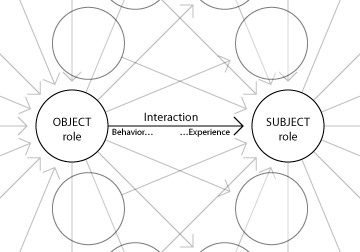
This paints experience and behavior as two sides of the same coin, opposite perspectives on the same one thing: an interaction. Our experience of a thing is that thing's behavior upon us. An object is red inasmuch as it appears red, and it appears red inasmuch as it emits light toward us in certain frequencies and not others: the emission of the right frequencies of light, a behavior in a very broad sense, constitutes the property of redness. Every other property of an object is likewise defined by what it does, perhaps in response to something that we must do first: an object's color may be relative to what frequencies of light we shine on it (e.g. something that is red under white light may be black under blue light), the shape of the object as felt by touch is defined by where it pushes back on our nerves when we press them into it, and many other more subtle properties of things discovered by experiments are defined by what that thing does when we do something to it.
We can thus define all objects by their function from their experiences to their behaviors: what they do in response to what it done to them. The specifics of that function, a mathematical concept mapping inputs to outputs, defines the abstract object that is held to be responsible for the concrete experiences we have. Every object's behavior upon other objects constitutes an aspect of those other objects' experience, and every object's experience is composed of the behaviors of the rest of the world upon it.
All of reality can then be seen as a web of these interactions, the interactions themselves being the most concrete constituents of that reality, with the vertices of that web constituting the more abstract objects, in the usual sense, of that reality.
We each find ourselves to be one complex object in that web, and the things we have the most direct, unmediated awareness of are those interactions between our own constituent parts, and between ourselves and the nearest other vertices in that web, those interactions constituting our experience of the world, and also our behavior upon the world. By identifying the patterns in those experiences, we can begin to build an idea of what the rest of the world beyond that is like, inferring the existence and function of other nodes beyond the ones we are directly connected to by their influence in the patterns of behavior of (and thus our experience of) those nearest nodes.
This work is where philosophy ends, as far as investigating reality goes at least, and the physical sciences take over, postulating the existence of abstract objects with functions that would give rise to the concrete experiences we have of the world. Early physics began by identifying the behavior of large complex objects, and the different kinds of stuff that they are made of, "elements" like "earth", "water", and "air". But in time it has found those all to be made of many kinds of smaller particles of a similar nature to each other, molecules, interacting with each other in different ways. Those many diverse molecules have in turn been found to all be composed of a more limited set of still smaller particles, atoms; and those in turn of an even smaller set of smaller particles still, electrons and nucleons like protons and neutrons; the latter in turn made up of triplets of two still smaller and more fundamental particles called up and down quarks.
And I believe that contemporary physics has come far enough along, dug deep enough into the constituent particles of reality, that it has now identified as its most fundamental particles objects that are literally identifiable with the very "occasions of experience" that make up the web of reality described in my ontology above.
For clearest illustration, consider the experience of vision, which is now understood to be mediated by particles of light called photons. Whenever we see anything, all we're actually seeing in the most technical sense is the photons that hit our eyes; the objects we see, in the casual sense most people mean, are only inferred from the patterns in those photons hitting our eyes. Because of the distortion of space and time relative to motion, from the frame of reference of any given photon, the distance that it travels between whatever emitted it and your eye is zero, and the journey takes no time at all; from the photon's perspective, it exists only at a point and only for an instant,the whole of its being constituted entirely by the interaction between whatever emitted it and your eye. Contemporary theories of physics hold that fundamentally, all of the most fundamental particles are essentially like photons in that way, all naturally moving at the speed of light, and so finding themselves, in their own frames of reference, to exist for but an instant at the point where two other objects interact, and their own existence consisting entirely of that interaction between them.
It is only the aggregate patterns of interactions between these particles that gives rise to the appearance of the conventional, slower-moving particles out of which all of the aforementioned structures arise, up to the macroscopic scale we're familiar with. For instance, electrons as we commonly understand them are understood to be an aggregate pattern of two different light-like particles, each similar to an electron and to each other but differing from each other in a property called spin, neither of which is able to travel any measurably large distance in space without immediately interacting with something called the Higgs field. The Higgs field absorbs that particle, and immediately emits another identical to it other than having opposite spin, only for that to be immediately reabsorbed and a particle like the first one emitted again, the overall pattern of those two kinds of particles, oscillating between each other immeasurably quickly as they interact with the Higgs field, constituting the particle that we conventionally think of as an electron.
Those light-like fundamental particles, that I think are identifiable with the interactions or "occasions of experience" that constitute the web of reality as described here in my ontology, thus make up, in a sense, the electrons and quarks that make up the atoms that make up the molecules that make up all of the matter that makes up the entire world, including people like you and me.
That is to say, I hold that there definitely is an objective reality, as opposed to any kind of relativism, idealism, or nihilism, which hold either that what is real is relative to some group's beliefs or to someone's subjective experiences, or else (as I consider equivalent to those) that nothing is actually real at all.
But I also hold that the content of that reality is entirely empirical in nature, that there is nothing real that is in principle beyond all observation, that if something exists, there will be some noticeable difference in the reality that we experience compared to what we would experience if it did not exist, and the whole of that thing's existence is the observable differences in reality it makes.
This empirical realism might well also be called physicalist phenomenalism, in that it holds that only physical phenomena exist — which is to say, things that are observable (phenomena) in an objective (physical) way accessible to all observers and not mere figments of any one person's imagination. This kind of view traces back to at least John Stuart Mill, who held the "permanent possibilities of experience" to constitute the entirety of an object's existence.
This is a kind of monism, holding that there is one kind of stuff that exists that all the many things in reality are made up of, in contrast with pluralist ontologies that hold that there are multiple fundamentally different kinds of stuff, especially with dualism as espoused by the likes of Rene Descartes which holds that there are wholly different mental and physical kinds of stuff. It is not quite the usual monism held contrary to that dualism, namely materialism, though as described above it is definitely physicalist; nor is it quite the other usual kind of monism, idealism, though as described above it is definitely phenomenalist.
But neither is it quite neutral monism in the usual sense, as espoused by the likes of Baruch Spinoza, as that holds that there is one kind of stuff that has both mental and material properties; whereas I hold that there are not so much different kinds of properties, much less different kinds of stuff, as there are what could crudely be called mental and material ways of looking at the same properties and the same objects, that are essentially both mind-like and matter-like in different ways, that distinction no longer really properly applying when we really get down to the details.
I would say that the most concrete things that exist are, as Alfred North Whitehead called them, "occasions of experience". These are the things of which we have the most direct, unmediated awareness, and the only things of which we can have no doubt.
Rene Descartes famously attempted to systematically doubt everything he could, including the reliability of experiences of the world, and consequently of the existence of any physical things in particular; which he then took, I think a step too far, as doubting whether anything at all physical existed, but I will return to that in a moment. He found that the only thing he could not possibly doubt was the occurrence of his own doubting, and consequently, his own existence as some kind of thinking thing that is capable of doubting.
But other philosophers such as Pierre Gassendi and Georg Lichtenberg have in the years since argued, as I agree, that the existence of oneself is not strictly warranted by the kind of systemic doubt Descartes engaged in; instead, all that is truly indubitable is that thinking occurs, or at least, that some kind of cognitive or mental activity occurs. I prefer to use the word "thought" in a more narrow sense than merely any mental activity, so what I would say is all that survives such a Cartesian attempt at universal doubt is experience: one cannot doubt that an experience of doubt is being had, and so that some kind of experience is being had.
But I then say that the concept of an experience is inherently a relational one: someone has an experience of something. An experience being had by nobody is an experience not being had at all, and an experience being had of nothing is again an experience not being had at all. This indubitable experience thus immediately gives justification to the notion of both a self, which is whoever the someone having the experience is, and also a world, which is whatever the something being experienced is.
One may yet have no idea what the nature of oneself or the world is, in any detail at all, but one can no more doubt that oneself exists to have an experience than that experience is happening, and more still than that, one cannot doubt that something is being experienced, and whatever that something is, in its entirety, that is what one calls the world. So from the moment we are aware of any experience at all, we can conclude that there is some world or another being experienced, and we can then attend to the particulars of those experiences to suss out the particular nature of that world.
The particular occasions of experience are thus the most fundamentally concrete parts of the world, and everything else that we postulate the existence of, including things as elementary as matter, is some abstraction that's only real inasmuch as postulating its existence helps explain the particular occasions of experience that we have.
George Berkeley famously said that "to be is to be perceived", and I don't agree with that entirely, in part because I take perception to be a narrower concept than experience in a broader sense, and because I don't think it is the actual act of being experienced per se that constitutes something's existence, but rather the potential to be experienced. I would instead say not that to be is to be perceived, or that to be is to be experienced, but that to be is to be experienceable.
And I find this adage to combine in very interesting ways with two other famous philosophical adages: Socrates said that "to do is to be", meaning that anything that does something necessarily exists; and more poignantly, Jean-Paul Sartre said that "to be is to do", meaning that what something is is defined by what that something does. Being, existence, can be reduced to the potential for or habit of some set of behaviors: things are, or at least are defined by, what they do, or at least what they tend to do. (Coupled with the association of mass to substance and energy to causation, this notion that to be is to do seems to me a vague predecessor to the notion of mass-energy equivalence).
To combine this with my adaptation of Berkeley's adage, we get concepts like "to do is to be experienced", "to be experienced is to do", "to be done unto is to experience", and "to experience is to be done unto".
This paints experience and behavior as two sides of the same coin, opposite perspectives on the same one thing: an interaction. Our experience of a thing is that thing's behavior upon us. An object is red inasmuch as it appears red, and it appears red inasmuch as it emits light toward us in certain frequencies and not others: the emission of the right frequencies of light, a behavior in a very broad sense, constitutes the property of redness. Every other property of an object is likewise defined by what it does, perhaps in response to something that we must do first: an object's color may be relative to what frequencies of light we shine on it (e.g. something that is red under white light may be black under blue light), the shape of the object as felt by touch is defined by where it pushes back on our nerves when we press them into it, and many other more subtle properties of things discovered by experiments are defined by what that thing does when we do something to it.
We can thus define all objects by their function from their experiences to their behaviors: what they do in response to what it done to them. The specifics of that function, a mathematical concept mapping inputs to outputs, defines the abstract object that is held to be responsible for the concrete experiences we have. Every object's behavior upon other objects constitutes an aspect of those other objects' experience, and every object's experience is composed of the behaviors of the rest of the world upon it.
All of reality can then be seen as a web of these interactions, the interactions themselves being the most concrete constituents of that reality, with the vertices of that web constituting the more abstract objects, in the usual sense, of that reality.
We each find ourselves to be one complex object in that web, and the things we have the most direct, unmediated awareness of are those interactions between our own constituent parts, and between ourselves and the nearest other vertices in that web, those interactions constituting our experience of the world, and also our behavior upon the world. By identifying the patterns in those experiences, we can begin to build an idea of what the rest of the world beyond that is like, inferring the existence and function of other nodes beyond the ones we are directly connected to by their influence in the patterns of behavior of (and thus our experience of) those nearest nodes.
This work is where philosophy ends, as far as investigating reality goes at least, and the physical sciences take over, postulating the existence of abstract objects with functions that would give rise to the concrete experiences we have of the world. Early physics began by identifying the behavior of large complex objects, and the different kinds of stuff that they are made of, "elements" like "earth", "water", and "air". But in time it has found those all to be made of many kinds of smaller particles of a similar nature to each other, molecules, interacting with each other in different ways. Those many diverse molecules have in turn been found to all be composed of a more limited set of still smaller particles, atoms; and those in turn of an even smaller set of smaller particles still, electrons and nucleons like protons and neutrons; the latter in turn made up of triplets of two still smaller and more fundamental particles called up and down quarks.
And I believe that contemporary physics has come far enough along, dug deep enough into the constituent particles of reality, that it has now identified as its most fundamental particles objects that are literally identifiable with the very "occasions of experience" that make up the web of reality described in my ontology above.
For clearest illustration, consider the experience of vision, which is now understood to be mediated by particles of light called photons. Whenever we see anything, all we're actually seeing in the most technical sense is the photons that hit our eyes; the objects we see, in the casual sense most people mean, are only inferred from the patterns in those photons hitting our eyes. Because of the distortion of space and time relative to motion, from the frame of reference of any given photon, the distance that it travels between whatever emitted it and your eye is zero, and the journey takes no time at all; from the photon's perspective, it exists only at a point and only for an instant,the whole of its being constituted entirely by the interaction between whatever emitted it and your eye. Contemporary theories of physics hold that fundamentally, all of the most fundamental particles are essentially like photons in that way, all naturally moving at the speed of light, and so finding themselves, in their own frames of reference, to exist for but an instant at the point where two other objects interact, and their own existence consisting entirely of that interaction between them.
It is only the aggregate patterns of interactions between these particles that gives rise to the appearance of the conventional, slower-moving particles out of which all of the aforementioned structures arise, up to the macroscopic scale we're familiar with. For instance, electrons as we commonly understand them are understood to be an aggregate pattern of two different light-like particles, each similar to an electron and to each other but differing from each other in a property called spin, neither of which is able to travel any measurably large distance in space without immediately interacting with something called the Higgs field. The Higgs field absorbs that particle, and immediately emits another identical to it other than having opposite spin, only for that to be immediately reabsorbed and a particle like the first one emitted again, the overall pattern of those two kinds of particles, oscillating between each other immeasurably quickly as they interact with the Higgs field, constituting the particle that we conventionally think of as an electron.
Those light-like fundamental particles, that I think are identifiable with the interactions or "occasions of experience" that constitute the web of reality as described here in my ontology, thus make up, in a sense, the electrons and quarks that make up the atoms that make up the molecules that make up all of the matter that makes up the entire world, including people like you and me.
Comments (74)
Does this resolve beyond the cogito? I can doubt whether I exist, which implies the existence of a subject (self) and an object (self) because they are one and the same. But doubting the world exists doesn't imply a world beyond the self, right?
If empirical realism is an ontological verus an epistemological stance, then how do you describe the status of subjective experiences, from an empirical realist standpoint?
But if these are distinct categories, then would not the concept of "reality" by definition (and usage) have to be expanded to encompass both? Maybe it is an "inflationary" reality(-concept). ie. the representation has a reality also.
I just thought of another way of relating subjective experiences to objective reality in my view. Subjective experience are like partial sums of an infinite series; objective reality is the total sum of that infinite series, which is the limit of the series of partial sums of it.
Just had to ask. It's interesting how you invoked a mathematical concept as the bridge to subjectivity.
But I'm not clear how this all fits together for you. Is it that there's no effective separation between our seeing and the thing we see, except for a fluke of Higgs fields and reference frames?
The overall thesis is that there is nothing to reality besides the observable features of it, nothing hidden behind our experience, of which our experience is merely a representation -- our experience is direct contact with a very small part of reality (the parts that we are literally in direct contact with: the photons hitting our eyes, and mediating the kinetic interaction between air molecules and our ears, or between anything else and our skin, as well as the chemical interactions with our olfactory sensors), and we (intuitively) infer the rest of reality from the behavior of that very small part, in exactly the same way that we can infer wind from the motion of leaves, or infer gravitational waves from the changing interference patterns of two carefully set-up lasers.
It's almost a kind of idealism, except that reality isn't "in" any mind(s), it's just made up of "mind-like stuff"; the actual (e.g. human) minds experiencing it being presumably just the activity of brains, those brains being made up of matter, which is made up of this "mind-like stuff", these "occasions of experience" as Whitehead called them.
It also ties into the mathematicism we were discussing in my other thread. Those "occasions of experience" are equally interpretable as behaviors of thing A upon thing B, as much as they are experiences by thing B of thing A; those are just two ways of looking at the interaction between things A and B. The things themselves in turn are just the bundles of their properties, which are all behaviors, or propensities to behave certain ways in response to certain things that are done unto them, i.e. in response to certain things they experience, i.e. certain other interactions. So every thing is entirely definable by its function from its experiences (inputs into it from its interactions) to its behaviors (outputs from it through its interactions). The interactions/experiences/behaviors are the edges of a complex graph, and the nodes of that graph, the things experiencing and behaving, interacting with each other, the functions mapping the stuff done to them to stuff that they do, are the objects of reality.
The stuff about the Higgs etc is just an interesting observation at the end of all of that, noting that a posteriori empirical science, which began by investigating big compound nodes in that graph (macroscopic objects) and has investigated over time into the smaller and smaller components, seems to have finally arrived a posteriori at components that can be taken as identical with the the very same constituents of reality that we've arrived at through a priori philosophizing here. Massless particles like photons (and the particles that get "blended" into electrons etc by the Higgs) are exactly like the "occasions of experience" that philosophers like Whitehead wrote about, and that in my elaboration upon that (viz the mathematicism stuff above) can be taken as signals passing between the mathematical functions that constitute the abstract object that is our concrete reality.
...and hence the realism reduces to phenomenology.
Why? Because it joins Descartes in the error of following the chimera of certainty, finding oneself in a garden of mere experience and behaviour.
In the very act of setting out this fabulous journey you use, and hence must admit, the language in which it is embedded. Here's a certainty that escapes mere experience.
How is language something beyond experience, or behavior? It’s something we do to each other, and experience each other doing — as well as something we do to ourselves, and experience ourselves doing.
It isn't.
But it can't be done without someone else - which is why you are presenting your theses in a public forum.
So you can leave out the bit that deduces stuff from a basis of certainty, and proceed instead from the common sense of the stuff around us. Hence, there is no need to derive only from your own experience in order to justify your belief in chairs and tables and trees and people to talk to. That you are talking to us shows that you are embedded in a world where such things are ubiquitous.
That puts far to great a restriction on what is knowable; the philosopher's error of seeking certainty.
The antidote is the realisation that not just certainty, but also doubt, may need justification.
I don't see how idealism is bypassed here. How can mind-like stuff be just the activity of brains, unless there are indeed brains? But there cannot be brains since all there is, is mind-like stuff, and brains are not mind-like stuff... a vicious little circle if ever there was one.
Pfhorrest is a covert idealist.
Further evidence of covert idealism. Are they particles, and hence Pfhorrest is a realist, or are they "occasions of experience", and hence Pfhorrest is an idealist? This is the inevitable result of taking experience as fundamental, to the exclusion of all else.
You seem to be arguing here for a critical rationalism, which I also support. But that's an epistemological position (which particular beliefs are justified), not an ontological position (what even is it for something to be real). The two are not in conflict, and are in fact necessitated by the same deeper principles.
Empiricism is necessitated by the same principle that necessitates rationalism more generally: every answer must be questionable, which means not taking anything on faith, which means not entertaining claims about anything that can't be tested.
Meanwhile objectivism is necessitated by the same principle that necessitates critical rationalism specifically: every question has an answer, which directly entails objectivism, but also demands a rejection of justificationism, as that leads via infinite regress to nihilism, leaving only the options of fideism, which we've already ruled out above, or else critical rationalism.
In any case, I'm not arguing for empirical realism from a place of Cartesian doubt. I haven't actually presented much of an argument here at all, merely an exploration of the relation of empirical realism to other threads of philosophical thought, including Spinoza (it's a neutral monism but not like his), Mill (it's much like his ontology), Descartes, Gassendi and Lichtenberg (it's not like Descartes because of the reasons Gassendi and Lichtenberg give), and Whitehead (it's very much like his ontology).
My argument for this position would just be an argument against nihilism (including solipsism, relativism, and subjectivism), and an argument against transcendentalism (meaning in this case basically supernaturalism), leaving us with the position that there are objective answers to questions about reality, but that those answers consist entirely of claims about the kinds of experiences there are available to be had in what circumstances.
Quoting Banno
"Mind-like stuff" is not the activity of brains, on my account. Actual minds are. "Mind-like stuff" is a loose way of saying essentially "information": it's the kind of stuff that minds process. Minds, being the behavior of brains, are made of that same stuff, because all physical stuff is. In a computer, every program is made of data, and what those programs act upon is more data. I'm saying reality is analogous to that, or maybe not even so distant as to be an analogy. Reality is made of information, of the kinds that minds process, but information that exists whether or not minds are there to be processing it; minds, being (behaviors of) real physical things like anything else, are made out of that same information, that they then process. The data is first, execution of the data comes later, and only certain data constructs do any interesting data-processing when executed; most just crash. (Which is why not all this information-stuff reality is made of exhibits consciousness like we normally think of it, despite being made of the same stuff as brains that can be conscious; it's not structured correctly, into a thinking machine. It's data that doesn't do anything interesting when executed).
Quoting Banno
Quoting Banno
"Minds are an action of physical things, but physical stuff is made of ideas in minds"... sure, that's a primitive way I once thought of this line of thought decades ago, when I was tempted by both idealism in ontology class and materialism in philosophy of mind class.
The resolution to that apparent conflict is neutral monism. There isn't mental stuff and material stuff, or just one or the other, but a neutral stuff that's kinda both or neither. Physical stuff is phenomenal stuff, the kind of stuff you can empirically observe, but that isn't dependent on you observing it, that is independent of your particular subjective experience, without being something completely beyond all possibility of being experienced.
One direction away from that position lies supernaturalism, believing in stuff that can't possibly be observed, the existence of which could only be taken on faith, but "it's really objectively real I swear" if you do take it on faith. In the other direction away from it lies some kind of subjectivism, relativism, solipsism, or nihilism, denying that there is any reality to the stuff you experience beyond your experiencing of it, such that it would cease to exist if you did. Carefully avoiding anything like either of those leaves you where I am: empirical realism, or physicalist phenomenalism, or anti-supernaturalist anti-solipsism if you really prefer.
Well, that ain't so. Think of Quine's holism. It's fine to question anything, but absurd to question everything.
There are things in which we needs must be confident in order to participate in doubt.
You callin' me names?
Popper did say similar things, and I'm not in disagreement with much of what he wrote, but he was misled by certainty into thinking too highly of the issue of induction. No, I'm thinking Moore of Quine and Wittgenstein.
I don't see that disembodying ideas by calling them "information" relieves you of the charge of idealism.
I thought Quine's holism seemed obvious when I first heard about it, but then I was already a falsificationist by that time, and from a falsificationist viewpoint of course you're only ever testing the entirety of all your theoretical assumptions at once and can modify any of those assumptions you want to fit the new observation. Confirmation holism is only novel if you're already a confirmationist, which I'm not.
Quoting Banno
I didn't say to question everything (at once). Like I said, I'm not coming from a place of Cartesian doubt; I only described the relationship of Descartes' thought (and later commentary on it) to mine.
Quoting Banno
If "critical rationalist" is a name, then it's a good one.
Quoting Banno
The disembodiment is the whole crux there. If the "ideas" can exist without there being minds to be thinking them, as they can on my account, then they're not really "ideas" as usually meant by that word, so I don't use that word.
Nice 'anticipation shift'. You should put it in your malapropisms thread.
...only it can't be, because experiences cannot be disembodied... your experiences are only ever yours.
So is everything experience, ideas, or information?
“Observation” in a quantum mechanical sense happens even in a universe full of nothing but gas. Our human observation is just a complicated form of that. I mean “experience” here in precisely the same way.
Then what we "experience" is made entirely of sodium ions.
Isn't "empirical" a property of justifications or knowledge?
So you're saying there are no unstated true propositions?
Good reason to be skeptical.
Quoting Banno
Yes, follow Banno's advice KK, use your common sense and be skeptical.
Quoting Banno
No it isn't absurd to question everything. That's how certainty is produced by questioning things. It's impractical to question everything, because this takes time, but the time it takes to question something, and resolve that doubt with a solution is not infinite. So the person who questions everything is slower (and much more annoying) than someone else, but that person is not incapacitated by such questioning.
There is no infinite regress of questioning unless you assume a relationship between one question and another. But if you question one thing, answer it and proceed, there is no infinite regress. In reality, this idea which you, and so many others profess, that a person "must be confident in order to participate in doubt", is what is absurd. It's just based in a straw man of what "doubt" is. Use your common sense, and recognize that certainty is only produced from questioning things, and therefore could not be necessary for it.
Let's put this in context: it's neither as amazing or alarming as a giant sky lord judging me for masturbating.
....the principle grounding empiricism and rationalism generally;
Quoting Pfhorrest
....the principle grounding objectivism and critical rationalism.
If epistemology and ontology are not in conflict, which is agreeable, and are necessitated by the same principle, yet these listed principles are not the same......what is the same principle that necessitates both?
Is “empiricism and rationalism generally” to be considered epistemology, and “objectivism and critical rationalism” to be considered ontology? The other way around? Not connected at all?
I see two fundamental principles but I don’t see the same fundamental principle necessitating two schematically distinguished cognitive paradigms.
(ontology the prime schema of which is “existence”; epistemology the prime schema of which is “necessity”)
And.....how is the intrinsic circularity of those two given principles reconcilable with the characteristics of human knowledge? Seems rather to be fertile ground for the infinite regress terminating in nihilism, which is the same as the impossibility of human knowledge itself, which is anathema to both a posteriori science and a priori metaphysics.
Not trying to be obtuse, honest. Just don’t see the logical authority in those principles, when conjoined to each other, which appears must always be the case.
Yes, obviously with the 'in principle' caveat: there are potentially possible modes of experience that we will, through localism, dumb luck, or technological limitation, never realise. For instance, when an electron moves from A to B it has a high probability of scattering with many virtual photons. Each virtual photon has a low probability of decaying briefly into a virtual electron-positron pair. Accounting for this is extremely important for making extremely precise comparisons between theory (knowledge) and experiment (technology). It is the fortune if our technological maturity that this can be experienced indirectly by us, and a matter of necessity that it may be experienced by the electron.
I guess that's why I find the primacy of mind and experience in your language (and I think that you do not distinguish between the experience of a person and of an electron) a bit of a barrier. That said, I haven't slept for two days, so...
Quoting Pfhorrest
I guess I'm just not seeing the relevance of masslessness. Unless you're drawing a poetic equivalence between light (image, appearance, experience) and matter (the thing itself as an element of objective reality). I will Google Whitehead and "occasions of experience" and see if I get anywhere. :)
This might be off topic, but one thing occurs to me. When we interact with anything, it is overwhelmingly electromagnetic in nature. When we see a tree, photons emitted by that tree are destroyed in our eyes: this is sight. When we feel the tree bark, virtual photons emitted by the charges in the bark are destroyed by charges in us: this is touch. We never destroy charges, only the emissions of charges or systems.
In your literalist interpretation of the creation/annihilation operators of QFT, it is the fields that destroy electrons directly. (The Higgs mechanism is the destruction of an electron with one isospin followed by the creation of another with the opposite isospin. The motion of an electron is the destruction of the electron at one position followed by the creation of an identical electron at another.) Somehow this makes me think of the sort of equivalence between experience and objective reality you're getting at without necessarily being the sort of thing you had in mind.
Phenomena are things that are experienced, by definition, so those are the same thing. And I’m saying there’s nothing more to those phenomena than the information that is conveyed in the experience of them, so on my account that’s the same thing too. But an idea is something in a mind, so in a universe with no minds, just gas, there aren’t any ideas per se.
Quoting Isaac
Or the photons that mediate the chemical interaction with those sodium ions, sure; at least, if you draw the border between “self” and “world” at the edge of the brain, rather than the edge of the whole body as I was doing earlier. Exactly where to draw that border is a fuzzy question to begin with and I don’t have a hard opinion on which of those is the more appropriate place.
Quoting frank
No, “empirical” just means related to experience. It can be used of knowledge—that which is gained from experience—but it’s not limited to that use. To say that reality is empirical is just to say there is nothing real that is beyond all experience, e.g. nothing supernatural.
Quoting frank
Nope, I don’t see where you get that from.
Quoting Mww
You got those backward: answers being questionable implies empiricism and rationalism generally; questions being answerable implies objectivism and critical rationalism specifically.
Empiricism and objectivism are ontological positions in this context, while rationalism (including critical rationalism) is epistemological, so each of those principles has implications on both ontology and epistemology.
Quoting Pfhorrest
SO you're saying there is no unexperienced information?
The point being that since idealism holds that all is in some way mental, an idealist can moot no true propositions that are not thought - stated, in Franks terms, or information that is not experienced, in your terms. That the unexperienced cup in the cupboard is red, is a realist position; that it cannot be said to have a colour is an idealist position.
If you are not an idealist, then you must hold that there is unexperienced information. If you hold that all information is experienced, as you seem to be saying here, then your position is idealist, not realist.
My own worldview is best defined as both Empirical Realism and Transcendental Idealism. That seems to be similar to Kant's position on Reality and Ideality. It's based on the usefulness of both Empirical and Theoretical knowledge. Rational theories can try to fill gaps in Materialistic Science. :smile:
Kant's Realism : Nonetheless, while Kant is an empirical realist and this is a commendable thing (was it ever in dispute that he wanted to establish the objectivity of science and mathematics?), he remains a transcendental idealist. In short, Kant’s empirical realism only extends as far as the subject and humans. He nonetheless remains committed to the thesis that what objects might be independent of humans, and whether objects exist as our empirical claims portray them, is something that we can never know and which must be carefully excluded from philosophical discussion.
https://larvalsubjects.wordpress.com/2009/12/02/empirical-realism-and-ontological-realism/
Empirical and Theoretical Science :
http://bothandblog2.enformationism.info/page57.html
Your comment missed the point. From my perspective, the Empirical and Theoretical views are not contradictory, but complementary. Human reason can "transcend" empirical reality, by imagining scenarios that are not visible to the physical eye. This is how Einstein came up with his revolutionary ideas about the ultimate nature of Reality. Of course, it helps if the theories are subject to empirical testing, as some of his were. :cool:
Both/And Principle :
[i]My coinage for the holistic principle of Complementarity, as illustrated in the Yin/Yang symbol. Opposing or contrasting concepts are always part of a greater whole. Conflicts between parts can be reconciled or harmonized by putting them into the context of a whole system.
The Enformationism worldview entails the principles of Complementarity, Reciprocity & Holism, which are necessary to ofset the negative effects of Fragmentation, Isolation & Reductionism. Analysis into parts is necessary for knowledge of the mechanics of the world, but synthesis of those parts into a whole system is required for the wisdom to integrate the self into the larger system. In a philosophical sense, all opposites in this world (e.g. space/time, good/evil) are ultimately reconciled in Enfernity (eternity & infinity).
Conceptually, the BothAnd principle is similar to Einstein's theory of Relativity, in that what you see ? what’s true for you ? depends on your perspective, and your frame of reference; for example, subjective or objective, religious or scientific, reductive or holistic, pragmatic or romantic, conservative or liberal, earthbound or cosmic. Ultimate or absolute reality (ideality) doesn't change, but your conception of reality does. Opposing views are not right or wrong, but more or less accurate for a particular purpose.
This principle is also similar to the concept of Superposition in sub-atomic physics. In this ambiguous state a particle has no fixed identity until “observed” by an outside system. For example, in a Quantum Computer, a Qubit has a value of all possible fractions between 1 & 0. Therefore, you could say that it is both 1 and 0[/i].
http://blog-glossary.enformationism.info/page10.html
PS__I apologize for resorting to my peculiar "style" of argumentation, that you are not comfortable with.
I don't know. You tell me. It's your subjective theory. :joke:
Well, presumably, since you accept both p and ~p, by the explosion principle it can be any colour. Or not.
But then, because quantum.
Hmmm...I sure did. Beside the point, though, I think, with respect to knowledge.
Thanks for the clarification anyway.
Science does not give us any evidence that all real things can be experienced, so how did you arrive at that conclusion?
I don't see how your masturbation is relevant.
My masterbation is relevant...don't make me show you. Joking, just joking
Quoting Kenosha Kid
Yes, of course.
Quoting Kenosha Kid
It's only massless particles that are lightlike, and so have an existence that (from their frame of reference) consists entirely of the interaction between what emitted them and what absorbed them.
Quoting Kenosha Kid
Yes, that's something I've been assuming as background knowledge in this thread. Glad you explicitly pointed it out though. :-)
Quoting Kenosha Kid
I see the experience of a person as a special subset of the experience of an electron. "Experience" here can be taken as equivalent to QM "observation". When a human observes something, they are still doing the thing that an inert object merely interacting with it does, that causes (or is) wavefunction collapse or entanglement or the splitting of worlds, however you want to interpret it. But a human is also doing a lot of other stuff that an electron isn't doing. That other stuff isn't metaphysically important here, it's just brain function, more complex information processing, but it's a thing humans do that electrons don't.
Quoting Kenosha Kid
Yes, although not all motion can be reckoned like that -- specifically, the lightlike motion of massless particles can't, because from their frame of reference they travel zero distance in zero time, so motion is irrelevant. It's only massive particles, which already consist of a "blending" of several more-fundamental massless particles through their constant annihilation and recreation by the Higgs field, that can be construed as moving through a series of annihilations and recreations; because it's precisely that series of annihilations and recreations that gives them mass, and makes their motion slower than light.
Quoting Kenosha Kid
It sounds like you're on basically the same track as me, to me. :up:
Quoting Banno
I am not saying that all information is experienced, but that all that exists is the kind of stuff that can be experienced -- whether or not it actually does get experienced. That kind of stuff can be characterized as information.
Quoting Gnomon
In Kantian terms, any empirical realism is also a transcendental idealism, and conversely any transcendental realism is an empirical idealism.
An empirical realism is a view that takes the stuff we can observe, phenomena, to be the stuff that is concretely real, and conversely the transcendental, unobservable stuff, the noumena, to be only abstract ideas. My account of the "objects of reality", the nodes in the "web of reality", being abstract mathematical functions, which we infer from their behaviors that we experience in response to other behaviors they experience, accords with this.
An empirical idealism, on the other hand, would hold that the kind of stuff we can observe, phenomena, are just abstract ideas in our minds, and conversely that actual concrete reality is the transcendental, unobservable stuff, the noumena, that underlie those phenomena, and which those phenomena represent to our minds. That's a view that both Kant and I reject.
Quoting frank
From the practical reasoning that if we ever take any claims to be beyond questioning, we simply stop searching for the truth, and so are likely to never find out if we are wrong, so we must not ever take any claims to be beyond questioning; and that claims about things that are not subject to experience cannot ever be shown wrong (because we could not tell whether or not they were, because we have no experience of them at all), so we could only take such claims on faith, without the ability to question them; so we must not ever entertain the possibility of things that are in principle beyond all experience, for in doing so we would be giving up our pursuit of truth.
And it definitionally cannot be shown that there does exist something beyond experience, because to show that would be to make it available for experiencing, so we don't have to worry about ever finding our assumption that there is not to be wrong.
So I follow your advice and make no claims at all about unexperiencable things. But I hear you making the positive claim that there is no such thing. Why should I believe that?
I think you could support the notion that all real things can be experienced if you could demonstrate a contradiction in the idea of the unexperiencable thing.
Quoting Pfhorrest
And that doesn't support your claim either. There is a view that true statements must in principle be confirmable. But that's not really in line with what you're saying either. Hmm.
Nope, my view is that statements must be falsifiable. That’s exactly why I reject all claims of unobservable things: they could not be falsified.
And if they were true, their truth would make no difference whatsoever to us, so such claims are effectively empty. They add nothing. Appending a claim about unobservable things to your view of reality is like adding zero to a sum.
Does your "explosion theory" take into account the weirdness of Quantum Reality? If so, then statistically your exploding particle can be both P and ~P.. Both here and there, both singular and dual as it passes through a slit. :joke:
Quantum Weirdness : https://www.newscientist.com/article/mg22730370-500-where-does-quantum-weirdness-end/
Are there philosophers who hold that "actual concrete reality" is transcendental? How would you classify neuroscientist Don Hoffman's Model Dependent Realism? As I understand it, the physical phenomena we think we see are merely models in the mind that represent the underlying reality : indirect concepts instead of direct percepts. It's a "symbolic interpretation of the world, yet it is not an illusion, but merely a simplification of the messy reality of the Actual world (true reality vs apparent reality??), most of which we are not aware of. He thinks that evolution prepared our brains to abstract just enough information from the outside world to survive long enough to replicate.
His novel theory may sound crazy at first glance, but the computer screen analogy makes sense to me. Be that as it may, I treat my conceptual percepts as reality, for all practical purposes. Only speculative philosophers, and imaginative neuroscientists, need to entertain the possibility of Transcendental Reality behind the curtain of Phenomenal Reality. I get confused about which is which. "Which is real and which is Memorex"? :smile:
Model Dependent Realism :
“claims that it is meaning-less to talk about the "true reality" of a model as we can never be absolutely certain of anything. The only meaningful thing is the usefulness of the model.”
https://en.wikipedia.org/wiki/Model-dependent_realism
Reality is not what you see : http://bothandblog6.enformationism.info/page21.html
They don’t usually call it such because they’re usually pre-Kantian, but basically all representative realism is transcendental realism in Kantian terms, because it holds that phenomena are just ideas, not real, they only represent what is real.
Quoting Gnomon
It sounds like a kind of empirical realism to me.
Fine.
All there is is experienceability. I don't know why it's so difficulty to communicate this difference, between something being the kind of stuff that is available to be experienced, and something being actively experienced by someone.
On my account, there is a reality independent of anyone in particular experiencing it, but there is nothing about that reality that is not accessible to experience.
The difference is clear enough; its use, less so. The difference between a cup and...what shall we call it...the experienceability of a cup? - sure; And the experienceability-of-a-cup will presumably be full of experienceability-of-tea. All too convolute for my taste, especially as it is apparently there to answer an unwarranted scepticism.
There is no difference between those on my account. The existence is the cup is consists entirely of the potential of certain experiences.
That potential of certain experiences vs anyone actually having those experiences is the difference I mean. The existence of the cup doesn't consist of (or depend upon) someone experiencing a cup. But it doesn't consist of anything that is not some kind of potential for experience.
But you said that humans are doing what other matter does, in that it experiences this interaction. So you've decided on the unit doing the experiencing. Otherwise you're left with "The universe experiences itself". To have an experienced and an experiencer you have to divide up the universe into at least two parts. If this division is arbitrary then you've not defeated solipsism by any means other than say saying 'let's not' (which, incidentally, is my own argument against solipsism).
Once that photon 'hits' the retina, as far as our 'experience' is concerned it could be registered, ignored completely or made-up. I don't then see how something unique about the information it contains constitutes the final experience we have.
I don't pretend that my rejection of solipsism is very much more than "let's not", albeit with pragmatic reasons why it's more useful to "not".
Earlier upthread I even wrote already:
Quoting Pfhorrest
Are there abstract Ideas in your Real world? If so, then you must accept both Idealism and Realism. If not, then you must repudiate the reality of Ideas. There is no contradiction, only the distinction between Abstract and Concrete. :cool:
Like the username 'ThePhilosopher'. Bet you were gutted!
Okay... So all elementary behaviours are then creation and annihilation events that, in the frame of reference of the thing being created and annihilated, take no time and traverse no space. I'd go with that.
Then the massive electron as we know it is a series of such events, each timeless but constituting the ticks of the electron's "experience". These are the atoms of experience? And for us macroscopic blighters, the atoms of our experience are similar things: the destruction of a photon from one bit of a car, the destruction of a photon from another bit, and so on, building up over (brief) time the experience of seeing a car. That sort of thing?
Quoting Pfhorrest
This obviously isn't the case for the Higgs. For instance, the electron interacts with the Higgs field as it goes through the left slit and is it goes through the right. The observation, in the Copenhagen sense, has not occurred.
(This is a common trend in my philosophical thinking: a lot of supposedly contradictory things work out to the same thing in the end, and the seeming contradictory perspectives are just different, equally valid ways of looking at the same underlying reality. See for example the earlier notion of a true solipsism just being equivalent to the self being part of the world. Or I guess the whole topic of this thread, where phenomenalism, which is like idealism, boils down to the same thing as physicalism, which is like materialism, even though materialism vs idealism is nominally a clash of opposites).
Quoting Pfhorrest
I tend to take this as a sign of incompleteness. If two theories with different ontologies yield the same results, there's usually a third that yields the other two under two different sets of incomplete, incorrect, or approximate assumptions. Or else one of the two is incomplete and the other is better. MWI, for instance, appears complete; Copenhagen does not, so MWI might be right, or else something else is right such that, when you omit or approximate true facts or add untrue facts, you can derive MWI or Copenhagen or other.
Either way, I guess your portrait of reality is insensitive to such things. The nodes of the web are frame-dependent due to, at a fine scale, the Higgs mechanism, while the edges are non-inertial. Like a non-inertial plenum or singularity resolved into a discretised web by choice of inertial frame.
Quoting Kenosha Kid
Wait isn't the concept of a reference frame for the speed of light meaningless? It doesn't make sense to talk about a frame where light is at rest since it's always moving at c, no?
Yes, but also the concepts of duration and distance. As the new Nobel laureate Sir Roger Penrose says, photons can't get bored.
So are you suggesting that the reference frame of a photon is meaningless as well as the concept of duration and distance?
The notion of duration and distance is meaningless for a photon, yes. While you can't choose a reference frame with a velocity of c, you can see that the proper duration of a photon is zero by taking the limit v->c.
Sorry, I thought you meant they were meaningless in general (a bit tired right now), though I'm still not sure about the use of phrases like "for a photon" when it seems like the very idea of a perspective for light or other massless particles just simply doesn't make sense. Talking about the limit as v->c is different from talking about the situation of when v=c. This isn't to say that light does "experience" time or space or that it doesn't but rather that the whole notion is just undefined like 1/0.
You can still calculate invariant quantities for photons even if you cannot construct a rest frame for them. The proper time is an example.
Quoting Mr Bee
Literally the same in fact. The reason why you cannot have a rest frame for the speed c is that the transforms from other frames are inversely proportional to the square root of (1 - v/c). When v = c, you get 1/0.
My point still stands that I don't think we should call it the "perspective" of a photon, certainly not the "reference frame". Then again, I feel like that is neither here nor there with respect to the topic of this thread, so sorry for derailing it.
Quoting Kenosha Kid
Exactly. I thought I missed something last night. The maths get very unhappy when you try v=c which is why the situation of an object travelling at the speed of light isn't applicable for relativity theory. That's why you need to rely on talk of the limit instead (like 1/x as x->0), but that isn't really the same as talking about the case when v=c (or when x=0 for 1/x), as I stated earlier.