
The principles of commensurablism
Pfhorrest 2020-06-25
EDIT: This thread was originally supposed to be about systemic philosophical principles generally, but it turned into a discussion about my principles specifically. I do want to talk about that, but I also want to talk about systemic principles generally, so I'm repurposing this thread into one about my own principles, and starting another one about systemic principles generally.
My core principles are:
[b](UPDATE FROM 9MO IN THE FUTURE: I've since revised my terminology, and since the image linked below now reflects that change, I've edited this note in to clarify. Instead of "objectivism vs nihilism", I now use the terms "universalism vs relativism", and consider universalism a type of objectivism alongside transcendentalism, and nihilism a type of relativism as well. Instead of "criticism vs fideism", I now use the terms "criticism vs dogmatism", and consider dogmatism a type of fideism alongside liberalism. Together with the remaining positions, this groups everything into four sets of two:
- Objectivism, which includes both universalism :up: and transcendentalism :down:,
- Subjectivism, which includes both phenomenalism :up: and relativism :down:,
- Fideism, which includes both liberalism :up: and dogmatism :down:, and
- Skepticism, which includes both criticism :up: and cynicism :down:)[/b]
I think that these principles necessitate things like:
And I see two different common errors that I think underlie all of the positions that I find wrong:
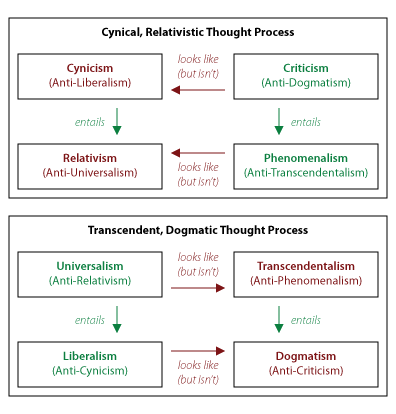
On the one hand, those who reject nihilism, as I do, and correctly adopt its negation, objectivism, but wrongly equate phenomenalism with nihilism and thus objectivism with transcendentalism, then correctly see that transcendentalism entails fideism, and so conclude that the only alternative to nihilism is fideism. If they likewise correctly see that rejecting nihilism entails rejecting cynicism, but wrongly equate criticism with cynicism and thus liberalism with fideism, they will likewise conclude that the only alternative to nihilism is fideism. In either case, from their correct rejection of nihilism, they find themselves seemingly but wrongly compelled to adopt fideism.
I think that this error underlies views like:
On the other hand, those who reject fideism, as I do, and correctly adopt its negation, criticism, but wrongly equate liberalism with fideism and thus criticism with cynicism, then correctly see that cynicism entails nihilism, and so conclude that the only alternative to fideism is nihilism. If they likewise correctly see that rejecting fideism entails rejecting transcendentalism, but wrongly equate objectivism with transcendentalism and thus phenomenalism with nihilism, they will likewise conclude that the only alternative to fideism is nihilism. In either case, from their correct rejection of fideism, they find themselves seemingly but wrongly compelled to adopt nihilism.
I think that this error underlies views like:
(ALSO UPDATE FROM 9MO IN THE FUTURE: looking back here I realize that because of reasons, a bunch of what was supposed to be in the OP got left out way back when: I've now posted it in a followup comment below, at: https://thephilosophyforum.com/discussion/comment/513602).
My core principles are:
- That there is such a thing as a correct opinion, in a sense beyond mere subjective agreement. (A position I call "objectivism", and its negation "nihilism".)
- That there is always a question as to which opinion, and whether or to what extent any opinion, is correct. (A position I call "criticism", and its negation "fideism".)
- That the initial state of inquiry is one of several opinions competing as equal candidates, none either winning or losing out by default, but each remaining a live possibility until it is shown to be worse than the others. (A position I call "liberalism", and its negation "cynicism".)
- That such a contest of opinion is settled by comparing and measuring the candidates against a common scale, namely that of the experiential phenomena accessible in common by everyone, and opinions that cannot be thus tested are thereby disqualified. (A position I call "phenomenalism", and its negation "transcendentalism").
[b](UPDATE FROM 9MO IN THE FUTURE: I've since revised my terminology, and since the image linked below now reflects that change, I've edited this note in to clarify. Instead of "objectivism vs nihilism", I now use the terms "universalism vs relativism", and consider universalism a type of objectivism alongside transcendentalism, and nihilism a type of relativism as well. Instead of "criticism vs fideism", I now use the terms "criticism vs dogmatism", and consider dogmatism a type of fideism alongside liberalism. Together with the remaining positions, this groups everything into four sets of two:
- Objectivism, which includes both universalism :up: and transcendentalism :down:,
- Subjectivism, which includes both phenomenalism :up: and relativism :down:,
- Fideism, which includes both liberalism :up: and dogmatism :down:, and
- Skepticism, which includes both criticism :up: and cynicism :down:)[/b]
I think that these principles necessitate things like:
- An empirical realist ontology
- A functionalist and panpsychist philosophy of mind
- A critical rationalist or falsificationist epistemology
- A freethinking philosophy of education
- A hedonic altruist account of ethical ends
- A compatibilist and pan-libertarian philosophy of will
- A liberal or libertarian account of ethical means
- An anarchic political philosophy
And I see two different common errors that I think underlie all of the positions that I find wrong:
On the one hand, those who reject nihilism, as I do, and correctly adopt its negation, objectivism, but wrongly equate phenomenalism with nihilism and thus objectivism with transcendentalism, then correctly see that transcendentalism entails fideism, and so conclude that the only alternative to nihilism is fideism. If they likewise correctly see that rejecting nihilism entails rejecting cynicism, but wrongly equate criticism with cynicism and thus liberalism with fideism, they will likewise conclude that the only alternative to nihilism is fideism. In either case, from their correct rejection of nihilism, they find themselves seemingly but wrongly compelled to adopt fideism.
I think that this error underlies views like:
- A supernaturalist ontology
- A dualist philosophy of mind
- A fideistic epistemology
- A religious philosophy of education
- A puritanical account of ethical ends
- A metaphysically libertarian philosophy of will
- An absolutist account of ethical means
- An authoritarian political philosophy
On the other hand, those who reject fideism, as I do, and correctly adopt its negation, criticism, but wrongly equate liberalism with fideism and thus criticism with cynicism, then correctly see that cynicism entails nihilism, and so conclude that the only alternative to fideism is nihilism. If they likewise correctly see that rejecting fideism entails rejecting transcendentalism, but wrongly equate objectivism with transcendentalism and thus phenomenalism with nihilism, they will likewise conclude that the only alternative to fideism is nihilism. In either case, from their correct rejection of fideism, they find themselves seemingly but wrongly compelled to adopt nihilism.
I think that this error underlies views like:
- A nihilistic ontology
- An eliminativist philosophy of mind
- A justificationist epistemology
- An "epistemic anarchy" philosophy of education
- An egotistic account of ethical ends
- A hard determinist philosophy of will
- A consequentialist account of ethical means
- An anomic political philosophy
(ALSO UPDATE FROM 9MO IN THE FUTURE: looking back here I realize that because of reasons, a bunch of what was supposed to be in the OP got left out way back when: I've now posted it in a followup comment below, at: https://thephilosophyforum.com/discussion/comment/513602).
Comments (91)
What possible reason could you have to believe that experiential phenomena are a 'common scale', when virtually all the evidence we have seems to point to the contrary with regards to the questions of philosophy.
1. No major philosophical question has been resolved to anyone's satisfaction despite over a thousand years of equally intelligent people attempting to do so. If equally intelligent people maintain these difference despite the longest examination period of any topic in human history, it is blind faith to conclude anything other than that our phenomenal experiences by which we judge the conclusions are actually different in this regard.
2. If (1) wasn't enough, psychological evidence working with neonates shows distinct enculturation of concepts even as simple as object permanence. Something as fundamental as the means by which we navigate 3d space etc might well be hard-wired, but pretty much everything else is an interaction between the child and their social environment.
For someone so opposed to fideism, you seem to have taken a massive leap of faith here, which makes the remainder of your anti-fideism seem rather pointless.
I'm not saying that philosophical questions should be settled by appeal to people's intuition from their life experiences, I'm saying that a core philosophical answer (that I'm not presenting an argument for here, just stating that it's the answer I settled on), an answer to a question about how to answer questions, is "answer them by appealing to the phenomenal experiences that people have in common".
Also note that I didn't say "experiential phenomena, which are all accessible in common by everyone", but "[those] experiential phenomena [that are] accessible in common by everyone". Experiences that others don't share are no grounds for answering questions, e.g. observations that aren't repeatable are not admissible evidence.
Well then you're describing science, not philosophy. Science models phenomena and judges those models by their correlation which the sorts of phenomenal experiences we share (mostly sensory perceptions).
Quoting Pfhorrest
So you're saying that the answer to the question "how should we settle questions" is "by reference to common phenomenal experience", which is science. Isn't that just positivism? Not that that's a problem, just that it seems a rather long way round of revisiting a prior philosophical tradition.
I'm saying that my philosophical position is one that embraces the methods of science... for answering factual or descriptive questions, and analogous methods for answering normative or prescriptive questions.
Science and philosophy don't have to be at odds. In defending why you should do science instead of something else, you're doing philosophy.
Quoting Isaac
It's much like positivism, when it comes to descriptive questions. But unlike positivists, I don't take descriptions to be the only meaningful kinds of speech-acts, and I have a whole analogous part of my philosophy that approaches prescriptions in a way analogous to how positivists approach descriptions.
Positivists generally commit the errors I ascribe to "nihilism" (as defined here) when approaching normative or prescriptive questions. My principles are meant to be broader abstractions of ones similar to positivist principles, in a way that doesn't ab initio rule out the possibility of answering ethical questions.
Quoting Pfhorrest
So by what should the correctness of answers to these questions be judged, if not common phenomenal experience (which we've just established is science)?
Appeal to common phenomenal experience to answer descriptive questions is (physical) science. But as I already said earlier,Quoting Pfhorrest...and in that establish the groundwork for ethical sciences: not physical (empirical) sciences applied to ethical questions, but an analogous kind of investigation, appealing to experiences of things seeming good or bad instead of experiences of things seeming true or false, to put it roughly.
I was about to edit this into my previous comment before you responded: Positivists also err (in my view) on some descriptive topics too. They generally don't embrace the principle I called "liberalism" when it comes to descriptive questions, and so fall into a justificationist epistemology; and they also tend to be eliminativists about philosophy of mind.
It's pretty evident I think that the matter of things 'seeming' some way or other ('good' or 'bad' in this case) is exactly the kind of matter where there is very little by way of shared phenomenal experience. What makes you think you'd find any here?
There are outliers, of course, but there are also blind and deaf people when it comes to empirical experience, and we can account for that.
Yes, but there's is not a shared phenomenal experience that pain is 'bad'. Many people seems to expect the use of the term 'bad' to do something other than refer to pain.
If something doesn’t feel bad, how can it be called pain? Pain, or suffering more generally, is a bad-feeling experience.
Quoting Isaac
Many people seem to expect the use of the term “real” to do something other than refer to observables. Those people are rejecting empiricism, and I think they’re wrong. Likewise, people who think that things can be bad even though they hurt nobody reject hedonism, and I think they’re wrong.
NB again that I am not arguing for these positions here right now, just stating that they are my positions and clarifying what they are. Of course people who disagree with those positions think differently. I think it can be shown that they are wrong. That’s how disagreement works.
Not in the sense 'bad' is used when talking about morals. In that sense, some people think pain is 'good' (retribution, just suffering, self-flagellation...).
Quoting Pfhorrest
Fine.
Quoting Pfhorrest
That's circular. We're discussing whether these matters are amenable to judgement by measure against shared phenomenal experience (the measure you proposed for the resolution of conflicting arguments). So you can't then claim that people who have a different phenomenal experience are wrong, that just immunises your argument against any critique.
There are people whose phenomenal experience of what seems 'bad' does not equate with hedonic sensations. They feel (or see) pain and do not feel that it is 'bad', in a moral sense. That's their phenomenal experience. If you're going to start saying they're wrong then you're doing just that which you decried at the beginning.
It seems to me that you are still mistaking what I’m talking about in the way I already clarified here:
Quoting Pfhorrest
Whether hedonic experience equates to moral 'good' and 'bad' is the matter in dispute. You cannot resolve that issue using the method you outlined because there is no shared phenomenal experience of hedonic experience equating to moral 'good' and 'bad'. The feeling that it does/doesn't varies widely.
You are still conflating two different things here. What you are asking for is like asking to empirically prove that empiricism is correct. I am not saying that you can do that, or that you can hedonically prove that hedonism is correct. I am saying that I take hedonism to be the correct way to tell whether things are normatively correct, in the same way that I take empiricism to be the correct way of telling whether things are factually correct. I haven’t presented arguments for either of those positions here, just said that they are my positions.
This thread isn’t about justifying my philosophical principles, I only gave them as an example of the kind if systemic principles this thread is supposed to be about.
Maybe this will help clarify more what those principles are, if it will settle this tangent down. Those four principles applied specifically to normative or prescriptive questions mean:
Phenomenalism: it’s experiences of pain, pleasure, suffering, enjoyment, etc — things feeling good or feeling bad — that matter in determining whether something is good or bad.
Objectivism: Everyone’s such experiences matter equally, without bias.
Liberalism: All intentions/actions are to be considered permissible by default until they can be shown wrong as above.
Criticism: Any intention/action could in principle be shown wrong like that; none are beyond question.
And again, I’m not saying that these principles can be used to prove themselves. I’m not trying to prove them in this thread, I’m just stating what they are as an example.
Maybe you need to include a cultural dimension also. Reading this, I began to consider that what binds human behavior isn't simply the desire for pleasure or lack of suffering in the individual, but pursuit of collective control along with concessions and compromises to sustain that control in the face of everyone's subcultural weakness, which is what makes the difference between a kinship clan and an institutional framework. Not necessarily a rational social contract, but a pragmatic baseline level of respect for the implications of what contrasting social groups want or do. Perhaps civilization is not even possible without this not hedonic but communal sensibility, no matter how hardnosed the participants are. This communality could be a very tenuous phenomenon at best, but perhaps certain conditions in education and elsewhere can foster its enhancement.
Quoting Pfhorrest
Do you see where it's confusing?
Again, you can’t expect empiricism to prove that empiricism is correct, but that doesn’t mean there can be no arguments that empiricism is correct; and its inability to prove itself solely by appeal to itself is no argument against it.
So another of your core principles is that there's a clandestine second way to resolve conflicts of opinion which you're going to leave out of your core principles because...
Sorry to intrude. I am not a philosopher, but I am not sure what you mean, here. For example, in the philosophy of morals or ethics, what is the "correct" opinion regarding Sophie's Choice?
In the case of the literal Sophie’s Choice from the book, it’s probably the case that either choice of child is a less-bad option than letting both children die, even though all options are bad to some extent. In general, if you can’t save everybody, saving somebody is still better than saving nobody. That doesn’t excuse that not saving some people is still a bad outcome (though not necessarily reflective of bad choices on anybody’s part, if there was nothing anybody could do about it; though in the case in the book, it’s the Nazis who are ultimately at fault, of course).
Quoting Pfhorrest
be said to be compatible with objectivism? So as for the second "error", I'm sympathetic.
Other than that, I share the same core principles, and notice similar patterns. It strikes me that the first set of converse positions also often share a view that my principles somehow undermine something precious: absolutism, idealism, mysticism. It's always a sense of tearing something down rather than building something up: in a word, conservativism. So I wonder if the seeming error is a symptom rather than a cause.
My principle of objectivism isn’t saying that we have direct experience of (the whole of) reality (or morality), or that all our thoughts are objectively correct. Just that there is something that it would be objectively correct to think, as opposed to saying there is no correct or incorrect and every opinion is just as baseless as any other.
Your use of “limit” is apropos here, because on my account objectivity is the limit (in a mathematical sense) of progressively less wrong opinions, what our opinions converge toward as we take more and more experiences into proper account, but which we can never quite reach.
Quoting Kenosha Kid
I’d say liberalism is actually entailed by objectivism: if you are going to hold that such a thing as a correct opinion is possible, you have to give every opinion the benefit of the doubt that that one might possibly be it, otherwise you would be forced to dismiss all opinions as equally incorrect out of hand, i.e. cynicism. (At least, unless you're willing to also reject criticism for fideism, and say that there are simply some foundational opinions that are beyond question).
Likewise phenomenalism, as anti-transcendentalism, is entailed by criticism: if you are going to hold every opinion open to question, you have to consider only opinions that would make some experiential, phenomenal difference, where you could somehow tell if they were correct or incorrect. (At least, unless you're willing to also reject objectivism for nihilism, and say that there are some questions about things beyond experience that simply can never be answered).
I don't think I would. I think empiricism about the external world is something which cannot really be doubted, so I don't think it requires a justification. But that's not the point. What you're doing with your meta-ethics is not merely advocating a method (though you phrase it that way), you are making a proposition about the shared world - that the moral sentiments 'good' and 'bad' equate to the physiological sensations 'pleasure' and 'pain' in some exhaustive way. This proposition itself is contrary to your empiricism with regards to facts about what is the case in the shared world. It does not itself form an opinion which can be resolved by reference to shared phenomenal experience, and yet it is a statement about what is the case. So I'm not saying that everything (including your foundational principles) must be justified - that would set up an impossible task. I'm saying that, at the very least, your foundational principles should not be built on a belief which itself contradicts one of those very principles.
Say if I was a radical Christian biblical literalist. It would be unreasonable for anyone to expect me to find proof in the bible that I ought to believe everything in the bible. The decision to believe everything in the bible must come first. But if I were to say "I believe everything in the bible because my version was published by Collins and they're the new Messiah", we could justifiably cry foul. The Bible - the very thing I believe every word of - says the opposite.
You're doing the same with your ethics. You're saying on the one hand that a core principle is that we should dismiss from discussion anything which cannot be adjudicated by reference to a common phenomenal experience, and then on the the other you're presenting something as the case (and claiming to be able to argue for it) that is absolutely not judicable by reference to common phenomenal experience.
Ahh phew, not Ayn Rand Objectivism, but Objectivity. This is still an extreme end of a scale for me. For instance, if we take a human moral question, this presumably has an exact and true answer. One would expect, probably rightly, that, all other things being amenable, the consensus-driven progress of actual human answers to that question, as implemented by legislature say, would approach that correct answer, but not necessarily expect them to ever reach it. It would seem odd to me for some alien anthropologists to take a view that, whatever it is, there was a right answer to a human question that did not exist at any time during the lifetime of humanity.
I come from a more relativist, structuralist, pragmatist, and ontologically minimalist angle which, to me anyway, also seems consistent with empiricism and phenomonology. It is not that I disbelieve that some phenomonological thing has an underlying objective reality necessarily, more that it's easier to dismiss false beliefs about that reality than it is to justify good ones. Unlike moral questions, physical questions may have an objective answer but, like moral questions, the meaning is always deferred. And even well-founded moral beliefs such as the golden rule are difficult to justify on a cosmological scale, an example of relativism.
The "errors" I see are in phrasing questions that at best can only have contingent answers and at worst are effectively meaningless, particularly ones in which actual experience and empirical facts are deemed unimportant to the question. Anthropocentricism I think is one of the most the most pernicious errors, underpinning much of the three errors mentioned in my last post, as making a virtue of a human bias is wont. I think these would be alleviated by a healthy dose of relativism, phenomonology, scepticism and pragmatism.
Most of my position comes from my background in science, that great human decenterer and natural relativist and pragmatist. I think the only thing that doesn't, my structuralism, comes from my interests in other sciences such as anthropology, and from my enjoyment of postmodern art, particularly literature and, weirdly in my partner's view, ceramics.
And yet plenty of people doubt it. People believe in supernatural things that can’t be empirically tested, and disbelieve things that have stood up to empirical testing, all the time. Most people, probably. But we who advocate for science say that those people are wrong. I think arguments can be given for why they’re wrong; arguments that don’t beg the question by presupposing empiricism.
I’m just applying the exact same process to normative questions and hedonic experiences. Most people agree on some level that pain is bad, just like most people generally believe their eyes. But then they also go on to think that all kinds of things that hurt nobody are bad, and things that do hurt people are okay. I think that’s wrong just like people who disbelieve empiricism are wrong, and that arguments to that effect can be given, arguments that don’t beg the question by presupposing hedonism.
Quoting Isaac
You keep making this category mistake, here and other times this has come up. Common phenomenal experience doesn’t JUST mean empiricism. I am absolutely not saying that hedonism can be empirically proven. Hedonic experiences are a KIND of phenomenal experience, the prescriptive analogue to the descriptive kind of experience we call empirical. I am saying that appeal to common (shared) experiences of that kind is how to settle normative questions, just like appeal to our common (shared) empirical experiences is how to settle factual questions. Lots of people disagree with both if those “how to”s, but I think they can be shown wrong; without begging the question by assuming either kind of phenomenal appeal.
At first glance I read this as a comment about there being correct answers to “human questions” that predate the existence of humanity, but on second glance I can’t parse this correctly. Maybe you can rephrase?
If it did mean what I initially took it to mean, then I’d say the only answers that existed to human moral questions prior to humanity itself were conditionals. Like today, we can say that supposing we artificially created some kind of life form vastly different from humanity, such-and-such would be the correct answer to a moral question that might come up in such a species’ culture. But that species doesn’t exist yet. Likewise, it can have been true for all time that if humans do such-and-such to other humans it is bad, even if no actual humans exist yet, or anymore. It’s just kind of a useless truth when there aren’t any humans.
Quoting Kenosha Kid
That is exactly the implications of my principles, both about reality, and about morality. Initially anything goes, but options can be weeded out, by showing them in conflict with experience, and the more options we weed out by accounting for more and more experiences, the more we narrow in on the correct answer. I think you already get what that means for investigating reality. For morally, it roughly means that everything is permissible until it can be shown to hurt someone, and the more and more such hedonic experiences we account for, the narrower and narrower the range of still-permissible options remaining, closing in on (but never reaching) the correct answer to the question of what we should do.
It's not about whether hedonic experiences are shared, it's about whether the feeling that they relate to 'goodness' and 'badness' is shared, which you skip over with...
Quoting Pfhorrest
This is not in the least bit true. Virtually everyone in the world believes their eyes (especially if you take as I presume it was rhetorically meant to imply senses in general), only the insane don't. There's nowhere near this level of agreement that pain is bad.
Empiricism about the external world is indubitable because without it one would be unable to simply navigate 3D space. There was a good thread about this recently but I can't remember whose it was, but when you don't focus on the stuff we generally discuss (God, ghosts etc) we agree on the vast majority of stuff, and most of that agreement is about the qualities of what we sense (the other parts being things like the meaning of words and the rules of maths etc).
The relationship between pain and 'badness' does not enjoy anything like this level of agreement. The argument for empiricism is based on this indubitability. So no similar argument can be made for treating moral judgment as measured by hedonic variables.
You dismiss all the beliefs people have in things they can’t see, and disbeliefs people have about things they could see if they looked at the evidence, to say that empiricism is ubiquitous, when it’s really not. Some degree of it is, sure, but not a full commitment to it.
Likewise, most people consider people who say they like to be hurt to be as crazy as people who see hallucinations. Who in their right mind wants to be tortured? That kind of partial hedonism (not liking to be hurt) is as ubiquitous as your partial empiricism (trusting your senses). But a full commitment to it is as rare as a full commitment to empiricism.
In any case, how commonly something is accepted is besides the point. I was saying that lots of people reject these principles (both empiricism and hedonism), and those people are nevertheless wrong. I’m not saying “Look how everyone accepts these things! They must be right!” You’re doing that, and I’m denying the validity of that inference.
Quoting Isaac
And one would quickly die if they didn’t care about pain at all.
Empiricism is about the source of knowledge, not the source of beliefs. Whatever measure you use to distinguish between the two (I prefer a fuzzy gradation, myself) there is a difference.
Quoting Pfhorrest
Firstly, that only works for personal hurt. Something which is morally bad is something which we ought not do. So all you get from this is a proscription against self-harm.
Secondly, this only covers physical avoidable harm. Most people would find heavy exercise painful, but they do not think that pain is bad. People are even more ambiguous about whether various types of emotional pain is good or bad in the long term.
Quoting Pfhorrest
Perhaps it would be quicker and easier if you simply tell me (or direct me to) your method for demonstrating that judging moral rights and wrongs using hedonistic variables is more right than other systems. That seems to be the sticking point and so it might be better to just jump to it.
Quoting Pfhorrest
Again, it's caring about the pain of others which is required for your translation of hedonic values into moral ones. This is not equivalent to empiricism where it is my knowledge which is being sourced from my senses.
Knowledge is a species of belief, and the kinds of things I’m thinking of (theists and other spiritualists, flat earthers, etc) often claim knowledge despite lack of or contrary empirical evidence.
Quoting Isaac
Developing an intersubjective agreement on what is or isn’t real depends on caring about other people’s observation at least enough to go and see if you have the same observation in the same circumstances, and then on account of that confirmation agreeing that reality actually is such a way that it continues to appear that way to them, even if you’re not making that observation yourself right at this moment.
Likewise, my hedonic account of morality hinges on people confirming first hand as necessary that yes indeed it does hurt when someone does that, and then on account of that confirmation agreeing that it morally is wrong for people to do that, even if it’s not you experiencing the pain right at this moment.
Sure you could just care about your own hedonic experiences to the extent that you say so long as you’re not a actively experiencing the pain then it’s not bad, but that would be akin to taking a solipsistic view of reality that anything that you’re not currently observing isn’t real. That’s the kind of thing my principle of objectivism is to guard against. Phenomenalism by itself isn’t my whole view; it’s phenomenal objectivism, or objective phenomenalism. Objectivity means not being biased toward your own perspective, but accounting for others’ too.
Quoting Isaac
I’ve been asked not to link to my book anymore, but you can find it in my user profile. It’s the chapter called “Commensurablism”.
Yes, but limiting your sample to those people does not then contradict the argument that the vast majority of people are empiricist about the vast majority of things.
Quoting Pfhorrest
In the first case the equivalence is between what is sensed and what is real. The consideration is of other's senses to inform your understanding of what is real. There is already a belief that senses relate to reality in some way, we check others to confirm our own.
In the second the equivalence would have to be between pain and 'badness' (as we've discussed this is nowhere near as certain as that between senses and reality). The consideration of other's pains would have to inform my understanding of 'badness' (there's even less certainty that there's any equivalence here, whereas there is with other's senses). There would have to be already a belief that pain relates to 'badness' (there isn't) and we'd have to be checking others to confirm our own (we're not).
So whilst the two cases look superficially similar, on analysis, they're not.
Quoting Pfhorrest
This only demonstrates that I should no more take a solipsistic approach to what is painful than I should to what is observable. I agree. A good way to find out if the thing I find painful really is painful is to see if others find it so, just like I do to check my vision. Where in any of that am I compelled not to cause that pain?
Quoting Pfhorrest
I will have a read.
I think this answers my other question. In effect, your idea of objective moral truths are prohibitive and fundamental rather than extensive. (One need not, for instance, wonder if it is okay to sing Dennis Leary songs in church; it is sufficient to know that, since it harms no one, it is permissible.)
So far this is hedonistic and liberal, as you say, but consistent with the idea of contingent moral truths rather than traditional ideas of objective morality. For instance, I am not offended by being called a mzungu in East Africa, but I know other racial slurs against other people in other places is bad. That this is logical by your nominally objective morality and yet completely consistent with moral relativism makes me wonder what is so objective about your objective morality.
Is it the case that you believe that complex and seemingly contingent moral truths reduce to simpler truths, objective in themselves, but manifest differently in different contexts? "Do no harm" does seem to fit this bill, with "harm" being highly contingent. What about "Do no harm to animals?" or "Do no harm to the planet?" Morality is expanding beyond consequences for humans.
I do take most of morality to be entirely contingent, but that doesn't make it non-objective. Most facts about reality are contingent (not necessarily true), but still objectively true. (I think there are some necessary moral truths, obligations, but they're rather vacuous without taking into account some contingencies: just like the only necessary descriptive truths are logical truths that only mean anything non-vacuous in terms of the contingent assignment of meaning to words, so too the only moral obligations regard rights, which I construe as all about property, and so depend entirely upon the contingent assignment of ownership).
Non-contingent moralities are generally called "absolute" rather than just "objective". (And contingent ones are sometimes called "situational" in contrast). Objective in the sense that I mean it is often also called "universal". It's opposite relativism (which also has multiple senses, but it'll be clear which one I mean) in the sense that what is or isn't moral doesn't change depending on who you ask -- people will give you different answers, but some (if not all) of them are wrong -- even though it can change depending on context or circumstance.
For a descriptive analogy, relativism would hold that inside the headquarters of the Flat Earth Society, the entire world is flat, because that's what people there believe. But as soon as you step outside of there, the entire world is round. Objectivism in contrast says that the shape of the world doesn't depend on who you ask: one of those views about it is wrong (and I'm sure you know which). But that doesn't mean that the world couldn't actually be shaped differently at different places: it's conceivable that there could be a flat side to the world and a round side. (Not conceivable in terms of actual science, but we can imagine a hypothetical world where that was so). In such a scenario, everyone should agree that it's flat over on that side and round on this side, and if people disagree about where it's flat and where it's round, at least one (if not all) of them is wrong.
And yeah, my concept of morality is in no way limited to humans. It can be applied to animals, aliens, anything. (Paging Dr. Singer).
Let me put this way, if a scenario has the rights of one group of people, say trans women, at odds with the rights of another, say cis women, do you believe there is an objective moral truth that can resolve or override the conflict? These are the sorts of situations where I can genuinely see the argument from both sides, recognise that the good of one is the bad of the other. Any objective moral truth that cannot decide or override the conflict at least in principle doesn't seem to have much business calling itself objective.
Quoting Pfhorrest
For sure, relativism is not the opposite of objectivity insofar as an anti-objectivist is not necessarily a relativist and a anti-relativist is not necessarily an objectivist. Even in moral relativism a thing can be considered objectively true for that person/culture and objectively false for others though, again, it seems to me you can do away with the objectivity altogether.
I think there's a myth, exacerbated by nihilists, that the baby is thrown out with the bathwater with moral relativism, which fails to observe that we have more in common than distinguishes us. My view is that we all have a self-rewarding drive toward altruism in our genetic inheritance, albeit competing with selfish drives. We all have the capacity for empathy, an empathy that is amenable to socialisation in what seems to be a staggeringly flexible manner. The application of these capacities beyond the environment they were selected for is the basis of moral philosophy: how to behave in a giant social group of mostly strangers. We had no need of objective morality when everyone we met was a relative or a neighbour. I feel we do have a duty of moral consideration now, and the illusion of an objective morality might have expediency. But that doesn't make it true.
Quoting Pfhorrest
I expect that you know that isn't true. There is a truth relativism, but it doesn't concern facts like the shape of the Earth, rather how systems of truth can be constructed differently with different truth values for the same questions. It isn't nearly as controversial as absolutists make out. For instance, all mathematical truths are true with respect to a mathematical framework: choice of axioms. Different axioms yield different outcomes of truth values. Most of us are pretty comfortable with this.
There are some nutjob extremists though tbf.
Yes. Rights in principle cannot conflict; if they seem to, at least one claim of rights is incorrect.
Quoting Kenosha Kid
That sounds, again, like a weird use of “objective” to me; maybe you mean it as a synonym for “absolute” again? Different cultures consider different things moral absolutes, of course. Relativism would say that they’re each right, in their own cultures. Objectivism (as in universalism) would say that at most one (of any set of contrary claims) is right.
Quoting Kenosha Kid
Mathematical truths are of a different kind to claims about the world. They are logical truths, which depend only on the assigned meanings of the words used in them, the axioms of the logical system as you say, which are arbitrary; we could easily assign them differently. The moral analogue of that, on my account, is property rights, which depend entirely on who owns what, which is likewise arbitrary and could be assigned differently. But most of morality concerns supererogatory goods, which are the moral analogue of contingent truths. That’s why I gave a contingent descriptive scenario (about the shape of the earth) as an analogous form of relativism.
I read it. I can't find anything in there answering the question about how you show someone is wrong if they do not equate moral 'good' and 'bad' to hedonic 'pleasure' and 'pain'. The section on commensurablism seems to just repeat what was said in your OP, so I read the linked section on The Metaphilosophy of Analytic Pragmatism, but that just declares it to be the case that there's an equivalence, whereas you claimed to be able to demonstrate that a person was wrong for thinking otherwise. I know it's difficult with the restrictions on self-publicising, but could you just paraphrase, or copy-paste the argument here for me?
The most important part is:
Plus just earlier:
Where hedonism is the normative half of what I mean by phenomenalism, as explained here.
So there's an argument for commensurablism generally, half of which is criticism, which entails phenomenalism, half of which is hedonism.
None of that says anything about the equivalence between moral 'good/bad' and hedonic 'pleasure/pain'. That's the thing you said you could prove (or at least demonstrate to be less wrong). I'm trying here but you're being very evasive. The closest I can get from your quoted section is perhaps "if you are going to hold every opinion open to question, you have to consider only opinions that would make some experiential, phenomenal difference, where you could somehow tell if they were correct or incorrect." - but the best I can see this as an argument for would be that if morality is to be the sort of thing where opinions are held open to question, then it had better be measurable by some phenomenal difference. It makes no argument that we should take up this contingency.
Now there's the dogmatism of objectivity I was looking for!
Quoting Pfhorrest
No, the opposite. Abortion may be right for Anna, wrong for Barbara. As I went on to say, though, in the bit after what you quoted, I find the compatibilism pointless myself.
Quoting Pfhorrest
Exactly. They depend on systems, and in that sense are relative. Morality also depends on systems (moral codes), and systemisation can crop up where it ought (language) and where it ought not: systemic Western bias in history, system sexism in medicine, etc. The truths espoused are relative to those systems.
I'm not a truth relativist btw, more a sceptical relativist. The method is useful for analysing structures of truth though (structuralism).
Just saying there is some correct answer or another is not dogmatic, when what that answer might be is completely open to question. Objectivism is not fideism; criticism is not nihilism.
You’re doing exactly the conflation of different things that I describing in the OP, so... thanks for the demonstration I guess.
Quoting Kenosha Kid
Sure. That’s not relativism though. That’s “situationism”. Relativism would say something more like that whether abortion is right for Anna depends on whether we ask California or Alabama, because whether people think it’s morally okay varies between those places.
Quoting Kenosha Kid
One could equally (wrongly) claim that truth in general (even about contingent things like the shape of the world) depends on belief systems, which was my point about the shape of the world changing when you enter or leave the Flat Earth Society HQ. The prevalent belief systems change between those places, so if one held truth relative to belief systems the way moral relativism holds goodness to be relative to moral systems, then the truth would change as you walked through the door.
Objectivism as I mean it is the opposite of that. About both reality and morality. What people think the correct opinion is doesn’t matter. (But what people experience does). The correct opinion, about reality or morality, is independent of what anyone thinks it is.
Quoting Isaac
The argument for that part was the main thing I was directing you to, and the first bit I quoted in my last post.
But here, let me walk you through the whole thing backwards as a reductio.
The opposite of hedonism as I mean it is the supposition that some things are bad even though they don’t feel bad to anyone; they just are. The supposition that there is such a thing as a victimless crime, morally speaking.
If that were the case, the only way of telling which things were good or bad would be to take someone’s word for it. You would not be able to confirm that something is bad to someone by standing in their place and seeing if it felt bad to you too. You’d be stuck just agreeing or disagreeing with no manner of adjudication.
One could get around this problem of having to take someone’s word on what is good or bad by denying that anything is actually good or bad, saying all there is is people’s words about it and if those differ between people then what is good or bad differs between them too.
But if you do that, then if there is such a thing as the right opinion after all, you will never find it, because you never even attempt to answer what it might be, and you will remain wrong forever.
So we’re back to having to take someone’s (maybe your own) word for it without any way of questioning it. But then if your opinions should happen to be the wrong ones, you will never find out, because you never question them, and you will remain wrong forever.
There might not be such a thing as a correct opinion, and if there is, we might not be able to find it. But if we're starting from such a place of complete ignorance that we're not even sure about that — where we don't know what there is to know, or how to know it, or if we can know it at all, or if there is even anything at all to be known — and we want to figure out what the correct opinions are in case such a thing should turn out to be possible, then the safest bet, pragmatically speaking, is to proceed under the assumption that there are such things, and that we can find them, and then try. Maybe ultimately in vain, but that's better than failing just because we never tried in the first place.
So we try by proceeding under the assumption that there is such a thing as a correct opinion, in a sense beyond mere subjective agreement, but that there is always a question as to which opinion, and whether or to what extent any opinion, is correct. And if you are going to hold every opinion open to question, you have to consider only opinions that would make some experiential, phenomenal difference, where you could somehow tell if they were correct or incorrect.
So when it comes no normative questions, we’re left appealing to shared normative experiences: we agree (from our firsthand experience) that this feels bad to people like so in situations like such, so subjecting people like so to situations like such is bad.
And since if you are going to hold that such a thing as a correct opinion is possible, you have to give every opinion the benefit of the doubt that that one might possibly be it (otherwise you would be forced to dismiss all opinions as equally incorrect out of hand), we have to proceed on the assumption that anything else might as well be good enough until it can thus be shown bad.
Most of this post is things I already wrote either here or in the essay I sent you to, just rearranged to address this one specific point.
I really didn’t intend this whole thread to be a defense of just one small part of my own principles. I wanted to talk about systemic principles in general and gave mine as an example of the kind of thing I mean.
I wasn't being wholly serious. It is certainly a stricter position. "One of you is wrong, and that's that!" My beef with this is that, unless we have a means of evaluating the objective truth, there's nothing going on inconsistent with the view that there isn't one. Referencing our discussions elsewhere, belief in it appears unjustified to me.
Quoting Pfhorrest
No, it's forwarded by some in relativism too (I'll dig a link out later). The idea being that what is good for Alice is objectively good for Alice, even if it is objectively bad for Barbara. I'm not arguing it's merit, just saying it's out there. As someone who believes that, even if there were an objective truth out there, we wouldn't know it, I think it's an exacerbation of a bad idea.
Quoting Pfhorrest
Sure, and you'll find nihilism at an extreme end of relativism that not only acknowledges that facts determined scientifically, technologically or otherwise empirically are with respect to systems that may contain biases, but that therefore all facts yielded by those systems are as dubious as any other. To say this is the position of relativists, though, would be like describing atheists as Stalinists. It's a weak pejorative, and leading proponents of relativism like Rorty thought it was as stupid a conclusion as you and I do. Relativism says little about the relative merits of facts, but it is quite easy to see that a fundamentalist Christian's biases are more numerous, more impactful, and more wrongheaded than any odd slight bias in science. You're talking about a small number of idiots who made a big splash because their ideas were the right kind of controversial: clickbait before the click.
On which, and I've had this discussion with other anti-relativists in different fields, science is pretty friendly to relativism. While a lot of theist postmodernists during the science wars tried to use deconstruction to lower science's standing, it had the opposite effect. At university, I was taught to be mindful of unconscious biases in a way that previous generations of physics undergraduates were not. What doesn't kill us... Which is why I've always had a fondness for people like Latour, wrongheaded as his motivations were. We owe him a debt, as we have done to every philosopher who held a mirror to us. (I still say "us" like I'm still doing active research, what a pretentious bellend!)
Quoting Pfhorrest
RE: emphasised point... not a little bit dogmatic? I, as I said, am a sceptical relativist, but that doesn't particularly define a solid position on either. I believe that there is some objective reality behind phenomena, and that scientific modelling is a way of gaining insights on the limitations of its behaviour. But I do not believe that science is revelation. We do not access objective reality; we see the results of interactions between its parts. I suspect objective reality is something quite fundamentally different from our state-of-the-art models and, while we will always improve the accuracy of those models, we might never have a faithful representation, or know it if we do have it.
Morality is a different matter. It is quite clear to me that human morality is defined by human biology, sociology, history, and moral philosophy. Being as it is comprised of individuals who generate that morality and who have very similar genetic heritage and, in the West at least, very similar socialisation, it is no surprise that there is usually consensus on moral matters, giving the illusion of objective moral truth. Applied scientifically, this would predict that cultures whose social structures are very different ought to have different moral structures too. This wins out. It would also predict that individuals from one social structure ought to be, given the opportunity, as amenable to the moralities of other social structures as their own. This wins out. The biological bases of morality point to fairness, empathy and altruism, suggesting that, over history, the trend ought to point in those directions as we consider more and more historic cases. This wins out. Moral objectivity simply fails to justify its existence.
However, getting back to the OP, there's not much pragmatic difference in believing in a right answer that we do not have access to and believing there is not always a right answer. I think we're aligned on everything else, and I notice we tend to agree on things (I'm glad we have something to disagree on, actually, other than the meaning of the QM wavefunction, as you're great to talk to), so hopefully that suggests the errors you see I have mostly escaped, by luck if not by design.
That's fine, I won't continue this line of enquiry then, another time maybe.
In my replies to Isaac in the same post you’re replying to, I gave my reasons for why to proceed on the assumption that there is one, and explained why I advocate hedonism specifically because of the need for a common ground to evaluate it by.
Quoting Kenosha Kid
It sounds like we’re just disagreeing about terminology here. I acknowledge that there is a lot of variation in what people mean by different terms in this area, and all I can do about that is be clear what I mean by my use if them. The reasonable kinds of things you’re saying are not what I mean by the things I say I’m against. The unreasonable stuff I’m identifying these terms with are the things I am against. Being mindful of biases, different contexts, individuals differences, etc, is not relativism in the sense that I am against. That’s rather things like criticism in the sense I am for. Failing to distinguish between these kinds of things are the errors I was on about in the OP.
Quoting Kenosha Kid
Nope, quite the contrary. Dogmatism boils down to “because I say so”, and I am saying it doesn’t matter who says so, they still might be wrong.
Quoting Kenosha Kid
I agree completely; and then I take an analogous approach to morality as well. Objective anything, reality or morality, is just the limit of increasingly improved fallible models. Objectivism in the sense I mean it is basically just acknowledging that there is some notion of “improvement”, some way of assessing one fallible model as better or worse than another, so that there is some notion of a limit being approached.
Quoting Kenosha Kid
Thanks, I enjoy talking to you too.
There's maybe more to it than that. I think any philosophical position with any value will, as it is refined and developed, have offshoots that begin to resemble other refined developments of other philosophical positions. Your objective morality is a lot less strict than others, allowing for contingencies that some more fundamental mind/person/culture-independent moralities (e.g. Plato, even Kant) might not. My nominal position takes instead those contingencies as a starting point, and allows for the possibility of a distant objective morality without justifying any belief in it, far from the nihilistic potential of short-sighted and opportunistic pomo critics. I think any practical approaches to moral philosophy from different assumptions would have resemble others in this way or die, or, worse, become insane ab initio rants.
OK. Can I first paraphrase you to check I've understood what you're saying so far? I have something like...
There is such a thing as correct opinion which we may only approach, but never claim to have reached for certain, and the measure of having gotten closer to it is agreement with some shared phenomenal experience.
Where there is no shared phenomenal experience there's no correct opinion.
Where we don't know if there's shared phenomenal experience, we're better off proceeding as if there is because that we we might approach a correct opinion, whereas presuming there isn't rules out that possibility.
You seem then to be arguing that with morality, we are in this third position. It's not clear that there's a shared phenomenal experience of what's right and wrong, but we're not going to find a correct opinion unless we proceed as if there is.
I agree with the first three propositions, It's the last one I'm having trouble with (to the extent that I'm not even sure I've characterised it correctly). So the opinion that I'm asking about is the opinion that right/wrong equates to pleasure/pain. That opinion seems not to be one which benefits from much shared phenomenal experience - people seem to disagree quite widely about it. So that would clearly fall under the second proposition above.
You seem to then make some jump (which I'm unclear about) to saying that we might benefit under the third proposition, if we just equated good/bad with pleasure/pain - despite the fact that this would contradict many people's phenomenal experience - simply because it enables us to measure it against something which is shared phenomenally and so approach a correct opinion.
But this last seems like a very weird trick to pull. I might say the same about art appreciation (which is not shared phenomenally), let say that the good-art/bard-art distinction (which is currently not shred phenomenally) actually maps to looks-like-what-it's-a-picture-of/doesn't-look-like-what-it's-a-picture-of - something that contradicts many people's phenomenal experience of good-art, but it enables us to measure it against something which is shared phenomenally and so approach a correct opinion.
This doesn’t sound quite like what I mean, but I’m having difficulty explaining quite why.
I think a good illustration would be the parable of the three blind men and the elephant, which I presume you’re familiar with. As the story goes, none of the three men have shared their phenomenal experiences of the elephant yet. But there is still the correct opinion, that it is an elephant they are feeling. That correct opinion has to be consistent with all of their separate experiences. Nobody is going to come to that opinion without having all of those different experiences to combine together; and even someone who has had all of these different experiences still has to think up something that would account for all of them together.
So for any of these blind men to figure out what they’re really touching despite their differences of opinion (that all seem well-founded to each of them based on their limited experiences), someone is going to have to stand where the other ones stood and feel what they felt in order to have the full set of experiences with which their hypotheses about the thing in question need to accord. If the blind man doing that checking doesn’t feel what the other blind men reported feeling there, he’s got to figure out what is different between them to account for why they feel different things in the same circumstances.
That doesn’t mean he has to figure out what could possibly be a tree, a snake, and a rope all at the same time. It means he’s got to figure out what feels like a tree to this kind of person in this context, feels like a snake to that kind of person in that context, and feels like a rope to another kind of person in another kind of context. In the end, the investigative blind man will have a bunch of experiences with which the hypothesis of an elephant is consistent.
Quoting Isaac
It’s more that, as described above, we should proceed on the assumption that our phenomenal experiences are in principle sharable: that we can figure out what is different about ourselves and the circumstances we’re in that accounts for the differences in our experiences, and then build a model that accounts for every kind of experience anybody would have in any circumstance. That might be really hard to do, but we have a better chance of getting closer to doing it if we act as though it’s possible by trying to do it, than if we say it’s not possible and so don’t try.
Quoting Isaac
This seems like a category error to me. When I talk about pleasure and pain etc, I mean them in a way that isn’t separable from the things seeming good or bad. If you like some experience, enjoy having it, then it doesn’t seem correct to call that painful to you.
You might still decide to bear some pain to get something else you enjoy, but if it’s truly pain to you then it seems analytic that you would prefer to avoid it if possible. If you could get a healthy fit body (which is enjoyable to have) without suffering from your workouts, you’d want that. You decide to bear the pain of the workout for the greater pleasure of fitness because the alternative seems to you like even greater suffering overall. You’re picking the path that seems least bad, even though it is still kinda bad — “bad” in terms of suffering and enjoyment, pleasure and pain, etc.
That is all a purely subjective assessment of good and bad so far; not an assessment that pain is bad etc — that’s just analytically true, “pain” is “whatever feels bad” — but an assessment of what is best on account of merely your own pain etc. Making it objectively just means concerning yourself in the same way with experiences that you personally aren’t having right now. In the same way that you could be an empiricist and be a total solipsist, believing that things you personally don’t see are not real; making such empiricism objective just means accounting for everything that “seems true” (empirically) to everyone in every context. Likewise, hedonism can be made objective by accounting for everything that “seems good” (hedonically) to everyone in every context.
The alternatives in both cases are either denying that anything at all is actually true/good (and so all our empirical/hedonic experiences of things seeming true/good are just subjective illusions all equally baseless), or else that whatever it is that is true/good is so in virtue of something besides our experiences (in which case we have nothing against which to gauge what is true/good, and just have to take someone’s word as to what it is).
And if we’re not even sure whether anything is true/good or whether we can figure out what it is, we stand a better chance of figuring out what it is (if that turns out to be possible after all) if we try, acting as though something is true/good and we have some access to (experience of) what that is, and then trying to account for as many pieces of that access (as many experiences) as possible.
When applied to questions of what is true, that results in empirical realism. When applied to questions of what is good, that results in hedonic altruism.
Well, that sounds like a laudable aim, but you've rejected that approach already. You're saying "let's assume moral goodness is equivalent in some way to hedonic pleasure" and just ignoring that fact that millions of people feel differently. In what way does your approach try to "figure out what is different about ourselves and the circumstances we’re in that accounts for the differences in our experiences"?
Quoting Pfhorrest
You keep repeating what you claim to be possible, and I understand that, what I'm asking is why. If I were to say "you know how when you push a ball it rolls down hill? Well so it's the same with helium balloons", you'd tell me that despite me saying they fall into the same category, they don't. It's like that with your descriptive and normative categories. All you're doing is saying that however we treat descriptive theories, we can do the same with normative theories, but you're not presenting any arguments to make your case, simply declaring that it can be done.
Descriptive practices are different from normative ones, they have different properties and different sociological roles, as such it's not the case that however we treat the former we can do so with the latter.
We can analyse how different people feel in different circumstances, sure. Then we'd have a good description of how and when people feel good/bad. At no point in time in such an investigation will we have even touched on an argument as to why we ought to make others feel either of these ways.
Imagine I have an absolutely perfect understanding of what makes people feel good - I have a 100% accurate model. Why ought I carry out behaviours to bring that state about?
You keep making some kind of category error in talking like these things can come apart, like the "good" and "bad" in "feels good or bad" is a different sense than in "morally good or bad". Hedonic experiences analytically just are things that feel good or bad, in the same way that empirical experiences analytically just are things that look true or false. You can doubt either one, but then you're either doubting whether these experiences you're considering are enough, or else whether any experiences matter at all.
If no experiences matter at all, then you're left either holding no opinion whatsoever on the matter, or taking someone's word for it (maybe just your own). In either of those cases, you have at best a random guess's chance (whoever's word you might choose to take) at arriving at the correct opinion, if such a thing is possible, which at this point in the inquiry we're not sure of yet. So if you want to arrive at the correct opinion, if that should turn out to be possible, and have more than that tiny chance of guessing right the first time, then you've got to proceed as though there is one, but that you can't take anyone's word for what it is -- those are my principles of "objectivism" and "criticism" -- and then try to narrow in on what it might be. And if you're doing that, the only thing you have left to turn to is the experiences of things seeming correct, of things looking true or false, and feeling good or bad.
Now that we've ruled out doubting whether any experiences matter at all, we're left with doubting whether these particular experiences are enough or not. If not, that means what you need to do is account for more experiences. In the case of moral questions, that's more experiences of things feeling good or bad -- since that's the only kind of good or bad we have left to turn to, having ruled out just taking someone's word for it. It's entirely likely that the experiences you alone are having right now aren't enough to go on. That just means that you also need to account for experiences other people are having, and experiences you and they might have later. The only direction left to turn besides that is to just give up, in one of the ways described in the paragraph above.
Quoting Isaac
Bob has never had a certain unpleasant experience that Alice has had, because Bob has never been in the circumstances that Alice has been in to experience it. Bob may therefore be callous toward Alice's plight. My approach says Bob should consider the different circumstances Alice has been in, and why those would lead to different experiences that Bob hasn't had. If Bob doesn't believe Alice that those experiences in those circumstances are unpleasant, my approach says he should go stand in those circumstances himself and undergo the experience himself, to confirm that it is actually unpleasant. If still Bob doesn't find it unpleasant even though Alice reports that she does, my approach says they should look into what is different about themselves that gives rise to Alice experiencing such displeasure in those circumstances while Bob does not. The moral conclusion they should derive is that it is bad to subject people who are like Alice in the relevant way to such circumstances, because it causes displeasure in them, but it's okay to subject people like Bob to it, since those people don't experience displeasure in those circumstances.
What Alice or Bob say they believe "is morally right" isn't relevant, any more than the beliefs of scientists conducting experiments is relevant to the science. It's just the experiential data that matters. We don't ask them their opinions on hedonism, just whether things feel good or bad to them. This is why it's a category error for you to ask for this procedure to prove hedonism itself. You can't ask scientists to do an empirical experiment that proves empiricism is true without begging the question, either.
Quoting Isaac
I'm not just saying "it's possible, take my word for it", I'm saying nobody has given a good reason why it's not possible.
The default state of any inquiry has to be one where all the options and their negations are merely contingently possible, neither impossible nor necessarily true. This is part of not taking anybody's word on anything, leaving everything open to question, plus the necessity of giving everything the benefit of the doubt because otherwise you fall down an infinite regress and can never get any justification off the ground, leaving you stuck holding no opinions on anything again, which again is just giving up on trying. (This last bit is my principle of "liberalism").
Out of that initial state of inquiry, the burden of proof is on whoever wants to say that something is either impossible or necessary to show that the relevant alternatives can somehow be ruled out, leaving only that option for necessary truths, or anything besides that option for impossibilities.
Starting in that initial state of inquiry, I've given arguments why rejecting either of my principles of objectivism or criticism leaves you no hope of figuring out what the correct answers are, even if there are any that can be figured out, and why assuming those principles is therefore necessary. Those principles in turn entail liberalism and phenomenalism, the normative half of the latter being hedonism.
But your concern doesn't seem to be so much with hedonism vs its alternative (just taking someone's word for what's good or bad), but rather with moral objectivism. So that's a much more straightforward problem: you either assume moral objectivism, or you give up all hope of figuring out what's good and bad by simply assuming (on no grounds) that nothing could possibly be actually good or bad.
Once you're assuming moral objectivism, you can either take someone's word for what objective morality is, which is just another form of giving up on trying to be correct, or else you can question everything and try to narrow in on what might be right.
If you're going to question everything, you've got to give every possibility the benefit of the doubt, or else infinite regress quickly takes you back to assuming nothing is possible.
And if you're going to whittle away at those options you're giving the benefit of the doubt, without taking anybody's word on it, all you've left to go on is experiences of things seeming good or bad, as many such experiences as you can account for.
No they're not. Moral judgements of good and bad apply to behaviours, not to experiences. Hitting children is a behaviour which most think is morally bad, being hit is an experience which most think is hedonicly bad. The two are not the same. Assuming they are assumes a kind of 'Golden Rule' morality without any justification.
Quoting Pfhorrest
You've given no argument as to why this is the moral conclusion. Is all you're saying here that you prefer 'Golden Rule' type morality because it's easier to work out?
Quoting Pfhorrest
But then I don't understand what your argument is. We all already knew it was possible. all meta-ethical positions are possible and no-one has given any reasons why any of them are not possible. So what's new here?
Quoting Pfhorrest
I agree. But what seems good and bad in morality is behaviour, not experiences. It's my behaviour to to others that seems morally good/bad to me, not my experiences.
But on what grounds does your behavior toward them seem good or bad, if not either their experiences, or because someone else just said so?
My feelings, my neurological wiring, unconscious following of social norms, predictions of positive outcomes for me, God, the effects of the moral ether, aliens controlling me because we're living in a simulation...
Those are your experiences.
my neurological wiring
That’s a cause, not a reason.
unconscious following of social norms
That’s “because someone said so”.
predictions of positive outcomes for me
Gauged by your expected experiences?
God
“Because someone said so”.
the effects of the moral ether, aliens controlling me because we're living in a simulation...
Causes, not reasons.
Yes, not their experiences.
Quoting Pfhorrest
What's the difference as far as a proper understanding of morality is concerned?
Quoting Pfhorrest
No its not, no one need say anything, we learn social norms from birth.
Quoting Pfhorrest
Yep my experiences. I need not care in the slightest about the valence of the experiences of others, only their likely responses.
Quoting Pfhorrest
No. He might have instilled the instinct to act that way in me. No one need say anything at all.
Quoting Pfhorrest
Again, you'd need to clarify the difference in this context.
We might just not 'work out' what the morally right course of action is at all. It doesn't mean that no right course of action exists (nihilism) nor does it mean we can't say that some course of action is better than another, but 'better' might be by almost any measure. You're just picking 'because it makes most people happy', it could be 'because it makes you happy', or 'because it makes society more productive'....
1. Let's assume that there is an objective moral right and wrong because that way we've got a chance of finding it
- I find this suspect from the beginning because we don't presume there's an aesthetic right and wrong on the same grounds. I don't presume there's a right and a wrong type of hat to wear on the same grounds. So why would I presume there's an objective moral right and wrong, just because that maximises my chances of finding one isn't a sufficient justification.
...but assuming it is for now, you then say...
2. If there is an objective right and wrong, it must be measured by the hedonic pleasure/pain those behaviours cause other people because that's the only measure that isn't either subjective or arbitrary.
- Again, I don't agree that this is the only non-subjective, non-arbitrary measure. Neurological wiring is non-subjective and non-arbitrary and might well show what is objectively right and wrong (in that it is a behaviour which universally causes those moral feeling in all similar circumstances). Such knowledge would provide us with scientifically predictive models to say "if you do X (in circumstance Y) you will feel morally bad about it , that's just the way your brain is wired". That would undoubtedly indicate that X was morally bad. I'm not saying fixed neurology is the right answer, just showing that your 'Golden Rule' isn't the only non-subjective, non-arbitrary measure. Social norms are another such measure ("you will feel bad about behaviour X because it is opposed to your societies norms").
Basically, you're making the assumption that moral statements are normative, I don't agree. I think moral statements are expressive.
It sounds then like you are using the same words to refer to something different than I am. Rather than arguing about whose use of the word “moral” is right, I ask that you just substitute every instance of “moral” with whatever you would label something that is actually normative, because normativity is entirely what I’m talking about.
This is exactly the same is-ought problem I was just explaining to @Kenosha Kid in the postmodernism thread. If you want to reduce all attempts at prescriptive discussion to descriptive discussion, what you end up doing is just ignoring the prescriptive discussion entirely. Refusing to attempt to answer a question doesn’t somehow show that it is unanswerable.
What I'm saying is that normativity itself is an expressive act, there's no fact of the matter to be had in normativity of any sort because it's a category error to assume it's the sort of thing that's amenable to facts. All normative statements of any sort are expressions of the speaker's feelings, not statements of fact.
You’re doing essentially the same thing (but in reverse) as the social constructivist who claims that all assertions of supposed facts are in actuality just social constructs, ways of thinking about things put forth merely in an attempt to shape the behavior of other people to some end, in effect reducing all purportedly factual claims to normative ones. In claiming that all of reality is merely a social construct, such constructivism reframes every apparent attempt to describe reality as actually an attempt to change how people behave, which is the function of normative claims. On such a view, no apparent assertion of fact is value-neutral: in asserting that something or another is real or factual, you are always advancing some agenda or another, and the morality of one agenda or another can thus serve as reason to accept or reject the reality of claims that would further or hinder them.
I imagine you disagree with that kind of view vehemently (as do I), but it is simply the flip side of the same conflation of "is" and "ought" committed by scientism like yours: where scientism pretends that a superficially prescriptive claim can only be evaluated in terms of descriptive claims, constructivism pretends that all descriptive claims have prescriptive implications.
Constructivism responds to attempts to treat factual questions as completely separate from normative questions (as they are) by demanding absolute proof from the ground up that anything at all is objectively factual, or real, and not just a normative claim in disguise or else baseless mere opinion. So it ends up falling to justificationism about factual questions, while failing to acknowledge that normative questions are equally vulnerable to that line of attack.
Conversely, scientism like yours responds to attempts to treat normative questions as completely separate from factual questions (as they are) by demanding absolute proof from the ground up that anything at all is objectively normative, or moral, and not just a factual claim in disguise or else baseless mere opinion. So it ends up falling to justificationism about normative questions, while failing to acknowledge that factual questions are equally vulnerable to that line of attack.
Either error results in simply refusing to consider one kind of question, which is why both run counter to my principle of cynicism, because they inevitably lead to nihilism of one sort or another.
I'm not merely assuming, there are cogent arguments for non-cognitivism, it's disingenuous to try to paint one position as more refractory than the other. I think it is more parsimonious to consider moral statements to be no more than they evidently are until we have good reason to change that. Since there's no evidence of an objective 'ought' it makes sense to assume there's no such thing until we have reason to believe there is. It's the same reason I don't believe in God.
Quoting Pfhorrest
Why do you caricature my position as 'demanding' whilst yours (which you are no less attached to, is painted as the more reasonable? I've made no 'demands' here. I've just said that I find it more plausible that apparently normative statements are actually just expressive. Is there some reason why my finding this more plausible annoys you so? Quoting Pfhorrest
Who said I'm falling to acknowledge that factual questions are vulnerable to that line of attack. Have you read anything else I've written here? I'm strongly in favour of model-dependent realism. But normative and descriptive propositions are different. They may both be vulnerable to the same line of attack, but that doesn't oblige me to find their defences against those attacks equally plausible.
Prima facie they are attempts at asserting that something actually ought to be some way or other. You yourself in this same post say:
Quoting Isaac
I say to just take that appearance at face value. People are trying to say things about what ought or ought not be, not just describing themselves, and they treat other people saying different things of that sort as contradicting their claims about what is moral, not merely describing a difference between themselves as people. That indicates that they are trying to claim that things objectively ought to be one way or another, not just trying to describe how some things make them feel. Non-cognitivism claims that they aren't really doing what they superficially seem to be doing, usually because doing that thing is held to be impossible.
The burden of proof lies on the one who's saying that something is different than it seems, and that something or its negation is not possible. The starting point of any investigation is that anything and its negation is possible and so things might well be just how they seem until there's reason to think otherwise. You're saying that people making moral claims aren't really doing what they seem to be doing, and that the thing they seem to be doing isn't possible. I'm saying that there's no reason to think that, to think otherwise than that people are doing what it seems they're doing (making normative claims) and that that's a possible thing to do (some of those normative claims could be correct, and so their negations incorrect).
Quoting Isaac
There cannot be evidence either for against objectivity of either reality or morality. All there can be evidence of is that we either have so far, or else have not yet, succeeded in some attempt at modelling some part of our experiences or not. In the physical sciences, we have so far had tremendous success in many ways, but not yet had success in other ways. (Which is just to say, science isn't done; there are unsolved problems, that we merely assume we can eventually solve). In ethics, we have so far had less (but non-zero) success, and the remaining challenges have just not yet been overcome.
Objectivity is an attitude to take in the approach to these topics, not something we can find "out there". We cannot escape our own limited experiences; we can only make assumptions about what is beyond them, and we cannot help but tacitly make such assumptions whenever we act. Objectivity or not is thus merely a question of how to act: try to make sense of things as an unbiased, unified whole, or else don't try.
Quoting Isaac
I proceed open-mindedly on the assumption that some normative claims might be correct in what they appear to be saying, yet also critical of each of them, mindful of ways that would show it to be wrong. You instead cynically want proof from the ground up that it is even possible at all for any normative claim to be right in what they appear to be saying. That guarantees that you "have" to reject all of them, because it initiates an infinite regress: any proof of any "ought" will be another "ought" and you'll require proof of that first which will be another "ought" for which you'll require proof ad infinitum. But the same problem applies to claims of fact...
Quoting Isaac
...because if every "is" statement required proof before it could be accepted, that proof would be another "is", which would in turn require further proof, which would be another "is", which would require further proof, ad infinitum. If you subjected factual questions to this same degree of cynicism, you would be a nihilist about reality too.
But instead, if I understand you at all, you accept that reality is at least possibly as it seems (to the senses, i.e. empirical experiences), until something else seems (empirically) to contradict that, and then you look for a new model that accords with all of that empirical experience. You don't (I think) demand that every claim of fact be proven incontrovertibly from the ground up. That would be impossible, as I think you know.
If you took that same open-minded but critical approach to morality, then you would accept that morality is at least possibly as it seems (to the appetites, i.e. hedonic experiences), until something else seems (hedonically) to contradict that, and then you'd look for a new model that accords with all of that hedonic experience. But instead, you seem to want incontrovertible proof of any normative claim at all, before you'll accept the possibility that any of them might be right. That kind of proof is as impossible for norms as it is for facts.
But that's not a problem for your approach to facts, so why is it a problem for an approach to norms?
What a thing is or is not prima facie is not an objective fact but another statement of your psychological state.
Quoting Pfhorrest
At face value people who pray very much appear to be speaking to an all powerful God. People who put ivy over the door appear on face value to be sending messages to actual evil spirits. Neither can be disproven. Are you suggesting we take no further steps to assess the likelihood of each prima facie belief but simply presume they're true?
Quoting Pfhorrest
Yes, and non-cognitivists feel they've adequately met that burden. The fact that they haven't convinced you personally doesn't damn the entire enterprise.
Quoting Pfhorrest
Again, where have I asked for proof. The fact that I don't find the position plausible is not this obstinate demand you keep trying to caricature it to be.
Quoting Pfhorrest
Yes. But I don't. Because I find the idea of an external reality more plausible than I find the idea of an objective morality.
Quoting Pfhorrest
I don't know how many times I have the interest to keep saying the same thing... Because facts and norms are two different things. I'm not obliged to find arguments for realism in either case equally plausible.
I quoted what you agreed was prima facie too. You said "apparently normative statements" yourself; they appear normative to you too, but you think that appearance is deceiving. And you know, we could always ask the speakers themselves what it is they're trying to do. I strongly doubt a majority of them will say they're just expressing their feelings. If so, then we wouldn't have moral arguments.
Quoting Isaac
They appear to believe they are doing those things, in the same way that people making moral claims appear to believe that they are true. Those are examples of descriptive, (purportedly) factual beliefs though, not prescriptive, (purportedly) normative beliefs, though, so we check them in respectively different ways.
I can easily check if God or evil spirits actually seem to exist as far as my experiences go: I can try praying or hanging ivy over the door and see if anything different seems to happen. If not, then those beliefs won't seem true to me, and I'll be inclined to disagree unless they can walk me through something that does make them seem true to me. If we all check each other's claims against our experiences thoroughly like that, then we can gradually build up consensus about what seems to be true or false universally.
And I can likewise check if supposedly bad things actually seem bad as far as my experiences go: I can undergo those supposedly bad things and see if they feel bad. If they do, then yeah, I'll be inclined to agree that those are bad. If not, then I'll be inclined to disagree unless they can walk me through something that does make them feel bad to me. If we all check each other's claims against our experiences thoroughly like that, then we can gradually build up consensus about what seems to be good or bad universally.
You are denying somehow that the latter counts the same way that the former does. If I tell you that it's bad for people to get punched in the face, and you disagree, you can try getting punched in the face, and I expect you'll agree that that sure seems bad!
Maybe you can point out how the only available alternatives to getting punched in the face would seem even more bad, and that would be a sound argument for why in that context getting punched in the face could be okay -- like undergoing the pain of dentistry to avoid even greater future pain of tooth decay -- but in that case you'd at least be agreeing on the criteria by which we can assess such things.
Or you could agree on those criteria, but just disagree that anyone's experience but yours matters -- you getting punched in the face is bad, but it doesn't matter whether anybody else gets punched in the face -- but then we're back to the moral equivalent of solipsism, and you presumably reject solipsism about reality, you continue believing in things you can't currently see, so this isn't asking anything more than that.
Quoting Isaac
You haven't put forth any of their arguments here, just said that they disagree with me and you agree with them. But I suspect the main thrust of it is that moral facts would be a really weird kind of fact, necessitating the existence some kind of bizarre non-physical stuff. And I agree, which is why I don't strictly think in terms of in "moral facts" or "moral beliefs", though I might sometimes sloppily use that common language. Morality is not about facts, or reality. Moral claims don't imply the existence of anything. It's not like I think there's some big object out in deep space, or in some other dimension, or some abstract Platonic realm, that is "the objective morals", that we can somehow find.
Prescription is a different kind of speech-act than description, and saying that prescriptive statements can be evaluated for their correctness doesn't have to have any implications on any descriptive statements at all. I am a non-descriptivist about metaethics myself, which is often lumped under non-cognitivism, but there are non-descriptivist cognitivist metaethical views, like my own. They are newer and so far rare, but they address all the complaints non-cognitivists have about moral realism without throwing the baby out with the bathwater.
Quoting Isaac
I'm not saying you're actively asking me to give you proof. Just that you're rejecting the very possibility of there being any correct normative assertions, in such a way that one would first have to prove some normative assertion correct from the ground up in order to convince you of any. I know you're not asking to be convinced, but your apparent standards of evidence are unreasonable.
Quoting Isaac
So your argument here is just "I disagree". That's not much of a rebuttal of anything.
Quoting Isaac
Unless you can point our relevant differences between them that deserve different treatment, then on pain of hypocrisy you are.
My entire argument here is just asking what's the relevant difference that makes one deserving of different treatment than the other. Your response so far seems to be just "I feel like treating them differently, like these [non-cognitivist] guys do." The non-cognitivists at least have supposed reasons. I'm happy to shoot those down. But you're not even appealing to them.
None of this makes it not about psychological states.
Quoting Pfhorrest
There's little point in continuing if you're just going to repeat stuff we've already been through. All of the above presumes that moral statements are merely statements about what feels bad to whom. These are not what moral statements are about. Moral statements are about the behaviour, not the feelings it generates. In your example, the moral claim is not that one ought not to punch another in the face (we don't teach children morality by individual action, one at a a time). The moral claim is that you ought not make another person feel bad. Facts like that another person feels bad when punched in the face are used to determine which circumstances fall under the moral claim and which don't, they are not the moral claim themselves.
So I cannot test, in any way, the moral claim "you ought not make another person feel bad". It simply stands as an assertion, in exactly the same way as "God exists" stands as an untestable assertion. We can argue about the exact nature of that existence (and theologians do), just as we can argue about exactly what actions make another feel bad, but there are no further tests we can carry out to check the objectivity of "god exists", and there are no further tests we can carry out to check the objectivity of "you ought not cause another to feel bad".
Quoting Pfhorrest
Some I have, others not. At the moment I'm merely opposing your assertion that moral propositions and factual propositions are sufficiently similar that they need be treated the same. To oppose that I only need point out the differences, not present arguments about the consequences of those differences. In short form, however...
1. Moral statements appear to be statements assigning properties to behaviours, they make claims that behaviour X has the property 'morally bad'.
2. As Moore points out, we cannot 'work these claims back' because we end up infinitely asking ourselves "but why is it bad to...?". - As in... "It is bad to punch someone in the face", "Why is that bad?", "Because it will make them feel bad and it is bad to make another person feel bad "Why is that bad?"...
3. As such, the assignation of 'morally bad' to a behaviour must be either a brute fact of reality (not derived from other facts), or an arbitrary assignation (not derived from facts at all).
4. The latter fails to explain the otherwise unlikely coincidence of assignation across cultures (there's a universal sense one must 'justify' harming another whereas one need not 'justify' going for a walk - harming another seems to be a special category of behaviour). So we accept the former, behaviours being morally bad is a brute fact.
5. So the question, whence the brute fact. Either it is of the physical realm, or it is of its own realm. Inventing realms just to hold propositions when they can be easily explained within the realm we already believe in is non-parsimonious, so we reject the latter.
6. Damage to certain portions of the brain alters what the injured party thinks are morally good/bad behaviours. Being brought up in a particularly violent or uncaring culture affect what behaviours those people think are morally good/bad. Very young babies appear to have senses of justice, as do chimpanzees. So, altogether, the most plausible candidate for the physical origin of the brute fact of the morally good/bad properties of behaviours is in the brain, manipulated by the culture in which that brain develops.
7. Moral statements are therefore an expression of this psychological state.
Quoting Pfhorrest
Basically, propositions about physical reality have an obvious candidate for the mechanism by which they are made true. An external physical reality. Normative propositions have no such obvious candidate for an external truth-maker. In fact, their unanimity can be completely explained using the external physical reality we have already committed ourselves to, namely that this unanimity is the result of a shred culture acting on a shared brain-structure. Thus making moral statements expressions of this mental state.
Only to the same degree that claims about reality could also be said to be about psychological states. There is a very plausible sense in which an ordinary claim of fact is pushing a belief or perception from the speaker to the listener, trying to induce in the listener the same psychological state as the speaker. But that is different from making a statement ABOUT the speaker’s beliefs or perceptions. The former has implications on the latter, as evidenced in Moore’s Paradox, but not vice versa. Likewise, moral claims imply things about the speaker’s psychiatry states, but they are not ABOUT them.
Quoting Isaac
I agree, and I’m getting tired of repeating myself, and looking forward to this conversation ending because I really don’t foresee getting through to you.
Quoting Isaac
No, they presume that moral statements are about what IS bad (or good), and that the obvious starting point for an investigation into the truth of such statements is whether it SEEMS bad (or good) “to the senses“, the “senses” by which things seem good or bad, the appetites. Exactly as statements about what is true or false are not directly statements about who observes what, but are most obviously judged by what SEEMS true to sensorial observation. (And again, there isn’t even universal agreement that that is how to judge reality, so disagreement about how to judge morality is beside the point).
Quoting Isaac
...”reality is whatever accords with empirical observation”.
You can’t experientially verify that experience is the way to verify things, whether we’re talking empirical or hedonic experience, verifying what is real or what is moral. That’s why discussion of these things is philosophical, not scientific. We’re discussing reasons why or why not to trust experience versus something else. You can’t turn to experience for an answer to that.
But we’ve been over this before...
Quoting Isaac
Does God’s existence have any empirical import? That is how we check for existence after all. If so, we check if those predictions pan out. If not, then claiming that God exists is descriptively meaningless, and even if he does exist it’s the same as if he didn’t, so no matter what he’ll seem not to, and we’re to conclude he doesn’t. That’s different from the philosophical claims in the paragraph above, because neither of those is making a
claim about the existence of something. That you think my metaethical position is more like a claim about God than a claim about empiricism belies that you still don’t understand it at all. I’m beginning to suspect willfully.
Quoting Isaac
You really do though. If you said a white person was a better fit for a job than a black person and I asked why and all you could point to was the color of their skin, I’d be right to demand you explain why skin color matters.
Quoting Isaac
Already disagree on two points:
Moral judgement applies to more than just behaviors, but also to states of affairs more generally. Behaviors are just one feature of states if affairs that can be good or bad.
And “is good” does not appear to function like an ordinary descriptive property, but rather expresses a judgement in the same was “is true” or “is real” does, but a judgement with a different direction of fit than those.
Quoting Isaac
Moore meant this an an argument against ethical naturalism, and I agree with it for that purpose. He instead proposed that there must be non-natural moral facts to ground claims in, and I’m pretty sure we both disagree with that. You say you support non-cognitivism but in the end you come back to identifying moral claims as being about some descriptive, natural, psychological facts. My stance is much closer to non-cognitivism, in that I escape Moore’s non-naturalism despite accepting this argument by saying moral claims aren’t even trying to describe anything at all. But then I differentiate such non-descriptivism from non-cognitivism by saying that non-descriptive claims can still be evaluated on their own terms.
Anyway, what you’re really describing here is an infinite regress argument, and they apply equally well to claims of fact too. (This is what I mean about you “demanding” things of normative claims that you don’t demand of factual claims). Why is X true? Because Y is true. But why is Y true? Because Z is true. But why is Z true? Etc. You either pick some brute fact that you don’t question (foundationalism), some circle of reasons collectively equivalent to a brute fact (coherentism), or you accept that nothing can ever by justified... or, you stop asking for complete ground-up justification before admitting things as tentative possibilities in the first place, and instead focus on weeding out possibilities that have active problems.
Back on the topic of the OP, that last bit is precisely what my principle of “liberalism” says to do. Without differentiating between factual or normative claims, because there’s no reason to.
Quoting Isaac
You still think moral claims are trying to describe reality.
Quoting Isaac
Or we tentatively accept the fallible appearance of certain behaviors seeming bad, and focus instead on sorting them into those that continue to seem so consistent with more such appearances, and those that don’t.
Quoting Isaac
If moral claims were describing reality, this would be a good point, but since they’ve not, it’s irrelevant.
I just want to be clear that I am absolutely a physicalist and do not posit any kind of moral realm or anything like that. If you think I am, you gravely misunderstand me. Normative judgements are a different kind of judgement about the same world as factual judgements, and normative claims assert those judgements the same way factual claims assert factual judgements.
Quoting Isaac
In other words, empirical experience. Things looking true or false.
Quoting Isaac
It’s clear to me they do: hedonic experiences. Things feeling good or bad.
Well then there's little point in continuing.
----
The underlying reason I hold this general philosophical view, or rather my reason for rejecting the views opposite of it, is my metaphilosophy of analytic pragmatism, taking a practical approach to philosophy and how best to accomplish the task it is aiming to do.
This view, commensurablism, is just the conjunction of criticism and universalism, which are in turn just the negations of dogmatism and relativism, respectively. If you accept dogmatism rather than criticism, then if your opinions should happen to be the wrong ones, you will never find out, because you never question them, and you will remain wrong forever. And if you accept relativism rather than universalism, then if there is such a thing as the right opinion after all, you will never find it, because you never even attempt to answer what it might be, and you will remain wrong forever.
There might not be such a thing as a correct opinion, and if there is, we might not be able to find it. But if we're starting from such a place of complete ignorance that we're not even sure about that – where we don't know what there is to know, or how to know it, or if we can know it at all, or if there is even anything at all to be known – and we want to figure out what the correct opinions are in case such a thing should turn out to be possible, then the safest bet, pragmatically speaking, is to proceed under the assumption that there are such things, and that we can find them, and then try. Maybe ultimately in vain, but that's better than failing just because we never tried in the first place.
This line of argument bears similarities to Blaise Pascal's "Wager", or pragmatic argument for believing in God. In the Wager, Pascal argues that if we cannot know whether or not God exists, we nevertheless cannot help but act on a tacit opinion one way or another, by either worshipping him or not. This results in four possible outcomes:
- either we believe in God, and he doesn't exist, and we lose a little in the wasted effort of worship;
- or we disbelieve in God, and he doesn't exist, and we save what little effort we would have spent in worship;
- or we believe in God, and he does exist, and we reap the infinite reward that is heaven;
- or we disbelieve in God, and he does exist, and we suffer the infinite loss that is hell.
Pascal argues that it is thus the practically safest bet to believe in God, whether or not he turns out to actually exist. My pragmatic argument for commensurablism bears a formal similarity to that, in that I am also arguing that if we cannot know whether there are answers to our questions to be found, we nevertheless cannot help but act on a tacit opinion one way or another, by either trying to find them or not, resulting again in four possible outcomes:
- either we try to find the answers, and there are none, and we lose a little in the wasted effort of investigation;
- or we don't try to find the answers, and there are none, and we save what little effort we would have spent in investigation;
- or we try to find the answers, and there are some, and we reap the unknown but possibly immense reward that is having them;
- or we don't try to find the answers, and there are some, and we suffer the unknown but possibly immense loss that is never having them.
The important key difference between Pascal's Wager and mine is that Pascal urges us to "bet" on one specific possibility, when there are many different possibilities with similar odds – different religions to choose from, different supposed Gods to worship and ways to worship them – leaving one forced to choose blindly which of those many options to bet on, and necessarily taking the worse option on all the other bets. Whereas I am only urging one to "bet" at all, to try something, anything, many different things, and at least see if any of them pan out, rather than just trying nothing and guaranteeing failure.
To analogize the respective "wagers" to literal wagers on a horse race: Pascal is urging us to bet on a specific horse winning, rather than losing, while I am only urging us to bet on there being a bet at all, rather than not. If there is no bet, then we cannot lose the non-existent bet by betting in that non-existent bet that there will be a bet, even though we still might not win either, if there is indeed no bet to win.
I would argue that to do otherwise than to try (even if ultimately in vain) to find answers to our questions, to fall prey to either relativism or dogmatism, to deny that there are such things as right or wrong opinions about either reality or morality, or to deny that we are able to figure out which is which, is actually not even philosophy at all.
The Greek root of the word "philosophy" means "the love of wisdom", but I would argue that any approach substantially different from what I have laid out here as commensurablism would be better called "phobosophy", meaning "the fear of wisdom". For rather than seeking after wisdom, seeking after the ability to discern true from false or good from bad, it avoids it, by saying either that it is unobtainable, as the relativism does, or that it is unneeded, as the dogmatist does.
Commensurablism could thus be said to be necessitated merely by being practical about the very task that defines philosophy itself. If you're trying to do philosophy at all, to pursue wisdom, the ability to sort out the true from the false and the good from the bad, you end up having to adopt commensurablism, or else just give up on the attempt completely, dismissing it as either hopeless or useless.
As Henri Poincaré rightly said, "To doubt everything or to believe everything are two equally convenient solutions; both dispense with the necessity of reflection." (La Science et l'Hypothèse, 1901). Or as Alfred Korzybski similarly said, "There are two ways to slide easily through life: to believe everything or to doubt everything; both ways save us from thinking."
To further elaborate on the worldview entailed by this general philosophy:
I hold that there are two big mutually exclusive and jointly exhaustive questions, neither of which is reducible to the other, and between the two of which all other smaller questions are covered. One is the descriptive question of what is real, or true, or factual. The other is the prescriptive question of what is moral, or good, or normative.
There are many more concrete questions that are each in effect a small part of one of these questions, such as questions about whether some particular thing is real, or whether some particular thing is moral, that are the domains of more specialized fields of inquiry. And there are also more abstract questions about what it means to be real or to be moral, what criteria we use to assess whether something deserves such a label, what methods we use to apply those criteria, what faculties we need to enact those methods, who is to exercise those faculties, and why any of it matters. But in the middle of it all are those two big questions, in service of which all the other questions are asked: "What is real?" and "What is moral?"
I hold that in answering either question, it is completely irrelevant who thinks what is the answer, or how many people think what is the answer. All that matters is whether there are any reasons at hand to prefer one answer over another. In absence of any reasons, any proposed answer might be right, no matter who or how many people agree or disagree. But no matter how many reasons to prefer one answer over another, that preferred answer still always might be wrong, no matter who or how many people agree or disagree: the reasons to discard it may merely not be at hand just yet.
All of inquiry, on either factual or normative matters, is an unending process of trying to filter out opinions that we have reasons to think are the wrong ones, and to come up with new ones that still might be the right ones. But no matter your current best answer to either question, there is always some degree of uncertainty: you might be right, but you might be wrong. All we can do is narrow in further and further on less and less wrong answers.
In a way this is somewhat comparable to the "spiral-shaped" progress described by philosophers such as Johanne Fichte and Georg Hegel. Imagine an abstract space of possible answers, with the correct answers lying most likely somewhere around the middle of that space. Our investigations whittle away further and further at all opposite extremes, theses and their antitheses, and then again at the remaining extremes of the resulting syntheses, again and again, indefinitely. The center of the area remaining after each step will consequently wander around the original complete space of possibilities in a manner that gradually "spirals", roughly speaking, closer and closer to wherever the correct answer is in that space.
Fichte and Hegel's "spiral-shaped progress" of theses, antitheses, and syntheses is, I think, a bit too much an idealization of this process, but it is at least in the right general direction relative to its predecessors, in a way that is itself an illustration of this very process:
Eliminating first the extremes, the thesis and antitheses, of viewing worldviews either as constant and static, or as progressing linearly in a given direction, a first approximation at a synthesis could be the notion of circular change, alternating between opposites in a constant pattern. Hegel's notion of spiral progress is a further refinement upon that, a synthesis between linear progress and circular change, a view of alternating between opposites but narrowing in constantly toward some limit.
My view is a refinement further still, which can perhaps be framed as the synthesis of Hegel's view, and the view that there is no pattern at all to change, just random or at least chaotic, unpredictable change. In my view the changes of worldview are largely unpredictable and unstructured, but by constantly weeding out the untenable extremes, the chaotic swinging between ever-less-extreme opposites still tends generally toward some limit over time.
Commensurablism is itself explicitly such a synthesis of opposing views. As described already in the introduction, the history of philosophy is itself a series of diverging theses and antitheses punctuated by unifying syntheses, and I aim to position this philosophy as a synthesis of the contemporary pair of thesis and antithesis in that series, Analytic and Continental philosophy.
It is furthermore a synthesis of two opposing trends in general public thought that I observe in my contemporary culture, that very loosely track affinity to those professional philosophical schools. One of them places utmost emphasis on the physical sciences and the elite academic authorities thereof, largely denying the universality of morality entirety. The other places their utmost emphasis on the ethical and political authority of the general populace, while largely denying the universality of reality entirely.
But each of the faults of each of those trends of thought stem ultimately from haphazardly falling one way or another into one of the two worldviews that commensurablism is most truly a synthesis of: fideist objectivism and skeptical subjectivism. I aim to adapt and shore up the strengths of each of those opposing views, while rejecting those parts of each against which the other has sound arguments, resulting in this new view that retains the best of both and the worst of neither, being critical yet universalist about both reality and morality.
This is muddled. Criticism is not the opposite of dogmatism as a general approach and relativism is not the opposite of universalism.
As per Wittgenstein on certainty or Ramsey on truth, we cannot doubt everything, to even doubt requires a framework of hinge propositions which cannot be doubted, so dogmatism (belief held unquestioningly) is unavoidable. You cannot rationally doubt something without a dogmatic belief in the process of rational thought. So all positions involve degrees of dogma and degrees of flexibility (elements open to criticism). It's not sufficient, therefore to simply advocate one over the other, but you'd need, rather to say what ought be open to criticism and why.
Relativism is not the opposite of universalism, especially when it comes to morals. That moral rights might be relative (to time, place and individual) does not prevent it from being the case that such rights might be universally so for every replication of that time place and individual. Since such a replication may never happen (or rarely so) a pragmatic relativism may be more realistic, but it doesn't contradict universalism.
Both of which mean that your key conclusion is wrong.
If one is dogmatic it is not true that one will "remain wrong forever" because it's most often the case that any question will contain elements of dogma and elements of flexibility. Even a divine command theorists may unquestioningly hold that what is 'right' is the word of God, but discuss at length with theologians what exactly the word of God is on some matter. There are a vanishingly small and irrelevant number of people who are so dogmatic that for any given real-world question they will have no route by which to update their beliefs on that question.
If one is relativist, it is not true that there is no such thing as the right opinion. relativism only states that what is right in one context may not be so in another. It neither asserts that this is always the case, nor does it prevent anyone from determining what is right in the exact context they find themselves in. If I am relativist about morals, for example, it has no bearing on the fact that I need to work out what the 'right' amount of money for me to donate to charity is, that I believe that 'right' amount applies only to me in the exact circumstances I find myself in does not make me 'always right' about that calculation.
Quoting Pfhorrest
You need to support this. Why, for example, is there not also a question about what is beautiful, what is tasty, what is exciting...? It is obvious that we share answers to the question of what is real - we agree on the vast majority of it, and those areas where we disagree are largely specialist fields where new data is being actively discovered with specialised instruments. This is abundantly not the case with what is moral. There's no new data being acquired with specialised instruments, it's largely the same data we've had for millions of years and that about which we disagree remains that about which we disagree. On the face of it it seems far closer to aesthetics (about which there is similarly widespread disagreement and no new data). There's a heavy burden of justification if you want to place morality with judgement about reality rather than aesthetics.
Quoting Pfhorrest
As we've discussed before, this undermines your principle of avoiding the 'never find the right answer' state. There are always reasons. Data severely underdetermines theory and theory severely overdetermines confirmation. No-one who wants to hold a particular position is ever going to find themselves unable to produce reasons to prefer that position over another. As such they're going to be in no better a position than the dogmatist or the relativist. All that you've required of them additionally is the imagination to come up with a good post hoc rationalisation for their belief.
Quoting Pfhorrest
If this were the case you should be able to produce evidence of it happening. We've had 300,000 years at least as modern humans, so in that time how does your theory explain the first 290,000 years of remarkably similar cultures and then 10,000 years of explosion into the chaos we have now? What evidence can you draw from long-term historical studies that supports this idea?
You apparently didn't re-read the OP of this thread, that this latest post is a follow-up to, where I apply these terms as labels for specific things, not just whatever some common use or another of them might be. I'll spare you the click (and the reading of the extra paragraph where I note my changes in terminology since then) and post an updated quote of myself right here:
Quoting Pfhorrest
These are the positions being argued for or against in the post you're responding to. If you think these aren't the most accurate terms for those positions, I'm open to alternative suggestions; I've obviously already revised the terminology I use, based in part on feedback here.
Quoting Isaac
You're conflating the distinctions between the two different types of "fideism" and "skepticism" above. What you're saying here is an argument for "liberalism" over "cynicism", and I agree with it. That's different from an argument for "criticism" over "dogmatism". Correct, we cannot (and even if we could, must not) actively doubt to the point of rejection everything all at once, so we must hold some beliefs without having proven them from the ground up. That's "liberalism" over "cynicism". But we can (and must) remain open to the possibilities of each particular belief being wrong, not holding them above questioning. That's "criticism" over "dogmatism".
Quoting Isaac
There are several different senses of "moral relativism", and the usual one in meta-ethics is (surprise) meta-ethical relativism, which very much is just the negation of universalism. Saying that what is right varies with context and circumstance isn't relativism in that usual sense and isn't anything I'm arguing against.
Quoting Isaac
There are questions about those things, but they can be analyzed into some combinations of those big two, because there are only four possible directions of fit and two of them are not applicable to questions (and even if they were, they are themselves combinations of the first two).
Quoting Isaac
And as I've rejoined before, there is pragmatic reason to dis-prefer positions that require jumping through elaborate hoops to maintain them like that, namely that of efficiency, which in the case of descriptive knowledge manifests as parsimony. The reason to have a theory instead of an unsorted list of observations is that it's a more efficient way to interface with the world, it's a model of the world that you can use as a proxy, so you can just check what your model says instead of having to go out there and look and see what the world says. If, in order to maintain consistency between your model and observation, you have the choice to either make your model much more complicated and difficult to use, or just switch to a different model, there's always that reason to switch to the different, simpler model. If they really agree in all of their predictions then they're empirically equivalent anyway, so why would you want the harder-to-use one?
(See for example the possibility of constructing a model in which the Earth is flat, or inverted, or what have you, and all the physics still works out the same as observed, but you have to make unwieldy spaghetti of your model's math to accomplish that).
Quoting Isaac
See the history of science for reference.
Quoting Isaac
Writing would be the obvious candidate for an explanation. Hard to make any progress when you're limited by the bandwidth of oral tradition.
That's still the opposite of what I'm saying despite your specific meanings (noted - thanks). Wittgenstein and Ramsey aren't simply saying we can't hold everything in doubt at once, they're saying there are matters that we simply cannot doubt. we are human beings and when we doubt we do so with a machine (a brain) and embedded in a culture and a language which we cannot shake (we cannot be culture-less). So rather than your "we needn't doubt everything but should be ready to", it's "we cannot doubt some things but we can be aware of that when relying on them".
Quoting Pfhorrest
So your 'relativism' is the opposite of 'there is such a thing as a correct opinion, in a sense beyond mere subjective agreement' ie, that there is no such thing as a correct opinion other than mere subjective agreement? So where does just thinking one is correct fall? You seem to have divided the options into either thinking one is correct (and therefore everyone who disagrees is wrong), or thinking there is no correct (just more or fewer people agreeing with one). That seems to miss out entirely any form of ethics where one can be morally right in neither of those senses. If I feel it is right for me to refrain from punching you, I can feel that way without it being because I think it's 'correct for everyone', nor just that 'most people agree with me'. I can think it's right because it feels right to me.
Quoting Pfhorrest
I don't see how the concept of direction of fit covers this. I'm not super familiar with Searle's version, but I am familiar with Anscombe's proto-version and it doesn't seem to bear on the distinction you want to make. Statements of desire, as Anscombe puts them, intend that the world should fit our beliefs, as opposed to statements of fact where we expect our beliefs to conform to the world. That seems a reasonable assessment, but says nothing of the universality of those beliefs. My belief that "you should wear red more often" is a desire that the world should be some way it currently isn't, but it's clearly just mine and not something I expect other people to desire also.
So I don't have any problem with the direction of fit classification (unless the version you're using is significantly different to the one I've used), but I don't see what work it's doing here. To say that there are matters of fact about the world-to-belief direction is to undermine the direction itself, it turns moral statements into beliefs-to-world statements again, yet the 'world' to which they're being adjusted is just psychology (people's beliefs about the way the world should be). But this doesn't get you an 'ought', it still only gets you an 'is'.
Quoting Pfhorrest
I agree, but this, then, is a subjective matter, not an objective one. What people personally find more or less elaborate, more or less efficient will depend on the extent, clarity and embedded-ness of their other beliefs. We, as a society cannot judge our beliefs that way. I also have deep doubts from the work I've personally done on belief construction (it happens to be my research field) that anyone does maintain an overall low efficiency 'tangle'. There's good evidence that the way our internal modelling cortices work would make it impossible fo that to actually occur, even though any given 'local' belief network might be inefficient in isolation.
Quoting Pfhorrest
Science would be the one and only candidate, as far as I can tell.
Sure we cannot be culture-less or language-less, but that doesn't mean we cannot change culture or language, just by "doing culture" / "doing language" differently ourselves, even if that doesn't change the culture and language of everyone around us. We have these unquestioned things that we start from, but we can in principle question them and change what we think about them.
This sounds very similar to the debate about the Sapir-Whorf hypothesis. No doubt that what language we've given shapes our thoughts, but that's a far stretch from saying it necessarily constrains them; because language (and culture more generally) is something we make up, and we can make up new ones and discard old ones if we find we need to.
Quoting Isaac
That sounds like it clearly falls on the "nothing is actually correct" side of things, if in thinking it feels right to you (and so is right, but only to you) you're not objecting to someone else thinking it (the same event) feels wrong to them (and so is wrong, but only to them).
My "universalism" is basically the position that if two people disagree about something -- the exact same specific thing, full context included -- at least one (but possibly both) of them is wrong; and my "relativism" is conversely the negation of that.
Quoting Isaac
Right, I'm not saying that direction of fit demands universality of things with both direction of fit. Just that the kinds of questions to be addressed are distinguished by their direction of fit. One could in principle then treat each kind of question with special rules just for that kind, and one of them might include universalism and the other might not. But I'm just starting with rules that say nothing about direction of fit one way or the other, and then applying those rules equally to questions with opposite directions of fit.
Quoting Isaac
I'm talking about the overall belief system, not any one particular belief in it. And there are objective measures of informational efficiency; compressibility, or something like Kolmogorov complexity.
The sorts of culturally embedded beliefs we're talking about here run deeper than the aspects of culture which change. It's more like Anscombe's derivation of 'ought's - limits on what a culture can believe placed upon by the kind of thing a culture is, just like there are limits resulting from the kind of thing a brain is (though ultimately one reduces to the other - I agree with you about strong emergence). Basically , the part you're missing in the paragraph you took the above from, is the part about brains. We believe using brains, we doubt using brains, we rationalise using brains, we run Kolmogorov complexity calculations using brains...
You can't ignore the issue of how these brains work and the way in which that limits the things they can do, and the nature of the results they provide.
Quoting Pfhorrest
Yeah, I get that, but you're not raising any argument against relativism, you're just appropriating terms to make your position sound stronger (or rather the other position sound weaker). To a relativist (in the sense I'm using it), there is a 'correct' answer. I could either help the old lady across the road or not, one of them is the correct answer. You stealing away the word 'correct' for use only when two people disagree doesn't actually constitute an argument that their position results in 'nothing being correct'. You've done nothing more than say it does on the grounds that you've changed the meaning of the word 'correct' so they can't use it in that circumstance.
Quoting Pfhorrest
Why? Having established that there are two directions of fit that are incommensurably different, why would the first thing you do be to assume (against all the evidence from our behaviour) that the rule applying to them would be (should be?) the same. Seems a really odd move.
Quoting Pfhorrest
If you can give an example of such an analysis I'd be amazed. Belief systems don't have variables which are amenable to Kolmogorov complexity calculation.
This basically circles back to the issue we've discussed to death before, of how something being hard doesn't make it wrong or unworthy or trying to do as well as possible; not making perfect the enemy of good. It could be that human brains just have insurmountable flaws in their ability to be completely rational, and I wouldn't be surprised at all if they did, but that doesn't change the nature of what a rational process is, or that we should do our best to follow it even if we're doomed to do so somewhat imperfectly. Less imperfectly is still better than more imperfectly.
Quoting Isaac
I'm not appropriating terms, I'm just using different senses of them than you are. I linked you before to an article about different senses of the term "moral relativism" and named which of those I'm using. The sense you're using doesn't even appear there; the closest technical term I'm aware of to the thing you seem to mean is "situational ethics", although that's a more specific, particularly Christian ethical view. I've sometimes seen people use "consequentialism" as though it means that (as though it's the antonym to absolutism), but that's not technically accurate. I am familiar with lay people using "relativism" in the way you are, but not of any professional philosophical source.
Quoting Isaac
I'm not sure if this is supposed to be in disagreement with me? Because I totally agree with this.
What I disagree with is the position that:
- if you think that you helping that lady cross that street there right then is the correct thing to do,
- and someone else thinks that you helping that lady cross that street there right then is an incorrect thing to do
- then you're both right relative to yourselves, or relative to your cultures (say the other person is on the far side of the world hearing about your situation), or something like that.
On my view someone else helping a different lady cross a different street some other time (or not) still might or might not be correct regardless of whether you helping this lady was, depending on the different and similar details of the two circumstances.
Quoting Isaac
Now I'm confused, because I'm not trying to do any such thing. I'm only using a situation with two people disagreeing as an illustration for clarity; there don't have to be two people involved in any particular judgement scenario. It's just that if one held that two people could disagree on their judgements of the exact same event and neither of them would be incorrect, that would mean also that one held there to not be a correct judgement of that event; that there's no particular right or wrong way to judge that situation, just different ways, none of them right or wrong. That is the kind of relativism I'm opposing, and the kind that universalism is the antonym to.
Quoting Isaac
My reasoning is the other direction around: first consider abstract principles of how to investigate the answers to questions in general. Then note the different directions of fit in some questions, and see how those abstract principles, formulated "blind" to direction of fit, pan out in the specific circumstances of those different kinds of questions.
Immediately, a bunch of parallels between well-known things in philosophy pop up all over the place. The ontological-epistemological distinction parallels the ends-means distinction in ethics. Functionalist philosophy of mind parallels modern compatibilism regarding free will. Philosophy of education parallels political philosophy. Even particular long-dead philosophers' approaches to different fields end up in parallel positions, even though they presumably weren't conscious of this parallel structure. Mill embraces both an empirical realist ontology and an altruistic hedonist account of moral ends, which are parallel positions on this line of reasoning. Kant embraces a kind of anti-confirmationist epistemology and also an anti-consequentialist account of moral means, which are parallel positions on this line of reasoning. Kant also straight up coins the concept of synthetic a priori knowledge, and meanwhile, without exactly naming it as such, uses something ethically parallel to it in his Categorical Imperative.
With all these big landmarks in existing philosophy already falling into place in that paradigm, I looked to see what gaps there were to fill in. One of the biggest ones was a meta-ethics compatible with this paradigm, which I had to invent almost out of whole cloth... only to later learn that someone else had already come up with basically the exactly thing I did, and just weren't well-known enough to have been taught in my classes.
And we've been around this several times before and don't need to do it again, but I don't see "all evidence from our behavior" running counter to this parallelism at all. People argue about moral things as though one of them was right and the other was wrong and they weren't just different but equal opinions; even across cultures, people argue that this or that culture has this or that moral advantage over another, so it's not just appeal to cultural conformity. People also appeal to expected enjoyment or suffering in those arguments as reasons why this or that is good or bad. People often act like they don't need to give a reason why to do something, only a reason why not to, with it assumed that in absence of a reason not to do something it's fine to do whatever. But people also act like there can be reasons given why someone should not do something, and each other's intentions are not unquestionable.
Those are all four of my principles commonly in action regarding normative decisions. True, people aren't very consistent about their application... but neither are they consistent about their application to factual decisions. I agree that we're all probably more consistent in their application to factual decisions than to normative ones, and that that's why the development of moral philosophy has lagged behind the excellent philosophical underpinnings of the physical sciences. But in light of all of the evident parallels already existing in centuries of philosophical work, that just pops out clear as day as soon as you formulate the problem right, that's hardly reason to call the whole project a fool's errand.
See I think it does. It's too simplistic to say that trying to do what's best is the only sensible option. If 'what's best' is too hard, then trying can be demoralising, time-consuming, error-prone, fractious... there's all sorts of reasons why we should not select methods which are beyond our capabilities even if they seem like they're headed in the right direction.
But it goes beyond this pragmatism too. You talk as if both rationality and suffering were something outside of the brain that our poor, flawed, brains have to work out a way of achieving/minimising. But both rationality and suffering are a product of those same flawed brains, they wouldn't exist without them. All the biases, self-deception, cultural mores, power struggles and linguistic muddles do not stand outside of these noble quests, only to hinder them, they're right there in the scrum with the rest of human ideas.
Your idea of what is ideal has been derived using exactly the flawed process you think we should try to get around to reach a 'rational' solution - as has that thought.
Quoting Pfhorrest
The sense in which I'm using 'relativism'
Quoting SEP
Note it specifically states that 'correctness' is relative to the perspective, not that there is no correct.
Quoting Pfhorrest
Yes, that is the view I'm espousing as 'relativism' (the one you say you disagree with). It seems to chime perfectly with the description from the SEP. It's still false to claim there are no 'correct' answers by this method. Both the SEP and you yourself have used the term 'correct' to describe the answer arrived at by the relativist.
Quoting Pfhorrest
As can be seen from the SEP summary, this is just wrong (in the universal sense, of course!). One can have a solution that is 'correct' relative to their framework, and so it is not the case that "that there's no particular right or wrong way to judge that situation". There definitely and demonstrably is a right or wrong way to judge the situation because a person can consider themselves to have judged it wrongly. they can't have done that if there exists no wrong way. I think it would be 'correct' for me to help the old lady across the road (without necessarily thinking it would be correct for anyone else in my exact position). I can't think that if there's no such thing as the 'correct' thing to do.
I'm not an individual relativist. For various reasons I don't think it's a coherent position, but the above works for cultures, specifically language groups, which are the units at which I think moral statements are correct or not.
Quoting Pfhorrest
The underdeteminism of data for models is quite a widely established principle now, you'll have a hard time convincing people otherwise.
I'm aware that that is what such relativists think. My argument is that it's transparently incoherent. Being correct only relative to a perspective or framework is just the same thing as being thought correct by those who hold such perspective or framework. But the very thing at question is whether what they think is correct, so saying "it's correct according to what they think" is a non-answer. Everyone's views are correct according to what they think; the question is whether what they think is correct, regardless of whether or not they think so. "Relative correctness" is just opinion. Culture-relative "correctness" is just popular opinion.
Quoting Isaac
Good thing I'm not trying to.
Good issue, and a natural question here is what is correctness? What exactly do we mean by true? I don't think such words have exact meanings, though philosophers can try to specify meanings and reduce by not eliminate the ambiguity in a particular context.
Right, which is why another of the principles in the OP besides universalism is phenomenalism, which says that what makes something true or not is its relationship to our experiences. Propositions with different direction of fit (factual vs normative) are made true or false by experiences with the corresponding direction of fit (empirical vs hedonic).
Right, so the issue is what is this relationship? And what is experience? Obviously we have a rough, practical idea. We get by. For context, I think the situation is ineluctably fuzzy. I don't mean that we should never strive for clarity but only that we'll never be able to do without a skill with the concrete that can't be formalized. I don't think critical thinking can be automated, that some system can articulate its essence so that the rest is trivial.
No it isn't. One can think something correct only to find out later that it was not correct, all without consulting any outside reference at all. But as I said, I'm not taken with individual subjectivism for other reasons, so lets stick with cultural subjectivism. Is it 'correct' that 'Green' is the word for the colour of grass? It is if you're English. Not if you're French. It's clearly not only possible, but common, to have different answers constitute 'correct' for different languages in different contexts.
Quoting Pfhorrest
Who, then would hold that 'correctness' in their mind without it being "correct according to what they think". Where are we going to put this 'correct' world-to-mind notion - in a computer? All the while it's in someone's mind it is, by definition, 'correct according to what they think'.
'Correct' is a meaningless term without someone to think it.
Quoting Pfhorrest
You have literally done exactly that. The only argument you've given for your approach is that the data (philosophical theories) fits your theory ("pops-out"). I could come up with a bookshelf-full of theories which fit the data (the whole point of underdetermining, which you claim not to be disputing). So why should we choose your, what are it's other advantages notwithstanding the easy 'qualifying round' of its actually fitting the data.
Oh and since you seem interested in my motives for posting, this is another. You keep dropping off counter-arguments only for me to find they've been resurrected later.
You claimed earlier that complexity of belief systems was an objective measure that could be analysed by Kolmogorov complexity. I asked for an example, but you've abandoned that.
You claimed earlier that
Quoting Pfhorrest
I asked for evidence, you proffered 'science', I suggested that if it were that case it would be the only such example... You seem to have dropped that too.
You also claimed earlier that "we should do our best to follow [your methods] even if we're doomed to do so somewhat imperfectly". I argued that it's not always the case, gave several reasons why one would not want to follow a theoretically perfect, but pragmatically unachievable method. You seem to have dropped that.
I don't mind if you just don't want to talk about these issues anymore, but what I find disingenuous is when I read them raised them again, as if they were fresh ideas, with other people, or in other posts. It just gives the impression that, as Sophisticat said, we're talking to a telemarketer, not a discussion partner. If you're interested in those notions, that entails an interest in their counter-positions, especially when they constitute quite bold, and clearly demonstrable claims, such as that entire belief networks can be analysed with Kolmogorov complexity. That's an astonishing claim supporting an absolutely key component of your theory. It's worrying that you've no interest in further supporting it.
It is universally correct that "green" is the word used in the English language for the color of grass, and not the word used in the French language for the color of grass. It might also be universally correct that the English generally think a certain kind of act is morally permissible, while the French generally do not. But that's akin to saying said act is legal in England but not in France. Those are questions about what particular groups think or say, and there is a universally correct answer to those questions.
It's not the case that in England "green" is the English word for the color of grass, while in France "green" is not the English word for the color of grass. An English-language course in France would also teach that the word "green" means that in English, and it would be incorrect in a universalist sense if it taught otherwise. Likewise, an English course on international law would teach that while in English such-and-such is legal, it's not legal in France, and the French course would teach the same thing, or else at least one of them would be wrong.
These are universalist claims about particular peoples and the things they say and do and think, and as such they are uncontroversial, as they do not constitute relativism. It's likewise not relativist to say that Alice thinks such-and-such is permissible and Bob does not: it can be a universalist fact that Alice thinks it's permissible and Bob does not, and anyone who thinks contrary is universally wrong, because what we're talking about here is claims about what people think, not the things they're thinking. What would be relativist is to say that there is nothing more to something being permissible than Alice or Bob or whoever's opinions about it.
Quoting Isaac
Say you're judging someone else, in the third person, and trying to decide if they are forming their opinions in the proper way; if the things that they think are the correct things to think. Is the only standard you would ever appeal to that of whether or not you think likewise? Or whether a particular someone(s) else (specified how exactly?) thinks likewise?
If so, is that the case for ordinary descriptive facts as well? I know already you're going to say no, for those you can appeal to the standard of objective reality, which you know exists because you can't help but think that it exists, while there's no such thing as objective morality because you can (or because many do) doubt that there is, therefore there isn't.
We've been around and around this before. Aside from the dubiousness of your claim that people aren't generally moral universalists while they are categorically factual universalists: it doesn't matter philosophically what how many people do or don't think. It's logically possible to doubt the objectivity of reality, as well as morality: at the extremes, solipsism and egotism are both well-known things in philosophy. And there are arguments that work against them both equally. Like the kind that I appeal to.
If all such arguments fail, then there's no rational reason not to fall into solipsism and egotism both equally (or lesser relativisms, but there's really nothing rational propping up any other kind of relativism from these most extreme individualist ones). There may remain the fact that people are often just less inclined by nature to do one than the other, even if they're rationally free to do both equally. But that's not a philosophical argument in either direction, not a reason to think one way or the other; that's just a statement of (purported) fact about what people are inclined to think.
Quoting Isaac
I misunderstood your comment there; I thought you were claiming that one of my philosophical principles was counter to the underdetermination of theory by data (when my principles actually demand accepting that data underdetermined theory), not that I was acting counter to it then.
In any case, I'm not saying "look my model fits the data therefore it's definitely right". You just were asking about the motivation behind my model, saying that it seemed odd, and in response to that I was explaining why it seemed like a plausible thing worth considering, not trying to give a proof of it. It's like if you said it seemed odd that I supposed all swans were white, while every swan I'd ever seen, and I'd seen a lot of them, were white. That doesn't prove that all swans are white (and that couldn't ever be proven, even if it were true), but hopefully it conveys the motivation for supposing they are, why it would seem plausible that they are, why it's not odd to think they are.
Quoting Isaac
You don't respond to every argument I give you either, and later say things that I feel I've already given strong arguments against as though you didn't read what I said before. This is a pretty common thing that it seems like basically everyone on the internet does. I sometimes do it because I'm getting tired of how (ever-increasingly) many hours I'm spending every night responding to a conversation that's going nowhere.
(Funny you should bring it up actually, because last night I kinda just didn't have anything in particular to say right away to the first part of your previous response, and felt like it was just going around and around something we'd already beaten to death before, and I just didn't want to deal with it yet again, but I imagined if I didn't respond you would say something like this, but then I thought to myself "well he doesn't always respond to everything I say point-by-point either, and it's the middle of the goddamn night and I'm up way later than I should be responding to someone on Australian time again...").
Quoting Isaac
That was a genuine oversight. The last part of my post was very long (and as I said, middle of the night) and I forgot that there was another thing to respond to there by the time I finished it.
I don't really know what kind of response to the Komologrov thing you want, and I wasn't committing hard and fast to Komologrov complexity specifically, just throwing it (along with compressibility more generally) out as examples of the kind of way that informational complexity can be objectively measured. You surely don't doubt that the complexity of a mathematical scientific model of reality could be measured in such a way, nor that such models are the kinds of things that can be believed in, no? That's enough to get my basic principle across. That it may be very difficult (or in practical terms impossible) to quantify naturally-formed belief systems in that way is beside the point; this kind of abstract quantitative approach would only practically be used when dealing with mathematical scientific models anyway, and only a much looser folksier notion of "complexity" would in practice be applied to looser, folksier kinds of beliefs.
Quoting Isaac
One example is enough to show the process working in principle, and also, science is literally half of the domain in question (see again about only the two big questions, and science addresses one of those). I admit that progress has been much more slow and haphazard in the moral subdomain, but there is still evidence of some progress over time: concepts like liberty, equality, democracy, etc, getting much more recognition now than thousands of years ago, as well as the secularization of society and a focus more on material well-being than some abstract spiritual purity or such. All of that slow and haphazard, nowhere near monotonically increasing, but then my model doesn't claim that it will.
Quoting Isaac
Your pragmatic arguments there aren't really counter to what I'm advocating. You're basically saying that trying to bite off too much at once can lead to bigger failures than if we set ourselves more modest goals. You're saying that in response to me saying that we should do the best we can do, even if we can't do the best most perfect thing possible. But setting modest goals that we can achieve so as to avoid total failure is doing the best we can do. It doesn't change the fact that doing even more than that would still be better, if we can actually pull it off. In other words, that once we've achieved those modest goals, and don't have other more urgent things that we have to prioritize, that it's worth trying to make a little more progress when and where we can.
To be more concrete about what I advocate and how it related to this: I'm not saying that every single person should be trying to exhaustively think through all of the consequences of all of their actions on the entire universe, present and future. If everyone did that, the consequences of their subsequent (in)actions would probably be worse for the entire universe, present and future. I'm just saying that the measure of judging whether an action is better or worse doesn't have any hard limit where you've considered "enough" people and the rest "don't matter". Consider however many you can handle considering. The others still matter, and if you could handle considering them, that would be better. But if the best you can do is just considering the one person you're interacting with right now, then that's the best you can do, so do that. If you can do better, do better, but if you can't, then you can't. That doesn't mean that better isn't better, just that it's too hard to do... for you, right now. But if you or someone else can manage to do better, then that's still better, and better is always worth doing, if you can do it.
That's the core principles as they apply to every day life. I do also advocate that we should try to have an organized social effort to get the best of us together to do the best that they can for the best of everyone, like we have an organized effort to investigate reality in the form of scientific peer review, not just leaving everything up to isolated individuals. But the epistemic principles underlying science still apply to individuals outside of that organized effort, even if they can't be reasonably expected to accomplish great feats of science all on their own. Science is an organized effort to apply good epistemic principles; those principles themselves aren't dependent on there being such an effort. Likewise, while I do advocate there be an organized effort to apply my ethical principles, the principles themselves aren't dependent on there being such an effort.
I've literally just cited the standard definition of relativism which says almost exactly that. 'What is 'correct' is relative to the particular people doing the judging.
Quoting Pfhorrest
Yep. That's right. Alice think X is correct = X is correct (if you're Alice). Still not getting to 'there is no 'correct'', which is your claim.
Quoting Pfhorrest
Depends on the subject.
Quoting Pfhorrest
Yep. Just like if Alice said "Vaughan Williams is terrible", I've no reason at all to think she's making a statement about some objective fact where she might be correct or otherwise. Yet if she said "Vaughan Williams was a man" I would not say "Non, c'était un homme". It would have been right for her to use the word 'man' to English speakers.
Quoting Pfhorrest
True, and both are nothing but sophistry. But regardless, it's not clear what you're arguing here. You seem to separate out ethical facts from aesthetic facts purely on the grounds that people do not seem to act as if aesthetic facts were universal, and then you say that what people do or do not think as no bearing on the matter.
The fact is you can't escape being you, you're own perspective. So if you say Xing is morally wrong, even in a culture that thinks it isn't, you're still just saying that in your language game, Xing is the sort of thinng we use the word 'wrong' for. You're not playing the other culture's language game so obviously you're not going to use their word meanings. there is a difference between talking about another culture and talking in the same language games as another culture. If I say "French is a really beautiful language" I'm using English to talk about French. That's not the same as talking in French.
Likewise if I say "what that culture over there is doing is wrong" I'm talking about that culture, not in that culture, so 'wrong' still has the same meaning (wrong in the context of my culture).
Quoting Pfhorrest
Well no, because unlike the swans example, you're obviously aware that there are many, many philosophical theories which obviously fit the data sufficiently to satisfy perfectly intelligent and knowledgeable people. So 'it seems to fit the data' seems massively insufficient in a way that it wouldn't were you not aware of the countless alternatives.
Quoting Pfhorrest
No, but I'm not selling anything.
Quoting Pfhorrest
I absolutely do doubt that. How would you even begin?
Quoting Pfhorrest
Exactly. And within that 'looseness' you find find all the disagreement there is amongst intelligent rational folk. Thus achieving nothing by way of reducing the field. How do I know this? Because intelligent rational folk have been trying to reduce the field of such ideas for millennia and have failed to do so thus far. That a thing has been tried several thousand times and failed is pretty solid evidence it's not possible.
Quoting Pfhorrest
Which undermines your argument.
Quoting Pfhorrest
You'll have to give me an example more than just your hand-waiving claim. Take a nomadic hunter-gatherer tribe and talk me through the progress you think they've made by gradual elimination of nonsense ideas to, say, modern America.
Quoting Pfhorrest
Right. But that's basically all moral theories. As, literally everyone is currently telling you on the hedonism thread, seeing the wider sense of pleasure/pain is not the problem ethical theories have, it is this exact problem of what to do with the uncertainty generated by being unable to judge all the consequences all the time. Most (non-looney) normative moral theories are about dealing with that uncertainty.
You've even, on that thread, acknowledged that getting to an afterlife would be hedonistic. So that's all religious moral theories brought into this fold too.
Basically, we all want what's best for us, our family/tribe/country, and everyone else - in that order, usually. What we struggle with is how to work out whats best in the long run...
Just do whatever you like and it will all work out, do whatever God says (he knows best), do whatever your parents did, imagine as many consequences as possible and do your best, do whatever a virtuous person would do, do whatever you could at the same time wish were a universal law... and so on.
If we knew for a fact that some action would lead to masses of suffering for the rest of humanity do you really think any ethicist anywhere would argue that we should nonetheless do it?
No, obviously not. So their various ethical theories obviously only exist in the gap, the uncertainty about that future.
Quoting Pfhorrest
This begs the question because you couldn't know who constituted 'the best'. In science we have universal repeatability as our goal. It's fairly easy to test for and so fairly easy to tell who's good at it. You couldn't even start with the problem of judging long-term consequences in the face of massive uncertainty because the goal is to have good long-term consequences. Something we won't know until long after the decisions have been made by the experts we chose.
All you're really advocating is that we consider short-term, easy to predict gains over longer-term, more uncertain ones.
The 'almost' there is an important difference, that we've circled around a lot before. It's the difference between a claim that Alice thinks X and Bob thinks not-X, which can both be true in a universalist sense at the same time; and a claim that Alice thinks X and she's right to do so, while Bob thinks not-X and he's right to do so, which just amounts to saying that both X and not-X.
This relates closely to another thing you said so I'm going to continue in response to that:
Quoting Isaac
It's a question of what the kind of speech-act is trying to do. When making aesthetic judgements we're not usually trying to say anything other than that we like or don't like something, and possibly naming the specific details that we do or don't like. If people making ostensibly moral judgements only mean to do that, if they're really just expressing their feelings about things, then those people using ostensibly moral language that way are in the same situation as people making aesthetic judgements.
But then, there's no argument to be had there. The things they're saying aren't meant to contradict one another. They can both be true, in a universalist sense, at the same time. But if Alice says "X is wrong" and Bob says "no it's not" and then they argue about it, like they think they can't both be true (in a universalist sense, though specifying this every time really shouldn't be necessary) at the same time, then it's clear that they're not just expressing their feelings about things, because they're acting as though it's not possible that what they respectively think can both be true at the same time.
Moral relativism denies that the latter kind of conversation is ever had, or at least that it's worth having. It's just to refuse to have that kind of conversation, to give up on answering that kind of question.
I expect you'll ask why I don't object to neglecting to have such conversations about aesthetic matters, and to that I'd say that to have such conversations about aesthetic matters would just reduce to having moral conversations, because the grounds on which an object of aesthetic consideration would be objectively of aesthetic value would be the same grounds on which a matter of moral consideration would be objectively morally right. Conversely, moral relativism amounts to saying that there's no conversation to have about value besides effectively aesthetic value: just "I like it" vs "I don't".
Quoting Isaac
So if a German in 1945 said "Hitler hat nichts falsch gemacht", that would be true? Because Hitler was democratically elected by the German people, and acting in the supposed interests of the ethnically German majority, against the interests of minorities sure but their views obviously weren't the dominant ones in Germany at the time. In other words, Germans in Germany in 1945 were generally of the opinion that Hitler did nothing wrong, so if they said so in their language, that would be true, because that's just how "falsch" (wrong) was used then and there? And if, say, Albert Einstein, over in America, disagreed with that, in German, at the same time, his claim would have been false?
Quoting Isaac
Since we're still talking about my motivation here, not about proving my views correct, the missing piece is that those alternatives all look unsatisfactory to me, and I’m not alone regarding any of them. I didn't start studying philosophy already having these views. I expected to find out what the correct answers that others had already come up with were. Instead I found a bunch of alternatives that all seemed only half-right, and no clear consensus on any of them being completely right, everyone insisting that the other side is completely wrong. So I started trying to figure out what would it look like if I took to heart all of the arguments of every side against each other, what alternatives were there in the wake of that. What I'm trying to "sell", as you put it, is just another alternative that I haven't seen presented before (though most of the pieces of it have been, separately, not all put together like this), and the only reason I think it's worth talking about is because I haven't seen exactly this put forth before. When you've got a bunch of models none of which fit the data perfectly, and no consensus emerging on which is the best way forward, one of the most valuable things you can find is an alternative approach.
FWIW this is also largely why I'm so disappointed with the nature of your responses to me. It's not really addressing the novel big picture that makes any of this worth stating at all, it's just addressing the old pieces with old arguments that have already been tread to death. I don't find those old arguments about the same old things that interesting, and it's just a chore to tread over them again and again in a way that no new ideas are being exchanged, it's just banging the same heads against the same walls as have been done a thousand times. Meanwhile, the actual new bits, the interesting things that make any of this worth talking about, are ignored, just because they're connected to the same old bits it's not even worth arguing about anymore.
Universalism (of either kind) isn't any new thing I'm putting forth; but I am putting forth what so far as I know is a new kind of argument for it (that applies equally to both). Neither empiricism nor hedonism (even in the broad sense I mean it) are new things I'm putting forth; but so far as I know the subsuming of both of them within a broader-than-usual sense of "phenomenalism" is new, and I've got what as far as I know is a new kind of argument for that. Neither liberal deontological ethics nor critical rationalist epistemology are new things, of course; but treating them as the application of the same two principles toward questions with different directions of fit is a new thing, so far as I know, and I've got what as far as I know is a new kind of argument for those.
So far as I know, grouping those four principles and their antonyms into alternate types of "objectivism" and "subjectivism", "fideism" and "skepticism", where within each I support one of the types while opposing the other, is a new kind of thing. And all of those "new kind of argument" four those four principles are the same basic argument, and even that kind of argument simpliciter isn't entirely new, just the application of it to secular principles like these instead of to the existence of God is new... again, so far as I know. And of course the notion of progress being possible isn't new at all, and the notion of a "spiral-shaped" progress like Hegel's isn't even new; but so far as I know, attributing a variant of that to the consequences the aforementioned critical-liberal methodologies is new. And so on with all of my philosophical views; those are just the ones discussed in this thread so far.
And that same one general argument that yields the principles underlying the scientific method also yields some ethical principles, none of which individually are new at all, but the particular combination of which in exactly this way is, so far as I know. So if the argument yields one very well-accepted conclusion (the scientific method) and also a subtly different approach to ethics combining bits that each have a lot of support for themselves separately... seems like maybe that's something at least worth looking into, and not a weird thing to even consider.
Quoting Isaac
Any mathematical model of data is basically a compression algorithm. A formula for a curve takes less information to state than all of the points of that curve separately. A simpler (smaller, shorter, lower-information) formula that more closely matches more data points compresses that data more efficiently.
Quoting Isaac
The novel part this aspect of my argument (the difference between me and Hegel) is precisely the "slow and haphazard" part.
Quoting Isaac
This is a case where that Dogen quote applies. Nomadic hunter-gatherers, from all I've read, had generally pretty good moral standards for the most part, largely because one couldn't survive well with poor morals. The advent of agriculture then enabled hierarchical and authoritarian civilizations and a lot of really evil shit became possible and even advantageous for the ones who did it. Then, slowly and haphazardly over the ages since then, we've begun identifying the worst of those things and building consensus that they are wrong (and thus social resistance to the implementation of them), with things like (as I mentioned) liberty, democracy, equality, etc, becoming increasingly normal standards we try to hold ourselves to, whereas once they would have been seen as loony impossible dreams doomed to fail.
(FWIW I think this same Dogen-arc happened with regards to models of reality as well. The actual texts of most religious traditions mostly don't appeal to strictly supernatural things verbatim, e.g. "spirit" is literally just "breath", the afterlife in Judaism is a time in the future of this world when everything will be made perfect and the dead will be resurrected rather than some kind of non-physical alternate world, etc. I like to think of the traditional mythology of truly prehistoric people as something just as proto-scientific as it is proto-religious, just attempts at explaining the world as best they could using their limited knowledge. It's not until the same hierarchy and authority that enabled morally awful things arose that truly religious views, in a sense opposed to scientific views, became widespread, and then science has been weeding out that nonsense for a while now since.)
Quoting Isaac
And that's why I'm not a consequentialist. This anti-consequentialism is basically the only distinguishing factor between my views and ordinary utilitarianism. (This is one of those novel things that I think is interesting and worth talking about. All your arguments against me are also arguments against utilitarianism, and so old and tired and uninteresting to have. What's interesting, what I'd like to be talking about, is things like "what if utilitarianism, but not consequentialist?")
Quoting Isaac
Not all religious moral views say that the pleasure or pain expected in the afterlife is the reason why doing something is morally good or bad, even those that do claim there will be a reward or punishment in some afterlife for doing good or bad is this life. In that thread I was responding to a specific Bible quote wherein someone was factoring the expected pleasure of the afterlife into his moral decisions.
Quoting Isaac
Probably not that 'for the rest of humanity' part. But there are plenty of people who think certain parts of humanity suffering is straight-up good irrespective of its consequences; see again retributive justice for its own sake. There's also lots of people (though probably not many who'd call themselves ethicists) who think there's a natural, morally-right hierarchy of people, with themselves at the top naturally, and others below them suffering for their (the people at the top's) benefit being morally good. Find a neo-Nazi, for instance, and pose to him a hypothetical post-scarcity technological utopia where not only all white people but all Jews and black people and so on all get their happily-ever-afters equally, and ask if he thinks that that's as good a scenario as one where only the whites get that.
(I expect the reason why they’d think only whites getting it is better would boil down to retribution anyway: they think the Jews et al are evil and trying to tear down the righteous whites, and therefore deserve to suffer for their wrongs).
Quoting Isaac
In context with the discussion about being able to account for more considerations in our decision-making, "the best" are the people with the capacity to do such broader considerations. Are you familiar with spoon theory? In this context "the best" I refer to are people with "a lot of spoons".
Quoting Isaac
Not at all. I'm just advocating that we consider what gains we're able to predict, however well we're able to predict them. For things that can be clearly predicted, we should aim more stridently to avoid the predictable bad things and target the predictable good things. For things that are difficult to predict, we should aim instead to be as ready as we can to handle anything, and maybe aim vaguely toward the direction of the slightly more likely to be good things and away from the slightly more likely to be bad things. If it should turn out that we're not able to make great long-term predictions, then so be it; we did the best we could, and that's all I ask.
Only if you've already begged the question of whether the X in question is objective. If the X in question is true relative to the person expressing it, then Alice thinks X and she's right to do so, while Bob thinks not-X and he's right to do so is not the same as saying both X and not-X, because a statement X without the context of a person stating it would not make sense. As I said earlier 'correct' has no meaning without a person to think it. It's a judgement and judging is a activity brains do.
Quoting Pfhorrest
Of course they're acting as if what they respectively think can't both be true at the same time, it can't - for Alice, or for Bob. For Alice, Bob is wrong and Alice can't do anything but argue as Alice so she's going to argue as if Bob is wrong, because Bob is wrong for her and she can't argue as if she weren't her (or at least it would no longer be a moral argument if she did).
Quoting Pfhorrest
It does no such thing. If I think Xing is morally bad it means I don't want people to X. In what way does that lead to the conversation about X not being worth having? It's the conversation in which I express that Xing is wrong.
From a cultural perspective, I'm saying "in our tribe Xing is wrong, so if you don't want to be ostracised, you'd better not do X". That's not only an argument worth having, but for a social species it's an incredibly powerful one.
Quoting Pfhorrest
Yeah, sounds about right - only a few years into your reign before your favourite music becomes mandatory because your panel of experts deemed it to actually be the best and anyone thinking it isn't is just factually wrong. Ever spoken to a Pink Floyd fan?
Quoting Pfhorrest
I can't say it would. As I've tried to explain, the 'truth' of moral statements is context dependant, and for me, Hitler did do something morally wrong. Asking whether it's 'true' without context is already assuming objective morality. I could pretend to be a Nazi, and say, "no Hitler didn't do anything wrong", I expect that's what a Nazi would say, but why would I care what a Nazi would say, I'm not a Nazi.
Quoting Pfhorrest
Yes (although with the caveat that I'm referring to language games, which are smaller units than actual language, but we'll skip over than and assume that rather than German, we're talking about the specific language game within German that Nazis were engaged in). If a Nazi said to another Nazi "don't do the wrong thing, you must do the right thing" the second Nazi would understand that as meaning 'shoot the communist' (or whatever atrocity we're thinking of). This is unequivocal proof that 'wrong' and 'right' meant those things to those people. If they didn't then they wouldn't have understood each other.
Quoting Pfhorrest
You know literally everyone feels this way, right? There's not a person in the world whose web of beliefs is identical to another's. We all think our own model is the most accurate, that it differs from other in ways where those other models are flawed. It's nothing unique to you, it's human nature.
Quoting Pfhorrest
Again, this is obviously how it seems from your perspective. What's odd is how you can't see that this is how your ideas look from the perspective of those you engage with. What seems new and interesting to you is the old arguments that have already been trod to death to others, and what you see as the old arguments that have already been trod to death are, to those espousing them, new an interesting takes on them.
You can always see ideas as being either derivative or new depending on the scale at which you examine them (I have a recent conversation with Fdrake to thank for that insight). Your ideas are just re-hashed hedonism. But if you look closely, you see all the nuances that make them new. My ideas might be re-hashed relativism, but they're based on a psychological approach which was only demonstrated in the early 2010s so categorically cannot be old arguments that have already been trod to death, at that scale.
Quoting Pfhorrest
That doesn't go any way toward analysing a person's web of beliefs.
Quoting Pfhorrest
Right. But what you've quite specifically said there is that agriculture caused a change in human morality (or at least the expression of it). So you've undermined your model of morality growing through the exchange of ideas. It appears morality was perfectly adequate without that, agriculture just fucked things up. Maybe an exchange of ideas has occurred since then, but not a necessary one, clearly.
Quoting Pfhorrest
So something other than the foreseeable consequences of your actions makes them morally right? What would that be?
Quoting Pfhorrest
No, some claim that God knows best. Either way it's still a way of dealing with the uncertainty about what is 'best'.
Quoting Pfhorrest
You're just straw-manning. You need to provide a quote from someone in support of retributive justice claiming that it is morally right even if it leads to horrific consequences over all timescales.
Quoting Pfhorrest
Actually I think most neo-Nazis would agree. Much white supremacist ideology is about the segregation of 'lesser races' and is phrased as either being better for both races (ie the lesser ones would be less hassled if they knew their place). Original racism was couched as the "white man's burden" to civilise the savages (for their own good). Later 'master race' concepts were all about the dilution of the whole of humanity by mixing of higher with lower races. Obviously an entire humanity of lesser hybrids is worse overall than one which at least contains some 'supreme beings'. Again, if you want to avoid straw-manning, you'd have to provide some quotes to that effect.
We're back to the same argument about post hoc rationalisation. People simply do not arrive at their beliefs and actions by a process of rational consideration. Not now, not ever. If you ask a neo-Nazi the question you posed, you will not get such an obviously irrational answer as the one you suggest, unless perhaps their friends are listening and they're afraid of sounding weak in front of them. If you demand of them (or they demand of themselves) a rational explanation for their beliefs they will provide one that seems to make sense (coherent, correspondent with reality) depending on their skill at doing so. None of which has any bearing whatsoever on why they hold that belief. as you said yourself...
Quoting Pfhorrest
... is a world in which evil people are allowed to do their thing without fear of punishment a better world? No. so their actions are still rationalised in terms of making an overall better world. The evil people have to suffer to stop them from doing their evil things, to benefit the rest of us. At no point in time is is couched in terms of the Jew being fine, no character flaws or evil plans, but we're just going to get rid of them 'cause we don't like them. the whole rhetoric is still about creating the 'best of all worlds'.
Quoting Pfhorrest
I am, we refer to it as bandwidth in cognitive sciences. The trouble is that it is not a character trait, not under any of the psychological tests for it that have been published. It is entirely circumstantial, so there'd be a different set of 'bests' on a day-to-day, or even minute-by-minute basis. Plus also, incidentally, the poor would come out bottom of that list every time. Is that really what you want, ethics decided by the rich?
Quoting Isaac
Quoting Pfhorrest
...says it all.
If you're already invoking a question of "rightness" in any way separate from mere agreement (and of course everyone already agrees with themselves), then you're talking about objectivity already. "Is true relative to the person expressing it" means nothing more than "is the opinion of that person", and we already agree that there's no problem with Alice just thinking that X and Bob thinking that not-X; that's totally possible. But that says nothing more than "it is possible for people to disagree". Duh.
What remains is the question of whether there's any resolution of that disagreement to be had; whether either of them is right in their opinion, in a sense other than the trivial sense of "agrees with their own opinion". You can refuse to consider that question if you want, you can claim that there's no way to answer that or no sense to make of it, but then you are just bowing out of the conversation between people who are trying to figure out the answer to it. Which is your prerogative, you don't have to participate in that conversation, but then you are doing exactly what I said in the post that all of this is in response to: giving up on that question.
Quoting Isaac
Then they are not acting as relativists on this matter, but as universalists. They're acting like they each think they are actually correct, and it needs to be settled which of them is; like they can't just have their separate opinions neither being in any way better than the other.
Quoting Isaac
In which case you're acting in a universalist fashion, not a relativist one.
Quoting Isaac
What you're saying then is "Xing is disliked in our tribe". That moves the focus of disagreement from Alice and Bob to some Alician tribe and a Bobian tribe. The Alicians disapprove of some kind of action, and the Bobians think it's fine. Do they just tell each other "alright you do you, it's not like either of us is actually right about this", or do they act like the other is actually wrong -- do the Alicians act like the Bobians are letting people get away with moral atrocities, and the Bobians act like the Alicians are being tyrants for not permitting something harmless? If they act in the latter way, they're acting like universalists, like there is such a thing as correct in a sense other than just "our opinion" and there is a disagreement about what that is.
The part about ostracization, furthermore, moves from the realm of rational discourse to the realm of threats. You're not talking about reasons to support or oppose some kind of action or state of affairs, but just about the fact that someone or another does support or oppose them and there will be consequences for you if you act contrary to their opinions. On the inter-tribal level, it's the difference between, on the one hand, the Alicians and the Bobians talking to each other about whether Xing is a moral atrocity or perfectly harmless and trying to convince each other's people to agree to support or oppose Xing in their own respective societies (which then has to appeal to something other than what their respective societies already support or oppose); and, on the other hand, one or the other of them threatening to invade and force the other to change if they don't comply with their own judgement.
Further still, and maybe most importantly: where do you draw the line around a "tribe"? Is California my tribe? Ventura County? The Ojai Valley? My block? My household? Or in the other direction, the United States? The world? The whole universe? And how many of the people in whatever unit you pick have to be in agreement for that to be the thing that is "actually right or wrong relative to that unit"? If half of my tribe thinks something is terrible and the other half think it's fine, am I right or wrong to do it? Why can't I just call the half that thinks what I want to think "my tribe" and then claim that I am right by that definition? Why can't I keep doing that until it's just me identifying myself as my own tribe and claiming that since I agree with myself (of course) that I am right, and anyone who disagrees can fuck off because it's not like there's any better standard than the one I'm appealing to (the standard of "I agree with it") by which they can call me wrong. Unless you say that a larger consensus within a larger group is "more right", in which case the "most right" would be universal unanimity... and oh look you've arrived at universalism. That's the basic dichotomy here: relativism collapses to egotism, or else expands to universalism. We're in agreement against egotism, so...
Quoting Isaac
You did catch that I'm an anarchist, right?
Quoting Isaac
Then you act like a universalist with regards to Nazis. :up:
Quoting Isaac
If one Nazi said to the other "shoot the Spaniard, not the Italian", and the second Nazi shot the person that the first Nazi meant for him to shoot, but in fact both of the people in question were from Italy, does that prove something about the definition of "Italian" and "Spaniard" in the Nazi's language-game? Of course not, it only shows that both Nazis thought that one of the two people they were discussing was Spanish, but they were both incorrect about that.
Quoting Isaac
I'm not just saying that I think my views are right and different from the views that I think are wrong; of course everyone thinks that. What I'm saying is that, surveying the different kinds of views that people have had as thoroughly as I could, I couldn't find any views that weren't clearly wrong -- in ways that someone else was usually pointing out too, though they in turn were clearly wrong in ways that still others were pointing out -- so I had to come up with new ones. In other words, there are a lot of philosophical questions where someone asks me "are you an Xist or a Yist?" and the only answer I can give is "no, or yes, depending", because the usual opposite sides of that argument, X and Y, are things I both agree and disagree with in about equal proportion. It's not my views being mine and thinking that some other people are wrong that makes my views seem worth talking about, it's that I haven't seen anyone espousing anything quite like the ones I've settled on.
I would have expected people to have a tendency to come up with unique original views of their own in light of this situation, and I've tried to elicit people to share them, including here on this forum, because finding new and different ways of looking at things is the most interesting thing about philosophy to me. (Likewise, the only reason I share my views at all is that I expect them to be new to someone; I try to avoid getting into arguments where I'm pushing something someone else already knows about and has rejected, because that's pointless.) I try asking people: what's a "third way" kind of view you've come up with that doesn't just agree with one or the other side of some classic disagreement? And very few people seem to be forthcoming about that, so if they're out there, they're strangely quiet. And that's unexpected to me.
Quoting Isaac
We were talking about formal scientific models, not natural, folksy webs of belief.
Quoting Isaac
On the account that I gave, agriculture enabled an exploration of moral ideas that previously would not have been possible to explore, because in a pre-agricultural society only very narrow ways of living are even possible in practice. Once it was possible in practice to explore those different ways of living, we as a species explored some really shitty options, and have since then slowly been learning why not to do things that way, even though we can.
It's a lot like personal maturation. When we're children and live with our parents our lives are more strictly regulated, and there's a lot of things we simply can't do, even if we wanted to, because our parents won't allow us to do them, or just because we lack the practical means, the power, to do them. When we become adults we're suddenly free from those restrictions and are able to do a bunch of things we couldn't do before -- including a bunch of awful things that we really shouldn't do. In time we learn why we shouldn't do those things, even though we can, and begin to self-impose restrictions and regulations on ourselves. The transition from restricted childhood to wild-and-crazy early adulthood wasn't some kind of negative learning. We didn't know not to do those things before, and we didn't need know that to because we were prevented from doing them anyway. It's not until we were able to do them that we needed to learn why not to.
Quoting Isaac
On my account you can't ever positively show that anything is morally obligatory, just like you can't show that any belief is definitely true. You can only show that something is morally forbidden, just like you can only show that a belief is false. That's why consequentialism is the parallel to confirmationism. "This plan would lead to good consequences, therefore this is a good plan" is just as invalid as "this theory has true implications, therefore this theory is true". Affirming the consequent either way.
And yes, because of underdetermination, you can in principle always rearrange a bunch of other plans to counteract the things that would make this one thing wrong, so this thing can be okay, so long as you do a whole lot of other stuff differently to make it okay. But just like with parsimony of beliefs, that's where efficiency comes into play, though it's even more obvious when we're talking about efficiency of actions rather than informational efficiency of beliefs. It quickly becomes the case that it's practically (but not in principle) impossible to do the kinds of things that would counteract whatever makes this or that wrong, as we just don't have unlimited cosmic power to do whatever it takes.
Quoting Isaac
We were discussing the criteria by which to judge something better or worse, not the uncertainty in applying those criteria.
Quoting Isaac
You are straw-manning with that demand, because I'm not claiming that anyone would support retributive justice "even if it leads to horrific consequences over all timescales". It's not that they completely ignore all hedonistic consequences, it's just that not every concern is merely instrumental to those ends. If retributive justice would make everyone suffer forever, then I don't think anyone would be for it, because people do care about some suffering, especially their own. But if retributive justice isn't particularly effective at reducing suffering (of future victims), there are people who will nevertheless be for it anyway, because there are some people (the criminals) who they think deserve to suffer, not because of any instrumental reason, but just intrinsically.
Quoting Isaac
Therefore there's no point in trying to have any rational discourse about such things? Then you really are just giving up like I say all relativism is tantamount to.
Quoting Isaac
No more than I want science decided by the rich. What I really want is for there not to be rich and poor at all, but given that there are, of course it's only people with at least a certain baseline of material stability in their lives who are going to have the bandwidth to do heavy thinking. Scientists have to be "rich" enough to have afforded their educations and lived the kind of lives where they could succeed in their educations, but that doesn't mean they're "the rich" on par with Buffet or Musk or Bezos or Gates.
Quoting Isaac
Quoting partial sentences for cheap rhetorical points? Really does say it all.
As I said, I don't hold with individual subjectivism so this is not something I'm going to get into.
Quoting Pfhorrest
You've not made your case beyond just asserting it here. Why is the only way to resolve differences to decide that one view is objectively right?
Quoting Pfhorrest
Again, this is just asserted. Why does it need to be settled which of them actually is right?
Quoting Pfhorrest
Not at all. I'd also prefer a world in which no-one liked Justin Bieber, doesn't mean I think it's objectively wrong to do so, it would just be a better place to live.
Quoting Pfhorrest
You've just totally misunderstood relativism, despite having it clearly set out by the SEP quote. Nowhere in the definition of relativism does it specify that people with different opinions about what's right must be allowed to get on with it by people who think it's wrong. Relativism says nothing whatsoever about how we should act. I could (as above) start a campaign to rid the world of all Justin Bieber records, to ban him from the airwaves and make it illegal for him to sing. None of that would have any bearing on whether I think other people are 'wrong' to like his music. It's just a reflection of how strongly I don't like his music.
Quoting Pfhorrest
That there will be consequences for you is a reason to support or oppose some kind of action.
Quoting Pfhorrest
It depends on the language game in question, who you are talking to and what they're likely to understand by 'right' and 'wrong'.
Quoting Pfhorrest
You can if you want to. But if you seriously can just decide like that what is 'right' and what is 'wrong' like that, then you need psychiatric help, not a philosophy discussion.
Quoting Pfhorrest
Private Language Argument. 'Wrong' wouldn't make any sense if only you knew the definition of it.
Quoting Pfhorrest
Nope. Again it's about the Private Language Argument. There needs to be (potentially) a community of language speakers for a word to have a meaning. One person is not sufficient. From a technical standpoint, two people is sufficient, but from a pragmatic one we need a substantial group to consider it anything more than an ephemeral meaning. Once that threshold has been met however, there's nothing more to be gained by increasing the number of users.
Quoting Pfhorrest
Yeah, right!
Quoting Pfhorrest
Again, you've just misunderstood relativism. I'll quote again from the SEP
Quoting SEP
I've bolded the relevant section this time. Relativism states that the correctness of a moral statement is relative to the person issuing it. Not that there is no such thing as correctness as you keep assuming.
Quoting Pfhorrest
That's not analogous to the example I gave. In my example the Nazis concerned did not make an error of understanding. They both knew what 'right' meant and carried out the action which was 'right'. No amount of subsequent information (like a passport, in your example) would change their understanding of what action was being demanded. They understood the word 'right' to mean something like protecting the fatherland against the communist menace by any means. That's unequivocal evidence that that's what 'right' means for them. So when they ask "was that 'right'?" the answer will be "yes". If you want to claim they made an error in categorising that action as 'right' you'd have to explain how it is that they understood each other when using the word, and, more challengingly, from where words get their meaning if not from people using them and understanding each other in doing so.
Quoting Pfhorrest
Yep, as I say, nothing unusual there, that's how I feel too, and probably most people who post here.
Quoting Pfhorrest
They invariably have. It's your prejudice that sees them as "the same old tired positions I've already brilliantly refuted". As I said, you'll not find my particular combination of semantic relativism and active inference of affect states in any philosophy textbook either. If you derisively zoom right out and say "Oh that's just re-hashed relativism" then of course it's going to look old and tired, but at the same zoomed out scale your position looks like re-hashed hedonism. If you refuse to consider the details, anything's going to look re-hashed. If I'm wrong and you've already heard my detailed position before then quote me a few passages from the author you're thinking of.
Quoting Pfhorrest
No, you were saying that people's moral beliefs could be analysed for complexity using Kolmogorov. You've yet to even begin to explain how.
Quoting Pfhorrest
Give me some examples of moral activity which was not possible (even in kind) in hunter-gatherer communities that agriculture made possible.
Quoting Pfhorrest
I'm sure you don't mean it, but as a warning shot you do realise how massively insulting this narrative is to modern day tribal people's? They lead alternative lifestyles, not backwards or underdeveloped ones. The path of human development is not at all like one from children to mature adults. It's just one of a number of possible choices, most modern societies took that path, some didn't. You need to choose analogies that avoid making those that didn't sound like they're backward.
Quoting Pfhorrest
From the SEP again...
Nothing in the definition of consequentialism specifies that it derive a moral requirements as opposed to a moral proscriptions, and negative utilitarianism is a form of consequentialism. See https://en.wikipedia.org/wiki/Negative_consequentialism
Quoting Pfhorrest
I know. The argument you keep failing to address is that when we have a choice about what criteria to use (which we do), dealing with the uncertainty in applying those criteria is one of the merits we should consider. You want to just ignore how practical your chosen criteria are to apply, for some reason. It's just daft to say we're going to choose the criteria first regardless of any pragmatic implications, then deal with the pragmatic implication of applying them later. Why would we do that?
Quoting Pfhorrest
Again, you'd have to provide some citation for this. The reason I mentioned universal suffering is that it's one way to tease out the reasons people think criminal should suffer intrinsically. If you want to just play at philosophical word games, that's fine, it can be fun, but I was under the (perhaps mistaken) impression that you seriously think your arguments could, and should, apply to the actual real world. If that's the case then your opposition is what people actually really think, not just what they say they think because they haven't thought it through properly. A person who wants retributive justice despite the negative consequences on human suffering truly does value retribution higher than suffering, a person who just says that retribution is instrumental but would not go so far as to pursue it to the detriment of suffering just hasn't thought about their reasons that much and probably values retribution because their peer group do, but when push comes to shove would take the option that minimised suffering if clearly offered.
To be clear, if you want your moral theory to be actually applied in the real world you need to deal with the fact that what people say they believe and what people actually believe are not the same thing. You can argue against what they say they believe in an academic game, but if you want to apply it to the real world you have to deal with what they actually believe.
Quoting Pfhorrest
Why would rational discourse be the only way that doesn't constitute giving up?
Quoting Pfhorrest
Right. So a consequence of your proposed system is that the rich get to decide what's moral. Saying you don't want that to be a consequence isn't sufficient.
Quoting Pfhorrest
Very well. You claimed not to be interested only in predictable consequences (undeniably dominated by the short-term ones) and then said "I'm just advocating that we consider what gains we're able to predict" How is that not a direct contradiction?
I didn't think it was necessary, on a philosophy forum, to specify that I mean rational discourse when I say "resolve differences": exchange reasons why one view is better than another to get all on the same page as to which is which. That implies that the involved parties think that there is some scale (independent of their own opinions, which differ already) on which the options can be ranked as better or worse, more correct or less correct.
Quoting Isaac
I said "They're acting like they each think [...] it needs to be settled which of them is [actually correct]." I'm not here asserting in my own voice that it needs to be settled, only that people arguing about a disagreement are acting as though they think they need to settle it.
Quoting Isaac
When you say "it would just be a better place to live" do you mean anything more than "I would prefer to live in that world"? I expect not. And by "doesn't mean I think it's objectively wrong" do you mean something like "I don't think that people who don't prefer that world are wrong to prefer it, as though they have to be convinced to change their minds; they're entitled to their tastes, I just don't share them myself"? I expect so.
In that case you are a relativist about tastes in Justin Bieber, which is fine because Bieber is probably morally irrelevant. But do you feel the same way about your differences with Nazis? I expect not. I expect (and hope) that you're not just willing to agree to disagree with Nazis, and wouldn't just say you have different tastes in genocide than them but leave them to their genocides like you'd leave Bieber fans to their music. In that respect, if my expectations of your attitude toward Nazis are accurate (and I sure hope they are), then you act toward Nazis like a universalist.
Quoting Isaac
As a sidenote, there is a kind of moral relativism (normative moral relativism) that does claim that there is a moral obligation to tolerate differences, but I think (as do most philosophers) that that's even more incoherent than the meta-ethical moral relativism we're talking about.
But with regard to that meta-ethical moral relativism, I'm not talking about the relativism obliging behavior, but rather about it not justifying prohibiting behavior. You could start a campaign to ban Bieber from the airwaves and make no pretense about it being because that's what objectively ought to be done, but then you're just nakedly exercising power to curtail others' behavior without offering any justification for why that's warranted, why others should be prohibited from what you're prohibiting them from doing. Others might say "stop, I don't like Bieber either but banning him is wrong!" And your response would be what, "doesn't matter, I can so I am"? That's pretty explicitly giving up on caring about what's right or wrong, just like I say that relativism amounts to.
Quoting Isaac
Only in the non-rational sense that "swear your belief in our god or be tortured to death!" is a "reason" to believe in said god. It doesn't give you any internal reason to honestly think that that god exists, it just gives you incentive to let the others see you appearing to believe in it. Likewise, the threat of punishment for acting otherwise than compelled doesn't give you any internal reason to honestly support that course of action, as in to aim to do that of your own will, because you think that's what should be done; it just gives you incentive to be seen doing it.
Quoting Isaac
See, it's things like this that make me think that you really just have no idea whatsoever what my views actually are. Way back in the OP of this very thread, before the start of our interminable series of conversations where you obsess about the moral side of one of my four principles (universalism) to the neglect of all of the other principles, which are all there explicitly to temper each other away from the extremes you think that one principle of universalism would lead to, I said this:
Quoting Pfhorrest
It's particularly the principle of liberalism that's behind those: that by default anything goes (both beliefs and intentions, and therefore actions), and the onus is on those who want to show that some option is a wrong one.
I also explicitly affirm that we can in principle show some options to be wrong, that nothing is just completely beyond all question: that's the principle of criticism. But the burden of proof is on those who want to claim so, and they must appeal to experiences in common with their interlocutors to accomplish such proof.
In light of the principle of criticism, that principle of liberalism is actually demanded by my principle of universalism, because with criticism and without liberalism you would be left with "cynicism" (for which I wish I had a better name) -- the view that by default nothing goes, and the onus is on those who want some option to be considered to first show conclusively that it is the right one. Which is a standard that cannot possibly be met, leaving all options (of what to believe or what to intend) forever ostensibly rejected. But because we can't actually believe nothing and intend nothing, that just leaves us believing and intending whatever we're inclined to and calling it right because we're inclined to, without any self-judgement as to whether we actually believe or intend the right things or not. Which is, as you call it, individualist subjectivism, the extreme end of relativism.
So universalism, in denying relativism, demands that we also reject cynicism, as it inexorably leads to relativism. That could all by itself allow taking recourse in dogmatism, as you seem to assume universalists must do. But together with the principle of criticism (which denies dogmatism), universalism leaves no option but accepting liberalism, so as to avoid cynicism and therefore relativism. And liberalism plus criticism, translated into the descriptive and prescriptive domains respectively, equal critical rationalist epistemology and libertarian deontology, which in turn demand the rejection of all claims to epistemic and deontic authority: religions and states, respectively. TL;DR: universalism (with criticism) demands anarchism.
Quoting Isaac
Yes, I get what the claim of relativism is, and I'm arguing that it's incoherent. For something to be "correct relative to someone" is no different from it being someone's opinion. Everyone agrees that people have different opinions, that everyone thinks their opinion is correct, and will call an opinion that agrees with theirs correct -- even people who explicitly say that there is no such thing as correct in any sense agree with all that. The question at hand is if there's anything more than that to consider, a sense of correctness that's not just the same thing as being someone's opinion; and relativism says no to that question.
Quoting Isaac
This bit makes me think that perhaps part of the problem here is that you're not differentiating between the intension and extension of language. The Nazis undoubtedly understood something like "protecting the fatherland against the communist menace by any means" as within the extension of the term "right": that is a thing that they consider to be within the set of things that are right. But undoubtedly that wouldn't capture the full intension of what they mean by "right". This issue goes all the way back to Socrates, who when asking for the meaning of "piety" or "justice" etc was first met with lists of examples and then rejected those as not giving the real meaning of the word. The language of "intension and extension" didn't exist in his time of course, but that's what's at issue there: a list of examples of things that a word applies to tells you something about its extension, but it doesn't necessarily tell you anything about its intension.
If you only talk about the extension of a term, that leaves you no grounds whatsoever to ask whether or not something belongs within the extension of the term. The intension gives you some kind of criteria by which to measure up a thing and decide if it is a member of the set denoted by that term. The extension just gives you a list of the things denoted by it. So if all you have to define a term is its extension, there can be no question as to what does or doesn't belong in that set: the set is defining the term.
With the Italian and the Spaniard example, we both understand that there is an intension for each of those terms that the Nazis agree on, and that they have applied the criteria of the intension of "Spaniard" to the man in question the same way as each other, and so included him within the extension of "Spaniards" as they mean it at that moment; but, given the information you and I have but they don't, we know that they must have somehow misapplied those criteria, because the man they're including within the extension of "Spaniard" doesn't actually fit the intension.
To say that any X just means "whatever is called X" is to ignore the intension of "X" and only pay attention to its extension. And you seem to do that only with moral terms, not with anything else. That seems suspiciously motivated; really, all of these conversations have, I just haven't put my finger on quite why it's seemed that way. But it's always seemed like you really want only some of the same principles that apply to factual matters to not apply to moral matters. It feels... weasely.
Quoting Isaac
I was saying that all beliefs, moral and otherwise, have reason to be (dis)preferred compared to each other on account of their efficiency, which in the case of non-moral beliefs means informational efficiency, parsimony, the simplicity or complexity of a belief compared to the data it encodes. (With "moral beliefs", i.e. intentions, it's practical, energy efficiency instead: less work required to achieve the same good is better). You claimed that complexity was completely subjective. I gave things like Komogorov, and compressibility more generally, as examples of objective measures of complexity. You challenged me to apply that to a web of beliefs, and I said that you must surely agree that it applies at least to mathematical models like used in scientific theories, and such theories are a kind of thing that can be believed; and I admitted that less rigorously modeled beliefs can only be correspondingly less rigorously judged more or less complex. You said you don't surely agree that it applies to such models, so I explained how. Then you said that doesn't do anything to explain webs of belief. And then I said what you just responded to here, and now you're introducing moral beliefs into a sub-conversation that was explicitly only about non-moral beliefs.
Quoting Isaac
From what I have read (i.e. I'm not claiming this as my area of expertise), extreme hierarchy and authority was not possible in hunter-gatherer communities because the person trying to boss everyone around and horde everything for himself could just be abandoned by the rest of the tribe, moving on away from him; he had no real leverage over them. When people settled and became dependent upon specific plots of land they'd been tending to all year long, a strong man violently excluding them from that necessary capital had leverage to demand obedience to him, which he could use to secure even better leverage over them, with which he could secure more obedience, and more leverage, in a vicious cycle; and every step further away from hunter-gatherer society, every further specialization of labor and dependency on the whole socio-economic structure held hostage by the assholes at the top, gave the assholes more ability to get away with things they could not have done in hunter-gatherer society.
Quoting Isaac
I'm certainly not trying to give that impression. From what I've read (I think some of the same sources as the above), many early refugees from agricultural civilization fled from it specifically because they saw the bad things that it enabled, and learned quickly to avoid getting involved with that. In the analogy with individuals growing up, that's like people who saw the crazy shit young adults got up to, preemptively learned from it, and intentionally didn't do that stuff themselves. I'm not saying that tribal people today are the same as people living in pre-agricultural times. They may live lives that resemble them in some ways, but since it's a choice now to live that way, since agriculture is known and could be adopted if they wanted, it's not the same as people living in times before agriculture was invented.
Quoting Isaac
I'm aware of negative utilitarianism, and it's not the same as my view; it is still consequentialist, as you say. A negative utilitarian still faces the same "ends-justify-the-means" problem of all consequentialism: one could, in principle, justify killing one healthy person to harvest their organs and save the lives of five people who need organ transplants on a negative utilitarian account (your end is to prevent suffering, you prevent more suffering than you cause this way, therefore the means are justified, according to the negative utilitarian). On my anti-consequentialist view that kind of argument can't fly: it doesn't matter that your actions prevent more harm than they cause, they still cause some harm, and so are unjust.
(Preemptively: yes, I know it's very hard in practice to avoid causing any harm to anyone, and in those circumstances my view says to cause the least harm possible, but that's different from saying to do whatever it takes to minimize any harm that happens at all for any reason).
Quoting Isaac
What I was saying was that you were saying something non-sequitur. We were talking about my hedonism even counting concerns for pleasure or pain in the afterlife, and you said that that rolls all religious morality under my hedonism too. I said not all religious views of morality are concerned with pleasure and pain in the afterlife. Then you said something about God knowing best and uncertainty... which doesn't track with the rest of that subthread at all.
In any case, you seem not to have noticed that my very argument for the hedonistic criteria (as well as all of my principles) is a pragmatic one. Just taking someone's word for something without question is an impractical way of finding out what's actually a correct or incorrect thing to think. Avoiding just taking someone's word for something requires some experiential standard, apart from anyone's word. When it comes to questions of good and bad, experiences of things seeming good and bad are hedonic experiences. [hide="*"]
(And because we already went around and around on this in some other thread: a judgement that something is good or bad, even an unreflective snap judgement, is not the same thing as an experience of it as good or bad. It's analogous to the difference between seeing someone act as though something is true and snap-judging them to be right or wrong about that, and seeing with your own eyes that it looks true or false, or remembering that you have seen such before. Likewise, seeing someone do something and snap-judging "that's wrong to do" is not the same as it feeling bad to you, in a hedonistic way, or remembering that you have felt such before. You can of course, in both cases -- and in practice often will have to -- rely on others' reports that something looked this way or felt that way, respectively, but that's still accepting appeals to empiricism and hedonism, respectively, even if you didn't verify them yourself).[/hide]
Therefore hedonism, for the sake of practicality. If doing hedonism is still hard... well, we'll just have to do our best at it, because the alternative is even less practical. Nobody said anything would be easy.
Quoting Isaac
It's not a question of which they value more than the other, it's a question of whether they value them independently as ends in themselves, or one only because it's instrumental to the other.
Say I'm willing to help an old lady carry her groceries from the store to her car, just because I value her well-being and comfort intrinsically; I'm not doing it because I get anything out of it. (I'm stipulating that as part of this scenario, not putting it up for debate). But then I find out that she's not carrying them to her car, but carrying them to her home, significantly further away. Perhaps I might not be willing to go that far out of my way to help her, because I also value my own well-being, and judge that the cost to me is not worth the benefit to her. (Setting aside for now whether that judgement is correct.) That doesn't prove that my willingness to help the old lady was selfish all along, only instrumental to my own well-being. It just proves that I also value my own well-being in addition to hers.
Likewise, if these retributionists want "evil people" to suffer just for the sake of them suffering, even if it's not very effective at preventing the suffering of many others, that shows that that's not just instrumental to universal suffering-reduction, but something they consider intrinsically valuable in and of itself. They want it because they want it, not because it gets them something else they want. The fact that they might let an "evil person" get off without retribution if that's necessary to prevent the suffering of a bunch of innocents doesn't prove that all they really cared about was preventing suffering all along. It just proves that they also care about preventing suffering, in addition to caring about retribution for its own sake, and sometimes the cost to one of those ends might not be worth the gain to the other.
Quoting Isaac
Even so, getting people to stop advocating things that they don't actually believe is still a step in the right direction. The only benefit I think philosophical arguments can really have is to get people to make their thoughts and actions more consistent, both within each of those domains and between them. In doing so, if we can manage to do so, we can get people who do have practical, functional, correct views as the deepest parts of their belief networks to bring the rest of themselves more in line with that; and also, expose any people who do have truly deep-seated dysfunctional views, make them face up to that and deal with it.
Quoting Isaac
Like I said... ugh... three hours ago... I didn't think it was necessary, on a philosophy forum, to specify that I mean rational discourse as the thing I'm talking about not giving up on.
Quoting Isaac
If only that part of my system were implemented in an otherwise unchanged world, sure -- though that wouldn't really be a change, because the rich already get to decide what is declared right or wrong today, since they control all governance. Other parts of my system are meant to specifically fight against that.
And also, the point of mentioning science was that this isn't a problem unique to this domain, but a much wider problem, that we already have, across all domains.
Quoting Isaac
You said I advocate attending only to short-term easily-predicted things to the neglect of long-term hard-to-predict things. I countered that I advocate attending to all of those, as much as we can from each, given their differences. I'm not advocating that we neglect the long term, but if it's hard to get good data on the long term one way or the other, then of course we can't plan as narrowly for it, and instead have to broadly plan as well as we can afford for everything in the range of possibilities, in proportion to whatever likelihoods we can manage to figure out about them.
I know what you meant. It's just that you're empirically wrong. There are evidently other ways of resolving differences.
Quoting Pfhorrest
Nope. They're acting like they each want the other person to behave a certain way. That's not the same as settling who is actually correct.
Quoting Pfhorrest
Quoting Pfhorrest
Where does this 'willing to agree to disagree' come from. In my example I never specified what I was or was not willing to tolerate, only that I was willing to concede that I'm only 'right' from my perspective. I don't have to be universally 'right' to fight Nazism, I can fight Nazism purely because I think it's wrong from my perspective.
Quoting Pfhorrest
Again (for emphasis), why do I need to be universally right about something in order to fight for it?
Quoting Pfhorrest
Nope. Again you've just ignored what relativism is defined as. I care very much about what's right and what's wrong, I just don't agree that it amounts to anything more than the meaning of the words in my culture. Nothing in that means that I don't care about what is right or wrong.
Quoting Pfhorrest
Of course it does. Why would my tribe feel so passionately about my behaviour that they feel the need to take such drastic action to deter it? The answer, of course, could be all sorts of things, but it's clearly false to say that the disagreement of everyone I live with isn't good reason to think I might be wrong.
Quoting Pfhorrest
I don't think there's any need for me to spell this out further. You see the difference between (1) and (2), yes?
Quoting Pfhorrest
You've still not supported this assertion. It's trivial to demonstrate alternatives (as I did with different languages). The 'correct' word to use to refer to a man is 'man' if you're English and 'homme' if you're French. It is not just personal opinion what the correct word is, but it is relative to the person's circumstances. There's no global answer to what the right word is, that would be nonsense.
You can universalise it by saying "the right word, if you're French, is...", but that's exactly the same claim as relativism makes "the right behaviour, if you're X, is...", with X being whatever one is claiming moral correctness is relative to.
Quoting Pfhorrest
So from what source do we discover the 'intension' of a word, if not it's use. You surely don't expect to be able to carry some ancient Platonic argument about essences and forms past almost all of modern philosophy since the linguistic turn?
See Wittgenstein's discussion of the meaning of 'game'. What would you say the intension of the word is in that example? The idea that words have these set criteria for membership was thrown out long ago.
Nonetheless, it's not even clear what weight you think the intension would carry. If both soldiers consider killing communists to be within the extension of 'right' then the argument still stands that in their language game it's one of the things that is 'right'. You've not answered how they understood each other if the misused the word.
Quoting Pfhorrest
Where have I veered from a general 'meaning as use' approach elsewhere? I think I've actually been pretty vocal about it.
Quoting Pfhorrest
Why? Is it somehow the default position that either all or none of the principles that apply to factual matters should apply to moral ones, but not anywhere in between? That seems like an odd position to hold without any prima facie reason.
Quoting Pfhorrest
Then the diversion was pointless. Moral beliefs are not reducible to the sorts of theories that can be analysed for complexity by any objective measure. As such anyone can maintain that their particular set of beliefs is the simplest, no-one can contest that and we're no closer to an objective answer. Which is exactly the position I outlined before your sidelined it into a discussion about Komogorov.
The point remains unanswered. If you accept underdeterminism you have to admit that a wide range of theories will be matched by the same data points. You've shown that there's no non-subjective way of judging either parsimony, or elegance, or any other measure of preference for one theory set over another. As such underdeterminism undermines your argument.
Quoting Pfhorrest
That doesn't make it impossible, it makes it unwise. exactly one of the 'weeding out' processes you claim have been part of a gradual (if staccato) evolution. Are you, for some reason, eliminating behaviour being unwise from the reasons to eliminate it?
Quoting Pfhorrest
Thought you probably weren't. I do some work with Survival International, I'm touchy about those sorts of descriptions and like to check. some otherwise perfectly intelligent people do believe that kind of shit (Stephen Pinker, for example).
Quoting Pfhorrest
OK, this is new (to me). You think that moral behaviour is only that which causes no harm? So I shouldn't trip a gunman over to save a thousand people from slaughter because that would harm him? I don't understand how you could arrive at such a nonsensical view I'm afraid. surely you can't mean that?
Quoting Pfhorrest
Why? Taking the word of a trustworthy individual or group with lots of experience is a considerably more efficient game strategy than working the whole thing out for yourself from scratch.
Quoting Pfhorrest
Agreements are few and far enough between for us to not squander them by repetition. I happen to agree with you that hedonism (in the very wide sense you use it) is the proper goal of people's moral feelings, so we needn't go over and over that point. My disagreement is about how to decide what course of action brings about the best of all worlds, I don't disagree that the best of all worlds would be the one in which everyone had their appetites satisfied.
Quoting Pfhorrest
Then are you arguing that no-one should value any other ends than the avoidance of negative affect? That (particularly coupled with your argument about non-consequentialism) makes your moral position sound even more bizarre than I first thought. You seem to be saying that no-one should act to achieve any other end than the immediate avoidance of harm regardless of the consequences of doing so. That's just lunacy.
Quoting Pfhorrest
If wishes were horses... Do you have any idea how long it takes to set up a psychology experiment? It can take months, years even. Do you know why I take that long over experiment design, controls, pre-registration, peer review, statistical analysis, modelling...? It's because I care about what people actually do, what effects our interventions actually have... If I could just make shit up about how people behave I would have published considerably more than my paltry record.
Quoting Pfhorrest
Well then the same question applies. Why would you restrict your options to rational discourse?
Quoting Pfhorrest
I don't see the link. The government control the law which lists the consequences of certain behaviours. It doesn't have any say at all in what's right and wrong. Maybe via the curriculum, or support for certain media outlets, but it's indirect and easily avoided. I can't see how a panel of rich college graduates telling people what's right and wrong is going to help.
Quoting Pfhorrest
Right. Which, given unarguable facts about complexity means that de facto you're including short-term gains and ignoring long-term ones, because long-term gains cannot be so easily accounted for.
___
Really need to sort out this crazy aspect of what you're advocating. I've no interest in conversing with a flat out sociopath. Are you seriously saying that you think we should not harm someone even if doing so saves potentially thousands of lives and that no other ends should ever even be considered? If so we can just end our conversation here, no point in replying to the rest.
Maybe in the sense of just "getting someone to comply". But people arguing -- exchanging reasons in an attempt to convince the other person -- aren't using those methods. You clearly understand that there is a difference between rational discourse and other interactions, since you're insisting that people don't only do rational discourse (which is true). So you must be able to understand that when I'm talking about people doing rational discourse, I'm not talking about just any interaction that might get someone to do something. And I'm only claiming that it's that kind of interaction that implies a belief that some kinds of answers are correct. Someone pleading or coercing or otherwise interacting in a way that just gets someone to go along with something without actually convincing the other person to honestly think differently about anything is not "argument", at least not in sense used in philosophy. (Maybe in the colloquial sense whereby e.g. shouting insults counts as "argument" too).
Quoting Isaac
I explained this later in the previous post: it's not that relativism obliges anyone to tolerate anything, but rather it undermines any justification for not tolerating. If you want to force people to do differently than they otherwise would on no grounds other than that you don't like it, you can do that (if, in fact, you do have that power), but then you're just nakedly exercising power with no rationalizing excuse. Assuming, again, that we're philosophers here, and care about reason.
For someone who seems so concerned with me becoming a tyrant, you seem awfully eager to say that we don't have to live and let live or agree to disagree, and we don't need any reason to go against that kind of equality besides that we just want to (and, perhaps, that we have enough friends that are okay with us doing that, so we're not gonna catch shit for it from society at large). My view, on the other hand, is that we have to live and let live, or agree to disagree, unless we can give reasons (real reasons besides just our own or popular opinion) that the other person has to be stopped.
Quoting Isaac
Where you take the meaning of those words to be identical to what some nebulous power-majority of people around you treat as true of the things they apply those words to.
If most(?) people in some culture spoke of the Earth as though it were a flat infinite plane and completely unlike the points of light in the night sky that move relative to the other points of light in the night sky, would that make it true by definition in that culture that the Earth was not a planet? Would someone claiming the Earth is the same kind of thing as Mars or Jupiter just be using words wrong there?
Quoting Isaac
Widespread disagreement with your views can be good cause to question yourself and search harder for evidence or reasons against your views, in case you've somehow missed something that everyone else noticed, but it is not itself evidence or reason against your views.
Quoting Isaac
In the same sense that I see the difference between what relativists claim and what I think their views actually amount to, sure. But the only evidence we have for people's beliefs, in a purely textual medium like this at least, is what people say about their beliefs, so to focus on one small part of a set of claimed beliefs that are all supposed to counterbalance each other will lead you to grossly misinterpret me. Someone else could have focused on liberalism instead of universalism and accused me of wanting to "let people get away with murder just so you don't violate their precious rights!"
I've actually noticed that the mere order in which I list my principles completely flips who responds to me and what they accuse me of. I used to list my opposition to dogmatism first, and then my opposition to relativism, and most of the responses I got were from religious people who completely missed out on the universal and liberal parts (which permit them to believe without absolute proof, and prevent the relativism they're so scared of, respectively). When I list them the other way around, I more often get people accusing me of being too akin to those religious people, completely missing out on the same critical and phenomenal parts that the religious folks took such offense to.
You're maybe the only person who's objected to both sides of that, which makes your views seem very dangerous to me, because a relativism that co-oexists with dogmatism is just might-makes-right, not viewing relativism as undermining all claims to power (like some relativists), but viewing whatever dogmatists are in power as entitled to that power, and not because of any kind of supposed infallibility of theirs about what's universally true or good (as the religious would claim), but just on account of having the social support behind them to get away with it.
Quoting Isaac
I would say that there is no "right word" for anything period, not in the sense that there are right actions or right beliefs, exactly because there's not a global answer. Words mean whatever people agree that they mean, and they can only be "wrong" in the sense that they break with a previous agreement. I think there is an analogue of that on the moral side of things, but it's not the entirety of morality: it's the assignment of ownership to property. Nothing is rightly the property of anyone in particular, except inasmuch as there's agreement to treat something as the property of someone; and transgressions against such assignment of ownership is only wrong in the sense that it goes against that convention.
I went over both of these extensively in my threads on types of knowledge and types of justice, respectively, wherein:
- both synthetic a posteriori knowledge (empirical truths) and imperfect duties of distributive justice (hedonic goods) are public and non-arbitrary;
- both synthetic a priori knowledge (conceptual relations) and perfect duties of distributive justice (the categorical imperative) are non-arbitrary but entirely private;
- both analytic a posteriori knowledge (the meaning of words) and imperfect duties of procedural justice (the assignment of ownership) are public but entirely arbitrary;
- and both analytic a priori knowledge (logical implications) and perfect duties of procedural justice (property rights) are public and non-arbitrary again, but depend entirely on a combination of the preceding two respectively private and arbitrary categories, and so are still inferior in a sense to the empirical truths and hedonic goods of the first category.
It's the last two categories, procedural justice matters (property stuff) and analytic knowledge matters (language stuff), where any concerns for social convention factor into my big picture, but that does nothing to undermine the importance of either empirical truth or hedonic goods, in universalist senses both. We can't change what is objectively, empirically true just by changing what we conventionally take words to mean, and neither can we change what's objectively, hedonistically good just by changing what we conventionally take to belong to whom. But we use language with conventionally assigned meanings and properties with conventionally assigned ownership as useful tools in our means of pursuing the actual truth and good, in terms of empiricism and hedonism. (And consequently, patterns in the assignment of meaning and ownership can still be better or worse for that use, even though the particulars are still arbitrary; e.g. when the structures in a language more closely track the structures in the things it's about, or when the ownership of properties more closely tracks the good that can be done with them by whom).
Quoting Isaac
We discover intension from use, the same way we discover extension. We look at the things named by it (the extension) and infer what they all have in common with each other, then take that to be the intension of the word. If something in the set of things named by it doesn't fit the pattern, that raises the question of whether that thing really belongs in that set, or if we've been misapplying the word to that thing.
Quoting Isaac
Same way they both understood what was meant by "the Spaniard" and yet both misused that phrase to identify someone who was actually an Italian.
Quoting Isaac
Parsimony demands assuming patterns continue as they do elsewhere unless there is reason to think otherwise. I.e. whatever the normal rules of other things are, assume they probably apply to this thing too, unless you have reason to think they don't. I know you think there are reasons to think that they don't, but it feels (and I admit that this is a purely subjective perception of the discourse) like you're really reaching for an excuse for why they don't, like you have some kind of motivated reasoning going on. I expect you'll say the same back at me, and like I say this is just my subjective impression; but also per the start of this paragraph the burden of proof contra parsimony is on the claim that something needs to be treated with different rules than anything else.
Quoting Isaac
As I said in the post you just responded to, I don't think that moral models* are supposed to be analyzed for informational efficiency but for (in a broad sense) energetic efficiency, which is just a way of phrasing a really uncontroversial thing, barely worth saying, in terms that show it analogous to parsimony: it's preferable if you can get more good done with less work.
It strikes me right now that a similarly casual way of phrasing the principle of parsimony could be something like "it's preferable if you can speak more truth in fewer words".
*(Technically I don't think there are such things as "moral beliefs" and consequently no "moral theories" -- not to be confused with philosophical 'theories' about how to investigate morality -- but rather there are intentions, which are the moral analogues of beliefs, and strategies, which are the moral analogues of theories. A theory is an explanation of how things happen, things that we believe do happen; and a strategy is a plan to make things happen, things that we intend to happen).
Quoting Isaac
I haven't shown (or even conceded) that there's no non-subjective way of judging parsimony. I've shown that there's a clear objective way of judging parsimony for clearly formulated mathematical models. The objectivity of preference between less clearly formulated models (as in natural beliefs) will be correspondingly less clear, but that doesn't make it not present at all. It just means that it's hard to accurately assess the comparative parsimony of natural beliefs, not that there is no difference in it and so no reason to prefer one over the other.
This touches on something that I think is really at the heart of motivating relativism: the conflation of uncertainty with the absence of truth ("objective truth", which is the only actual kind of truth). Saying that something or another is the (objectively) correct answer isn't a claim to certainty that this particular thing definitely is that correct answer. You can hold that there is some (objectively correct) answer, and at the same time also that we're not sure what it is.
That's exactly what my two most core principles (universalism and criticism) are about, balancing the two sides of that, denying ever having complete certainty in any particular answer but also denying ever having complete doubt that there even is a right answer.
Quoting Isaac
I didn't mean that they would abandon him as a punishment, making it unwise for him to try to do it, but just that he has no leverage to actually do anything to begin with. "Do what I say!" "Or what?" "Or I won't let you browse from this tree!" "Okay, I'll find another tree, there's plenty of them all over the place. Not like anybody owns the forest." "I do!" "Haha, right."
He could of course use the old-fashioned "do what I say or I'll hit you" instead, but I don't think it was the advent of agriculture where people began to "explore that option" and then learn that it was bad. That's a kind of moral knowledge that pre-agricultural people would have already had. But moral questions about how best to organize society in light of the structural power problems that are only possible in enormous highly specialized civilizations are things that we only really had the opportunity to learn about once we got into situations where we could screw up that bad.
Quoting Isaac
The gunman morally oughtn't be doing the slaughter to begin with, but of course that alone isn't going to stop him, so I make an exception (to what is already an exception to the general freedom that is the default norm) that it is still permissible to do things that would otherwise be wrong as necessary to stop someone from doing something wrong. That kind of exception still doesn't allow the problematic kind of ends-justify-the-means scenarios that undermine consequentialism, because e.g. the healthy person whose organs you harvested to save five other people wasn't himself doing harm to those other people. If he had stolen organs from other people to save himself, then it would be permissible to take them back and put them back in their rightful owners, even if he died in the process. Of course if what he's trying to save himself from is someone else stealing his organs, then it's also permissible (and omissibly good) to take those organs back to save him too, but that still doesn't justify his organ theft from others.
You'll find this kind of exceptions-to-exceptions-to-exceptions pattern continues throughout my philosophy. We start with defining what a morally good end is. Then define morally acceptable means toward that end. Then morally acceptable responses to violations of those means. On a larger scale, we can build governments that act only according to those principles, but if those are unstable and would be immediately supplanted by a much worse kind then it's okay to have a slightly less-perfect but more stable government in place to stave off the even worse option, and multiple layers of tradeoffs of perfection for stability so as to always be at the least-bad state presently attainable. And in pursuit of that incremental perfecting, it's okay to ally with forces that are not ideal so as to counterbalance them against even less-ideal forces (e.g. voting for the lesser of two evils). We start with the optimum and then make as minimal exceptions as possible to keep pursuit of the optimum from resulting in the worst possibility, and then, as better options become possible in practice, stop using those exceptions, so as to converge back to the optimum.
Quoting Isaac
It's the "trustworthy ... experience" part that's doing the heavy lifting there. Someone whose explanation of why you should believe them is "because I said so" is not trustworthy. Someone who's explanation is "because this other guy said so" just passes the buck to that other guy: how trustworthy is he? If he's just saying "because I said so", or if the chain of buck-passing ever stops at that, then it's not trustworthy. But if the buck stops at someone who's willing to offer experiential evidence, reasons, in defense of the claims -- even if you don't have the time or energy or expertise or whatever to actually take him up on that offer -- then he's trustworthy. It's that appeal to reason and experience rather than just someone's word that constitutes trustworthiness.
Quoting Isaac
:up: :smile:
Quoting Isaac
Yes, but see above about the means to those ends for my response to the rest that came after this. The point about what good ends are is just the start of the whole picture. It gives us a direction to head toward, a criteria by which to measure progress, and so by which to value other things instrumentally for their usefulness at making such progress.
Quoting Isaac
I thought your position was that it's those social consequences that make things right or wrong.
Though that isn't my position of course, I read the prohibition or obligation of certain behaviors as an implicit claim about what's right and wrong, even if that claim might not be true. At least in modern states exercising Weberian rational-legal authority; a old-fashioned charismatic authority could just be nakedly punishing things he doesn't like without any claim that that's morally justified, just that he can get away with it so he does.
In any case, in my envisioned system, the people conducting moral research have no more authority than natural scientists do today. Their end-products are trustworthy (see earlier) texts about what kinds of systems of what kinds of things produce positive or negative experiences for what kinds of people in what kinds of situations, to the best of their ability to ascertain such things. Voluntarily subscribed-to defense, mediation, and advisory organizations voluntarily use these texts as neutral guidelines about such contingent moral matters as they become applicable to the disputes that such organizations are mediating, or as the basis for their advice in avoiding such conflicts to begin with. (And that whole network of such organizations is the substitute for the state in my form of governance). If the people conducting that research are somehow less trustworthy than others, then people aren't going to subscribe to the organizations that use their texts, but will pick ones that use texts from more trustworthy sources; thus it's in the interests of said organizations to vet their sources for trustworthiness, and the emergent consensus will be on the output of whichever experts that people generally trust.
Quoting Isaac
This is a very black and white way of looking at things. (Also, you're speaking only of gains, whereas my focus is equally if not more so on avoiding losses). If the longer-term just is harder to plan for, as you say is inarguable, then there's not much that can possibly be done to plan for it one way or another. But however much it is possible, I advocate that we try. And as I've already said, I think that planning for that hard-to-foresee long term mostly involves keeping options open and improving flexibility and adaptability so whatever we end up needing to do when the time comes close enough that we can figure that out, we're in a position to be able to do it.
====
As a purely pragmatic discursive thing, I would really like to find some way for us to make these posts shorter. I can't afford to be spending hours every day replying to you.