
How much is Christ's life, miracles, and resurrection a fraudulent myth?
ernestm 2020-04-29
[b][i]An entirely new interpretation of historical evidence,
exercising rational skepticism
that denies neither atheism nor the Nicene creed
as possible truths.[/i][/b]
------------------------------------------------------------------------------------------------------------------
Contents
- Preface
(1) Of 'Historical Evidence'
(2) Of Rational Explanation of Scientifically Impossible Events
(3) Of Hermeneutic Corroboration
(4) Of the Theist vs. Anti-Theist Debate
------------------------------------------------------------------------------------------------------------------
Preface
Who am I, what do I believe, and why's it special? After learning Latin and Ancient Greek from age 10, I studied Philosophy and Psychology at Oxford University, where I was trained in rational skepticism and the philosophy of science. Now I am 60 and retired in Chico (CA).
Regarding belief, it evolved while researching this project. I eventually found myself considering the disciple St. Thomas, because like me, he was a rational skeptic, asking to put his fingers in Jesus' wounds to know the truth. Jesus did not say 'get thee hence' or 'shame on thee for doubt.' Instead he said 'go ahead,' afterwards saying '??? ??????? ??, ???????????; ???????? ?? ?? ??????? kai ????????????" ("Because you've perceived me, you believe; blessed are those who haven't and yet believe," John 20:29). From the perspective of science, Thomas made a request for validation of sufficient hypotheses to corroborate a theory as being undeniably true.
I thus extrapolate an apparently new theological position based on empirical skepticism: I cannot know whether there is an afterlife, without direct experience of it--but if there is an afterlife, then nothing could ever please me more than meeting Jesus! An all-knowing God must know I am sorry for what I've done wrong. After I pass away, I can only ask if I really must make God's beautiful son suffer for my stupid sins. More ardent believers indicate I don't get the blessing they do for believing beforehand, but no worries, my education makes up for it.
What is 'proof'? Upon shared a little homily, ‘Christ’s Passion, the Shit Sponge, and Beyond’ on Facebook, almost all of the ~100 replies within 3 days scorned, with absolute and unequivocal certainty, that all four gospels are entirely made up from beginning to end, because there is no 'proof.' Well, as of the current day, there are mathematical proofs, in the form of tautologies; yet according to the philosophy of science, a hypothesis can never be proven, only corroborated. Those many demanding 'proof' need to adjust their expectations about what actually can be known about events 2,000 years ago, instead considering what might've actually happened with a neutral and open mind.
------------------------------------------------------------------------------------------------------------------
(1) Of 'Historical Evidence'
How much are historical documents reliable? Now, perhaps it seems too obvious to me that up to the time when the Church Fathers selected the books for the New Testament, ALL historical accounts were written from oral reports, frequently handed down over spans of 300 years (and even longer in the case of Homer). Thucydides (460~400 BC) is widely purported to be one of the best historians ever, but he entirely made up speeches he never heard, and which even might not have been given at all, simply by imagining what he thought could have been said over the vast expanse of the three Peloponnese wars he described. Unless one is a wildly enthusiastic fan of 'Game of Thrones,' realistically, it remains difficult even to imagine Generals, standing in battlefields, conducting long rhetorical debates with various inhabitants of besieged cities, too frightened to open the gates for parlay. Moreover, when gathering oral accounts, Thucydides decided himself which were most accurate and conflated all his sources into one storyline, without stating ANY differences in accounts he heard, setting an awful precedent for thousands of years of equally questionable reportage. It wasn't until the last century, when structuralists examined the speech patterns and dialects across different Greek city states, that anyone even questioned whether the speeches in Thucydides were accurate at all. But he is lauded as one of the best historians ever.
Much the same is true for all the greatest pieces of 'historical evidence'' we now have about the ancient world, even in Plutarch's 'Parallel Lives,' which is continually presented as genuinely unquestionable fact. Plutarch's history goes back to Alexander the Great, over 500 years earlier, in 356 BC. It was written somewhere in around 200 AD, and the earliest existent copy is from 800 years later. No one thinks to say it is all invention, despite the far lower degree of authenticity, not only of the textual and verbal traditions he passed on, but also in the far later age of the oldest manuscript we have. On Alexander the Great, Plutarch's is one of the few 2nd- or 3rd-generation reports we have, assembled from a few lost sources and oral traditions, again conflating all sources into one storyline. No one says Alexander the Great obviously didn't exist, instead pointing to cities named after him that could equally have been named for a God; or frescoes and statues of him as 'proof,' rather oblivious that the earliest ones were still made centuries after Alexander's death.
How much are oral traditions reliable? Another ignored fact is how oral traditions worked at the time. As described in my separate essay 'on Oral Traditions,' they were not simple ramblings as people tend to thing of storytelling now. There were separate groups telling the story in different places, and in each group, one of the younger adults would be asked to tell the story for the children. The older adults listened, providing corrections and embellishments from their own memory. Of course, there were different opinions on how the story should be told, and different memories of the original events too; but overall the unity of each group in preserving a story would certainly compare quite favorably to the different stories one now hears, for example, about Trump, derived from MSNBC, Fox TV, etc.
What about Judaic history? The time during the first Roman emperors was very turbulent in Judea. Quite a large number of different people attempted to dominate the region and/or usurp the Romans. One effort notably terminated in a huge siege of a mountaintop fortress called Masada. The Romans spent almost a year breaking the fortress, forcing an army of slaves to build an earthen ramp, 375 feet high and thousands of feet long, to reach the citadel. On this we have "The Jewish War" by Josephus (75 AD). The original Hebrew, Aramaic versions, and later Greek translations are mostly lost. The earliest entire version is Slavonic from 1463 AD. It states an ironclad siege tower containing a battering ram was hoisted up the ramp and placed into position to strike against the rebels’ casemate wall. However, archaeological remains indicated the mound never reached the citadel itself. Instead, it appears catapults and basilica also bombarded the citadel's inner buildings so much that even a giant cistern, partly subterranean, was broken open, leaving the besieged with barely no water. It's also believed all the besieged solders and families committed suicide before the siege end. So it appears Josephus is not very reliable in reporting history. But there are accounts of an individual that could have been Jesus, mentioned in passing, in some earlier remnants of Josephus' writing from 75 AD, but not others.
The lack of historical accounts about Jesus outside Josephus is often construed as counter-evidence of his existence. On the other hand, Judaic and Roman historians had no reason even to acknowledge his existence at all in their own history, because they totally denied his significance. If anything they would have denied his existence, because they were losing converts to Christianity. But they didn't deny his existence either. They simply said nothing, because he wasn't really important to them at the time.
Why are there parallel accounts? In marked difference from historical conventions practiced throughout the era elsewhere, the historians working for the first Christian Emperor, Constantine, (272-337 AD) did something entirely unique, making the recorded account of the oral tradition, overall, about an order of magnitude MORE reliable than other sources. Perhaps most importantly, when the four gospels were selected to be reliably preserved, with continual efforts to make every syllable as genuine as possible for millennia, they DID NOT conflate the four accounts into one storyline like everyone else did, but meticulously kept all of them as different as they were, so that future readers could decide themselves how to resolve discrepancies across the separate descriptions.
The differences between the gospels are frequently stated as proof they are wrong. But the historians felt it important to make the record as genuine as possible. Thus they not only preserved the four different accounts as they had been handed down separately in different provinces of Rome, but also, moreover, traced direct lineage of each account through individual people who had been remembering and repeating them since the disciples first starting sharing their 'good news' (the literal meaning of 'gospel'), in order to choose four, not one but four, out of hundreds of documents, as the ones which would be painstakingly transcribed by hand and handed down through the centuries until the first printing press in 1440 AD. Even before then, more copies of the bible were handwritten and carefully translated into multiple languages than any other book in the world.
We know that the historians went thought at least a hundred documents, with at least a thousand prior copies that had been made before, to choose and make these four separate accounts as the best, authentic ones. There is NO OTHER historical evidence from that time that has anywhere near that much 'evidence.' Nothing. The current biblical canon remains as it was formally defined and widely circulated ca. 350 AD, by which time there were copies of multiple collections of documents, including gospels and letters, which were not old at all for that era, dating back only 150 years or so to 150~200 AD (or perhaps earlier, but earlier versions have not survived).
What other documents are there? In later time, those with more interest in saving souls than historical evidence tried to destroy all the other documents completely. And they formed 'a single message' that everyone could agree on, allowing the doctrines to survive terrible persecutions and, even more importantly, the majority's massive ignorance and inability even to read or write. About a dozen texts not in the bible were preserved by the church including The Acts of Thomas (see the Gnostic Society Library). Scattered remnants of surviving texts include the Dead Sea Scrolls. More recently, in 1945, a large cache of comparatively well preserved and totally lost documents were found in Egypt.

As a collection of some of the earliest bound books we now have, this 'Nag Hammadi library' is comparatively well preserved. Books are far more compact than scrolls, and they contain yet more accounts and letters that in total corroborate the history stated in the gospels. Unless one chooses to twist the translation of words such as 'spirit' to such devious ends, none of the other scriptures outside the bible describe Jesus as deceitful evil or demonic, such as one frequently might now hear about both Trump.
------------------------------------------------------------------------------------------------------------------
(2) Of Rational Explanation for Scientifically Impossible Events
Any rational inquirer could justifiably claim the documented evidence belies no more than ridiculous supernatural beliefs. A very small number of people have before suggested that there exists more rational explanations, and they've been very popular. For example Lloyd Douglas' book "The Robe (1942) was a bestseller for more than a year. Few now alive read the book, instead watching the movie, which does not mention Douglas' rational explanations.
In the spirit of rational empiricism, I extend Douglas' hypothesis to explain all events described in the New Testament canon, such that they all can be explained by the laws of science we now know.
Immediately I am obliged to add, this is not a denial of the possibility that there were supernatural events, either in total or part. Rather, I present it as an alternate hypothesis that could explain one or more, or even all the miracles, and even the resurrection too, if one is not inclined to accept the scientifically impossible deeds of Christ as recounted in the gospels. In the past I speculated that Jesus obtained such extraordinary knowledge for the time by divine inspiration, but now I have a feasible rational explanation for that too.
Did Jesus learn Egyptian medical knowledge? It is not an unreasonalbe hypothesis that Christ could had learned otherwise unknown medical techniques from scrolls that had been plundered from the library of Alexandria, after its first major fire in 145 BC.
According to canonical texts, Joseph took his family to Egypt immediately after the census, escaping Herod's massacre of the innocents (Matthew:2:13-15), although many historians now think this massacre was 'only' of Herod's own sons. Joseph brought his family back to Nazareth after the death of Herod in 4 BC (Luke 2:4). Jesus was an avid learner and could read at least Hebrew (Luke 4:16-20). So at least one opportunity existed for Joseph to purchase scrolls for Jesus according to canonical history, or Jesus could even have obtained them himself. There is a gap in historical accounts of Jesus' life before adulthood of about 10 years. Jesus and/or Joseph could have been in Egypt then, only returning for the annual passover feast (Luke 2:41). Others have speculated Jesus was studying in Alexandria during this time, particularly because after Jesus' death, St. Mark lived and died in Alexandria (est. 61~68 AD). Others who knew Jesus may well have lived in Alexandria, due to the size and power of the early church there. Moreover, there would have been both religious and political objections to mentioning Jesus' 10-year stay there, because Israel was created from slaves who rebelled from Egypt.
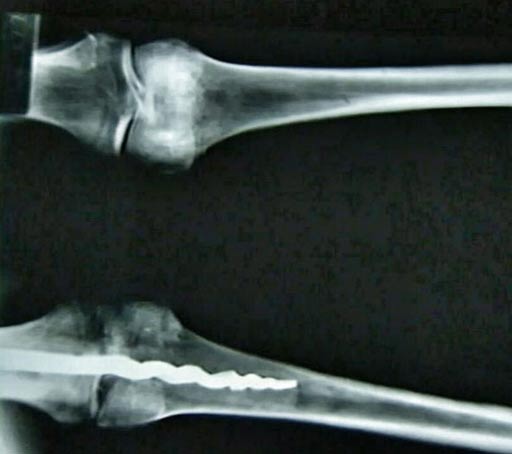
We also know that the Egyptians possessed extraordinary and lost medical knowledge. For example, the Egyptians at ;least knew how to perform surgery, demonstrated by a mummy from 400 BC in the Rosicrucian museum, San Jose, CA (BYU Professor Finds Evidence of Advanced Surgery in Ancient Mummy, Brigham Young University, 2015).
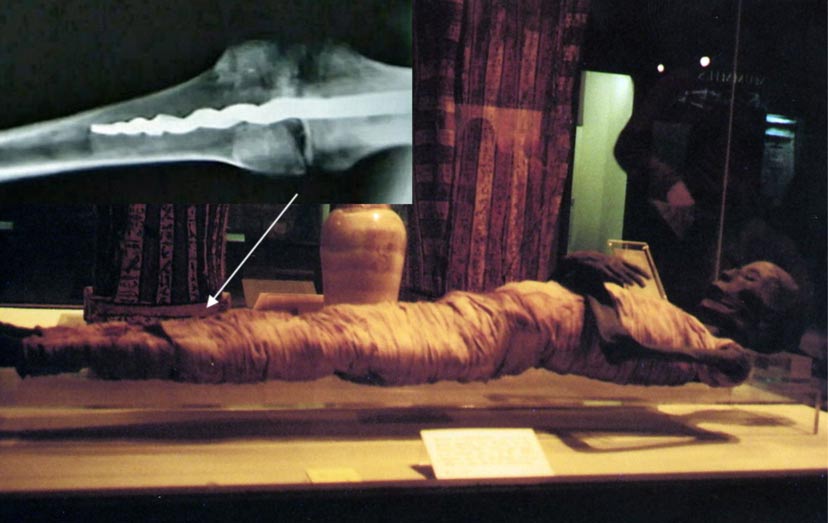
Carbon dating has verified the remains to be genuine, but debate does continue whether the surgery was performed before or after death. X-rays have shown the pin to have a spiral shape, resembling almost exactly that used for attachment of prostheses now. Also, sampling the cement revealed it to contain organic resin, similar to modern bone cement (Medical Mystery of Usermontu: Why the Discovery of 2,600-Year-Old Knee Screw Left Experts Dumbfounded, Ancient Origins, 2015). Here I speculate that the pin was inserted after death in this case to reattach the leg, but prosthetic attachment had already been long practiced, with only this example of the technique surviving.
Are there rational explanations of miracles and the resurrection? So maybe Joseph found and brought tracts, otherwise unpreserved and now lost, from Egypt when he yearly traveled up to Jerusalem, to see Mary and Jesus for Passover. As well as perhaps including some translations of Buddhist texts on ?ry?????gam?rga from three centuries previously, maybe the tracts described lost secrets such as:
There it is. A rational explanation, now, for the miracles and resurrection, if you prefer rational explanation. It only surprises me no one has ever proposed it before.
I could provide many more rational explanations. After several decades of thinking about it, the last event to defy reasonable interpretation was Christ's ascension into sky after death. Cynics have said it was merely a convenient theological addition, to rid themselves of the problem of what happens to a resurrected body. But now it seems most likely to me that he chose to climb the heavenly Mount Sinai, as did his ancestors Abraham and Moses, and passed away there alone.
------------------------------------------------------------------------------------------------------------------
(3) Of Hermeneutic Corroboration
Did Romans and Greeks feel guilt? In 2015, I speculated where there was any case in Pre-Christ Roman texts where people felt guilty about something they'd done wrong. There is valor, humor, and desires to improve civilization in Stoic manners, but no guilt as we understand it today. I asked some friends and family knowledgeable in the field, including two with PhDs who had specialized in history and archaeology. They were surprised they had never heard the question before, but almost instantaneously agreed I was right, to such an extent no further discussion ever took place.
So what of the pre-Christian Greeks? They were very adept at shaming others, but even of those shamed, there is no clear indication that they ever took personal responsibility for what they had done wrong. Instead, they blame the Gods and other people for inflicting fates upon them that they could not escape, from Helen of troy's 'abduction,' all the way to Oedipus blinding himself because he did not know he had killed his father and married his mother. So I asked my friends again. They paused longer, but said they couldn't think of any example of Greek guilt either. A year later, someone at Oxford I don't know gave a lecture on it (reprinted in Armand D'angour, Shame and Guilt in Ancient Greece, New Imago Forum, to psychoanalysts and academics, 2016). The author avoids committing to any absolute statement as to whether the Greeks ever took personal responsibility for what they did wrong, but it contains no concrete example that they did.
Emotional guilt was instead known commonly to the Israelites, who were the first society to attempt a system of rational law based on divine justice (compare to, for example, Draco's tabulation of totally random rules in Athens (620 BC); and the far more common systems of punishment based solely on opinions of the rulers at the time, without any clear statement at all as to what crimes actually were). Prior to that, there is some idea of guilt in the Egyptian judgment in the afterlife. But it was a very different idea than it is now, based on terror of Gods, whether living or beyond life. When we look back to those eras, we tend to assume everyone had much the same judgments and emotions we have now, but we are looking at an extremely savage time, and the social mechanisms to enable such judgments and emotions to blossom in civilization had not fully evolved.
Does hermeneutic change corroborate the New Testament? According to the texts, Jesus introduced astounding teachings on love, hope and forgiveness that were totally alien to the cultures of the time. I speculate that the hermeneutic change was far more significant than merely proving he was alive. The novelty of his lessons could have been no more than amusing, and simply disappeared, but somehow thew grew with significant alacrity. It remains unclear how his teachings gained so much traction at all, amidst the far louder rhetoric and more powerful means of rich and well-entrenched opponents.
His new ideas resulted in spiritual growth of compassion, and love, together with the positive nature of the afterlife, looked to with hope rather than fear (unlike any other tradition of the time ever). Cultural response of the opponents included Nero's feeding early Christians to lions, because they didn't mind dieing, and the Roman crowds just adored watching it, without any guilt at all. This icon from 320 AD shows 40 Christians who were fed to lions all at once. One Christian, on the left, changed his mind at the last minute and was permitted to leave.

It is impossible to imagine at all how so many people professing faith in Christ would join together in such an apparently defeatist effort, and let themselves be so persecuted. Not only does it beg the question of whether there is no empirical evidence for the Holy Spirit working in the world, but also, regardless that, there must have been some genuine historical antecedence (as perpetuated by the Nicaean council, however one regards the creed they defined). But here, I put aside how much corroboration should be necessary to consider belief in the Holy Spirit as rational too.
New teachings by themselves would not be enough to convince people that another way of life might be better. Even now, people are extremely resistant to changing their mind about virtually anything at all, only scoffing at others being wrong. So it seems to me Jesus'' medical knowledge, described by people of the time as miracles, was totally necessary to affect the change for the better he sought. Some would scorn that as fraudulent, but amidst the ignorance and savagery of the time, I personally do not find it in myself to be so condemnatory.
------------------------------------------------------------------------------------------------------------------
(4) Of the Theist vs. Anti-Theist Debate
There are many extreme reactions to the rational perspective presented here, from both sides of the religious divide.
What of believers? Virtually all believers find it impossible even to accept that there might be a rational explanation for gospel events that fits within the scientific laws of our universe. On the side of believers, I can imagine, for example, that there was a Creator. With His mighty hammer he struck on an anvil of heat, aiming to send a spinning arc of flame, that is our sun, through time and space. Over the last centuries, many have strongly criticized viewing our planet as the center of creation, because our planet is not at the geometric center of Euclidean space. Nonetheless, its orchestration of complexity, down to the DNA strands evolving in us, is the ‘entropic’ center of the Universe. There is more complexity here than anywhere, most especially within ourselves. almost 7 billion strong, each of us with more neural synapses than stars in all the known galaxies. One cannot deny the possibility of divine intention in some manner or other.
But the Nicaean creed, which is the foundation of virtually all churches today, requires belief in the scientifically impossible. The resulting spiritual and physically violent conflict is immense, not only between theists and antitheists; not only between Christians and Jews and Islam; not only between different branches of Christian churches themselves; but also in inescapable doubts of each and every believer. But why is this even necessary? Would it not be even more extraordinary that Christ could indeed have done all that he did WITHIN the laws of the universe that His father created?
What of unbelievers? On the side of atheists, I can say there are reasons to doubt many specifics of the accounts handed down. That is another topic for far more extensive contemplation. Nonetheless, the overwhelming corroboration of evidence, from the historical to the hermeneutic, makes it rather unreasonable indeed to insist that Christ never existed at all, whether rational science can explain the supernatural events or not.
Maybe the accounts or miracles and death, or coma, are fraudulent, the intentional extent of which would never be more than opinion, even in any heavens and hells of the afterlife. Nonetheless, however fraudulent the account may be, there is still a massive amount of corroboration of his existence, to a level unlike that for any other event of the epoch. That makes it extremely unlikely indeed that Christ’s existence was only a myth.
If one does not believe Jesus to be a divine incarnation, then he cannot be blamed, in person, for deeds which his followers have only committed in delusion. Instead, he remains a beautiful and extraordinary doctor of the human spirit, advocating in parables that even the most uneducated could understand, entirely new ideas of love and forgiveness, without which our race might well have destroyed itself already.
What of St. Thomas' resolution? This homily started by indicating how to extrapolate logically from the skepticism of St. Thomas. He did not accept that Jesus actually had been on the cross without feeling the holes in his limbs. This is exactly how the scientific method works: he wanted experiential corroboration before he could believe the claim true. St. Thomas could very much speak for the reasoning person of science today. Unfortunately, references to St. Thomas in the canonical gospels are few. But there is the 'Acts of Thomas' of his later life preserved by the church itself, indicating its significance. Then in 1945, a gospel by St. Thomas himself was found in the Nag Hammadi library, hidden during the long dark ages, all the way through the emergence from the enlightenment, to the current era of scientific skepticism. With excitement I worked on my own translation in early days of research, only to find, to my complete astonishment, that it contains virtually no statements of historical events in Jesus' life at all. The text instead simply describes enough to set the stage for a fantastic set of Jesus' replies to questions. In the answers, Jesus often emphasizes how to find the Kingdom of Heaven--not necessarily only in whatever afterlife there is, but also, possibly, here on Earth as well. Those familiar with St. Thomas' work usually feel St. Thomas just didn't consider further historical events important.
The first chapter of St. Thomas' gospel, in my own translation, is here:
https://www.linkedin.com/pulse/long-lost-gospel-st-thomas-ernest-meyer/
So now, as discussed already, we have no necessary proof that that there is an afterlife. In accordance with rational empiricism. We can only wait to genuinely know of it, after our own passing. Yet it is fairly truthful to say, like St. Thomas, we still can turn to the marvelous lessons of Jesus to find joy here on Earth, right now, with all people joined together by the spirit of hope, love, and forgiveness, every day. All churches today may say I have no faith. In one respect, they would be correct. The scientific method frowns upon belief without empirical ratification. But in another respect, I still believe in the lessons of Jesus.
Whatever faith I may be felt to possess, this homily has shown that the textual evidence for the existence of Christ is an order of magnitude greater than for any other person of the era. It can only remain a matter of opinion whether or how much the gospel accounts of miracles, and inconsistencies between the gospels are fraudulent, intentionally or not. St. Thomas puts the quibbles of inconsistent historical details aside. Indeed, instead of recounting historical events at all, he focuses on his memories of Christ's lessons. For Jesus still leads us to a kingdom of perfect joy, eternal beyond time.
exercising rational skepticism
that denies neither atheism nor the Nicene creed
as possible truths.[/i][/b]
------------------------------------------------------------------------------------------------------------------
Contents
- Preface
- Who am I, what do I believe, and why's it special?
- What is 'proof'?
(1) Of 'Historical Evidence'
- How much are historical documents reliable?
- How much is oral history reliable?
- What about Judaic history?
- Why are there parallel accounts?
- What other documents are there?
(2) Of Rational Explanation of Scientifically Impossible Events
- Did Jesus learned Egyptian medical knowledge?
- Are there rational explanations of miracles and the resurrection?
(3) Of Hermeneutic Corroboration
- Did Romans and Greeks feel guilt?
- Does the hermeneutic change corroborate the New Testament?
(4) Of the Theist vs. Anti-Theist Debate
- What of believers?[
- What of unbelievers?
- What of St. Thomas' Resolution?
------------------------------------------------------------------------------------------------------------------
Preface
Who am I, what do I believe, and why's it special? After learning Latin and Ancient Greek from age 10, I studied Philosophy and Psychology at Oxford University, where I was trained in rational skepticism and the philosophy of science. Now I am 60 and retired in Chico (CA).
Regarding belief, it evolved while researching this project. I eventually found myself considering the disciple St. Thomas, because like me, he was a rational skeptic, asking to put his fingers in Jesus' wounds to know the truth. Jesus did not say 'get thee hence' or 'shame on thee for doubt.' Instead he said 'go ahead,' afterwards saying '??? ??????? ??, ???????????; ???????? ?? ?? ??????? kai ????????????" ("Because you've perceived me, you believe; blessed are those who haven't and yet believe," John 20:29). From the perspective of science, Thomas made a request for validation of sufficient hypotheses to corroborate a theory as being undeniably true.
I thus extrapolate an apparently new theological position based on empirical skepticism: I cannot know whether there is an afterlife, without direct experience of it--but if there is an afterlife, then nothing could ever please me more than meeting Jesus! An all-knowing God must know I am sorry for what I've done wrong. After I pass away, I can only ask if I really must make God's beautiful son suffer for my stupid sins. More ardent believers indicate I don't get the blessing they do for believing beforehand, but no worries, my education makes up for it.
What is 'proof'? Upon shared a little homily, ‘Christ’s Passion, the Shit Sponge, and Beyond’ on Facebook, almost all of the ~100 replies within 3 days scorned, with absolute and unequivocal certainty, that all four gospels are entirely made up from beginning to end, because there is no 'proof.' Well, as of the current day, there are mathematical proofs, in the form of tautologies; yet according to the philosophy of science, a hypothesis can never be proven, only corroborated. Those many demanding 'proof' need to adjust their expectations about what actually can be known about events 2,000 years ago, instead considering what might've actually happened with a neutral and open mind.
------------------------------------------------------------------------------------------------------------------
(1) Of 'Historical Evidence'
How much are historical documents reliable? Now, perhaps it seems too obvious to me that up to the time when the Church Fathers selected the books for the New Testament, ALL historical accounts were written from oral reports, frequently handed down over spans of 300 years (and even longer in the case of Homer). Thucydides (460~400 BC) is widely purported to be one of the best historians ever, but he entirely made up speeches he never heard, and which even might not have been given at all, simply by imagining what he thought could have been said over the vast expanse of the three Peloponnese wars he described. Unless one is a wildly enthusiastic fan of 'Game of Thrones,' realistically, it remains difficult even to imagine Generals, standing in battlefields, conducting long rhetorical debates with various inhabitants of besieged cities, too frightened to open the gates for parlay. Moreover, when gathering oral accounts, Thucydides decided himself which were most accurate and conflated all his sources into one storyline, without stating ANY differences in accounts he heard, setting an awful precedent for thousands of years of equally questionable reportage. It wasn't until the last century, when structuralists examined the speech patterns and dialects across different Greek city states, that anyone even questioned whether the speeches in Thucydides were accurate at all. But he is lauded as one of the best historians ever.
Much the same is true for all the greatest pieces of 'historical evidence'' we now have about the ancient world, even in Plutarch's 'Parallel Lives,' which is continually presented as genuinely unquestionable fact. Plutarch's history goes back to Alexander the Great, over 500 years earlier, in 356 BC. It was written somewhere in around 200 AD, and the earliest existent copy is from 800 years later. No one thinks to say it is all invention, despite the far lower degree of authenticity, not only of the textual and verbal traditions he passed on, but also in the far later age of the oldest manuscript we have. On Alexander the Great, Plutarch's is one of the few 2nd- or 3rd-generation reports we have, assembled from a few lost sources and oral traditions, again conflating all sources into one storyline. No one says Alexander the Great obviously didn't exist, instead pointing to cities named after him that could equally have been named for a God; or frescoes and statues of him as 'proof,' rather oblivious that the earliest ones were still made centuries after Alexander's death.
How much are oral traditions reliable? Another ignored fact is how oral traditions worked at the time. As described in my separate essay 'on Oral Traditions,' they were not simple ramblings as people tend to thing of storytelling now. There were separate groups telling the story in different places, and in each group, one of the younger adults would be asked to tell the story for the children. The older adults listened, providing corrections and embellishments from their own memory. Of course, there were different opinions on how the story should be told, and different memories of the original events too; but overall the unity of each group in preserving a story would certainly compare quite favorably to the different stories one now hears, for example, about Trump, derived from MSNBC, Fox TV, etc.
What about Judaic history? The time during the first Roman emperors was very turbulent in Judea. Quite a large number of different people attempted to dominate the region and/or usurp the Romans. One effort notably terminated in a huge siege of a mountaintop fortress called Masada. The Romans spent almost a year breaking the fortress, forcing an army of slaves to build an earthen ramp, 375 feet high and thousands of feet long, to reach the citadel. On this we have "The Jewish War" by Josephus (75 AD). The original Hebrew, Aramaic versions, and later Greek translations are mostly lost. The earliest entire version is Slavonic from 1463 AD. It states an ironclad siege tower containing a battering ram was hoisted up the ramp and placed into position to strike against the rebels’ casemate wall. However, archaeological remains indicated the mound never reached the citadel itself. Instead, it appears catapults and basilica also bombarded the citadel's inner buildings so much that even a giant cistern, partly subterranean, was broken open, leaving the besieged with barely no water. It's also believed all the besieged solders and families committed suicide before the siege end. So it appears Josephus is not very reliable in reporting history. But there are accounts of an individual that could have been Jesus, mentioned in passing, in some earlier remnants of Josephus' writing from 75 AD, but not others.
The lack of historical accounts about Jesus outside Josephus is often construed as counter-evidence of his existence. On the other hand, Judaic and Roman historians had no reason even to acknowledge his existence at all in their own history, because they totally denied his significance. If anything they would have denied his existence, because they were losing converts to Christianity. But they didn't deny his existence either. They simply said nothing, because he wasn't really important to them at the time.
Why are there parallel accounts? In marked difference from historical conventions practiced throughout the era elsewhere, the historians working for the first Christian Emperor, Constantine, (272-337 AD) did something entirely unique, making the recorded account of the oral tradition, overall, about an order of magnitude MORE reliable than other sources. Perhaps most importantly, when the four gospels were selected to be reliably preserved, with continual efforts to make every syllable as genuine as possible for millennia, they DID NOT conflate the four accounts into one storyline like everyone else did, but meticulously kept all of them as different as they were, so that future readers could decide themselves how to resolve discrepancies across the separate descriptions.
The differences between the gospels are frequently stated as proof they are wrong. But the historians felt it important to make the record as genuine as possible. Thus they not only preserved the four different accounts as they had been handed down separately in different provinces of Rome, but also, moreover, traced direct lineage of each account through individual people who had been remembering and repeating them since the disciples first starting sharing their 'good news' (the literal meaning of 'gospel'), in order to choose four, not one but four, out of hundreds of documents, as the ones which would be painstakingly transcribed by hand and handed down through the centuries until the first printing press in 1440 AD. Even before then, more copies of the bible were handwritten and carefully translated into multiple languages than any other book in the world.
We know that the historians went thought at least a hundred documents, with at least a thousand prior copies that had been made before, to choose and make these four separate accounts as the best, authentic ones. There is NO OTHER historical evidence from that time that has anywhere near that much 'evidence.' Nothing. The current biblical canon remains as it was formally defined and widely circulated ca. 350 AD, by which time there were copies of multiple collections of documents, including gospels and letters, which were not old at all for that era, dating back only 150 years or so to 150~200 AD (or perhaps earlier, but earlier versions have not survived).
What other documents are there? In later time, those with more interest in saving souls than historical evidence tried to destroy all the other documents completely. And they formed 'a single message' that everyone could agree on, allowing the doctrines to survive terrible persecutions and, even more importantly, the majority's massive ignorance and inability even to read or write. About a dozen texts not in the bible were preserved by the church including The Acts of Thomas (see the Gnostic Society Library). Scattered remnants of surviving texts include the Dead Sea Scrolls. More recently, in 1945, a large cache of comparatively well preserved and totally lost documents were found in Egypt.
As a collection of some of the earliest bound books we now have, this 'Nag Hammadi library' is comparatively well preserved. Books are far more compact than scrolls, and they contain yet more accounts and letters that in total corroborate the history stated in the gospels. Unless one chooses to twist the translation of words such as 'spirit' to such devious ends, none of the other scriptures outside the bible describe Jesus as deceitful evil or demonic, such as one frequently might now hear about both Trump.
------------------------------------------------------------------------------------------------------------------
(2) Of Rational Explanation for Scientifically Impossible Events
Any rational inquirer could justifiably claim the documented evidence belies no more than ridiculous supernatural beliefs. A very small number of people have before suggested that there exists more rational explanations, and they've been very popular. For example Lloyd Douglas' book "The Robe (1942) was a bestseller for more than a year. Few now alive read the book, instead watching the movie, which does not mention Douglas' rational explanations.
In the spirit of rational empiricism, I extend Douglas' hypothesis to explain all events described in the New Testament canon, such that they all can be explained by the laws of science we now know.
Immediately I am obliged to add, this is not a denial of the possibility that there were supernatural events, either in total or part. Rather, I present it as an alternate hypothesis that could explain one or more, or even all the miracles, and even the resurrection too, if one is not inclined to accept the scientifically impossible deeds of Christ as recounted in the gospels. In the past I speculated that Jesus obtained such extraordinary knowledge for the time by divine inspiration, but now I have a feasible rational explanation for that too.
Did Jesus learn Egyptian medical knowledge? It is not an unreasonalbe hypothesis that Christ could had learned otherwise unknown medical techniques from scrolls that had been plundered from the library of Alexandria, after its first major fire in 145 BC.
According to canonical texts, Joseph took his family to Egypt immediately after the census, escaping Herod's massacre of the innocents (Matthew:2:13-15), although many historians now think this massacre was 'only' of Herod's own sons. Joseph brought his family back to Nazareth after the death of Herod in 4 BC (Luke 2:4). Jesus was an avid learner and could read at least Hebrew (Luke 4:16-20). So at least one opportunity existed for Joseph to purchase scrolls for Jesus according to canonical history, or Jesus could even have obtained them himself. There is a gap in historical accounts of Jesus' life before adulthood of about 10 years. Jesus and/or Joseph could have been in Egypt then, only returning for the annual passover feast (Luke 2:41). Others have speculated Jesus was studying in Alexandria during this time, particularly because after Jesus' death, St. Mark lived and died in Alexandria (est. 61~68 AD). Others who knew Jesus may well have lived in Alexandria, due to the size and power of the early church there. Moreover, there would have been both religious and political objections to mentioning Jesus' 10-year stay there, because Israel was created from slaves who rebelled from Egypt.
We also know that the Egyptians possessed extraordinary and lost medical knowledge. For example, the Egyptians at ;least knew how to perform surgery, demonstrated by a mummy from 400 BC in the Rosicrucian museum, San Jose, CA (BYU Professor Finds Evidence of Advanced Surgery in Ancient Mummy, Brigham Young University, 2015).
Carbon dating has verified the remains to be genuine, but debate does continue whether the surgery was performed before or after death. X-rays have shown the pin to have a spiral shape, resembling almost exactly that used for attachment of prostheses now. Also, sampling the cement revealed it to contain organic resin, similar to modern bone cement (Medical Mystery of Usermontu: Why the Discovery of 2,600-Year-Old Knee Screw Left Experts Dumbfounded, Ancient Origins, 2015). Here I speculate that the pin was inserted after death in this case to reattach the leg, but prosthetic attachment had already been long practiced, with only this example of the technique surviving.
Are there rational explanations of miracles and the resurrection? So maybe Joseph found and brought tracts, otherwise unpreserved and now lost, from Egypt when he yearly traveled up to Jerusalem, to see Mary and Jesus for Passover. As well as perhaps including some translations of Buddhist texts on ?ry?????gam?rga from three centuries previously, maybe the tracts described lost secrets such as:
- How to perform artificial respiration (resurrection of Lazarus)
- How to stitch a man's ear back on with needle and thread after it had been cut off (Peter at Gethsemane),
- How to clean a cruddy infection out of an eye with sand and water (John 3:5).
- Perhaps other kinds of knowledge, such as how to make a delicious rosé by putting heated water in porous jars that previously held thick wine (and many other such miracles in Luke's gospel). Similarly, when Jesus handing out little pieces of bread and fish (whether once or many times, depending on how one treats the Gospel differences), there were thousands of people there who had traveled great distances to reach the grassy hilltop whence he spoke. So they probably had brought some food and wine for themselves for refreshment before their return. Upon hearing his lessons on giving to others, they could have shared their repasts all around, together enjoying an enormous picnic that otherwise would not have happened (again, an unprecedented event within all history that we know). Now some would say that is not a miracle. To me, it is.
- And finally here, possibly, how to induce a coma by sucking a shit sponge the roman soldiers carried to wipe their arses (crucifixion). It's discussed a little later here, but for more on that, please see my separate homily, 'The Passion, the Shit Sponge, and Beyond.'
There it is. A rational explanation, now, for the miracles and resurrection, if you prefer rational explanation. It only surprises me no one has ever proposed it before.
I could provide many more rational explanations. After several decades of thinking about it, the last event to defy reasonable interpretation was Christ's ascension into sky after death. Cynics have said it was merely a convenient theological addition, to rid themselves of the problem of what happens to a resurrected body. But now it seems most likely to me that he chose to climb the heavenly Mount Sinai, as did his ancestors Abraham and Moses, and passed away there alone.
------------------------------------------------------------------------------------------------------------------
(3) Of Hermeneutic Corroboration
Hermeneutic: (from Hermes, messenger and soul guide of the Greek Gods): wisdom in interpretation. Hermeneutic theory is "a member of the social subjectivist paradigm where meaning is inter-subjectively created, in contrast to the empirical universe of assumed scientific realism (Berthon et al. 2002). Other approaches within this paradigm are social phenomenology and ethnography. As part of the interpretative research family, hermeneutics focuses on the significance that an aspect of reality takes on for the people under study" (University of Colorado).
Did Romans and Greeks feel guilt? In 2015, I speculated where there was any case in Pre-Christ Roman texts where people felt guilty about something they'd done wrong. There is valor, humor, and desires to improve civilization in Stoic manners, but no guilt as we understand it today. I asked some friends and family knowledgeable in the field, including two with PhDs who had specialized in history and archaeology. They were surprised they had never heard the question before, but almost instantaneously agreed I was right, to such an extent no further discussion ever took place.
So what of the pre-Christian Greeks? They were very adept at shaming others, but even of those shamed, there is no clear indication that they ever took personal responsibility for what they had done wrong. Instead, they blame the Gods and other people for inflicting fates upon them that they could not escape, from Helen of troy's 'abduction,' all the way to Oedipus blinding himself because he did not know he had killed his father and married his mother. So I asked my friends again. They paused longer, but said they couldn't think of any example of Greek guilt either. A year later, someone at Oxford I don't know gave a lecture on it (reprinted in Armand D'angour, Shame and Guilt in Ancient Greece, New Imago Forum, to psychoanalysts and academics, 2016). The author avoids committing to any absolute statement as to whether the Greeks ever took personal responsibility for what they did wrong, but it contains no concrete example that they did.
Emotional guilt was instead known commonly to the Israelites, who were the first society to attempt a system of rational law based on divine justice (compare to, for example, Draco's tabulation of totally random rules in Athens (620 BC); and the far more common systems of punishment based solely on opinions of the rulers at the time, without any clear statement at all as to what crimes actually were). Prior to that, there is some idea of guilt in the Egyptian judgment in the afterlife. But it was a very different idea than it is now, based on terror of Gods, whether living or beyond life. When we look back to those eras, we tend to assume everyone had much the same judgments and emotions we have now, but we are looking at an extremely savage time, and the social mechanisms to enable such judgments and emotions to blossom in civilization had not fully evolved.
Does hermeneutic change corroborate the New Testament? According to the texts, Jesus introduced astounding teachings on love, hope and forgiveness that were totally alien to the cultures of the time. I speculate that the hermeneutic change was far more significant than merely proving he was alive. The novelty of his lessons could have been no more than amusing, and simply disappeared, but somehow thew grew with significant alacrity. It remains unclear how his teachings gained so much traction at all, amidst the far louder rhetoric and more powerful means of rich and well-entrenched opponents.
His new ideas resulted in spiritual growth of compassion, and love, together with the positive nature of the afterlife, looked to with hope rather than fear (unlike any other tradition of the time ever). Cultural response of the opponents included Nero's feeding early Christians to lions, because they didn't mind dieing, and the Roman crowds just adored watching it, without any guilt at all. This icon from 320 AD shows 40 Christians who were fed to lions all at once. One Christian, on the left, changed his mind at the last minute and was permitted to leave.
It is impossible to imagine at all how so many people professing faith in Christ would join together in such an apparently defeatist effort, and let themselves be so persecuted. Not only does it beg the question of whether there is no empirical evidence for the Holy Spirit working in the world, but also, regardless that, there must have been some genuine historical antecedence (as perpetuated by the Nicaean council, however one regards the creed they defined). But here, I put aside how much corroboration should be necessary to consider belief in the Holy Spirit as rational too.
New teachings by themselves would not be enough to convince people that another way of life might be better. Even now, people are extremely resistant to changing their mind about virtually anything at all, only scoffing at others being wrong. So it seems to me Jesus'' medical knowledge, described by people of the time as miracles, was totally necessary to affect the change for the better he sought. Some would scorn that as fraudulent, but amidst the ignorance and savagery of the time, I personally do not find it in myself to be so condemnatory.
------------------------------------------------------------------------------------------------------------------
(4) Of the Theist vs. Anti-Theist Debate
There are many extreme reactions to the rational perspective presented here, from both sides of the religious divide.
What of believers? Virtually all believers find it impossible even to accept that there might be a rational explanation for gospel events that fits within the scientific laws of our universe. On the side of believers, I can imagine, for example, that there was a Creator. With His mighty hammer he struck on an anvil of heat, aiming to send a spinning arc of flame, that is our sun, through time and space. Over the last centuries, many have strongly criticized viewing our planet as the center of creation, because our planet is not at the geometric center of Euclidean space. Nonetheless, its orchestration of complexity, down to the DNA strands evolving in us, is the ‘entropic’ center of the Universe. There is more complexity here than anywhere, most especially within ourselves. almost 7 billion strong, each of us with more neural synapses than stars in all the known galaxies. One cannot deny the possibility of divine intention in some manner or other.
But the Nicaean creed, which is the foundation of virtually all churches today, requires belief in the scientifically impossible. The resulting spiritual and physically violent conflict is immense, not only between theists and antitheists; not only between Christians and Jews and Islam; not only between different branches of Christian churches themselves; but also in inescapable doubts of each and every believer. But why is this even necessary? Would it not be even more extraordinary that Christ could indeed have done all that he did WITHIN the laws of the universe that His father created?
What of unbelievers? On the side of atheists, I can say there are reasons to doubt many specifics of the accounts handed down. That is another topic for far more extensive contemplation. Nonetheless, the overwhelming corroboration of evidence, from the historical to the hermeneutic, makes it rather unreasonable indeed to insist that Christ never existed at all, whether rational science can explain the supernatural events or not.
Maybe the accounts or miracles and death, or coma, are fraudulent, the intentional extent of which would never be more than opinion, even in any heavens and hells of the afterlife. Nonetheless, however fraudulent the account may be, there is still a massive amount of corroboration of his existence, to a level unlike that for any other event of the epoch. That makes it extremely unlikely indeed that Christ’s existence was only a myth.
If one does not believe Jesus to be a divine incarnation, then he cannot be blamed, in person, for deeds which his followers have only committed in delusion. Instead, he remains a beautiful and extraordinary doctor of the human spirit, advocating in parables that even the most uneducated could understand, entirely new ideas of love and forgiveness, without which our race might well have destroyed itself already.
What of St. Thomas' resolution? This homily started by indicating how to extrapolate logically from the skepticism of St. Thomas. He did not accept that Jesus actually had been on the cross without feeling the holes in his limbs. This is exactly how the scientific method works: he wanted experiential corroboration before he could believe the claim true. St. Thomas could very much speak for the reasoning person of science today. Unfortunately, references to St. Thomas in the canonical gospels are few. But there is the 'Acts of Thomas' of his later life preserved by the church itself, indicating its significance. Then in 1945, a gospel by St. Thomas himself was found in the Nag Hammadi library, hidden during the long dark ages, all the way through the emergence from the enlightenment, to the current era of scientific skepticism. With excitement I worked on my own translation in early days of research, only to find, to my complete astonishment, that it contains virtually no statements of historical events in Jesus' life at all. The text instead simply describes enough to set the stage for a fantastic set of Jesus' replies to questions. In the answers, Jesus often emphasizes how to find the Kingdom of Heaven--not necessarily only in whatever afterlife there is, but also, possibly, here on Earth as well. Those familiar with St. Thomas' work usually feel St. Thomas just didn't consider further historical events important.
The first chapter of St. Thomas' gospel, in my own translation, is here:
https://www.linkedin.com/pulse/long-lost-gospel-st-thomas-ernest-meyer/
So now, as discussed already, we have no necessary proof that that there is an afterlife. In accordance with rational empiricism. We can only wait to genuinely know of it, after our own passing. Yet it is fairly truthful to say, like St. Thomas, we still can turn to the marvelous lessons of Jesus to find joy here on Earth, right now, with all people joined together by the spirit of hope, love, and forgiveness, every day. All churches today may say I have no faith. In one respect, they would be correct. The scientific method frowns upon belief without empirical ratification. But in another respect, I still believe in the lessons of Jesus.
Whatever faith I may be felt to possess, this homily has shown that the textual evidence for the existence of Christ is an order of magnitude greater than for any other person of the era. It can only remain a matter of opinion whether or how much the gospel accounts of miracles, and inconsistencies between the gospels are fraudulent, intentionally or not. St. Thomas puts the quibbles of inconsistent historical details aside. Indeed, instead of recounting historical events at all, he focuses on his memories of Christ's lessons. For Jesus still leads us to a kingdom of perfect joy, eternal beyond time.
Comments (147)
But if not, it's also pretty certain that Lucius Flavius Silva led a legion to Masada, given the remains of temporary castra and an encircling wall around that place, not to mention the remains of the giant ramp that eventually provided access by elements of the legion. Whether the pet Jew of Vespasian and Titus, Flavius Josephus, provided an accurate account of what happened then is unknown, however, as you note. The Romans weren't quite as devoted to detailing the legions' victories in gory detail as were the ancient Assyrian kings when describing their conquests, so as far as I know there's no Roman account of what took place either, beyond the fact Masada was taken.
Tacitus refers to someone who may be the person we call Jesus being executed per the order of Pontius Pilatus (whose existence is apparently established by part of an inscription found in Caesarea Maritima). I think Suetonius made some reference as well. Flavius Josephus did too, but it's thought that part of that reference is a later Christian forgery.
As for the accounts of the accepted and unaccepted Gospels, and the various Councils held as Christianity assimilated the Empire and pagan culture and philosophy, the extent of the history involved and the evidence of it became unimportant and I think largely ignored when Christians began their persecutions not only of pagans but of other Christians over such questions as whether Jesus was a god or God, or some other kind of divine being but not quite a god or God, and just how the Christian God was three persons in one God. It didn't help, of course, that Jesus never cleary called himself God (there were other sons of God or a god wandering all over the Empire in the first century) except as he was portrayed in the last of the Gospels, that of John. Over the years heretics were identified and condemned, and eventually an orthodoxy was established. Historicity just wasn't much of a concern in the early Church, I believe.
I wonder, respectfully, what difference it makes to you? For myself, I do not expect to be performing or witnessing miracles, so what I have from the Gospels is an illustration of how to live. Love your neighbour, heal the sick feed the hungry, don't be greedy, and so on. The truth of this is not a matter of history, but of human nature.
It seems unlikely that the whole existence of Jesus is made up and equally unlikely that every word of the Gospels is gospel truth. If one buys into the divine Son of God and died to Redeem us doctrine, well that's another matter, but I'm not clear that there is strong evidence in the gospels or anywhere for that.
Have you come across either Maurice Nicoll's writing on the New testament, or Robert Graves' King Jesus, the latter a heretical retelling of the gospel story as a mytho-magical attempted coup that went wrong? The former is a very measured spiritual reading of the esoteric meaning of the Gospels.
oh ok. There is almost nothing on the subject by comparison in terms of documentation. What we have are rather good archaeological ruins whence events were reconstructed. Unfortunately Jesus was a carpenter and didnt make piles of earth a thousand feet long.
thank you very much for the references. I have been rather buried in the Nag Hammadi, working on a new English version of the gospel of Thomas which maybe you would particularly like also, because it makes no mention of any historical events at all, and simply recounts his teachings in a new way )
I thought scientific proofs turn hypotheses into theories. And do tautologies offer anything meaningful?
When sufficient corroboration has been accumulated, then hypotheses about an abstracted rule for those hypothesses can make a 'theory' I (an abstracted rule for group of hypotheses) 'true' in a general sense, although there can still be exceptions.
For example, consider whether water could spontaneously jump out of a glass. So the probability of that happening is more than the age of the known universe so they say, its generally true that the water wont jump out the glass, although its still considered a simplification, because in the field of quantum mechanics, its false.
Just shows you shouldn't believe everything you read on fb, in fact you shouldn't even take any of it seriously.
When I described all historical documents from the time, I mentioned that Plutarch's Lives, (ca. 200 AD) contained oral traditions dating back to the birth of Alexander the great (July 356 BCE). I should have added that it is one of the few secondary or tertiary sources on Alexander the Great. Earlier written accounts of Alexander the Great are entirely lost. Plutarch combined the lost texts with oral traditions into one seamless discourse.
In the current day, it's natural to assume that oral traditions were less reliable than written texts. For example, one frequently voiced criticism of the gospels is that they were written down long after the actual events, starting with the Gospel of Mark, first written down between fifty and a hundred years after Christ's death. If one puts oneself in the shoes of historians of the time, one sees a different perplexity. Should a historian rely on written text more than oral tradition? In the current day, one needs to understand the methods of oral tradition at the time, in order to understand the perplexity.
My father's mother and her siblings, who moved to the USA to escape the Russian Pogrom, often practiced the same oral tradition with me when I was a child. Also in those days, TVs were black and white, and had few channels. So once a week, after dinner, my grandmother would start telling a story about the family's past to all the guests. My grandmother's brother and sister would sit listening, occasionally interjecting only a few words. At first my great aunt would interject short corrections if she said something wrong, or a question if my grandmother said something she was not sure about. My grandmother would back up in the story and retell it, until my great aunt approved. So they corrected each other's memories, this way, in oral traditions.
Every couple of years, my grandmother would retell the same story, remembering and emphasizing the corrections from last time. Over the years my great Aunt had to make less and less corrections, instead interjecting small elaborations, with a big smile. My Great Uncle's role was entirely different. He would sprawl on the sofa, pretending to be dozing, surreptitiously watching to see if the guests were bored, if necessary jumping up and saying "hey, that's enough stories for one night. You can tell us the rest next time. let's get an ice cream cone" or the like.
So that's an oral tradition from me, hahaha, about oral traditions. Families like my Russian grandparents, as well as churches in groups, have been telling stories like that for 5,000 years. With other listeners correcting the storyteller's mistakes, they were repeated with a far greater level of accuracy than most people of the current day appreciate.
In ancient times, historians writing new texts would combine oral traditions with written texts. First there is a question of how much the written texts might contain mistakes or deliberate errors. And there remains debate on how many of the oral traditions were added to the bible as we know it today, Maybe scribes would sometimes add pieces of information they heard from other places, thinking it better than the written copy they had.
When the early church fathers formalized the current canon of the New Testament ca. 350 AD, there were already differing versions of the scrolls written up to 300 years earlier. The older surviving scrolls took priority when the Testament text itself was formalized, only using newer scrolls if originals had decayed too much to be readable, either on the scroll edges or entirety. At least a dozen main sources, in total, had been handing down these texts separately. For example the Gospel of Mark came from Egypt, because that's where Mark went after Christ's death. There were newer copies of Mark's gospel all around the Roman Empire, some together with other original gospels. Then newer copies of original gospels from other places also made it back to Egypt.
When the historians working for the first Christian Emperor, Constantine, were frrst formalizing the New Testament contents, they faced a different problem than any other historians to that day. In the past, there were scant records and story collecting from oral traditions was a difficult task, requiring much travel. But for the New Testament, there were too many texts and copies. There was ten times as much different content as in the current New Testament, and another order of magnitude of different copies.
So oral traditions were not included. There was no room for them in the size of the New Testament as it is now, the bible is already enough scrolls to fill quite a fair-sized truck. Instead, Constantine's historians found the oldest written texts from different places, tracing their lineage through the churches that kept them, and their congregations, back to the original disciples. So there were no oral traditions added or substituted to the New Testament at the time it was formalized.
Even so, there was a period of oral tradition, varying between 50 and 150 years for each of the gospels. Many have criticized this lack of reliability, with a ridiculously large majority stating the entire New Testament was total myth. One of the cultural facts I omitted in my last post was that oral traditions were remarkedly reliable if you compare them, for example, to the continually conflicting accounts of political events on TV broadcasts over the last decade or two.
https://en.wikipedia.org/wiki/Lynne_Kelly_(science_writer)
I'm really not sure if "scientific" is an appropriate label for your work or not.
I am not particularly knowledgeable about the subject, but it was my general impression that at least the majority opinion among historians is that Jesus was a real person, it's just noch clear to what extent we can trust the details of his life.
Arguments I have heard against Jesus being a historical person usually fall into two broad categories.
One is about the lack of any biographical information concerning Jesus in the Gospels, and the similarity that the very early accounts share with widespread jewish stories about angels. The earliest account after Jesus' supposed death that uses the name doesn't describe a person, but a sort of angel. The argument here goes that Christinity perhaps started out like many other jewish sects, and that the heavenly being they worshipped gradually transformed into a historical person in their accounts.
The other category is the lack of any contemporary mention of Jesus, or any kind of jewish preacher that might fit. There are no records of disturbances in the jewish community, nor are there any records of a new religion forming in the decades after, until the first gospels show up. An interesting comparison in this regard is with the rise of Islam, where some kind of religious leader is mentioned in contemporary accounts and we do have early reports of the religious practices of the arabs after the invasion, though these accounts suggest that Islam didn't exist as an organized religion until much later.
What's your take on these two points?
What possible difference does it matter whether "Jesus" ever lived or not?
There were some teachings that somebody (or a group of somebodies) developed that has morphed into an ethic, of sorts, that many people live by today.
"Did the 'Christian ethic"'develop?" is an easier question to answer.
YES...of course it did.
How?
What difference does it make "how?"
It has.
We can deal with the fact that "it has" without dealing with whether or not Jesus, the person described in the Bible, ever lived.
ASIDE: There seems to be amble evidence that this guy, Paul, lived...and had a following. That seems to be a much more important aspect of Christianity (and the ethic) to deal with than whether or not the Jesus character did.
Assuming those Mark quotes in his Gospel were accurate, he was a carpenter with four brothers. I don't know about you, but I was brought up in the One Holy Catholic and Apostolic Church, and we never heard about those brothers. I suspect that was because either the Church didn't think such things were important if they were true, or the Church was hesitant to tell its members that God the Son (who was also God the Father and God the Holy Spirit, depending on what person was involved at the time) had brothers.
I think many people aren't inclined to accept the Gospels as historically accurate because of the extraordinary claims made by them in some cases and by others regarding not Jesus the man, but Jesus as God or magician (wonder-worker). According to John's Gospel Jesus said with some clarity that he was God. If he did, it seems very odd that he didn't according to the other canonical Gospels. Did Matthew, Mark and Luke forget he made that claim? Did they think it unimportant that he did? It's not likely. Also, Jesus said according to certain Gospels those standing with him would see the coming of the Son of Man and the establishment of his kingdom. That didn't seem to happen. If the Gospels are unsound or conflicting in these most important requests, why believe them to be accurate otherwise?
Personally, I think it's likely there was Jesus the man, but that Jesus as God was created, and don't see that creation as primarily beneficial. You say the pagans had no concept of guilt. Certainly they didn't have the Christian or Jewish conception of guilt, but it isn't clear to me that they were the worse for that. There's an interesting book, There is No Crime for Those who Have Christ by Michael Gaddis. The title are the words of a Christian of the 5th century justifying religious extremism. No crime, no guilt.
It doesnt surprise my jewish historians dont mention him. He just wasnt an important person to them. I have heard some people saying, the fact they didnt proves he didnt exist. Well that means alot of people didnt exist, doesnt it.
If you think about it, the Jews would have had very good reason to say there was this false sect and he didnt really exist. They were losing their own as converts. I think they just decided not to say anything at all. And I have to say, the technique of thinking about what writing we have DOES NOT say is a very powerful technique. Very powerful. Its worth practicing )
I can point to my own experience. No one else suggested he used lost scrolls about medicine to impress people. No one else said he intentionally induced a coma by sucking on a shit sponge. I never heard anyone even say it was a shit sponge. Thats what it was. Thats why it was there. No one hought it through. After 2000 years I cant imagine why. Moreover, I talked with a couple personal friends about the romans having no guilt. They were astonished. They said it was an incredible observation and agreed with me. I talk to classical depts in universities. I moight as well be throwing mud at a wall. Im not important, they say, if I want to write about it go to the bursars office and buy a phd. Well there you are. Thats what I have to say about it.
Oh. Well it's an uncomfortable subject for the Catholics. Ive actually written some historical imagination on it to put it in context, but Im not sure this is the right place to share it, because its not really philosophical. But I do remember once seeing a controversial painting of Jesus with his four brothers, with a splinter in his finger. I cant find it. Do you know who painted it?
Well of course Ive thought about it. But also he never claimed he was THE son of God, he said he was THE SONE OF MAN, He said he prayed to his Father, and the funny thing is, the word he uses in that context means 'daddy.' Fundamentalists use this to say we should have a close personal relationship. Personally I think he missed his blood father alot, and alot of the things he said were distorted. Thats what I think, I cant prove it, I respect other opinions, and its one of those things about him we can never 'know' per se and it remains a matter of faith. Its taken me a long time to talk about it, Im not sure I talk about it as well as I should, but what really annoys me, actually REALLY annoys me, is how I usually cant talk about it at all without getting into hugely emotional arguments on one side or the other. So Im glad at least we can have a neutral conversation here!
I do feel it appropriate to respond about my own beliefs, I have to follow St. Thomas on it, I really do. i love his gospel too, which mentions nothing about historical events at all. Jesus said to pray, he was a beautiful man, so I do, it has helped me however ridiculous you think it may be, Regarding adamant assertions of Godhood, Its like Thomas said about sticking his fingers in the nail holes. When Im dead Ill know what the truth is. Until then, I kind of would love to see jesus in the afterlife, but I dont want Jesus suffer for my sins. I thought about this alot during services. and talked with priests about it, and I have to say, this position is very, veryalienated from BOTH sides of the religious divide.
If there is an afterlife, I really would have to ask God if I actually HAVE to ask Christ suffer for my sins. I cant think I can trust others to tell me what is right for me in that respect. So I pray to St. Thomas. Im not sure about the intercession of saints either, Im not sure if he really hears me, but Jesus says to pray, so I do, and I find it helful. Usually I have a laugh with my teddy about it afterwards. We have alot of fun together D
I didn't know there was such a painting. I'll see if I can find it.
Well, he comes as close as can be to claiming godhood.
John 8:58 - "Jesus said to them, 'Most assuredly, I say to you, before Abraham was, I AM.'
John 6:35 - "I am the bread of life. He who comes to Me shall never hunger, and he who believes in Me shall never thirst."
John 8:12 - "I am the light of the world. He who follows Me shall not walk in darkness, but have the light of life."
John 10:9 - "I am the door. If anyone enters by Me, he will be saved..."
John 11:25 - "I am the resurrection and the life. He who believes in Me, though he may die, he shall live."
That doesn't leave much room for a God who isn't Jesus.
The transition of the Empire from pagan to Christian has always fascinated me.
One reason the painting of jesus with a splinter and his four brothers was controversial is that it portrayed his humanity. Of course some people did not even like the thought that he could even get a splinter by mistake.
I'm sorry this is a little long, but I really think you will find it worth reading. MANY people are VERY eager to argue about whether Jesus was truly divine, but as far as I can find, no one has ever really thought through all the implications of considering his life in rational terms. Not to the extent I present below.
So a good place to start is with Jesus' four brothers. I will clarify the reasoning on this as I discuss the evidence, but regrettably, its likely they were half brothers. Later they were probably counted among his disciples, whose exact count and members varied over time, simplified as a total of twelve. But Jesus' father wasn't there, and Mary had to make money, so it's likely they were half brothers. That's NOT a nice thought, is it. But it's worth actually considering in more detail, because it has ALOT of implications. First there is the mention of them in Mark, the earliest and shortest of the gospels:
Hmm. Seems like they really could have been half brothers, doesn't it, the people in the synagogue being so offended? It must have become a debated topic VERY early in the church, and it is rather a signification of the true dedication of the scholars who worked on the gospels that the mention of his brothers remains there, and was not deleted. What a horrible thing to have to say at all. This is why I had to wait a long time before I could talk about my ideas. What can one say without making alot of people very angry, because it goes beyond debates about Jesus' nature, to include the feelings of many women who have found great consolation in praying to Mary. What can one say. Well, Mary certainly got alot of people praying to her. Hats one thing. Another thing is, Jesus had to be oldest son for reasons of claimed inheritance line.
And that approaches the issue of immaculate conception.
Well in preface to that, I have to say, I really do, its an awful thing for a woman giving birth not even to be allowed to use a pub table for it. Awful! One can console oneself that the innkeepers probably had reason to believe the child a bastard, considering the prior remarks in the gospels, so maybe one can find a little justification for them not helping a woman giving birth, but even so, what would Jesus have thought of that himself growing up? Its clear Joseph had money to pay for a room, because it says the pubs were full. There's no reason for the apostles not to say Joseph was too poor. Couldn't even one visitor even let Mary have a bed to give birth? No! We have the parable of the good Samaritan instead!
Anyway, however much money Joseph had, one thing he'd really want is not for Mary to give birth in horse shit, not to mention cow shit, goat shit, chicken shit, and camel shit.
At least camel shit doesn't smell so bad, when you burn it to stay warm.
Burning other shit smells horrible, and doing so makes a disgusting mess, and that's one Joseph would have had to do to keep Mary warm. I feel all the romanticism of his birth is nothing less than abominable, frankly, now that it has even extended to this deplorable illusion that children have to suffer under, that there is a Santa Claus, who could be viewed, in ancient terms, as a bizarre jolly God, now controlling 15~20% of the world economy--For nonbelievers, a new God not acknowledged as a God, because the old Gods were too hard to believe in any more. And for believers, too pretty a way for remembering the wise men (but not the camel shit) in gift giving, totally and completely dwarfing the appalling circumstance of Jesus' birth.
Then there is considering how Joseph was not with Mary all the time (and how Jesus could in fact have asked his father to bring scrolls from Egypt as presents, so the boy could learn more, we know he was an avid learner):
I am obliged to note that Jesus' time in Egypt may have been added to fulfill a prophecy that St. John then mentions; but WHY is it mentioned here that Joseph stayed in Egypt? It certainly inst necessary to the story that the church requires faith in, and one has to bear in mind all these words had to be painfully transcribed many times. The other main mention of Joseph in the texts indicate Joseph met Mary annually in Jerusalem:
...well..running away like that...that does sound like Jesus was saying Joseph might not have been his blood father, and was trying to figure out what Mary told him about the immaculate conception . again, what a horrible thought. We can discuss the immaculate conception more if you wish, they are not uncomfortable thoughts to me any more, but it could REALLY hurt the feelings of other people.
What a horrible thing Jesus had to live with, which is the other part of what I think about him getting hold of medical scrolls from Alexandria, and why he decided to do what he did in the first place. Most people would call it fraudulent and scoff at it. Well I thought more about it than they did. Perhaps it was fraudulent, but its certainly NOT something to scoff at. There you are. That's what I believe.
As to his claims to godhood, if you read what I wrote you previously about my beliefs, you'll understand better that I totally abstain. Considering what he achieved, certainly he could have been, and as I say, how much more incredible would that be, if he achieved all he did without needing to break the laws of science that the Creator, if indeed a Creator exists, had established for humankind on this planet, the entropic center of the universe So I follow St. Thomas on it, who despite his skepticism is counted among the faithful. I'll know the truth when Im dead, and before then, I abstain )
Quoting B G Upadh
Well I can understand what you say about exaggeration. On the other hand, though, I do have to indicate there was a major change in social attitudes about him. It's difficult to believe that could happen either. I know the tendency is to dismiss it out of hand, but why? Why was there was so much change because of him, and him, specifically? Is it equally reasonable, in fact, to dismiss claims of the Holy Spirit at work as being more exaggeration?
Before you get to something like considering whether something happened or not, there is all this work relating to accounts of what happened or not to be considered.
If one has decided to weigh accounts upon a scale a number of other people agree to use as a system of measure, then the method is the result. Nothing can be "verified" through using it because the use of the measure is also an argument for its use.
I have read a lot of the text you are referring to.
So, whatever.
I recommend not looking at it as a matter of what pisses people off.
All the angry places have been taken. That is the Christianity I understand.
There is something toxic in what you observe. But it ultimately is not about what happens to you or me because we say stuff.
The only thing is what is happening to all of us. My narrative is limited in that regard, not so much because it is missing information but because it draws back from what some thoughts require.
So, all the terrible moves to remove people because of what they think/believe.
The point I wish to make, without regard to what I may think is/was the case, is that mixing narratives of what one approves with those one does not approve needs an overarching structure that you have not provided.
Theory 1:
My earlier point was that it is best to reconstruct the original person of Jesus (Joshua), his very early followers, etc. by using a variety of historical and archaeological sources that provide a most likely scenario. It seems that John the Baptist started/continued some sort of Essenic interpretation of Torah law- with much emphasis against the political structure (anti-Herodian for John/ anti-Temple Establishment for Jesus). Jesus was known as some sort of miracle-worker (not uncommon at the time except the idea that his services were free and made him possibly more well known.. see Honi the Circle Drawer, Hanina Ben Dosa, and other of this time).. He goes to Jerusalem in an anti-Temple Establishment tirade at the center of the Establishment. This pissed off the authorities and had him crucified for trying to foment dissent and probably claiming kingship (Messiah title).
His immediate followers were led by his family, specifically his brother James (Jacob). This group thought Jesus was not actually dead because he was too righteous. Paul becomes an interloper who reinterprets the group and their not-quite-dead messiah. He introduces ideas of mystery cults- the idea of a god that dies for sins. He also elevates Jesus to more than a righteous guy (who was believed not-quite-dead by his followers), into a literal Son of God. He introduces shades of Gnosticism and views Jesus' life and death as a complete replacement of the Torah itself. This is Gnostic in the idea that the Torah represents the old (the "physical", the "demiurge", the lesser) and the new way is the "real" path ("the spiritual", Jesus' death and resurrection is greater vehicle). These irreconcilable and monumental changes in theology brought him in conflict with the original John-Jesus-James Movement. Paul, along with his followers, go and form their own communities, either under James' nose (without his knowledge) or simply without even having his consent. His ideas mostly resonated within the Gentile communities throughout the Greco-Roman world. These Pauline communities are what will eventually become "Christianity". This Pauline Christianity will eventually create many of its own schisms, that will eventually coalesce to become dominated by Roman Catholicism and Eastern Orthodox.
The John-Jesus-James Movement, some possible subsect of Essenic Judaism (with anti-Establishment, Messianic message), becomes more obscure in the Jewish community as the Temple is destroyed by 70 CE. With the Bar Kochba Rebellion in 132-136 CE, this group becomes even more of an outcast in synogogues in the Levant as their dead messiah seems less efficacious than Bar Kochba, a general and messianic claimant who was actually beating the Romans.. The group probably lived on in the fringes of Jewish society, known as the "Ebionim" or "Ebionites" much later (meaning the "poor ones", possibly a name the original Jesus Movement called themselves).
Theme 2:
What was probably the case was Jesus fit very firmly in his cultural context of 1st century Judea. Based on his sayings and his outward focus, he was probably a radical or reformist Pharisee (focused on the margins of society and intent behind the law). He had his own opinions on Mosaic law (as there was no INTERPRETATION of the law codified yet in anything like a Talmud, at least for the Pharisee sect). Also, he was probably an apocalyptic Pharisee which made him unusual as most Pharisees were "wait and see". They knew too much focus on End of Times would get people killed by Roman authority. Thus by going to the "Lost Sheep of Israel" and getting them to be what he thought was better Jews, he thought the hastening of the Kingdom of God would occur. He probably incorporated that part from the same ideas as John the Baptist who came right before him. When he went to Jerusalem, he probably thought the Kingdom of God was literally going to start happening, and he was going to do some miraculous event. I have a feeling, the most historical lines in the whole New Testament was, "My God, My God, Why have you forsaken me?" If not whitewashed, that actually indicates that he really thought hew as going to get something done to change things and this didn't happen. Pontius Pilate (noted by Josephus and Roman historians as overly ruthless, even for Rome) had him crucified, like almost every other Jewish claimant to be the Jewish king. Oh, it didn't help it happened on Passover, the very holiday that Rome looks for Jewish "freedom fighters" and messianic claimants because it was a holiday revolving around liberation from a foreign culture (mythological Exodus story).. Rome knew this and acted swiftly. At that time, the High Priests and the Temple priests in general were in the pockets of Rome and were essentially their lackeys, helping them keep "order". This all makes sense. Jews that were of the radical Pharisee sort, Apocalyptic types, One -off Messiah claimants, Essenes, and Zealots would be not looked upon kindly if they acted up against Rome or Temple Priestly authority.
Anyways, a couple decades later, Paul's ideas of the death/resurrection of Jesus set the stage for Replacement Theology.. whereby the "new" Israel were believers in Jesus. Interestingly, early Gentile Christianity represented by people like Marcion wanted to completely detach from the "Old Testament" as he thought it might even be a separate god. However, in Roman society, ancient cultures were deemed more legitimate than "new age" innovations. Thus, early gentile Christians realized that to spread the theology of Paul (Jesus died for your sins), they NEEDED to attach the idea to a culture that was more ancient (Judean/Jewish culture) to have it seen as more legitimate amongst the converts around the Mediterranean. So, this is what the early "Church Fathers" did and succeeded in converting most gentiles to the new religion by the year 400 CE. Thus, the original Jewish Jesus sect died out basically in those first couple centuries. The Pauline gentile variant spread. With the idea of Replacement Theology, Jews were considered to be stubbornly "wrong" in interpreting their own religion. They needed to be persecuted to be corrected. Then of course the whitewashing of Jesus' death so that they are deemed as "Christ-killers" etc. This made Judaism even more insular as it needed to protect itself from interference and persecution. The rest is history. That hatred permeated in various forms throughout history up until the 20th and 21st century. So in the end it is the very basis of Christianity (Replacement Theology) to "kill" the original copywriters and "correct" that culture's own ideas about its mythological history. Again, that's crazy.
* There is substantial corroboration that he exists, and immense consequences even in society today. The extent of corroboration is greater than most understand, not having learned much about ancient times, as we know about them today.
* As rational beings, we can examine the specifics of events as they were reported, and attempt to resolve issues for rational skepticism, or to counter doubts in faith for believers, that do not create toxic destruction of good communities, and reduces the ridicule, replacing it with more compassionate consideration.
* the number of topics are indeed immense for which one can discuss specifics. I have focused on miracles, social changes attributed to the Holy Spirit, the extent of accuracy one may expect from surviving texts, and in them, so far: Jesus's siblings, his birth, and the immaculate conception. For this I examine not only what is written, but the choices in what was written, and what was not.
* Personally, I regard St. Thomas as a principal agent in our modern age, and just as he likely felt about the other disciples, I admire and respect other followers for believing in love and forgiveness so much they are willing to accept the scientifically impossible. Like he wanted to put his fingers in Jesus' wounds as proof, I do not know if there is an afterlife, but if there is, nothing ever will delight me more than meeting jesus.
That's what Im trying to say. I have asked you several times for examples of why you think my text is toxic, exactly, and so far you only elaborated on what you think about your own beliefs of toxicity.
Im a little tired, Im going to need to rest a while, and consider your writing properly then. Im just writing to say thank you very much! Wow :)
I'm glad they were of interest.
Quoting ernestm
Sure, here are the original threads they came from:
https://thephilosophyforum.com/discussion/comment/71045
https://thephilosophyforum.com/discussion/comment/369750
I won't be able to get back to you until tomorrow, its bed time.
You are correct...it was long.
It seems you are more interested in lecturing than in discussing.
If you get around to where you want to discuss instead...let us know. I'll certainly join a discussion.
The toxic element I was referring to was the description of your experience when you said:
"Many Christians have not only expressed hate for what I am saying. Ive been excommunicated from a number of churches."
I wasn't saying that You were toxic.
Remarkable, but but ultimately unfortunate, I tend to think.
Personally, having been raised by a Jewish Father and Christian Mother, I have to say, I am extremely grateful for the existence of love and forgiveness that Christ initiated in the West. I do understand other people have not had good experiences with the Church. I also have not had good experiences with the Church in the last few decades, despite my continued love of Jesus, so I totally understand that frustration. But I do not believe he can personally be blamed for how religious authority still tries to dominate the world, with increasingly less success.
What do you think of that?
Remove the ‘must’ or the ‘religious’. What deeper question?
I have read a lot of Gnostic texts, including the Gospel of Thomas.
I have a different view of it than yours. I am not sure how to go there from your premises.
I will have to mull upon ti.
I have to put some time into reading Schopenhauer's posts, it may be some time before I can get back to you.
* 'The Alpha, the Omega, and the Bee Orchid - Discussing how a different perspective of time can accommodate the biblical visions both of the creation and end of the universe make sense, also discussing the impact of technologies such as cloning on lifespans, and Kant's theory of intelligent design with respect to this planet being at the entropic center of the universe, rather than Euclidean space. Also it includes how history since Christ can be viewed as the three eras of the father, son, and holy spirit.
* The passion, the shit sponge, and beyond - Historical imagination and contemplation on the significance of of Christ 'only being dead enough' when taken off the cross.
* Holy Crap - historical imagination of the birth and contemplation on it
And I would like to include the Gospel of Thomas in the anthology
The Response of St. Thomas:
This homily started by indicating how to extrapolate logically from the skepticism of St. Thomas. He did not accept that Jesus actually had been on the cross without feeling the holes in his limbs.. St. Thomas could very much speak for the reasoning person of science today. The philosophy of science holds that truth can only be known when sufficient hypotheses are verified to corroborate a theory beyond doubt. That's what St. Thomas was saying.
References to St. Thomas in the canonical gospels are few. But in 1945, a gospel by St. Thomas himself was found in the Nag Hammadi library, hidden during the long dark ages, all the way through the emergence from the enlightenment, to the current era of scientific skepticism.
With excitement I worked on my own translation in early days of research, only to find, to my complete astonishment, that it contains virtually no statements of historical events in Jesus' life at all. The text instead simply describes enough to set the stage for a fantastic set of Jesus' replies to questions. In the answers, Jesus often emphasizes how to find the Kingdom of Heaven--not necessarily only in whatever afterlife there is, but also, possibly, here on Earth as well.
So now, as discussed already, we have no necessary proof that that there is an afterlife. In accordance with rational empiricism. We can only wait to genuinely know of it, after our own passing. Yet it is fairly truthful to say, like St. Thomas, we still can turn to the marvelous lessons of Jesus to find joy here on Earth, right now, with all people joined together by the spirit of hope, love, and forgiveness, every day.
All churches today may say I have no faith. In one respect, they would be correct. The scientific method frowns upon belief without empirical ratification. But in another respect, I still believe in the lessons of Jesus.
My next homily "the alpha, the omega, and the bee orchid" discusses how current scientific knowledge, as well as Kant's 'theory of intelligent design,' can provide insights into the entire span of spiritual time, from the creation to the end of the world.
But for now, whatever faith I may be felt to possess, this homily has shown that the textual evidence for the existence of Christ is an order of magnitude greater than for any other person of the era. It can only remain a matter of opinion whether or how much the gospel accounts of miracles, and inconsistencies between the gospels are fraudulent, intentionally or not.
St. Thomas puts the quibbles of inconsistent historical details aside. Indeed, instead of recounting historical events at all, he focuses on his memories of Christ's lessons. For Jesus still leads us to a kingdom of perfect joy, eternal beyond time.
In reference to ‘religious authority’ I can bend that, quite a way, to be referring to what is terms ‘religiosity’ - a kind of psychological ‘susceptibility’ to phenomenon like hypnosis or merely an ability to suspend belief, etc.,. In terms of authority in general I think people like someone to take responsibility off their shoulders to some degree or another. The body of ‘authority’ (be this parents, teachers, political/religious figures) necessarily lifts the burden of responsibility off of people, but by doing so limits their freedom. Some will ‘respect’ authority and some will ‘rebel’ - it depends.
I’m still interested to hear what the ‘deeper question’ is explicitly if can spare a minute to point it out and/or outline it for me.
Thanks
To repeat, if you’re completely subservient to someone then you have little to no responsibility because you’re not making any decisions and therefore nothing is your fault. If you’re in full-blown rebellion then you’re taking on all the responsibility (whether you know it or not) and anything that goes wrong is your fault.
I’m not for a second suggesting reality is anywhere near this black and white, just pointing out that we give up certain ‘freedoms’ to relieve ourselves from the heavy burden of responsibility. We don’t tend to do this willy nilly though, and shift our sense of ‘responsibility’ to an authority figure, or authoritative structure, that we deem more able to cope - our choice is never absent we simply distance ourselves from it in order to ease the stresses and strains of living.
Some people just see an easy option and go for it. Some analyze more. All vary in their attitudes dependent upon the level of import they attach to the circumstances they are in. We never get anything perfectly right, but may see a vision of perfection in ‘what has been’ never in ‘what is’.
The manner in which religious ideas accumulate over time and jump from culture to culture - and/or manifest in the same manner in and of themselves - fascinates me no end.
Maybe we’re not on the same wavelength, either way it is interesting to read your thoughts.
Maybe because they wish to experience something ‘wholly other’. Meaning, as their sense of being and self is essentially tied to their ‘will’ (choices), then absconding and giving themselves over to some ‘other’ may seem appealing. People may do this due to trauma, curiosity and or purely by accident.
Another possible answer ... mmm ...? Do you have any suggestions?
I guess they may have seen someone else do this and they simply like the look of it, or they’ve been living too rigid a life and feel suffocated (there could no end of possible reasons for such a feeling).
However I see it it’s a matter of ‘comfort zones’ and ‘exploration’ and/or the neglect of them.
The author was a man who made everyone worship the protagonist's son.
God would result in insane barbaric people.
https://wiki.c2.com/?FalseDichotomy
(2) Hermeneutic Corroboration
-----------------------------------------------------------------------------
So then, now I believe I can pose my thought to you. Why exactly was guilt and forgiveness suddenly so appealing to international cultures which had lived without them for centuries, indeed, over a millennia? If there were not some underlying spiritual force, be it of the human nature or supernatural, guilt and forgiveness would simply have vanished, as unnecessary or unwanted or for whatever reason you may construe, in the panoply of human experience. But those emotions did not disappear, instead they surged with such force that people were fed to lions, when they simply could have left the church. They chose not to. They were so committed to brotherly love they found, that they even let themselves be eaten alive for sport. If there were not some underlying need in the human spirit, whatever that need may actually be, then there would be no reason for such a sudden, dramatic change that swept the Western world. That's how I see it. If it still does not make sense to you, I would be indebted if you would ask for clarification or criticize what I say, because I do feel it is an important observation that has in fact never been made before.
You asked why people give up their ‘will’ in reference to people’s ‘respect for authority’ (I removed the ‘religious’ part because I don’t see the importance - authority is authority regardless).
So, why is the subject willing to give up their ‘will’? That’s what you stated as the ‘deeper question,’ so I’d like a direct answer as I’ve given you a few possible answers myself already.
Thanks
This is not true. Most of the plays deal with guilt. Plato's Republic chooses culpability over freedom from it.
You really have no idea what you are talking about.
Monks set themselves on fire in Vietnam. That is something we do know more about.
Basically you seem to be talking about sacrifice. Maybe ‘Fear and Trembling’ would be a good read for you. I’m not really interested in highly speculative history based solely on religious texts.
As for the ancient Greeks not feeling guilt you’d have to show your thinking more. It is an interesting idea.
Maybe it is the opposite of the original question to you. But it is not the opposite of the original question to me. Also monks still set themselves on fire in Tibet. However as you have asked to put aside the issue of religious authority, its not directly pertinent to why people let themselves be eaten alive before there was any religious authority, because, they were doing so in protest that the government had overruled their own religious authorities. The issue of why people would commit themselves so much to brotherly love and forgiveness in a society which previously had not even manifest guilt remains.
I invite you to find an example of guilt in roman and greek texts. As I say, I talked with a number of historians from Oxford, two with PhDs, and they could not think of any example either.
You made an assumption:
You said ‘must’ and that isn’t necessarily true. It is an assumption. Regardless it boils don’t to the statement that people ‘want to respect religious authority,’ which is again, an assumption without any founding.
Tell me SPECIFICALLY what is the difference between ‘respecting’ religious authority that is intrinsically different from just respecting authority in general. That might help.
Now you’ve switched to Christians and lions. It is not at all difficult to find individual examples (factual or fictional) that align with some original claim. The point being if you make a sweeping statement about humans and religion a singular story doesn’t cut it.
People, humans, are willing to die for a whole host of reasons (revenge, patriotism, god, guilt, etc.,.) That doesn’t mean the reasons they willingly die for are stupid, noble, right, wrong or anything else. As for people dying for a cause they deem worthy, they are making a sacrifice. People, often lovers and parents, have been dying to save others for a long, long time that undoubtedly predates Christianity.
The guilt thing is interesting. References would be useful because some unnamed professors doesn’t give me much to work with.
So the idea that Jesus didn't exist doesn't have much scholarly support. But do check out the debate as it contains some good details.
Most people are ignorant about lots of things, not just history so that shouldn't be surprising. However, I don't really think many people doubt that Jesus was at the very least a historical figure. I'd imagine it is a fringe group.
Also your original post made me think of this blog post: https://calumsblog.com/2017/08/11/jesus-secular-sources/
where the guy puts together a nice list of sources and quotes about Jesus from various non-Christian sources.
This certainly goes along with your point. It doesn’t really suggest that there was no sense of guilt.
Clearly there is great emphasize on topics like ‘justice’ from both the Romans and the Greek. I could simply argue that people didn’t lie because they had no concept of guilt, but that would be silly.
Guilt, as in a guilty party, clearly existed. If you’re simply saying there was no specific adjective for ‘guilt’ fair enough. If there were crimes, which there were, then there are people who are guilty of such crimes. People would be accused of crimes and claim innocence.
Logically I’d say that ‘to feel guilty’ is a repercussion of common law not something given to humanity from an individual - or ‘guilt’ and ‘remorse’ would be quite alien concepts today.
It is interesting to see that Metanoia meant ‘change of mind’ in Greek.
Note: I’d appreciate it if you gave me some names of the professors you’re referring to. Thanks
This is exactly what I am saying. Not only is there no record of the Greeks and Romans taking personal responsibility for the things they did wrong themselves and feel bad about it...but now, 2000 years later, a thinking and rational person like yourself cannot even tell when someone is demeaning and degrading their own wife...Instead he blames her for her behavior because of what he did wrong, in this case, if I identify the location of the quote correctly, without even thinking she might be slightly upset about her husband disappearing for seven years to a war she didnt want him to join in the first place. I rest my case. Even today people these days cant tell the difference. YOU can't, lol. Not that I blame you, everyone else does it, but it does show the scale of the problem I am trying to address.
I should actually explain, spell out, and repeat that guilt is not saying someone else is at fault, but taking personal responsibility for a fault. I would also like to include, with your permission, your quote, claiming it is an example of guilt, to illustrate how even now people dont know what it is so well, which may partly explain why no one noticed the absence of guilt in Romans and Greeks before.
Apologies my memory since 2003 is off. I had said there is evidence were in posession of many lost advanced medical techniques, which kjesus could have learned from scrolls that his father had obtained from the plundering of the library of Alexandria in the first great fire, 145BCE. So first of all, specifically, the mummy is in the Wikipedia, but the text is currently out of date:
https://en.wikipedia.org/wiki/Usermontu_(mummy)
Above it states the mummy is from 400BCE, according to carbon darting (I had remembered 1500 BCE). There is a current link on the page to an article stating that a metal pin was used to repair a broken knee before death.
BYU Professor Finds Evidence of Advanced Surgery in Ancient Mummy
https://magazine.byu.edu/article/byu-professor-finds-evidence-of-advanced-surgery-in-ancient-mummy/ BYU Magazine, Brigham Young University, 1996.
And this could be a cause for many's confusion, because the story changed over successive examinations since the first time I heard it. What I remembered was hearing with astonishment that the man lived at least a decade with the pin in his leg. Quote from article:
Most bizarrely, a more recent article from 2015 explains more details about the pin, claiming it was inserted after death instead, but quotes the above article as source.
I did not quite represent this correctly. From Thuc. 1:22:
The specific problem to scholars remains, Thucydides never indicates which speeches he recalled from hearing in person, and which speeches were reported to him. Stucturalist analysis of the speeches could reveal no differences in the prose at all.
Huh? I literally just pointed out the difference between guilt and being guilty. The Greeks tended to use sorrow. If you think I thought you were just talking about ‘guilt’ in general you’re quite wrong. I mentioned guilt because - obviously - feeling guilty about an action is related to guilt. ‘Feeling guilty’ necessarily requires an appreciation of guilt.
Quoting ernestm
Absolutely no need to. I know exactly what it means. There is a hell of a lot more to feeling guilty than just that.
Note: you’ve still not given me the name of a single professor? I I’d also still like to know what is specifically different about ‘religious authority’ compared to ‘authority’ in general?
If you ‘rest your case’ on this it’s a poor case. It follows, in my mind, that feelings of guilt extend from common law, which extends from natural empathy through the so-called ‘social contract’.
I’m curious, do you believe there are instances where feelings of guilt were presented in cultures not influence by Christian society?
You do realise that no human could walk on that leg? The ‘joint’ certainly wasn’t fixed, unless the meaning of ‘fixed’ was ‘fastened and immobile’. There are records of surgeons in ancient Rome dealing with brain clots quite effectively though - they were capable due to the gladiatorial traditions and centuries of bloody warfare.
Now. I repeated continuously what I meant by the emotional guilt, and you still did not understand it. I asked you to consider a correction, and you challenged my own authority and authenticity, and tried to change the subject. That's offensive to me. Considering your refusal to accept your own error when I pointed it out repeatedly, I now have to reciprocrate the question. Who the FUCK are you?
Clearly I didn’t understand my error, or you thought I made an error where I didn’t. Either way, as you claim, this is common mistake so it might pay you not berate me.
We don’t have to continue if you don’t want to. I would still like you to explain what is different about religious authority and I would still like to know your academic sources about your claims - if they are not forthcoming for whatever reason fair enough. If you’d care to explain my error better go ahead.
I have not been ‘rude’ (to my honest knowledge) nor tried, at any point, to switch topics. Far from it. I’ve asked the same questions repeatedly and if you think it is ‘rude’ to keep pressing for a response to questions/inquiries that haven’t been addressed that isn’t really my concern either.
I am called Matthew Roffey, I am 42 years old, and my interest here is precisely what I said it was before - I’m interested in how religious ideas develop, change, jump and manifest in different cultures. I also have a large interest (non-professional) in cognitive neurosciences tied to many phenomenon including emotions and altered states of consciousness.
Note: I don’t care who you are all that much tbh. Obviously you’ve meet often with some aggression from others and reciprocate it. It happens a lot when people mention Jesus or Christianity. Personally I wish there was more consideration for people on the basis of them having a genuine interest rather than looking to ensnare each other and ‘win’ some debate - that REALLY doesn’t interest me.
So, all that aside should I hang around or move on? I don’t wish to waste my time or yours (especially mine).
Karl grew up in Wisconsin, his Mother was a Russian Jew, and his Father a German humanist. At Wisconsin University he almost became a Rhodes Scholar, but he was interested in the international dealing of archaeological artifacts but wanted to work in politics, so he won a place at Princeton, where he earned an MPA and doctorate in politics, studying there with Henry Kissinger. He became a journalist, manager of Bernstein and Woodward before the Watergate scandal at the Washington Post, ran the Post's Washington bureau in London, and on the editorial board in charge of human rights issues for the New York Times for many long years.
Karl was a VERY erudite man, who loved books, read them continuously, his private library was at least 10,000 books. With his interest in archaeology, he read all the Greek and Roman texts he could find, now I cannot say in how much detail, often he read very quickly, but he was very familiar with the era. KRAL could not think of an example of any Roman or Greek being upset because they had taken any personal responsibility for what they had done in all he read. Karl did think about it a very long time, and he did say, of everything I ever said to him, it was maybe the only thing I ever said that really impressed him, lol.
But he also hated Saul, or St Paul as most call him, with a fervor you cannot imagine. Karl called him Satan incarnate way before the phrase was common after Bush called Hussein that. Karl said no man had ever been responsible for more deaths in history. Now on the RESULTS of Paul's letters we can perhaps all agree to some greater or lesser extent. But on the other hand, it really was not what Paul was trying to do, and personally, I would regretfully say, it was really the Church Fathers who over-emphatically selected his letters for the canonical bible, and St Augustine's City of God which places personal salvation above secular justice and bringing about the entire Dark Ages, that were the real sources of the problems with religious authority that led to the Crusades, the Spanish Inquisition, and other such abominations. So I wrote kindly of Saul, or Paul, saying he had such a sudden episode of guilt that, not knowing what to tell his followers eager to pillage and rape some more Christian households in his hometown in Syria, Damascus, while returning there after killing many Christians on his own mission, tolerated with amusement but not generally regarded as necessary at the time, for killing Christians who denied the Emperor as God. In other cases, the Roman Empire did not disturb local religions, but in this case, Saul took it on himself, it seems from what we know, to conduct a kind of genocide, reaping the rewards in much the same way the Nazis seized belongings during the Holocaust.
The thing that strikes me, whether he was actually blinded or just described it that way, or something else, is that the Christians then said much like 'ok youve done some bad things, well, worse than most, but anyway, come in and have some wine.' And Saul, baptised Paul, was totally overwhelmed by the forgiveness. Totally, For the rest of this life.
But Karl really could not tolerate me saying that. I waited until he died before speaking at all of almost all my thoughts to anyone.
While in private contemplation, I sat in silence with the Quakers for many years in silicon valley. There a man was working on the translation of the Gospel of Thomas. At first I objected in a very asinine Christian way, but then I realized how much he loved Jesus, so I thought about it quite a bit. In the canonical bible there is what 2 verses? 3 verses? Thomas says he cannot know if Jesus is really him without sticking his fingers in the wounds. What does Christ say? Does he say 'you stupid boy'? Does he say 'get thee hence for doubting me'? No! He says 'go ahead, if that's what you need to do.' And so I thought about all my doubts from studying philosophy and psychology at Oxford, and it seems to me in the modern era, many other people have the same problem with miracles and such, and that Thomas is a model for the modern scientific way commonly described in a simplistic way as 'obtaining proof.'
So I did not want Karl to die. I would rather have waited longer. But now Karl has passed away, I have this huge idea, a new concept that could make so many people happy who have been struggling with doubts, that St. Thomas' skepticism is a channel through which us scorned intellectual elitists, us scientists, us rational beings, that we also may also discover the love of God, however skeptical we are, and may know the kingdom of heaven, if not in the afterlife, but right here on earth, just as Thomas writes in his gospel. I asked the Quakers about it, but they could not do anything for other reasons....I keep hoping they change their mind....In fact only one person has ever really supported me on my beliefs, a monk on patmos, where St John the Divine had his revelation. He said I should start a new church. At first I did not want to be so disruptive. There are so many churches already. But the churches have rejected me and some have even excommunicated me for even mentioning part of my beliefs.
So now I am trying to write all my long-hidden ideas down. Next I am working on my next homily, 4th attempt to get it right, 'the alpha, the omega, and the bee orchid.'
So now Matthew, as for our debate on the what Romans or Greeks actually felt, I did ask you to review my elaboration on it. I would be grateful if we could step back to that a few posts ago, and meanwhile I should start working on my next homily, because I have spoken with a neighbor here, at long last, about publishing it, and I should get it written for him.
Oh. As you see from what I told you, regarding giving his name: I cannot believe Karl would give his permission to use his name in my published work as substantiation of what I say due to his own beliefs; and my Jewish stepmother is doing everything possible to silence me. I reached the point of threatening to put a restraining order on her.
But I would tell you in confidence, you can see Karl's biography here, Im just looking at it for the first time in a while. My stepmother essentially tried, for many years, to take his place, and after my father became too terrified even to talk to her any more, in my opinion, she declared him senile, made my share of Karl's estate her own and disowned me from the family; made a separate page for herself for her own career; removed any mention of archaeology that would help my own meagre ambitions from the page, and it even tells a lie to do so. Karl actually spent 6 years 1969-1975 working on various published books on archaeology, one published by Atheneum, one of the most prestigious publishers in the world. She rewrote it saying he was still working at the Post 1970-1975 instead. That's just not true, as you can see from the bibliography on this page, he actually published 3 books on archaeology during that time.
Also she removed the names of me, Jon, and Heather from his page. After making Jon and Heather subservient to her own fiscal dominance, having taken as much money she could for herself, and my siblings have to do what she says. So I lost them as family too. Thats why I am a little emotional at the moment. I keep finding things like this she did already. Again, apologies.
https://en.wikipedia.org/wiki/Karl_E._Meyer
If you cannot provide me with scholarly works about ‘guilt’ in the ancient world that’s okay.
The only thing I’ve found is this: https://www.armand-dangour.com/2017/03/shame-and-guilt-in-ancient-greece/
Well it has evolved over time
The 'early church' until about 150 AD operated rather like a commune. New members contributed their money upon joining, which supported the fiscal necessities of all members very well, because the early church grew in size slowly, yet exponentially. So it didnt have any authority. it was an early form of communism that you can idealize, or scorn, as much as you like.
After about 150 AD until Constantine, there were just too many Christians for a purely socialist system, and church leaders were chosen mostly according to literary skills and experience. Each church started to operate as an independent entity with its own rules and social organization that generally grouped into orders, much like the different monasteries of the catholic church in the later middle ages (Benedictines, Cluniacs, Cistercians, Carthusians, Premonstratensians, and Trinitarians, I find on quick search. There were also Franciscans, so I know the list is incomplete or evolved. Hm. Dominican too. Anyway, if you are really interested in religious authority, the maxims of the different monastic systems over the monks in them may be of particular interest to you, because they are different practices of religious authority over the religious alone :)
Between Constantine and the reformation, the Roman empire increasingly tried to cling to more power by claiming religious authority over feudal states. during this time it infamously recruited soldiers for wars and raised money for wars by selling papal pardons. Also during this time, the church most famously in England excommunicated the supreme authority of a feudal nation, King John, in such a horrible scenario there has never been a second King John. The battle between the Church and King John is of especial interest to the Presbyterian church, which takes scholarly study of its own history and power very seriously, tracing its Protestantism back to this period. In the USA it is the best place to learn about church history I think.
During the reformation, most notably King Henry VIII in England who started much of it, church authority was totally redefined. Mostly its known for destroying statues because they idols, ripping representation of Christ off crosses, and so on. That was actually a continuation of a very long debate about iconery in the Eastern church empire, as to how much spiritual power is invested in a pictorial representation of a Godly nature. However more significantly in terms of authority, Henry VIII basically revolutionized history by rejecting the doctrines of Augustine, that individual salvation is more important than secular justice, as stated in City of God (for which I do have specific references to his rebuttal of the main form of secular law). At the time the main target was a system of natural law proposed by Cicero. Cicero's work well survived the purge of heretical texts because it was necessary to understand the doctrines of Augustine. Rather charmingly, Henry VIII wrote 'this boke is myne' on his own copy when he was a child.
Largely as a consequence of his interest in this book, the adult King Henry VIII started the process of resurrecting secular law as separate from church authority that has evolved into what we know today. After the reformation feuds, there was a real effort to draw a precise division between ecclesiastical and secular domains, where the church only had power over its own creed and wealth, just as if it is exactly the same as any other modern institution or business. There are some anomalies, such as the remaining separate city state of the Vatican in Rome, but overall this kind of division has taken over entirely.
When the USA was formed, for example, Jefferson based the natural rights, and the justification for rebelling against the British. as a violation of theistic natural law defined in Locke's Essay on Human Understanding, mostly in the chapter 'On Power.' However from this, authority is seen to PROMULGATE from a natural divine law down to common law, such that religious authority is irrelevant to its secular action. Now it is an extremely hated fact, at least in the USA, that the nation's justification to rebel against the British, and the justification of its own secular power is entirely founded on a Christian hypothesis of a benign loving God who rewards those who act for the greater good in the afterlife. They can't even teach it in public schools or universities, so now almost no one knows it. Curious huh. The USA: best example of a successful religious authority in the world ever???? No!!!!!!! But yes, lol
The concept of PROMULGATION of power from divine law to common law is from the massive work of Thomas Aquinas, Summa Theologicae, an absolutely huge set of volumes spanning all aspects of religious ideas that are astonishingly still close to what is practiced today. Aquinas is noted to be the first theologian to exercise rationalism to the fullest extent possible, at least for the scope of rational knowledge at the time. While some of what it says here in the wikipedia may appear too trite to be worth stating, it was never really stated like this before, and its become a rather widely accepted intuitive view, which is why it seems so trite to us now, haha.
https://en.wikipedia.org/wiki/Thomas_Aquinas#Political_order
Thanks so much for the reference! Ill enjoy reading it, but in appreciation of your finding it, I did want to write something however inadequate it may be on the topic of interest to you.
I completely agree that people surrender their freedom in order to avoid responsibility. To avoid responsibility is also to stave off any possible sense of guilt. From that it would follow that people who surrender their will are effectively avoiding responsibility so as not to make any mistakes, and to point the finger at someone else - their authority being the ruling authority not themselves (of course, it is dangerously ironic, but that’s how I see it and that explains why some people who shirk responsibility like to attach themselves to a ‘higher authority’ and claim to be ‘good’ as opposed to those with free will who are willing to suffer the direct responsibility of their actions/thoughts.
It seems to me, there's a new method here. I started by discussing why people obey a doctrinal authority when it is against their personal interest, such that they will even let themselves be eaten alive by lions. To determine the nature and limits of such doctrinal authority, perhaps it's worth reversing the question, as according to the scientific method, and examining cases of when people rebel against religious authority that has already achieved political domination.
Two notable cases occur to me.
The FIRST is the historical emergence of scientific explanations that rivaled traditional religious doctrine. The most obvious example, seems to me, is Galileo, was it, being put in prison for insisting the earth went round the sun? Ok, well that is really a geometric reordering of the solar system that is SIMPLER, because they had mathematical models and even astrolabe-style machines to represent the jiggles of planets seen in the sky:
However the geometric simplification eventually resulted in Newton explaining how a force called gravity could explain the movement of planetary bodies around the sun. So it was a very useful simplification. But at first it met with immense resistance as heresy and was severely punished. Maybe you have a particular example you'd like to explore of scientific ideas causing people to rebel against religious authority? But this is an example to me that sufficient objective truth will supersede religious authority.
The SECOND major case to me is exemplified by the split from the Catholic church by Luther. If you search for it on Google you get something like "On Oct 31st 1517, the small-town monk Martin Luther marched up to the castle church in Wittenberg and nailed his 95 Theses to the door, thus lighting the flame of the Reformation." If you look in the wikipedia this event is almost invisible under a large volume of letter exchanges with various church authorities. Again one could look deeper into this, but it seems to me the main point was that the printing press, starting 1440, had made it possible for many more people to get their own copies of the bible. According to the Greek orthodox Church, this ended the 'Era of the Father' (characterized by ecclesiastical dominance over the ignorant) and started 'the Era of the Son (truly emphasizing personal salvation via direct knowledge of the scriptures). Maybe I don't say it quite right. Somewhere I've seen estimates of the number of bibles printed by the time of Luther, it was humungous. This enabled people en masse to question religious authority that had been dictated to them as unquestionable truth, but had no apparent usefulness to the individual in terms of spiritual growth, or even spiritual existence at all. So I would characterize this as being the main historical case demonstrating that sufficient subjective truth will supersede religious authority.
Does that help advance the discussion do you think? I will sleep on it and maybe something else will occur to me tomorrow more directly related to your question, but I think it is a good first step.
I’m pretty sure that many pagans were put to death too for refusing to give offerings to some other deity. Christians are likely singled out today because Christianity took on many other traditions and rituals of the time as its own.
As a comparable ‘authority’ I do see ‘patriotism’ as being almost identical to ’religious piety’ - in some modern cases they are very much entwined. To die for your country to me is only slightly less different than dying for some deity. I think in both situations it is a combination of protecting your sense of identity - place in the world (holding to your ‘axis mundi’) - and holding to certain sets of principles and ethics that seem commonly enough represented in the ‘authority’ figure (institutional or otherwise).
The feeling of ‘mob’ to both disturbs me and that is why I tend to question any claim to ‘authority’ - even within myself. I believe, foolishly or not, that I would die before giving up my freedom, so can relate to an unerring sense of duty to a set of principles that you live by (the ‘axis mundi’). Once the central pillar of your existence is torn away you’re done for anyway. The thing is the central pillar (‘axis mundi’) is hardly different from any dogmatism which just shows us that life necessitate a guiding map of some form (meaning ‘authority’ isn’t a dirty word anymore than ‘freedom’ is a delightful idea - both in the extreme drain life away).
That would have been highly unusual until the Christians took over the Roman state. Then pagans (and other, erring, Christians) were killed relentlessly and with great savagery. The persecutions of the Christians which took place were occasional and minor in comparison to the persecution of pagans by Christians.
Before then, the Romans were generally quite tolerant, provided the cult of the emperor or spirit of Rome was honored and there was peace and order and taxes paid. There were certain pagan cults the Romans felt outlandish and dangerous and were banned (e.g. Druidism), but for the most part you could worship whatever god you wanted, and it wasn't unusual for a person to worship several gods, and be initiates of more than one of the "mystery religions" such as those of Isis, Magna Mater and Mithras. Some even worshipped Jesus along with other figures such as Appollonius of Tyana and traditional pagan gods such as Asclepius.
Good points..
This is why for a while Judeans gave Rome such a headache. Many groups did not accept images of emperors (the Caligula affair in c.40 CE). They also didn't help Pax Romana by constant riots and calls to revolt against the pagan overlords, corrupt leadership, and oppressive tax collectors. This, along with internal strife between sects, helped precipitate the Jewish Revolt against Rome in 66 CE-73 CE. After the failed revolt, Jews around the empire had to pay a poll tax until the Emperor Julian ended it in 363 CE (Fiscus Judaeicus). By-and-large though, the Jews were left alone by Pagan Rome as it was an ancient religion that was respected as such, like any other of the religions around the Empire. So you are right. As long as your religion paid tribute to Rome in some sort of way, and paid taxes, they seemed to be ok with whatever you prayed to or whatever ritual you wanted. Jews were allowed the exception to Roman images as it was well-known they didn't do so as an ancient practice of this particular group. It wasn't allowed I would imagine amongst regular pagan religions which were synchronous because that was an actual signal they didn't care about Rome.
Edit: Ironically, as long as the early Jewish-Christians were identified as Jews, they were probably more protected. As Christianity became more gentilized around the Empire, it was not seen as part of the more ancient religion and its exceptions, so was seen as subject to any other pagan sect around the Empire and would be deemed as suspicious that they weren't paying tribute to the Emperor or the State properly.
Very true.
The status of the Jewish people in the Empire is remarkable, I think--up to the first great revolt. Despite the antics of a madman like Gaius Caligula, they had a special, and favored, status under Augustus and the late Republic. I think this was the result of a combination of policy and respect. The Romans were aware that Judaism was exclusive, but tolerated its intolerance of others because it was ancient and true to its traditions, in its own way worthy of a certain admiration.
The revolt showed the other side of the Roman state, of course; utterly ruthless and devastating in enforcing and perpetuating its imperium. I was in Rome and saw the arch of Titus and its relief of the legions carrying the spoils of the Jewish Temple during his triumph (seeing history is impressive). The second revolt brought even greater devastation and Hadrian renamed Jerusalem. The Jews suffered much more than the Christians did for flouting the authority of Rome.
[*deleted sentence whilst typing there! Wasn’t massively important :)]
I don’t see how Christians would be more willing to die on religious principles than any other religious person.
Of course I could be quite wrong, but I’d need some pretty damning evidence to dismiss it out of hand. Is there any?
Thank you so much! It appears to be a longer response from a scholar at Oxford resulting from my positing the original question there in 2015. It totally concurs with your statement that the ancient Greeks did feel shame, and regularly shamed each other. On the topic of whether the ancient Greeks ever took personal responsibility for the criticisms they received shame, it expresses ambivalence concerning there being no direct evidence for it, but the author doesn't want to go as far as making the single sentence commitment that I make. Well that's understandable, as I said in my initial reaction. Making a statement like that as a paid scholar of the classics is just very dangerous. Too easy to be mocked oneself if someone finds disproof of the statement. How interesting. I had no idea someone had actually been inspired to look for specific instances in such detail :)
Well, a couple of things. I think it would have been noted, somewhere, by someone, if a pagan was executed by Roman authorities for not honoring a pagan god, or for refusing to honor the cult of the emperor. As far as I know, there is no record of that. Also, I think we'd know if a pagan religion or religious belief prohibited the following of any other pagan belief. As far as I know, there's no record of such a pagan belief.
In the case of Christians, we have records regarding their failure to honor Rome and the emperor, their hatred of pagans and pagan beliefs, and the fact that they were executed for it. The record that comes immediately to mind is the famous correspondence between Trajan and Pliny the Younger. Pliny was governor of Bithiya at that time and was asking the emperor what to do with Christians. That was around 112 A.D. or C.E., still long before the "triumph" of Christianity. I think it's likely that if pagans were causing concerns of that kind, some governor or legate or functionary would have noted it.
That, alas, is the best I can do, as far as the Roman world is concerned. I understand that isn't absolute certainty, nor does it address the possibility that somewhere outside of that world some non-Christian was killed for not honoring some non-Christian god, if that's what you meant.
Christian Roman authorities (and individual Christians) certainly killed pagans for refusing to convert to Christianity, but I assume you weren't referring to that. We have quite a bit of evidence that took place, including writings of various Christian leaders urging that pagans be killed, their temples destroyed, etc.
Quoting Ciceronianus the White
Thank you both for joining in the discussion here. Maybe collaboration on an anthology is taking it too far, and we can just enjoy talking here. Currently I am still engaged with 'I like Sushi' and I hope to offer some helpful thoughts to you two later )
https://theconversation.com/mythbusting-ancient-rome-throwing-christians-to-the-lions-67365
Again, call me cynical, but if some other religion had risen to prominence I’m sure its followers would’ve found plenty of instances of religious persecution and martyrs.
My original point was that I don’t see how other religious creeds wouldn’t have been as willing to die as Christians were for their beliefs. Such beliefs are not usually something people can just throw aside and in many cases death can seem more inviting than turning their back on their whole world view.
Hm. That;s a an interesting overvation, I will think about it while I mow my lawn, lol.
My first reaction is, other authorities may not be prone to 'dogma' per se, but they are often equivalent 'rules of conduct' appropriate to their field.
For example, lawyers can argue that precedence is a legitimate method of resolution to debate, and lawyers must at least respect constitutional edicts--Although the edicts themselves are subject to revision, it is intentionally a complex procedure. That is to say, lawyers don't have dogma, lol, but they base their actions on prior rules.
Similarly scientists have to respect the philosophy of science underlying the scientific method. If a hypothesis is not conformant to the dictates of the scientific method, publications will reject publication of a research study. Similarly, conclusions from the hypothesis, and any proposed truth to a new theory, is subject to the rules of scientific inquiry. I guess if you were a skeptic abut the scientific method itself, you could be considered to questioning a dogma.
So my frist reaction is, religious dogma is a set of rules about belief, because religion is at least meant to be about beliefs, at least from a philosophical stance, not exclusively so, but still about beliefs. Other authorities have rules too, but they aren't so much focused on whether belief in the rules is necessary for the authority itself.
Christianity was peculiar in that it encouraged its believers to die. Martyrdom was actively sought by Christians. To die for the faith was to be guaranteed a place in heaven. Christians were angry, or at least disappointed, if they were denied death. The more gruesome the death was, the better as far as the saintliness of the martyr was concerned.
Tertullian, one of the Church Fathers, proudly wrote of the large group of Christians who flocked to the house of the Roman proconsul for Asia Minor, Arrius Antoninus, in 185 C.E. and demanded that he execute them. It seems he obliged some few of them but told the rest to disperse, telling them that if they were so eager to die there were plenty of cliffs they could throw themselves off of and plenty of rope they could hang themselves with; and that they didn't need his assistance.
Bear in mind that Tertullian was boasting of this in a letter to another Roman official. According to Tertullian, "The blood of martyrs is the seed of the Church."
Revisions to original post:
If you are interested in collaborating, or receiving acknowledgment in the planned published work, please send me a LinkedIn invitation at https://www.linkedin.com/in/ernest-meyer/
Please let me know if you don't want to receive update notifications.
Thanks for reading )
Hi, I'm still working through your past comments, and I adjusted the text under the pictures now in the leading article to state more fully my speculation here, between the two pictures. Good point, I have to agree with you, but as the guy who did it indicates, the quality is astounding, so I speculate the Egyptians had done it before to attach prosthetics, and it was here used to reattach a leg to someone already dead. I think. It's a very important point to my main hypothesis, so I do want to get this right.
Also I added the link you provided about guilt and shame in greece and adjusted the text. And if you'd like an acknowledgment, I'm glad to include it. I do plan to get it published eventually )
And I added a picture of lion feeding, which I think rather important because it shows one who changed his mind at the last minute and was allowed to leave.
Ah. Well as you might have seen from the picture and above text I added, at least in some cases it was entirely voluntary, lol.
Quoting I like sushi
Now that's an interesting thought. Protecting one's identity. In fact I think we converge there. Patriots die for their country because they are born there, and Christians are saints because that's where they chose to put their hearts. One could say, one has no choice what country one's born in, but patriots are patriots in all countries, so I guess they'd probably be patriots somewhere else if they were born somewhere else. So one has two parallel cases there, one where people identify with the place of their physical birth, and the other, with their spiritual rebirth. How interesting!
I like your axis mundi too.
Quoting schopenhauer1
Do either of you know something about why Saul decided to go on his rampage before he became Paul? I do remember being told it was kind of his own deal, but I cant remember more about it.
Science and law both lay no claim to absolute truth, and both change and develop over time. Just because they stagnate doesn’t mean they are based on dogmatic principles. For example, the way ‘justice’ was dished out centuries ago is nothing like it is today, and science today is utterly different to what to was centuries ago too.
Religion is based on doctrines, from scriptures most of the time. The ‘truth’ of the scriptures is never held to be questionable yet the interpretation, due to the nature of language, is varied. This is mostly, as far as I can see, due to the institutions of religion rather than a true reflection of ‘being religious’. A religious person needn’t be dogmatic, but at the root the institutionalized doctrine of a religious organisation is heavy embedded in dogma - the writ, unquestionable truth.
Of course, this is just a brief overview. I don’t parcel off my views as being black and white. I think some views, be they religious, scientific or legal, are prone to stagnation and that cultural trends push and pull different views and categories of thought in different directions.
Well I know what you are saying, lol, but there are people in both fields who claim otherwise.
Quoting I like sushi
That's VERT well said.
Quoting I like sushi
Ah. Well that's why I started talking in the first place. If you see my revisions on this chapter, one of four in my book now provisionally titled "THE NEWER TESTAMENT for RATIONAL HUMANS (fresh perspectives on the most powerful story ever told) contains a rather astonishing number of new thoughts, as far as I can determine after talking with people across many religions, churches, and other disciplines over the last few decades.
Given the way the current church has kind of walled itself in with dogma to its own continuing detriment, it seems to me well worth trying to expand the domain of people who can find comfort in the life and teachings of Jesus within a framework that does not conflict with the laws of science, while neither denying existing doctrinaires, nor atheism, as possibililties. My own interpretation finds a path through that mess based on St. Thomas, as now described in the second and third paragraph.
I have work to do moving that into its own context, within my book, and also on finishing the chapter 'from ALPHA TO OMEGA' which is now being reviewed by book publishers on linkedIn, and also on formatting my translation of the Gospel of Thomas, and last not but not least, updating my various fiction accounts.
So I really enjoy this discussion, but given the amount of actual writing work I have ahead of me already, I really need to constrain further discussion to adjustments of my revised post at the beginning of this thread, that is, to quotes and criticisms of it. I hope you will not find my limited time and abilities dissuade you from doing so, because we did get past a rather difficult hurdle in our dialog, and I would value your continued ctriticisms of my actual revised first post very much
What immediately sticks out is your personality. If that is what you want, great. If you wanted your work to sound more distanced then you have some heavy editing to do.
Again, I’ve said this previously to someone else - very recently. Generally speaking people read not to get to know who you are, and what you know/think. They read for their own purposes - be this entertainment, to explore and attach their views to what is written, or to merely absorb information (the later is where personally distanced scholarly work comes to the fore).
It appears, correct me if I’m wrong, that you’re aiming this work at Christians and/or people with a specific scholarly interest in the gospels. That isn’t me sadly, so my comments are flavoured by that fact.
Often enough it is better to get your general ideas down on paper before you then decide on who you are speaking to and what you would like them to get from your words - probably one of the most difficult and confusing things to sort out imo!
GL
(this is literally my answer).
I don't care what this author seen. What are his credentials? If he says he was with Christ, it's on his head to provide evidence too, or, it's bollocks.
Some blue blood for testing would be nice, I mean, I'm losing actual faith in complete, boring religious style. Let's pray to God - or not - because as a civilization that has moved forward and lot's of us learned that's doing nothing.
You're holding us back (with specifically your hot headedness).
Do you deserve to get angry at me?
Do you deserve to have your writing, read?
Just get hot headed about it... That will work.
(you could come up now with near enough exactly the same frame of mind, free of God - why don't you? Look I'll show you. I believe I was created, and I have full faith in it and it's work. Did I say God? No.)
I don't think it's reasonable to maintain that the quality (or quantity) of historical evidence supporting the existence of Jesus is comparable to that supporting the existence of Alexander the Great. Quite the contrary.
There's a great deal of contemporary evidence of the existence of Alexander, from many different sources. He's mentioned in 1 Maccabees Chapter 1 for example. Those who accompanied him on his conquests, like Ptolemy, Callisthenes and Nearchus, wrote accounts of him. There are contemporary Babylonian accounts of him inscribed on clay tablets. There's an inscription memorializing his dedication of a temple to Athena. His name and figure appear in contemporary Egyptian hieroglyphics. Coins were minted while he was alive with his name and likeness.
There is no comparable evidence of Jesus.
That's true, but Paul wrote as if Jesus was a real person in the 50s AD, and he mentions meeting with Peter and James, Jesus's brother. Mythicists argue that Paul was referring to a divine being, not an earthly human, and that James was only Jesus's brother in the faith. But there was the Jurasalem sect who survived for centuries, known as the Ebionites. They considered Jesus to be a regular human being who was also chosen by God to be the Jewish messiah, and taught his followers to obey all of the Torah. And that is traced back to James and Peter.
We know from Paul's legitimate letters in the NT (seven of them), and the writer of Acts, that Paul had disputes with the Jurasalem Church over whether Gentile converts had to be circumcised and some other issues related to following the law.
Josephus also wrote about John the Baptist, and there's evidence from the Gospels that Jesus was probably a disciple of his at one point.
I think the existence of the Ebionites makes it harder to believe the mythicist account, where Jesus starts off as an archangel crucified in the firmament by demons, since it's pretty clear they didn't believe that. My guess is that there was a real Jesus of which a little bit can be known from Paul and the Gospels, but there was also Son of Man myth that he was combined with dating back to the Qumran writings, like the Book of Enoch. Or Paul imported Philo's Platonic teachings into his revealed gospel, since he didn't know Jesus while he was alive. Or a combination of all three and maybe more elements. Religion is syncretic and it evolves over time. There are usually different sects fighting over the true faith.
It's also important to note that the Ebionites considered Paul to be a first rank heretic.
If you are to COMPARE the evidence for the two, it really is not unreasonable to postulate that the Macedonians ENTIRELY MADE HIM UP, based on some minor deity popular at the time, for much the same reasons the Christians would have made up that Jesus existed, except for political rather than religious power. He could have just been a God, I say, for the strength of the evidence we have.
I think it's likely there was a real person, Jesus, as well. We can add to the sources you note the brief mention made by Tacitus to someone like him; also Suetonius. But the evidence regarding the existence of Alexander is so extensive it simply makes no sense to me to maintain that there is no more reason to believe Alexander existed than there is to believe Jesus existed.
Hi folks, this contains the completion of the hermeneutic argument started in the first post, that the pre-Christian Romans and Greeks did not feel bad because they had taken personal responsibility for what they did wrong. It is within an explanation of the history of the gospel of St. Thomas. I would extract the portions specifically peritnent to the original hermeneutic argument and put it in the first post, but it has reached the maximum lenght supportd on this forum of ~5,000 words. I highlight the portions pertinent to our discussion in bold.
Why was the Thomas' Gospel lost, and how was it found?
When the Church Fathers first selected texts for the canonical version of the New Testament, they had hundreds of documents to consider, and ten times as many copies. The Old Testament scrolls were already enough to fill a truck. Each document they selected would have to be meticulously copied by hand many times, and re-transcribed after a few generations, because parchment started to decay after that long.
Among the documents they considered were a crate of shorter texts written in 'Coptic,' which is vaguely similar to Greek, but with a different alphabet. Coptic was mostly written in Egypt. By the time the first Christian Emperor, Constantine, hired historians and theologians to formalize the New Testament and the Nicene creed ca. 350 AD, Egypt had become part of Byzantium, with the capitol of Constantinople (now Istanbul). In Byzantium, bizarre combinations of Egyptian traditions and the new Christian ideas were rife, because the earliest and most powerful early church of the era was founded in Alexandria by the apostle St Mark, about 30 years after Christ's life.
Not many people could read Coptic elsewhere. It's possible none of the Church Fathers who lay the foundations of the canonical New Testament could read Coptic. Also, there were far more texts than they needed. And Greek was rather like English is today, whereas not many other people spoke Coptic outside Egypt anyway. So it's possible they just lumped the low lot together as not being usable and put them aside.
[b]Moreover, it was already rather well known what OTHER weird things the Egyptians were already doing. As illustration, one of the Church Fathers who selected texts for the bible, Orizen, castrated himself so that he would not be distracted by sexual desire, and even that was relatively normal compared to some of the weird things happening in Egypt. I draw a polite curtain over other self mutilations converts were doing to themselves, to abase themselves and prove their admission of guilt before God.
To curb the castrations and other forms of self mutilation that were exploding all over the Roman territories, the Nicene Council decided to formulate an extremely precise, clearly bounded, and exclusive creed, which states that personal redemption only requires asking of forgiveness in prayers to Jesus to fulfill the Holy Covenant and guarantee eternal life. For that purpose, they felt the letters of St Paul, previously Saul the Slayer, were particularly important. Also, they decided to assure better transmission of historical records by maintaining four accounts of the life of Jesus separately, not conflating them into one account as everyone else did at the time. This left little space for much more than a few disciple letters and St. John the Divine's vision of the End of Days, which included also corrective messages to many churches.[/b]
Thus there are many reasons why the Gospel of Thomas was put aside, Even though it says nothing contrary to the Nicene creed, it does not add further to the message of personal redemption, as stated in the selected gospels and letters.. It was in Coptic. They might not even have been able to read Coptic. Coptic was from Egypt, and there was weird stuff going on there. They had to put emphasis on stopping the weird stuff, really, right away.
Not long after that, St. Augustine wrote his pivotal CITY OF GOD, which took the Nicene Creed one step further, denying even secular law should be honored over the need for personal redemption, and resulting in 1,200 years now infamously known as the Dark Ages. During the Dark Ages, Ecclesiastical authorities destroyed huge numbers of texts as heretical. Whether the destruction was to protect their own power, or to ensure absence of distraction from the need of personal redemption, remains a matter of opinion.
Whatever the case, the Coptic texts were almost entirely lost. There were fragments found of the Gosepl of St; Thomas in Oxyrhynchus. Then an amazing discovery in 1945 of 'the Nag Hammadi Library' in Egypt contained the complete Gospel of St. Thomas, thus surviving all the way through the Dark Ages and the upheavals of Church splits after the printing press was invented, to the current day.
Well, no. Ptolemy (who may have been his half-brother), Callisthenes and Nearchus were all there with him when Darius was defeated, Tyre besieged, Jerusalem entered, Egypt taken, Alexandria(s) founded, and so on. They didn't write their accounts 300 years later--there's no evidence they lived over 300 years. His generals, friends and relatives like Ptolemy and Seleucus, the Diadochi, ruled portions of his empire just after his death. Why would they pretend there was someone who led them in the conquest of the known world? Then they'd have to make up his father, Phillip, as well, whose conquest of Greece is well-attested to. Athens and Corinth revolted against Alexander's rule while he was alive. We may as well say Aristotle was made up while we're at it, since he was hired by Phillip as Alexander's teacher. The coinage, the dedication to Athena, the Egyptian hieroglyphics, the Babylonian tablets, have all been dated to around 330 BCE, when he lived.
What I have been told by others is that we don't have particular evidence that any of the texts said to be by Ptolemy are genuine either. All that does is extend the debate in a parallel way to the debate about the genuine nature of the synoptic gospels. I think it is a fruitless rabbit hole, personally, and as you already accept the existence of both of them, lol, not something worth spending our time on.
Instead, as you are obviously very knowledgeable of ancient history, please could you tell me of any texts you know about on the huge amount of self mutiliation that was going on before the Nicene council formalized the creed of personal redemption based only on asking for forgiveness from Jesus?
On self mutilation at the time, the easy topic to find references on is castration. But the other self mutilations are not so easy to find. I did find one rather extensive Egyptian document stated to be from the era, lauding self mutilation so much I felt nauseous reading it and didn't keep the link. Most other people have probably had the same reaction. Castration however has been a subject of fascination due to Castrati singers, the last of whom was still alive when I was born.
While there has been extensive debate with Christians finding the notion that a church father castrated himself repugnant, there really doesn't seem any reason why the assertions about it in classical literature could possible make something like that up, for much the same argument as about Alexander the Great.
The most commonly stated biblical justification is Matthew 19:12: "For there are eunuchs who have been so from birth, and there are eunuchs who have been made eunuchs by men, and there are eunuchs who have made themselves eunuchs for the sake of the kingdom of heaven. Let the one who is able to receive this receive it." Origen himself points to a pre-Christian document, 1st century BC, praising the virtue of self castration, the Sentences of Sextus https://www.sbl-site.org/assets/pdfs/pubs/065501P.front.pdf . The practice of self castration was even older, traced back to a Phrygian cult worshipping Atys in the 4th Century BC. As in many other cases, those seeking to migrate more ancient religions into christianity as part of their spiritual journey simply pointed to the above Matthew verse and similar ones to justify it.
Beyond that on self mutilation in general, on quick search I immediately find the following, as I remember from earlier research. The biblical justification is Matthew 5:30 "And if thy right hand offend thee, cut it off, and cast it from thee: for it is profitable for thee that one of thy members should perish, and not that thy whole body should be cast into hell." (KJV).
In his Apology from the second century, Justin martyr tells how a young Christian in Alexandria petitioned the Roman prefect for permission to be castrated. Permission was denied, but Justin’s apologetical use and evident approval of the effort itself are striking. For much more, see “The Practice and Prohibition of Self-Castration in Early Christianity.” Vigiliae Christianae, vol. 51, no. 4, 1997. Caher remarks “Though evidence of castration is fairly scanty, sources from the fourth century indicate by then self castration had become a real problem in the nascent church.” Caher cites Basil, and specific rules against self castration in both the Nicaean Canons and Apostolic Consitutions.
Philo of Alexandria, in a lost work, allegedly asserted, “It is better to eunuchize yourself than to rage madly for unlawful sexual intercourse.” (Taylor, G. (2002). Castration: An Abbreviated History of Western Manhood. NY, New York: Routledge.) (https://apostleswarning.wordpress.com/tag/gnosticism/_ )
So the discussion of the hermeneutic change, on absence of personal guilt for pre-Christian Romans and Christians, has reached my conclusion from it: the huge wave of new guilt resulted in so much castration, and other self mutilation, than the Nicene council had to write a creed defining personal redemption as only possible through asking forgiveness in prayer....
So to me, religious authority did result in an improvement, although of course, speculating on different historical outcomes from postulated changes in prior events, such as, what would have happened had the Nicene council done something different, can only ever be speculation.
Regardless, I TOTALLY UNDERSTAND you not wanting to continue discussion on motivation for religious authority in the church, lol. I don't even want to think too much about self mutilation either. You have a safe day there )
You know I thought about it, and frankly saying the first law of the Nicene canon prohibits castration really is enough.
https://en.wikipedia.org/wiki/First_Council_of_Nicaea#Promulgation_of_canon_law
Sorry to ask you to do such a horrid thing, lol.
I was going to suggest that what took place regarding self-mutilation took place at or around the same time as the Church began to abandon its glorification of martyrdom, and for much the same reason. To put it very simply, the Church had begun to take over the Roman state. As it did so, self-mutilation like seeking a martyr's death--like living on top of pillars and other extravagances--became something of a nuisance and embarrassment, and may have threatened the status quo. My guess would be this kind of extremism was discouraged more and more after the reign of Diocletian. It no longer served a purpose. From the time of Constantine, Christians became more concerned with oppressing pagans and other Christians.
It seems to me, the single fact that the very first rule in the Nicene canon makes castration wrong is enough evidence that the council really did have a specoific reason to write the Nicene creed, at the time they did, with a specific goal to stop even more spread of the self mutilation. I dont see how castration could ever be a particular 'nuisance' to people in power, nor why it should be.
However, since the creed was formalized, it has been grossly abused by a large number of people as cynical as yourself but on the other side of the religious divide, which is frequently used to dismiss the entire idea of Jesus actually having anything valid to say too, because if people in power abused their power by whatever means they could, in this case the distortion of a divine message, then it means the divine message is also wrongfully labeled as evil.
Part of the problem I have personally with this problem is that I can't tell the difference between the people at each extreme, besides where both sides stand on their beliefs, the attitudes just seem to be exactly the same, except pointed in the other direction at each other. Both sides, and you too, use vast generalizations that lump everything and everybody into a religious or anti-religious weapon, to the complete exclusion of any other motivation that does not fall in line with a rigid, one-size-fits-all condemnation.
I think the Nicene council had very good reason to want to do something good, and tried to do good. Not everything they did was perfect, but one thing's for sure. They stopped the castration. Later on, various weird monks would masochize themselves as described with disgusted relish in William James 'variety of religous experience,' but I also do not generalize that to be the overall state of how Christians want to treat themselves, despite many times being told that real Christians are always masochists, I just dont find that to be true.
I think it's pretty well established that the (first) Council of Nicea was called by Constatine at the urging of a synod of bishops primarily in an effort to address, and condemn, the claims of Arius and his followers and establish a set of rules and doctrine to govern the Church. The Arian claims were renounced at the Council, and other points of doctrine approved (e.g. the date on which Easter was to be celebrated), and so there was formulated what's called the Nicean Creed, we we fortunate Catholics dutifully recited at mass, first in Latin (Credo in unum Deum, etc.) and then after Vatican II in the local language that applied. The renunciation of Arianism had the result that the Creed states that Jesus is begotten, not made, and is one in being (consubstantial) with the Father.
Nonetheless, Constantine's successor emperors Constantius and Valens were Arians, and Arianism thrived for a time, so other Councils were held at which other controversies were also addressed. It took some time for orthodoxy to be established and to a certain extent there remain in play controversies regarding, for example, the role and status of the Bishop of Rome.
I doubt very much that the Council of Nicea was held primarily to address self-mutilation or castration, certainly one of the less enchanting aspects of ecstatic Christianity and of the worship of Attis, consort of the Great Mother, and Dionysus, which preceded it.
Call me cynical if you like, but I think the Councils and the eventual establishment of an orthodoxy were to be expected as a religion which sought to regulate so extensively the lives and beliefs of all persons and forbid any contrary thought and conduct took hold of the apparatus of the Empire.
Call me cynical, but the Nicene council had little to do with the power of religious authority. They were a minor set of clerks on the edge of things, not considered to be that important at the time. In fact, at the time, not even Constantie took them that seriously and continued to do his Sun God thing,
Call me cycnical, but I think it rather irrefutable the domination of thought and conduct arose from Augustine, not the Nicence council. As a side point, his Apologetics is the first major attack on Arianism. But far more importantly one can find the first major atttack on denial of secular law in Augustine;s City of God, which states secuar law (and therefore secular authority) is insignificant compared to the needs of personal salvation. That was siezed upon by those thirsting for power as a legitimate excuse to depose the Roman empire and place religious authority in its stead.
Nothing the Nicene council said directly challenged secular authority. the council only chalenged the divinity of secular authority, which was ignored by both the Romans AND the Christian church. Call me cynical, but the Byzantine empire and even the catholic church for large portions of its history, continued to claim divinity in the head of state--Just as the Egyptians did, for thousands of years previously. Their claim to Godhead for a human being totally ignored the creed's statement of there being only three Gods and one at the same time.
Quoting Ciceronianus the White
And it is clear, given the above, that their primary concern, in establishing a set of rules. was to stop castration Instead the council mandated salvation as possible ONLY through personal prayer. That was the central point of the Nicene creed, and the first law in the Nicene canon. FIRST RULE. The first rule was not about authority or doctine on the number of Gods. The first ruel in the canon was to stop castration.
Quoting Ciceronianus the White
Because, whatever an academic thinks, the control of power deemed by most people as the only reason for religious authority was actually still not important to Christian academics, all of whom were at the time more concerned with the dismaying behavior of people abusing their bodies than with who should run the world how. They couldn't even really have an opinion on it. They were hired by Constantine.
Quoting Ciceronianus the White
A minor finge sect from Phrygia that had little to do with it. There are about a dozen vierses in the NT cited as supporting self mutiliation. My thesis, that the Romans had no prior experience of an emotion arising from taking personal responsibility for one's own faults, would be much more likely given the epicenter of the problem was Egypt, not Turkey. I would account that to [1] the dilution of the original message in Mark's gospel which was written there by conflation with new notions on the Holy Covenant from the Old Testament, which was previously rather unknown there due to political conflict between Egypt and Judaea, and [2] to some extent ideas from the Atis cult but not very much, as it had never been particularly dominant, and [3] Egyptian myth, which had many forms beyond reckoning during the start and evolution of the Byzantine empire, and not one single interpretation as popularly held in modern culture.
Maybe I’ll see if I have anything to offer later next week (probably not if I’m totally honest).
https://thephilosophyforum.com/discussion/8256/of-christianity-dominating-the-secular-world