
The Codex Quaerentis
Pfhorrest 2020-01-27
Over a decade ago I started writing a philosophy book. A little over a year ago I started re-writing it from scratch. A few days ago I finally finished a first draft of it. Now I'm looking for beta readers to help me polish it up a bit.
This isn't a commercial project, or a professional academic project, this is just me doing philosophy for the love of philosophy. I've never seen any well-known philosopher with quite my worldview (though there are lots who agree with various pieces of it), so I just thought it would be handy to write it all down for posterity or something.
I'm looking for feedback both from people who are complete novices to philosophy, and from people very well-versed in philosophy. I'm not so much looking to debate the ideas themselves right now, especially the ones that have already been long-debated (though I'd be up for debating the truly new ones, if any, at a later time). But I am looking for constructive criticism in a number of ways:
- Is it clear what my views are, and my reasons for holding them? (Even if you don't agree with those views or my reasons for holding them.) Especially if you're a complete novice to philosophy.
- Are any of these views new to you? Even if I attribute them to someone else, I'd like to know if you'd never heard of them before.
- Are any of the views that I did not attribute to someone else actually views someone else has held before? Maybe I know of them and just forgot to mention them, or maybe I genuinely thought it was a new idea of my own, either way I'd like to know.
- If I did attribute a view to someone, or gave it a name, or otherwise made some factual claim about the history of philosophical thought, did I get any of that wrong?
- If a view I espouse has been held by someone previously, can you think of any great quotes by them that really encapsulate the idea? I'd love to include such quotes, but I'm terrible at remembering verbatim text, so I don't have many quotes that come straight to my own mind.
- Are there any subtopics I have neglected to cover?
And of course, if you find simple spelling or grammar errors, or just think that something could be changed to read better (split a paragraph here, break this run-on sentence there, make this inline list of things bulleted instead, etc) please let me know about that too!
I am thinking that I will do a new thread for each chapter, to help keep things manageable. I will wait for each thread to fall off the main page for a day before beginning the next thread, so as to pace things out, and keep from spamming the forum.
This thread is just for the introductory page:
The Codex Quaerentis
I will edit in links to later threads in this space as they are created, and link back to here from them too:
This isn't a commercial project, or a professional academic project, this is just me doing philosophy for the love of philosophy. I've never seen any well-known philosopher with quite my worldview (though there are lots who agree with various pieces of it), so I just thought it would be handy to write it all down for posterity or something.
I'm looking for feedback both from people who are complete novices to philosophy, and from people very well-versed in philosophy. I'm not so much looking to debate the ideas themselves right now, especially the ones that have already been long-debated (though I'd be up for debating the truly new ones, if any, at a later time). But I am looking for constructive criticism in a number of ways:
- Is it clear what my views are, and my reasons for holding them? (Even if you don't agree with those views or my reasons for holding them.) Especially if you're a complete novice to philosophy.
- Are any of these views new to you? Even if I attribute them to someone else, I'd like to know if you'd never heard of them before.
- Are any of the views that I did not attribute to someone else actually views someone else has held before? Maybe I know of them and just forgot to mention them, or maybe I genuinely thought it was a new idea of my own, either way I'd like to know.
- If I did attribute a view to someone, or gave it a name, or otherwise made some factual claim about the history of philosophical thought, did I get any of that wrong?
- If a view I espouse has been held by someone previously, can you think of any great quotes by them that really encapsulate the idea? I'd love to include such quotes, but I'm terrible at remembering verbatim text, so I don't have many quotes that come straight to my own mind.
- Are there any subtopics I have neglected to cover?
And of course, if you find simple spelling or grammar errors, or just think that something could be changed to read better (split a paragraph here, break this run-on sentence there, make this inline list of things bulleted instead, etc) please let me know about that too!
I am thinking that I will do a new thread for each chapter, to help keep things manageable. I will wait for each thread to fall off the main page for a day before beginning the next thread, so as to pace things out, and keep from spamming the forum.
This thread is just for the introductory page:
The Codex Quaerentis
I will edit in links to later threads in this space as they are created, and link back to here from them too:
- The Metaphilosophy of Analytic Pragmatism
- The Philosophy of Commensurablism
- Against Nihilism
- Against Fideism
- Against Cynicism
- Against Transcendentalism
- On Language and the Meaning of Words
- On Rhetoric and the Arts
- On Logic and Mathematics
- On Ontology, Being, and the Objects of Reality
- On the Mind and the Subjects of Reality
- On Epistemology, Belief, and the Methods of Knowledge
- On Academics, Education, and the Institutes of Knowledge
- More to come ...
Comments (96)
Also, I don't believe this is grammatical, since codex is masculine but quaerendae is a feminine form. Maybe quaerendi? Is it a genitive that you're looking for?
I think I am looking for the genitive, yes. "Book of/about Questions/Questioning" is the general notion I'm trying to capture.
(I am pretty attached to calling it "the Codex [something]" though, so despite the pretentiousness I think that's not going to change. At least it's not "Codex Sapientiae" anymore; even I thought "Book of Wisdom" was too pretentious).
That's me.
I am not sure I will be able to do all the readings, but here are some initial impressions...
I thought your text was very accessible. There was very little that required multiple readings, which is what I prefer if I am being introduced to a subject. I don't know enough about philosophy to know if you are always right, but your history of the various philosophers/philosophies was clear and understandable.
I think the perspectives of the philosophically educated are likely to be more important, but I am happy to let you know that, as a novice, it seems understandable so far :smile:.
In what sense do you mean? I mean it in the sense of the philosophy called “pragmatism”, focusing on philosophical questions through the lens of what practical endeavor an answer is meant to facilitate. Do you mean some other sense?
That was the sense that I was talking about - the philosophical sense.
Obviously I don't know your whole philosophy, and yes it's your book so its your decision.
Do you remember our discussion about the existence of non-moral oughts? You said that there wasn't because the non-moral oughts in the end just basically come down to moral oughts, if I remember. You were trying to find the truth behind the language, but I just don't think this is how a pragmatist would approach it. Pragmatists would probably be more partial to ordinary language philosophy where we just take the meanings as they are commonly used in the language.
I've tended to view you as more on the abstract side of things, generally, but again it's you we're talking about so you're the authority.
This is probably better saved for the chapter on philosophy of language, but I don't see that view as being at odds with ordinary language philosophy at all, because I wasn't really talking there about what ordinary words mean, but more how the concepts they refer to relate to each other. And the way those concepts relate to each other, in that particular instance, seems very pragmatic to me, in that morality isn't something beside ordinary practical reason, but rather something completely continuous with it: "moral oughts" are just "non-moral oughts" that are sufficiently (to some arbitrary measure of sufficiency) detached from immediate personal decisions, and to draw a distinction between them would be like drawing a distinction between "real" as in rocks and trees and "real" as in quantum fields and superstrings: they're parts of the same picture, just "foreground" and "background" so to speak, little things up close vs distant big things lying behind all those little things.
Let me try another example:
If I were to ask you to defend libertarian socialism would you respond with something along the lines of "Well, here's case study 1, here's case study 2, and here's case study 3 where the practical application of libertarian socialism led to x,y, and z as opposed to these implementations of capitalism here...."
Now, I haven't studied pragmatism academically, but from what I understand about it is that it's a ground-up approach where you're starting more with whether the approach has actually worked in the past and there's no meaningful sharp distinction between "in theory" and implementation.
I've just always read you as more of a theoretician; it would seem to me that a pragmatist's first impulse would be to respond with actual empirical data or historical fact to an issue rather than theory.
Quoting CS Peirce as quoted in Wikipedia on The Pragmatic Maxim
Maybe a thread about it would be useful.
Pierce also said: "Consider the practical effects of the objects of your conception. Then, your conception of those effects is the whole of your conception of the object." This was his version of the pragmatic maxim.
If pragmatism is just about keeping purposes in mind then it's pretty innocuous, but I think it's founders had a little more in mind than that.
I think by 'practical effects' he means the effects which actually happen on the ground, not effects that you theorize to happen. The ultimate verdict of a theory for the pragmatists would be if it actually works during its implementation, not whether the relations between the abstract ideas work out.
But this is really getting off topic for this thread. There are multiple other places in later chapters where I apply pragmatism, and we should save more of this discussion for there, rather than weighing in on whether the "pragmatic" in the title is accurate without having read the actual work yet.
Tractatus Logico-Philosophicus
It sounds to me that saying a question can be answered is saying that there is a true answer to it. That answer may be broad and admit of multiple specific implementations, but if it can be truly answered that suggest that at least there cannot be contrary answers, i.e. mere differences of opinions.
That sounds right. There may be many answers to a question, as the question might be considered in various contexts, but in any given context it would seem absurd to say that there could be contradictory answers to it.
So, that might apply to ethical or moral questions, where different answers might be given in different cultural contexts. Or if such questions are merely matters of opinion, then a question that calls for an overarching answer would not be appropriate.
My position that unenlightened quoted is specifically taking a stance against that kind of thing (cultural relativism, everything being just matters of opinion), but it occurs to me that Wittgenstein's quote isn't. I am saying "P therefore Q" and he's saying "if not Q then not P", which both have in common "if P then Q" but I'm explicitly affirming P (there are meaningful questions, which therefore have answers) while from what I understand of Wittgenstein he's more likely, regarding moral questions at least, to deny Q, to say that there are no answers and therefore the question is meaningless.
I think that's right, at least regarding the Wittgenstein of the Tractatus. Later Wittgenstein would say that, for example, overarching ethical, aesthetical and theological questions are not meaningless despite the fact that no inter-subjectively determinable answers to them can be given. Instead they gain their meaning in relation to the common usages involved in their respective language games. Of course, it may then follow that there are meaningful questions to which no one true answer can be found.
Well it came to mind as I read you. But I think on further consideration W realised that there are questions that can only be answered with one's life. "Do you take this woman to be your lawful wedded wife?" It is not "I do" that answers, but the actual doing.
Wow! You have a book!! I have doodles on scraps of paper. :sad:
Good point. My passage you quoted does have the "of reality and morality" clause, limiting the scope of my claim to just those two types of speech-act, which I elaborate upon later in my essay On Meaning and Language, which also briefly touches on the existence of those kinda of bidirectional speech-acts.
Quoting TheMadFool
This book started as doodles like this (later redrawn on computer obviously) in my notebook during my first philosophy class. (I'm glad I titled that file "nonsense", because even I can't make any sense of it now, 16 years later.) Maybe some day you will have a book too.
I'm kind of going off-topic in my own thread / getting ahead of the game here, but for some reason this question just popped back into my head again and I wanted to give kind of a response to it.
The way I get to libertarian socialism from a pragmatic grounding isn't by starting with the question "is this the best political system?" but with much more general questions like "What do we mean by 'better'? And what is a political system supposed to do?" and tackle those in a pragmatic way. As we'll see in more detail in the later essays on these topics, I first address what prescriptive questions are practically asking for, then later what criteria are practicable ones by which to judge the answers to those questions, then what is a practical way of applying those criteria, and (glossing over all of that that will be covered later) end up with a liberal hedonistic altruism as the most pragmatic way of figuring out answers to prescriptive questions; of figuring out what to do. A political system is supposed to tell who has prescriptive authority, and from the "liberal" part of the aforementioned system it follows that nobody has prescriptive authority: in other words, philosophical anarchism.
But even the briefest reflection on the practical implementation of anarchism shows that to keep people from exercising prescriptive authority they don't rightfully have requires a general degree of equality, which is where the socialist aspect comes from. How exactly to keep people generally equal, so they can be free of each other's unwarranted prescriptive authority, without in the process exercising such authority oneself, is a question that leaves the domain of philosophy and enters the domain of a more applied ethical science (as I'll call them later), like political science, where case studies etc are applicable. The goal of libertarian socialism is a philosophical result, reached a priori with only regard for the practical ends that are in mind -- what are we trying to do, and what is a logically entailed sub-goal required to do that -- but how to get libertarian socialism is a scientific question, to be answered a posteriori.
I suppose the reason for this is that you seem to be implying, "Look! Look! I'm as smart and as important as Newton! Or at least Wittgenstein." And most people will just roll their eyes at that implicit statement.
|>ouglas
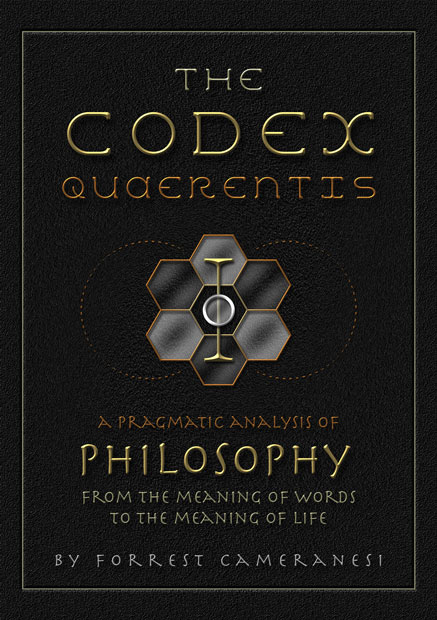
It's meant (along with the cover design) to be eye-catching to a lay audience who may not be familiar with philosophy: stark black book with gold writing and symbols and a weird name, followed by a subtitle with large "philosophy" to tell you quickly what the topic of it is about.
If I did away with the "Codex" part I'd probably do away with everything before "Philosophy" and leave it just "Philosophy: From the Meaning of Words to the Meaning of Life". That part of the subtitle is only a very recent invention... like last month recent.
I would hope that anyone who would read so far as the introduction wouldn't think I'm trying to sound as important as any big-name figures, as I feel like I'm very self-deprecating there, looking back with shame on the younger version of me who dreamed that maybe some day I would be.
That self-deprecation isn't an act either; I'm very... I want to say "ashamed" but that's not quite the right word, nor is "embarrassed"... something vaguely opposite of "proud"... of this work. Like it's really far too little far to late, it makes me look bad to have spent so long producing so little, and I maybe I ought never have begun it. But it's been my "life's work" for most of my adult life, and to abandon it completely feels like just giving up on life, which is something I'm struggling quite hard not to do these days.
And I've felt similarly about other major projects I've worked on, and though it might have taken over two decades, at least one of those has developed something of a fandom, some people who are glad I did it and think it was worthwhile to do, so I cautiously hold a tiny bit of hope -- so tiny I feel bad even admitting it -- that maybe this one might someday too.
I don't know if "codex" is too pretentious. It may be Latin, but it's also English. On the other hand, "quarentis" doesn't mean anything to me, but I can tell it's Latin, and hence it comes across to me as an attempt to appear more educated than I am.
|>ouglas
- Are there any subtopics I have neglected to cover?
I've added that to the OP of this thread now, and will include it in the OP of future threads as well.
I also realized that at some point in this version of the project I had lost the use of the term "Analytic Pragmatism" for my metaphilosophy, which is why "A Pragmatic Analysis" is part of the title. I think perhaps part of that was because I was unhappy with the word "Analytic" in there, as I mean for it to be sort of the opposite of "Pragmatic", as in concerned with language and ideas in the abstract, rather than practical action. But I can't think of a better alternative, and I'd appreciate some help if anyone can lend it.
The problem is that:
Analytic is already the opposite of synthetic.
Abstract is already the opposite of concrete.
Idealistic is already the opposite of materialistic.
________ is the opposite of pragmatic, but not in a pejorative way, just a way that means something like analytic/abstract/idealistic?
("Theoretic" occurs to me, but elsewhere I pair that with "Strategic", so I don't want to reuse that here too).
Personally, I would use theoretic as an opposite of pragmatic. I would never pair theoretic and strategic as opposites. The opposite of strategic would be, if I had to think of something, unthinking or reflexive (meaning - acting on reflexes) or short-term thinking or impulsive maybe. Honestly, I know it's boring, but unstrategic or poorly thought out work well here.
Good strategy often involves months and months of theoretical planning - take military plans.
I don't mean I juxtapose theoretic and strategic as opposite approaches to the same thing, but rather as parallels in different things. Theory is about explaining how things happen, strategy is about planning how to make them happen; one is about beliefs, the other is about intentions. They're both equally well thought-out, but in different domains, and in that way both of them are equally pragmatic, but also similarly... abstract? Analytic? Whatever the word I'm looking for here is.
Do you have any suggestions in that regard?
Would that seem better to you as well?
Also considering working in "No Unquestionable Answers Or Unanswerable Questions" in there somehow, since that is the succinct summary of my entire philosophy, but that seems like the title would get awkwardly long in that case. Like "The Codex Philosophia: No Unquestionable Answers Or Unanswerable Questions, from the Meaning of Words to the Meaning of Life". Too long, no?
All of them. I’d advise sticking to one in depth piece of writing rather than scattered pieces that try to cover everything - and essentially fail.
It feels like you’ve given me a collection of synopsis’s and want me to view it as a singular piece of writing.
In any case I'm definitely not going to completely change the entire point of this project, which is to present a complete system of philosophy, relating positions on different topics to each other and grounding them all in the same common principles. That relational aspect is the most novel thing in here, e.g. my deontology and my epistemology are just descriptive and prescriptive applications of the exact same general principles.
But if I need to go into more depth some place or another I would like to know what is not adequately explained, and why not. I have tried to err on the side of being less wordy, especially when in many cases there are other authors who have already given much wordier explorations of the same or similar subjects.
If it’s for your own purposes, great! If written for others to read, it’s poorly thought out possesses little structure for the reader to grab onto (nothing of any immediate interest or concern - present a clear problem/argument EARLY). It might help to start at the end to garner interest/curiosity by showing the reader the potential use of the problem/argument.
You start off by literally showing us what you know. It is exactly the style of writing reminiscent of high school students. You’re not writing for teachers. We don’t care about what you’ve learnt we’re reading for US.
Note: I am not critiquing the content only the presentation. Your intent isn’t clear - meaning you’ve not presented the reader with a problem to engage with or offered up critique of your given topic (which is nebulous at best).
Quoting I like sushi
I was taught that proper philosophical writing is done from the first person, and lots of (if not most) notable historical philosophy has been written this way. I'm also trying to be humble in my presentation, and avoid sounding like Tractacus-era Wittgenstein, like I did when I was younger: just stating my core premises as facts authoritatively and then deriving all of the consequences from that. I'm also trying not to sound combative, like I'm attacking anyone's worldview, because that is not a productive way to change anyone's mind about anything. (I already rearranged the order of the essays so it doesn't begin with an attack on faith; the old structure was an attack on fideism, an attack on nihilism, attacks on things that reduced to either fideism or nihilism, and then finally my own moderate viewpoint; now I put my view first, and then go into why those alternatives are wrong). I even say in the introduction:
Quoting The Codex Quaerentis: Introduction
That is also in keeping with the very philosophy I end up laying out, where the proper method of investigation is not by starting with some kind of iron-clad indisputable foundational principles and then building an unassailable castle of impenetrable reasoning out of that, but instead by starting with a bunch of initially-equal possible opinions and then whittling away at the ones that can be shown problematic.
In the Codex I am elaborating on my views as a possibility that perhaps hasn't yet been considered by the reader, showing what the problems are with broad swathes of alternatives to it, and then further elaborating on how all the myriad of different topics can be accounted for under my view. E.g. my core principles have immediate implications on ontology, epistemology, and normative ethics, which have their own sub-topics that then need to be addresed; but those views on those topics then raise immediate questions about the mind and the will ("but if the world is all physical and causal then is there no consciousness or freedom!?"), educational and governmental institutes ("but if appeals to authority are wrong then are all religions and states unjustified!?"); and issues about language (including logic, mathematics, rhetoric, and the arts) need to be addressed to make sense of all of that; and all of that together then finally provides a ground to answer the big questions people are really looking for answers to, about the meaning of life.
I do say a variety of things like that in several parts of the introduction, both at the very beginning and at the very end:
Quoting The Codex Quaerentis: Introduction
But maybe I could punch up that first paragraph some (you actually gave me an idea to begin with the same sentence that I end with), and make it more explicit how all these topics relate to each other and what the point of going over them all is. Possibly rearrange and rephrase some of the intro more too. I have a little time this afternoon, maybe I'll give that a go soon.
Quoting I like sushi
The point isn't to show off my knowledge, but rather to not assume anything about the reader's knowledge. I'm picturing trying to explain my philosophy to my (largely uneducated) mom when I write; or, as I said, myself from twenty years ago, when I barely even know what the word "philosophy" meant. As I say in the intro already:
Quoting The Codex Quaerentis: Introduction
Quoting The Codex Quarentis: Introduction
It's almost even more first-person than before, but I think it's also a lot more engaging. At least I hope.
I also made smaller modifications to the rest of the intro, including removing the mention of my degree, which I agree just kind of sounded boastful.
Yes, because it’s for the ‘layman’. If you’re dumbing down the text you’re addressing philosophers so you shouldn’t be writing a philosophical piece - pick your audience rather than trying to cater to all (it won’t work).
You absolutely have to grab your reader early on. It is not ‘combative’ to present a problem and to say something someone says is wrong - that is telling the reader why your piece of writing is of value.
Quoting Pfhorrest
That’s another problem. People don’t read things to have their mind changed. You present a problem they care about, offer a better solution (a brief explanation of the solution) and then investigate it at length (warts and all).
Quoting The Codex Quaerentis: Introduction
Who cares? What’s the point? What are you selling? Pose some questions for the reader to ponder (a great many pop-science books do this because it engages interest in the reader by interacting with them.
That is basically like saying I have some opinions about life. That is the nebulous part I was talking about. You hinted at relativism earlier on but never explicitly mentioned it - that would’ve anchored the reader a little.
Look here:
This would turn off the majority of your readers. You tease your reader by building up then evade. The reader still has no reason to continue nor any knowledge of what they’re reading or of any potential value for themselves. You’ve just constructed a huge barrier between the writing and your reader (note: not YOU and your reader; you don’t matter to them at all).
If you think my points aren’t valid hire a professional editor to look at your work and see if they echo what I’ve said. I’m certain they would.
Note: to repeat, this has nothing to do with the philosophical content.
Where? I think you might have misunderstood something.
Quoting I like sushi
What would? Saying that I’m going to talk about metaphilosophy (for one chapter) before all the other philosophy I “teased”? Saying that philosophy is of wide practical importance to everything else, and that I’ll elaborate why? What?
I welcome specific, actionable criticism, suggestions for how I can do what I’m trying to do better. The only thing I dislike is responding is to “how do I do this better?” with “don’t do that” — i.e. scrap the whole thing.
Instantly turned off. That is no way to engage the reader. Essentially you just said, what I’m about to say is most probably useless (whether it is or it isn’t doesn't matter). It would be better to start with a ‘gist’ sentence.
Too much, too many ‘trying’ broken up by a needlessly long sentence doing the same thing - listing. People don’t like to read lists.
Note: You’ve still not given me a anchor. No question or clear problem revealed.
One key word ‘But’. It comes far too late after two long lists spattered with terms that don’t encourage the reader (eg. ‘hopeless,’ ‘maybe,’ ‘trying,’ ‘powerless’).
And here’s a clunky part:
That’s one sentence!? Fair enough if you were outlining some specific point of import and selecting your words carefully and economically to get the thrust of your point across ... but you weren’t.
Note: I write like this too often enough. I try my best to edit as I write, but in reality editing some time after you’ve written your original piece with a highly self-critical attitude will improve both your ability to edit as you write and leave less work later on.
It could be that you’re looking at your writing as a set of ideas instead of a piece of writing. Forget what you’re saying and focus on how it reads. Pick up any pop-science/philosophy book and analyse how they open their subject matter up and the kind of questions they pose.
Examples from my shelf (four books picked at random):
‘In her book, Philosophy in a New Key, Susanne Langer remarks that certain ideas burst upon the intellectual landscape with tremendous force...’
We know this person has studied something and also setting up a potential ‘But...’ (Opening Chapter directly after preface)
‘All states, all powers, that have held and hold rule over men have been and are either republics or principalities.’
The subject matter is clear and there is a hint of ‘But...’ (Opening chapter after dedication)
‘Greek and Roman mythology is quite generally supposed to show us the way the human race thought and felt untold ages ago.’
Preempting an obvious ‘But...’ (Opening sentences of Intro)
‘The extraordinary interest aroused all over the world by Rudolf Otto’s Das Heilige (The Sacred), published in 1917, still persists.’
I sentence that displays both subject matter and the value of the coming content. (Opening sentences of Intro)
Your first few lines sound like the start of a novel as do the lists.
I would start something like this:
Throughout the history of human civilization we have found ourselves struggling with numerous questions, be these intellectual, moral and/or socially concerned. Even today a great many people will be asking themselves what the point is, or holding to some way of life based loosely on the life and thoughts of people long dead - be this Epictetus, the slave, Christ the Savior, or Albert Camus’ and his ‘absurd’ view of human existence. But is there really a ‘best’ way to live our lives? Should we cut our own uniques paths through time or live by the ideals set out by others? How should we live?
Note: To repeat; nothing to do with the content. The point being if you’re not engaging with your target audience then the content doesn’t matter because no one will be willing to read further.
If you want critique of your ‘ideas’ that won’t happen until you improve how to present them. It’s bloody hard work, and for the most part the process won’t be particularly rewarding or fun because you’ll have to cut away swathes of yourself as you refine and remake how you think/articulate to the point where you can be your own audience rather than simply throwing ideas at a wall without considering at better technique to make them stick.
Sometimes the fault is mostly with the reader and sometimes the fault is with the author. There is always some fault in both. You have to be honest with yourself and with your audience. Very few people will just pick something up and read it start to finish. People may select something at random, but they decide relatively quickly whether or not they are going to continue reading or move on.
The narrower your target audience the harder it will be to judge the impact of your words. If you’re writing for academia then you need to study academic writings in your area of interest. If there is no ‘area of interest’ and what you have is ‘original’ you just have to accept the fact that it’s not ‘original’ but simply ‘unwanted’. That doesn’t have anything to do with the ‘value’ of your writing though.
Note: You may find it both interesting and useful to look at literary theory, and to research different forms and styles of writing - maybe practice writing the same thing for different audiences (for early teens, adults, students, teachers, professionals, amateurs, intellectuals, etc.,.)
Quoting I like sushi
This sounds to me (and my English major girlfriend) like the start of a bad high school paper.
I also asked her to read the new intro I wrote, and she said that it gets a lot better in the second section -- i.e. the section that goes back to the old style that the whole intro used to be in, before I rewrote the first section trying to address your critiques.
All in all this makes me wary of the value of your stylistic critique. (She straight up says I should ignore you, but I can't bring myself to ignore anybody outright; I always try to take something of value away from any criticism).
I second that.
That is heartening to hear, thanks.
http://geekofalltrades.org/codex/xindex.php#intro
Be forewarned, I am absolute crap at writing dialogue, which is why that version of the project was abandoned.
Also, the ideas presented in that are not all my current ones.
You sound like you have the right attitude as does your gf. She’s meant to encourage you and support you. I’m not here to support you and encourage you in anything like the same manner.
Again, I’m not the one asking for a critique, but you are? I gave a quick example of how to engage with the reader quickly. Given that you missed the point of it I’ll make this clearer ...
1) Gist sentence about subject matter.
2) Pose a problem to the reader and hint/show ‘value’ - things like ‘many people,’ ‘but,’ and ‘although’. Why should the reader care?
3) Questions make the subject more concrete and actively engage with the reader - rather than passively absorbing words.
4) Avoid long lists, especially in an introduction to the subject matter.
5) State position as clearly as possible before explaining why you have this position.
When I said ‘high-school’ I meant that in such essays you are writing to show comprehension. If you’re writing a book/essay you’re writing for your audience and given the subject matter you have to address the audience differently because the audience is different.
I’m still unsure what your aim is. You seem to be writing something that is an introduction to philosophy, an educational resource, your own personal philosophical view, and a critique of philosophy in general. If it’s educational (textbook) then terms like ‘I’/‘we’/‘us’ should be avoided as much as possible. I don’t need to know about your personal story or journey; I don’t care (in terms of a educational piece of writing.
If you’re going for something more like ‘Zen and the Art of Motorcycle Maintenance’ though, I’d certainly go into more personal detail.
The thrust of what I’m saying is that I don’t know who this is for and I not convinced you do yet either. I’m getting mixed messages due to how it is lain out. The ‘set up’ matters a lot because people like to know what they are getting themselves into.
My own critique of my critique here would be to say I should really give positive feedback too. I like a lot of the content because I’ve looked at your essays before. I judged you to be someone less concerned with compliments and more likely to take criticism seriously if it was straight up - if you were a student it would be a different matter and I’d likely use a more ‘encouraging’ tone.
Quoting I like sushi
I just gave an explanation of the target in the other thread.
(edit to quote it here for posterity:)
Quoting Pfhorrest
Quoting I like sushi
Thanks for that, but it’s really not the lack of compliment that’s been discouraging, but how the gist of your critique has seemed less “here is how to do this better” and more “don’t do that, do something else instead”; and also shades of “don’t argue, just do it, or pay someone else to critique this for you”.
I would like to instead explain what I am trying to communicate (which is not arguing with the critique) and get suggestions on how that could be better communicated.
When I have the time at my desk, not on my phone in bed.
The Book of Questions - Liber / codex quaestionum
quaerend? is the masculine genitive singular of the verb future participle quaerendus
The Book of What is to be Asked - Liber / codex quaerend?
quaerentis is masculine genitive singular of the verb present participle quaerens
The Book of Questioning - Liber / codex quaerentis
So you have got the choice :)
So here's a quick attempt at that, looking at the current version post-revisions-based-on-your-critique:
"It may be hopeless, but I'm trying anyway."
This is the moral of the story, so to speak. It's the maxim that everything boils down to. It's also catchy. (Someone in the other thread liked it as catch phrase, and my girlfriend said it caught her attention immediately). I hoped it would make people ask "what is hopeless? what are you trying?"
"Trying to live a meaningful life, by empowering and enlightening myself and others. Trying to bolster and support the right institutes of governance and education, that will best promote justice and knowledge, helping bring ours wills and our minds into alignment with what is moral and what is real. Trying to understand what it even means for something to be moral or for something to be real, by understanding the language we use to even discuss any of this, and all that that entails about logic and rhetoric, mathematics and the arts. "
The book is about philosophy. These are the things philosophy is about, so these are the things the book is about. Three sentences, for the three general sections of topics, in reverse order: the practical how-to-live-your-life stuff, the core sequences about reality/knowledge and morality/justice, and the abstract communication stuff. They're in reverse order to start with the stuff people might care more about, the less abstract stuff, first, even though in the book itself I have to start with the abstract stuff to ground the more practical stuff.
"Maybe that endeavor is hopeless. Maybe life is meaningless, all social institutes are incorrigibly corrupt, justice and knowledge are impossible, the mind and will powerless to grasp what is real or what is moral, if anything is at all, if it even makes any sense to try to talk about such things. Maybe that's all hopeless. But just in case it's not, I think we stand a better chance of succeeding at that endeavor, should success be at all possible, if we act on the assumption that it's not hopeless, and we try anyway. "
This is that 'moral of the story', applied to that subject matter. These are the things at stake. Meaningless, incorrigible corruption, impossibility, powerlessness, incomprehensible nonsense, etc, are the threats posed by lack of a good philosophy. But I'm offering hope against those, in the face of apparent hopelessness.
"That is the core principle at the heart of my philosophy, that I am to elaborate in the following essays: to always try, and so to act under whatever assumptions trying tacitly necessitates, namely that success is always possible, but never guaranteed. I consider the general philosophical view supported by that principle to be a naively uncontroversial, common-sense kind of view, from which various other philosophical schools of thought deviate in different ways. In these essays I aim to shore up and refine that common-sense view into a more rigorous form that can better withstand the temptation of such deviation, and to show the common error underlying all of those different deviations from this common-sense view."
Restating the kind of thing I'm going to do in the book: defend the common-sense view that things aren't completely hopeless/meaningless/etc, using that core principle.
"Put most succinctly, that common error is assuming the false dichotomy that either there must be some unquestionable answers, or else we will be left with some unanswerable questions. All of the deviations from the view I defend stem ultimately from falling to one side or the other of that false dichotomy, on some topic or another, because doing so in either way constitutes a failure to even try to genuinely answer the relevant questions. In contrast, my philosophy is the view that we must always try to answer our questions, and must therefore always proceed on the assumption that there are no unanswerable questions, and no unquestionable answers; that every question can in principle be answered, and every proposed answer is open to question."
Overview of what is wrong with the competition, and why what I'm offering is better.
"Very loosely speaking, that means that there are correct answers to be had for all meaningful questions, both about reality and about morality, and that we can in principle differentiate those correct answers from the incorrect ones; and that those correct answers are not correct simply because someone decreed them so, but rather, they are independent of anyone's particular opinions, and grounded instead in our common experience. Put another way: that what is true and what is good are beyond the decree of any of us, yet within reach of each of us; and that we can in principle always eventually tell whether someone's opinion is right or wrong, but we can never immediately assume any opinion to be such, and must give each the benefit of the doubt until proof is found one way or the other."
Overview of what the thing I'm offering is, in more detail.
"That general philosophical view is the underlying reason I will give for all of my more specific philosophical views: everything that follows does so as necessary to conform to that broad general philosophy, rejecting any views that require either just taking someone's word on some question or else giving up all hope of ever answering such a question, settling on whatever views remain in the wake of that rejection.
The core principles I will outline have immediate implications about what kinds of things are real, what kinds of things are moral, the methods of attaining knowledge, and the methods of attaining justice, which will each be covered in their own essays. Those positions then raise immediate questions about the nature of the mind and the will, and the legitimacy of educational and governmental institutes, which will again each be covered in their own essays. But all of that first requires a framework of linguistic meaning to make any sense of, which will be covered in its own essay, along with attendant essays on the related topics of logic and mathematics, and rhetoric and the arts, each covering different facets of communication in more detail. And with all of that in place, we finally have the background to tackle the most practical questions of enlightenment, empowerment, and leading a meaningful life, each of which will be covered in its own essay as well."
Structural overview of the rest of the book to follow.
"For these far-reaching influences, I see philosophy as the most central field of study, bridging the most abstract of topics like language, math, and the arts, to the physical and ethical sciences that in turn support the development of all the tools used to do the jobs of all the world's various trades. It is in light of that pragmatic role of philosophy that I will begin my approach to the subject, and it was likewise that centrality that initially drew me to it."
Another take on why this subject is important, and segue to the next section where I explain why I found this important and how and why I'm sharing it with others now.
...
That's the first section for now, gotta run.
Quoting Pfhorrest
Yet all you give the reader is this:
Quoting Pfhorrest
For a novel, yes it’s an intriguing opening. For a philosophical work I don’t care for it and it doesn’t tell me anything directly ... remember this is the opening sentence. If it’s the maxim of the book then why not simply state that it is the maxim of the book?
I think you’re just upset because you claimed you were looking for something yet did your best to avoid it. It happens, and it will happen again to you and me both. I’m not at all sorry if I touched a nerve. Sometimes things are better said than not and if in this instance I shouldn’t have pointed out what I pointed out it’s moot now - I said as I saw fit because I get upset seeing myself and others miss what’s right under their noses.
I don’t hold grudges because I know everyone has a necessary capacity to change - for better or worse. If may ‘feel’ like I attacked you, but I didn’t attack you because I don’t know you.
Not devoting that tiny bit of time to your meaningless "chair" exercise instead is not "trying my best to avoid" actually constructive collaboration on something that means something to me.
I try enough because I try as much as I can, and if the results aren't enough then tough shit, I'll try again when I can and see if it gets better.
You're not my fucking boss, this isn't my fucking job, this is a passion project I do when I can as best I can, and I know it's not enough, it's not enough for me, and I don't need you fucking telling me it's not enough for you, because your opinion doesn't fucking matter.
You've outed yourself as a concern troll. You pretend to care so that your attacks will hurt more. You're not worth the pixels your words are printed on. From here on out I'm considering you a hostile actor not to be trusted.
I'm looking for people who like what it is that I'm trying to do and have thoughts on how I can do it better. It seems you don't think I should be even trying to do this, and your only thoughts are on how it's awful, with no constructive suggestions for how to make it better.
This isn’t true at all. You asked for criticism and I’ve clearly offered constructive criticism.
Anyway, you’ve made yourself clear enough. If you have a change of heart let me know, if not no problem. I’ll not be bothering you anymore than I have appeared to already.
I like sushi has a point Pfhorrest. From experience of my own, here is some advice about seeking feedback on your writing;
1. Do not expect useful literary criticism from anybody close to you emotionally. There are reasons why they have that connection to you, all of them sincere, and that are likely to bias their approach to your writing whether they are aware of that bias or not. That bias may, of course, be negative or positive.
2. Find someone close enough to your target audience as you can and who has no, or very little, vested interest in your emotional wellbeing, and ask them to devote some time to reading your work. You will no doubt have a clear picture of that kind of individual, so you can perhaps identify a suitable person or some suitable people within your circle of loose acquaintances. You might find such a person on this board, but I have my doubts. When you do find that person, ask that they be brutally honest and convince them that you have a thick skin, even if you don't. Do not expect that person to advise you what to do to improve the book, you are writing it, not them. When they do come back to you with a list of problems, and from personal experience with following this advice myself, they are likely to have quite a number of them, address those issues yourself and try to convince them to reread your work to see if they believe it has improved.
On a different note, if you goal is to see this book in print and to be published by someone other than yourself, you need to be able to convince a literay agent that you have a target audience that is crystal clear from a marketing point of view, and sufficiently large to give a chance that there will be some profit to be made. Agents and publishers are in it for the money, although perhaps not exclusively. What you have said about your target audience seems to me to be too nebulous to meet those commercial requirements.
Of course, if you don't care about seeing the book in print, and you are doing this just for yourself, then I do not see why you need the advice of anyone concerning your writing style, just keep writing and rewriting and make of yourself your own worst literary critic.
@jkg20 is spot on.
Sushi made it obvious from the start he didn't give a shit about your feelings and was just going to say what he was going to say. Which is exactly what you should ideally expect (and hope for) in criticism.
As an aside, I've just finished re-editing and relaunching a book of short stories, which I put a lot a lot of work into and which I've been highly emotionally invested in. But it took me over a year to go back and see some of the fuckups in there because it can take that long away from a creative project to divest yourself of bias and look on it in a way similar to a detached critic. Of course, you'll never be fully objective, but you'll get nowhere without giving yourself time to be so. Your reaction to Sushi suggests you're not there yet. But if you want your work to be better, you need to get there. That's just the way it is.
Also, you're not even supposed to be promoting your own work here or getting feedback on it. Normally, I delete that kind of stuff as self-promotion/advertising. And now I've got another good reason, which is people getting pissed off that everyone doesn't love their stuff as much as they do.
Nobody in my close circle of friends seems to be that kind of individual. I would generally characterize that kind of individual as “philosophy fans”: non-experts with an interest in the field, the kind of people who might otherwise be philosophy students. I thought a forum like this would be full of them.
Quoting jkg20
I don’t understand what to do to improve something when the feedback is just “I don’t like this” or “I don’t understand this” and any attempt to get more details about what or why is taken as defensive. When I have tried just blindly rewriting something from scratch, like I did for sushi, the response was just more “I don’t like this”. I don’t even know if the change was in the right direction or the wrong direction. I have no idea where to proceed from feedback like that.
Quoting jkg20
It’s not. I don’t see what the point of that would be, I’m not doing this for money, I’m trying to give away something useful to the world.
Quoting Baden
It’s not about him not caring about my feelings. I was trying to work with his criticism, as useless as it was, as best I could. I was trying to get better clarification on what kind of change would be more in the direction he wanted. I had just finished another round of attempting to adjust for his comments and came here to say so only to find that he had just attacked not the work but my character (in the other thread), saying I’m not trying hard enough. That personal attack is the only thing that made me angry.
Quoting Baden
I never expected anyone to love it. I think I’m garbage and everything I make is garbage. (Even that game mod that lots of people love still looks like garbage to me). All I hope for is someone to find it interesting garbage with potential and give constructive feedback on how to make it less garbage.
And as I said, I only got pissed at the personal attack on my character, not the criticism of my work.
I did not say or imply that you were in it for the money. Publishers and agents are. You might, however; want your work published to reach a wider audience than a bunch of insomniancs with nothing better to do than try to prove other people are interpreting Wittgenstein incorrectly. If you do want to do that, you will need to have a sharper target in sight than just "people who in other cicumstances might have been philsophy students". If you sharpen your target you may also have to sharpen the focus of the work, of course, and turn it into something with more limited scope.
In any case, if your target audience is people interested in philosophy, then my single piece of advice to you, and I think Sushi made much the same point, and which you can certainly do something about very easily without affecting the content, is to depersonalise it. The "I" count is very high in the sample chapters I have skimmed through and, speaking as a person interested in philosophy, it is off putting.
The audience of people willing to pay for something is wider than the audience of people willing to read something for free? That seems counter-intuitive.
Quoting jkg20
I still think this advice is countermanded by people with better standing to give such advice, such as all of my philosophy professors, who explicitly instructed everyone that philosophy is written from the first person; and a survey of most of the historical philosophical literature, which bears out that instruction, being written in the first person unless it's a dialogue or some kind of literature review not putting forward its own arguments.
I understand that other kinds of disciplines, and high school teachers apparently, drill first-person writing out of people, which is why the philosophy professors have explicitly hammered on how that kind of advice is to be ignored for the sake of philosophical writing.
I just did a quick search for philosophical writing advice and found these choice quotes:
“Philosophers often use the first person, especially when announcing their argument.”
https://www.vanderbilt.edu/writing/wp-content/uploads/sites/164/2016/10/phil-papers-handout.pdf
Some examples of “good writing”:
“In this paper, I will refute Smith’s argument against the existence of free will by showing that it trades on an ambiguity.“
“ As I have shown clearly in my reconstruction of Smith’s argument, the word “free” as it appears in Smith’s
first premise (meaning uncaused) must be interpreted differently from the word “free” as it appears in Smith’s third premise (meaning unforced) – otherwise at least one of those premises would be highly implausible. But in that case, Smith’s argument is logically invalid.
It might be objected that I have interpreted Smith’s argument unfavorably. I can think of only one other reasonable interpretation of Smith’s argument. It uses the same first two premises but...”
https://philosophy.fas.harvard.edu/files/phildept/files/brief_guide_to_writing_philosophy_paper.pdf
All of this article generally:
https://writingcenter.unc.edu/tips-and-tools/should-i-use-i/
Also of interest:
“There is no need to point out that your topic is an important one, and one that has interested philosophers for hundreds of years.”
http://www.sfu.ca/philosophy/resources/writing.html
It kind of sounds like many of you have never actually written a philosophy paper and are running on old high school writing rules.
Questionable advice, and in any case open to interpretation. The suggestion was not that you should, or even could, write without dropping in the odd first person pronoun here and there where it makes sense. However, your use of it seems extravagant and very often entirely unnecessary. Compare your use of it with, say, Kant's and perhaps you will see. In any case, you wanted opinions from people interested in philosophy and who read philosophy, and, being such a person, I gave you one. What you do with it is entirely up to you.
Please do read, or reread, the "should I use 'I'" article you provided. As you do so, ask yourself the question whether you might be using the first person pronoun so much that you undermine any potentially positive effects of doing so.
I will not speak for the others contributing to this thread, but I have written more philosophy papers than I care to count and have read even more. Some of them were better than others, but none of them were better because the first person pronoun had been scattered around the pages like confetti. When I taught undergraduate philosophy, I certainly advised people to try to put things into their own words, find their own examples to replace the ones contained in the set texts, come up with questions that express what it is that they did not understand about some philosopher's remarks, and so on. To some extent, that is adopting a first person approach to writing philosophy, but does not require excessive use of "I" in its execution. I also advised on many occasions that where one sentence will do in place of five, opt for brevity. Many, if not all, of my colleagues were in the habit of dealing out very similar counsel.
On a different note, unless you are doing so with express intent, avoid splitting infintives. Some people, of course, intend to split their infinitives and on rare occasions doing so enhances a sentence. However, if you are doing it without that intent, then just bear in mind that sometimes the careless splitting of an infinitive can lead to unwelcome ambiguity and not simply to stylistic discomfort. Also, beginning sentences with conjunctions is mostly to be avoided: conjunctions have the grammatical purpose of conjoining two or more phrases in a single sentence. Finally, in the absence of its serving some essential end or its being unavoidable, eschew using the same word more than once in a sentence. Such repitition smacks of laziness, engenders boredom and can indicate to the reader that you lack vocabularly. You could also extend that last rule of thumb to cover a whole paragraph. Here is one sentence of yours where you go against all of the foregoing advice:
Perhaps this is the one and only time you break those guidelines of grammar and style in so few words. However, on the off chance that the aforementioned quotation is indicative of your writing generally, you might want to look up those three pieces of advice on the internet and see if anyone else agrees with them or not.
How about 'first person impersonal' (e.g. Spinoza, Kant, Schopenhauer, Wittgenstein, Peirce, Russell ... Nussbaum, Meillassoux, et al)? Less 'systemic' memoir, more autopsy ... of reflection / reasoning. :chin:
Quoting jkg20
:up: "Drinks for all my friends!" ~Henry Chinaski, Barfly
:death: :flower:
Well expressed.
Cheers. Next round's on me as well.
Can you give me an example passage from the codex that is too “personal” and rephrase it in the tone you think it should be? When I look through for ways to make things less personal, all I see are opportunities to falsely claim my own views as indisputable facts, which seems like it would be much worse.
Here is a first draft depersonalised version:
The recommendation is not, though, to reject out of hand every claim made by any authority. In cases where we lack information, or even the resources to obtain it, we may have good reasons to defer to the testimony of an expert, the legislation of a government or the edict of a pope. However, deference should neither become, nor be confused with reverence. Everyone, no matter their expertise or power, remains fallible.
Everyone, no matter their expertise or power, remains fallible, even me.
Edit: strictly speaking, grammar requires that "even me" be "even I", but that seems inelegant. Anyway, as I say, this is just a first draft which you should feel free to flush away like a used sheet of toilet paper.
Bingo! :up:
Also got the girlfriend finally reading/proofreading it; she's not interested in philosophy and so hadn't read it until I pressed her to read the first part of the intro a few days ago, but I asked her if I can try to teacher her philosophy while she teaches me to be a better writer by collaborating on this, and she's tentatively agreed and given me partial notes on the intro already.
There is always a danger in philosophy of presenting a statement as truth when in fact it is false, or at least dubitable. With the possible exception of Socrates, who asked questions rather than made statements, I can think of no philosopher who avoided doing so. However, if the statement concerned is preceded by good arguments or reasoning for believing it to be true, it would be a very sensitive person indeed who would be affronted in any way by your audacity in passing it off as a truth. They might take it on as a challenge to prove you wrong, but is not that precisely one thing that we should be inviting as writers of philosophy? In any case, if you want to hedge a statement, whilst occassionally an "in my opinion" or "as far as I can see" might be just what you need, there are usually always impersonal alternatives to try out for size.