
Seeing everything upside down
Wheatley 2019-11-08
When light enters your eyes the light is refracted in such a way that it projects an inverted image on the retina:
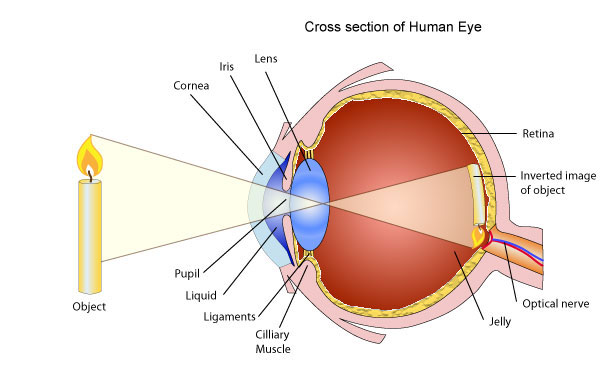
I don't know if this means we actually see the world upside down. It all depends on how vision works, which isn't the concern and scope of this OP. What interests me is, supposing that we do see the world upside down (hypothetically or not), would it make any difference?
One thing to note is that if I saw everything upside down I would also see myself and my bodily movements upside down. How would this perceptual impairment effect my life? Suppose I decide to move my hand upward? Let's break it down:
I decide to move my hand up, however what I believe is up is actually down. As a result, I'm really attempting to move my hand down.
The thing is, attempting to lower my hand in a world that is inverted from how I see it would have the opposite effect and make it rise.
The end result is me lifting my hand. I wanted to lift my hand and I actually lifted my hand in the real world, even though my judgments were all wrong. Whether or not I see the world inverted or not, I get the same results. How incredible is that?
I don't know if this means we actually see the world upside down. It all depends on how vision works, which isn't the concern and scope of this OP. What interests me is, supposing that we do see the world upside down (hypothetically or not), would it make any difference?
One thing to note is that if I saw everything upside down I would also see myself and my bodily movements upside down. How would this perceptual impairment effect my life? Suppose I decide to move my hand upward? Let's break it down:
- The world will remain the way it is, positioned correctly.
- I see the world as inverted.
- I see my actions as inverted. (after all, I am part of the world)
I decide to move my hand up, however what I believe is up is actually down. As a result, I'm really attempting to move my hand down.
The thing is, attempting to lower my hand in a world that is inverted from how I see it would have the opposite effect and make it rise.
The end result is me lifting my hand. I wanted to lift my hand and I actually lifted my hand in the real world, even though my judgments were all wrong. Whether or not I see the world inverted or not, I get the same results. How incredible is that?
Comments (17)
For one, the idea of light moving at straight, clean angles and intersecting at a point, where the interaction with the eye seems to be posited as if the eye were more or less a vacuum for light "rays" to travel in seems a bit ridiculous(ly oversimplified).
We still don't even have a really good model of what light is. It doesn't seem to be quite a particle or quite a wave but something that exhibits properties of one or the other in various situations.
Same applies to matter. Maybe it's all some kind of field.
We see the world the right way up.
@Terrapin Station we don't need QM here. Stop over-thinking.
I imagine if the reflection on the retina was right way up, we might see the world inverted, assuming reflection is working like mirrors.
As Banno noted, this exact thing - wearing inverted glasses over a prolonged period of time - has been a well known scientific experiment, and there's been alot written about the results. The first most striking result is that after a while, one simply gets used to it - your perception of the world - after interacting with it (this is important) - simply rights itself eventually, and you see just like you did without the glasses. Moreover, once you take the glasses off, your vision has to once again readjust - it has to 'correct' itself once again.
The second striking result is the phenomenology of it: wearing the inverted glasses doesn't simply flip the world up-side down, at first. Rather, it disrupts sight altogether - it leads to a kind of initial experiential blindness. Quoting one of the studies: "During visual fixations, every movement of my head gives rise to the most unexpected and peculiar transformations of objects in the visual field. The most familiar forms dissolve and reintegrate in ways never before seen. At time, parts of figures run together the spaces disappearing from view: at other times, they run apart, as if intent on deceiving the viewer." Or as Alva Noe puts it, the result is not (initially) simply seeing differently, but failing to see.
This eventually changes, as the glasses wearer interacts with the world around themselves, and quite literally learns to see again. As Noe reports, there are three stages to this: the first stage is a confusing one: things on the left look as though they are on the right, even though things feel as though they are on the left. Next, things on the left still look as thought they are on the right, but now they also feel that they are on the right. Last, everything aligns: what's on the left both looks like it's on the left, and feels like it's on the left. 'Normal' vision is restored. Importantly all this happens only if one interacts with the world around themselves, moving, holding, touching, reaching out, etc.
The biggest takeway from all this is that visual perception is bodily and interactive in the extreme: sight is not just a question of 'images' but of literally interacting with a world which gives rise to sight. Perception is a 'complex', a conjunction between what is seen, what is felt, how one interacts with the world, and not just 'what' one sees. In short - anti-realism is a bunch of bullshit, and any elementary study of perception will confirm this.
mentioned it, too.
Actually there were a couple of other anecdotes that I read of around this time, one of which the story of a pygmy chieftain, who was taken, by some anthropologists, up on top of a mountain look-out. This individual had spent his entire life in dense forest where everything was more or less within arms' reach. Once at this mountain lookout, the pygmy didn't seem to react badly, but after a while he was seen squatting down and reaching forwards as if to pick something up off the ground in front of him. The anthropologists theorised that he was actually trying to pick up a distant herd of wildebeest that could be seen on the distant plains beneath; they got the impression that he thought they were insects right at his feet. Because, of course, he had no 'wiring' for 'distant plains beneath', not ever having experienced such a vista.
What this all points to, is the role of the mind and brain in 'constructing' or synthesising experience; it shows up how what we instinctively categorise as real is in some fundamental way dependent on a constructive act of synthesis.
It also emphasizes the far reaching ability of the brain to manipulate sensory input (course we already knew that.)
The vision-inversion experiment proves only that:
1) A vision-inversion-experience takes some time for the mind to process and integrate.
2) The experience of motion and interaction within a visually inverted frame of reference is crucial to processing and integrating a vision-inversion-experience.
It has nothing conclusive to say about realism and anti-realism. You've assumed your conclusion. Your hammer has turned it into a nail.
Says the post that shunts everything into the artificially constructed vocabulary of 'experience' from the get-go.
...To demonstrate that a vision-inversion experiment is easily assimilated to an experience-centric dialect and metaphysics.
Note my conclusion: A vision-inversion experiment has nothing to say about realism and anti-realism.
Sure, if you beg the question, anything is possible.
Because you have chosen your camp you attack my counterpoise as a kind of begging. This is the hammer speaking. My intention is more charitable: I mean to demonstrate that a vision-inversion experiment is as content with Berkeleyan idealism as with the directest of realisms.
Again: A vision-inversion experiment has nothing to say about realism and anti-realism.