
Evolution: How To Explain To A Skeptic
ep3265 2019-01-31
Given our current understanding, a majority of scientists believe evolution to be true. I'd like to take a minute to discuss how we as scientific believers can explain the existence to a person of religion. I'll give my take, you are welcome to add onto what I've discussed.
First let's get our definitions out of the way.
Science - the intellectual and practical activity encompassing the systematic study of the structure and behaviour of the physical and natural world through observation and experiment. (This is the first result on Google, when we talk of science, this is what we mean. Science is our approach to understanding the universe, not religion. If you don't believe a clearly stated scientific discovery, with sufficient evidence, as being true, you are inherently wrong and are therefore too stuck in your own way of thinking.)
Scientific Theory - a coherent group of propositions formulated to explain a group of facts or phenomena in the natural world and repeatedly confirmed through experiment or observation (When we talk of theories, we don't mean the slang term. This is what scientists mean when they speak of theories, doesn't matter what your take on the term theory is, this is the scientific definition, and therefore if you don't accept it as being the true definition, you are missing the point. There's a huge difference between a scientific law and theory. The below image will summarize the difference between laws, theories and hypotheses.)
Quote from Google: "A hypothesis is a limited explanation of a phenomenon; a scientific theory is an in-depth explanation of the observed phenomenon. A law is a statement about an observed phenomenon or a unifying concept, according to Kennesaw State University. ... However, Newton's law doesn't explain what gravity is, or how it works."
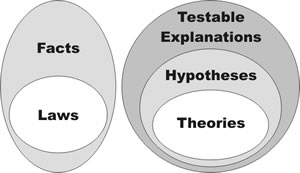
Now that we have semantics out of the way, let's discuss it. First let's talk about the logical side of things, we all believe in genes being passed down from parent to offspring. If you don't believe in genes then I don't know what to do about you, you're a lost cause. Luckily, most people believe this. So given our evidence that we inherit genes from our parents, and therefore our genes are a conglomeration of what is our past selves, then why is it out of the question when it comes to difference of species? Okay, I get it, it's hard to see how we are related to that bird or that dog, etc, that's out of the question. Look at how much we as humans have changed over the last hundred years, we've all evolved different social skills, difference of opinions, etc. Ourselves are completely different looking then our grandparents, great grandparents, and especially our great great grandparents, but we're still related to them. Look at it on a bigger scale, if it happened for millions of years, is it so far fetched to believe we could become an entirely different species? Okay, maybe you're not convinced let's discuss the evidence then, shall we?
The claim of evolution existing is the party that has the burden of proof, so let's discuss. While Darwin was on a trip to the Galapagos Islands, he observed the differences in finches there. We all believe in natural selection, if you are unable to succeed in your current environment, you are unable to pass on your genes, and therefore unable to pass on what you were. This is true throughout the animal kingdom. If I have a trait that allows me to survive in the current climate, more than likely I have a higher chance of breeding than another person who is unable to survive. Quote from livescience.com, "The theory has two main points, said Brian Richmond, curator of human origins at the American Museum of Natural History in New York City. 'All life on Earth is connected and related to each other,' and this diversity of life is a product of 'modifications of populations by natural selection, where some traits were favored in and environment over others.'" So let's talk about Darwin's finches. Darwin observed difference in the beak types of the finches there. Another study which was conducted by Princeton University, lasting 40 years also documented evolutionary changes in beak size affected by El Niño/La Niña. This was observed by Peter and Rosemary Grant. Here is their Wikipedia page: https://en.wikipedia.org/wiki/Peter_and_Rosemary_Grant
Here's a very simplified powerpoint, that explains very clearly what the findings were, and what to expect: sciencecases.lib.buffalo.edu/cs/files/darwins_finches.ppt, I can't find any citation or credit to give, but I didn't make the powerpoint.
So what can we conclude? Natural selection absolutely exists, it's undeniable. The finches were UNABLE TO BREED with the other finches. This means a new species was created. Doesn't matter that they looked similar, what matters is that a whole brand new species was created. Therefore, the whole "micro-evolution vs macro-evolution" argument is unsubstantiated. Okay, still unconvinced let's take a step back. Natural selection exists, no doubt. The fact that new species are created also therefore proves that we all started out a very similar species at least. You must take into account the entirety of the world's long existence. If substantial change can be observed in 40 years, then the difference of life is almost incomprehensible. Evolution is a long and arduous process. The Earth is 4.543 billion years old. Life has existed on Earth for approximately 3.5 billion years. We understand that homo sapiens have existed for around 100,000 years. If we divide the existence of the universe vs the amount of time humans have existed, we see that the existence of humans is 1/35,000th the time life has existed. Take a minute to think about that. Humans are substantially different from one another from our perspective. So take the differences of humans from the present, multiply it by the differences of people from 10 years ago, 35 times, and 100 times that.
First let's get our definitions out of the way.
Science - the intellectual and practical activity encompassing the systematic study of the structure and behaviour of the physical and natural world through observation and experiment. (This is the first result on Google, when we talk of science, this is what we mean. Science is our approach to understanding the universe, not religion. If you don't believe a clearly stated scientific discovery, with sufficient evidence, as being true, you are inherently wrong and are therefore too stuck in your own way of thinking.)
Scientific Theory - a coherent group of propositions formulated to explain a group of facts or phenomena in the natural world and repeatedly confirmed through experiment or observation (When we talk of theories, we don't mean the slang term. This is what scientists mean when they speak of theories, doesn't matter what your take on the term theory is, this is the scientific definition, and therefore if you don't accept it as being the true definition, you are missing the point. There's a huge difference between a scientific law and theory. The below image will summarize the difference between laws, theories and hypotheses.)
Quote from Google: "A hypothesis is a limited explanation of a phenomenon; a scientific theory is an in-depth explanation of the observed phenomenon. A law is a statement about an observed phenomenon or a unifying concept, according to Kennesaw State University. ... However, Newton's law doesn't explain what gravity is, or how it works."
Now that we have semantics out of the way, let's discuss it. First let's talk about the logical side of things, we all believe in genes being passed down from parent to offspring. If you don't believe in genes then I don't know what to do about you, you're a lost cause. Luckily, most people believe this. So given our evidence that we inherit genes from our parents, and therefore our genes are a conglomeration of what is our past selves, then why is it out of the question when it comes to difference of species? Okay, I get it, it's hard to see how we are related to that bird or that dog, etc, that's out of the question. Look at how much we as humans have changed over the last hundred years, we've all evolved different social skills, difference of opinions, etc. Ourselves are completely different looking then our grandparents, great grandparents, and especially our great great grandparents, but we're still related to them. Look at it on a bigger scale, if it happened for millions of years, is it so far fetched to believe we could become an entirely different species? Okay, maybe you're not convinced let's discuss the evidence then, shall we?
The claim of evolution existing is the party that has the burden of proof, so let's discuss. While Darwin was on a trip to the Galapagos Islands, he observed the differences in finches there. We all believe in natural selection, if you are unable to succeed in your current environment, you are unable to pass on your genes, and therefore unable to pass on what you were. This is true throughout the animal kingdom. If I have a trait that allows me to survive in the current climate, more than likely I have a higher chance of breeding than another person who is unable to survive. Quote from livescience.com, "The theory has two main points, said Brian Richmond, curator of human origins at the American Museum of Natural History in New York City. 'All life on Earth is connected and related to each other,' and this diversity of life is a product of 'modifications of populations by natural selection, where some traits were favored in and environment over others.'" So let's talk about Darwin's finches. Darwin observed difference in the beak types of the finches there. Another study which was conducted by Princeton University, lasting 40 years also documented evolutionary changes in beak size affected by El Niño/La Niña. This was observed by Peter and Rosemary Grant. Here is their Wikipedia page: https://en.wikipedia.org/wiki/Peter_and_Rosemary_Grant
Here's a very simplified powerpoint, that explains very clearly what the findings were, and what to expect: sciencecases.lib.buffalo.edu/cs/files/darwins_finches.ppt, I can't find any citation or credit to give, but I didn't make the powerpoint.
So what can we conclude? Natural selection absolutely exists, it's undeniable. The finches were UNABLE TO BREED with the other finches. This means a new species was created. Doesn't matter that they looked similar, what matters is that a whole brand new species was created. Therefore, the whole "micro-evolution vs macro-evolution" argument is unsubstantiated. Okay, still unconvinced let's take a step back. Natural selection exists, no doubt. The fact that new species are created also therefore proves that we all started out a very similar species at least. You must take into account the entirety of the world's long existence. If substantial change can be observed in 40 years, then the difference of life is almost incomprehensible. Evolution is a long and arduous process. The Earth is 4.543 billion years old. Life has existed on Earth for approximately 3.5 billion years. We understand that homo sapiens have existed for around 100,000 years. If we divide the existence of the universe vs the amount of time humans have existed, we see that the existence of humans is 1/35,000th the time life has existed. Take a minute to think about that. Humans are substantially different from one another from our perspective. So take the differences of humans from the present, multiply it by the differences of people from 10 years ago, 35 times, and 100 times that.
Comments (31)
Just wanted to point that out.
(1) Evolution is a theory and some people are skeptic about it.
(2) Natural selection is something everybody accepts.
As some people already pointed out, there should be no evolutionary skeptics, because evolution is not a theory, but a fact. One can actually observe evolution, say, in a petri dish, in a population of organisms with higher mutation rates (or some other mechanism that induces variation) over a period of time.
On the other hand, natural selection is a theory. It is the darwinian theory of how evolutionary change happens in a population. The theory of natural selection offers an explanation for how evolution works.
Speciation in the population of finches shows exactly this: that the population changed. It does not show that it changed through natural selection, though this is a good explanation for the observed facts.
The thing to say to an "evolutionary skeptic", in my opinion, is that there are facts on one hand, and personal beliefs in the other hand. The sensible thing to do, when facts contradict your personal belief system, is to revise the latter, and not the other way around.
But when you meet a skeptic and start shoving your facts and arguments in their face, all you ever do is entrench them even further in their skepticism. Even someone who started out pretty indifferent to the issue will come away with a much stronger opinion - and not in your favor.
This phenomenon is by now well-known in psychology, but I didn't even need psychologists to tell me about it, because believe me, I've observed it first-hand more times than I care to recount.
You can't explain anything to a devout skeptic.... they're annoying that way.
They're like small children who continually as "why? why? why?" no matter how detailed you explain something to them until you just say "because!" (to which they still ask "why?").
In other words, the skeptic could only possibly be satisfied with an answer to even the simplest of questions if you could present him simultaneously with an explanation of all that is, was, and will be in the totality of the universe.
This is visible throughout the entire Post you made. So I'll play devils advocat.
1) Refering to people with a different view as stupid:
Quoting ep3265
or not reasonably minded :
Quoting ep3265
is not only "slightly" inapropriate in a philosophical discussion. It also shows that you basically don't know the philosophy 101 concept of "positive interpretation" that is used to prevent one from creating a strawmen.
Furthermore I hope I don't have to explain to you that defining reasonable as "the position I hold" is logically flawed.
What this statements basically express is that you can't understand the opposing position(framework they operate with) and then you dissmiss it (argument from incredulity).
If we assume you weren't calling the position you argue against stupid you basically just are babbeling on with the crucial point being "how do I make people change their mind (with psycholgical tricks)". Since your post doesn't hint at all at this option I think it's fair to assume(with refrence to the quotes), that you view the people holding a different view as stupid. Which as elaborated is highly questionable.
(Quick note: Since you address a set of different believes it's hard to argue in defense for all of them at the same time. So I will take a position of a person that takes the bibel rather seriously but not necessarily strictly literal as example so you can apply the reasoning to watered down positions.)
2) If we use the term evolution we already are in the scientific framework. This is the case, since evolution implies progressive change(simple to complex) and not simply change or degenerating change(complex to simple). However religious views often strictly don't use progressive change. You assuming the case of evolution is therefore dodging the issue. (It is tacticaly reasonable to try to frame the debate but not logical justified without arguing for it, smart religious people will notice that). Since you're basically trying to presuppose your conclusion by entailing it in your premis. Because you denie with this premiss the possibility of god (complex), creating living beings (complex) that pass on their genes. In fact if you project the basic idea of progressive change to a universal level it strongly argues against god.
Furthermore even in scientific terms progression is not as trivially given as it might seem. One example might be the extinction of the dinos that can be atrributed rather to luck for mamals. An other (sometimes made pseudo) point would be the second law of thermodynamics suggesting that order decreases over time. So one could say god creates order and then entropy increases leading to the degeneration of the world (including the biological sphere).
3) It's a simular case for natural selection. The very essence of a religious world view is that god is paramount. Therefore we could (and see people) embrace devine selection (gods plan) as principle. F.e. If asked why children die.
At this point evolution is particulary weak since it uses a circular argument. Namley natural selection which states survival of the fittest. Meaning only those who survive are fit.
While fittness is defined as those who survive.
This doesn't lend to much predictive power. Or in other words it has a simular predictive power as the religious view that states that it was gods plan. Who is currently fit or divinley selected we simply don't know.
As above you use this premis as given just to entail it twice in the conclusion as basis of your argument. But if the opposing side doesn't agree on the premis your further thoughts, as good as they might be, are usless.
4) New Species and micro/macro evolution. Again you miss the religious premis that basically postulates a soul embeded in a dualism(on earth). The key part of this dualism is that objects have a essence and a form. A soul would be the essence, the looks would be the form. Could god make a new essence with divine selection? Yes he could. But if we assume a more passive god we could still view the changes occuring as simply changes of form. One year the birds are bigger the other one it's smaller but the essence remains. The selection criterion you embrace (sexual reproduction or in your words inability to breed) is deeply flawed after all humans can not only not breed with half of the human race (same sex) but we also might have individuals that may have problems with reproduction for whatever reason. Simply saying they can't breed therefore they aren't human would be kind of a stretch.
Note that also the time frames are not necessarily substantiated by religious texts.
In Conclusion:
I agree with you and what your intending to do. However I think you don't address the actual issues at all. You rather list arguments that sound convincing to you as someone who already embraces this view. But it's clearly visible that you aren't even trying to understand the opposing position/framework. This plus the condecending statements you made earlier seem to indicate that most people will see through you, no matter behind what pleasent words you hide your statements. Since it's a talking down position you take rather then trying to have an honest discussion.
I would also consider if I where you if:"I just want to show myself that I am smarter then those "dumb" evolution deniers" is the case. Or if you are genuinly intrested in changing minds.
Either way I hope my post helped to shed some light on the issue and sorry for it getting so long and the intial "rant".
I would google something like this or this or this. Many resources for beginners there, from one-pagers to short courses. On the other hand, I would be wary of a non-expert trying to educate me, especially one who comes across as evangelical (that doesn't necessarily describe you).
But let me backtrack a little from what I said earlier. Writing about a subject is a good way to learn it, to organize and internalize what you've learned. So if nothing else, this will be a good experience for you. If it also helps someone else - that's an added bonus.
However, I am troubled by your thinking about your potential readers as stupid and simple-minded. To be sure, there are stupid and simple-minded people among those who are skeptical about evolution, but here I have these concerns. One is that your direct approach of presenting facts and logical arguments (my arguments are airtight, surely they'll see the reason!) isn't going to work well with stupid and simple-minded people. You will require better-suited pedagogy. Another concern is that a patronizing attitude may push people away. Finally, I am wondering about your motivation in the whole endeavor. What do you need with these people? Why is it important for you that they accept the truth of evolution (of all things)?
General Relativity is a deterministic theory (with some caveats), and GR is our best account of gravity. But GR is not a theory of everything - it is only a theory of spacetime and gravity at large scales. We don't have to be committed to ontological determinism writ large just because of GR.
Darwinian evolution deals with random variation in populations. That is statistical indeterminism - it also does not force upon us any metaphysical commitments.
That may be so, but Darwin's metaphysical commitments are of interest to Darwin's biographers; they matter little to modern biology and its philosophical interpretations.
Quoting Evola
Your picture of intertheoretic relationship is false as a statement about actually existing scientific theories, and it is untenable as a normative statement.
Pedagogically, that's just about the worst approach I can think of for convincing an evolution skeptic (within the bounds of civility). Not to mention that this is an extremely controversial - I would even say fringe - thesis.
It's precisely the argument compatibilists employ with regards to free will. Why is a fully determined universe compatible with free will and not evolution?
If you want my opinion on other topics or modified versions of the argument feel free to tag or contact me.
Btw. I wan't to quickly state that I didn't intend on suggesting you to work on your being insensitive.
Since I think there are truths that can hurt people. Just because others view telling the truth as being insensitive you shouldn't restrain from telling the truth. Thats why the criticism torwards calling people stupid wasn't that it's insensitive and more that it is bad for achieving your goal.
I say evolution isn't proved. Because empirical claims are not provable. Not because I don't buy evolution.
The key is your mentioning religion. I'd guess that virtually everyone who doesnt believe evolution believes in fundamentalist religous doctrine; and since the two conflict the person has to choose. For someone who believes in the literal truth of the Bible the choice is simple. So you have to challenge and break that wilfull ignorance of science. Good luck!