
The Trinity and the Consequences of Scripture
Ciceronianus 2018-08-21
I'm sure that all of you, like me, take the time during an otherwise busy day to contemplate the Trinity, the Triune God accepted by most Christian faiths. It may surprise you to learn that some have found it hard to accept or understand the Trinity, when its nature of course should be clear to all thanks to this helpful diagram:
[/img]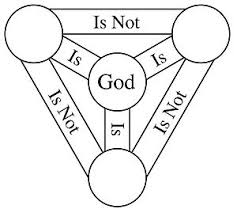
Be that as it may, it's interesting to contemplate not only its nature but its origins. The Trinity after all is not mentioned in the Bible as such. Why, then, is it part of Christian doctrine? It's not a concept which springs to mind and on its face seems contrary to the belief in One God.
But while "the Trinity" isn't found in the Bible, other words are and their presence proved troublesome. The "Holy Ghost/Spirit" appears, and of course Jesus is referred to as the Son of God, and Jesus himself is inclined now and then to speak of his Father. Jesus, the Father and the Holy Ghost/Spirit when they're mentioned are distinguished, one from the other. Then, in Genesis, God has a tendency to refer to himself as "we" or "us."
What, then, were the early Christian leaders to do? They could ignore these confusing references, or accept that Jesus, the Father and the Holy Ghost/Spirit were separate entities or come up with an explanation for the references which was, somehow, consistent with monotheism. Some early heretics, like Arian, chose the second option, and maintained that Jesus was not of the same substance as the Father. Although some of the early Christian emperors were Arian, his followers and others who were unorthodox were eventually duly quashed, such explanations of the Scriptural references being deemed inadequate. The Trinity was accepted as One God, but the Son, the Father and the Holy Ghost/Spirit each being Persons in their own right, and as separate Persons distinguished in function and purpose but all being God. Though separate Persons they may be, they're all of the same substance and so, in reality, One.
If you're like me you'll think this is sorry stuff indeed, but Christian philosophers and apologists have been explaining the Trinity for centuries and much thought, time and effort have been expended, all to provide apost hoc rationale for the appearance of certain words in a Holy Book.
Here we have a problem which arises whenever certain texts are considered unquestionable, and I'd venture to say the problem may apply to more than religious texts. But in all cases I suggest that when post hoc explanations are needed or used in order to explain or justify writings of any kind which purport to be more than evocative, the lack of clarity which requires or invites those explanations is a deficiency in the writings and their authors.
[/img]
Be that as it may, it's interesting to contemplate not only its nature but its origins. The Trinity after all is not mentioned in the Bible as such. Why, then, is it part of Christian doctrine? It's not a concept which springs to mind and on its face seems contrary to the belief in One God.
But while "the Trinity" isn't found in the Bible, other words are and their presence proved troublesome. The "Holy Ghost/Spirit" appears, and of course Jesus is referred to as the Son of God, and Jesus himself is inclined now and then to speak of his Father. Jesus, the Father and the Holy Ghost/Spirit when they're mentioned are distinguished, one from the other. Then, in Genesis, God has a tendency to refer to himself as "we" or "us."
What, then, were the early Christian leaders to do? They could ignore these confusing references, or accept that Jesus, the Father and the Holy Ghost/Spirit were separate entities or come up with an explanation for the references which was, somehow, consistent with monotheism. Some early heretics, like Arian, chose the second option, and maintained that Jesus was not of the same substance as the Father. Although some of the early Christian emperors were Arian, his followers and others who were unorthodox were eventually duly quashed, such explanations of the Scriptural references being deemed inadequate. The Trinity was accepted as One God, but the Son, the Father and the Holy Ghost/Spirit each being Persons in their own right, and as separate Persons distinguished in function and purpose but all being God. Though separate Persons they may be, they're all of the same substance and so, in reality, One.
If you're like me you'll think this is sorry stuff indeed, but Christian philosophers and apologists have been explaining the Trinity for centuries and much thought, time and effort have been expended, all to provide apost hoc rationale for the appearance of certain words in a Holy Book.
Here we have a problem which arises whenever certain texts are considered unquestionable, and I'd venture to say the problem may apply to more than religious texts. But in all cases I suggest that when post hoc explanations are needed or used in order to explain or justify writings of any kind which purport to be more than evocative, the lack of clarity which requires or invites those explanations is a deficiency in the writings and their authors.
Comments (74)
Not being of the Christian persuasion, such a conclusion doesn't trouble me, and actually seems obvious, since triune (where 3=1) is illogical and contradictory on its face.
Modern day heretics believe that the trinity are 3 entirely separate personages. The Mormon view: https://www.mormon.org/blog/do-mormons-believe-in-the-trinity
John 1:1 identifies Jesus' place in the trinity. Roman Christians very consciously adapted Christian images to Platonic themes. To say that early Christians should have had fundamentalist issues is anachronistic.
I'm saying it was necessary for the early Church to explain the text, and this is how the orthodox faith did so.
The problem I'm addressing (or trying to address, in any case) arises when the text in question is itself accorded a special significance, by its author or by others who reverence the text or the author of the text. That reverence is such that efforts are made to rationalize, to justify, to explain statements which appear in the text which appear inconsistent, dubious or subject to interpretations those who revere the text find objectionable or which are believed contrary to the intent of the author.
The greater the effort, and the more elaborate the explanation, the more we're justified in questioning it and the status of the importance of the text itself (as opposed to the importance ascribed to it).
It's quite possible that the versions of the Bible I'm familiar with are not good translations of the originals, but I think that the Holy Spirit is referred to as something special and distinct in itself in those versions.
The trinity is Neoplatonic in origin. The scripture I directed you to identifies Jesus as the Logos.
If it trips you out that early Christians didn't rely entirely on the Jewish Bible or Pauline writings to form their understanding, it would probably further blow your mind that the Franciscans relied on the writings of a Brit named Merlin. Yes, that Merlin.
But I think you mistake what was used in justifying the Trinity on a philosophical basis (and the use of the Logos) with what made it necessary or desirable for the Christian God to be a triune God. I doubt the Arian/Athanasian dispute arose because some Christians read Plotinus or that it was resolved at the First Council of Nicaea by consulting the works of Plotinus.
It's official: "They" don't want to be called Mormons anymore. They want to be called "The Church" (Catholics will object), or The Church of Jesus Christ. So, if you see two guys dressed in dark suits and white shirts and ties walking down the street, they aren't Mormons--you insensitive lout. They are "two Church of Jesus Christ of Latter-day Saints". You have to say the whole thing to be polite.
This is only applicable to people who insist on using whatever pronouns the transgendered demand we use. The rest of us can continue to call them whatever we like.
I guess I had Unitarian tendencies from the get go.
There was a Stoic Logos. Stoics also esteemed Plato, so they're part of the same stew.
Quoting Ciceronianus the White
It's Neoplatonic. The Father is the One, the son is the Logos, and the Holy Spirit is the Soul. Where did you think it came from?
Quoting Ciceronianus the White
Christians were taking over Platonism before Plotinus. They continued through his lifetime and continued on afterward. You should read a history of the era. You'd find it fascinating considering your interest in Rome. If you'd like a superficial review of Neoplatonism, I know of some good youtube videos.
Years ago I listened to a priest explain the Trinity to his congregation by comparing it to a ham sandwich.
Scholars disagree. But you think Christians found a basis for a trinity in the Old Testament? If not, what Bible are you talking about?
Personally, I believe in love and justice though I am confident they do not exist. So call me irrational, and snort in derision.
Agree - the trinity is a matter of faith. Faith, other than reasons for its existence are not matters of philosophy. There are no rational arguments for or against faith. The only question should be, is what I believe by faith in conflict with truth or reason.
In this case, the base question is, as it so often is, is belief in God reasonable. If so, and your answer is yes, than by faith there is no reason not to believe in His trinity.
You mistake my claim, which is that the spiritual is unreasonable. In matters of fact, truth and reason are king and queen; in matters of faith, beauty and goodness. What extraordinary folly to be reasoning whether there is one love or three or three in one - there is no love, therefore one must believe in it.
As noted in the OP, God's use of "we" and "us" in Genesis is taken to be an indication that God is more than one Person. (Genesis 1:26-27); likewise in reference to the Tower of Babel, when God says "Let us go down and confuse their language." The reference to "God" and "the Spirit of God" in Genesis 1:2 is claimed to support a "plural" deity, as is the word "Elohim" which some claim is a plural noun. Then it's noted God makes man in what he calls "our" image (make and female he makes them; two different kinds of man). It's claimed that God appeared to Abraham in the form of three men, indicating God is triune (I know the three men are called "angels" in some tellings).
In fact, I can clap with one hand, and make a sound when doing so. Something to do with the length of my fingers, I think. So, I know what the sound of one hand clapping is, and can produce that sound at will, thus confounding Zen Buddhists everywhere.
What is the sound of you clapping me in irons with one hand?
That might be a fair characterization of Geach's motivation for coming up with the thesis of the relativity of identity. But that would be a bad mischaracterization of Wiggins' thesis of the sortal dependency of identity since the purpose of the latter was to disentangle the philosophical insight embodied in Geach's flawed thesis from Geach's own motivation to salvage a particular Christian doctrine.
The sound of one heel clicking is unassailable.
This is a good book about the subject.
There are 3 ways one can believe something to be true and act accordingly
1. Fact - prior to the world of Trump anyway facts just are. 2 + 2 = 4. One can not argue facts. They just are.
2. Reason - based on facts, one can use ones ability to reason propositions one believes to be true. I believe there is no such thing as a unicorn on earth. That is not a fact, but it is reasonable to believe it is true and act accordingly. Reasoned beliefs can not be in opposition to facts
3 faith. - one can by faith alone believe something to be true, and act accordingly. Beliefs based on faith cannot be in opposition to fact, or reason
Facts are the realm of science, reason is the realm of philosophy and faith is the realm of theology. All equally valid and real in their own nature
I say nothing of the validity of the thesis, which I know nothing about. What I find interesting is the belief that it's necessary to find a way to account for the text--in this case, the belief that although the Trinity seems to make no sense, it must make sense, so we must find a way for it to make sense, and the only way to do that is to provide an explanation which is lacking in the text. This tells us something about the text and also those who revere it.
Just a quick point. The divinity of Jesus, and the trinity as a belief of the church was a product of Nicea. This was a Catholic doctrine. In Catholicism there is no difference in authority between scripture and apostolic tradition. The concept of sola scriptua is post reformation
My whole point on apostolic tradition was in ref to this. Your own point below on the quote from John also seems in contradiction to your point above.
"Assimilated" is a ... good word for it.... :wink:
I don't understand what you're saying, in that case. As for the Gospel of John, it like other parts of the Bible contains language which made it necessary to come up with the concept of the Trinity. If Jesus is one with the Father, how can he be the Son? Did the Father die on the cross? If Jesus is the Father, does that mean Jesus existed before he was born?
The concept of the Trinity makes it possible for apologists to say Jesus is the Son of the Father, but he's the Father too in the sense that both are the same God but also different Persons. God didn't die on the cross--God's "mode of existence" or something or other which is the Jesus Person did. So, problem solved!
That was the Athanasian position, which became orthodoxy. The Gospel of John was used to rebut the Arian belief. The Arian belief can find support in the Bible as well, however, as Jesus frequently distinguishes himself from the Father and not mentioned at all in the Old Testament, though efforts were later made to find reference to his coming.
Please prove that human logic would be binding on a God.
HUMAN: A single half insane species only recently living in caves on one little planet in one of billions of galaxies.
GOD: Proposed to be something like the source of everything everywhere.
Unless you can prove that something as small as human logic would be binding upon something as large as a god, then gotchas like "illogical" and "contradictory" are basically meaningless.
The fatal flaw in atheism is not that it rejects theism, but that it rejects it's own most fundamental principles.
Well, no. What's illogical would still be illogical, and what's contradictory would still be contradictory. We've defined what those words mean, you see, and have no "God Logic" to refer to for different definitions. What you're claiming is that God isn't bound by the rules of logic, and can be "contradictory" (e.g., something and something else at the same time, I suppose).
My guess would be this claim wouldn't impress many atheists.
Agreed, but it still hasn't been proven that these human concepts would be binding on a creator of everything everywhere, should such a thing exist.
Quoting Ciceronianus the White
To be more precise I'm claiming that it has not been proven that a God would be bound by the rules of logic. I'm doing the very same thing atheists reasonably do, declining to accept things on faith, asking for proof etc.
Quoting Ciceronianus the White
Agreed. That's because they're often not really that interested in reason, but in ideology, and typically don't understand the difference between the two. That's why I said...
The fatal flaw in atheism is not that it rejects theism, but that it rejects it's own most fundamental principles. Many or most atheists accept as a matter of faith (ie. without proof) that the rules of human reason are automatically binding on everything everywhere. By accepting this as a matter of faith they are heretics to their own chosen methodology.
Surely not.
I think that's an excellent position. It was the position of Immanuel Kant, a devout theist who essentially said that we were incapable of doing any reasoning about God.
It does however mean that any statements of belief in the trinity, or indeed about any aspect of God whatsoever, must be acknowledged by those making them to be pure items of faith, not reasoned as they are so often presented to be.
Further, the statements are meaningless because statements about something are only meaningful if they have consequences, and consequences depend on logic, which we have just agreed may not be applicable.
So I think the welter of theological reasoning about the trinity and other items of dogma should be replaced by the following simple statement, by those that like the trinity idea :
'when I think of God I think of like a sort of three-fold thingy'
Now that's theology I can respect!
How many things do your see? Three? But that means not counting the middle circle; Four? then it's not a trinity. One? Then whence the division?
Nothing sensible can be said about the trinity.
The following one looks perfectly logical to me.
If anybody wants to complain of equivocation we can proceed to examine what emerges in an investigation of such a complaint.
It's not mine. But I will take the credit, if you insist.
Your comment may be tongue in cheek but you remark relies on interpreting "non est" as the negation of numerical identity and "est" as the copula rather than the affirmation of numerical identity.
My response is that it is impossible to interpret the 'est' to mean 'equals', because the equals relation is transitive and the est relation in the diagram is non-transitive. So it must be some other meaning of est. I chose the 'is a member of the class...' interpretation, but any other interpretation, whether in current use or not, would do as well.
Either that or, as I suggested earlier, following Peter Geach, one endorses a relative conception of the relation of numerical identity between substances. I don't endorse that, myself, but I am not committed either to defend the Christian doctrine of the Trinity.
To be a bit more precise, we are clearly capable of reasoning about God, but we have no way of knowing how relevant that process might be to the reality.
Quoting andrewk
Will atheists make the same acknowledgement?
THEISTS: Are holy books the word of God? There is no proof, so such a claim is faith.
ATHEISTS: Is human reason applicable to everything everywhere? There is no proof, so such a claim is faith.
See? Both sides are doing the same thing, accepting the validity of their chosen authority without proof, as a matter of faith.
It's interesting to see that even those that reject faith, sometimes adamantly, are themselves using faith. This suggests that there is a deep human need to know, or at least create the illusion of knowing. It may also suggest that by offering a method of creating that illusion of knowing theists have been addressing and serving the human condition in a fairly realistic manner. The evidence of this is that even in the age of science faith based religion continues to flourish all over the world.
Of course it's also true that religion doesn't work for everybody, and probably never has. And so many people are required to look for other authorities to have faith in, other methods of creating the illusion of knowing.
You don't need to convince me that all humans rely on faith. David Hume demonstrated that conclusively in the eighteenth century. Hume was accused of being an atheist, and many these days suspect he was, but of course he did not say so, as doing so at the time was tantamount to suicide.
In your last sentence you seem to be implying that all atheists believe that human reason is applicable to everything everywhere. Such an application would be wrong. Many atheists reject that idea, starting with Thomas Nagel and Ludwig Wittgenstein.
Ok, cool, so I'll ask again...
Will atheists make the same acknowledgement you are requesting of theists? Which was...
Quoting andrewk
I'm not disagreeing with your request quoted above, I'm just asking if we are going to apply this equally to all parties to the debate, given that it appears to be agreed that all parties are operating from faith.
As example, if an atheist wishes to discuss "any aspect of God whatsoever" such as perhaps a claim that no such God exists, should they acknowledge that their claim is a "pure item of faith", and "not reasoned as they are so often presented to be"?
I have already answered that.
Some atheists do and some atheists don't.
Just like Christians.
My understanding is different. I have held that the person who had the final say in what was kept and what was not was not Constantine, but some other fellow - who wasn't even Christian. Cannot remember his name off the top of my head. Too lazy to look it up.
The diagram can have plenty said about it that is sensible. The center is the existential commonality between three distinct manifestations of that commonality.
Care to answer for yourself?
Quoting andrewk
It does however mean that any statements of DISBELIEF in the trinity, or indeed about any aspect of God whatsoever, must be acknowledged by those making them to be pure items of faith, not reasoned as they are so often presented to be.
But I've never heard that a non-Christian called the shots at Nicaea. Constantine, by the way, wasn't baptized until he was near death, so may not have been a "real" Christian before then.
Working from memory, but believe the major issue with the divinity of Jesus at Nicea was if He was begotten. Therefore had no beginning. Also if memory serves, the vote of the bishops was overwhelmingly in favor of being begotten. The “fight” or conflict between the bishops at Nicea on the divinity of Jesus is more driven by The Divinchi Code” type fiction than by fact
The issue was the "heresy" of Arius, and that was alive and well at the time of the Council and afterwards, in fact. Some of Constantine's successors as emperor were Arians, e.g. Constantius II. At the time of the Council, Arius and those who followed him had been driven out of Alexandria but were still going strong in Palestine and Nicomedia. Certainly the majority of bishops who attended the Council were followers of Athanasius, but it was believed that there was a very serious dispute and discord that Constantine wanted to address.
It was decided at Nicaea that Jesus was begotten but not made. The Arians took the position that Jesus was created by the Father, and so was not of the same substance, but of similar substance. That was not tolerable to the Athanasians, but it could not be denied that Jesus was the Son of God. It was apparently thought and decided that Jesus was not created, but was procreated (begotten), and in such a manner that he was the same substance as the Father. To quote the Catholic version of the Nicene Creed adopted at the Council--"begotten, not made, one in being with the Father."
This is the same logic that allows Hinduism to be a monotheistic religion. They have one God with tons of different personalities that all have different powers, stories, etc.
Most religions are publicized esoteric lore and due to the profound nature of esoteric teachings which are primarily symbolic and conceptual, the average person is almost always at a loss in their attempt to understand the abstract system of associations.
I am responding to this primarily because Jesus is one of my favourite philosophers, and this argument somewhat misrepresents his teachings of a monotheistic God. [I was raised Christian and later abandoned all pretense at religion but I still (go figure!) have a soft spot for Christianity.]
TRINITY = GOD + GOD'S WISDOM + GOD'S SPIRIT. (This I shall endeavour to expound)
The 'Trinity' has its place in the study of religion and spirituality but, as has been observed, many Christians misrepresent it. Christianity is and has always been a monotheistic religion. Those who claim 'three gods in one' are mistaking an analogy for literal fact. But, this isn't new to us (humans)? The teachings of Jesus make claim that, -> that which is begotten of God, who is Divine, is also Divine. Hence, God's Wisdom and God's Spirit are imbued with that aspect of Divinity which God is. Nothing more, nothing less. Nowhere does it say or teach that God's Wisdom and God's Spirit are separate deities. The 'Trinity' is the understanding of God as an Absolute Being of Divine Spirit and Divine Wisdom. [Absolute Being -> representing the whole of reality; Divine Spirit -> Whose nature or essence is beyond and fundamental to that of everything; Divine Wisdom -> in Whom Absolute Unity and Harmony reside.] Period.
The role of God's Wisdom and God's Spirit are represented as distinct and significant aspects in the relationship between God and humans throughout the Biblical teachings. Unfortunately, due to their symbolic anthropomorphism, they have been mistaken, primarily by adherents of the religion, for distinct and individual persons.
As to God's Spirit being a different being, all I can do is ask, "Is there any evidence or precedence (in this case, the Bible) where a person's spirit is shown to be separate from the body?" All expressions of spirit represent it as something which supersedes material existence in character but, is distinctly in close proximity or in direct contact with the body during material existence. The same may be asked of God's Spirit -> Can anyone suppose it to be where God isn't?
As to Jesus (the Christ) relationship with God's Wisdom:
[Matthew 16: 13-20 => When Jesus came into the coasts of Caesarea Philippi, he asked his disciples, saying, Whom do men say that I, the Son of man, am? And they said, Some say that thou art John the Baptist: some, Elias; and others, Jeremias, or one of the prophets. He saith unto them, But whom say ye that I am? And Simon Peter answered and said, Thou art the Christ, the Son of the living God. And Jesus answered and said unto him, Blessed art thou, Simon Bar-jona: for flesh and blood hath not revealed it unto thee, but my Father which is in heaven. And I say also unto thee, That thou art Peter, and upon this rock I will build my church; and the gates of hell shall not prevail against it. And I will give unto thee the keys of the kingdom of heaven: and whatsoever thou shalt bind on earth shall be bound in heaven: and whatsoever thou shalt loose on earth shall be loosed in heaven. Then charged he his disciples that they should tell no man that he was Jesus the Christ.]
-> It should be realised that the word 'Christ' is used as a title which refers to the identity of the Son of God. Also, that Jesus agrees he is The Christ. However, upon investigation, it will also be realised that 'The Christ' refers specifically to the 'Word' of God (Divine Wisdom) which was 'alive' or in living manifestation through Jesus. It is the Christ, God's Wisdom, which was prophesied to make an appearance, not Jesus the man of flesh and bones.
[John 1: 1-2 => In the beginning was the Word, and the Word was with God, and the Word was God. The same was in the beginning with God.]
[John 3: 16 => For God so loved the world, that he gave his only begotten Son, that whosoever believeth in him should not perish, but have everlasting life.]
Only a literal translation of begotten son would bring confusion because Jesus was undoubtedly the biological son of Joseph and Mary (who was brought forth through a human birth and suffered a human death). However, accounting for the symbolic language of the Bible and through the application of reason, it should be clear that by 'only begotten son' is meant 'Divine Wisdom', which, as is portrayed in the Gospels, was embodied by Jesus. That is, in the same way God used the other prophets to bring a message to the people, He used Jesus to be the manifestation or living testimony of Divine-Wisdom in this human world. It is that purpose which sets Jesus apart from the other prophets (nothing to do with him physically).
[John 6:42 => And they said, Is not this Jesus, the son of Joseph, whose father and mother we know? how is it then that he saith, I came down from heaven?]
[John 6: 48-52 => I am that bread of life. Your fathers did eat manna in the wilderness, and are dead. This is the bread which cometh down from heaven, that a man may eat thereof, and not die. I am the living bread which came down from heaven: if any man eat of this bread, he shall live for ever: and the bread that I will give is my flesh, which I will give for the life of the world. The Jews therefore strove among themselves, saying, How can this man give us his flesh to eat?]
[John 6: 60-61 => Many therefore of his disciples, when they had heard this, said, This is an hard saying; who can hear it? When Jesus knew in himself that his disciples murmured at it, he said unto them, Doth this offend you?]
[John 8: 19 => Then said they unto him, Where is thy Father? Jesus answered, Ye neither know me, nor my Father: if ye had known me, ye should have known my Father also.]
[John 8: 57-58 => Then said the Jews unto him, Thou art not yet fifty years old, and hast thou seen Abraham? Jesus said unto them, Verily, verily, I say unto you, Before Abraham was, I am.]
[John 10: 30-38 => I and my Father are one. Then the Jews took up stones again to stone him. Jesus answered them, Many good works have I shewed you from my Father; for which of those works do ye stone me? The Jews answered him, saying, For a good work we stone thee not; but for blasphemy; and because that thou, being a man, makest thyself God. Jesus answered them, Is it not written in your law, I said, Ye are gods? If he called them gods, unto whom the word of God came, and the scripture cannot be broken; Say ye of him, whom the Father hath sanctified, and sent into the world, Thou blasphemest; because I said, I am the Son of God? If I do not the works of my Father, believe me not. But if I do, though ye believe not me, believe the works: that ye may know, and believe, that the Father is in me, and I in him.]
[John 14: 6-11 => Jesus saith unto him, I am the way, the truth, and the life: no man cometh unto the Father, but by me. If ye had known me, ye should have known my Father also: and from henceforth ye know him, and have seen him. Philip saith unto him, Lord, shew us the Father, and it sufficeth us. Jesus saith unto him, Have I been so long time with you, and yet hast thou not known me, Philip? he that hath seen me hath seen the Father; and how sayest thou then, Shew us the Father? Believest thou not that I am in the Father, and the Father in me? the words that I speak unto you I speak not of myself: but the Father that dwelleth in me, he doeth the works. Believe me that I am in the Father, and the Father in me: or else believe me for the very works' sake.]
It should be clear that the same confusion we find in most of today's adherents was present two thousand years ago.
=> This is a reeeaalllly abridged version. To understand properly, try reading the Gospels with the above analogy in mind. Also, I apologize if I seem to have brought a machine gun to an arm wrestling match. It was meant for another thread but it got halted by admin.
What assumptions?
To suppose there was no analogy means to believe everything in the Bible is based on actual physical reality. If so, then I must assume you have had direct experience of everything described in the Bible or enough to trust everything.
To suppose the Bible is a work of fiction or may include tales which are not necessarily actual historical experiences implies the use of analogy.
The argument is not the historical fact of Jesus' life but the logical deduction of the narrative given in the Bible. Whether there is one or a million gods, does not alter the present condition of our shared perception of reality. However, it is unfair to suppose Christianity could be anything but a monotheistic religion when there is no explicit statement to that end, and when the narrative itself unfolds the opposite view (i.e., against polytheism) when analysed comprehensively.
And what I point out, which I think is supported well by the history of the early Church, are the problems arising from the use of certain language in the gospels, and the need which arose to produce an explanation (such as it is) for it consistent with the claim Christianity is monotheistic.
Ok.