Hehehe, yup, science have made metaphysics kinda irrelevant. We can use it for things that's still hard to prove, with proper logical arguments, but I find most metaphysical ideas today to exist among religious, spiritual people who can only form ideas around their beliefs rather than facts or people who think their personal opinions are facts, but I've rarely seen any proper metaphysical philosophy that don't use scientific premisses and facts.
Except, Democritus was on to something, we're still debating some of those things, like the mind/body problem (consciousness in particular). Witty didn't end the speculation. He just added to the speculation that it might largely be the result of a misunderstanding of how language works.
Hehehe, yup, science have made metaphysics kinda irrelevant.
Not really. Science has been able to answer some questions that used to be metaphysical. But there are plenty of questions that we don't know how to investigate empirically. Questions about consciousness, the interpretation of QM, laws of nature, causality, the nature of time, mereology, supervenience, the nature of perception, and various debates over realism vs anti-realism.
Okay, but what makes water be like water and not like glass? Well, turns out ordinary matter has a chemical composition which determines that. And how does chemical composition determine the properties of water? Physics. And what determines physics? And now you're on to cosmology, which is one step removed from asking metaphysical questions.
I think Collingwood makes a pretty good case that the only possible science of metaphysics would consist in a history of absolute presuppositions. Science, whether modern, medieval or ancient always involves indemonstrable metaphysical presuppositions; so Wittgenstein was dead wrong in saying (if he did say) that metaphysics is always merely an abuse of language. Of course this is not to say that there have not been examples of metaphysical thought which do consist in abuse of language.
Wittgenstein was reportedly fond of Bishop Butler's aphorism: "Everything is what it is and not another thing".
Arguably, this isn't so much an anti-metaphysical attitude as it is a repudiation of reductive analysis. Arguably, also, Wittgenstein's own philosophical quietism can be construed as being consistent with the practices of connective analysis, and of descriptive metaphysics, in the sense Peter Strawson used those phrases.
I think Collingwood makes a pretty good case that the only possible science of metaphysics would consist in a history of absolute presuppositions. ...so Wittgenstein was dead wrong in saying (if he did say) that metaphysics is always merely an abuse of language.
What is a "absolute presupposition"?
They appear not at all dissimilar to "hinge propositions".
Reply to Banno As I understand it. according to Collingwood absolute presuppositions are the fundamental principles upon which the fields of human inquiry depend. They are understood to be different than propositions in that it is inappropriate to speak about them in terms of truth and falsity.
As I understand it. according to Collingwood absolute presuppositions are the fundamental principles upon which the fields of human inquiry depend. They are understood to be different than propositions in that it is inappropriate to speak about them in terms of truth and falsity.
My reading of Collingwood is that it's about questioning and absolute presuppositions. When you study a philosopher you come up with questions met with answers which lead to further questions which lead...eventually, to the point where the views of that philosopher offer no answer. Here are the absolute presuppositions which, I agree with Banno, bear a remarkable resemblance to hinge propositions.
As someone on the old forum said to me, one very odd thing about Collingwood is that he held these seriously anti-ontological views (I don't think they are anti-epistemological) but he also went to church every Sunday and engaged in acts of worship.
Yes, I think what you say is kind of true, though not only of philosophy, but of science, economics, anthropology; in short of all domains of inquiry. As absolute presuppositions are also operative in the kinds of everyday commonsense beliefs that we could never foresee being overturned, they may be said to resemble hinge propositions. The difference is that in the domains of inquiry the absolute presuppositions are things we can be said to necessarily suppose, rather than believe, in order to carry out any investigation at all.
So, for example that the cosmos is mind could be the absolute presupposition of an idealist philosopher, which is required for the further elaboration of his idealist philosophy. From within that philosophy the truth of its founding assumption can never be questioned; the question simply cannot arise. Similarly from within the methodological naturalism of the physical sciences the absolute presupposition that the cosmos is material cannot be questioned.
There is also some commonality with Peirce's idea of 'regulative assumptions'. This paper:https://slideheaven.com/regulative-assumptions-hinge-propositions-and-the-peircean-conception-of-truth.html explores the commonality between Peirce's regulative assumptions and Wittgenstein's "hinge propositions". Here is the abstract:
[i]Abstract
This paper defends a key aspect of the Peircean conception of truth—the
idea that truth is in some sense epistemically-constrained. It does so by exploring
parallels between Peirce’s epistemology of inquiry and that of Wittgenstein in On
Certainty. The central argument defends a Peircean claim about truth by appeal to a
view shared by Peirce and Wittgenstein about the structure of reasons. This view
relies on the idea that certain claims have a special epistemic status, or function as
what are popularly called ‘hinge propositions’[/i]
This passage from Cheryl Misak's The American Pragmatists deals with Peirce's notion of 'regulative assumptions':
[i]His answer is that it is a regulative assumption of inquiry that, for any matter into which we are inquiring, we would find an answer to the question that is pressing in on us. Otherwise, it would be pointless to inquire into the issue: “the only assumption upon which [we] can act rationally is the hope of success” (W 2: 272; 1869). Thus the principle of bivalence—for any p, p is either true or false—rather than being a law of logic, is a regulative assumption of inquiry. It is something that we have to assume if we are to inquire into a matter. Peirce is clear and explicit on this point. To say that bivalence is a regulative assumption of inquiry is not a claim about special logical status (that it is a logical truth); nor is it a claim that it is true in some plainer sense; nor is it a claim about the nature of the world (that the world is such that the principle of bivalence holds). The principle of bivalence, he says, is taken by logicians to be a law of logic by a “saltus”—by an unjustified leap (NE 4: xiii). He distinguishes his approach from that of the transcendentalist: when we discuss a vexed question, we hope that there is some ascertainable truth about it, and that the discussion is not to go on forever and to no purpose. A transcendentalist would claim that it is an indispensible “presupposition” that there is an ascertainable true answer to every intelligible question. I used to talk like that, myself; for when I was a babe in philosophy my bottle was filled from the udders of Kant. But by this time I have come to want something more substantial.[/i]*
Misak, Cheryl. The American Pragmatists (The Oxford History of Philosophy) (pp. 50-51). OUP Oxford. Kindle Edition.
As someone on the old forum said to me, one very odd thing about Collingwood is that he held these seriously anti-ontological views (I don't think they are anti-epistemological) but he also went to church every Sunday and engaged in acts of worship.
I don't know much about it, but apparently Collingwood accepted the truth of his own version of the Ontological argument, which might indeed seem odd considering his notion of the historical relativity of absolute presuppositions.
Collingwood seems to have a negative view of epistemology. He thinks that the fields of human inquiry are based on uncertain thoughts.
An "uncertain thought" is a thought about which we are undecided as to whether it is true or not. Absolute presuppositions are understood to be things we necessarily suppose in order to investigate anything at all, and about which it is inappropriate to think in terms of their being propositions which could be demonstrated to be true or false; so...no.
I'm not sure Wittgenstein could be considered to be consistent if he were to say that "hinge propositions" are true, even though they are not justifiable.
In any area of endeavor where thinking is involved, you get to ask if your process - whatever it is - is valid (true, provable, whatever qualifying word you want). Pretty quickly you get to, in some areas, axioms. Within the process or activity, the axioms are - well, we all know what axioms are, yes? Outside the process, a person may question axioms, but while the answers may be interesting, they are not relevant to the process itself - unless they destroy the process.
What do you mean, "we all know what axioms are"? An axiom in mathematics exists by a completely different standard from an axiom in philosophy. And I am sure there are many in between.
It's reasonable to question axioms, because how the results of the questioning break influences, rebounds back to, the endeavor.
In philosophy an axiom is a self-evident truth. It is based in experience, description, and definition. It's really not reasonable to question an axiom unless you have reason to believe that the description or definition is inaccurate. In this case one might question it, because the so-called "truth" is not self-evident to that person who sees a fault in the description or definition.
I know, all sorts of people get immediately exercised at the notion that something can be efficacious independent of its truth, but the idea is that it is an absolute presupposition, and the idea of an absolute presupposition is that you have to start somewhere. This isn't to say that the starting point is weighed and tested and argued on; usually it isn't. Absolute presuppositions evolve. And they change, usually as the result of a significant rupture in understanding and culture, whether large or small.
Why not start with description rather than "absolute presupposition"?
Here's a not very good example of an absolute presupposition. Suppose you need a sterile bandage. You find some at home, and you (relatively) presuppose that they're sterile. But they've been in your cabinet for five years, so it's reasonable to ask if these supposedly sterile bandages are really sterile. You decide you need to be sure, so you go to the pharmacy to buy some new sterile bandages. The presupposition that the pharmacy bandages are sterile is an absolute presupposition in the sense that they're what you're going to use, and the question as to their sterility does not arise (it is absolutely presupposed).
An "uncertain thought" is a thought about which we are undecided as to whether it is true or not. Absolute presuppositions are understood to be things we necessarily suppose in order to investigate anything at all, and about which it is inappropriate to think in terms of their being propositions which could be demonstrated to be true or false; so...no.
If we suppose them, we believe them to be true. I wouldn't suppose something I didn't believe to be true, except for the purpose of a counterfactual. So it's not true to say that we cannot speak of them in terms of truth or falsity, we are supposing them not for the purpose of counterfactual, we are supposing them as truth, therefore we speak of them as true.
Even if we suppose them as counterfactuals, they are uncertain thoughts. So either way, if we suppose them as true when we have no reason to believe them as true, or if we suppose them as counterfactual, they are uncertain thoughts.
No, assuming something for the sake of investigation does not entail that I must believe what I am assuming to be true. Look at the example of bivalent logic in the passage quoted above from Misak's book on the American pragmatists.
No, it's not an uncertain thought under that definition, because its truth or falsity is not in question; we are not undecided about its truth or falsity; it is simply irrelevant.
It is not an uncertain thought in any other sense, either, because it may be as clearly conceived as you like.
No, it's not an uncertain thought under that definition, because its truth or falsity is not in question; we are not undecided about its truth or falsity; it is simply irrelevant.
Yes the truth or falsity clearly is in question, according to that quoted passage. Did you read it? We hope to someday resolve it as to truth or falsity, though it is not resolvable at the time of making the presupposition.. From that quoted passage:
when we discuss a vexed question, we hope that there is some ascertainable truth about it, and that the discussion is not to go on forever and to no purpose.
The fact that we hope it will some day be resolved as true or false indicates that it is something which we are undecided about. It is an uncertain thought.
“the only assumption upon which [we] can act rationally is the hope of success” (W 2: 272; 1869). — Janus
when we discuss a vexed question, we hope that there is some ascertainable truth about it, and that the discussion is not to go on forever and to no purpose. — Janus
The fact that we hope it will some day be resolved as true or false indicates that it is something which we are undecided about. It is an uncertain thought.
You're misunderstanding what is written there. "We hope that there is some ascertainable truth about it" means that we proceed as if there were, otherwise we would not enquire; it does not mean that we are in a state of uncertainty about whether there is "some ascertainable truth". I'ts a subtle, but salient, difference you are missing.
Think of it another way in terms of another example. Science (leaving aside QM) proceeds on the assumption that every event must have a cause. Science is not concerned with proving that every event must have a cause, because that would seem to be impossible, since we cannot possibly examine every event or even show definitively that the events we can examine had causes. Rather, an absolute presupposition of science is that every event has a cause; if we didn't think in terms of causation, science would be impossible.
So we can say that whether or not every event has a cause is undecidable, but that does not mean that we are undecided about the truth or falsity of "every event must have a cause"; in fact we are not undecided about that at all, because we have decided that it is undecidable, and we have decided to adopt it nonetheless, because we have decided that it is indispensable to our inquiries.
Attitudes towards statements of thought are where certainty and uncertainty reside. Attitudes.
Thoughts aren't the sort of thing that can be certain or uncertain. Thoughts do not doubt their own truth. Rather, they presuppose it somewhere along the line. Uncertainty arises from doubt. It is a product thereof. If a thing cannot doubt, it is not the sort of thing that can be uncertain. Thoughts aren't the sort of thing that can doubt.
Language use matters.
The irony... :lol:
I overstated the importance of language...
:joke:
Edited to add the following exception...
To be clear... creatures without statements can be uncertain about the immediate future as well. My cat can be uncertain about the noise it heard, or about the stability of what she's about to step onto. Her thoughts about the noise and the structure aren't uncertain. Rather, she is as a result of having those thoughts.
I'm inclined to disagree with Witt about metaphysical language schemes/constructs. He draws a conclusion that's afflicted in the very same way that "All swans are white" is.
Okay, but what makes water be like water and not like glass? Well, turns out ordinary matter has a chemical composition which determines that. And how does chemical composition determine the properties of water? Physics. And what determines physics? And now you're on to cosmology, which is one step removed from asking metaphysical questions.
Yes, I think what you say is kind of true, though not only of philosophy, but of science, economics, anthropology; in short of all domains of inquiry. As absolute presuppositions are also operative in the kinds of everyday commonsense beliefs that we could never foresee being overturned, they may be said to resemble hinge propositions. The difference is that in the domains of inquiry the absolute presuppositions are things we can be said to necessarily suppose, rather than believe, in order to carry out any investigation at all.
Thanks, the quotes about Peirce are very illuminating. There are many strains of analytic philosophy that go on a lot about 'belief'. I've been reading a bloke called Duncan Pritchard who holds that for Wittgenstein hinges are not 'beliefs' at all, indeed they must stand outside what we think of as 'beliefs' for rational thought to function. Thus hinge presuppositions hold the same place in the intellectual firmament as Collingwood's absolute presuppositions. We recognise that these are contingent - as Tim Wood said above - on time, place, person: Wittgenstein himself, for instance, banged on about no man having visited the moon as a hinge, a basis for rational reflection, when within 20 years it would cease to be so.
Looked at in this way I don't think hinge propositions could be said to be true false or anywhere in between. Instead they're the foundations upon which claims of truth are built. So while it's a skeptical position it also claims to be an answer to a certain kind of skepticism, since it asserts that if we don't start with some presuppositions or other, there is nothing to talk about, indeed, there's probably no talking :)
Instead they're the foundations upon which claims of truth are built.
So P is true iff P AND the absolute presupposition P rests upon?
Simon Blackburn is a guest on the latest Partially Examined Life talking about deflation and truth in different areas. He said empirical claims were easy: you just look and see that the cat is on the mat.
However, the presupposition underlying that truth is probably that there is an external world with a real cat on a real mat that we can perceive by just looking. Certain skeptical scenarios would undermine the presupposition, making the empirical justification false.
And indeed, he does mention attending a magic show where the illusionist performed all sorts of tricks that made it look like impossible things were happening, and as such, you can't always trust your senses.
But then again, Blackburn considers himself a quasi-realist, so maybe he's not terribly concerned about the more radical skeptical scenarios.
You're misunderstanding what is written there. "We hope that there is some ascertainable truth about it" means that we proceed as if there were, otherwise we would not enquire; it does not mean that we are in a state of uncertainty about whether there is "some ascertainable truth". I'ts a subtle, but salient, difference you are missing.
Notice I quoted twice where the word "hope" was used. That we "hope" there is such an ascertainable truth indicates that we are uncertain as to whether there is.
So we can say that whether or not every event has a cause is undecidable, but that does not mean that we are undecided about the truth or falsity of "every event must have a cause
If you claim, "Whether or not every event has a cause is undecidable", then clearly you are undecided as to the truth or falsity of "every event must have a cause". What you are insisting is nothing but nonsense.
If, science proceeds on the assumption that "every event has a cause", and it is an "absolute presupposition", as described, such that it makes no sense to discuss whether this is true or not, then science proceeds as if "every event has a cause" represents an uncertainty.
You might say that we "hope" that "every event has a cause" is true, but since the procedures of science in general are an attempt to prove whether or not it is true, these procedures demonstrate the uncertainty of that thought.
Reply to tim woodReply to creativesoul
If the material may be "misread", there is a problem with it. I happen to believe that tim wood's interpretation is completely wrong, requiring tim wood to make up a completely fictional, and nonsense distinction between "suppose" and "presuppose" to support this misinterpretation. To "presuppose" means to suppose before hand. So at that time, before hand, when the presupposition is created, it is nothing other than a supposition. Later, when it is being used, we call it a presupposition in relation to its use.
An "absolute" is an ideal, like God, and this is where "hope" and uncertainty enters the representation. We "hope" that the "absolute presupposition" is correct, but nevertheless we are uncertain. If we proceed to represent this uncertainty concerning the absolute presupposition as certainty, e.g. "I am certain that God exists", instead of "I hope that God exists", we are mistaken. And this is misleading.
If, science proceeds on the assumption that "every event has a cause", and it is an "absolute presupposition", as described, such that it makes no sense to discuss whether this is true or not, then science proceeds as if "every event has a cause" represents an uncertainty.
Science may have held this absolute presupposition, but modern physics forced scientists to reevaluate it, at least for the very small. Not sure whether that supports what you're saying about presuppositions equating to an uncertainty, but developments have lead people to question their presuppositions.
No, you misunderstand. Saying that "there's a possible world where that's true" is the same as saying "that's possibly true", and saying that "there's a possible world where that's true" implies that you believe that in the actual world it isn't true.
Reply to creativesoul There does seem to be similarity, but I think the difference is that absolute presuppositions are not taken to be self-evidently and timelessly true in the way a priori intuitions are. Instead absolute presuppositions (Collingwood) or regulative assumptions (Peirce) or, assuming that Wittgenstein is on the same track, hinge propositions, are taken to be those things we need to suppose in order to further our investigations, or carry out our everyday activities. So, for example, the idea that chemical elements could be transmuted into other chemical elements was an absolute presupposition, regulative assumption, or, perhaps it might be said, a hinge proposition, for the alchemists.
I still tend to think the difference between Wittgenstein and the other two, might be that the former would want to say, as Reply to Banno suggests, that hinge propositions are true, but not justifiable.
I'm not convinced that it could be consistent with any coherent notion of truth to say that something could be true, yet not justifiable.
Notice I quoted twice where the word "hope" was used. That we "hope" there is such an ascertainable truth indicates that we are uncertain as to whether there is.
No, the point is that, following this line of thought, we assume there is an ascertainable truth; we don't take an attitude of uncertainty, because that would be crippling to our investigations. The other point, contra to what Peirce says (perhaps carelessly) there, is that we don't actually need to assume that there is an ascertainable truth (not, at least in every case) at all, we merely need to assume whatever it is that is indispensable to inquiry and can safely leave aside the question of its truth, or we might go further and think that its truth is not ascertainable even in principle.
So, for example, in the case of assuming that every event has a cause, which underpins scientific hypothesis and investigation, we can fully acknowledge that the truth of this assumption could never be ascertained, and yet proceed on the assumption that every event has a cause merely for the sake of seeing what our investigations then lead us to discover.
Remember that, for Peirce, a truth is that which we would never find reason to doubt, no matter how much we investigated it. This is an "in principle" definition, and in practice we can never, at any time, know whether future investigations will find reason to doubt anything we might currently accept as true. This means that all things accepted as true are provisional, all knowledge is fallible.
Science may have held this absolute presupposition, but modern physics forced scientists to reevaluate it, at least for the very small. Not sure whether that supports what you're saying about presuppositions equating to an uncertainty, but developments have lead people to question their presuppositions.
Yeah, that's relevant. My point was that science really is not based on "absolute presuppositions", it's based on descriptions and definitions, and these provide self-evident truths. However, as time passes and knowledge evolves, the descriptions and definitions change as well, such that what was once a self-evident truth may no longer be a self-evident truth. The fact that what was once a self-evident truth, is no longer a self-evident truth, so that its truth or falsity can no longer be ascertained, doesn't qualify it for the what is called an "absolute presupposition". The absolute presupposition is supposed to be neither true nor false at the time it is supposed, yet the self-evident truth is supposed to be true.
As I understand it. according to Collingwood absolute presuppositions are the fundamental principles upon which the fields of human inquiry depend. They are understood to be different than propositions in that it is inappropriate to speak about them in terms of truth and falsity.
In sum, to date, every thing you have written about absolute presuppositions has been plain wrong.
So it seems quite clear that an "absolute presupposition" is something which was supposed when there was a lack of evidence as to its truth or falsity, and is therefore nothing more than an uncertain thought.
If you'd like to explain to me what an absolute presupposition "really is", in a way which leaves it not reducible to an uncertain thought, then be my guess.
But as I've explained, I think this proposition of Collingwood's is off base, wrong. I think that science is based on descriptions, definitions, and self-evident truths, not absolute presuppositions. If I misunderstand what an "absolute presupposition" is then pleas explain exactly what it is.
No, the point is that we assume there is an ascertainable truth; we don't take an attitude of uncertainty, because that would be crippling to our investigations.
That's ridiculous. If we assume that there is ascertainable truth, yet this truth is not already ascertained, then there is uncertainty by the fact that it has not been ascertained. We investigate to find answers because we are uncertain. So it is absolutely necessary that we proceed with an attitude of uncertainty. If we proceeded with an attitude of certainty this would be a bias which would be utterly crippling to the scientific method which is designed with a procedure of objectivity, to avoid such bias.
So, for example, in the case of assuming that every event has a cause, which enables scientific investigation, we can fully acknowledge that the truth of this assumption could never be ascertained, and yet proceed on the assumption that every event has a cause merely for the sake of seeing what our investigations then lead us to discover.
Either way, if we assume that the truth could never be ascertained, or that the truth is ascertainable, each implies a lack of ascertainment, and that is an attitude of uncertainty. The fact that the truth or falsity of the assumption has not been ascertained indicates that there is uncertainty.
You're conflating two different things here. Of course we must be uncertain about what we will find when we investigate, but we cannot investigate without assuming that nature is invariant, if not deterministically, than at least statistically, and that things have been caused to be the way they are observed to be. We are not uncertain about invariance and causality, even though we know they cannot be proven; they are not what is in question at all in any scientific investigation, instead they are indispensable assumptions.
You seem to want to say they are "uncertain thoughts' just on the basis that they cannot be proven. I don't think that is a helpful way to think about it, but if you insist that that is how you want to think about, I am not going to argue further about that, because I think it is merely a trivial pedantic point which is not at all relevant to the salient point; which is that our scientific inquiries are based on indispensable absolute presuppositions which themselves cannot be demonstrated. If you acknowledge the salient point, or if you do not, yet fail to produce a decent argument why not, then I think we are done here.
However, as time passes and knowledge evolves, the descriptions and definitions change as well, such that what was once a self-evident truth may no longer be a self-evident truth. The fact that what was once a self-evident truth, is no longer a self-evident truth, so that its truth or falsity can no longer be ascertained, doesn't qualify it for the what is called an "absolute presupposition". The absolute presupposition is supposed to be neither true nor false at the time it is supposed, yet the self-evident truth is supposed to be true.
This is contradictory nonsense. If something were once really a "self-evident truth" then it could never fail to be true forever. If it later comes to be false, then it was never a self-evident truth in the first place, but at best a provisional truth, that may have seemed to be self-evident to some minds. And that is really the difference between the kind of thinking which underlies the belief in a priori truths, and the kind of thinking that is involved in the notions of absolute presuppositions and regulative assumptions. The latter are not taken to be true and should not be thought about in terms of truth and falsity; the avoidance of thinking about them in terms of truth and falsity is the way to avoid the absurdity involved in the idea of self-evident truths that could later cease to be self-evident truths.
Of course we must be uncertain about what we will find when we investigate, but we cannot investigate without assuming that nature is invariant, if not deterministically, than at least statistically, and that things have been caused to be the way they are observed to be.
OK, so let's suppose that we assume that nature is invariant, for the purpose of investigation. Either we assume that such is true, In which case it's not an absolute presupposition as described, or we assume that we do not know whether this is true or not, in which case it is an uncertain thought, but also qualifies as an absolute presupposition. What am I missing?
We are not uncertain about invariance and causality, even though we know they cannot be proven; they are not what is in question at all in any scientific investigation, instead they are indispensable assumptions.
If you claim that we are not uncertain about invariance, then why can't we call it truth. If I am certain of something, I believe it to be true, so why not say that? It's nonsense to say that it's acceptable to claim that you are certain that nature is invariant, yet it's unacceptable to claim that it's true that nature is invariant. If I am certain of X, on what basis do you insist that I ought not say it is true that X.
Why not face the reality, that you are not really certain that nature is invariant, and this is why it cannot be proven? If you are not really certain that nature is invariant, and therefore uncertain, this justifies your claim that you ought not speak about the invariance of nature in terms of truth or falsity.
If something were once really a "self-evident truth" then it could never fail to be true forever.
A self-evident truth is dependent on the meaning of the terms, definitions. These things change over time. Therefore what was once a self evident truth is not always a self-evident truth. There is no contradiction, because contradiction requires that the same thing is and is not at the same time. The proposition is a self-evident truth at one time, and not a self-evident truth at another time. Where's the contradiction?
The latter are not taken to be true and should not be thought about in terms of truth and falsity; the avoidance of thinking about them in terms of truth and falsity is the way to avoid the absurdity involved in the idea of self-evident truths that could later cease to be self-evident truths.
The fact that what was once a self-evident truth later ceased to be a self-evident truth is not at all absurd, it's just a reflection of the temporal nature of reality. Things come into being and cease to be, that's what happens in the temporal world. Human knowledge is a part of this temporal reality.
The absurdity is your description of absolute presuppositions, as something you are certain of, but you cannot claim to be true. That this is absurd is self-evident.
If you claim that we are not uncertain about invariance, then why can't we call it truth.
We can't call it truth because certainty or uncertainty about it is irrelevant to the fact that we merely assume it on account of its indispensability to our investigations.
A self-evident truth is dependent on the meaning of the terms, definitions. These things change over time. Therefore what was once a self evident truth is not always a self-evident truth.
This seems to be nothing more than sophistry. If we can still understand the definitions that were being used when what is now false was allegedly 'self-evidently true", then its truth, in the context of those definitions, should still be self-evident to us. Can you offer up an example for analysis?
The fact that what was once a self-evident truth later ceased to be a self-evident truth is not at all absurd, it's just a reflection of the temporal nature of reality.
I'm not the one proposing that there are self-evident truths at all, beyond the analytic, and even those may be questionable. However it does seem evident to me that nothing of a temporally contingent nature could ever be self-evident, but would have to be observed to be so or not.
The absurdity is your description of absolute presuppositions, as something you are certain of, but you cannot claim to be true. That this is absurd is self-evident.
It's tiring to have to repeatedly correct someone who is repeatedly distorting the intended meanings of my words! I haven't said that we are certain of absolute presuppositions at all, or uncertain about them, but that we assume them for the sake of scientific investigation. (I've also failed to follow my own stipulation that I would not argue over this pedantic point any further).
I'll try one last time to help you to understand the point. Returning to the example of causation; it seems to us that the events we observe have causes, but we also know we cannot prove that all (or even any) events actually do have causes; so, why would we need to claim that it is true that all events must have causes, rather than merely assuming that they do in order to enable our investigations? You need to show what practical advantage it would lend to our investigative abilities to claim that it is true that all events must have causes, rather than merely proceeding on the provisional assumption that they do, if you want to convince me that your harping on this point is not merely pedantic carping.
The third alternative that you are missing is that we think it is inappropriate to speak about it being true or not, because it is undecidable.
If the truth or falsity of a matter is undecidable then thoughts about that matter are uncertain thoughts. That's not a third option, it's the second option.
Human beings once described the sun and planets as orbiting the earth. That the sun took 24 hours to orbit the earth was a self-evident truth. It's no longer true.
I haven't said that we are certain of absolute presuppositions at all, or uncertain about them, but that we assume them for the sake of scientific investigation.
You clearly described absolute presuppositions as things which we are uncertain of. Then when I called them "uncertain thoughts", which is how you described them, you objected, as if they were somehow certainties. Now you seem to claim that scientific investigation is based in thoughts which are neither certain nor uncertain.
The issue is that there are two aspects to our approach to scientific investigation, things which we are certain about, and things which we are uncertain about. Proper scientific investigation proceeds by maintaining a clear distinction between these two, to confuse these two is disastrous to science. The conflation of the things which we are certain of, with those that we are uncertain of, and the claim that absolute presuppositions are neither, is a simple violation of the fundamental laws of logic. Any description which violates the fundamental laws of logic is wrong. Therefore this description of the foundations of science, as "absolute presuppositions", is wrong.
I'll try one last time to help you to understand the point. Returning to the example of causation; it seems to us that the events we observe have causes, but we also know we cannot prove that all (or even any) events actually do have causes; so, why would we need to claim that it is true that all events must have causes, rather than merely assuming that they do in order to enable our investigations?
You are just describing the problem of induction. We see through observation that all events have causes, but the proof is in inductive reasoning, and the problem of induction allows you to deny that this proof proves. Therefore any principle known by induction cannot be known with certainty, and cannot be called "a truth". Because of this, you would claim that any premise based in induction is neither true nor false. But this would render all deductive logic which follows from these inductive premises as unsound. Therefore your approach renders everything which follows from scientific investigation as unsound.
You need to show what practical advantage it would lend to our investigative abilities to claim that it is true that all events must have causes, rather than merely proceeding on the provisional assumption that they do, if you want to convince me that your harping on this point is not merely pedantic carping.
The practical advantage is that by distinguishing true from false in inductive reasoning, we have the means whereby we can judge inductive reasoning and the premises upon which scientific knowledge is based, so that not all scientific knowledge is classed together as unsound. We turn to the accuracy of descriptions and definitions to judge the validity, and determine the truthfulness of scientific premises based in induction, instead of just claiming that such principles are neither true nor false because inductive reasoning cannot give us truth.
Coin that, you've just designed the worst possible insult.
Let me be succinct. To describe a proposition, assumption, or presupposition, as neither true nor false is to violate the law of excluded middle. Any description which violates the law of excluded middle is illogical. Therefore the description of "absolute presuppositions", which describes these as neither true nor false is illogical.
Your remarks on the topic in the face of repeated references and descriptions is not reasoned argument, rather it is a form of badger-like viciousness.
If, to point out that one's position is illogical is to be vicious, then you are correct to accuse me of viciousness.
Reply to tim wood
OK, an absolute presupposition is different from a proposition in the sense that the distinction of truth or falsehood does not apply to them. Why would you not accept that what you have described is what I call an "uncertain thought"? Propositions which we are certain of, we describe in terms of truth and falsehood, this is a representation of our certainty. To say that something is true or false indicates one's certainty. If an absolute presupposition falls outside of these descriptive terms, then why is the absolute presupposition not an uncertainty? If we do not say that absolute presuppositions are true or false, this indicates that they are uncertainties.
Make clear that you have researched absolute presuppositions to the point where you can exhibit that understanding and make clear that you understand what they are. Then argue them, up or down, either way. Until you do, what you write is error and misleading: you dis-serve everyone who reads your posts. That is, put up or shut
I've seen enough information about absolute presuppositions to know that the description of them places them into the category of uncertainties. if you truly believe that I am wrong about this, then please, by all means demonstrate that you have a better understanding of "absolute presuppositions" than I, and show how I am wrong. If not, then accept my description and we can proceed to discuss what, if any role, uncertain thoughts play in science and metaphysics. And quit the fuss, you're like a child wrongfully accusing me of bullying.
Similarly, you can if you want "transliterate" absolute presupposition into proposition. Then you can say whatever you want about the proposition.
Clearly I recognize the difference between an absolute presupposition and a proposition. We describe propositions in terms of certainty, truth and falsity. We do not describe absolute presuppositions in these terms, so I conclude we describe them in terms of uncertainty. So I have not been trying to translate one to the other, I've been trying to relate one to the other.
Why not just try to understand them for what they are? If you want to call them "uncertain," I suppose ultimately you can. But since that designation is irrelevant, then why not call them also bing cherries or horse chestnuts?
You have claimed that absolute presuppositions are fundamental to science. Therefore whether they are certain or uncertain is extremely relevant. It's .nonsense to point out the foundational elements of epistemology and then claim that it's irrelevant whether they are certainties or uncertainties.
As fundamental to epistemology, clearly it is relevant whether we are certain about them or not. Furthermore, propositions form the body of epistemology, so we need to find a relationship between propositions and absolute presuppositions if they truly are fundamental to epistemology. Therefore my act of establishing a relationship between propositions and absolute presuppositions, by means of the terms stated above, certainty and uncertainty, is warranted, and relevant.
Why not just try to understand them for what they are?
That's exactly what I am trying to do, understand them for what they are. They are said to be fundamental to science, yet truth and falsehood is irrelevant to them. From the former I conclude that they play a key role in epistemology, and from the latter I conclude that we have no certainty concerning them.
But I wouldn't ask if the explosion had a cause - that I would take for granted; that would be for me an absolute presupposition; that would be my ground, my logical starting point.
I would call this an intuition. That's the word Aristotle, as well as others used to describe this type f knowledge, "intuition". Are you comfortable categorizing an absolute presupposition as an intuition? I would say that "intuition" has a broader meaning such that an absolute presupposition is a type of intuition, where there would be other types of intuitions as well. An absolute presupposition would be a pure intuition, while a relative presupposition would be less pure.
Is it "uncertain" that everything that happens has a cause? You answer. And whatever you answer, it is irrelevant to the fact that for me it is an absolute presupposition of my beliefs about the explosion.
Whether or not the absolute presupposition is uncertain may be irrelevant to you, the one presupposing it, but to the metaphysician who is analyzing it in relation to epistemology, the degree of certainty of the absolute presupposition is extremely relevant.
Here's another thing to consider. To you, being the one presupposing, and acting on this intuition, the presupposition has the effect of having a high degree of certainty. You act on it without doubting it, therefore it appears like you hold this belief with a high degree of certitude. That is your personal attitude, which is a subjective certainty. To the metaphysician, who seeks to observe these intuitive activities, that activity is activity which is unjustifiable and is therefore based in uncertainty. Until the intuitions, absolute presuppositions, can be brought out, stated in the form of propositions, and justified, these intuitions are uncertainties to the metaphysician.
In the same way all endeavor rests on absolute presuppositions. To be sure, ancient ones might sound ridiculous to you and me. But it would be a mistake to dismiss them, because they were the foundation for the machinery that got that work done. And we all everyone at every level have them now. But they're hard to ferret out. Some are obvious (hidden in plain sight, as it were): God, for Christians; Allah, for Muslims; none of the above, for atheists. Unlike most APs, these are often made explicit and questioned. But most APs lurk in the background.
So once the absolute presuppositions are "ferreted out", they may be stated, and are put in the form of propositions. At this time they can be judged for truth or falsity. Prior to this, they are intuitions, tendencies in one's actions, a hunch that worked so you follow it. They really cannot be judged for truth or falsity, nor stated as propositions, because they are not understood, nor are the words available. When the action is repeated time and again, the reasons for the action start to come to light, the words to describe these reasons are produced, and the intuition is ferreted out, stated as a proposition so that it may be judged.
Perhaps you don't think the notion that everything that happens has a cause is a supposition.
The notion that everything which happens has a cause is a very ancient intuition. It has already been ferreted out by Aristotle, and forms the basis of the cosmological argument. In its propositional forms, the most common being the principle of sufficient reason, it is judged by some as true and by others as false. This reflects its uncertainty.
I thought this thread was in general philosophy; how did it get into the lounge - or is that where it always was?
Being in the lounge we're allowed to use bad language, insult each other, maybe even throw things at each other. It's all in good fun until someone gets hurt.
The trouble with a presupposition's not being true is that it could not then be used to make any deductions - if it is not true, nothing true could follow from it.
Why not? Truth and justification are quite distinct, after all; they are independent of each other.
I don't see that; it seems to me that if truth and falsity are properties of propositions. then the truth of a proposition is justified by its accordance with actuality. this is the logic in "Snow is white is true" iff snow is white. Perhaps I am using "justification" in a way somewhat different than you might be accustomed to; for me it is synonymous with 'verification".
So, I think the verification of a statement just is its truth and the falsification of a statement is its falsity; truth and falsity are not some substantive metaphysical essence that stands beyond the processes of verification and falsification.Truth is simply the property, accordance with actuality, we mean to ascribe to statements that we believe do accord with actuality.
The same logic is inherent in Aristotle's "To say that that which is, is not, and that which is not, is, is a falsehood; therefore, to say that which is, is, and that which is not, is not, is true".
This does not mean that we can perceive some purported accordance-as-metaphysical-essence or relation; it just expresses the straightforward logic of our thinking about truth and actuality. Obviously, we don't perceive the exhaustive or absolute nature of actuality, but the point is that what we think is the truth is that which we have no reason to doubt after exhausting our possibility of investigation. It seems reasonable to say that there are actualities which are beyond our grasp, but not that are truths beyond our grasp, since truths only seem to exist in relation to minds, whereas actualities could conceivably exist independent of minds. It seems pointless to try to dig any deeper than that.
The trouble with a presupposition's not being true is that it could not then be used to make any deductions - if it is not true, nothing true could follow from it.
It is not that deductions are made from absolute propositions, but rather abductive and inductive inferences are grounded upon them. So, to return to the absolute presupposition that every event has a cause, the whole of science has been made possible by this "regulative assumption". The truth or falsity of scientific theories cannot be deductively proven; this is uncontroversial in philosophy of science; so deduction is not really the salient issue.
No, that's not the form of my argument at all. There is no third option. My argument is that there are two options, A and B, where B is opposed to A. Thoughts may be described in terms of certainty or uncertainty. Thoughts which are certain, such as those expressed by propositions, are described by the terms of certainty, which are "true" and "false". Absolute presuppositions are not described in terms of certainty, therefore they are uncertain thoughts.
If all you are doing is using "uncertain" as a synonym for "undecidable" then I would agree with you. But if you want to say that absolute presuppositions are uncertain in the sense that they might turn out to be true or false, then I would disagree, because 'undecidable' means that they cannot, even in principle turn out to be true or false. We are certain of their undecidablility, because they are things which cannot be either empirically or logically confirmed.
But if you want to say that absolute presuppositions are uncertain in the sense that they might turn out to be true or false, then I would disagree, because 'undecidable' means that they cannot, even in principle turn out to be true or false
We need to ask then, in what sense are they "undecidable". If it's as per the quote you gave me from Peirce, "we hope that there is some ascertainable truth", then the belief that "they cannot, even in principle turn out to be true or false", would constitute contradictory beliefs. In the one case we would recognize that they could never turn out to be true or false, and in the other case we would hold out hope that there was ascertainable truth. These two are inconsistent, incompatible.
We are certain of their undecidablility, because they are things which cannot be either empirically or logically confirmed.
I really don't think that this is the case with absolute presuppositions. I think the hope is there, that they will be decisively proven at some future time. That's my opinion. However, having the nature of uncertainty, one person's attitude toward an absolute presupposition might be different from another's. So some people who hold a particular absolute presupposition, might have hope that it could be decided in the future, while others might believe it is impossible for it to be decided ever. That's the nature of subjectivity.
This is why it is important to determine the precise characteristics of what it means to be an absolute presupposition. We need to find the precise thing which is referred to and analyze it. Only then can we make an informed judgement as to whether or not there is hope of ever proving one true or false. I believe that we ought not do as tim woods does, and continually make blind assertions concerning the nature of absolute presuppositions, denying the descriptions provided by others, we need to really look at what they are and agree on descriptive terms.
As I explained already, if the idea that all things have a cause, is an absolute presupposition, the nature of this particular presupposition has already been explained by Aristotle in his Physics. And it now exists in a propositional form, as the principle of sufficient reason. Therefore it would be incorrect to say that an absolute presupposition could never be rendered in a propositional form. Perhaps it loses it's status as an absolute presupposition if rendered in propositional form, but that would be a different matter.
We could look at some other absolute presuppositions as examples. There must be some such presuppositions in relation to space and time, what Kant calls pure intuitions.
If it's as per the quote you gave me from Peirce, "we hope that there is some ascertainable truth", then the belief that "they cannot, even in principle turn out to be true or false", would constitute contradictory beliefs.
I think Peirce, as a good scientist, allows for the possibility, and even hope, that what is understood to be possible in principle in the future may not be the same as it is understood now. So I see no contradiction there.
I really don't think that this is the case with absolute presuppositions. I think the hope is there, that they will be decisively proven at some future time. That's my opinion. However, having the nature of uncertainty, one person's attitude toward an absolute presupposition might be different from another's. So some people who hold a particular absolute presupposition, might have hope that it could be decided in the future, while others might believe it is impossible for it to be decided ever.
Well, what you point to there is a difference of dispositions in relation to beliefs, and yes, of course, there will be such differences between individuals, and this might be a difference between Peirce and Collingwood. As it stands now, though, we can only see two ways in which propositions can be confirmed, the one certain and the other forever uncertain, in the final analysis. So deductively logical confirmation is certain, because it is dealing with tautologies, with the fact that true premises must, deductively speaking, yield true conclusions. Inductively logical confirmation is uncertain, or only relatively certain, insofar as it is a matter of empirical observation and is always contingent upon empirically observable events and matters of fact.
So, the idea that every event has a cause is neither logically nor empirically confirmable, and hence is undecidable in principle. However, we are committed to the idea, because it is indispensable to, because absolutely presupposed by, all our investigations of anything. Although we might say that it seems logically impossible to us that something could come from nothing, or come about without cause, nonetheless that may just reflect the way we are constitutionally determined to interpret events; so that without the assumption of causation there could be no interpretation of the general nature of events possible for us.
So, we can say that the idea is epistemologically necessary, but not that it is ontologically necessary, unless we wish to conflate knowing with being. And indeed, QM gives us some reason to think that causation has no absolute provenance. Whatever way you look at it; from the current situation of human knowledge, the question would seem to be undecidable, so we can be certain of its undecidablitiy now, and more certain of its future decidability (since there is not even a hint of a foreseeable means to decide it) than that the question will be answerable in the future. The other point is that an answer to the negative would seem to be fatal for all future inquiry.
I'm a big fan of Collingwood, and I've enjoyed reading your erudite exposition of his concepts, even in such a challenging environment as 'the lounge' (which I hardly ever venture into for this reason), but I'm not sure where you're going with this last post, particularly "... If you identify an ancient absolute presupposition for the purpose of mocking it and laughing at it and the people who held it, you can do so if that's what you think is valuable. But are you prepared to mock and laugh at modern natural science? Or everyone, for that matter. ". Surely one of the things it is reasonable to take away from Collingwood is that some presumptions which seem to be absolute presuppositions turn out, on analysis, to be either relative presuppositions, or not to be presuppositions at all, but propositions. That is, surely the point of analysing them?
It is in this sense that one can mock (or critique, depending on one's disposition) those presumptions which appear to be ancient absolute presuppositions, by revealing them to be, in fact, relative presuppositions, or indeed propositions posited as an answer to a specific question (and if shown to be a ridiculous answer, then one deserving of all the mockery it gets).
You seem to be implying (and I'm open to the possibility I've simply misinterpreted you) that if a presumption appears prima facae to be an absolute presupposition (such as that of your virgin-sacrificing volcano worshippers), then it must be fairly treated as such without question, and I'm fairly certain that is not what Collingwood is saying.
Furthermore, I realise you must be tired of the harassment you've had for trying to explain these ideas, but I think you have gone too far in dismissing possible criticisms of Collingwood's terms, even within his own framework. A philosopher will rarely define a term as being simply 'all that with property x'. It is more usually (and certainly so in Collingwood's case) that terms are defined as 'all that with properties x, y and z'. It therefore leaves open the possibility that one does not need to take his definition of terms as fact prior to critique. If one could, for example, demonstrate that there are no x's that are also y's then his definition is incoherent. I'm not saying that Collingwood's is, but that your refusal to acknowledge that the definitions themselves can be analysed for their rigour goes too far.
I hope you don't take these as excessively negative. It's just that defending the concept of absolute presuppositions is something I think is quite important and I wanted to plug any gaps I thought might be there.
I think Peirce, as a good scientist, allows for the possibility, and even hope, that what is understood to be possible in principle in the future may not be the same as it is understood now. So I see no contradiction there.
What do you mean no contradiction? You said "they cannot, even in principle turn out to be true or false". Clearly that contradicts "we hope that there is some ascertainable truth", "possible in principle in the future". One expresses hope, the other no hope.
As it stands now, though, we can only see two ways in which propositions can be confirmed, the one certain and the other forever uncertain, in the final analysis.
Propositions are confirmed as either true or false. They cannot be confirmed as "forever uncertain". That's nonsense which you are making up.
So deductively logical confirmation is certain, because it is dealing with tautologies, with the fact that true premises must, deductively speaking, yield true conclusions. Inductively logical confirmation is uncertain, or only relatively certain, insofar as it is a matter of empirical observation and is always contingent upon empirically observable events and matters of fact.
Deductive logic alone cannot produce certainty because it cannot confirm the truth or falsity of its premises, and it requires premises. Truth or falsity of the premise is most often confirmed with inductive reasoning. If you deny that inductive reasoning can produce certainty, you deny the possibility of certainty altogether. That is what you have done here, denied the possibility of certainty.
So, the idea that every event has a cause is neither logically nor empirically confirmable, and hence is undecidable in principle.
You've just denied the possibility that we could be certain about anything. Everything, even the idea that every event has a cause, is undecidable in principle, when your principles are such as you have described, because you deny the possibility of certainty.
So, we can say that the idea is epistemologically necessary...
You haven't shown that it is epistemologically necessary though. You have just asserted that it is indispensable to all our investigations. That particular "absolute presupposition", if it is true that such are required for investigation, is responsible for some particular investigations, but from another "absolute presupposition", other investigations follow. So that particular "absolute presupposition" is not necessary.
There is no contradiction involved in saying that what seems impossible in principle now may not seem so in the future; in other words there may appear a foreseeable way to answer questions about which there is presently no foreseeable way to answer them.
Propositions are confirmed as either true or false. They cannot be confirmed as "forever uncertain". That's nonsense which you are making up.
Again you're distorting what I've said. I am saying that, according to contemporary philosophy of science it is not controversial that scientific knowledge is fallible; it is not certain.
Deductive logic alone cannot produce certainty because it cannot confirm the truth or falsity of its premises, and it requires premises.
Yes, you're agreeing with me. The deductive certainty as I already explained is that the conclusion must follow from the premises if the argument is valid. Whether or not the premises are true is the uncertain, empirical part.
Yes, I do, because that is the way it is with our knowledge. The only deductive certainty is validity and tautology, neither of which count as substantive truth. The only certainty with regard to substantive truth is empirical "certainty", which is fallible. The closest we can get to certainty is where we have no reason to doubt.
That particular "absolute presupposition", if it is true that such are required for investigation, is responsible for some particular investigations, but from another "absolute presupposition", other investigations follow. So that particular "absolute presupposition" is not necessary.
If by "that particular absolute presupposition" you mean the idea that every event is caused, made possible by certain other conditions, then what kind of investigations are you alluding to that could dispense with that idea? Please provide an example.
Reply to tim wood
Why do you say that an absolute presupposition "never answers a question" then give examples, each of which is an answer to a question. You make such a fuss about how little I know about absolute presuppositions, and how I misunderstand the whole concept, yet you give examples which clearly contradict the description you give. I really think that you know less about this then I do, and I quite obviously know very little. But I think that it's worse when you know little, to think that you know a lot.
The alchemist, trying to turn tin into gold, or whatever, makes any number of relative presuppositions. But what does he absolutely presuppose? That there exists a method, which he intends to find, of accomplishing his goal of turning tin into gold.
This cannot be an absolute presupposition because it answers the question of is there a method to turn tine to gold, with Yes, there is such a method.
The witch doctor sacrifices virgins to the volcano god because he absolutely supposes that his efforts will mean fewer volcanic eruptions.
Once again, an answer to a question. Why do you think that these examples are of absolute presuppositions rather than relative presuppositions? They all appear as relative presuppositions to me.
The significance of the relative presupposition, then, has nothing to do with its being true (the car is in the lot where I think it is) or false (the car is not in fact there); rather it has to do with its efficacy in facilitating my thinking.
It's very clearly not true that the significance of the relative presupposition has nothing to do with its truth or falsity. It may be true that it facilitates thinking, but the truth or falsity of the presupposition leads one toward either appropriate, or mistaken thinking respectively. Thinking itself is insignificant, it may be completely random, but whether the thinking is correct thinking, or incorrect thinking is what is significant, and this is determined by the truth or falsity of the relative presupposition.
Are you ever going to get to the question of the nature of the absolute presupposition? That's what you're talking about isn't it?
Any natural scientist absolutely presupposes one god - monotheism. That is, the world is absolutely presupposed to operate under one set of rules and not many sets of irreconcilable rules, and that the one set is valid both here and there. (And because the presupposed god is perfect, the nature of his creation is absolutely presupposed to be comprehensible within the bounds of scientific thinking). That is, "[N]atural scientists standing in the Greek tradition absolutely presuppose in all their inquiries
1. That there is a world of nature....
2. That this world of nature is a world of events....
3. That throughout this world there is one set of laws according to which all movements or events, in spite of all differences, agree in happening; and that consequently there is one science of this world.
4....." (222-223).
All these are answers to questions, and absolute presuppositions are never answers to questions. Furthermore, the truth or falsity of these presuppositions would guide the scientist either correctly or incorrectly. So let's get beyond these relative presuppositions, and find the true nature of an absolute presupposition, one whose truth or falsity is irrelevant to the thinking of the person presupposing.
Didn't Socrates or Plato say that philosophy is derived from wonder? Would you agree that "wonder' is completely general, and never the answer to any specific question, but related to many questions? And would you also agree that wonder presupposes no specific truths or falsities? The point I think you are missing is that the absolute presupposition cannot presuppose any truth or falsity, or else it is not absolute, as described. Truth or falsity must be irrelevant. The truth or falsity of the presupposition cannot lead the person's thinking correctly or incorrectly, so the thinking must be free from any presupposition of truth or falsity. The thinking may go any which way, because there is no presupposed truth or falsity.
So you cannot give examples of "absolute presuppositions" as this or that person believes that such and such is true, because this makes truth or falsity relevant in directing the thinking correctly or incorrectly. You need examples where nothing is presupposed as true or false, where there is a complete lack of bias or prejudice, and this is why "wonder" is a better example. The problem though, is that as we approach the true "absolute presupposition", it ought to become increasingly clear to you, that this requires that nothing is presupposed. The real "absolute presupposition" is the presupposition of nothing. Any inquiry, to be objective, true, unbiased, and honest, must approach the matter without presupposition. The "absolute presupposition" is the complete lack of presupposition.
Surely one of the things it is reasonable to take away from Collingwood is that some presumptions which seem to be absolute presuppositions turn out, on analysis, to be either relative presuppositions, or not to be presuppositions at all, but propositions. That is, surely the point of analysing them?
Yes, this is where I'm trying to get. How are we going to distinguish an absolute presupposition from a relative presupposition? According to tim woods' description, there is a substantial difference between these two, so there must be some defining principles which we could identify within presuppositions to distinguish them, if the various presuppositions are described properly.
There is no contradiction involved in saying that what seems impossible in principle now my not seem so in the future; in other words there may appear a foreseeable way to answer questions about which there is presently no foreseeable way to answer.
I know, but you said "they cannot, even in principle turn out to be true or false", to me that implies in the future. So if you remove that implication, then there is no contradiction. However, then the absolute presupposition may take the form of a proposition which may or may not be proven to be true or false, in the future. And that's what we're trying to avoid.
However, then the absolute presupposition may take the form of a proposition which may or may not be proven to be true or false, in the future. And that's what we're trying to avoid.
Yes, but as has been pointed out absolute presuppositions are historical. Something can be an absolute presupposition for us at our present stage of knowledge, and not be such for future inquirers. I have already given the example of the alchemists' absolute presupposition that elemental metals can be transmuted into other elemental metals. That is no longer a presupposition for science; but this fact does not prove that metals cannot be transmuted.
On reflection, it seems that example is perhaps not so great, though, maybe it does not even qualify as an absolute presupposition, but rather as an hypothesis, because although it can never be proven that metals cannot be transmuted into other metals, it would be demonstrated that they could be, if a method were found and it were done reliably and repeatably. Of course all hypotheses necessarily involve absolute presuppositions; so the hypothesis that metals can be reliably transmuted were the method found, would involve the assumption that there is some lawful process via which transmutation could occur. And this, similarly to the case with the assumption of the universality of causation, could not, I believe, at least as far as we can currently foresee, ever be definitively shown to be true.
So, I think the idea that all events are caused, and related principles, are far more certain candidates for being considered to be absolute presuppositions or regulative assumptions. And returning to that example, you have not provided any instances of investigations (hypotheses) which do not presuppose such principles.
On a theological note, the related ideas of God, an infinite being, infinite intelligence, universal designer or first cause,are certainly absolute presuppositions. There is no foreseeable way to prove the existence or non-existence, of God, an infinite being and so on. Apart from arguments for such a being, or beings, which appeal to inferences to the best explanation, and are not very convincing to the modern scientifically informed mind, the best we can do is to argue that the assumption that God exists is valuable or useful for some practical purposes.
Another absolute presupposition is that humans can acquire certain knowledge of a 'higher" kind. As I have argued extensively with @Wayfarer, it seems certain that this could never be definitively shown to be so. An individual may be convinced that they have attained higher certain knowledge by the nature of their own experience (which is the only way one ever could be "legitimately" convinced of such a thing) and yet this could never be a good reason for anyone else to believe it, and it is always possible that the individual convinced by their own experience is deluded.
However, then the absolute presupposition may take the form of a proposition which may or may not be proven to be true or false, in the future. And that's what we're trying to avoid.
No, that's not what I (at least) am trying to avoid at all. And I don't think Collingwood would argue that we could establish what must be absolute presuppositions for all time, but merely what are or have been the absolute presuppositions in various contexts at various historical moments. We can establish what are absolute presuppositions for us, what cannot presently "take the form of a proposition", as I have already argued.
The metaphysical analysis that's supposed to identify APs is according to the author an historical science. I understand that to mean that he, the historical scientist, aka metaphysical analyst or just analyst, after suitable research, publishes a statement to the effect that this bunch of folks held such-an-such as an AP during that period of history. As such, it is a fact supported by research - or overturned by subsequent research as you suggest is possible. If true and accurate, then that bunch of folks actually did hold such an AP and presuppose it in their endeavors.
Likely most APs, once identified, and especially if ancient, likely don't cut it in modern science, or politics, or religion, or whatever. But this doesn't touch them as APs. Rather it evaluates them as current propositions.
Absolutely, I hadn't intended to give the impression that this would necessarily be a metaphysical analysis. In fact, I'm fairly convinced it would not be. Maybe a psychological at the most analytical end, but, as you say, mostly simply historical, or anthropological. My concern really is that whilst I agree entirely with Collingwood's concept and his method, I find myself disagreeing with many of the classifications I've read used as examples of APs from a psychological point of view. By this I mean that when someone says that such-and-such a society simply held belief X as an absolute presupposition, I don't doubt the existence of such a concept, nor the fact that, once found it is simply an historical fact and should be treated as such, but I do find myself often asking - did they though? Or were they really trying to answer a question? It may be my rather broad streak of cynicism, but I just get the gut feeling (not entirely unsupported by social psychology) that a lot of the practices and beliefs held by prior cultures which to us seem strange were quite consciously invented to create and maintain power structures, and belief in them merely professed out of fear of ostracisation rather than genuinely held.
So I take a more social psychology approach to the analysis of APs which finds far fewer of them in the sense they were (I think) intended. I find that in many cases people merely act as if they held an AP but in fact quite often question it internally, or ask the question to which it is an answer (and so render it no longer an AP), it's just that externally doing so is something of a taboo for their social group so you don't often see the behaviour which the historical analyst would otherwise use to discard it as an AP.
The push to regard APs as ordinary propositions is strong and naturally so. One form of innoculation against the pressure is to remember that the AP is always (formally) a statement about what some person or group of people in fact did.
So basically, this is the point I'm tempted to want to modify, by introducing some small element of psychology. I think the value of APs is in understanding human behaviour, but in order to do that, it does have to allow at least small element of psychological analysis of all behaviour, both private and social. Take revolution as an example, in any revolution where an AP is overturned (for example the AP that 'the king has been appointed by God to rule the country'), there must have been a period prior to the revolution where the society was still acting as if it held that particular AP but in private it was no longer an AP, it was a proposition made by one class which was being rejected by another. The rejecting class, at least, held it to be a proposition, but at some point in the revolutionary process, they must have done so without any external sign that this was the case. This doesn't just count for political revolutions, but all revolutions and paradigm shifts.
So the key question that needs to be answered for an investigation of APs is - how long does this period last? Do people act as if beliefs were APs, when in fact they're treating them as propositions, for only a short period before the revolution, or does it go on for years, decades even?
I think this has important implications in modern society for things like religion, but also, at the other end of the scale, things like advanced science where the question would be - do people actually understand the position well enough to hold it as an AP or are they actually holding some other AP but acting as if they hold the AP in question because they've been told by those more intelligent than they are to act that way? For example, can you hold an AP that space and time are all one unified dimension if you don't actually understand what that means?
Of course, one can over-think this and risk losing some of the wonderful simplicity that Collingwood introduced, and I hope I'm not guilty of that, or perhaps only a little.
Surely one of the things it is reasonable to take away from Collingwood is that some presumptions which seem to be absolute presuppositions turn out, on analysis, to be either relative presuppositions, or not to be presuppositions at all, but propositions. That is, surely the point of analysing them? — Pseudonym
Yes, this is where I'm trying to get. How are we going to distinguish an absolute presupposition from a relative presupposition? According to tim woods' description, there is a substantial difference between these two, so there must be some defining principles which we could identify within presuppositions to distinguish them, if the various presuppositions are described properly.
Yes, according to Collingwood, the principles are relatively simple. They are the same as those of any assessment of behaviour in an historical enquiry - the answer to the question "why did they do/think that?". As soon as that question no longer seems to have an answer you have an absolute presupposition. I think the mistake you're making is in not treating the classification as a theory. Like any other theory, it's a best guess until something better comes along or some evidence disproves it. Collingwood's conclusion (at least in my interpretation) is not to treat the classification of a belief as an AP as if it were a final indisputable fact, it's to treat is sufficiently like a fact that one does not get hung up on keep asking the question "why?" when it's just not yielding an answer.
In my interpretation, one asks of a belief "why would they believe that?". Sometimes one will find a set of empirical evidence and a rational argument but these will always be accompanied by another belief (the belief that this evidence coupled with this argument leads to this conclusion). So we ask the same question of that belief. At some point in time we do not find empirical evidence and rational argument forming part of the justification. At that point we propose the theory that this is an absolute proposition, and move on with investigating other things until such time as new evidence arises, or a better theory comes along. It's pragmatism as much as metaphysics really.
Yes, but as has been pointed out absolute presuppositions are historical. Something can be an absolute presupposition for us at our present stage of knowledge, and not be such for future inquirers.
If it's absolute, it cannot be relative to temporal existence in this way. Being relative to temporal existence is what makes it about something particular and therefore relative, like your example.
Of course all hypotheses necessarily involve absolute presuppositions;
Unless you can show the logic behind this conclusion there is no sense to the assertion. As far as I can see, hypotheses involve relative presuppositions, but I don't see how an absolute presupposition is even possible.
So, I think the idea that all events are caused, and related principles, are far more certain candidates for being considered to be absolute presuppositions or regulative assumptions
Even this is quite clearly a relative presupposition. It is a proposition which relates to physical existence in general.
No, that's not what I (at least) am trying to avoid at all. And I don't think Collingwood would argue that we could establish what must be absolute presuppositions for all time, but merely what are or have been the absolute presuppositions in various contexts at various historical moments. We can establish what are absolute presuppositions for us, what cannot presently "take the form of a proposition", as I have already argued.
This is clear evidence of the failure of Collingwood's theory. If the presuppositions change at various moments in history, then they are relative and not absolute. They are relative to the concerns of the people at that time. It is contradictory to say that the absolute presuppositions are different at different times, for different peoples, because this describes them as relative.
I think the mistake you're making is in not treating the classification as a theory. Like any other theory, it's a best guess until something better comes along or some evidence disproves it.
This is not quite correct. Many insist that the skeptic cannot criticize a theory without offering a better one. But that's not true because we will not seek a better one until the problems of the existing one are exposed. So exposing the problems is first, and does not require offering a better theory. Further, it does not really require "evidence" to prove that a theory is faulty. If a theory can be proven to be illogical, by way of contradiction or that it breaks some fundamental laws of logic, this suffices to demonstrate its faults, though one might call this evidence it is not physical evidence.
In my interpretation, one asks of a belief "why would they believe that?". Sometimes one will find a set of empirical evidence and a rational argument but these will always be accompanied by another belief (the belief that this evidence coupled with this argument leads to this conclusion). So we ask the same question of that belief. At some point in time we do not find empirical evidence and rational argument forming part of the justification. At that point we propose the theory that this is an absolute proposition, and move on with investigating other things until such time as new evidence arises, or a better theory comes along. It's pragmatism as much as metaphysics really.
This is just an assumption. To break the infinite regress of justification you say there must be an absolute presupposition. But perhaps you are going in the wrong direction. You are looking backward in time, asking which belief is prior to this belief, in order to justify it. But if you consider the nature of intentionality, you'll see that beliefs are justified by what is wanted, or desired, "the end", and this relates to what will come to be in the future, not what has been believed in the past. The infinite regress is ended by "the end", not by the beginning. So to justify "why would they believe that?" you must look at what they wanted, and there is no empirical evidence at that time, for what they wanted, because it comes into existence at a later time. Empirical evidence at one time always points to what was wanted at an earlier time.
You're responding to the wrong sense of 'absolute'. All it means is that the absolute presupposition in a context is the one that underpins all the others and is not itself underpinned by another.
You're responding to the wrong sense of 'absolute'. All it means is that the absolute presupposition in a context is the one that underpins all the others and is not itself underpinned by another.
I think we're talking about "absolute" as opposed to relative. That is to say "absolute", as distinguishable from "relative". This would mean "absolute" in the sense of that which can exist without being related to anything else..
If you think you can show how one "absolute presupposition" could underpin every single presupposition that someone has, then be my guest. This would disallow the possibility of conflicting or contradicting presuppositions, which many people appear to have.
Until then we should consider "absolute" in the sense that Collingwood uses it, as distinguishable from relative. This would mean that the absolute presupposition is not underpinned by another presupposition, because this would make it "true" in relation to that other presupposition, and the absolute presupposition must be free from that relation. But the absolute presupposition doesn't necessarily underpin all others, that one may have, and this is why multiple absolute presuppositions are possible.
The reason why I said that there could only be one absolute presupposition, so that all absolute presuppositions would be one and the same presupposition, is that there could only be one end to that seemingly infinite regress of presuppositions, and that would be the complete lack of presupposition. So an absolute presupposition could be nothing other than a presupposition of nothing. Nothing presupposed. This could be the only "first" presupposition, the one which supports others, but is not itself supported, the presupposition of nothing. If it presupposed something, this would be a prior presupposition which supports it.
Until then we should consider "absolute" in the sense that Collingwood uses it, as distinguishable from relative.
It is obvious that in all senses 'absolute' is "distinguishable from relative", so you're not really saying anything that is not trivial here. Have you actually read Collingwood's Essay on Metaphysics? It doesn't sound like it!
I have already said that absolute presuppositions are not underpinned by any other presuppositions; but the conditional here is "in particular contexts". So, the AP that underpins physics will not be that same one that underpins biology. Also you must realize that there can be different APs for different standpoints in each field. So, there is no "infinite regress" and APs are not necessarily all reducible to one master AP; it would depend on your worldview. That said, as I have already alluded, the idea that all events are caused in the broadest sense of the notion, might indeed qualify as a master AP. In theology, though, God is the master AP, because He is the Ultimate Cause.
Any contradiction is only on account of your misunderstanding. TBH, I don't think you want to understand it or, it seems, anything else that doesn't tally with your pedantic sophistry.
I was always under the impression that Collingwood rejected the whole idea of revolutions. In The New Leviathan doesn't he say something like the term revolution being just an admission of the historian's lack of understanding about the continuity of the historical process? Its a long time since I read anything about him so I may be wrong, but this line of argument has always been a point of diversion for me, as I outlined above.
I agree with your analysis that APs are usually so deeply set as to be outside of the matter of day-to-day discourse. That's really the point where I start to doubt the correctness of the classification of many of the examples I've heard of, as many beliefs overturned during revolutions (political or otherwise) become necessarily part of day-to-day discourse. I'm not sure whether to call this the method by which absolute presuppositions are replaced (that which was unspoken becomes a topic of conversation, thereby questioned and thereby no longer an AP), or is it more correct to say that this is just such evidence which the historian could use to show a belief not to be an absolute presupposition afterall, but merely seeming so? Not sure myself, but I'm tempted by the latter as I think it preserve the 'absoluteness' of APs better. To make real use of them in our historical understand of different societies (as well as our contemporary understanding of those with different world-views to us), it's important that they really are absolute and not a kind of 'conspiracy of silence', where everyone knows the belief is on shaky ground because they've questioned it privately (meaning it isn't really an AP) but no-one dare say so because of social taboo, or fear of ostracisation (causing it to appear to be an AP to the casual observer).
As you say it's more about picking apart the way absolute presuppositions work because without this knowledge of mechanism it will be impossible for the historian, or contemporary analyst to know what signs to look for, probably more psychology than philosophy, but I'm interested in the overlap.
TBH, I don't think you want to understand it or, it seems, anything else that doesn't tally with your pedantic sophistry.
I understand it, it's not very complicated at all. I just don't agree with it, and that's why I point out the inherent contradictions. The only true absolute presupposition is to presuppose nothing, because to presuppose is to presuppose something and this makes the presupposition relative. To go beyond relative presuppositions, is to leave the category of presuppositions, and then we're not talking about presuppositions. anymore. So what Collingwood calls an "absolute presupposition" is not a "presupposition" at all, and he's completely off track with that term. He's trying to leap from presuppositions to something which is not a presupposition at all, giving it the misleading name of "absolute presupposition".
Sophistry is only possible when the fundamental laws of logic are not strictly adhered to. So pedantry is not sophistry, it's the way we defeat it.
I don't see that; it seems to me that if truth and falsity are properties of propositions. then the truth of a proposition is justified by its accordance with actuality. this is the logic in "Snow is white is true" iff snow is white. Perhaps I am using "justification" in a way somewhat different than you might be accustomed to; for me it is synonymous with 'verification".
But there is clearly a distinction to be made between a proposition being true, and its being verified as true. There are, after all, unverified true propositions.
And until we agree on this, there is not much else to be said.
But there is clearly a distinction to be made between a proposition being true, and its being verified as true. There are, after all, unverified true propositions.
That depends on how you look at things. Some might say that truth requires judgement, that to be true requires a judgement of truth. Ever heard the saying "beauty is in the eye of the beholder"? We can say the same with "truth", it is a property of the judgement.
The reason why it makes sense to argue this position, against what you say, is that the words or symbols of the proposition must be interpreted for meaning. And, it is the meaning which is judged for truth or falsity. So without the interpretation of what the proposition means, the proposition cannot have any status of being true or false. Let's say "the sky is blue". Without definitions for "sky" and "blue", it makes no sense to talk about this proposition being true or false. A judgement as to the meaning of "the sky is blue" is required in order that the proposition may be either true or false, and there can be no such thing as an "unverified true proposition".
Yes, but a proposition is only true if it would be verified as true after exhaustive inquiry. This rules out the idea of absolute truths that are forever beyond human, or any finite intelligences', verification in principle. The only way such truths could be would be if there were an infinite intelligence to think them. An infinite intelligence would not need to verify them, they would be, and be justified, merely on account of being thought by such a mind.
I'm guessing you don't wish to go there, so you have no coherent and consistent way to justify the idea of truths that could be absolutely independent of verification and justification, as far as I can tell.
No, absolutely not. A proposition consists of two aspects, the words or symbols, and the meaning. The truth or falsity of a proposition is relative to its meaning. The meaning is dependent on interpretation. Therefore the truth or falsity of the proposition is relative to the interpretation of the proposition.
This has nothing to do with "belief", it's just a demonstration that a proposition being true or false is relative to an interpretation of that proposition. One interpretation may render the proposition as true while another may render it as false, so there is a need to validate the "correct interpretation". Therefore, there can be no such thing as an unverified true proposition, because verification of the meaning of the proposition is required in order that it may be true.
You seem to be taking for granted that any given proposition has a "correct interpretation" already inherent within it, so that verification of the meaning is not required. But that is a mistaken assumption.
Propositions can be true and yet not known, not believed and not justified. Get that right, and we can move on.
It's not a question of whether the proposition is presently known, believed or justified. Give me an example of a proposition that could be true and yet incapable in principle of being verified, falsified and/or justified; and then we can move on.
A proposition consists of two aspects, the words or symbols, and the meaning.
The term proposition has a broad use in contemporary analytic philosophy. It is used to refer to some or all of the following: the primary bearers of truth-value, the objects of belief and other "propositional attitudes" (i.e., what is believed, doubted, etc.), the referents of that-clauses, and the meanings of declarative sentences. Propositions are the sharable objects of attitudes and the primary bearers of truth and falsity. This stipulation rules out certain candidates for propositions, including thought- and utterance-tokens which are not sharable, and concrete events or facts, which cannot be false.
Hence, "It is raining" and "Il pleut" are the same proposition and yet the words used are distinct.
Reply to Banno You don't seem to be capable of, or else interested in, engaging with ideas that challenge your own settled views, or of arguing effectively for those views; so I am left wondering what's the point?
I asked you to provide an example of a proposition, or kind of proposition, that would support your assertion that truth is completely independent of validation, verification and justification, and since you failed to do that, then I can only assume that you have no evidence to support your assertions.
Hence, "It is raining" and "Il pleut" are the same proposition and yet the words used are distinct.
This is irrelevant to the fact that the words "it is raining", or "il pleut", if used as a proposition, require an interpretation in order that there can be a truth or falsity to that proposition. There can be no truth without an interpretation because the words have no meaning without an interpretation. And interpretation is a form of verification. Therefore there can be no unverified true propositions.
That doesn't seem right. I can interpret the meaning of the statement "there is intelligent life elsewhere in the universe" without being able to verify (or falsify) it.
I asked you to provide an example of a proposition, or kind of proposition, that would support your assertion that truth is completely independent of validation, verification and justification, and since you failed to do that, then I can only assume that you have no evidence to support your assertions.
There's Fitch's paradox of knowability. If the proposition p is an unknown truth then either the proposition "p is an unknown truth" is an unknowable truth or there are no unknown truths.
But then I think sentences of the kind "p is an unknown truth" are different to sentences of the kind "there is intelligent life elsewhere in the universe", and so even if the former must be unknowable truths it doesn't then follow that the latter can be unknowable truths.
Hence, "It is raining" and "Il pleut" are the same proposition and yet the words used are distinct.
I think @Metaphysician Undercover is saying that propositions don't exist sans interpretation. The ink on the paper exists independently, the rain exists independently, but the proposition expressed by the two sentences "it is raining" and "il pleut" does not exist independently. That they share the same proposition just is that we interpret them the same way.
And if there are no propositions sans interpretation then there are no true propositions sans interpretation.
I can interpret the meaning of the statement "there is intelligent life elsewhere in the universe" without being able to verify (or falsify) it.
Right, you can interpret without verification, but the point is that there is no truth or falsity without verification of the interpretation. Perhaps Banno confused me into saying something not quite what I meant to say.
I think Metaphysician Undercover is saying that propositions don't exist sans interpretation. The ink on the paper exists independently, the rain exists independently, but the proposition expressed by the two sentences "it is raining" and "il pleut" does not exist independently. That they share the same proposition just is that we interpret them the same way.
I think that's a good way of putting it. A "proposition", as Banno defines it, is dependent on an interpretation. The interpretation is inherent within the proposition. This would be the "correct interpretation". And "correct" requires verification. So "proposition" implies "correct interpretation" and "correct interpretation" implies verified.
Without the "correct interpretation", any interpretation would be acceptable and this allows that the proposition could be both true and false. So "truth" requires "correct interpretation", and "correct interpretation" requires "verification".
Perhaps you meant to say that propositions can be true and yet unknowable?
No, I didn't. My point is the simple one that a proposition's being verified is not the exact same thing as a proposition's being true. I think Janus is wrong here.
No, I didn't. My point is the simple one that a proposition's being verified is not the exact same thing as a proposition's being true. I think Janus is wrong here.
But that's not what he said. He said that a statement is true iff it is verifiable, which isn't the same as saying that it is true iff it is verified, hence why your response to his claim only made sense if you were saying that a true statement can be unknowable (rather than just unknown, which I don't think he disagrees with).
Sure. That's not what meta said, but we can proceed; all propositions are always, already, interpretations.
So is Meta's point that a given proposition can be true under one interpretation, and false under another?
Because I can't see how that could work.
The group of words can be interpreted in different ways, and can be true or false depending on the interpretation. The proposition is, as you say, always already an interpretation. So this interpretation, which comprises the proposition, must be always already verified as the correct interpretation. Therefore there cannot be an unverified true proposition. The proposition is by its very nature already verified, and it is only by means of this "verified correct interpretation" that it may be true or false.
But then I think sentences of the kind "p is an unknown truth" are different to sentences of the kind "there is intelligent life elsewhere in the universe", and so even if the former must be unknowable truths it doesn't then follow that the latter can be unknowable truths.
If p is "there is intelligent life elsewhere in the universe", and we allow that it could be true or false, although we don't currently know which, then p could indeed be an unknown truth without entailing that it must be unknowable. Perhaps Fitch had in mind the kinds of metaphysical propositions which would seem to be undecidable in principle.
So, if the proposition "God created the world" is p, then if that were a truth, it would seem to be not merely an unknown, but an unknowable truth.
Here's a question for you Banno. Since it is required that a proposition be already verified, in the sense that I described, such that it consists of the correct interpretation of the words, wouldn't this verification process also verify whether it is true or not?
For example, take your proposition, "it is raining". Inherent within that proposition is the correct interpretation of those words. Wouldn't the same process which determines the correct interpretation of those words also determine whether those words speak a truth or a falsity?
He said that a statement is true iff it is verifiable, which isn't the same as saying that it is true iff it is verified,
Ok, so my point is that a propositions being true is not the very same thing as a propositions being verifiable; there are, of course, verifiable falsehoods...
SO at the very least he will need to take more care with his wording.
The group of words can be interpreted in different ways, and can be true or false depending on the interpretation. The proposition is, as you say, always already an interpretation. So this interpretation, which comprises the proposition, must be always already verified as the correct interpretation. Therefore there cannot be an unverified true proposition. The proposition is by its very nature already verified, and it is only by means of this "verified correct interpretation" that it may be true or false.
A group of words is not a proposition. It's not even a sentence, unless it follows some grammatical rule. The apparent slide between strings, sentences, statements and propositions does not help your case.
That slide should be clear to @Janus and others, in the paragraph I quoted. If not, then... leave it.
Why can't "p is an unknown truth" itself be an unknown truth (if it is indeed true); why must it be unknowable? Am I missing something here?
It's never possible to know that "p is an unknown truth" is true because to know that you must know that p is an unknown truth, which is a contradiction.
Ok, so my point is that a propositions being true is not the very same thing as a propositions being verifiable; there are, of course, verifiable falsehoods...
He's saying that a statement is true iff it can be verified as true (and presumably false iff it can be verified as false).
Does it make sense for there to be two indistinguishable worlds where in one the cat is on the mat and in the other it isn't? @Janus, as I understand him, would say it doesn't. That it's true in one world and false in the other just is that there is some relevant distinguishing feature.
If some statement is true under one interpretation and false under another, then these two interpretations express distinct propositions.
That's pretty much what a proposition is.
Right, so if you and I are talking about the proposition "it is raining", what is the process which ensures that we each have the correct interpretation of the words "it is raining", such that we are both talking about the same proposition?
Is this not a process of verification? Or, is it the case that when we discuss specific propositions, the different people in the discussion, having slightly different interpretations of the same words, are never really discussing the same proposition? if there really is such a thing as "a proposition" under this definition, where would the interpretation which constitutes "the proposition" exist? Isn't this what Plato questioned, inquiring into independent ideas?
Right, so if you and I are talking about the proposition "it is raining", what is the process which ensures that we each have the correct interpretation of the words "it is raining", such that we are both talking about the same proposition?
Perhaps a better example would be something like "he's pissed". Are we talking about someone being drunk or angry?
Reply to Michael
I guess if there is no clear and evidently correct interpretation, there is no proposition there. That's why I asked, if there really is such a thing as a proposition under this definition. Try The Second Amendment, I guess there's no proposition there either.
what is the process which ensures that we each have the correct interpretation of the words "it is raining", such that we are both talking about the same proposition?
Why suppose there is such a process?
Is that a teleological assumption - there must be one true shared meaning, so there must be a process for verifying that we share the one true shared meaning - although apparently without making use of the word "true"...
Or are there just sentences spoken to let people know it is time to jump in the puddles?
It's never possible to know that "p is an unknown truth" is true because to know that you must know that p is an unknown truth, which is a contradiction.
OK, I see what the point is now, I think; but, I wasn't thinking that we could know that the truth of a particular true proposition is unknown, but of knowing that the truth or falsity of some propositions are unknown. The first is indeed a contradiction if applied to any actual proposition; how could we know it is a true proposition, if its truth is unknown? On the other hand it is at least reasonable to believe that there are true propositions the truth of which are unknown; I can't see any contradiction in that.
So, to say it again in the way you have: "It's never possible to know that "p is an unknown truth" is true because to know that you must know that p is an unknown truth" but it is possible to know that there are unknown truths (just not possible to know which ones they are). There must be unknown truths about distant galaxies, for example.
Now we have truth apt, and presumably non-truth-apt-propositions.
In my world, all propositions are either true or false. that's what it is to be a proposition.
I don't think it makes any sense to say that there are non truth-apt propositions; which is the same as to say that "all propositions are either true or false". Now we back to Collingwood's "absolute presuppositions" which he explicitly says are not truth-apt propositions, or Peirce's "regulative assumptions".
So, to return to a previous example, we do not propose that every event has a cause we necessarily assume it in order to investigate anything at all. Thus it makes no sense to say that "every event that can be explained must have causes or determining conditions" could be true or false, unless we want to assert with Kant that it is true a priori, but then it could not be false, and again could not count as a proposition according to your definition.
Is that a teleological assumption - there must be one true shared meaning, so there must be a process for verifying that we share the one true shared meaning - although apparently without making use of the word "true"...
No, I don't think there is anything teleological here. Interpretation is a process. Do you not agree? An interpretation is the result of an act of interpretation. So whatever it is that produces the one "correct" or "true" interpretation, which is necessary for the existence of a proposition, this must be a process as well.
I don't believe there is any such thing as "one true shared meaning", we all interpret things in our own unique and idiosyncratic ways. The "correct" or "true" interpretation, therefore cannot be a one shared interpretation, because there is no such thing as a shared interpretation. interpretation is something one does on one's own. This is why I question your assumption that there is one "true" or "correct" interpretation. That would require one "true" or "correct" act of interpretation. Is this supposed to be an act of God?
...are rubbish. You look in your wallet to see if there is money in it; you do not assume that there is money in it, and try to falsify your assumption. Regulative assumptions result from forcing explanations out of pragmatic preconceptions.
we each have the correct interpretation of the words — Metaphysician Undercover
I don't believe there is any such thing as "one true shared meaning" — Metaphysician Undercover
This appears to me to be a pretty direct contradiction. I'm lost.
The former, "we each have the correct interpretation of the words", is a statement of what is required for the existence of a proposition under your definition of "proposition". The latter, "I don't believe there is any such thing as "one true shared meaning", is a statement of what I believe. The two are directly contradictory. Therefore I do not believe that there is any such thing as a proposition under your definition of "proposition". In other words, I think your definition of "proposition" is wrong, it doesn't describe the thing which is referred to with that word.
...are rubbish. You look in your wallet to see if there is money in it; you do not assume that there is money in it, and try to falsify your assumption. Regulative assumptions result from forcing explanations out of pragmatic preconceptions.
I can't see what point you are trying to make here; all this seems to show is that you have no understanding of the notion of regulative assumption.
Perhaps no point continuing...
Ok, so my point is that a propositions being true is not the very same thing as a propositions being verifiable; there are, of course, verifiable falsehoods... — Banno
He's saying that a statement is true iff it can be verified as true (and presumably false iff it can be verified as false).
Well, Michael understood the point and even pointed it out to you.
You actually don't know whether you have missed much, or what you might have missed, now do you? Perhaps open your mind up a little to other possibilities beyond your apparently fixed views...?
OK, I want to say that a proposition is not true because it is verifiable; it is verifiable or falsifiable because it is truth-apt. The other point is that it makes no sense to say that a proposition is true unless it is verified; but "verified" here simply means that we have no reason to doubt its truth. We have to leave open the possibility that that could change.
The problem with what seems to be your absolutist view is that you seem to hold that a proposition could be true and yet never ever be known to be true. The question then would be as to what could make it true. Put it another way, do you want to say that there could have been true propositions if humans had never existed, or could be true propositions after humans are extinct?
This is a difficult topic to talk about coherently to be sure!
The other point is that it makes no sense to say that a proposition is true unless it is verified;
I think your "...it makes no sense to say that a proposition is true..." here hides that you are adopting an attitude towards the proposition. That is, you have stoped talking about truth, and moved on to talking about belief.
Are truths confined to just one system then? The other point is that axioms are not truths, but absolute presuppositions or regulative assumptions. If they can't be proven, then on what basis can you claim they are truths? Are you taking refuge in Kant's notion of the absolute truth of the a priori?
I think your "...it makes no sense to say..." here hides that you are adopting an attitude towards the proposition. That is, you have stoped talking about truth, and moved on to talking about belief.
Not at all. I am saying that although of course we could be wrong about the truth of any proposition it makes no sense to say that a proposition is true unless it is verified to the best of our current ability. To say that we believe it is true is the same as to say that it is true, is it not? Of course, saying that it is true does not entail that it is true.
There is no contradiction to this unless we take an absolutist view of truth. An absolutist view is really a correspondence view, and the logic of a deflationary view such as Tarski's is really no different, even though it purports to abjure metaphysics and confine itself to semantics.
So given a system that is capable of arithmetic, there are truths that cannot be deduced.
Perhaps we might discover such a truth by building a second system that talks about the first, and can display for us the unproven truth in the first system.
So now we have a new system, consisting of the first and the second systems combined. And we know that there are truths in this third system that cannot be proven within that system.
So we have a regress in which there are always unproven truths.
But if we take all the possible systems, this entire heirachy - then we must have all the truths defined musn’t we? But that would be yet another system; and hence there would be truths unprovable even in that setup. Cantor's diagonal strikes again.
Could one argue that natural languages somehow bypass this approach? Well, this post is in a natural language, one in which we talk about such systems, so it appears that natural languages contain all these proposed systems. I don't see a way out - do you?
I am saying that although of course we could be wrong about the truth of any proposition it makes no sense to say that a proposition is true unless it is verified to the best of our current ability.
Sure. And I am saying that is wrong. I don't see that there is any such relationship between truth and proof. That is certainly the case in formal systems, as mentioned above, and it's the contention of philosophers since ancient Greece. What is an axiom if not an unverified truth?
And hinge propositions or bedrock propositions or whatever you wish to call them, are unverified truths.
And hinge propositions or bedrock propositions or whatever you wish to call them, are unverified truths.
How do you know they are truths if you have no way to verify them? When, and if, you can verify an axiom, hinge proposition, absolute presupposition, regulative assumption or whatever you want to call it, it will cease to be such, and will become, for all intents and purposes, a true proposition; true that is; until and unless it is later demonstrated to be false.
S0, I am saying there are only truths for us, because reality is reality only relative to us. This is not to say that it completely depends on us, though; we do not invent it; we are constrained by the given. You still haven't attempted to answer my question as to whether there were true propositions before the advent of humanity, or whether there will be after humanity is extinct.
You still haven't attempted to answer my question as to whether there were true propositions before the advent of humanity, or whether there will be after humanity is extinct.
I've answered it so many times I've lost track.Some here may remember the chairs at the end of the universe. But I hadn't noticed you asking it. If I had, I would probably not bothered to reply to your other posts.
Probably, but what relevance does that have? If we say it is true that the triceratops had three horns that is because we have evidence to support that contention. Perhaps it would help if you explained what you think the relevance of this question to the argument is.
Again, knowing that some proposition is true is not the same as that proposition's being true.
Again, that's irrelevant. The question was about how you can claim that an axiom is a truth (as opposed to an assumption or stipulation we work with) if you cannot demonstrate that it is true, and/ or have no actual evidence that it is true.
What could it mean for a proposition to be true completely independent of any good reason that anyone might have to think it is true? If something were true completely independently of us knowing it is true or justifiably thinking it is true, what could that even mean?
What would make it true, in other words? Perhaps you are going to say that actuality would make it true, but then how would its truth differ from its actuality? And how would this differ from the correspondence theory of the naive realist?
And you have still failed to answer the most salient question, which is: Could there be true propositions if there were no one to think them? You keep evading this, I suspect because you know it is fatal to your absolutist position. The long and short of it is that for your position to be coherent and consistent you need God, and I suspect from past experience that is not acceptable to you.
You still haven't attempted to answer my question as to whether there were true propositions before the advent of humanity, or whether there will be after humanity is extinct.
— Janus
Again, knowing that some proposition is true is not the same as that proposition's being true.
— Banno
Again, that's irrelevant.
But that's the very point on which we disagree.
DO you agree that some proposition's being true is not the same as Janus knowing that the proposition is true?
If you don't, then this would be a basic disagreement between us, and further discussion would be pointless. You would simply be using words incorrectly.
If you do, then your contention that propositions can only be true if verified fails.
The only out I could see for you is to go back to something like Meta's position:
The group of words can be interpreted in different ways, and can be true or false depending on the interpretation. The proposition is, as you say, always already an interpretation. So this interpretation, which comprises the proposition, must be always already verified as the correct interpretation. Therefore there cannot be an unverified true proposition. The proposition is by its very nature already verified, and it is only by means of this "verified correct interpretation" that it may be true or false.
Failure to commit is a common symptom of antirealism. Do you suffer that affliction?
You appear to be arguing in bad faith, now. The above ad hominem coupled with your continued attempts to distort my arguments, and your failure to attempt to address telling questions against your position convinces me that you are not serious. So we'll leave it there.
The only out I could see for you is to go back to something like Meta's position:
See, my position avoids the problems of yours (the need for a true interpretation), and the problems of Janus' as well (the disrespected distinction between being true and being judged as true). It really is the only out.
Reply to Cheshire
Verification: the processor instance of establishing the truth or validity of something.
The question is whether something can be true without this verification process which establishes that it is true. It is very similar to the question of justification. Some argue that a belief can be justified without a process of justification. It is not the same question though, because "true" is not the same as "justified". So the process which establishes "truth" is not necessarily the same process as the process which establishes "justified". Since "verification" can refer to one or the other, the process which establishes truth, or the process which establishes justification, the Banno and Janus discussion reflects a failure to separate these two.
Janus seems to confuse justified with true, and Banno argues that a proposition can be true without any act of verification which would justify the proposition. But Banno doesn't seem to recognize that an act of verification, perhaps a different sort of verification, is required in order that a proposition may be true.
But Banno doesn't seem to recognize that an act of verification, perhaps a different sort of verification, is required in order that a proposition may be true.
Here you appear to be using "verification" for some form of interpretation - so are you saying that in order to be true a proposition must be understood? How would that be different from saying that in order to be true a proposition must be a proposition?
Not at all; I have explained many times now to apparently little avail, considering Banno's responses (only Michael seems to have understood) that I consider being justified as equivalent to being counted as true. Would it makes sense to say that we count anything as true without justification?
Here you appear to be using "verification" for some form of interpretation - so are you saying that in order to be true a proposition must be understood? How would that be different from saying that in order to be true a proposition must be a proposition?
Hence, I do not understand your point.
Yes, in order to be true a proposition must be understood. Under your definition of "proposition" though, a proposition must have a special type of understanding, a shared understanding. But this is impossible because understanding is not the type of thing which a person shares with another. My understanding is mine, and yours is yours. So propositions as they exist, are not "propositions" according to your definition.
So we're right back to the same place we were. And I think you really do understand my point or else you wouldn't have demonstrated it so succinctly with your post.
Here's an issue relative to the "history of metaphysics" . There is a trend in modern metaphysics to define words in unorthodox ways. So for example we have earlier in the thread Collingwood's definition of "presupposition" which allows for an "absolute presupposition", and here, your definition of "proposition". Then the unorthodox definition is use to support a metaphysical position. The problem is that the definition doesn't reflect the real use of the word, so the "presuppositions", or in this case "propositions", which are described are articles of fiction, they are not the presuppositions or propositions which are talked about in normal discourse. So the metaphysics supported by the arguments which utilize the fictional definitions are simply illusions, they do not reflect reality. That's bad metaphysics.
Not at all; I have explained many times now to apparently little avail, considering Banno's responses (only Michael seems to have understood) that I count being justified as equivalent to being counted as true.
That's exactly what I said, you confuse justified with true. Here you just admitted so much by saying that you count being justified as equivalent to being true. Therefore you see no difference between being justified and being true.
Would it makes sense to say that we count anything as true without justification?
Yes, it does make sense to say that. I think we often say that we believe something is true without being able to justify why we believe it is true. This is the case with intuition, it inclines one to believe in the truth of something without justification for that belief.
That's exactly what I said, you confuse justified with true. Here you just admitted so much by saying that you count being justified as equivalent to being true. Therefore you see no difference between being justified and being true.
No, not unless you think "counted as true" is equivalent to 'true'; which I don't.
Yes, it does make sense to say that. I think we often say that we believe something is true without being able to justify why we believe it is true. This is the case with intuition, it inclines one to believe in the truth of something without justification for that belief.
So you think it's OK to believe things without having any rational justification for doing so? If that's true, then why bother trying to practice philosophy at all? You can just believe whatever you feel like, without worrying about whether those beliefs are justified at all.
You seem to be taking an atomistic, rather than a holistic, view of justification. As Quine points out particular beliefs are justified within the context of our whole current web of beliefs. Looking at justification holistically avoids the atomistic chains of regress or circularity.
And again you seem to have failed to notice (just like MU) that I did not say that every truth requires a justification, but that everything we count as being true requires justification. Can you not understand that distinction?
Under your definition of "proposition" though, a proposition must have a special type of understanding, a shared understanding. But this is impossible because understanding is not the type of thing which a person shares with another.
The problem is that the definition doesn't reflect the real use of the word, so the "presuppositions", or in this case "propositions", which are described are articles of fiction, they are not the presuppositions or propositions which are talked about in normal discourse.
Could you hope to find a better example of blatant self-contradiction than is exemplified in these two statements?
No, it's not a vicious circularity in the sense of going around and around in a circle. It might be understood to be a virtuous circularity in the sense of being contained within a hermeneutic circle, though.
It seems obvious that human inquiry is contained within, in the sense of always beginning from within, the circle of present understanding and knowledge; and we don't ever get out of that circle, rather we expand it to contain ever more.
Why, should I bother further when you never even attempt to answer questions that challenge your position? Are you afraid you will fail?
So you think it's OK to believe things without having any rational justification for doing so? If that's true, then why bother trying to practice philosophy at all?
I don't see how believing things without justification is incompatible with practising philosophy. Perhaps I practise philosophy in an attempt to understand why I believe things without justification.
And again you seem to have failed to notice (just like MU) that I did not say that every truth requires a justification, but that everything we count as being true requires justification. Can you not understand that distinction?
You haven't answered my criticism. How can you count that being justified is equivalent to being counted as being true, unless you believe that being justified and being true are one and the same thing? If you do not believe that being true and being justified are one and the same thing, then being justified counts as being justified, and nothing more. But being justified cannot be equivalent to being counted as being true if being justified and being true are counted as two distinct things..
Here again, you think meaning is in one person's head, I think it is something we build together. I'm right.
We're not talking about meaning, we're talking about the understanding of, and interpretation of meaning. To understand, and to interpret are things which happen within each of our minds. That's evident.
Again, you're practising this act which I've noticed is prevalent in modern metaphysics. You are changing what we are talking about, redefining to suit your purpose. If meaning is what we are talking about, you might be right. But we are not talking about meaning, we are talking about the understanding of meaning, so you're not right. I'd wish you good luck on trying to change reality to suit your metaphysical principles, but that's really bad metaphysics, and I'd prefer that you would just quit, and start adapting your principles instead..
The question is whether something can be true without this verification process which establishes that it is true.
Doesn't this beg the question against your position? I can suppose verification would show something hasn't been proven false, so in that light it would make an assumption of truth rational, but aside from particles verifying only brings light to truth, but it can't create it.
In a physical reality I measure something but the measurement doesn't change the thing measured.
Janus seems to confuse justified with true, and Banno argues that a proposition can be true without any act of verification which would justify the proposition.
I'm not really reading Janus quite the same way. If we count 1000 things as true, we'll probably discover some amount were actually not true at a point later in time, so allowing for this inevitable seems worth while to me. To be counted as true allows for errors, to simply be true ignores the reservation.
True, it is circular in the virtuous sense, as I described, but my position is not coherentism, or rather, not just coherentism. I say that what we are justified in believing is what is consistent with overall experience and human judgement, but that overall human judgement is constrained by what is given in experience.
What is given, in its fundamental sense, is not socially constructed, but real independently of any and all opinions about it, but it does not consist of, but rather gives rise to, teacups, and chairs and keys in the cupboard as well as atoms, molecules, quarks and everything else. In other words we are constrained by the given, but anything we say about it is not what it is. It is not any-thing.
And what we count as being true... is the stuff we believe, isn't it? Which is what I am saying.
SO now we agree?
Yes, I agree with that. Where we may not agree is on the question of whether there is truth beyond what we count as being true, including all that we will come to count as being true. I can't see how we could coherently say there could be, unless God is posited.
Of course, this still allows that what we presently count as being true may not be, because we may later come to count it as false. That is true which will always be counted as true, no matter how much it is subjected to criticism and investigation.
I sugest it is the understanding of, and interpretation of - the use of - our utterances.
Again, meaning is not in the head of an individual.
You're only contradicting yourself. You say that meaning is the understanding and interpretation of utterances. But clearly this is what goes on in the heads of individuals. Then you say that meaning is not in the head of an individual.
I suggest that we define meaning differently. Isn't meaning what is inherent within things like utterances, statements, and propositions? These things are a representation of what was meant by the author, so we say that they have meaning. I think meaning is what was meant.
Do you acknowledge a difference between saying something, and therefore meaning to say what was said, and interpreting or understanding what was said? What was meant must be interpreted, and the interpretation is not necessarily a correct, or even an adequate understanding of what was said, therefore understanding and interpretation is something other than meaning.
Now, do you see a difference between "meaning" and "value"? Can you apprehend interpretation as a form of valuation, or even evaluation? It's a matter of judging importance. We all view things through a veil of personal values, and this determines what is important to us. So when we interpret we must fit the words into our own structure, or hierarchy, of values or else we cannot understand what was said. We only remember what has importance. What you call "shared meaning" is more like a shared value structure by which we may have compatible interpretations of meaning.
I can suppose verification would show something hasn't been proven false, so in that light it would make an assumption of truth rational, but aside from particles verifying only brings light to truth, but it can't create it.
I don't think so. To show that something has not been proven false does not verify that thing, it only verifies that the thing has not been proven false. So it is not at all rational to assume as true, the thing which hasn't been proven false.
As for "verifying only brings light to truth, but it can't create it", that assertion hasn't yet been justified. Do you think of truth as correspondence? How could one thing correspond with another without some sort of judgement? And how could there be a judgement without some form of verification?
I'm not really reading Janus quite the same way. If we count 1000 things as true, we'll probably discover some amount were actually not true at a point later in time, so allowing for this inevitable seems worth while to me. To be counted as true allows for errors, to simply be true ignores the reservation.
It appears to me, that when you and Janus say such and such "counts as true", what you are really saying is that such and such is justified. So you're not talking about what it means to be true at all. If you want to talk about what it means to be true, then we must move on from this talk about being "counted as true", because this is just another way of saying "justified", and that's not truth at all.
Where we may not agree is on the question of whether there is truth beyond what we count as being true, including all that we will come to count as being true.
With that being said, the problem is that it is true....The foundational axioms of metaphysics are continually processing and changing. It is this progress, however that acts as the boundary from which metaphysics is formed as one axiom projects to another and then another, which the new axioms inevitably cyclicaling back to the old while expanding into further.
This directional nature of the axioms of metaphysics effectively form the nature of metaphysics as a process of being qua being, with "qua" as "which way" or "as" observing inherent seperative or connective qualities associated with direction.
This progressive amd self referential nature of metaphysics, if not all philosophy/religion/science for that matter, necessitates an inherent limit with the foundation of metaphysics as directed movement where this directive movment acts as the limit through which metaphysics exists.
This nature of metaphysics as limit through limit, axiomized in its inherent form and function, necessitates metaphysics as the study of limits itself.
Reply to Janus Fluid theory (Reproduction/Feed/Reasoning) decanted selfmultidimentionalover...
The simultaneity polydynamics of the movement (Reproduction/Feed/Reasoning) generates pseudo-autonomy as material property, of the autogenous phenomenon; existing.(...)
Simultaneous as my unidimensional variability...
unidimensional variability = live-beings
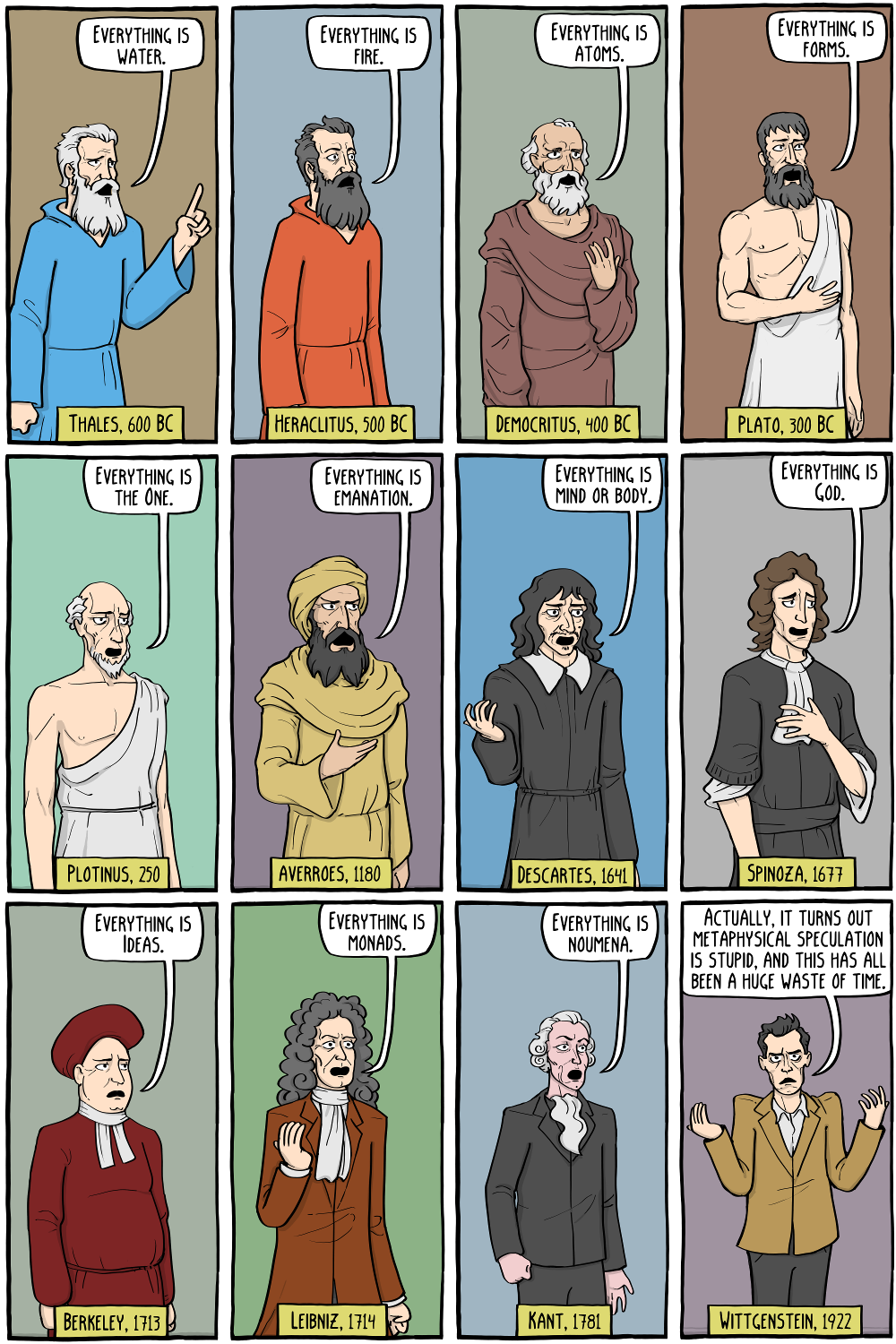

Comments (198)
Hehehe, yup, science have made metaphysics kinda irrelevant. We can use it for things that's still hard to prove, with proper logical arguments, but I find most metaphysical ideas today to exist among religious, spiritual people who can only form ideas around their beliefs rather than facts or people who think their personal opinions are facts, but I've rarely seen any proper metaphysical philosophy that don't use scientific premisses and facts.
Except, Democritus was on to something, we're still debating some of those things, like the mind/body problem (consciousness in particular). Witty didn't end the speculation. He just added to the speculation that it might largely be the result of a misunderstanding of how language works.
Not really. Science has been able to answer some questions that used to be metaphysical. But there are plenty of questions that we don't know how to investigate empirically. Questions about consciousness, the interpretation of QM, laws of nature, causality, the nature of time, mereology, supervenience, the nature of perception, and various debates over realism vs anti-realism.
Which isn't saying anything. Water is water.
Okay, but what makes water be like water and not like glass? Well, turns out ordinary matter has a chemical composition which determines that. And how does chemical composition determine the properties of water? Physics. And what determines physics? And now you're on to cosmology, which is one step removed from asking metaphysical questions.
I think Collingwood makes a pretty good case that the only possible science of metaphysics would consist in a history of absolute presuppositions. Science, whether modern, medieval or ancient always involves indemonstrable metaphysical presuppositions; so Wittgenstein was dead wrong in saying (if he did say) that metaphysics is always merely an abuse of language. Of course this is not to say that there have not been examples of metaphysical thought which do consist in abuse of language.
Wittgenstein was reportedly fond of Bishop Butler's aphorism: "Everything is what it is and not another thing".
Arguably, this isn't so much an anti-metaphysical attitude as it is a repudiation of reductive analysis. Arguably, also, Wittgenstein's own philosophical quietism can be construed as being consistent with the practices of connective analysis, and of descriptive metaphysics, in the sense Peter Strawson used those phrases.
What is a "absolute presupposition"?
They appear not at all dissimilar to "hinge propositions".
OK, if we can't speak of them in terms of whether they are true or false, why not identify them for what they are then? They're uncertain thoughts.
Quoting Janus
Collingwood seems to have a negative view of epistemology. He thinks that the fields of human inquiry are based on uncertain thoughts.
Where Wittgenstein differs from this may be in saying they are true but unjustifiable.
My reading of Collingwood is that it's about questioning and absolute presuppositions. When you study a philosopher you come up with questions met with answers which lead to further questions which lead...eventually, to the point where the views of that philosopher offer no answer. Here are the absolute presuppositions which, I agree with Banno, bear a remarkable resemblance to hinge propositions.
As someone on the old forum said to me, one very odd thing about Collingwood is that he held these seriously anti-ontological views (I don't think they are anti-epistemological) but he also went to church every Sunday and engaged in acts of worship.
This comic makes Descarte the only dualist in the entire history of philosophy
Yes, I think what you say is kind of true, though not only of philosophy, but of science, economics, anthropology; in short of all domains of inquiry. As absolute presuppositions are also operative in the kinds of everyday commonsense beliefs that we could never foresee being overturned, they may be said to resemble hinge propositions. The difference is that in the domains of inquiry the absolute presuppositions are things we can be said to necessarily suppose, rather than believe, in order to carry out any investigation at all.
So, for example that the cosmos is mind could be the absolute presupposition of an idealist philosopher, which is required for the further elaboration of his idealist philosophy. From within that philosophy the truth of its founding assumption can never be questioned; the question simply cannot arise. Similarly from within the methodological naturalism of the physical sciences the absolute presupposition that the cosmos is material cannot be questioned.
There is also some commonality with Peirce's idea of 'regulative assumptions'. This paper:https://slideheaven.com/regulative-assumptions-hinge-propositions-and-the-peircean-conception-of-truth.html explores the commonality between Peirce's regulative assumptions and Wittgenstein's "hinge propositions". Here is the abstract:
[i]Abstract
This paper defends a key aspect of the Peircean conception of truth—the
idea that truth is in some sense epistemically-constrained. It does so by exploring
parallels between Peirce’s epistemology of inquiry and that of Wittgenstein in On
Certainty. The central argument defends a Peircean claim about truth by appeal to a
view shared by Peirce and Wittgenstein about the structure of reasons. This view
relies on the idea that certain claims have a special epistemic status, or function as
what are popularly called ‘hinge propositions’[/i]
This passage from Cheryl Misak's The American Pragmatists deals with Peirce's notion of 'regulative assumptions':
[i]His answer is that it is a regulative assumption of inquiry that, for any matter into which we are inquiring, we would find an answer to the question that is pressing in on us. Otherwise, it would be pointless to inquire into the issue: “the only assumption upon which [we] can act rationally is the hope of success” (W 2: 272; 1869). Thus the principle of bivalence—for any p, p is either true or false—rather than being a law of logic, is a regulative assumption of inquiry. It is something that we have to assume if we are to inquire into a matter. Peirce is clear and explicit on this point. To say that bivalence is a regulative assumption of inquiry is not a claim about special logical status (that it is a logical truth); nor is it a claim that it is true in some plainer sense; nor is it a claim about the nature of the world (that the world is such that the principle of bivalence holds). The principle of bivalence, he says, is taken by logicians to be a law of logic by a “saltus”—by an unjustified leap (NE 4: xiii). He distinguishes his approach from that of the transcendentalist:
when we discuss a vexed question, we hope that there is some ascertainable truth about it, and that the discussion is not to go on forever and to no purpose. A transcendentalist would claim that it is an indispensible “presupposition” that there is an ascertainable true answer to every intelligible question. I used to talk like that, myself; for when I was a babe in philosophy my bottle was filled from the udders of Kant. But by this time I have come to want something more substantial.[/i]*
Misak, Cheryl. The American Pragmatists (The Oxford History of Philosophy) (pp. 50-51). OUP Oxford. Kindle Edition.
* the bolded text is Peirce's own words
Quoting mcdoodle
I don't know much about it, but apparently Collingwood accepted the truth of his own version of the Ontological argument, which might indeed seem odd considering his notion of the historical relativity of absolute presuppositions.
Quoting Metaphysician Undercover
An "uncertain thought" is a thought about which we are undecided as to whether it is true or not. Absolute presuppositions are understood to be things we necessarily suppose in order to investigate anything at all, and about which it is inappropriate to think in terms of their being propositions which could be demonstrated to be true or false; so...no.
I'm not sure Wittgenstein could be considered to be consistent if he were to say that "hinge propositions" are true, even though they are not justifiable.
What do you mean, "we all know what axioms are"? An axiom in mathematics exists by a completely different standard from an axiom in philosophy. And I am sure there are many in between.
Quoting tim wood
In philosophy an axiom is a self-evident truth. It is based in experience, description, and definition. It's really not reasonable to question an axiom unless you have reason to believe that the description or definition is inaccurate. In this case one might question it, because the so-called "truth" is not self-evident to that person who sees a fault in the description or definition.
Quoting tim wood
Why not start with description rather than "absolute presupposition"?
Quoting tim wood
What does this have to do with metaphysics?
Quoting Janus
If we suppose them, we believe them to be true. I wouldn't suppose something I didn't believe to be true, except for the purpose of a counterfactual. So it's not true to say that we cannot speak of them in terms of truth or falsity, we are supposing them not for the purpose of counterfactual, we are supposing them as truth, therefore we speak of them as true.
Even if we suppose them as counterfactuals, they are uncertain thoughts. So either way, if we suppose them as true when we have no reason to believe them as true, or if we suppose them as counterfactual, they are uncertain thoughts.
No, assuming something for the sake of investigation does not entail that I must believe what I am assuming to be true. Look at the example of bivalent logic in the passage quoted above from Misak's book on the American pragmatists.
OK, but it's still nothing more than an uncertain thought under your definition
Quoting Janus
No, it's not an uncertain thought under that definition, because its truth or falsity is not in question; we are not undecided about its truth or falsity; it is simply irrelevant.
It is not an uncertain thought in any other sense, either, because it may be as clearly conceived as you like.
Yes the truth or falsity clearly is in question, according to that quoted passage. Did you read it? We hope to someday resolve it as to truth or falsity, though it is not resolvable at the time of making the presupposition.. From that quoted passage:
Quoting Janus
Quoting Janus
The fact that we hope it will some day be resolved as true or false indicates that it is something which we are undecided about. It is an uncertain thought.
Quoting Janus
That a thought is clearly conceived doesn't make it a certainty.
You're misunderstanding what is written there. "We hope that there is some ascertainable truth about it" means that we proceed as if there were, otherwise we would not enquire; it does not mean that we are in a state of uncertainty about whether there is "some ascertainable truth". I'ts a subtle, but salient, difference you are missing.
Think of it another way in terms of another example. Science (leaving aside QM) proceeds on the assumption that every event must have a cause. Science is not concerned with proving that every event must have a cause, because that would seem to be impossible, since we cannot possibly examine every event or even show definitively that the events we can examine had causes. Rather, an absolute presupposition of science is that every event has a cause; if we didn't think in terms of causation, science would be impossible.
So we can say that whether or not every event has a cause is undecidable, but that does not mean that we are undecided about the truth or falsity of "every event must have a cause"; in fact we are not undecided about that at all, because we have decided that it is undecidable, and we have decided to adopt it nonetheless, because we have decided that it is indispensable to our inquiries.
Quoting Metaphysician Undercover
If the idea is clearly conceived and we are certain that it is indispensable to our inquiries, then it cannot be counted as an "uncertain thought".
Thoughts aren't the sort of thing that can be certain or uncertain. Thoughts do not doubt their own truth. Rather, they presuppose it somewhere along the line. Uncertainty arises from doubt. It is a product thereof. If a thing cannot doubt, it is not the sort of thing that can be uncertain. Thoughts aren't the sort of thing that can doubt.
Language use matters.
The irony... :lol:
I overstated the importance of language...
:joke:
Edited to add the following exception...
To be clear... creatures without statements can be uncertain about the immediate future as well. My cat can be uncertain about the noise it heard, or about the stability of what she's about to step onto. Her thoughts about the noise and the structure aren't uncertain. Rather, she is as a result of having those thoughts.
I do not believe that it is deliberate. It's very annoying none-the-less.
This reminds me of what Kant called a priori. That which is necessarily presupposed by experience itself.
It is what it is.
Depends on what the definition of "is" is.
Thanks, the quotes about Peirce are very illuminating. There are many strains of analytic philosophy that go on a lot about 'belief'. I've been reading a bloke called Duncan Pritchard who holds that for Wittgenstein hinges are not 'beliefs' at all, indeed they must stand outside what we think of as 'beliefs' for rational thought to function. Thus hinge presuppositions hold the same place in the intellectual firmament as Collingwood's absolute presuppositions. We recognise that these are contingent - as Tim Wood said above - on time, place, person: Wittgenstein himself, for instance, banged on about no man having visited the moon as a hinge, a basis for rational reflection, when within 20 years it would cease to be so.
Looked at in this way I don't think hinge propositions could be said to be true false or anywhere in between. Instead they're the foundations upon which claims of truth are built. So while it's a skeptical position it also claims to be an answer to a certain kind of skepticism, since it asserts that if we don't start with some presuppositions or other, there is nothing to talk about, indeed, there's probably no talking :)
So P is true iff P AND the absolute presupposition P rests upon?
Simon Blackburn is a guest on the latest Partially Examined Life talking about deflation and truth in different areas. He said empirical claims were easy: you just look and see that the cat is on the mat.
However, the presupposition underlying that truth is probably that there is an external world with a real cat on a real mat that we can perceive by just looking. Certain skeptical scenarios would undermine the presupposition, making the empirical justification false.
And indeed, he does mention attending a magic show where the illusionist performed all sorts of tricks that made it look like impossible things were happening, and as such, you can't always trust your senses.
But then again, Blackburn considers himself a quasi-realist, so maybe he's not terribly concerned about the more radical skeptical scenarios.
I'm 90% sure it means "is", but don't quote me on that.
Well, dictionary.com says:
"3rd person singular present indicative of be."
Which brings in objectivity, time, existence and being all in one sentence.
Uhhhhh, well, I took quoting to mean something else. So not true, exactly.
So now we're arguing on what the meaning of "quoting" is?
Oh well. It is what it is.
As all things are.
Notice I quoted twice where the word "hope" was used. That we "hope" there is such an ascertainable truth indicates that we are uncertain as to whether there is.
Quoting Janus
If you claim, "Whether or not every event has a cause is undecidable", then clearly you are undecided as to the truth or falsity of "every event must have a cause". What you are insisting is nothing but nonsense.
If, science proceeds on the assumption that "every event has a cause", and it is an "absolute presupposition", as described, such that it makes no sense to discuss whether this is true or not, then science proceeds as if "every event has a cause" represents an uncertainty.
You might say that we "hope" that "every event has a cause" is true, but since the procedures of science in general are an attempt to prove whether or not it is true, these procedures demonstrate the uncertainty of that thought.
If the material may be "misread", there is a problem with it. I happen to believe that tim wood's interpretation is completely wrong, requiring tim wood to make up a completely fictional, and nonsense distinction between "suppose" and "presuppose" to support this misinterpretation. To "presuppose" means to suppose before hand. So at that time, before hand, when the presupposition is created, it is nothing other than a supposition. Later, when it is being used, we call it a presupposition in relation to its use.
An "absolute" is an ideal, like God, and this is where "hope" and uncertainty enters the representation. We "hope" that the "absolute presupposition" is correct, but nevertheless we are uncertain. If we proceed to represent this uncertainty concerning the absolute presupposition as certainty, e.g. "I am certain that God exists", instead of "I hope that God exists", we are mistaken. And this is misleading.
Except bald kings of France.
Science may have held this absolute presupposition, but modern physics forced scientists to reevaluate it, at least for the very small. Not sure whether that supports what you're saying about presuppositions equating to an uncertainty, but developments have lead people to question their presuppositions.
Depends on whether the past exists.
I don't think it does, but it probably will.
I think there's a possible world where that's true.
Which is to say that it's possibly true, and you're suggesting that it's actually false.
P is false if and only if P is possibly true.
New theory of falsity.
No, you misunderstand. Saying that "there's a possible world where that's true" is the same as saying "that's possibly true", and saying that "there's a possible world where that's true" implies that you believe that in the actual world it isn't true.
Okay, but what does my belief have to do with possibility and truth?
It has to do with what it has to do with.
I want to believe:
Only in a transcendental sense.
Until the goat eats it.
I still tend to think the difference between Wittgenstein and the other two, might be that the former would want to say, as suggests, that hinge propositions are true, but not justifiable.
I'm not convinced that it could be consistent with any coherent notion of truth to say that something could be true, yet not justifiable.
No, the point is that, following this line of thought, we assume there is an ascertainable truth; we don't take an attitude of uncertainty, because that would be crippling to our investigations. The other point, contra to what Peirce says (perhaps carelessly) there, is that we don't actually need to assume that there is an ascertainable truth (not, at least in every case) at all, we merely need to assume whatever it is that is indispensable to inquiry and can safely leave aside the question of its truth, or we might go further and think that its truth is not ascertainable even in principle.
So, for example, in the case of assuming that every event has a cause, which underpins scientific hypothesis and investigation, we can fully acknowledge that the truth of this assumption could never be ascertained, and yet proceed on the assumption that every event has a cause merely for the sake of seeing what our investigations then lead us to discover.
Remember that, for Peirce, a truth is that which we would never find reason to doubt, no matter how much we investigated it. This is an "in principle" definition, and in practice we can never, at any time, know whether future investigations will find reason to doubt anything we might currently accept as true. This means that all things accepted as true are provisional, all knowledge is fallible.
Yeah, that's relevant. My point was that science really is not based on "absolute presuppositions", it's based on descriptions and definitions, and these provide self-evident truths. However, as time passes and knowledge evolves, the descriptions and definitions change as well, such that what was once a self-evident truth may no longer be a self-evident truth. The fact that what was once a self-evident truth, is no longer a self-evident truth, so that its truth or falsity can no longer be ascertained, doesn't qualify it for the what is called an "absolute presupposition". The absolute presupposition is supposed to be neither true nor false at the time it is supposed, yet the self-evident truth is supposed to be true.
Quoting tim wood
I'm just going by what has been posted in this thread. The following:
Quoting Janus
Quoting tim wood
So it seems quite clear that an "absolute presupposition" is something which was supposed when there was a lack of evidence as to its truth or falsity, and is therefore nothing more than an uncertain thought.
If you'd like to explain to me what an absolute presupposition "really is", in a way which leaves it not reducible to an uncertain thought, then be my guess.
But as I've explained, I think this proposition of Collingwood's is off base, wrong. I think that science is based on descriptions, definitions, and self-evident truths, not absolute presuppositions. If I misunderstand what an "absolute presupposition" is then pleas explain exactly what it is.
Quoting Janus
That's ridiculous. If we assume that there is ascertainable truth, yet this truth is not already ascertained, then there is uncertainty by the fact that it has not been ascertained. We investigate to find answers because we are uncertain. So it is absolutely necessary that we proceed with an attitude of uncertainty. If we proceeded with an attitude of certainty this would be a bias which would be utterly crippling to the scientific method which is designed with a procedure of objectivity, to avoid such bias.
Quoting Janus
Either way, if we assume that the truth could never be ascertained, or that the truth is ascertainable, each implies a lack of ascertainment, and that is an attitude of uncertainty. The fact that the truth or falsity of the assumption has not been ascertained indicates that there is uncertainty.
You're conflating two different things here. Of course we must be uncertain about what we will find when we investigate, but we cannot investigate without assuming that nature is invariant, if not deterministically, than at least statistically, and that things have been caused to be the way they are observed to be. We are not uncertain about invariance and causality, even though we know they cannot be proven; they are not what is in question at all in any scientific investigation, instead they are indispensable assumptions.
You seem to want to say they are "uncertain thoughts' just on the basis that they cannot be proven. I don't think that is a helpful way to think about it, but if you insist that that is how you want to think about, I am not going to argue further about that, because I think it is merely a trivial pedantic point which is not at all relevant to the salient point; which is that our scientific inquiries are based on indispensable absolute presuppositions which themselves cannot be demonstrated. If you acknowledge the salient point, or if you do not, yet fail to produce a decent argument why not, then I think we are done here.
This is contradictory nonsense. If something were once really a "self-evident truth" then it could never fail to be true forever. If it later comes to be false, then it was never a self-evident truth in the first place, but at best a provisional truth, that may have seemed to be self-evident to some minds. And that is really the difference between the kind of thinking which underlies the belief in a priori truths, and the kind of thinking that is involved in the notions of absolute presuppositions and regulative assumptions. The latter are not taken to be true and should not be thought about in terms of truth and falsity; the avoidance of thinking about them in terms of truth and falsity is the way to avoid the absurdity involved in the idea of self-evident truths that could later cease to be self-evident truths.
OK, so let's suppose that we assume that nature is invariant, for the purpose of investigation. Either we assume that such is true, In which case it's not an absolute presupposition as described, or we assume that we do not know whether this is true or not, in which case it is an uncertain thought, but also qualifies as an absolute presupposition. What am I missing?
Quoting Janus
If you claim that we are not uncertain about invariance, then why can't we call it truth. If I am certain of something, I believe it to be true, so why not say that? It's nonsense to say that it's acceptable to claim that you are certain that nature is invariant, yet it's unacceptable to claim that it's true that nature is invariant. If I am certain of X, on what basis do you insist that I ought not say it is true that X.
Why not face the reality, that you are not really certain that nature is invariant, and this is why it cannot be proven? If you are not really certain that nature is invariant, and therefore uncertain, this justifies your claim that you ought not speak about the invariance of nature in terms of truth or falsity.
Quoting Janus
A self-evident truth is dependent on the meaning of the terms, definitions. These things change over time. Therefore what was once a self evident truth is not always a self-evident truth. There is no contradiction, because contradiction requires that the same thing is and is not at the same time. The proposition is a self-evident truth at one time, and not a self-evident truth at another time. Where's the contradiction?
Quoting Janus
The fact that what was once a self-evident truth later ceased to be a self-evident truth is not at all absurd, it's just a reflection of the temporal nature of reality. Things come into being and cease to be, that's what happens in the temporal world. Human knowledge is a part of this temporal reality.
The absurdity is your description of absolute presuppositions, as something you are certain of, but you cannot claim to be true. That this is absurd is self-evident.
The third alternative that you are missing is that we think it is inappropriate to speak about it being true or not, because it is undecidable.
Quoting Metaphysician Undercover
We can't call it truth because certainty or uncertainty about it is irrelevant to the fact that we merely assume it on account of its indispensability to our investigations.
Quoting Metaphysician Undercover
This seems to be nothing more than sophistry. If we can still understand the definitions that were being used when what is now false was allegedly 'self-evidently true", then its truth, in the context of those definitions, should still be self-evident to us. Can you offer up an example for analysis?
Quoting Metaphysician Undercover
I'm not the one proposing that there are self-evident truths at all, beyond the analytic, and even those may be questionable. However it does seem evident to me that nothing of a temporally contingent nature could ever be self-evident, but would have to be observed to be so or not.
Quoting Metaphysician Undercover
It's tiring to have to repeatedly correct someone who is repeatedly distorting the intended meanings of my words! I haven't said that we are certain of absolute presuppositions at all, or uncertain about them, but that we assume them for the sake of scientific investigation. (I've also failed to follow my own stipulation that I would not argue over this pedantic point any further).
I'll try one last time to help you to understand the point. Returning to the example of causation; it seems to us that the events we observe have causes, but we also know we cannot prove that all (or even any) events actually do have causes; so, why would we need to claim that it is true that all events must have causes, rather than merely assuming that they do in order to enable our investigations? You need to show what practical advantage it would lend to our investigative abilities to claim that it is true that all events must have causes, rather than merely proceeding on the provisional assumption that they do, if you want to convince me that your harping on this point is not merely pedantic carping.
.
If the truth or falsity of a matter is undecidable then thoughts about that matter are uncertain thoughts. That's not a third option, it's the second option.
Quoting Janus
Your argument is deception, describing an uncertain thought and claiming that it's some form of certainty.
Quoting Janus
Human beings once described the sun and planets as orbiting the earth. That the sun took 24 hours to orbit the earth was a self-evident truth. It's no longer true.
Quoting Janus
You clearly described absolute presuppositions as things which we are uncertain of. Then when I called them "uncertain thoughts", which is how you described them, you objected, as if they were somehow certainties. Now you seem to claim that scientific investigation is based in thoughts which are neither certain nor uncertain.
The issue is that there are two aspects to our approach to scientific investigation, things which we are certain about, and things which we are uncertain about. Proper scientific investigation proceeds by maintaining a clear distinction between these two, to confuse these two is disastrous to science. The conflation of the things which we are certain of, with those that we are uncertain of, and the claim that absolute presuppositions are neither, is a simple violation of the fundamental laws of logic. Any description which violates the fundamental laws of logic is wrong. Therefore this description of the foundations of science, as "absolute presuppositions", is wrong.
Quoting Janus
You are just describing the problem of induction. We see through observation that all events have causes, but the proof is in inductive reasoning, and the problem of induction allows you to deny that this proof proves. Therefore any principle known by induction cannot be known with certainty, and cannot be called "a truth". Because of this, you would claim that any premise based in induction is neither true nor false. But this would render all deductive logic which follows from these inductive premises as unsound. Therefore your approach renders everything which follows from scientific investigation as unsound.
Quoting Janus
The practical advantage is that by distinguishing true from false in inductive reasoning, we have the means whereby we can judge inductive reasoning and the premises upon which scientific knowledge is based, so that not all scientific knowledge is classed together as unsound. We turn to the accuracy of descriptions and definitions to judge the validity, and determine the truthfulness of scientific premises based in induction, instead of just claiming that such principles are neither true nor false because inductive reasoning cannot give us truth.
How low can you go?
Quoting tim wood
Coin that, you've just designed the worst possible insult.
Let me be succinct. To describe a proposition, assumption, or presupposition, as neither true nor false is to violate the law of excluded middle. Any description which violates the law of excluded middle is illogical. Therefore the description of "absolute presuppositions", which describes these as neither true nor false is illogical.
Quoting tim wood
If, to point out that one's position is illogical is to be vicious, then you are correct to accuse me of viciousness.
OK, an absolute presupposition is different from a proposition in the sense that the distinction of truth or falsehood does not apply to them. Why would you not accept that what you have described is what I call an "uncertain thought"? Propositions which we are certain of, we describe in terms of truth and falsehood, this is a representation of our certainty. To say that something is true or false indicates one's certainty. If an absolute presupposition falls outside of these descriptive terms, then why is the absolute presupposition not an uncertainty? If we do not say that absolute presuppositions are true or false, this indicates that they are uncertainties.
Quoting tim wood
I've seen enough information about absolute presuppositions to know that the description of them places them into the category of uncertainties. if you truly believe that I am wrong about this, then please, by all means demonstrate that you have a better understanding of "absolute presuppositions" than I, and show how I am wrong. If not, then accept my description and we can proceed to discuss what, if any role, uncertain thoughts play in science and metaphysics. And quit the fuss, you're like a child wrongfully accusing me of bullying.
Clearly I recognize the difference between an absolute presupposition and a proposition. We describe propositions in terms of certainty, truth and falsity. We do not describe absolute presuppositions in these terms, so I conclude we describe them in terms of uncertainty. So I have not been trying to translate one to the other, I've been trying to relate one to the other.
Quoting tim wood
You have claimed that absolute presuppositions are fundamental to science. Therefore whether they are certain or uncertain is extremely relevant. It's .nonsense to point out the foundational elements of epistemology and then claim that it's irrelevant whether they are certainties or uncertainties.
As fundamental to epistemology, clearly it is relevant whether we are certain about them or not. Furthermore, propositions form the body of epistemology, so we need to find a relationship between propositions and absolute presuppositions if they truly are fundamental to epistemology. Therefore my act of establishing a relationship between propositions and absolute presuppositions, by means of the terms stated above, certainty and uncertainty, is warranted, and relevant.
Quoting tim wood
That's exactly what I am trying to do, understand them for what they are. They are said to be fundamental to science, yet truth and falsehood is irrelevant to them. From the former I conclude that they play a key role in epistemology, and from the latter I conclude that we have no certainty concerning them.
Quoting tim wood
I would call this an intuition. That's the word Aristotle, as well as others used to describe this type f knowledge, "intuition". Are you comfortable categorizing an absolute presupposition as an intuition? I would say that "intuition" has a broader meaning such that an absolute presupposition is a type of intuition, where there would be other types of intuitions as well. An absolute presupposition would be a pure intuition, while a relative presupposition would be less pure.
Quoting tim wood
Whether or not the absolute presupposition is uncertain may be irrelevant to you, the one presupposing it, but to the metaphysician who is analyzing it in relation to epistemology, the degree of certainty of the absolute presupposition is extremely relevant.
Here's another thing to consider. To you, being the one presupposing, and acting on this intuition, the presupposition has the effect of having a high degree of certainty. You act on it without doubting it, therefore it appears like you hold this belief with a high degree of certitude. That is your personal attitude, which is a subjective certainty. To the metaphysician, who seeks to observe these intuitive activities, that activity is activity which is unjustifiable and is therefore based in uncertainty. Until the intuitions, absolute presuppositions, can be brought out, stated in the form of propositions, and justified, these intuitions are uncertainties to the metaphysician.
Quoting tim wood
So once the absolute presuppositions are "ferreted out", they may be stated, and are put in the form of propositions. At this time they can be judged for truth or falsity. Prior to this, they are intuitions, tendencies in one's actions, a hunch that worked so you follow it. They really cannot be judged for truth or falsity, nor stated as propositions, because they are not understood, nor are the words available. When the action is repeated time and again, the reasons for the action start to come to light, the words to describe these reasons are produced, and the intuition is ferreted out, stated as a proposition so that it may be judged.
Quoting tim wood
The notion that everything which happens has a cause is a very ancient intuition. It has already been ferreted out by Aristotle, and forms the basis of the cosmological argument. In its propositional forms, the most common being the principle of sufficient reason, it is judged by some as true and by others as false. This reflects its uncertainty.
Quoting tim wood
Being in the lounge we're allowed to use bad language, insult each other, maybe even throw things at each other. It's all in good fun until someone gets hurt.
Why not? Truth and justification are quite distinct, after all; they are independent of each other.
I don't see that; it seems to me that if truth and falsity are properties of propositions. then the truth of a proposition is justified by its accordance with actuality. this is the logic in "Snow is white is true" iff snow is white. Perhaps I am using "justification" in a way somewhat different than you might be accustomed to; for me it is synonymous with 'verification".
So, I think the verification of a statement just is its truth and the falsification of a statement is its falsity; truth and falsity are not some substantive metaphysical essence that stands beyond the processes of verification and falsification.Truth is simply the property, accordance with actuality, we mean to ascribe to statements that we believe do accord with actuality.
The same logic is inherent in Aristotle's "To say that that which is, is not, and that which is not, is, is a falsehood; therefore, to say that which is, is, and that which is not, is not, is true".
This does not mean that we can perceive some purported accordance-as-metaphysical-essence or relation; it just expresses the straightforward logic of our thinking about truth and actuality. Obviously, we don't perceive the exhaustive or absolute nature of actuality, but the point is that what we think is the truth is that which we have no reason to doubt after exhausting our possibility of investigation. It seems reasonable to say that there are actualities which are beyond our grasp, but not that are truths beyond our grasp, since truths only seem to exist in relation to minds, whereas actualities could conceivably exist independent of minds. It seems pointless to try to dig any deeper than that.
Quoting Banno
It is not that deductions are made from absolute propositions, but rather abductive and inductive inferences are grounded upon them. So, to return to the absolute presupposition that every event has a cause, the whole of science has been made possible by this "regulative assumption". The truth or falsity of scientific theories cannot be deductively proven; this is uncontroversial in philosophy of science; so deduction is not really the salient issue.
If all you are doing is using "uncertain" as a synonym for "undecidable" then I would agree with you. But if you want to say that absolute presuppositions are uncertain in the sense that they might turn out to be true or false, then I would disagree, because 'undecidable' means that they cannot, even in principle turn out to be true or false. We are certain of their undecidablility, because they are things which cannot be either empirically or logically confirmed.
We need to ask then, in what sense are they "undecidable". If it's as per the quote you gave me from Peirce, "we hope that there is some ascertainable truth", then the belief that "they cannot, even in principle turn out to be true or false", would constitute contradictory beliefs. In the one case we would recognize that they could never turn out to be true or false, and in the other case we would hold out hope that there was ascertainable truth. These two are inconsistent, incompatible.
Quoting Janus
I really don't think that this is the case with absolute presuppositions. I think the hope is there, that they will be decisively proven at some future time. That's my opinion. However, having the nature of uncertainty, one person's attitude toward an absolute presupposition might be different from another's. So some people who hold a particular absolute presupposition, might have hope that it could be decided in the future, while others might believe it is impossible for it to be decided ever. That's the nature of subjectivity.
This is why it is important to determine the precise characteristics of what it means to be an absolute presupposition. We need to find the precise thing which is referred to and analyze it. Only then can we make an informed judgement as to whether or not there is hope of ever proving one true or false. I believe that we ought not do as tim woods does, and continually make blind assertions concerning the nature of absolute presuppositions, denying the descriptions provided by others, we need to really look at what they are and agree on descriptive terms.
As I explained already, if the idea that all things have a cause, is an absolute presupposition, the nature of this particular presupposition has already been explained by Aristotle in his Physics. And it now exists in a propositional form, as the principle of sufficient reason. Therefore it would be incorrect to say that an absolute presupposition could never be rendered in a propositional form. Perhaps it loses it's status as an absolute presupposition if rendered in propositional form, but that would be a different matter.
We could look at some other absolute presuppositions as examples. There must be some such presuppositions in relation to space and time, what Kant calls pure intuitions.
I think Peirce, as a good scientist, allows for the possibility, and even hope, that what is understood to be possible in principle in the future may not be the same as it is understood now. So I see no contradiction there.
Quoting Metaphysician Undercover
Well, what you point to there is a difference of dispositions in relation to beliefs, and yes, of course, there will be such differences between individuals, and this might be a difference between Peirce and Collingwood. As it stands now, though, we can only see two ways in which propositions can be confirmed, the one certain and the other forever uncertain, in the final analysis. So deductively logical confirmation is certain, because it is dealing with tautologies, with the fact that true premises must, deductively speaking, yield true conclusions. Inductively logical confirmation is uncertain, or only relatively certain, insofar as it is a matter of empirical observation and is always contingent upon empirically observable events and matters of fact.
So, the idea that every event has a cause is neither logically nor empirically confirmable, and hence is undecidable in principle. However, we are committed to the idea, because it is indispensable to, because absolutely presupposed by, all our investigations of anything. Although we might say that it seems logically impossible to us that something could come from nothing, or come about without cause, nonetheless that may just reflect the way we are constitutionally determined to interpret events; so that without the assumption of causation there could be no interpretation of the general nature of events possible for us.
So, we can say that the idea is epistemologically necessary, but not that it is ontologically necessary, unless we wish to conflate knowing with being. And indeed, QM gives us some reason to think that causation has no absolute provenance. Whatever way you look at it; from the current situation of human knowledge, the question would seem to be undecidable, so we can be certain of its undecidablitiy now, and more certain of its future decidability (since there is not even a hint of a foreseeable means to decide it) than that the question will be answerable in the future. The other point is that an answer to the negative would seem to be fatal for all future inquiry.
I'm a big fan of Collingwood, and I've enjoyed reading your erudite exposition of his concepts, even in such a challenging environment as 'the lounge' (which I hardly ever venture into for this reason), but I'm not sure where you're going with this last post, particularly "... If you identify an ancient absolute presupposition for the purpose of mocking it and laughing at it and the people who held it, you can do so if that's what you think is valuable. But are you prepared to mock and laugh at modern natural science? Or everyone, for that matter. ". Surely one of the things it is reasonable to take away from Collingwood is that some presumptions which seem to be absolute presuppositions turn out, on analysis, to be either relative presuppositions, or not to be presuppositions at all, but propositions. That is, surely the point of analysing them?
It is in this sense that one can mock (or critique, depending on one's disposition) those presumptions which appear to be ancient absolute presuppositions, by revealing them to be, in fact, relative presuppositions, or indeed propositions posited as an answer to a specific question (and if shown to be a ridiculous answer, then one deserving of all the mockery it gets).
You seem to be implying (and I'm open to the possibility I've simply misinterpreted you) that if a presumption appears prima facae to be an absolute presupposition (such as that of your virgin-sacrificing volcano worshippers), then it must be fairly treated as such without question, and I'm fairly certain that is not what Collingwood is saying.
Furthermore, I realise you must be tired of the harassment you've had for trying to explain these ideas, but I think you have gone too far in dismissing possible criticisms of Collingwood's terms, even within his own framework. A philosopher will rarely define a term as being simply 'all that with property x'. It is more usually (and certainly so in Collingwood's case) that terms are defined as 'all that with properties x, y and z'. It therefore leaves open the possibility that one does not need to take his definition of terms as fact prior to critique. If one could, for example, demonstrate that there are no x's that are also y's then his definition is incoherent. I'm not saying that Collingwood's is, but that your refusal to acknowledge that the definitions themselves can be analysed for their rigour goes too far.
I hope you don't take these as excessively negative. It's just that defending the concept of absolute presuppositions is something I think is quite important and I wanted to plug any gaps I thought might be there.
What do you mean no contradiction? You said "they cannot, even in principle turn out to be true or false". Clearly that contradicts "we hope that there is some ascertainable truth", "possible in principle in the future". One expresses hope, the other no hope.
Quoting Janus
Propositions are confirmed as either true or false. They cannot be confirmed as "forever uncertain". That's nonsense which you are making up.
Quoting Janus
Deductive logic alone cannot produce certainty because it cannot confirm the truth or falsity of its premises, and it requires premises. Truth or falsity of the premise is most often confirmed with inductive reasoning. If you deny that inductive reasoning can produce certainty, you deny the possibility of certainty altogether. That is what you have done here, denied the possibility of certainty.
Quoting Janus
You've just denied the possibility that we could be certain about anything. Everything, even the idea that every event has a cause, is undecidable in principle, when your principles are such as you have described, because you deny the possibility of certainty.
Quoting Janus
You haven't shown that it is epistemologically necessary though. You have just asserted that it is indispensable to all our investigations. That particular "absolute presupposition", if it is true that such are required for investigation, is responsible for some particular investigations, but from another "absolute presupposition", other investigations follow. So that particular "absolute presupposition" is not necessary.
There is no contradiction involved in saying that what seems impossible in principle now may not seem so in the future; in other words there may appear a foreseeable way to answer questions about which there is presently no foreseeable way to answer them.
Quoting Metaphysician Undercover
Again you're distorting what I've said. I am saying that, according to contemporary philosophy of science it is not controversial that scientific knowledge is fallible; it is not certain.
Quoting Metaphysician Undercover
Yes, you're agreeing with me. The deductive certainty as I already explained is that the conclusion must follow from the premises if the argument is valid. Whether or not the premises are true is the uncertain, empirical part.
Quoting Metaphysician Undercover
Yes, I do, because that is the way it is with our knowledge. The only deductive certainty is validity and tautology, neither of which count as substantive truth. The only certainty with regard to substantive truth is empirical "certainty", which is fallible. The closest we can get to certainty is where we have no reason to doubt.
Quoting Metaphysician Undercover
If by "that particular absolute presupposition" you mean the idea that every event is caused, made possible by certain other conditions, then what kind of investigations are you alluding to that could dispense with that idea? Please provide an example.
Why do you say that an absolute presupposition "never answers a question" then give examples, each of which is an answer to a question. You make such a fuss about how little I know about absolute presuppositions, and how I misunderstand the whole concept, yet you give examples which clearly contradict the description you give. I really think that you know less about this then I do, and I quite obviously know very little. But I think that it's worse when you know little, to think that you know a lot.
Quoting tim wood
This cannot be an absolute presupposition because it answers the question of is there a method to turn tine to gold, with Yes, there is such a method.
Quoting tim wood
This cannot be an absolute presupposition because they do not answer questions, and this answers the question of am I better off eating the enemy.
Quoting tim wood
Once again, an answer to a question. Why do you think that these examples are of absolute presuppositions rather than relative presuppositions? They all appear as relative presuppositions to me.
Quoting tim wood
It's very clearly not true that the significance of the relative presupposition has nothing to do with its truth or falsity. It may be true that it facilitates thinking, but the truth or falsity of the presupposition leads one toward either appropriate, or mistaken thinking respectively. Thinking itself is insignificant, it may be completely random, but whether the thinking is correct thinking, or incorrect thinking is what is significant, and this is determined by the truth or falsity of the relative presupposition.
Are you ever going to get to the question of the nature of the absolute presupposition? That's what you're talking about isn't it?
Quoting tim wood
All these are answers to questions, and absolute presuppositions are never answers to questions. Furthermore, the truth or falsity of these presuppositions would guide the scientist either correctly or incorrectly. So let's get beyond these relative presuppositions, and find the true nature of an absolute presupposition, one whose truth or falsity is irrelevant to the thinking of the person presupposing.
Didn't Socrates or Plato say that philosophy is derived from wonder? Would you agree that "wonder' is completely general, and never the answer to any specific question, but related to many questions? And would you also agree that wonder presupposes no specific truths or falsities? The point I think you are missing is that the absolute presupposition cannot presuppose any truth or falsity, or else it is not absolute, as described. Truth or falsity must be irrelevant. The truth or falsity of the presupposition cannot lead the person's thinking correctly or incorrectly, so the thinking must be free from any presupposition of truth or falsity. The thinking may go any which way, because there is no presupposed truth or falsity.
So you cannot give examples of "absolute presuppositions" as this or that person believes that such and such is true, because this makes truth or falsity relevant in directing the thinking correctly or incorrectly. You need examples where nothing is presupposed as true or false, where there is a complete lack of bias or prejudice, and this is why "wonder" is a better example. The problem though, is that as we approach the true "absolute presupposition", it ought to become increasingly clear to you, that this requires that nothing is presupposed. The real "absolute presupposition" is the presupposition of nothing. Any inquiry, to be objective, true, unbiased, and honest, must approach the matter without presupposition. The "absolute presupposition" is the complete lack of presupposition.
Quoting Pseudonym
Yes, this is where I'm trying to get. How are we going to distinguish an absolute presupposition from a relative presupposition? According to tim woods' description, there is a substantial difference between these two, so there must be some defining principles which we could identify within presuppositions to distinguish them, if the various presuppositions are described properly.
Quoting Janus
I know, but you said "they cannot, even in principle turn out to be true or false", to me that implies in the future. So if you remove that implication, then there is no contradiction. However, then the absolute presupposition may take the form of a proposition which may or may not be proven to be true or false, in the future. And that's what we're trying to avoid.
Yes, but as has been pointed out absolute presuppositions are historical. Something can be an absolute presupposition for us at our present stage of knowledge, and not be such for future inquirers. I have already given the example of the alchemists' absolute presupposition that elemental metals can be transmuted into other elemental metals. That is no longer a presupposition for science; but this fact does not prove that metals cannot be transmuted.
On reflection, it seems that example is perhaps not so great, though, maybe it does not even qualify as an absolute presupposition, but rather as an hypothesis, because although it can never be proven that metals cannot be transmuted into other metals, it would be demonstrated that they could be, if a method were found and it were done reliably and repeatably. Of course all hypotheses necessarily involve absolute presuppositions; so the hypothesis that metals can be reliably transmuted were the method found, would involve the assumption that there is some lawful process via which transmutation could occur. And this, similarly to the case with the assumption of the universality of causation, could not, I believe, at least as far as we can currently foresee, ever be definitively shown to be true.
So, I think the idea that all events are caused, and related principles, are far more certain candidates for being considered to be absolute presuppositions or regulative assumptions. And returning to that example, you have not provided any instances of investigations (hypotheses) which do not presuppose such principles.
On a theological note, the related ideas of God, an infinite being, infinite intelligence, universal designer or first cause,are certainly absolute presuppositions. There is no foreseeable way to prove the existence or non-existence, of God, an infinite being and so on. Apart from arguments for such a being, or beings, which appeal to inferences to the best explanation, and are not very convincing to the modern scientifically informed mind, the best we can do is to argue that the assumption that God exists is valuable or useful for some practical purposes.
Another absolute presupposition is that humans can acquire certain knowledge of a 'higher" kind. As I have argued extensively with @Wayfarer, it seems certain that this could never be definitively shown to be so. An individual may be convinced that they have attained higher certain knowledge by the nature of their own experience (which is the only way one ever could be "legitimately" convinced of such a thing) and yet this could never be a good reason for anyone else to believe it, and it is always possible that the individual convinced by their own experience is deluded.
Quoting Metaphysician Undercover
No, that's not what I (at least) am trying to avoid at all. And I don't think Collingwood would argue that we could establish what must be absolute presuppositions for all time, but merely what are or have been the absolute presuppositions in various contexts at various historical moments. We can establish what are absolute presuppositions for us, what cannot presently "take the form of a proposition", as I have already argued.
Absolutely, I hadn't intended to give the impression that this would necessarily be a metaphysical analysis. In fact, I'm fairly convinced it would not be. Maybe a psychological at the most analytical end, but, as you say, mostly simply historical, or anthropological. My concern really is that whilst I agree entirely with Collingwood's concept and his method, I find myself disagreeing with many of the classifications I've read used as examples of APs from a psychological point of view. By this I mean that when someone says that such-and-such a society simply held belief X as an absolute presupposition, I don't doubt the existence of such a concept, nor the fact that, once found it is simply an historical fact and should be treated as such, but I do find myself often asking - did they though? Or were they really trying to answer a question? It may be my rather broad streak of cynicism, but I just get the gut feeling (not entirely unsupported by social psychology) that a lot of the practices and beliefs held by prior cultures which to us seem strange were quite consciously invented to create and maintain power structures, and belief in them merely professed out of fear of ostracisation rather than genuinely held.
So I take a more social psychology approach to the analysis of APs which finds far fewer of them in the sense they were (I think) intended. I find that in many cases people merely act as if they held an AP but in fact quite often question it internally, or ask the question to which it is an answer (and so render it no longer an AP), it's just that externally doing so is something of a taboo for their social group so you don't often see the behaviour which the historical analyst would otherwise use to discard it as an AP.
Quoting tim wood
So basically, this is the point I'm tempted to want to modify, by introducing some small element of psychology. I think the value of APs is in understanding human behaviour, but in order to do that, it does have to allow at least small element of psychological analysis of all behaviour, both private and social. Take revolution as an example, in any revolution where an AP is overturned (for example the AP that 'the king has been appointed by God to rule the country'), there must have been a period prior to the revolution where the society was still acting as if it held that particular AP but in private it was no longer an AP, it was a proposition made by one class which was being rejected by another. The rejecting class, at least, held it to be a proposition, but at some point in the revolutionary process, they must have done so without any external sign that this was the case. This doesn't just count for political revolutions, but all revolutions and paradigm shifts.
So the key question that needs to be answered for an investigation of APs is - how long does this period last? Do people act as if beliefs were APs, when in fact they're treating them as propositions, for only a short period before the revolution, or does it go on for years, decades even?
I think this has important implications in modern society for things like religion, but also, at the other end of the scale, things like advanced science where the question would be - do people actually understand the position well enough to hold it as an AP or are they actually holding some other AP but acting as if they hold the AP in question because they've been told by those more intelligent than they are to act that way? For example, can you hold an AP that space and time are all one unified dimension if you don't actually understand what that means?
Of course, one can over-think this and risk losing some of the wonderful simplicity that Collingwood introduced, and I hope I'm not guilty of that, or perhaps only a little.
Yes, according to Collingwood, the principles are relatively simple. They are the same as those of any assessment of behaviour in an historical enquiry - the answer to the question "why did they do/think that?". As soon as that question no longer seems to have an answer you have an absolute presupposition. I think the mistake you're making is in not treating the classification as a theory. Like any other theory, it's a best guess until something better comes along or some evidence disproves it. Collingwood's conclusion (at least in my interpretation) is not to treat the classification of a belief as an AP as if it were a final indisputable fact, it's to treat is sufficiently like a fact that one does not get hung up on keep asking the question "why?" when it's just not yielding an answer.
In my interpretation, one asks of a belief "why would they believe that?". Sometimes one will find a set of empirical evidence and a rational argument but these will always be accompanied by another belief (the belief that this evidence coupled with this argument leads to this conclusion). So we ask the same question of that belief. At some point in time we do not find empirical evidence and rational argument forming part of the justification. At that point we propose the theory that this is an absolute proposition, and move on with investigating other things until such time as new evidence arises, or a better theory comes along. It's pragmatism as much as metaphysics really.
If it's absolute, it cannot be relative to temporal existence in this way. Being relative to temporal existence is what makes it about something particular and therefore relative, like your example.
Quoting Janus
Unless you can show the logic behind this conclusion there is no sense to the assertion. As far as I can see, hypotheses involve relative presuppositions, but I don't see how an absolute presupposition is even possible.
Quoting Janus
Even this is quite clearly a relative presupposition. It is a proposition which relates to physical existence in general.
Quoting Janus
God may be an absolute presupposition, but this assumption would need to be defended, justified.
Quoting Janus
Again, this is relative. It is relative to human knowledge, and answers a question concerning human knowledge.
Quoting Janus
This is clear evidence of the failure of Collingwood's theory. If the presuppositions change at various moments in history, then they are relative and not absolute. They are relative to the concerns of the people at that time. It is contradictory to say that the absolute presuppositions are different at different times, for different peoples, because this describes them as relative.
Quoting Pseudonym
This is not quite correct. Many insist that the skeptic cannot criticize a theory without offering a better one. But that's not true because we will not seek a better one until the problems of the existing one are exposed. So exposing the problems is first, and does not require offering a better theory. Further, it does not really require "evidence" to prove that a theory is faulty. If a theory can be proven to be illogical, by way of contradiction or that it breaks some fundamental laws of logic, this suffices to demonstrate its faults, though one might call this evidence it is not physical evidence.
Quoting Pseudonym
This is just an assumption. To break the infinite regress of justification you say there must be an absolute presupposition. But perhaps you are going in the wrong direction. You are looking backward in time, asking which belief is prior to this belief, in order to justify it. But if you consider the nature of intentionality, you'll see that beliefs are justified by what is wanted, or desired, "the end", and this relates to what will come to be in the future, not what has been believed in the past. The infinite regress is ended by "the end", not by the beginning. So to justify "why would they believe that?" you must look at what they wanted, and there is no empirical evidence at that time, for what they wanted, because it comes into existence at a later time. Empirical evidence at one time always points to what was wanted at an earlier time.
You're responding to the wrong sense of 'absolute'. All it means is that the absolute presupposition in a context is the one that underpins all the others and is not itself underpinned by another.
I think we're talking about "absolute" as opposed to relative. That is to say "absolute", as distinguishable from "relative". This would mean "absolute" in the sense of that which can exist without being related to anything else..
If you think you can show how one "absolute presupposition" could underpin every single presupposition that someone has, then be my guest. This would disallow the possibility of conflicting or contradicting presuppositions, which many people appear to have.
Until then we should consider "absolute" in the sense that Collingwood uses it, as distinguishable from relative. This would mean that the absolute presupposition is not underpinned by another presupposition, because this would make it "true" in relation to that other presupposition, and the absolute presupposition must be free from that relation. But the absolute presupposition doesn't necessarily underpin all others, that one may have, and this is why multiple absolute presuppositions are possible.
The reason why I said that there could only be one absolute presupposition, so that all absolute presuppositions would be one and the same presupposition, is that there could only be one end to that seemingly infinite regress of presuppositions, and that would be the complete lack of presupposition. So an absolute presupposition could be nothing other than a presupposition of nothing. Nothing presupposed. This could be the only "first" presupposition, the one which supports others, but is not itself supported, the presupposition of nothing. If it presupposed something, this would be a prior presupposition which supports it.
No, as i understand it, for Collingwood absolute presuppositions are always such in relation to a context.
Quoting Metaphysician Undercover
It is obvious that in all senses 'absolute' is "distinguishable from relative", so you're not really saying anything that is not trivial here. Have you actually read Collingwood's Essay on Metaphysics? It doesn't sound like it!
I have already said that absolute presuppositions are not underpinned by any other presuppositions; but the conditional here is "in particular contexts". So, the AP that underpins physics will not be that same one that underpins biology. Also you must realize that there can be different APs for different standpoints in each field. So, there is no "infinite regress" and APs are not necessarily all reducible to one master AP; it would depend on your worldview. That said, as I have already alluded, the idea that all events are caused in the broadest sense of the notion, might indeed qualify as a master AP. In theology, though, God is the master AP, because He is the Ultimate Cause.
Sounds just like a relative presupposition then.
Quoting Janus
No I haven't it doesn't sound very interesting, and full of contradiction according to how you and tim wood explain it.
Any contradiction is only on account of your misunderstanding. TBH, I don't think you want to understand it or, it seems, anything else that doesn't tally with your pedantic sophistry.
I was always under the impression that Collingwood rejected the whole idea of revolutions. In The New Leviathan doesn't he say something like the term revolution being just an admission of the historian's lack of understanding about the continuity of the historical process? Its a long time since I read anything about him so I may be wrong, but this line of argument has always been a point of diversion for me, as I outlined above.
I agree with your analysis that APs are usually so deeply set as to be outside of the matter of day-to-day discourse. That's really the point where I start to doubt the correctness of the classification of many of the examples I've heard of, as many beliefs overturned during revolutions (political or otherwise) become necessarily part of day-to-day discourse. I'm not sure whether to call this the method by which absolute presuppositions are replaced (that which was unspoken becomes a topic of conversation, thereby questioned and thereby no longer an AP), or is it more correct to say that this is just such evidence which the historian could use to show a belief not to be an absolute presupposition afterall, but merely seeming so? Not sure myself, but I'm tempted by the latter as I think it preserve the 'absoluteness' of APs better. To make real use of them in our historical understand of different societies (as well as our contemporary understanding of those with different world-views to us), it's important that they really are absolute and not a kind of 'conspiracy of silence', where everyone knows the belief is on shaky ground because they've questioned it privately (meaning it isn't really an AP) but no-one dare say so because of social taboo, or fear of ostracisation (causing it to appear to be an AP to the casual observer).
As you say it's more about picking apart the way absolute presuppositions work because without this knowledge of mechanism it will be impossible for the historian, or contemporary analyst to know what signs to look for, probably more psychology than philosophy, but I'm interested in the overlap.
Quoting tim wood
Thanks, though my student days are way behind me.
I understand it, it's not very complicated at all. I just don't agree with it, and that's why I point out the inherent contradictions. The only true absolute presupposition is to presuppose nothing, because to presuppose is to presuppose something and this makes the presupposition relative. To go beyond relative presuppositions, is to leave the category of presuppositions, and then we're not talking about presuppositions. anymore. So what Collingwood calls an "absolute presupposition" is not a "presupposition" at all, and he's completely off track with that term. He's trying to leap from presuppositions to something which is not a presupposition at all, giving it the misleading name of "absolute presupposition".
Sophistry is only possible when the fundamental laws of logic are not strictly adhered to. So pedantry is not sophistry, it's the way we defeat it.
But there is clearly a distinction to be made between a proposition being true, and its being verified as true. There are, after all, unverified true propositions.
And until we agree on this, there is not much else to be said.
That depends on how you look at things. Some might say that truth requires judgement, that to be true requires a judgement of truth. Ever heard the saying "beauty is in the eye of the beholder"? We can say the same with "truth", it is a property of the judgement.
The reason why it makes sense to argue this position, against what you say, is that the words or symbols of the proposition must be interpreted for meaning. And, it is the meaning which is judged for truth or falsity. So without the interpretation of what the proposition means, the proposition cannot have any status of being true or false. Let's say "the sky is blue". Without definitions for "sky" and "blue", it makes no sense to talk about this proposition being true or false. A judgement as to the meaning of "the sky is blue" is required in order that the proposition may be either true or false, and there can be no such thing as an "unverified true proposition".
Yes, but a proposition is only true if it would be verified as true after exhaustive inquiry. This rules out the idea of absolute truths that are forever beyond human, or any finite intelligences', verification in principle. The only way such truths could be would be if there were an infinite intelligence to think them. An infinite intelligence would not need to verify them, they would be, and be justified, merely on account of being thought by such a mind.
I'm guessing you don't wish to go there, so you have no coherent and consistent way to justify the idea of truths that could be absolutely independent of verification and justification, as far as I can tell.
Why add that?
Propositions can be true and yet not known, not believed and not justified. Get that right, and we can move on.
No, absolutely not. A proposition consists of two aspects, the words or symbols, and the meaning. The truth or falsity of a proposition is relative to its meaning. The meaning is dependent on interpretation. Therefore the truth or falsity of the proposition is relative to the interpretation of the proposition.
This has nothing to do with "belief", it's just a demonstration that a proposition being true or false is relative to an interpretation of that proposition. One interpretation may render the proposition as true while another may render it as false, so there is a need to validate the "correct interpretation". Therefore, there can be no such thing as an unverified true proposition, because verification of the meaning of the proposition is required in order that it may be true.
You seem to be taking for granted that any given proposition has a "correct interpretation" already inherent within it, so that verification of the meaning is not required. But that is a mistaken assumption.
It's not a question of whether the proposition is presently known, believed or justified. Give me an example of a proposition that could be true and yet incapable in principle of being verified, falsified and/or justified; and then we can move on.
Lame.
Quoting Metaphysician Undercover
Hence, "It is raining" and "Il pleut" are the same proposition and yet the words used are distinct.
I asked you to provide an example of a proposition, or kind of proposition, that would support your assertion that truth is completely independent of validation, verification and justification, and since you failed to do that, then I can only assume that you have no evidence to support your assertions.
This is irrelevant to the fact that the words "it is raining", or "il pleut", if used as a proposition, require an interpretation in order that there can be a truth or falsity to that proposition. There can be no truth without an interpretation because the words have no meaning without an interpretation. And interpretation is a form of verification. Therefore there can be no unverified true propositions.
That doesn't seem right. I can interpret the meaning of the statement "there is intelligent life elsewhere in the universe" without being able to verify (or falsify) it.
Quoting Banno
These aren't mutually exclusive, hence Janus' response. Perhaps you meant to say that propositions can be true and yet unknowable?
There's Fitch's paradox of knowability. If the proposition p is an unknown truth then either the proposition "p is an unknown truth" is an unknowable truth or there are no unknown truths.
But then I think sentences of the kind "p is an unknown truth" are different to sentences of the kind "there is intelligent life elsewhere in the universe", and so even if the former must be unknowable truths it doesn't then follow that the latter can be unknowable truths.
I think @Metaphysician Undercover is saying that propositions don't exist sans interpretation. The ink on the paper exists independently, the rain exists independently, but the proposition expressed by the two sentences "it is raining" and "il pleut" does not exist independently. That they share the same proposition just is that we interpret them the same way.
And if there are no propositions sans interpretation then there are no true propositions sans interpretation.
Right, you can interpret without verification, but the point is that there is no truth or falsity without verification of the interpretation. Perhaps Banno confused me into saying something not quite what I meant to say.
Quoting Michael
I think that's a good way of putting it. A "proposition", as Banno defines it, is dependent on an interpretation. The interpretation is inherent within the proposition. This would be the "correct interpretation". And "correct" requires verification. So "proposition" implies "correct interpretation" and "correct interpretation" implies verified.
Without the "correct interpretation", any interpretation would be acceptable and this allows that the proposition could be both true and false. So "truth" requires "correct interpretation", and "correct interpretation" requires "verification".
Sure. That's not what meta said, but we can proceed; all propositions are always, already, interpretations.
So is Meta's point that a given proposition can be true under one interpretation, and false under another?
Because I can't see how that could work.
No, I didn't. My point is the simple one that a proposition's being verified is not the exact same thing as a proposition's being true. I think Janus is wrong here.
But that's not what he said. He said that a statement is true iff it is verifiable, which isn't the same as saying that it is true iff it is verified, hence why your response to his claim only made sense if you were saying that a true statement can be unknowable (rather than just unknown, which I don't think he disagrees with).
The group of words can be interpreted in different ways, and can be true or false depending on the interpretation. The proposition is, as you say, always already an interpretation. So this interpretation, which comprises the proposition, must be always already verified as the correct interpretation. Therefore there cannot be an unverified true proposition. The proposition is by its very nature already verified, and it is only by means of this "verified correct interpretation" that it may be true or false.
Why can't "p is an unknown truth" itself be an unknown truth (if it is indeed true); why must it be unknowable? Am I missing something here?
Quoting Michael
If p is "there is intelligent life elsewhere in the universe", and we allow that it could be true or false, although we don't currently know which, then p could indeed be an unknown truth without entailing that it must be unknowable. Perhaps Fitch had in mind the kinds of metaphysical propositions which would seem to be undecidable in principle.
So, if the proposition "God created the world" is p, then if that were a truth, it would seem to be not merely an unknown, but an unknowable truth.
For example, take your proposition, "it is raining". Inherent within that proposition is the correct interpretation of those words. Wouldn't the same process which determines the correct interpretation of those words also determine whether those words speak a truth or a falsity?
Ok, so my point is that a propositions being true is not the very same thing as a propositions being verifiable; there are, of course, verifiable falsehoods...
SO at the very least he will need to take more care with his wording.
If some statement is true under one interpretation and false under another, then these two interpretations express distinct propositions.
That's pretty much what a proposition is.
The Gordian Knot of @Metaphysician Undercover misunderstandings. Think i might have to leave you to it, @Janus.
A group of words is not a proposition. It's not even a sentence, unless it follows some grammatical rule. The apparent slide between strings, sentences, statements and propositions does not help your case.
That slide should be clear to @Janus and others, in the paragraph I quoted. If not, then... leave it.
Every false proposition has an observely true counterpart, so truth and falsity are two sides of the one coin.
I'd say it's not so much about true propostions as it is about truth-apt propositions; the latter can of course be true or false.
It's never possible to know that "p is an unknown truth" is true because to know that you must know that p is an unknown truth, which is a contradiction.
Now we have truth apt, and presumably non-truth-apt-propositions.
In my world, all propositions are either true or false. that's what it is to be a proposition.
He's saying that a statement is true iff it can be verified as true (and presumably false iff it can be verified as false).
Quoting Banno
I think he did: "a proposition is only true if it would be verified as true after exhaustive inquiry".
It's not a good thing to have the definiendum on both sides of the definition.
So there's one issue: defining verification without using truth...
Quoting Michael
When is an inquiry exhausted?
Why? I am guilty iff a jury declares me guilty. My name is Michael iff my birth certificate or deed poll states my name to be Michael.
Quoting Banno
I'm sure you know what it means to verify/justify a proposition as being true. I doubt you and Janus disagree on that.
Quoting Banno
When there's no more evidence to find.
Brilliant!
http://existentialcomics.com/comic/252
How do you know when there is no more evidence to find?
You probably don't, but that has nothing to do with Janus' claim.
Right, so if you and I are talking about the proposition "it is raining", what is the process which ensures that we each have the correct interpretation of the words "it is raining", such that we are both talking about the same proposition?
Is this not a process of verification? Or, is it the case that when we discuss specific propositions, the different people in the discussion, having slightly different interpretations of the same words, are never really discussing the same proposition? if there really is such a thing as "a proposition" under this definition, where would the interpretation which constitutes "the proposition" exist? Isn't this what Plato questioned, inquiring into independent ideas?
Perhaps a better example would be something like "he's pissed". Are we talking about someone being drunk or angry?
I guess if there is no clear and evidently correct interpretation, there is no proposition there. That's why I asked, if there really is such a thing as a proposition under this definition. Try The Second Amendment, I guess there's no proposition there either.
Why suppose there is such a process?
Is that a teleological assumption - there must be one true shared meaning, so there must be a process for verifying that we share the one true shared meaning - although apparently without making use of the word "true"...
Or are there just sentences spoken to let people know it is time to jump in the puddles?
OK, I see what the point is now, I think; but, I wasn't thinking that we could know that the truth of a particular true proposition is unknown, but of knowing that the truth or falsity of some propositions are unknown. The first is indeed a contradiction if applied to any actual proposition; how could we know it is a true proposition, if its truth is unknown? On the other hand it is at least reasonable to believe that there are true propositions the truth of which are unknown; I can't see any contradiction in that.
So, to say it again in the way you have: "It's never possible to know that "p is an unknown truth" is true because to know that you must know that p is an unknown truth" but it is possible to know that there are unknown truths (just not possible to know which ones they are). There must be unknown truths about distant galaxies, for example.
I don't think it makes any sense to say that there are non truth-apt propositions; which is the same as to say that "all propositions are either true or false". Now we back to Collingwood's "absolute presuppositions" which he explicitly says are not truth-apt propositions, or Peirce's "regulative assumptions".
So, to return to a previous example, we do not propose that every event has a cause we necessarily assume it in order to investigate anything at all. Thus it makes no sense to say that "every event that can be explained must have causes or determining conditions" could be true or false, unless we want to assert with Kant that it is true a priori, but then it could not be false, and again could not count as a proposition according to your definition.
No, I don't think there is anything teleological here. Interpretation is a process. Do you not agree? An interpretation is the result of an act of interpretation. So whatever it is that produces the one "correct" or "true" interpretation, which is necessary for the existence of a proposition, this must be a process as well.
I don't believe there is any such thing as "one true shared meaning", we all interpret things in our own unique and idiosyncratic ways. The "correct" or "true" interpretation, therefore cannot be a one shared interpretation, because there is no such thing as a shared interpretation. interpretation is something one does on one's own. This is why I question your assumption that there is one "true" or "correct" interpretation. That would require one "true" or "correct" act of interpretation. Is this supposed to be an act of God?
Quoting Metaphysician Undercover
This appears to me to be a pretty direct contradiction. I'm lost.
Nor do I; a proposition, if it is anything, is truth-apt. And yet you said:
Quoting Janus
The phrase "truth-apt propositions" was contrasted with "True propositions", as if there could be propositions which were not truth-apt...
SO you lost me with that wording.
Quoting Janus
...are rubbish. You look in your wallet to see if there is money in it; you do not assume that there is money in it, and try to falsify your assumption. Regulative assumptions result from forcing explanations out of pragmatic preconceptions.
The former, "we each have the correct interpretation of the words", is a statement of what is required for the existence of a proposition under your definition of "proposition". The latter, "I don't believe there is any such thing as "one true shared meaning", is a statement of what I believe. The two are directly contradictory. Therefore I do not believe that there is any such thing as a proposition under your definition of "proposition". In other words, I think your definition of "proposition" is wrong, it doesn't describe the thing which is referred to with that word.
No, the point, which you apparently failed to get, was merely that not all truth-apt propositions are true propositions.
Quoting Banno
I can't see what point you are trying to make here; all this seems to show is that you have no understanding of the notion of regulative assumption.
Perhaps no point continuing...
Then why didn't you say that?
Quoting Janus
I doubt that I have missed much.
Quoting Michael
Well, Michael understood the point and even pointed it out to you.
Quoting Banno
You actually don't know whether you have missed much, or what you might have missed, now do you? Perhaps open your mind up a little to other possibilities beyond your apparently fixed views...?
So, I'm defending a minimalist view of truth. I gather you want truth to involve verification.
IS that a start?
OK, I want to say that a proposition is not true because it is verifiable; it is verifiable or falsifiable because it is truth-apt. The other point is that it makes no sense to say that a proposition is true unless it is verified; but "verified" here simply means that we have no reason to doubt its truth. We have to leave open the possibility that that could change.
The problem with what seems to be your absolutist view is that you seem to hold that a proposition could be true and yet never ever be known to be true. The question then would be as to what could make it true. Put it another way, do you want to say that there could have been true propositions if humans had never existed, or could be true propositions after humans are extinct?
This is a difficult topic to talk about coherently to be sure!
But Godel showed that there are truths that cannot be proven within a given system. Hence, there are unverifiable truths.
I think your "...it makes no sense to say that a proposition is true..." here hides that you are adopting an attitude towards the proposition. That is, you have stoped talking about truth, and moved on to talking about belief.
Are truths confined to just one system then? The other point is that axioms are not truths, but absolute presuppositions or regulative assumptions. If they can't be proven, then on what basis can you claim they are truths? Are you taking refuge in Kant's notion of the absolute truth of the a priori?
Not at all. I am saying that although of course we could be wrong about the truth of any proposition it makes no sense to say that a proposition is true unless it is verified to the best of our current ability. To say that we believe it is true is the same as to say that it is true, is it not? Of course, saying that it is true does not entail that it is true.
There is no contradiction to this unless we take an absolutist view of truth. An absolutist view is really a correspondence view, and the logic of a deflationary view such as Tarski's is really no different, even though it purports to abjure metaphysics and confine itself to semantics.
So given a system that is capable of arithmetic, there are truths that cannot be deduced.
Perhaps we might discover such a truth by building a second system that talks about the first, and can display for us the unproven truth in the first system.
So now we have a new system, consisting of the first and the second systems combined. And we know that there are truths in this third system that cannot be proven within that system.
So we have a regress in which there are always unproven truths.
But if we take all the possible systems, this entire heirachy - then we must have all the truths defined musn’t we? But that would be yet another system; and hence there would be truths unprovable even in that setup. Cantor's diagonal strikes again.
Could one argue that natural languages somehow bypass this approach? Well, this post is in a natural language, one in which we talk about such systems, so it appears that natural languages contain all these proposed systems. I don't see a way out - do you?
Sure. And I am saying that is wrong. I don't see that there is any such relationship between truth and proof. That is certainly the case in formal systems, as mentioned above, and it's the contention of philosophers since ancient Greece. What is an axiom if not an unverified truth?
And hinge propositions or bedrock propositions or whatever you wish to call them, are unverified truths.
How do you know they are truths if you have no way to verify them? When, and if, you can verify an axiom, hinge proposition, absolute presupposition, regulative assumption or whatever you want to call it, it will cease to be such, and will become, for all intents and purposes, a true proposition; true that is; until and unless it is later demonstrated to be false.
S0, I am saying there are only truths for us, because reality is reality only relative to us. This is not to say that it completely depends on us, though; we do not invent it; we are constrained by the given. You still haven't attempted to answer my question as to whether there were true propositions before the advent of humanity, or whether there will be after humanity is extinct.
I've answered it so many times I've lost track.Some here may remember the chairs at the end of the universe. But I hadn't noticed you asking it. If I had, I would probably not bothered to reply to your other posts.
SO did a triceratops have three horns?
Again, knowing that some proposition is true is not the same as that proposition's being true.
Probably, but what relevance does that have? If we say it is true that the triceratops had three horns that is because we have evidence to support that contention. Perhaps it would help if you explained what you think the relevance of this question to the argument is.
Quoting Banno
Again, that's irrelevant. The question was about how you can claim that an axiom is a truth (as opposed to an assumption or stipulation we work with) if you cannot demonstrate that it is true, and/ or have no actual evidence that it is true.
What could it mean for a proposition to be true completely independent of any good reason that anyone might have to think it is true? If something were true completely independently of us knowing it is true or justifiably thinking it is true, what could that even mean?
What would make it true, in other words? Perhaps you are going to say that actuality would make it true, but then how would its truth differ from its actuality? And how would this differ from the correspondence theory of the naive realist?
And you have still failed to answer the most salient question, which is: Could there be true propositions if there were no one to think them? You keep evading this, I suspect because you know it is fatal to your absolutist position. The long and short of it is that for your position to be coherent and consistent you need God, and I suspect from past experience that is not acceptable to you.
Quoting Janus
:grimace:
Quoting Janus
Failure to commit is a common symptom of antirealism. Do you suffer that affliction?
Quoting Janus
But that's the very point on which we disagree.
DO you agree that some proposition's being true is not the same as Janus knowing that the proposition is true?
If you don't, then this would be a basic disagreement between us, and further discussion would be pointless. You would simply be using words incorrectly.
If you do, then your contention that propositions can only be true if verified fails.
The only out I could see for you is to go back to something like Meta's position:
Quoting Metaphysician Undercover
But do you really want to do that?
You appear to be arguing in bad faith, now. The above ad hominem coupled with your continued attempts to distort my arguments, and your failure to attempt to address telling questions against your position convinces me that you are not serious. So we'll leave it there.
Quoting Janus
If you like.
But did you answer the question Quoting Banno
I've asked it a few times, and I don't recall seeing your answer. SO that sort of comment cuts both ways.
Let's go back a few steps:
Quoting Janus
The question is, how could these two proposals be compatible?
See, my position avoids the problems of yours (the need for a true interpretation), and the problems of Janus' as well (the disrespected distinction between being true and being judged as true). It really is the only out.
Verification: the processor instance of establishing the truth or validity of something.
The question is whether something can be true without this verification process which establishes that it is true. It is very similar to the question of justification. Some argue that a belief can be justified without a process of justification. It is not the same question though, because "true" is not the same as "justified". So the process which establishes "truth" is not necessarily the same process as the process which establishes "justified". Since "verification" can refer to one or the other, the process which establishes truth, or the process which establishes justification, the Banno and Janus discussion reflects a failure to separate these two.
Janus seems to confuse justified with true, and Banno argues that a proposition can be true without any act of verification which would justify the proposition. But Banno doesn't seem to recognize that an act of verification, perhaps a different sort of verification, is required in order that a proposition may be true.
Here you appear to be using "verification" for some form of interpretation - so are you saying that in order to be true a proposition must be understood? How would that be different from saying that in order to be true a proposition must be a proposition?
Hence, I do not understand your point.
The action of speaking or acting in accordance with the truth.
Not at all; I have explained many times now to apparently little avail, considering Banno's responses (only Michael seems to have understood) that I consider being justified as equivalent to being counted as true. Would it makes sense to say that we count anything as true without justification?
Yes, in order to be true a proposition must be understood. Under your definition of "proposition" though, a proposition must have a special type of understanding, a shared understanding. But this is impossible because understanding is not the type of thing which a person shares with another. My understanding is mine, and yours is yours. So propositions as they exist, are not "propositions" according to your definition.
So we're right back to the same place we were. And I think you really do understand my point or else you wouldn't have demonstrated it so succinctly with your post.
Here's an issue relative to the "history of metaphysics" . There is a trend in modern metaphysics to define words in unorthodox ways. So for example we have earlier in the thread Collingwood's definition of "presupposition" which allows for an "absolute presupposition", and here, your definition of "proposition". Then the unorthodox definition is use to support a metaphysical position. The problem is that the definition doesn't reflect the real use of the word, so the "presuppositions", or in this case "propositions", which are described are articles of fiction, they are not the presuppositions or propositions which are talked about in normal discourse. So the metaphysics supported by the arguments which utilize the fictional definitions are simply illusions, they do not reflect reality. That's bad metaphysics.
Quoting Janus
That's exactly what I said, you confuse justified with true. Here you just admitted so much by saying that you count being justified as equivalent to being true. Therefore you see no difference between being justified and being true.
Quoting Janus
Yes, it does make sense to say that. I think we often say that we believe something is true without being able to justify why we believe it is true. This is the case with intuition, it inclines one to believe in the truth of something without justification for that belief.
That's not so. As everyday conversation demonstrates, we do share such understandings.
No, not unless you think "counted as true" is equivalent to 'true'; which I don't.
Quoting Metaphysician Undercover
So you think it's OK to believe things without having any rational justification for doing so? If that's true, then why bother trying to practice philosophy at all? You can just believe whatever you feel like, without worrying about whether those beliefs are justified at all.
If every truth must have a justification, which will you choose - infinite regress or circularity?
You seem to be taking an atomistic, rather than a holistic, view of justification. As Quine points out particular beliefs are justified within the context of our whole current web of beliefs. Looking at justification holistically avoids the atomistic chains of regress or circularity.
And again you seem to have failed to notice (just like MU) that I did not say that every truth requires a justification, but that everything we count as being true requires justification. Can you not understand that distinction?
Quoting Metaphysician Undercover
Could you hope to find a better example of blatant self-contradiction than is exemplified in these two statements?
No, it's not a vicious circularity in the sense of going around and around in a circle. It might be understood to be a virtuous circularity in the sense of being contained within a hermeneutic circle, though.
It seems obvious that human inquiry is contained within, in the sense of always beginning from within, the circle of present understanding and knowledge; and we don't ever get out of that circle, rather we expand it to contain ever more.
Why, should I bother further when you never even attempt to answer questions that challenge your position? Are you afraid you will fail?
Quoting Banno
How does conversation show that we share an understanding? Talking about the same things is a far cry from sharing an understanding.
Quoting Janus
I don't see how believing things without justification is incompatible with practising philosophy. Perhaps I practise philosophy in an attempt to understand why I believe things without justification.
Quoting Janus
You haven't answered my criticism. How can you count that being justified is equivalent to being counted as being true, unless you believe that being justified and being true are one and the same thing? If you do not believe that being true and being justified are one and the same thing, then being justified counts as being justified, and nothing more. But being justified cannot be equivalent to being counted as being true if being justified and being true are counted as two distinct things..
Quoting Janus
I suppose I'm not so good at finding "blatant self-contradiction" as you are. Perhaps you could help me by showing me where to look.
Here again, you think meaning is in one person's head, I think it is something we build together. I'm right.
Your reply, above, is the sort of thing that leads me nonplussed, and not to reply to many of your posts.
Sure, but coherentism is circular.
Quoting Janus
And what we count as being true... is the stuff we believe, isn't it? Which is what I am saying.
SO now we agree?
We're not talking about meaning, we're talking about the understanding of, and interpretation of meaning. To understand, and to interpret are things which happen within each of our minds. That's evident.
Again, you're practising this act which I've noticed is prevalent in modern metaphysics. You are changing what we are talking about, redefining to suit your purpose. If meaning is what we are talking about, you might be right. But we are not talking about meaning, we are talking about the understanding of meaning, so you're not right. I'd wish you good luck on trying to change reality to suit your metaphysical principles, but that's really bad metaphysics, and I'd prefer that you would just quit, and start adapting your principles instead..
Doesn't this beg the question against your position? I can suppose verification would show something hasn't been proven false, so in that light it would make an assumption of truth rational, but aside from particles verifying only brings light to truth, but it can't create it.
In a physical reality I measure something but the measurement doesn't change the thing measured.
that's got to be some type of record. Well played sir.
I'm not really reading Janus quite the same way. If we count 1000 things as true, we'll probably discover some amount were actually not true at a point later in time, so allowing for this inevitable seems worth while to me. To be counted as true allows for errors, to simply be true ignores the reservation.
What is meaning. then?
I sugest it is the understanding of, and interpretation of - the use of - our utterances.
Again, meaning is not in the head of an individual.
True, it is circular in the virtuous sense, as I described, but my position is not coherentism, or rather, not just coherentism. I say that what we are justified in believing is what is consistent with overall experience and human judgement, but that overall human judgement is constrained by what is given in experience.
What is given, in its fundamental sense, is not socially constructed, but real independently of any and all opinions about it, but it does not consist of, but rather gives rise to, teacups, and chairs and keys in the cupboard as well as atoms, molecules, quarks and everything else. In other words we are constrained by the given, but anything we say about it is not what it is. It is not any-thing.
Quoting Banno
Yes, I agree with that. Where we may not agree is on the question of whether there is truth beyond what we count as being true, including all that we will come to count as being true. I can't see how we could coherently say there could be, unless God is posited.
Of course, this still allows that what we presently count as being true may not be, because we may later come to count it as false. That is true which will always be counted as true, no matter how much it is subjected to criticism and investigation.
You're only contradicting yourself. You say that meaning is the understanding and interpretation of utterances. But clearly this is what goes on in the heads of individuals. Then you say that meaning is not in the head of an individual.
I suggest that we define meaning differently. Isn't meaning what is inherent within things like utterances, statements, and propositions? These things are a representation of what was meant by the author, so we say that they have meaning. I think meaning is what was meant.
Do you acknowledge a difference between saying something, and therefore meaning to say what was said, and interpreting or understanding what was said? What was meant must be interpreted, and the interpretation is not necessarily a correct, or even an adequate understanding of what was said, therefore understanding and interpretation is something other than meaning.
Now, do you see a difference between "meaning" and "value"? Can you apprehend interpretation as a form of valuation, or even evaluation? It's a matter of judging importance. We all view things through a veil of personal values, and this determines what is important to us. So when we interpret we must fit the words into our own structure, or hierarchy, of values or else we cannot understand what was said. We only remember what has importance. What you call "shared meaning" is more like a shared value structure by which we may have compatible interpretations of meaning.
I don't think so. To show that something has not been proven false does not verify that thing, it only verifies that the thing has not been proven false. So it is not at all rational to assume as true, the thing which hasn't been proven false.
As for "verifying only brings light to truth, but it can't create it", that assertion hasn't yet been justified. Do you think of truth as correspondence? How could one thing correspond with another without some sort of judgement? And how could there be a judgement without some form of verification?
Quoting Cheshire
It appears to me, that when you and Janus say such and such "counts as true", what you are really saying is that such and such is justified. So you're not talking about what it means to be true at all. If you want to talk about what it means to be true, then we must move on from this talk about being "counted as true", because this is just another way of saying "justified", and that's not truth at all.
Tis takes us back to the OP.
With that being said, the problem is that it is true....The foundational axioms of metaphysics are continually processing and changing. It is this progress, however that acts as the boundary from which metaphysics is formed as one axiom projects to another and then another, which the new axioms inevitably cyclicaling back to the old while expanding into further.
This directional nature of the axioms of metaphysics effectively form the nature of metaphysics as a process of being qua being, with "qua" as "which way" or "as" observing inherent seperative or connective qualities associated with direction.
This progressive amd self referential nature of metaphysics, if not all philosophy/religion/science for that matter, necessitates an inherent limit with the foundation of metaphysics as directed movement where this directive movment acts as the limit through which metaphysics exists.
This nature of metaphysics as limit through limit, axiomized in its inherent form and function, necessitates metaphysics as the study of limits itself.
The simultaneity polydynamics of the movement (Reproduction/Feed/Reasoning) generates pseudo-autonomy as material property, of the autogenous phenomenon; existing.(...)
Simultaneous as my unidimensional variability...
unidimensional variability = live-beings