
It Takes a Village Where the People Have Their Shit Together
BC 2018-04-11
Many people live in communities where there is little social capital. The ties that are supposed to bind people together are frayed or broken.
QUESTION: How does a nation build social capital, when social capital mostly has to come FROM individuals, rather than be given TO individuals?
Congress has issued it's Social Capital Project, a useful rating of the The People's social capital, county by county. The Social Capital Index is composed of 7 sub-indexes: Family Unity, Family Interaction, Social Support, Community Health, Institutional Health, Collective Efficacy, and Philanthropic Health. The subindexes are all practical: The Family Unity subindex measures the % of births in past year to women who were unmarried, the of women ages 35-44 who are currently married (and not separated), and % of own children living in a single-parent family. The % of married couples with children is a positive factor.
The details are provided HERE and HERE
As one would expect, some parts of the country are in considerably worse shape as far as their social capital is concerned. Here is a national map by county: Dark colors = much less social capital, light colors = much more social capital.
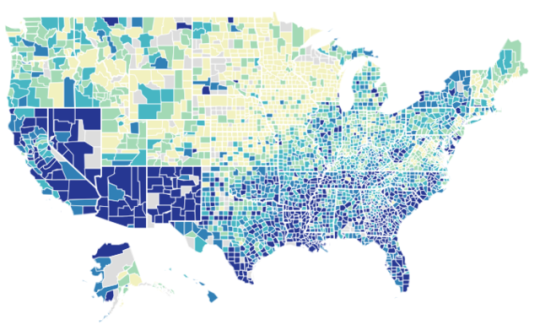
I was fortunate to have grown up in a relatively poor rural county with what is still very intact social capital: Fillmore County, MN ranks 37 out of 2,992 counties with data, or in the 99th percentile.
It ranks 7 out of 85 counties with data in Minnesota.
Subindex Percentiles:
Family Unity: 94th (a large % of families are intact)
Community Health: 93rd (people participate in civic activity)
Institutional Health: 98th (people donate to causes they value)
Collective Efficacy: 92nd (low crime)
It helps a great deal to have grown up in this kind of environment in terms of being a contributor to the social capital later in life.
QUESTION: How does a nation build social capital, when social capital mostly has to come FROM individuals, rather than be given TO individuals?
Congress has issued it's Social Capital Project, a useful rating of the The People's social capital, county by county. The Social Capital Index is composed of 7 sub-indexes: Family Unity, Family Interaction, Social Support, Community Health, Institutional Health, Collective Efficacy, and Philanthropic Health. The subindexes are all practical: The Family Unity subindex measures the % of births in past year to women who were unmarried, the of women ages 35-44 who are currently married (and not separated), and % of own children living in a single-parent family. The % of married couples with children is a positive factor.
The details are provided HERE and HERE
As one would expect, some parts of the country are in considerably worse shape as far as their social capital is concerned. Here is a national map by county: Dark colors = much less social capital, light colors = much more social capital.
I was fortunate to have grown up in a relatively poor rural county with what is still very intact social capital: Fillmore County, MN ranks 37 out of 2,992 counties with data, or in the 99th percentile.
It ranks 7 out of 85 counties with data in Minnesota.
Subindex Percentiles:
Family Unity: 94th (a large % of families are intact)
Community Health: 93rd (people participate in civic activity)
Institutional Health: 98th (people donate to causes they value)
Collective Efficacy: 92nd (low crime)
It helps a great deal to have grown up in this kind of environment in terms of being a contributor to the social capital later in life.
Comments (47)
Why is 'coming from' opposed to 'being given to'? Those subindices all feel like things that are 'given to' individuals in a such a way that they can then 'give' them to others.
Maybe there is an implicit thing here. When you talk about things being 'given to' individuals - are you talking about stuff that is passively received? A government handout that doesn't assess the character of those to whom it hands out?
What I mean by the to and from bit, is "How do individuals who don't have much social capital get it now as adults?" It obviously isn't a cash payment or something that is in question. It's the experience of neighboring, mutual assistance with ordinary tasks, volunteering, going to meetings (and being constructive, of course), stuff like that.
Those who have not done these things may not know how. How do we teach them "how". (Obviously, you invite them to meetings, you help them shovel their walk if they can't, you invite them to block parties--blah, blah, blah. But people who don't have this kind of capital don't necessarily know what to do with what is offered them. One has to pass it on, give what one has received. That's the difficult part to teach.)
I think losing the random element in human evolution, sciological or otherwise, is ultimately harmful.
My gut feeling, for what it's worth, tells me we should limit the Socratic principle of self-examination. The unknown may be harmful but probably not as much as omniscience (read manipulation).
I'll consider the "virtue", but you can keep your "Christian". Blasting someone like me with Christianity is not a very good tactic. Think of how lots of people react to Jehovah's Witnesses. Even nonreligious charities that go door knocking or cold calling get a lot of short shrift. So something a little more subtle or sophisticated than a cannon blast might work better.
What about hard virtue, soft virtue, red-white-and-blue virtue? Virtue means virtue.
Social capital can come from a sense of national belonging or unity, but I am not talking about this in a nationalistic sense as this can be abstract and broad. I am talking about this in a more traditional conservative sense where in the pre revolutionary era (before 1848) life was centred upon faith in God and the Kaiser (King). In a sense resulted together seemingly isolated villages, but led to strong communities in those villages where everyone would know each other and this would create a sense of unity, which links to the “village” idea of the discussion. In a sense the 1848 revolutions attempted to destroy this connection through a variety of ways such as liberalism and nationalism, changing the balance of power around the world, which ultimately affected the village community.
I live in a medium sized (pop. 14,000) suburban town in Massachusetts. Good schools. Good things for kids to do. Good town services. I've lived here since 1979 and I'd say I am involved in my community, although much less now than when my kids were young. There are just a few people, maybe a couple of hundred, who hold the community together. There are three or four stores and restaurants where people gather. The owners of those business tend to be heavily involved in the community. Other people run for town offices and organize community organizatons. They all seem to show up everywhere. They lead boy scout troops, coach, participate in schools, play Santa Claus at Christmas time. You see them everywhere you go.
Not sure how this relates to how we go about establishing social capital. However it's done, you will need this type of people in order for it to work.
Your hostility towards the term indicates poverty of the same kind.
Social capital, like the term or not, is [s]important[/s] vital to our future.
I hope we can get a worthwhile discussion going here.
I think it was a pretty good point that unenlightened made, too, in that it indicates how much this type of thinking has infiltrated our approach to problems, or, more specifically, to finding possible solutions to those problems. Said in the form of a question, What if the increasing dominance of that calculative/monetary way of thinking is the primary source of the growing social problem?
On the surface it does seem like an innocuous use of language, but it may actually reveal something deeper about way we relate to others, to ourselves, and to our world more generally in our (post)modern consumer culture. We see things as exploitable "resources" (e.g., human resources, information resources, natural resources) to be used as efficiently as possible, while other forms of non-calculative, non-instrumental ways of relating to others, and the the world more generally, are driven out. Examples abound. We want to maximize our possibilities as consumers, etc.
On a related note, I also think the fast-paced nature of life in the modern world - with a highly mobile workforce matching the needs of a complex, technologically-advanced global economy - has likely contributed a great deal to the loss of social capital. Commercial interests seem to reign supreme and the guiding values of these interests (speed, efficiency, productivity) have supplanted much less productive but more family, religious, and communally-based ones.
I live in nice, small (just over 10,000 people), community-oriented town despite it being located less than 15 miles from downtown LA. There are no stop lights, we have an all-volunteer fire department, and zero corporate stores or restaurants. Last night we voted on whether or not to keep the local library open, and the proponents pitched their defense almost entirely in economic terms, i.e., numerous studies have (apparently) shown that libraries (indirectly) make positive contributions to a city's economic development, etc.
Way down on the list of reasons to approve a new tax there was mention of things like libraries being "important community spaces where people can connect with books, with other people..." and whatnot, but it's clearly a sign of the times that damn near everything is subordinated to larger economic considerations. Education, healthcare, etc., etc., all have to be defended in these terms. I understand the importance of economic development and prudent spending, but I'm also of the antiquated opinion that we may have it backwards, and that the economy should be seen as a means to non-economic ends rather than the other way around. I'd even say a means to "higher" ends guided by a superior set of non-calculative values. I don't think we need to tie this hypothetical shift in values or alternative modes of thinking in with traditional religious values, either.
Apologies for sounding preachy here, and this is admittedly (and obviously) a pretty speculative approach, but understanding that underlying ontological framework - as articulated in the way we use language - may at the very least open up new ways of thinking about issues like this one. That's where the main battle is going to be waged imo - identifying and addressing the primary cause of the various symptoms - if we're ever going to reverse the current trend of a continued loss of "social capital."
My understanding of the term is that a volunteer fire service counts as social capital, whereas a paid fire service does not. This seems like an arbitrary moral distinction that makes paid work necessarily more 'selfish', and less 'social'. A society that institutes social care as an integral part of the economy has less social capital than one that relies on volunteers; a government funded and organised universal health system has less social capital than a pay as you go system with a bit of voluntary assistance for the poor.
What is it about governments (and companies?) that excludes them? It seems to me that they have exempted themselves from all social obligations, and that use of the notion of social capital legitimises this. 'It's terribly important that we are kind to each other and cooperate, but this is not the business of business or government.' What? Really?
My purpose in bringing this up was simply to show that the town I live in has a relatively high level of social capital. I guess the distinction between volunteer and paid work would come down to motivation: are you driven by making money or a genuine care for the community? The two are not necessarily mutually exclusive, of course, and you make a good point about that, as well as other things. There are a lot of wealthy people around here (not me) - many of whom have been the beneficiaries of the accumulated family wealth of previous generations - so they can afford to be virtuous in that way.
Quoting unenlightened
That's a good point, but it seems like a big part of the guiding narrative for those of us who live in the US - as opposed to the UK and almost everywhere else in the world it seems - is an overall suspicion of government (think separation of powers, federalism, etc.) and a corresponding emphasis on the importance of non-political or sub-(national)political things like individual responsibility, private charity, local politics, etc. We're not bound together so much by race or a shared history/culture or other such things, but instead by a commitment to abstract ideals grounded in notions of individual natural rights, with the primary purpose of government being to protect these rights.
There have been various waves of progressivism in the US over the past 100+ years which have taken a more positive approach to government (and a more hostile stance towards businesses lacking a sense of social responsibility), including the more prominent role it could and should play in bettering citizens' lives - e.g. Woodrow Wilson, FDR, Lyndon Johnson, and Obama - but there's always been significant resistance to these "activist" and purportedly unconstitutional endeavors. This antagonism continues to play itself out now, obviously, in a number of ways.
Anyhow, I'm not saying that I agree with the sentiment that's skeptical of what it considers to be government overreach - nor in my disagreement do I dismiss it as completely absurd - but it is there (or rather here) and has been pointed out by European interpreters of our country from the time of its inception up to today, such as Tocqueville in his Democracy in America (great book!) back to the 1830's, I believe. The idea persists among a large segment of the American population, and may help (in part) explain BC's setting up the social/political juxtaposition.
I can understand why the term would be used. It's a way to "monetize" social and cultural values so they can fit into standard economic understandings. I have no problem with that. I can also understand Unenlightened's skepticism. At the company I worked at for 28 years, I saw the company's relationship with workers go from personnel, to employee relations, to human resources, to human capital as the company got bigger and went public and we more and more became cogs in the machine.
I find myself imagining @Bitter Crank's frustration at your and @unenlightened's unwillingness to discuss the issue he has raised and turning it into a discussion about language. You know what he's trying to talk about. Talk about it.
Sorry for putting words in your mouth, BC.
It's a frustrating habit of philosophers to question the question, and problematise the terms of debate. But this is not mere political correctness. If I may make it personal for an illustration, I have at one time signed on as unemployed and worked for a charity without pay, and at another been employed by another charity. The former seems to count as a contribution to social capital, and the latter not. Frankly, it's bollocks. I do what I need to to live, and I do what I can to help. Why insist that they be separate?
I don't doubt the value of what you're saying, I just don't think it's what BC started the discussion for. I won't continue with this since I'm basically doing the same thing I accuse you of doing, i.e. distracting from the subject of the OP.
In that regard, I don't really know what to do to increase social capital, or whatever you want to call it. All I can think of is personal action. I've been reasonably conscientious with that in my life. As I mentioned before, people who contribute much more than I ever have form the foundation of our communities.
Maybe that's why I'm a liberal, the desire to use social institutions to make things better for people. On the other side, a lot of authentic conservatives see the therapeutic/entitlement society as leading to the breakdown of community. I'm a fan of Christopher Lasch, although I haven't read any for a long time. Maybe it's time to reread. He wrote a lot about this sort of thing.
So, you, Unenlightened, and Erik don't like "social capital." What's the right word for what BC is talking about? Social values? Civic virtue? Community spirit? Quality of life? Or do you really have no idea what he is trying to get at?
I live in the suburbs where the lawns are well manicured, unemployment is very low, education is high, families are intact, most are financially independent, and crime is low. There is much fat of the land I suppose, but not that many really need it. It would also be unusual for me not to migrate to a community that was pretty well functioning, as opposed to subjecting myself to a more struggling community.
And here's another problem: Communities support pales in comparison to family support, meaning the community, while well intentioned, will never get those less fortunate ones to the level of those who were graced by good circumstances. So, sure, being near good families is going to make things a bit better for those in bad families, but the real solution is to make good families.
Is it really a matter of teaching someone to get involved? Some people are just joiners, they get involved, they enjoy the social element of it all. I'm in my local Kiwanis, for example, but it's hard to call me the backbone of my community because I enjoy talking to the local bankers over a free sammich every other Tuesday and hearing some speaker tell me about goings on at the local children's hospital. My real contribution is that I raised a couple of kids who did well in school and local law enforcement doesn't know their names (and the Chief is in Kiwanis too, another added benefit should things go awry). Sure I pay my taxes, I cut my lawn after getting my warning from the HOA (and I'm the President there as well, so there's that perk should things go awry), and I sometime help plant trees down at the local plant the trees thing. All those details just make me a guy who likes to occupy his time in clubs and whatever, but I really harbor no illusions that my little contributions here and there do a tremendous amount. But, if my kids were hellions, that'd be another matter.
I think secularization erodes social capital. First, I think people need to feel like they have values in common with another person or organization in order to be willing to contribute their time/effort/money. Why would you voluntarily contribute anything to a person or organization if you think there is a good chance that they will use that resource in a way that does not comport with your values? Religion tends to create a set of shared values among adherents and secularization tends to reduce the number of shared values.
Second, religion changes peoples' perception of gain. It may cause you to believe that there is greater gain to be had from the activities that contribute to social capital (volunteering, charity, etc.) either due to rewards after death or greater feeling of fulfillment even in life. This isn't to say that no non-religious person ever expects to feel greater fulfillment from doing these sorts of activities, but whatever perceived gain exists in a materialistic view of the world would also exist in a religious view of the world. Religion also may reduce the perceived gain from those activities that compete with activities that contribute to social capital. If this life is not all there is, then there is less perceived gain in maximizing your material (and recreational) well-being in this life, such as by working as much as possible, which makes you more likely to choose an activity that contributes to social capital.
So, I think that for the government to develop social capital, the most effective thing it can do is reduce the availability of social safety nets, but I'm sure some would consider this treatment worse than the disease. I don't think there is much the government can do on the religious front except to be vigilant in not suppressing it. Getting rid of public schools would probably help a lot because a lot of people would probably turn to religious education instead, but I again think that many people would consider this beyond contemplation.
I don't think it is a mistake to use economic terminology to describe non-monetary behavior because both monetary and non-monetary activity operate on the basis of perceived gain. It is just that monetary behavior can be quantified much more easily (because of markets) and so it is easier to conceptualize and to create a vocabulary around. Now that the concepts and vocabulary have developed in that simpler context, they can be used to elucidate human action that is more amorphous.
Well, think about the Social Credit Score system being put in place in China right now. Do you want to live in a world where your rights are in parts determined by how close-knit your family is? How quickly you reply to official letters? How many children you can be expected to have?
The step from simply quantifying Social Capital to ordaining society around such a score may seems dystopian, but it's the direction the world is taking.
In this case, rather, the paternalism is freaking disgusting. Why the hell should I tolerate that someone calls me "poor" in Social Capital just because I never speak to my family? Unless you've analyzed my finances, my lifestyle and my friendships, then you have no clue whatsoever.
A lot of places are very poor in social capital. You could live in a neighborhood where there was always trash in the street because your neighbors left it there. You could live in a community where property crime is endemic. You could live in a town where the police are corrupt, and nobody much cares. You could live where most male children will have arrest records by adulthood. You could live in a village where out-of-wedlock children are the rule--women with maybe 5 children and no regular partner, let alone a husband. You could live in a neighborhood where junked cars stay where they died for months at a stretch. You could live in a neighborhood without a fire department, volunteer or otherwise.
Social capital makes a big difference in everyone's lives.
Quoting Akanthinos
Nobody called you poor in social capital, because it isn't an individual issue. "Ecology" isn't about one particular weed amongst the nice flowers, it's about all the plants, weeds, flowers, trees, crops, bushes, grass, bacteria in the soil, worms, birds, and gophers all grouped together and measured en masse. Similarly, social capital is about all the people in the community, not the case histories of each individual.
If nobody in your county of residence speaks to their family, they have one hell of a deficit. If you don't speak to your family, it's statistically irrelevant.
So why don't you talk to your family?
It is astonishing that you find an effort to assess "the degree to which people in a community contribute to one another's wellbeing" as a plot to further dehumanize the world.
Quoting StreetlightX
Assessing the "wholesomeness" and "social vitality" of communities is another chapter in the fragmentation of the human psyche? Asking about mutual assistance contributes to anomie?
What planet are you living on?
All to the good of course, that you earn your daily bread and help others as the occasions arise and as you are able at the time to help others. In such a life you contribute to the healthy community ecology in which you live. You could do otherwise -- like, " help only yourself by taking cash from social services and "do nothing to help anyone".
Unenlightened bends over backward till his ears are between his ankles.
I don't know about England or Australia, but in the US large cities have paid fire departments because swift and expert response is critical in a large city with many hazardous substances, high-rise buildings, dense population, and many buildings built close together. In a small rural town, the fires will either be an individual house fire (normally not very close to another house) or a barn fire, fueled by stored dried hay. When small towns do have larger fires, they summon help from other volunteer departments. In large cities, additional paid help is summoned from additional fire stations.
Fire departments are a part of healthy social ecology (a term I am using just for you since you can not stand "social capital" apparently.)
Well, it's not like I don't have already a dozen institution who'se only purpose in life is to quantify my social and national usefulness. And the distinction between the social and the individual is a red herring. You cannot dissociate the amalgam from the amalgamated, or vice-versa, simply because "it's not the issue". The issue here is the social capital that can become yet another point of pressure and conformity in a society increasingly devoted to "soft control", so to speak.
I think the problem people are having with 'social capital' isn't that they think the stuff talked about in the OP is unimportant. Like, all of those subindexes all point to (in my opinion) absolutely vital stuff which any community will be utterly fucked if it loses.
I think the problem with the term is more like this. All of those disparate aspects of life can only come under a single heading once they've up and left. To take an analogy: empty nest syndrome. Let's say you married early, had kids (five red-cheeked cherubs) and spent the next thirty years tending to them. They leave. You feel awful.
Now how/why do you feel awful?
You could, if you wanted, break it into categories. (1)Felt Lack of Purpose Upon Awakening ( no one to help get ready for school) (2) Lack of Interest in Hobbies (You used to spend the days baking food, or mending clothes etcc.) (3) Decline of Communal Dinners (family is gone)
etc etc
Now say someone came into town, came to your apartment, tallied you on these categories and said aha! lack of Family Capital. Then they say....
Well, what do they say? When some community is lacking [x] and its a very big deal, and its a national deal, who comes in to help? Who comes in to fix things? Social Capital expert is who. The person who comes into town and looks around and says hey you guys enough of that, time to start working on social capital! What's your experience with experts like this? Do they not, almost uniformally, seem disconnected from the place they're trying to vitalize? If they threw a bingo night, wouldn't they kind of leave out the special sauce that made doug's bingo night work? And isn't that kind of linked to the fact that they're consciously trying to fix the Social Capital Deficit that they did their undergrad work on, whereas Doug was just trying to have a good night? Intuitively knew what would work and what wouldn't?
Your kids left. It fucking sucks. What do you now? Someone who breaks your homelife into categories and appraises them and then offers a Homelife Capital solution - how helpful is that going to be?
tldr: 'social capital' may very well be pointing to a real problem. It almost certainly is. But the very approach implied in 'social capital' qua deficiencyindicates a failure to grapple with whats going on. "Social Capital" is a technocratic word, and it tows in its wake a technocratic approach. But what if technocracy is the thing that cut social capital out in the first place (my opinion: It is. Look at the people who were whispering to Reagan and Thatcher as they put into place the policies that gutted rural communities. And look at the people whispering to Clinton while he did the same stuff with a democrat face. Why would we listen to that same sort of person, with that same way of talking, to discuss solutions?)
The New York Times and other newspapers have on a number of occasions published maps of the US which display state-by-state or county-by-county characteristics. One of the lessons of the maps is that the US is not nationally homogenous, and in fact is more homogenous within regions. Stephen Pinker has observed similar things about the US in his book Better Angels of our Nature.
The northern tier of states (more or less), or the far NW American states + the Upper Midwest + the NE American states have a much lower level of suspicion toward government than the SE, southern, and SW parts of the country do. It isn't entirely coincidental that the areas on the map at the beginning of this thread show healthier levels of social capital (or healthy human ecology) across the north, and much lower levels across the south.
The historical experiences, the politics, and the religions of the 3 northern regions opposing the 3 southern regions are different, and contribute to the quality of social capital that exist. The theme of resenting centralized authority (whether at the federal, state, or county level) is much higher across the south than the north. A preference for hard-edged individuality "I'm not responsible for your problems", and "it is up to you to take care of your own family" are more typical of the south than the north.
So, there are many parts of the US where you won't find individuals spouting suspicion towards government.
But think of the children! What planet could one be living on to see treating children as data as thoroughly detrimental to education???
But of course so too with 'social capital', which is as a much a disease as it is a cure. A Phramakon, if you will. It's really quite simple. Focus on infrastructure. Focus on healthcare. Focus on good education - new textbooks, good teachers, flexible extra-curricular programs. A well maintained, affordable, and extensive system of public transport. Well kept public spaces for recreation. The 'social capital' will flow from there. Not some arbitrary metricized rubbish, invention of technocrats and people with no ability to understand the shape of individual lives.
I am thoroughly baffled that something I consider at least benign, but actually very desirable, social capital, to have elicited such negative responses. What is objectionable about determining the percent of families that are married couples with children? Two parents produce better outcomes for their children than one parent. It isn't mysterious why--there are four hands instead of two to do the work of raising the children, and generally two incomes instead of one, with lighter material burdens on both parents. Communities whose citizens are involved in civic affairs generally provide more satisfaction to residents than places where there is no civic engagement, or active hostility toward civic engagement.
Quoting StreetlightX
Why does one community have good healthcare, good education with new textbooks, good teachers and well maintained buildings? How does it happen that City "A" has a "well maintained, affordable, and extensive system of public transport" and in city B, there is a minimal, barely functioning transit system? Why does one city have parks and recreation while another has only concrete and cars?
Whether it was present at the beginning of a city's history, or came about as a later reform measure, the infrastructure that makes a good city had to have advocates, interested citizens, and many citizens willing to accept a higher tax burden to get these public goods. (At least in the US, city infrastructure is often paid for by either property taxes or bonds repayable through property tax.) Good infrastructure usually doesn't come from heaven as a gift.
I mentioned in the OP that the county I grew up in (Fillmore) was not wealthy. It is quite hilly farmland, small farms, and very small towns. There is very little industry, no mining, and only small tourist attractions like a cave, a bike trail, and canoeing on a small river. Its population is about 20,000 in 860 square miles. It's about 92% NW European ethnicity.
Still, by measures of social capital, it is # 36 out of 2600 counties in the US. Why? Because it has very stable population, long-lasting community relationships (little geographic mobility), a stable but hardly vibrant economy, strong families, and good community institutions--churches, schools, and small town organizations. People have been willing over the last 100 years to tax themselves, volunteer, and pay for their communities' good features. That's what social capital is about -- the people.
There are neighborhoods in Minneapolis, wherein I live now, that have maybe 20,000 people living in comparative density, and simply can not pull together cohesively for any common purpose. Why? They lack social capital. Their population is very mobile (here today, elsewhere tomorrow), not very interested in pursuing education, not civically engaged, fragmented families, and associated poverty and crime. Other neighborhoods, same size, same diversity, same population, same city, are much more engaged and consequently obtain more infrastructure (like frequent bus service, better school maintenance, more street repair...). The overall infrastructure in the city is the same, but some areas engage with it and are nice areas in which to raise families (or live singly). There is less poverty, less dysfunction, less crime.
I'll grant you, good infrastructure is a public good, but citizens have to be willing to work for it, and use it for maximum benefit.
The issue, to begin with, is one of methodology: your approach, or at least the approach you've outlined here, looks to me like one of social atomism, where it's some kind of ephemeral 'good psychology' ('interested, willing citizens') that counts as what motivates good societies. But this is, to put it lightly, a discredited form of thinking when it comes to sociology: people are 'interested and willing' when they are given the means to do so, when they have the tools, instruments, and institutions that support, foster and encourage the cultivation of such interests and 'wills'. Interests and wills also do not come from heaven as a gift.
But this is more than just a discredited form of sociology: it also has disastrous policy consequences. The line that 'good infrastructure is a public good, but citizens have to be willing to work for it, and use it for maximum benefit', has been the justification and rationale for legions of neoliberal policymakers to divest public funds from public goods, and to demand that emphasis be placed on psychology before actual tangible investment. It conditions investment on 'good psychology' and ephemeral 'wills', mistaking effect for cause.
I meant it when I said that the elevation of 'social capital' as a concept comes at a time when it seems to be in crisis: but what is unspoken in all this is that the crisis of social capital is the very reason for it's elevated status: to throw the individual into crisis is the surest way to place focus on the individual and not on the institutions and the world in which he or she resides. Regardless of its well-intent, one cannot ignore the strategic role this kind of thinking does and has played out in real time.
There is a legitimate question here of virtuous and vicious cycles of social cohesion, path-dependent on local histories, and hwo to shift the one into the other, but 'social capital' as a rule, has no historical dimension. It's just metrical abstraction. I think you would do well to engage with @csalisbury's post here, which gets at alot of the concrete problems with the concept. He's right to note that 'social capital' names a real problem; but it's its manner of framing that causes all sorts of issues.
It's not like this one concept is an anomaly working in isolation - as a technical term used by experts who make their living studying issues like this within universities - within an otherwise poetic or at least less monetized public discourse. No, uses like this pervade everyday language and frame the way we perceive and respond to the world around us, setting up a system of values in which beings are reduced to a collection of exploitable resources to be studied, measured, manipulated, managed, etc. Human beings included.
When language is understood along these lines - e.g. as the "house of being" or as expressing a particular "form of life" - then simple shifts in language represent concomitant shifts in the way we understand ourselves and our world. Heidegger was apparently horrified, for instance, when young students around campus began talking about the "Uni" rather than the University. Seems like an absurd overreaction, but what we see as completely benign and/or more efficient/technical uses of language, he saw as intimating a new and more impoverished disclosure of our world.
To bring this full circle, if this world of advanced technology, global capitalism, managerial elites, research universities, etc. has led to a cumulative loss of social capital - and I think a compelling case can be made that it has - then nothing short of an equally radical transformation in the way we understand ourselves and our world can reverse that trend. That hypothetical shift would involve a corresponding shift in language. A sort of word mysticism, I suppose.
Good topic, though, @Bitter Crank. It's a ridiculously complex issue with so many contributing factors, but in many ways it's the one I find most worthy of study and reflection. My apologies if I offended you or anyone else here. Just wanted to take the clever response of @unenlightened and run with it. I've been impressed with the responses so far and feel like I've learned a few things from the contributors that I'll appropriate for my own ends.
Where did the information and terminology for the Social Capitol Project come from?
The American Community Survey, the National Survey of Children's Health, and the Behavioral Risk Factor Surveillance System are produced respectively by The US Census Bureau, Bureau of Labor Statistics, and National Center for Health Statistics at the Centers for Disease Control
The Internal Revenue Service, Master Business File (information on non-profits)
The Election Administration and Voting Survey (voting behavior)
The US Census Bureau (breakdowns of 10 Year and Special Surveys)
The Uniform Crime Reporting Statistics, FBI
University of Michigan Population Studies Center, Institute for Social Research
The rankings of states and counties was based on the following statistics. You can certainly quarrel with their choices, but this is what they used:
Share of births in past year to women who were unmarried
Share of women ages 35-44 whoare currently married (and not separated)
Share of own children living in a single-parent family
Share who report child spends at least 4 hours per weekday in front of a TV
Share who report child spends atleast 4 hours per weekday on electronic device, excluding homework
Share who report someone in the family read to child every day in past week
Share saying they get the emotional support they need only sometimes, rarely, or never
Average number of close friends reported by adults
Share of adults reporting they and their neighbors do favors for each other at least 1x/month
Share of adults reporting they can trust all or most of their neighbor
Share of adults who report having volunteered for a group in the past year
Share who report having attended a public meeting re. community affairs in past year
Share who report having worked with neighbors to fix/improve something in past year
Share of adults who served on a committee or as an officer of a group
Share who attended a meeting where political issues were discussed in past year
Share who took part in march/rally/protest/demonstration in past year
Registered non-religious non-profits plus religious congregations per 1,000
Average (over 2012 and 2016) of votes in the presidential election per citizen age 18+
Mail-back response rates for 2010 census
Share of adults reporting some or great confidence in corporations to do what is right
Share of adults reporting some or great confidence in the media to do what is right
Share of adults reporting some or great confidence in public school to do what is right
Violent crimes per 100,000
Share who report having made a donation of >$25 to a charitable group in past year
"It takes a village to raise a child."
If I may make so bold, it still takes a village to raise a child badly. If parenting is not valued by the community, if schools are terrible, if the police are corrupt or biased, if the women are all unmarried, and the men are all selfish, it still takes all these people and institutions to raise a child.
Quoting StreetlightX
As if societies are made of individuals, rather than that individuals are made of societies. As if it takes a child, or some number of children, to raise a village. How can it have been so backwardly understood?
We are talking of something of supreme importance - 'the good'. We are talking of love. And it is abominable to reduce love to a piece of paper from the city hall. To measure the strength of love, as of anything, is to find its breaking point. And then it is broken. I'm sorry to resort to the religious, but the sacred is immeasurable.
There is a social cohesion that arises from fear and hatred of a common enemy; there is a social cohesion that arises from intolerance for difference. There are marriages sustained in hatred by fear of social ostracism. Is this what is being measured? Is this the social capital being lauded?
As Michael Rosen points out above, the measurement of education is the devaluing of education, and not the valuing of it. The measurement of your relationships is the devaluing of them, and in the end the destruction of them.
Test the love of your partner by seeing if they still love you when you are horrible: eventually you will reach the breaking point, and be left with no relationship and a habit of making a deal out of a gift.
Thou shalt not test love, nor measure it.
Here endeth the lesson. The choir will now sing:
I'll consider it at least.