
The Body as a Diagram of Forces (with Diagrams!)
Streetlight 2018-03-26
In a famous line from D'Arcy Thompson's On Growth and Form, Thompson refers to the body as a 'diagram of forces'. This is a particularly evocative phrase, but one whose meaning is best displayed pictorially:

On the right is a thigh bone (femur) while on the right is a crane head - the lines indicate 'stress contours', or vectors of tension and compression. Thompson relays the story of how one day, an colleague of his, an engineer, happened to walk past the drawing of the femur, pinned to the wall of an anatomists's board, and, with the shock of recognition exclaimed: 'that's my crane!'. Like the crane, the bone's morphology (form and shape) exhibited nothing less than the play of forces which shaped it, and moreover, which made the bone perfectly suited to it's task of load-bearing. It's with examples like this in mind, along with numerous others, which lead Thompson to claim that the body is nothing other than a 'diagram of forces'.
Philosophically, I think is an incredibly powerful and interesting way of thinking about bodies, insofar as it takes the focus away from bodies as, well, static lumps of meat and bone, and instead frames the body as a dynamic outcome of environment and action, placing it into a milieu which works upon it over time, dynamising and temporalizing the body as less a thing than a process, always ongoing. To make the point even clearer, and to speak of whole bodies rather than just parts, one might take the striking example of ink drops in water:
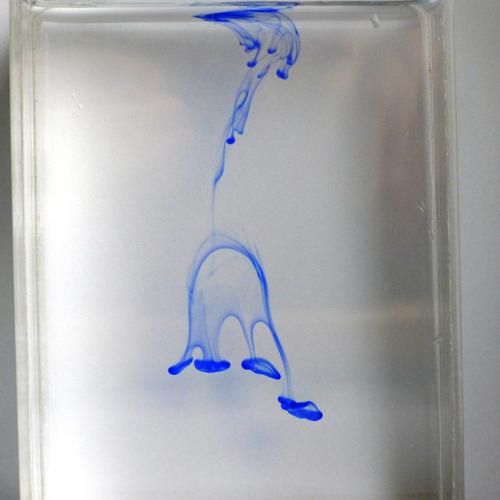
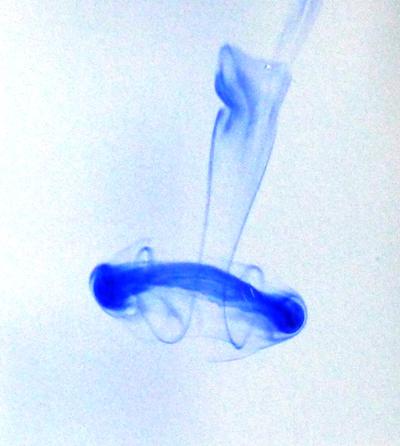
It is mere coincidence that the ink drops look so much like the forms of jellyfish? While this latter example is more speculative than the first, one can at least see in them the same principles at work in the crane and the bone: the coupling of form and movement, process and embodiment. But more than just in natural terms, one can even see this play out in what is probably one of my favourite works of art, Umberto Boccioni's Unique Forms of Continuity in Space, which I had the pleasure of seeing in the flesh a couple of years back:
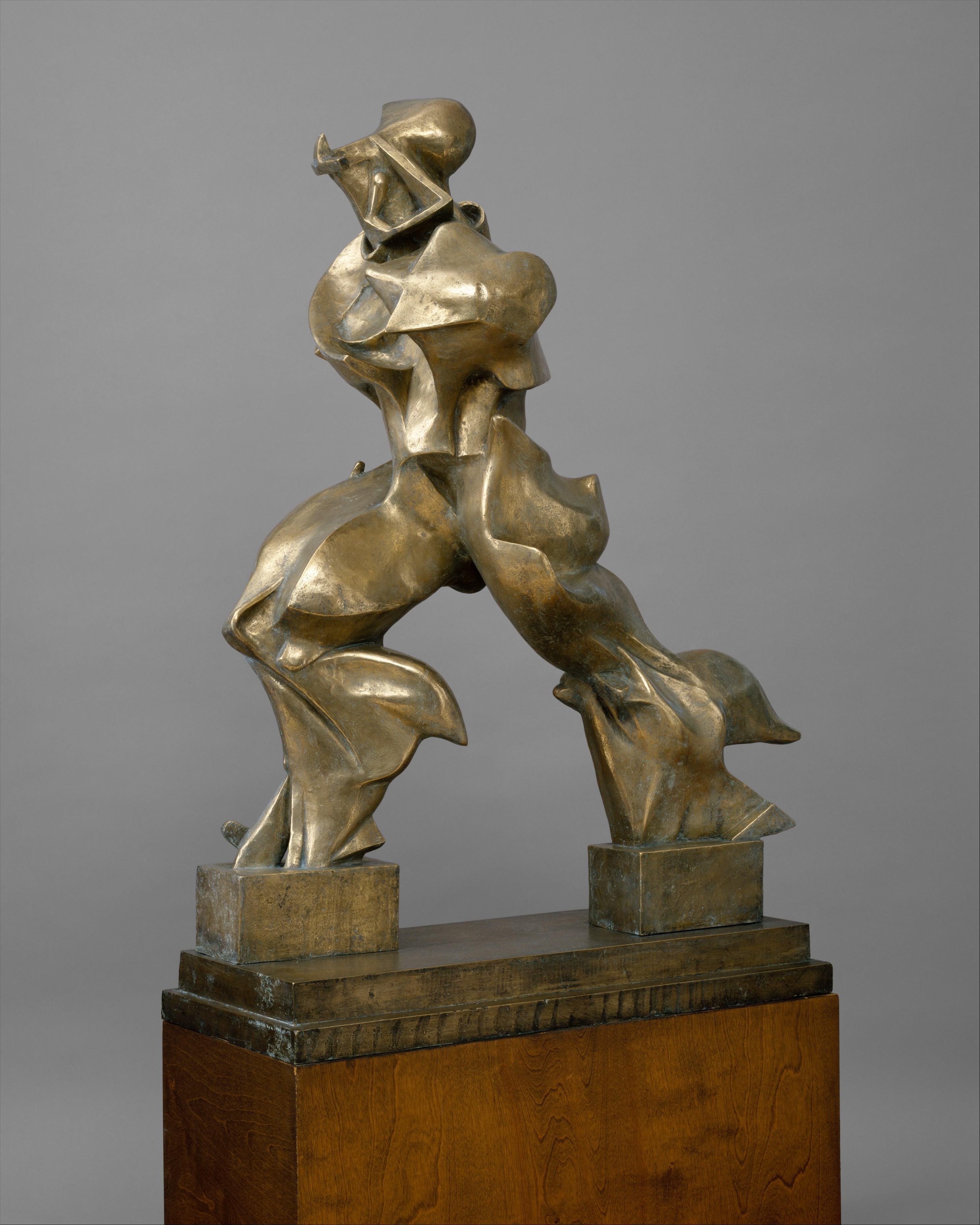
Boccioni was an Italian Futurist, who, like all Futurists, was concerned above all with speed and flux, principles which largely informed their approach to art. What's so cool about the sculpture is that it aims less at capturing a 'body' than a stride, a form-of-motion, motion given form, and not simply a body that so-happens to move. Movement is primary, even as the depiction itself is static (statuesque?!). The title of the piece - Unique Forms of Continuity in Space - also emphasises this, the continuity of body with space. In any case, what all the above illustrate are ways of thinking the body as a 'diagram of forces'. Like Boccioni's sculpture, diagrams are interesting because they always 'point elsewhere'; they capture, in static form, dynamics: one sees in diagrams movement(s), lines of force, directions, orientations. And bodies are always best, I think, thought of in exactly those terms.
On the right is a thigh bone (femur) while on the right is a crane head - the lines indicate 'stress contours', or vectors of tension and compression. Thompson relays the story of how one day, an colleague of his, an engineer, happened to walk past the drawing of the femur, pinned to the wall of an anatomists's board, and, with the shock of recognition exclaimed: 'that's my crane!'. Like the crane, the bone's morphology (form and shape) exhibited nothing less than the play of forces which shaped it, and moreover, which made the bone perfectly suited to it's task of load-bearing. It's with examples like this in mind, along with numerous others, which lead Thompson to claim that the body is nothing other than a 'diagram of forces'.
Philosophically, I think is an incredibly powerful and interesting way of thinking about bodies, insofar as it takes the focus away from bodies as, well, static lumps of meat and bone, and instead frames the body as a dynamic outcome of environment and action, placing it into a milieu which works upon it over time, dynamising and temporalizing the body as less a thing than a process, always ongoing. To make the point even clearer, and to speak of whole bodies rather than just parts, one might take the striking example of ink drops in water:
It is mere coincidence that the ink drops look so much like the forms of jellyfish? While this latter example is more speculative than the first, one can at least see in them the same principles at work in the crane and the bone: the coupling of form and movement, process and embodiment. But more than just in natural terms, one can even see this play out in what is probably one of my favourite works of art, Umberto Boccioni's Unique Forms of Continuity in Space, which I had the pleasure of seeing in the flesh a couple of years back:
Boccioni was an Italian Futurist, who, like all Futurists, was concerned above all with speed and flux, principles which largely informed their approach to art. What's so cool about the sculpture is that it aims less at capturing a 'body' than a stride, a form-of-motion, motion given form, and not simply a body that so-happens to move. Movement is primary, even as the depiction itself is static (statuesque?!). The title of the piece - Unique Forms of Continuity in Space - also emphasises this, the continuity of body with space. In any case, what all the above illustrate are ways of thinking the body as a 'diagram of forces'. Like Boccioni's sculpture, diagrams are interesting because they always 'point elsewhere'; they capture, in static form, dynamics: one sees in diagrams movement(s), lines of force, directions, orientations. And bodies are always best, I think, thought of in exactly those terms.
Comments (13)
Bodies of cities as diagrams of population flows:
(data visualisation of traffic flows in London)
Airflows across an F-18:
All more examples of bodies - broadly construed - as diagrams of forces. Another way to put this of course is that all of these things are ecosystems...
That was one of the points about effective field theories. They model a hierarchical or fractal development of scale - the bit that renormalisation describes as a homogenous ground state. Yet - rather artificially - limits must be inserted to prevent infinities that would blow things up. Some kind of "regulator" - like the imposition of a lattice, fractional dimensions or mass cancelling particles - has to be added to the ontology.
So nature is growth plus switches. Bodies are formed by dynamical and self-organising growth processes. But genes need to provide the schedule that knows when to turn the growth on and when to turn it off.
Shear-moment diagram:
Mohr's circle - this one for soils:
Everything looks like something else when you are a pattern seeking animal. Ink drops fall, and by the reverse effort a jellyfish propels itself upwards. But there are other ways to do this.
By the way, what is a "crane-head?" Doesn't look like a part to any crane I've ever seen, machine or bird.
It's the head of a fairbairn crane:
Also, thanks for the force diagrams but the most pertinant point is not to see forces diagrammed in the abstract (as 'graphs') but to see bodies themselves as directly diagamming forces. Bodies are diagramms (of forces).
https://www.wired.com/2015/03/empzeal-eiffel-tower/
"The Eiffel tower is incredibly well optimised to do what it was designed to do, to stand tall and stand strong, while using a minimum of material. Rather than hide its inner workings with a facade, Eiffel exposed the skeleton of his masterpiece. In doing so, he revealed its "hidden rules of harmony", many of the same rules that give your skeleton its lightweight strength."
I understand, but what took me some time to recognize in school, is the way forces move through the element as a function of position rather than time. That's what struck me as similar. A Mohr's circle or shear moment diagram presents all the views of forces in the elements at one time. A single view of everything that's going on in three dimensions.
Like everything else here, Otto's structures are force diagrams. The sculptor Tobias Putrih creates bubble sculptures inspired by Otto's work:
Ah, I see what you mean. I suppose what I 'don't like' about such diagrams is precisely that the abstract away the time element, and correlatively, the body. One way to think about this is that embodiment always entails an 'entemporalment': to have a body is to exist in time (which is why Plato - as Nietzsche put it - was a 'despiser of the body', and much preferred eternity to time - these two things are not unrelated). Trying to insist on the irreducible 'forceful' nature of time (and space) is something I tried to explore in my other recent thread on time and space.
The beams represented by shear and moment diagrams are actual bodies supporting actual loads (sustaining forces) in static equillibrium, hence; the time element is irrelevant. However, the space (geometry) element is not.