
Are prayer and meditation essentially the same activity?
Bret Bernhoft 2026-01-31
In full disclosure I pray and meditate every day, throughout each day. As an atheist. I come with this question from a place of respect, quasi-familiarity and neutrality.
In terms of definitions, here are my suggestions:
Prayer: Prayer is an invocation or act that seeks to activate a rapport with an object of worship through deliberate communication. - Source
Meditation: To engage in contemplation or reflection. - Source
With the above said, I often wonder if prayers and meditations are ultimately the same activity? Or perhaps distinct variations of the same thing, a parent category?
In my experience there are only minor distinctions between the two. More significantly, both are a form of yoga, it seems. In so many different forms across the planet throughout history.
Maybe meditation is more physical, whereas prayer is mental? But probably not.
What about the Sufi Whirling Dervishes?
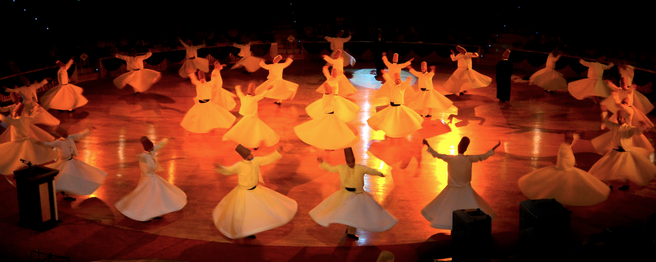
Any insights you can shed on this subject is valued.
In terms of definitions, here are my suggestions:
Prayer: Prayer is an invocation or act that seeks to activate a rapport with an object of worship through deliberate communication. - Source
Meditation: To engage in contemplation or reflection. - Source
With the above said, I often wonder if prayers and meditations are ultimately the same activity? Or perhaps distinct variations of the same thing, a parent category?
In my experience there are only minor distinctions between the two. More significantly, both are a form of yoga, it seems. In so many different forms across the planet throughout history.
Maybe meditation is more physical, whereas prayer is mental? But probably not.
What about the Sufi Whirling Dervishes?
Any insights you can shed on this subject is valued.
Comments (17)
One might ask this: how many who presume to pray are truly opening themselves to God, and how many are merely rehearsing their own desires, making nothing more than a crass shopping list of wants?
Maybe so, maybe not. Meditation [I]toward God[/I] might be indistinguishable from prayer [I]toward God[/I]. If not toward God, then toward the ineffable.
Prayer can and maybe should be more than a shopping list of wishes and needs--depending on the religious sophistication of the person praying. "Oh Lord, won't you buy me a Mercedes Benz" is not what I would call a worthy prayer. (Sorry, Ms. Joplin). I'm not Catholic, but I gather that people sometimes say the Rosary in a quite perfunctory manner, though that's only external appearances. The prayer series may help them in a meditative or prayerful way.
Prayer should certainly not be transactional -- "Dear God, IF I do not fornicate with (list names, even though the omnipresent God will be there each time) this week, would you send $3,000 for me to make the overdue mortgage payments?" Does God make deals like Donald? Does God care $3000 whether you fornicate with (list names) or not? Would God be moved by a successful henceforth and forever more vow of chastity? Perhaps your forfeiting the house to the bank is part of God's plan? Maybe He is making arrangements to house a homeless immigrant family? You want to help God, don't you?
Fortunately for our earthly reputations, most of pray silently, so we aren't leaving behind a string of public confessions.
I don't know how many people meditate for "spiritual" purposes. I found mediation most useful for maintaining mental health.
There are monks and nuns who pray for a living. They do pray for specific needs (usually not their own, but on behalf of others) and I gather that they pray toward God.
BTW, from my limited experience I find somebody else's prayers perfectly fine. If the Psalms have been in use for thousands of years, it's because they are effective--for us, especially.
There is quite some overlap.
There was a book called 'flow' by a guy with a really long eastern name which said that essentially ALL flow activities are the same, be it meditation, playing in the pocket, whatever. I don't think I would agree with that, but an interesting concept to explore. Just being 'in the zone' is not the same as being enlightened although they might share some similarities. I know this is not what you are asking but it is related in comparing 'flow states' with one another.
In my thread I have discussed many times that both eastern and western religious people have reached what might be called a state of enlightenment. A notable figure of the west is Meister Eckhart. He would not have meditated I doubt, probably doing traditional prayer, but still achieved some higher state of consciousness. I don't know much about him but noticed him mentioned several times as an awakened one of the western tradition by contemporary voices.
I like how you frame the difference between prayer and meditation. Where meditation is a sort of "warm-up" for the "main show", which is prayer.
And your point about the degree to which meditation and prayer overlap being dependent on the definitions one holds. This is an interesting statement and makes me think.
Your closing question though, regarding how many actually pray for a closer relationship with God, is perhaps the most important and personal part of your response. So primary to what prayer and meditation are all about in the first place.
I answered no. They are not the same thing. With prayers, we take our chances, with humility, to be heard. We acknowledge the power and graciousness of the God. So, whatever we pray for, asking for help or giving thanks, we are exposing our vulnerability and fears while being aware that we might not be heard after all because God has other plans for us.
A lot of meditation forms involve the repetition of mantras, which is quite similar to the citation of prayers and a way of influencing the subconscious, which can be very powerful in its effect if practiced with discipline.
Prayer is a beautiful act of union with greater mysteries. Which seems to happen or occur within the person praying, first and foremost.
It would be difficult to convince me there is such a thing as an "ugly prayer" or "distasteful prayer". Especially when praying is done with sincerity.
Like you said, another person's prayers are perfectly fine.
Jesus. Did you measure the distance in kilometers or feet?
I say, this is one of those cases where any difference seals it, and no amount of negotiation as to how far or close the definition is should change the nature of each.
But doesn't that just beg the question? Ours is a world of words where we insist upon definitions to all things including those which are not necessarily amenable to precise definition. And sometimes the only reason we define some things is for the very purpose of comparing and contrasting theme to other things. And is there really any consensus regarding the nature of either? Ultimately, both seem to be directed toward the stillness of being and that may be all we can truly say about the nature of either.
In what way it begs the question?
Spiritual meditation, while it does have the word spiritual in it, is the purification of mind and body, achieving the connection with the divine by letting go, momentarily, of the worldly/materialistic connections.
When we pray, we are actually acknowledging that we are human, with all our faults, trying to communicate to God for something. In fact, our prayers consist mostly of praying for success, for health, for a goal to come true, for happiness, for world peace, for safe travel. These are all worldly desires -- not saying they are bad, just that they are human desires. When we give thanks in our prayers, we are actually thanking God for the good things that come to us.
This is a fascinating mental exercise, to observe and experience the acts of prayer and meditation from both the first and third perspectives.
I can definitely see how from the third person perspective, prayer and meditation appear to be the same activity. As there are many overlapping quantifiable behaviors and rituals.
You are thinking of "Flow" as written by Mihaly Csikszentmihalyi.
I enjoy the core ideas of the book, about hyper-performance and time dilation while inside flow.
But I would agree with you in there are some activities (such as meditation and prayer) which are similar to being in the flow, but not quite the same thing.
Interesting nonetheless.
Prayer can also be passive: one prays to accept the will of God, whatever that may be. One doesn't pray for a miracle cure of one's terminal cancer, one prays for the capacity to endure it until death.
Meditation, on the other hand, is becoming open and accepting without judgement. Paradoxically, one must take the initiative in becoming passive. When we meditate we strive to open our 'mental windows' and let the sounds of the world pass through. We don't aim to suppress mental chatter, we just accept it. We relax. We breathe evenly, more slowly. we focus on some point, or object, or nothing...
With patience, this very passive meditative practice results in less mental chatter, the sounds of the world become less intrusive, and the self may recede a little bit. I'm not suggesting the self disappears; if one can achieve a slightly less forward self for a while, that's a big deal.
For the 'adept', a state of deep trance can be reached; blood pressure, heart rate, metabolism, etc. drop significantly. The 'adept' meditator hasn't left the scene -- he or she can return to the normal alert state, voluntarily. I've only seen this on film.
You describe an interesting perspective. One which contrasts quite a bit from my own understanding of what and how prayer is. But by no means untrue or unimportant.
Reading how different people relate to prayer and meditation is mind-boggling to me. It seems everyone has their own lens through which the world is perceived.
From what I have participated in, your point about disciplined repetition being transformative seems to be true. Almost like a rule of the universe?