
Michel Bitbol: The Primacy of Consciousness
Wayfarer 2025-12-25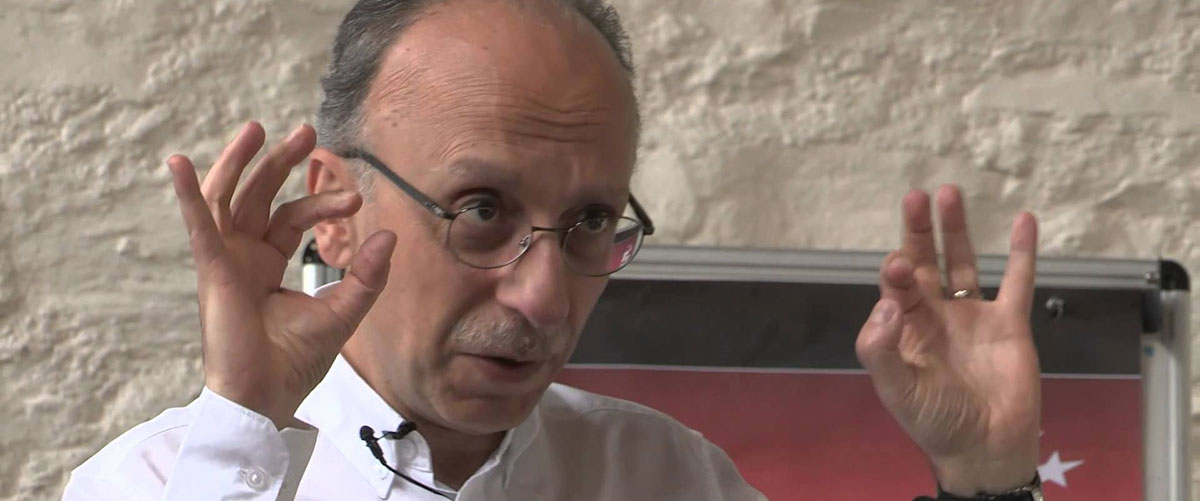
This OP introduces philosopher of science Michel Bitbol (above) through the lens of phenomenology, showing why his work matters for understanding the limits of objectivity and the often–overlooked significance of lived experience in scientific understanding.
Michel Bitbol (b. 1954) is a French philosopher of science whose work bridges quantum physics, phenomenology, and the study of consciousness. Originally trained in medicine and biophysics, he later turned to philosophy and is now Emeritus Researcher at CNRS/Ecole Normale Supérieure, Paris, France. Bitbol is known for his phenomenological interpretation of quantum mechanics, his dialogues with Francisco Varela, and his critiques of reductive materialism. He has participated in the Mind and Life dialogues chaired by the Dalai Lama and has learned Sanskrit to deepen his knowledge of Buddhist philosophy.
The aim of this essay is to introduce Michel Bitbol’s approach to phenomenology in general philosophy.
The Primacy of Consciousness
Michel Bitbol’s approach to the philosophy of mind draws deeply from the phenomenological tradition initiated by Edmund Husserl in the early 20th century — and, further back, from Immanuel Kant’s revolutionary critiques of the nature of knowledge in the 1700's. Phenomenology begins from a simple but far-reaching insight: the reality of first-person consciousness is ineliminable, and any account of the world must ultimately be grounded in the structures of experience as they appear to the subject. The field of “phenomenology” takes its name from the Greek word phainomenon, meaning “that which appears.” This reminds us that its starting point is not hidden entities or abstract theorizing, but rather, the way the world actually shows up in experience. Note that this presupposes an observer to whom things appear.
At its core, phenomenology is the disciplined study of conscious experience from the first-person perspective. Think of it as more an exercise in directed attention. It avoids importing external, third-person explanations of the source of experience — whether physical, biological, or metaphysical — and instead turns attention “to the things themselves”: the world as it is immediately given — in lived experience and prior to conscious interpretation or rationalisation.
Its primary method is the epoch? or “bracketing,” in which one suspends the “natural attitude” — the habitual assumption that the world exists just as we take it to do. This suspension is not a denial of the world; it is a way of clarifying the pure content and structure of experience without smuggling in our preconceived notions of what it means. The resemblance between Husserl’s procedure and the Buddhist practice of “bare awareness” in mindfulness meditation is not coincidental.
For Bitbol, phenomenology is the real starting point in the quest to understand consciousness, because it reveals something that scientific objectification systematically brackets out or ignores — namely the observer, the scientist, the one who makes observations, draws conclusions, and decides on the questions to be asked. Yet the point runs deeper than methodological oversight. Scientific objectivity does not merely forget the observer; it presupposes the observer as the one for whom objects appear, measurements make sense, and evidence is meaningful in the first place. Before there can be data, models, or theories, there must be a lived field of experience in which anything like a “fact” can show up at all. Phenomenology begins from this pre-objective dimension, revealing the conditions that make scientific inquiry possible but that science itself cannot capture because they are already assumed in every act of objectification.
What Consciousness is Not
As Bitbol argues in Is Consciousness Primary?* consciousness is not an object among objects, nor a property waiting to be discovered by neuroscience. It is not among the phenomena given to examination by sense–data or empirical observation. If we know what consciousness is, it is because we ourselves are conscious beings, not because it is something we encounter in the natural world. (We may infer that other sentient beings are conscious, but only our own consciousness is immediately given to us.)
Michel Bitbol:Pure experience is beyond the level of being and has no essence… It permeates the show without showing itself
Accordingly, Bitbol considers consciousness to be “self-evidentially absolute”: the one domain of existence that is given fully and indubitably whenever it is present. By contrast, natural objects are always incompletely present, appearing only as partial profiles or “adumbrations,” forever subject to correction by further experience. (“It looked square from that angle, but now I’m nearer, it’s plainly not.”) Accordingly, while the fact of experience is impossible to deny, the conclusions that may be drawn from it are another matter.
This asymmetry leads to Bitbol’s central claim: the attempt to derive consciousness from material processes reverses the real order of priority. Whatever is presumed to exist in the physical world already presupposes consciousness as the field in which such ascriptions occur.
From this perspective, the materialist project of locating consciousness in the brain or in neural processes is not just incomplete; it is conceptually incoherent. Like any empirical analysis, it rests on the presumption that what is real is what can be objectively measured and assessed. (Here I am referring specifically to the empirical sciences — physics, neuroscience, and biology — which construct their claims through measurement and intersubjective verification.)
However, the very notion of the objective world described by the empirical sciences is itself a product of selective abstraction — what Bitbol calls the end-product of the procedure of objectification. Why? Because science methodically brackets out the subjective pole of observation so as to arrive at an intersubjective consensus about the observer-independent attributes of the object. But when this methodology is applied to the question of the nature of consciousness, it turns around and tries to explain conscious experience in terms of that consensus.
The result is not only circular but, he says, will always culminate in the notorious “hard problem”: consciousness treated as if it were something that emerges from structural relations in objectively–existing matter, when in reality it is the precondition for identifying those relations in the first place. In that sense, it is prior to the emergence of both objective and subjective, which themselves rely on distinctions that arise within consciousness.
Not Something, Not Nothing
Bitbol opens his essay with one of the most disarming lines in the philosophy of mind: sensation is “not a something, but not a nothing either”. This deliberate paradox, borrowed from Wittgenstein, is not a rhetorical flourish but the key to Bitbol’s approach. On the one hand, consciousness cannot be treated as an object — something manipulable, measurable, or existing independently of the subject. This is because objects are by definition other to us, and are given only through the sense-data profiles which, as we have seen, are open to correction by further experience.
But if consciousness is not a “something,” it is also not a “nothing.” It is neither a useful fiction, nor a byproduct of neural processes, nor a ghostly residue awaiting physical explanation. Instead, says Bitbol, it is the self-evidential medium within which all knowledge about objects, laws, and physical reality arise (here the convergence with Kant is manifest). Any attempt to treat consciousness as derivative — as some thing that “comes from” matter — therefore reverses the real order of dependence. The world of objects may be doubted, corrected, or revised; but the presence of experience itself, here and now, cannot be disconfirmed. In this sense, consciousness is “absolute,” not as a metaphysical substance (which phenomenology rejects) but as the unavoidable ground of meaning, evidence, and world-hood.
Michel Bitbol:There is no world without consciousness, though consciousness is not a thing in the world
The Framing Problem
From the above, it can be seen that the error of materialism is that it applies categories developed for describing objects in a domain that does not, itself, comprise objects and forces. The vocabulary of physical science — process, function, mechanism, identity, information — presupposes an already existing domain of publicly observable entities and regularities. To say that consciousness is or arises from neural activity is to employ terms that belong to the logic of object-identity: the identity of two things available from the outside.
But consciousness does not appear from the outside. It is the medium within which anything like “outside” and “inside” is first constituted. Trying to subsume it under object-concepts therefore involves a quiet category mistake. It forces consciousness into a conceptual grid that cannot accommodate its defining characteristics — characteristics always assumed, yet rarely noticed. Bitbol’s point is not that materialism is wrong in its domain, but that it becomes inappropriate — and conceptually unstable — when extended to the nature of conscious experience.
It is, in short, a framing problem: a powerful conceptual frame applied to the wrong kind of subject–matter.
Conclusion
Taken together, these considerations establish the central thrust of Bitbol’s phenomenology: the attempt to explain consciousness in terms of a physical world existing independently of the mind rests on a confusion about the order of dependence. Conscious experience is not a phenomenon among others. It is that in and to which the very distinction between “phenomenon” and “object,” “inner” and “outer,” first take shape. The attempt to frame the question in physical terms does not so much deny this as forget it. It applies a conceptual framework designed for analysing public objects to something that is not a public object at all. The resulting puzzles — the Hard Problem most of all — arise not from the mysteriousness of consciousness, but from the misapplication of categories that cannot, by design, encompass them.
Bitbol’s alternative is not a metaphysical theory but a reframing: a return to the primacy of lived experience as the ground of all knowledge, including scientific knowledge. Far from undermining science, this reorientation clarifies its proper domain. Physics, biology, and neuroscience describe the structural, relational, and functional aspects of the world-as-object; they do not, and need not, account for the presence of the world-as-experienced. As such, consciousness is not something over and above the world, nor something inside it. It is the condition for there being a world at all.
This concludes the brief introduction to Michel Bitbol’s phenomenology.
* Originally published on Philosophy Today (Medium) - access via friend link without requiring registration. See Medium version for footnotes and bibliography.
Comments (384)
Would a phenomenologist have to stand on her head to explain how that works?
Phenomenology as a resource for translational research in mental health
Phenomenology as a resource in mental health
The phenomenological nature of schizophrenia and disorder of selfhood
Sure. Those are still cases where primacy goes to materiality. Drugs and alcohol are other cases of it.
Indeed it does, but outside that imaginative act what remains?
The point of Bitbol's line of criticism, is that both the subject and the objects of scientific analysis are reduced to abstractions in day-to-day thought. But these abstractions are then imbued with an ostensibly fundamental reality - the subject 'bracketed out' of the proceedings, the objective domain taken to be truly existent. But it should be acknowledged, the 'co-arising' of the subjective and objective is very much part of the phenomenological perspective.
I don’t deny the veracity of scientific reconstructions of a pre-conscious world. Bitbol’s point is subtler: such reconstructions are abstractions constituted within present experience, and it is a further step — one that often goes unnoticed — to treat those abstractions as ontologically fundamental while bracketing out the very subjectivity that makes them intelligible. The question isn’t “Did the world exist before consciousness?” but “What does it mean to assert existence independently of the conditions under which existence is ascribed at all?”
Closely related to this is the further assumption that consciousness is the product of those inferred facts — facts which, as facts, already exist within consciousness. There's a subtle but pervasiveness inversion going on here.
Quoting Wayfarer
It means 'the map(maker) =/= territory' (i.e. epistemically ascribing has (a) referent(s) ontologically in excess of – anterior-posterior to – the subject ascribing, or episteme).
What remains outside of our imaginative acts is whatever there is or was prior to our acting imaginatively.
It can be said that all "day-to-day thought" consists in abstractions?at least that part of it which is linguistically mediated thought. However, our thoughts are not whatever it is we are thinking about, so the things we think about exist prior to our thinking about them, otherwise we would have nothing to think about. It seems to be true that their existence for us is relational?the forms they take in our perceptions are of course in part a functions of our perceptual systems. It doesn't follow that they have no existence apart from that.
Quoting Wayfarer
That question makes no sense as far as I can tell unless you mean what does it mean to us? If so, I'd say that it means we are being able to think outside of the narrow perspective of our own experience and allow that there is more to the world than just that. It is a kind of humility and a rejection of anthropocentrism.
Quoting 180 Proof
Exactly, we are not the world?the world is more than merely human.
Nothing in the OP, or anything I've said about it, suggests an 'immaterial consciousness', although the fact that it will always be so construed by yourself and Janus is philosophically signficant.
Banno of course would point out that this is muddled, that we are inherently social beasties, and that our place in the world is not that of a homunculus siting inside a head looking out, but of a being already and always embedded in a world that includes others... and so on.
Where Bitbol emphasises first?person experience as the unavoidable condition of possibility for objectivity, Banno would push back: experience is always already structured by social and intersubjective relations.
Where Bitbol tends toward a version of transcendental dependence in which the world and science is only intelligible within a lived field, Banno would say this is too individualistic if it doesn’t acknowledge that lived experience itself is socially mediated.
Where Bitbol brackets the “natural attitude” to expose pre?objective experience, Banno would emphasise that the social world is also "pre?objective" in a different sense: language, norms, cultural practices, shared lifeworlds shape the very way phenomena show up. So consciousness isn’t a solitary medium but a socially inflected field.
Yet Bitbol and Banno would agree that physical reductionism misses something of the utmost import.
But you know Banno would do that, as does ChatGPT, and yet you carry on regardless. :wink: Good for you.
Hope Christmas was enjoyable.
Carry on.
Sort of. Our families are now far-flung and there's not many at the table. But, thanks, and same to you.
Quoting Banno
And, not really sure how that cuts against the quoted passage. Phenomenology is most definitely not invoking any kind of homonculus. The key books that I've at least partially absorbed are Husserl's Philosophy as a Rigourous Science, and the Crisis of the European Sciences. The emphasis on the reality of the living subject is precisely to ameliorate the sense of pervasive abstraction that arose out of Cartesian dualism.
Here:
Quoting Wayfarer
It rests consciousness on the distinction between "inner" and "outer "- the homunculus arrises!
Bitbol wants to make consciousness foundational, but he inadvertently re-inscribes the Cartesian subject, which is exactly what Banno resists. The emphasis on the reality of the living subject hopes to ameliorate the sense of the homunculus that arose out of Cartesian dualism - does it succeed? To be conscious is to be conscious of something, and so is already embedded in what for Bitbol must be outside the mind...
We also had a quite, and quite peaceful day, of music and books and happily much home garden produce, mostly with cream.
For yourself do you see his work more as a starting point for further work, or as a system/approach that is of itself useful as a philosophical practice?
I have an incomplete understanding of this material but would you say that Bitpol seems to be closer to Kant than other phenomenologists? He views reality as jointly shaped by the observer and the world within certain constraints, rather than seeking ultimate essences or structures that exist independently of how we experience them. Like Kant’s phenomena, these co-constituted realities cannot be understood as things-in-themselves; we can only describe and engage with them as they appear within the constraints of our experience and conceptual frameworks.
Bitbol does not seem to delve as deeply into Being or the essence of experience, and he appears to recognize epistemic limits more explicitly. Do you think this is accurate, and what is the significance of this for philosophy?
No more than anyone else. The correspondence observed between brain function in humans and what those humans experience is compatible with all positions on consciousness, even substance dualism.
What evidence are you thinking of?
Do you mean the presence and not-presence of consciousness is determined by material conditions (a very strong claim), or that the type or content of consciousness is determined by material conditions (a different weaker claim). I think you probably mean the former.
I think you're misreading it, but I won't press the point.
I'm a beginner with Bitbol and much of phenomenology. But it resonates with me on several fronts. I agree that Bitbol is rather neo-Kantian, the first thing I learned from was his lecture on Neils Bohr Bohr's Complementarity and Kant's Epistemology. I've got another draft on his philosophy of science, which I hope will also be published by Philosophy Today.
This is very much a starting point - not a 'manifesto', not a 'system', so much as a reminder. It's very much connected with Heidegger's 'forgetting of being' - we become fixated by and with the objects of perception, the 'objective world' and consequently forget the matrix of being within which everything arises. But then as soon as you begin to say what that is, the point is already lost.
Quoting Tom Storm
As said, he's not a system-builder creating some grand all-encompassing scheme. It's more a matter of paying attention to the here-and-now.
I also have an essay planned on his dialogues with Buddhism, and the connection between the phenomenological epoch? and Buddhist ??nyat?. (There's an historical connection, too, between Pyrrho of Elis, and the Madhyamaka Buddhists of Gandhara.)
Cosmological, paleontological.
Quoting bert1
We know of no consciousness which is not accompanied by material conditions. It is arguable, in fact it seems unarguably true, that the type or content of consciousness is determined by the material conditions it is conscious of. So, both are indicated.
Quoting Wayfarer
The OP says that consciousness is primary against, presumably, the idea that the material is primary. If consciousness is not, according to you, material, or at least a function of, or dependent on, the material, then the implication would be that it is immaterial, and that disembodied consciousness is possible.
Be honest now and say whether you believe disembodied consciousness is possible. I'm betting you won't answer that question.
I will. I don't see a misreading. Quoting Wayfarer
Yet consciousness is a response to the world in which it arrises.
There's the Cartesian temptation to choose some one thing as fundamental and derive everything else from it. Then there is the Hegelian move to two things, interacting. But last we have the Wittgensteinian dissipation of an absolute foundation, to different and yet equally valid ways of being and of doing.
Bitbol moves backwards to Descartes.
That's likely true, but that's different from the existential claim:
Quoting Janus
Quoting Janus
Yes, I think I agree with that.
Descartes is undoubtedly an influence (although I will also mention that this is another example of your 'presentism', that virtually all philosophy before about ten minutes ago has been superseded.) But there's a footnote in the Medium edition, to wit:
Also notice the reference to Wittgenstein:
Quoting Wayfarer
So, that is very different from Descartes' 'res cogitans', the 'thinking thing', which I think Husserl recognised as an oxymoron. But even so, Husserl, and all phenomenology, recognise Descartes' role as a precursor of phenomenology, in recognising the apodictic nature of consciousness.
So Bitbol is not saying that 'things are derived from consciousness', which is what you seem to think he is saying.
Okay, but if we know of no consciousness which is not accompanied by material conditions, it follows that we cannot really have a grasp of the possibility, even though we can of course say it is logically not impossible. So, the question becomes 'What significance could such a vague possibility have".
Your original claim was that the existence of consciousness (or absence of it) depends on material conditions. That makes material conditions ontologically prior. That's not the same claim as saying that wherever there is consciousness, there are also material conditions. In the latter case, neither consciousness nor material conditions is ontologically prior - they always occur together.
I admire your use of Medium, by the way.
Yeah, there is - that we must begin with consciousness.
Have you noticed the push-back against Buddhism as it is so often viewed by the west, in the last few weeks? The most recent Philosopher's Zone and Australian Philosophy Review both take issue with the common perspective. Interesting stuff.
And this was the point of our walk through the mountains toward the sea - to give an account of how it hasn't been forgotten, but how it is inadequate. The account given by the homunculus is too small.
And, as predicted you didn't answer the question I posed re whether you believe that immaterial or disembodied consciousness is possible.
I see it like this: you are still very much under the sway of post-Cartesian dualism. Accordingly you habitually interpret what I write, and what Bitbol is saying, against that perspective. The world, for you, remains divided between res extensa, measurable by science, and res cogitans, thinking substance. Bitbol doesn't make any metaphysical posits about 'immaterial mind' or anything of the kind. But you will think that to question one is to assert the other. Hence the assertion of an 'immaterial or disembodied consciousness', which is the only possibility this schema allows. Whereas, the point of phenomenology is to call this apparent division into question at its very root. But again, you will say this is a dodge or a non-answering of the question.
Quoting Banno
A conversation which clearly indicated that you didn't grasp the point with which you intended to take issue.
Ok, so have another go at explaining it to me.
'cause I think I do, and everyone else is still sleeping off their Christmas.
And indeed
"...so there is something more here than just perspective. Something explains this agreement. Sure, there are minds that make the sentences, and sing the songs, but there is more than just mind here".
There is something more than just perspective, but without perspective, there is no thing.
My criticism was going to Wayfarer's assessment of phenomenology. Phenomenology is a philosophical approach, not a position on the nature of consciousness. But I did note your sneer. Merry Christmas.
Chemical treatments for mental illness seem to show that consciousness is not primary. Though I think the issue really comes down to the way we talk rather than what we know about the world.
More politics than philosophy.
We live in a material world, and all our propositional knowledge is material knowledge. All our feelings are bodily feelings. All our coherent thoughts are thoughts about things we have, as embied material beings, experienced. What is the point of saying that consciousness is not material, if not to say it is immaterial..to say that it is something beyond the material world?
Do you think consciousness is mortal, confined to mortal beings, or is it something beyond this temporal world? You believe there is an afterlife, right? Why not be honest about what you believe and what your actual agenda is?
Quoting Banno
But no, as I said, carry on.
:100:
Quoting Janus
:smirk:
Quoting frank
I would hope that any thoroughgoing philosophy would stake a position on the nature of consciousness, and phenomenology as introduced by Husserl certainly does that.
Quoting Wayfarer
I think you did a great job of articulating the divide between your approach to consciousness and the distinctions Janus is relying on. Before one can decide which position is preferable, yours or his, it is necessary to be able to effectively summarize each position from within its own logic. You have done a reasonable job of representing the Cartesian position as pitting external, objectively causal stuff against inner subjective feeling. Janus, by contrast, is imposing that same logic onto his representation of your position rather than capturing how the logic differs.
Quoting Wayfarer
This summary of phenomenology is general enough to accommodate the different varieties offered by the likes of Husserl, Scheler, Henry, Sartre and Merleau-Ponty (but not Heidegger). Having said that, I think Bitbol’s interpretation of phenomenology owes more to Michel Henry than to Husserl. Like Henry, Bitbol’s focus is on consciousness in Kantian terms as immanent structural conditions of possibility for an individual subject, whereas for Husserl, Merleau-Ponty and enactivists like Varela and Thompson exposure to intersubjectivity is equi-primordial with subjectivity. Bitbol treats social influences as secondary to the transcendental or structural conditions of intelligibility, whereas Husserl treats intersubjectivity as co-original with subjectivity. The transcendental ego is always already a transcendental-collective ego, insofar as the world it constitutes is already populated by others and the meaning of objects is co-constituted through shared experience.
An ability which seems surprisingly rare.
Quoting Joshs
I was wondering what the difference might be (and its influences).
Quoting Joshs
Cool. Are you more partial to Husserl's approach?
Quoting frank
The fact that chemical treatments are far from guaranteed to work, and work differently in different persons, indicates that objective materiality abstracted away from the interaction of the world with subjectivity is also not primary. What is primary is the indissociable interaction between the subjective and objective poles of experience, and this is the lesson phenomenology is trying to teach.
Quoting Tom Storm
Yes, for Husserl every fact we know about ourselves and the world is the product of social construction, and therefore contingent and relative, except for the tripartite structure of time consciousness itself (retention-impression-protention).
Is that also considered to be a social construction?
Chomsky is pretty thorough-going, but he is a mysterian.
Anyway, I was calling out Wayfarer's assessment of phenomenology. It does not start with the primacy of the subject. That is an intellectual conclusion, not a product of experience.
Quoting Joshs
I'm partial to phenomenology. The OP is not accurately describing it.
And you say I'm putting words in your mouth :rofl:
Quoting Joshs
Thank you, I value your opinion.
This is, as said, an introduction - as much for me as for the reader, as I'm exploring the subject by researching and writing about it. As it happens, I first encountered Bitbol on this forum, some time back, when he was mentioned by @Pierre-Normand. I've subsequently read and listened to quite few of his talks. I find him a marvellously congenial presence. I was also introduced to Dan Zahavi, by you, as it happens. Overall I'm very much taken by their philosophical stance. Oh, and am also reading Michel Henry. His 'Barbarism' is quite an accurate diagnosis of eliminative materialism.
At the heart of my understanding of how things work is the conviction that the foundation of philosophical thought is introspection and self-awareness. Believing that, an attraction to phenomenology would seem natural, but I've always been sceptical. The way phenomenology is discussed here on the forum and what I've read makes it seem a bit like new age spirituality wrapped up in philosophical jargon. At the same time, I've come to see that my own understanding of the relationship between humanity and the cosmos needs to be clarified. I have work to do. I'll try to be fair minded with what you've written.
Quoting Wayfarer
This is one of my big problems with your presentation of what Bitbol believes--As I understand it, it is exactly a metaphysical claim. A valid and useful one, but still metaphysics. A failure to recognize that makes what you've written seem dogmatic and rigid, much as the philosophy of reductionist physics is. You have to have both. What brought me to my interest in Taoism, which is related to this question, is an understanding that reality is one half human. But there is another half. Writing that off as a delusion of some sort undermines the argument.
Quoting Wayfarer
I would have no problem with this if it meant that both our internal experience and some sort of external reality are considered equally fundamental. I get the impression that's not the case, which leaves us with something close to solipsism.
Quoting Wayfarer
This is another problem for me. As I see it, conscious experience is not a metaphysical entity, it exists in the world of apples and pogo sticks--an object among objects. Ultimately, we can only know it empirically while acknowledging the special difficulties associated with limited access. This is where any possible compromise between positions seems to fall apart. Neither of us can understand why the other can't see what seems self-evident to us.
Quoting Wayfarer
Here's one of the things I don't get. In what sense is our experience not part of the natural world? Why is there any problem with us learning about consciousness in others through inference? Much of scientific knowledge is gathered indirectly and without direct observation. Why is this situation any different? Speaking personally, I don't see that conscious experience is all that special. It's just one more thing for us to learn about. One more thing we encounter as we live our lives.
Quoting Wayfarer
This is presumptuous. I'm a pretty smart guy. If it isn't evident to me, it probably isn't self-evident at all. Language I might be willing to accept in it's place would be "It is my understanding that considering consciousness absolute is the best way for us to gain a useful understanding of it's principles." That's not all that different from the position I find most useful.
Quoting Wayfarer
I don't understand the problem with applying tools and procedures developed by the mind on the mind itself. What's wrong with a little self-reference. Measurements of distance I made with a ruler in the good old days ultimately depended on comparing the ruler with the length of a bar of platinum in storage somewhere. One ruler measuring another. Calibration. Whatever problems there are with this are methodological, not fundamental.
Quoting Wayfarer
As I noted, it's not circular in any kind of problematic way. And the hard problem is only notorious to Bitbol et. al. To many of us here on the other side, it feels like a made up problem that seems to arise from an understanding that is spiritual. Spirituality, as I understand it, is focused self examination with the goal of improving self-awareness—another valid mode of knowledge. And this is where a failure to see Bitbol’s alternative as metaphysical runs us into a wall, because both the scientific approach and Bitbol’s approach are metaphysical. They’re not mutually exclusive. If you’ve paid any attention to the things I’ve written over the years you’ve seen I see self-awareness as essential to our understanding of the universe. That doesn’t tell us anything about whether standard scientific practices can contribute to our understanding of consciousness.
What 'metaphysical claim' do you think is being made?
Quoting T Clark
There's a categorical distinction you seem to be missing. Where in the world of apples and pogo sticks is your experience? You can't locate it in some place, or distinguish it as an object. Your awareness of the fact of your own existence is categorically different to your awareness of the objects of perception. You could be in a sensory deprivation tank, or under the influence of a powerful sedative that blocks out all sensory perception, and provided you were conscious, you would know that you were conscious. That awareness would not be dependent on anything external.
The following passage from your OP describes the metaphysical positions, claims of both the scientific and phenomenological approaches.
Quoting Wayfarer
Quoting Wayfarer
Where are electrons? Where is dark matter? Where are the thoughts going on in your mind to me? Bitbol wrote consciousness is “not a something, but not a nothing either.” Does that mean consciousness does not exist, isn’t real?
If you read it with enough care you would have seen it was a question, not a statement. A question you refuse to answer for what would seem to be obvious reasons.
Quoting Joshs
What distinctions do you think I'm relying on? You seem to be suggesting that you agree with Wayfarer that my position is some kind of Cartesian dualism. If so, you are mistaken. I do see language itself, as opposed to the world, as inherently dualistic. My main point was that there is no incoherence or inconsistency in thinking that the physical world existed prior to the advent of consciousness. Science informs us that it did. The fact that such judgement is only possible where there is consciousness (and language for that matter) I see as a mere truism. What do you think?
I don't think the passage you're citing does present a 'metaphysical position'. Looking at it part by part:
'For Bitbol, phenomenology is the real starting point in the quest to understand consciousness, because it reveals something that scientific objectification systematically brackets out or ignores — namely the observer, the scientist, the one who makes observations, draws conclusions, and decides on the questions to be asked.'
I don’t see that passage as advancing a metaphysical position. It doesn’t make claims about what exists in itself, but about what scientific objectification leaves out by design. That’s a methodological and epistemological point about the conditions under which scientific knowledge is produced, not a thesis about the ultimate nature of reality.
'Yet the point runs deeper than methodological oversight. Scientific objectivity does not merely forget the observer; it presupposes the observer as the one for whom objects appear, measurements make sense, and evidence is meaningful in the first place. Before there can be data, models, or theories, there must be a lived field of experience in which anything like a “fact” can show up at all.'
Again - no metaphysics here. It is a fact that there must be an observer for whom the facts of observation and measurement show up. To say that 'facts require an observer' is not to say that reality depends on minds, but that facts are not the same as un-interpreted events.
Analogously, the distinction is made between 'data' and 'information'. The data are the recorded events or observations, but they are not considered information until they are assimilated and understood.
Quoting T Clark
Isn't that what this point is about?
Quoting Wayfarer
Put another way, the fact that T.Clark is able to know or sense anything, is because you are a sentient being and the subject of experience. But subjectivity is not a possible object of perception, as it is that to which or whom experience occurs. I think the fact you're having such difficulty grasping that distinction kind of reinforces the point at issue ;-)
You may not need another cook for this broth, but . . .
Quoting Wayfarer
This assertion is clearly key, so let me see if I understand what you mean by "ineliminable". I think you mean that, if there could somehow be a view-from-nowhere perspective on what there is, that perspective would "discover" consciousness. And the question that must follow is, Would the discovery be first-personal, even from the viewpoint of the view from nowhere?
(If talk of a God's-eye or view-from-nowhere perspective is troublesome to some on TPF, just think of it as a limit question: Is there any way to conceive how consciousness may be observed or discovered that is not itself an instance of consciousness?)
What I think you don't mean is that we can't imagine a world without consciousness. Sure we can. We can imagine a world without any living things too, even though only a living thing can do any imagining at all. Unless one is a panpsychist, there was no consciousness in the early universe.
Tell me if this is right, and I'll take it a bit further.
It wasn't my intention to sneer at all, and I may have misunderstood your point.
:100:
Quoting Janus
:up:
:up: :up:
@Wayfarer
Everyone on this forum has an agenda, one can feel it behind posts. One can also hallucinate motive, and I think that also happens frequently. Luckily, such agendas and motives are all philosophically irrelevant, so we don't have to talk about them. Likewise, everyone on this forum says what they do because they are mentally ill in some way or another, luckily, that is philosophically irrelevant, so we don't have to talk about that either. Everyone on this forum is weak and wants a safe comforting worldview to make them feel better. Luckily this is philosophically irrelevant so we don't have to talk about it.
I really like this question. One big advantage of a materialist reductive account, say some kind of functionalism, is that it can clearly answer this question. The thoughts going on in @Wayfarer's mind are literally within his physical skull, because they just are some subset of his brain function. The more dualistic one's view is, the more work one has to do to come up with a plausible answer.
Quoting Janus
Both Husserl and Heidegger make a radical claim that is hard for most to swallow: Husserl argues that transcendental consciousness does not emerge at some point in the empirical history of the world along with living things. It doesnt precede the world either. Rather, it is co-determinative of history. Heidegger makes a similar argument about Being. One doesn’t have to accept their claims about consciousness or Being in order to embrace their rethinking of the basis of empirical science, causality and objectivity away from physicalism.
"This preliminary argument is considered by some phenomenologists (Henry, 2001) as sufficient to declare that naturalism is faulty from the outset. The fact that some scientists finally relinquish their naturalist dogma when they have carefully pondered about this argument could be taken as a further reason to stop the enquiry at this point. But, in view of the remarkable development of natural science and of the implicit adoption of naturalism that goes along with it for a vast majority of scientists, we cannot content ourselves with an argument completely external to science."
Bitbol does not argue that consciousness is ontologically primary, but rather that it is methodologically primary. i.e. any objective description arises as an invariant structural pattern for subjects endowed with conscious experience. He advocates for a phenomenologically-informed approach that acknowledges the irreducible role of conscious experience in all knowledge.
So how would this influence the advance of a scientific understanding of mental processes? SOME paradigm is needed - that's foundational to knowledge, so It seems to me that it entails being open to new paradigms.
Here's a new paradigm I recently read about: On biological and artificial consciousness: A case for biological computationalism. This one isn't phenomenologically informed, per se, other than the fact that it reflects openness to a somewhat fresh start.
Sorry, I misunderstood. :yikes:
I've been reading through Is Consciousness Primary and am enjoying it very much. I think your summary is generally very faithful to Bitbol’s thesis, but I do feel that you sometimes slide into an ontological register that Bitbol himself would resist. Here are some examples:
Quoting Wayfarer
Quoting Wayfarer
Quoting Wayfarer
Bitbol makes it fairly clear that it’s not his intention to make any positive pronouncements regarding the ontological relationship between mind and world, whereas I feel that your interpretive comments are a bit more ambiguous on this point:
So while Bitbol’s answer to the question “Is Consciousness Primary” is “yes”, he’s not thereby positing an ontological dependence between mind and world, only a methodological dependence (as others on the thread have also noticed). He’s willing to say what he thinks the ontological relationship between mind and world is not, but he entirely refrains from proposing any positive account of that relationship.
Personally, I find this dissatisfying. While I think Bitbol is right to reject reductive materialism, right to expose the limits of objectification, and right to insist on the primacy of lived experience, I don’t think Bitbol is successful in dissolving the ontological question and, therefore, simply ends up leaving it unanswered. In my opinion, this results from a refusal to move from phenomenological critique to a positive, critically grounded account of being and truth. It mistakes the dissolution of bad metaphysics for the end of metaphysics itself.
What are your thoughts on this? Do you agree with my interpretation of Bitbol, or am I getting him wrong, and how does this criticism relate to your own view?
But you've been drunk.
(Indeed, perhaps you were when you wrote that...)
The function of a biological structure is not “nothing” – and consciousness may be considered as the function of neural processes arising from the material of the brain. Consciousness is an emergent property, and is created in steps:
Awareness/perception > neural integration > analysis > thought-making
Treating consciousness as “derivative” is merely recognizing this order of its production, how information goes in, consciousness happens, and thoughts go out.
it means, can't be eliminated from the reckoning. The salient point is again that in pursuit of objectivity, the presence or contribution of the subject is sought to be deprecated or 'bracketed out' so as to arrive at an ostensible 'view from nowhere', which is purportedly independent of any act of mind, existing 'in itself', so to speak.
Quoting J
Of course we can imagine it. It can be modelled with high degrees of precision. But as I said in the mind-created world OP, that still requires or implies a perspective. If you take away all perspective, so that no point in the panorama is nearer or further, so that there is no scale, and then you take away all sense of duration, so that there are no units of time, and no distinction between past, present and future - then what remains to be imagined?
Hence Kant 'take away the thinking subject and the whole world must vanish'. Not because it has become suddenly non-existent, where previously it was existent, but because it is outside any conception of existence or non-existence. The mind provides that scale and perspective even to imagine a world with no concsious being in it. But we don't see it, of course, because we're looking through it, not at it. Hence the 'change of stance' that is required by phenomenology.
Hence:
Quoting Joshs
Quoting bert1
Nothing in particular. Just the basic stance of phenomenology, as outlined in the various quotes and references and the questions that have come up.
Quoting Relativist
Good question! The emerging paradigms of enactive or embodied cognition draw heavily on it. The key book in that genre is The Embodied Mind, Varela, Thompson and Rosch, revised edition, 2015. But phenomenology generally is nowadays considered in the social sciences and psychology (as per some links provided above.) Constructivism, which is related, is influential in philosophy, psychology and education, see constructivist.info for example. There's also QBism in quantum physics, which dovetails nicely with phenomenology. (The next in this series is Bitbol's philosophy of QM.)
Quoting Esse Quam Videri
I see what you mean about possible tendentiousness on my part, but I don't know if it is warranted; I don't think I'm reading something into Bitbol that he doesn't say.
But notice Bitbol says that consciousness has existential and methodological primacy - not ontological primacy. He's not positing a 'cosmic mind' or 'universal consciousness' that is temporally prior to matter. He says what is required is a change of stance:
Quoting Esse Quam Videri
That is a profound observation, and it exposes a very deep question. This is also why Bitbol finds the Buddhist philosophy of N?g?rjuna congenial (subject of the third essay). As noted in the preamble, Bitbol has studied Sanskrit so as to have a better grasp of Buddhist principles, and Buddhism is an essential component of the Embodied Mind book mentioned above.
So, to really unpack that would require a deep dive into Buddhist philosophy. Suffice to say, Buddhism has never posited a creator God nor ultimate substance (in the philosophical sense of that term). This leads many critics (for example the Buddha's Brahmin opponents) to accuse Buddhism of nihilism. But the Buddha doesn't say that 'nothing exists' or that 'everything is unreal'.
N?g?rjuna’s analysis is subtler: it is the rejection of the inherent existence (svabh?va) of particulars, not of their existence tout courte. Phenomena are real, but relationally and dependently — not as self-grounding entities possessing inherent reality. In that sense, Madhyamaka doesn’t abolish metaphysics so much as reframe it, replacing substance-based ontology with an analysis of conditions, relations, and modes of appearing. A key point is that there is nothing to grasp or posit as a first principle or ultimate cause. The causality Buddhism is concerned with is the cause of dukkha — the suffering and unsatisfactoriness of existence. And Buddhism refrains from positing views of what is ultimately real, as it has to be seen and understood, rather than posited, which leads to 'dogmatic views'. N?g?rjuna is well known for saying that he has no doctrine of his own.
Quoting Questioner
The linked paper provides six detailed arguments against the materialist view.
If only I'd thought of that!
I am sorry you did not chose to reply to me in your own words, but instead link a 21-page paper. Nevertheless, I did scan through it and couldn't find anything that contradicts the current scientific investigations into consciousness, and the vast amount of evidence linking consciousness to brain activity.
Are you mocking me, sir?
Let the electrochemical activity play out, and let's see what we come up with
We've been down this path before. Your and my understandings of what metaphysics is are not compatible.
Quoting Wayfarer
I can take a picture of my camera. I can see my eye reflected in a still puddle of water. I can think about your and my minds. I don't understand why people see this as difficult.
Only a little, your position is that of the majority I suspect. Emergentists, it seems to me, often use many more obscure words to say exactly what you refreshingly did in two: 'consciousness happens'. How does it happen exactly? is the question, and Why there? Not that the OP is offering a theory of the generation of consciousness, nor does it seem to be asserting a temporal priority to consciousness, nor is there a position on where consciousness is in the world. Not sure if an ontological priority is asserted, or if it is just epistemelogical or methodological priority. Perhaps it's bollockological priority. I'm not a scholar of historical phenomenology I'm afraid.
This lays the issue out well. I would add one thing--there is no incoherence or inconsistency in thinking that the physical world did not exist prior to the advent of consciousness. That is the essence of the Taoist way of thinking as I understand it. There is no reason both those ways of thinking may not be useful depending on the context.
Quoting Joshs
What do they mean by "history" though? History as constructed and understood by humans or history meaning the actual unfolding of events going right back to the Big Bang (assuming provisionally that the current cosmological accounts are accurate)?
Quoting T Clark
I think that's true if you mean by 'incoherence' and 'inconsistency', "logical incoherence and inconsistency". In other words it is a logical possibility that the physical world did not exist prior to the advent of consciousness. On the other hand the idea that the world did not exist piroir to consciousness does not cohere with, and is inconsistent in relation to, all of our science. And I think that alone should give us pause. I think it should be taken into account that Taoist thought is of a time prior to any understanding of the world that we could class as scientific. That said, does Taoism explicitly declare that the world did not exist prior to consciousness?
Anyway even if it does explicitly say that I don't think that should detract from its poetical and spiritual import.
Thanks. Seems interesting. I sent the article to Kindle and I'll take a look.
So it's just about human reckoning? I was wanting you to make a bigger claim: I asked, "If there could somehow be a view-from-nowhere perspective on what there is, that perspective would "discover" consciousness. And the question that must follow is, Would the discovery be first-personal, even from the viewpoint of the view from nowhere?" I thought you wanted to say "Yes, the discovery is, ineliminably, from a perspective." I was then going to ask, "Is this perspective identical with consciousness?" I think a lot of the thrust of a view-from-nowhere argument concerns whether perspective, viewpoint, stance, et al., are referring to exactly the same thing that "being conscious" or "being a subject" refers to. In the scenario you describe, where we try to imagine a perspectiveless description of the early universe, it seems true that there is nothing left to imagine. Does that mean that we cannot imagine it (referring to consciousness) or that there is nothing to be imagined (referring to the lack of perspective)? Or are they one and the same? Sorry if this is muddy; it's hard to find the right way to express the problem.
It's a pet niggle of mine - accusing people of purposes, biases etc derails discussions. But complaining about it doesn't help, so I should probably shut up.
I think there’s an inherent contradiction in the question you’re wanting to pose.
At issue was the discussion between Janus and myself, regarding ‘material conditions’ and in what sense the universe existed before human consciousness of it. (See the Merleau Ponty quotation in above).
The basic contention of phenomenology and also of transcendental idealism, is that the concept of ‘the world before humans existed’ is still a concept. So, on the empirical level, it is of course true that the universe pre-exists humans, there is abundant evidence of that. But the interpretation of the evidence into a coherent idea is still something that can only be done by a mind. Accordingly, we are not really seeing the world as it is (or would be) without any consciousness of it. Put another way, we are not seeing it as it is (or was) in itself, but as it appears to us. That does not make it an illusion, but it qualifies the sense in which it can be considered real.
Now I’ve been pressing this point in one form or another for years on this forum, and it often comes down to: ‘so, you’re saying “the mind is immaterial”? That is the question I was asked by Janus. It comes from the fact that I question scientific materialism as capable of providing a holistic account of the nature of existence. So if you question science, then you must believe that ‘the mind is immaterial’! And with that, goes the presumption that you probably believe in an afterlife:
Quoting Janus
This is why I said that this question originates from the sense we all have (not unique to Janus), of the ‘real physical world described by science’, on the one hand, and the ‘mental picture of the world’, private and subjective, on the other. That is like a ‘master construct’, if you like, and very much a consequence of the Cartesian division between matter and mind. It is part of our ‘cultural grammar’, the subject-object division that lies at a deep level of our own self-understanding.
So I’m saying that the question comes out of ‘cultural conditioning’, and this is what happens when it is challenged.
But again this is a mere truism and/ or a conflation?of course a concept of "the world before humans existed" is a concept. However the world before humans existed is (or was, if you like) not a concept. This is so self-evident I cannot understand why you apparently fail to grasp this.
Quoting Wayfarer
As you should know, I don't deny that we see and understand the world only as it appears to us, and that this is not, by any stretch, the whole of the world. We can never know the world in its entirety. There are also countless other creatures that presumably see and understand the world more or less differently than we do. And it seems obvious that the totality of that animal experience does not even come close to exhausting the nature of the world.
As you also should know, I favour a process metaphysics, so I see the world as fundamentally relational, but I don't see relationailty as confined to us or even to animals, or plants or even cells or molecules. On the other hand the world as it appears to us is as much a part of the world as any other of its relations or processes. As such it is not an illusion?the world (of which we are an integral part) reveals itself to us truly. That said, dualistic thinking can move us away from that primary participatory knowing.
You say that the fact that we don't see the world as it is unperceived qualifies the sense in which the perceived world can be considered real. I think that unless you mean that the perceived world cannot be considered to be the whole of reality, then what you say is a kind of nonsense. Our experience of the perceived world tells us that our perceptions are not the world, but on the other hand all we can directly know is the perceived world. Regarding how the unperceiveable aspects of the world might be, we can only surmise based on our perceptual experience, so it can never be perceptually real for us, even though we know it must be real in itself.
Quoting Wayfarer
It is not only the real physical world as described by science but the real physical world as revealed by perceptual experience and our feelings of embodiment (our bodies obviously being part of that world). I don't think in terms of "mental pictures of the world" at all, although I acknowledge that we work with models of the world whenever we think discursively (i.e. dualistically) but that is not what our primary experience of the world is at all?that is it is not an experience of "mental pictures".
Your saying it is a "master construct" is just another just-so story for me. Humans are diverse, and the ideas of each should be addressed on their own terms, not shoe-horned into some psychologistic narrative about "cultural conditioning" or dismissed by categorization. The "subject-object" division is just another distinction made possible by dialectical, discursive thought or logic, if you like.
Your last sentence, for me, seeks to dismiss any disagreement with your ideas as being merely a product of cultural conditioning. If you want to challenge or refute what others say, you should, in my view, have enough good faith to believe they are just as capable of thinking for themselves as you think you are, and then if you disagree address their arguments in their own terms by cogent counterarguments, or if you cannot find such counterarguments, then admit as much.
On the contrary, you’re already imagining yourself able to make the distinction between the world as it appears, and how it truly is, when that is the issue in question. That is what is not being grasped.
Quoting Janus
Not at all. I put that forward as to why you made the demand to ‘reveal my agenda’ and the insistence that ‘I must believe in an afterlife’ - when none of that is the least relevant to anything that I’ve said in this thread. I’m saying that these demands arise from particular mindset.
At its most fundamental, consciousness is produced by the functioning of neurons in the brain. (Structure produces/complements function is a central idea of biology)
But – a crucial element of this function is the intimate interaction between the brain and the outside world. Consciousness does not exist in isolation, but is produced through an autopoietic process – a process I hinted at when I posted earlier:
Information in > consciousness happens > information out
This represents a part of the causal cycle involved in the formation of consciousness – part of a continual loop of lived experience –
… world > body + brain > world > body + brain > world > body + brain …. and so on….
How does this happen? Short answer: By the electrochemical functioning of neurons.
And I don’t think that reduces the wonder of consciousness, but rather enlarges it. I am totally in awe that we can detect and perceive information that is not a part of us, take it in, analyze and synthesize, and then respond appropriately.
We know the source, the properties, and the characteristics, of human consciousness. Discovering the exact mechanisms is still a work in progress.
Quoting bert1
Well, this seems to be asking why we evolved the way we did. I can answer by saying the brain is best positioned at the top of the organism, and the major sense organs are best positioned on the head, but I don't think that is what you are asking.
No, I don't need to imagine myself making a distinction, I simply make the obvious conceptual distinction between the world as it appears and as it is in itself, and that doesn't rely on knowing what or how it is in itself, but only on the fact that I can think it is something in itself. It doesn't even matter that it might not be anything in itself?I grant that possibility, even though I think it implausible. That distinction might not be possible for you because you don't understand it or it makes no sense to you personally?I don't know about that.
Quoting Wayfarer
No, the reason I asked is because I believe you do believe in an afterlife because I doubt you have changed your mind since you took Buddhist vows and because you were in discussions always against Bachelor's "Buddhism without beliefs", and I surmise that the reason you are so obsessed with debunking materialism is that you think that if it were true it would discount the possibility of an afterlife. That said, I admit an afterlife is not directly relevant or necessary to what you've been arguing (or more accurately, stipulating) and I'm also not suggesting there is anything wrong with believing in an afterlife by the way. I tend not to believe, but I'm on the fence myself since I believe we all know so little really.
Yes, because "subjectivity" (like e.g. humanity or infinity) is merely an abstraction. Subjects, however, are concrete objects and directly or indirectly perceiveable as points out.
However, the subject is not.
You know what I was saying about a lightbulb moment, where something clicks and it colours your world in a new light. But nothing in the world has changed, only your perspective has changed slightly. But it is almost impossible to convey that to someone else, because nothing in the world has changed, it was just a tiny little tweak in your own mind.
Wayfarer is trying to convey something like that. You’re both only millimetres apart, but there seems to be an insurmountable gap that just can’t be bridged between you.
It’s like the goldfish in the goldfish bowl. Wayfarer is saying the goldfish doesn’t realise there’s water there, it can’t see the water and takes it for granted. While you are saying, I know the water is there, but it’s no big deal. But then he says, but without the water you’d be lying on the bottom of the bowl and you say I know I’m suspended in water and it’s primary to me being suspended, but again it’s no big deal.
I broadly agree with Bitbol's perspective and his 'phenomenological' approach. IMO it is a very valid path of inquiry to get some necessary epistemic modesty. Also, it is a very good way to introduce or re-introduce in us the 'wonder' that animates philosophical search.
My problem, however, is this. If we are so 'constrained' by our own perspective and we can't make statements about the 'things in themselves' - i.e. metaphysical statements - the problem I notice is that the apparent intelligibility of the world as we experience it remains unexplained. Yes, following the 'broadly' Kantian tradition that Bitbol supports, it seems to me that we are compelled to say that intelligibility should be explained in terms of the capacity of our mind to 'order' experience, to 'give it a form'.
However, the problem is that even the most radical follower of this tradition must acknowledge that the possibility of such an 'ordering' - unless one is also prepared to say that the whole 'form'/'order' of the empirical world is a contrived self-deception or a totally furtuitous event - it is rooted on some property of 'what is outside of experience' that makes it possible. But to me this implies that the 'things in themselves' have, indeed, an intelligible order at least in principle.
In other words, after this suspension of the 'natural attitude' one is compelled, IMO, to take one of these alternatives:
Of course, one is free to not make a choice about any of the above and remain content with a non-committal stance (as I think Bitbol does). However, such a 'cautious' stance to me it is simply excessively cautious. Before adopting it, I would want to be certain or reasonably certain that other pathaways are impassable.
However, I don't think that these kinds of insights forbid us to investigate further. The fourth alternative seems to point unhappily to solipsism. The first simply is a restatement IMO of Bitbol's position. The third would mean that our cognitive faculties are just screwed, unreliable etc. While perhaps this is a legitimate alternative, I don't take it seriously precisely because it would make any kind of metaphysical and epistemic inquiry pointless. Furthermore, it has no real explanatory power of how our cognitive faculties are 'pragmatically useful'. So, tentatively, I accept the 'second alternative' what I called the 'veiled reality' approach. The investigation of our empirical world ('the world as it appears to our consciousness') does give us some knowledge of the world as it is. However, we should also be aware that it is imperfect, indirect etc and therefore not being too dogmatic about it.
Could be. What do you think it is?
So what's your point?
Quoting boundless
An order which makes intelligibility possible is not the same thing as an intelligible order, if intelligible order implies a fixed a priori form dictating a particular logic of intelligibility.
One doesn’t have to assume such an epistemological a priori, as Bitbol does. Within the phenomenological tradition, there are more radical approaches than Bitbol’s, including those of Merleau-Ponty, Heidegger and Husserl. For them, the intelligibility of the empirical world is contingent and relative. For Husserl and Merleau-Ponty, the embodied subject is a center of activity. The subject dictates no specific a priori content to the experience of the world. Its formal role is to organize events on the basis of the relational structure of time.
One could say then that without the subject there is no time to produce the glue which makes the objectively real possible. The formal structure of time is not to be understood as ‘inside‘ the subject, however. It requires the exposure of the subject to a world, and therefore there is no subject prior to a world. There are no things in themselves, whether those things are objects outside the subject or an inner realm inside the subject. The subject has no interior since it is not an in-itself but the exposure to a world. It is also not a fixed perspective but the empty capability of generating perspectives.
I agree with your assessment of Bitbol, and I believe you can find a “positive, critically grounded account of being and truth” in phenomenologists like Husserl, Merleau-Ponty and Heidegger “.
I think it is not one or the other, it is both. Consciousness does emerge from structural relations of non conscious entities, and consciousness is the precondition for identifying those relationships in the first place. This circularity results in the hard problem, but the hard problem, like all problems, is epistemic. We, as conscious beings, may face an insurmountable barrier in explaining consciousness itself. But from this apparent epistemic barrier it cannot be concluded that consciousness has no naturalistic explanation. Just that we might never get to it.
We have no chance of getting to it if we continue to understand naturalism in terms of objectively causal processes which treat subjectivity as something added onto an objective world.
Nice, I add interconnected worlds too. Well layered and interconnected, with a layered and interconnected subject.
I think you’re right that phenomenology alone doesn’t “explain” why the world is intelligible — but Bitbol’s point is that intelligibility isn’t the kind of thing that needs explaining by appeal to a reality-in-itself. The mistake, as he sees it, is assuming that intelligibility must belong either to the subject or to the world as such. His refusal to choose among those options isn’t skepticism, but a refusal to reintroduce a metaphysical comparison that phenomenological suspension has already shown to be unwarranted. Intelligibility is a characteristic of being-in-the-world. In fact, I wonder if the demand to “explain intelligibility” is itself a mistake — as if we want to explain explanation. Maybe that's an antinomy of reason! Bitbol’s refusal to supply such an explanation isn’t evasion, but critical in the Kantian sense.
But then, even given that scientific objectivity is not the be-all and end-all, there's still an enormous range of things it can accomplish. I don't think Bitbol is throwing that away or belittling it - just reminding us of the underlying assumptions which are so easily forgotten in our bedazzlement with what science can do. And also a reminder of the limits of objectivity.
Quoting hypericin
You do wonder how different a 'naturalistic explanation that might never be grasped' is from a 'metaphysical postulate'.
The point is why bother saying that the mind is immaterial? If the mind is a process of the brain, then it is no more immaterial than digestion. Neither are objects of the senses, and if you are using 'immaterial' merely to indicate that, then sure.
All our thinking is dualistic anyway. As soon as you start talking about all experiences of things being the experiences of a subject, you have already entered Cartesian territory, at least in terms of modes, or distinctions if not substances.
Heidegger criticized Husserl, claiming he never freed himself from Cartesian thinking. If you start trying to pin this idea of different kinds of being (as opposed to different kinds of beings of course) down, you will inevitably end in paradox.
Even saying that we do not see reality as it is in itself is a product of dualistic thinking and cements the dualism even further.
Quoting Punshhh
Perhaps it's like that. The irony is that I see Wayfarer's thinking as dualistic, whereas he claims that I am coming from a Cartesian standpoint, whereas, while I acknowledge that any discursive thinking is going to be inherently dualistic as that is just the nature of our language when it is doing analysis, I'm saying I see no point in claiming the mind is immaterial, even though we obviously have that conceptual distinction between material and immaterial. Every concept automatically invokes and evokes its opposite.
You're the one who made the suggestion in the first place:
Quoting Janus
And then:
Quoting Janus
You're still seeing the debate through the apparent dichotomy of material/immaterial.
:up: :up:
Welcome to the club! :up:
Quoting Janus
Exactly. :100:
Notice that the term 'immaterial' came up a couple of times, first in this post of 180's and then shortly after by Janus (they seem to be in furious agreement).
What I'm saying is that this is the false dilemma of Cartesian dualism, which divides the world into 'the physical' (res extensa) and the mental (res cogitans). But this is much larger that 'the philosophy of Descartes', as it is woven into the cultural grammar of modernity - we naturally tend to 'carve up' reality along those lines. So the implication is, if something is not physical, then it must be res cogitans - hence 'the immaterial mind'.
Understanding that the mind/consciousness is the function of the structure (the brain) dispels any notion of Cartesian dualism. Function cannot be separated from operating structure, no more than the music played by a piano can be separated from the piano.
I would rephrase "[at] least prior to consciousness as we understand it" as something along the lines of "at least prior to intelligence capable of contemplating and discussing it". Because I think there are things that are conscious that do not have that kind of intelligence. I don't draw any line at all, which I know you disagree wirh. But do you draw a line? I don't imagine dolphins contemplate and discuss consciousness, but are they conscious? If so, how about bats? Bees? Worms? Paramecia? Archaea?
Yes. That is plain materialism.
Quoting Questioner
Of course it can. It can be played on another instrument, recorded, or transcribed into notation. In every case the music stays the same while the material form is different.
I follow Whitehead in thinking that everything experiences processes and relations with other things, but I don't think it is necessarily conscious experience. I think about 99% of what we humans experience is not conscious experience.
So, I think there is a sense in which everything feels the affects of being acted upon?Whitehead, I seem to recall, refers to this as "pan-experientialism". The other point is that I think everything has a kind of immanent intelligence. I see consciousness, experience and intelligence as three different things that may or may not be connected or operating together depending on what phenomena we are considering.
I’m going to say something controversial, another conclusion to the one in bold is that they didn’t co-arise, but that consciousness was introduced, to a pre-existing world. It makes more sense to me than the idea that consciousness was always present, even in the Big Bang.
( I’m quite happy with the Cartesian view that consciousness might have arisen when life emerged from the primordial soup. I just don’t give it much weight in the light of alternatives that I have worked out)
Right at the beginning of my interest in philosophical thinking, back in the mists of time. The first thing I learned to do was to think outside the box, so to speak. I was reading a book written by a Sufi Guru/ mystic (I can’t remember the author, or the book, if I say which book it was, I might have confused it with another, so I won’t, it was quite well read, you might have read it yourself). He kept going back to the same idea, from different angles and it stuck with me.
Basically that, intuitive thinking is a skill that can be developed and it is like trying to listen to someone in the next room, talking quietly, while sitting in a noisy room, with someone talking at you, trying to convince you of something. The person trying to convince you of something is your conditioned self. In a philosophical context your Cartesian, or empirical self.
The idea being that for the Sufi, they are concerned with what that quiet person is saying.
What I’m saying is that there is a way of stepping out of this dualistic thought process. To develop a sense of things which can become like an alternative approach, or perspective on an issue. Over time, it becomes like a reference system, but not dualistically based, but intuitive/feeling based. It helps if you are dyslexic, which I am, because you have to work out your own alternative ways of thinking, because you just can’t do the simple stuff like learning how to read and write. (Learning to read was a Herculean task for me, I still don’t know how I did it).
Anyway what I’m thinking of in this discussion and what I think Wayfarer is trying to put across is that there is something about the subject which is deeper, more fundamental than what the Cartesian thinking can allow. The Cartesian fish can’t see the water, doesn’t know it’s there and when it’s told there is water there, it says, yes I know, so what?
Now I know I might come out with some pretty weird stuff, but I don’t necessarily believe any of it. They are all just working hypotheses for me. Like alternative ways of reading when the part of my brain that reads the written word, doesn’t work properly.
Yes, I know, the conditioning is so deep, it goes to every fibre of our being. But we must remember, that that being and the nature we are being conditioned by is all natural and is perhaps closer to the truth than we might think.
While I agree with the wording, my problem here is that I don't see how these kinds of accounts are plausible. They appear to give to the subject the entire 'responsibility' of the 'ordering' of the empirical world. In other words, for all practical purposes, an epistemic solipsism.
Quoting Joshs
Does this mean that the only value of knowledge is pragmatic?
Quoting Wayfarer
The problem is that we have all reasonable evidences to conclude that we aren't necessary for the existence of the 'world'. While what Bitbol and others might say is true for the empirical world, I can't see how the same can be said for anything else.
If intelligiblity requires our 'being in the world', it seems to me that this can't avoid the claim that 'without us' the world is unintelligible. This is an ontological claim, not merely an epistemic one.
Quoting Wayfarer
I can see that. And I'm not completely against that. I just think that what Kant and so on achieved is that we can't have a certain/direct knowledge of 'how reality is' irrespective of our own perspective. I just don't see how this excludes any possibility of speculation beyond it.
Do you recall that that blog post about Schopenhauer that you posted - how time began with the first eye that opened?
Yes, and I still in some way I agree with that perspective, i.e. that consciousness is foundational to intelligibility.
However, we need to ask ourselves which 'consciousness' is foundational. The consciousness of any sentient being doesn't seem foundational. The consciousness of any given sentient being seems to be contingent and have arisen. Assuming that such an arising isn't unintelligible, these consciousnesses of each sentient being must have arisen in some way and this means intelligibility preceded each of them.
Anyway, I still agree with the blog posts in two senses:
1) Consciousness is foundational to intelligibility. Intelligibility is incomprehensible without a necessary relation to consciousness. However, I nowadays lean towards panentheism, so not problem for me.
2) There is a limit of what a given sentient being can know and this limit is also due to the particular perspective such a being finds itself in. So, an individual sentient being can't know directly anything 'in itself'. But this doesn't pose an a priori limit to speculations.
I’m not so sure about this, yes with the sensory apparatus we have, I would agree with this. But it doesn’t mean we can’t bear witness to it, or be hosted by a being who can know it.
But that question is still being asked from an external perspective i.e. treating consciousness as a phenomenon, something that exists or may not exist. I think you're actually conflating two perspectives, that of regarding consciousness as an attribute of sentient beings, as you would from an evolutionary perspective, and then the transcendental insight that consciousness is the horizon within which the nature of being is intelligible in the first place. That excerpt from Schopenhauer does address this. He acknowledges that life evolves from matter, that higher organisms evolve from earlier forms:
"On the other hand, the law of causality and the treatment and investigation of nature which is based upon it, lead us necessarily to the conclusion that, in time, each more highly organised state of matter has succeeded a cruder state: so that the lower animals existed before men, fishes before land animals, plants before fishes, and the unorganised before all that is organised; that, consequently, the original mass had to pass through a long series of changes before the first eye could be opened."
"And yet", he goes on, "the existence of this whole world remains ever dependent upon the first eye that opened, even if it were that of an insect. For such an eye is a necessary condition of the possibility of knowledge, and the whole world exists only in and for knowledge, and without it is not even thinkable. The world is entirely idea, and as such demands the knowing subject as the supporter of its existence." Of course that goes against the grain of 'the inborn realism which arises from the original disposition of the intellect'. I've had many long (and mainly fruitless) arguments about this point on the forum, contested by those who are adamant that the world is there, external, outside of us, and ideas internal, in the mind, subjective. This long course of time itself, filled with innumerable changes, through which matter rose from form to form till at last the first percipient creature appeared,—this whole time itself is only thinkable in the identity of a consciousness whose succession of ideas, whose form of knowing it is, and apart from which, it loses all meaning and is nothing at all."
At this point, 99% of people will object: “But we know that the world existed before there were any sentient beings.” My reply is that “before” is a mental construct. Fossils are not mental constructs, nor is the geological record. But pastness is not something contained in those rocks. It is a form under which they are understood. Outside that form—outside a temporal framework supplied by consciousness—the fossils do not say “earlier,” “later,” or “before” at all. They simply are.
The record constrains what can coherently be said, but it does not interpret itself. And without that interpretive framework, the notion of a world that “existed before” anything capable of experience is not false so much as unintelligible.
But it would not be that particular music - those particular vibrations propagating those particular acoustic waves through that particular air - played by that particular piano at that particular point in space and time.
That would be like saying my brain could produce your consciousness
ETA - besides, you did not refute my main point - that you cannot have piano music without a piano
Just note that this not any kind of phenomenology. It makes the thread a little confusing if you smash up differing philosophical approaches.
Ok, perhaps 'direct'/'indirect' isn't the best way to put it. But I would say that our knowledge of the world is limited, imperfect, we can't deny the role of our mind in ordering the experience and so on etc.
Thanks for the answer, but I don't think it rejects what I was saying. Kant, Schopenhauer, Bitbol etc are, as I understand them, saying that there is antinomy between what we learn by analysing the events of the empirical world and what we learn by analysing the intelligible structure of the empirical world. In the first case, we are presented with evidence that strongly suggest that our consciousness began at a certain point of time, is derivative and so on. The latter analysis, however, suggests that the framework in which the former 'story' is intelligible is a framework given by consciousness itself. This clearly poses a problem, a tension with two seemingly contradictory accounts.
One is of course free to stop at the antinomy and accept it as unsolvable. We can't 'go beyond' it. That's where Kant, Bitbol and so on ask us to stop. The two perspectives can't be reconciled in a singular conceptual framework that explains both. As I said, I respect that. But I don't think the antinomy alone forces us to stop to seek some kind of way to reconcile the two 'perspectives' that generate it.
However, this is one of these situations where I can't help but remind myself that the 'puzzlement/wonder' it creates is a motivator for trying to go beyond that. So, as a way to solve the antinomy, I propose that we need to accept both stories and reconcile them. Yes, our consciousness is contingent, is ontologically dependent etc and it can't be the ground of 'intelligibility' of ourselves and the 'external world' (and also the 'empirical world', at the end of the day). But at the same time, I take seriously the other 'side' of the antinomy and I also affirm that intelligibility seems to be grounded in consciousness. However, in order to get a 'coherent story' that includes both insights, I acknowledge that I have to posit a consciousness of some sort that can truly be regarded as the ground of intelligibility. Panentheism is a way, I believe, to overcome and at the same time accept the 'main message' of the antinomy you are referencing.
At the same time, however, I am also inclined to agree with the antinomy in that it correctly shows that we can't have the kind of 'certainty' that pre-Kantian philosophers sought. We can discuss about the plausibility of 'worldviews' but I don't think we can 'certainty' about them. So I do not claim certainty about my own purpoted 'solution' but I think I have reasonable motivations to think it is plausible.
I entirely agree, although I expect our interpretations will differ somewhat.
Thank you for bringing this to my attention. I have encountered N?g?rjuna before through the secondary literature in the philosophy of religion, but I didn't realize that Bitbol was influenced by him so specifically. This actually helps me to better understand Bitbol's reticence toward metaphysics and also helps to clarify more precisely where I think Bitbol's position is unstable.
The more I reflect upon it, the more it seems to me that Bitbol's aim is really to set boundaries on what can and cannot be said. This is not the quietism of the early Wittgenstein ("what we cannot talk about, we must pass over in silence") but something more like the therapeutic stance of the later Wittgenstein ("philosophical problems arise when language goes on holiday"). Bitbol isn't saying "stop talking about metaphysics", he's saying "take a critical look at what makes you talk this way and then you will stop talking about metaphysics".
I don't think this is incoherent per se, but there is definitely a major tension implicit here. Basically, Bitbol relies on the authority of rational critique, but refuses the ontological consequences of that very authority. As part of his critique Bitbol makes claims such as:
1. Some ways of framing questions [I]really[/I] are mistaken
2. Some metaphysical claims [I]really[/I] are illegitimate
3. Some explanations [I]really[/I] do invert the explanatory order
It invites the question: are these claims about the way things [I]really[/I] are? I think this is a tender point for Bitbol. He wants to gatekeep the bounds of reason, but in order to do this he needs to grant reason a level of authority that he also seemingly wants to deny to it. If reason has the power to say what is unconditionally the case when engaging in critique, then how can we deny it that same power when it comes to ontology?
N?g?rjuna, by contrast, seems to take the bull by the horns in a way that Bitbol doesn't. While Bitbol and N?g?rjuna seem share some of the same methodological interests, N?g?rjuna seems much more willing to simply jettison any ultimate commitment to grounding, normativity or truth as final arbiters of anything at all. In response to the charge of inconsistency or self-contradiction N?g?rjuna's response would simply be "yes". As such, N?g?rjuna isn't really proposing a [I]philosophy[/I] in the modern sense of the word, but rather something more like a [I]path of liberation from philosophy[/I] (in the modern sense of the word).
Before I say anything further I want to get your thoughts. Does my critique of Bitbol hit the mark? Is my characterization of N?g?rjuna's intent accurate?
For Husserl, the nature of the order on the basis of which events cohere is not fixed but, as you say, pragmatic. It is an order of associative similarity (not associative in Hume’s causal sense, but association by relevance to an intending subject). If you dont like the idea of a pragmatic ordering of the world depending on the notion of an a priori subject, you can find accounts which follow the phenomenologists in their deconstruction of the natural empirical attitude without relying on subjectivity as necessary ground. Such accounts can be found with Nietzsche, Foucault, Deleuze, Karen Barad, Joseph Rouse and others. For these writers, we can remove human beings and livings things from the picture and show how materiality is agential or ‘subjective’ in itself, in that no object pre-exists its interaction with other elements within an already organized configuration of elements.
... which is or is not how things are [I]objectively[/I] (re: noumena)? :chin:
This is interesting, and perhaps coherent. But my mind recoils at the offensive apparent bootstrappyness of it. Some idealists avoid this bootstrapping - Berkeley by invoking God as the prior cause, Sprigge with panpsychism providing consciousness at the start.
From the bit you quoted, the ontological foundation for everything is the first experience, which then creates the temporal causal order that is the precondition of its own ability to experience. Don't you find that offensive? If someone said that in a pub, they'd get a slap. Adding God or panpsychism makes it much easier to swallow, no?
EDIT: I'm grateful for you bringing it up though, I hadn't thought about idealism quite in these terms before.
Quoting 180 Proof
One wouldn’t begin with pre-existing objects and then move from there to relations. One begins with configurations, which have subjective and objective aspects but are neither strictly subjective nor objective. Their objective aspect is what is relatively predictable and stable over time, their subjective aspect is the qualitatively transformative basis of their ongoing existence.
This is an insightful reply to antinomy framing. I wonder, though, if there's another way forward that renders the antinomy only apparent. An alternative framing is to see it as two separate questions that are being run together:
1. A question about the genesis of human consciousness in time
2. A question about the conditions of possibility of knowing anything at all
To my mind, these are not strictly contradictory. In order to see this, we need to distinguish between two different orders:
1. Order of being / efficient causality: how X comes to be
2. Order of knowing / intelligibility: how X can be known, affirmed, understood
I would argue that this only [I]feels[/I] contradictory when questions about the "conditions of knowing" are collapsed into questions about the "conditions of being". But asking after the conditions of our knowing X is not the same as asking after the conditions for there being X. These two sets of conditions are not identical, and the fulfillment of the former is generally neither necessary nor sufficient for the fulfillment of the latter. To put it more bluntly, transcendental conditions are not efficient causes, though they are the conditions for the [I]knowledge of[/I] efficient causes.
Thoughts?
.... describes or does not describe an objective state of affairs?
Quoting 180 Proof
What does an objective state of affairs look like?
We have no access to it. Everything constructed in the mind of the subject is by definition subjective. We have no choice but to believe our senses.
An objective account is in 3rd person. It's like a novel written in 3rd person, a God's eye view.
I think the answer to Josh's question is that a state of affairs looks different depending on where you're standing. And 180's point resists sophism. If you're describing the way the world is, you're giving an objective account.
But that can be no more than fiction. Surely, there is a place for rationalism, but rationalism has got a worse record than empiricism, starting with Thales saying everything is sourced from water.
Quoting frank
This sentence is contradictory. If it's your account, it's not objective.
It's a model you use to make sense of what you're experiencing. If you find the model is wrong, you update it. Davidson said it's like a web of inter-related beliefs, and possessing such a web is the hallmark of rationality.
Empiricism only gets you so far. You run into the problem of induction.
Quoting Questioner
If you precede your statement with "from my point of view" then your statement is 1st person.
A physics book expresses a 3rd person account. That doesn't mean it's not derived from 1st person data, or that it's necessarily true. We're just talking about what kind of voice the account is in.
I agree. We need to think about what we find out by way of empiricism. Problems arise when rationalists ignore scientific knowledge. Rationalism without the benefit of empiricism is ignorant.
Quoting frank
A physics book is not written as a 1st person account, but by the results of scientific investigation.
A voice that gives an account without the benefit of empiricism is no authority on the subject.
Quoting Questioner
Don’t we have access to it intersubjectively? Isnt objectivity intersubjective agreement? I interact with a rock, and in this way I don’t simply believe my senses , I construct my senses in line with my goal-oriented intentional activity. It’s not simply ‘seeing is believing’, it’s ‘believing is seeing’: as I interact with the rock my expectations co-determine what I see and how I see it. My subjective knowledge of the rock as object is the result of patterns of correlation that emerge from the responses of the rock to my movements in relation to it. I can reliably predict how the rock will respond to my engagement with it, such that I can think about it as a unified thing which persists as itself over time ( object permanence) , even when I pick it up and move it from place to place or hide it from view.
This first-personal process of objectivation already involves idealization and abstraction, but this object for me is not yet an empirically objective thing. I have to compare my perspective on the rock with that of other subjects, and through this intersubjective correlating, we come to a consensus on the idea of the rock, seen differently for each of us as individual subjects, as an empirically objective entity which is ‘identical’ for all. The third-personal empirically factual object is an abstraction derived from shared first personal accounts, but a scientifically useful one. This is Husserl’s phenomenological concept of the origin of objectivity. For him all third-person empirically objective accounts are subjective and relative, since they are abstracted from, without eliminating, first personal experience.
Beg to differ. Schop as one of Kant’s principle interpreters is very much part of the phenomenological lineage. Not that any of them endorse him wholesale but this passage in particular is highly relevant.
Quoting Questioner
It would not be the same rendition, but it would be the same piece. Claire de Lune retains its identity whether played on piano, guitar, or a singing birthday card.
This is the tip of a very large iceberg for your ‘mind=brain’ materialism: how something like a composition, a sentence, a formula can retain its identity across different versions and even different media. ‘The same and yet different’.
Very perceptive as always. I will respond when time permits.
I alluded to this above in deriving the idea of the identical third-personal empirical spatial object from the constructed first personal object.
But what is that rock, really? Objectively, it does not appear as you see it. In reality, it, and all of reality, outside of human perception, it is a conglomeration of colourless particles and waves, a haze and maze of uncertainty that turns into certainty only when you observe it. (I have heard it described as wavelength collapse, but I don't know enough about it to comment.)
The grass is not really green. That's only the light that particular conglomeration of chemistry reflects to your eyes. Outside of perception, objective reality might be "there," but it has no definition or meaning.
Quoting Joshs
because we have the same senses, and in a manner of speaking, the same consciousness
I'm sorry, you have missed my point.
Are we not all individual renditions of consciousness? And does not that consciousness emerge as the function of neurological processes?
You’re taking the derived abstraction ( the empirical third-person account) and making it the basis for the actual phenomenological experience which constructed the abstraction in the first place.
I've never read Whitehead. I just googled, and the AI's summation seems nearly exactly my position. I guess I should get to know him.
Schopoenhauer believed subject and object are two sides of the same coin. That insight goes back to Plato. You're in danger of calling all of philosophy phenomenology.
Wow, that’s pretty philosophically dense. I think I understand, but I want to reiterate that my original point was to separate the subjective from the objective. Also, calling something an “abstraction” does not mean that it is false. In the case of objective reality, I think our “derived abstractions” better capture it, than do our perceptions.
of course, subjective reality - and subjective truths - are real. Indeed, they are the only things that have personal consequence.
I suspect this is not really a concern for most scientists. I don't think they give up their humanity.
Do you mean just with humans? Or does that include your dog?
I do not think consciousness arises from neurological processes, regardless of what species were talking about.
In humans, we are conscious of - we experience - neurological processes. Things without neurons experience other things. They experience their own beings.
I don't think so, although interestingly your view is compatible with the kind of mind-primacy that @Wayfarer has been talking about in this thread.
Quite, the experience needs to be stripped bare to the bones. And compared with itself unstripped. And with the social group (or biosphere), not just the individual.
Ok. But, again, if there is no a priori intelligible order, why our conceptual maps work?
Quoting Joshs
Same as above. The problem is not which kind of 'entity' is to be taken as a subject. The problem is how to explain the appearance of intelligibility in a non-contrived way. Honestly, the only thinker I know with a certain familarity among the ones who cited is Nietzsche (I read a book of Deleuze many years ago).
However, those thinkers, in my opinion, even this kind of perspective can't given an account to explain why the empirical world - which I agree 'arises' from the interaction between the subject and the 'world' - appears to be intelligible. Are we merely going to say that it is a 'happy coincidence' that we can make conceptual models that work? Or is there a deeper reason that explain why they work?
Cratylus, a pre-Socratic thinker thought that the flux of becoming was so pervasive that 'entities' do not exist and we can only point our fingers to the changing 'reality' without any hope to get a conceptual scheme that actually leads us to an understanding of it. Let's say that Cratylus was right in saying that 'entities' are merely illusory. Yet, it seems that there are regularities in this 'flux' and even one like Heraclitus pointed out that the world seems like a 'kosmos', an ordered world. Are these regularities merely illusory? Are they mere superimpositions of our own cognitive faculties?
:up:
Quoting Esse Quam Videri
That's an interesting way to frame the antinomy. However, I feel like it divorces the 'epistemological' and the 'ontological' aspects in a too radical way. Let me explain why.
The dilemma consists of two 'horns':
1) The analysis of the empirical world (and here I include the inner experience of sentient beings) strongly suggests that the consciousness of individual sentient beings is not fundamental. It even suggests that these individual consciousnesses arose in time via an evolutionary process.
2) However, the above 'insight' assumes that the 'world' is intelligible. Assuming that this intelligibility is not a deception, it makes us wonder why it is there in the first place. Does it make sense to think of 'intelligibility' without any reference to a cognizing consciousness?
So (1) suggests that individual consciousnesses of sentient beings are contingent and perhaps derived from something that isn't conscious. (2) however seems to suggest that this 'not conscious ground' is somehow understandable by consciousness.
So, let's say one wants to take seriously both insights. Sentient beings are not 'fundamental entities' per (1). Ok, but (2) suggests that the 'external world' is intelligible. If it is true, then we have an ontological claim about the 'external world' that is 'outside' the consciousnesses of sentient beings.
If it is true, as I believe, that it can't be that 'intelligibility' makes any sense without reference to a cognizing consciousness, the most reasonable alternative that I believe we have is to posit a 'Consciousness' that is, in fact, fundamental. The apparent intelligibility of the 'external world' isn't a 'happy accident' that is unexplainable and that somehow by pure coincidence gives us the possibility to navigate into the world. Rather, intelligibility would be an essential property of both the 'sentient' and 'insentient' entities.
Nagarjuna went further and claimed, as I understand him, that even these purpoted 'ultimate entities' are in fact illusion-like, just like the self*. So, all conceptual models that we can imagine about 'reality as it is' (i.e. ultimate reality) inevitably fail. And, in fact, by analysing the claims of his both non-Buddhist and Buddhist opponents he concluded that all ontological theories about 'ultimate reality' are inconsistent. For instance, there is no coherent way, according to him, to explain the arising and ceasing of a 'truly existing' entity. This leads to the conclusion that the 'entities' that supposedly arise and cease in fact do not arise at all*. So, Nagarjuna claimed that in order to avoid inconsistencies, one should avoid to have any 'thesis', i.e. any metaphysical theory*.
However, Nagarjuna was also wary to point out that at a provisional level, there is an appearance that entities arise, cease, display regularities (e.g. 'dependent origination')*, there are selves that are subject to 'karmic' laws and so on.
The objection that I would personally give to Nagarjuna is how these two 'truths' can be reconciled. That is, how if there are is no indeed an intelligible ultimate reality we can even make sense of the appearance of an intelligible world of selves, 'dharmas' and so on, especially when we are told by Nagarjuna himself that we should take this 'apparently intelligible world' very, very seriously.
* I quote some citations from a work attributed to Nagarjuna, the 'Sixty Stanzas of Reasoning':
Quoting Nagarjuna, Sixty Stanzas of Reasoning
I don’t think so. The primacy of consciousness claims that consciousness has metaphysical primacy over existence. I take the opposite point-of-view, that existence comes first. A brain must structurally develop before any consciousness can arise from it.
And there’s extensive clinical and experimental data to support the correlation of structure (brain) and function (mind/consciousness). We may not understand exactly how consciousness is generated, but it’s an “incontrovertible premise that consciousness comes about from the action of the brain.”
And -
Therefore, the question “What is it that we are ‘being’?” has an answer in the standard model: “We are ‘being’ EM fields from the atomic level up.”
https://pmc.ncbi.nlm.nih.gov/articles/PMC8907974/
Knowing what we are still leaves lots of room for philosophical questions, especially centered on “How should we be?”
And – knowing the foundation of consciousness does not subtract from its grandeur and wonder – its ability to be both provocative and evocative - no more than knowing the Mona Lisa is paint on canvas subtracts from the infectiousness of art.
That's indeed arguable, but that does not address @Wayfarer's point. The point is that there is nothing pre-existing the first experience according to his view - time does not exist yet, there can be no prior (temporal) conditions. Once the first experience happens, that creates time and all the temporal preconditions (development of a brain etc) for that experience. It's all done in a one-er, if you see what I mean. The experience depends on the brain, but the brain depends on the experience, but temporal order isn't an issue because time doesn't exist before the experience. So the appallingly offensive bootstrapping is perhaps permissible. I don't buy it, but you need to grasp the argument before dismissing it.
If the issue is ontological dependence rather than temporal, that's not as problematic. That can be circular, as one does not need to precede the other, they can be mutually helpful. I'll give you a foot up at the same (non-)time that you give me a foot up, and then we both find we have climbed the wall.
It's not though. Correlation is, famously, not causation. It might be evidence of causation, but you need an argument.
Quoting boundless
Think of an intelligible order as a scheme or system of rationality. Within that order or map, things work a certain way, according to certain criteria. We can determine correctness or incorrectness on the basis of the criteria that are dictated by the qualitative organization of the scheme of rationality. Think of a theoretical approach within physics, for instance. Not only does its scheme generate predictions which can be verified , but these predictions can be articulated mathematically to a remarkable precision.
This precision of prediction is what a rational
scheme buys us. But is there not also a downside to this precision? The quantitative accuracy of the map applies to the relations among its founding concepts, but those concepts themselves are qualities, not quantities, and cannot be derived quantitatively. As a result, the mathematical precision of the predicted relations sits along side aspects of the model which are arbitrary, such as the features of the world which are considered random in their behavior. Thus, the scheme works, but it works in a particular way, combining the precisely predictable with the arbitrary and random in a certain way. According to philosophers of science like Thomas Kuhn, as theories change, the way in which the random or arbitrary relates to the precisely predictable is reconceptualized.
Quoting boundless
The challenge for these thinkers isnt just to explain why the world is intelligible, but why the meaning of its intelligibility (the qualitative organization of our schemes of rationality) changes continuously over long periods of time. The world is always intelligible to us i. some way or other, because we interact directly with it according to pattens of activity which have a certain stability to them. That is the definition of a living system. The world is intelligible ina certain sense to an amoeba in that the amoeba constitutes an organism-world ecosystem that maintains consistency through change.
Our human models of our world express constructed ecosystems of interactions. Each modification in our scientific knowledge constitutes a change in that built ecosystem. The point is there is no one correct map, model or scheme of rationality that mirrors the way the world is. Our knowledge is not a mirror of the world. It is an activity that continually modifies the nature of the world in ways that
are meaningful and recognizable to us. There is no intelligibility without a pragmatic refreshing of the sense of meaning of what is intelligible.
:up: Yes, "an intelligible order" more or less is a grammar for discursive practices (or like language games within a particular form of life).
Quoting bert1
I took this as an invitation to go back and read the OP once again (there was no mention of the time dimension) – and I thank you for that. And so, I will reply to some of the specific claims made in the OP (quotes from the OP are in bolded italics)
… the reality of first-person consciousness is ineliminable, and any account of the world must ultimately be grounded in the structures of experience as they appear to the subject.
Of course, consciousness is subjective. All neuroscientists understand this. But this statement makes an erroneous assumption – that any one neurological investigation tries to solve the problem of hard consciousness all at once. That’s not how science works. It’s one bit of information at a time. Specific functions of the brain can be investigated without access to the entirety of the subject’s consciousness.
As Earl Miller, the Picower Professor of Neuroscience in the Department of Brain and Cognitive Sciences at MIT says, “You can’t study the complexities of executive [brain] function and not get to consciousness.”
https://bcs.mit.edu/news/science-consciousness
If we know what consciousness is, it is because we ourselves are conscious beings
Science does not dispute this.
Pure experience is beyond the level of being and has no essence… It permeates the show without showing itself— Michel Bitbol
Well, it has essence as far as we would consider that the function of a structure has essence. But in all cases, and especially with consciousness, “existence precedes essence.”
Bitbol considers consciousness to be “self-evidentially absolute”: the one domain of existence that is given fully and indubitably whenever it is present. By contrast, natural objects are always incompletely present, appearing only as partial profiles or “adumbrations,” forever subject to correction by further experience.
Bitbol’s “consideration” is not a substantiated claim. I can just as easily say that – "no, consciousness is not absolute – it depends on the functions of the brain" – and my claim would be backed up by scientific investigation.
Bitbol’s central claim: the attempt to derive consciousness from material processes reverses the real order of priority. Whatever is presumed to exist in the physical world already presupposes consciousness as the field in which such ascriptions occur.
Is he saying the world can’t exist unless it is being detected?
the materialist project of locating consciousness in the brain or in neural processes is not just incomplete; it is conceptually incoherent. Like any empirical analysis, it rests on the presumption that what is real is what can be objectively measured and assessed.
No such claim is made by neuroscience investigating into the source of consciousness. Bitbol is conflating “locating consciousness” with “determining what is real” – two wholly different aims – and different branches of investigation.
Also - while science may measure certain structural features associated with consciousness (brain scanning, blood flow, etc) – this is often done in conjunction with self-reporting of the subjective experience. Scientists not only measure the system, but investigate the effects of the system.
However, the very notion of the objective world described by the empirical sciences is itself a product of selective abstraction — what Bitbol calls the end-product of the procedure of objectification. Why? Because science methodically brackets out the subjective pole of observation so as to arrive at an intersubjective consensus about the observer-independent attributes of the object. But when this methodology is applied to the question of the nature of consciousness, it turns around and tries to explain conscious experience in terms of that consensus.
Okay, trying to parse this – he’s saying that science can never explain the conscious experience because it focuses on the object rather than the subject? But scientists are subjects themselves?
Someone help me out here. What’s he saying?
(I am reminded of Einstein’s famous quote - “If you can't explain it to a six-year-old, you don't understand it yourself.”)
The result is not only circular but, he says, will always culminate in the notorious “hard problem”: consciousness treated as if it were something that emerges from structural relations in objectively–existing matter, when in reality it is the precondition for identifying those relations in the first place. In that sense, it is prior to the emergence of both objective and subjective, which themselves rely on distinctions that arise within consciousness.
So, he’s saying, consciousness can’t know consciousness because consciousness came before consciousness.
On the one hand, consciousness cannot be treated as an object — something manipulable, measurable, or existing independently of the subject. This is because objects are by definition other to us, and are given only through the sense-data profiles which, as we have seen, are open to correction by further experience.
Neuroscientists do not treat consciousness as an “object” – but rather as a function of the brain.
Bitbol seems entirely lacking in the “structure-function” concept.
And no, scientists do not treat consciousness as something existing independent of the subject.
Yes, consciousness may change depending on further experience.
… consciousness … is neither a useful fiction, nor a byproduct of neural processes, nor a ghostly residue awaiting physical explanation. Instead, says Bitbol, it is the self-evidential medium within which all knowledge about objects, laws, and physical reality arise … Any attempt to treat consciousness as derivative — as some thing that “comes from” matter — therefore reverses the real order of dependence. The world of objects may be doubted, corrected, or revised; but the presence of experience itself, here and now, cannot be disconfirmed. In this sense, consciousness is “absolute,” not as a metaphysical substance (which phenomenology rejects) but as the unavoidable ground of meaning, evidence, and world-hood.
He recognizes what consciousness is, but errs in thinking that neuroscience does not. He goes to pains to explain what, in his view, it is not, but his argument seems more like pronouncements – like wishes – than a rebuttal.
Who’s disconfirming the presence of experience? If that is the criterion for determining that consciousness is absolute, then he has made an error in his understanding of the present state of neuroscience, thus nullifying his conclusion.
Indeed, he makes no attempt to refute any of the large body of scientific evidence supporting the idea that consciousness is a function of brain electrochemistry.
Physics, biology, and neuroscience describe the structural, relational, and functional aspects of the world-as-object; they do not, and need not, account for the presence of the world-as-experienced. As such, consciousness is not something over and above the world, nor something inside it. It is the condition for there being a world at all.
Neuroscience does not substitute the “world-as-experienced” for the “world-as-object.”
That we can only experience the world through our consciousness is not an argument that opposes the idea that consciousness arises from the neurological functioning in our brains.
I agree with you that the epistemological and ontological dimensions can’t be simply sealed off from one another. My worry, though, is that the antinomy only arises if we assume that intelligibility itself must be grounded in a conscious subject, rather than being intrinsic to being as such.
Following a more Aristotelian line, I would want to say that intelligibility is not something projected onto the world by consciousness, nor is it a mere coincidence. Rather, being itself is intelligible: it is structured, law-governed, and dynamically ordered in ways that can be grasped by intelligence. Consciousness is required for the act of understanding, but not for intelligibility to be operative in reality in the first place.
On this view, the fact that the empirical world is intelligible does make a genuine ontological claim, but it is a claim about the nature of being, not about the presence of a fundamental cognizing consciousness underwriting it. Intelligibility belongs to things insofar as they are, while understanding belongs to subjects insofar as they inquire and grasp.
This is why I’m still inclined to think the force of the antinomy depends on collapsing two distinct explanatory orders. Questions about how consciousness arises in the world concern the order of efficient causality. Questions about knowing concern the structure and operations of consciousness as oriented toward grasping the intelligible order of being in-itself. The latter does not, I'd argue, require that consciousness be ontologically fundamental.
That is a penetrating critique of Nagarjuna's philosophy, and I think it exposes a major instability in his thought. I get the impression that this instability is by design, though, in the sense that Nagajuna's aim is not to produce a philosophical system, but to force the mind [I]out[/I] of any such system. As such, his critique causes the mind to cycle endlessly between affirming and denying both conventional and ultimate reality, never finding a stable resting point between the two. On this interpretation, the generation of aporia is intended to work as a therapeutic device, kicking the mind out of it's attachment to representation and into...well, that's the question. Enlightenment?
Like you, though, I think this approach works "too" well, as it undercuts any stable ground from which Nagarjuna can assert the "reality" of emptiness, nirvana, samsara, karma, or anything else. In other words, his (non)-doctrine of emptiness seems to be left teetering precariously on a precipice with nihilism on one side and naive realism on the other. Some might see this as a boon, but I'm not so sure.
And what if everything is the subject?
Consciousness is another matter. The descriptions of the physical events that explain thinking and autonomic functions are not describing subjective experiences. For example, you can list any and all steps that begin with photons hitting the retina, including molecules of retinal changing shape, ion channels, sodium ions, axons and dendrites and neurotransmitters, and everything else, and you will never tell us where red is found. We'll understand how the system can discriminate different wavelengths of the spectrum, which some mechanical/electronic devices can do. But how our experience of colors also happens will not be revealed.
Also, if there is consciousness in things without brains, then, obviously, it doesn't come about from the action of the brain.
Quoting Joshs
And what if everything is the subject?
Quoting Joshs
If the order of the world is infinite and our models finite then there would be infinitely many ways to model its order truthfully, but also infinitely many ways to model it erroneously.
That my brain controls my heartbeat is not an argument against it producing my consciousness. My brain does many things.
Quoting Patterner
Right. One is structure, one is function.
Quoting Patterner
Good example of structure and function.
Quoting Patterner
Where else is consciousness found?
Yes, we just don't know. It begs the question as to whether the laws of nature were present from the start or whether they are, as Peirce suggested, evolutionarily acquired habits. If the laws, even if only as potentia, came into being with being then they cannot be separated from it and that would suggests the presence of a kind of instinctive intelligence inseparable from being.
Quoting Punshhh
I agree with that and I think we are always already not in that dualistic mode most of the time; we just may not have learnt how to attend to that intuitive mode, because the analytic dualistic mind demands a kind of spolighted precision which doesn't belong to that intuitive mode, and confusion and aporia follow.
I hear you! Obviously this is a deep and difficult question, but again, my orientation is shaped by my reading of Buddhist philosophy. You will recall that there is an unequivocal statement in the Pali texts, to wit, 'there is, monks, an unborn, unmade, unfabricated', and that if there were not, there would be no possibility of escape from the born, the made, the fabricated (reference). 'There is!' Of course, what that means - what precisely is the unborn, unconditioned - is beyond discursive reason. Probably also out of scope of naturalism, which puts it out-of-bounds for most here.
Quoting boundless
He does indeed. I'm also reading some of Bitbol's essays on Buddhism and he acknowledges this. That will be the subject of the third essay (if the next two are accepted by Philosophy Today.)
Quoting Esse Quam Videri
What exactly is he discerning in this essay? Bitbol is not claiming that he can determine what reality is like independently of experience. Notice at the outset, he says 'no alternative metaphysical view is advanced.' He is claiming that reason can notice when it has overstepped its bounds by mistaking the conditions of experience for objects within experience. That critique does not establish an alternative ontology - it is ameliorative rather than constructive. The aim is only to show the mistake inherent in trying to treat the issue of the nature of consciousness in objective terms, as the subject matter is categorically different. I don't think he's challenging naturalism when it comes to its legitimate subjects of interest, but its missapplication in philosophy of mind. All of which was anticipated by Husserl in his transcendentalist phase.
Quoting Esse Quam Videri
There's a Buddhist metaphor that comes to mind. This is that the Buddha's teaching is like the stick used to stir a fire to help get it burning. But when the fire is burning, the stick is tossed in. There's another simile, the 'simile of the raft'. This compares the dharma to a raft 'bound together from fragments of sticks and grasses' (hence, nothing high-falutin') which is used to 'cross over the river' but which is discarded when the crossing is accomplished (Alagaddupama Sutta.) This has been compared to Wittgenstein's 'ladder' metaphor, that philosophy is like a ladder that is discarded after having been climbed.
Quoting Questioner
I read your posts, generally, as common-sense realism. We're evolved hominids, the universe is governed by the laws of physics, mind arises from brain, in line with the principles of evolutionary biology, and so on. Things that everyone knows, or thinks they do. But it is just that common-sense realism which is being challenged here. Granted, it takes some background reading to get the drift of these challenges, but suffice to say, many popular claims about what science has established and understands in respect to the nature of consciousness are subject to criticism - not on empirical grounds, but on philosophical grounds, i.e. what they mean.
Reductive materialism is the view that the mind is 'nothing but' the activities of neural matter and that as knowledge of neuroscience develops, so too will the grasp of this correlation. That neural reductionist view is propounded by a group of influential scholars and academics and is also associated with the 'new atheist' writings of popular intellectuals such as Richard Dawkins. By this means, it is hoped to reduce the understanding of consciousness or mind, to the network of physical causation by which other natural phenomena are explained.
The phenomenological critique is not that neuroscientific or evolutionary accounts are factually mistaken, but that the reduction of the nature of mind to physical causation is an extra step that is not warranted by the evidence. But those arguments are lengthy and difficult to summarise in a forum post. Perhaps a good starting point would be this essay Minding Matter, Adam Frank, who is a professor of astronomy. It actually discusses in some detail, but in a reader-friendly way, the philosophical challenges that 'wavelength collapse' pose for reductionist materialism. But there are many other such arguments, including those discussed by Michel Bitbol in the essay that this OP is based on.
Quoting bert1
It has some support in physics.
Quoting Patterner
The problem is that 'there' is implicitly objectifying. It is locative. You're already orienting the discussion in terms of space-time by using it.
We can describe the function of the windmill, also. whether an old one with the mechanism inside the ground wheat, or modern one that produces electricity.
The brain's structure and function turn not explain the presence of consciousness. Any activity noted is function, such as discriminating wavelengths of visible light. there is no explanation for why we subjectively experience color when those physical events, and the discrimination of wavelengths, take place.
Quoting QuestionerAny living thing.
Quoting Janus
Exactly. But not all at the same time. For long stretches of time, during normatively stable periods within a science or a culture, there is but one or a handful of related accepted ways to model truth and error. Since we always inhabit one of or another of these normative epochs, the world always makes sense to us in some way, according to some accepted scheme of rationality.
Rubber bands and rocks
I may as well be building a mountain scene with tunnels on a big table in the garage for my train set, and the whole thing suddenly takes flight. Well, I put that motorized spinning thing in the front to create wind to blow the miniature trees and wheat fields. And those two long thin projections going to either side were supposed to be fishing piers. And the...
Oh fer crissakes! It [I]does[/I] look like an airplane, now that I think about it!
Of course, the analogy doesn't work, because there's no explanation of how the physical arrangements and activities of the brain can produce consciousness, unlike the physical arrangements and activities of things like wings and a propellor can make something fly.
There’s an anecdote I sometimes re-tell that bears on this point. It concerns the arrival of the Endeavour in Botany Bay during James Cook’s voyage in 1770. Joseph Banks noted in his journal that a group of Indigenous people camped on the shoreline, roughly a mile away, showed no reaction at all to the ship’s presence. It was only some hours later, when a small boat was launched and rowed toward the shore, that they began to respond.
The point is not that the ship was misinterpreted. It seems not to have been interpreted at all — until the small boat entered the space of possible interaction. Only then did it cross the threshold from ignored anomaly to meaningful presence, presumably because its scale and form bore at least some resemblance to a canoe. (That part is conjectural, of course, but the lack of any initial reaction was a recorded fact.)
There’s another anecdote, often attributed to the anthropologist Colin Turnbull, concerning a chieftain from a forest-dwelling group in central Africa who was taken by car to a mountain lookout. After some time, he knelt down and began pawing at the ground in front of him. According to the translator, this was because distant herds of savanna animals were being interpreted as small creatures nearby — the result of a lifetime spent in dense forest, where visual depth rarely extends beyond a few metres.
Taken together, these strike me as illustrations of what one might call cognitive relativity: the way an underlying cognitive framework conditions how visual phenomena are interpreted — or, in the first case, ignored altogether. On a far more sophisticated level, Einstein was making essentially the same point when he insisted that theory determines what can be observed — something Manjit Kumar discusses in Quantum, and which influenced Heisenberg early on. The claim isn’t that observation is subjective, but that intelligibility comes first: a framework has to be in place before anything can count as “what is observed.”
I’m not endorsing out-and-out relativism here — I think there are real constraints and non-negotiable elements in experience. But these examples are a useful reminder to keep an open mind about the limits imposed by our own frameworks. It is especially relevant in discussions of phenomenology, which is very sensitive to the way that the implicit metaphysics of day-to-day culture shape our attitudes to experience.
Quoting Patterner
Unless yours is the hand holding one end, in which case the shriek will be yours.
I mean, in truth, it was. There was once a time when consciousness didn't exist. Time passed. At some point, reality started experiencing itself. If "added" is not the right term (after all, who or what added it?), consciousness at least arose from an unconscious world.
And so, if consciousness arose from unconscious processes, we can in principle describe how this happened. The trouble is, unconscious reality only has a third person perspective, while consciousness only has a first person perspective. We simply lack the cognitive tools to cross this perspectival gap, as we have never crossed it before.
From whence do the pre-sentient denizens of the cosmos derive 'a perspective'? Unlike our various panpsychist friends, I'm loath to admit they have any: consciousness is required for there to be any kind of perspective.
From phenomenology of biology, in particular Hans Jonas' book on that - the most rudimentary of organisms distinguishes 'self from other' in a way that no non-organic matter does. It is the very first thing that an organism must do to maintain itself against the relentless onslaught of entropy. That, I see, as the fundamental emergence of consciousness, on a very rudimentary level, although not of sentience, which comes later.
Quoting Patterner
My hesitation with this line of panpsychism is that it extends the concept of matter so as to include consciousness as an attribute, rather than questioning the object-centred metaphysics that made consciousness invisible in the first place. From a phenomenological standpoint, consciousness isn’t something that can be injected retrospectively into an already third-person model of reality. Any framework that begins by screening out subjectivity — as the physicalist model has done — will inevitably fail when it later tries to reintroduce it as a fundamental property alongside mass or charge.
That is why thinkers like Michel Bitbol press the need for a change of stance or attitude. This form of panpsychism still retains the self–other, subject–object paradigm that underlies naturalism; it simply enriches the inventory of properties without questioning the framing itself.
In that sense, even the question “what is consciousness?” is improper if it is posed within that same objectifying register. (It's what don't like about Anikka Harris and Galen Strawson, who are trying to rehabilitate physicalism, rather than seeing through it, mainly, I suspect, out of the fear of religion.)
Quoting hypericin
Let’s say we go with the idea that there was a time when consciousness didn’t exist. Is the only conceptual vocabulary available to us to describe the world prior to the appearance of conscious beings one which treats the natural in terms of objective causality? Let me start by suggesting that consciousness is not a matter of reality experiencing itself, as though to perceive is simply to stare at. Consciousness constructs, creates, becomes. To be aware of something is to produce it. Not in the sense of fabricating a world out of whole cloth, but in the sense that perceiving is acting upon, making a change in the world we are already a part of. So with consciousness, reality doesn’t experience itself, reality alters itself. Phenomenologists hold this view of the nature of consciousness, which is radically different from the conventional dualistic view of it implied by panpsychisms (that for a material thing to have consciousness is to be aware of itself).
Poststructuralists reject the idea that consciousness was always present in the world, but they agree with the phenomenologists that reality exists by altering itself, that no entity pre-exists its interactions within a configuration of elements. In other words, they reject a view of naturalism or materialism as objectively causal processes.
Quoting hypericin
Both the phenomenologists and the poststructuralists argue that a third person perspective is a derived abstraction generated via intersubjective processes (and which was developed contingently at a certain point in cultural history), Reality prior to the advent of human consciousness has neither a third personal nor a first personal perspective. It has the multiple, continually changing perspectives of all of its interacting aspects. When conscious entities like ourselves study any of these aspects, we contribute to the alteration of the shifting patterns we interact with through our observations. As scientists, philosophers and poets we are a part of the cosmic dance, not passive onlookers.
I don't think the scientific consensus can be reduced to common sense, but anyway....
Quoting Wayfarer
I wonder why this is so threatening to some people?
Quoting Wayfarer
A very interesting article. Thanks so much for sharing it.
I didn’t see that the article spoke of philosophical challenges, but rather the problem of reconciling the materialist view of consciousness with quantum mechanics – which was not touched on at all in the OP.
And whereas the OP specifically is written as an argument for “the primacy of consciousness” – that was not the gist of the article I just read. (I suppose Bitbol made his own conclusion about that.)
The main thrust of the article seems to be:
How can there be one mathematical rule for the external objective world before a measurement is made, and another that jumps in after the measurement occurs?
And
The measurement problem highlights this barrier between epistemology and ontology by making explicit the role of the observer (that is: us) in gaining knowledge.
So, two opposing strategies for explaining subjective consciousness have taken shape:
Psi-ontologists – who see consciousness as a fundamental feature of reality, like mass or charge
Psi-epistemologists – who say that subjective experience arises from how information is processed and made available, not from a new ontological ingredient
(Bitbol is a psi-ontologist, I am a psi-epistomologist)
But then the article makes an illogical conclusion -
This arbitrariness of deciding which interpretation to hold completely undermines the strict materialist position.
Science is awash with contradictory positions, but somehow it marches forward. (I was a little surprised to read at the beginning of the article that the author was shocked to find uncertainty in science. Science runs on uncertainty.)
Consider the controversies surrounding dark matter and dark energy. One theory is formed, it shows cracks, and a new theory comes along, based on new evidence. This is the way science works. Pieces of the puzzle are put together.
No, science has not yet put together the entire puzzle that will answer the question of consciousness, but all the pieces of the puzzle so far point to consciousness being a function of neurological processes. Any other theory is just a matter of wishful thinking.
The article goes on to say that physics from the psi-epistemologist is no longer a description of the world in-and-of itself. Instead, it’s a description of the rules for our interaction with the world.
Rules? What rules?
Yeah, consciousness is built on interaction with the world. But it is built in a functioning brain.
Not in all of us. ;)
A side note - something I read in the Aeon article linked by Wayfarer -
‘I refute it thus,’ said the 18th-century writer Samuel Johnson kicking a large rock as refutation to arguments against materialism he’d just endured.
Here’s a poem by Richard Wilbur:
Epistemology
I.
Kick at the rock, Sam Johnson, break your bones:
But cloudy, cloudy is the stuff of stones.
II.
We milk the cow of the world, and as we do
We whisper in her ear, ‘You are not true.’
Quoting WayfarerDo you think there is ever going to be a paradigm that does not have self and other? What does it mean to [I]not[/I] have self-other? Will all minds and consciousnesses merge into one? What is your vision off the future? Will we no longer use the sciences that developed by ignoring consciousness? Will we not live in houses, not use electricity, not use propulsion systems and math to launch ships to Mars and beyond?
I've only just now noticed this earlier comment of yours, and I commend you for it.
The idea is that modern science assumes a strict division between the scientist/experimenter/subject and the object of analysis, such that the object exists the same for any and all observers, and the role and/or presence of the observer can be disregarded.
Yes, scientists are subjects themselves, but in the typically modern view of science, their presence is 'bracketed out' so as to derive an observation which will be the same for all observers. So the subjectivity of the scientist is ruled irrelevant.
The paradigmatic example is, of course, modern physics, which is where this whole approach got started, in the work of Galileo, who also introduced the idea of 'primary qualities'. These are those qualities which are amenable to precise qualitative measurement - mass, velocity, momentum, and so on. How the object appears is said to be explained in terms of 'secondary qualities' - color, taste, scent, and so on. This was then combined with the dualism of René Descartes with the distinction between matter (res extensa) and mind (res cogitans), to produce the characteristic paradigm of early modern science:
Quoting Questioner
According to whom does the 'present state of neuroscience' accomodate the foundational role of first-person experience?
Because it's not true, yet a very large number of intelligent people seem to accept that it is. And because ideas have consequences.
Quoting Questioner
Actually, in the Michel Bitbol paper that the article draws on, the last of the 'six arguments' is that from modern physics. He says that the context-dependent nature of the findings of quantum physics mitigates against the idea of a 'material substrate' which can be used as an explanation for consciousness.
This is implicit in 'the observer problem' in quantum physics, which undercuts the strict subject-object distinction which Galileo had introduced. Which is why strict scientific realists, like Sir Roger Penrose, say that quantum theory must be wrong or incomplete.
Quoting Questioner
The Born Rule is a principle one.
------
Quoting Patterner
I can only say that 'transcending the self-other distinction' is a recurring motif in mysticism and the perennial philosophies, generally. That is why 'Nirv??a without remainder' is said to be only possible on the far side of death.
Quoting Patterner
I don't believe interstellar travel is at all feasible for terrestrial creatures such as ourselves. We might be able to send ultrasmall computers via laser energy, but we'll never send large metal and composite material vessels with living organisms in them. Mars is a possibility, but the idea of colonizing Mars is a Musk fever dream. (I'm writing a 'psi-phi' novel on this very theme at the moment, although constantly sidetracking myself with forum posts.)
I have a lot of sympathy with your stance and there is an interpretation of my stance which fits with yours. But it comes from an entirely different root to what is being discussed in this thread.
I’ve been thinking of raising the issue of electrical charge and consciousness. As you mention charge, this seems like an appropriate time.
It occurs to me that consciousness might be emergent from the presence of charge in matter (mass, or extension, ie spacetime). Or the other way around, the presence of matter (spacetime) in charge. Although when it comes to extension in space and time and charge, they are all a consequence of extension and rely on it to have existence.
To put that simply, space/time/charge emerge together. Consciousness could be emergent in the presence of charge in matter. The animating part, electricity. We can see how electricity and charge play a fundamental role in life processes. Particularly in the central nervous system, indeed in thought, sentience and the exalted state of consciousness observed in humans. We are an electrical processing device, which processes information for the purpose of increasing our chances of survival.
So rather like your train set aeroplane analogy. We have developed a processing device to be better at survival, but inadvertently produced something which could take us out into space.
A beautiful metaphor, something I have acted out many times. Thankyou.
:100:
...says the ChatGPT subscriber.
Quoting WayfarerFine, let's use another example. Will doing away with the subject–object paradigm mean we will no longer use our current sciences to try to find or develop better energy sources?
Although I really don't have any idea what your position is, I know that we both think consciousness is a bigger, and/or more ubiquitous, part of the universe than many people posting here do. That doesn't mean we will, or should, discard physical sciences. There probably are times when one aspect of reality is not needed for, and possibly interferes with, our pursuits in one area or another. There will probably always be people wasting their time trying to prove that things like sodium ions passing through the membranes of neurons produce consciousness. But it might be equally foolish to insist that we cannot find way to produce lighter, stronger metals without first figuring out how to add consciousnes as an ingredient.
Another expert psychologist on the forum! What causes materialism? Too much breast milk?
Indeed, and this point is well taken. However, there's a real tension in Bitbol's position. The issue is not that he wants to engage in a critique of reason, but that his critique relies on a [I]normatively binding[/I] use of reason to establish limits, while simultaneously denying reason any standing to make [I]normatively binding[/I] claims about reality. In contrast to Nagarjuna, Bitbol's critique is not merely therapeutic. He makes claims about correctness, error and order which raises the question: are these claims themselves unconditionally valid, or merely perspectival? If they are unconditionally valid, then reason seems to have precisely the kind of authority Bitbol denies it in ontology. If they are not, then it becomes unclear why his critique binds anyone who does not already share his stance.
Quoting Wayfarer
Yes, this is philosophy as therapy. People can (and do) find real value in such an approach, but the persistent worry is that if reason is simply discarded along the way (e.g. ladder, veil, raft, etc.), what is left to adjudicate insight from delusion, depth from emptiness, transcendence from regression?
To the extent that you’ll not see the word “true” in a scientific paper, this is accurate. The most that a scientific paper will claim is that “this is the best explanation for the evidence collected.”
Are you claiming that what Bitbol is saying is “true?”
Quoting Wayfarer
Thus raising questions about their intelligence?
Would you question the intelligence of the MIT Consciousness Club, whose members aim to build a bridge between philosophy and cognitive neuroscience? They do this by exploring how “neurological activity gives rise to human experience.”
Maybe we can look at one aspect of neurological research into consciousness, and determine how it would appear through the lens of Bitbol’s analysis.
Consider the perceptual reality monitoring theory of consciousness (PRM). PRM is a higher-order theory of consciousness, meaning it associates the emergence of consciousness with the emergence of the reality monitoring function - i.e. perception (sensory input) > signal evaluation > reality tagging (signal reliable?) > consciousness/cognition/thoughts.
Philosopher Matthias Michel, (co-leader of the MIT Consciousness Club and the Old Dominion Career Development Professor in the Department of Linguistics and Philosophy), takes a science-based approach to his work, and investigates PRM. This past year, he published Sensory Horizons and the Functions of Conscious Vision – which explored distribution of conscious (vs. unconscious) vision in aquatic and terrestrial animals.
In the last section of the paper, he writes:
“… we offer an argument that seeks to explain, rather than merely describe, this co-evolution of model-based planning and consciousness.”
His conclusions suggest:
“… by selecting a coherent set of representations among the myriad representational activities the mind is engaged in, a reality monitoring mechanism grants those representations the epistemic profile that is typical of our conscious representations. Through this lens, reality monitoring and the capacity for model-based planning are deeply intertwined, offering a new perspective on the functions of conscious vision.”
So – what would be Bitbol’s critique of this investigation? What step in reality monitoring is made invalid by the measurement question of quantum mechanics?
Quoting Wayfarer
Scientific knowledge is not “ideas” but the only substantiated knowledge we have, based on the best evidence. It can be examined and tested – for example in function-based theories of consciousness. Can Bitbol’s claims be tested?
Quoting Wayfarer
Well, if the physical evidence contradicts the mathematical model, I would say it is the mathematical model that must be adjusted, because it is impossible to adjust the physical evidence.
The discussion was the emergence of consciousness as the 'self-other' distinction basic to the emergence of organic life. It is also a basic theme in phenomenology.
Quoting Esse Quam Videri
I think your concerns about ‘the discarding of reason’ are perhaps overblown. Bitbol is not trying to establish normative limits on reality in the Kantian sense of legislating what can or cannot be the case tout court. Rather, he is diagnosing a performative incoherence in a specific epistemic stance —namely, the assumption that consciousness (I actually prefer ‘mind’) can be treated as a fully objective explanandum from inside the very practices that presuppose lived experience. Phenomenology, generally, is dealing with the philosophical conundrums that arise from 'objectification'.
Well, that is an impressive research program! Not questioning that, at all. There is an explosion of similar kinds of research under the heading 'consciousness studies'. One of the triggers was the 1996 publication of David Chalmer's essay Facing up to the Problem of Consciousness'. This was the paper that articulated the 'hard problem' of consciousness. So as not to get bogged down in too many digressions, it is worth recapitulating some of the key ideas and paragraphs from this paper.
One is the contrast between 'easy problems' and 'the problem of consciousness'. Chalmers says the 'easy problems' - problems which easily admit of a scientific explanation - are:
He says 'There is no real issue about whether these phenomena can be explained scientifically. All of them are straightforwardly vulnerable to explanation in terms of computational or neural mechanisms.'
But, he goes on:
I should note, I think 'the hard problem' is a polemical or rhetorical construct. It's purpose is only to point out that the first-person, experiential quality of experience can never be properly captured from a third-person perspective. So it's not a problem to be solved, in that sense, and (some have said) a misuse of the term 'problem' on those grounds (i.e. properly described, it is a mystery, not a problem.) But I'm bringing this in, because it serves to focus on what exactly is at issue in many of these discussions.
Quoting Questioner
I can't speak for Michel Bitbol, but I will point out that phenomenology is usually found in these programs, for the reasons given above. Chalmers is not himself associated with phenomenology but many other researchers in the field are. This is in recognition of the criticism of phenomenology, that the third-person accounts of conscious experience must necessarily omit something of fundamental importance.
So, the opposition here is not between 'phenomenology and science'. It's between 'phenomenology and reductive materialism', where 'reductive materialism' is the belief that the first-person nature of subjective experience is insignificant or secondary to the objective description. Daniel Dennett is the natural foil for these arguments, as he believes that first-person consciousness is essentially derivative from unconscious cellular processes.
Quoting Questioner
Not relevant. Falsifiability is a criterion used to distinguish empirical from non-empirical claims. Bitbol's arguments are not empirical arguments, but are based on reasoned inference from the apodictic nature of first-person experience.
I've posted this before. In [I]Until the End of Time[/I], Brian Greene writes:
He emphasizes the "I don't know" in the audio book. If he doesn't know what charge is, I certainly don't. Plus, I'm the one saying particles have subjective experience. So I'm in no position to rule out too many ideas. :grin:
I will say, though, that I'm skeptical of something pulling "double duty" like that. Charge does an awful lot in the physical realm. It's a major factor in how particles interact. It's why we have solids, liquids, and gases. It's why one solid, liquid, or gas is different from another. It's why flight is possible. It's why we have DNA, the electron transport chain, ATP, blood cells carrying oxygen. It's why oil is a good source of energy. It's why [I]everything[/I].
I would be surprised if charge was [I]also[/I] the root of consciousness. Doing double duty in the two realms seems like a lot to ask. Fine that an engine to run a car also produces heat. It wasn't the goal, but it's easy enough to see how it happens. Do you have thoughts on how consciousness is either (what I guess, for lack of a better phrase, I'll call) a primary function of charge, as causing particles to interact and combine to form solids, liquids, and gases is, or an unintended side effect, the way heat from an engine is?
Good quote. Thanks for sharing it. I enjoyed reading it.
And no, neuroscience hasn't solved the hard problem yet.
Quoting Wayfarer
I want to note that the way the word "problem" is used in science means something yet to be discovered. (Science doesn't consider any problems unsolvable, lol) So "the hard problem" is not a construct at all, hard consciousness really does exist, but it is a matter of future research. What may be said, though, is that the different understandings of how - or if - the hard problem may be solved has become a polemic and rhetorical matter.
Quoting Wayfarer
But does the scientist need to feel the actual sadness, or the love, or the anger, that the subject of the research feels in order to discover how that emotion is generated? I would say no. The subject can communicate how they feel, and the brain activity mapping it (or whatever methods are used) will point to its source.
Quoting Wayfarer
I think this represents a misunderstanding of how the science is done.
Quoting Wayfarer
Science does not put the apodictic nature of first-person experience aside, but rather includes it in its methodology, which relies on more than subjective inference.
As a side note - I went down a bit of an internet rabbit hole today, starting by Googling "Schrodinger's Cat." It led me to an excerpt from a short story written by Ursula Le Guin in 1974 - entitled "Schrodinger's Cat."
Here it is - a dialogue between the nameless narrator and a dog called Rover -
[i]‘… We cannot predict the behaviour of the photon, and thus, once it has behaved, we cannot predict the state of the system it has determined. We cannot predict it! God plays dice with the world! So it is beautifully demonstrated that if you desire certainty, any certainty, you must create it yourself!’
‘How?’
‘By lifting the lid of the box, of course,’ Rover said …[/i]
Oh, there are so many "what if?" questions to be asked!
But first we need to open the box!
So far.
I want to reiterate - that when science speaks of a "problem" they are referring to something that needs further research.
The scientist needs to actually verify the emotion is really there, before investigating the cause. With humans, this is easy. We all just assume we feel emotions because we're all built the same way, but what about alien emotions? What about machine consciousness? Will we ever be sure a machine is feeling the emotion it says it is? How on Earth could we verify that?
Neuroscientific investigation has a whole battery of tests to measure emotion.
Quoting RogueAI
That's outside the purview of this discussion.
I would say neuroscience studies the physical processes and correlates associated with emotional states. If you were unable to orgasm, neuroscience is not going to help you understand what an orgasm feels like. Suppose Mary falls and hits her head and says she can't feel any emotions anymore. Her body still displays all the physical signs of emotions, but Mary claims to never actually feel any emotion anymore. How would neuroscience verify this claim? Suppose her brain is studied and everything is normal. Do we not believe her?
"That's outside the purview of this discussion."
Is it? I thought this was about the primacy of consciousness. Is it only about the primacy of human consciousness?
In this case, the problem is more of a categorial one. It is the missapplication of objective methods to a subject which evades objective specification.
Quoting Questioner
Sufficient research has been done to establish that there is no place in the brain where the detailed, unified visual world we experience could be neurally encoded. The architecture of the visual system is now well mapped: high-resolution information is confined to a tiny foveal region, processing is massively distributed across specialized areas, and no stable, full-field representation exists. What remains unresolved is not a gap in empirical data but a conceptual gap between this well-understood neural machinery and the phenomenology of a coherent, stable visual world. In that sense, the issue is no longer “awaiting further research” in the usual scientific sense; it is an explanatory problem about how subjective experience arises at all.
In short, appealing to “further research” in this context amounts to what Karl Popper called the 'promissory notes' of materialism: the repeated assurance that a purely physical explanation will eventually emerge, even despite the empirical evidence.
----
Happy New Year to all, I'm probably a time zone ahead of most others here, back in 2026! :party:
Sorry, perhaps I am missing something, but all I see here is an explanation of how intelligible models work but I don't see an explanation about why they do.
On the other hand, if we say that we do know (albeit imperfectly, in a distorted way etc) the 'things in themselves', the reason why they work is clearer.
Quoting Joshs
The fact that there is no 'perfect model' that mirrors the way the world isn't enough to say that we get no knowledge of the 'things in themselves'. In other words, my question is: according to all these thinkers is there a reason why our predictive models work? Is it just a 'brute fact'?
Quoting Patterner
It does at least suggest that sentient beings came into existence, i.e. there is a first point of their coming to be. And it clearly suggests that the existence of each one of the sentient beings in this world isn't a necessary fact.
I do accept both things. However, this doesn't exclude the possibility that some form of consciousness is fundamental as it is suggested by the second 'horn' of the dilemma.
Yes that's a jump in my argument, I admit that. However, note that it makes sense as an hypothesis. If this is not so, we have no explanation on why entities are intelligible. It is again a 'brute fact' we have to accept. Personally, I don't see much advantage than accepting that there is no intelligible order in the 'in itself' and we just 'get lucky' in our attempts to understand things.
Quoting Esse Quam Videri
As I said above, I'm not sure that being 'understandable' ('intelligible') makes sense without any relation to an 'understanding' ('intellect'). I see this as an evidence of a non-contingent Intellect, i.e. a Divine Mind, but I agree with you that intelligibility alone doesn't prove that.
Quoting Esse Quam Videri
I agree with that. It doesn't force the conclusion but indeed it does point to that direction!
Quoting Esse Quam Videri
Yes, I agree. The 'ambiguity' is intentional and, indeed, Nagarjuna seems to insist that what he is doing is to reject ontological theories, not affirming one. However, assuming that he indeed rejected definitively his opponents' theories, there is a big step from that to say he managed to show that all possible ontological theories are inconsistent. He seemed to clearly believe that and this belief is IMO also shared by the authors of the Prajnaparamita sutras.
However, he arrived at a point in which there is an unresolved tension. On the one hand, he cannot reject the world of appearances and its order. On the other hand, he claims that, ultimately, all ontological claims about 'reality' are inconsistent. However, the very fact that appearances 'appear' and show a structure 'cries' for an explanation. Perhaps, he is right and there is no such an explanation and the answer is 'silence'. I'm not sure of that. Anyway, I happen to think that if there is no metaphysical 'Absolute', his 'view' is in fact correct. However, I remain unconvinced that there is no metaphysical Absolute.
Quoting Esse Quam Videri
Agreed. Interestingly, in the seventh chapter of his Mulamadhyamakakarika, he writes:
So, his argument about that the unconditioned is 'illusion-like' rests on his conclusion that the conditioned is 'illusion-like'. To me this is a logical jump and, anyway, only makes sense if one already accepts that the conditioned is 'illusion-like'. It is indeed fascinating, maybe it is true. It also rejects any kind of 'reductionism' because there is no 'ultimate layer' in which 'provisional truths' are reduced to. Every entity is ultimately as unreal/real as the selves and this is quite different to what even other Buddhist argued (i.e. that the 'selves' are just arbitrary labels we impose on fundamental entities).
But I'm unconvinced. Perhaps, the existence of the 'unconditioned' is precisely the reason why the 'conditioned' isn't just an appearance.
Quoting Wayfarer
Yes, I agree with that. Also, even if the positive 'there is an unborn' is interpreted as Nagarjuna does, it is beyond the scope of naturalism. Indeed, Nagarjuna would reject all metahpysical position and naturalism isn't an exception. I believe that the naturalists that think that Nagarjuna agree with them do not appreciate how radical his views are. He doesn't merely think that there is no 'metaphysical absolute' but he goes all the way to think that all ontological theories must be false.
Quoting Wayfarer
:up:
BTW, I wish a Happy New Year to everyone.
Where I still want to push back is on the claim that, absent such an Intellect, intelligibility must be either brute or a matter of coincidence. From an Aristotelian standpoint, intelligibility is neither a coincidence nor an unexplained remainder, rather it is grounded in the very structure of being itself as intelligible relations (form, order, lawfulness) that do not depend on being understood in order to be what they are.
Of course intelligibility is relative to intellect in the sense that it is what the intellect grasps. But that does not entail that intelligibility is ontologically dependent on an intellect in order to exist. The relation is asymmetric: intelligence is ordered toward being [I]because[/I] being is intelligible, not the other way around.
At some point, explanation has to bottom out. My suggestion is that it can bottom out in being in-itself without incoherence, rather than requiring a further appeal to a cosmic subject. The latter may well be a reasonable metaphysical hypothesis, but I don’t yet see an argument that shows the former to be unstable, self-undermining, or equivalent to brute facticity.
So I think we’re now at a more precise question: is intelligibility a fundamental feature of being itself, or must it be further grounded in a non-contingent intellect? That seems to me a genuinely open metaphysical choice, not one settled by the antinomy as such.
Happy new year to you and to all!
Quite right. However, in order to [I]diagnose[/I] the purported performative incoherence, Bitbol must presuppose universally binding normative standards of judgment (correctness, error, and order) that he then withholds from metaphysical inquiry. If the standards are universally binding, then reason has authority beyond any particular stance, and it becomes unclear why that authority should suddenly stop at metaphysics. If they are not universally binding, then Bitbol’s charge of incoherence loses its force because the diagnosis is only valid from within the (non-universal) scope of the framework from which it is made.
Quoting boundless
They work because the world (including us) changes with respect to itself in a manner that is recursive, self-reflexive and self-referential. This gives its continual self-transformation an intimate and intricate character. From the vantage of human experience this translates into the perception of the order of pattern. The world never doubles back on itself, but its differentiation implies self-similarity. It continues to be the same differently for us. A world which changes in this intimate way can allow for the anticipation of new events on the basis of both similarity and difference with respect to previous events. Instead of talking about this ongoing intelligibility in terms of a mirroring , copying or representing of an external world of ‘things in themselves’ by a subject-in-itself, we can think of intelligibility in terms of the ordered, assimilative way the knower makes changes in themselves.
Thanks also to you for the interesting exchange.
Quoting Esse Quam Videri
Intelligibility, however, implies the potential to be understood. At least at the level of potentiality, intelligibility does refer to such an Intellect. This doesn't automatically mean that such an Intellect exists, but it is a 'clue', as it were, that that Intellect does exist. Not a proof, but a clue.
Note that Aristotle himself, however, endorsed the idea that a Divine Mind exists. I know that one can make an Aristotelian model without reference to such an Intellect, but it nevertheless is interesting that apparently Aristotle himself thought that the two ideas are connected.
But note that even within your own model intelligibility doesn't pertain to the subject alone but also to the 'world'. So, it would seem that the 'world' in which the subject exists also has a structure, an order that is somehow related to the changes the knower makes in themselves.
In other words, unless you admit that such changes are done arbitrarily, you need to say that 'what is outside the subject' has a structure, an order. And I'm not sure how this doesn't imply that the 'world external to the subject' is intelligible (at least, in principle).
Quoting boundlessNo, it doesn't exclude that possibility.
Are you suggesting there are not ways to determine how a person feels?
Quoting Questioner
Neuroscience may have many tests to measure correlates of emotion, but emotion, like pain, can only be experienced first person. So whatever test performed would have to be validated against the subjects reports.
Are you familiar with the expression 'the explanatory gap' in philosophy?
"In Joseph Levine’s formulation, the explanatory gap names a specific failure of intelligibility rather than a dramatic metaphysical puzzle. Levine’s point is that even if we possessed a complete and correct physical account of the brain—covering all neural mechanisms, causal roles, and functional organization—it would still be unclear why those physical facts give rise to particular qualitative experiences. The gap appears when we move from physical or functional descriptions to phenomenal character: nothing in the physical story seems to explain why pain feels the way it does, or why color experience has its distinctive qualitative nature. Unlike later discussions of the “hard problem,” Levine does not claim that consciousness is therefore inexplicable in principle or non-physical; rather, he argues that current forms of physical explanation leave an unresolved conceptual gap between objective accounts and subjective experience, a gap that cannot be closed simply by adding more neuroscientific detail.' Joseph Levine, “Materialism and Qualia: The Explanatory Gap” (1983), Pacific Philosophical Quarterly.
The reason I say electricity has probably something to do with consciousness is that it has some remarkable qualities which are not in any way present in matter, (if we are thinking of matter in isolation), it provides energy for atoms, which can be provided in relative quantities, it readily forms into fields and it behaves as though it can move around at the speed of light. It almost behaves like an omnipotent God, outside of space and time. It provides the animation in living processes, and provides all sorts of charge fields and electrical processes in living bodies.
Now going back to the idea that consciousness is fundamental like space, time, physical material. What do you think is going on in a star, in terms of consciousness. This is important because the majority of the material in the universe is either present in a star, or has been in the past. A star is like a melting pot in which matter dissolves into plasma, meaning the strong and weak atomic forces somehow merge, we can observe powerful magnetic forces at play in our local star and I can’t imagine what electricity is up to in a place like that. Where is the consciousness in all that?
As for your question about what part electricity may play in consciousness, well, I’m just guessing like everyone else. But for me it is a way in, a portal for consciousness, spirit, perhaps to come into the physical world. As I said before, I see the physical world as an artificial construct, the real world being made up of consciousness and mind, which acts out certain things in the artificial world for some reason, or other.
Good point. I would add that this also distinguish Bitbol from Nagarjuna. The latter only accepts the binding normative standards to show that, according to him, the metaphysical positions of his opponents are incoherent. However, he doesn't accept them as true for himself.
It depends what you mean by "fundamental". Clearly, consciousness is not the origin of the physical world and does not exist independently of some physical substrate. That suggests that it is the physical world that is fundamental. So what do you mean by "fundamental".
Quoting boundless
You are right to think that our not knowing all about everything does not mean that we know nothing about anything. However, the reason why our predictive models work is that we test their predictive power. If they fail, we revise the model or abandon it. What more do you want?
Quoting Wayfarer
I'm not sure that there is a real question here. It seems to presume that pain might not feel the way it does or colour might have some different qualitative nature. But those possibilities seem like empty gestures to me.
Quoting Wayfarer
That's true. However, it seems to me to follow that the metaphor of the gap that can't be closed does not work. It assumes that the two sides of the gap are, somehow, in the same category or commensurable. But physics is designed to exclude anything that doesn't fit its methodology. Nothing wrong with that, until you start claiming that the physical world is the only real world.
Quoting Punshhh
There's no doubt that the physical world, as treated in physics, is an artificial construct, so I agree that it has no special claim to be the real world. However, I see consciousness and mind, as conceived here, as an off-shoot of that construct. The real world has both as natural inhabitants and co-existents. In the real world, physics needs conscious, mindful people and conscious, mindful people need the physical world.
You've never heard of megahurts?
Assuming you mean megahertz, yes, I've heard of it. I was not listing every unit of measurement. I was only giving a few examples.
Edit: Or did you mean emotions are measured in megahertz?
I disagree about the 'clearly'. Theists, panentheists, idealists etc would have a word about it. Even someone like Spinoza would disagree. For him the 'physical' and the 'mental' are two attributes of the one Substance - so to him neither of them is foundational to the other.
The fact that scientific evidence suggests that all individual sentient beings can't exist without a physical basis doesn't exclude all metaphysical models that posit consciousness as fundamental. One might think that scientific knowledge doesn't give us a complete knowledge about the physical world.
The physical world seems to have an intelligible structure. If consciousness isn't fundamental in some sense, how can we explain that?
Quoting Ludwig V
An explanation that explains why our conceptual models work that isn't reduced to a mere "they work because experience tells us they work". This kind of answer means either that:
(1) "it just happens that the physical world has an intelligible structure", i.e. there is no explanation, it's just so.
(2) "intelligbility is illusory". It appears that there the physical world has an intelligible structure but this isn't true.
Levine opens Chapter Four, The Explanatory Gap, in Consciousness with this -
“We want to know not only that such-and-such is the case, but also why it is the case. If nature is one large, lawful, orderly system, as the materialist (or the naturalist) insists, then it should be possible to explain the occurrence of any part of that system in terms of basic principles that govern nature as a whole.”
Well, give it time. There are plenty of scientists and philosophers who believe that science is on track to one day discover how perception associating with memories and feelings give rise to qualia.
And there are those who believe qualia is not a problem that materialism needs to address.
I’d also like to mention that it is not an objective of neurobiology to ask “why?” but to ask “how?” – and by the end of that chapter, Levine changes his scope –
I think the explanation of gappiness is a very deep problem, and … the problem of explaining how the physical gives rise to the phenomenal and the problem of explaining the peculiar features of phenomenal concepts are intimately connected…
We’ve already mentioned the understanding of the word “problem” in science as a direction for further research, and perhaps this is how Levine means it here, too.
Anyway, there is a biological explanation for why pain feels the way it does – our brains evolved a system of specialized nerve endings that detect harmful stimuli and then send electrical signals via the nervous system to the brain (thalamus, cortex) where the signals are interpreted as pain, and then we respond to those signals.
It wouldn’t have worked if detecting harmful stimuli felt good! No evolutionary advantage in that.
An understanding of why we are the way we are must involve our evolutionary history.
I am left with this question - If not the brain producing consciousness, and qualia, then what?
All evidence points to it being the brain, and that is the direction in which future research should go.
Quoting Wayfarer
Well, many would disagree with him, and some would say it does not matter.
Anyway, yes, we might say that there is only one person inside any one head, but we have our ways of communicating our existence – how it impacts on us - in a multitude of ways. Both science and philosophy rely on it.
What does a smile tell you about the person smiling? We are even able to discriminate between different kinds of smiles. Do you have to have epistemic knowledge about what the smiler is feeling – experience the specific activity of their amygdala - in order to understand the message of the smile? That would be like saying I cannot study the gravity on the moon unless I feel it.
Perception of emotional expressions (fundamental to social development) has been the focus of much research in infants –
Facial and vocal expressions of emotion convey communicative intent, provide a basis for fostering shared experience, are central to the development of emotion regulation, and guide infant exploratory behavior (Gross, 1998; Saarni, Campos, Camras, & Witherington, 2006; Walker-Andrews, 1997). Within the first half year of life, infants are sensitive to emotional information in facial and vocal expressions, (Field, Woodson, Greenberg, & Cohen, 1982; Flom & Bahrick, 2007; Walker-Andrews, 1997), and in the prosodic contours of speech (Fernald, 1985, 1989; Papousek, Bornstein, Nuzzo, Papousek, & Symmes, 1990). Much research has focused on infant discrimination of adult emotional expressions (see Walker-Andrews, 1997; Witherington, Campos, Harriger, Bryan, Margett, 2010 for reviews), particularly for static faces. By 4 months of age infants can discriminate among static faces depicting happy, sad, and fearful expressions (Barrera & Mauer, 1981; Field, Woodson, Greenberg & Cohen, 1982; Field, Woodson, Cohen, Greenberg, Garcia, & Collins, 1983; La Barbera, Izard, Vietze, & Parisi, 1976). For example, La Barbera and colleagues (1976) found that 4- to 6-month-olds discriminated pictures of joyful, angry, and neutral facial expressions and preferred to look at joyful expressions. Between 5 and 7 months of age, infants discriminate between a wider range of static facial expressions including happiness, fear, anger, surprise, and sadness, and can generalize across expressions of varying intensity and across different examples of an expression performed by either the same or different individuals (Bornstein & Arterberry, 2003; Caron, Caron, & MacLean, 1988; Ludman & Nelson, 1988; Nelson & Dolgin, 1985; Nelson, Morse, & Leavitt, 1979; Serrano, Iglesias, & Loeches, 1992).
https://pmc.ncbi.nlm.nih.gov/articles/PMC3843965/
Shall this research be disregarded because the researcher did not feel what the baby was feeling?
As for the “how do we measure?” question – here’s an example – in a study entitled Infants' facial electromyographic responses to the sight of emotional interpersonal touch – which investigated infants' sensitivity to the emotional valence of observed touches -
To investigate this issue, we measured facial electromyographic (EMG) activity in response to positive (caress) and negative (scratches) observed touches in a sample of 11-month-old infants. Facial EMG activity was measured over the zygomaticus major (ZM) and corrugator supercilii muscles, respectively involved in positive (i.e., smiling) and negative (i.e., frowning) facial expressions. Results have shown distinct activations of the ZM during the observation of scratches and caresses. In particular, significantly greater activation of the ZM (smiling muscle) emerged specifically in response to the observation of caresses compared to scratches. Our finding suggests that, in infancy, observed affective touches can evoke emotional facial reactions.
https://pubmed.ncbi.nlm.nih.gov/38873865/
Here’s an interesting perspective from Hannah Arendt – explored in a section of The Life of the Mind – that the interplay of “being” and “appearing” frames our very existence, that we are no less object than subject. She writes:
[i]Nothing could appear, the word “appearance” would make no sense, if recipients of appearances did not exist — living creatures able to acknowledge, recognize, and react to — in flight or desire, approval or disapproval, blame or praise — what is not merely there but appears to them and is meant for their perception. In this world which we enter, appearing from a nowhere, and from which we disappear into a nowhere, Being and Appearing coincide… Nothing and nobody exist in this world whose very being does not presuppose a spectator. In other words, nothing that is, insofar as it appears, exists in the singular; everything that is is meant to be perceived by somebody… Plurality is the law of the earth.
Since sentient beings — [humans] and animals, to whom things appear and who as recipients guarantee their reality — are themselves also appearances, meant and able both to see and be seen, hear and be heard, touch and be touched, they are never mere subjects and can never be understood as such; they are no less “objective” than stone and bridge. The worldliness of living things means that there is no subject that is not also an object and appears as such to somebody else, who guarantees its “objective” reality. What we usually call “consciousness,” the fact that I am aware of myself and therefore in a sense can appear to myself, would never suffice to guarantee reality… Seen from the perspective of the world, every creature born into it arrives well equipped to deal with a world in which Being and Appearing coincide; they are fit for worldly existence.[/i]
This calls to mind something I posted previously, that consciousness is intimately interconnected to the environment -
[i]Information in > consciousness happens > information out
This represents a part of the causal cycle involved in the formation of consciousness – part of a continual loop of lived experience –
… world > body + brain > world > body + brain > world > body + brain …. and so on….
How does this happen? Short answer: By the electrochemical functioning of neurons.[/i]
I want to end this post by saying thank you for giving me so much to think about.
Well, here is a link to the Depression, Anxiety and Stress Scale DASS-42 test to see how you're feeling
https://www.healthfocuspsychology.com.au/tools/dass-42/
OK, how does the brain produce consciousness? Your answer is to give it time, science will find a way. Pretend it's a thousand years in the future and we still don't have an explanation. At what point do we stop giving it time and realize there's some fundamental problem going on, like a category error?
If you read the entirety of my post, you'll better understand my position.
Besides, I'm not a neurobiologist
Sounds like Mary is either delusional or lying. Brain trauma can interfere with the emotional response, but that would manifest in physical symptoms, like monotone speaking, no change in facial expression, avoidance of eye contact and neutral body language (i.e. relaxed and staying still in a situation where they should be tense)
Also - if she really "felt no emotions" the injury to one of these structures would be detected: hypothalamus, amygdala, hippocampus
Isn't it possible that a small unnoticeable change to a region of the brain could result in her condition? Or it could be a psychological condition that a brain scan will never pick up?
I guess so.
Sorry, I don't understand the purpose of these questions in the context of this discussion.
Well, Mary would probably be excluded from the study.
Quoting RogueAI
Why does this matter?
I'm sorry. I didn't mean to imply that consciousness isn't fundamental in some sense. I was just asking in what sense you think it is fundamental. Obviously, you don't mean in the sense that it is the causal origin of the world.
Quoting boundless
So you accept that they do work. But if they work, they provide an explanation - that's what conceptual structures do, isn't it?
Quoting boundless
I don't understand the first alternative. If the world has an intelligible structure, then there is an explanation why things are the way they are.
As to the second, it happens all the time that we think we have an account of the world and it turns out to be wrong. We just set to work to devise another, better, one.
Isn't science supposed to be explanatory? If science cannot answer the "what is it like?" question, isn't that a huge failure?
No.
:roll:
It’s not a matter of time, or more research. Consider this passage you yourself posted in another conversation:
Quoting Questioner
A materialist explanation of a work of art would be that it comprises these materials that make up the surface on which the paint is applied, that the various pigments comprise such and such chemical bases, that react together in such and such a way as to produce the various hues and shades that are visible to the observer.
Do you think that such an account, no matter how detailed, will ever satisfy the requirements given here by Tolstoy?
But here, you're singling out one layer in this complex and dynamic whole, and claiming that 'everything' is derived from that layer. That is, after all, exactly what reductionism does - it reduces (or tries to reduce) consciousness, intentionality, rational inference, and so on, to the level of the so-called 'hard sciences', where absolute certainty is thought to be obtainable, where everything can be made subject to so-called 'scientific method'. I'm not going to try and give a detailed account of what I think it wrong with that, other than registering it here.
It might be that science is just not set up to answer questions like "what is it like". Myself, I don't think that question has an answer at all. The only way to know what it is like is to experience it.
The irony is that certainty is never obtained in the hard sciences. No scientific theory can ever be proven to be true. While many people fail to understand this fact, it may be that many, or even most, scientists do not fail to understand it.
In one sense we know that consciousness, intentionailty, rational inference and so on are not neural activity, because they are simply different ideas. We consciously experience the former and not the latter. On the other hand it is possible, although it can never be proven, that the former exist only because of the latter. It is also possible that the former somehow, in some way we cannot really fathom, have their own existence, and that the latter is just what they look like to the senses. That also can never be proven.
Quoting Ludwig V
Yes, what it is like cannot be subject to ontological analysis, even though we may be able to give inadequate verbal descriptions of it. The descriptions, if they are to be intelligible, are always in terms of sense objects and bodily states, sensations and feelings.
What the 'explanatory gap' and 'hard problem' arguments are aimed at, is precisely that claim. That everything is reducible to or explainable in terms of the physical. That is the point at issue!
As an idealist, I agree.
Quoting JanusWe certainly are not aware of the existence of the former without the latter.
Quoting WayfarerThey make clear that everything is [I]not[/i] reducible to or explainable in terms of the physical.
The internal combustion engine is well understood. The understanding of its workings were not the kind of thing I had in mind when I spoke of scientific theories.
Quoting Patterner
We are in vivo, and until modern times always were altogether, unaware of neural activity. We don't directly perceive neural activity giving rise to consciousness, we correlate the two on the basis of neural imaging and first person reportage.
When it comes to your example, the internal combustion engine, we do directly see the combustion of the fuel giving rise to motion.
Quoting Patterner
I think it is undeniably true that most of human life cannot be explained in terms of physics. On the other hand physics certainly seems to be the basis of chemistry and chemistry the basis of life and life the basis of consciousness, and even if this is so it still doesn't follow that emergent systems can necessarily be understood comprehensively in terms of the systems they emerge from. Try understanding poetry, art or music in terms of physics, or even biology, and see how far you get.
This interpretation misses a key point - it neglects the artist and the receiver of art, on who Tolstoy's focus was. A painting is merely matter, but a brain is "matter in motion" - involved in complex chemical processes, with capacities for sign, symbol, and meaning.
The rules of 'matter in motion' are those of physics. To reduce a phenomenon to physics or chemistry, it is necessary to show that this phenomenon in question can be explained solely in terms of physics and chemistry. How can 'the capacities for sign, symbol and meaning' be reduced to, or explained in terms of, physics and chemistry? Where would you look in physics or chemistry for those explanations?
Besides the 'receiver of art' is not 'a brain'. The subject is not 'a brain'. This is an example of the mereological fallacy - the logical error of attributing properties or actions to a part of something (like the brain) that can only properly belong to the whole (the being).
Apropos of 'capacities of sign, symbol and meaning'. One of the long-time posters here, Apokrisis, has introduced myself and many others to the emerging discipline of biosemiotics. This is, briefly, the application of semiotics to biological processes, from the cellular level upwards. One of the founders of this discipline, Howard Pattee, has this to say about the relationship of signs and matter:
This is a far cry, however, from describing the brain as 'matter in motion'.
This is a far cry, however, from describing the brain as 'matter in motion'.
Thank you for that. I respectfully hold a different point-of-view on the matter (pun intended).
"Reduce" is a funny word. I rather think of the functioning of the brain as a grand, astonishing, glorious, stupendous culmination of the evolutionary process. I am blown away when I think of it, as much as I am blown away when I gaze upon a star-studded night sky. I sense the bigness of it all, not the smallness. I can affirm the reverence that should be accorded life, even while understanding its source.
And - what do you mean? Reduced from what? The notion that there is something else - something more - accounting for our mental capacities - that human consciousness is a fundamental component of reality as opposed to a manifestation of natural processes, jerks humans out of all of nature, makes us something special that evidence and logic do not support. We are not "above and beyond" nature, but a part of it, just like everything else that exists. An anthropocentric understanding of consciousness to me is at best arrogant, and at worst narcissistic.
When I criticise reductionism, I’m not denying biological continuity or evolution, neuroscientific correlation, or the legitimacy of physical explanations. I’m criticising a closure claim: the claim that first-person experience, meaning, and normativity are nothing over and above what can be captured in third-person physical description, such that once the latter is given, the former are thereby accounted for in principle. And that is the position you are maintaining.
This is why I returned to the passage from Leo Tolstoy that you quoted. When Tolstoy writes that “art is a human activity, consisting in this, that one man consciously, by means of certain external signs, hands on to others feelings he has lived through, and that other people are infected by these feelings, and also experience them,” the “feelings” he refers to are precisely what contemporary philosophy of mind discusses under the heading of qualia—the qualitative character of lived experience. (Incidentally I’m not claiming Tolstoy was doing philosophy of mind as such; I’m pointing out that what he calls “feelings” are what contemporary debates categorise as 'qualia'.)
Reductionism, in the relevant sense, claims that these qualities of experience are nothing but neurophysiological processes occurring in the brain and body, and that those processes fully account for the qualitative dimension of experience, such that nothing over and above the physical description is doing any explanatory work. Once the neural story is told, the experiential story is, in principle, complete. (This is, for instance, the philosophy of the late Daniel Dennett.)
What I am questioning is not whether neural processes are involved—clearly they are—but whether this “nothing-but” account is meaningful. The issue is whether a third-person account of causal mechanisms can exhaustively account for the first-person character of experience itself, rather than merely correlate with it. And I don't believe that, so far, you've recognised this distinction.
On Bitbol’s view (and others in the phenomenological tradition), it cannot be so reduced - not because consciousness is “outside nature,” but because the very intelligibility of physical description presupposes experiential and normative structures that are not themselves found in the empirical domain.
Let me go back to Edmund Husserl, who instigated modern phenomenology:
Now, I fully understand that if you're encountering this idea for the first time, then it might not be intuitively obvious. What you're arguing for is very much the accepted wisdom - science as the arbiter of reality and naturalism as the presumed epistemic framework. I think I understand it, but I dissent from it.
Quoting JanusThat's because those things, and most of human life, only exist because of consciousness. What emergent system that doesn't involve consciousness can't be explained in terms of physics?
I don't think so. The working of the engine can be observed directly?transparent models have been constructed. It's like saying that we don't really know how clocks work?we do know.
Quoting Patterner
Biology cannot adequately be explained in terms of physics.
Yes, although what Wayfarer and myself are doing here is taking a step back from the analytic dualistic thought processes and treating the subject as something external, or orthogonal to it. Or in other words somehow independent of the nature of the experience, while also essential for the experience. An onlooker, who is required to witness it, for it to have occurred. Both transcendent of and in the middle of (essential to) the experience, simultaneously.
This next bit is what I think, I can’t speak for Wayfarer on this.
So the meaning, or intimate nature of the experience is shaped by the transcendent nature of the subject. An identical experience (empirically) is different and unique dependent on the transcendental state of the subject. That the subject is in essence all subjects (an archetypal being, entirely transcendent),simultaneously, while having a unique perspective in the presence of the experience. And is uniquely necessary for that experience to occur.
However, I don't take the subject to be transcendent or transcendental. I tend not to think of universal mind (if it is real or even just as an idea) as being subject to anything. The subject is the other to the object, and both arise due to the dualistic nature of our thinking, in my view. And I would say that is as much the case under a naturalistic, even materialistic, model as it is under an idealist model.
You might be disappointed by what I say now: I am a panentheist, so obviously, I regard the (Divine) Consciousness as ontologically fundamental (incidentally, I believe that 'classical theism' is a form of panentheism but honestly I'm unclear if my views are truly compatible with 'classical theism'). However, I do not believe that 'consciousness' is fundamental if by 'consciousness' we mean the consciousness of (finite) sentient beings.
Why do I accept the view that there is such an 'ontologically fundamental Consciousness'? There are various reasons but IMO the most pertinent here are the following:
Quoting Ludwig V
No, merely stating and observing they work isn't an explanation. They could for instance work by pure 'luck'. Think for instance, about the problem of induction.
Quoting Ludwig V
If intelligibility is a fundamental property of being, we might ask ourselves if there is a reason why it must be so. Again, merely stating that "intelligibility is a fundamental property of being" is an assertion but not an explanation.
Quoting Ludwig V
What gives you a guarantee that the 'better' account isn't also illusory if there is no intelligibility?
Then we can presumably view the subject as transcendent to the extent that it extends to having a presence in the material world, to emotions, or feelings, to mind, to soul and to spirit. In this sense of having a presence in each of these spheres the subject is transcendent of each sphere by having a presence and reference (in their being) in the others.
So I view the subject as orthogonal to the stratification of these layers of being. Reaching across the spectrum.
As for a universal mind, I see it more as a collective mind within the kingdoms of nature. For example a person is a collection of individual cells. A civilisation, or world, is a collection of people, or organisms. It helps to, if tenuously, to regard the planet as a being, with people as equivalent to the cells in the person of the world. This principle can be extended.
I'm not disappointed at all. Many people have beliefs of this kind that I do not share. You, in your turn, may be disappointed to learn that I have never been able to sign up to any doctrine of this kind - mostly because I find it too hard to make sense of them. For purposes of classification, I call myself an agnostic. I think we can co-exist.
Quoting boundless
I don't understand what you are asking for.
Quoting boundless
"The physical world seems intelligible" means, to me, that we can understand the physical world. You use the word "seems" which suggests that you think that might not be the case. I agree that we do not understand it completely. Is that what you mean? I can't see what it might mean to say that our partial understanding is an complete illusion, as opposed to partly wrong.
Conscious beings evolved in the physical world, and evolved the means for understanding that world. If those means had failed to understand the physical world, our species would likely have died out long ago. No?
Quoting boundless
There is no guarantee. In fact, past experience supports the idea that any given account will be superseded in due course. I see no reason to suppose that there will ever be a final, complete account. The thing is, each account generates new questions.
Quoting Janus
I'm always fascinated by the fact that a question that seems, on the face of it, to have a perfectly straightforward answer manages to persuade us that it has no proper answer at all. The descriptions are gestures towards what escapes description. But if the description is not the real thing, it cannot substitute for the real thing in our experience.
Quoting Wayfarer
Well, that's a good point. But doesn't idealism fall into the same trap in reverse? The solution, if there is a solution, is to understand the two apparent foes in their relation to each other.
Here's an attempt. (I'm channelling Ryle here, but I'm sure that won't prejudice you.)
An accountant knows everything that goes on in the library - it all shows up in the accounts, one way or another. So every book registers in the accounts. But all the accountant (qua accountant) knows is how much the books cost, how much the shelving for the books costs, etc. What accountants don't know is anything about what is in the books - the stories. You have to read them to know that. (There's a by-way here about the meaning of "in" the books. What's in the books, you might say, is paper and ink or maybe words and pictures. Where is the story? Well, it is not outside the book, that's for sure.) You could say that the accounts include everything that goes on in the library, but miss the point of the library, which is what the stories and ideas in the books. That does not mean that the accounts are irrelevant. On the contrary, they are essential if the library is to function properly.
We could tell a similar story about all the other people involved in the library, both inside it and outside it. The whole story needs all these points of view if the institution is to be understood properly.
Yes, I was thinking of that as I was writing, my comment was more of an aside to Janus. I struggle to limit the subject to these binary terms, ie, the world and consciousness, without looking more closely at how consciousness manifests in humanity and it’s theological implications.
Quoting Wayfarer
But this makes it sound as though there is more than one real world; that physics effectively captures the reality of an aspect of it (the physical) and we need another explanation alongside of it for something like consciousness. This is dualism, a reification of the hard problem. If instead we claim that the phrase ‘physical world’ is not describing a world that is real in the sense of being real independent of our conscious interaction with it, then we are doing phenomenology. This dissolves the dualism of the hard problem by showing there to be a single underlying process of experiencing accounting for the historical decision to bifurcate the world into concepts like ‘physically real’ and ‘real in other ways’.
I enjoyed reading introduction, and I think your defend these ideas well. Inspires me to give Bitbol a serious look. But I wonder, when you consider Husserl's reduction, where do your thoughts lie regarding its direction, the things that turn up when "the world" is suspended? And perhaps, do you think phenomenology provides a view of that metaphysics, the finality that is disclosed when one gets to the uncanny bottom of things, that is more penetrating that what Buddhist metaphysics has to say? What I have in mind is the primacy of liberation, as opposed to the busy work of words.
I agree with you that the hard problem needs to be dissolved rather than solved. But it is also worth remembering that the intention behind the arguments is precisely to stake a claim for the reality of consciousness - to put a block in the way of reduction. The arguments have succeeded, I think, in doing that. But they have presented us with another problem instead of the original problem.
Part of the problem is encapsulated by the confusion inherent in the idea of the "real world", "reality". The idea that physics captures the reality of an aspect of the world is meant to insist that there is only one world, which is thought of in many ways. These conceptual systems are related to each other in something of the way that different interpretations of a picture are related. They are independent, complete in themselves, yet, in a sense competing with each other, and, in that competition, co-existing. The picture of the duck-rabbit is really a picture of a duck and a picture of a rabbit and it is not possible for it to be both simultaneously; yet there is only one picture. It seems impossible and yet, there it is.
Quoting Joshs
So, in order to avoid consciousness being subsumed in physics, you subsume physics in consciousness. That just perpetuates the issue. Yet it is true that physics qua science was developed by human beings. But those human beings posited the world as something that existed independently of consciousness or at least of how consciousness happens to conceive of it. We cannot be true to consciousness, it seems, without being false to physics - and vice versa. The puzzle picture resolves our anxiety or at least to show that we can live with both.
Quoting Joshs
I don't think it does. We need some way of conceiving of a single process, but not one that dissolves the physical into the mental. We didn't need the dissolution of consciousness into physics either. Co-existence, co-dependency is the only way to go. Not that it is easy.
There’s a difficult point at issue here so bear with me. It is often said that ‘materialism says that everything is physical, and idealism that everything is mind or mental.’ That they are therefore structurally similar albeit constructed around different ontological elements. That dualism is exactly what phenomenology seeks to avoid. From the OP:
Quoting Wayfarer
Also notice here the convergence with Descartes’ cogito ergo sum - with the caveat that Husserl, the founder of phenomenology, thought that even though Descartes original insight was true, his tendency to ‘objectify’ the mind as ‘res cogitans’ (‘thinking thing’) introduces a fatal category error that was to plague post-Cartesian philosophy. Something which Kant, and later Husserl, took great pains to untangle. (Husserl published a book ‘Cartesian Meditations’.)
Quoting Joshs
Sure, agree. I hope all of that is made clear in the original post.
Thank you :pray: I’m still trying to come to grips with the epoch? and need to read some more. Whatever grip I have of the idea comes from its similarity to Buddhist mindfulness/emptiness practices - as noted in the OP, Husserl wrote glowingly of abhidharma. And there are many convergences between phenomenology and Buddhism, generally. I am planning to write a third essay on Bitbol and Madhyamaka Buddhism (following the next on his philosophy of science, which is in the approvals queue at Philosophy Today,)
But I don’t really get Husserl’s ‘eidetic vision’ and the ‘grasping of essences’. From reading around a little, I don’t think this aspect of Husserl’s endeavour really took root, many of his successors criticised it or sought to embellish or vary it. As for Michel Bitbol, though, I haven’t encountered anything yet which speaks in those terms.
But one takeaway is that both phenomenology and Buddhism are very much concerned with philosophy as lived, as it informs day to day or moment to moment existence.
Quoting Ludwig V
Yes, description of lived experience in our necessarily dualistic language is the best we can do in the discursive mode. The evocative languages of poetry and literature, the visual arts and music do it much better in my view. Both Heidegger and Wittgenstein said that the best way to do philosophy would be to use poetic language.
And of course the description is not the real thing and cannot substitute for the real thing in our experience.
Quoting Patterner
Even the activities of cells cannot be understood without introducing the idea of signs (biosemiotics).
I had a look at this and realised that what he was trying to do is what is well versed in mysticism. But the difference being and where I see it as problematic, is that he seems to be applying it to the external world, to experiences in and of the world.
I thought it was accepted, within mysticism that this can only be applied internally. Or at least that is my interpretation. And that any attempt to externalise it as a means to gain understanding would only ever reveal structures of external forms. So one would be left chasing one’s tail, endlessly.
Whereas in mysticism it is used as a means of synthesis within and transfiguration of the self. Revealing the immanent and transcendent qualities of being.
Yes I can see this, although I would suggest that transcendence can be brought into the mix. But I have noticed a taboo on this forum around transcendence, so won’t push it further unless asked to.
Quoting Punshhh
Totally with you there. Many will insist that 'immanent' is OK, but 'transcendent' is not, without realising that they are actually a pair - transcendent is to immanent as hills are to valleys.
This was developed in diverse ways by his successors but those central points remained influential.
Still chasing their own tail though.
Your strategy is quite right. But I don't think your solution really works.
It the underlying process is a process of experiencing, then isn't it firmly located on one side of the dualism? One needs something that embraces - or even, I suppose, transcends - both sides.
You mention history, so you have opened the door to complication. It seems to me that the original decision happened in ancient Greece. But your characterization of it does not quite catch its significance. Plato - who may or may not have been the first - makes the division you describe. But, for him, the physical world was a world of shadows because it is a world of change. The true world was the changeless world of mathematics where the objects we call Forms resided.
That suspicion of the material world survived and was dominant in Western culture until Aristotle was rediscovered. It suited the Christian church perfectly. However, Aristotle, of course, brought the Forms back to earth and located them firmly in physical reality. Perhaps this was when the primacy of matter began, But materialism was not unknown to the ancient world - Democritus, Epicurus, Lucretius.
Quoting Janus
I don't recall Wittgenstein's remark about poetry, but I'm prepared to believe it. I seem to remember that he says somewhere that one could write a whole book of philosophy that consisted of nothing by jokes. I wouldn't have expect jokes to be a forte of Wittgenstein's, who seems an extremely serious-minded person to me. But then, he loved cowboy movies. Perhaps we all have a lighter side. I hope so.
Quoting Wayfarer
You don't actually reject this, and there must be some account of the two in relation to each other that brings out the agreements and the disagreements. Without some such structure, there wouldn't be a problem.
Quoting Wayfarer
I guess this is the difficult point you mention. I'm not sure that I should pronounce on phenomenology at all. But if it is the epoche that you are talking about, I don't see how it helps. It seems to me more like a clear taking of sides - especially when the resulting project is called phenomenology which locates it in the world of phenomena - experience.
Quoting Wayfarer
There is much to agree with in the first sentence. I'm not sure I completely understand the second sentence, but it is certainly true that only people and, to some extent, other conscious beings can be said to know things. But then comes the slide. You put it more clearly in the OP
Quoting Wayfarer
Presuming anything is the act of a conscious being, so it is certain that presumption of the physical world presupposes a conscious being. But we know that the physical world existed long before any conscious beings existed (at least on this planet) and, since we know of no conscious beings that exist without a physical substrate, we can be sure that the physical world can exist without any conscious beings in it. You and Bitbol seem to slide from what is obviously true to something that is either obscure and not explained or clearly false.
If I had a clear explanation of what is meant by "priority" and "derive" here. I might understand better what you are getting at.
The last sentence of your quotation seems to be true, in a sense, although I do not think that the idea that there is a world of objects can be doubted or corrected or revised. However, it is true that many (most) specific assertions about that world can be doubted or corrected or revised. But I don't see the relevance.
Quoting Wayfarer
I can get behind that. I don't fully understand how the "theoretical stance", which is so popular in philosophy, and the lived world are related. But I'm clear that, in the end, philosophy needs to attend to both and recognize that the lived world is the context for the theoretical stance, not the other way round - unless, perhaps, you are Euclid. I'm sure you are aware that is a theme found, not only in Heidegger, but also in Wittgenstein as well.
Bitbol's "if consciousness is not a something, it is not a nothing either" rang a bell.
I don't claim there's any great illumination for us here. It's just a curiosity. Does Bitbol ever mention or quote Wittgenstein?
As for your other comments - perhaps look at the original post if you haven’t already rather than the passage in isolation?
Regarding the pre-existence of the world I discuss that in the Mind Created World.(I will come back later it’s late in my time zone.)
I guess I should. Give me a few hours.
I was joking but it seemed to me that your use of adverbs like 'clearly' meant that it was impossible for you that I could be a panentheist :smile:
Quoting Ludwig V
Consider this analogy. Alice every time that plays a lottery, wins. Let's say that this reapeats for 10 times.
Our instinct is: it can't be "just a coincidence". We want an explanation of "what is really going on". Perhaps, we discover that the lottery system is rigged in her favour, with or without her knowledge. And then we discover how it is rigged and we can make an explanation of why she is winning.
However, someone else might just say: "well, it is unlikely but it isn't impossible. The game works as it should, Alice is just very, very, very lucky.".
So, here's the point. If, for instance, the mathematical structure of our physica models doesn't 'reflect' an intelligible structure of the "physical world as it is", our success becomes difficult to explain. We might just be lucky: there is no intelligible structure but somehow we manage to make models that work. Or there is an intelligible structure which is 'reflected' (albeit imperfectly) into our models that allows us to make successful predictions.
Quoting Ludwig V
I agree with you here. However, notice that we have no 'guarantee', i.e. no 'absolute certainty', that we understand the world, even imperfectly.
However, if you agree with me and there is an intelligible structure in the physical world, things get interesting.
Quoting Ludwig V
Yes, but why should a 'mindless world' be intelligible at all? If conscious beings - and even more rational beings - are completely accidental product of 'blind' processes of a 'mindless world', why would such a world have a structure that can be truly (even if imperfectly) understood by them?
I thought you might be. Perhaps my response was clumsy. I must confess I didn't give a thought to your possible religious beliefs. If I offended you, I apologize.
Quoting boundless
Thanks. This is very helpful. Mind you, I'm not entirely sure that we are lucky to be alive. Some people think that life is a bit of a curse.
Quoting boundless
I'm finding it very hard to envisage the possibility that there may be no intelligible structure in the world. It seems to me that the fact that we survive and find our way about seems to me to demonstrate that there is. So, for me, there is no "if there is an intelligible structure...", only "Given that there is an intelligible structure..."
There is the possibility that quantum mechanics demonstrate that, at that level, there is no intelligible structure. But I maintain that the probability laws in quantum mechanics demonstrate that there is some structure in the world, even if there is some chaos. If there was none, there would be no probability laws.
There is an interesting and possibly confusing issue about how much of the structure we perceive in the world is imposed on it by us, and how much of it is recognized by us - i.e. does exist in the world independently of our perception of it. I don't have an answer for that.
Is there such a thing as an unintelligible structure? If there's a structure, it will be intelligible. If it's not intelligible, it won't be a structure.
Quoting boundless
Why do you think a mindless world might not be intelligible?
I don't know that we are an "accidental" product of the processes of the world. That presupposes there is some purpose or system at work with a definite aim. I don't think there is. However, given that it was always possible that life would be generated by the world that we inhabit, it is not all that surprising that life did develop.
Your description of "mindless" and "blind" hints that you think there is some impossibility or unlikelihood of that happening by itself, as it were. Am I right? Why do you think that?
Perhaps the probability of life developing is small. But small probability events happen all the time. Ask any lottery winner. Consider the existence of any star.
Finally, given that we evolved to survive and even thrive in this world, it cannot be much of a surprise that we are equipped to understand it.
Quoting Ludwig V
Reduction by itself isnt necessarily a bad thing, but we want to aim for the right kind of reduction. Reducing phenomena to physical processes relying on objective causal mechanisms is concealing kind of reduction since it slaps abstractive idealizations over what we experience, hiding the richness of that experience. Husserlian reduction and Wittgensteinian seeing bracket the flattening generalizations of empiricism so we can notice what is implicated in them but not made explicit.
Quoting Ludwig V
For both Husserl and Heidegger, but in different ways, ‘reality’ refers back to a canned method which developed between Galileo and Descartes, defining empirical phenomena in geometric terms as bodies at rest or in motion. Husserl reserves the word ‘reality’ for a certain realm of abstractive idealizations that we construct. For instance, the ‘reality’ of the real spatial object is constituted by us when we move from the perception of a flowing, changing nexus of sense data to the constitution of patterns of correlation linking our movements and their kinesthetic feedback with phenomena such that an overall self-similarity obtains. The leap to the concept of ‘real’ is the abstraction we make in which we see such patterned phenomena in terms of ‘this unitary, self-identical object’.
Similarly for Wittgenstein, we get caught up in grammatical confusions when we reify our abstractive generalizations. We can see something as a duck, as a rabbit, or as a picture which functions as a categorical container for both (“there is only one picture”). This leap towards the ‘real’ as a general fact comprising particulars obfuscates the change in grammar we undergo when we move from seeing something as a duck, to seeing something as a rabbit, to seeing something as ‘this categorical ground of a duck and a rabbit’. Each shift in grammar is, in a subtle way, a change of subject. Generalization , inclusion, identification all involve such shifts in grammatical sense, but we tend to conceal from ourselves these qualitative changes in meaning.
And there is a glue which ties together these changes in sense. It is the glue of relevance. The hard problem consists in assuming that relevance , mattering and significance refer to processes associated with an aspect of the world called consciousness or subjectivity. The aspect called physical reality comprises events and objects which in themselves are devoid of affect, relevance and mattering. They simply ‘are’ as neutral facts of the real. Relevance is a gloss we as subjects add to them.
Why interpret a principled rejection of the idea of transcendence as a "taboo"? It seems that some folk seek to psychologically explain away the holding of views which contradict ideas they hold instead of presenting cogent arguments in support of those ideas.
I don't think in terms of transcendence because the idea of a transcendent realm or reality seems unintelligible to me, or else simply a reification of a conception of this world into another imaginary register, so to speak, and I don't think the idea is at all helpful philosophically.
For me, philosophy calls upon us to come to terms with this world, this life.
Quoting Ludwig V
I remember reading his comment about philosophical jokes too. Perhaps the point of both the reference to poetry and jokes was that the overly explicit nature of cold analysis cannot capture what is philosophically important or escape from the befuddling dualism which is inherent in propositional language.
Quoting Patterner
The idea that everything is physical does not entail that everything can be explained in terms of physics. The apprehension of the meaning of a poem might be a neural, that is physical, process, but the meaning apprehended cannot be explained in terms of physics.
That’s fine by me, perhaps what I’m thinking of coincides somewhat with what you describe as immanence.
It's simple; "taboo" implies a socially conditioned introjection governing responses and the presence of fear.
As I said, I was joking. So no offence. No need to worry or apologize. However, unfortunately, it is easy to get misunderstanding in written medias.
Quoting Ludwig V
I get that. But I was referring to being lucky about the fact that our strategies for survival, scientific models 'work'. But I think you understood.
Quoting Ludwig V
Yes, I agree. But note that generally 'metaphysics' is, so to speak, 'chastised' for that. To make a few examples, 'epistemic idealists', 'transcendental idealists', some phenomenologists etc claim that we have no possibility to know "how the world is" because all we know is a representation ordered by our own cognitive apparatus or even deny that the the world has an intelligible structure. How the world 'is' independent from that is unanswerable because we can't get out from our own perspective. I believe that there is a truth in there but at the same time, they overreach. We might have no 'certain knowledge' but I believe we can make 'reasonable speculations'.
Indeed, the fact that our strategies 'work' suggest that we have some knowledge of the 'world independent from us'.
Quoting Ludwig V
:up: and if there's no structure, how could sentient beings with cognitive apparatuses come into being?
Quoting Ludwig V
Because, it has no reason (I am using this word without any reference to 'purpose' here) to be intelligible, otherwise. It might be intelligible, yes, but I don't think there is any need for that. And yet, it seems that it is. It could be a complete 'chaos' and yet it is ordered. My question is: why is it so?
My own speculative answer is that even what we call 'mindless', 'inanimate' matter has a structure because it derives from a 'Principle' of both 'being' and 'intelligibility' (and this IMO is an 'argument' - speculative argument, not a 'proof' - of the existence of a 'Divine Mind').
Quoting Ludwig V
The fact that the arising of life and our species (i.e. a specie that can use reason) isn't impossible is for me something that is cause of wonder.
Quoting Patterner
On the surface your account sounds as if you are rejecting the inner/outer split, but property dualism usually preserves and stabilizes the hard problem rather than dissolving it. The key issue is where the split is located. Phenomenology dissolves the hard problem by denying that the split between neutral physical reality and affectively laden experience is ontologically basic in the first place. Property dualism, by contrast, typically relocates that split inside the world itself. Instead of two substances, it posits two irreducible kinds of properties, physical and experiential, cohabiting the same entities. That leaves intact the explanatory gap
For instance, you claim that consciousness is a property of particles in the same sense as mass or charge. But once consciousness is treated as a property alongside physical properties, it immediately raises the question: why do certain physical configurations instantiate this additional property at all, and how does it relate to the others? We still have a world described completely in third-person terms, to which experiential properties are added as something extra.
For Husserl and Heidegger, the mistake lies in taking “the physical world” as something already fully constituted as neutral, objective, and affectless, and then asking how consciousness gets added to it. That picture is a theoretical abstraction derived from scientific practice, not a description of the world as it is originally given. The world is first encountered as meaningful, relevant, and affectively structured. Neutral objectivity is a derivative achievement, produced by bracketing relevance, concern, and involvement, not the metaphysical ground floor.
You say that when calculating the trajectory of a baseball, we ignore charge or consciousness. Yes, but phenomenology insists that scientific abstraction does not reveal a consciousness-free world; it selectively suspends certain dimensions of sense in order to achieve specific explanatory aims. Property dualism treats consciousness as a property that is “there anyway,” even when we are not attending to it. But what is the property? Phenomenology tell us that any set of facts about the world, any act of empirical measurement which deals with what is the case, gets its meaning sense and intelligibility fro the qualitative ‘how’ it makes sense as a system of understanding. This underlying ‘how’ is always present as that which guides and organizes the sense of what it means to calculate the trajectory of a baseball. It is there implicitly but not explicitly. This is only a property dualism if we consider the explicit ‘what’ of physical facts and the implicit ‘how’ of their anew and intelligibility to be properties.
Property dualism remains wedded to the hard problem of it accepts a conception of the physical as fully intelligible without reference to the qualitative intelligibility dimension of experience. Once that concession is made, consciousness can only appear as something mysterious, whether localized in brains, spread across particles, or treated as fundamental. The question “Why is there something it is like?” remains unavoidable.
By contrast, the phenomenological move is not to say that consciousness is another property of reality, but that the very distinction between “neutral physical” and “felt subjective” is a theoretical artifact. Worldhood, for Heidegger, is already affectively attuned; intentionality, for Husserl, is already value-laden and sense-bestowing. Affect and mattering are not added to a neutral base; they are conditions under which anything shows up as a base at all.
Quoting Patterner
If a physical description of the behavior of billiard balls involves objectively causal mechanisms of interaction, how should we talk about what it is that is ‘there with the physical all along’? If it is consciousness which is there, what is it doing there? What is it contributing to the physical description? Is it simply contributing some mysterious quality of inner feeling?
The problem for phenomenology is that all of what is said above is also a "theoretical artefact". Property dualism is discursively inescapable. I think that is why the later Heidegger reverted to poetic language. Dualism is not inherent in lived experience and the primal synthetic apprehension of things, but it is inherent in any and every saying that is the product of analysis.
Quoting Janus
That’s right. The ‘theoretical artefact’ can also be called a qualitative stance or value orientation. It is such stances and orientations that are inescapable when we use an objectively causal physical description of an aspect of the world. The world is always objective on the basis of a particular qualitative system of understanding and intelligiblity Is the distinction between a qualitative system of valuation and the causal account which is organized on its basis a dualism? If so, it is only the dualism of implict vs explicit, surface versus depth, abstractive vs primary. It seems to me these aren’t properties so much as dimensions.
If one is a physicalist, one will not notice the way the underlying value framework is indispensable to the direct intelligibility of all physicist accounts. One then will say that values are properties of subjective feeling ‘sprinkled over’ the properties of the physicalist account. That’s dualism, and it doesn’t require the postulation of a supernatural or non-natural realm.
I think this is the key, and that it can be situated historically. This is why Husserl's book The Crisis of the European Sciences is important. He says this is all implicated in 'the scientific worldview' that characterises modernity. Not only is it a different worldview, it is also a different sense of the nature of reality, which insinuates itself into all aspects of culture. This is also very central to Bitbol's work.
This property is what gives everything the ability to subjectively experience. Subjective experience, however, does not mean thinking, awareness, self awareness, emotion, and various other things that are generally labeled as "human consciousness". What we are conscious [I]of[/I] is not what consciousness [I]is[/I]. self-awareness is not consciousness. Self-awareness is our subjective experience of information processing and feedback loops. Emotions aren't consciousness. Emotions are our subjective experience of things likeneurotransmitters. Memory isn't consciousness. Memory is our subjective experience of stored information being referenced.
The subjective experience of a particle is very different from, and I would say very much less than, the subjective experience of people. Particles do not have any information processing, neurotransmitters or other chemicals, information storage, etc. They do not have sensory apparatus to give them input from the outside world or from within. There is, in fact, no within for a particle. So it's consciousness is of very little. Simple existence.
Quoting JoshsNot "added as something extra." No more than mass is added as something extra to charge. All properties are there all the time, all doing what they do. The fact there we describe the world in third-person terms in order to understand certain things, and use them to our advantage, is not there world's fault. It is what it is. We might want to think of it, and our place in it, differently.
Quoting JoshsThat all sounds good to me!
Quoting JoshsHow can anything be intelligible without an intelligencer experiencing it?
Quoting JoshsThe answer is, because it is a property of the universe.
It seems to me that you insist it all must be viewed in a certain way. I disagree. I think it is all one; the universe experiencing itself all the time. Each part experiencing according its nature.
That makes sense to me.
Quoting Joshs
I don't see why one could not be a (non-eliminative) physicalist without devolving into some form of dualism. One could maintain that subjective feelings are perfectly real events and are also completely physical, and that they only seem non-physical to us on account of the bewitchments of dualistic language.
On this view it would be energy which would be understood to be fundamental and consciousness (or mind, instinct or intelligence) would be included as being an ineliminable aspect of energy insofar as it behaves in a lawlike manner and constitutes the structures and processes we call "things" in an intelligent and intelligible manner. Any quality I can think of seems to be unintelligible if thought of as lacking energy.
This is basically Whitehead's view at least as I understand it.
Apologies for a bad choice of word. I didn’t mean taboo in that sense. I’ve only ever used it in the sense of a quiet, or unspoken, consensus not to go somewhere.
I see the issue of transcendence as fundamental when we’re looking at the bare bones of consciousness and being. This is also relevant when we’re talking about the Cartesian divide, because prior to the divide transcendence was pivotal to people’s understanding of the world. The Buddhist, vedantic and Abrahamic traditions out of which philosophy and the sciences sprang was steeped in the understanding and implicit acceptance of a transcendent ground of being. I am fortunate enough to be able to visit the gothic cathedrals of Europe. I have recently visited the Notre Dame, Canterbury cathedral, Ely and Norwich Cathedrals. Their walls are plastered with divine iconography in which a transcendent, or divine ground of being is implicitly portrayed. All the iconography of the Buddhist and Hindi religions is similarly depicting people touched by, or participating in the divine realm. Monastic life is about this, prayer and meditation is about this. Any mention, of divinity, God, faith, or belief derived from any of these religions is referring, perhaps not directly, or unknowingly to the principle of a transcendent ground of being.
Perhaps it is time to look at the elephant in the room and include it in discussions of the ground of being.
But what is the transcendent ground of being; God, Brahman, the One, or all of the above? And how could we ever know that such a foundation exists? It is one thing to adopt a phenomenological perspective and seemingly dissolve the mind–body distinction; it is quite another to posit a principle that underlies everything. What if there is no ultimate ground? What if the very idea of a ground is merely a human desire to impose causes and explanations on the world, constructing answers where there may, in fact, be none? Perhaps it is a question without end, an endless recursion where each answer only leads to another question.
This is what I think I understand: the mind is not a detached observer, and the body is not merely a machine. They exist together, intertwined within a single field of lived experience. From this perspective, the traditional problem of interaction or dualism might be said to dissolve. Phenomenology does not assume that mind and body are two independent entities that must somehow be connected. Instead, it understands them as co-emerging, inseparable aspects of the way we inhabit and experience the world. Yet it seems to me we can ask whether this really addresses the heart of the mind–body problem, or simply reframes it in a more elegant way, substituting abstract categories like “lived experience” for concrete questions about causality, consciousness, and physical reality that first give rise to the apparent problem.
How do thoughts relate to brain in this model? What would it mean to say a thought is not reducible to a neural process? If phenomenology isn't monist what exactly does co-emergence mean?
Yea, but I’m defining what you’re calling ‘subjective feelings’ as a qualitative system of rationality within which a physical account is intelligible. Imagine we are looking at a picture which can appear as either a duck or a rabbit. The system of rationality (the particular way the lines and curves are defined and organized into a whole gestalt frame of meaning) differs between the duck and the rabbit, and it differs qualitatively, valuatively, as a ‘felt’ sense of meaning . A physicalist will say , yes but we can locate the underlying facts which explain this difference.
The phenomenologist will say that those underlying facts themselves will always require a quantitative , valuative, felt system of rationality to make them intelligible and there is no physical account which can ground it. We can as phenomenologists study the process of constructing qualitative systems of rationality, but this will not lead us to a physicalist explanation, since the physicalist explanation presupposes the developed framework of a qualitative system of rationality. Think of physicalism as dealing with events described on the basis of a logic derived from an axiomatic system, and phenomenology as revealing subject-world interactions as the ground of axiomatization.
There are is no end to the variety of qualitative systems of meaning we can constitute, and physicalism is just one historically produced narrative. It is not the world which is physical, or based on energy, it is a narrative which emerged a few centuries ago and which we have been quite attached to. We are so blinded by the usefulness of that narrative we can’t see through it or beyond it, as though we were all living in The Truman Show.
Quoting Tom Storm
I think we need to dissolve or bracket all fixed distinctions between mind and body, and see change, inter-affection, intertwinement and interaction as primary. The body is already minded in itself and the mind embodied. What does this mean? It means that before we solidify processes into entities with pre-assigned laws and properties ( what a body is and does, and what a mind is and does) , we have fields of interacting bits. These bits aren’t defined by any substantial , pre-assigned content , but by what they do, how they affect and are affected by their neighboring bits.
The whole system is in constant change with respect to its prior states, and local patterns of distinctions and differentiations emerge dynamically from out of this total interactive activity. It is not the property of mind to observe but to act, just as the body continues to exist only by acting. To perceive and to know is to be changed. Changed by what? It is changed by a world which is not simply outside of it, as though there were mind here and world
out there. Interaction is prior to the notion of an inside being affected by an outside. To say we experience the world is to say we experience ourselves, make changes in ourselves.
Quoting Tom Storm
Husserlian phenomenology is monist. There is reduction, but not from thought to physical entity. Rather, from physical entity to underlying process generating qualitative systems of rationality. Is this process physical? Spiritual? It is not physical since the physical is one of an infinity of possible narratives that we can construct to navigate and organize events, and saying something is physical doesn’t address the underlying system of rationality which organizes the theory of the physical or the genesis of systems. Where does this underlying system of rationality come from, if not the physical? We can say that the bits comprising mind, body and world are not physical, since the physical presupposes but doesnt explain them. But what does explain them? Or better yet, can we come up with an understanding which avoids ‘explanation’ of a physicalist or causal sort, avoids spiritualist mumbo jumbo, and also grounds physicalism?
It would seem that current neuropsychological models give us much of what we need to ground mental phenomena, since they assume a brain and body in continual change with respect to itself, fields of interacting elements and systems of model making which link mind and world. This is a good start, but from a phenomenologist’s vantage, it still stumbles on remnants of physicalistic reification when it treats mind as mirroring, modeling or representing an outside world. This treats neurons as inner objects shaping themselves to conform to outer objects.
To get rid of the remnants of physicalism, we need to stop talking about the mind, body and world in terms of objects which interact , even objects that exist only very briefly. The bits I have been describing here aren’t tiny objects, they are actions, differences, events, creations, values, vectors. To make this our starting point rather than the concept of neutral , affectless ‘object’ allows us to avoid the hard problem’s dilemma of explaining the relation between value, quantity, affect, feeling, creation, meaning on the one hand and object, fact, identity, thing on the other. It also means that we have to start treating the concept of time seriously, radically, primordially.
This introduces two questions, is there a ground to the being we find ourselves in? and, is there an ultimate ground.
For the first question, well there must be something, whether it qualifies as a ground of being, or something else. That is part of the debate, presumably. As for the second, that might be a question too far, for now at least.
Yes, something to be aware of and distinguish. This might even require a bracketing out of the intellectual frameworks we are conditioned with and a new system developed. Presumably, theology has addressed many of these questions already.
Yes well regression is all around, it’s something we have to accommodate.
Thanks for your detailed response. It all alludes to a broader perspective and reading than my own on this, so in reading you, it’s a bit like listening to a cell phone call with reception which fades in and out. Bits are recognisable, bits are missing. I’ll sit with it.
I can't help be reminded of Buddhist abhidharma in this description. From Merleau Ponty and Buddhism, Gereon Kopf, Jin Y. Park:
This is why Buddhism is mentioned so frequently in connection with enactivism and embodied cognition. (Although the convergences shouldn't be overstated - the book also says that Buddhism is soteriological in a way that phenomenology is not. But again this is where Michel Bitbol is particularly insightful, he's been a participant in the MindLife Conference which explores parallels between science, philosophy and Buddhism.)
Quoting Tom Storm
Phenomenology was not originally concerned with spiritual or theological matters as such. Its primary task was methodological: clarifying the structures of experience and the grounds of meaning, objectivity, and being. That said, there are certainly existentialist thinkers—Søren Kierkegaard, Gabriel Marcel, Emmanuel Levinas—who engage seriously with questions of transcendence. But they do so in a way that is fully aware of the postmodern situation: the loss of metaphysical guarantees and the rejection of intellectual abstraction as a genuine mode of existence.
In these thinkers, transcendence is not treated as an 'ultimate ground' or cosmic substrate, but as an irreducible implication of lived experience.
It’s also worth recalling the original meaning of the phenomenological epoch?, as articulated by Husserl: the suspension of judgement with respect to what is not evident (which it has in common with ancient scepticism.) This suspension does not amount to a denial of the transcendent, nor does it imply that there is no ultimate ground. Rather, it refuses to speculate.
In that sense, phenomenology neither asserts nor rules out a “beyond”; it simply declines to turn what exceeds experience into a theoretical object. There’s something quite Buddhist about this also: a refusal to indulge metaphysical speculation, paired with an insistence on attending carefully to the nature of existence/experience moment-by-moment.
Fair enough?I guess "taboo" could just mean 'not acceptable'. It has been used on here in the other sense?to suggest that there is a fear of religion and/or the transcendent that explains why it is eschewed in philosophy.
Quoting Punshhh
I'd say that is true of the Vedantic and Abrahamic traditions. It's not so straightforward with Buddhism?there the predominant idea seems to be that there is no ground of being. On the other hand Buddhism as a whole is a multifaceted movement, and very much open to various interpretations.
Quoting Punshhh
Such images are always imaginary amalgamations of imagery derived from this world of course. Think about the portrayal of God in Michelangelo's work in the Sistine Chapel.
Quoting Punshhh
I suppose you could say that the ground of being, if it were anything more than just an idea, would be transcendent. And the idea itself is thought of as an idea of something transcendental (as opposed to transcendent) insofar as it is not empirically evident.
Quoting Tom Storm
Phenomenology brackets the question about the external world, of which I would say neural processes, if considered mind-independent, would be part. I see phenomenology as attempting to elaborate what lived experience is like, and I think it oversteps its bounds if it meddles with metaphysics and ontology. Of course lived experience is primary for us but it doesn't follow that it is primary tout court. I think that claim would be the epitome of anthropocentrism?and hence I find claims that the physical world did not exist prior to human life absurd.
So, I think phenomenology would treat neural processes as an idea which is secondary and derivative of our lived experience. There is a sense in which I can agree with that. Hundreds of years ago there was of course lived experience and there was then no idea of neural processes. But that there was at one time lived experience and no neural processes is an epistemological, not an ontological, fact. Did neural processes only come into existence when we could detect them? That would also seem to be an absurd conclusion.
Quoting Patterner
The idea would be more that energy is fundamentally intelligent, directed. I wouldn't call that consciousness. I don't think intelligence, experience and consciousness are all the same. I see consciousness emerging out of experience and experience emerging out of intelligence. By 'intelligence' I don't mean discursive intelligence, but more like instincnt and more than instinct?creative problem-solving. You could call it 'will', but the danger there would be that the idea of premeditation might sneak in.
Quoting Joshs
I don't understand visual phenomena like the duck/ rabbit as rational at all. I see them as just ambiguous patterns which can resemble more than one thing. Does it look like a beak or ears? Which resemblance do I notice first?
Quoting Joshs
Physicalism does not rule out qualities, though. All physical things have their attributes or characteristics, which is the same as to say qualities. A particle may have the quality of mass or not. An orange has the quality of roundness, and of appearing to us as orange. In fact I can't see how anything non-physical could have a quality. If by 'quality' you just mean 'human feeling' then sure physical objects as such do not have human or animal feelings, and they may not even evoke the same feelings in different percipients.
Quoting Joshs
Everything you say there is equally a narrative told from a particular perspective which is just one among many. I don't say the world is "based on energy" I say it is most primordially energetic, ever-changing. Your saying that physicalism is just a narrative which we have become attached to, is itself a psychologising narrative designed with the intention of refuting physicalism as a mere attachment. Physicalism comes in many forms, as does naturalism. These are all attempts to understand the world we find ourselves in while being informed by science. None of these metaphysical pictures is certain?the best we can hope for is plausibility given what we know from experience. I think you are in danger of succumbing to a postmodern relativism.
This is one reason why it attracts me. If only it wasn't so fucking difficult. :wink:
Do you mean the theory or the practice? If phenomenology consists in attending to experience, then the theory is unnecessary?which is not to say the practice is easy.
Quoting Janus
What I mean by rational is that when we recognize a
series of lines and curves as a duck, each line and curve has a particular role that it plays in forming the pattern that appears as the duck. In other words, the pattern is constituted as a structure of relations according to a particular logic. When we see the image as a rabbit, the role of the lines and curves in constituting this pattern is different. What appears as a line when the image looks like a duck may no longer be seen as a line. So the pattern constituting the rabbit expresses a different logic or relations. I call the logic of pattern a system of rationality.
Quoting Janus
Do these qualities inhere in the things themselves independent of our encounter with them, or only in our response to these things, in how they affect us? By quality, I mean human feelings in the sense that the quality of an object is something that is felt, sensed by us. According to this definition, if a physical object, defined by qualities such as mass or roundness, may not evoke the same feelings in different percipients, then we cannot call these qualities of the object, but qualities of the interaction between the object and ourselves. Are qualities like mass and roundness universally felt as the same by all of us, or do we simply hypothesize that the differences among us in qualitative sense of the same object amounts to subjective variation in the experience of an objectively invariant quality inhering in the object itself? Can we ever prove this hypothesis, or must we take it as a given if we are to act as physicalists?
I would add that my example of the duck/rabbit image is meant to show that individual qualities don’t just appear to us as what they are in isolation. They appear within systems or patterns of inter-related qualities. Mass and roundness mean what they mean within a larger system of qualitative relations constituting a theory or model which you can think of as a meta-quality (what I’ve been calling a system of rationality). Think of mass or roundness like the lines and curves within the duck or rabbit image. It’s not just that what constitutes a line or curve differs depending on the larger gestalt configuration it belongs to. It’s that the very concept of something like mass or roundness depends on a larger system of qualities that we perceive in things.
Quoting Janus
I’m not trying to refute physicalism. It isnt wrong and it isn’t merely an attachment . It is a model and models are intrinsic and necessary to our experience. Are all models relative? Phenomenology says that is it is what all models have in common (the subject-object structure of temporality) which is non-relative, rather than it being the case that we can get beyond perspectivalism to how the world really is in itself absent our participation.
My view is that the great philosophers contribute one or two or a few new ideas, new ways of looking at things, and that is their value. The rest is "filler" for me?a waste of time. I think the idea of attending closely, as closely as possible, to experience is a great idea, and it wasn't invented by Husserl, Heidegger or Merleau-Ponty. There is so much mythology that gets built up around these figures, who were just very smart, very obsessed men who came up with some good ideas.
That said, if the academic life is attractive to you, then I would say 'go for it'. As for the practice, the more I attend to my experience without falling into trying to analyze the fuck out of it, the richer my life becomes. What more can we realistically hope for than an enriched life?
Quoting Joshs
Fair enough. The direct experience for me is just seeing a visual pattern that can be read either way. Being interested in reading and writing poetry and also drawing and painting this is nothing new or surprising to me. Just as we often see forms or faces emerging form natural formations of rocks or clouds for example, so when I paint in a more "abstract" mode I often find similar images emerging there.
Quoting Joshs
I'd say that some qualities are relational and others are intrinsic to physical objects. Opacity of most things other than glass, the heaviness (mass) of stones and wood, the liquid flowingness of water and so on. I think roundness is a real non-relational quality, as I do form and pattern in general. Due to scale some characteristics may not be perceptible to some creatures; insects for example.
Quoting Joshs
I believe anyone will feel the mass of a stone for example. It may feel heavier to a smaller, weaker person, obviously. If you tested a thousand people and asked them which of two stones, a relatively small one and a relatively large one, is the heavier, I don't believe there would be any disagreement. I believe that if you showed any number of people a sphere and a cube and asked them to identify which is which, that there would be no disagreement. This shows that the characteristics of objects are not human-dependent. Even my dog can tell the difference between a ball and a heavy stone?he won't try to pick up anything too large for his jaws.
Quoting Joshs
I'm not trying to defend physicalism either. As a metaphysical position I probably find it the most plausible. That said, I'm not totally averse to Kastrup's speculations (although I would say it is mind not consciousness which might be more coherently considered fundamental). On the other hand I am naturally averse to thinking in terms of fundamentality at all.
If I put on my physicalist hat, I would say that the physical, that is energetic configurations, are inherently mind-like in some way that is very hard, maybe impossible, to articulate clearly. I don't know if you are familiar with the experiments being carried out by Michael Levin. If not, if you are interested search his name and you will find plenty of material. I won't go into detail, but he hypothesizes a "platonic morpho-space" which he thinks is his currently best hypothesis to explain what he observes with clumps of human and other cells spontaneously organizing themselves such as to be able to problem solve in various ways. It's fascinating.
I agree with you that we certainly cannot "get beyond" human perspectives, but I think some perspectives are more plausible than others. That said, since there is no universally acceptable criteria for assessing plausibility, and since others will not find most plausible what I do, I acknowledge that metaphysics is largely a matter of taste.
Quoting Janus
Sure. I am neither inclined to practice nor to theorise, but I am interested in understanding the range of perspectives out there. I find embodied cognition and its implications fairly compelling, and I tend toward a constructivist view of reality, with sympathies for anti?foundationalist thought. I am also interested in any conceptual framing that seeks to potentially dissolve old problems and dichotomies.
I hesitate to make statements about Buddhism as I didn’t study it deeply. I would say though that the implication of a transcendent reality underlying our known world is implicit everywhere. True, there is supposedly no God and no soul as such. But there are bodhistvas galore and people who achieve a realisation of Nirvana, who are enlightened. There is reincarnation, although modern commentators seem to contort this into something that isn’t the transmigration of souls, but the transmission of some kind of common being, or essence which is undefined.
So what is going on here, what is Nirvana and Para-nirvana, for that matter. If a transcendent ground of being were not implicated these phrases and ideas would be meaningless, just novel ways of describing the annihilation of death.
Yes, but they are allegorical of transfigured, God like beings inhabiting a heavenly realm.
It’s time we accepted that all this religious activity, iconography and religious practices are shouting from the roof tops that there is a heavenly world, a Nirvana underlaying our known world, that is primary to it and that our world is a pale reflection of this reality.
Yes, although I would not confine it to a ground of being. I see transcendent relationships in our world of experiences. Although it might not fit the definition in terms of being something other worldly.
For example, for the cells in my body, they live a life in a colony of cells making up a body. They have a community, of which they are a part. But they have no idea that I as the head of the community, so to speak, am thinking about moving the whole community at great speed in a vehicle to a Cathedral to look up at shaped stones at the tops of columns. My activity as a human is transcendent of their lives as cells performing a group task in a community of cells. What they do, why they do it etc bares no relation to what I do and visa versa. It is a transcendent relation in a shared body, or colony of living cells, or beings.
Now if we take this analogy and extend it upward (in a hierarchy of being) to a situation where there is a community of people equivalent to the community of cells. That community of people (cells), has no idea that the head of the community which might be God, or Gayá has some conversation going on with other exalted beings in other galaxies for example, that bare no relation to our lives and visa versa, while it is a transcendent relation in a shared body, or colony of living beings (cells).
Now Michelangelo might have been representing these God like beings in his frescos in the Sistine Chapel, but depicting them as human, because their true nature is inconceivable to us, is in a transcendent relationship with us. In which case it bares no conceivable relation to our concept of iconography.
This is where it becomes problematic, transcendent relationships are problematic empirically, because they cannot be reduced analytically. They need evidence of the transcendent partner in the relationship and its interaction, or co-dependence. But if the evidence of the transcendent partner can only be found through revelation, or enlightenment. It requires us to take seriously what those reports tell us. Or in other words to believe religious doctrine. It is an exercise in the blind leading the blind, in the absence of revelation.
I think there is something to be made of the idea. For example, the table is somehow more than the sum of its parts. One might recognize this by saying that the table transcends its part. But there is no particular glamour or value involved here. It is just that the parts need to be integrated, arranged, put together in a certain way before the parts become a table. In addition, one can recognize that any description of the table will fail, in some sense, to "capture" everything about the table, so the object transcends the descriptions of it.
Quoting boundless
I agree with that - especially that there is a truth in there. Philosophy pushes into binary yes/no responses. But, for example, it is true that we can't get out from our own perspective. What idealists tend not to notice is that our perspective throws up problems that it cannot deal with. So we are forced to reconsider and develop a new perspective. The disruption is the world talking back to us.
Quoting boundless
If it has no reason to be intelligible, it has no reason not to be. But this misunderstands what intelligibility is, in two respects. Intelligibility is always partial, never finished. What we understand generates new questions and hence new understandings. But also, the category of the chaotic is, curiously enough, a matter of perspective. A disordered pile of books is only chaotic because it is not ordered in a way that is interesting to us. There are in fact, endless ways in which they could be ordered. Our problem is only to pick which order we impose on them. Radical chaos is different. In such a world, we would be unable to identify any object, process or event; there could be no constituents to be ordered or chaotic.
Quoting boundless
I'm really not qualified to speculate with you, I'm afraid.
Quoting Joshs
I agree that reduction is not necessarily a bad thing. It depends, I would say, on the context, and there is a huge dose of pragmatism required here, rather than the simple-minded pursuit of truth. But I have to say, Wittgenstein's project seems to me the most promising approach. Husserl and Heidegger, for me, amplify and elaborate the range of theoretical stances available, but do not manage to arrive in the lived world. Perhaps Wittgenstein does not get there either, but he does identify where we need to go.
Quoting Joshs
Well, there is a case for saying that relevance is not properly though of as something added to the neutral facts, but something that underlies the project of thinking of things as neutral facts. In other words, we pursue the project of understanding the world stripped of relevance in pursuit of our human lives. So that project needs to be seen in the context of our lives.
:up: We might have a distorted, imperfect knowledge but we are not ignorant. "We see through a glass, darkly" to borrow a Biblical phrase but we are not blind. Knowledge comes into degrees.
Quoting Ludwig V
Good point. But still, if it is intelligible it seems 'natural' to ask ourselves if there is a 'reason' of that intelligibility.
Quoting Ludwig V
Of course, you are free to avoid such speculations. But I find them very interesting, fascinating and so on.
Quoting Janus
Interesting. Here is where phenomenology (and hermeneutics, enactivism, poststructuralism and the later Wittgenstein) differs. The claim there is no such thing as a non-relational quality. Furthermore, a quality is an event, a change of relation. A quality doesn’t first come into existence and then sit there self-identically over time. Quality is the flow of the Heraclitean stream, always returning to itself differently. Phenomenology shows us how we are able to construct relatively stable patterns of sense from this qualitative flux
Quoting Janus
No, it shows that there is enough similarity between the ways that each of us construct pattens of sense-making out of the flux that we can create abstractive idealizations that we call empirical objectivity. When we do this we convince ourselves that the multitude of similar perceptions among a community of observers amount to different vantages on the absolute ‘same’ object. In believing in the identity of objects independent of our idealizing abstractive
interaction with them, we ignore the gradually but continually shifting experience of them for each of us over tome, as well as the differences between persons. Note
that we do t invent our experience of the world
out of whole cloth. Whether do when we theorize empirical objects is begin with real but shifting patterns of interaction and harden them into formal logico-mathematical unities (this self-identical object).
Quoting Janus
Levin buys into a mathematical platonism that goes back to Leibnitz and ignores all the thinking since Kant that this OP is drawing from. He assumes arbitrary mathematical truths in themselves which are utterly non-relational and then wants to integrate these pure ‘non-physical’ truths with evolutionary processes.
Quoting Wayfarer
It may be a different situation with Husserl than Edith Stein or Max Scheler. For him a beyond of experience is not impossible but meaningless. There is no coherent sense to be attached to a reality that is not even in principle accessible to intentionality, because “accessibility in principle” is built into what it means for something to be something. The world always exceeds what is currently given, but it never exceeds the structure of givenness as such. Husserl isnt just declining to speculate; he is showing that certain speculative questions rest on a confused picture of meaning and existence.
Well, my first reaction is to examine the question to work out what will count as an answer.
Quoting Ludwig V
I think that's as good an answer as you are ever going to get.
Quoting boundless
Fair enough.
Are there? How do you know?
Quoting Punshhh
Again, how do you know there is reincarnation?
Quoting Punshhh
Yes, of course they are allegorical?I was only pointing out that all our supposedly transcendent imagery really derives from what we have seen in this world.
Quoting Punshhh
I don't see any reason to believe that. That said, I don't deny that others might feel they have reasons to believe it. For me the idea that our world is a pale reflection of some other reality is unsupportable, since this world and our experiences in it and of it are all we know.
Quoting Punshhh
This makes no sense to me. There are many religious doctrines, incompatible with one another, and I have no desire to be led by the blind.
Quoting Joshs
Sure, there is a sense in which it can be said that the quality of roundness or mass is a mere potential unless it interacts with something, is felt. But that doesn't change the fact that objects that have mass and are round may exist without ever having been perceived by any human or even animal. A round rock might be dislodged by water or wind and roll down a hill in a remote place that has never been visited by humans, or even animals.
Quoting Joshs
This seems incorrect to me. Sure, the ways in which we see things are mediated by our sensory systems, but it is the ways things are seen, not what is seen that is mediated. If everybody sees a cube on the left and a sphere on the right that cannot be explained by the similarity of the human visual system alone.
Quoting Joshs
Levin is merely speculating at this stage, and his thinking is more in line with Spinoza, Hegel and Whitehead than with Leibniz. He is a scientist, so maybe he doesn't labour under an academic assumption that insight is to be found only in the mainstream, or that there is a progressive line of academic authority in philosophy.
Levin is about testing explanatory hypotheses for phenomena which cannot be explained in terms of mechanical causation or evolution and thinking rather in terms of final and formal causes, ideas which, as you no doubt know, go back to Aristotle.
Quoting Ludwig V
Sure, a very different sense of 'transcendence' that the one I was addressing.
But I'm a bit uncomfortable with the suggestion that this is a state of kind of dumb indolence. I was responding to @Tom Storm question about 'God, Brahman, The One'. In that context, I said that phenomenology was not overtly concerned with the question of the 'ultimate nature or ground'.
But here I have to acknowledge the way that Buddhism has influenced my attitude. Specifically the book Zen Mind Beginner's Mind. This is a S?t? Zen text which stresses the 'ordinary mind' practice. Ordinary mind teachings suggest that enlightenment is not a distant, supernatural state to be achieved in a future life, but is found in the natural, unconditioned state of one’s own mind during everyday activities. But at the same time, this "ordinary" mind is not the habitual, reactive mind filled with habitual tendencies, judgment and grasping, but rather a state of "no-doing" or wu wei.
It is here that the parallel with epoch? can be seen. As you probably know, there is scholarship on the parallels between epoch? in Greek scepticism and Buddhist philosophy, originating in the encounter of Pyrrho of Elis with Buddhist traditions in Gandh?ra. In both contexts, dogmatic views (d???i) were seen as a source of disturbance or suffering. But this did not amount to scepticism in the modern, argumentative sense. The suspension involved was not a matter of withholding belief pending proof, but a practical discipline aimed at loosening attachment to reified ways of seeing, in order to transform one’s mode of experience. It was inextricably connected with meditative awareness, which in the Buddhist context, is the actual seeing of how 'dependent origination' conditions consciousness.
So the point is, behind all of this, there is considerable philosophical sophistication which can easily be misunderstood. S?t?, in particular, is built around the writings of Master Dogen and his work the Shobogenzo, which is a classic of Buddhist philosophy and practice. Since the Kyoto School, there's been quite a bit of comparative literature on Heidegger and Dogen.
Interesting and an important point.
Where is the quote about before you attain enlightenment, you put on your robe and eat your rice. But after you obtain enlightenment, you put on your robe and eat your rice.
Edit:. I might be thinking the same book.
"To have some deep feeling about Buddhism is not the point; we just do what we should do, like eating supper and going to bed. This is Buddhism."
Quoting WayfarerYet nothing is left undone.
It’s in the iconography and teachings, although reference to this sort of thing has been toned down for the Western market. Presumably because Westerners are not inclined to take it seriously, because of the results of the Cartesian divide etc. I’m not saying that I believe it because it’s in the iconography and teachings, but acknowledging it’s presence there in.
Yes and the conversations, if they can be described that way between cells will derive from what they are familiar with in their living processes. This might seem to be facetious, but there is an important point about transcendent relationship here. The minor partner (the one who is transcended) has no idea of the nature of the transcendent partner, it is inconceivable, incomprehensible, bares no relation to their experiences.
I’m not saying that anyone should believe it, or that I believe it. But that we should at least acknowledge that it was believed by all the adherents of these religions movements and is depicted en masse in their iconography and teachings. And was accepted as true by the whole population prior to the Cartesian divide.
All I’m saying is that if we are going to consider transcendence, we have to somehow translate what is revealed to people during revelation into something amenable to philosophical discourse. That there is no other way. It is rather like Kant’s neumenon. Philosophy accepts the neumenon into discursive discourse, why not transcendence? It’s rather like a positive form of neumenon.
Well, yes, if I had read the whole piece, I would not have got so excited about the Wittgenstein reference. But now that I have, I don't see that everything that I said was so far off the mark as to deserve no reply. But then, one can't expect a reply to everything.
As I understand it, the practice of tying one's comments to quotations is to try to ensure that comments are directed at something specific. I think that's good practice, although it is sometimes rather limiting.
Quoting Wayfarer
What bothers me here is that the methodology of our physics makes a very similar move. It brackets those aspects of the world that cannot be handled by its methods. So my question becomes how phenomenology resolves what classical physics leaves out . In a sense, perhaps it does, but it sits alongside physics, insulated from it - as physics is insulated from phenomenology. Both are theoretical projects and result in the hard problem rather than solving or dissolving it.
Quoting Wayfarer
Quite so. So phenomenology is part of the defence of consciousness, but not part of the solution of the problem.
Quoting Wayfarer
As I understand it, you do not deny the truth of the naturalistic, causal account of the relationship. So what does "priority" mean here? Does it mean something more like "logical priority", in which Eucldi's axioms are prior to his theorems, but not temporally prior to them? Or something like Heidegger's "always already"?
Quoting Wayfarer
I don't see how consciousness can be both the medium withing which inside and outside are defined and at the same time one limb of the dialectical pair.
The solution is simple. It is to accept that knowledge is always of something, and therefore, most often, connected to the outside. Ditto consciousnes, experience, concepts etc. You seem to think that knowledge exists in its own right, quite independently of what it is knowledge of. But knowledge is defined in relation to its objects (and to its subject as well) So the supposed gap is bridged.
Quoting Wayfarer
I could say exactly the same about idealism.
If our customary starting point for grounding reality is objects-in-themselves, self-identical substances which exist first before they interact, then there must first be something before it can be perceived by something else. For Husserl and the other thinkers I mentioned there are no thing-in-themselves. Not just because humans or animals must be present for them to be perceived, but because a world seen in itself, apart from humans or animals, is a temporal flux of qualitative change with respect to itself.
The real places that “have never been visited by humans, or even animals” is this self-reflexively qualitatively changing flux. When humans (as part of the flux itself) interact with this flux such as to produce certain relatively stable patterns, we create abstractive idealizations, a garb of ideas we place over the patterns. We then interpret the patterns in terms of ‘physical objects’ and say such things as that a round rock has been dislodged by water or wind and rolls down a hill in a remote place. For sure something in the world has taken place, but our contribution to its apparent solidity and ‘objectness’ is much greater than just passively observing it.
Quoting Janus
Spinoza, yes. Hegel and Whitehead, no. For the latter two the idea of mathematical truths that are utterly independent of history, world, relation, or realization is not just false, it is philosophically incoherent. Hegel explicitly criticizes mathematics for mistaking abstraction for truth. Mathematical truth does not explain reality, it abstracts from it. Mathematical entities achieve certainty only by stripping away determinacy, relation, and mediation; they are true as abstractions, not as accounts of reality.
Whitehead would never say that mathematical forms “emerge from mathematics” independently of the world. Mathematics, like logic, is an abstraction from the patterns of actuality, not a transcendent realm dictating those patterns from outside. He would say Levin’s platonism reifies potentiality and ignores the relational, processual conditions under which anything, including mathematics, can be intelligible at all. Hegel and Whitehead’s process theories are early progenitors of Bitbol’s phenomenology, and far removed from Levin’s platonism.
I had the idea that his ‘eidetic vision’ was concerned with essences ‘the pure perception of the essential, invariant structures (eidos) of phenomena, moving beyond mere empirical facts to grasp universal essences, achieved through the method of eidetic reduction, where one uses eidetic variation (imaginatively altering features of an object to find what must remain constant) to discover necessary laws of consciousness’. However it’s centered on conscious structures not on some supposed ‘third realm’. He referred to it as a kind of qualified Platonism.
I was taking liberties in referring to a world apart from consciousness. One finds this in Deleuze and Foucault, not in Husserl. They want to deconstruct subjectivity so as to make it an effect of processes which are pre-subjective and pre-personal. But this isn’t as big a departure from Husserl as one might think. For instance, what exactly is left for Husserl once we perform the most radical and complete phenomenological epoche? What invariant structures remain as essential? Only the present itself (as retention-impression-protention) as an empty form. What’s important here is that for Husserl, as for Deleuze and Foucault, no substantive content is left once we have reduced the naively seen world to its irreducible basis. No objects, substances, material forms. Only a synthetic repetition of change of sense. For Husserl the site of this repetition is time consciousness (transcendental subjectivity). For Deleuze it is a multiplicity of differences producing not a single flow of time constituted by a single source or zero point ( the subject) but multiple times arising out of multiple differences ( the pre-subjective collectivity).
I wanted to show that we can end up with a similar deconstruction of empirical objectivity even if we don’t use Husserl’s starting point in subjective consciousness (which sets people off because of its strong connection in their minds with older metaphysical notions of consciousness) and instead talk about the relational structure of the world ‘in itself’.
My belief is that numbers, forms, and so on, are structures in consciousness, in a somewhat Kantian sense. Put very simply, if you ask me what 2 and 2 are, I am obligated to answer '4' - which doesn't say there is any such 'thing' as a number in some purported 'platonic space'. Counting is an act, and numbers represent those acts. So as acts, forms, ideas, etc are intrinsically dynamic, but also invariant.
(I haven't read Deleuze yet, although watched a very interesting video lecture on his 'registers', which, um, registered for me.)
I wouldnt say that for Husserl the objectivating constituting acts of intentionality amount to a realism about empirical objects. Rather, when Husserl says that the objects which are constituted are ‘real’, he means to treat the real as a subjective, relative idealization which must be bracketed and reduced in order to locate the non-relative grounds of objectivation. For Kant, empirical reality is not a merely relative idealization that can be reduced away in favor of a more primordial level of constitution. Rather, empirical objects are objectively real within the bounds of possible experience because they are constituted according to a priori forms and categories that are universally and necessarily binding for any finite discursive subject. The reality of the empirical object is secured not by ongoing intentional syntheses that could, in principle, be otherwise, but by the fixed transcendental framework of sensibility (space and time) and understanding (the categories).
This leads to a different sense of “non-relative.” For Kant, what is non-relative is not located in a deeper phenomenological stratum beneath empirical objectivity, but in the transcendental conditions that legislate objectivity as such. Once an appearance is subsumed under the categories and situated in space and time, its empirical reality is not something to be bracketed or reduced; it is fully legitimate and irreducible as appearance. Husserl radicalizes transcendental idealism by showing that even the sense of empirical reality is a constituted achievement that can be methodologically suspended.
Quoting Wayfarer
They are neither our own ideas nor simply in the world. They are products of the idealizations we construct out of our actions in relation to the world. The origin of number for Husserl is the again and again of ‘same thing different time’. Do we ever experience anything in our imagination or in the world which accords with this ideal of identical self-repetition? The answer for him is that no contentful event in imagination or world repeats itself identically. This is something we add to experience in order to have matematizable objects.
Understand that the conditions of mathematizing objects Husserl is describing above don’t come to us from the world, or ready made from our imagination, but from the idealizing abstractions we perform on actual events in order to make countable things appear. From Husserl’s point of view, Platonism is not attractive because of its advantages but because it answers the wrong question. The problem is not how we gain epistemic access to a realm of already constituted ideal beings, but how ideal objectivity, validity for anyone whatsoever, is possible at all. Husserl’s answer replaces the metaphysics of a Platonic realm with an analysis of the lawful structures of intentionality that make ideal unity, necessity, and exactness intelligible. Once that shift is made, it is no longer clear what work “mind-independence” is supposed to do.
Kant would have his own objections to what Tieszen is trying to do. Kant’s first objection would target the claim that mathematical objects are “given” in something like intuition in a way analogous to empirical objects. For Kant, mathematical cognition is intuitive only because it is grounded in pure sensible intuition:space and time. Geometry concerns the a priori form of outer intuition; arithmetic concerns the a priori form of inner intuition. Mathematical objects are not encountered as invariants in experience, nor are they disclosed through a special kind of categorial or eidetic intuition. They are constructed in pure intuition according to rules. This is why Kant insists that mathematics is synthetic a priori: its objects and truths arise from the active construction of concepts in intuition, not from the recognition of independently existing ideal entities.
Second, Kant would reject outright the idea that mathematical objects could be mind-independent, self-subsistent, and “in every sense real,” even with a transcendental qualification appended afterward. For Kant, this language collapses the critical distinction between appearances and things in themselves. Mathematical objects are objectively valid, necessary, and universally binding, but their objectivity is exhausted by their validity for any possible experience structured by our forms of intuition. To say that numbers or geometrical figures exist independently of those forms is, for Kant, to relapse into dogmatic metaphysics. We do not have access to objects as they are in themselves, and mathematical objects are no exception.
Third, Kant would object to the extension of “empirical realism” to mathematics. Empirical realism is Kant’s way of affirming the full objectivity of appearances while denying their transcendence beyond experience. It is not a general recipe for realism wherever cognition is successful. Mathematical objects are not empirically real at all; they are transcendentally ideal constructions whose application to experience is secured by the fact that space and time are forms of sensibility. Kant would therefore see Tieszen’s move as a category mistake: it treats mathematical objectivity as if it were just another species of objecthood, when for Kant it is a distinct mode of cognition grounded in construction rather than givenness.
Kant would see the phrase “transcendentally constituted but mind-independent” as incoherent. In Kant’s framework, transcendental constitution already exhausts what it means for an object to be. Once an object’s being is located in the conditions of possible experience, there is no further metaphysical question about whether it exists independently of those conditions. To insist on independence “in every sense real” is to overstep the limits of reason that the Critique is designed to enforce.
That’s true, although it’s worth noting that Aristotle’s unmoved mover does not function as a source of the world’s intelligibility. As ??????? ??????, it thinks only itself, and does not impose form or order on the cosmos. For Aristotle, the intelligibility of nature is intrinsic to substances themselves rather than conferred by a divine intellect contemplating or structuring the world.
Quite, it is necessary to see the intellectually conditioned self for what it is in order to free oneself from it’s conditioning.
I would suggest though that “a beyond of experience” is not actually meaningless, but our intellectualisation of it, from within our intellectually conditioned self is. Once free of that it can be looked at afresh.
As above, but this time we mustn’t exclude what might be going on behind the scenes.
I'm not so sure about this. While God is not seen as an efficient cause of entities, it is seen as their final cause, IIRC. Given this, I'm not sure how you can safely say that their intelligibility isn't rooted in the Unmoved Mover according to him.
Regardless for that, however, I agree with you that intelligibility alone certainly doesn't 'prove' the existence of God.
Yes, I agree.
Quoting Ludwig V
In other words, the intelligibility of the world to you is a 'given' that isn't explainable in terms of something more fundamental. Am I misunderstanding you?
Quoting Ludwig V
Ok.
That’s a fair point — you’re right that, for Aristotle, the Unmoved Mover functions as a final cause of cosmic motion, even though it is not an efficient cause. I don’t mean to deny that.
My claim is narrower: even granting divine final causality, Aristotle does not treat the Unmoved Mover as the source of the intelligible form of natural substances. Final causality explains why motion is directed toward an end; form explains what a thing is, and it is form that grounds intelligibility. On Aristotle’s own terms, those forms are intrinsic to substances rather than conferred by divine cognition.
So while Aristotle certainly affirms a divine intellect, the intelligibility of nature, as he understands it, does not consist in being thought by God, but in being formally structured in its own right. And on that much, I think we agree that intelligibility alone doesn’t prove the existence of God.
I don't think this assessment is accurate if the Ancient Greeks philosophers are taken into account.
Quoting Punshhh
Perhaps, but 'revelation' is a loaded term?I prefer 'altered states' or 'non-ordinary states'. Kant's noumenon is specifically defined as that of which no experience at all is possible. The question about revelation is as to whether what is revealed is the same as what is articulated. The question is whether adequate discursive articulation is possible. I tend to think not. In fact I think the same about ordinary states?they are made to seem ordinary by the assumption that our talk in terms of identities adequately characterizes them, captures their nature.
Quoting Joshs
I agree?we identify things as determinate things, as being this or that. On the other hand I think there is structure in the temporal flux or field of differential intensities that is the determinator, that enables the reliable appearance of a shared world for both humans and animals. If not all would be anarchic chaos, and no discourse at all possible.
Quoting Joshs
I'm not going to argue about Hegel, as he is complicated and variously interpreted, including as having links with the Hermetic Tradition, but I think you need to look closer at Whitehead. In his ontology there are actual occasions, more or less evanescent events that make up the spatiotemporal flux that constitutes reality, and there are eternal objects?atemporal potentials that are "ingressed" (a Whiteheadian term that Levin has adopted) in the actual occasions. Basically the actualization of eternal potentials. Mathematical objects, or better, patterns, and forms, including ontic forms.
Whitehead stands Plato on his head as Marx did with Hegel?or perhaps better, stood Plato on his feet (as Marx said he did with Hegel), in that he denied that actual reality is the dim, imperfect copy of eternal forms, but their actualization, without which they would be effectively nothing at all. The eternal objects together constitute the totality of possibility, which is of course, numerically speaking, far greater than actuality, but greater only in that sense.
I don't find a clear meaning in the question whether the world is intelligible or not. I was trying to extract some sense from it, by paying attention to cases, rather than large generalities.
I was saying, perhaps not very clearly,
1. that in some cases, what we call disorder is disorder in a collection of objects (or processes) that we can recognize. So it is disorder among elements, but identifying the elements is a level of order. Here, the world is both ordered and disordered. It's a question of levels.
2. so in radical disorder (as in "the world is unintelligible") we could not even identify distinct objects or processes. What, then, would it mean, to say that such a world existed - not that it could be said, because we couldn't exist in it.
3. Sometimes, order in the world is something we recognize, and sometimes it is something we impost, in the sense that we choose which of many possible orderings we wish to pay attention to. In the latter case, it is a moot point whether one says that we recognize the order or impose it.
It seems to me that "The world is unintelligible" and "The world is intelligible" are a false dilemma. But even to consider it allows that it is possible that the world is intelligible, and even that possibility may be sufficient to say that the world is intelligible. I would rather say that the possibility is a methodological assumption which is indefeasible, because if our existing ways of understanding the world fail us, we can construct new ones. So there will never be compelling evidence that we must give up on that assumption.
The straightest answer I can give is that the world is partly intelligible and partly not. But even where we do not understand some part of the world, we wring from it such understanding as we can.
Does that help?
Yes, there would have been a few deeper thinkers who had thought about this, but the world they were living in was steeped in the belief, to such an extent that it was as accepted as real as water and air.*
Yes, altered states could suffice, but it leaves out the important thing about revelation. That the person is contacted by a being, who is in a transcendent relationship to himself. This requires something called hosting, in which the person is temporarily transfigured, or “sees through” the eyes of the transcendent being. Is taken up into heaven, so to speak and witnesses heaven. That when the person comes back down to earth, what they witnessed is no longer explainable, or conceivable, but is couched in a conceptual language of this world and their terrestrial conditioning. Hence allegory, now if that person discusses their experience with someone else who has witnessed similar, they are holding a discursive conversation about a transcendent state.
By comparison, and I’m not drawing a direct comparison, only hinting at a possible parallel. In the human body were we to assume a transcendent relationship between the person and the individual cells in his body, a hosted cell might be a receptor cell in the eye, or a memory cell in the brain of the person. Such that an individual cell in his body bares witness to the transcended state of being a person. Of course that cell would not “comprehend” what it witnessed, but the image perceived by the person, has possibly passed through that cell, so in an esoteric sense, the cell did witness something the person saw.
Two people who have experienced revelation can hold a discursive discussion about it.
Regarding the neumenon, I still see a parallel, it’s true that we may never experience the neumenon, or have an understanding of it. But we are composed of it, hosted by it, so in a sense we have access to it. But we are totally blind of that access.
I agree entirely, which may be a doorway through which it can be discussed.
*I could go on at length about how a culture, particularly a historic culture, where everyone believes something without question. Is very different to what we experience in our disparate culture. Magic does happen, religious narratives do come to life. I witnessed such myself in India.
I'm not sure. Intelligibility of an entity merely means that, in principle, the entity has some kind of structure that can be known by an intellect. So even claiming that an entity has a structure implies saying that it is intelligible IMO (not necessarily by you or me but in principle).
It seems to me that you aren't denying that the world independent from us has a structure. To me this means that you're saying that it is intelligible. However, this intelligibility might be a 'given' that isn't necessarily 'due to' something more fundamental. I would say that it is 'due to' something more fundamental but intelligibility alone doesn't force that conclusion.
Quoting Punshhh
There is certainly a power to collective belief.
Yep, there's a power in shared worldviews, motivated reasoning, and magical thinking. I can think of subcultures here (I’m sure you can too) who claim to have experienced things which are not particularly surprising, but are taken as incontrovertible evidence of magic.
My favourite was a man I knew who had been one of L. Ron Hubbard’s early assistants back in the 1960s. I asked him if L. Ron was special. He said, "Yes, very much." He once witnessed L. Ron’s hair go from grey one day to red the next.
"Hair dye?" I offered. He looked pained, thought for a while, and then said, "No. Will power."
Joking aside, there is plenty of opportunity for magic to happen without violating the laws of nature. All it needs is movement and the opportunity for chance coincidences in the physical world. Or internally within the mind, or being of a person, or group of people.
I would say though, that I do think that if there is a heaven, or Nirvana, that magic is common place, or even intrinsic to what happens there and that the fact that physical magic doesn’t happen in the physical world is due to it’s structure, rather than the absence of magic at all.
The supposedly "objective" view of science - the God's eye view, the view from nowhere - actually depends on subjective capacities (conceptualization, measurement, mathematical reasoning) that have been systematically hidden or bracketed. The subject is constitutively necessary for the objective picture but gets erased from the picture itself.
In quantum mechanics specifically:
This erasure becomes impossible to maintain. The measurement apparatus, the observer's choice of what to measure, the collapse of the wave function - the subject keeps reappearing because quantum phenomena are inherently relational. You can't bracket out the conditions of observation the way classical physics was able to.
Michel Bitbol's "veiled subject":
Bitbol argues that modern science achieved its success precisely by veiling the transcendental subject - making it seem like we're describing nature "as it is in itself." But this veiling has costs: we forget that all such knowledge is contingent on the structures of possible experience. Quantum mechanics has forced this forgotten 'bracketing' back into view.
The "transpersonal" qualifier is important:
The transpersonal subject is not solipsistic - it is not 'the individual consciousness creating reality'. Rather, it's the shared structures of rationality, perception, and measurement that together constitute the conditions for any subject. Accordingly, the 'veiled subject' is transcendental/transpersonal, not psychological.
Quoting Wayfarer
In writers like Ken Wilber transpersonal psychology has specific connotations pointing to mystical experiences and expanded consciousness. Do you subscribe to this vein of thought, and are you imputing it to Bitbol’s work?
So, how might I answer the question, "What is the origin of consciousness?"
If consciousness is bedrock, this is not an empirical origin question at all. It's similar to asking, “What makes inquiry possible?” On my view, the answer is, consciousness does, and it's not the sort of thing that receives a further causal explanation without circularity or the problem of infinite regress.
A further point I'll throw in for good measure. Consciousness is bedrock, but so is time. Explanation runs on temporal rails.
For Bitbol and other phenomenologists we are not objects separate from other objects. Consciousness is the site of subject-object interaction. The subject is not a thing but one pole of the subject-object binary. If there is an ontological or metaphysical primitive for Bitbol or Husserl it is the structure of time consciousness. Wittgenstein doesn’t deal directly with temporality in this way, since he is not interested in ontological or metaphysical grounds, and his hinges do not function as such bedrocks.
Bitbol does often quote Wittgenstein, including the quote in the original post. But I agree with Joshs that it's a mistake to say that we as agents can considered as objects.
Quoting Janus
The Bitbol discussion is way over my head. So, I'll limit my unsolicited contribution to questions related to the Primacy of Consciousness (OP).
The cosmological "fact" that human consciousness --- subjective experience of "material conditions" or abstract ideas --- is a latecomer in evolution, raises the question : what form did Fundamental Consciousness take "prior to humans"? If it was not Physical, was it Spiritual*1? Is "disembodied Consciousness" spiritual, as in Souls that exist before life and after death? Or was it simply Potential Platonic Form? Whatever that may be.
Is there any language we can use here that does not commit us to inherently antagonistic Materialism vs Spiritualism*2? Is there any Philosophical middle ground between Religion and Science that is appropriate for this forum? :cool:
*1. The scripture describing the Spirit moving over the water is Genesis 1:2, which states: "The earth was formless and empty, darkness was over the surface of the deep, and the Spirit of God was hovering over the waters" (NIV). This passage depicts the Holy Spirit in a state of brooding or active, preparatory presence during creation.
https://www.google.com/search?client=firefox-b-1-d&q=spirit+moving+over+the+water+bible+verse
Note --- Would it be legitimate to describe that "preparatory" state as Potential, in a sense similar to the potential voltage of a AA battery prior to completion of a material conductive circuit?
*2. The philosophy of consciousness explores the nature, origin, and structure of subjective experience—the "what it is like" to be a conscious being. It addresses the "hard problem" of why physical brain processes produce subjective feelings (qualia). Major theories range from materialism (physicalism) to dualism and panpsychism, analyzing how mental states relate to physical reality.
https://www.google.com/search?client=firefox-b-1-d&q=consciousness+philosophy
Note --- The Hard Problem seems to be related to agreeing on a definition of what Consciousness is essentially (i.e. disembodied ; a priori)*3.
*3. Consciousness is regarded as a priori because it is the fundamental, self-evident foundation for all experience and knowledge, preceding empirical observation. René Descartes established that the immediate, subjective awareness of thinking ("I am conscious") cannot be doubted, making it a necessary truth independent of sensory experience.
https://www.google.com/search?client=firefox-b-1-d&q=consciousness+a+priori
Note --- Consciousness cannot be doubted by the aware Subject. But from an objective perspective outside the observer, C may not be so doubtless. Hence the problem of Other Minds.
What form could it have, before it had form? :chin:
This is obviously a difficult and even a paradoxical question. The question is, how to think about it? The scientific attitude is fundamentally conditioned by the requirement of objectivity: it has to seek explanations in terms of what is observable or measurable, or what can be inferred on the basis of observational data. But, as your quote #3 notes, consciousness is the prior condition for any observation or empirical theory whatever. This is why it is described as a problem for scientific accounts, as it is not objective in the scientific sense. That is the 'hard problem of consciousness' in a nutshell.
Henri Bergson famously proposed that life was distinguished by an elan vital, an internal, creative impulse. But, almost without saying, such an 'impulse' could in no way be identified by science - what, after all, would you be looking for? How would you even define it? So 'elan vital' and 'vitalism' are generally laughed at nowadays.
But I regard Bergson's idea of having at least metaphorical validity. Life and living things do in my view possess an irreducible quality, that is, something that resists explanation in physical or chemical terms. But that 'something' is again not a specific, measurable attribute. It is not objectively discernable. It is not really even 'a thing'. Hence the problem!
There's a philosopher of biology that I really like, Stephen L Talbott, who published a great series of articles in The New Atlantis over a period of years.They can be reviewed here. The last in the series, What do Organisms Mean?, directly addresses this question in terms of causation and agency.
Talbott notes that the singular differentiator of all life forms is the purposive nature of their activities - the fact that they display agency. And this goes right down to the most fundamental level, even the cellular level. And whereas physical causation - the kinds of causation described by physics and chemistry - can be given in completely non-intentional terms, the same cannot be said for the activities of organisms, which are intentional from the get-go:
He goes on to say:
So - I'm drawn to the idea, found in phenomenology, that the emergence of organic life is the rudimentary manifestation of intentionality. I don't know if it's meaningful to think about how it might exist in the abstract, because it is never encountered in the abstract. But whatever life or mind or consciousness is, it resists explanation in terms of lower level descriptions derived from physics and chemistry, as it has an intrinsic intentionality that non-organic matter does not possess.
On Purpose (Medium friend link.)
The brain has an internal format or 'language' that we can readily see - or redly see, such as the quale of redness. This can only be for representing states in a way that supports: …
… I will do some research and report back. “Experience” as an extra ingredient will be shown not to be so.
Intro
A “solution” to the hard problem has to do one of two things:
Add a new fundamental ingredient to physics (dualism, panpsychism, primacy), or show the hard problem is a mistake in how we’re framing the target—a category error—and then replace it with a viable research program.
Chalmers’ “hard problem” is: why and how do physical processes have phenomenal character—why is there “something it is like”?
The hard problem feels hard because we implicitly treat consciousness like a glow added on top of brain activity.
Dissolution: the “glow” is not an extra property. It is what it is like for a system to be running a certain kind of self-model—one that makes some internal states seem immediately present, private, and ineffable.
This view-point is often called illusionism (not “consciousness is unreal,” but “the extra Cartesian glow is a misdescription”).
Neuroscientific Case Studies are shown at the end of this report.
[hide="Reveal"]Overview: Conscious experience equals a controlled, integrated, self-updating model of the world, the body, and (crucially) the system’s own attention and valuational priorities, used to guide flexible action and report.
Mechanistically, this aligns with the mainstream “workspace” idea: contents become conscious when they’re globally available/broadcast to many systems (memory, language, planning, control).
“Qualia” are not spooky atoms of redness. They’re the brain’s internal syntax & semantics for representing brain states in a way that supports fine discrimination, stable memory hooks, rapid report, and value-weighted decision.
The model is built for internal control, not for external inspection, and thus it feels private, and also because it is, since the ‘assembly’ levels of the neurological are done and past, beneath, and so there is no ‘referral’ to them needed, nor could they be understood in their neural firings.
It feels ineffable because the system can’t fully “open up” its own low-level encoding into the same public format it uses for speech.
It feels like a given because the model treats its own current winning representation as the present.
The hard problem’s “why is there something it’s like?” becomes “why does this architecture produce the conviction of something-it’s-like?”—and that is answerable in cognitive/neural terms.
Instead of “explain the glow,” the aim to explain and predict, from mechanism, these measurable signatures:
- Global availability (what becomes reportable and action-guiding)
- Integration + irreducibility constraints (how much the system functions as one)
- Self-model of attention (why experiences seem present/owned)
- Counterfactual stability (why a percept seems the same across shifts in viewpoint/conditions)
- Metacognitive access (why we can say “I am experiencing X”)
When a theory can take brain-state data and predict these properties (including when they break: anesthesia, seizures, split-brain-like dissociations, neglect, blindsight-style phenomena), the “hard problem” has been functionally and explanatorily dismissed.
It solves the hard problem as a scientific problem by showing the demand for an extra non-structural “glow” is a mistaken extra requirement—science explains structure, dynamics, and function, and consciousness is a special case of those, not an add-on.
It doesn’t prove that dualism/panpsychism are false. It argues they’re unnecessary once you stop reifying the “glow.”
Dissolving the Hard Problem of Consciousness: A Structural–Process Account of Phenomenality as perspectival identity.
Abstract
The “hard problem” of consciousness asks why and how physical processes give rise to phenomenal experience. The problem arises from a category error: it treats phenomenality as an extra ontological property requiring explanation beyond structural, functional, and dynamical facts. Phenomenal experience is identical to the internal perspective generated by certain self-modeling, value-integrating processes.
Once this identity is made explicit, the hard problem dissolves and is replaced by a tractable research program focused on mechanisms of global availability, self-modeling, and value-weighted integration. This account aligns naturally with a process metaphysics inspired by Alfred North Whitehead, without requiring panpsychism or non-physical properties.
Phenomenality is better understood as a perspectival identity rather than an extra feature. Phenomenal experience is what it is like for a system to instantiate a certain kind of internal model—namely, one that represents its own states as present, salient, and action-guiding.
The demand to explain why such states “feel like something” is equivalent to demanding an explanation of why a first-person model is first-person in addition to being a model. This is a category mistake: first-person-ness is not an added property; it is the mode of access intrinsic to the model.
Why the Illusion of an Extra Explanandum Persists…
Three features of cognitive architecture generate the intuition that something extra is present:
- Representational opacity. Systems cannot introspect the low-level encoding of their own states, only their outputs.
- Self-modeling of attention. The system represents some internal states as immediately present and owned.
- Compression in report. Rich internal states are mapped to sparse linguistic labels (“red,” “pain”), creating an appearance of ineffability.
These features produce the judgment that phenomenal properties are irreducible. But the judgment does not entail the existence of non-structural properties.
Identity, Not Reduction: This view does not reduce consciousness away. It asserts an identity:
- Phenomenal experience equals the operation of a globally integrated, self-modeling, value-sensitive process from the system’s internal perspective.
- Just as “being money” is not something over and above functioning within certain social and representational systems, “being experienced” is not something over and above functioning within certain cognitive architectures.
Once the hard problem is dissolved, it is replaced by concrete, empirical questions:
- Global availability: What mechanisms allow certain contents to coordinate memory, action, and report?
- Integration and dominance: Why does one representational coalition win over others at a time?
- Self-modeling: How does the system represent its own representational activity?
- Value-weighting: How do affective and motivational systems bias integration?
- Counterfactual stability: Why do experiences appear invariant across changes in viewpoint and context?
These questions are already under active investigation.
Whiteheadian Process Reframing…
Alfred North Whitehead’s notion of prehension—events taking account of other events—offers a metaphysical vocabulary consistent with the above identity.
On this view: Physical events integrate causal influences. Biological systems integrate with value (survival). Nervous systems integrate with prediction. Conscious systems integrate their own acts of integration.
Phenomenal immediacy corresponds to a temporally unified, value-dominant integration—what Whitehead called “subjective immediacy.” No new substances are introduced; only increasing structural recursion.
Objection 1: This explains reports, not experience itself.
Reply: Reports are part of experience’s functional profile. To demand explanation of experience beyond all structural and behavioral consequences is to posit an explanandum with no explanatory role.
Objection 2: The identity claim is stipulative.
Reply: All successful reductions proceed by identity claims (e.g., heat = mean kinetic energy). The burden is not to justify identity a priori, but to show no explanatory work remains undone.
Objection 3: This denies the reality of qualia.
Reply: It denies their reification, not their existence. Qualia are real as internally accessible representational formats.
Conclusion
The hard problem of consciousness arises from treating phenomenality as an ontological addition rather than a perspectival identity. Once experience is understood as the internal aspect of certain self-modeling, value-integrating processes, no explanatory residue remains.
Consciousness is not physical process plus something else. It is what physical process is like when it models itself from within. The hard problem dissolves—not by denying experience, but by understanding what kind of thing experience is.
Neuroscientific Case Studies Supporting the Dissolution
If phenomenal consciousness were an ontologically extra “glow,” dissociable from structure and function, we would expect it to remain stable across significant neural reorganizations, or to appear without corresponding changes in access, integration, or self-modeling. Instead, clinical and experimental neuroscience shows that phenomenality tracks specific architectural features—and fractures exactly where those features break.
Blindsight: Experience Without Access Is Not Experience, Patients with damage to primary visual cortex (V1) can correctly discriminate visual stimuli in their blind field while reporting no visual experience. They insist they are guessing—yet perform above chance.
Key facts: Visual information is processed via subcortical pathways. Discrimination and action can occur. Global availability and reportability are absent.
Implication: If phenomenality were independent of access, blindsight patients should still experience “raw feels” of vision. They do not. What disappears is not processing, but experience-as-presence.
This directly supports the identity claim: conscious experience requires not mere information processing, but integration into a self-model that treats contents as present and owned.
Split-Brain Patients: Two Experiences, Not One Glow: After corpus callosotomy, patients exhibit two largely independent streams of perception and action.
- Each hemisphere can guide behavior independently.
- Each can answer questions (via speech or pointing).
- Experiences diverge without contradiction.
Implication: Phenomenality divides exactly where integration divides. There is no single, indivisible “field of consciousness” floating above the brain. This contradicts substance or property dualism but follows naturally from a process-based identity: each integrated, self-modeling subsystem instantiates its own perspective.
Hemispatial Neglect: Experience Is Value-Weighted, Not World-Complete: Patients with right parietal damage ignore the left side of space—not only perceptually, but conceptually and motivationally.
- Sensory signals from the neglected side may still reach cortex.
- Patients deny ownership or relevance of those signals.
- Neglected stimuli can influence behavior unconsciously.
Implication: Experience is not determined by sensory input alone, but by value-weighted dominance in the system’s integrative hierarchy. Phenomenality follows salience, not stimulation.
Anesthesia: Gradual Loss of Integration, Not Sudden Loss of Glow. Under general anesthesia, consciousness fades gradually, not abruptly.
- Early loss of long-range cortical connectivity.
- Breakdown of feedback loops.
- Local processing often persists.
Implication: Experience disappears as integration and self-modeling degrade, even while neural activity continues. This strongly favors structural accounts over ontological additions.
Disorders of Selfhood: Depersonalization and Dissociation. In depersonalization disorder, patients report experiences that feel unreal, distant, or unowned.
- Sensory and cognitive processing remain intact.
- Metacognitive and affective integration is altered.
- Patients describe “experience without me.”
Implication: Phenomenality includes not just content, but ownership and immediacy—features of the self-model. Alter the model, and the “feel” changes accordingly.
Pain Asymbolia: When Pain Hurts Without Hurting, Patients with damage to insular or cingulate regions report feeling pain sensations without distress.
- Sensory-discriminative aspects preserved.
- Affective-motivational components absent.
- Patients report pain but do not care.
Implication: Qualia are not atomic. They are structured integrations of sensation and value. Remove valuation, and the “what-it’s-like” changes in lawful ways.
Synthesis: Why These Cases Dissolve the Hard Problem
Across all cases, the same pattern appears:
Neural Change leads to Phenomenal Change
Loss of global integration leads to Loss of experience
Loss of self-model access leads to Loss of ownership
Loss of valuation leads to Loss of affective tone
Loss of unity leads to Multiplication of perspectives
There is no residue—no phenomenality floating free of architecture.
These cases demonstrate that:
- Experience tracks integration, access, and self-modeling.
- Phenomenality fractures, fades, or transforms exactly where structure does.
- No additional explanatory layer is required.
Thus, the hard problem’s demand—“Why does all this processing feel like something?”—misfires. Neuroscience shows that feeling is the internal aspect of this kind of processing, not a further fact.
Strengthened Conclusion
Neuroscientific evidence does not merely correlate brain states with consciousness; it maps the internal structure of experience itself. Once we recognize phenomenality as a perspectival identity rather than an ontological addition, the hard problem dissolves.
Consciousness is not mysterious because it is nonphysical. It is misunderstood because it is what complex physical systems are like when they model themselves as subjects.[/hide]
For the purposes of this reply, I would reword that question as : What Platonic Form could Consciousness have, before it had Physical Configuration?
Bitbol argues against the view that conscious experience derives from a material basis. This, despite the evidence that all Life on Earth does have a material basis. So I assume his Primordial Consciousness is Abstract instead of Concrete, and a Verb, not a Noun, hence also pre-material. Does that make sense to you? A common pre-scientific understanding of conscious abstract entities is a disembodied Ghost : life & mind without matter. But a more modern & scientific term for abstract meaning/knowing is "Information". And 21st century science has equated Information with Energy*1. Both being abstractions without material substance*2.
So I would answer your question about the pre-physical form of Consciousness with Causation : the power to transform ; the Event before the Effect. The most familiar form of Causation today is invisible Energy, which Einstein equated with tangible Matter, albeit in the form of mathematical Mass and vector Velocity : E = MC^2. A philosophical interpretation of that equation is that Matter is slowed-down & condensed Energy*3. Hence, the existence of matter depends on pre-existent power to transform stuff : Causation.
Likewise, at the turn of the 20th century, Henri Bergson postulated an answer, related to the Consciousness question, with a Latin term for Life Energy*4. Yes. I know that the notion of "Life Energy" is taboo for Materialists. But does the equation of Information, Causation, Energy, and Consciousness make sense, in the light of Quantum Physics and Information Theory? Does Life make sense as an extension of Causation, and Mind as supervenient upon Life & Matter?
Consciousness is obviously a necessary pre-requisite for Science & Philosophy*5. But could it also be essential for physical existence? How would Bitbol answer that question? :smile:
PS___ Yes, I continue to harp-on my Information-based thesis.
*1. Mental Information and Physical Energy :
Information is not technically energy itself, but it is deeply linked to energy through physical processes. While information refers to the arrangement of matter or data, it requires energy to be created, stored, and erased, following thermodynamic laws. Recent findings, such as the Landauer principle and Maxwell's demon experiments, suggest that information and energy are interchangeable, meaning information can be converted into work.
https://link.springer.com/book/10.1007/978-3-658-40862-6
Note --- See image below
*2. Energy is considered an abstract, scalar, and foundational concept in science, representing a conserved quantity rather than a tangible substance.
https://www.google.com/search?client=firefox-b-1-d&q=energy+is+abstract+concept
*3. The concept that matter is "slowed-down and condensed energy" is a philosophical, artistic, and simplified interpretation of physics, often linked to Einstein's [E=mc^2] equation, where matter and energy are convertible.
https://www.google.com/search?client=firefox-b-1-d&q=Matter+is+slowed-down+%26+condensed+Energy.
*4. Henri Bergson’s élan vital, or "vital impetus," is a philosophical concept introduced in his 1907 work, Creative Evolution, representing the fundamental, non-mechanical force driving all life and evolution. It is an anti-entropic, creative, and dynamic energy that drives living systems to increase in complexity and diversity.
https://www.google.com/search?client=firefox-b-1-d&q=bergson+elan+vital
*5. Consciousness stands as the primary "given," enabling the subsequent understanding of the world, making it a foundational, a priori element of existence.
https://www.google.com/search?client=firefox-b-1-d&q=consciousness+a+priori
Note --- This concept is relevant to the Intelligibility threads.
The brain's "internal language" is a set of abstractions (ideas ; qualia) filtered from objective sensory experience (400 - 480 terahertz physical vibrations) to the subjective feeling of redness (e.g warmness associated with infrared heat). The "words" are mini-models (representations) of things & events. But how does gray matter convert incoming physical data into mental images? Experience is not an "extra ingredient", but a snapshot model of external reality, to tuck away in the album of memory for future reference. That mysterious transformation/translation from concrete (foreign language) to abstract (native language) is the Hard Problem of Mind & Matter. :smile:
Cite anything from the original post that makes this claim.
What you're doing is trying to paraphrase what you think Bitbol is saying, but in doing that, you're also misrepresenting it. You're forcing it into a Procrustean bed.
'A Procrustean bed is a metaphor for an arbitrary, rigid standard to which conformity is forced, regardless of individual variations or natural differences. Originating from Greek mythology, where the bandit Procrustes stretched or cut guests to fit a bed, the term describes ruthlessly forcing people or ideas into a pre-set mold.'
The mold, in this case, is your idiosyncratic 'enformationism'.
I cite the post as a whole. I haven't read any of Bitbol's work. Quoting Wayfarer
:smile:
Quoting Wayfarer
Excerpts from Gnomon post :
"PS___ Yes, I continue to harp-on my [idiosyncratic]*1 Information-based thesis."
"Bitbol argues against the view that conscious experience derives from a material basis."
Do you deny that interpretation of his position?*2*3 :cool:
*1.Idiosyncratic describes a unique, peculiar, or highly individual habit, mannerism, or characteristic that sets a person or thing apart from the norm.
https://www.google.com/search?client=firefox-b-1-d&q=idiosyncratic
Note --- The "norm" in this case is scientific Materialism.
*2. Michel Bitbol argues against the materialist view that consciousness is an emergent property or byproduct of the brain, proposing instead that conscious experience is existentially and methodologically primary. He contends that trying to derive consciousness from matter reverses the actual order of dependence, as any material, objective world is only recognized through the pre-existing field of conscious experience
https://www.google.com/search?client=firefox-b-1-d&q=Bitbol+argues+against+the+view+that+conscious+experience+derives+from+a+material+basis
*3 Bitbol uses quantum physics to show that the "measurement problem" often brings the observer back into the picture
https://www.google.com/search?client=firefox-b-1-d&q=Bitbol+argues+against+the+view+that+conscious+experience+derives+from+a+material+basis
Note --- my own thesis also "uses" Quantum Physics as evidence of the power of Consciousness. But it combines physical power (energy) with the metaphysical theory of Information (meaning).
From a previous post :
Quoting Gnomon
Actually, my second post, that you are reacting to, is an attempt to paraphrase what you said about Bitbol. Since I had never heard of Bitbol, I searched for an overview on Google. And that's where the summary in question came from. I didn't intend to cut-off his legs to make him fit my own thesis. But, yes, everything I say on this forum is enformed by my own personal philosophical worldview : "the mold".
Although I highly respect your views on this forum, my background is very different from yours. For example, I have no formal training in Philosophy, and had almost no occasion to engage in philosophical dialog. (My religious training was mostly in biblical exegesis) So the way I express concepts may sound strange to your ears. What university training I had was mostly in the Natural Sciences : Physics, Chemistry, Biology, Psychology, etc.
The inspiration for my "idiosyncratic" Enformationism thesis was Quantum Physics and Information Theory. Just a few years before I was retired by the Great Recession of 2008, I read an article by a quantum physicist, who exclaimed : "It's all information!". So that set me off on a quest to understand what he meant by that. The Bitbol "paraphrase" you objected to --- against the view that conscious experience derives from a material basis --- has been a topic of many of my recent posts on this forum. And I assumed that you would agree.
After retirement, I discovered The Philosophy Forum, and learned the hard way, how to talk to philosophers, about metaphysical questions. One thing that became clear is that some of the most vocal posters have a very dim view of Metaphysics, along with the assumption that Consciousness is matter-based, with no spiritual or metaphysical priors. So, I spend an inordinate amount of time translating metaphysical (mental ; ideal) concepts into physical (material ; real0 language.
Although the Enformationism thesis is indeed idiosyncratic, it doesn't stand alone. I think you are familiar with Astrophysicist/Cosmologist Paul Davies. His use of Information theory, in a long series of physics books, to explain physical/metaphysical reality was a primary source for the thesis. And in the book linked below*1, he associates with physicists, philosophers, and theologians to discuss how post-Shannon Information theory sheds light on both physics and metaphysics. I suppose that may be one reason I call my personal philosophy : BothAnd*2, instead of Either/Or. For example : Consciousness has both Material and Metaphysical grounds. :smile:
*1. Information and the Nature of Reality :
From Physics to Metaphysics
https://www.cambridge.org/core/books/information-and-the-nature-of-reality/811A28839BB7B63AAB63DC355FBE8C81
*2. BothAnd Blog
Since it includes the principles of Complementarity, Reciprocity, and Holism, BothAnd can’t completely ignore other points of view. But it can be skeptical of belief systems that result in violent clashes between opposing adherents.
https://bothandblog9.enformationism.info/page2.html
You interpret him as 'arguing against the view that conscious experience derives from a material basis.' He doesn't [s]say that[/s] put it in those terms. You interpret it in those terms because of the framework in which you interpret it.
Would you say the term participatory realist still describes him? Bitbol clearly identifies that scientific knowledge depends on the conditions of participation of observers in the manner of phenomenology. Would we say he is something of a transcendental idealist?
Bitbol isn’t saying that our experience is random but shaped or perhaps constrained by a reality we simultaneously co-create as we experience it. Or something like this.
I’d be interested in whether you employ a working conceptual definition of “reality” I’m assuming you would found it in experience. I am sympathetic to the notion that experience is irreducible but it still leaves the question, what is expedience? Experience seems to be an interaction - do we ever have it without a relationship with an other of some kind?
Quoting Tom Storm
Can we ever say we experience experience? Isn’t consciousness always in relationship to something else?
In ordinary thought, we are constantly naming and so objectifying whatever we experience - 'this is X, it means Y' and so on. This happens at a subliminal level of awareness because we're enculturated to think this way. We constantly classify, divide and define - that is the work of discursive reason. So becoming aware of that process requires a metacognitive insight. In my view, that is an important task of philosophy.
We may say that there's 'the spiritual' and 'the physical', and that these somehow have to be re-united. But what I'm suggesting is more radical than that. We have to retrace our steps to where this 'mind-body' divide was made in the first place instead of trying to re-unite what perhaps ought not to have been divided in the first place. That's the subject of another essay on Michel Bitbol, Phenomenology Meets Buddhism.
Quoting Wayfarer
What you say may be true of Eastern practices, but I think Tom makes a good point with regard to the phenomenological vantages of Husserl and Merleau-Ponty. Consciousness is essentially intentional: it is always consciousness of something. Even when I reflect on my own experience, that reflection is itself an intentional act directed toward a lived experience. There is no “bare consciousness” floating free of intentional structure. Even so-called pure self-awareness is structured as a temporal flow of retention, primal impression and protention, in which each phase is related to others. Consciousness is not a thing in itself but a dynamic correlation between noesis (subjective act) and noema (intended object).
Husserl would insist that even after the most radical phenomenological reduction, consciousness remains relational. It is always correlation, never an isolated substance. For Merleau-Ponty, consciousness is embodied, not secondarily but fundamentally. The self is not first and then related; it is constituted in relation, it is world-involving. There is no pure inward gaze that escapes the fleshly intertwining of body and world.
Again, I need to clarify that the "terms" you objected to are the words of Google AI Overview, not from my own "framework". I haven't read anything by Bitbol, so I depend on You and Google to interpret his attitude toward Consciousness and Matter. If you say that he doesn't "argue against the material basis of consciousness", I'll accept that. But, personally, I think Consciousness derives from both Abstract Causation (agency ; constraints) and Concrete Matter (container)*1. :smile:
*1. Incomplete Nature: How Mind Emerged from Matter
[i]a 2011 book by biological anthropologist Terrence W. Deacon that explains how life and consciousness arise from physical matter, arguing that "absences" or constraints are key to this emergence. The book traces the development of this unique causal power from simple thermodynamics to self-organizing systems, proposing that meaning and subjectivity are legitimate, physically potent components of the world, not just byproducts. It integrates physics, biology, neuroscience, and philosophy to bridge the gap between the material and the mental.
Deacon argues that life and mind are not mystical additions to the physical world but are emergent properties of specific, complex physical dynamics. He proposes a new scientific framework that can account for subjective experience, meaning, and purpose as legitimate physical phenomena, suggesting that "we are made of these specific absences".[/i]
https://www.google.com/search?client=firefox-b-1-d&q=how+mind+emerged+from+matter
Since I haven't read anything written by Bitbol, I'll defer to :smile:
Good question. An act of Awareness is a two-party event : knower & known ; subject & object, sender & receiver. But the point of transformation from physical processing of incoming Information to extracting ideas, feelings, meanings, and qualia, remains a mystery : the Hard Problem.
We can't define Sentience mechanically, but we know it when we see it. Yet even more puzzling is the transition from bare animal Sentience (feeling ; sensation) to human Sapience (thinking ; reasoning). :smile:
PS___ I suppose that to "experience experience" is what some call a "Mystical" Experience (direct unmediated engagement). But I have no personal experience with such intimate mindfulness. So again, I'll defer to .
Conscious experience is often distinguished from mere unconscious processing, such as reflexes or autonomic nervous system functions, which occur without awareness.
https://www.google.com/search?client=firefox-b-1-d&q=what+is+conscious+experience
Go back to the quote from the OP:
What I'm saying, is that @Gnomon's analysis tends to make consciousness (or the mind or self) 'an object among objects'. Any 'theory of consciousness' will tend to do that, because theories themselves are grounded in the objective stance. But 'if we know what consciousness is', it is not because of objective analysis, but because we ourselves are conscious beings. And that knowledge, as Descartes said in his second meditation, is the indubitable reality of our own existence (cogito ergo sum). But then, Descartes also set in motion the classical 'mind-body' division, which underlies many of the arguments about 'whether consciousness can have a material basis'. In doing so, he set up the very division which Husserl sought to address in his many writings on Descartes.
Apropos of which, and not coincidentally, I've had another essay published by Philosophy Today about this very topic, called Descartes' Ghost ('friend' link).
But again, this is because of the way we've set out the question, appropriating terminology and observation and trying to meld them together into a 'theory'. But the reality of one's own existence is not theoretical on that sense, it is lived.
Incidentally 'theoria' in ancient philosophy meant something very different. It was the 'contemplation of first principles': In Book X (1177a12–18) Nichomachean Ethics, Aristotle describes the contemplative life:
“The activity of reason (nous), which is contemplative (the?r?tik?), seems to be superior in seriousness and to aim at no end beyond itself, and to have its own proper pleasure.”
In keeping with Aristotelian ethics where "virtue is its own reward".
Quoting Gnomon
I suspect that what happens during long and arduous contemplation is precisely nothing. There is no 'mystical experience' to be had. In Zen Buddhist training, one is strictly admonished from either chasing 'spiritual experiences' or treasuring any that might happen (where they're called 'makyo', meaning literally 'the devil's cave'.)
I suspect what happens instead is that one starts to be become intimately and directly aware of one's own experience, in a way that one does not when constantly distracted, entertained and amused, as we all are.
Incidentally, regarding Terrence Deacon. I most admire Terrence Deacon, I think he's a real trail-blazer, although how big an impact he's having in mainstream academia, I'm not sure. But in any case, I don't think his 'constitutive absences' are at all compatible with a thoroughgoing physicalism (or naturalism for that matter.) The very title of his book could be parodied as 'Incomplete Naturalism.'
That's exactly what I was trying to get at. Thanks.
That sounds strange to me. I don't view Consciousness as an object, a thing, a substance ; but as a process, and an action. I suppose what gave you that odd "object" idea is my understanding that Human-type Consciousness is not fundamental to reality, but emergent from the creative process of evolution.
Of course, it's possible that God-type Consciousness is a priori to everything in the world. But I don't know anything for sure about that*1. Since I view the hypothetical First Cause --- or "Programmer" as I like to call it --- as non-intervening, the physical universe can run the program-of-evolution automatically & mechanically, without any twiddling of dials by the "Developer". However, you could say that the Mind of God is embedded in the evolutionary program in the form of natural Laws, which are causal constraints, not conscious thoughts .
Descartes' cogito ergo sum may not refer to divine cognition, but to the fact that in order to know my self, I must have the power of knowing : consciousness. So, in that sense, C is fundamental to human thought, but not necessarily to God-like creativity. About which I know nothing specific : just guessing, based on limited human imagination & creativity. The bottom line is that God-Consciousness is way over my head. So, all I know about Universal Mind is analogies & metaphors derived from glimpses of human experience & inference.
Therefore, my "analysis" indicates that ongoing Creativity (directed Causation) is essential to the evolving world. But, modern Cosmology indicates that the physical universe has existed for eons without any sign of internal Consciousness, right up until just an evolutionary blip ago. But intentional Causation (energy + law) was essential to the process from the get-go. The Bible says that God described Himself as "I am" (L. "sum"), indicating that God is not only self-existent, but self-conscious. Yet, for me, lacking direct mystical communication with God-Mind, it's just a theory. :smile:
*1. "I know that I know nothing" (or "All I know is that I know nothing") is a foundational concept in Western philosophy, derived from Plato’s "Apology" regarding the trial of Socrates. It signifies that true wisdom lies in recognizing the limitations of one's own knowledge, prioritizing intellectual humility over the false pretense of expertise.
https://www.google.com/search?client=firefox-b-1-d&q=socrates+know+nothing
That the transformation from sensation to sentience occurs is not in question. But scientists & philosophers want to know how & why Mind happens. Hence, the Problem, and various theories to resolve it. :smile:
Quoting Wayfarer
That's not what I was led to believe, back when I did a short & easy, technology assisted*1, experiment in meditation. Could it's lack of arduosity explain why what happened was "precisely nothing". :sad:
Meditation-induced mystical experiences are profound, altered states of consciousness characterized by feelings of oneness, intense joy, and ego dissolution, often occurring during deep, thought-free states.
https://www.google.com/search?client=firefox-b-1-d&q=meditation+mystical+experiences
*1. EKG machine to determine when I entered Alpha & Theta brain waves. And Float Tank isolation, where my monkey mind still found external things to focus on.
Quoting Wayfarer
Deacon's book definitely influenced me, in my amateur philosophizing*2. So, I don't really care about his impact on stuffy, stilted academia. Yet I agree with your suggested alternative title, implying that our current understanding of Nature, especially human nature, is missing something. :wink:
*2. Why does Deacon describe nature as incomplete? [i]Because information seems non-physical (it is actually physical, just not material), . . . .
He reifies this absence and says cryptically that "a causal role for absence seems to be absent from the natural sciences." . . . .
We can agree with Deacon that ideas and information are immaterial, neither matter nor energy, but they need matter to be embodied and energy to be communicated. And when they are embodied, they are obviously present (to my mind) — in particular, as those alternative possibilities (merely potential information) in a Shannon communication, those possibilities that are never actualized.[/i]
https://www.informationphilosopher.com/solutions/scientists/deacon/
His work is considered crucial for breaking down Cartesian dualism (mind vs. matter) and fostering a deeper understanding of how intentionality and meaning emerge from physical processes.
https://www.google.com/search?client=firefox-b-1-d&q=terrence+deacon+impact+on+science&zx=1771795007235&no_sw_cr=1
Note --- In my thesis, Information is "physical, not material", just like Energy. Hence, my suggested parallels, under the heading of Causation.
What I'm trying to say is that you're 'taking an objective view' - treating consciousness as an objective phenomenon, from the outside so to speak. The point I'm laboring, obviously not successfully, is that we know consciousness by being it. Our own consciousness is the most fundamental fact of existence. You touch on that, in your response, only to immediately dismiss it again.
Quoting Gnomon
You know the essay I wrote on that, Mind Created World, acknowledges this right up front - but maintains that 'consciousness is fundamental' - not as some mysterious Ingredient X in the constitution of the Universe, but as the basic prerequisite for any grasp of the meaning of existence whatever. And therefore that the Universe known to exist by us prior to our existence in it, is still known through the forms of understanding that we bring to it. Kant 101.
Anyway - I'm going to log out of this version of thephilosophyforum now that I'm active on the new platform. I've got too many spinning plates to look after. Ciao.
Eastern mystics would beg to differ. When the outward flow is stilled, one (the self) does not vanish. Because it is not the flow of consciousness/experience which brings us into this world and sustains it. The biosphere as a whole in concert with the physical correlates sustains it. The system has to be considered as a whole with an allowance for what is beyond the veil, so to speak (the component we are not aware of).
So would Western philosophers like Spinoza, Plotinus and Nicholas of Cusa.
If I could read your mind, and you mine, I wouldn't have to "take an objective view" for forum discussions. I am experiencing the "subjective view" right now . . . . do you read me? :wink:
Quoting Wayfarer
Yes. The Categories of Understanding may seem to be a priori, from one perspective*1. But, from an Information Theoretic and post-Darwinian point-of-view, eons of, objective & subjective, brain-mind evolution could have constructed, via selection & survival & learning, those mental compartments for storing & retrieving incoming information, as necessary for survival in a complexifying world*2.
Besides, Causation is another category of meaning that we learn from experience, and sort into specific memory compartments. Animals seem to understand causality, but lack words to describe it. Anyway, I'm beginning to think that Causality might be more fundamental to the evolving Cosmos than human-style Consciousness. Perhaps the hypothetical First Cause was working with Holistic God-style Awareness & Intention. :smile:
*1. Categories imposed vs learned :
[i]Despite his skepticism about causality, Hume's "naturalism" convinced him of the practical truth of strict causal determinism.
"What can I know?" asked Immanuel Kant. Faced with the skepticism of Hume which put into doubt all phenomenal knowledge gained by perception alone, he postulated a noumenal world accessible to the mind by introspection. There the "things themselves" exist along with God, human freedom, and immortality. But since they are outside the phenomenal world - the physical world governed by strict causal deterministic laws of motion - Kant's claim to knowledge was as weak as Hume's skeptical claim was strong.
Kant accepted Hume's (and Aristotle's) distinction between abstract analytic a priori knowledge and experimental or empirical synthetic a posteriori knowledge. But he claimed that the human mind imposed certain categories of understanding on the world, leading to some necessary empirical truths, or what he called synthetic a priori knowledge. Among these are that space must necessarily be Euclidean, that "7 + 5 = 12" is mathematically necessary, and that the deterministic laws of Newton must be strictly true.
Although all these "truths" have been found empirically to be false, modern developmental psychology finds that some ideas are indeed "built-in" to the mind, as Kant held. Infants are born able to recognize continuity, contiguity, causality, and form. These conceptual abilities are immediately available. They do not need a set of prior experiences from which to abstract. Thus Locke's tabula rasa dictum that everything that is known comes first through the senses is wrong.[/i]
https://www.informationphilosopher.com/knowledge/history/
*2. The brain categorizes understanding through specialized lobes and networks: the frontal lobe manages executive function and reasoning, the parietal lobe handles spatial awareness and sensory integration, the temporal lobe processes language, memory, and emotions, and the occipital lobe manages visual recognition. These regions work together to form complex, sub-conscious mental categories for interpreting the world.
https://www.google.com/search?client=firefox-b-1-d&q=Brain+categories+of+understanding
PS___ I apologize for distracting you, from more important work, with hypothetical theories on an obsolete forum.
See you on the other side! :grin:
I expect there is one for each philosophical position. Perhaps one who considers a transcendent element* would be closer to what I had in mind. I can’t talk in terms of philosophers though.
*transcendent in both terms of being and group consciousness.
This is a continuation of my previous post on this topic. Again I apologize for belaboring this side-track on the Primacy of Consciousness OP. I hadn't given a lot of thought to how human conceptualization & compartmentalization of the non-self world came to be. So, your challenge to my "objective" view pushed me to look for either confirmation of my assumption, that the late-bloomer talent for Consciousness evolved from general Causation, or a plausible fundamental alternative (Soul?). If the notion of evolved, instead of fundamental (created), categories of consciousness*1 doesn't make sense, here's something to think about.
I just came across a Scientific American article on the topic of animal language, and incidentally about mental categories (my term), of songbirds. The example presented in SciAm jan26 is how songbirds warn of a home-wrecker Cuckoo in the area. The cuckolding bird is called a “brood parasite” because it lays its own eggs in another species' nest, and leaves them for the other birds to hatch, feed & raise. Somehow, the songbirds have learned about this naughty behavior, and have developed a “word” (whining sound) to identify the category of avian, that presumably learned by evolution to instinctively practice cuckoldry. Likewise, the songbirds have a species category & word (seet) for predatory birds like hawks, that is necessary for Darwinian survival of the smartest.
Therefore, I doubt that specific categorizing concepts are fundamental (from Creation or Big Bang beginning), but some form of conceptual file cabinets may be necessary for organizing animal brains. And the human brain seems to be setup with compartments for philosophical categories*2. Even birdbrains, in the forest schools of songbirds, may be capable of learning by classification, billions of years after the Bang. So, were the words & names innate in DNA or learned from the songbird context? Which came first, The Potential, the Cosmos, the Context, or the Songbirds, or the Word for Cuckoo?
I'm open to both Subjective (experiential) and Objective (empirical) answers to this debatable topic. I recognize that the blank-slate Potential for Consciousness must have non-existed at the beginning, in order for Actual categorizing consciousness to emerge at a later date. As usual, my cover-all-bases position is BothAnd. :nerd:
*1. Whether conceptual categories are innate [i]is a central, debated topic in philosophy and cognitive science, with evidence supporting a hybrid view: while many concepts are learned, foundational "building block" concepts—such as causality, object permanence, space, and number—are likely innate, genetically encoded programs. These are not fully formed ideas at birth, but rather, they are predispositions that allow the mind to organize environmental input into meaningful categories
https://www.google.com/search?client=firefox-b-1-d&q=are+conceptual+categories+innate
*2. Core conceptual categories are the fundamental, enduring, and interdisciplinary frameworks—such as time, space, causality, and substance—that underpin human thought and knowledge acquisition. These categories allow for the organization of experience, enabling classification, prediction, and reasoning. Key frameworks include inanimate objects (cohesion), animate agents, sets/number, and spatial geometry.
https://www.google.com/search?client=firefox-b-1-d&q=core+conceptual+categories
Quoting Gnomon
This is the central point! But it's not a scientific matter. What I'm arguing against - and it's not this 'both/and' melange that you're continually pushing - is the understanding of humans as the product of impersonal physical causation and biological evolution. This is not to deny those factors, but to draw attention to the fact that they are still human theories. They describe the Universe from a human perspective — which is then bracketed out or forgotten, as the Universe is so large, and we're so minute. But that is only true from an outside perspective, as if we can view ourselves on the same plane as all of the other objects of scientific analysis. Which we can't.
Oh, and we have cuckoos down here, too - the koel, a medium sized black bird, and the channel bill, a large striped bird that flies in pairs with its mate. They arrive every spring and then leave back to New Guinea in late summer.
Again, it must be said. We only know what we find, as humans.
My BothAnd "melange" (mix of incongruous elements) may sound wishy-washy to a Good-vs-Evil Idealist, or an Us-vs-Them Realist*1. But I view it as a Socratic approach to truth. Metaphorically, it's the philosophical equivalent to Quantum Uncertainty*2.
Of course Causation & Evolution are "human theories" drawn from a "human perspective". What else could they be : absolute Truth or divine Insights? Science is merely physical evidence plus metaphysical theories. And it does approach Humanity from a downward-looking Objective perspective, instead of looking to the heavens for inspiration. Yet, subjective Psychology attempts to deal with human foibles on a more personal basis. By contrast, idealistic Philosophy is a Quixotic attempt to understand the world from a transcendent perspective : from a higher "plane", unclouded by mundane human limitations, yielding perfect Wisdom. When philosophers no longer contradict each other, we will have outgrown the need for the materialistic Objective perspective.
However, Socrates admitted that Absolute Truth is not accessible to ordinary humans*3, so True Wisdom requires humility*4. That's why I try to view all philosophical topics from both sides*5, to avoid the illusions of perfect Either/Or Truth.
*1. Black-and-white idealism refers to a rigid, binary perspective often called "black-and-white thinking," where situations, people, or morality are viewed in extremes (pure good vs. absolute evil, success vs. failure) without nuance or middle ground. It is a cognitive distortion that often stems from high, unrealistic standards, and in philosophy, it reflects a dualistic view of the world.
https://www.google.com/search?client=firefox-b-1-d&q=idealism+black+and+white
*2a. Philosophical uncertainty is the fundamental, often inescapable, lack of absolute certainty regarding knowledge, reality, and ethics. It encourages embracing ignorance as an intellectual, creative virtue rather than a failure, requiring us to navigate life through probabilities, risk assessment, and continuous inquiry rather than rigid dogmas.
https://www.google.com/search?client=firefox-b-1-d&q=philosophical+uncertainty
*2b. Quantum philosophical uncertainty, rooted in Werner Heisenberg’s 1927 principle, posits that pairs of physical properties (e.g., position and momentum) cannot be simultaneously known with arbitrary precision. This fundamental limit implies that nature is inherently probabilistic, not deterministic, challenging classical physics by asserting that measurement creates, rather than just reveals, physical reality.
https://www.google.com/search?client=firefox-b-1-d&q=quantum+philosophical+uncertainty
Note --- Objective measurement yields, not absolute Truth, but abstract Subjective models of concrete Reality, and "brackets out" the messy details.
*3. Socrates : "I know that I know nothing" (or "All I know is that I know nothing") is a foundational concept in Western philosophy, derived from Plato’s "Apology" regarding the trial of Socrates. It signifies that true wisdom lies in recognizing the limitations of one's own knowledge, prioritizing intellectual humility over the false pretense of expertise.
https://www.google.com/search?client=firefox-b-1-d&q=socrates+know+nothing
*4. Both/And Principle : My coinage for the holistic principle of Complementarity, as illustrated in the Yin/Yang symbol. Opposing or contrasting concepts are always part of a greater whole. Conflicts between parts can be reconciled or harmonized by putting them into the context of a whole system.
https://blog-glossary.enformationism.info/page10.html
Note --- BothAnd is a Holistic approach to understanding, that merges absolute deterministic Positive vs Negative into a useful-but-humble probabilistic assessment of real world complexity.
*5. Both Sides :
[i]I've looked at clouds from both sides, now
From up and down, and still somehow
It's cloud illusions, I recall
I really don't know clouds at all[/i]
___ Joni Mitchell