
The Future Belongs to Christianity?
Agustino 2017-06-16
The article here presents statistics from Pew Research.
Just according to pure numbers, Islam is the world's fastest growing religion. What accounts for that growth however isn't Islam's converting power, but rather the breeding rate of Muslim population coupled with the "death for apostasy" policy, which unnaturally keeps people who should leave in the Muslim faith. Check the table below:
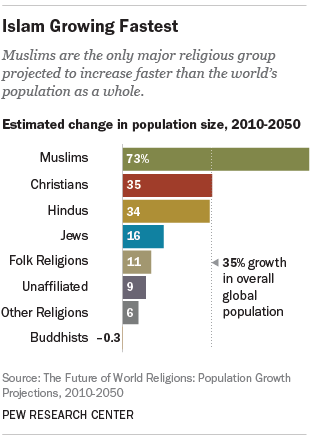
The more important thing shown by this table is that apart from Islam and Christianity all the other religions will dwindle and see their share of the world's population and influence greatly reduced. By 2100, close to 70% of the world's population will be either Muslim or Christian, up from around 55% today.
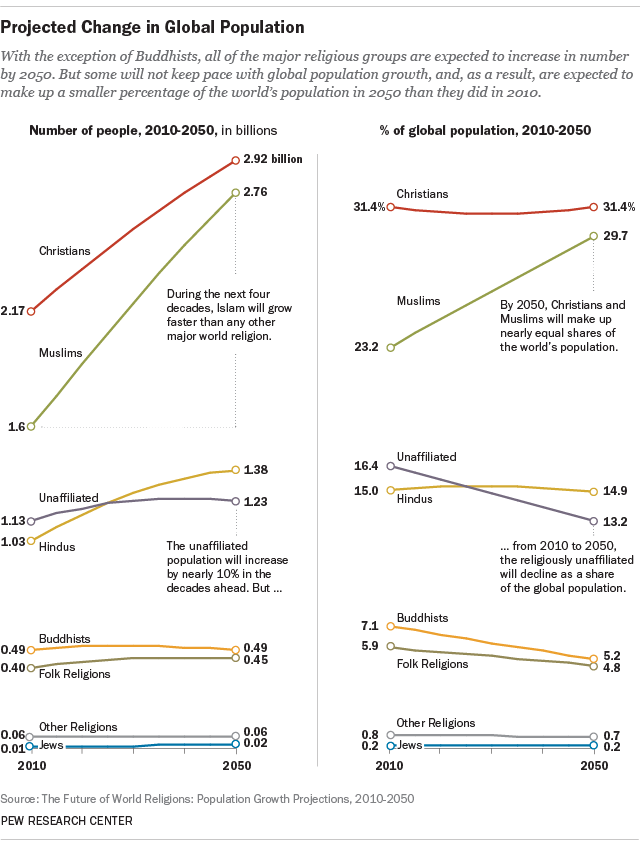
Buddhism and atheism (the religiously unaffiliated) will both decline, largely, in both cases, due to failure to reproduce. It seems that the pessimism associated with both (although in different directions) leads to a significantly lowered natality rate. Natural selection will play in favour of the religious who are bringing more children onto the Earth, and will therefore also inherit it.
Atheism will convert more than any other religion, but to what use, its population will dwindle away. When hedonism and promiscuity reign supreme, children will not be brought into the world - and the price of extinction will be paid. Atheism's biggest gains will be in the Western world.
Buddhism on the other hand suffers both from lack of conversions - it literarily has no mechanism capable to bring millions upon millions of people to the religion - and low natality rates. This was somewhat surprising, I expected Buddhism to become more popular, but this is actually not the case. It is a dying religion.
Islam is expected to take over Christianity (just barely) by 2100 in terms of population.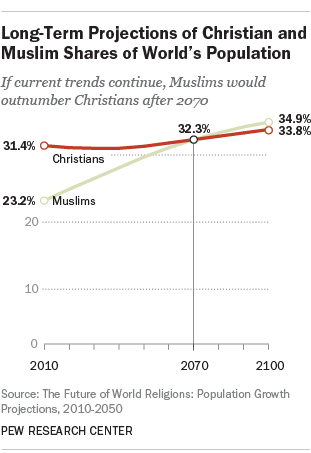
The most interesting is this table, showing conversions and people leaving each religion:
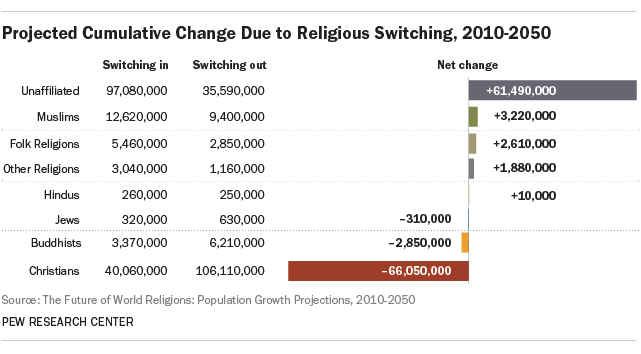
This table seems to depict Christianity as the loser. In terms of purely conversions, Christianity nets a whopping loss of 66 million people in the next 40 years. Also in terms of pure conversions, Atheism is winning.
However - it must be noted that Christianity will be able to bring in more converts than all the other religions put together - close to 1 million new converts ever year (total of 40 million), compared to Islam + Folk Religions + Other Religions + Hindus + Jews + Buddhists which will bring in a combined total of only 25 million (approx. 625,000/year).
The Church has clearly set up a conversion mechanism like no other. And while Christianity is losing a whopping 2.5 million adherents every year, this is mostly due to losses in the West. Once Christianity manages to put an end to the Western leak, it will be on the path to dominate the next 500 years. And the leak will come to a close by itself. Atheists with their life denying philosophy - and it seems that their philosophy simply cannot be otherwise, for without the infinite hope of the afterlife, atheism has nothing much to offer - will not breed, and will willingly yield the earth over to those with infinite hope and faith. Not only this, but the Western world is currently rejoicing in relative material well-being - once the shit hits the fan, atheism, along with its permissiveness and licentiousness will come to an end.
So why do I think that the future belongs to Christianity, even though Islam is the fastest growing religion? Because Islam (1) doesn't have the conversion mechanism of Christianity (bringing in just 325K people vs 1000K for Christianity), (2) its severe punishments for apostasy artificially lower deconversions and it will not be possible to maintain this forever, (3) Islam does not have access to capital and resources as much as Christianity, (4) the fact that large portions of Islam exist in war-torn regions makes them more prone to be heavily impacted by pandemics, droughts, and other natural disasters, (5) other religions will dwindle, and maybe even disappear from the Earth in the next 600 years.
What do you think? What's the future of religions looking to be on the Earth? Which religions will be popular 100 years from now and why?
Just according to pure numbers, Islam is the world's fastest growing religion. What accounts for that growth however isn't Islam's converting power, but rather the breeding rate of Muslim population coupled with the "death for apostasy" policy, which unnaturally keeps people who should leave in the Muslim faith. Check the table below:
The more important thing shown by this table is that apart from Islam and Christianity all the other religions will dwindle and see their share of the world's population and influence greatly reduced. By 2100, close to 70% of the world's population will be either Muslim or Christian, up from around 55% today.
Buddhism and atheism (the religiously unaffiliated) will both decline, largely, in both cases, due to failure to reproduce. It seems that the pessimism associated with both (although in different directions) leads to a significantly lowered natality rate. Natural selection will play in favour of the religious who are bringing more children onto the Earth, and will therefore also inherit it.
Atheism will convert more than any other religion, but to what use, its population will dwindle away. When hedonism and promiscuity reign supreme, children will not be brought into the world - and the price of extinction will be paid. Atheism's biggest gains will be in the Western world.
Buddhism on the other hand suffers both from lack of conversions - it literarily has no mechanism capable to bring millions upon millions of people to the religion - and low natality rates. This was somewhat surprising, I expected Buddhism to become more popular, but this is actually not the case. It is a dying religion.
Islam is expected to take over Christianity (just barely) by 2100 in terms of population.
The most interesting is this table, showing conversions and people leaving each religion:
This table seems to depict Christianity as the loser. In terms of purely conversions, Christianity nets a whopping loss of 66 million people in the next 40 years. Also in terms of pure conversions, Atheism is winning.
However - it must be noted that Christianity will be able to bring in more converts than all the other religions put together - close to 1 million new converts ever year (total of 40 million), compared to Islam + Folk Religions + Other Religions + Hindus + Jews + Buddhists which will bring in a combined total of only 25 million (approx. 625,000/year).
The Church has clearly set up a conversion mechanism like no other. And while Christianity is losing a whopping 2.5 million adherents every year, this is mostly due to losses in the West. Once Christianity manages to put an end to the Western leak, it will be on the path to dominate the next 500 years. And the leak will come to a close by itself. Atheists with their life denying philosophy - and it seems that their philosophy simply cannot be otherwise, for without the infinite hope of the afterlife, atheism has nothing much to offer - will not breed, and will willingly yield the earth over to those with infinite hope and faith. Not only this, but the Western world is currently rejoicing in relative material well-being - once the shit hits the fan, atheism, along with its permissiveness and licentiousness will come to an end.
So why do I think that the future belongs to Christianity, even though Islam is the fastest growing religion? Because Islam (1) doesn't have the conversion mechanism of Christianity (bringing in just 325K people vs 1000K for Christianity), (2) its severe punishments for apostasy artificially lower deconversions and it will not be possible to maintain this forever, (3) Islam does not have access to capital and resources as much as Christianity, (4) the fact that large portions of Islam exist in war-torn regions makes them more prone to be heavily impacted by pandemics, droughts, and other natural disasters, (5) other religions will dwindle, and maybe even disappear from the Earth in the next 600 years.
What do you think? What's the future of religions looking to be on the Earth? Which religions will be popular 100 years from now and why?
Comments (207)
How long will a good God put up w/ His (self-proclaimed) followers putting wealth first and mistreating their neighbors [the message is, "sure, you can immigrate to flee persecution... just don't come here" and "oh, you're poor? Too bad, shoulda tried harder to be born into a good family."]
I imagine telling my son about Christianity:
Me: There is a cool religion that is all about a good God who sent His Jesus son to die in our stead. This God says that we ought to love one another as He loves us. His followers turn the other check when insulted. They love their neighbors as themselves. (Thou shalt love the Lord thy God will all your heart... and thou shalt love thy neighbor as thyself) Jesus told them to give up all worldly possessions, and follow Him... (Matthew 19:21)
Son: Where are those followers?
Me: They all died a long time ago...
When was the last time you saw a (self-proclaimed) Christian who did anything even remotely like the character of the tax-collector in the story of the 2 men who went to the temple to pray ( Luke 18:10)?
Because you will be living in that world, so you need to take this into account. Maybe you're not happy that this is the case, and you want to change it. Or maybe you're like me, and you're asking yourself how you can help Christianity achieve this.
Why would I care which denomination will achieve religious monopoly? I don't even buy into religion.
Impossible - very very unlikely. Why would you say that?
Because, for example, say Islam achieves it, and people vote for an Islamic theocracy where you have to convert to the religion, then you yourself, who don't accept it, will be forced to join it.
And why is Christian theocracy any better? In fact, why is any decision taken by the demos any better?
demos? What demos?
Quoting Noblosh
Ah, so then you do give a damn about what happens with religion and atheism in the future.
Christianity seems like fairy tales. A Christian church is a museum. It's so just that many haven't noticed that yet.
So you do give a shit about it. Thanks for recognising.
Sure it does.
On topic, Christianity's growth includes fundamentalist Protestant denominations herding the dumb and uneducated in SEA, South America. and southern Africa, which is not going to save what's already being hemorrhaged. Pentecostalism vs. moderate Islam, hoo boy, I better start popping the popcorn now.
Because Islam will not permit this forum!
Yes, but the uneducated are an important source of converts. Those are the battlegrounds that all religions are actively seeking to win over.
How else would you suggest stopping the haemorrhage*?
The haemorrhage will stop naturally. Christianity needs to get rid of those people who aren't actually Christians in the first place. This cleaning is more than welcome in my eyes. They are free to go waddle in their permissive atheism, natural selection will take care of them.
It's better to know who your enemy is and have him far away from your breast, than hold the snake close so that you get bitten. In a certain way, the permissiveness of modern liberal Western culture is a blessing in disguise. Because they fear no shame and there is no compulsion in religious adherence, the wheat will be separated from the chaff by itself.
If I was the Pope, I'd be adamant about this. An important job of the Church should be to find a mechanism to even speed up the process of removing fake believers from within. A wolf in sheep's clothing is more dangerous than even a pack of wolves! What is necessary are people who are totally committed to the traditions of the Church, to its history, to living moral lives, and to God.
The only way to defeat Islam is to expose the character of Muhammad. Islam cannot be beaten militarily, economically or politically. Those battles are long past – although still pursued in vain. It must be shown that Muhammad is a pedophile (he had sex with a nine year old girl), murderer (he beheaded people), slave dealer (created and sold), illiterate psychopathic and morally bankrupt prophet with a sword? Muhammad is touted as the ideal man. The fact is, he is quite the opposite.
http://www.telegraph.co.uk/news/2017/01/30/muslim-refugees-converting-christianity-find-safety/
We as philosophers are on the front lines of this war. We are both the generals and foot soldiers in this war. We have an important function to play. Most importantly, we have an obligation to civilization to maintain and advance the dialog of what is right and moral. We must not abdicate or abstain from this job.
ISIS is also an ideological virus. This means that there is no ISIS headquarters that can be bombed and ISIS would be eradicated. If we dropped nukes on Syria and wiped them out, we'd still have terror attacks in the West from people claiming to be affiliated with ISIS.
Quoting Thinker
Excellent statement, I agree.
My goodness, you have an amazingly inflated opinion of how much what we say here matters. In what way are you "on the front lines?"
The fact that you, Agustino, and your ilk are so afraid of Islam shows the emptiness of your ideas. You just want to keep what's yours and make sure no one else gets their share.
What is the "Church"?
What rules the world? Money – military - politics – religion – movies – art – literature - ? What is common to all these things? Ideas. Ideas rule the world – always have and always will. Ideas breathe life into any institution. Civilization is only an idea. Ideas are our life’s blood. The philosopher's job is paramount and profound - one that is needed now more than ever.
The body of Christ, the cumulative number of faithful Christians. But, for the sake of this argument, you can take it as just the Catholic Church, which is a clear cut institution.
Argue that Muhammad was an upstanding and moral man. If you can't do that, there should be an x in the top of right of your screen which you could perhaps click.
Money - military - politics - religion - movies - art - literature; most of these have nothing to do with ideas, at least not the kind of ideas we're talking about here. Definitely not "philosophical" ideas. Even if they did, spouting off about ideas on an obscure website won't do anything. You would have to take those ideas out into the world - start a company, run for Congress, write a book.
Right mate. First, I'm totally not afraid of Islam. What's there to be afraid of, at the moment Christianity is still holding sway. However, this doesn't mean that we should neglect a threat and let it grow to levels where it actually becomes dangerous. That's the reason behind the loss of many great powers in history - neglecting "little" insignificant threats.
We both hold a degree in the same profession, but it seems that unlike me, you're not very much self-motivated, by your own previous admissions on the forums. Maybe that explains your lack of understanding of history and your totally unrealistic opinion here:
Quoting T Clark
I have no opinion about Muhammad's character. He died 1,400 years ago. It's not relevant to what we are discussing. Thousands, tens of thousands, of Catholic priests have raped tens of thousands of children, in many cases destroying their lives. Does that justify rejecting Christianity out of hand? Actually, maybe it does. That's not the only stain on the robe of Christianity.
As for me clicking on the x at the top right of my screen, are you saying that if I don't agree with you I should not express my opinion? Is that Christian or Islamic dogma?
You certainly seem to be afraid of something.
Quoting Agustino
So, let me see if I understand, I'm wrong not because you can provide any argument against my position, but because I lack self-motivation. It has to do with me and my character rather than the content of what I wrote. You are more qualified to make judgments because you are self-motivated and not because of the quality of your ideas. Is that correct?
That's correct. But so what?
Quoting Heister Eggcart
It is a curious thing. From afar, protestants (thinking here of evangelicals mainly) seem a lot more into their religion, at least superficially, than many lay Orthodox believers (or Catholic) that I know personally. But obviously I don't have as much acquaintance with protestants as you do. So what's your general take on Protestantism from within the belly of the beast?
On another note, would you say that this:
Quoting Terrapin Station
Is a common experience with Protestant believers? >:O >:O
Quoting Heister Eggcart
Right, so now we know that you don't own a Mac ;) ;) ;)
The semblance is of your own making, it's a creation of your mind which has misjudged. Have you taken that possibility into account?
Quoting T Clark
No.
If you used your mind I'm sure you could figure it out. Because I'm self-motivated I have studied the development, growth and decay of civilisations, which you, not being self-motivated and needing someone to prod you to do this and that, probably didn't.
You missed my point. In the previous post and this one, you made a statement about my lack of understanding without addressing the content of my statement. Is my statement incorrect? Show me why.
One factor is the tenor of the two leading religions. In their local manifestation, either/both of the religions can be fiercely militant or accommodating, and have been both. The distribution of militant and accommodating believers coupled with demographics will matter a great deal. Some Christians and some Moslems are hot, cold, and lukewarm.
Global warming looms over all predictions. No area of earth will be untouched, but some will be touched more than others. How severe the effects of global warming are (and not just warming per se, but other consequences like drought, insect vectors and disease distributions, flooding, unpredictable rains and dry periods, food production, etc.) is going to result in disruption of population predictions and familiar climate conditions.
Now, people in North Africa, the Eastern Mediterranean, Western Asia, and Southern Asia are (sadly) unlikely to become Christians, Buddhists, or Atheists just because the weather is bad, but they may not be as successful in reproducing as they have been. The water crunch in the Middle East has not really hit hard yet. Their aquifers have been overdrawn (just like aquifers in the US great plains have been) and will be recharged only in the distant future. As oil production diminishes (owing to diminishing supply) the amount of income in the Middle East could be insufficient to support massive desalination projects and food imports.
So, projections of population growth may not be fulfilled.
A third factor is change in religious tenor. Christianity has gone through periods of decay and rejuvenation. In the colonial period, religiosity was not very intense. This changed in the early part of the 19th century in the unpredicted "great reawakening" episodes, the effects of which were long-enduring. I don't anticipate a great reawakening in Europe or North America, but it isn't at all inconceivable.
A new religion might appear; that would not necessarily be a good thing. There are possibilities that are quite unsavory.
From the holy Book of Armaments, Chapter 2:
And Saint Attila raised the hand grenade up on high, saying, "O Lord, bless this Thy hand grenade that with it Thou mayest blow Thine enemies to tiny bits, in Thy mercy." And the Lord did grin and the people did feast upon the lambs and sloths and carp and anchovies and orangutans and breakfast cereals, and fruit bats and large chu... [At this point, the friar is urged by Brother Maynard to "skip a bit, brother"]... And the Lord spake, saying, "First shalt thou take out the Holy Pin, then shalt thou count to three, no more, no less. Three shall be the number thou shalt count, and the number of the counting shall be three. Four shalt thou not count, neither count thou two, excepting that thou then proceed to three. Five is right out. Once the number three, being the third number, be reached, then lobbest thou thy Holy Hand Grenade of Antioch towards thy foe, who being naughty in my sight, shall snuff it." Amen.
Yes, amen! And strength to the Writeous. And chronic diarrhoea to those who shall quarrelth with them, disputing their Glorious Mandate.
For the simple reason that there is no evidence that as poor countries become wealthier, the share of the wealth of Western countries becomes lower. The GDP of the US relative to the GDP of the world was at roughly 25% in 1980 and it is at roughly 25% today, 40 years later.
Here's a chart for you to look over. Generally what led to changes in economic power were technological advances. When Europe became technologically superior to the whole rest of the Earth, they went around conquering and pillaging. Currently America, Russia, and China hold the world's power in their hands. It will be difficult for anyone to wrestle it away.
That's why the statement you made is hardly worth refuting. It's purely nonsense - a fantasy. You may believe that fantasy because it sounds nice for the world or some bullshit, but it doesn't make it true.
I look at the charts you provided and they show a fairly constant decrease in the US's share of world GDP since 1950. Other Western countries also show something of a decrease. China shows a dramatic increase. This data is only through 2008. How have things changed since then?
Well since 2008-2009 was the period of the financial crisis, those years marked a decrease for US/Western world. After that, if we use IMF statistics for 2016, the US is back at 25% of the world's GDP. US -> 18.5 trillion, World -> 75 trillion.
The fact is that the US is not decreasing at all, rather China, a nation of almost 2 billion people is growing and it should! It's completely unnatural for China to have a share of global GDP of 10% when it is home to 37% of the world's population. But if you look at the a better indicator for well-being, GDP per capita, you'll see that the US and UK and other Western countries have been growing far more as a percentage of world gdp/capita compared to the poor countries.
There is a salient aspect of the Islamic culture which is extent today - the headscarf or hijab in Islamic culture. What does the hijab mean? It means men get to say how women dress. It means women are viewed as sexual objects. It means women are controlled and become the vessel and vehicle of Islamic propagation and domination. There is an Islamic cleric in Brussel’s that has recently said: “Democracy is the train we will ride to domination”. This is a true and disturbing statement. It is partially true because of the hijab. The hijab is part of the culture but comes from the Quran and Ahaditha and the ideas of Muhammad. The hijab is a type of enslavement.
What we need more than ever in society is the participation of women. For the last 5000 years men have dominated civilization. This fact still continues today. Have men done a good job? Not so much. Women are 50% of the human intellect and they are different than men. Women think differently than men and this is a good thing. We are not fully using 50% of our toolbox. This is dumb. Women are here to balance our prospective – not to overpower it – like men do now. We need a partnership in order for human beings to flourish and reach a new horizon. We need to honor women and men alike. This is common sense – not a radical idea.
I fully agree with your sentiments, and commend you for making this post.
You are correct the growth of the very cancerous forms of hedonism, nihilism, moral relativism, sexual immorality which have largely swept through the Western world have left it in tatters. That's why our divorce rate is over 50%, most people actively fornicate and have no respect towards their own body or the body of their future partner, engage in idol worship, and are not at all concerned about the state of their souls.
However - my assessment is that this is now changing. A lot of the younger people are getting interested in religion once again, and have started to rebel against the prevalent nihilism and moral relativism prevalent in their societies. I've been saying this for a very long time, and some people question it, thinking that nihilism has already won, but that's far from the truth. I think we're on the edge of a rebirth of religion in the West, which will slowly spring up in the next 10 years, and enter into full force only in the coming decades.
Yes, these figures are open to various interpretations. "The Oxfam report calculates the wealth of the richest individuals using the Forbes Billionaires list and the wealth of the poorest groups from the Credit Suisse Global Wealth Report." When various caveats are figured in, it isn't 8 people that have more wealth than 50% of the world's population, it's about 60 people. 8, 60, 120, 500, 1000, 2000 -- what difference does it make? It's all very disproportionate.
And, chances are it will stay that way, because that much wealth controlled by a few people, the wealth can hardly avoid increasing at a generous rate. Poor farmers just can't generate new wealth for themselves quickly, unless they unearth a gold mine. And if they do unearth a gold mine, chances are that it will be taken away from them.
Money is the best way to make money, and power is the best way to make power. However intelligence often does find ways to beat even those advantages, so they are never certain. But yes, due to the magic of compound interest, people who spend conservatively and have a lot of money are likely to remain rich for many generations to come.
I think that the future of religion on Earth is irreligion. Christianity and Islam will go the way of Judiasm, and like cultural Jews might identify somehow with the values espoused by traditionalists but won't take them very seriously. Christianity already has a great number of these in the form of families who attend church ceremonies less than once a year and whose main connections to the ideology come in the form of Christmas, Easter, and contemplating existence and belief in the afterlife when confronted with death.
While I don't think religion will ever go away, in regions where technology and wealth continue to offer more and more diversity in choice and quality of education, indoctrination (especially of one's children) into religious schools of thought will become more and more difficult. Islam will likely outlast/overtake Christianity because the regions where it's popular are currently more orthodox on average and lag behind the west in terms of technology, but I suspect that the trend of atheism will continue grow. We will take religious beliefs less and less seriously as our societal intellect matures and the need for it is lessened.
Quoting VagabondSpectre
>:O My IQ is quite high, believe me on that, there's no problem with it. And I totally see a need for religion. But forget myself, many of the brightest minds in history have been theists - Leibniz, Newton, etc.
Enough of an opinion to suggest that Thinker's characterization of Mohammad was and is an "empty idea" ...
Having sex with a child is immoral, whether it's now or 1,400 years ago. Do you contest this?
Seeing as you replied to Thinker's post about Muhammad's character and the need for [Christians] to use moral argument in light of Islam's cherished prophet, I fail to see any other discussion being attempted, from either you or Thinker.
Ah, yes, this ole flimsy defense. Sees discussion about Muhammad and Islam, decides to move the goal posts so the topic changes to being about Catholic priests. Sigh, I really do tire of seeing this argumentative approach, here and elsewhere. If you or anyone wants to critique Mohammad, compare him to Jesus. If you want to analyze immorality in Catholic priests, compare it to Muslim Imams. But, this would rubbish your position, so I'm sure you won't do that, which is why you've proclaimed not to have an opinion on a psychopathic, child molesting desert warlord in Muhammad, but will readily scream about pedophilic priests, giving your opinion on them when no one desired it.
Atheists don't need to reproduce! All babies are atheists ;) And the ability of parents to adequately indoctrinate them seems to be on a down slope. If we actually look at the young population, we see many religious "revolutionaries", but we also see unending hordes of self-absorbed hipsters and social media addicts. How successful has religion been at branding itself through social media so far? If you want to win the children, you've got to do it in an arena that cannot be formalized or controlled.
What makes you think that watered down religion is going to go away? Why shouldn't it just get more watered down (especially as more countries begin to figure out that secularism is blatantly a better bet than theocracy)? What's going to change that will reverse these trends in the west and possibly globally as we slowly but surely globalize?
The main reason why I'm not very swayed by birth and conversion rates is that historical trends aren't going to be representative of the novel and sweeping change that is happening across the globe. The real history of religious growth and decline is a messy line of ups and downs which correlate with the local contributory factors of the time, and so drawing conclusions about the immediate future from long term trends can be quite risky. For instance, Islam might be on the rise especially in borderline third world countries (countries with large and impoverished populations) but as the wealth of these nations grows, maybe that trend will be reversed as it has been for Christianity by a surge of irreligion. I prefer an analysis of the causation over statistical projections, but if we focus on recent trends only and set aside the prediction that we will soon return to a world of fire and brimstone, then atheism and irreligion is set to rise...
Change (more than ever before) is what typifies the contemporary world, and so I would have predictions of the future take this into account, but that usually makes it far too difficult.
So, you bemoan the decay of the west. Ok – I bemoan the decay of the world, because we do not understand how civilization got here. Where do you think civilization comes from? How did it get its start? Think back – way back – in the cave – or even before the cave – what happened? Or, maybe I should first ask – what is civilization? Civilization is a social contract. People band together for mutual benefit – right? So, what is the first “banding” together for mutual benefit? It is a mother and a child. A mother and child is the first social contract and the foundation of all civilization. What holds a mother and child together – love. A mother loves her child because she loves herself. A mother loves herself because she learned love from her mother. A very practical dynamic – that - sets in motion a force - which humans use to propel themselves through life’s journey. What is the basis of civilization – it is the love bond between a mother and child. Love is a kind of contract between two beings. I call mother/child love the first human contract. It is an agreement to protect, nurture, cherish and persist. This contract is what gives civilization its start. More importantly – it is what holds civilization together – today and on into the future.
Want to save the world – honor and cherish women – now. It is not a guarantee – but it is a good start. You want a better world – support your local love machine – mother and child.
There's a pretty big difference between not being Catholic and being Catholic, just as there's a huge gulf [teehee] between Sufism and some other sect of Islam. Pentecostalism doesn't save Christianity, just as radical Islamism doesn't save Islam.
Quoting Agustino
Islamist suicide bombers seem pretty "into their religion." But does that make what they say or believe in right? Or does it mean that they actually understand their "religion"? I don't think so.
And for what it's worth, since you inquired, I don't think Protestants are any more pious, let's say, than their Catholic or Orthodox counterparts. Although it's true I've not been in contact or have surrounded myself with as many Catholics and Orthodox Christians, I can confirm from my own experience that the mumbling and hand flipping many evangelical Protestants do have no bearing on how they treat others. They're as rotten and sinful as everyone else, so there's definitely an outward, superficial aspect there that you had best not get lured in by.
I also think that Lutherans and Methodists and all other bland ass, more leftist Protestant denominations are as fake as the evangelicals. Though, perhaps James Comey is the most moral Methodist I "know", 8-)
Quoting Agustino
Many of the minister's daughters I have met are simply strange, dunno about promiscuous...haven't tried them out >:)
Quoting Agustino
But we both know that Sappy sure does, ;)
I'm not suggesting that smart people cannot be theists or even that dumb people tend to be theists; I don't doubt your IQ. What I was more so referring to is the basic degree of sophistication that exists in a society not just in terms of the average intellect, but also in the social institutions which enshrine and enact the social services which religion has historically been a primary provider of. Secularization seems to occur as a developing society realizes that it needs improved standards (such as reason and fact based justice) to confront the novel challenges that growth and success produce.
Some argue that individually there is a psychological need for some religious values, and while I consider myself an exception I might assent to that reality for many. But socially, in terms of how we organize and how we can best improve, I don't see any strictly religious values that could be of assistance, so I think they'll decline.
The Christian church in the United States is certainly not dead, and it isn't dying--it is diminished. Fewer adherents, and adherents with more varied theological stances, but adherents none the less.
From the experience of the last 60 years we can not conclude that the church will continue to shrink, or that it will suddenly start expanding again. We will just have to wait and see what happens.
True. Rather than the term "atheist" I think "secular" and "secularized" is better. Secularization is an active process brought about by urbanization, technology, communication, prosperity, education, and other factors. Of course, urban, techno-sophisticated, plugged in, prosperous and educated people may be religious, but they are more likely not to be, certainly less likely to be traditionally religious.
They also have as much integrity, interest in salvation, and are as attentive to the teaching of Jesus as everyone else.
I have had lots of interaction with conservative and liberal Catholics, mainline Protestants and evangelicals. Sincere and earnest believers are all pretty much alike, as are lukewarm believers, whatever their denominational membership.
Quoting Heister Eggcart
My, such a glittering generality. What, actually, do you know about Lutherans and Methodists?
What is your idea of the Genuine article?
In the end it all does come down to factors that are not adequately predictable. Augustino alludes to some future point where our wealth and prosperity go away (almost as if he holds out hope for it :p), and it troubles me that he might be completely correct. For the loser now might be later at a win, for the times, they are a changin'.
I agree with what you said, and as distressingly stupid as some POMO 'texts' are, in all fairness I don't think POMO, a few French Philosophers and American graduate students are responsible for the Decline of the West.
My personal opinion is that economics has done much more damage to the family, religion, and other important institutions than any philosophical strand could have. Concentration of wealth has resulted in a concentration of power, and in both cases, most individuals lack both wealth and power -- sometimes having too little to keep body and soul together.
Yes, and I'm sure all Christians drink water, too.
Quoting Bitter Crank
I think I'd venture to agree with you here, though I still think it's important to separate x believer with y believer on the grounds of what they believe, not merely how fervently they believe.
Quoting Bitter Crank
Firstly, that you're either Lutheran or Methodist, considering the bitterness of your tenor at present. Secondly, I never claimed that all Methodists or Lutherans or what have you are fakes. In this thread at least I'm not being positive with regard to Protestants because they've been very little good to me and my family. Those legions of charlatans I've come in contact with ought to feel the heat of hellfire, but tu, Bitter Crankus? No, I like you. You seem like a good, upstanding gentleman.
I was being bitter at present? (Hrumphs bitterly to himself... O the fickleness of the world!)
Quoting Heister Eggcart
I'm far more of a cultural Christian than an ardent believer. Whether I even believe in it is unclear. I hang around a Lutheran church because it is near by (across the street) and it helps me maintain a little community with other people. I would prefer a bit more community, and would like to have more gays and oddball outliers among my circle,. But success in seeking oddballs and outliers in Lutheran churches is contraindicated.
That is certainly what I hope for, I have a feeling that young people just might disregard the foolish philosophical ideas of those who came before them. Young people who were born within the last 16 years in particular. Who knows, could be another Great Awakening.
I got that sense, but...you sort of prove my point from earlier, that a lot of religious people aren't particularly religious, they just value a sense of community super highly.
Edit: I mean, how many religions would even survive without a community component? How many Christians would there be if they couldn't hang out, go to church, play basketball in the gym after a potluck, etc.? No community and you just end up with a couple monks out in the middle of nowhere.
Interesting aside... Luther represented his childhood as quite poor. It wasn't. Luther's family was fairly well off. They were in the mining and smelting business.
True enough. Perhaps we differ in what we mean by "religious'. If religion refers to the rituals of the church (kneeling, genuflecting, saying certain creeds, praying certain prayers, singing certain responses, etc.) then sure, a lot of people aren't religious.
However, if you mean by religion that they enact the beliefs of the faith (the various corporal acts of charity, unconditional generosity, etc.) then you find far fewer pseudo-religious people, because people aren't unconditionally generous, usually, unless they really are motivated by good feeling toward others. In fact, you probably don't find a lot of genuine believers, period, because following Jesus or Buddha is hard.
Quoting Heister Eggcart
I'd go so far as to say a religion which doesn't foster community (people together) isn't worth having or saving.
Most major religions have always had an ascetic component, practiced to varying degrees. I personally have trouble with both concepts; I see value in each.
Sure, what does that have to do with me using the Catholic Church for the sake of this discussion though?
Quoting Heister Eggcart
Well yeah, I don't think there's much comparison between strapping bombs to your chest and blowing yourself up, and fervently praying, reading, discussing the Bible.
Quoting Heister Eggcart
Okay thanks for sharing that.
Quoting Heister Eggcart
>:O
Quoting Heister Eggcart
Sappy has a poster of Jeremy Corbyn on his bedroom wall for sure! :D
That's your opinion, but I'd argue that you are absolutely wrong. The desire for the transcendent (including God) is a natural human desire, which existed from the very beginning of mankind. So babies aren't born atheists, they're born with a desire for God from the very beginning.
Quoting VagabondSpectre
Parents don't need to be indoctrinated at all. My parents most certainly didn't "indoctrinate" me in my religious views. I learned myself, through self-education.
Quoting VagabondSpectre
God BLESS the unending hordes of self-absorbed hipsters and social media addicts - without them, religion could most definitely not win. But their weakness, sloth, laziness and complete lack of virtue is a gift. These people will change with the winds, they pose no resistance at all. So let's see - on the one side, we have the fervently religious, who are determined to save their societies, and on the other you have punk-ass kids who like to have lots of sex and play video games and don't give a fuck about their world. Whose going to win, you tell me?
Quoting VagabondSpectre
It's not going to go away, it's going to reduce. People will understand where nihilism and atheism lead to, namely complete social disintegration, which is, by the way, exactly what we're witnessing in the West right now. The rise of rampant hedonism, an ideology that takes life as something to be enjoyed, rising divorce rates (50%+), broken families, the dissolution of hope (and I'm not talking about some puny ass "better technology" or "better economic conditions" hope that liberals always trump about - that's fake hope as far as I'm concerned), the promotion of vices by the media and Hollywood, etc.
Religion will bring the missing order into society.
Quoting VagabondSpectre
The rise of religious movements combined with a complete renunciation of PC and neo-liberal dogma that permits such unnatural trends to exist in the first place. The election of Donald Trump, and BREXIT, are just the beginnings.
Quoting VagabondSpectre
Right, I don't see how development is antithetical to religious values. Religious values, on the contrary, have given birth to all that development we've witnessed in the West. It's only in recent history, once those values were abandoned, that the West started to collapse, which is where we stand today in history.
Quoting VagabondSpectre
No, actually I don't. We'll be more prosperous than ever, and it will be a true golden age, when religion and morality finally return in full force in Western society - it will be a new Renaissance.
Right. When Job had everything taken away from him, had diseases cast on him, and saw his whole world collapsing, he could keep his soul and faith in God together. And yet, these weaklings today can't even keep their body and soul together in much less pressing circumstances because of the concentration of wealth and power. Give me a break.
This faux paradigm confuses many people. It's not the outward circumstances that determine the inner, but the other way around - the inner determines the outward. As above, so below.
When you see these feminazis sometimes you feel bad for being a fellow human being >:O
I know many "fervent atheists" who are "determined to save their societies". I don't agree with them, but I respect their fervor, and find it lacking in more of (but not all of) my Christian friends.
Indeed, fervor is the key. I see atheists as spiritual beings of a sort. Atheists are profound thinkers. They have looked deeply at the universe and come to an understanding – a knowing. This knowing has logic, but more importantly it is a feeling of what is right. After all the logic and reasoning is done they arrive at a conclusion – an evaluation. The conclusion is almost superfluous to their sense of being settled. What we seek is to be settled – we want to know – something. This knowing is a spiritual journey – no matter what you think. The journey is special and it is worthy. Atheism is a religion of one. It doesn’t matter if they think they are God or there is no God. They have come to a knowing. What we see in an atheist intellect is courage – this is noble.
Is it right? Who cares – it is a conclusion of significance. The significance is that they have a feeling – a knowing. We live our entire life moving from one feeling to another. We play leap frog in our minds from one moment to the next. The feelings are what makes our journey unique and it is a spiritual quest to find ourselves. To know thyself is a holy quest and it is unending. I applaud the man or woman of courage who seeks their own destiny and knowing. Those people who line up to be told what to think – do not show much courage.
How many Christians would drop everything and follow Him if He came upon your doorstep? Methinks very few. The idea of Jesus is quite nice, but if the reality came knocking...hard, I agree.
If the discussion is about saving Christianity, getting a bunch of evangelical Protestants mucking about doesn't save Christianity or the Catholic Church.
You know what I've found in many Christians? Fear. Fear that somehow this world doesn't belong to them, and they must adjust to that fact. Reticence. They're not willing to take action - they're not willing to fight for their beliefs. The atheists act as if they are right, and anyone in their right mind should follow them. Christians should adopt the same attitude and fight back, otherwise they can't win. So yes, the fact that fervor is lacking in your Christian friends is a problem. Fire them up. Get them to believe.
Quoting Heister Eggcart
Good, now you're finally saying something. What should be done then?
Quoting Agustino
Kill the infidels.
No, something moral and realistic please. I expected you to have an opinion if you're so into criticising what you see.
Either you are interpreting the charts wrong or I don't understand what you are trying to say. The first two charts show that the US's share of worldwide GNP has been decreasing fairly steadily between 1950 and 2008. That is relevant to my statement about the changing world. Agreed - the data does not show the past 10 years.
The third chart shows that the absolute value of per capita income in the US has been increasing faster than other countries. That is something completely different and is not relevant to what we were discussing.
That is an important issue, but I'm not sure if it is relevant to the point I was trying to make. Do you think so?
Sigh? That's a cogent argument? Furthermore, I disagree. The behavior of priests is much more a measure of the health and value of a religion than what happened more than a thousand years ago. Beyond that, you are being disingenuous. Muhammad is your straw man. If you thought Islam was a religion that shared values and dogma with yours, you wouldn't have brought up Mohammad's behavior. You only bring it up for rhetorical purposes - to try to convince people when your other arguments can't.
It doesn't matter what Mohammad did 14 centuries ago. It matters what Islam does now.
I agree. Related to the concentration of power and wealth is the corporatization of the world economy. Maybe the rise of corporations caused the concentration of wealth.
As a side note, a joke I like - Republicans think life begins at incorporation.
That's not true, I'm full on aggressive! But yes, I'm bored, bored of worthless and off the point critiques like yours, not designed with any productive purpose in mind but the satisfaction of a disgruntled and pretentious jerk. Apathetic because of so much uncodemned foolishness in the world that goes on to reproduce ad infinitum.
Quoting Thinker
And why would Christianity permit it? Christian or Islamic theocracy, I can't care less for the difference.
I have argued something similar on another post, although I don't think the "transcendent" necessarily means "god," at least as Christianity and Islam see him. I think there is a (possibly) hardwired capacity and motivation to look for something beyond ourselves.
I don't necessarily think there's a clear cut solution to the problem. At the very least I don't think it's prudent for the Catholic church to water down its liturgy so it's more agreeable with vacuous, stupid people, which is the targeted demographic of many Protestant denominations. ~ Is Orthodoxy watering itself down, though? And if it isn't, is it also dying?
Also, I'd say there needs to be more of a shift in society in general toward the arts, philosophy, etc., which would create an environment where thinking is appreciated and religion isn't just some afterlife bet or community dispenser. The "fixes", say, that the Catholic Church need in order to preserve Western Civ can't only come from itself. A whole more needs to fall into line in order for there to be generations of thoughtful Christians.
The fact is, this world does not belong to them. It never has. I doubt it will. I'm glad it doesn't. It will be good for the Christians to learn a bit of humility. Didn't Jesus talk about the importance of humility?
Priests did not establish Christianity, however, Jesus Christ did, just as Muhammad founded Islam. As I said, critiquing priests in light of critiquing Muhammad is moving the goal posts, and is in fact a straw man.
Quoting T Clark
Huh? I do not think Islam shares the same values as Christianity, which is why Muhammad was brought up, seeing as his reprehensible nature is entirely inferior to that of Jesus Christ's.
Quoting T Clark
I think it does matter that Islam now glorifies a child molesting warmonger as their religion's most moral man and enlightened prophet. I, among others, find this reverence toward Muhammad to be appalling and sickening.
Additionally, you're trying to paint me as a hypocrite for defending Christianity and not Islam, solely on the grounds of there being pedophilic priests. I contest this because the Church, and indeed 99.9% of all Christians, vehemently condemn the actions taken by those improper priests, which has resulted in their defrocking, being thrown out of the Church, and in many cases being charged criminally by secular law. So, on one hand we have a religion in Christianity that has been immensely embarrassed by the sex abuse scandal and which has taken drastic steps to eradicate the occurrence of such instances within its institution, while on the other hand, we've Islam that looks at child molesting sex abuse as a virtue in Muhammad, the ideal man. If you fail to see this dichotomy, then I don't know what else I can do to assuage you of your irrationality.
Contrary to this projection of yours, I'm actually contributing to this thread by having reasonable conversation with Agustino, BC, and T Clark. If you'd like to join, by all means, come on in. My tongue has edge enough for you still!
Why would I participate? This is not even a proper subject for a philosophical forum, maybe for a religious one. it's just people debating which denomination they should gamble their faith on.
I'm also not interested in your edginess, it's in bad taste.
I'm not asking you to defend Islam. I'm just saying your argument about Mohammad is a weak argument, a non sequitur, and a bit self-serving. I changed "disingenuous" to "self-serving" because I think saying "disingenuous" questions you honesty, which I don't mean to do. Fact - the highest levels of the Catholic Church hid and enabled pedophile priests for decades until the Boston Globe blew the lid off. They got the Pulitzer Prize for that. They deserved the Nobel Peace Prize. Many (most?) of the priests never were held accountable either because they died before they were found out, they are still being protected, or no one ever came forward to report them.
Amen, brother! (Y)
And further, for those others obsessed with such matters, there is significant doubt whether the girl in question was really pre-pubescent. She may have been 15 or 16. And those were different times and a different place. He had six wives for example, and was esteemed by most contemporaries. For whatever that is worth.
And before someone else tells me the obvious... Terrorism is wrong, and should be stopped and punished. There is no doubt the severity of our current situation. I honestly share the concern. Terrorists are murderers, NOT brave and dutiful soldiers. And they should be treated as criminals. No matter if they happen to be Muslim, Christian, atheist, or a government official.
Yes, I'm sure you're one of those, "delete philosophy of religion" sorts of people. If this thread irks you so much, leave.
Yes, I agree on the dubiousness, fundamentalism, and evangelism present in this thread. But maybe the moderators are choosing to be like NBA officials in the playoffs, and letting the players battle it out. If then, so be it. ;)
How so? You already said you have no opinion of Muhammad, but you're willing to refute the opinions of others who do critique him? :^/
Quoting T Clark
To play devil's advocate here, I thought you said that the past doesn't matter? So who cares if some kids were raped 14 centuries ago, eh?
I'm not refuting your opinions, I am denying they are relevant to an examination of present-day Islam.
Quoting Heister Eggcart
Are you joking? If my memory is correct, the Boston Globe started it's stories in the early 2000s. Many of the priests and abused children are still alive. Although I'm not a Christian, I'm not trying to undermine the validity of the Christian church. I'm only trying to undermine the validity of your Mohammad argument.
Fucking wow. This is still child molestation, you creep.
For at least this post, i agree, fwiw. And commend you on the attempt to see the big picture, to see both sides of the spinning coin. (Y)
First, you are shamelessly dishonest. What did I say here?
Quoting Agustino
Now, look at those graphs, and tell me, is it a continuous decrease if in 2016 the GDP is 25% of the world's GDP? No. It's virtually the same.
Quoting T Clark
No, that graph does not show per capita INCOME. It shows GROSS DOMESTIC PRODUCT per capita. The two are absolutely not the same. Really this is my last response to you on this topic, as it seems you don't even understand basic economics. And it is absolutely relevant to the discussion, since you're trying to say that the poor countries are catching up and the relative share of the wealth is more evenly spread - and that's not true. The US and the rich countries are getting further ahead relative to their populations compared to the poor countries.
Something that by the way even you recognise in the underlined bit. So thanks for admitting to your ignorance. Next time please stay in the areas you're comfortable with.
Quoting T Clark
Well, that remains to be seen.
First of all, this is posted in the philosophy of religion section. Seems appropriate to me. And while Agustino and Heister Eggcart are a bit pugnacious and smug, I don't see much in the way of fundamentalism and evangelism.
From Wikipedia:
[i]The age of consent in Canada is 16. All U.S. states set their limits between 16 and 18. The age of consent in Mexico is complex. Typically, Mexican states have a "primary" age of consent (which may be as low as 12), and sexual conduct with persons below that age is always illegal.
Ages of consent in North America - Wikipedia[/i]
And this was over a thousand years ago. Please take the time to get the facts at least somewhat straight. And chuck you, Farley! (L) X-) (L)
Did I say anything about watering down? The problem at the moment is that they're not forcefully representing their REAL position.
Quoting Heister Eggcart
No, it's not watering itself down, but the dumb people call themselves Orthodox, even though in reality they're following local traditions more than the teachings of the Church. Is it also dying? Not in Eastern Europe and Russia it isn't, but neither is it growing very fast - although there are some young people who show keen interest in religion.
Quoting Heister Eggcart
Well part of the problem is that the Church isn't emphasising its position in a coherent way. It is afraid not to upset the gay community, or not to upset other religions, etc. etc. It's so politically correct, that it is in reality in a straight jacket, even though it has all the power that it needs, if it wanted to do something.
Also, a lot of the Church's arguments for religion, while valid, are antiquated, and don't speak well to people today. These arguments need to be reframed and recast in a way that speaks to modern people.
Yes, he had 6 wives, while other men were only allowed a maximum of four. But Muhammad was special, God let him have more.
And the fact that someone is ESTEEMED for having multiple wives is no different than someone being esteemed for being rich, or for being powerful, or for having an army of slaves. I'm not quite sure if that esteem is worth having in the first place. Sounds to me like pandering after social approval.
This thread is in the philosophy of religion section. If you can't even discuss religion there, where can you discuss it then? We're discussing the evolution and relationship amongst religions, including, yes, deciding and talking about which religion is best. You have an issue with that? Has it hit your "politically incorrect" button?
Good one. Well... the law of the land (whatever land it is) is definitely NOT perfect. And religious wisdom guides us hopefully. And in that spirit, would you mind terribly stopping the uncalled-for insults, dear chap? Thanks.
Explain. I don't see what you're getting at here.
Quoting Agustino
I mean, what's this thread about, then? Are we wanting to save true believers in Christianity, or just the facade of people going to church? If it's the former, I don't think we can get every Christian to be true believers. Do you?
Quoting Agustino
I don't think the Church is going to budge much, to be honest...
You're a creep. Why would I not call a spade a spade?
Incidentally I know a few people who have done this in real life (not that I'm friends with them, but I do know them). It's hard to prevent it when others hold social power and use it - even if it's just local power, say being the mayor of a village. It's not an infrequent affair in Eastern European countries, unfortunately.
They don't articulate their position frequently on the media. For example, they don't speak against promiscuity loudly and openly. Instead those in favor of promiscuity get all the screen time. What's the Church doing, are they embarrassed of their position?!
Quoting Heister Eggcart
Multiple things. First it's about discussing the future of religions. Second, it's about discussing the role of Christianity in the future, including what actions are likely to be favourable/unfavourable for it. And thirdly, there's a lot of side discussions going on which are addressing issues on the side of these main topics of discussion, which is exactly what should be happening in my honest opinion (for example, me discussing economics with Mr. Clark).
Quoting Heister Eggcart
No that is indeed impossible. But that's not really the point. The point is that Christianity's influence on culture has sharply decreased, to the point that, especially in the West, as evidenced by some responses in this thread, it is viewed with ridicule, as a museum artefact (to quote Mongrel). That's something that has to change.
Quoting Heister Eggcart
Why not?
Alright... i may have exaggerated. But in my opinion, not by very much. This is more like "the politics of Religion". But I'm splitting hairs. It is what is. If I didn't think it was worthy of discussion, I would ignore it. Carry on! (Y)
Wait... did you just say which religion is best? What is this, the Super Bowl? X-)
Here's what I said in my original post on this subject - "Economic factors will have a much bigger impact on how things go in the future than religion. It's happening now. As poor countries become wealthier, Western countries' share of the wealth goes down, even if their standard of living does not. Formerly poor countries will take on a greater power role in the world. We will have less of a say in how things go. In terms of overall humanity, it's a good thing."
Note - I said "Western Countries," not "United States."
From Organization for Economic Cooperation and Development. The table on the bottom is the relevant one.
Ad hominem. Care to take it back?
It's hard to take your arguments seriously when you write things like this.
Okay, I see what you mean, now.
Quoting Agustino
Won't change for the better if the Christian standard is evangelical Protestantism.
Quoting Agustino
The Catholic Church has already made a lot of concessions. I just don't see them making a bunch more.
You don't find it wrong that an older man has sex with a 12 year old, or a 15 year old, or a 16 year old. This makes you a creep. So, no, I'm not going to take it back because it is the truth.
It's hard for me to even find your argument. Why won't you substantively reply to my last post to you? What's wrong?
West - 29156/5663 = 5.15
Africa - 1620/852 = 1.90
Latin America - 7163/2554 = 2.80
Eastern Europe - 8886/2120 = 4.19
Former USSR - 6450/2834 = 2.28
World - 8100/2114 = 3.83
CONCLUSION: The West is growing faster in its share of wealth relative to its population than pretty much any other region listed above, including, on average the world as a whole.
The point is they've made too many. Why are they making them? Sometimes I feel that the high up Church officials have adopted a Wayfarer mentality of not "pushing hot buttons". Quite the contrary, they should push hot buttons so much that their position stops being taken as laughable in the general culture, and is given a fair hearing.
Quoting Heister Eggcart
I didn't mean to suggest switching to evangelical Protestantism is the answer.
Not only will continuous and public expression of such views overwhelm them, the media itself will start reporting on it because it would be outrageous in their eyes. News worthy! Suddenly religion would be gaining a lot of air-time, for free.
I was simply quoting Wikipedia about the different ages of consent in various parts of North America. Probably off-topic. Sorry if that was so upsetting. Want to talk and share about it? You are among friends here. Though i am not a therapist. I am not even a lawyer, let alone a supreme arbiter of Universal Justice.
Hey, if Ted Nugent can put aside the harsh words, surely we can too.
Yes, I think it's relevant -- that's why I posted it.
You were discussing charts of relative GDP over time. That's important, but it isn't the only operative factor in the way wealth affects cultural trends, including economic trends (see Piketty). The point I was making is that a very small number of people -- from a number of countries, including countries like Mexico--not a top GDP player itself--control a vast amount of wealth, wherever it is coming from.
If wealth were equitably distributed, then GDP would be of paramount importance, but wealth isn't evenly distributed. You know about the 1% in the US, but in the world it is far less than 1%. We could assemble the richest people in the world, put them in a large ballroom, and they would have room to move around--get to the drinks and hors d'oeuvre tables, do some slow dancing, and do whatever the richest people in the world do together -- I don't know what they do, maybe sit around in a circle and jerk off. This group would control more wealth than maybe 70% of the world's population (just a guess, could be more).
Rich people have always pushed their own agendas -- what's the point of being rich if you can't do that? -- and that includes religious agendas. For instance, the Saud family which more or less owns Saudi Arabia, are quite rich and can regretably pay for the promotion of ultraconservative Wahabi Islam.
Your last post to me was a reiteration of your other posts to me. I've responded to it several times already. I think it makes sense for us to recognize that it doesn't make any sense for us to keep kicking the can back and forth. We are not getting anywhere.
For better or worse, in the eyes of many, including many Catholics, the Catholic Church has lost the authority to preach morality. The major cause for that is the abuse of Catholic children by priests. That's not a moral statement, just a practical one.
Yes, that perception is exactly what must change. And it begins by the Church not being ashamed of its positions.
You shur are a slippery feller. You keep changing the question. Here is the statement in question - "As poor countries become wealthier, Western countries' share of the wealth goes down.."
Yes, that statement is false.
I think you and I are going around in circles. Probably a good time to stop.
Quoting Agustino
If you do, then your statement is false. How can it be true that as poor countries become wealthier, Western countries' share of the wealth goes down when Western countries' wealth grows FASTER than the wealth of poor countries? In relative terms the West is getting richer while the poor are getting poorer.
Yes, and what does this stem from?
It stems from the fact that the atheists have created a world and a society which is profoundly anti-Christian. They have employed the means of social pressure and ridicule to make Christians ashamed of what they believe, and to make them feel inferior. They have made them feel that this is not their world, and they can't make a home here.
I disagree, I don't think atheists (such a broad term!) have any sort of ulterior motive to destroy a Christian viewpoint. Some may, and some leading "new atheists" may. But I don't think the average atheist has this view.
Quoting Agustino
To the contrary, I think the Christian feeling of not "owning" this world is due exactly to Christian theology. Christians of every ilk are taught that this world is fallen, and that salvation exists in a world that is beyond this world. What exactly do you want, Augustino? Do you want this world, or the world to come? This world does not belong to Christian dogma and theology, but the next one does. Which is it?
The average atheist today is a New Atheist.
Quoting Noble Dust
Both.
This is a common misunderstanding that is floating around which is doing much damage. The irony, which Socrates best revealed, is that surprisingly, the person who most prepares for the next world, will also live the best kind of life in this world. I posted this over 1 year ago, read especially the underlined bits:
Quoting Agustino
These are beautiful thoughts - thank you.
So do I, but I'm saying that this focus on the next world to come is ingrained in Theology itself.
That's just like, your opinion, man...
In all seriousness, I have no clue why you think "the desire for god" was there "at the very beginning of mankind" (which is a controversial subject).
I would argue that early human desires had a lot to do with physical comforts and safety given that much of our hard-wiring is oriented toward keeping us physically healthy. What evidence or actual argument do you have to indicate that spiritual health might have been an early human drive, and if so why did it necessarily include "god"?
Babies themselves don't exactly have ordered thoughts because they haven't yet constructed an ordered mind through experience. A baby cannot tell the difference between it's mother leaving the room and going into non-existence. Are you telling me that babies wax philosophical about god or that all humans grow up to desire god?
Quoting Agustino
That's well and good, you're an outlier, but your entire "birth rate" argument is predicated on the idea that parents will indoctrinate their children successfully.
Quoting Agustino
What do you mean "who is going to win"? Is it a competition? A battle? A war? I don't get how you can see apathy towards your religion as a boon for your religion unless you think some kind of grandiose event is coming.
I really don't buy into that kind of rhetoric, but since that's your argument: religious apathy is seemingly a trend among the youth, they don't need to "win", they just need to wait a generation or two...
Quoting Agustino
So you think that the west is going to croak in a pool of it's own un-Christian moral degeneracy because anything not god oriented clearly leads to no-good?
Hmmmmmm... While divorce rates are up, so too is the average standard of living (thanks secular hedonism!) People are living longer and happier lives in the west than they ever have before and it's all thanks to better economic conditions and better technology. We're more free to choose how to live despite the hypocritical condemnations of those who choose to worship this or that specific idea. Crime, especially violent crime, is way down, and many nations are making great leaps and bounds when it comes to reducing the suffering of their people due to poverty and the oppression of them due to superstitious old world beliefs and plainly bad moral policy. Hysteria is up though. Some people are saying that it's all coming to and end, but they don't explain how; they just state that hedonism and godlessness will be to blame.
You are trying to convince me that I'm going to be less happy because of my irreligion and therefore should be religious, while simultaneously arguing that doing what leads to happiness is self-serving and evil.
Quoting Agustino
This is... Laughable... Going to break out the bible and claim it has all the best moral solutions to our problems? Or is it the divine power of god that will cause Christianity to sweep once more across the unwashed masses? You might be a bit late to the game on that one...
Quoting Agustino
So once we renounce political correctness, (which does not have a majority stake currently, and has already suffered wide-spread rebuke for decades) we're going to default back to religion? I'm asking why religion will rise: "the rise of religious movements" is not an answer.
Quoting Agustino
You have a very peculiar view of history...
America was founded on democracy, not on god. It enshrined the idea that the people rule, not god or king who represents him. It enshrined freedom from religion, and that the laws of the land should be the law of the people, not of one particular religious sect.
The separation of the church and state was an undeniably successful turning point in the history of the west, and the relevant gains of the west which have occurred in post theocratic society have dwarfed any achievement of any civilization to come before us. No longer does religion have legal footing in the realm of politics, and no longer can it force itself into the ideas of the unwilling. It wasn't religion or even religious values that made the west great in the 18th and 19th centuries, it was freedom from it.
In the 1940's Britain was still castrating gays thanks to Christian values, thankfully though they realized the immorality of many of their dogmatic positions.
Which Christian value or values did the west abandon which triggered the beginning of it's collapse?
Quoting Agustino
Wait what?
You just got finished saying how atheism leads to social disintegration, rampant hedonism, "broken families" and the loss of hope.
So we're going to be more prosperous than ever (thanks hedonism?) when suddenly, for no apparent reason, religion will come rushing in and claim responsibility for finally cleaning up the moral shit hole that the Earth has been for many millennia?
I have a hard time seeing how if we're more prosperous than ever why we will suddenly pine for religion. If we spoil ourselves on earthly delights then sometimes in our want for more we reach for the metaphysical sacramental wine (a la Tolstoy), but I doubt that we're ever going to reach such a utopia, and if we did I don't think Christianity would necessarily be a popular answer to such existential dilemmas. Buddhism seems more exotic, I think that would make me happier!
Which is a problem. That's precisely why Church bureaucrats are no longer capable to adequately deal with what is happening. They're not pragmatic enough.
Quoting VagabondSpectre
Worship is one of the first and most ancient actions of mankind. From the very beginning, man was religious. Man had a connection with the transcendent, which was obvious and evident - very different from all the rest of the animals. Cave paintings indicate this, early worship rituals indicate this. Man was on his knees worshipping divinity from the very earliest moments of recorded history. No civilisation exists without the concept of divinity. It is absolutely essential that what being human is.
Quoting VagabondSpectre
I never spoke of spiritual health. I spoke of an innate desire for the divine.
Quoting VagabondSpectre
And? What's your point? Babies are born with certain desires, including the desire for food, the desire for water and momma's breast, etc. They're even born with desires that don't manifest right away, like the desire for intimacy.
Quoting VagabondSpectre
Actually, statistically speaking, parents are quite successful at that. Christianity for example is losing a net 1.5 million adherents a year based on conversion data, but overall it is growing because of birth rate. Of course there are exceptions. And it's not indoctrination, it's simply introducing the child to things he would not otherwise be introduced to. Most of religious growth happens not because of conversions, but rather because of giving birth to new children, just so you know. Religion should also be taught in schools again. I studied religion in school, and looking back it was probably one of the most interesting classes I had to take at that young age. Much more interesting than math, history, and other bullshit.
Quoting VagabondSpectre
Yes it is absolutely a conflict for who will dictate the direction of society. If you haven't realised this until now, I don't know what to say. It's a battle for the soul of man.
Quoting VagabondSpectre
Yes, I am quite sure of that in fact. Man does not live on bread alone.
Quoting VagabondSpectre
Right, I guess broken marriages are an increase in the standard of living. Never knew. :-}
Quoting VagabondSpectre
Prove it. Stats actually show the opposite. People are more depressed and upset than ever, so I don't know what kind of pot you're smoking.
For example http://college.usatoday.com/2016/10/22/depression-is-at-an-all-time-high-for-college-students/ .
It seems that this is a mere repetition of your axiom that the better technology and comfort available, the better lives people will live. Despite the evidence, you just have to believe that, because that's what your atheism hinges on. Give people bread, pussy and "freedom" - and they'll be happy. Where's the evidence to back it up? Once again, my axiom which is better supported by evidence is that man does not live on bread alone, contrary to your own vile materialism.
Quoting VagabondSpectre
No, you're actually not. You're less free than ever to choose. You are only given the illusion of freedom of choice. That's like telling a slave you're perfectly free to run away, you'll just get shot when you do. For example, how are you free to get married and have a life-long marriage when divorce rate is 50%+?
There is no pure freedom. There is freedom to do something. You're less free to be moral today than before. You're less free to be happy today than before.
Quoting VagabondSpectre
Bullshit.
America is a nation founded first and foremost on God. That is why, even on your dollar bills, it is written "In God We Trust". It doesn't say "In The People We Trust"... And quite the contrary, America would count as a constitutional republic, by the way, not a democracy.
http://www.heritage.org/political-process/report/did-america-have-christian-founding
Quoting VagabondSpectre
I don't think I am at all. I think I'm right on time.
Quoting VagabondSpectre
Once we renounce political correctness, atheism/hedonism will have no means of defence anymore.
What defence will someone like this have from being shouted off and kicked out of civilised society? She should be ashamed of herself (certainly not proud), and the rest of us should shun any dealings with her. Society needs to govern itself by showing individuals that they are not above the necessities of decent behaviour, and if they are, then they will be kicked out, or at least labelled and treated adequately. If she wants to be a prostitute, she should be absolutely free to be one.
Quoting VagabondSpectre
Sorry, but since when is castrating gays a Christian position? Where in the Bible does it say that if you find a homosexual you are to chop his balls off? Where in the Catechism, or the ecumenic councils, or any other official church position (either Orthodox or Catholic) do you find such nonsense?
You Sir, don't even know what you're talking about.
Quoting VagabondSpectre
• Belief in a transcendent order.
• Charity (real love, not the bullshit leftist version of it).
• Belief in the purpose and meaning of life.
• Duty (life is not here to enjoy it).
• Courage.
• Respect for tradition, culture and continuity.
• The sanctity of marriage.
• Chastity.
• Devotion and selflessness.
You can read more on a similar topic here.
Quoting VagabondSpectre
No, I actually said we're going to be more prosperous than ever once religion takes over, not now.
Quoting VagabondSpectre
Buddhism is a failing and dying religion, and the statistics prove it. The people in the West who are interested in Buddhism don't generally have the commitment necessary to be "religious" - they're just wanna-bes. Without virtue, religion cannot flourish. Buddhism ruined itself when, greedily, it sought to take converts from Christianity by downplaying its own harsh morality. It's a failed religion. Look at the statistics I've posted. Buddhism will suffer the most out of all religions in the coming 50 years. There's absolutely no indication that Buddhism will prosper, apart from the media generated "hype".
With all due respect...
Remember when I mentioned before that, in my opinion, this thread was coming dangerously close to being evangelism? Well, with that last post of yours it seems you have unabashedly become an evangelist, the preacher to save all of humanity ("battle for the soul of man"), starting apparently with the nihilistic atheists and the holders of other worldviews present here. One could quote several individual sentences to support that, but what is more relevant is the whole tone and tenor of your post, which caps off where the thread seemed to be headed all along. Evangelism is discouraged, if not outright prohibited by this forum's guidelines. And for good reason, I believe. This forum, as far as I honestly understand it, is not the virtual equivalent of a street corner, where absolute free speech seems to rule. I am not going debate you point-for-point on which religion (and related political position) or worldview will be or should be crowned eventual World Champion, because it appears that you believe it to be a settled matter. And please don't suggest that if a sensitive soul is offended by your posts, not to read this thread. That would be obscuring the issue, which to repeat, is your engaging in evangelism.
Please understand this is not meant as an attack even on your beliefs or viewpoints, let alone on you as an individual or esteemed member of this forum. I am actually sympathetic to many of the views you hold, for whatever that is worth. I generally enjoy your posts, and admire your passion and scholarship. And I think for the most part, your posts show respect and courtesy. It is the approach that seems to me both unproductive and against the guidelines. Because I unfortunately have to say that here it seems that you are just pissing on anything that contradicts your manifesto, for lack of a better way to put it.
This is simply my honest and hopefully constructive opinion. If the moderators or other members wish to tell me that I have misunderstood the guidelines or am off-base, that would be welcome.
Number 1, drop the political correctness. In my view (and moderators can correct me if I'm wrong), you're just trying to shut down discussion because you do not like what you hear. A philosophy forum is, unfortunately, a place where you do have to hear what you don't like to hear some of the time. This is your second attempt, after your first attempt at ridicule completely flopped.
VagabondSpectre has a very strong opinion, which he has adequately expressed. He thinks that religious views will not even be taken seriously in the future. Is he evangelising, or is it only when the theist has strong beliefs that it's evangelism?
Furthermore, I don't think you quite understand what evangelism is.
It's defined by Baden himself:
I'm not trying to convince anyone of anything. I'm stating my views, and debating with another member, and each of us is providing justification for what we believe, and sharing what we believe.
Quoting 0 thru 9
I don't think that's the issue at all, I think that's what you'd like the issue to be, so then you could shut down discussion. Typical leftist anti-religious tactics.
Quoting 0 thru 9
I think atheism (not all atheists) is having a negative effect on culture and society. Is that a problem? I'm not allowed to express that view or what's the matter?
Quoting 0 thru 9
Well, again, I do think the conflict between atheism and religion is a battle for the soul of man. What's wrong with that? Where did I tell you that you should think the same too, or otherwise you're an idiot?
Quoting 0 thru 9
In-so-far as I have evidence to back up what I believe and arguments, then yes, I do believe I am right. Wouldn't you?
Quoting 0 thru 9
Yes, I see you're smart, this certainly adds to the credibility of your post and thoughts :-} We call this pretence of being unbiased, it's a tactic that is often used and recommended to gain influence.
Quoting 0 thru 9
Well, unless the moderators think differently, that's precisely what I will suggest you do. And no, it wouldn't be obscuring the issue, because I'm not evangelising to begin with. So if you're offended, don't follow this thread anymore.
Quoting 0 thru 9
Cite where I claimed to be a preacher to save all of humanity please. I think it's more likely that it's all in your mind.
Quoting 0 thru 9
Yeah, if you can do it, cite it. Otherwise there's no point.
If you want to make a complaint to us about a post or poster, please PM us or flag the post.
Quoting Agustino
I don't see anything that needs to be moderated in the context of this discussion.
Thank you.
What does a "better" life mean to you? And why are you unconvinced that a religion (take your pick) doesn't enable people to live better lives?
A better life is one that has facilitated a person more toward actualizing virtue from a position of humility. Christianity accomplishes this more than any other religion, apart from some strains of Buddhism (which really just end up being philosophies more than strict theologies.)
Quoting Agustino
Because most religious folks are more concerned with issues of an afterlife instead of, "spending [their] heaven doing good on earth."
What, exactly, "America" was "founded on" depends on where and when in history you place the founding.
The initial settling of the English colonies was for the express purpose of making money. Even the Puritan "City on a hill" colony was expected to produce raw material (lumber, in particular) for shipment back to England. The Middle Atlantic colonies -- same thing -- and the southern colonies, more of the same.
A century and a half later (1776): There were religious people here, of course -- people you would recognize as faithful Christians, and there were churches and missionaries (like John Wesley). The colonies' upper crust was not very religious. Religion didn't come to a boil in the United States until the early 19th century--the Second Great Awakening. (The Second Great Awakening was a Protestant religious revival movement during the early 19th century in the United States. The movement began around 1790, gained momentum by 1800 and, after 1820, membership rose rapidly among Baptist and Methodist congregations whose preachers led the movement.)
"In God We Trust" didn't end up on the currency until mid-19th century.
Quoting Agustino
This is an assumption based on behavior observed long, long after homo sapiens achieved species status. We really don't know what our early direct ancestors were doing. They were sitting around the fire, but only long after 25,000 years ago (cave paintings, fertility figurines) do we have evidence of something as vanishingly insubstantial as "worship" activity. Maybe Neanderthal and early homo sapien peoples were profoundly religious -- maybe not -- there just isn't any evidence, one way or the other.
Quoting Agustino
Well, some of these are admirable traits. Whether all of them are essentially Christian -- and whether your take on them is essentially Christian -- is debatable.
I commend a biography of Dorothy Day -- "A Harsh and Dreadful Love: Dorothy Day and the Catholic Worker Movement" by William D. Miller and "The Duty of Delight: The Diaries of Dorothy Day" for a swift kick in your derriere by this likely-to-be-sainted Christian leftist.
"Belief in the purpose and meaning of life" is a nothing generality. What do YOU mean?
On Duty, I recommend James Thurber's short tale of the faithful bloodhound. “The paths of glory at least lead to the Grave, but the paths of duty may not get you Anywhere.”
Courage. Pretty much everybody needs courage. More so every day that passes.
There is an uncomfortable odor of fascist ideology here. I don't think you are a fascist. Yes, there are strains of Christian thinking that are very conservative. Dorothy Day was very conservative in her daily Mass attendance and her recognition of the authority of the church. That didn't stop her from being harshly critical of some highly UN-Christlike aspects of American tradition, culture, and continuity.
Had Jesus followed your advice, he would have stuck with carpentry, gotten married, and fathered children--all that for tradition, culture, and continuity. Ditto for the 12 Apostles, Paul, and various saints, martyrs, missionaries, etc. down through the last 2000 years (and longer, if you count the OT prophets).
Christianity is a sword--two sharp slicing sides. There is the dead-hand-of-history conservative side and the revolutionary claims of the Kingdom of God side, It's either-or.
Quoting Agustino
It seems like church bureaucrats are either not pragmatic enough or altogether too pragmatic -- whichever works least well.
Quoting Agustino
Quoting Agustino
We don't know this. Why? Because, as you said, these "innate desires" don't manifest themselves right away. By the time the manifest themselves, most children have been thoroughly exposed to all sorts of divine-thinking by their parents, culture, school, church -- the machinery of tradition and continuity.
Quoting Heister Eggcart
Maybe. However, I'm not so sure anymore that this is sufficient for a good life. Don't get me wrong, virtue (and humility) are necessary but ultimately insufficient. In the end, it does feel like virtue is the reaction to a decadent and corrupt world - virtue belongs to the warrior, and the warrior belongs to war. And of course, this world is itself a war-torn kingdom, and has always been such.
There is always a fleeting sense of paradise, where there are no conflicts, people are grateful for what they have, and live in simplicity and peace. That is but a dream in this world - for one must always prepare for evil, time and time again. One cannot put down one's ruthlessness - the sword cannot be dropped, but must time and time be wielded to keep evil at bay. Marcus Aurelius dreamt of giving up his kingdom to live peacefully at the countryside - it never was more than a dream. It can never be more than a dream.
If it becomes more than a dream, then that person, along with their family and relatives, are headed towards destruction. That is the danger of immanentizing the eschaton. But the eschaton is useful, as a source of motivation, so it cannot be dropped. There is a certain tension there at play - - - .
Quoting Heister Eggcart
I agree, and would add that other religions aren't wrong, but just less correct.
Quoting Heister Eggcart
• Do you say that these strains of Buddhism produce more of what you've identified as "the better life" than Christianity?
• Which are these strains of Buddhism, and can you offer some examples of people who exemplify this better life?
• What's your take on the coming disappearance of Buddhism as per the statistics I've presented?
Quoting Heister Eggcart
Good is a relative and not absolute term in the world. The good that is possible to achieve in the world is always tainted by evil, in that it may necessitate acts which are in themselves evil. Hence why we are prodded to be wise as serpents. A good King is also a ruthless king, and therein lies the paradox. A merciful master is also a cruel master - indeed must be such. Part of what makes them good (relatively) however, is their willingness to engage in such ambiguous acts.
Sure, as I said in my first post, I'm referring to ever since recorded history. Of course you, nor I, can have evidence of what happened before. This however seems like sufficient evidence, especially when you consider men across different geographies, and you realise that no other animal worships. What's his face, G.K. Chesterton wrote very well about this in The Everlasting Man.
Quoting Bitter Crank
Sure, as I said there is no direct evidence for it. However, the earliest evidence we do have, suggests that man was religious from the beginning. Things seem to heavily point to religion being something intrinsic and particular to man.
Quoting Bitter Crank
I think a swift kick in my couilles is better :P Thanks for those resources.
Quoting Bitter Crank
I didn't mean to suggest that tradition should be BLINDLY respected. But neither should it be overthrown without reason or quickly. We must have respect for our ancestors, their work, and the traditions they have passed unto us, even when we proceed to modify them.
I am probably less of a traditionalist than Mr. Kirk explains above, but I do share the general gist of that description. In fact, I'm starting to feel conservative is something of a misnomer with regards to many of my positions, especially with regards to economics, but there's no better label.
Liberal, conservative, centrist, radical, socialist, fascist -- all the political terms that serve for facile quick identification fail once you try to get below their surface. Maybe this has been true for a very long time -- but I think it is a later 20th and 21st century problem. Part of the problem is abuse of terms, part of it misuse, and part of it is actual changes in political thinking.
I think the problem is just that the terms are old. They carry a lot of baggage with them, which doesn't much reflect the world today. For example, conservative ideology developed as a response to a particular historical occurrence - the French Revolution - and obviously the problems we're dealing with today aren't the same at all. I think we need "fresh" terms.
Which cave paintings indicate that early man had a connection with the transcendent?
Seems to me like most cave paintings indicate they had a connection with the land and animals they hunted...
What about Buddhist and Jainist societies? Didn't some of them operate without the concept of a supreme god? Furthermore, it might be worth noting that the religions of old share the singular attribute of motivating their aderents to go out and conquer/convert other people to their religion.. If atheist communities did sprout up in the old world, it would have only been a matter of time before some ideologue rolls into town and lays down the bullshit. Old world atheists would have had no scientific basis or the critical thinking skills to refute religious claims, and so really what you might be referring to is a learned or innate desire for awareness.
People want to be aware; they want to know things. Perhaps the existence of science and reason in the world of today explains why fewer and fewer people are exhibiting "desire for god"... They found much more salient answers in science...
Quoting Agustino
O.K, what evidence do you have that innate desire for the divine is a natural human drive? (hint: alluding to cave paintings isn't satisfactory).
Quoting Agustino
Strictly speaking, babies exhibit fixed action responses which are hard-wired into them. It's not that the baby wants to be fed or want's a breast (they don't know what breasts are pre-tit), it's that the pain of hunger makes it cry. When a baby suckles a tit for the first time, it does so automatically and without knowing what's going on, why it's doing it, or why it feels good. Like a baby chicken who instinctively pecks at the ground, these fixed action responses do not equate to actual conscious desires. Pelvic thrusting is another fixed action response: some humans and animals might try to hump something but have absolutely no clue why they're doing it, only that it feels good and natural at the time. This isn't an instinctive desire for intimacy, it's actually hard-wired impulses which work directly on pain and pleasure centers while hijacking motor controls. An actual desire for intimacy (especially for something specific) is something you need to learn.
Desires we learn are different than instinctive fixed action responses. To say that we are born with a desire for a relationship with god would be like saying a baby is born with a desire to play Magic: The Gathering"; it has no clue what you're talking about.
Quoting Agustino
I'm aware of this, but I'm suggesting that the success with which parents can indoctrinate their children will decline due to developing factrors (namely freedom of thought and access to more view-points through social media). I'm suggesting that looking only at conversion and birth trends isn't enough to carry your predictions very far into the future (indeed, birth and conversion rates tend to fluctuate from decade to decade).
It's also worth noting that while Christianity might be growing, if it's losing the proportion of it's share of the population then we might as well describe it as becoming less globally significant.
Quoting Agustino
I don't believe in souls, I believe in the freedom from religion. That means a religion cannot possibly, under the standards of all western constitutions, win the right to "dictate the direction of society". You would need to overthrow the foundations of the west to achieve this. Planning any coup d'etats by chance?
Quoting Agustino
Actually man can live on bread alone presuming the bread (*and water) has sufficient nutritional values.
How does what you're doing here not amount to scare-mongering over irreligion and promiscuity?
Quoting Agustino
My father grew up in a good unbroken Christian home and had absolutely nothing, while I grew up in a broken Christian home, and while I was still very poor, had a much higher standard of living. The shoes that went on my feet tended to fit, I had an endless supply of second-hand clothes to wear, and from time to time my family could afford to send me on a school trip or take me to the movies. At 14 my father became a shoe-shine so he could buy clothes, and he hasn't stopped working since. He's turning 60 in a few days.
In general human happiness tends to even out, but when you're very poor there's more sources of pain and suffering, the avoidance of which can be just as meaningful as happiness itself. (For instance, your child's life is saved thanks to a new and affordable vaccine (thanks modernity!).
Quoting Agustino
College students are upset about stuff? COLOR ME SURPRISED!
I can play rhetorical games too! This one is called "spot the trend"!:
Seems like a pretty solid correlation with GDP and satisfaction in life. Not necessarily because money makes people happy, but rather because poverty and the oppression that tends to come with it (including religious oppression) tends to make them distinctly unhappy
Quoting Agustino
Curiouser and curioser...
I wonder if the rise in divorce rates has something to do with an increase in freedom (namely the freedom to change your mind about marriage). I also wonder if this has something to do with the gains that women have made in terms of personal rights within the last century... *Shrug* Who knows!
But I should tell you that you're absolutely free to get married and stay married, so long as you continue to love your partner and she you. If you fail at marriage you can thank your inability to properly select a life-long mate or your own inability to live up to whatever standards are expected of you from the mates you do choose.
Being forced to stay in a marriage with an abusive partner is one modern notion of hell on earth. Just a few weeks ago some guy robbed a bank to escape his wife through arrest. They took pity on him for that reason though and let him go... The poor sod...
But you are probably right though. Unhappy college students is such an unnatural omen that it must mean the end is nigh...
HA!
Quoting Agustino
What do you mean taught in schools? You mean like, we teach the kids all the doctrines and parables of Christianity and tell them that's what's moral?
Or do you mean something along the lines of "comparative religion" where we look at the differences between religions without trying to make one of them seem like the best? Whose version of religious history do we teach? Surely not the young earth creationist version...
Quoting Agustino
This scares me a bit. Religion might be more interesting than math, but without math our civilization would be nothing. We would never have had the industrial revolution, and we would likely be living countrified lives under this or that monarch (who god clearly has blessed more than ourselves). If we were even semi-blessed, then from time to time our local land-lord would come around and demand we fight with him, so at least we might get to enjoy the glory of death in battle or the brief enjoyable praise we may receive if we win and don't die.
You're not exactly suggesting that we don't also teach math, but to our current society math is indispensable while religion is not.
Quoting Agustino
Religion vs History. Who do you think will win?
Seriously though, you really think that kids ought to spend more of the time we set aside to learn real world stuff like math and history and other bullshit to instead learn about their favorite religion?
In addition to learning religion I learned a lot of math and history and other bullshit myself. So when you for instance make the claim like "desire for god has been there since the beginning", I can actually try to reconcile that claim with known historical facts. For instance:
The monotheism of the Abrahamic religions extends back until some point when the Jews became monotheists (CIRCA 8th century BCE). The greater world at this time was pagan and filled with shrines to lesser gods. As we go back farther religions become more primitive and their deities more animistic, until we are in an ancient tribal setting where whatever they believe is down to the schizophrenic shaman who has the village spirit-market cornered (with the help of his trusty hallucinogenic powder!). In fact, of all the customs common to all human cultures, there are only two I know of which are universal: 1) burial of the dead (or some alternative ceremony), and 2) The use of intoxicants for recreation and enlightenment. No matter which tribe you pull up you can find an example of them getting high by any means (whether they need to ferment the saliva of elders into alcohol, get toad-based poison into their blood stream, or process a plant in a certain way and shoot the powder up their nostrils, they will find a way to inebriate).
I know you won't like to hear this at all, but spiritual enlightenment is essentially just another kind of mental stimulation that humans fancy, in the end, because it makes them feel good. It's really not very different from other modes of though which offer different rewards but all of them geared towards the same inexorable goal: happiness. You suggesting (part in parcel) that this life is not for enjoyment is in fact the method by which you've wound up trying to enjoy this life.
Quoting Agustino
When America declared it's independence, it mentioned the freedom of man given to them by a god of nature, but beyond that everything in America's founding pertains to the will of the people. They purposefully left god out of the constitution and enshrined freedom of and from religion to ensure that one religion would not be able to hold the reigns of the government or government favor.
When people say America isn't a democracy it's just the cutest thing ever. A constitutional republic is a form of democracy. It is known...
P.S, here is the mission statement of the website from the shitty article you linked: "The mission of The Heritage Foundation is to formulate and promote conservative public policies based on the principles of free enterprise, limited government, individual freedom, traditional American values, and a strong national defense." I don't want to risk wasting time on this. If you want to read it and communicate the evidence it might contain for your claims, I welcome you to do so.
Quoting Agustino
"A wizard is never late, nor is he early. He arrives precisely when he means to. “
Quoting Agustino
Ye gods man!, she was clearly joking!
She cannot possibly believe she could make good on a promise to enthusiastically fellate the millions of men who voted for Hillary Clinton... Did she at least add in the caveat that she would not have to deliver if she didn't win? (that's for the lawyers to debate I suppose).
You're totally right though. society should hold the position that women have the right to be prostitutes but then consequently should immediately shun them for being ungodly and unclean because we think they're vile sinners (even as we make use of their services). We like our women pregnant, bound with a ring, barefoot, and in the kitchen, don't we? ;)
But in regards to your sudden and surprising valuation of "decency", just how decent do you think it is to accuse the rest of the world of sin and degeneracy for merely enjoying themselves and not worshiping your god? You're all vinegar and no honey; mostly stick and only a few carrot shavings. I recommend adapting this strategy if you aim for more success in religio-poltical spheres (unless you want to just play oldies to a crowd of regulars).
Quoting Agustino
Castrating gays has been a christian position since they decided that putting them to death was a bit too harsh.
Alan Turing, the man who basically invented the programmable computer (and subsequently may have won WW2 for us by using it to decrypt the Enigma machia), was imprisoned and chemically castrated on suspicion of homosexuality. This was in 1952. Not long after his "treatment" he committed suicide...
Leviticus 20:13:If a man also lie with mankind, as he lieth with a woman, both of them have committed an abomination: they shall surely be put to death; their blood shall be upon them.
This says gays should be put to death and it's their own guilty fault. This is part of the christian doctrine...
Quoting Agustino
(responded to in order)
There are more charitable organizations and socially helpful efforts than ever before
Belief in the value of life hasn't gone anywhere, it's only the highfalutin arbitrary claims of the ultimate which are beginning to subside in the west.
What is our duty? To worship god in pursuit of the next life?
Courage hasn't gone anywhere
We're better off with some traditions dying out, like the idea that women are there to serve men for instance (a Christian value).
The rise in divorce rates will bring down society? How?
How does the loss of chastity trigger the collapse of society?
Devotion is just another word for duty really, and selflessness another word for charity, of which there seems to be more than ever before.
Quoting Agustino
I cannot possibly submit to any reading you suggest (in this case on principle as I refuse to treat what is in all likelihood conservative and partisan literature that gets randomly hurled at me as something warranting rebuke). It's not that I won't read articles upon request, it's just that the blatantly partisan slant of what you've been suggesting makes this far too tedious as a means of carrying on this debate.
If you want to pick out the relevant bits that demonstrate your point (including at least a brief explanation/example evidence) then I would happily respond to anything and everything you have to say.
Quoting Agustino
But we're already more prosperous than ever... Aren't we?
I'm confused. I thought that you suggested millennials (hipsters) will get tired of their hedonic delights and turn to religion for hardcore metaphysical fulfillment, but now you're clarifying and saying that their hedonic delights will simply come to and end and then they will realize that spiritual enlightenment is more reliable or better?
Which is it, are we going to drown in a world of hedonism and material wealth/delight until we reach for god to find meaning, or are we going to live in a world of suffering where we realize our hedonic delights are what got us there? Pick one.
One of the factors affecting Christianity in some areas (definitely in North America, possibly Europe) is ethnic affiliation. 75 to 100 years ago (and further back) ethnicity tended to be closely related to one's religious affiliation. Germans in midwestern states were mostly Catholic or Lutheran, depending on the part of Germany they came from. The Irish, Italians, and French were generally Catholic. Other western Europeans scattered among (including Germans) Methodist, Presbyterian, and what used to be the Congregational (now United Church of Christ). Jewish congregations tended to be ethnically affiliated too.
In the 1960s and 70s, ethnicity faded and became a lot less important to Europe-originated people. With fading ethnicity, came a fading allegiance to ethnic churches, and in many cases, to churches at all. What faded here was not so much theology as ethnic loyalty.
Now, what I just said applies to places where ethnicity and religion were closely connected, In many parts of the US this connection isn't obvious.
Still strong after about 2500 years. Don't think it is going anywhere. Saw a projection that has its numbers going up until 2030, then declining somewhat to 2050. Not sure how one would figure numbers 30 years in advance for that type of thing. Anyway, in the West it doesn't seem to be a "bring your family to services" type of thing. I would think the influence of its ideas and practices far outweigh the number of people sitting in the pews, or on the cushion, as it were.
Thanks for your thoughts. Very helpful. Should get credit for 5 posts on the length alone. ;)
I think it's birth-rate mainly. Birth rate seems to be the driving factor for religious growth. And apparently Buddhism isn't very successful in Communist China. I mean if most of China was Buddhist, then Buddhism would be quite possibly the world's second largest religion.
It seems you do have a tendency to ask bullshit questions. I'm sure you could research this yourself if you actually cared.
https://en.wikipedia.org/wiki/Paleolithic_religion
http://www.historytoday.com/rw-brockway/prehistoric-cave-paintings-and-religion
https://www.apollon.uio.no/english/articles/2006/python-english.html
Quoting VagabondSpectre
The connection was a religious one, unlike the connection other animals had with the land and the creatures they hunted.
Quoting VagabondSpectre
Nope, that's absolutely not what I said. I said humans had a connection with the transcendent and a desire for the divine. I'm sure Buddhists and Jainists have that too, no concept of a supreme God needed.
Quoting VagabondSpectre
You have any proof for this nonsense? Religions have not generally aimed at conquering and converting, especially in the very ancient times.
Quoting VagabondSpectre
Study human history. Compare it to animal history. You can clearly see that whatever other differences, one clear difference is that humans have a NATURAL drive towards the divine, while animals don't.
Quoting VagabondSpectre
First of all that comparison is inadequate, because each country/region has a different culture/tradition and some of the poorest countries are badly affected by diseases and wars. So their GDP/capita isn't the only factor playing a role in their happiness. Moreso, if you look at Latin America, they are generally poorer, but happier. What accounts for that happiness is largely their traditional orientation, including religion, because yes, Latin Americans are on the whole quite religious, especially when compared to the West.
Quoting VagabondSpectre
In my eyes, that's not an increase in freedom. That's an increase in freedom to not be committed and devoted, an increase in freedom to be a selfish snitch. I don't want that kind of freedom, you can keep it for yourself. Your kids will pay the price by their broken family.
Quoting VagabondSpectre
LOL! Who needs personal rights and freedoms if they can't even enjoy them? If you can't even have a family because divorce rates are so high, who needs this freedom? What will we do with it? Wipe our buttoms? You're talking as if freedom was a good in itself.
Quoting VagabondSpectre
Well leave me out of discussion, I'm a smart guy. Let's talk about your average man, who isn't that well-educated, isn't aware of all the social trends, doesn't know what kind of women to look for, etc. He's the one who will pay the price, not people like me. And if you tell him that he's absolutely free to get married and stay married, that's like telling a black slave 100 years ago he's absolutely free to run away and live on his own! It's fucking bullshit, and we both know it's bullshit. The social environment isn't conducive, on the whole, towards life-long marriage. Most people cannot escape their social environment, nor should it be expected of them to do so.
Quoting VagabondSpectre
Yes, if he dies while trying to escape, the slave can thank his inability to run faster or his inability to live up to whatever standards he set for himself. Great one mate >:O
Quoting VagabondSpectre
Define abusive. If, for example, your wife doesn't want to have as much sex as you do, that doesn't count as abusive. Please remember that.
Quoting VagabondSpectre
No, I mean introducing the local religion to children in school, and discussing the concepts involved, whether they be moral, about the afterlife, or otherwise. It seems that the only kind of religious education you can think of is one where people are told "This is what you have to believe. Now believe it". Your imagination is quite poor.
Quoting VagabondSpectre
And does it seem to you we have achieved that much? Man does not live on bread alone.
Quoting VagabondSpectre
Nope, that's not what I said. Again, get your facts straight mate. Seems like you can't even understand what I'm telling you.
Quoting VagabondSpectre
This is false.
Quoting VagabondSpectre
That's according to whom? According to you? Because as far as I know, most people who believe in spiritual enlightenment (take Wayfarer on this forum) would disagree with you.
Quoting VagabondSpectre
Happiness and pleasure are not the same.
Quoting VagabondSpectre
:s Riiiiiight, a bunch of (mostly) Christians mentioned that freedom is given to man by a God of NATURE! I don't know where you're making this stuff up from, but you may like to provide some sources.
Quoting VagabondSpectre
Right, so I suppose if someone at a party jokes about how he'd like to fuck your wife, that's alright no? He was just joking! Or even better, your wife jokes about giving them a blowjob. That's very "decent". Or your mother jokes about giving a blowjob to a random guy. That's certainly what people should be doing, so long as they're just joking right?
Quoting VagabondSpectre
Society should discourage vice and sin, even if only for the bad social effects it has (including by the way rising divorce rates).
Quoting VagabondSpectre
I don't know who taught you this bullshit, but no. We like our women strong, decent, moral, and upstanding, not running around promising blowjobs.
Quoting VagabondSpectre
Why do you suppose they should be enjoying themselves?
Quoting VagabondSpectre
Yes, I wouldn't deceive people with a carrot like you seem to like doing. A carrot that never satisfies them and just makes them hungrier.
Quoting VagabondSpectre
No, I don't have to satisfy your laziness and inability to read a source provided to you because you think it's not good without even reading it. :-}
Quoting VagabondSpectre
No, it was a British position, not a Christian one. The law was written by the British government, not the Church.
Quoting VagabondSpectre
Actually, again you are bullshitting. The part in Leviticus that you're quoting is part of God's Mosaic Covenant with the Jews at one particular time in history. What does this have to do with Christianity today? The Mosaic Covenant wasn't just a religion, but a state as well. Jewish religious leaders would prescribe the laws as well. Us Christians read that as instructive history (for example you can understand from that that homosexual sex is sinful, and the punishment for sin is death).
Quoting VagabondSpectre
What does that have to do with the virtue of Charity again?
Quoting VagabondSpectre
I didn't mention anything about the value of life - again I don't know where you're taking this crap from.
Quoting VagabondSpectre
To live virtuously in a way that honours God.
Quoting VagabondSpectre
One second you say courage hasn't gone anywhere, the other you talk about the millions of teens who can't do anything better but stay glued to social media. Makes much sense.
Quoting VagabondSpectre
Well serve is the wrong word. Women are there to help men, among other things.
Quoting VagabondSpectre
Seriously? By destroying families? By making children suffer? By increasing conflicts? By increasing harmful emotions like jealousy, anger, hatred?
Quoting VagabondSpectre
Same as above.
Quoting VagabondSpectre
It seems to me you don't understand what charity is.
Quoting VagabondSpectre
Right, you want to remain stuck in your narrow self-chosen prison. I see.
Quoting VagabondSpectre
If you're going to be lazy, there's no point in having a conversation.
Quoting VagabondSpectre
No, we aren't. Again, man does not live on bread alone. More bread doesn't mean more prosperous.
I have a theory about the decline in bhuddism: Islam and Christianity are conquering religions which prior to modernity had secured a sufficiently large and spread out global nucleus of adherents. The corrosive effects of modernity on religion might be impacting Buddhism more severely simply because Buddhists have a much smaller community over which to diffuse certain pressures (I.E, the size of your local religious community might incentivize you to stay in it if it is a very big community).
It's sort of an immune system analogy; Christianity and Islam might simply better situated to cope with the pressures facing them as a function of diversity and mass. Obviously this won't explain everything, but it might be one contributing factor.
My guess is that the stone age painters in caves (25,000 years ago, +/-) were doing it for some sort of magical purpose. The circumstances of the workplace - deep in the cave, very poorly illuminated, etc.) would suggest something more than casual sketching on a warm afternoon in the park. BUT this is a guess, or wishful thinking -- not a fact.
Was it magic or transcendent religion? It matters which NOW, because we distinguish between the two. (Magic is religion you don't like, religion is magic you do like.)
We don't know whether a religious impulse is innate today, because culture is self-perpetuating and it becomes impossible to disambiguate the innate from the learned. My guess is that it is innate, but...
In the end, it doesn't matter. Whether learned or innate, tending-toward-transcendent thinking and acting is abundant. Can tending-toward-transcendent thinking and acting be extinguished? I suppose it could -- given intense isolation of children, which would amount to extreme child abuse. A few isolated children who were deaf managed to come up with a simple sign-language among themselves.
The 25000 year old paintings were the product of culture, not just some previously uncultured innate urge. If tending-toward-transcendent thinking and acting behavior is innate, we would find its roots in a period which has left nothing but stone tools and chipped stone behind.
I actually don't think it matters. Magic is transcendent.
Quoting Bitter Crank
From the Wiki article:
"130,000 years ago – Earliest undisputed evidence for intentional burial. Neanderthals bury their dead at sites such as Krapina in Croatia"
"300,000 years ago – first (disputed) evidence of intentional burial of the dead. Sites such as Atapuerca in Spain, which has bones of over 32 individuals in a pit within a cave"
It seems to me that burying one's dead does suggest a strong impulse towards the transcendent, and that is earlier than 25000 years ago. The fact is clear that the human being is entirely different from all other animals, and not just because of reason.
A better example of "primitive" mentality is the skeleton of a severely and congenitally deformed adult from way back then. This person would have required quite a bit of care to have made it to adulthood. Accidental survival for this stone-age someone is highly unlikely. Clearly a family/tribe cared to take care of this person.
I'm sure you would make your own arguments if you actually cared. And then I might actually respond to them. As it stands though, I'm not at all interested in being sent around the internet at the speed of your google searches; read your own source material and compose an actual argument... Please...
Quoting Agustino
So you say it's a religious connection. That's your conclusion. What are your premises and evidence?
Quoting Agustino
Alright well now you're going to need to rigorously define "divine" and "transcendent". I thought you were talking about god but I guess you were talking about something even more vague...
Quoting Agustino
Actually religions, at least the successful one's, did tend to aim for conquest and conversion. The Religions that were successful at this tend to be the most popular religions of today. I'm sure you know that Islam was "spread by the sword" during a certain period of time, but how do you feel about the Christian crusades or evangelical missionary works? In very ancient times there was no conquering monotheistic god to speak of, that shit came after the end of paganism in Rome.
Quoting Agustino
Strictly speaking, non-human animals aren't capable of thought sophisticated enough to entertain the idea of a creator god. Maybe if they were smart enough some of them would become god-obsessed, and maybe some wouldn't. But just because some humans do claim to have a drive towards the divine doesn't mean that it's innate, hard wired, or common to all humans. Some humans have a drive to smear feces on the walls, but it's not a natural human drive.
If you want to describe a natural human drive, try something that is actually common to all humans or demonstrably inherent in human psychology.
Quoting Agustino
What's that? There are these magical things called "other factors"!? HOLY CAUSATION BATMAN!
You start by saying correlation based on a single factor doesn't amount to causation, but then you go right ahead and state that the single factor of religiosity is the causative force behind the raised cluster of Hispanic countries.
Who would have thought that there was more than a single factor in the world? POMO and sex will end civilization. Irreligion leads to unhappiness, and the singular and universal human need for "the divine" is the reason why; other factors be damned.
I don't see any reason why your haphazard interpretation of the graph should be any more worthy of consideration than my haphazard interpretation (except that mine boasts a tighter correlation). But this was my whole point. Throwing a graph in someone's face amounts to a rhetorical game unless you're able and willing to make a strong conclusion from it through actual analysis, explanation, and argumentation. I call it "rhetorical" because without dissection it amounts to a persuasive tool that appeals only to authority of the publisher and not the strength of the evidence.
The three links you posted about cave paintings for instance: The wiki article talks mostly about burial ceremonies, shamans, and animism (are these things transcendent or divine?) and describes how these tendencies began to emerge maybe around 300,000 years ago. It doesn't say that everyone was religious, it says that this is when the first behaviors even describable as religious started to emerge. We might have worried about fertility and hunting, but it doesn't say we were all concerned with a next life or a string-pulling god or an experience of "the transcendent".
The wiki description of paleo-religious setting is exactly what I described though; there were groups of people who A), bury the dead, and B), may have had a shaman (who most likely gets them high) and would have been the arbiter of whatever the fuck it is they might have believed. Not all tribes would have believed the same or even necessarily similar things though. Some of them might have had no sophisticated metaphysical beliefs pertaining to "the transcendent and the divine" of any kind. This is why I refuse to investigate a source you yourself won't take the time to quote (to provide your argument in a concise manner). In this case it backs up what I've previously said while not at all backing up what you have said (that "desire for the transcendent or divine is natural to all humans").
-- Just because we dig up one ancient cave-shaman doesn't mean we should then go ahead and conclude "the desire for the divine was inherent at the beginning". What's equally likely is that something about being incredibly superstitious confers some kind of survival/reproduction advantage, and so superstition wielding groups tended to spread (just like how a vigorous policy of conversion (I.E: christian missionary work) is beneficial for the spread of the religion), and so that's why superstitiousness is a common (but not universal) human trait.--
The second link from "historytoday.com" is behind some kind of subscription wall...
The third link shows the existence of an animistic python worshiping cult and shaman from 70k years ago. What did it mean to them though? Was the snake divine? Was the snake their transcendent link to something? Maybe they hoped the python would devour their enemies or help to ensure a good crop harvest. Who knows? It's just another shaman preaching random beliefs, and we don't even know what they were. Not every group had a shaman and not ever shaman would have preached metaphysical truth (some of them would have been primarily medicine men who share wisdom and provide leadership, which might be important in some harsh environments).
If you want to hold it in your head that religious belief is somehow an important aspect of human cognition, I won't actually hold it against you. Not all humans have the same desires or think in similar ways. Religious belief might actually be intrinsic to your mind and if that's what makes you happy then go for it. But I must disagree on the strongest possible grounds that "desire for the transcendent or divine" is common to all humans, or that "it was there from the beginning".
Quoting Agustino
What do you mean "snitch"? Is that like, where the woman or the man complains to the judge that their spouse cheated on them?
Quoting Agustino
You're talking about marriage as if it's good in itself. Sometimes marriage is not good and in the old world where divorce rates were low, spousal abuse was prevalent.
If two people get married and then get divorced, it's not the fault of some societal divorce rate that demanded they be separated. You're griping about the behavior of free humans as it's some terrible force that is going to destroy you. I really don't get it: the freedom to divorce is actually the un-freedom to stay married???????
There's no law that says a certain number of people must be divorced, that's just a behavioral trend....
Quoting Agustino
O.K, so, the whole "that's like telling a slave" argument is beyond ridiculous. If you're legally a slave and are physically restrained from doing something, this is different then being free to try something and to fail.
If we apply this brand of logic to, for example, your economic views, then we can see that statistically most people are not wealthy or well off. Telling someone that they're free to get rich in the free market is like telling a slave that they're free to escape, because statistically they will fail..... Right?
Quoting Agustino
Each to his need, each to his ability? Is that what you're trying to say?
Quoting Agustino
Abusive would be forcing your spouse to have sex when they don't want to. Uh... Please remember that?
Quoting Agustino
What if the class decides that the local religion is irrational and immoral?
Quoting Agustino
Yes we have achieved that much. See: modernity.
Also, arguments do not live on vague metaphors alone. The bread bit does nothing for me.
Quoting Agustino
Forgive me for not being able to keep your meaningless terms straight. You have yet to define the transcendent or the divine. I thought we were talking about desire for god.
Quoting Agustino
It's just as plausible as your assertion that all humans have "an innate desire for the divine" (did I get that right?).
Quoting Agustino
Yes that's according to me. (Sorry Wayfarer!). It's by your own words that I reason this though; you speak of a coming desire for the divine or the transcendent where hedonic pleasure won't be sufficient. You even referred to it as a natural human drive; something psychological. So even by your own admission and description, you are just following the natural drives that your mind is geared toward, and following what it is geared toward makes you happy.
Quoting Agustino
Happiness is different for different people, but we can all agree that pain and pleasure have at least some relationship with it.
Quoting Agustino
The declaration of independence states "When in the Course of human events it becomes necessary for one people to dissolve the political bands which have connected them with another and to assume among the powers of the earth, the separate and equal station to which the Laws of Nature and of Nature's God entitle them, a decent respect to the opinions of mankind requires that they should declare the causes which impel them to the separation.". But the constitution of America (the thing that founds and grounds the legal framework of the entire state) does not mention god and establishes freedom from religion in the 1st amendment. My sources are the Declaration of Independence and the Constitution of America.
Why did they explicitly make it so that no religion could ever become a state religion (or gain favored legal status over another religion) if America was to be founded on Christianity?
Quoting Agustino
Do you know what a false moral equivalence is? It's when you try to compare two things and say that one is just as bad as the other when in reality the two things are entirely different. Joking about fucking someone's wife is different than joking about offering blowjobs, which is also different than your wife joking about offering blowjobs. You make it sound like any joke which is vaguely offensive to anyone's sensibilities is a bad joke. You sure you haven't been drinking that political correctness cool-aid?
Quoting Agustino
What exactly do you mean by "discourage"? Are you really just saying that society should adopt and promote your own moral standards?
In short, who determines what "sin" is?
Quoting Agustino
So you like your women with successful professional careers, the ability to choose if and when they have children, and the freedom to marry another woman if they so choose?
No you're right... How dare that woman offer blowjobs... The end is nigh.
Quoting Agustino
That's because I sell actual carrots. You just allude to this magical invisible carrot that will satisfy you forever. You peddle the promise of ultimate gratification, ultimate fulfillment, while I offer a basic but genuine staple of human life: enjoyment.
If you want to beat me in sales, it's not too late to change products...
Quoting Agustino
It's very amusing how you're able to turn "please selectively quote or reference your own sources to compose an argument" into "you're too lazy to read any and all sources i provide and construct my argument for me? Pshaw I say! PSHAW!"
Quoting Agustino
The law was written by the British government but it was informed by prevailing religious views amongst it's people. The bible describes homosexuality as abominable and would have definitely contributed to why Christians have had such lasting negative positions towards homosexuals (we can look at the lynching of gays in America as an anecdotal starting point).
One value of democracy is not that it absolutely prevents arbitrary (and wrongful) religious moral standards from holding sway in society, it's more so that it permits us to escape those religious moral standards, as a society, as the people change and progress more quickly than their religious doctrines.
Quoting Agustino
I mean, this is a [s]nice try[/s] disturbing mental back-flip and all, but Jesus himself stated that the ancient laws were still good. And it's not as if it makes much sense that god went into extraordinary detail about the moral standards expected of the Jews but then later on changed his mind about what is moral. You might not be sent to hell for it thanks to Jesus, but sin is sin right?
What I don't get is what you mean by "instructive history". I know you believe homosexuality is sinful, but do you also believe that they should be put to death for it?
Quoting Agustino
You suggested we've abandoned charity. We clearly have not.
Quoting Agustino
If only there was a God to be found that we could waste time honoring...
Quoting Agustino
You're going to have to be a bit more specific. Teens glued to social media has nothing to do with courage. Perhaps you think yourself courageous for not being glued to social media, or for living the good Christian life-style, and maybe in some ways you are, but teens glued to social media vs being religious is not what comes to mind when I think of the kind of courage it takes to perpetuate human society...
Quoting Agustino
HA! Why can't women just be there without some necessary role of subservience to men? You do realize that most modern Christians side with me on this right?
Quoting Agustino
Sometimes divorce is easier on the children than the destructive relationship of the parents were it to be maintained.
Regarding promiscuity, how often is it the cause of divorce? I wonder if something like a rise in the cost of living (which subsequently now on average has both parents working full-time jobs to make ends meet) might have an effect on their relationship or if the subsequent time spent apart might even be a factor contributing to promiscuity itself.... I wonder...
Quoting Agustino
It seems you no longer understand your own point here: you tried to say that we've abandoned these values (selflessness and charity among others) and that's why the west will collapse. Me pointing out that we still have these things contradicts your premise that we've abandoned them.
P.S, if you are truly selfless then give away all of your posessions. W.W.J.D?
Quoting Agustino
Actually I refuse to enter the fun-house maze of corridors and distorted mirrors you've tried to beckon me into. All you need to do is quote the bit in the source material that you think makes your point. It's so easy, you don't even need to paraphrase it.
Quoting Agustino
That's how I feel when you hurl a link at me and say "read it" as your only argument or rebuttal to a specific point.
Quoting Agustino
Yes because according to you prosperity is a function of religiosity.
Man actually needs something other than bread to live on. I agree: they need a circus; games.
Bread and circuses kept the roman masses appeased for centuries, long after they'd lost their precious republic.
"Already long ago, from when we sold our vote to no man, the People have abdicated our duties; for the People who once upon a time handed out military command, high civil office, legions — everything, now restrains itself and anxiously hopes for just two things: bread and circuses".
It wasn't religion that they'd lost, it was a sound grasp of the fundamental principles of democracy and why it's important to participate in it, and their ability to do so. Circuses and games then became the highlights of roman life.
When the bread train slowed, and the now poor masses then felt the extreme squeeze of poverty and societal neglect, Christianity was born.
Had there been more bread and better circuses, nobody would have noticed the crucifixion of one carpenter.
:s :-}
Quoting VagabondSpectre
The fact that they buried their dead, the religious paintings, the fact that they had rituals, shamans, and all the other stuff we can now identify as being associated with a religious impulse.
Quoting VagabondSpectre
Yes, you thought that because your reading comprehension skills are very poor. I was very clear that I'm talking about the divine/transcendent. As for what the divine/transcendent refers to, it refers to anything spiritual, anything which shows evidence of pushing beyond the merely material realm. Burying one's dead for example is a sign of respect for them. If they had no spiritual impulse, they wouldn't give a shit about burying the dead and showing respect to them, because why would they? They are dead, they're no more, what's the point of respecting someone who doesn't exist anymore?
Quoting VagabondSpectre
No, these religions were successful because they gained, rather quickly, a critical level of followers. Even if there were no Crusades, Christianity would still be a huge religion. As would, by the way, Islam. Sharing the religion, not necessarily through conquest, is part of ALL religions, pretty much. A follower of a religion has something good, he is likely to want to share it.
Quoting VagabondSpectre
Exactly, and religions still existed and flourished without it :) My point isn't about the idea of One God, but of the transcendent.
Quoting VagabondSpectre
Hedonic pleasure is never good, not that it won't be sufficient. Hedonic pleasure is any pleasure which is made into the highest good, and isn't aligned in its proper place.
Quoting VagabondSpectre
That depends what you mean by "pleasure".
Quoting VagabondSpectre
Right, it seems they made a distinction between the natural laws (including what is known in philosophy as natural morality) and God, who is above those laws.
Quoting VagabondSpectre
Because people of other religions were free to make their home in the US? Because religion is different from government? :s This position by the way is a very Christian one - render to Caesar what belongs to Caesar and to God what belongs to God.
Quoting VagabondSpectre
First of all, "joking" about that when millions of young girls are watching and looking at you as their model is completely unacceptable. Second of all, Madonna has been married in the past, and more importantly she has 6 children, so yes, I think her joking about that is just as terrible as your wife joking about that would be.
Quoting VagabondSpectre
No, that's not what I've suggested. I've suggested that demeaning sexual jokes of a vulgar kind have no place in the public arena.
Quoting VagabondSpectre
Tradition, reason, natural moral laws.
Quoting VagabondSpectre
Women should absolutely be able to have successful professional careers if that's what they want. Women should choose ALONG WITH THEIR HUSBANDS when to have children, and they should be "free" to live with other women, but not marry them, as marriage is a religious institution and is hence bound by religious laws which define it as being the union between a man and a woman.
Quoting VagabondSpectre
Promiscuity whether it comes from men or women, is indeed a serious moral problem of the modern world.
Quoting VagabondSpectre
Religion has already beaten you in sales, by FAR! You better pick it up faster if you ever want to catch up.
Quoting VagabondSpectre
Number one, the Bible did not actually describe homosexuality as abominable, but rather homosexual sex. That's an entirely different thing. Number two, there is a difference between religion and government, which is biblically supported.
Quoting VagabondSpectre
Well only a madman would call rising divorce rates well into 50%+, and rising promiscuity and sexual immorality as progress. You are aware that poor men and women, the most vulnerable in society, and their children, suffer the most out of these developments right? Many women in today's world, especially if they come from a poorer background, cannot find a man who respects and values them.
Quoting VagabondSpectre
Sure, but only with reference to the Mosaic Covenant. Christians don't have a Mosaic Covenant with God.
Quoting VagabondSpectre
It absolutely does, because first of all those additional laws were meant to be advice for the Jewish people at that particular time in history, not forever. The essential, unchanging laws are represented by the 10 Commandments, the Noahide laws and natural morality.
Quoting VagabondSpectre
No I don't believe homosexuality is a sin. I believe homosexual sex is a sin. The two are different. One is being sexually attracted to members of the same sex, while the other is engaging in sex with members of the same gender. The act itself is punishment enough (I'm a virtue ethicist). In addition, it's not up to us to punish people for sin, so long as that sin doesn't cause any other social sins which impact others. God will render justice unto the end - as promised, the punishment for sin will be death, regardless of what that sin is. But the vengeance will belong to God, not to human beings. "The vengeance is mine, saith the Lord".
Quoting VagabondSpectre
Yeah, the fact that there's millions of charity organisations doesn't mean we haven't abandoned charity. The existence of such organisations has little to do with the virtue of charity.
Quoting VagabondSpectre
Who told you women are subservient? I just told you that the Bible says that women are helpers to men. Helpers are not servants or slaves. Helpers have an equal position to the one helped, or higher.
Quoting VagabondSpectre
:s if by that you mean that Christians don't believe that women are slaves to men, of course! We absolutely don't believe that. Women are highly valued in Christianity.
Quoting VagabondSpectre
Very often. Promiscuity prior to marriage is also very important, because old habits die hard. If you don't prepare to respect and save yourself for your spouse (or at least do your best to), then clearly you're not going to be able to keep your marriage intact either.
Economic factors do have a role to play, but it's not fundamental. If people were virtuous, they would not be promiscuous, regardless of external circumstances. It's an excuse that many like to use to justify their sin.
Quoting VagabondSpectre
I would, if I thought that's actually the way of doing the most good.
Quoting VagabondSpectre
Not only a function of spiritual well-being, but that's also very relevant.
Quoting VagabondSpectre
Bread and circus is just a means of controlling and enslaving a peoples. Not a way of maximising their well-being. And don't forget that the Romans were religious, by the way.
We should not just assume that ALL of them had shamans and rituals just because we've found that SOME of them did.
Also, which cave-paintings are distinctly spiritual or religious? Is a half-man half antelope really a sign of religious impulse?
Burying the dead is very practical if you don't want disease and vermin to run rampant or to be given a constant and hideous reminder of your own mortality. That said, different cultures used different rituals; the only thing they all have in common is that they disposed of the dead. Some of them did it by just leaving a corpse up on a mountainside for the birds to consume, some did it by burning the body, and some did it by burial. Burial of the dead is interesting because it is so very common, but it can be done without meaning behind the ritual and should not be taken as necessarily an innate expression of human religious thinking because it's also the most obvious way of dealing with a rotting corpse; it's common sense. The building of tombs might be as much an expression by wanting permanence in the material world and in the memory of the living as much as it is a statement about a next life.
Quoting Agustino
You've been anything but clear. Remember when you said "So babies aren't born atheists, they're born with a desire for God from the very beginning", right after saying "The desire for the transcendent (including God) is a natural human desire, which existed from the very beginning of mankind."? Then when I brought up Jainism and Buddhism you decided that desire for god was never included in your original position, and instead "anything spiritual" is what you meant. You accuse my reading and comprehension skills of being poor only as a means to cover the sloppy ordering of your own ideas.
Even now you recede further into vagueness: "divine/transcendent refers to anything spiritual, anything which shows evidence of pushing beyond the merely material realm.". Anything beyond the material realm? In this case I'm not sure how burying dead corpses or remembering the person as they lived is in anyway necessarily beyond the physical. Strictly speaking we celebrate the lives of those who die for our own reasons as much for spiritual ones (I.E: mourning as opposed to ensuring they pass safely to the next world)
Quoting Agustino
If Christianity and Islam didn't at some point gain through attempts at conversion and conquest, maybe some other religion might have become dominant. Zoroastrianism? Perhaps the Egyptian gods?
If Constantine didn't make Christianity the official religion of Rome, it might have been lost to time like so many other religions. Would Christianity still have spread if it didn't benefit from the ability to travel on the roads built by roman conquest?
Quoting Agustino
My point in this case was that the popular religions were the one's with conquest behind them. For instance, when a Roman general would strut back into town with a fortune in loot, he would most likely build a shrine or donate a large portion of it to his favorite cult, or else would invest in games or public works (like a bath house) in order to gain the praise and support of the masses. The bigger shrines generally have more successful generals to thank.
Quoting Agustino
I don't quite understand what you mean, and if I do I think it irrational; I don't equate specific pleasures with the highest good, but I do incorporate pleasure itself (as a whole) into what for me is the highest good (happiness).
It seems like you're saying that if I value pleasure above god or some other spiritual nonsense then I'm engaging in hedonism. Really all your saying is that deriving happiness from anything other than the transcendent is hedonism.
Quoting Agustino
Well what do you mean by pleasure?
I mean comfort and the avoidance of pain. For instance, if you were to lose your right hand in an accident, the pain would affect your happiness, as would the ease with which you carry on in life thanks to the disability.
Quoting Agustino
They made a distinction that they have the right to self governance. They said: "the separate and equal station to which the Laws of Nature and of Nature's God entitle them" meaning that the laws of nature and the god of that nature entitle them to self governance. They did not however establish any kind of specific religious authority or what the laws of god actually are beyond permitting self-governance. And in the constitution, they not only did not mention god, but they established the separation of church and state.
All I said was that the founding of America was based on the rights and will of the people, not some arbitrary religious values. This is really uncontroversial stuff. The monarchs of old who claimed divine connection could be said to be religiously founded states, but not America.
Quoting Agustino
It's also a christian position that the king is unto his subjects as god is unto all of man kind. (you're a King James reader right?)
But it seems you're now agreeing with me. America and it's government is different than religion; it wasn't founded on religion. America was distinctly founded on ideals of freedom, including the freedom to be irreligious.
Quoting Agustino
The only people who stand to suffer emotional harm from this are her children, and if her children really cannot tolerate her making a joke, then that's between Madonna and her children.
She is not the model for millions of young girls, she's 58 (no offense Madonna, you look sexy as ever but the kids have their new trends and all). Even if she was, then it's up to parents to censure and censor what media their child consumes.
But with the entire Western world of promiscuity laid before you, you choose to use Madonna joking about blowjobs as a point of contention??? You could have at least chosen someone like Miley Cyrus or something. Maybe some degree of sexualization is harmful for society, but you would be hard pressed to come up with good, specific, and useful answers in that regard.
--Blowjobs outside of the marriage bed are not to be feared--
Quoting Agustino
It depends on the sensibility/sensitivity of the public. If that kind of humor really has no place in the public then the public will naturally sanction her. The argument you have against vulgar humor is your own sensitivity and appealing to traditional cultural and religious values.
Quoting Agustino
Natural moral laws are a bit controversial, although there's some merit in some of it's postulates. Reason is a great source of morality.
But tradition? How can something be moral or immoral (sin or not sin) just because it happens to be a traditional position?
Some traditional positions are distinctly immoral, need I list some?
If you want a reason based morality, then do away with your wanton and fallacious appeals to tradition.
Quoting Agustino
Thinking you have the right to legally forbid something that doesn't harm you on the grounds that it belongs to your religion is blatantly immoral per the standards of modern Western society. Marriage confers economic privileges which should not be denied to gays. You should not even have the right to forbid them from calling it "marriage", because all you're basing that on are your god's morals and your hurt feelings...
I don't understand why gay marriage upsets the religious so much. If they aren't hurting you, what's your problem? Does it make baby Jesus weep or something?
And just to clarify, if a women decides they want to have no kids, should the man married to her (who wants kids) have the right to decide for her? Wouldn't divorce be more appropriate?
Quoting Agustino
A serious problem? Why? Because it leads to divorce? Why is that a serious problem? Because it hurts the kids????
What hurts more, being trapped in a dysfunctional household or living with a single parent?
Quoting Agustino
If we look at the number of religious folk (in the west) who actually attend religious functions and behave in a religious manner, they're pretty much all behaving like secular atheists. Now-a-days people are much more concerned with real carrots than they are metaphysical ones.
Quoting Agustino
Whether the act or the person was described as abominable makes very little difference. It still says gays should be put to death.
Quoting Agustino
The poor suffer more when social welfare programs are de-funded than they do from divorce. But again, here you somehow equate freedom to divorce with the un-freedom to stay married. When marriages fail we might be causing more harm by forcing them to live together. The host of factors which contribute to divorce (and the negative effects some divorces might have on children) extends well beyond promiscuity and irreligion as causative drivers.
Quoting Agustino
So your god has a double standard then? The chosen people are given the long form god-morality but the Christians, being less, are given the Morality-for-Dummies version?
Quoting Agustino
So, it's not sinful to disobey the laws of the Mosiac covenant if you're not Jewish or lived outside a certain time period? (or sin depends on who and when you are?).
Forgive me but it seems odd that god should give very very specific set of "moral advice" to a group of "his chosen" and then somehow later on some people decide "oh well those moral laws don't apply to us". What changed regarding the morality of homosexuals being put to death for instance? (also, the idea that it was "advice" is kind of off. It was an agreement between god and the jews; a kind of contract)
Let's look at the Noahide laws though...
So you believe in theocracy?
Quoting Agustino
So essentially you would put it to homosexuals like this: "Listen, I know you're attracted to the same sex, but if you can just resist the drive to carry out your biological urges then you will be granted entrance into this ultimate and dope eternal afterlife which will dwarf whatever carnal pleasure you are in search of. Furthermore if you don't heed my warning then god is going to send you to hell to suffer forever and ever and ever."
Does that sound about right?
Quoting Agustino
But your point was that we have abandoned charity and therefore the west will collapse. It really doesn't seem like we've actually abandoned charity. Can you explain why we have in light of the millions of charity organizations which exist?
Quoting Agustino
Are men helpers to women? We are all just a bunch o' happy helpy helpers?
What do you actually mean by "helpers to men"?
Quoting Agustino
Are they valued more than men even?
Why do we have to ascribe value based on sex? That's sexism...
Quoting Agustino
Not everyone wants to be perfectly virtuous and not everyone shares your opinion about what is virtuous.
I wonder if you think it equally compromising for a woman to engage in per-marital sex as for a man to do so. Just curious...
Quoting Agustino
Well what else is there? According to you actual bread and actual carrots are valueless...
Quoting Agustino
Some Romans would argue that religion is just another way of controlling and enslaving a people, and has very little to do with maximizing good other than providing a source for social organization (even if irrational in it's basis)
Personally I would argue that religion is not essential to human life, while things like bread and carrots are. Yes yes, man does not live on bread alone, but that's just a platitude you keep restating which has no more rational strength than me stating the opposite.
But you couldn't know this unless you actually became a Christian.
Quoting Heister Eggcart
It could be that concern for the afterlife (salvation) is the best way to do good on earth.
Must I become a Christian in order for me to judge self-professed Christians' actions? Surely a "Christian" who fails to act morally is living a worse life, no? Additionally, must I be a Christian in order to understand what justifies a person being a Christian or not? Do I need to be an Islamist Jihadi in order to fully realize what it means to be a Islamist Jihadi? Perhaps I'm missing out on some truth by not being an Islamist. And if I'm not missing out, wouldn't your denying such a possibility be adequate judgement enough for whether being an Islamist is prohibitive of living a better life? If so, why can you judge Islamism and I can't judge Christianity?
Also, I'm not denying that I may live a better, more moral life by being a Christian, but that, as I said, religion isn't a foolproof system that ensures you, me, or anyone else from living poorer lives.
Quoting Thorongil
Only if you equate salvation to a life-after.
Alright, that's what I had in mind. I realize you can judge the morality of others who claim to be Christian, but I'm interested in whether one, as an individual, may live a better life by being a Christian. It seems to me that it's possible, so then the question becomes why or why not one should become one.
https://thephilosophyforum.com/discussion/comment/78859
Right, I was just talking :-} :P :
Quoting Agustino
I asked you these three questions.
You do a lot of that. I'm not the only poster who could tell you that.
Quoting Agustino
More moral people? Perhaps. A lot of Buddhist asceticism enables the good, just as Christian asceticism can and does.
Quoting Agustino
Again, a "better life" means one that is more moral than what came before. Christianity doesn't have a monopoly on morally upright people. I shouldn't have to name you Buddhists, including Buddha himself, for you to see how others can live good lives.
Quoting Agustino
How many "Buddhists" really want to come to terms with the basic tenant, "life is suffering"? Few.
Well, I don't know about that, but statistically, you are the only one ;)
Quoting Heister Eggcart
Ehmmm... Number one, I think you should read the darn question again lol... :P
Number two, I've never suggested in this thread that people of other religions cannot live good lives, so I don't see why you're bringing that one up.
Number three, you yourself said previously that "certain strains" of Buddhism lead to a better life - so I'm asking you, what strains of Buddhism are you talking about? What Buddhists have you read about or know (excluding Buddha for now, because we're talking about the followers of a religion not its founders) that are so living?
Quoting Heister Eggcart
Sure enough, but what the hell does this have to do with the question I've asked? :s >:O Do you just mean to suggest that Buddhism is losing adherents because not many people want to accept that "life is suffering"?
One moment, let me get my pen and paper and tally up how many moral people each religion has produced...is that what you're asking? Cause I can't do that. And neither can you.
Quoting Agustino
Well I believe that's how I was defining a "better life." One that is more moral. My position is merely that a person can live a more moral life by being either a Buddhist or a Christian.
Quoting Agustino
This is essentially a thread in itself. I'd be happy to respond if you flesh out the question here. It's like asking the same about Christianity. Saying "Catholic>Methodist" doesn't really tell anyone anything.
Quoting Agustino
Simplistically speaking, yes. I think many religious people like to skip steps, Buddhists included. "Is life suffering? Meh, I'll just pull out my yoga mat." "Is salvation contingent upon faith and good works? Meh, I'll just believe and do whatever the fuck I want!"
And this projection has them not disappearing. http://www.pewforum.org/2015/04/02/buddhists/
Buddhists are on six continents, and it would not be surprising if some Antarctican researchers were followers too. It might be interesting if Islam and Christianity could armwrestle for the heavyweight title, but it is not the only show in town. Thanks. Carry on!
No, that's not what I'm asking. When you first popped around the forum, I remember you accused me of talking to you as if you were a peasant. Now it seems you've become the big boy and are talking to me as if I'm an idiot >:O
Quoting Heister Eggcart
The only reason I'm asking you is because you yourself have referred to certain strains of Buddhism. These are your own words. You didn't refer to Buddhism as a whole, but to certain strains. After Christianity of which I know the most because I am a Christian, Buddhism is the religion that takes second place in terms of my knowledge. So what strains are you referring to? Zen Buddhism? The Thai Forest tradition? Tibetan Buddhism? It's not that hard to answer, since you yourself were thinking of certain strains when you wrote that, not of Buddhism as a whole. So I presume you don't think highly of all forms of Buddhism, but only some, just like for example you don't think that well of certain Christian denominations.
Noam Chomsky's book Why Us? is about the sudden emergence of rationality and language (and presumably self-awareness and myth-making along with it) in the form of the genus h. sapiens, about 100,000 years ago. He observes that there is a radical discontinuity between animal communication and symbolic-rational language. (I know that is not the topic of this thread, but bear with me.)
I think the case can be made that the emergence of h. sapiens is the subject of the mythological retelling of the 'myth of the fall'. The myth of the fall re-tells the emergence into self-consciousness, self-awareness, and indeed 'the self', for which a sense of oneself and things that you can gain, or loose, would become a reality; and language and rationality are intrinsic to that. Even though some animals seem to recognise death I think that overall the emergence of self-consciousness, language, tool-use and ownership marks the beginning of the self and thereby the 'knowledge of good and evil'. Why? Because prior to this stage of development, animal consciousness has no real sense of loss, of death, of alternative futures, the way things could be. So it is that the Apple is of the tree of 'the knowledge of good and evil' which coincides with the beginning of shame (the fig leaf) and the beginning of individual judgement - what I like, or think is good, and what I don't.
All ancient religious rituals, then, sought to reconcile the isolated self with the primal 'mother' or 'father' - various conceptions of deity fall under both - through returning part of what we have to the Gods (or to the ancestors) through rituals of sacrifice and atonement -animal sacrifice, the throwing of treasured possessions into the graves of departed loved ones, and so on. These are rites of atonement, i.e. at-one-ment, which aim to heal the separation and resultant existential angst which is an inevitable aspect of individual existence.
What the Christian faith offers in this context is the 'end of all sacrifice', i.e. the one supreme sacrifice by the 'source of all that is' of that which He loves most, namely, his 'Son', whereby those who believe in Him for once and for all overcome the dreadful existential anxiety of existence and are re-united with 'God in Heaven' for all eternity.
What makes this increasingly incomprehensible to the post-industrial, post-modern culture, is that the very notion of 'sacrifice', 'atonement' and 'redemption' are no longer intelligible - at least not in the way they were to pastoral cultures who were steeped in the belief of ritual sacrifice and atonement. So I think that increasingly, many of those who preach, or believe in, 'the Word' no longer understand the symbolism or the 'psycho-drama' behind the story, as the allegories, tropes and images that it is embedded in, are so remote from today's culture ('sheep?'. Although at the end of the day, that might not be so important as actually living a life which is unconditionally committed to sacrifice, compassion, service to the poor, and the other elements of the Christian faith - praxis over theoria as it were.)
Another observation is that western secular culture has become so anti-religious, that while it no longer really understands what it is rejecting, the antipathy to what it understands as 'religion' is such that it undermines any possibility of apprehending the larger truth which the symbolic forms of religion are supposed to convey. This manifests as the reflex rejection of certain ideas, ways of thought, modes of being, because they 'sound religious'. Instead we unconsciously take our cue from the generally materialist cultural milieu in which we're situated, which will automatically seek scientific, sociological, cultural or political explanations, rather than anything that sounds like it might be religious. That results in certain subtle, deep, but unmistakeable taboos, when it comes to particular lines of thought (an early insight into which I gained through Alan Watt's last book, The Book: On the Taboo against Knowing who you are).
But the death of Jesus Christ on the Cross was not a sacrifice. This is precisely the point of the Gospels. Unlike all other myths, Jesus Christ was innocent. The sacrifice wasn't necessary. He was not guilty. Read more here (I've started to adapt your tactic to send you to other sources ;) - see, I'm learning from you):
https://orthosphere.wordpress.com/2017/04/29/truth-versus-the-crowd-in-the-work-of-rene-girard/
How was it not necessary?
In the OT it was all about sacrificing your best and most unblemished animal. The innocence of the lamb (the sacrificial lamb) is somewhat associated with Jesus.
Wayfarer is right. Jesus was the one ultimate sacrifice to god that was such a great sacrifice that it meant god could forgive the sins of all mankind (so they could achieve salvation/a blessed afterlife).
Before then salvation was very expensive, which is one of the reasons why Christianity became a favorite religion of the poor masses...
(IIRC salvation as not immediately doled out as it is today in the earliest days of Christianity. At first communion was only for the clergy and patrons were expected to donate for status (something that asceticism broke out against). At one point, answering the call to crusade would have meant a guaranteed place in the preferred afterlife. Overtime holy wine and bread and salvation got put on offer to anyone willing to pay their taxes, and finally until today where the standards of salvation are so loose that you merely need to hold a certain belief and say some specific words and you're in like St. Flynn...).
You would have a hard time making that stand up in an essay on Christian theology. I have heard of Girard, but he's obviously a very profound author, and one I haven't had time to absorb. But I don't think it detracts from the point that 'Christ's sacrifice on the Cross' is a perfectly orthodox expression and arguably the central point of the entire Christian faith.
In a sacrifice, the thing sacrificed is generally innocent. The sacrifice is not to punish the guilty, but to make a demonstration to the higher power (God). This is why the procedure, which is "the sacrifice", is well thought out, even contrived, and carried out on the innocent, to ensure that the higher power will respect the sacrifice as a sacrifice, and not just a killing of the condemned, the unwanted.
So, one observation I have, is that our post-industrial culture simply doesn't 'get' the idea of 'sacrificial atonement' at all. There's nothing like it in our cultural background any more. However, it also should be noted that not all Christian denomination accept the 'doctrine of vicarious atonement'. The Orthodox view is quite different.
But the story of the Gospel exposes the inadequacy of sacrifice. When Cain murders Abel, the sacrifice is shown to be evil, for it does not resolve the mayhem. When Jesus is put on the Cross, it is Satan that is killed and Jesus that is living - for the mimetic mechanism is exposed clearly for all to see, and we cannot blame the faults of society on the victim anymore, except, of course, in bad faith. You say that:
Quoting Wayfarer
And that's precisely the point Girard makes. We don't get the idea of sacrificial atonement because the idea is unjust at its core - and the Gospel exposes it as unjust and undeserved. Jesus the blameless Lamb is put on the Cross and killed - but His death, unlike the death of mythical heroes - does NOT resolve the crisis in society but rather exacerbates it. Jesus brings a SWORD:
"Do not assume that I have come to bring peace to the earth; I have not come to bring peace, but a sword"
The reason Jesus brings a sword is because he lays bare the injustice of the sacrifice, and therefore renders the sacrifice ineffective at dissolving the mimetic tension that builds up in society. Since the mimetic tension can no longer dissolve - there's no mechanism left for it to - society becomes more and more conflictual, since means of conflict resolution do not exist, except through repenting. Jesus has forced us to have a look at our own faces.
The idea that sacrifice ever worked was Satan's lie. Sacrifice never resolved the problems of society, quite the contrary, an innocent victim was killed to resolve the faults of society that they weren't responsible for in the first place. It was Satan's lie which kept hidden the underlying mimetic conflict, which is now completely exposed.
So the fact that we don't understand sacrificial atonement isn't showing the lack of success of Christianity - BUT ON THE CONTRARY. The fact we don't understand sacrificial atonement anymore is the profound success of Christ, which no one can deny.
Jesus is not a sacrifice. Jesus is not made sacred by His death. He was always sacred, he was never profane, therefore He could never have been a sacrifice. His death and resurrection was His victory.
To call Jesus a sacrifice isn't Orthodox, but heretical - it is blasphemy. It means to treat Christ as one of the many mythical heroes of the past - and that's exactly what Christ is not - He's the anti-mythical hero.
Of course - but by means of giving, or giving something up - something of great value.
Quoting Agustino
That is not what Christians believe, though. I believe you have said in the past that you are associated with the Orthodox faith - ask any orthodox Christian whether they speak of 'the sacrifice of Jesus', I'm pretty sure that they will tell you that is what their faith revolves around. Don't argue the case with me, I'm not an apologist. Find one, and ask him or her.
I am not familiar with Rene Girard, but I presume his account is naturalistic, is it not? Anthropological?
As for 'the sword' - surely that is metaphorical, is it not? It is the division between those who are faithful to him, and those who are not. As is obvious, many of those who originally followed Jesus were put to the sword for their faith.
No, that's actually not true at all. If I ask a fellow Christian, he will tell me his whole faith revolves around the death and resurrection of Jesus, not His sacrifice.
Quoting Wayfarer
René Girard is a Christian. He's a Catholic. His anthropology and work led him to convert and affirm the truth of the Gospels, since the Gospels are the opposite of all other myths.
Quoting Wayfarer
Precisely. But usually in myth, the sacrifice of the victim brought peace to society (that was Satan's lie). In this case the opposite happens - the death and resurrection of Jesus brings division, not peace in His society.
But the fact is, it is commonly understood as a sacrifice.
Girard might be a Christian, but that is immaterial for the account, which is naturalistic, is it not? I'm not saying there's anything the matter with it on that account, but I can't see how it would support an orthodox understanding.
// 'religion was necessary in human evolution to control the violence that can come from mimetic rivalry, and that the Bible reveals these ideas and denounces the scapegoat mechanism.//
Interesting. I will try and find time to read some more.
And I would have thought the former presupposes the latter.
@Mariner - would you have any comment on this point?
By who? The Orthodox don't typically view it as a sacrifice.
Why do you think it's naturalistic? Quite the contrary, the coming of Christ is a divine revelation, not naturalistic at all...
Why? Why is Jesus' death and Resurrection a sacrifice? It is true that Jesus died for our sins (that's why he was killed), but that doesn't mean that it's a sacrificial death. The reason why it's not is because it didn't perform the function of a sacrifice, which is at-onement of the community. It didn't bring peace, but division.
Dont forget who the true, and only loaf ward was, and how dat loaf became a spiritual symbol, and was passed on to you through his flesh and blood. A ransom for all spiritual debts, leaving only to render on to caeser what is caeser's.
I think that it was indeed a sacrifice, and frees and redeems the world. Of course it brings division... 99.99999% of the time that someone becomes free, they decide that no one else can handle it, and horde all that precious loaf... but a few try to give it up... its just as difficult to receive as it is to part with.
Here is a catechism from a site called 'Orthodox Europe' which is 'Department for External Church Relations of the Moscow Patriarchate'. There are 18 instances of the word 'sacrifice' on it, in such phrases as:
'Christ’s sacrifice for the life of the world...'
'a Cup, the symbol of Christ’s redemptive sacrifice...'
'Orthodox Tradition regards Christ’s saving sacrifice as a common act of love and self-emptying of all three Persons of the Trinity'...
'It is in this sacrifice that the love which exists within the Trinity was given and became known to humans....'
'The Local Council of Constantinople, which was convoked in 1157, stated that Christ brought His redemptive sacrifice not to the Father alone, but to the Trinity as a whole: ‘Christ voluntarily offered Himself as a sacrifice, offered Himself in His humanity and Himself accepted the sacrifice as God with the Father and the Spirit... The God-man of the Word offered His redemptive sacrifice to the Father, to Himself as God, and to the Spirit...’
Quoting Agustino
What is the point of asking me that?
Quoting Agustino
What I said was that Girard's account is naturalistic, not the Bible's. I'm not saying there's anything the matter with it on that account. (As I said, I am not acquainted with Girard, and he seems a thinker of great profundity, so I don't wish to pass further comment on him.)
If they don't, and they're not, then He might just find somebody else to do His will.
I don't find this site to be trustworthy. A lot of the Anglo material isn't very good with regards to Orthodoxy, which explains a lot of the misunderstanding one finds here with regards to it.
However you miss the point that I initially made - sacrifice had a different meaning in the past, which is pretty much the meaning that Vagabond is talking about:
Quoting VagabondSpectre
This is where the Bible differs from myths. In myths and other ancient stories, sacrifices are made to appease the gods, and save a community (from the mimetic conflict as René Girard remarks). Thus something or someone profane - a criminal - is sacrificed, and because the community is saved through his sacrifice, he also becomes holy and pure - a hero. This is close to the old Latin meaning of sacrifice, which as I said before, is "to make sacred".
Now the Bible does carry the form of myths, however its content is anti-myth. For example Jesus is taken to be a criminal, put on the Cross, and killed, in an attempt to save the community. BUT the singular difference in this case is that everyone knows that Jesus is innocent. They no longer believe -
in good faith - that Jesus is a criminal who is responsible for the condition of their community. So the punishing of the innocent is shown clearly, and thus violence and scapegoating become impossible in good faith.
You can say that Jesus Christ sacrificed Himself to save us (& reveal the mimetic conflict) - however this "sacrificed" means something completely different. This means giving up on oneself, in order to benefit another. Jesus Christ willingly went to his death, even though He could have avoided it being God. In this sense, yes, he sacrificed himself. But His "sacrifice" has nothing to do with appeasing the gods, as the death of Jesus Christ isn't a form of penal substitution to a menacing God - contra what VS thinks, he's absolutely wrong about that. Jesus Christ is not "made sacred" through his sacrifice, nor is the Pharisaic community saved through it - but quite the contrary. The English language doesn't differentiate very well between these two meanings of sacrifice it seems.
https://blogs.ancientfaith.com/morningoffering/2016/07/heresy-penal-substitution/
Quoting Wayfarer
Because you have to illustrate to me how it makes someone sacred, how it appeases God, etc. if that's what you believe.
Quoting Wayfarer
Yes, I'm asking you why do you consider G's account naturalistic? G does not deny that Jesus Christ is the Son of God, and the Messiah.
There are numerous Orthodox websites which say very similar things.
Quoting Agustino
Your objection is to specific forms of 'atonement theory'. I already said that the Orthodox churches don't believe in the doctrine of vicarious atonement.
Quoting Agustino
Which is the sense in which I referred to it, and what I think it means, and what I believe you are denying.
Quoting Agustino
I didn't define the articles of the Christian faith. When young, I went to a Church school, and we were taught about 'Christ's sacrifice', which is what Christianity revolves around. So it's not my job to explain the articles of faith to you.
You seem to completely misunderstand the nature of sacrifice Agustino. Cain murdered Abel. This was not a sacrifice. A sacrifice cannot be a murder, one is presumed to be good in the eyes of God, the other evil. Do you see the difference between the two? Do you see that murder is deemed evil, necessarily, by definition, it is a wrongful killing. Do you accept that it is possible that a killing could be good? And do you see that this is the nature of sacrifice, a killing which is presumed to be good?
Quoting Agustino
Jesus willingly went to his death, because he apprehended that in the eyes of God this was good. Whether Jesus sacrificed himself, or the others sacrificed him, is irrelevant. They were all part of the sacrifice, Jesus included, so they all sacrificed him, including Jesus himself who sacrificed himself. The point though, is that they perceived that in the eyes of God, the killing was good, and this is what made it a sacrifice.
Quoting Agustino
Why would you say that Jesus was not made sacred through his sacrifice?
One's heart becomes bound up, anxious, strangled, and less and less able to even handle the truth. It's no small task to climb your way out... the longer your stay, the deeper the pit, the less able your heart becomes to even handle the truth of what you've really become. What you've really done.
No, my objection is to the meaning of sacrifice I described in my first post on this subject:
Quoting Agustino
This meaning is not the Christian meaning of it.
Quoting Wayfarer
Right, but this wasn't the sense I referred to in the post where I said to say that Jesus Christ is a sacrifice is heretical. As I had clarified in the previous post, I was dealing with the old meaning of sacrifice, which involves appeasing the gods, etc.
Quoting Wayfarer
Well do you believe those articles of faith? If so, then yes, I would expect you to explain them.
Which was:
Quoting Agustino
I quoted the Catechism of the Orthodox Church, which states that it is a sacrifice, in response to which you declared the source dubious. But all of the Christian churches declare that it is. And while I agree that the meaning of the word 'sacrifice' is open to interpretation, that it was 'a sacrifice' is not.
Quoting Agustino
Quoting Agustino
No it was not a sacrifice if you bother to read my definition. I can't believe that you're insisting on equivocating on the word. Yes it seems that the English language does not distinguish between different meanings of sacrifice as well as other languages do.
Quoting Wayfarer
No you haven't. It seems that you don't quite understand how Orthodoxy works, nor do you get that the English term sacrifice has two different meanings, which are actually two different words in some of the Eastern languages.
Quoting Wayfarer
Yes, in a very different sense than what you mean by sacrifice, and what was originally meant by sacrifice.
I did, Agustino. Those citations were from http://orthodoxeurope.org/page/10/1.aspx. It is not a matter of equivocation, I am simply citing an authoritative source.
It is the official, online 'Department for External Church Relations of the Moscow Patriarchate', presented in multiple languages. Yet you dismiss it as 'unreliable' because it doesn't suit your argument. Indeed, All of the catechisms of the Orthodox, Catholic, and Anglican religions refer to 'Christ's sacrifice'.
I wrote that:
Quoting Wayfarer
>:O >:O >:O Good that I see at least you removed your insults from this comment.
No, it's not at all authoritative. The Moscow Patriarchate does not, first of all, represent the Orthodox Church as such, it is only part of the Orthodox Church (and much less does one of its Departments represent the entire Orthodox Church). The Ecumenical councils and synods typically decide on doctrinal matters. And second of all it is:
The Mystery of Faith is "A personal commentary on the teaching of the Orthodox Church, its historical development and its relationship to the spiritual life".
Since when for fuck's sake is a personal commentary of a Bishop "authoritative" in terms of Orthodox dogma? As I said, it seems you don't know what you're talking about with regards to Orthodoxy.
Second of all suppose this was perfectly valid (which it clearly is not), "sacrifice" in the way it is used in the text you have presented, has NOTHING to do with the meaning of sacrifice that I had been using from the very beginning in my comments.
To illustrate, I say:
Quoting Agustino
See the bolded bit? If I took sacrifice to hold the meaning of Jesus dying for our sins (or sacrificing Himself for our sins), then I would not deny it - for behold, I affirmed it many posts ago, the same way the "Catechism" you have presented affirms it. But it is very clear that I was referencing the other, older meaning of sacrifice, which is to make something profane into something sacred for the purpose of appeasing the gods.
Now, English does not differentiate between the two meanings of sacrifice with different words. Other languages however do. It's very typical of the Anglo world it seems to think they can know what Orthodoxy teaches with precision by reading a few materials off Google :-}
Now don't take this the wrong way but it is the case with many Western liberals, especially from the 60s hippie generation, to think that understanding something is easy, so they end up having superficial understandings of matters that are actually quite a bit more refined.
This is false under a common reading that equivocates between the two uses of sacrifice. Orthodox believers are supposed to, in English terminology, sacrifice themselves for the good of their community and for God - the same way Christ sacrificed Himself for mankind. So no, Christ did not end this sacrifice.
You are correct that Christ's sacrifice (one sense of the word here) did 'put an end to all sacrifice (different sense of the word here)'. This last sense of the word sacrifice is the one I have been referring to all along. His death wasn't such a sacrifice.