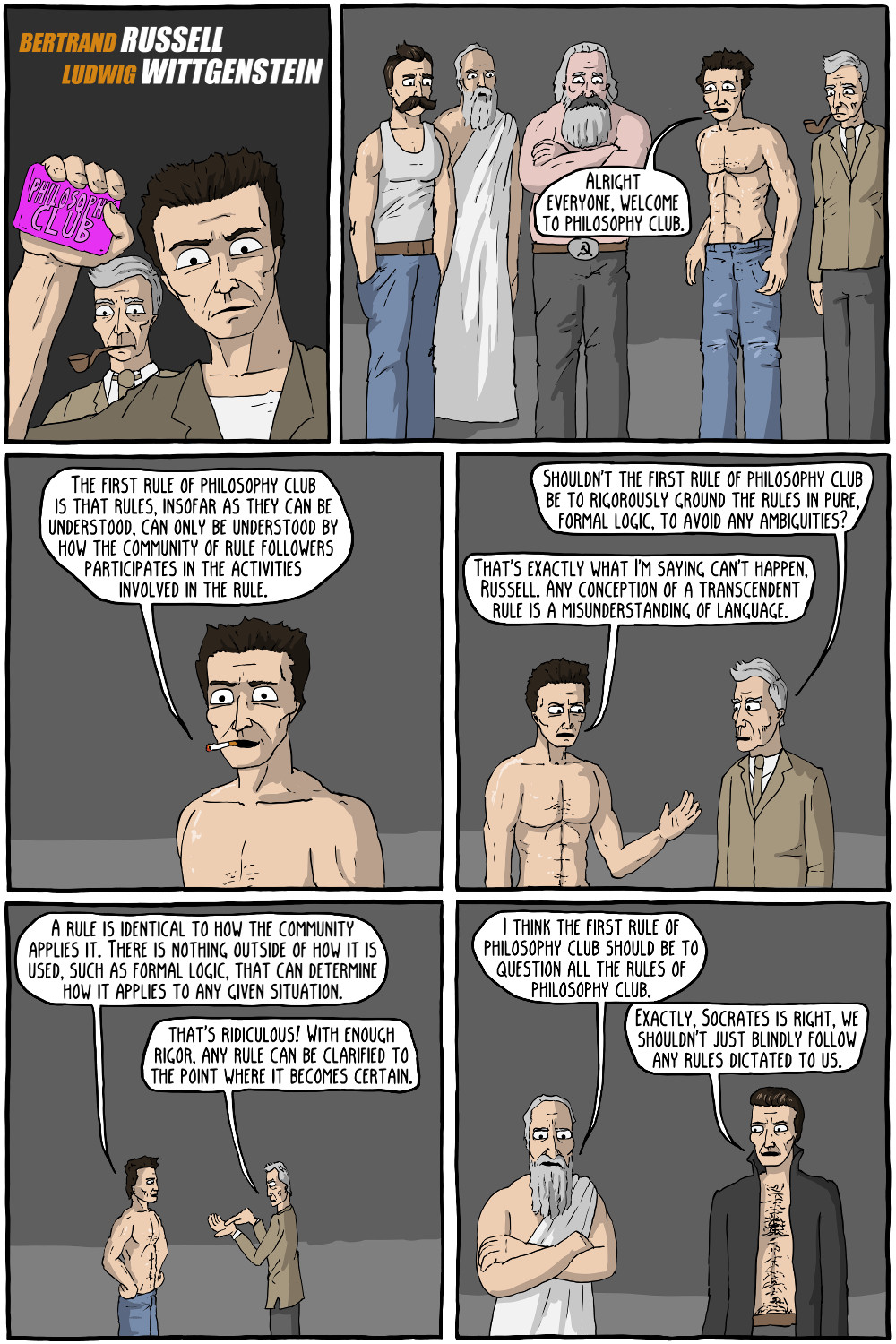
The first rule might arguably be, 'Treat the opinions of philosophers merely as suggestions for further discussion, not as religious-style revelations that must be accepted merely on the philosopher's authority'. (That includes you too, Wittgenstein.)
That particular first rule probably applies self-referentially to the rule itself. Which might be why philosophers rarely seem to progress from A to B.
The first rule is that the first rule is a paradox so ignore it.
The second rule is no Hanovers.
The third rule is "Thou shalt not kill" (except in the case that that conflicts with the second rule).
The first rule is that the first rule is a paradox so ignore it.
The second rule is no Hanovers.
The third rule is "Thou shalt not kill" (except in the case that that conflicts with the second rule).
There are currently over eight thousand rules of philosophy club, and I of course cannot expound them all here, and will rather do so arbitrarily when it suits me, and if I happen to give two rules with the same number, then that just means that I forgot to mention that it was section B of the rule, or whatever.
First rule of philosophy club is to always operate within the rules, of which I'm the sole arbiter.
Isn't the first rule of philosophy club to not talk about philosophy club?...
Given that rules, insofar as they can be understood, can only be understood by how the community of rule followers participates in the activities involved in the rule, and given that we're all talking about philosophy club, then no.
It seems to me that there is no the first rule -- but rather, there are first rules. And depending on which first rule you state first that has a kind of guiding force on what follows.
The first rule of philosophy club is "know yourself" -- followed hastily by "but not just yourself"
Many clubs have presidents, and/or other people who make necessary decisions for the club as a whole. I suspect that it is due to undesirable behavior that rules are formed, and that only a strong president, a sovereign can make an exception to established rules.
If a club is an association of people united by a common interest or goal, then Philosophy Club is a club whose members are not united by a common interest or goal, a club without members. Its first rule might, therefore, be that it's not a club.
The first rule is that the rule that can be spoken is not the first rule.
The first rule is that there cannot be a first rule that speaks about the impossibility of speaking the first rule.
This is because any transgression of that would not be a self-referentially paradoxical statement that is true if false and false if true, but would rather be merely self contradictory.
Thus there may be unspoken rules, but no unspeakable rules.
PS. There is a different sense in which the first rule of Monty Python's philosophy club (where all the members are named 'Bruce') is unspeakable in today's cultural climate; and this is a politically correct sense of unspeakability. Does anyone remember it?

Comments (45)
That particular first rule probably applies self-referentially to the rule itself. Which might be why philosophers rarely seem to progress from A to B.
The first rule is that the first rule is a paradox so ignore it.
The second rule is no Hanovers.
The third rule is "Thou shalt not kill" (except in the case that that conflicts with the second rule).
You're welcome.
So there are no rules?
So the first rule is that philosophy club shall be anarchic or perverse?
I would give my vote to
1. Play nice.
Whereof one cannot speak, thereof things must be shown in action.
First rule of philosophy club is to always operate within the rules, of which I'm the sole arbiter.
Honour code. Have you no honour!
What is honour code?
You know, we shame each other into it.
unless they disagree with your ideas
then shoot them.
Given that rules, insofar as they can be understood, can only be understood by how the community of rule followers participates in the activities involved in the rule, and given that we're all talking about philosophy club, then no.
I was referring to Fight Club...
Dude, the first rule of Fight Club is to not talk about Fight Club. Now we're both disqualified.
The first rule of philosophy club is "know yourself" -- followed hastily by "but not just yourself"
Yes Banno, that probably is better suited to the times in which we find ourselves living.
If a club is an association of people united by a common interest or goal, then Philosophy Club is a club whose members are not united by a common interest or goal, a club without members. Its first rule might, therefore, be that it's not a club.
Rule #2 no Sam26's only Sam27's
No, the first rule of Philosophy Club should be cats.
Are you saying philosophers have no loyalty unless you feed it and enjoy killing wildlife?
The first rule is that there cannot be a first rule that speaks about the impossibility of speaking the first rule.
This is because any transgression of that would not be a self-referentially paradoxical statement that is true if false and false if true, but would rather be merely self contradictory.
Thus there may be unspoken rules, but no unspeakable rules.
PS. There is a different sense in which the first rule of Monty Python's philosophy club (where all the members are named 'Bruce') is unspeakable in today's cultural climate; and this is a politically correct sense of unspeakability. Does anyone remember it?
Philosophy club's membership is restricted to those members who do not have active members?
Is this a form of brainwashing?