
Art, Truth, & Bull, SHE confronts Fearlessly
Cavacava 2017-04-14
Wall Street's famous Bull was installed in 1989 as a piece of gorilla art, an unauthorized 7000 lbs. bronze casting of a bull which cost around $360,000 and was entirely paid for by the artist. The City loved it,accepted it and made it a permanent fixture outside the New York Stock Exchange. The Occupy movement was initiated here.
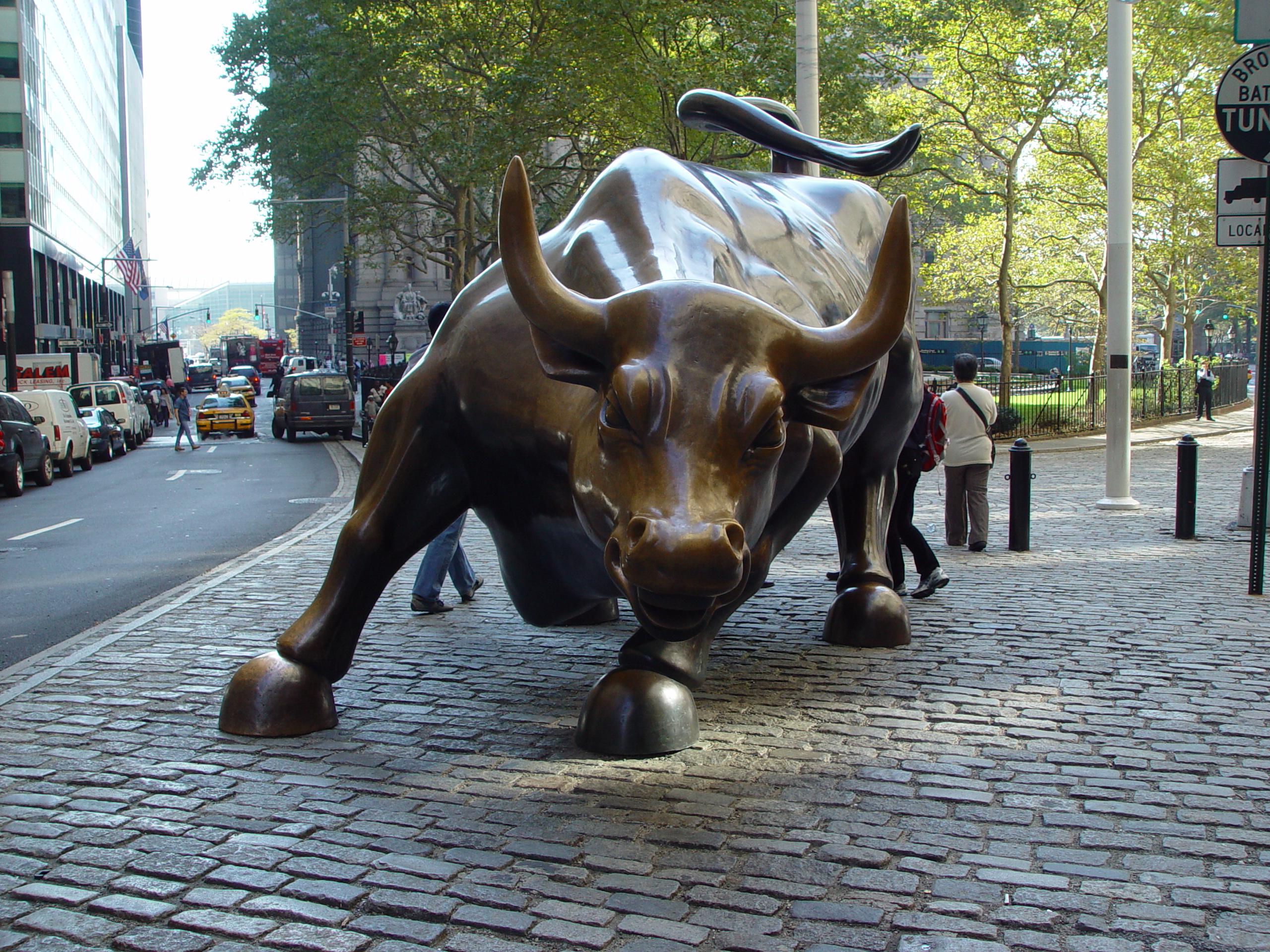
On March 7, 2017 (a day prior to International Women's Day) the City of NY issues a 30 day permit for the installation of "Fearless Girl" a 250 lbs casting and installed it confronting, standing facing the Bull. NY City likes it so much that it has extended the permit until November

The artist who created the Bull is upset, which means lawyers, who claim that his work is protected under the Visual Artists Rights Act of 1990 (VARA)
I think the 'truth' of the Bull has been drastically changed by the additional of the "Fearless Girl", at least as long as she can hold her ground. Do you think the ontological of the Bull provides the power behind the "Fearless Girl".
Regarding the legal matter, I am not sure I agree with the law. It seems to me that every work of art potentially affects all other works of art, which is part of being in the world, but I am interested ya'lls opinions on this question.
On March 7, 2017 (a day prior to International Women's Day) the City of NY issues a 30 day permit for the installation of "Fearless Girl" a 250 lbs casting and installed it confronting, standing facing the Bull. NY City likes it so much that it has extended the permit until November
The artist who created the Bull is upset, which means lawyers, who claim that his work is protected under the Visual Artists Rights Act of 1990 (VARA)
VARA was the first federal copyright legislation to grant protection to moral rights. Under VARA, works of art that meet certain requirements afford their authors additional rights in the works, regardless of any subsequent physical ownership of the work itself, or regardless of who holds the copyright to the work. For instance, a painter may insist on proper attribution of his painting, and in some instances may sue the owner of the physical painting for destroying the painting even if the owner of the painting lawfully owned it.
I think the 'truth' of the Bull has been drastically changed by the additional of the "Fearless Girl", at least as long as she can hold her ground. Do you think the ontological of the Bull provides the power behind the "Fearless Girl".
Regarding the legal matter, I am not sure I agree with the law. It seems to me that every work of art potentially affects all other works of art, which is part of being in the world, but I am interested ya'lls opinions on this question.
Comments (114)
The girl adds some sanity to the whole place.
The original artist apparently placed the bull there as a monument to his own ego and the collective ego of Wall Street. I'd hardly even consider it art. In fact, the little girl brings it much closer to being art by involving it in a real juxtaposition, a meaningful conflict.
And what Question said. (Y)
OK, you win. I'm still going to hate on Wall Street every chance I get though.
lol.
Political art tends to leave me cold; it's usually just a preaching to the choir. Sure, this piece is in the Financial District, so it doesn't preach to the choir in that respect. From a purely artistic standpoint, it's interesting. From a practical standpoint, I don't think it's going to change the minds of any Wall Street employees, or anyone sympathetic with Wall Street. These sorts of moves are generally just opportunities for the progressive left to get riled up for their cause. But political art like this doesn't tend to lead to actual change, which is what I would assume would be the purpose. Part of this is because the conservative right doesn't tend to place the same significance on art anyway. The major metropolitan areas where the forefront of art is cultivated are generally filled with politically liberal people who place a high value on art (obviously with the exception of Wall Street, but NYC is still largely a democratic city). This is why it tends to be a preaching to the choir, because using art as a language to express a political message tends to be a one-sided conversation.
You also win. This isn't good political art. It's more of a sop to liberalism. So, yes, it won't change anyone's mind. The pigeon triumphs. That doesn't mean you can't have good political art though...
If your name's Banksy, that's because it is unanswerable, but in this case, it looks as if a political art work has been answered with another. The first artist seems to have conceded the point by resorting to lawyers.
There are a batch of bronze sculptures in Minneapolis that I do like and see frequently. They were thoughtfully placed in a particular context, and the sculpture and its surroundings are unified. The meaning and cultural value of a given work could be "defaced" by placing something inappropriate or deliberately contrary to the sculpture.
What can legally be done, what should be done, what ought not be done, what is tasteful, what is tasteless, and so on are all too complicated to be settled quickly. I tend toward thinking that a sculpture that has been in place for at least a few years has priority.
The Bull should stand alone. The little girl should clear the hell out and stand somewhere else.
Cities tend to jumble things together, and the results are often unfortunate. Architects design buildings that are an affront to every building surrounding them--not because they are so good, of course, but because they are so bad. The design shouldn't have been accepted, and once built there is nothing that can be done about it. That's why sensitivity, taste, aesthetic skill, and such are important in public works.
Any sculpture, save that of a rampant bear, would be inappropriate in the vicinity of The Bull.
That's pretty funny, but I'm not sure how the humor makes it better political art. I'm still not sure it's impacting anyone's opinion. It reminds me of political cartoons; clever, prescient, but ultimately just an artful form of complaining.
That's true. But it's unclear to me what, if anything, the bull was originally supposed to suggest. And it's still unclear to me whether any actual changes will take place in wall street thanks to either piece.
In fact some tourists give its presence as their reason some for visiting NYC.
The "Fearless Girl" was commissioned by State Street Global Advisers, its stock symbol is SHE, and this creation was the idea of McCann Erickson one of the largest marketing/advertising companies in the world.
The Bull artist I think he's right.
I also like the pigeon, at least it knows which target is easier to hit.
I agree.
What do you think a horny, powerful, pawing, snorting, twisting bull would represent--little girl sisterhood and apple strudel? Cream cheese? Got Milk? No. it's clearly a symbol of aggressive financial optimism and prosperity. Bulls have balls, like the big-bad American Economy, so look out little girl, or you-know-what will happen to you.
Wet dream.
See Cavacava's post above.
Ok, let's subtract the humor. Guernica. Good political art?
BTW I did not know of the existence of those laws, but I can understand their motivation. Imagine how da Vinci might feel if the Mona Lisa were permanently displayed with a moustache attached to it, even if the moustache were removable without damaging the painting.
I wonder whether the law would prevent (or render vulnerable to litigation) somebody making copies of the Mona Lisa with moustaches on them though. Or - in the case of the bull, a similar bull sculpture being installed somewhere else accompanied by the girl.
I was also unaware of these laws. Regarding its application:
Here
A man vandalizes a public space, and the public subsequently decides they like the aesthetics of said vandalism, so they elect not to destroy/remove it.
Some years later, someone else vandalizes that vandalism, to the aesthetic appeal of the public, and now the original vandal thinks he has rights in this situation?
He has no authority to curate a public space, regardless of whether or not his art exists there. The moral rights he has to his artwork were reasonably forfeit when he discarded it in a public space, ostensibly abandoning it as refuse. We give artists such rights because they work hard on and love their art, but this artist stuffed this particular piece of work into a political cannon and fired it into no-mans-land. He lost all rights over it when he chose to illegally inflict it upon the public, in my view.
Even if he wanted to have the bull removed (to protect it) at his own expense, he should be denied that right. It belongs to the public, morals and all. It's theirs to mutilate.
Sure the fearless girl destroys the original message, but since the public owns the bull, message included, it's theirs to destroy.
Sure the original artist ought to be pissed. He got beat at his own game.
Precisely, he has not a hoof to stand on.
Yes, a really interesting facet of this jewel is the artist still owns the work, the City has only permitted its use at this location. I think it can be argued that the public has taken it over by kinda of eminent domain. Similar to some of the arguments I have read about citizens complaining when a building owner carved a Bansky off the side of a building he owned to sell it at a gallery. The citizens arguing that it was owned by the community (shipped it to Miami of course).
But like most public statues in the USA, it still makes me think of the Reichskulturkammer. Of course it doesn't compare to the horrifying turning of Lincoln into an idol god (the government insisted the artist change it so the soles of Lincoln's shoes are above any onlooker's head)
Then there is the statue of liberty, which is mistakenly called 'she' because the word for statue in French is feminine. It's actually Helios, the god of the sun, and modeled on a version of Helios which is said to have been modeled itself on the Colossus of Rhodes. That's why his crown looks like sun rays. The fact Americans think of the statue as a she rather says it for me. Reichskulturkammer.
Have Sanders hold hand with the fearless girl in front of the bull with him holding a big axe in the other hand.
Yeah, take that you fucking ugly fucking bull.
Fascinating... The city chose to give it back to him basically. What a terrible decision...
When NY first woke up to the sudden appearance of a bronze bull abandoned in the middle of an intersection, they owned it. They could have cut it to pieces with torches and sold the bronze to pay for it's removal. Whoever floated the idea that the original artist still owns it even as it gets inducted as a permanent fixture of the city, needs to be smacked.
They've successfully given private control over a public exhibit to a private citizen who has no business dictating how the community is allowed to decorate itself. Since he still owns it, he is free to remove it at anytime, for any reason...
I do think the city could easily sue for ownership though. When the city decided to adopt it instead of removing or destroying it, the artist lost his right to make that decision. His abandoning of it and the community tolerating it was absolutely tantamount to a transfer of ownership.
As a public fixture, rather than merely a piece of privately owned art, it is the moral and artistic prerogative of the public, not the artist, to curate the aesthetics and meaning of it's features.
Wall street isn't his personal soap box.
oh. So is the bear gone? If the bear isn't there it really wouldn't make sense.
I'm sure you're referencing bull/bear market trends, but I'm not sure how :)
Booms and busts in economics are depicted by a bull locked in an eternal battle with a bear.
In this pair, there used to be a bear raised on hind legs. But I cant even find a picture of it like that on the web, maybe it was removed a long time ago. This picture is similar, I don't think its the same statue, but it shows how it used to be.
It's a great work of art. I happen to love Picasso. I saw the collection of his sculptures that was shown at MoMA, and it changed my life, I would say. But as political art, it seems that that piece is just historically associated with the Spanish Civil War, more than anything. But sure, it must have had some impact on people's awareness of the problem. You're also using probably the best example of a piece of political art. I can't think of another piece that actually had that sort of impact, but I could certainly be wrong. So sure, I grant that the piece made real, cultural waves, at least historically speaking. That's not a problem, especially because Picasso was such a great artist who made all sorts of pieces. Think about it: what makes it a great piece? Picasso. I agree with Steve Reich when he said something to the effect of "Shut up Picasso, no one cares! Just make good art." (this was clearly in an interview, sorry I don't have a link, I did a brief search). What I have a problem with is when art is just subjected to being political propaganda (and I don't see Guernica as propaganda per se). Living in NYC and working at a contempo-classical music venue that considers themselves "the future of music", I see so much ridiculous pomp and circumstance, and so much squelching of artistic voices because of the need to curate pieces that are cutting-edge political statements. And not to mention the questionable money that goes into art, and with that money, the power to influence which voices are heard. It's becoming this fundamentalist-progressive-left-religious phenomenon of creating high-art propaganda voodoo that has no real cultural hold. I always say...political music is as bad as Christian rock music. It's that Simpsons quote, "you're not making Christianity better, you're just making rock music worse". It applies to political propaganda in the form of art as well; it's the same principle.
The bowling green bear which used to stand where the girl is has been totally eradicated from public memory.
I can't even find a picture or mention of it on the Internet.
I wonder what happened. I can remember when I actually saw it now, it was 1985.
So to be a little more clear here, the problem I have is with the distinction of what is primary in art. The idea, or the expression? We live in the post-Duchamp age, so for us, the idea is primary, whether we realize it or not. But I don't like this. When the idea (political or religious, or nihilistic or whatever) takes precedence, what happens is the artist forces the concept down the throat of the unassuming audience. Example, the bronze girl here. We live in an age where this is how art is done. Is it art? It is absolutely art. But is is creative, in the sense that human creativity is generative? No, it's abstract in the worst possible way. It's an idea, subjected to a weakened form of the human imagination. Imagination has to be primary in art; this is how unexpected new forms of art appear. Indeed, this is even how Duchamp came to the point that he came to. The creative act, for instance, in it's pure form is not primarily a process of reason; it's kinetic. I pick up an instrument and begin playing, I feel the pressure of the brush on the canvass, and suddenly, the ideas come. IF the result happens to be political, I have no problem. But an artist who begins from a political perspective is just making propaganda, not art.
You must be confusing this piece of art with a different one! (or else are making a reference to economic shenaniganry that went above me head!)
) good night
Love it. Fully endorse it.
If only our worshipful fine art overlords would stoop to such a move...
Doesn't that defeat the purpose of what art is supposed to represent? Although I cannot go into detail as I am on my way to go grocery shopping and I'm on my phone, I am sure Banksy didn't get upset with (cannot remember name) when his artwork was completely sprayed over considering the nature of his art. Art is about challenging the boundaries and so it makes little sense if artists get upset about that.
Some of Mozart's most beautiful works are completely in conformity with the conventions of his day. Some artists astonish us by breaking boundaries. Others astonish us by showing just how expressive one can be without having to stray outside the boundaries.
The difference is Banksy is used to being sprayed over. He made an entire persona out of being a "guerrilla" artist, so to speak. I'm not sure it's the same for what's-his-name who did the bull.
Quoting andrewk
I think I disagree here. I think art that "astonishes us" within the boundaries of what's an artistic norm tends to be dead, meaningless art that just assuages an artistic fetish; it never creates a new artistic possibility. For instance:
https://www.youtube.com/watch?v=PgvJg7D6Qck
Is the technical ability off the charts? Yes. Does it have any real cultural significance? No. It's fetishistic. The fetish is the shear ability of Bobby to use his voice to perform a piano part. Incredible, right? Significant in any way other than a dick measuring contest? No.
Salieri's fictional, bitter description of the opening of the Adagio from Mozart's 'Gran Partita':
Performance of the Adagio
There's a line I like from Woody Allen in the movie 'Paris Manhattan', when he's listing some of what he sees as the very few reasons to go on living. One of them is 'the slow movement of the Jupiter Symphony' (by Mozart).
Here's a 1907 version by E Fairfax Taylor: the fuller quote is even more apposite, but perhaps that's what you meant subtly to imply and I've only registered it by seeking it out :)
I think the bull is superfluous, because it is just a metaphorical description of what is already present at Wall Street: a bunch of aggressively enterprising animals.
Also the girl refers to them, but unlike the bull she does not merely describe them but prescribes a protest against their intimidating aggression by exemplifying innocence and fearlessness. She would do that with or without the bull.
Perhaps not, but artistic creativity is an aesthetic attitude and the boundaries itself is the limitations - such as conformity - that impact on the integrity of the art itself. Mozart may not have expressly broken the rules but his personal circumstances and social position compelled him to conform to what was wanted at the time, though one can distinguish these differences in his compositional attitude. The way that Mozart challenged the boundaries paradoxically within the boundaries is his liberal and emotional carelessness and he had a certain freedom in his melodic attitude; Don Giovanni, for instance, and the wonderful sturm und rang style that's just awesome. Stravinsky broke rules too but compares nothing to Beethoven, but I guess it is not about 'breaking' the rules but about understanding it and not letting it define you. No one could perform piano concertos or interlace musical themes until Mozart.
There was quite a lot of outrage, though, when his art was sprayed over but he found that to be quite hilarious. It is this attitude - the reasoning behind the girl is apparently the lack of women in business and therefore a symbol of protest against the gender-bias - that challenges the Bull' symbol of power to one of the oppressor, which is why he wants it removed. But, that defeats the purpose of what art is supposed to be about and to use statutory regulations where he claims his moral rights to artistic integrity have been infringed seems baseless since there is no actual destruction of his art.
He is just an arrogant moron, really.
I think "superfluous" is the wrong word. The culture in US fetishizes imagery and the "Charging Bull" reifies "Wall Street [as] a bunch of aggressively enterprising animals" as an economical image.
The "Fearless Girl" would not be "Fearless" unless facing something to be feared. It is an advertising/marketing ploy as previously indicated. The City of New York is known for its love of confrontation, and it loves the confrontation between the Bull and the Girl. (I am a native New Yorker).
But I think the Fearless Girl derives its power from the Bull, its meaning is dependent on it, as a work of art, otherwise what do you have...
It seems to me your objection is more to a type of activity that presents itself as art, that is recognized as art, but because of the intent behind it is more of a political product than actual political art. You mentioned the term propaganda, which I agree no more deserves to be called art than advertising. And the analogy is pretty clear - you sell an idea rather than a product but your aim is never more than instrumental. So, I agree art can’t be purely instrumental in its aims; it can’t merely be the case of selling an idea external to itself. That doesn’t mean, however, that the idea internal to the art, that which it expresses, as in the horror of war in Guernica, can’t be primary. Picasso is not selling an anti-war message, he's revealing one in a unique way - the idea is primary but it works in harmony with the form. So, I don’t think that the idea being primary is the issue here; the idea must in a sense always be primary, but it must work within the expression such that it reveals rather than merely commands. And what it reveals must be of value. Picasso does this, Banksy does this, Orwell does this, etc.
Quoting Noble Dust
As I mentioned above, I agree that if the motivation is to sell an idea - instrumental reason - then you don’t get art - the artistic potential gets crushed under the jackboot of ideology. However, the impetus for art may be anything including the political. It doesn't have to be a case that it just happens. Guernica was painted in response to the bombing of the town of the same name. It wasn't entirely spontaneous. That the pressure that pushes the artist's fingers to the keyboard, or hand to the chisel, or paintbrush across the canvas is a wonder, fear, or disgust of a political nature no more negates the final product than any other impetus as long as the art speaks for itself, has its own voice, and is not merely an echo of some prevailing wind that its creator wishes to amplify.
I agree, Guernica is a great work of art, which deserves its own thread. I think it transcends its political aspect, as a work that demonstrates man's inhumanity to man, in the abstract, which I think is quite amazing. I think it is far easier to horrify in realism, it is quite an accomplishment to be able to elicit this reaction to an abstract piece. But that just grazes the surface. The New York Times reported on Feb 3 2003 that the White House had Rockefeller's tapestry of the work covered up prior to Colin Powell's infamous speech about Iraq, which spurred on the anti-war protestors.
I saw the original at MOMA way back when, it's awesome.
I think the distinction is whether the art was created first, or whether in the case you discuss, the commission was first. If the commission was first, then it is craft, not art, which means that it is decorative for a purpose, in this instance political propaganda.
Sure, in this case, if the deal was, "Let's make a cute little girl to stand in front of the bull to make the libs happy" that's not at all art but craft. And crafty.
You mean like the confederate flag in the South?
Oh yea they took a few of them down a couple of years ago up by you, didn't they?
You're a Nazi. I'll take that back if you take back calling me a white supremacist.
A picture says a thousand words.
Neither by connotation or denotation, only by location.
I don't think that it's fair to say that it turns the bull into a villain, or misrepresents a thing. She doesn't have a weapon, and isn't there to kill it. The bull is there to symbolize intimidating strength, and the little girl is there to be unintimidated by it, while bolstering no such pretensions in her own representation.
Yes, the Spartans saw it that way.
Well it is a matter of opinion as to whether it makes the bull into a villain, but the artist seems to think so. I don't really think he has a say, but that is what he says.
Anyway, the Girl means very little aside from her fake confrontation with the Bull. The Bull on the other hand is not beholding to her at all.
That's a weird thing to say.
You think that one is legitimate, and the other is not, so you anthropmorphize them with this opinion? They're inanimate objects, with no concerns at all.
This does not change the fact that the bull stands meaningfully without her, while she is a simply a girl without him.
It's hardly impossible to imagine the girl statue being meaningful without the bull, it just so happens that within context, her meaning is dependent on the bull.
They sound like a lot of fun.
I said they sounded like fun, so clearly I was speaking of someone else.
The addition of the girl seems to put innocence at odds with capitalism. Whoopdedoo!
Looking deeper into the origin of the fearless girl statue, it was actually commissioned by an investment group as an advertisement for an index fund made up of companies with "higher percentages of female leadership". Oh sweet pale irony...
I wondered why there would not be a girl and a boy standing defiantly, which I think would probably be more evocative, but alas some art is best interpreted in terms other than the artist's original intent.
The fearless girl was intended to mean: "Hey! Women can be tough capitalists too!", but it certainly doesn't give me that vibe.
The girl is clearly about to be trampled, (unless we shoot the bull?). Originally the bull was American strength, but now that it's at odds with women and children it's "American tyranny; capitalism". Apparently we must all rush to the defense of a helpless and irrational child whose absent minded parents allowed her to wander into a bull pen.
They should have made a Calamity Jane-esque statue holding a gun and tentatively threatening the bull in a show of equal strength. (either that or a full blown horse mounted heroine complete with lasso, which would be a massive and impressive statue that I think would constitute worthwhile art). Of course, those cheap wall-street bastards would never spring for that much bronze.
I am not sure that 'weakness' as displayed in the Fearless Girl is weak. She is shaming it defiantly.
"God chose what is weak in the world to shame the strong. God chose what is low and despised in the world, even things which are not, to bring to nothing things that are" Paul (1 Cor. 1:27-8)
The protests on March 8 for International Women's Day may have been the largest protests in USA history, and perhaps in the world. A sign of strength by collaboration. Innocence should not be confused with weakness.
I agree, but fearless should not be confused with strength.
The image of a lone child doesn't speak to collaboration, to me is expresses desperation. Where is the community behind her?
If we're to be led by children against corporate America, we're fucked. Fearlessness alone is just as reckless as the fearlessness of the bull, except the bull has weight to back him up. The natural shame of the mighty bull is that it tramples meek and the innocent. That's the feeling I get from the standoff.
When stocks are going up, it's called a 'bull market',
When it's going down, it's called a 'bear market.'
That is why many bulls and bears have been placed around NYSE over the years.
They are considered to be in continual conflict, one winning then the other.
And, I learned, it is why the bull artist put the bull there in the first place. To encourage stock dealers during the depression of the time.
Little girls don't figure in it at all.
The Fearless Girl statue was meant as statement in support for women's interests by a very large corporation ($64Bn I think) in support of the International Women's Day. It was installed on March 7th the day before International women's day on the 8th. The community behind her showed up the following day.
In other words, it was PR. Either way, it's all bull then.
A patron commissions a work of art, Picasso's Guernica was a commissioned work, does the fact that it was commissioned make it any less a work of art. If the work was morally decadent, but provided insight would its decadence make it any less a work of art, or is that not a liberal bias.
The thinking behind the statue and its placement (which Adweek called a stunt) was engineered by McCann Ericsson Advertising (which had $7.6 billion in revenue 2015). It was art commissioned as part of a public corporate campaign.
Advertising agencies and their corporate clients deal in Truth, of course. It says so right there on the landing page of the McCann Ericsson:
Who needs philosophy when large, intellectual, ethical corporations reveal TRUTH as part of their mission? Move over, Aristotle, and make way for the Thought Leadership unit.
Thanks BC, I am somewhat familiar with State Street Bank, it is the Un-Bank, Bank, a custodial service that makes pennies on each transaction, and does a zillion transactions.
McAnn Advertising agency is one of the largest in world. "It's the real thing" and Coke's Hilltop song were hugely effective. Mad Men
I think advertising is primarily concerned with purpose, whereas a work of art is primarily concerned with itself, it is purposeless in that sense. That does not mean that other meanings don't attach to art, such as who commission at work, or what the artist's intent was in crafting the work, simply that as a work of art it must 1st be able to stand on its own as a work of art.
Does the "Fearless Girl" stand on her own? I don't think she can stand as "Fearless Girl" without the "Charging Bull". Without the Bull she is no longer "Fearless", she is a 250 lb bronze casting of a girl standing with arms akimbo, which maybe art but not art with the confrontational power suggested by her facing the bull.
The what now?
I'm with the bull. To hell with the girl. She represents more of that silly feminist, social justice, anti-capitalist nonsense that will do and change absolutely nothing but will make people feel good about themselves. "Fearless" my ass.
Lol. You killed several birds with one stone there. You may have missed the pigeon though.
When we know the wherefore and wherefrom of an art work, we can't take it on its own merits without some mental gymnastics--which are, of course, well within our operational capabilities.
Had she been cast in Sofia, Bulgaria by an artist who had never heard of the State Street Global Advisors, McCann Advertising, or the Bull, we would be in a better position to say that the sculpture should be taken on its own merits. That isn't the case here, and it wasn't the case from the start.
The Bull, of course, isn't an art work that can be taken on its own merits either. Its wherefore and wherefrom preclude our naiveté. The bull-girl combo is mid-brow political messaging.
Not really. I just found your comment amusing. Carry on...
I very much agree that from the Bull's perspective the girl taps its power. She is supervenes over the Bull expanding on its representation of capitalist power, the power of the exchange of values, and yea she suggests social justice as a confrontational value to corporate values especially as regards to women, just in time for one of the largest protests in American history.
She could represent that for you, and I would agree that as far as social justice goes, the whole thing is rank nonsense.
In fact, the object of SSGA and McCann was to speak in favor of the benefits of having women (not little girls) on corporate boards, because executives at SSGA think that corporations with some women on the board do better financially than boards that are men-only. One would not guess that by looking at the juxtaposition of the sculptures.
So, the origin of the project was not anti-capitalist. The folks who put it there are all about capitalism. On the other hand... Getting wealthy women on Fortune 500 corporate boards has nothing to do with social justice, and I would hope that serious feminists would not think that getting hundreds of wealthy women into the boardrooms was the goal of their movement.
I don't think the girl, aside from the bull is much of a work of art, the girl confronting the bull, as a symbolic act installed the day prior to one of the largest protests by Women...come on that's something that disrupts, and it continues to disrupt, which is what art is supposed to do.
Maybe so, but this is what it has become; a rallying cry for the occupy potheads and the like.
Not sure I understand what you are saying here, are you suggesting that women are treated equitably in corporate America?
Doesn't this symbolic confrontation point to the shame of the social injustice inveighed against women in corporate America?
You mean the millions of women who marched the following day were potheads...
sad.
Your face is sad. How bout that.
Punk
"Neither males nor females, neither Jews nor Gentiles, neither gay nor straight, neither young nor old, neither caucasians nor negroes nor asians nor aboriginals" are treated equitably in corporate America. There are super-elites, elites, and sub elites (that's maybe 5% - 15% of the population), then there's everybody else. Everyone below the sub-elites down to the proles are subjected to various and fairly vigorous forms of inequity. Above the elites there is inequity too, but I am not concerned with how males, females, Jews, gentiles, gays, straights, whites, blacks, and asians are distributed within the elites. If a white woman graduate of Wellesley who was born with a silver or gold spoon in her mouth and who wants to be in the 1%-5% isn't hired into top level management or BOD at Apple or Exxon, I just don't care.
Quoting Cavacava
Corporate America is shame itself. Remember what the statue placement is about. It's NOT about women who are struggling to earn a living wage. It's about getting women on boards of directors. Who is invited into the corporate board/power centers? Jane Iverson from Scranton, PA with her BA in accounting from Scranton State College who has a not-appealing job in NYC where she can hardly afford to live? No. It's Vanessa Bush of Chicago's Gold Coast (and the Hamptons) who was worth a few million from the night of her conception, and who knows her way around the elites because she has always been a member of the elite.
I somehow missed your post here, sorry. The result of checking the forum on my phone, it seems. I almost agree; with the case of Guernica, the idea may have been primary (who knows?), but only in harmony with the form, as you say. So, for any piece of art that would dare to say something specific and plain, it better be in concert with the form itself, otherwise it's just embarrassing. I'm saying this from experience. It is possible, I just think it's rare, and therefore, the examples of it, especially within the political realm in our age, get distorted and set on pedestals. They get fetishized. See the bronze girl from the OP.
Quoting Baden
Sure, to me these instances are almost accidental; how can it be otherwise without being propaganda, whether political or religious or whatever? I saw Pussy Riot Theatre here in NY recently, and it was amazing. Why? Because it was art that happened to be about politics. The political message of the music was the inmost impulse of the artists. The same could be said for Bach's Hallelujah Chorus. The inmost impulse of the music was deeply religious. I mean that quite literally. So, that's my point. Does that make any sense?
Yes, I don't think we disagree about much really. And don't worry about the late reply; actually, you've reminded me I need to respond too to an earlier post by @Cavacava, which I will as soon as I get a chance.
I should also come full disclosure and mention that my issue here is primarily a fundamental one. I think a lot about the role of art, or the purpose of art, or the purpose of creativity. I don't think man's primary purpose as a creative being is political. I think the political role is just a stand-in for the essential role, the spiritual role. I think the creative urge in man strives to transcend the political, the physical. This is where a lot of my criticism of political art stems from.
Well, I'm not that knowledgeable about visual art either; I'm a musician. So perhaps I need to revisit Mozart? But I never had a great impression of him. I'm certainly willing to revisit him. I have always loved The Four Seasons, but as I mentioned to Bitter Crank at some point, that's just a nostalgic childhood connection more than anything.
The artist's idea, the artist's conception for the work is outside of the work and all artworks are political. Works of art cannot not be politically derived from culture. The main tension in any work is between the form (which contains its social aspect) and the matter, but it does not end there: form + matter does not equal the work of art. The artist's idea, the narratives that any good work of art illuminates, and its observers all are intergral parts of any work of art . Art has a double character (Adorno), it is at once art and politics.
Why do you think Guernica was done in grisaille.
The Bull & the Girl seem almost curated, and maybe that is right for our age. Frederic Jameson holds that position, he believes that the Curator is the new artist of the 21th century and Curators are found all over the art-world, not just in museums.