
Visualizing the Cosmic Microwave Background
VagabondSpectre 2017-04-08
The CMB represents one of the most important discoveries in all of cosmology, but it remains esoteric and exotic to those uninitiated with it's properties and origin.
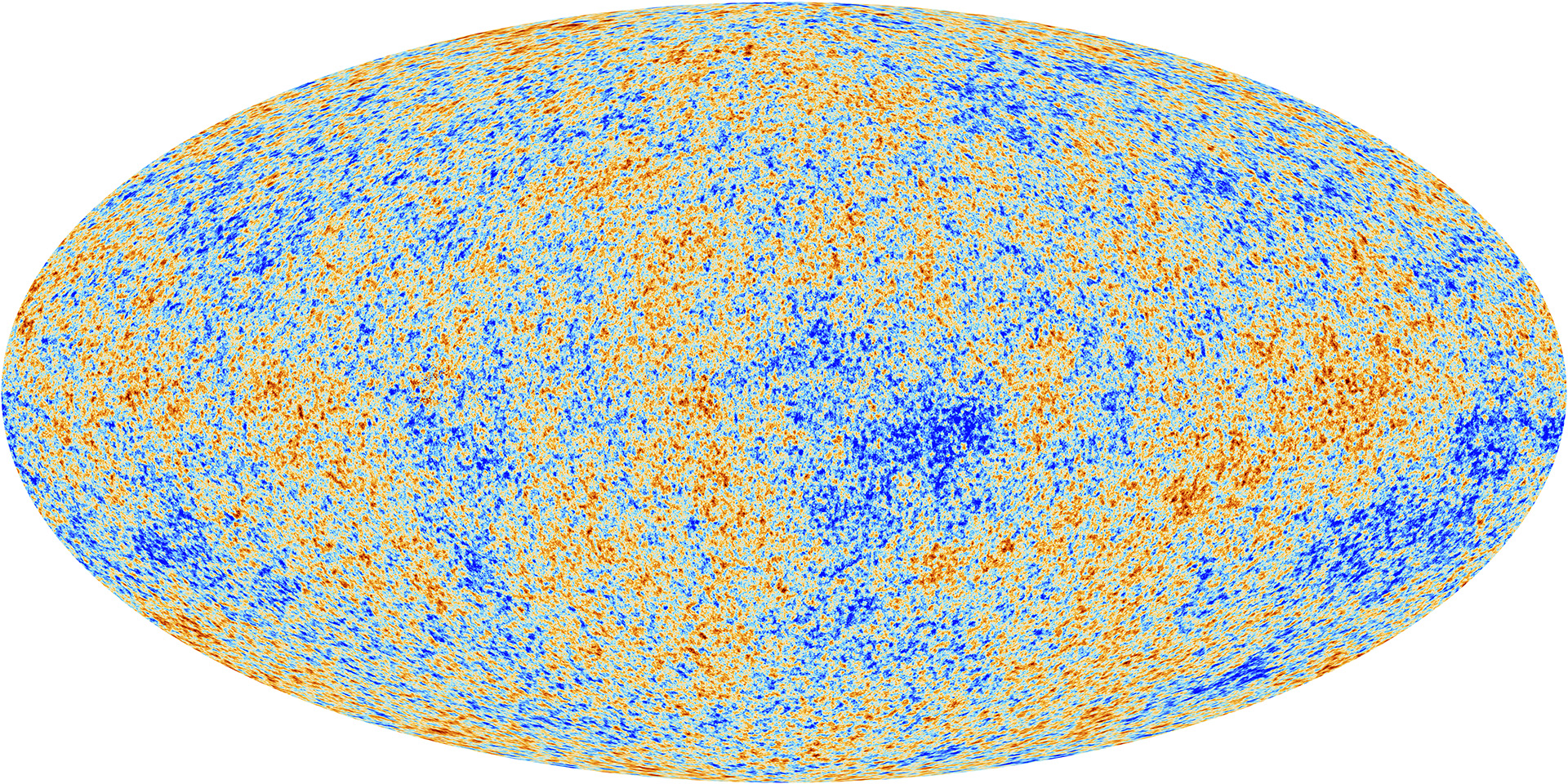
The first thing to understand about the above image is that it represents a spherical map (just like a 2d map of the 3d earth). Instead of the outside surface of a sphere, this is what we see plastered over the spherical night sky above us, in all directions...
(What we're actually seeing in terms of bright and cold spots is a very particular kind of light (photons) that exists on a very thin spectrum).
Understanding that is the easy part, the hard part is visualizing where the CMB comes from, why it surrounds us, and what it means...
When the observable universe (note: I'm speaking about everything which is in our observational horizon, not beyond) was much smaller, it was composed of a foggy plasma of atomic nuclei, electrons, photons, (and more?). The photons were essentially trapped in this fog because they constantly bounced back and forth off of the electrons and atomic nuclei and couldn't really get anywhere. As the universe expanded and cooled, electrons became able to bind to atomic nuclei (forming neutral atoms like hydrogen) which then created sufficient space in-between for all these primordial photons to start actually traveling in long straight lines. As the observable universe continues to expand (imagine a sphere) this fog gives way to translucent space, and so the photons that were trapped inside are sent in all directions from all regions of space.
Fast forwarding the universe, and taking into account it keeps expanding and is exceedingly big, many of these photons are still traveling in straight lines and have not yet escaped the observable universe. As we exist within what was originally this foggy universe, we are being struck by these very old photons, from all directions, that have been traveling toward us since they originally "decoupled" with the fog billions of years ago. The CMB we see are the photons that happened to be traveling in what would become our direction from basically all points in space. It's the light radiation from when the "decoupling" occured.
The most interesting thing about the CMB is it's implications. The hot and cold spots we see represent places where more photons were released more quickly from given regions of space (back when the fog became opaque). This implies that there was more heat and energy in those regions of space (at the time), which implies that structure (stars and subsequent forms and groupings of matter) might be more likely to develop there as a result. These hot and cold spots essentially correlate to the distribution of matter in the observable universe.
What's more though, is that this distribution of matter also has implications about what was going on before then. This makes the CMB not only the oldest observational data we've been able to gather, but contained within that data is information pertaining to even older events, the structure/fluctuations which lead to the distribution pattern found in the CMB, which lead to the distribution pattern of matter found in the observable universe.
The CMB is a 3D map of old light, but it's also a map of past, present, and future structure in the universe, which is much more interesting than the psychedelic trip poster many people see it as.
The first thing to understand about the above image is that it represents a spherical map (just like a 2d map of the 3d earth). Instead of the outside surface of a sphere, this is what we see plastered over the spherical night sky above us, in all directions...
(What we're actually seeing in terms of bright and cold spots is a very particular kind of light (photons) that exists on a very thin spectrum).
Understanding that is the easy part, the hard part is visualizing where the CMB comes from, why it surrounds us, and what it means...
When the observable universe (note: I'm speaking about everything which is in our observational horizon, not beyond) was much smaller, it was composed of a foggy plasma of atomic nuclei, electrons, photons, (and more?). The photons were essentially trapped in this fog because they constantly bounced back and forth off of the electrons and atomic nuclei and couldn't really get anywhere. As the universe expanded and cooled, electrons became able to bind to atomic nuclei (forming neutral atoms like hydrogen) which then created sufficient space in-between for all these primordial photons to start actually traveling in long straight lines. As the observable universe continues to expand (imagine a sphere) this fog gives way to translucent space, and so the photons that were trapped inside are sent in all directions from all regions of space.
Fast forwarding the universe, and taking into account it keeps expanding and is exceedingly big, many of these photons are still traveling in straight lines and have not yet escaped the observable universe. As we exist within what was originally this foggy universe, we are being struck by these very old photons, from all directions, that have been traveling toward us since they originally "decoupled" with the fog billions of years ago. The CMB we see are the photons that happened to be traveling in what would become our direction from basically all points in space. It's the light radiation from when the "decoupling" occured.
The most interesting thing about the CMB is it's implications. The hot and cold spots we see represent places where more photons were released more quickly from given regions of space (back when the fog became opaque). This implies that there was more heat and energy in those regions of space (at the time), which implies that structure (stars and subsequent forms and groupings of matter) might be more likely to develop there as a result. These hot and cold spots essentially correlate to the distribution of matter in the observable universe.
What's more though, is that this distribution of matter also has implications about what was going on before then. This makes the CMB not only the oldest observational data we've been able to gather, but contained within that data is information pertaining to even older events, the structure/fluctuations which lead to the distribution pattern found in the CMB, which lead to the distribution pattern of matter found in the observable universe.
The CMB is a 3D map of old light, but it's also a map of past, present, and future structure in the universe, which is much more interesting than the psychedelic trip poster many people see it as.
Comments (25)
It completely backfires when we think of the 2nd law of thermodynamics too, because the CMB is practically homogenous in temperature and smoothness. What the heck happened to entropy?
Ahh, frick cosmology is hot :-*
Quoting VagabondSpectre
Are you talking about the acoustic oscillations detected by WMAP? If so, this is wrong. ;)
I wanted to write down my understanding of the CMB to see how well I understood it, and it occurred to me that not many people are very familiar with it whatsoever. They see the CMB map and they have no sweet clue what they're looking at... I don't think I achieved what I wanted to though, which was to really help to visualize what it actually is/looks like.
Quoting TimeLine
They think the universe is really really flat, which means it should keep expanding, but eventually slow down, and never actually stop (If Krauss is to be taken at his word).
Quoting TimeLine
As far as I understand it, pressure differences in the photon-baryon fluid are the acoustic oscillations. The photons we gather reflect that pressure distribution at the time of decoupling.
Why more or hotter photons are detectable in different regions of the CMB must be due to some mechanism which caused more radiation from more dense regions of the baryon-photon fluid.
Is it that there were more photons released from dense regions because they contained more photons? Did the gravitational strength differential of these more dense regions cause more photons to be emanate from specific trajectories at the time of decoupling?
I admit I'm not exactly sure. The best digestible description I can muster is that directions where more (or hotter, I don't actually understand light very well) CMB photons are striking us, there was a denser cloud of baryon-photon fluid, and so when decoupling occurred more photons emanated form that direction.
Can you offer a correction?
As far as I know, the acoustic oscillations are a result of gravitational instabilities. Once this is accepted, you don't need a further mechanism to explain why there are more photons coming from the denser regions. If there are more atoms recombining in a given volume of space, then, of course, there are going to be more photons being emitted from that volume.
Ok, that makes sense and it is great that you are. But surely you enjoy the clueless by pretending the CMB is what earth will look like in two years if we continue eating McDonalds?
Quoting VagabondSpectre
Well, yes, following P-N a decrease in temperature increases density and enlarge gravitational ‘wells’ that attract matter and compress the fluid where photons resist and produce the troughs, becoming the seeds of the structural side of the universe. If decoupling in a denser space, a photon would get cooler trying to move away from the gravity as it thus loses some of its energy which contradicts the idea that the colder spaces are where photons move about more quickly. But CMB is a really dense space and anisotropy fluctuations in temps are spurious to say the least because the perturbations are infinitesimal.
What do you mean?
I wrote a sci-fi story once - never got published anywhere - about a scientist who discovered that there was a code embedded in the CMB. He gathered all this data from the CMB and thought he could find a kind of binary pattern in it. So he formed the idea that there was the signature of some kind of life or civilization or intelligence in the data. His problem was, nobody would believe him, because the idea was so outlandish, and the story ends with him in palliative care and about to die, having made this incredible discovery that nobody ever believed.
The initial stages of the universe began with low entropy and a perfect order (how else could it be?); using Einstein' cosmological constant, the gravitational field (of the universe following the big bang) expands while the energy density remains constant through repulsive energy within the field, expanding in volume (though the total energy is ridiculously close to 0 and yet does not violate the conservation of energy). The effect is infinite expansion. Remembering that the 2nd law of thermodynamics flows in a linear arrow of time and entropy obeys the 2nd law (that is, entropy is increasing as it obeys the law of the cosmological arrow of time and thus had to be smaller during the initial stages) along with the uniformity of the energy density during inflation responsible for the low entropy conditions, as the universe expands and progresses over this time, from an ordered to a high-entropy disordered universe, why is the universe infinitely expanding and homogeneous?
Quoting TimeLine
Yeah, the universe had better begin with a low(er) entropy, but I don't know if I would call a homogeneous gas a "perfect order".
Well, its clear why you did not understand. I haven't the time to write an explanation in detail for the unsophisticated, but though not 'clipped' perhaps read the link below...
https://arxiv.org/pdf/astro-ph/0210527.pdf
Not intending to be presumptuous but maybe the climax is too early in the story i.e. his big discovery. As in, protagonist makes big discovery! But..no one believes, then...still no one believes, then, dammit, no one believes! Then... protagonist dies. Sort of deescalating rather than escalating tension. Just a thought anyway...
Yes, this sounds a bit paradoxical when one is used to consider examples of low and high entropy restricted to systems that aren't dominated by gravity. Gases and liquids in closed boxes, for instance, display maximum entropy in homogeneous states. Yet, for gravitational systems characterized by a universal attractive force between the components, the opposite is true.
Think about the measure of entropy as the opposite of the measure of energy-available-for-work. In a vast cloud of gas (or individual stars) that is homogeneously distributed in space, gravitational instabilities can give rise to local gravitational collapses in which things heat up. This creates spatial varations in temperature that can be used for producing work. As the temperature of the newborn stars is lost to cold space, usable energy goes down and entropy goes up. The reverse process -- the "re-homogenization" of those stars and galaxies would require external work. Usable energy would go up and entropy down. (This can also be explained through the standard statistical mechanical definition of entropy as the logarithm of the number of micro-physical configurations. Counterintuitively, it so happens that gravitational systems have more spatially inhomogeneous states available to them than homogeneous ones. This is an interesting fact to reflect about.)
(Y)
Reminds me of the plot of a spinoff T.V series called "Stargate: Universe"...
An ancient alien race discovers anomalous or artificial structure in the CMB (geometry that could not have arisen naturally and implies intelligence) and sends a ship that can travel faster than the speed of light to the distant and corresponding region of space in order to investigate it. But before their race discovers the truth of it, they die. Thousands of years later, humans are teleported on board that ship (still traveling toward the anomaly) and set about continuing that research. But before they could discover the truth of it, the damned show died!!!
I was so hooked on that show and scientifically challenged enough (at the time) to really buy into the mysticism of it. But now it seems oddly fitting that ultimate truth should be so fragile and easily missed/lost. From this side of the big bang the truth of what came before might as well be dead and lost to us. Your main character dying, the ancient enlightened race from my show dying, and even the show itself dying seems like logic's way of saying "This is a truth you will never have".
Are you talking about the star itself or the stellar region? The entropy lost by the star is certainly not at an equal sum to what it gains by its surrounding, so you would need to further elucidate this point.
Quoting Pierre-Normand
While you literally made me feel bad since you were able to respond so eloquently to what I felt was a rather insufferable and elementary comparative of the homogeneity on small scales to that of the spatially large scale (an attitude I should adopt) what is your opinion on the cosmological arrow of time in relation to inflationary theories; I lean more towards Guth' model and his model rests mostly on the physics of scalar fields.
First, apologies, when I said "when the temperature of the newborn star is lost...", I meant "heat" not "temperature". I was picturing the temperature of the star and the temperature of interstellar space evening out.
I can make my point a little more precise through breaking up the process in two stages (i.e. two merely notional stages, because they normally overlap). In the first stage, gravitational instabilities are magnified into local gravitational collapses of large clouds of gases. Under the effect of self-gravity, those clouds heat up adiabatically. Adiabatic compression is a thermodynamically reversible process and so doesn't give rise to any entropy change within the collapsing gas masses (neglecting chemical or nuclear reactions). But then, in the second stage, the nascent stars (or hot gas clouds) begin radiating heat away to the comparatively colder space between them. It is this temperature inhomogeneity that can be harnessed to produce useful work (as indeed life on Earth makes use of). The process involved in this second stage isn't reversible since, as you note, more entropy is generated by the production of low energy photons (the warming up of cold space) than is lost to the cooling down of the stars.
This model makes much sense to me, but I am not in a position to assess it against competitors. (In fact, I don't even know what the viable competitors might be. When I was studying physics, I attended a graduate seminar in cosmology given by Hubert Reeves, but that was more than 20 years ago and I didn't consolidate that learning. So you must be much more knowledgeable than I am)
In the early, radiation-dominated universe gravitational collapse could not occur (because reasons). The universe then was close to a (local) thermodynamic equilibrium. If global expansion did not occur and the macro-state of the early universe persisted indefinitely, it would have remained a very uniform, hot "particle soup". The entropy then was close to its maximum value - which is why it seemed weird to me to characterize that state as "perfect order". But then, characterizing entropy in terms of order is generally misleading.
Following rapid non-equilibrium expansion and cooling additional entropy was created first by nucleogenesis and later by gravitational collapse.
I assume you mean "(regional) gravitational collapse(s)" and not global collapse.
Yes. The maximum entropy of a system isn't supervenient on its actual macro- and micro-physical states but also on the boundary conditions since those conditions contribute to determining the number of micro-states that are available to the system.
This is rather akin to the emegence of systems characterized by new kinds of entities that enjoy newly created low-energy degrees of freedom as a result of phase-transition (in the direction of lower enthalpy; e.g. recombination, condensation, freezing, etc.) or the emergence of systems characterized by effective field theories. What is created insn't entropy, since those global/regional transitions are thermodynamically reversible (since adiabatic), but rather new "opportunities" for newly created entities (e.g. dissipative structures) to persist in time through thermalizing the high energy radiation that was created (together with the new cold sinks) by the transition process.
Indeed, virial theorem, but I was actually concerned by your use of energy vis-a-vis entropy, particularly relating to statistical thermodynamics that you mentioned, since entropy is not a zero-point sum. But yes, the thermal pressure reduces through the distribution of heat that contracts and reduces the potential energy of the gravitational material as the kinetic energy increases (thus the temperature increases).
Quoting Pierre-Normand
With regards to the adiabatic process, if the gravitational instabilities effects the ability of the gas to transfer or exchange heat internally, would that not mean an internal change would be required? The spatial relationship with interstellar gas within the nebulae and the rapid pressure within the parameters of the density become the catalyst, but I am still not sure about how at this point.
Star formation is actually a lot more complex than we would like to think, there is simply not enough information for us to adequately predict the stellar evolutionary process at the point before nuclear fusion.
Hubert Reeves, way too cool! I was just an amateur (still am actually) but I have just started a graduate science degree in astronomy to finally solidify my understanding. I am quite eager to learn more about physics when I have the time, so I hope you continue making more contributions here.
But yes, inflationary models are just so interesting to learn about it.