
Metaphors and validity
_db 2022-04-06
Linguistics / philosophy of language is not something I am very familiar with, so I find it difficult to articulate exactly what I am thinking about here, though it has been on my mind recently.
Consider the proposition "Congress is a dumpster fire". This is a metaphor that is meant to draw attention to the fact that something about Congress resembles a dumpster fire. If it were a simile, it might be "Congress is like a dumpster fire" or "Congress is as ___ as a dumpster fire", but it might accomplish the same thing.
A metaphor would not be a metaphor if the objects being compared were actually identical. "John is a man" is not a metaphor; "John is a monster" is a metaphor.
From this, it seems like while metaphors can be useful in illustrating resemblances between things, it fundamentally is not a claim of identity. But it also seems that they are used in this way a lot, illicitly, oftentimes in politics.
For instance, take this propaganda poster from World War One:
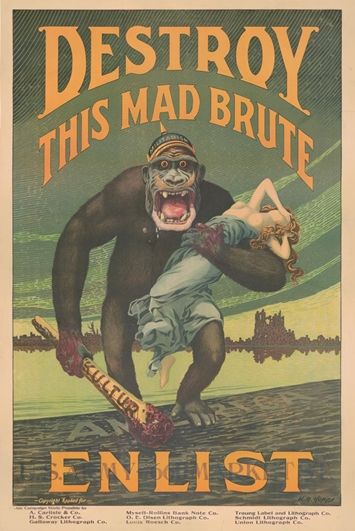
The German soldier is equated to a bloodthirsty ape. This metaphor illustrated that the German army was involved in serious crimes. But obviously none of the German soldiers were actual club-bearing apes, so this poster cannot be taken to be a completely factual depiction of reality.
I like using metaphors and so do most people, they are fun and can be powerful ways of conveying ideas. But my question is, are they valid ways of conveying ideas? Is it valid to use metaphors to illustrate certain attributes of an object, even though the objects being compared are not actually identical (although they are said to be)?
Consider the proposition "Congress is a dumpster fire". This is a metaphor that is meant to draw attention to the fact that something about Congress resembles a dumpster fire. If it were a simile, it might be "Congress is like a dumpster fire" or "Congress is as ___ as a dumpster fire", but it might accomplish the same thing.
A metaphor would not be a metaphor if the objects being compared were actually identical. "John is a man" is not a metaphor; "John is a monster" is a metaphor.
From this, it seems like while metaphors can be useful in illustrating resemblances between things, it fundamentally is not a claim of identity. But it also seems that they are used in this way a lot, illicitly, oftentimes in politics.
For instance, take this propaganda poster from World War One:
The German soldier is equated to a bloodthirsty ape. This metaphor illustrated that the German army was involved in serious crimes. But obviously none of the German soldiers were actual club-bearing apes, so this poster cannot be taken to be a completely factual depiction of reality.
I like using metaphors and so do most people, they are fun and can be powerful ways of conveying ideas. But my question is, are they valid ways of conveying ideas? Is it valid to use metaphors to illustrate certain attributes of an object, even though the objects being compared are not actually identical (although they are said to be)?
Comments (39)
https://terpconnect.umd.edu/~israel/lakoff-ConTheorMetaphor.pdf
I recommend Metaphors We Live By. Lakoff's work on math is also good, if you like math.
Derrida's White Mythology is an excellent though more difficult text. Anatole France reduced metaphysics to anemic metaphors, but this requires employing metaphor (itself an anemic or dead metaphor) as a metaphysical crowbar, forgotten by the critique it enables.
Another source:
https://news.stanford.edu/news/2006/february22/hofstadter-021506.html#:~:text=Analogy%20is%20the%20%22motor%20of,has%20written%20on%20topics%20including
If analogy is such a prevalent thing in our cognition, then it would seem to be necessary (though perhaps not completely possible) to find some way of talking about this phenomenon without participating in it, in order to reach a true understanding of it and the world in general. Any true proposition cannot be self-contradictory (e.g. "everything is subjective", "nothing is true", "all propositions are metaphors", etc).
In what way are analogies different from hallucinations? Believing that John is a monster is different from believing that John shares characteristics with monsters; metaphors allow us to say the former while meaning the latter. But a lot of the power behind analogies seems to come from the way people forget that they are analogies and take them to be identity claims, which would seem to make them hallucinations. It is easier to kill a German if you think they literally are a club-bearing ape, etc
The primary subject (the thing you want to make a point about) is, in a sense, reduced to the analog (that which is being used as a yardstick/standard).
There's a clear and present danger of commiting the strawman fallacy as the analog is, on most occasion, simpler (cartoonish) than the primary subject; there's a thin line between simplifying and oversimplifying I suppose.
Metaphors also tend to pop up in situations where the words to express certain thoughts and, mostly feelings are missing from a standard dictionary. Examples? Think of one on your own. I promise it'll be worth your while.
@jas0n and I had a conversation on this topic and he wished to point out that though metaphors are useful - they can add that zing that makes conversations interesting to say the least - they're also, in a certain sense, pitfalls for they, I surmise, constrain a person to a particular point of view, a one-dimensional way of looking at things that though helpful can result in tunnel vision. Am I right jasOn?
My current opinion is that we are mostly stuck using new metaphors to dislodge old ones. Consider Wittgenstein's fly in the bottle, or his insistence that we tend to be misled by pictures. Metaphors warning us of metaphors, but of course it's the hidden metaphor that traps us, hence the transparency of the bottle. Rorty discusses the mirror of nature as a candidate for an especially dominant 'picture' of this kind. I prefer the synonymous metaphor of lens. The point is mediation. Philosophy dreamed/dreams of mastering/articulating the structure of all possible experience by figuring out the nature of the mirror/lens. Then there's Plato's cave. Locke's tabula rasa. The list goes on. If metaphor/analogy is the essence of cognition, then any 'true' understanding would be only the latest dominant metaphor? Like the metaphor metaphor...
The past haunts a future that haunts the present. Inherited metaphors frame possible futures. We need the same dead metaphors that trap us. We are snakes climbing out of our skins, Neurathian rafts of metaphors clusters.
Indeed! Maybe metaphors occur as systems e.g., I juat found out, theatrical metaphors ("All the world's a stage..."; Shakesepeare) could limit one's understanding, viewing everything in terms of actors/plays/movies/etc.
Likewise, each domain of human activity may serve to construct a metaphorical system specific to it e.g. there could be physics metaphors, a sociological one, and so on.
:up:
I like looking at it that way. The 'big' metaphors are the basic structures of an era or a personality.
@apokrisis and I were discussing the machine versus organism metaphor as applied to physics/nature.
Yep, I remember how I tried to modernize Plato's Allegory of the Cave and simply couldn't find anything in today's world that could replace "shadows" and "cave". One philosopher comes close to achieving this using the images on an idiot box (TV) to replace the shadows on the wall of Plato's cave.
Suggestion: It's time we updated the metaphors we find so useful and adapt them to current times so that people can relate to them more easily. An example of a successful metaphor rehash is the brain-in-a-vat gedanken experiment.
:up:
Quoting Agent Smith
T. S. Eliot is pretty great on this. Reminds me of Hegel/Feuerbach too.
https://en.wikipedia.org/wiki/Tradition_and_the_Individual_Talent
You can see above that the future haunts the past too.
I think the update is simulation theory.
However, has that much water flowed under the bridge to make some historical/ancient metaphors utterly useless? It's been just 2.5k years since philosophy took root and literature too, language has been around for roughly 7k years tops. Perhaps there's still life in these "ancient" metaphors, they still pack a punch if you know what I mean. We still have caves, fire, people, and shadows.
Anyway, thanks for sharing your views on such an exciting topic.
:up:
:up:
Which I can't make sense of, so maybe I'm Cypher. It hurts to stub my toe, whether or not I call the pain 'real' or 'simulated.'
https://plato.stanford.edu/entries/schlegel-aw/#PhilArt
https://nextexx.files.wordpress.com/2018/10/julian_jaynes_the_origin_of_consciousness.pdf
Just a taste:
We are trying to understand consciousness, but what are we really trying to do when we try to understand anything? Like children trying to describe nonsense objects, so in trying to understand a thing we are trying to find a metaphor for that thing. Not just any metaphor, but one with something more familiar and easy to our attention. Understanding a thing is to arrive at a metaphor for that thing by substituting something more familiar to us. And the feeling of familiarity is the feeling of understanding.
Quoting jas0n
Maybe the metaphors arent as dead is it might seem:
According to Gendlin, following Wittgenstein, an event(whether conceived as conceptual or bodily-physiological) is itself, at one time and in one gesture, the interbleeding between a prior context(source) and novel content(target). Gendlin(1995) says, in such a crossing of source and target, “each functions as already cross-affected by the other. Each is determined by, and also determines the other(p.555)”.
All events are metaphorical in themselves, as a mutual inter-affecting of source and target escaping the binary of representation and arbitrariness.
Gendlin(1997a) explains:
Contrary to a long history, I have argued that a metaphor does not consist of two situations, a "source domain" and a "target domain". There is only one situation, the one in which the word is now used. What the word brings from elsewhere is not a situation; rather it brings a use-family, a great many situations. To understand an ordinary word, its use-family must cross with the present situation. This crossing has been noticed only in odd uses which are called "metaphors"...all word-use requires this metaphorical crossing(p.169).
Doesn't seem bloodthirsty to me. Why did the poster convey to you the idea the ape, or German soldier, drank blood or was thirsty for it?
But it's easy to think of the ancient Greek getting an idea and thinking it is a God speaking to him.
I didn't reject his idea out of hand, although it certainly sounds outlandish. I just don't see how he justifies the idea. Have you read the book? As I noted, it has some interesting stuff in it. But the main idea seems farfetched.
:fire:
Yeah I've read parts of Jayne's book, I don't think his theory of consciousness is taken that seriously anymore, though it was a cool idea.
There's blood on the club and the hands, though you're correct, "bloodthirsty" is an embellishment in the same vein (ditto) as the OP.
Yes, some time ago. It's around the house somewhere, so I'll try to find it. The notion of voices in one's head from the various gods of the time - a kind of schizophrenia - doesn't seem so outlandish to me. But fun to contemplate.
A metaphor shows something, rather than saying it.
See What Metaphors Mean but Donald Davidson. A metaphor does not have a second, explicable meaning. A metaphor is not a way of conveying an idea. It does not say something more than its literal meaning.
To see how metaphors work, one must look to their use. Seeing the poster as saying that germans are apes is literally false, and not the purpose of the poster. The poster gives you an insight, a way of seeing the events in Europe, such that you will be inspired to enlist.
If I can circumvent anticipatory hippopotomonstrosesquippedaliophobia and perfunctory floccinaucinihilipilification, I'd like to suggest rolling smaller blunts.
Quoting Joshs
Sounds to me like a longwinded description of a target domain ('the one situation') and a source domain ('a use-family, a great many situations.') Roughly the source is...the past.
Would the real hurt more than the simulation?
It frequently pops up in discussions on Wittgenstein. Pain presumably collapses the pereceived boundary betwixt reality and dreams (illusions).
Correction! Aryan...apes?
Quoting Banno
:up: Rings true!
I'm thinking we tend to aim a word like 'real' socially. If something caused lots of people pain at the same time, it'd be called real. But if you suffer alone, not so much ?
So, a person who's in pain but alone, isn't in pain? When a tree falls and there's no one around, does it make a noise? :joke:
I never quite understood the distinction between one and many. Isn't a group made up of individuals. How can society be happy when individuals aren't? Also, elections, each vote counts; am I to give my input and expect no output? Life, no fair!
I'd say that 'pain' tends to (try to) point at some secret inside of a person. So it's real-for-them.
I'd say that 'real' points (endlessly and terribly vaguely, and only in some contexts) at stuff that's there for all of us. You might 'think' you see a raccoon getting into the trashcan. If it's 'really' there, I should be able to see it too. Hard indeed to make sense of 'real' that doesn't involve more than one person.
:up:
What if the meaning of 'pain' is everything 'around' the otherwise ineffable painfeeling? The 'pain itself' is the hole in a donut. The dough is buying aspirin, saying the word 'pain,' etc.
The mess goes back at least to Aristotle:
How can Aristotle know this ? Did he mindmeld with all his buddies when they complained of toothache? Or is this some kind of mostly unquestioned folk psychology that evolved as a convenience?
Remember , for Gendlin and Heidegger, the o my past that we have access to comes to us already changed by what it occurs into, that than sitting there occupying a slot we call a ‘source domain’ or a ‘past’.
Like I mentioned elsewhere, to another poster, we're all humans i.e. we share a biology that would, in my humble opinion, mean that my experiences (inner ones included) are going to be very similar if not identical to another's. So, my pain will feel exactly like your pain or someone else's.
It's good to be skeptical, but as @180 Proof reminds me, there's gotta be a good reason to be doubtful like that and we have none.
I feel you, but we have no data to support/falsify such a conclusion.
Quoting Agent Smith
I don't deny that it's as impractical as lots of other varieties of metaphysical handwringing. To me what makes it interesting is its connection to the problem of meaning and to epistemology. Some philosophers have postulated 'clear and distinct ideas' as foundational, while others have proposed 'sense-data.' Then they try to construct the everyday world from such 'bricks.' Hence the concern that one is living in a simulation, that others are p-zombies, that my red isn't your red....
Relating this to the OP, are we to believe that all of our current supposedly literal concepts are pre-installed in the brain ? That we merely have to attach names to them? Maybe with the help of metaphor?
I think that's a primary distinction between pragmatic Science and theoretical Philosophy. Science tries to describe material reality in terms of physical attributes, while philosophy characterizes the invisible immaterial aspects of reality in terms of analogies, comparing mental concepts to material objects. Unfortunately, there is no objective validity in those symbolic figures of speech, because they are essentially subjective, and often culturally biased. However, a metaphor is just as valid as a pencil sketch of the defendant in a trial : to illustrate appearances from a limited perspective : not to prove innocence or guilt. :smile:
Metaphor in philosophy :
https://en.wikipedia.org/wiki/Metaphor_in_philosophy