
What is Climate Change?
Mikie 2022-03-26
In explaining climate change, for people who are truly interested in learning about it, I always like to start with an easy experiment: you can take two glass containers -- one with room air and one with more CO2 added, and put it in the sun, seeing which one heats up the fastest. Easy, simple. In fact, Eunice Foote did exactly this experiment in 1856:

Then we can ask: How much CO2 is in our atmosphere? Since trees take in CO2 and most living organisms let off CO2, there's always fluctuations. So the next thing would be to look at the CO2 concentrations in the atmosphere, measured all over the Earth -- starting in the Mauna Loa Volcanic Observatory in 1958 and expanding from there.
What do we see? Concentrations go up and down a little, naturally, every year, because there are more leaves on trees in summer in the Northern Hemisphere than in winter. Yet the average rises every year, leading to the famous Keeling Curve:
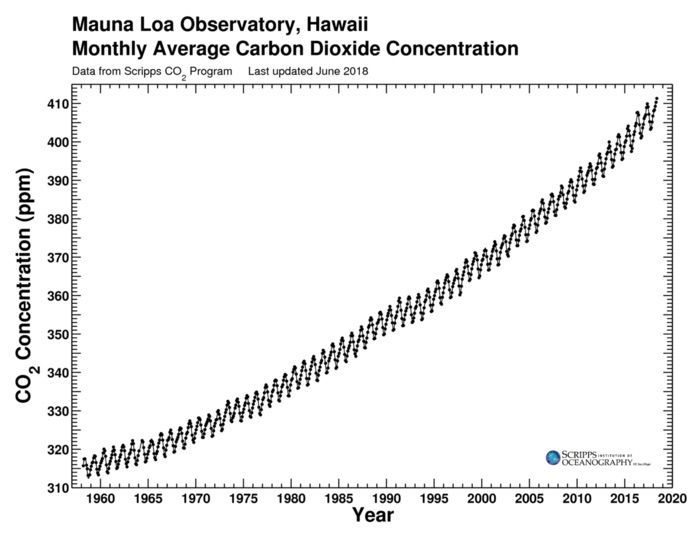
That's just from 1958 to the present. When you look at the concentrations over the last 800 thousand years, an even more interesting trend emerges:
https://climate.nasa.gov/climate_resources/24/graphic-the-relentless-rise-of-carbon-dioxide/
That's 412 parts per million currently, and the last highest level was about 350 thousand years ago at 300 ppm, before modern humans were even around.
So we know (1) that CO2 is a greenhouse gas and (2) that there is a lot more CO2 in the atmosphere now than in the last 800,000 years.
One would think the planet would be warming, giving these two facts. So now we'd have to look to see how temperatures have fluctuated over time, and if increases in temperature correlates in any way with increases in CO2. Is there a correlation?
Turns out there is.
Over 100 years:
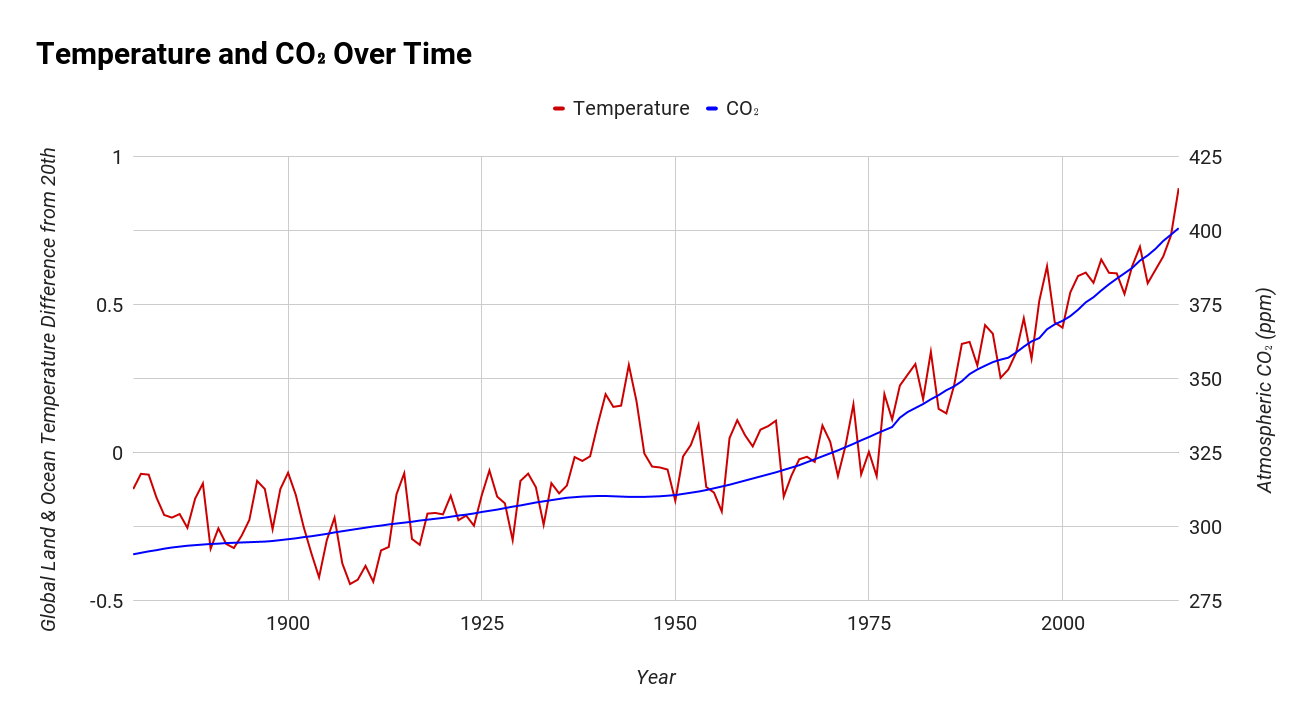
And over 800 thousand years:

Then the question becomes: why is this happening? Where is all of this extra CO2 coming from -- and in such a relatively short period of time?
The answer to that question is because of human activity, especially since the industrial revolution. As world population increases, and more trees are cut down (for fuel, houses, and to make room for raising livestock), there is less of a carbon "sponge."
But on top of this, we're also burning things. Burning wood puts CO2 into the atmosphere. Cows and other livestock also release a lot of methane, another greenhouse gas.
But of course it's not only wood and not only livestock. The main culprit, it turns out -- and why the industrial revolution was mentioned -- is fossil fuel: coal, oil, and natural gas. These are carbon-dense objects, and when burned release a huge amount of CO2. Multiply this burning by an increasing population, year after year for over 150 years, and it becomes very clear where the excess CO2 is coming from.
So human activity is the driver of rapid global warming.
Lastly, so what? What's the big deal about increasing the global temperature by just a few degrees?
I think the answer to this is obvious once you realize how only a few fractions of a degrees has large effects over time, which we're already beginning to see. The melting of the ice caps, sea level rise, an increase in draughts and wildfires -- all happening before our eyes, as every year we break more heat records.
In my opinion, I think it's undeniable that this is the issue of our time and those of us who aren't in denial should at least put it in their top 3 political priorities and act accordingly.
[hide]Borrowed from a prior post of mine a few months back. [/hide]
Then we can ask: How much CO2 is in our atmosphere? Since trees take in CO2 and most living organisms let off CO2, there's always fluctuations. So the next thing would be to look at the CO2 concentrations in the atmosphere, measured all over the Earth -- starting in the Mauna Loa Volcanic Observatory in 1958 and expanding from there.
What do we see? Concentrations go up and down a little, naturally, every year, because there are more leaves on trees in summer in the Northern Hemisphere than in winter. Yet the average rises every year, leading to the famous Keeling Curve:
That's just from 1958 to the present. When you look at the concentrations over the last 800 thousand years, an even more interesting trend emerges:
https://climate.nasa.gov/climate_resources/24/graphic-the-relentless-rise-of-carbon-dioxide/
That's 412 parts per million currently, and the last highest level was about 350 thousand years ago at 300 ppm, before modern humans were even around.
So we know (1) that CO2 is a greenhouse gas and (2) that there is a lot more CO2 in the atmosphere now than in the last 800,000 years.
One would think the planet would be warming, giving these two facts. So now we'd have to look to see how temperatures have fluctuated over time, and if increases in temperature correlates in any way with increases in CO2. Is there a correlation?
Turns out there is.
Over 100 years:
And over 800 thousand years:
Then the question becomes: why is this happening? Where is all of this extra CO2 coming from -- and in such a relatively short period of time?
The answer to that question is because of human activity, especially since the industrial revolution. As world population increases, and more trees are cut down (for fuel, houses, and to make room for raising livestock), there is less of a carbon "sponge."
But on top of this, we're also burning things. Burning wood puts CO2 into the atmosphere. Cows and other livestock also release a lot of methane, another greenhouse gas.
But of course it's not only wood and not only livestock. The main culprit, it turns out -- and why the industrial revolution was mentioned -- is fossil fuel: coal, oil, and natural gas. These are carbon-dense objects, and when burned release a huge amount of CO2. Multiply this burning by an increasing population, year after year for over 150 years, and it becomes very clear where the excess CO2 is coming from.
So human activity is the driver of rapid global warming.
Lastly, so what? What's the big deal about increasing the global temperature by just a few degrees?
I think the answer to this is obvious once you realize how only a few fractions of a degrees has large effects over time, which we're already beginning to see. The melting of the ice caps, sea level rise, an increase in draughts and wildfires -- all happening before our eyes, as every year we break more heat records.
In my opinion, I think it's undeniable that this is the issue of our time and those of us who aren't in denial should at least put it in their top 3 political priorities and act accordingly.
[hide]Borrowed from a prior post of mine a few months back. [/hide]
Comments (91)
You really think the situation improves? Last years saw the highest emission, if I recall correctly. Our only hope is fusion, or solar energy and hydrogen to make the energy portable. Or even better, a drastic reduction of economical activity. Try that telling capitalists though...
I have no idea. I do know that if people resign themselves to defeatism, it's guaranteed nothing will improve.
It is the issue of our time, but what should be done about it is not that clear. 'Act accordingly' sounds a bit like the solution automatically follows from the problem.
Without trying to be exhaustive about it, part of the problem is that energy is life, and fossil fuels are the most dense, convenient energy-source we have, and also the basis on which our entire globalised system is built.
Anyway, i'm not suggesting that we shouldn't do anything about it, just that exactly what is the real question here.
I agree with the urgency of the environmentalist argument, but in these illustrations ancient historical data might not represent the same cause and effect relationship as the recent and post-industrial age data. ??
For ancient data rising global temperatures appear to cause rise in CO2. For the past 150 years or so, cause and effect seem to have reversed so that CO2 is causing rising global temperatures. To see this, one could try to overlap the red and blue charts or just use a ruler to connect corresponding top chart and bottom chart peaks and valleys, it looks to me like the ancient red temperature chart is leading the blue CO2 chart. But I could well be all wrong.
The clock's ticking.
We can smoke, heavily, chain-smoke in fact. The average [math]CO_2[/math] blood levels are higher in smokers than non-smokers, and we (I'm a chain-smoker) are none the worse than our non-smoking brethren. Did mother nature anticipate global warming, does Gaia know humans in and out?
If you put the blue and red chart on top of each other it's not quite clear what the causal relation is between the temperature and the CO2 levels. But what else can cause temperature change? There seems to be a periodic natural variation. Not sure if it's truly periodic. What's sure, is the short time in which temperature has occurred is specific for modern man age. Like the shape of the increase in time. And it's sure there are two effects. T-rise because of CO2 rise and CO2 rise because of T-rise.
We tend to think of cause-effect as a simple and direct relation tied together by some unseen underlying commonality. Like when a billiard ball hits another on a smooth surface we have to invent momentum to explain what happens. Climate has many outside environmental causes most of which are complex on their own. Astronomical events like the precession of Earth's axis cause secondary causes, like ice caps, air and ocean currents, vegetation and bacterial life.
Indeed. The natural processes are complicated. Forks of causation, feed back, chaos, strongly linked and weakly linked processes influencing one another. Its impossible to get the full picture. The atmosphere and surface of the Earth influence one another quite actively. It's no flat surface and its in motion and full of life.
How would the Earth look if no humans stepped on the stage long ago? They have made quite some impression on nature! Fast and furious. Like that Blitzkrieg.
Carbon fibre and non-biodegradable plastics to replace steel and aluminium wherever possible, ie cars planes etc.
Insulate buildings until they are energy neutral. Less steel, glass, concrete, brick, and tile for new build, more wood, plastic, slate, stone, mud, straw, wool, etc.
Get busy with the obvious power sources, tidal, wind, geothermal and heat pumps for heating, solar, etc.
Reduce meat consumption and plant trees and peat bogs as appropriate. reduce fertiliser use by rebuilding soil fertility.
Just slow the fuck down a bit; travel by internet more and aeroplane less. More public transport and bicycles, less cars and private jets. More communal facilities in general - we don't need a washing machine each, we can share.
Less rocket science, more brain surgery.
That's my idea too. We can do the same for many things. And indeed, reducing the speed, intensity, of the economic machine. A sober material lifestyle re-establishes contact with our nature.
:lol:
Every country in the world seeks the sense of security, militarily, economically etc. this results is less effort and space for climate change resolutions.
For example if China or the US is to limit CO2 emissions it will cost them a lot economically, but both would rather spend these resources on increasing military budget because there are tensions and lack of sense of safety.
You are probably right that "a drastic reduction if economic activity" (which pretty much covers everything) is probably the only possible plan that could make a difference. All other plans involve "too much magic".
It isn't only the capitalists who will resist. A sharp, abrupt reduction in economic activity (including reduced food production) means immediate (rather than delayed) disaster. Reduced economic activity means a severe and prolonged depression--no work, no income, dwindling resources across the board, food shortages and hunger, then starvation. Grim.
Perhaps we could maintain some food production and distribution by marshaling the populations of nations to raise food. To the Fields! Human hand labor has a lower carbon foot print than your typical John Deere. If that were to work (and we didn't have a revolution sparked by angry office workers required to hoe long rows of beans) we might avoid starvation. But much less grain would be produced. Rice, wheat, corn, millet, and so on can be grown and harvested in smaller fields, but not in the huge quantities now produced.
Some small-scale manufacturing will be needed too, in all sorts of industries, but nothing like the present.
This dramatically scaled down economic activity would still leave room for the "reproduction of society", but a simpler poorer society, one more locally centered.
What are the chances of a peaceful reduction in the economic activity of the world?
Poor.
"Magic" assumes that we can have it all without the CO2, methane, and so on. Somehow we will be able to feed 8 billion people without heavy farm machinery, distribute food across the world without heavy shipping, and house and clothe everyone without using vast raw material and growing megatons of cotton. Somehow there will be dry land and clean water for everyone. Somehow it won't be too hot and humid (the wet bulb temperature) for people to work outside.
Fossil fuel is vital, critical, and central to the industrialization that produces the world we live in. There are no practical substitutes for fossil fuel. Wind, solar, wave energy, tidal energy, heat pumps, geo-energy, and so on ALL require the existing industrial base. Then there is the feedstock that coal, oil and gas provide. Heat pumps require mines, smelting, factories and electricity, for instance. Ditto for all the rest.
Are we totally screwed?
We may be. We will try to carry on, none the less, whatever happens, until...
An Englishman's home is his castle; and everyone else's home is his bailiwick. Unfortunately, this only makes sense when there is only one Englishman. These days, everyone thinks they're the Englishman. This is the problem that has to be solved before we can effectively deal with climate change. It is a psychological problem. The solution to climate change is straight forward, but we are busy keeping out the migrants and fighting wars against the baddies. until that mindset changes, we are indeed screwed so tight the thread is stripped.
Then we're faced with the preceding problem of how to get that to change.
At least with climate change itself there's only two solutions (change the atmosphere, or change what we're pumping into it). The trouble with psychological problems is that every man and his dog has a theory about how to fix them (with a suspicious majority involving a return to the morality of the popular youth movements of their respective teenage years - also the time in their lives when they would have felt most solidarity and most confidence in their group identity - but that's just another psychological theory - they really are two a penny).
Every Englishman and his dog has a theory about how to solve everyone else's psychological problems, but no clue at all how to solve their own. I'm always trying to change your mind and keep mine the same. This is the problem.
You think? There seem to be an awfully large number of self-help books on the shelves... Aren't the avid readers of such beacons of enlightenment as "12 Rules for Life", or "Can't Hurt Me: Master Your Mind and Defy the Odds", or the delightfully titled "Unf*ck Yourself", desperately trying to, to use the technical terminology, 'unf*ck themselves'? These books seem very popular and they don't seem to be about changing other people's minds, but rather the reader changing their own.
Yup. All written without exception for the other chap, by people who think to have no further need to unfuck themselves.
Quoting Isaac
Books written to change the readers' minds are exactly authors' theories about how to change other people's minds. Who has a theory about how to change their own mind? It would be superfluous, would it not?
Oh, I see. A minority though, no? I mean the sorts of people who write those books are very much the smaller group compared to the sorts of people who read them. So I'm still not quite seeing how the self-righteousness of the self-help author can be to blame for climate change, there can't be more than a few hundred of them (though I admit sometimes it seems like they're everywhere).
Quoting unenlightened
Again, seems you're pointing to a minority (the ones who write the books, as opposed to read them - not to mention the conjunction who do both). What is it that links this minority to issues like climate change?
Quoting unenlightened
Not superfluous so much as already enacted. We have theories about how to change our own minds all the time, we just mostly have them quietly. If I'm expecting my cup to be on the table but see no cup when I look, I have to change my mind about what happened to my cup. I probably wouldn't post it on the internet though.
Would I agree with the random musings of an Internet troll with no understanding whatever of climatology? That’s an easy “no.”
You are welcome to believe whatever religion / cult / ideology you want, just be honest with yourself and don't call it science. ;)
It is science. Your own ramblings notwithstanding. Feel free to take your Republican talking points elsewhere.
“Optimal CO2 level.” :lol:
If it is science, can you verify or falsify it? can you explain how the scientific method was applied to come to this conclusion?
do you have a problem with republicans?
What's non-scientific about it? Seems pretty convincing to me. You gotta admit that capitalism is fucking up the planet. Which might not be evil per se, but is quite disturbing to be honest.
That's no criterion for being scientific.
Capitalism has certainly fucked some things up, like putting sugars and seed oils into food. But blaming all your troubles on it and assuming communism would do better might not be a reasonable way to go.
Sir pimpelPopper was a frustrated scientist, who tried to make science dance on the marchmusic of his false method.
Quoting stoicHoneyBadger
Where I claim to be a communist?
Don’t bother with trolls. Climate deniers don’t know about science or care about science. They’re as interested in “science” as creationists are.
50 years worth of research, overwhelming evidence (of which I give a sample in the OP), 99% consensus, etc — all irrelevant to those who follow Trump’s lead. It shows up in the stupid questions, for example about “optimal CO2” and so forth. Wow! They’ve cracked the case! Single handedly! All from spending 15 minutes on Wikipedia. Imagine the level of ego? It’s impressive.
And isn’t it funny how science ignoramuses ALWAYS point to Popper? It’s almost as if that’s the only philosophy of science they’ve ever heard about. :chin:
It all boils down to the fact that the idea of a minuscule ~1 degree warming causing some global catastrophe does not sound reasonable.
We have been promised sea levels raising, extreme weather events, etc. for decades, yet none of that has materialized. Is any nation underwater, as promised from the UN tribune 20 years ago?
If nothing happens in 5 years, 10 or 20 , when will you finally say "ok, guess it was a bit exaggerated"?
Actually, it has. Sea level has risen, and extreme weather events happen every year — breaking records. Not to mention average global temperatures are the hottest year after year. But I know that means nothing for those who don’t want to believe it.
Quoting stoicHoneyBadger
That’s because you don’t have a clue about the Earth’s climate.
Nevermind. It sounds unreasonable to you, so I guess that settles it. What are all those stupid scientists who’ve dedicated their entire lives to understanding the earth talking about? Idiots!
Quoting stoicHoneyBadger
We don’t have to wait— they’re already here, and have been visible now for about a decade. Which is exactly what was predicted back in the 1980s. Believe it or not, there’s a lot of information about this — all free. Or you can talk to a climatologist, and they’ll explain it to you.
Or you can go on believing you know more than them because you spent 5 minutes thinking about it and have judged it to be “unreasonable.” Your call.
How much has it risen? Is some city underwater? What extreme events has it caused? I can say the same way, if you want to see climate change, you will find it everywhere and than use it as a confirmation.
Quoting Xtrix
So you blindly trust some group of people, who claim to know something you can't verify? Why not trust priests or imams or UFO hunters?
Quoting Xtrix
In a same way you can talk to a liberal gender studies major and xzer will kindly explain you that there are 128 genders, yet it still does not make it reasonable or trustworthy.
I just checked randomly the levels at KeyWest, FL. Here is the graph, I can not see any sharp increase in it, can you?
The current rate it about 2.5mm per year. The highest point of KeyWest is 5.5m , so if my math is right, it will take just 2200 years for them to go under water.
Can you provide me with a counter example?
On average 1.75mm per year. I don't see any sharp increases, but ok, let's double that for the sake of the argument. So 3.5mm per year, elevation of SF is 16m , so at this rate it will still take like 4.5K years.
No, it’s a group of experts with overwhelming evidence that can be verified by anyone who wants to know about it. They can explain it to me and answer any questions I have about it. This is typical of science.
Or we can walk into a physics department and say “quantum mechanics seems unreasonable to me” and leave it at that.
Quoting stoicHoneyBadger
Someone’s been watching a lot of Fox News I see.
I’m not interested in your therapy.
Quoting stoicHoneyBadger
Who said it would be a sharp increase? You notice that sea level has indeed risen. Your claims about sharp increases or cities being under water are your own fabrications. That’s not what’s being claimed. There are areas in the world — like the Maldives and areas of Bangladesh where sea rise already is causing real problems. But no one is saying the seas will consume New York overnight. No one.
Quoting stoicHoneyBadger
Yeah…great job. So I guess that settles it! You’ve singlehandedly refuted all of climate science! Somehow they missed your extraordinary insight! Good work!
https://www.climate.gov/news-features/understanding-climate/climate-change-global-sea-level
Aha, so it went from 1.4mm to 3.6mm , therefor in one case Marseille would be under water in 25k years, but in the other in just 10k years. Yeap, that a real emergency! :D
You are looking at them like some God-send enlightened gurus, I see them just as another breed of quacks, similar to astrologers, homeopath, faith healers, taro card readers etc.
I don't need to read every book on horoscopes to know it is quackery.
:rofl:
:ok:
Seems pretty clear though that the planet has never been so fucked up as in recent times. Even the big asteroid that once hit had a mild effect in comparison.
The real emergency, though floods and fires are serious, lies not in temperature change per se. It's the short time in which it happens that matters. And in comparison with human impact on nature, even this looks pale and bleak.
Notice how you are moving the goalposts. Ok, temperature changes some 10 degrees every day/night cycle. It changes 50 degrees during the year. Having a 20 degree difference between average temperatures withing two sequential years is not unusual. Yet having a 1 degree increase in 30 years is the end of the world? Does that sound reasonable?
Quoting Haglund
See goalpost moved again. What exactly is this impact? Sahara is greening because of the release of trapped co2 by human. In cities situation is certainly way better than it was 150 years ago, when everything was covered with soot.
I think you just hate people as such and are trying to make up reasons for why we are bad.
Okay, analysis time. The final one! Now it's you who moves the goal posts. You introduce whole new goalposts even. The temperature changes you refer to, the daily or seasonal variations, are not what gives the danger. The goalposts we talk about are about the change in the average temperature. This change in average temperature (the energy contained in the whole atmosphere) has occurred before in history, even in shorter time, but this lasted a short time, so nature had not really suffered because if it. The temperature change induced by man is short term and lasting. There is no return to normal.
Quoting stoicHoneyBadger
No goalposts moved here. I placed the problem next to another problem: human intervention in nature in general. So nit only on the atmosphere. Again, I didn't change the posts, I put two larger and thicker ones around them. If you can't see the impact and consequences than yiu wear some damned big blinkers.
What is normal? I mean the idea that if temperature fluctuates tens of degrees withing a few years is not a problem, if the same happens over thousands of years it's ok, too. Yet if a 10 times smaller fluctuation happens within decades - global catastrophe! It does not sound very logical to me, nor is it testable in an experiment. Moreover, those "experts" are known to be wrong / grossly exaggerating many times before, so seems like quackery.
There is no fluctuation we induce. We induce a permanent increase (in short time) without fluctuating back. That's not natural. Not normal.
ok, but the question still is whether it is a small pleasantry or a global catastrophe. I don't see any tangible evidence to suggest a catastrophe.
In general: the shorter a change takes the bigger the consequence. Birth, lightning, a meteor crashing on Earth, etc. So the transgression in short time to a higher temperature will show. There is just more energy injected into the atmosphere. And the energy increases fast. You might call 1 degree rise in 10 years not much but it's huge. And it stays. A natural balance is disrupted. Chaotic effects. Forrest fires and floods happen quite regularly lately.
War! Pestilence! Famine! Death! and also locusts everywhere! I mean it is a doomsday cult prophecy, not a credible scientific theory. What if forest fires are caused by its mismanagement?
Not sure what these have to do with the atmosphere. Poisined air maybe?
Quoting stoicHoneyBadger
It's not a theory. There are just more fires and floods everywhere. For a fact. And you would expect management to have improved.
And how do you know it is caused by a 1 degree temp. increase? If we measure it in the number of death, the picture is not so bleak.
How else?
The article is about catastophes...And the number of deaths would be lower without temperature increase by man.
So in the graph we already see a sharp decline in death, yet without a 1 degree temp increase the decline would be even sharper? :grin: so, unfalsifiable.
Quoting Agent Smith
How's about "climate is always changing and a 1 degree increase is positive, yet so minuscule that there's really nothing to talk about".
You mean to say all this climate emergency hullabaloo is much ado about nothing? I would've loved to agree, but then all those papers, reports & seminars; no smoke without fire, a grain or two of truth, no?
Too, there's a thread on chaos theory and last I checked it had very much to do with the weather! Does chaos not extend to climate? :chin: Oh, I completely forgot, there are patterns in chaos. I could be wrong though; do lemme know if I am.
Yes. If man wouldn't have fucked up the atmosphere, there would have been less deaths. Because of the fires and floods it created wouldn't have happened then.
Yes.
Journalists are getting clicks on scary titles. Politicians get votes from scared people. Green energy shills are getting government payouts. Celebrities get to fly around in private jets, telling people how they should live. Even Austin the weirdo, who lives in his mom's basement, can walk around with a placard and feel like he is saving the earth.
sounds as unreasonable as "if people would have prayed more to God, there would have been less deaths." :D
If instead of fucking up the planet they had prayed, this would be the case indeed! :grin:
Anyone denying the unbalanced, irreversible, definitive, relentless imprint on nature caused by man is in denial.
Aren't men also part of the same nature?
Translation: How can 1 degree (such a small number) be such a BIG deal (not a small number)?
It took 50 years and thousands of scientists, and now finally the breakthrough insight we’ve all overlooked — pointed out by a guy on the Internet.
No need to learn about the subject.
Let me try: quantum mechanics seems spooky and unreasonable. How do we know what happens at small levels? Has anyone seen these things?
Bam. Refuted. And don’t tell me to read about it — I don’t need to read about things that are so OBVIOUSLY ridiculous. Quantum mechanics…climate change…electromagnetism…all on par with horoscopes and unicorns.
:lol: One surefire way of convincing us that there's truth in these climate change claims is to make a prediction and see if it comes true. Einstein did it with his theory of relativity - remember the solar eclipse of 1919.
Yes— it’s all a big hoax. Overblown. Thankfully we have experts on here like up to lead us down the right path with your intuitions. “small number no make big effect.”
Brilliant.
For some real reporting on why climate deniers like this troll even exist, and repeat the stupid bullshit they’re told, see the latest Frontline piece. No reading involved— so that should help. Big oil has been spreading misinformation for decades.
The thing you don't want to grasp here is the ability to verify a theory in an experiment.
Yeap. And so far all the "we have 3 years left!" predictions pretty much have failed.
And predictions have been spot on. Despite those who repeat denial propaganda want to claim.
https://amp.onlineathens.com/amp/2014160007
Ask and astrologer if his predictions are accurate and I have no doubt he will show you a few that actually came true. If you want a scientific approach, look for those that failed.
Climate change is a fact, not a “theory” (a term you don’t understand).
There’s a mountain of evidence that supports the idea that the rate of change is outside natural variability. The spike in global average temperature is the result of the industrial Revolution — burning fossil fuels, increasing deforestation through agricultural practices, etc.
There’s a thing called the Internet where you can LEARN about this stuff.
Or continue on being a buffoon. Works either way for me.
There was a video of this Mann guy talking in front of congress(?), promising Washington DC going underwater in the near future. Somehow it got dialed down to less than 8cm. :D
Or, if you want to stay a climate denier like you, just ignore everything that doesn’t fit that belief. That easy. Bam! “Science.”
Don’t worry your little head about it. I know you didn’t read the article — which is why it wasn’t meant for you.
Seems you been learning too much stuff that's not very accurate. Some even manage to learn that men can turn into women by wishing so, on the internet. :D
No, that’s just your idiotic claim. A claim repeated from whatever denialist bullshit you’ve gorged yourself on. Which is why you offer no references, no such video, etc.
“Al Gore claimed we’d all be dead by 2020! Hahaha! Fool!”
To climate denying cretins, facts don’t matter. It’s about what “feels” good. That’s all the science they care about.
:rofl:
Oh? Like what, specifically?
I won’t hold my breath.
Quoting stoicHoneyBadger
Quite obsessed with that issue, aren’t you. As I said before, I’m not interested in your transphobia.
So now biology is called transphopbia? Talk about science denial. :D
Yeah, exactly. Because those videos don’t exist. Nor do those idiot claims that you fabricated.
So not just a climate denier and transphobe, but a liar to boot. Nice trifecta.
Then you don't understand the impact of man, as the figures show you. Im not assigning any moral on how we should behave. Maybe it oughto happen. But the facts don't lie.
No— you repeatedly bringing the topic up is. Pretty obvious, actually.
But nevermind. Continue on with your pet culture war issue.
Yes. If you change the average T in a shirt time, the natural balance gets distorted. A small change, say 1 degree, leading to less patterns and more chaos.
Two types of deniers with whom it is misguided to talk about the science of man's negative impact on climate:
Those who have an enormous sense of entitlement.
For as long as their sense of entitlement is left intact, they won't change their mind.
The consequent Social Darwinists. To them, life is a struggle for survival, and only the strong survive. They take no issue with this.
To such people, the thought, "The climate situation is dire, we need to do something about it" never occurs, or at least it doesn't seem worth pursuing.
Chaos, in my humble opinion, as some say it is, is "order undeciphered". That seems to be the crux of chaos theory, oui? The "randomness" is an illusion. Have you seen those colorful pictures of chaos? They don't seem chaotic; mayhaps it's a matter of scale. The quantum world, according to physicists, is one where chance rules, but at our scale, everything's as orderly as troops in formation.
Oui, bien sur. But. The beautiful patterns might be disrupted by a small and fast change, like 1 degree uprise in 10 years without falling back.
:ok:
:up: