
Emmet Till
Cavacava 2017-03-27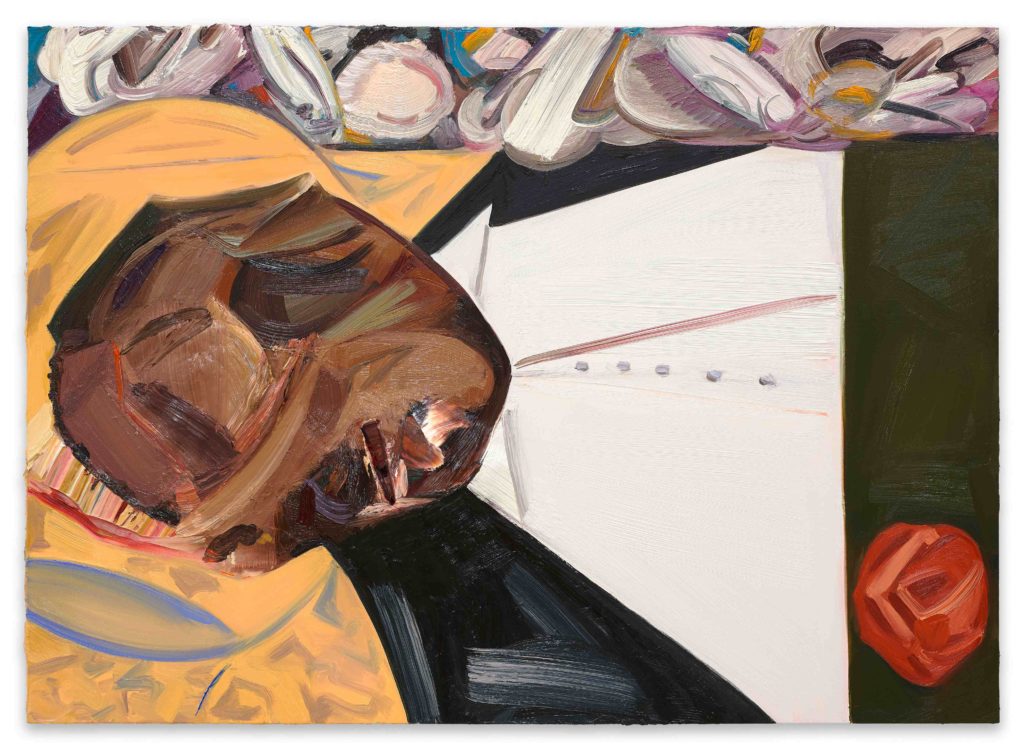
The painting depicts the unforgettable image of 14-year-old Emmett Till’s dead body in an open casket at his funeral. Till was lynched in Mississippi in 1955 after he was falsely accused of flirting with a white woman. He was horribly disfigured. His mother, Mamie Till, made the decision to have an open-casket funeral, saying, “Let the people see what I’ve seen.' and the photos were published in Jet Magazine a magazine geared to the black population. At Whitney Biennial opening on Friday, a small protest was staged in front of the painting, in an attempt to block it from view:

'The painting is by white NYC artist Dana Schutz. Artist Hannah Black (a black artist) wrote an open letter to the Whitney, signed by dozens of others, demanding not only its removal but also its destruction. Schutz has defended her work, and the biennial’s curators, Christopher Y. Lew and Mia Locks, have called its inclusion consistent with the show’s search for “empathetic connections in an especially divisive time.” Articlet
It has created an uproar in the art community. Many suggesting that this is the worst kind of cultural appropiation, where the artist makes fun & profits off their work at the expense of the black people's suffering. Schultz denies that it was her reason for the creation and she says she will never sell it. She agrees that she does not know what it is like to be black in America, but she said she does understand what is to be a mother.
The one criticism I thought worth addressing has to do with the abstract nature of Schultz's work. The face which was disfigured to the point of horror in the photograph is smoothed out in Schultz's work, which has us looking into the coffin similar to how it might be viewed at a wake. I don't think this is the case, I think Schultz did not need to make her work as horrendous as the reality for it to exert its power.
I think the work is respectful of its subject (maybe a little too respectful but...) it does justice to its subject and raises our awareness of the black/white/(...) discourse that is going on in America.
Comments (48)
Quoting Cavacava
I'm not sure whether "cultural appropriation" is a real thing, or just a short-out in the overheated academic imagination. Probably the latter. The term rarely if ever appeared in print until the mid 1980s (Google Ngram)--about the time post-modernism got on its roll. The term hit the big time very suddenly. If it is a crime, it's one of great refinement -- only the most delicate, sensitive, most prepared minds are going to suffer inconvenience.
Artists work for a living; Somebody will or has bought the painting. [EDIT: Schutz says that the painting was never and is not for sale.] Money will be exchanged. I don't think the painting is fun; I don't believe it was intended to, or accidentally did add to or subtracts from anyone's suffering.
Till's case is worth a quick review. It's appalling.
Lisa Whittington painted a much more compelling portrait of Emmrett Till "How She Sent Him and How She Got Him Back" here and explains what she thinks is wrong with Dana Schutz's painting. (For one, the artist was white. Oh dear.) But then, Ms. Whittington also did a painting where Emmett Till's likeness is on a wine bottle next to a wine glass. It's on par, in terms of softness, with the work of Ms. Schutz. Difference? Whittington's skin is black. (Ah, well, there you go! Now it's culturally relevant.)
I'm pretty sure Whittington's complaint is on target that galleries and museums give scant attention to black artists. They probably don't. But the policy of Saatchi is one thing, the intent of Schutz the artist is another, and being in the show isn't a fault of the artist.
I really like "How She Sent Him and How She Got Him Back" by Lisa Whittington, it displays some of horror of what was done. It addresses the violence of the act in a way that Schultz's work does not. Perhaps the story of Emmett Till is strong enough to be interpreted in a number of different ways and in a variety of media. Here is Bob Dylan's 1962 rendition (cultural appropiation) in his ballad:
How exactly does it cause harm?
I guess the only possible sane answer is that theft of intellectual property steals the profits from hard working...... Cultures?.... Races?.... Murder victims?...
It just doesn't make sense. Implying that Shutz is stealing profit from black artists (stealing profits IS the issue with intellectual property rights) also implies that the death of Emmet Till is the intellectual property of the black community rather than existing in the public domain.
It's especially backward to be outraged over someone spreading awareness of a crime because you feel you owned the right to spread that awareness and thereby gain notoriety...
The public domain is the public well, and once it's there, it's available. (I'm using public domain as just "the public" rather than 'expired copyright'.)
I can understand people wanting to tell their own story. The Till family might legitimately feel that their story was ripped off by a movie studio, for instance, or a novelist. Especially if their experience was really distorted.
Anything that resonates is likely to get picked up and passed around. A lot of gay stuff was picked up in the 80s, for instance, 'pink triangles'. [Variously colored triangles were used in the Nazi work and death camps to identify groups--Jews (yellow) , common criminals (black), communists (red), Christian objectors (purple) , homosexuals (pink), Gypsies (brown), and so on.] Some Jewish groups objected to gays using pink triangles because they thought it infringed on their holocaust experience. Some gay people objected to straights using pick triangles because they thought it infringed on their experience of oppression.
There is a large net benefit to cultural appropriation: It's the means by which cultural innovation spreads. The blues, or Jazz, didn't remain a piece of black subculture because it was appropriated by white people. White people didn't "take it away from blacks" of course, and white artists didn't take anything away from black artists in the Till situation.
On another note, I say in all my Jewishness that I welcome those of all colors and stripes to produce art depicting the horrors of the holocaust. Appropriate all you wish. I gain much comfort in knowing that someone other than Jews care about Jews.
I, likewise, agree and though controversial for a number of reasons, education on the subject vis-a-vis the controversy is much more valuable. I should note, however, with:
Quoting Hanover
You do make up a minority should you think of the Palestinian subject. I am completely neutral, anti-racist and my only concern is human rights and not politics, and having returned from Israel not too long ago, I learnt that as an outsider discussions on the subject was often viewed antagonistically, except in Tel Aviv. I care about the Jews, trust me on that, but I also care about the Palestinians. So, what does it mean to care?
I suppose all work about the facts of other people's lives is exploitative, but this one does look, well, exploitative, in the context of an artist who doesn't usually do politics, and whose justification is as banal as this. I liked the protester who stands in front of the picture several hours a day in a sweat shirt saying BLACK DEATH SPECTACLE.
As an ex arty-farty myself and something of a libertarian I'm also appalled by a fellow-artist suggesting the work should be destroyed. Countering exploitation by destruction seems deeply unpleasant and uncreative to me: better the man in the shirt.
While I am not a fan of the theory of authorial intent especially as it could be applied to philosophy & other works, I do think that each work of art is susceptible 1st & primarily to criticism on its own basis aside from other outside considerations. Here the problem as Hanover suggested is "It simply doesn't convey the horror of the event in any real way". The emphasis, at least for me is on the "real", to what extent a painting, song or any other work of art needs to maintain allegiance to the reality of the situation, especially any art-historical painting. Part of Picasso's genius was his ability to convey the horror of the bombing of the small town of Guernica in northern Spain by the Nazi's. He did it in a very abstract way, but it has more emotive force than any other such historical rendition has accomplished, at least over the last 100 years, if not ever.
I really like what Cathy Young (a well know writer & feminist) has to say about this work. http://forward.com/opinion/367198/why-fury-over-emmett-till-artwork-at-whitney-biennial-is-so-dangerous/
She points out that other works of art are similarly problematic, that the idea that you have to have same origin, background, culture, class or racial character to be able to convey feelings in empathy is specious. She noted that "“cultural appropriation” in the sense of supposedly illicit use of themes, styles, or practices from cultures not one’s own — or, at least, from the cultures of less powerful groups — is a pseudo-offense based on the pernicious idea of tribal ownership of culture."
She also noted that
The issue is the fictionalization of reality. Does, can, ought any work of art come close to representing the reality it is supposed to portrait? Isn't there a danger in fictionalization of what has occurred, in that it may not convey the harshness of the reality that it's supposed to represent, instead it may suggest a stance that is far removed from being honest to its origin, as TimeLine and mcdoodle seem to suggest.
What this means is that you wish to interject a non-sequitur regarding Israeli/Palestinian relations into the question of whether one should be opposed to the Holocaust. As you may realize (but maybe not), it's entirely possible to feel unmitigated sympathy to the Jewish victims of the Holocaust and still side with the Palestinians in the current Israeli situation.
By comparison, had someone said that they found they couldn't fully sympathize with Till because Blacks, after all, do commit a disproportionate amount of crime in society, I'd find the statement outrageously racist. By the same token, should someone say that one couldn't fully sympathize with the victims of the Holocaust due to the current state of affairs in Israel, I'd find the comment outrageously racist.
And so, back to what I said, in the hopes that you'll clarify what appears to be anti-Semitic comment. I would embrace anyone who creates art expressing opposition to the Holocaust for their allegiance to Jews just as I would hope that African Americans would embrace those who present opposition to what happened to Till. The fact that someone might have other misgivings about Jews or Blacks notwithstanding; the fact that there was allegiance in these regards is laudable. That you might wish to say that you stand by Jews in the Holocaust, but you want to be very clear that you don't like them always, isn't terribly laudable or necessary, and it's unclear why that clarification needed to be made to my uncontroversial comments regarding the horror of the Holocaust.
Actually, no, not at all. Whoever denies the holocaust has lost his/her sense of humanity and I am offended at the suggestion. The holocaust and the victims of African American slavery both heavily involve racism, discrimination, lack of self-determination and extreme violence. Comparatively, the Palestinian situation is the same. My interjection essentially lies in the fact that should artwork depict a child who has been shot and killed in Bethlehem for throwing a stone, would you feel the same way? Judging from the tone and complete misrepresentation of my post, I can see that you would.
Quoting Hanover
*sigh*
Even though I said:
Quoting TimeLine
Quoting Hanover
Look, not sure where you jibbed expressing opposition to the Holocaust from, you've probably been involved in way too many conversations about Chomsky that you are failing to read the point I was attempting to make, but 'outsiders' speaking about Israel and Jewish history is not often welcome. As an 'outsider' - whatever that actually means - and the controversial point of this OP relating to her artwork is what I wanted to understand. This African-American man, who was beaten to death, also shows the brutality and violence of White America, which is why the artwork is controversial.
As for not liking them always, the problem of a female 'outsider' getting involved with a Jew is a subject that hurts me as a female 'outsider', but that is a different story.
("How She Sent Him and How She Got Him Back" is a much better work of art though imo).
I realize you self declared this, but I was questioning it obviously. All I said in my post was that I'd stand by those who stood by me in their opposition to the holocaust, and you then started talking about injustice in Palestine. If you can't see why that might be construed as anti-Semitic, then maybe think a little deeper. If a Muslim were beaten to death for being Muslim and a Muslim poster expressed gratitude for non-Muslim support for the victim, do you think me bringing up the topic of Muslim terrorism would be in order? Do you really think it'd matter if I just said "Oh btw I'm not racist, so don't take this the wrong way"?
Sorry buddy, it was your so-called 'deep thinking' that led to an accusation of anti-Semitism and holocaust denial. If you cannot see just how ridiculous you were, I suggest you take some multivitamins or whatever that may assist in better cognitive function.
Quoting Hanover
Perhaps, but take a look at it from my perspective. I told you that I just came back from Israel and that contrary to your opinion would not be the case for many others; in line of the OP that meant that there is reason behind the controversy she is experiencing. Spitting out venomous notions of 'anti-Semitism' and holocaust denial to anything and everything is embarrassing and shameful.
Why are we now talking about holocaust denial? I don't remember that accusation being made. I also don't recall accusing anyone of ant-Semitism for anything and everything. I accused you specifically of it because you were. It was just an observation.
What happened is that I noted an instance of unambiguous Jewish victimization and you felt it necessary to insert an instance where you felt Jews were oppressors as if it added anything at all to the conversation.
I apologise for the digression in your thread. I have a hard time understanding how particular people must have authority on a subject based on their personal experience or relationship. I am not a mother, does that mean that I would not feel or understand the sadness the image of that young boy would convey? Does that lessen my authority? If the artist was African-American, would that enable her the right? This kind of thinking is regularly and rather fallaciously used and I am intrigued that the community reacted in such a negative way towards her. Setting aside cultural appropriation, I am of the opinion it was because of the message that it was sending, the horror of a historical reality where the aesthetic medium is preferred not be used to convey such a message. A painting, basically, is not doing the horror justice, nor the victim or the history. It is not enough.
In addition, art is also desirable, beautiful. It is a movement, perhaps, to challenge that stereotype. Her brush strokes - so thick and almost distorted - I feel is a great depiction of the confusion I felt when I saw the image, almost like I quickly looked away because of the abhorrence and her image represents that quickness. But, it is also colourful. The picture is not and that representation - whilst perhaps showing love - is probably not appropriate.
How was I anti-semitic? By saying that you are in a minority of Jewish people who would appreciate art that depicts the holocaust from those who are non-Jewish? I will concede, my response lacked clarity on a touchy subject that causes reactions and I should have been more vigilant, but blimey, I never anticipated your reaction. When people like you assume such negative opinions and rather immediately throw out the term 'anti-Semitic' for an unjustified cause, it is accusing anyone for anything and everything. You didn't think your accusation through and even you were aware of your doubts, so nice try.
Quoting Hanover
No, you mentioned art depiction of Jewish victimisation by non-Jewish artists and how you would welcome it, and I responded by saying you are in a minority. I knew it was a touchy thing to say, so I tried to clarify by showing that I experienced some negative reactions as a neutral outsider. I never said Jews were oppressors and this is precisely the purpose of my initial post, that sensitive topics always bring out and highlight reactions such as yours. You can assume my saying I am neutral and a human rights advocate that does not involve herself in politics to be merely a tool to covert my anti-semitism, but you are a fool for thinking that. End of story.
The "meaning" which lies within a work of art is often vague, ambiguous, or obscure, art often being of an abstract nature. The meaning is a representation of the artist's intent, what was meant by the artist. I don't think it is appropriate, or correct, to say that the meaning of the art is a "fictionalization of reality", it is more like an obscured reality. The artist may take a little piece of reality and, with the use of obscurity, attempt to create a wide range of meaning from that little piece of reality. Through the use of obscurity, the artist allows one's own intentions to be interpreted in many different ways. What the art means to me, and what the art means to you, may be completely different, due to that use of obscurity.
I think that in the exemplified case, the criticism is based in the fact that the art obscures the importance of that little piece of reality which it represents. So to the ones whom that piece of reality is extremely important, it belittles that importance. The point is that the artist can take that piece of reality which is intensely meaningful to a small group of people, distort it with ambiguity, and present it in a way which is somewhat meaningful to a large group of people. To argue that this is a bad thing to do is to argue that art is bad.
"...Cleanth Brooks, W. K. Wimsatt, T. S. Eliot, and others, argued that authorial intent is irrelevant to understanding a work of literature. Wimsatt and Monroe Beardsley argue in their essay "The Intentional Fallacy" that "the design or intention of the author is neither available nor desirable as a standard for judging the success of a work of literary art." Wikipedia
And I agree that first and foremost a work of art must stand on its own, it must be aesthetically valuable in-itself. (I am not sold on the intentional fallacy, but I agree with them this far). What a work means as you indicate may be abstract and obscure, but that is not what draws us to the work. What draws us to it is its aesthetic, the affect of its surface. The "meaning" of a work of art is I think secondary, and perhaps incidental to its affect, to its aesthetic. Music can be an example of pure affect.
The artistic portrayal of reality must be fictive, it is not the actual experience, not the actual apple, not the actual body in the casket, but rather the way or manner of narrative that enables a unique view of reality. The problem with this is that the aesthetic itself can be bias, prejudice, unjust, but very effective in seducing its viewers/readers/hearers by its affect, which is why propaganda (and rhetoric) can be powerful.
Of course we would not have a culture if not for cultural appropiation.
Why do you say:
Can you explain why this is so. I think Lisa Whittington's painting is much closer to conveying the horrendous brutality of what happened to Emmett Till, for sure. But I like what TimeLine says about Schultz's painting:
Perhaps Schultz's painting depicts the mother's view of her son, where he remained beautiful to her in spite of his brutal disfigurement, and horrendous death. She sees past the surface disfigurement to her remembrance of her son is all his innocence, the smiling boy we see in the photo prior to this heinous act. The passionately colored flower, symbolizing love.
I think it's not so easy to separate the meaning from the aesthetic. When we look at art, we take it for granted that it was created by an artist, so that premise of meaning is inherent within the aesthetic of the art. I don't know about you, but I look at a natural beauty in a completely different way from an artificial beauty, because the skill and technique of the artist is always in my mind when I look at art. I'm usually looking at "what the artist did" so I'm looking more at the meaning than at the aesthetic. Being a musician myself, I find this to be especially the case with music, so your example is lost on me.
Quoting Cavacava
In most cases, I don't think an artist is trying to portray reality, so art in general is neither actual nor fictive, it's something completely different. The more abstract the art is, the more "different" it is. The "affect" which you refer to is just what the individuals of the audience get out of the art. So it's not the case that the artist is actively seducing you, you are allowing yourself to be "affected". You do not have to allow yourself to be so affected, you can ignore the art. Think of a logical argument, if it's very bad, you will not be affected by it at all, but if it's good, you may be affected by it. Even if it's good though, you can still choose to ignore it.
I assumed that the colours symbolised innocence just like the little girl in the red dress in Schindlers List. A child-like purity. But the difference is that symbol was represented in the moving image because it ameliorated the horror surrounding her symbol - that all the victims were innocent as she was - which is why paintings may be inadequate when discussing such horrors and the impact the violence has not just to the victim and his family, but to all those who belong within the social and political problem itself. It is no longer about the victim and thus more than just a mothers love in the eyes of those who claim authority.
For me, though, a mother's love represents unconditional love and I believe this even though I never had a mother, because I feel that way, always. I teared up when I saw the photo, but I know that the best way to remember victims of heinous crimes is to remember them and not the criminal.
Art's aesthetic draws us to the work, the work's matter by way of its form strikes us (or not) as part of narratives that we understand. The value we give to of a work of art lies is in how we experience that work, which can be intimated but not fully explicated. I think great art has an enigmatic aspect, a remainder, something which can't be explained. At the same time our experience of a work of art follows the coherence and logic of the work, regardless of the intent of the artist.
I think all man made beauty depends upon natural beauty, aspires to natural beauty, is the mimesis of natural beauty. Music seems to me to be able to convey a sense of pure emotion and that's what I was getting at.
I disagree to the extent that whatever the work portrays is its reality, how it communicates and what it has to say is largely derivative of the society and culture that nurtured the artist. A good argument can be wrong, it can be knowingly wrong as in sophistry.
And I am not a-political or neutral on that topic :D.
There is very much a difference between the state of Israel, and Jewish ethnicity. And it doesn't seem to respond to @Hanover 's point -- that he would welcome anyone who wishes to express compassion towards Jewish people regardless of there ethnicity by making art about the Holocaust. So it should be viewed as a good thing, at least in a moral dimension even if the art fails at what it intends.
Whether someone is consistent or not with respect to other political topics is a bit off the beaten path, no?
I mean, I don't even know @Hanover 's stance on that issue -- but I do know that we can't blame the Jews for the actions of Israel, or even equate the two (many Jews are anti-apartheid, after all), and that whatever faults Israel may have it doesn't make sense to, immediately in response to the Holocaust, to bring up those faults. And I have to admit that though I do not think you intended this, that one fair interpretation was that Jews are to blame for the suffering of Palestinians and therefore we shouldn't have compassion for the Holocaust. I don't think you believe this -- but as you note, it's a sensitive topic. And with sensitive topics we tend to jump to the worst in others (sadly, with respect to race relations, because the worst is so often right).
While that is one fair interpretation I thought this is what you basically were saying: If we believe minorities, in general, shouldn't be persecuted for their minority status then as Palestinians are a minority then we should also believe, and stand with, them for the persecutions they suffer under the state of Israel. But, when visiting Israel, you were viewed as an outsider who shouldn't express these sorts of things or have an opinion on the matter because you are an outsider. So, while some jews might welcome people who express compassion for our pain, it seemed that some jews didn't want that same interaction when it came to their faults. So you would question Hanover on whether he is consistent on this point -- does he welcome outsider's only with respect to the past, or are outsiders always welcome?
But that's just a rough guess on my part. I'd welcome clarification or remonstration if I am wrong.
I do think that the ethics of insider/outsider is worth exploring. But maybe the Palestinian-Israeli conflict isn't the best ground in which to explore it?
No, the point is, however, that the Jews are sensitive to anything about the topic of Israel and Palestine together with the Holocaust and the concept of 'outsiders' is fairly strong, which is why I mentioned that he was in the minority. I agree that I perhaps was not clear, but my recent experience in the country made me think that - like the OP - controversy around the artist not being African-American and therefore not having the authority to paint the subject would be the same in Israeli culture, which is tied closely to the Holocaust. To be called anti-Semitic for saying that? That is just insane, whether what I said was out of the blue or not.
As for your interpretation, no, but I do see your point. I support Palestine, but it doesn't mean that I hate the Jews or Israel but every time I mention something about Palestine, the same reaction comes up. The one Hanover had, the incorrect interpretation you made, being called anti-Semitic. If I said I was in a relationship with an Israeli Jew, if I were Jewish myself, if I lived in Israel, would that reaction have been made? That is because I am an 'outsider' so if I were to depict anything about their history including the holocaust, it would be viewed with suspicion.
It doesn't help that there are so many horrible people who deny the holocaust, but even so, does that mean that I am not allowed to say that there are also many Israelis that deny anything bad going on in Palestine too, unless I am a holocaust-denier, anti-semite? In Palestine, the same sensitivity causes reactions when I mention Israel. I feel so sandwiched as a white, Western woman who will apparently never understand both of them and so I should just keep my mouth shut. Revisionist Zionism. PNA. Both do the same thing.
Quoting Moliere
I think it is, only because of the above mentioned complexity and sensitivity, but certainly it must be carefully explored. Clarity that I am not anti-Semitic would need to be understood and avoided. Otherwise, certainly, the subject frustrates me on many fronts. Including, for instance, appreciating the philosophy of authors who are 'bad' and so, though they write really good theories, because they have done bad things in their life, their authority on the subject is shaken.
There are specific and general reasons your comments appear extremely anti-semitic. 1.
Specifically, the Palestinians, even if considered wholly right and unfairly oppressed by the Israelis, are not experiencing systematic slaughter with an express aim to eliminate them genetically. They are not placed in workcamps and forced to labor until death. They are not starved to death and thrown into mass graves. That is, should I accept the Palestinian position in its most extreme form, the Holocaust is disanalagous as a matter of historical fact. That you can't see that says to me that your empathy toward Jews is minimal.
2. Generally, many minorities have experienced horrible events during their history that define that group to an extent - blacks and slavery, Native Americans and displacement, Jews and the Holocaust and many many more. Each group rightly believes their suffering incomparable (quite literally so). That is, that suffering is so extreme that it is unique. If you want to raise some ire, do as you did, and compare it to other moments of suffering. If you compare someone's incomperable suffering to anything, you won't be well received, especially when that comparison is so very tenuous, as in comparing Palestinian treatment by Jews to Jewish treatment by the Nazis.
Well, you answered it yourself. That aspect is salient for me. Of course, I may be missing something in Shulz's painting, but I just don't feel it.
Absolutely; it is incomprehensible to form an analogous view between the two as the holocaust is unequivocally brutal vis-a-vis genocide, but this is not a comparative. It is unfair on Jews and Israelis to brush aside the horrors of the holocaust because of current political activities as much as it is to brush aside the devastation and difficulties experienced currently by Palestinians. But, that was never my point. My point still - which you continue to ignore - is about you being in the minority when it comes to appreciating outsider' expression of that brutality. If I do something that may slightly be misinterpreted, I am immediately guilty.
You assume that there was a comparative, which is still nothing short of your own injecting or presumption into the argument. That is, somehow there was a comparative between the current plight of Palestinians and the experience of Jews in the holocaust; that was and remains your own presumption, but again, I can understand why you made it. But, I wonder whether you would have made it had I said I was Jewish living in Israel rather than a human rights activist who is politically neutral?
I agree that there is something about a work of art, which draws us toward it. I wouldn't say it's the aesthetic though, because "aesthetic" already implies a judgement of beauty or ugly. So I would say that something "strikes" us, it's striking. To take your example of music, you hear something and it attracts your attention, but right away, you may have made a judgement of whether or not you like it. The judgement is based on aesthetic value, but you do not necessarily make such a judgement. You may just hear the music and think, well this is different, and I don't really know if I like it or not. Then you are struck without judging the aesthetic.
Therefore we can remove aesthetics from the first impression, and aesthetics can be associated with meaning, it is part of the judgement we pass, beautiful, or ugly. Consider the painting of the op. The use of colours and patterns strikes you, and you are inclined toward thinking that there is some beauty there. But when you are informed about what it represents, you realize that there is massive ugliness hidden under that apparent aesthetic beauty. Then to represent this ugliness with even a hint of aesthetic attraction appears to be severely wrong.
Quoting Cavacava
You seem to not be realizing the fact that good art need not "portray" anything. The art work is a creative piece, it is made to "be" something, on its own, something stand alone, a piece of art. This is the reality of the art work. You cannot say that what it portrays is the reality, because it's not necessarily meant to portray anything, it is meant to "be" something. What it "communicates", is entirely a function of the audience, what "I get from it". That the artist intends to communicate is only true so far as the artist attempts to portray something. If the artist is attempting to portray something, then this may be, as you say derivative of the artist's society and culture. But I think it is wrong to look at any piece of art with the perspective of "what does the work portray", because the primary intention of the artist is to create something, not to portray something.
If what Timeline said appears extremely anti-semitic, there's not much left over for actual anti-semites to say is there? I can think of lots of examples of extreme anti-semitism, which I'd rather not repeat. Let's try to get our adverbs in order at least.
I don't think this is disallowed. I think, here, it's all in the timing.
An appropriate response to the Holocaust is deferential reverence.
Similarly so to slavery and the effects of white supremacy.
Now, there are flaws we could point out about African American communities. I am uncertain to what extent they are generalizable, but I am familiar. However, the time to discuss them is not in the same conversation as one about the horrors of slavery. Not only is it off topic, but it would be an insult, and the interlocutor would be right to wonder if I am trying to downplay their suffering, even if that is not what I am trying to do, because it's something that happens so often.
Quoting TimeLine
We can empathize with the suffering of others. I think we should do so, actually. And that this is a good thing. But in so doing it still makes sense to be considered an outsider. People who go through experiences will often see and hear more than those who don't. It can be transferred through communication, but only that way.
It makes sense to be treated as an outsider.
As horrible as these events are I will always be outside in one very salient point: it did not target me or mine. It is appropriate to treat me like an outsider for this fact.
The reaction to the Emmet Till painting makes sense for these reasons. She is an outsider. She should be treated as one. And, what's more, often times the suffering of African American's is used as a sick form of entertainment more than a bridge -- a kind of cathartic entertainment which is meant to alleviate guilt and help us feel pure and free of racism at last.
That may not be what's going on here, but it happens often enough that the reaction makes sense. Since that is the case it really does make sense to treat people like outsiders rather than members. Our coming from different backgrounds makes it so that I am not the target of these persecutions nor do I feel their ramifications -- as such, I just won't ever be a member of the group.
I can feel compassion and empathy for people. But in so doing, at least for myself, I'd think that I'd basically have the same attitude were I in their position.
My use of the term 'aesthetic' is that of our first experience with any object, it is of what is immediately presented to us, its surface. Any judgements we might make based on this experience are aesthetic judgements. It is the surface that draws us to the object, our experience of the surface, its aesthetic/surface is pre-judgemental. It is a matter of taste (desire/feeling) which is both subjective and normative, which draws us to the work. The surface draws us to the work, but our experience of the work only begins at its surface. A good work of art drives our imagination, it enables us to see what we weren't able to see or it discloses what we already know in a unique way that provides insights that would have been absent without the work. I am not sure anyone belonging to the same culture, with similar backgrounds can be indifferent to a truly great work of art, whether they like it or not.
I agree with you to the extent that any work of art must communicate something, even Cage's 4'33 communicates something. From the earliest cave paintings, to the most disturbing atonal music, to the highest form of conceptual art, there is communication, an intersubjective component in every work of art. What is communicated encompasses the reality of the work. What is communicated portrays something about the world (which includes thought and matter), what the work is in itself is purposeless (pace Kant).
"...which is why paintings may be inadequate when discussing such horrors and the impact the violence has not just to the victim and his family,"
No, how could you? A painting is far more complex than the reality it alludes to. The camera's glaze is inherently dumb. Give me David's Death of Marat (which not so incidentally is also idealized) over any celluloid pastiche...any day >:O
Whilst this is understandable, what exactly happens to empathy? Are we unable to recognise and understand another person' emotional state? I have never experienced something like rape, for instance, but would that mean that I am unable to simulate the possibility and imagine my emotional state as though I were a person who has experienced it? This may be a question of aesthetics, I guess.
Our relationship with the outside world, of perceptual encounters and external relations, it all depends on empathy, for instance like feeling shock and wincing when someone is hurt etc. We would not be human otherwise. So, how does your theory correlate with that?
Quoting Moliere
Again, this returns to my original problem, that somehow because of mad people who entertain horrible realities that suddenly Othering appears justifiable and unequivocally, even to those who are sincere. This is inexcusable. She is not an outsider, in fact, looking at what you wrote, conversely it is her empathy that helps us feel pure and free of racism, a united cohesion between those who are 'good' and those who are not; those who are human, and those who lack empathy. That should be the only division. In reverse, are we not being discriminatory back to her?
Quoting Moliere
Perhaps outsiders to our personal emotions, but not outsiders to our experiences. If I had an extremely violent father that caused me to become afraid of men, surely you can understand that. You cannot understand how isolating the pain feels of being hurt by someone who was supposed to love you, but nevertheless it would be wrong of me to say that you are an outsider to the concept of familial violence, even if you have never experienced it. It may frustrate me to see you underestimate the pain, but if you adequately express it somehow, you should not be treated as an outsider only because you have never experienced it.
How very dare you mock the cinematic medium! Give me the Seven Samurai over "Police Gazette" by Kooning anyday. On a serious note, though, I must agree since the overwhelming rubbish pouring out of hollywood only proves a painting' complexity is much more intriguing. You had to select Death of Marat, didn't you, to put me in my place! :-# I love neo-classicalism, but baroque just hits the spot for me.
But if you reduce art to a form of communication, then we must consider, first and foremost, what is intended by the artist. Because, if you believe that the piece of art is communicating something to you, but you allow that it is communicating something not intended by the artist, then you are practising self-delusion. This is like hearing voices, the artist is telling you something, but the artist is not really saying that.
It is only by removing this necessity, the necessity that the art work must communicate something, that we can really value art for what it is, and that is on the basis of how it affects us, rather than what the author intended to communicate. This is why I said we must consider that the artist creates the art work, not to portray anything, but to be something, itself. The art is made to be an existing thing, not the representation, or portrayal, of a thing. When we see the art in this way, we are not obliged to consider what the artist is trying to communicate. We are free to judge the work based on the affect which it has on us, without having to refer to what the artist is trying to communicate. Any attempt to determine what the artist is trying to communicate is nonsense, because the artist worked to create something, not to communicate.
That's right. there's no big disagreement, we're just discussing some finer points. The question right now is how we ought to approach the piece of art, if we are going to judge it. We have two distinct approaches, the artist is trying to communicate something to us (content), or the piece of work is a stand alone entity to be judged purely on its aesthetic qualities (form). Any piece of art though, would consist of elements of both of these, so to properly judge the art, would require that the critic determine the importance of these two primary intents, in relation to each other, in the mind of the artist. To think that the artist is trying to communicate something specific, when the individual is simply trying to produce something aesthetic, or vise versa, constitutes a gross misunderstanding of the piece.
Since a work of art is a composition of many different parts, the task is to distinguish which parts are meant to be saying something, and which parts are meant as aesthetic pieces. For example, in a song, the lyrics may be principally intended to say something, while the music is aesthetic. We can then further analyze each of these divisions, and find that the rhyming and rhythm of the lyrics is aesthetical, while certain phrases are meant to communicate something. In an abstract piece of visual art, we might find that the piece is principally aesthetic, while the title of the piece is meant to communicate something. Then if we look into the abstract art itself, bearing in mind what the title is saying, we might find little communicative pieces, supporting the title, hidden within the aesthetics.
To confuse an aesthetic aspect with a communicative aspect, or vise versa, would be to misunderstand the art. But if the artist is very good, the two will be indistinguishably blended, rendering the work impossible to understand. So this indicates that the real intent of the author is to disguise aesthetic aspects as communicative, and communicative aspects as aesthetic, creating a puzzling effect on the audience. In the case of the op, the different ways to resolve the puzzle may create controversy.
Ok, MU so getting back to the OP. How do you interpret Dana Schutz's work. She said she was prompted to create the work due to all the Black Lives Matter disturbances that we going on around the country when she did the work back in July of 2016. When she was asked to defend the fact that she is not Black and therefore could not understand the Black Experience, she said that she's is a mother, so she can imagine what losing a child would mean. Can you integrate what you're saying into an analysis of the work.
As you can probably tell, I've been trying to avoid actually interpreting the work, alluding to my belief that it is very difficult to do a proper analysis. Anyway, I'll offer a few opinions.
To begin with, I don't think that "cultural appropriation" should be made into a real issue at all. It is simply a divisive weapon, and segregation is destructive to society as a whole. It is by sharing the objects which hold significance to us, that we express love. And when we express love, we share our emotions and inner feelings. "Objects of significance" includes harmful things, and by sharing these harmful things we allow others to express their love for us, through emotions such as compassion and sympathy. To insist in any generalized way, that we should not share these objects of significance, is to say that we should not love each other. Of course this is blatantly divisive, and runs counter to what I believe is of primary importance to the artist, and that is to create an object of significance. The object created is meant to be shared, so the artistic creation is itself a loving act. To say that the artist is sharing something which should not be shared, is like you telling me I shouldn't have shared my feelings with you. I would say why, don't you love me?
On that issue, I pretty much agree with what you said was Schultz's remarks. Unless one infringes on copyright of intellectual property, cultural appropriation is a "pseudo-offence". Consider the Bob Dylan clip, where he says I took the chord progression from so and so. This might be copyright infringement, but that progression has most likely already entered the public domain, so there is no issue here. To say that it is the property of one sector of society, and not another, is rather nonsensical.
So the real issue is not whether we should share such things, but exactly how we express ourselves when we do that sharing. If you have been in a hurtful situation, and I move to express sympathy, and say the wrong thing, it might just magnify your hurt. In this situation, despite the fact that my move was a loving, compassionate move, it is not received as such. There could be many reasons for this. It might be an awkward blunder. But if you knew me well, you would overlook this and see the loving intent. It might be that you harbour a dislike for me already, so that even my approach to you would be seen as an affront. In this case there would be a high probably that what I said would be received as hurtful, so only a few, very precisely chosen words, might be acceptable as loving, and not magnifying the hurt. If I were the one who did harm to you, and realized that I must apologize, it would be an extremely difficult approach. Not only would my words need to be very precisely chosen, but my entire approach, how I could get close enough to you to express myself, would be paramount.
I can approach Schultz's painting in this way. I first assume that it is a true loving, sympathetic expression. But for the ones receiving it, it may be magnifying the hurt. So it is a bit of an awkward blunder, and there is not enough love and trust between them such that they might see the true loving intent, and so it is received as an affront. The question then, is to validate, justify, the assumption of true loving intent.
There is some use of colour in the painting which intrigues me. The border across the top, I see as a confused white, which could be significant. Behind the boy's head is a whole lot of beige, some blue thrown in, with a bit of red. I suppose the red is blood, it seems to come from the head. What do you think all that beige is there for? it's not his hair.
This type of question is crucial I believe, because an artist may abuse a situation, seeking attention, controversy, or media recognition. So we have to look very closely at the aesthetics, the form of the work, to determine whether she is expressing true compassion, or abusing the "object of significance" for other purposes, such as to attract attention to herself. In which case her expression ought to show a lack of sympathy, evidence of mistake, producing an awkward blunder rather than a true expression of sympathy.
Schutz recently responded to criticism saying:
‘I Feel Somehow That It’s an American Image’
and that explains a lot, at least for me. You asked about the white, and the beige in her painting, well I see the white as petals, hands, perhaps praying, the beige is Emmett's aura/halo, and his face is a sacred icon.
Her image of Till is that of an sacred icon.
It's interesting that Till tragic end was instigated by a lie told by a white woman, and all the current uproar is also instigated by a white woman...
I suppose the biggest question is the issue of sincerity. That's what I alluded to at the end of my last post. Does the artist have genuine feelings concerning the portrayed event, or is the artist opportunist, looking at potential controversy as a chance for notoriety and personal benefit. That would be a problem, for a white artist (or any artist for that matter) to take this "American Image", which was really a dreadful occurrence and shamelessly use it for personal advancement. Don't you agree that this would be bad taste?
We cannot really turn to the artist to ask this question, and artists are notoriously vague and obscure when describing the motivations behind their work. They prefer that we see for ourselves, what is within the work, and only tend to offer corrections if they think the critics have gone way off track. So the claim that it's an "American Image" is just an attempt to counter the charge of social appropriation, which I would agree is way off track.
But we still have the issue of the artist's sincerity, and the possibility of bad taste. We have to find hints of this within the work itself, true expressions of feeling would demonstrate that the artist is genuine. If it is true, as you say, that the image is of a sacred icon, then this would be an indication of sincerity. But I'm not sure that I see that. The beige could be an aura or halo, like you say, that makes sense, but it doesn't quite look like it to me. Is that really what the artist intended? What makes you say that it is? Why is there a straight edge and a sharp point at the top? I find the border at the top of the painting to be very interesting. I do see flowers there, as well as a white hand. What makes you think that the white hand is praying rather than preying?
Of course we cannot ask Shakespeare if he was being sincere when he wrote Hamlet. We have to wing it based on what is presented in the play. While Schutz is no Shakespeare, she is a well known and well regarded as an artist. More to the point, Emmett Till's mother asked for the casket to be left open so the world could see the evil violence that racial bigotry caused. His death was a trigger event for the social revolution that was taking place and took place over the next ten years in the United States.
Shutz's abstraction does not do justice to the reality of his violent death. Some think that by abstracting Till as Shutz has done, she has closed the casket because we don't see the essential, revolting realism. and this denies Till's mother's request.
Several levels of description are possible but if we deny authorial intent, then we cannot question Shutz's intent as the primary criticism of her work. I think that every work of art must be first and foremost understood, interpreted, criticised as a work of art, a monad, a 'universal' particular that stands for what we see in front of us and not extraneous contents. In other words, we should be able to critique the work as if we knew absolutely nothing about the real Emmett Till. It can and it is criticised on other levels as we have discussed in this thread.
I like the icon idea, it explains the work as such, and the more I look at it, the more I feel it fits (down to the tilt of the head). The painting is of a casket, and as such flowers, hands, praying are expected. What perhaps is tough to explain is why they are white...except that if you were to accept my interpretation, then it is heaven, & all those little angels that hover around saints that form the top border of the casket, hovering above Emmett.
As you stated. it is tough critique a work of art based on a photo. I understand that Schutz used cardboard to provide depth to the painting, with deep gashes, which is not readily apparent on the photos I've seen.
I don't agree with this criticism. For one thing, I think the disfiguring of the face is fairly represented. But more importantly though, it appears as if he is being portrayed as something like an angel of God, and it would be more appropriate to represent him as being at peace and satisfied in his post-death condition. The condition of his body is no longer of importance. At the time of his death, it may have been significant to his mother to demonstrate the act of violence which occurred. But the condition of his body is just a symbol representing the violence which occurred, and that violence is a symbol which represents a deeper problem, and under this, probably an even deeper problem. So Emmet Till's act, as an angel, is to bring to our attention the deeper underlying problems. The condition of his body is of very little relevance now. I feel that Shutz is justified to remove the ugliness from her image of him, because she wants to bring out the good, and represent his post-death condition, in a positive way, recognizing him as a beautiful person. The violent act leaves an ugly scar on the beautiful person, but it does not render the person as ugly. So there is no need for the artist to represent that person in an ugly way.
Quoting Cavacava
I think there is very good reason why the praying hands are white. It demonstrates the sympathy and compassion of white people, that white people just as much as black people abhor this violent act. So this is Emmet's angelic act, to bring to the attention of white people, that other white people will act in such an abhorrent way, in order that these white people will condemn this behaviour. It is unproductive for one social class to condemn the actions of another, without the power to do anything about it. Such condemnation is simply dismissed as the difference between classes. Each society, or sector of society, has its own little set of rules and codes which it follows, and only according to the powers of law can one sector impose its rules on another. The black community had no power to tell the whites that certain behaviour is unacceptable to them. There were no laws to afford them this capacity. So the power of change must come from within the white community. It is necessary that white people see what other white people are doing, as wrong. Therefore the significance of Emmet's post-death condition is best represented as white hands paying respect for what has occurred. The angelic power which Emmet expresses in his post-death condition is the power to change the minds of white people, something which living black people could not do.