
James Webb Telescope
Wayfarer 2021-12-11
The successor to the Hubble, this telescope has taken 20 years and billions of $ to build and test, and it's due to launch later this month, around 22 December. There's a great mini-doco on Curiosity Stream which explains the enormous technical challenges that had to be surmounted to build it (may be paywalled, not sure.) Or you can just Google it, it's getting a lot of coverage in the lead-up.
Here's hoping the launch (from British Guiana) and deployment (a million kilometers out!) go OK. There's hundreds of single-point failures in this device so many fingers will be crossed in Mission Control.
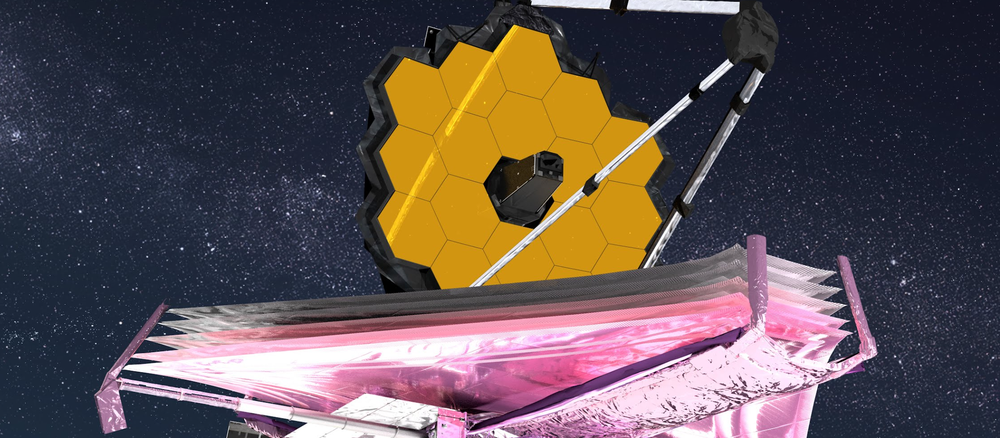
Or check out this 3D model by Google.
Here's hoping the launch (from British Guiana) and deployment (a million kilometers out!) go OK. There's hundreds of single-point failures in this device so many fingers will be crossed in Mission Control.
Or check out this 3D model by Google.
Comments (530)
It has to be a million kilometers out to avoid being affected by the infra-red radiation reflected from the Earth - the five-layer solar shade will shield the instrument from the Sun and is designed to allow the mirror to operate at around - 400 degrees F which is apparently a pre-requisite for the work it has to do. During the build they had to test it in a special NASA facility to ensure it works at these ultra-low temps. It's quite an amazing feat of engineering.
You beat me to making this thread. Thanks for posting.
I'm quite excited to see what we may discover here.
I'm sure there's a genius out there somewhere who can figure out a way to piece together our evolutionary history. The work, I believe, has already begun (the human genome project; old news) but there's more, a lot more that needs to be done.
However, I don't see, at least not in paleo-DNA or other aspects of current human existence, any hope of reconstructing extinct languages or ancient "ideaverses" unless, of course, DNA is, well, the [math]\alpha[/math] & [math]\omega[/math].
By the way, are you well-versed in optics?
What's the difference between a telescope and a microscope? People look tiny when viewed from far. In a sense microorganisms are, my logic tells me, distant (temporally) objects; they're our ancestors going back, at the most, 4 Gya. Just like stars, our sun 8 minutes old and others much, much older.
actually this question and @tim woods response makes me question whether the study of the evolution of the universe is actually 'history'. The web definition of history is 'the study of past events, particularly in human affairs e.g. "medieval European history".
2. the whole series of past events connected with a particular person or thing.
"the history of the Empire".
But the term 'pre-historic' is used for periods before written records, and the study of the development of life on earth is 'paleontology', where 'paleo' is derived from 'ancient past'.
So the 'history of the Universe' is, I think, a metaphorical or poetic use of the word 'history'.
Big History
Big History, if I understand it correctly, makes sense. In and around the Big Bang all there were were particles and so chronicle them. With the passing of each epoch, these particles began organizing themselves into more and more complex entities; Big History should reflect these stages in complexity. This, at the end of the day, implies the history of the cosmos at present should be about the most complex things in existence viz. humans, their minds to be precise; in other words, the last chapter in Big History, the present, should be the human mind and everything associated with it.
A good format or no?
Aha! That's what's wrong with my format. I was wondering, do you see an possibility of?, the mind being simpler than the material (matter + energy)? The material universe simply refuses to fit into a mental model (ToE) i.e. the physical domain is "larger" than the mental. In other words the material world is more complex than the mental. How can something more complex (physical) explain something more simple (mind)? We've put the cart before the horse.
Unicorns?
Plus, as we look further back into the past (James Webb telescope and others like it), we seem to be actually exploring/diving into concepts (singularities, particles, and so on). That's why ToEs, at least the string theory one, has no physical (observable) consequences. It seems it all started with a simple idea.
That's a different subject, one often discussed but not directly connected to this thread. See for instance here. I think in this thread I really just want to track this particular device and perhaps some of the discoveries associated with it, presuming it goes according to plan.
:ok: Just threw it out there if you were interested in some way.
Back to the main page: James Webb telescope. Isn't it rather convenient that scientists say that no matter how we try we simply won't be able to actually see the Big Bang because, they say, there's was a stage in Big History when the universe was, get this, opaque. That's kinda odd, don't you think? The universe seems determined not to let us find out what actually happened 13.8 Gya. Even our theoretical models fail, they can't parse anything before [math]10^{-43}[/math] seconds. If these kinda unknowable regions in Big History exist, they remind me of media blackouts and gag orders issued to the press.
Conspiracy theory? Why not? Someone should do a study on unknowables and see if there's a pattern in it. Are we being (deliberately) kept in the dark? In other words, are vital pieces of information, information crucial to solving the puzzle of all puzzles (life, the universe, everything) being (purposely) hidden (from us)?
Agnoiology
Sorry if this amounts to derailing your thread.
Not at all. '“Science cannot solve the ultimate mystery of nature. And that is because, in the last analysis, we ourselves are a part of the mystery that we are trying to solve.” ~ Max Planck.
As I understand it, the moment of the singularity can't be known because time and space themselves started along with it. But the technicalities are beyond my ken.
Quoting Agent Smith
:fire: :clap: The raison d'etre of the James Webb Telescope project, no?
I think the word "history" is used to create the illusion of science, by the authors. By calling it "history", the metaphysics which consists of speculations about the early universe. is presented as if it might be science.
I should've been clearer. My theory is that no methodology of knowledge, science or otherwise, can penetrate the fog of ignorance. Yes, our corpus of knowledge has grown exponentially over the past 10k years but the picture we have is incomplete/fragmentary/partial.
Crucial bits of evidence have been withheld from us, at least those of us who are in investigative disciplines (science, archaeology, cosmology, evolutionary biologist, and so on). This is the perfect moment for humanity to hire a private eye. They're natural skeptics, experience has taught them never to take things at face value. "Yes," one such especially sharp & seasoned detective might say, "we have evidence but there's something fishy about the evidence. I don't know to describe it but it's something like the last case I was working on." The investigator continues "We had a body but the head was missing and the fingers were badly mutilated. In short we had the victim but we couldn't identify him. It was as if the murderer was toying with us - giving us evidence that a crime had been committed but not enough to solve the case." :grin: I'm taking this a bit too far.
P. S. My fictional detective is old, DNA fingerprinting hadn't been invented during his time.
Quoting 180 Proof
Is there a pattern in/to our blindspots? What if all the action takes place in our blindspots. We would never know the truth. It's just a zany idea. Just let it flash by through your mind as you would a dull, vapid article in a journal/magazine.
Not necessarily. Philosophy is, in my humble opinion, the one subject that's always relevant, negatively, never irrelevant. In fact, we can have a philosophy of non-philosophy. Surely, something that's so all-encompassing will have something to say about cognitive psychology. Just sayin...
A question of empirical data (i.e. science) and not of e.g. formal construction or conceptual description or speculative interpretation (i.e. philosophy).
Quoting Agent Smith
You're, of course, entitled to your opinion, Smith. I, on the hand, would rather not consider apples in terms of oranges (which would be a category mistake).
This is interesting topic. How would the "beginning of time" appear to measuring instruments and to brains interpreting those measurements?
If time is the comparison of relative change (all measurements are comparisons of relative differences and similarities), then the beginning of time would be when things went from not changing to changing - when change started happening in the universe. But then one must ask the question if the universe is all there is and if there wasn't other change going on outside of the universe that may have caused the universe to come into being - which is just more change - in other words there could possibly be no beginning of time because there has always been change.
If there was no change at all at one point in the multi-verses history, then how can that state of non-change cause change? It's the old question of how something can come from nothing. How can space-time come from a state of no space and no time?
There are still a lot of questions to answer. Our observatios are the only clues we have about the "early" Universe. But we still haven't learned that what we believe we see may not be what is really there.
What if... "inflation" is still going on but expanding space ran out of elements to form matter some 13 billion years ago. What we would then see is what we are seeing now, that is, it would seem as if time started 13 billion years ago - because we have nothing to see past 13 billion years ago. That does not mean the Universe started 13 billion years ago - it could mean "matter" may have only been around for about 13 billion years. We would have no visual clues as to what matter was before it was matter... Not anywhere near enough information to compare, so we jump to conclusions and state matter is just matter and was always there...
See, The Blind Spot. (I don't think it's dull or vapid.)
Thanks!
:ok: Bookmarked the linked article for later.
I read the article. It's meant for people with a higher IQ than mine.
Anyway...
1. There's subjectivity we need to take into account because, for some (silly?) reason, objectivity is held in higher regard. I suppose the former can be rephrased, with respect to me, the way I see the world and the latter as the world as it really is.
That the very scientists who've put objectivity up on a pedestal enjoy a novel (fiction & non-fiction) every now and then bespeaks the value of subjectivity - different perspectives offered by different people/characters provide valuable insights into reality. Plus, who's to say this world itself, that which we take to be reality, is itself not a storybook?
What I'm getting at is the simple truth that subjectivity is an essential aspect of our lives and to dismiss it or demote it is to abandon a defining characteristic of what it is to be alive and conscious. Science does that. It's wrong!
2. Hempel's dilemma: Either we accept that science, as it is now, can't explain consciousness or claim that a future science will do so but we have no idea what that'll look like i.e. we may have to concede that consciousness is nonphysical. Have I got that right?
The reason is not silly.
Quoting Agent Smith
Or that matter is immaterial.
It has to be no? To be conscious is to have a unique take on the world. If one, like scientists do, claims that, for the sake of objectivity, that "unique take" is inadmissible evidence as to the true nature of reality, might as well not call minds to the witness box, throw, like some judges do, the case out.
Quoting Wayfarer
:up: So many possibilities. I wonder if we can ever narrow then down to the truth.
Science is concerned with objective and measurable facts that are true for any observer. In the context of this particular thread, I'm finding it hard to think of any reason to take issue with that. I guess where this particular interchange started was with your comments about 'blindspots' - that reminded me of the article you've just read. But the point of that article is not to criticize science per se - it says 'some models and methods of investigation work much better than others, and we can test this.' Sure, we can't get 'see' back to the 'big bang event', and there are some aspects of the Universe that can never be known, but they're not the 'blind spot' that the article is referring to. And that is a very interesting discussion in its own right, but not in relation to The James Webb Telescope project.
Did you know that the Big Bang is deduced mathematically? Some assumptions as to the rate of change of cosmic expansion and the approximate location of the galaxies are made. Plug in these values into a mathematical formula, work backwards that is, and hey presto! There had to be a Big Bang, roughly 13.8 billion years ago.
I have no idea why I said that!
I do know the theory now called 'the big bang theory' was originally the subject of a obscure scientific paper by a Belgian scientist named George Lemaître (who was also a Catholic priest). It didn't recieve much attention at the time but gradually became accepted. It was given the name 'big bang theory' by Fred Hoyle, who was scathingly dismissive of it, in a radio interview many decades later, I believe. I can't comment on the technicalities, which I'm sure are not intelligible to anyone without a degree in mathematical physics, but as an imaginative image, I have to say it sounds awfully close to creation from nothing. (So much so, in fact, that in the 1950's, the Pope started saying that the theory had 'proved' divine creation, which embarrased Lemaître tremendously; he was both a scientist and a devout Catholic, but enlisted the Pope's science advisor to stop repeating this line, which he did. Pity there wasn't much attention paid at the time, it would have made a great headline: 'Scientist advises Pope to Shut Up.')
Speaking of the launch, story in today's NY Times. 344 single points of failure. :yikes: :cry:
My question is why aren't animal eyes, including human eyes, mirror-based too? :chin: Is evolution lagging behind human technology.
Also, did you notice the hexagonal mirrors. Reminds me of insect compound eyes.
Will get back to you if my mind registers anything interesting.
Intriguingly, aging is largely a skin phenomenon and infrared light (James Webb telescope's shtick) is supposed to help us probe the past, the cosmic past.
Food for thought:
Imagine a lens L and a screen behind it. The lens focuses the world's (W) image (I) on the screen.
Now take a mirror M. It captures W on itself as R.
There's no difference at all between I and R (the former is the lens image and the latter is the reflection in the mirror).
Proposed hypotheses: Invisible mirror in the case of lens L and invisible lens in the case of mirror M.
MERRY SOLSTICE :sparkle:
25.12.21
Dec. 25, Saturday
(All times Eastern U.S. time = UTC-5.)
3 a.m. – Update on the fueling of the Ariane 5 rocket for the James Webb Space Telescope launch from Kourou, French Guiana
3:15 a.m. – James Webb Space Telescope highlights and launch pad views from Kourou, French Guiana
6 a.m. – Coverage of the launch of the James Webb Space Telescope on an Ariane 5 rocket from the Guiana Space Center in Kourou, French Guiana (launch scheduled at 7:20 a.m. EST) Goddard Space Flight Center/Space Telescope Science Institute/Kourou, French Guiana
9 a.m. – Webb Space Telescope post-launch briefing from Kourou, French Guiana
Separation! Brilliant, ESA/NASA! :clap:
JWST is on its way to L2 ...
I suspect that we might have to revise some of the best theories we have after we see results from this one. If I had to guess, either the big bang did not occur quite as we think it did, or we may appreciate better what dark matter/energy may be - that is, if it exists.
It's going to be awesome to watch, no matter what.
Last week, there were 15 tornadoes in Minnesota -- until then, Minnesota had never had so much as a chance of a tornado in December. Very little damage, but still... Omnia mutantur.
The happiest of holidays to you.
EDIT: on the other hand, NASA was able to send a rocket to Mars, pause the lander in its descent long enough to lower! the large vehicle to the surface--and then disconnect the cable and not have the lander crash on top of it's cargo. Inordinately complicated and it worked.
What a delicate instrument, where so many parts can fail, being sent to such a precarious place.
If it works, it will change what we can ask about the universe.
The view up your own colon apparently fascinates you to no end. :sparkle: Merry Xmas :sparkle:
:starstruck:
Haha! Nothing beats the image I see when holding a mirror between my legs. That's a black hole as never seen before! Well, a brown dwarf actually...
Merry Christmas :heart:
You also BC! The weather has been crazy, a foretaste of seasons to come alas.
:up:
Allow me to alert you to the fact that there is no dark side of the moon. The side we do not see faces the sun as much as the side we do see. Also, the 'far side' of the moon has been surveyed to some extent, and there are interesting differences, The far side has denser rock than the near side.
Also, the Big Bang was around 13 billion light years in the past, not 90 billion.
Quoting AgentTangarine
Just shove your head up your ass and get an even better view.
I was referring to spatial dimensions. Well, actually you're right. It's only 45 billion ly...
Yes, the dark side of the Moon is the far side. But to us that's pretty dark, as we can't see it.
"Just shove your head up your ass and get an even better view."
:lol:
Are you serious?
I apparently do not know what I am talking about. "They" say the universe is 13 billion years old, give or take 15 minutes. check. "They" also say the universe is 93.016 billion light years across, one edge to the other. I misunderstood the 'light year' concept. A light year is equivalent to 5.88 trillion miles (9.46 trillion kilometers). a light year is a measure of distance, not time, which is where I got confused. So, for sure the universe is many gazillion miles across--or thick, long, diagonal--however you slice it.
I shall now blush and bow out of this discussion.
:lol:
If you slice the whole universe, you get a lot more pieces of the cake than only our observable piece. In the face of this enormous cake we look even smaller... But we are the ones eating it (the cake). And there are infinite universes ahead of us, and an infinite still come... I will get fat...
Merry second Christmas day!
The discrepancy has to do with the expansion of space, I believe. And don't feel abashed, we're all amateurs here, and it's a very technical topic.
The JWST reminds me of Russell's teapot!
So, JWT (or JWST) can tell us about the early evolution of galaxies, but she didn't explain what we would specifically find out about dark matter/energy.
Maybe a bit about dark matter, if you could find rotation curves of the early galaxies. You could find something about the receding velocity. And find that it was less than the recession velocity of closer galaxies. By means of galactic candles. But nothing essential.
I don't think anyone knows what they are, only that they must be real, in order to account for the data.
I hadn't reviewed that 60 Minutes segment, there's a ton of James Webb videos on Youtube. The best I've watched is on a service I subscribe to called Curiosity Stream but I didn't post it, because I think it's behind a paywall.
The opportunity to get data about the early universe is seriously important.
What are those?
Are you serious? It's already obvious to me what happened at the big bang and before (which can be better described as far away from us).
"Hubble Space Telescope. In astronomy: Dark energy …1980s astronomers began to use Type Ia supernovae as standard candles"
They are standards of light intensities. They all are about the same. It was discovered that some of them stand further as expected. Which implied accelerated expansion.
Why should anybody be interested in what you think?
So far, you have only offered rhetorical responses.
I have offered the most actual info of all...It's a waste of money. Pure thought brings you a lot further. For free. No Webb needed.
We live in the bit of experience life offers to us.
The notion that you have information is suspect as such. Who made you the wizard of worlds not available to us ordinary humans?
The wizard of worlds? I didn't create it! But I do understand it. With or without Webb.
That must be really cool for you but useless for your brothers and sisters.
Why is that suspect?
My brothers and sisters? My sister is not one bit interested. Like most people. Except a few "chosen" ones.
If it is only something that cannot be demonstrated to others, then only silence will suffice.
You think your brothers and sisters are interested in photographs of a 100 million year old galaxy? Nothing to be learned from that.
What on Earth are you talking about? Why should I stay silent? Because it's a silly project?
That is not what I said at all.
Whatever, dude.
Webb can only show pictures. Now that makes you understand! Webb can't look at the big bang. I can. Like all people with imagination.
Yeah, whatever... Keep up your spirit of awe! Oooohh, pictures!
You equate the desire for more information with some more corrupt intention.
There wasn't much to 'see' in the Big Bang, because for the first 240,000 - 300,000 years, there was no light. Don't know about other radiation in the spectrum. Anyone?
Does God care whether the JW works or not?
You could look at neutrinos. Offers you a glimpse how it was a fraction of a second after the bang. But I can already tell you that looks the same as the CMBR. I advocate for a new mission! Let's shoot a 1000000 billion cube water basin into orbit! To observe neutrino distribution away from the Sun. Must give a spectacular view. A NBR view on the 10exp-35 seconds ATB! Oeoeff!
God knows.
Well, like duh. They go on the galactic birthday cake. All, umm, 13 billion of them. Not sure who gets to blow out the candles tho. . . . .
The intergalactic blow job...eeeehhh... galactic lightning struck fan. When the galactic black hole shitty hits it. Paaaarty time... Let's do the Webb....
For those actually interested in the project, the homepage is here https://jwst.nasa.gov/
https://jwst.nasa.gov/content/webbLaunch/whereIsWebb.html
Joseph-Louis Lagrange, baptized Giuseppe Lodovico Lagrangia, was either an Italian or a French mathematician, depending on the source. "In 1772, Lagrange published an "Essay on the three-body problem". In the first chapter he considered the general three-body problem. From that, in the second chapter, he demonstrated two special constant-pattern solutions, the collinear and the equilateral, for any three masses, with circular orbits." -- WIKIPEDIA.
La Grange rated a statue, which none of us have, so far.
It's a great project. Can't wait to learn from it.
[sup](I'd ignore the weird comments)[/sup]
Could you teach me how to change the font size/color? Thanks.
'Sub' means 'subscript' and produces smaller text output.
'Sup' means superscript, can be used for footnotes if required [sup] like this[/sup], also useful for formulae, i.e. e=mc[sup]2[/sup].
There's no way to change font color to my knowledge (BBcode has a tag 'color=blue' etc but it doesn't seem to be implemented in this forum software. Overall the formatting is basic but functional.)
Note[sup]1[/sup]
Got it! Thanks @Wayfarer
I only has an invariant position wrt Earth. It rotates around the Sun. The Sun moves in the galaxy, the galaxy moves wrt other galaxies. The galaxy cluster moves wrt other clusters. So a lot of motion. Still not enough to cause difficulty to keep Webb directed.
What I meant.
But why should that be important? Because of communication? Why should a telescope stay fixed wrt to Earth?
Well, what I understood is that only in L2 there is never any sunshine.
How does the JWST get power? I thought it used solar panels. :chin:
I was thinking exactly the same!
"The Webb telescope is powered by an on-board solar array. It also has a propulsion system to maintain the observatory's orbit and attitude. The solar array provides 2,000 watts of electrical power for the life of the mission, and there is enough propellant onboard for at least 10 years of science operations."
So the story goes...
Notice the misspelling. A telescope with an attitude...
"As of 2012, the propulsion system uses 16 MRE-1 thrusters which can provide one pound of thrust each. They are mono-propellant thrusters designed to survive the unique thermal conditions JWST including extended periods of direct sunlight and reflected light from the sunshield."
So there are extended periods of direct sunlight. Which means the Sun shines once in a while. So Webb is not completely stationary..
https://www.theguardian.com/commentisfree/2022/jan/02/james-webb-space-telescope-thrilling-future-for-mankind
machines in space
near-ish future on & off Earth
Something I firmly believe. But then he goes on:
So, in the Wild West of inter-planetary space, genetic re-engineering and transhumanisation will make us adaptable to space. What could possibly go wrong?
I've also been following Yuri Milner's Breakthrough Starshot project which is 'a $100 million research and engineering program aiming to demonstrate proof of concept for a new technology, enabling ultra-light uncrewed space flight at 20% of the speed of light; and to lay the foundations for a flyby mission to Alpha Centauri within a generation.'
Note that the 'spaceships' are basically microchips weighing a couple of grams. So we're sending sensors, not actual astronauts. It seems plausible, but even if it works getting actual life-size vehicles there would be a completely different matter.
There was light from the very beginning. But it was continually scattered by electrons and protons. The photons that scattered for the last time were set free after electrons and protons formed atoms, thereby emitting new photons. Together all these photons formed the cosmic microwave radiation, which back then was still visible, giving the universe an orange hot glow of about 3000 kelvin.
Quoting The Opposite
No. The exoplanets can't be seen. Let alone life on it. There will be another telescope in 2025. Together they look for planets that are possibly sustain life. By analyzing spectral data of the atmospheres. That's probably one around each star. So if we have to escape we can take off for Proxima Centauri. About 4 ly from us.
Apollo 11 travelled at around 40,000 kilometers per hour, a speed that would take it to Proxima Centauri in over 100,000 years. But spacecraft have since become faster. The Parker Solar Probe, to be launched this year (2018), will travel at more than 700,000 kilometers per hour, about 0.067 percent the seed of light.
So Marin and Beluffi use this as the speed achievable with state-of-the-art space technology today. “At this speed, an interstellar journey would still take about 6,300 years to reach Proxima Centauri b,” they say. 1’
All going well.
Cast your mind back to what h. Sapiens was doing 6,300 years ago. That was before the Pyramids were built, around the time that agriculture began to emerge in the Fertile Crescent.
Long time. Shame if it turned out to be a dud planet.
Thanks. I find it hard to picture the processes. Fortunately, it doesn't matter whether I understand it or not.
Over the course of exploring several quite different planets, they have not so far found one that is suitable. All of the planets have evolved life and had breathable air and drinkable water, but none were suitable to our life form. The biggest problems they found were micro and macro life forms that were perfectly capable of defending themselves, whether they were intelligent or not, and came very close to eating the earthlings several times.
They did encounter 1 intelligent species, however, and have joined up with them in looking for a suitable planet habitat for both of them.
Marchenko is a great character. He was a Russian astronaut who was trapped under the ice of Enceladus, where he encountered an apparently intelligent life form. By means unknown the creature digitizes Marchenko's mind and uploads it to the orbiting space ship. Marchenko lives on in several robot versions of himself. There are some other silicon minds in some of the stories with unknown origins,
Another character Morris invented (might be split off from Marchenko) is an artificial mind that downloaded itself into a robotic vacuum cleaner so it could inconspicuously spy on the Russians running a large space exploration project. It gets itself on board a mission to the vicinity of Pluto and turns out to be very helpful--also sarcastic and devious, sometimes.
I recommend Morris. His science fiction is inventive, positive, hopeful, and believable while still being sci fi.
I've followed the controversy around Avi Loeb with a bit of dismay. He published a book about a year ago saying that the strange object Oumuamua which he is convinced was the product of alien intelligence. From what I've read, he's copped a fair amount of criticism over that book. And as much as I'd like to believe him, I'm afraid it seems too much like wishful thinking to me. He has published papers conjecturing about the possibility of light-driven spacecraft and it seems to me that might have disposed him towards the view that he publishes in that book.
I read about his theory, haven't read the book. Thanks for the link to the New Yorker article, Did Arthur C. Clark's Rendezvous With Rama inadvertently influence Loeb's interpretation of the brief sighting? We have not been watching the skies with such good telescopes for that long. Probably objects have been crossing our solar path periodically, sight unseen.
That said, reports of unusual "objects" in space are highly arousing -- they arouse me, certainly. But evidence of intelligence (besides ours, such as it is) would be ambiguous. Would the intelligence be cold and dry, or would it be warm and humane? Would the intelligent beings wish to become our partners or overlords, benevolent or otherwise? Based on past performance, any intelligent, humane beings would be well advised to keep us at a long distance, if they value their lives.
I think he might have. (I loved that book - don't read a lot of sci fi but that one really grabbed me.)
If we did encounter any sign whatever of alien civilisation it would clearly be one of the greatest discoveries in history.
But my overall feeling about interstellar exploration is that a lot of it is driven by the sublimated longing for Heaven - that having ceased to believe in heaven, inter-stellar conquest is a substitution.
And, to quote Dostoyevski, "If god is dead, everything is permitted."
SETI is one of those organizations that'll never show results. An alien signal would throw open the doors to new technology, something the government would be reluctant to publicize for monetary and security reasons. You know what, I think SETI has already found aliens but it won't share it with the world! :smile:
You never know. :grin:
Likely because a coherent signal from very, very far away is unlikely to reach us, and b, such signals may never have been sent in the first place.
BTW, what radio telescope is SETI using, these days? Arecibo collapsed into rubble a while back, so that one is out (if they used it at all).
We should stop worrying about intelligent life elsewhere. Either we are alone -- and that is amazing, or we are not alone, and that is amazing. Let's leave it there. WE are certainly fucked up, so THEY would be well advised to avoid us, and it's possible (hard to imagine) that they are even more screwed up than us, and we would want to avoid them.
Or like my grandmother said, "God keeps us decent, civilized, humble, and submissive, a welcome quality for the tyrant."
Quoting Bitter Crank
Indeed. For some folks it seems to matter though. So if you find yourself in the company of people trying to impress you with their knowledge, tell'em the following story.
Imagine yourself between zillions of tiny shiny metal charged spheroidicals zipping around you with high speed, going right through you effortlessly. There are different kinds of spheroidicals. Tiny tiny ones, the neutrinoids and electronoids (and a tiny tiny tiny part of excitations thereoff) and the tiny protonoid/neutronoid spheroidicals, the nucleoids. Near the beginning of time, their mutual distance is small and their velocity huge. The light in between them is reflected only and the main frequency of the light is seen as gamma light at the start, turning to Röntgen, then ultra-violet, ultramarine, grass green, to misty orange at recombination time. At RT, The metal electrically charged balloids have not enough energy anymore to stay apart and there is a universal clickoid to be "heard" when the nucleoids stick together with electronoids. The releases a thorny spectrum of light, specific for the neutral atomoids that are formed, and this light puts itself atop of the light set free. Light will only rarely scatter again as there are no charged balloids left, only neutral atomoids and neutrinoids.
After the great liberation act during Recombination, the universe looks like an orange mist, in which tiny variations in brightness can be seen, because of the random distribution of the atomoids, which were the only objects present. The light changed color thereafter, because the expansion of the universe increased its wavelength, which seemingly contradicts energy conservation, but on closer observation is a relative effect only. Nowadays the light is radio light, and it was discovered because of a pigeon shitting on a radio telescope.
So the story goes...
:clap:
Made me think of Jesus. Being God, had he stayed cold and dead in his sepulchre, it would've been an even greater mircale. What's a simple resurrection to an all-powerful being, huh?
Raise the dead? :yawn:
Quoting Bitter Crank
Yep, I believe the signal weakens as the square of the distance. We'd need a humongous dish to collect every available ounce of any ET transmission out there in the great void.
Quoting Bitter Crank
If memory serves, one of those dish antennae arrays out there somewhere in a US desert (Mohave?)
What about...
Quoting Agent Smith
"Isn't that what happened?" he said, provoking a ZAP from on high.
The problem with the radiation SETI tries to use for establishing first contact, is that it's feebleadatious. But their are enough photons left to observe with big ears listening.
The tennis-court-sized multilayered sunscreen is being rolled out and tensioned.
https://blogs.nasa.gov/webb/2022/01/03/second-and-third-layers-of-sunshield-fully-tightened
:lol:
Good to see the mission going as planned.
https://www.space.com/james-webb-space-telescope-secondary-mirror-deployed
:up:
That's a lot.
But, given how much they've tested it, I doubt they'll have significant problems. So far, so good.
There was an article in Slate before the launch about scientists who were throwing up from the stress. I must admit I felt aprehensive watching the take-off after the number of years and the amount of money that's gone into it. If it fails, there's not going to be another shot, not for a long time. It must be shattering when a major space mission fails, like the European Mars lander a few years back (failed because an imperial unit was entered as a decimal unit somewhere.)
Yeah, I remember reading about that, big woops.
Well, they're as prepared as can be. The die's been cast.
At least it'll be halfway to L2 in three days or so. It should be fully deployed a few days after that, but then calibration and getting the equipment in working condition will takes months.
Nothing compared to the wait for Pluto, but much more significant, or so we hope...
Is there a camera on board (apart from making pictures of the stars)? They should see what they do, or not? Is it all automated?
Which raises the question for me - the Hubble produced thousands of iconic and spectacular images, if the JW is tuned to infra-red radiation, will it be producing images that are visually meaningful? I might do some digging on that.
I heard @Baden does this, when moderating.
The question about the kind of images JW will produce can be found here https://www.jwst.nasa.gov/content/about/comparisonWebbVsHubble.html
Here's a picture of the central area of the Milky Whey. The objects that James Webb will be imaging are of course very, very far away, and they might or might not have the visually appealing features that makes a galaxy something you would want to hang on your wall. Hubble's star nursery pictures, for instance, set a very high bar of visual interest.
This composite color infrared image of the center of our Milky Way galaxy reveals a new population of massive stars and new details in complex structures in the hot ionized gas swirling around the central 300 light-years. This sweeping panorama is the sharpest infrared picture ever made of the Galactic core and offers a laboratory for how massive stars form and influence their environment in the often violent nuclear regions of other galaxies.
Are other galaxies more violent than ours?
But sure, other galaxies have much higher rates of violence--murders, gun shots, axes sunk in skulls, beheadings, disembowelments, victims blown to smithereens, arson, rape, sudden planet extinctions, etc. Makes Chicago look like a day care play room.
The farther a galaxy is, the older it actually is.
The farther a galaxy is, the younger it looks.
So, the JWST is designed to pick up IR signals from the oldest galaxies but not as they're now but when they were young(er).
Am I getting this right or no?
Copy that!
Important distinction!
Once upon a time, in a galaxy far, far away...
Can't some light be cast? With a lantern? Would be nice to see an actual image of the telescope. You could see what's going on. I think you mean -440 Fahrenheit.
It operates in the dark because no light is cast. Wouldn't it be handy, only to get the te?escope started, to see what they are doing? So they can manually control the installation? Or can't you intervene when something goes wrong because of the time delay? I mean, if some widget is wrongly directed and flies into space, you will see it a few seconds later, and that could already be too late. How do they know the tennis court shield is in order? They can't see it.
Does feel like it sometimes. :death: :sweat:
Bridges sometimes fall; big passenger planes crash--even if only once, it's a big deal; rockets occasionally miss the planet. Very sad engineers
So much the better if this very complicated piece of machinery unfolds itself, powers up, and does everything it is designed to do.
and Adding a camera to take selfies would provide one more thing to go haywire. You are right, Wayfarer: the designers/operators of this machine know it, through and through, better than they know the backs of their own hands (which are valued at considerably less than $10,000,000,000 apiece). Little sensors register when shaft #52 is fully extended, when wheel #8 has turned 2.88 times, when the temperature at location #22 is within the specified range, etc. tell them exactly what is happening.
Their sensors are more informative than the "engine" light on our old VW's dashboard which could mean anything from "the engine will explode in 10 seconds to [i]a sensor is sending a meaningless warning[/I], or maybe both. You can interpret it however you like."
It seems the problem is that a small camera disturbs the equipment, because maybe a wire emitting IR radiation can produce false images. Still... For the installation phase the newly invented sand grain sized cameras could have been sent along, or a small accompanying guiding satellite could have been send along shining light and registering the process. Would have provided the public with a contextual, though interesting construction story. You can generate a visual computer narrative, but the real thing would be great to see. Once the starting conditions are set, bye bye camera. Off you go.
Nancy Grace Roman will join James Webb in a few years.
Seeing that widgets are joint out of balance, when the telemetry system provides exact information would be handy. Building on basis of telemetry and computer aid seems a shaky base. If some widget is accidentally directed in the wrong direction, can the on-board robot correct?
Dunno if that's a good idea. "We"?
The original plan contained no cameras, as these were too big then. They stuck to the original plan, so no cameras on board. I'm sure for Roman they use cameras. A problem might be time delay. "A bolt on the loose...!" "Grab him!" "Oops, 10 seconds too late..."
I'm just struck by how the L[sub]2[/sub] turned out to be the perfect spot for the JWST. I suppose what's obvious & reasonable to a wise person is an inexplicable coincidence to a fool.
They put it in this huge chamber and cooled it! No kidding.
Now that you mention it, I do recall reading about temperature tests done on the JWST. State of the art tech! It's a marvel of science and people who have no idea what goes into building such extreme machines will fail to appreciate the ingenuity and hard work involved.
The mirror has unfolded successfully. Phase 3 begins. :clap:
https://www.theguardian.com/science/2022/jan/08/nasa-engineers-complete-the-unfolding-of-the-james-webb-space-telescope
Wouldn't you be disturbed with a small camera on you all the time?
might be paywalled although you can usually browse one or two articles.
An alternate method of landing is also impressive: the delivery vehicle descended towards the Martian surface, ejected the rover package which consisted of the rover surrounded by large balloons which inflated before the package reached the surface. The balloons bounced a few times before settling. Then they deflated and detached and somehow did not get tangled up in the Rover's wheels, camera, etc.
It would make an engineer ill if the whole mission was successful up to the point where the rover couldn't drive off because a balloon had jammed its wheels.
Same thing for James Webb: How nauseating it would be if everything worked perfectly up until the last preliminary step, and then the ignition switch was jammed (using "ignition switch" as a figure of speech here). I don't see how they stand the tension and the disappointment when things do fail, as they sometimes do.
I was hoping we could build a JWST for our mind too. Setting aside the fact that we haven't even built the equivalent of an ordinary, run-of-the-mill space probe for the "mindverse", a mind-JWST would be infinitely more awesome - peering into the distant past of our minds, it could shed the much needed light on the origins of consciousness/mind. That would be really clever, right?
Right. Time machine?
I too wonder what it must be like for the people involved when a major mission fails. They take years to build, they have thousands of moving parts and extensive plans. Everyone is trained up for it and ready to work for some years into the future. Then - kaboom! Everything is over in an instant. Instead of all the happy-clappy folks dancing around and opening champagne, there’s silence, shaking heads, downward stares. What do they do then, after they all go home, and the post-mortems are finished. It would make an interesting screenplay. ‘When the bird fails’. It’s at those moments you’d want solid training in stoicism.
:chin: The JWST is a time machine - we're looking into the past of the cosmos, way back to the earliest galactic/stellar nurseries (the first light in the universe). Maybe we speak too soon, eh? Better not jinx the mission by counting our chickens before they hatch.
The micro shutter array was revisited (problems with the 248 000 micro windows, through which photons pass before detected), the actuators (capable to adjust the 18 mirror pieces with a precision of 1/10000 of a human hair!) needed adjustment, in 2015 it was reviewed and then again the project was delayed. It seems the path of all modern engineering projects. A date and a cost are determined and both turn out to be totally wrongly assigned. And the list goes on. Tax payers should be compensated. The engineers might feel nausea when all goes astray (how appropriate!), but what about the people who actually paid for it?
From an article on the net:
$1 billion and launching in 2010.
Planning for a telescope to come after Hubble began in 1996, but the Webb did not get its current name until 2002. NASA picked Northrop Grumman to build it, estimating costs from $1 billion to $3.5 billion. Mission managers expected it to launch as early as 2010.
Construction of Webb’s most complex structures — its main science instruments and the massive 18-plate mirror — began in 2004. In 2005, a review prompted redesigns to scale back its technical complexity.
$4.5 billion and launching in 2013.
Though less complex, the telescope became more expensive, with the price tag swelling to $4.5 billion, and NASA officials estimated a new launch date in 2013.
Well into the telescope’s construction around 2009, engineers and NASA officials began to grapple with the difficulty of inventing, building and testing cutting-edge technologies.
One challenge was developing the observatory’s “cryo-cooler” to keep Webb’s ultrasensitive infrared sensors and computers from overheating in space. Developing the telescope’s micro shutter array, a small device crucial to surveying massive swaths of the sky, was also difficult. The device, the size of a postage stamp, contains some 248,000 tiny shutters, or windows — each only a few times larger than a human hair — that open and close to allow light in.
$8.8 billion and launching in 2018.
An independent review of the program ordered by Congress in 2010 “found that the program was in a lot of trouble, and it wasn’t going to meet its cost and schedule deadlines, and it was not being funded appropriately, and there were a lot of management and oversight issues that were called out,” Ms. Chaplain said.
“I think it was a bit of a surprise,” she said. “It hit Congress pretty hard.”
The review estimated a new cost of $6.5 billion and a launch date of September 2015. In response, some lawmakers proposed a bill that would have canceled the telescope entirely.
But NASA vowed to get the program back on track, and prepared new estimates: an $8.8 billion total charge, including development and managing the telescope after its launch, with an October 2018 launch date.
To keep NASA in check, Congress capped the cost of the program’s development at $8 billion and required Ms. Chaplain’s team at the G.A.O. to conduct annual audits. It “was probably the first time we were asked to look at a major NASA program every year,” she said.
$9.6 billion and launching in 2021.
The telescope’s construction was completed in 2016. That’s when NASA and Northrop Grumman discovered a new set of bugs.
In 2017, NASA announced it would need to launch the telescope in 2019, because “integration of the various spacecraft elements is taking longer than expected,” the agency’s science chief, Thomas Zurbuchen, said in a statement at the time, stressing the change was not the result of any accident. No boosts to the program’s budget were needed, the agency indicated.
Then, an independent review in 2018 found that a handful of human errors had caused more delays and cost increases. The telescope’s propulsion valves were damaged when engineers used the wrong solvent to clean them. Dozens of screws that fastened the telescope’s massive sunshield came loose during vibration tests. And faulty wiring during tests sent excess voltage into the observatory’s transducers.
“The error should have been detected by the inspector, who did not inspect, but relied on the technician’s word that he had done the wiring correctly,” the 2018 report said.
Fears that the testing mishaps would lead NASA to breach its $8 billion development funding cap grew. The report said human errors cost the program $600 million and caused 18 months of delays. Then, in the summer, NASA announced a new date, acting on the report’s recommendations: Webb would launch on Mar. 30, 2021, Jim Bridenstine, President Trump’s NASA administrator, announced on Twitter.
The agency also concluded that the new development cost would be $8.8 billion, breaching its cap by $800 million. The program’s total cost, including post-launch operations, rose to $9.6 billion.
Last-minute jitters on Webb’s long journey.
Schedule disruptions caused by the coronavirus pandemic further delayed the launch of Webb in 2021.
At the same time, another stumbling block sprouted: The telescope’s name was called into question. James Webb, the NASA administrator who played a central role in the Apollo program, also served as the under secretary of state in the Truman administration. During his tenure, thousands of gay men and lesbians were ousted from government jobs in a period known as the Lavender Scare. NASA ultimately refused to rename the telescope.
In June, four months before Webb was expected to launch, NASA and ESA officials further delayed the launch to review the successful operation of the Ariane 5 rocket.
Once these concerns were resolved, the agencies set a Dec. 18 launch date. The telescope was ferried from California to French Guiana in October during a 16-day trek that passed through the Panama Canal. It was done in secret, in part out of concerns over piracy.
After two decades of tumultuous delays and cost overruns, the telescope had finally reached its launch site. The telescope, however, could not escape some late performance anxiety.
https://scitechdaily.com/earth-is-surrounded-by-1000-light-year-wide-bubble-source-of-all-nearby-young-stars/
Interesting to see what James Webb tells about exoplanets and early galaxies. After all, I remember the time when exoplanets were just a hypothesis, although a very strong one.
But then there is the cost, as always. Something similar will surely happen with Manned Mars missions. If they really leave the drawing board.
Good if I see something happening there in my lifetime. Or my school-aged children's lifetime.
Seems like costs don't matter for Musk. The guy wants to move to Mars and die there, together with his girlfriend. Something has gone horribly wrong on Earth!
https://www.theatlantic.com/science/archive/2022/01/nasa-james-webb-space-telescope-deployment/621211/
Bad planning, can't be helped I suppose.
The private programs have shown us that space exploration isn't just a thing that NASA or other great powers can do. That's the really positive issue with them.
The problem with the private space programs where billionaires want to go to space / to Mars is that:
a) The can die (of old age or disease) and their heirs likely will want to argue about the inheritance rather than continue on with the (vanity?) project.
b) They can run out of money or interest (likely money).
c) The stock market can crash and these multi-billionaires are left as ordinary billionaires or even worse, as rich "billionaires" as Donald Trump. And that simply stops the programs.
If there is a stock market crash and a severe economic downturn, Jeff Bezo's private space and Elon Musk putting a Tesla roadster on an escape trajectory might seem as the excesses of an age where the wealth differences, unequality between the rich and the poor and the stock market hype hit the extremes.
Then of course, the future might be so that the saying "You ain't seen nothing yet!" will be appropriate.
Don't mess with Fortuna! Don't even think of it!
By the way, in epistemology, very recent developments going by a lecture, but not so if you take into account Gettier (cases), there's :point: [hide]The No(t) Luck Principle: You didn't get it right by fluke.[/hide]
Webb orbits L2! So it's not stationary. It takes 6 months to complete one full orbit.
Haha! His soul secretly leaped in my body... Funny guy, though a somewhat heavy load to carry. Many more have made attempts, with varying success.
What's your avatar about? A tear in a building?
:clap: :clap:
Now we wait for the final cool down stage for several months, and hope we are around to get some data back!
Yeah man! Only the anticipation of the first photo makes it worthwhile. Are "ordinary" pictures taken too? What if it looked at Earth? Could it see me? No... seems too much.
As far as I know, I don't believe they have a "ordinary camera" on it, by that meaning any type of camera which can give us images like we got images from Pluto.
It's going to have a device that allows it to see infrared, which will be used as a picture, I'm assuming computers do some extra work to make the images look good. Unclear on how this process works.
Sounds intruiging! That's how the story should be told to the public! Apart from the pictures it expects something more for 10 billion. Luckily there is Wayfarer!
Smullyan would be a fan of it
A video on calibrating the 18 mirrors (in increments of 1/10,000 of a hair's width)
'Sure thing Fred. Give me half a nanosecond'.
You bet.
Note that many astronomy pictures, including from Hubble, are in false colors, eg colors code for certain wavelengths rather than be the real colors one human eye would see. To the human eye, most cosmic objects are white. Through the lenses of my very basic telescope, the Orion nebula looks like this:
Not like this:
JWST has parked @L2 :strong: :nerd: :up:
https://www.cnn.com/2022/01/24/world/james-webb-space-telescope-orbit-scn/index.html
Phase 4 this summers.
:clap:
Hopefully NATO and Russia avoid a nuclear war. It would be nice to see this before we vanish...
I was just talking about this with my wife! She's really scared. Let's hope the best and keep looking out for supernovae to find out about dark energy, instead of thermonuclear annihilation we never asked for.
It is very worrisome. I know these topics can be very tiring - the boy who cried wolf type of thing - but, there's only so many risky situations that need arise before an accident happens.
And right now, NATO especially, but also Russia, are seeing who can take a bigger piss.
It would be better to see these images by far. But we have to get there. It would be a shame to miss out.
At least we die happily then...
https://www.space.com/james-webb-space-telescope-turns-on-cameras
Also contains a good explanation of why the instrument has to operate at near-absolute zero degrees (which Is actually very simple when you read it. If it were generating any infrared - heat energy - then it would drown out the extremely faint infra-red radiation that it’s designed to capture.)
Second question: If we travel at very high speeds, do light waves become gamma rays (wave compression, Doppler effect) and won't that kill us, almost instantaneously as it were?
https://www.space.com/webb-telescope-space-selfie-nircam
You have a cool telescope, even if you say it's basic.
Or then we have blurry image and a huge collective D'OH!
https://www.space.com/25732-redshift-blueshift.html
In relation to redshift due to expansion of space, the shifts observed due to actual relative motion are rather small.
https://www.forbes.com/sites/startswithabang/2019/11/07/this-is-how-distant-galaxies-recede-away-from-us-at-faster-than-light-speeds/?sh=6f8ba9ed72a2
Theoretically, as more time passes and more distance is interposed the frequency of light should drop to zero. In other words, darkness is light waves stretched into a straight line (zero frequency). Amazing! Darkness, no such thing!
Ok, I was lying. Through the lenses of my very basic telescope, the Orion Nebula looks like this:
To my defense, it's not easy to find such a low quality pic of it on the Internet, precisely because everyone posting pics of it nowadays have better equipment than I do...
This one above was taken by Henry Draper, an American amateur astronomer, on September 30, 1880 with his Clark telescope of 11 inches aperture and an exposure of 51 minutes. It was the first photograph ever taken of any nebula.
https://articles.adsabs.harvard.edu/cgi-bin/t2png?bg=%23FFFFFF&/seri/MNRAS/0042/600/0000367.000&db_key=AST&bits=4&res=100&filetype=.gif
More at
https://edition.cnn.com/2022/03/16/world/james-webb-space-telescope-mirror-alignment-scn/index.html
It will, Agent, my dear. The true nature of dark energy will be revealed. Probably it is finally shown by observation, that the present big bang episode is just one in an infinite row! Imagine you and me philosophizing in every new universe, after each new big bang. That would be heaven on Earth. We could feel how the gods once felt!
That takes me out of the running, I'm a generalist, a little bit of this, a little bit of that, you know, jack of all trades, master of none!
Lagrange points (aspects of the so-called three-body problem) are points in space at which the gravity of two masses cancel each other out OR where the centrifugal force is equal to the gravitational force acting in the opposite direction.
The JWST was placed at Lagrange points to minimize the need for orbital corrections and/or to make them easier; plus, the sun and the earth are close enough to each other in the sky at Lagrange points which means sun-shielding is a much simpler task (less variation in sunshine).
Fun fact: Lagrange points are part of the famous three-body problem, the precursor to chaos theory (kind courtesy of Henri Poincaré). Will things go awfully wrong for the JWST or will it go as planned?
Agent Smith! What great contribution my dear! Don't worry love. Webb will oscillate happily along during her looking at the baby universe, in the safe shadow Earth offers her. What will she show us? The observations can reveal the expansion speed of the universe shortly after the bang. Shall we come to understand the nature of dark energy. Or even dark matter?
JWST got through all 344 single-point failures - things that, if they had gone wrong, would have doomed the mission. So - so far it is going exactly as planned, astonishingly well, in fact.
Did they expect it to go wrong?
But so far, so good!
Are you more interested in the technology than the cosmology?
Devil's luck or good planning! Can't tell which! :smile:
:up:
How I'd love to be him/her! That's called commitment! :cry: = :vomit: :point: :heart:
The West has perfected the art of planning, Nothing is left to chance! The Orient is catching on/up. We're atheists with respect to Tyche/Fortuna.
The same anti-luck spirit is to be found in (emergency) medicine.
"The West has perfected the art of planning"? Far from.
Planes crash. But let's close our eyes to that. A statistical nuisance. No more, no less...
X: I'm not Jewish!
Y: Yeah well, nobody's perfect!
You come up, as usual, with wondrous associations, love! Luckily not all minds are perfect! :starstruck:
https://blogs.nasa.gov/webb/2022/04/01/webb-completes-first-multi-instrument-alignment/
We can't wait to see the pics and the simplified (for our benefit) analyses that go with them. I hope this is a paradigm shift moment for science as a whole though the focus is on astronomy/cosmology. We can finally stop the imitation of old theoretical frameworks and take our understanding of our universe and us to a new level.
What if the JWST sees God (primum movens)? I can picture him waving at the cameras!
Old but not dead!
Telescopes are time machines! Only one problem: We can see the past, not the future.
Quoting Agent Smith
So are eyeballs, ears & memories! :smirk:
Now there's 5 000 found with over 300 multi-planetary system been found.
It's going to be interesting what James Webb will find...
When scientists do something, it's certain that years of planning have gone into it. Expect success rather than failure, almost all relevant contingencies have been taken into account! Only Divine interference can mess things up for science. Either we relax and enjoy the ride or God will reveal Himself! Win-win! Eh?
Let's give the supreme fascist a chance! Let's not get too cocky surey! :lol:
What is so fascist about God? Late Paul Erd?s is not alone in this particular or rather peculiar point of view in re the God-human relationship. The late Christopher Hitchens refers to YHWY as a, get this, celestial dictator. There are others like Mikhail Bakunin who supposedly said "If God really existed, it would be necessary to abolish him."
Why do people fear a theocracy? Look at Iran, look at North Korea. I don't know how clear my ideas about theocracies and autocracies are but in my mind both these countries are associated with the color dull grey - such systems suck the life out of you; truth is (I got this from an article on how technology - MRI scans, CT scans - can virtually unwrap mummies) religions and dictatorships are tools that are used to conduct virtual lobotomies of entire populations, numbering in the millions. :chin:
I hope I haven't derailed this thread to the point of it becoming irrecoverable. There's a mention of color and infrared (JWST) is a color, it's just that only our skins can "see" it, not our eyes. :grin:
1. Detect first stars (astronomy)
2. Detect first galaxies (astronomy)
3. Atmospheric studies of potentially habitable exoplanets (colonization)
It looks like old habits die hard (3). Worse, all of us will be doing what we kvetch that some (Europeans) did to others (Indians, Africans, Asians).
It's apparently online now sufficiently for something like this:
The title makes it look like WISE is older than Spitzer, but it's a wide survey instrument and is simply smaller.
Easy there, conquistador. :sweat:
Not really, but I will admit I haven't paid it much attention. But, hey, thanks for the update!
:grin:
Amazing team! Mantra: Failure is not an option!
It's turtles all the way down
:lol:
Enthusiastic as ever!
Smith is quite the optimist. I wonder if he's anticipating warp drive, suspended animation, teleportation - or something else.
Haha! Who knows. If you go fast enough you can reach billions of lightyears in 80 years. Only the CMBR poses a velocity limit.
Indeed! Another strange coincidence today. Two large gas explosions, one in Cuba and one in Spain.
When are new experiments at CERN to be expected? I would advise them to smash electrons.
Yuri Milner’s Breakthrough Starshot will attempt to send craft accelerated by lasers focused on sails to Alpha Centauri, 4.37 lya. But each ‘vehicle’ is a microchip weighing but a few grams. Nothing like big meaty air-breathing primate body.
Antimatter could do the trick. It's a bit expensive though: about $62.5 trillion a gram. And you need a few ounces...
It would actually make more sense to say that the Sun is a typical green star once we get to know it.
The problem is that the wise explanations for the lack of greenness contradict each other so they can't all be right. But fortunately we now have both the Hubble and the JWST to search the skies for the right answer.
The Sun emits most power in green. Green power!
:lol:
I'm not an optimist. I'm just tired of being a Gloomy Gus! I thought I might try on some optimism; you know, a test-drive of sorts! No untoward events to report till date. :grin:
It's full of stars? Is that what Webb has shown? Great discovery!
A good template for an argument that this world is the best of all possible worlds (re Leibniz).
MIRI arsenic-doped Silicon (Si:As) Detector.
Arsenic?! Was that the best material for the job?
:lol:
Arsenic is dope for life!
Olber's Paradox
Engineers believe it can be rectified.
Story here https://www.abc.net.au/news/2022-06-09/meteorite-strikes-james-webb-telescope/101137762
Most unfortunate! :groan:
I hope the JWST team had anticipated such eventualities i.e. the gold mirrors can self-correct and restore the proper alignment.
Quoting Planetary Society
and
Quoting Planetary Society
It's a basic biological drive?
And that's sending for sending microchips about the size of your thumbnail. Note the craft are accelerated at 10,000g - which raises another point. If you put humans in a vehicle it would take > 30 years simply to accelerate to a feasible sub-light-speed velocity, and even moving at that speed, the journey to the nearest interstellar objects would be thousands of years in duration. Longer than the elapse of time between today and the construction of the pyramids.
Frankly, I believe the science-fiction longing for interstellar travel is actually a sublimated desire for heaven, which is deemed to no longer exist by our materialist culture.
Good one! Nonetheless expansionism - the bane of humanity! The world is not enough! Too many mouths to feed, oui monsieur?
Much obliged for the reply - you're up to speed with the latest on interstellar travel. Michio Kaku has a book that has a chapter in using lasers for space travel and as you so rightly pointed out, miniaturization is the key. We should invest in nanotech, I hope some countries/companies are! Fingers crossed.
You might be interested in knowing that Michio Kaku explores the possibility of encoding our consciousness in light and then using lasers to carry it across the universe!
:grin:
Spaceship Earth! No obvious destination though! Perhaps in the coming few centuries/even millennia we'll rendezvous with a wormhole, just as planned by...who?
that's a philosophical problem. I think it's usually called 'Why are we Here?' :chin:
Indeed :chin:
The question of all questions: What is the meaning of life? What is our purpose?
:chin:
I feel so useless right now! :sad:
World Wars, (manufactured) famines, (weaponized) pandemics and pro-abortion/sterilization regimens can thin the herds far more cost effectively than "colonizing exoplanets".
Quoting Agent Smith
Quaint notion. :smirk:
Consider, however, the notion of rats fleeing a burning ship ("the Anthropocene").
Re: space habitation, not exoplanetary colonization:
https://thephilosophyforum.com/discussion/comment/580339
Re: "too many mouths to feed" until there aren't:
https://thephilosophyforum.com/discussion/comment/582635
A pulp dramatization of "mid-22nd century" class struggle of space habitat Haves versus global Earth-bound Have-Nots – watch the movie if you haven't already.
:cool:
True. The choices are kill humans or kill aliens. No prizes for guessing which of the two options we'll take. Even so, why go through all that trouble - developing space tech is hard and that's an understatement - when you can just club people to death and solve the problem?
Quoting Wayfarer
Sorry about that.
Is the sun, the planets with it, simply going around in circles with no particular destination inferrable from its trajectory?
Food for thought: What are the other planets for? Backup spaceships (reserve fleet), to be activated (terraformed) as the sun slowly expands into a red giant?
For the same reason the Einsatzgruppen and colonial slavers didn't live in concentration camps and plantation fields with their victims. The movie Elysium makes this perennial feature of oppression-exploitation quite clear.
I've got a crazy idea for you that I have not in any way corroborated or identified specific sources for, so I'm being liberal with facts, apologies. The speed of entanglement/coherence is at least 300 trillion m/s, and it occurs as a statistical correlation between bulk quantities of particles, which suggests an underlying macroscopic mechanism.
What if this macroscopic mechanism is actuated by dark matter/energy of which electromagnetic matter is a fractional component, and in some circumstances the physical principles of dark matter/energy predominate, including faster than light motion or ''nonlocality'' from the electromagnetic frame of reference, and perhaps more or less direct routes through spatial configurations that can be modeled with higher dimensions, in essence independent of the classical arrow of time. Can a spaceship conceivably use this mechanism to transport humans?
Across relatively short distances, perhaps a sixth of the mileage between Earth and Mars, this mechanism could be so rapid as to almost be instantaneous, about .1 s or less. You would arrive at your destination before you even knew what happened. This might be like pulling a tablecloth from under dishware, so rapid that the human body would not have time to react an iota before the spaceship was again at a standstill, like a mild jolt, provided the passenger was fastened in tightly enough.
If you determined and set the coordinates of your spaceship's destination with an unmanned, computerized homing beacon sent ahead by the same mechanism, you could leap frog between locations as far removed as planets of our solar system in minutes. This navigational procedure could be automated to a large extent, making the journey minimally demanding for the passengers as far as logistics. At that rate of travel, a leisurely trip could make it to Alpha Centauri in a month. Thinking less optimistically, unmanned probes might be designed that can tolerate the journey better and cover longer bursts for exploration of neighboring star systems.
Rates of entanglement within fields of coherence indicate that causality can attain these speeds, even as time travel. The issue is how to harness the essence of matter underlying electromagnetism.
Not physically. The idea I had for the sci fi story was about the discovery that some lifeform was able to transmit itself via electromagnetic radiation, manifesting as extremely subtle genetic mutations in humans and other species (among other things). The originating civilisation had worked out how to harness a supernovae to broadcast packets of data that could interact with any suitable life-bearing planet. It turns out that it was possibly the origin of life on earth in the first place. (It ties in to the intriguingly-named panspermia theory.) The problem for the hero of the story is that all the data is ambiguous and nobody believes him, they think he's talking about an occult force (which may not be that far from the truth.) But physically shunting actual matter around the universe - forget about it. The only thing that can be transmitted at lightspeed is information.
I wonder if by using an extremely powerful computer to calculate the wave function of a macroscopic space, you can generate or merely define a field of quantumlike coherence within that space, then do a targeted collapse of the wave function to create near-instantaneous convergence at a point within or on its perimeter. Perhaps you could compute a coherence field in space between your location and a destination, then collapse the wave function on a point near the destination via entanglement to travel long distances in a flash. Can the wave function and its collapse theoretically be any computable value? Wouldn't that make Schrodinger a hero!
the wave function does not occupy space. It's a distribution of possibilities, that is all. There's no such actual thing 'out there'. The 'collapse' of the wave function is likewise a figure of speech. Go read up on the QBism article pinned to my profile page.
I admittedly should do more reading, but...can the wave function and its collapse be instantiated with some technology, like a REALLY fast elevator you have to be strapped into? For the sake of brainstorming, why not? Just an engineering problem as far as I can tell. If measurement collapses the wave function predictably, why can't a souped up wave function with sophisticated measurement and better known properties of physically entangled objects in principle collapse anywhere energetically feasible?
That’s why modern physics forced a reconsideration of metaphysics. As Heisenberg said, electrons stand at a strange boundary between existence and non existence - they kind of exist. But scientific realism can’t deal with that, it wants to say that something either exists or it doesn’t.
https://www.sciencenews.org/blog/context/quantum-mysteries-dissolve-if-possibilities-are-realities
Regarding the position of an electron in an atom, is the uncertainty, as captured by the probability distribution
1. Epistemological as in the electron does have an exact location, it's just that we don't know or it's unknowable.
2. Ontological as in the electron actually is in all those locations as described by the probability distribution. Pythagoras was said to be possess the ability of bilocation.
???
:chin:
Any one else watching and waiting?
Here it is:
The NASA page is here https://www.nasa.gov/image-feature/goddard/2022/nasa-s-webb-delivers-deepest-infrared-image-of-universe-yet
It's insane. Finally we are getting the images after several months, I think they are going to share 4(3?) pics tomorrow.
Can't wait to see what new things they discover.
.
The objects which appear the deepest red are likely the furthest and oldest.
Though I would prefer if eventually some of those distracting bright Milky Way stars in the image foreground could be photoshopped out of my sight.
Astronmers are there to put us in our place! :snicker:
The irony is that Copernicus was working for the Church, an organization that's all about how humans are sooo special. Laozi?
Our place as the only species in the universe, as far as we know, that can build something like the James Webb telescope and find out a little more about the universe. Not bad for a fragile race of short lived bipeds currently restricted to a planet comparable to a grain of sand on the cosmic scale.
Yet all the universal vastness may only be able to claim any significance through us!
and only for us?
:up:
NASA releasing more images... the cosmic reef.
The increase in density and resolution with tremendous detail will add, after spectral analysis, another deep layer to the observed astronomical universe
Hopefully not. Come on SETI, find them aliens!
Absolutely although I first realised how important human consciousness may be to the universe via Carl Sagan, but Martin Rees, Astronomer Royal, another fantastic true seeker.
Thanks for sharing!
What an amazing, amazing achievement. One can only be in awe of these images.
(Mind you, both ‘tiny’ and ‘vast’ are matters of perspective.)
:gasp:
Water and carbon are the most plentiful substances in the universe, so chances are good.
I mean chances are good for ALIENS! That's a hell of a scope!
Not so, it's hydrogen, by a very large margin. There's an interesting special on Australian TV at the moment on carbon, https://iview.abc.net.au/show/carbon-the-unauthorised-biography which among other things points out that carbon is only ever produced by exploding stars (hence 'we are stardust', Joni Mitchell, one of the themes of the program.)
Quoting Banno
The phenomenal power of logic! What scientists are able to do these days could've been easily mistaken for sorcery a few hundred years ago! 1,500 light years away? That's 1.42 × 10[sup]16[/sup] km!!! :scream: That there are that many km in the distance we're talking about is an indication of how small humans are, relatively speaking of course.
(The nearest star to our Sun is Alpha Centauri - from memory - around 7 lya I think. Even that would be a voyage of thousands of years.)
Of course hydrogen is absolutely everywhere, but I read a physicist say that carbon and water are in most solar systems: comets, asteroids, planets etc. Fascinating that life resembling Earth's can possibly arise in so many places and we might scout where to look so precisely.
Signatures, distinct signs, of life!
We all seem to have vague ideas about what light-spectral identifying features of life are. Details, anyone have 'em?
How does the logic of biosignatures work?
Did the Mars rover "think"
1. If life then so and so biosignatures (scientific hypothesis i.e. amenable only to falsification)
OR
2. If so and so biosignatures then life (proof of life :snicker:)
OR
3. Both of the above
???
As we go bigger and bigger (cosmic scale), to extract any information that maybe useful (e.g. alien life), our instruments must make smaller and smaller measurements.
:up: I think it's a very reasonable proposal that there may well be an emergent universal consciousness in the sense of a collective totality of all sentient life. If all sentient life could 'network' at some point in the future, what would that produce?
So I have to ask you a follow-up question based on your 'sometimes' support of antinatalism.
If there were no humans then fantastic inventions like the James Webb telescope could not happen.
Do such wonders not make you feel that human life is indeed worth the effort despite the presence of harms and suffering and that the views proposed by antinatalists on this forum are misguided.
Listen to @DA671 not the antinatalists!
Proxima Centauri is only 4.2 light-years away. It has an interesting planet, Proxima B.
Perhaps we will build space stations along the way eventually, stepping stones across space.
Generational ships is another future possibility and who knows what 'shortcuts' we may discover in the future. If your future transhuman body is good enough we may find ways to survive in space and live for thousands of years. Never say never my wayfaring friend!
I am familiar with the starshot idea but it only offers information-gathering tiny probes. I am of course an enthusiastic fan of the starshot idea. I also despise billionaires in any form. Starshot should be under the control of a global space agency and not controlled by narcissistic billionaire boys with toys.
Spectacular events like these pics of billions of years old galaxies are few and far in between (the JWST took a decade + years). I don't begrudge people who go into a tizzy looking/describing these amazing images. Raining on other people's parade, not my style.
I'd even go out on a limb and say we can/may keep the problem of suffering on the backburner for the moment and get some of these awesome projects off the ground. Events/people/activities like these are, in my humble opinion, oases where humanity may rest, recuperate, refresh themselves in their voyage through the unforgiving desert life is. We must press on...let those of us who can, do so! Bonam Fortunam!
It's a shame you can't find (or you remain unwilling to find) enough hope in yourself to condemn the antinatalists based on the 'hope springs eternal,' example the James Webb project exemplifies.
that's the only kind of payload, as far as interstellar travel is concerned. You're never going to get carbon-based lifeforms to another star system, it's strictly sci-fi. (In fact, I think it's the sublimated longing for the Heaven we no longer believe in.)
So it is.
Sure we can. Time is vast in quantity. Even a simple idea like building a space station transit system may take us a million years but that million years will pass anyway and transhumanism means we don't have to remain purely carbon-based. Sci-fi often eventually becomes sci-fact. There are plenty of examples of that from the past so why not in the future.
:snicker:
:up:
We must figure out the secrets of gravity propulsion - that's the only force that's found in abundance in outer space. Can we focus it (gravity "waves", LIGO) or can we select which gravity well we want our spaceships to respond to? Gravity, unfortunately, is weak at large distances? Maybe we can amplify the signal like how radio telescopes do that to weak radio signals (we may need a gravity "antenna"). :snicker:
The two pictures show somewhat different views and need to be digitally overlapped for an even more spectacular image if that is possible.
https://esahubble.org/images/heic0719a/
? Demonstrating somewhat counter-intuitive gyroscope in zero gravity.
Wikipedia » Spacecraft bus (James Webb Space Telescope) » Gyroscopes
NASA » General Questions about Webb
NASA » Technical FAQ on a variety of mission issues, aspects and capabilities.
But since the initial release of these batches of images, I haven't seen many more. I can't seem to find a date for such image releases. Anybody know about this?
I'm surprised there aren't more frequent micrometeor strikes on satellites and space craft given that the (inner) Solar System is a veritable debris field.
They could be parked in a convenient but busy location. There's a lot of tiny debris that gets caught and swirls about in those gravitational low spots.
JWST has now taken the crown, finding something sexily named "CEERS-93316" with a redshift of z=16.6 ±0.1
https://arxiv.org/pdf/2207.12356.pdf
About the hit to the mirror:
Quoting 180 Proof
Strikes are actually quite common, and returning spacecraft (not even up there that long) are sometimes found with small holes. It was the size of the JWST strike that seemed to be very improbable.
Quoting magritteAnything caught in that low spot would be moving very slowly, else it would not be in that low spot. This object was not caught there, nor is the spot particularly attractive to random objects. It could have happened anywhere.
Micrometeroids! Like viruses, itty-bitty things that can do lotsa damage! I guess this is the small but terrible era!
Relatively speaking, how slow is slow and how fast is fast?
Slow is not even zero.
Nothing is stable at L2, so nothing accumulates there. JWST, once its fuel runs out, will eventually drift away. So the thing that hit it isn't part of the collection that gathers there since there is no such collection.
I read that it requires about 15-100 (depending on your calculations) m/sec/year of delta V to maintain its position there. That's one of the primary reasons for the limit of around 11 years for the JWST lifetime. It cannot be refueled or refurbished like Hubble can.
So Lagrange points aren't like regions in a stream for example where the flow of water (gravity) "slows down", allowing sediments to settle down/accumulate?
Ah thanks, I was confusing the gravitational hillocks at L1-L3 with the vales at L4-L5.
So shiny and radiant :sparkle: :100:
CEERS-1749 is either the earliest and most distant galaxy ever seen by a long way, or an imposter looking curiously far more distant than it really is.https://arxiv.org/abs/2208.02794
The data suggests two potential locations for the CEERS-1749
Now some torqued out astronomers (and others) want James Webb's name taken off the telescope.
I have no idea what James Webb did at the post WWII State Department. Yes, I am aware that gay people were rousted out of many government and military jobs. The outrage depends entirely on retroactively applying contemporary standards to a past which no longer exists.
Of course [as a gay man] I reject the hatred, loathing, medicalized diagnoses, criminal status, and so on that added up to gay people's pariah status in the post-WWII period. Being outed by the FBI in 1947 wasn't merely inconvenient, it could be life-wrecking. [As a gay man] I can also accept that this was where society was at in the post-war period. Even a modest organized resistance by gay people didn't emerge until 1950, and didn't achieve noticeable results for at least 20 more years.
Whether James Webb led the charge in ridding the State Department of gay employees, or looked the other way, he was acting in light of mainstream values of the time, and during a time that did not significantly change for several more decades.
James Webb's significant achievement was in the very demanding and difficult administration of the APOLLO program. The success of APOLLO was a very big deal. Sure, they could have named this telescope after Pythagoras, Ptolemy, or Pryzblinski, but they didn't. And they should keep the name, especially in the face of people who make it a practice to fly into rages because the past doesn't live up to their expectations.
It was a weird choice of name to begin with, like renaming a scenic bridge after a local politician's father including the first and last name. Cyclops would have been more appropriate imho.
:rofl: Holy mother of God! What will aliens think of us? We've managed to sully the heavens with our shit!
The past is so full of mistakes/gaffes/goof ups!
"if the profusion of early galaxies is real, astronomers may have to fundamentally rethink galaxy formation or the reigning cosmology."
JWST might be able to detect galaxies less than 200 million years after the Big Bang at redshifts greater than 20, but these galaxies will likely be faint and hard to find. Super bright early galaxies are not predicted by the theory of galaxy formation or by any cosmological theories. Either the observations will prove to be mirages by later followups or one or both major theories will have to be modified to accommodate the new finds.
Jupiter's auroras look radiant in new James Webb Space Telescope images
Narratives are spawned from current culture, that of the many, for simple widely acceptable public Wittgensteinian consumption, else from private reflection and imagination based on what each of us finds useful to make some sense of our cultural and experiential immersion in the universe. What generally goes can not be expected to make much sense to any of us in particular, because no one corresponds to us or "our place in the universe". Otherwise math and science that surprise and shock us with discoveries of eddies of the unknown would have no place in our world.
Meanwhile, nearby ...
And I can remember the time, not so long ago, that other planets outside our solar system were a theory, even if quite realistic one which the majority believed in.
This nebula shines visibly just over from the dark emu in the Australian sky. This view is somewhat more detailed than my small telescope shows.
:up: :sparkle:
Your new home.
I wish...
Quoting noAxioms
Scientists are sometimes quick to leap to hyperbole when singing the praises of their megabucks projects even if results can only be seen in comparative charts or new equations. But the JWST goes far to appease the astronomical amateur community by taking telescope time to give enthusiasts just what they've aimed to see in decades of stargazing on cold silent dark moonless mountain tops.
The universe was here first. We're just visiting for a short while seeing what we can see. Science is a tour guide pointing here and there. Most people are too busy with just staying alive or seeking daily comforts to notice. But then what's life for?
That's an interesting perspective you have there. It's just a ride, enjoy it, if you can!
It's the perspective of most scientists, if you ask them.
I see! :up:
The model:
WR 140.
[tweet]https://twitter.com/NASAWebb/status/1585996531705978881[/tweet]
The high-resolution image is quite something:
Pillars of Creation (MIRI Image)
:sparkle: Beautiful how they show their brightness to us. Isn't it? :sparkle:
Yep! The birghtness, it's compelling, for some reason.
https://youtu.be/BIgQpXObjFI
NASA’s Webb Reveals an Exoplanet Atmosphere as Never Seen Before
James Webb Telescope question costs Google $100 billion
---
Quoting JWST Instrument Shut Down by Radiation
JWST is better than anyone expected — here’s why
[sup]— Ethan Siegel · Big Think · Jan 23, 2023[/sup]
Quoting NASA
Green pea galaxies are small green and round.
But can our Milky Way be green?
It is about 50 meters across, roughly similar to the Tunguska (1908) and the Barringer Meteor Crater impactors.
However, people young enough to experience this in 2046 should not build up their expectations. NASA or some other agency will likely succeed in displacing the asteroid's orbit enough to delay or eliminate this event.
https://webbtelescope.org/contents/news-releases/2023/news-2023-105
And another interesting astronomy story although not connected to JWT
https://www.cnn.com/2023/03/21/world/ryugu-asteroid-organic-molecules-scn/index.html
As a longtime fan of the Panspermia thesis, can’t help but be interested.
And just how few years ago exoplanets were a hypothesis? I guess some 30 years ago, but I'm not sure just when it was generally accepted that we had proof. Now we have evidence of dust strorm on exoplanets.
And earlier have had to be really big ones very close to a star or then have been in the perfect angle towards us (going in front of the star).
Media commentary has been murmuring this possibility since September 2022, with many 'alt-science' sites and dubious youtube channels crowing about 'breaking the Big Bang'. The powers that be meanwhile have until now been tut-tutting the whole idea, move right along, nothing to see here. But it seems there might be a fundamental problem in the current cosmological model.
Just for balance, this is not a new problem. This from Jan 2021 —well before the launch of JWST.
https://www.scientificamerican.com/article/giant-galaxies-from-the-universes-childhood-challenge-cosmic-origin-stories/
In which it becomes clear that the standard model of cosmology is already in trouble over the Hubble constant, not to mention the dependence on dark matter and dark energy. So we might be almost ready for a whole new model. When you have constants that won't remain constant and undetectable matter and energy inserted to make the numbers come right - you have a problem, Houston.
Origins of the Universe Conference 2018
has a few talks/presentations
Someone's gotta fill in the gaps.
Quoting Banno
It's stuff like this that shows just how much can be extrapolated through scientific data and math and how "it's just a theory" by many anti-intellectuals and anti-science people holds little water when balancing hypotheticals against each other. The abstract nature of science before being verified in ways that can be witnessed through our senses, makes it so hard for some to accept scientific concepts that they don't, and then form whatever nonsense they believe is correct. So in areas that are even more abstract in nature, like quantum physics, no wonder people jump straight into nonsense fantasies when trying to wrap their heads around the actual data.
Gravitational lens gives us a third estimate of the Universe’s expansion
[sup]— John Timmer · Ars Technica · May 12, 2023[/sup]
With such grand scales, uncertainties should be expected, though.
It's not like measuring the front door for replacement.
Welp, gotta see more professionals try and make sense out of this. Getting rid of dark matter and dark energy would be helpful.
If the universe is indeed eternal, then the question of our existence is less puzzling, given that in an infinite amount of time, almost anything can happen, and here we are.
It will be interesting to see how they fix these Six Galaxies that appear to be older than the Big Bang allows them to be, in terms of time for formation.
"Because although some analyses indicate that these six galaxies aren’t as massive as first thought, others suggest that they might be even bigger. This indicates that, depending on follow-up observations, we may yet have to remake cosmology – most likely by throwing new cosmic ingredients into the mix to explain the apparent paradox.
“It basically means you’re seeing galaxies before they have time to assemble,” says Charles Steinhardt, an astrophysicist at the Cosmic Dawn Centre in Denmark. “If this is really true, this does mean the standard model of cosmology is broken.”
https://www.newscientist.com/article/mg25834433-200-what-the-huge-young-galaxies-seen-by-jwst-tell-us-about-the-universe/
It's paywalled, unless you have a way around it.
I haven't come across any evidence or learned consensus that the "Six Galaxies" are, in fact, what they appear to be. It seems more likely than not to me that they are images distorted by gravitational lensing or another spacetime phenomenon yet to be discovered in physical cosmology. 'Dark matter' and 'dark energy', respectively, seem to be much more substantiated predictions than this preliminary interpretation of 'anomalous' JWST images. :chin:
Predictions? I mean, so far as I know they (dark matter, dark energy) are postulates made in order to render serviceable the 5% of the universe we can make predictions of.
These six galaxies might end up having a solution and thus be rendered consistent with what we currently have, but there's beginning to be sufficient data that indicates that we are going to need to change our cosmology quite a bit. How drastic this will be is an open question.
Maybe we need to adjust the age of the universe a bit, or we discover that galaxies can be formed significantly easier than what we first thought. Or what you posted could turn out to be right, that would be most exciting.
Interesting times...
Ahhh, that was Penrose's idea. If I remember correctly, there are a few others that believe in similar things.
I think you would very much enjoy Cosmosapiens by John Hands, he goes over these theories, and a few different ones, other than the Big Bang Model and much, much more. Though not pop-sci, it's not too bad to read at all.
It's quite exciting to see the JWST shake up our model of Cosmology. We still need more and better analysis, but, something needs modification. Took longer than I expected, honestly.
All in all, very cool. :up:
Ayyye. We idealists, probably. :halo:
https://www.theguardian.com/science/2023/jul/03/astronomers-observe-time-dilation-in-early-universe
That's interesting, will have to wait and see how this pans out, but this is a promising avenue.
What is the purpose of the Euclid space telescope?
Completely off topic. It's not a telescope.
But would this effect have the opposite result? The anomalous galaxies appear much older than they should be?
Reinventing cosmology: uOttawa research puts age of universe at 26.7 — not 13.7 — billion years (at ScienceDaily)
[sup]— Bernard Rizk · University of Ottawa · Jul 11, 2023[/sup]
DOI 10.1093/mnras/stad2032
Is it or isn't it? That's the question!
Hands finds relevant ideas for a Philosophy of Cosmology in several ancient myths. He doesn't take them literally though, but as metaphorically relevant. A similar look at cosmology is physicist Joel Primack's The View From the Center of the Universe. He also finds some ancient mythical scenarios pertinent to our modern worldview, including those of the magical mystical Kabbalah.
For example, "But today we can see that the Kabbalistic metaphors suggest a reality closer to our modern astrophysical view than Newton's unchanging empty space does". He notes that "mythology . . . is different from theory because it makes "me" part of the story". Then emphasizes, "There is no deeper source of meaning for human beings than to experience our own lives as reflecting the nature and origin of our universe". After discussing the re-cycling Ouroboros myths, he concludes that it "helps us understand why this physical/spiritual dichotomy is illusory". "By the 'spiritual' we mean the relationship between a conscious mind and the cosmos".
Although we science-informed big-bang-begat moderns tend to imagine the evolving space-time world as analogous to an expanding balloon, most cosmologists insist that it has no geometric center. But Primack says that it does have a meaningful center-of-perspective: the point-of-view of its curious conscious beings perched on the surface of an insignificant rock on the outskirts of a middling galaxy among a panoply of celestial constellations. :smile:
Yeah - he covers a fantastic deal of territory in that book. We are always going to try some parallels between our "ordinary experience" and whatever science says about the world, it very hard not to do so. We like to have some general intuitions - even if they are mostly misleading in some cases - than "just" an equation, that does nothing for most people.
Sure, as long as we don't find evidence of another intelligent creature, we might as well be the "center" of the universe.
Have a listen to Harry Cliff's 2016 TED talk about the Higgs Field and Dark Energy - and the 'end of physics'.
I saw Nancy Abrams (Joel Primack's research partner) present at SAND 2012. Pretty mind-boggling stuff. Touches on that 'deep history' kind of perspective of Brian Swimme.
Quoting Gnomon
An idea also explored in German idealism
(DOES THE MULTIVERSE REALLY EXIST? (cover story) By: Ellis, George F. R.. Scientific American, Aug2011, Vol. 305 Issue 2, p38-43)
https://www.theguardian.com/science/2024/jan/11/newly-discovered-cosmic-megastructure-challenges-theories-of-the-universe
Very much so.
I personally would be in favor of more evidence forcing us to reformulate our picture of the universe. It signifies progress, though if such oddities can be accounted for within our existing theories, then I suppose that's progress too, but it's a bit less exciting.
If the solar power doesn't kick in real soon now, it's goodnight, mission over.
I really feel for the teams that put these missions together, it must take years of work, thousands of person-hours, and exquisite engineering. So when a mission fails - which happens a lot - I can only imagine how heart-breaking it would be for those teams. :fear:
:up: And yet all those folks are committed to James T. Kirk-san's motto: "Risk is our business!"
https://m.youtube.com/watch?v=4ErkeFA-QWk
:nerd:
Rise and shine: Japanese moon probe back to work after sun reaches its solar panels (Mari Yamaguchi · AP · Jan 30, 2024)
Yaay :)
https://www.theguardian.com/science/2024/feb/05/astronomy-telescope-chile-vera-c-rubin-observatory :clap: :nerd:
re: Voyager-1
https://www.bbc.com/news/science-environment-68881369
46 years and counting :)
https://en.m.wikipedia.org/wiki/Interstellar_travel
From 2021 ...
https://thephilosophyforum.com/discussion/comment/501897 :nerd:
https://www.scimag.news/news-en/68801/budget-cuts-loom-over-the-webb-telescope-can-nasa-save-this-scientific-marvel/
Thanks, DOGEbags! :shade:
Aahh... this has usually been the most positive, most optimistic and nice to read threads in PF.
Tells where the World is going.
A bit baffled that "DOGE" also affects the budget of the James Webb telescope. Since Musk is supposedly very interested in the universe, he should invest but not cut the funding of that scientific project. I think NASA (or other rich corporations) will save the project. Fortunately, he is not the only moneybag in this world.
I remember when we used to share beautiful pictures taken by the telescope. I hope we will continue to do so.
Trump will be asking, where's the return? Can't we mine an asteroid, or something? What's the point of that thing? All it does is take pictures. Billions of dollars and it's a frickin' camera.
Haha. Probably, that's the way he speaks to his cabinet. Astonishingly, a total circus.