
Why the ECP isn’t a good critique of socialism
Oppyfan 2021-07-16
The USSR had the second-fastest growing economy at the time 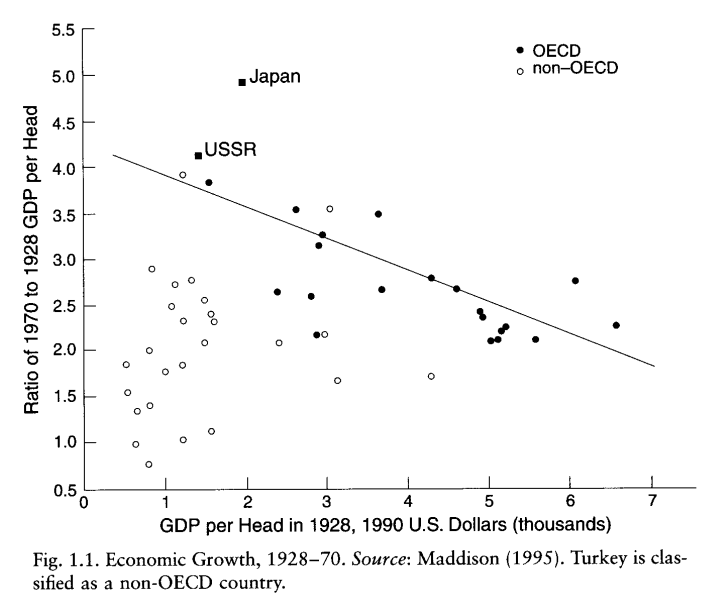 now libertarians can't explain this with saying the ECP exists. If a libertarian ever says ECP to you say dog problem.
now libertarians can't explain this with saying the ECP exists. If a libertarian ever says ECP to you say dog problem.
Comments (99)
Presumably,
OECD = Organisation for Economic Co-operation and Development
and
ECP = Economic Calculation Problem
Economic Calculation in the Socialist Commonwealth
I agree that it may not be a good critique, but the bottom line is that the Soviet system was to a significant degree dependent on the capitalist West and it eventually collapsed after Ronald Reagan stopped US financial and technological assistance in addition to expelling a large number of spies which was followed by other Western countries.
In the final analysis, it failed without capitalist support.
Maoist China would have gone down the same road had it not been for the Rockefellers and other big bankers and industrialists to save the regime with investments and loans from the 1970's onward.
In 1917, the year of the Russian Revolution, Ford started mass-producing Fordson tractors. Because of the Civil War in Russia, it could only start selling them in 1920 after which it exported tens of thousands of Fordsons to the Soviets. After 1924 Ford licensed the production of tractors and trucks in Russia itself.
From then on, there was a steady transfer of US cash and technology to Russia into the 1980s. The groups involved were the Rockefellers (chief financers of Fabianism) and associates through banking and industrial corporations like Chase Manhattan, Citibank, Bank of America, Morgan Guaranty Trust, Manufacturers Hanover, and Ford Motor Company as well as organizations like the USSR State Committee for Science and Technology (SCST) and the US-USSR Trade and Economic Council (USTEC) which was headed by Rockefeller executives and associates.
David Rockefeller was the leader of the US financial assistance effort to Communist Russia. In the early 1970s he started to overtly finance Russia and China. In 1973 he opened a Chase Manhattan branch in Moscow and visited China to negotiate US-Chinese economic cooperation.
Rockefeller also started to promote a worldwide policy of East-West rapprochement through his close friend and collaborator and US Government adviser Henry Kissinger and through the Rockefeller-funded UN. Rockefeller’s activities saved Communist Russia and China from economic collapse.
Meantime, Ronald Reagan had been studying the Soviets for a long time and he knew that communist economy was not a functional system. When he came to power in 1981, he immediately ordered an investigation into how the Soviets financed themselves and this was when he found out that they were assisted by US finance and technology.
In May 1982 Reagan went public with his plan. Speaking at his alma mater, Eureka College, he predicted that “the march of freedom and democracy … will leave Marxism-Leninism on the ash-heap of history as it has left other tyrannies which stifle the freedom and muzzle the self-expression of the people.”
He directed his top national security team to develop a plan to end the Cold War by winning it. The result was a series of top-secret national security decision directives.
In particular, Reagan adopted a policy of attacking a “strategic triad” of critical resources –financial credits, high technology and natural gas – essential to Soviet economic survival. Author-economist Roger Robinson said the directive was tantamount to “a secret declaration of economic war on the Soviet Union.”
When Reagan increased US military expenditure by 13%, the Soviets barely reacted because they simply could not afford to keep up.
The Soviets whose economy depended on oil exports also went through an oil crisis caused by a fall in oil production and prices.
The Soviets knew that they were finished and just gave up exactly as predicted by Reagan. After seventy years of communism or Fabianism, they were forced to reintroduce capitalism and feed themselves instead of relying on capitalist aid.
To get an idea of the situation, in 1970, the Soviet Union bought 2.16 million tons of grain. By 1985 this had risen to 44.2 million tons (a 20-fold increase). There were similar increases in meat imports and other products. Basically, the Soviet State had become incapable of feeding its own people.
D. Rockefeller, Memoirs
Fordson – Wikipedia
How Ronald Reagan Won the Cold War | The Heritage Foundation
Reagan’s Secret Directive NSDD-75 Federation of American Scientists (FAS)
No, still, communism and socialism are failures.
I hadn't heard about the extent of US trade/support to Russia and China, so thanks for that.
From what I've picked up from economics and economic history - from the economic base the inherited from the Tsarist regime, the different kinds of command economies the bolsheviks adopted up until about the 1960s were effective at developing the GDP of the USSR. The records of this may be somewhat inaccurate, but it's undeniable their economy did expand rapidly. They got in to problems, I have heard, when they attempted to continue with the same 5-year-plan, production-focused, centralised model as the economy became more complex. There are those who argue that if they had had access to modern computer power, they would have been more successful (than they were - may still have collapsed).
One thing which Red Plenty makes clear is that corruption - at least as we understand it as mainly a financial phenomenon - was very low in the USSR. This is because, internally, their economy made very little use of money. If you have to do all your chicanry with goods in kind, running a black market is very hard. I don't mean to say there wasn't lots of nepotism, bad and misleading bookkeeping, plus obviously immense human rights violations - there obviously were.
Socialism is not obviously a failure - many societies have socialistic elements, particularly in europe and asia, which work well. What level of socialism can be achieved is an open question, and obviously these states exist with a capitalist world order. Communism may not be possible, but then there are also lots of possible systems which qualify as communist, of which the eastern block displayed a few authoritarian examples. You need to show all of these are both impossible AND undesireable, and the same for socialism, to defend capitalism.
Even then, this doesn't obviously defend capitalism. This world system is currently failing to sustain a sustainable world for humanity in general. If it collapses - which I think is likely - then we will be left with things similar to feudal and hunter gather societies. Many of the latter actually have alot to support them - the most egalitarian, peaceable societies that have ever existed are hunter gatherer ones. Of course, we have to go through a holocaust and a mass extinction event to get to them.
Basically, we have no good options - but we maybe have some which are less worse than others.
First huge step is to believe USSR statistics. A country where honest statisticians or economists reporting the actual data are silenced by putting them into mental asylums, I wouldn't have high hopes on the accuracy of the statistics.
Second huge step is to think that the totally different economic system and accounting wouldn't matter in getting comparable statistics (I guess this is the ECP argument or something). When prices are administrative decisions and amortization isn't taken into record as in "capitalist" accounting, you have problems. And finally, let's not forget that a very huge segment of that "economic growth" went into armaments, weapons and the maintaining a Superpower armed forces. Compared to the US, the defence spending was a greater percent of the whole economy. Building tanks and nuclear weapons don't make the people more prosperous. When you look at the Soviet economy from that perspective, for example the Leningrad area was one huge military-industrial complex. Military expenditure was basically half of the government expenditure.
As Diana Negroponte points out when Gorbachev took over the system:
(Where that economic growth went into. An abandoned tank repair shop in Ukraine:)
Obviously the Russians are incapable of normal thought, and their entire economy is based on thieving, pilfering and fraud. Their economic miracle can be fully explained by huge aid monies and technological injections by the USA, which is clearly the world leader in honesty, technology, shitting, and economics. And in superior knowledge of god and the scriptures, far surpassing even the Vatican, child's play, really.
Russia's double-digit increase in industrial output as you rightly say, can be explain by their being unscrupulous lying bastards, mother lovers and child abusers. They eat little kittens for breakfast, and cute puppies for dinner. They also reject the kingdom of Jesus Christ, the Savior. They say their economic output is nearing the level of Jesus. Satan often visits Russia, and he is the guest of the state -- his chair is right next to Putin's right during gladiator sports, when Christians are fed to lions in an arena, strictly supervised by international soccer referees. They are on a point system there.
Well, he may well have been someone’s hose nozzle as most politicians are. After all, politics is about power and power is where the money is.
However, he was already an anti-communist in the 1940’s when most people had some knowledge of the communist world and he simply expanded the existing anti-communist “rollback doctrine". Plus he was informed by the intelligence agencies once in office. So, he probably knew a bit more than the regular guy in the street.
I'm not saying capitalism is perfect so I don't need to defend it. The onus is on socialists to show that socialism is better than capitalism. And that is exactly what they have failed to do from the 1800's to the present.
IMHO, the real failure is a failure of liberalism as (mis-)represented by monopolistic capitalism on one side and totalitarian socialism on the other. And what they both seem to have in common is materialism.
Yeah, it was 30 years ago so for many it's ancient history. Yet some have this romantic yearning for a failed totalitarian system as, well, it isn't at all politically incorrect. Yes, it did put the first man in space and defeated the Third Reich, but still, it simply sucked. Even more than western capitalism at it's worst.
That there are as many Russians now as there were in the year 1900 or so simply tells how horrific it all was.
The Soviets may have put the first man in space, but we must no forget how they got there. Aside from being provided with technological know-how by thousands of Western sympathizers (or useful idiots) and a worldwide industrial espionage network, most of the relevant technology was stolen from the Germans:
"Operation Osoaviakhim was a Soviet operation which took place on 22 October 1946, when MVD (previously NKVD) and Soviet Army units removed more than 2,200 German specialists – a total of more than 6,000 people including family members – from the Soviet occupation zone of post-World War II Germany for employment in the Soviet Union. Much related equipment was also moved, the aim being to literally transplant research and production research centers such as the relocated V-2 rocket center at Mittelwerk Nordhausen, from Germany to the Soviet Union, and collect as much material as possible from test centers such as the Luftwaffe's central military aviation test center at Erprobungstelle Rechlin, taken by the Red Army on 2 May 1945. "
Operation Osoaviakhim - Wikipedia
Yet you simply cannot deny the genius of Sergei Koroljov, who designed the R-7 and other rockets that the modern variants carried a year or two ago American astronauts to the ISS. Koroljov's rockets were far more advanced than the Germans had on the drawing board to strike mainland US, hence not all technology in the Soviet Union was copied from the west. That simply is false.
The Soviet Union was capable to design state-of-the-art weapons and for example in it's air defence missile designs were better than the US (simply out of necessity). Yet that is where it all went. What it totally lacked was to create anything truly new, to innovate new industries. A centrally planned system based on large corporations simply cannot compete in new ideas with the hippies from the silicon valley.
Central planning kills radical innovations. That is fact that many socialism lovers simply forget.
Well, Koroljov was part of a Soviet team dispatched to Germany to recover rocket technology in September 1945, a whole year before Operation Osoaviakhim. And the R-7 took about ten years to develop with massive government backing.
But I agree that central planning does not seem to work especially within a system where the leadership's primary concern is to stay in power at all costs.
China's communists seem to have learned a lesson or two from the Russian failure, and even they have benefited from substantial technology and cash transfer from the West, started by David Rockefeller in the 1970's
The big difference is that Gorbachev didn't go for the Chinese strategy and also with "Perestroika" had the idea of "Glasnost", openness. Gorbachev was a Marxist-Leninist who wanted reform within. The policy of Glasnost also really shook the power of the Communist party as opening up a totalitarian system for free speech is a huge deal. Then the privatization of the soviet economy was intended to be this transfer of assets to the ordinary people. It didn't go like that: the class of the oligarchs was created usually with the industry heads taken then the role of being owners. This created the kleptocracy of modern Russia with the new elite not investing in Russia, but buying yachts and football teams in the West.
With China the US thought that capitalism and investment would change the country also ideologically. Not so. The Chinese Communist Party can only show that they truly have done a historical leap in the last thirty years. With the USSR as the old Russian empire collapse (had been held together only by the marxist-leninist totalitarian state) the US decided that Russia was past and put it hopes on Yeltsin. Well, Yeltsin then picked his FSB chief as a replacement and the rest is history.
Yet with the example of China you can see what historical economic growth is. With the USSR you only needed to go to the countryside or to smaller cities and see just how much actually of the homes people lived in was still from the days of Imperial Russia. Just visiting Russia even today makes one really suspect just how awesome that economic growth actually was as Oppyfan thinks.
The Rockefellers and their associates from banking and industry had been dealing with the Soviets from inception, from the early years of the revolution. They were aware of the economic problems the Russians and the Chinese were facing. In the early 1970’s the Rockefellers were taking advantage of the oil crisis (partly caused by their own policies) and the weaknesses of communist economies in order to expand their petroleum and banking empire. Hence they promoted a policy of East-West rapprochement and David founded his Trilateral Commission, an association of multinational banking and industrial corporations, for the purpose.
When David Rockefeller and his representative Kissinger visited Beijing, the Chinese decided to open up to the West because they saw that they had no choice. Rockefeller reached out to Russia as well, even opening a Chase Manhattan branch in Moscow in 1973, the same year he was in China. But Russia was different, it was an empire with connections throughout the world and with a long and proud history in its dealings with the West. So the Russians opted for getting involved in projects like Afghanistan, and after that Reagan’s anti-communist initiative sealed their fate.
But I think in Russia’s defense it may be argued that there was no precedent for a totalitarian system of planned economy like that of the Soviet Union to transition to capitalism.
The oligarchs were only part of the problem. Privatization of state-owned assets was not simply state-appointed company directors taking over. Reintroducing capitalism required the creation of capital and this was possible only by selling state assets to foreign buyers who actually had the capital.
It was a matter of accessing international investment and credit. As the Russians had zero knowledge or experience, they were advised by the Rockefellers and their associates, i.e., Chase Manhattan, City Bank, Bank of America, J P Morgan, and Federal Reserve Bank of New York.
By 1993 more than 40% of Russian enterprises were owned by Western interests and a large part of the rest were co-owned by the same interests and their Russian associates.
So, Russia was on the road to becoming a third-world banana republic controlled by international banking and industry in collaboration with local oligarchs and corrupt politicians. "President" Yeltsin was suffering from heart disease and alcoholism. In 1999 Putin was brought in to restore Russian control of the economy and of the country.
Quoting Apollodorus
East-West rapprochement has a long history where some bankers weren't the only ones promoting this. The détente process was very important in part of the Cold War. Let's not forget that if after the invasion of Afghanistan by the Soviets the Cold War got colder, it was at the end of Reagan's administration that huge gains were got in disarmament. A major issue was the formation of OSCE, which is is the world's largest security-oriented intergovernmental organization (if you don't count the UN as such). And historians also note that the development that started from the CSCE Helsinki summit (that from was formed OSCE) were part of why the Soviet Empire collapsed. At the time for the Soviet Union the rapprochement / détente process looked like a fine strategy. Not so when the Communist bloc and Soviet empire collapsed and a lot of those agreements in the Helsinki accords backfired for the Soviet Union.
Quoting Apollodorus
This sounds quite large. Do you have a reference where this stat is from?
I'll have to look up the exact reference. I think The Shadow Party by Horowitz and Poe has quite a bit on what went on with Russia’s privatization.
But you are right, it does sound like a high percentage. That’s because from the start the privatization program was dominated by foreign players from advisors to government with links to the State Property Committee that was in charge of the program to international institutions like the IMF, International Finance Corporation (IFC), the European Bank for Reconstruction and Development (EBRD), and American and European banks.
The first sale of Russian bonds in 1996 was done through J P Morgan and SBC Warburg which gives some idea of who was involved.
But foreign investors often acquired their stakes through Russian intermediaries and of course there was little regulation and a lot of corruption with rigged auctions, etc., which is why Russians called the program “grabification”. Yeltsin was forced to implement some cosmetic regulation and Putin had to renationalize key companies soon after coming to power.
In any case, the oligarchs or “kleptocrats” were only part of the problem. China's communists were much more in control at least on the surface, though it's hard to know what exactly went on. With the Communists still in power, there is much less info on China than on Russia. But my feeling is that a lot of China's billionaire "capitalists" have very close links to the Party, so that a lot of Chinese "capitalism" is more apparent than factual. The leadership has never forgotten Mao's dissimulation tactics ....
Yes, interesting. Yet I'm not so sure how successful these were and how much did actually go through. I remember that various Western oil companies were eager to get their share of Siberian oil, but they were stalled and later left. Basically Russia needed desperately technological know-how and from the West to improve their infrastructure, but state security was over everything else.
Quoting Apollodorus
The sick old Yeltsin needed the oligarchs money to hold on to power and (avoid the communists taking power) and this increased their power and lead some to think that they could have also political power. This was an absolute no-no, just in like China. Only in the US can the super-rich grab political power and use it. In Russia (or that matter in China) if the oligarchs show desire for political power, they are jailed or are exiled. To survive and hold on to their billions they simply have to be obedient yes-men.
The real tragedy that this has left Russia in a state were crucial investments have not happened. Who of the billionaires would dare to extensively invest in Russia when all can disappear in a moment with the government confiscating your wealth?
I think that the massive fortune that Putin has personally stolen has far more to do with the concentration of power than wealth hoarding. To rule over other oligarchs, you have to have also more wealth than they do I guess. I remember on Russian opposition politician observing that just the expensive watch Putin wears is far more than the "official" wealth that Putin tells publicly he has.
Of course, everything is owned by the state when you are de facto the state...
Putin's mansion, officially state owned:
But I agree that something went horribly wrong somewhere and it is not that easy to piece it all together.
In any case, the key privatized assets that were of interest to foreign corporations were in industry, energy, and finance. And it was US industrial, energy, and banking giants (and some European ones) that played key roles in the project by providing loans to companies, etc.
First, "spontaneous privatization” was already underway by mid-1990.
Second, Russia in 1992 was “advised” by the (Rockefeller-founded) World Bank to privatize as much and as fast as possible. Rockefellers and associates represented by the Federal Reserve Bank of New York, Chase Manhattan, City Bank, J P Morgan and Bank of America in collaboration with economic experts from Rockefeller-controlled institutions like Harvard University, told the Russians how to do it, and the IMF under G-7 (i.e. US-Rockefeller) pressure gave the Russian state a few billions in loans to encourage (or bribe) them to do it.
Third, the Russian state converted state-owned enterprises (SOEs) into shareholder corporations.
Fourth, the state gave control of companies to workers and managers.
Fifth, Russian businessmen and speculators, who had made huge profits in the 1980’s by buying cheap raw materials and selling them abroad for dollars, bought control of companies from the workers and managers.
Sixth, the new owners or controllers had a choice between (1) investing in their companies to make them more profitable, (2) transfer profits to off-shore companies, and (3) selling them for hard currency to foreign buyers or otherwise acting as middlemen for them.
Obviously, option (1) was not the most attractive to people whose main interest was quick profit.
Big foreign investors were lining up to enter the takeover game, advancing money to Russian partners to gain full or partial control of privatized companies. As Andrew Balgarnie of Morgan Stanley who had earlier opened their Moscow office put it in 1994, "There's more money that wants to come to Russia than there are quality places to put it."
Exactly what those big foreign banks did in Russia is not entirely clear. However, only a few years after the start of the program, in 1997, Russia’s Central Bank announced that it would no longer do business with 11 American and European banks: Chase Manhattan, J. P. Morgan, Bank of New York, Banque Nationale de Paris, Credit Suisse First Boston, two subsidiaries of the Deutsche Morgan Grenfell unit of Deutsche Bank, Credit Agricole Indosuez, Societe Generale of Paris, Union Bank of Switzerland (UBS)'s London operation and Salomon Brothers.
Russia Punishes 11 Financial Concerns – New York Times
So, how much money foreign investors actually made is hard to tell. The downside for Russia was that there was a massive cashflow out of the country that went to off-shore companies, many owned or co-owned by Russians. The economy was fast going downhill, and in 1998, the Russian currency collapsed and the country was basically bankrupt.
“From about 1991 to 1998 Russia lost nearly 40% of its real gross domestic product (GDP), and suffered numerous bouts of inflation”:
The Post-Soviet Union Russian Economy – Investopedia
According to Horowitz and Poe, the privatization resulted in a loss of USD100 billion to the Russian economy.
In any case, some Western corporations did get their hands on Russian assets at least in joint-ventures in the energy sector, for example, TNK-BP, and the aluminium giant Rusal. I think this was the overarching plan that was stopped in its tracks by Putin.
The pressure that the West is now putting on Russia must logically have the same object, to open Russia up to Western capitalist investment and, ultimately, control. Monopolism seems to be capitalism's biggest problem. We can't really blame China for trying to copy our own monopolistic tendencies.
Berezovsky was a prominent businessman and former deputy head of Russia’s Security Council, who had close connections to Yeltsin. He was the head of the movement to build “oligarchic capitalism” around his gas company Gazprom and five to six other giant corporations.
However, Berezovsky was not the only one. There were rival political and economic factions competing for power. In addition to the general economic and political situation, this was a destabilizing and dangerous development.
Essentially, Putin’s task was to restore order and stability. When he came to power, he announced that he wanted to liquidate the oligarchs as a class. But he realized that some oligarchs could be useful in running the economy and the country. So, the oligarchs were told that from now on they have to play by the new rules. One wrong step and they would go straight to jail for fraud, tax evasion and other illegal activities.
There were about 36 of them. Berezovsky and two or three others didn’t like Putin’s suggestion and, unwisely, started organizing opposition. They soon realized that this was a bad move and fled to England. Berezovsky was later found dead by his wife in his London home.
In the meantime, the foreign corporations were going about their usual business. A number of them formed strategic alliances with Russian corporations to bid for Russian firms. In 1997 Royal Dutch/Shell teamed up with Gazprom (Berezowsky’s company) and Lukoil, and BP teamed up with Cidanco/Oneximbank in a bid for Rosneft, Russia’s largest state-owned oil company. The bid apparently failed but Shell later made other deals with Rosneft (or with Putin) and in 2017 Putin’s friend Gerhard Schröder was appointed chairman of Rosneft.
So, Schröder was Germany’s Chancellor until 2005. In 2006 he was hired by the Anglo-French firm Rothschild & Co (co-owners of Shell) as adviser and representative for their European and Russian operations. He also became a director of Anglo-Russian energy company BP-TNK, a post he held until 2011. After leaving Rothschild in 2016, he was hired by Rosneft of which the Rothschilds are shareholders ….
Gerhard Schröder – Rosneft
Obviously, foreign billions were invested in top Russian companies in exchange for shares and some form of control. The close collaboration with select foreign corporations has helped the Russian leadership to rebuild the economy and keep key sectors under control, and has simultaneously enabled the multinational corporations to advance their long-term objective of expanding their global control over resources and markets.
My guess is that the multinationals will win in the end. The final battle will be between them and China.
Yes. After the Soviet Union collapsed, there was truly a historical opening for Russia to integrate to West. Then Russians were truly open for the West. But that brief opening was wasted. It ended with the Kosovo war and the NATO attack against Yugoslavia (Serbia). Yet you would had to have truly larger than life politicians on both the West and in Russia. But you had just average politicians. The Americans thought of Russia being past and didn't think of it much. Hence when a director of the FSB and a career KGB spy was chosen to the position of the Russian President, the opening had surely past.
Yes.
There is a very successful political ideology called social democracy. It's so successful, that most who call themselves socialist absolutely hate it.
And the countries? They are capitalist societies with usually a large public sector. Yet they are just fine with a private sector, the market mechanism, free enterprise and so on. If you talk about countries like Sweden, Norway or my country, just to give examples.
I agree. Totally useless or, rather, self-interested politicians.
However, I think the story is a bit more complex than that and it's got to do with the same multinational corporations.
Remember that the European Union (EU) aimed to expand eastward into Eastern Europe and southwards into North Africa and the Mid East.
The Enlargement of the European Union was based on the Europe Agreements signed with the Central and Eastern European countries in the 1990s and to the Association Agreement with Turkey, and the Union for the Mediterranean based on the Euro-Mediterranean Conference of EU and Arab Foreign Ministers, 1995:
Europe Agreements
EU-Arab Conference 1995
Union for the Mediterranean – Wikipedia
For that objective, the EU and its US partners had to get rid of all the "dictators" (some real, some perceived) that presented any opposition to EU expansion. This is what created the big mess you see in North Africa and the Mid East.
And, of course, Russia and Turkey have taken advantage of the chaos, and China is never far behind ....
Did the EU aim to expand Southwards??? I know Turkey was a possibility, but I've not heard about Morocco, Algeria, Tunisia, Egypt or Libya anytime being on the line to be member states.
The only potential would be Israel and yes...that really isn't going to happen.
(Although the Israelis have participated in, won and hosted the Eurovision Song Contest, btw)
The EU having a get-together club with it's neighbors is another thing and a totally fine thing to do. But notice from the description from Wiki the last sentence:
Yeah, this is a conversation club.
And do notice one very, very important thing both when talking about EU membership or talking about NATO membership: the countries themselves wanted to join. Far too much emphasis is giving for example to Clinton wanting the votes of Americans with ties to Eastern Europe and far less on how much the countries themselves wanted NATO (or EU) membership. There was this window of opportunity, because some (very ignorant people) even talked about Russia joining the NATO.
When it comes to EU membership, both Norway and Switzerland held membership talks with EU, but came to the conclusion that nah, they are better out. With NATO, some countries like Sweden and my country has not formally requested membership as it would be politically a hot potato in these countries. And when Western countries asked about there being a possible defence coalition among Sweden, Finland and the Baltic States (that NATO wouldn't have to be involved), both Sweden and my country were absolutely horrified. Once the Baltic countries did join the NATO (and EU) there was a sigh of relief if Finnish military officials immediately noticed that NATO didn't raise a finger to do anything actually to defend the Baltic states...until the annexation of Crimea by the Russia (far later).
Quoting Apollodorus
Hm. I accept that there was this neocon moment when the Global War on Terror was rolling and the idea was to do this. But that's it. The Eastward expansion of EU/NATO happen with quite rosy feelings: the Czech, the Poles and other Warsaw Pact countries joined very nicely. Belarus was never in the picture.
To topple the dictators is this American idea, which one commentator called Donald Trump extremely well portrays in his 2011 commentary on why Libya should be invaded by the US:
Americans thinking like Trump above is the real problem.
Correct. American corporations led by the Rockefellers' Harvard Management Company and Goldman Sachs. And their European partners.
I didn't say all the countries that were expected to join were hostile to the idea. But definitely Serbia's Milosevic and some Arab leaders.
The EU needed to get its hands on Arab (North African and Mid Eastern) oil. The Mediterranean Union aimed to achieve economic, cultural, and political union. European technology and investment were to be exchanged for Arab migrant workers to make up for the EU's declining population.
BTW, personally, I think that the (unofficial) plan extended to Ukraine and even Russia. Again, tin order o supply the EU with Russian gas and oil. Of course, Putin couldn't allow that to happen. So, his government is on the EU-US hit list and this may ultimately drive Russia into the arms of China. The West is in a self-inflicted catch-22 situation and it isn't looking good.
Milosevic is a bit different issue because that started totally from the incapability of the Yugoslav states, mainly because of Milosevic, to break up as peacefully as the Soviet Union did. A long story of Yugoslav making. Not something like Bush deciding to invade Iraq because...why not?
We actually don't give credit enough to the Soviet era politicians who could dissolve the Union without larger violence. The events in Ukraine clearly show that the possibility of a similar bloody civil war as in Yugoslavia was a real possibility in the Soviet Union. That could have been a war in the millions of deaths and not so nice to me, as my summer place (where I'm now,actually) is only 10 kilometers from the Russian border.
Quoting Apollodorus
The EU is such a loose entity that it really doesn't itself have such imperial aspirations.
Quoting Apollodorus
Not likely. Only if the Russia emerging from the Soviet Union would have been controlled by strong and resolute Zapadniks. Yet the Zapadniks didn't take power. Putin, the FSB and the Siloviks took power in reality.
If they would have taken and new Russia would have taken a divide with it's past, then perhaps the most awesome alliance would have happened: The US-Russian bond in fighting the Global-War-on-Terror. I can imagine the horror of the liberals in the US. But Republicans? They would have loved it!
When you think of it, a pro-western Russia would be a dream ally for the US: has ample military strength and the willingness to use it. Doesn't get scared of Russian casualties. Is totally OK in fighting a dirty war anywhere. Would be truly willing to fight a Global-War-on-Terror (even now hinted at that). Has a great intelligence network. Would be lucrative market for military joint ventures, just think about Lockheed joining up with Sukhoi or Mikoyan-Gurevich. Those cheap Russian aeronautic engineers would be great for US defence contractors.
And furthermore, the Chinese would be absolutely scared shitless about US-NATO on their northern borders.
Union means union, economic, cultural, and eventually, political. Read the official EU documents. Oil extraction and distribution would be done by Western companies that have the know-how and the technology and some of which are co-owners of the oil fields.
It doesn't matter if the EU is a "loose entity". What matters is that it represents the interests of the banking and industrial corporations that founded it in the first place. And it has the economic and military power to implement its plans. Unfortunately, the Arab uprisings instigated by EU and US intelligence didn't quite work out as expected, Turkey's Erdogan had his own plans to rebuild the Mid-Eastern and North African provinces of the Ottoman Empire, Russia sided with Erdogan, Germany's economy became dependent on Russian gas and exports to Turkey (and now on exports to China), and the plan unraveled.
Now they have to do it gradually and by the backdoor through sanctions on Russia, etc. and with uncertain results.
I agree that Europe should have sided with Russia and both of them with America. But the EU, NATO, and US wanted to do it on their own terms and this was not possible. Now we've got a fine mess to deal with. China is building an economic corridor through Pakistan, Iran, and Turkey to Iraq, Mid-East oil, and on to Africa's resources on which Europe depends. This means the end of Europe as a power and the process is being accelerated through ever-closer economic cooperation with China.
EU having military power? NATO is different from the EU.
Quoting Apollodorus
You should perhaps prove here that they really instigated the uprising. You see, it's one thing to favor an uprising, even help it. Another thing to instigate it from scratch.
Quoting Apollodorus
Well, the Middle East is the ultimate American disaster movie.
It just gets worse and worse.
Imagine the time when there was CENTO, the so-called Baghdad-Pact, when Nasser asked the CIA if it would be OK for him to do a military coup? Then when Iraq had it's revolution and opted for the Soviet assistance there were US "Dual Pillars" of Iran and Saudi-Arabia. Afterwars there was the Iranian revolution and you got "Dual Containment" as a US policy. Then brief unity when Saddam tried to snatch Kuwait with even the Syrians being part of the US lead alliance. But then came Dubya with the invasions of Afghanistan and Iraq. How well those went we all know.
The final scene of the train wreck would be if the "next Iran" would be Saudi-Arabia with the Saudi monarchy being overthrown. The Americans would just enthusiastically love to loath and hate the Saudis. Would fit in perfectly there with Iran and Pakistan.
France and England had enough military power to deal with any Arab state. Even more so, with NATO involvement.
Quoting ssu
You should perhaps start by reading the EU documents on the Mediterranean Union. Or talk to yourself.
But they surely won't do it as an EU force on behalf of the EU. They will either do it a) as part of NATO, b) as part of a US lead alliance or c) own their own.
You need to start by understanding the Mediterranean Union project.
The primary intention was to do it by economic means. You start with economic cooperation agreements; you follow up with credit and investment; you tie their economy as close to, and make it as dependent on, your own, as possible; you promote the election of cooperative political leaders; you encourage capitalism dependent on international finance and intergovernmental institutions like World Bank, IMF, IFC; you liberalize and westernize their society as much as possible; you bind them to the West through legal agreements; and you gradually proceed with political integration.
You deploy your intelligence and other special operation services in collaboration with local opposition, criminal elements, and "useful idiots" to encourage or assist regime change, strictly if, when, and where necessary.
Military intervention is kept to the absolute minimum and only applied when absolutely necessary. It is never done except as a Plan C, i.e., after Plan A and Plan B have failed. And even then you first use proxies like local or foreign militias, etc.
It is a very gradual and carefully calibrated process that is designed and implemented by an army of experts. It is not really meant to get to Plan C as this can go horribly wrong and blow up in your face.
- David Miliband Speech at College of Europe, Bruges, Belgium, November 15 2007
David Miliband Archive: Europe 2030: Model power not superpower
He also called for the use of both “soft power” and “hard (i.e. military) power”, etc. Of course, Russian and Ukranian integration into the EU economic sphere never happened because of the Russian-Georgian War in 2008 and US-EU involvement in other former Soviet republics.
So the EU had to focus on the Mid East and North Africa (MENA) region. But that failed too:
Policy-Report-3-Towards-EU-MENA-Shared-Prosperity.pdf
But there is no doubt that the ambitions and expectations were very high:
The Future of Euro-Mediterranean Regional Cooperation: The Role of the Union for the Mediterranean : IEMed
Is Russia's Dialogue with the EU Coming to an End? - The Moscow Times
So, you can see that the plan for Russian integration into the EU was hatched at the same time that Russia was being opened up to Western capital and it was part of the larger EU expansion to the east and south. The Barcelona Process (BP), the precursor to the 2008 Mediterranean Union, was initiated in 1995, at the same time as the EU-Russia Partnership and Cooperation Agreement (PCA) was signed ....
The PCA aimed to achieve “Russia's progressive integration into the open international trading system” and “the gradual integration between Russia and a wider area of cooperation in Europe”.
EUR-Lex AGREEMENT ON PARTNERSHIP AND COOPERATION
And what YOU should try to understand that who make integration happen are those who really desire it ARE THE COUNTRIES THEMSELVES. Not only their elites, but the people also. Then integration and EU enlargement happens. Then even trade deals happen. If there is suspicion and bad relations, nothing but empty talk will happen.
Perhaps you cannot understand it, but I surely can. I come from a remote part of Europe which is dominated by Russia. And I know that if the Soviet Union would have annexed us in 1939, absolutely nobody would have cared a shit about it. On the contrary, it would have been seen as nearly inevitable. Hence their was always an extremely popular desire to somehow integrate with the West, but we had to do it extremely carefully as not to anger the bear. Once the Soviet Union collapsed, Finland (and Sweden) didn't waste time in joining the EU (EEC).
For the Warsaw Pact countries it was absolutely necessity to integrate to the West after all that they had endured under the Soviet regime. For them NATO was even more important.
Or think about the integration of Spain and Portugal to the EU. Franco's Spain was one thing, but so was Portugal under António de Oliveira Salazar also. Integration to the EU is seen also in a positive light in the countries that have integrated into it. In the EU, perhaps only Germany, France and the Benelux countries feel like they are in the heart of Europe and EU, other countries feel as they are on the fringes and don't think that they are in the heart of Europe.
Quoting Apollodorus
Yes, and that went nowhere, because a) no Zapadniks in power and b) the Kosova war left a very bad taste for Russia and Russians. In the early 1990's Russians were genuinely open at the idea of integrating to Europe. At the end of the decade, the feeling was over. Even before Putin came to power the honeymoon had ended.
That depends. Just because Finland and Sweden were keen to join, it doesn't mean it applies to all European countries.
The idea of a united Europe comes from the 1947 European Recovery Plan (ERP) a.k.a. Marshall Plan according to which European states that wanted US aid to reconstruct their countries after the war had to commit themselves to economic cooperation leading to political union.
Of course, this was in the interest of US business as they needed a Europe with a strong economy to serve as a market for US goods and give the US economy a boost.
The Germans, for example, were not even asked as they were under Allied occupation. They were ordered to team up with France, Italy, and the Benelux countries and get on with it.
The British were never very happy about joining and only did so under pressure and after a massive propaganda campaign by pro-EU groups. And, of course, with the 2016 referendum, they decided to get out. Others may follow the British example, China may take over Europe's economy, etc. It isn't quite as simple as you think.
Umm...yes.
Norway and Switzerland. Now the UK. And that's basically it.
Others have been quite OK to join. Perhaps added to the three above is Serbia, because NATO bombed it. Even if the US really and openly supported the Serbian opposition that finally ousted Milosevic (not done by CIA, but the State Department), now Serbia is an ally of Russia. Just an example how flawed the US foreign policy can be...
Others have been quite happy with the EU. One really shouldn't forget this as one reads or hears these specific narratives of just how rotten the EU is.
The real power of the conservative party is not in their economic growth, but in their superior alignment to the desires of the natural human being within us all.
Well, if you are a Finnish farmer living on EU subsidies then I suppose you would take a pro-EU stance.
But I think a more objective approach is preferable if we want to get to the bottom of it. In any case, when we analyze something it is important to take all the known facts into consideration, not cherry-pick stuff that we like and ignore stuff that we don’t.
The EU did not start as the “EEC”, it started as the European Coal and Steel Community (ECSC) established in 1951 through the Treaty of Paris.
As shown by its name, the project was about coal and steel. Coal and steel were the basis of European industry and, by extension, of European economy. Europe’s economy depended on coal and iron mines and steel plants that processed the coal and the iron ore.
The main continental countries that produced coal, iron, and steel were Germany, France, and the Benelux countries Belgium, Holland, and Luxembourg, to which they added Italy.
The Italians and the Germans had been allies during the war. The industries of the Benelux countries were interlinked with that of Germany. But the French and the Germans were long-time enemies, so why would France want to merge its economy with that of Germany?
Moreover, Germany was divided into East and West, with the Eastern half under Russian control and the Western half under US control.
The truth of the matter is that European unification was a precondition of US aid.
Why would America invest 13 billion dollars in Europe in addition to more billions in loans? Obviously, the Americans wanted Europe as a market for American goods and wanted to exert as much influence on European economy, finance, and politics as possible.
The European Recovery Program (Marshall Plan) was devised, promoted and implemented by elements linked to Rockefeller interests operating within the US State Department.
The Rockefellers’ Council on Foreign Relations (CFR) became official part of the State Department in the early 1940’s and by the time Truman became president in 1945 it was literally making America’s foreign policy. The CFR developed the idea of the “reconstruction of Western Europe” in 1946, this was announced in 1947 by State Secretary George Marshall and it was passed by Congress in 1948 as the European Reconstruction Program (ERP) a.k.a. “Marshall Plan”.
To promote their plan, the Rockefellers launched a massive propaganda operation to overcome public opposition. This was spearheaded by the Committee for the Marshall Plan, chaired by Henry Stimson, a Rockefeller lawyer who had ran the US War Department during the war, and consisted of other Rockefeller lawyers, directors of the Rockefellers’ CFR, the chairman of the Rockefellers’ Chase National Bank, and was funded by John D Rockefeller and his business associates.
NONPARTISAN UNIT HEADED BY STIMSON TO BACK EUROPE AID - New York Times
All the agencies that operated the Plan and through which money was funnelled to fund pro-unification organizations in Europe were run by Rockefeller people.
The whole Marshal Plan and associated European unification were a Rockefeller project.
This is why the Russians rejected the Plan as “economic imperialism”. The British took the money but refused to join the ECSC and its successor EEC on the grounds that it was unacceptable for the UK economy to be “handed over to an authority that is utterly undemocratic and is responsible to nobody”.
Germany was run by US military governor John McCloy, a Rockefeller lawyer and trustee of the Rockefeller Foundation, who was in charge of the Economic Cooperation Administration (through which the Marshall Plan was operated) in Germany, and who by his own admission, had “the powers of a dictator”.
The French were fighting a losing war in Indochina and aside from Marshall funds and loans, they depended on US military and financial assistance in their war and had no choice but to comply.
So I think that the whole project was far from being a democratic enterprise. It was more like US monopolistic capitalism working hand-in-hand with Europe’s own big bankers and industrialists and their political collaborators for their own ends.
What actually happened on the ground is that US goods and services were acquired by European countries with American taxpayers’ money from the corporations that had promoted the plan, and that most of Marshall Plan business went through banks controlled by the Rockefellers and their associates, viz., Chase National, J P Morgan, and Bankers Trust.
Additionally, by the 1960’s American corporations in Europe dominated the market in petroleum, farm machinery, telecommunications equipment, and other key sectors. Then came the oil crisis of the early 1970’s, also largely engineered by the Rockefellers, who used it to expand their global oil and banking empire; the Rockefeller-instigated East-West rapprochement; Rockefeller-spearheaded credit, investment, and business with China that facilitated China’s rise to major economic power, etc. ....
I think @Oppyfan is currently on vacation. But I tend to agree with your statement.
So do you think there is anything lacking in the Nordic countries, from the perspective of a capitalist, or are they not capitalist enough, or actually are they preferrable even from a capitalist perspective? And yes, I did have those countries in mind, but I could also talk about different aspects of lots of european countries.
I actually do think that the capitalistic element of those countries would ultimately win out, but that is because they are living in a capitalist world. Right now, they are arranged in a mixed manner between capitalism and something like socialism.
I think if you think that most of "those who call themselves" socialists "hate" social democracy, then you haven't talked to a wide enough section of socialists. I happen to think that social democracy is better than nothing but doesn't go far enough, but that doesn't mean I hate it. Admittedly, the often belicose language of some socialists and communists may given that impression overall!
Also, on the earlier comments about the USSR being reliant on trade with the US, how does this sqaure with what is related on the wikipedia article on "Foreign Trade in the Soviet Union"? According to that, trade between the two countries averaged 1% a year.
https://en.wikipedia.org/wiki/Foreign_trade_of_the_Soviet_Union#United_States
Was most of the transference aid? I can see that was significant during WW2, but was it for the entirity of the history of the USSR?
Well, the USSR was a secretive dictatorship, so finding exact statistics is difficult if not impossible.
Trade need not have been massive, only sufficient to keep the system going and it did increase later. However, it is important to bear in mind that the main reliance on the West was not trade but credit, investment, technology, and technical assistance.
In 1917, the year of the Russian Revolution, Ford started mass-producing Fordson tractors. Because of the Civil War in Russia, it could only start selling them in 1920 after which it exported tens of thousands of Fordsons to the Soviets. That was when Lenin introduced his New Economic Policy (NEP) based of state capitalism. After 1924 Ford licensed the production of tractors and trucks in Russia itself.
From then on, there was a steady transfer of US cash and technology to Russia into the 1980s. The groups involved were the Rockefellers and associates through banking and industrial corporations like Chase Manhattan, Citibank, Bank of America, Morgan Guaranty Trust, Manufacturers Hanover, and Ford Motor Company.
The weaknesses of centrally-controlled economy became apparent in the 1950’s and by the early 1970’s the USSR economy began to stagnate and this is when the regime became increasingly dependent on foreign investment and credit.
In 1960, a series of US-Soviet conferences (Dartmouth Conference) were initiated that included members of the Soviet government and American businessmen like David Rockefeller.
In 1973, the Rockefellers opened a Chase Manhattan branch in Moscow and in the same year the US-USSR Trade and Economic Council (USTEC) with Rockefeller as chairman of the nominating committee, was established to promote US-Russian economic cooperation.
Loans were granted by the US government via the Export-Import Bank (Eximbank) and by private banks controlled by the Rockefellers and their associates.
For example, in 1974, Eximbank granted a loan of $180 million to Russia to buy goods and services from US corporations in addition to private loans from US banks in the same amount.
180?MILLION LOAN TO SOVIET UNION IS MADE BY U.S. - The New York Times
In 1978, the Rockefellers’ Chase Manhattan was also involved in financing the Orenburg gas pipeline from Russia to Europe.
In the 1980’s the USSR was forced to import growing quantities of food for which it had no hard currency.
As the Wikipedia article says:
The banks were Moscow Narodny Bank (London), Ost-West Handelsbank (Frankfurt), Donau Bank (Vienna), Banque Commercial pour l'Europe du Nord (Paris), East-West United Bank (Luxembourg).
When the USSR finally collapsed in 1991 it had a foreign debt of $70 billion.
Finnish farmers actually got earlier more subsidies. I think the largest simple reason is that Finland without being attached in any way to the West would feel very precarious with Putin next door.
Quoting Apollodorus
And if you look at the EU budget in the past, basically it was largely an agricultural assistance program. But it morphed to something else.
Quoting Apollodorus
Hence there was the EFTA, don't forget that. And UK got out from the EU, so nothing new here.
Quoting Apollodorus
You seem to stick to one narrative. Even if the bankers did there part, the idea that it's only them, no other things happened, no other agents, players and motivations were not involved, etc. simply doesn't cut it.
Quoting Apollodorus
Now you go to full tinfoil-hat territory. Yeah, obviously the Rockefellers created OPEC and started the Yom Kippur War...
A plan that never existed in Spain... probably because Franco won and established a dictatorship? So ironic! Because later on US White House loved in the 60’s having Franco in Europe as a counter “socialism/communism” governor. This is why American government established a lot of military bases: Rota, Torrejón, Palomares, etc...
I never said it was only the bankers, did I? It’s a combination of bankers, industrialists, business people and politicians.
Quoting ssu
OK, let’s take a look at your logic:
A. The statement S (“the Rockefellers created OPEC and started the Yom Kippur War”) is on T (“tin foil hat territory”).
B. Those who make statement S are on T.
C. You (@ssu) made statement S.
D. Therefore you (@ssu) are on T.
I think even someone from Finland must see that if the Rockefellers had a worldwide petroleum empire, then they must have had something to do with oil production and prices, hence it is wrong to say that they didn’t. But maybe not.
By your own logic, if you are a Finnish farmer selling sheep or goat meat to Sweden, you have no interest in raising meat prices, yes?
Anyway, the fact is that the energy crisis actually started in 1970 - 1971 when the US oil production had peaked which meant a fall in supply and a rise in prices.
In October 1973, the OAPEC which was controlled by Kuwait, Libya, and Saudi Arabia, announced an oil embargo on some Western countries including America. The OAPEC used its influence to increase world oil prices.
The Rockefellers’ part in it was that officials of the Rockefeller-controlled Arabian American Oil Co. (ARAMCO) actually encouraged the Arabs to raise their oil prices to justify the Rockefellers’ own price increase in the USA.
According to the Washington Post, ARAMCO (consisting of ESSO, Mobil, Standard of California and Texaco), not only encouraged the OAPEC to raise prices but also neglected to invest in the maintenance of Saudi oil wells in order to hamper production.
The Rockefelllers also profited from Arabs and Iranians depositing their oil dollars in Rockefeller banks. By 1978, Iranian deposits with Chase alone exceeded $1 billion.
And in 1999 Exxon merged with Mobil to form ExxonMobil, the world’s largest oil company. But according to you, this is totally irrelevant.
Anyway, perhaps you should do some reading first before you start denying established facts.
D. Rockefeller, Memoirs
J. Anderson, “Details of Aramco Papers Disclosed”, Washington Post, 01/28/1974
L. Rocks, The Energy Crisis
You are right. That’s a very interesting point.
But I don't think it was the Americans. Apparently, because Spain was regarded as “Fascist” it was Britain’s socialist Labour government and France (that was dominated by socialists and communists) that were opposed to Spanish participation in the Marshall Plan.
The Marshall Plan and the Spanish postwar economy – ResearchGate
Thank you. This was a very interesting article to read. I learned a bit about what happened to my country in the 40’s. Sadly, the key word is isolation which led Spain in the completely misery...
De nada.
Yes, isolation is never a good idea in a fast-changing world.
However, it was not just isolation. Once upon a time, Spain was a world empire with extensive colonial possessions.
What intervened was other European powers funded by commerce and trade: Portugal, France, Holland, England.
England managed to assert its supremacy and, by allying itself with America and other former colonies, became invincible.
Still, in the end, America took over and now China is on the rise.
The country with the most ruthless business and foreign policies wins.
Also, money tends to corrupt and when we gain money and material possessions we run the risk of losing our culture and our moral values.
So, isolation may have its own advantages after all. Just think what materialism, open borders, and unrestricted immigration can do to your country.
Yes, I understand that an open country or world can be dangerous. But, in the end, it has more advantages than issues. European Union is a good example. Spain changed a lot thanks for being a member nation. Our GDP increased so fast and many people started to go more to university and learning languages. The incomes per year grew a lot too.
I guess it depends in the customs of each country. A mediterranean nation needs to be connected with others because it looks like it is our roots (i.e., many people here really love to make foreign friends, stay in the street, etc...) but I guess an Asian country as China does not have this kind of culture so it could be easier to establish a communist regime.
To be honest with you, I feel Spain disappoints me as a Spaniard. My country has a lot of opportunities around but it looks like our governors do not want to make important choices. Just cheap tourism... also we do not have a good image around the globe and I think it is unfair because we all are not the same...
Actually, the issue goes far further than just the Rockefellers.
That Saudi-Arabia sells it's oil in US dollars and uses American companies is one important issue for the whole status of the US dollar as the reserve currency. This was especially crucial for the US when it went off the gold standard. If you can buy oil with the money your central bank can create, that is one reason that the US has had the ability to be such a Superpower and fight all the wars it has fought.
Naturally Iran is out of this picture now after their famous revolution.
As a general principle, I think that philosophers should be more independent-minded and not always go with the money.
But the difficulty seems to lie in finding the right balance. When you transition from isolation to openness and you open up your economy to foreign investment and credit, you may reap some benefits but you also become more dependent and more exposed to risk.
According to Santander, Spain “has high levels of private and public debt, a very negative net external position and a high level of structural unemployment.“
Government debt to GDP rose from 69% in 2011 to 100% in 2014 and 120% in 2020.
Compare that to Germany (69.8%) and Russia (17.8%) as of Dec/2020
Country List Government Debt to GDP - Europe
Obviously, China’s pandemic activities have not helped:
Informe Anual 2020 – Bank of Spain
By the way, what changes would you like to see?
Well, we know that there was an Iranian revolution in 1979. My point was that the Rockefellers were involved in the oil crisis before the revolution and in the creation of the EU.
But anyway, consider the following facts:
The EU was rejected as undemocratic by Europe’s largest economies, Russia and England.
Germany which was under enemy military occupation was ordered to join.
France was pressured to join.
Belgium, Holland, and Luxembourg could not stay out as their economies were closely interlinked with those of Germany and France.
So, all facts considered, how democratic would you say the whole project was?
I want to see the following changes in Spain:
1 Educational system. Our universities are completely awful. They do not do anything interesting neither motivate the students. You cannot allow a system where you tell to the students that is “normal” to have a low income afterwards. When you are here, you feel like everything is cheated or corrupted. I want a more transparent and flexible colleges procedure. The lack and insufficient educational skills make Spain with the most young people unemployed (around 44 %. What an embarrassing rate...)
For example: I completely do not understand why despite the fact, we are the most tourist country of the world, most of the Spaniards lack of English skills. Can anyone explain this to me?
2. It is time to make peace with ourselves. There are a lot of division in the political context. When you have so, it is very difficult to reach consensus and pacts to improve the State. Most of the situations here feel like “revenge” against the political adversary. It is so useless promoting a good law and then, the opposite part in the parliament say “we will derogate it the next four years”. There is not a clearly plan to us. I do not know what the future holds in my country. I wish there is not more division. Since 1898, when we lost our last colonies, Spain has not did anything interesting at all. Only incompetents in the government.
3. I think the tax system is not well dispensed by the administration. Despite the fact Spain is a big imputation country where you have to pay a lot of taxes for everything, the income that the State receives, is not in a worthy expenditure. I do not see social changes neither impressive aspects. I have to admit with all the pain of the world, but yes, Spain is a poor country and I do understand that my State needs a lot of Taxes to have a good income because we don’t have here wealthy companies or entrepreneurs.
Due to this situation, we end up in a “black economy” (around 25 % of spanish GDP is in black money... check: https://feelingeurope.eu/Pages/Shadow_Economy_in_Europe.pdf) where the Spaniards only understand the only way it seems to survive because if I do have a low income and then the State demands on me a lot of taxes, it is understandable such big portion of black economy. I rather be “outside” the law and have cash everywhere because the taxes seem to not be worthy at all.
We, the Spaniards, do not trust the State at all and I think is sad... Imagine having an income of around 500 - 950 € and then having these prices of house and taxes:
Conclusion: I live in a State which doesn’t respect the individual in both scenarios: education and wealth. I only demand a government which will respect us doesn’t matter the ideology.
Hopefully, we are in the EU. Thanks to them, Spain doesn’t live in a third world country (we are close to)
Russia rejected the EU as undemocratic? ? ? When? Who? Must have been Vlad who has said that. Yeah, he's so worried about democracy.
Quoting Apollodorus
By whom? The Rockefellers?
Quoting Apollodorus
Again who?
So according to you, who pressured Jean Monnet and Robert Schuman to go on with the idea of integration and common markets? Again the Rockefellers?
Have you ever contemplated that after such ruinous wars starting with the Franco-Prussian war of 1870 and then continuing with World War I and World War II, all wars that left France in ruins and the two last ones with Germany too, that the political elites of both countries would finally, after millions of dead, come to the conclusion that there has to be another path forward than the adversarial, bellicose position that had lead to prolonged adversity and such calamity for so long?
Because the truth is the politicians like Monnet, Schuman, Adenauer, Bech, Beyen, De Gasperi didn't need to be pressured by some above entity (Bankers?) to work for European integration. They genuinely wanted something else than the environment that had brought so much death and destruction to their countries. Even Churchill favoured European integration and had the clear mind to have the UK to stay out of it (which now doesn't look like a bad idea, actually).
Oh yes, I bet bankers loved the idea. You can obviously find the Rockefellers, and of course the (ghasp!) Rothchilds, to having been in favor of European integration. Yet bankers are just ONE reason among others. But to argue that it was the bankers that did everything, were the most important reason is simply biased and wrong. To forget that EEC and the European integration process had it's roots in a continent that had experienced two diabolical wars that obviously killed fervent nationalism and the last jingoist in Western Europe for a while is simply an error.
Good point. One of the issues I have heard of is that Spanish schools tend to teach English spoken with a Spanish accent. I don't know how true that is, but presumably Spaniards have plenty opportunities to learn better English with the help of the social media and other communication technologies?
Having said that, there are lots of other European countries where foreign languages are not necessarily a priority, England and France among them. The situation is possibly different in Germany and Scandinavian countries like Sweden, Norway, and Denmark where the national language is closer to English than Spanish.
I was once told by Swedish students that the reason they speak such good English is that they watch English-language movies with Swedish subtitles.
But do you think better English would improve Spain's unemployment figures?
As regards education standards, I think most European countries have various issues, possibly due to lack of government investment and because young people either can't make up their mind as to what sort of education and career options to go for or simply for lack of interest. And I don't think the state benefits system helps either.
Upbringing and culture in general may be another factor.
You are not paying attention, are you?
It was Stalin, not Putin. I was talking about the Marshall Plan and the ECSC that formed the basis of the EU. They were launched when Stalin was in power. He put pressure on East Germany, Poland, Czechoslovakia, Hungary, Romania, Bulgaria, Albania, Yugoslavia and Finland to reject the Plan.
Germany was controlled by US military governor McCloy who was a lawyer with close links to the Rockefellers.
Schuman was under pressure from State Secretary Dean Acheson. Monnet was not elected by anyone was he?
Of course politicians were involved and so were bankers and industrialists. What I am saying is that it was not an initiative of the European people.
See OSS, CIA and European Unity: The American Committee on United Europe, 1948-60
Good point. Apart from all the opportunities that every Spanish has to learn English, I guess it is key here to develop a "social" education system. Nordic countries are good in this issue.
Here in Spain the classes are so competitive and if they can do it they would destroy you just for some "good marks" in the exams. For this reason, if you are shy or introvert (as me for example) you would suffer a lot of "how is your English pronunciation" so I remember I didn't participate speaking in public when I was a kid at my English class.
But, I always been so lucky to have parents with money, so them paid me for four years in a row a private English teacher every Sunday. This helped me a lot to improve not only my English skills but the ability to speak in public. I remember one day reading a book. The first word of the paragraph was "schedule". I never seen it until that day so I got freeze trying to know how to say it properly, because it looked like "German" to me :rofl:
When my parents perceived this, apart from keeping me with the private teaching, they started to pay a lot of money in English education like bilingual school and college (around 800 and 1200 € per month). I went to US with a family (Texas, Arkansas, Missouri, Illinois, Wisconsin
...) and EU (UK, Ireland, Scotland...) to be "around" only with native speakers so I was forced to speak properly English to get along with.
To be honest I am so lucky to have this kind of parents who put a lot of money in my English education but I do understand that all the Spaniards have not the luck as me... Here is when the public education should do something.
Quoting Apollodorus
I exactly do the same since my teacher recommended it. I see American or British films in English. I no longer see it in Spanish.
Quoting Apollodorus
I guess yes. This is due to the "dependent" of Spanish economy to the exterior and international market. Not only tourism but another elements as fruits, olives, meat, wine, etc...
We depend a lot of how other countries see us, so I think English is fundamental to improve our image and get more valuable profits.
I'm sorry, but Spain under Franco was a far-rightwing dictatorship. The only reason it wasn't explicitly fascist was because the fascists where one of the far-rightwing factions that Franco played off against each other. "The Spanish Civil War" by Paul Preston is an excellent history book on this which I happen to have read. he also makes it clear how these combined forces then carried out numerous executions once in power - not just communists, but liberals and centrists of all stripes. The aim was to roll back any progressive forces forever.
And describing the 1945 Labour government as "filled with communists and socialists" is similarly not accurate - at least as regards you appear to understand this. It was a centre-left government which was willing to take areas of the economy into public ownership - frankly, the conservative party in the UK was doing the same thing.
You do appear to be correct that America and the West supported the USSR economy to some degree. The USSR was required to take loans from the Paris Club, for example. I don't know why you are being sceptical about the amount of trade that Wikipedia lists as existing between the US and the USSR - even if the USSR statistics aren't accurate, surely the US ones are? This is obviously a complex issue - I don't think I have at all gotten to the bottom of it, but there is more to be said.
Not only executions but expropriation of property of those leftists and liberals. After Franco won, his objective was to massacre all the “enemies” (when they were Spaniards too...) and then have a real “catholic and traditional state” I don’t even know why this misery lasted 34 years. This is why in nowadays there still be some wounds that are not recovered yet...
I believe my statement regarding "socialists and communists" referred to France, not the Labour Party:
Quoting Apollodorus
However, since you mention the Labour Party, its co-founders like the Webbs were admirers of Lenin and Stalin. And there were quite a few others like Labour chairman Harold Laski himself who was an open advocate of communism.
The statement “The Labour Party is a Socialist Party, and proud of it” was in Labour’s election manifesto of 1945. So, I think it would be difficult to argue that it was not a socialist party.
- Labour Party Manifesto 1945
Not only that, but Labour controlled the London-based Socialist International that it founded and that it used to advance its own socialist agenda in Europe and across the world.
In the 1950 manifesto Labour wrote:
Unfortunately for Labour, by then the people had enough of socialism, food rationing (shopping conditions were worse under Labour than during the war), corruption, black market, prostitution, and crime, and they voted for Churchill to restore normalcy and order.
Food Rationing Ends
But Labour remained a socialist party:
- Labour Party Manifesto 1964
- Labour Party Manifesto 1970
- Labour Party Manifesto 1974
By 1979 Labour finally realized that the British people didn’t want socialism and changed its tune from “socialism” to “democratic socialism”:
- Labour Party Manifesto 1979
1983 was the last time that Labour manifestos mentioned socialism, democratic or otherwise until 2019, under self-identified socialist Jeremy Corbyn, when the National Health Service (NHS) was lamely dubbed “socialism in action”.
But the Fabian Socialists ousted Socialist Corbyn in 2020 and took back control with Keir Starmer (who has insisted that “he is still a socialist”) as new party leader ….
Keir Starmer: I still see myself as a socialist
In April 2020 Fabian Society general secretary Andrew Harrop publicly congratulated Labour’s new Fabian leaders:
Congratulations to Keir Starmer and Angela Rayner | Fabian Society
So, basically, Labour has moved from socialism to democratic socialism to no socialism in its manifestos, but covertly the party leadership still refers to itself as “socialist”. In fact, they cannot be anything else as they are all members of the Fabian Society which is a socialist organization:
Fabian Society – Our History
Evidently, "affiliated" in this case means "in charge" of the party ....
I think it definitely helps to have well-off parents, doesn’t it? :smile:
But it is important to look into why Francoism came to power in the first place. After all, there was a strong anti-communist movement led by Catholics. Arguably, Franco was a patriot who wanted to preserve Spanish culture.
In any case, I haven’t seen any evidence that Franco was a “Nazi” or "racist" or anything like that? Though I could be wrong.
On the other hand, there is no doubt that there was a worldwide communist movement aiming to establish a dictatorship all over the world. As usual, the British had a hand in this and used communism and socialism to destabilize and subvert other European countries, including Spain, in order to infiltrate and take over their financial, economic, and political systems.
This was primarily done through the infiltration of the education system by means of Fabian institutions and Fabian university societies.
Madrid had its own Fabian Society called “Escuela Nueva” that was run by the socialist Enrique Marti Jara who had studied at the Fabians’ London School of Economics and Political Science (LSE) where he was instructed by Fabian Society leaders Graham Wallas and Sidney Webb. Other Fabians were also active within the University of Madrid.
Martí Jara, Enrique
In general, I tend to think that the emergence of Francoism and European nationalism is a bit more complex than often assumed. There was a wide range of different factors involved and it would be wrong to paint everything as just "Fascism".
How could I, because Marshall Plan or even the ECSC isn't the EU. You wrote EU so I couldn't know you were referring to Stalin. Indeed, again a chap who was terribly worried about the state of democracy. Who wouldn't when they got over 100% of the vote (by other regions voting for him too).
Quoting Apollodorus
Again no. Of course, the other occupation regions don't matter, right?
Quoting Apollodorus
In fact, this article what you refer to actually makes well my point extremely well.
Do note the role which the article gives to European politicians like Coudenhove-Kalergi, Aristide Briand and Winston Churchill here for the US policy to change for European integration. Hence you have here, which the article perfectly explains, European politicians lobbying Americans to take on the idea of European integration. So the idea of Europeans being here hapless bystanders that are guided by American interests (and Wall Street) is rather biased and is the usual self-centered way of looking at things. As if the US would run the World.
For example Konrad Adenauer had been for long for European integration, well before WW2. That the "integrationist" took power happens simply because Europe had to find a different path from it's bellicose past. Especially in a situation where there was the Soviet Empire taking over Eastern Europe.
The British and American Zones merged in 1947 and were joined by France in 1949. The Americans had the supreme military command as well as the money, remember? :grin:
Military occupation is military occupation. Which part of it do you think is difficult to understand?
Anyway, here is State Secretary Acheson’s letter of October 30, 1949 to Schuman in which he admits that the Americans are “making decisions for the Germans” and tells Schuman to take action “to promptly and decisively integrate US-controlled Germany (note the Occupation Statute) into Western Europe”.
Letter from Dean Acheson to Robert Schuman (30 October 1949)
Had France acted on its own initiative, there would have been no need for Acheson to put pressure on Schuman. But since Acheson did put pressure on Schuman, it follows that France did not act on its own initiative but under American pressure. France acted as America’s puppet which is not surprising considering that it depended on American financial and military assistance.
Acheson himself told Truman that "These measures of relief and reconstruction have been only in part suggested by humanitarianism. Your Congress has authorized and your government is carrying out, a policy of relief and reconstruction today chiefly as a matter of national self-interest”.
Acheson of course, was a partner at corporate law firm Covington and Burling. He was a director of the Rockefellers’ Council on Foreign Relations, a member of the committee that drafted the Marshall Plan and of the Rockefellers’ Committee for the Marshall Plan that campaigned for the implementation of the Plan. He set the foreign policy of the Truman administration from 1949 to 1953, and was involved in creating West Germany’s government.
And you seem to have left out the inconvenient bits in the article, like US cash being funneled through the CIA to pro-unification organizations, etc. ....
And the Soviets funneled to their favorite parties money too.
But that European politicians lobbied to the US to choose a certain policy towards Europe makes my point.
Maybe you are forgetting that the Deutsche Mark was introduced in 1948? :smirk:
Well, I don't think that a poor understanding of how global corporations operate is particularly helpful.
The Rockefellers had a worldwide petroleum and banking empire. How do you think an empire like that is run?
First, you hire trusted lawyers to assist you. Next you invest your millions in foundations that you use to buy influence. You make grants to universities that produce politicians and to think tanks that advise governments. You influence economic and foreign policy by putting pressure on politicians. You install your own lawyers and business associates in government positions, etc.
You can see here how the same law firms like Acheson's Covington and Burling influence the EU on behalf of US corporations even now:
Bonanza as Firms Try to Influence European Union - The New York Times
You also keep forgetting that the Rockefellers' CFR became part of the US government in 1942:
The Council on Foreign Relations— Is It a Club? Seminar? Presidium? ‘Invisible Government'? - The New York Times
You mean 1948 when the Marshall Plan was introduced in Germany? :smile:
And you forget that the Americans, i.e., Rockefeller's people were in charge of both the US administration in Germany and of the Economic Cooperation Administration (ECA) that distributed the Marshall Plan funds.
In 1949-1952 West Germany received loans totaling $1.45 billion. All under US authority ....
No, you are not wrong. He was not racist neither nazi. Under his regime, he promoted a lot of laws accepting double nationality with Latin American countries like Chile, Argentina, Paraguay, etc...
He also developed (ironically) a constitution to Ecuatorial Guinea.
I guess one of the objectives was abolish socialism and communism, he did not cara about race or blood purity as Hitler wanted. But oh boy! it is so difficult obligate the Basques, Catalonians or Gaelicians feel Spaniards because they have a hard attachment to their roots.
Quoting Apollodorus
Agreed. It is so difficult to appoint a general factor to understand why Franco won a civil war which started in Canary Island and then lasted 34 damn years. There are a lot of factors but I guess the territory was key in this scenario. Furthermore francoism catholic ideas, Franco developed a map of Spain without autonomous regions. It was just "Spain" under the same law. This happened fue to one of the messes that the Republic did not avoid: the madness and changes of changing the map of spain just to satisfy the peripherals politicians (as Catalonia for example). Inside this mess, it is impossible to make a clear consensus in whatever aspect so Franco took advantage against a Republic which was already divided to territory stuff. The leftits, themselves, tend to being divided by regional issues.
So establish centralist map without territory federalism (as the Republic wanted) should ended this problems but only created others which follow until today.
Quoting Apollodorus
Interesting. I do not know how to answer this one... I do not know what is Spanish culture. It is a word which has many cultural points of view. Form my perspective, I would include Basque country but they do not feel Spanish enough... losing the Basques as nationalists was one of the biggest failures Spain ever made. We should respect more the basques, their language, culture, industries, etc... It is sad how they feel completely separated of Spain. There are zones that I do not like at all, specially the south they are lazy and live in backwards cities.
It always been so debated what is the meaning of Spanish culture and being Spaniard. I wish one day we can recover Basques. I want to live with them a period of my life and understand their way of seeing the life because they are the truest europeans not our mediterranean filthy ass abusive tourism.
What we had done wrong when they were sad and depressed whenever an ETA member died back between 70´s and 90´s.Euskadi Ta Askatasuna. Look:
There are lot of political conflicts and Basque was one of the toughest.
Another link of interest.
Navarre & the Basques
Thanks.
I think that to some, Spanish culture is having churros for breakfast, paella for lunch and tapas for dinner. Followed by rice pudding (not a great fan myself) or tarta de almendras (much better). Having a feria or a party every other day. Singing “en la calle”. Being as loud as possible. And talking so fast that no estranjero ever has a clue of what you are talking about unless you say it in slow and broken English :grin:
Another thing I have noticed is that Spaniards in general like to be Spanish and something else at the same time, which is why you hear them saying things like “I am Spanish and Andalusian”. Some get carried away and may even come up with something like “somos moros”!
But how “moros” were the moros? The Mauretanians were a Berber population and, apparently, DNA studies have discovered a close ancestral link between Berbers and the Saami of Scandinavia. Could @ssu be one of your distant cousins? :smile:
Saami and Berbers: An Unexpected Mitochondrial DNA Link - NIH
And of course the Berbers were colonized by Romans, Vandals, and Greeks ....
But I agree that the Basques are an interesting case. I can’t say that they look much different from other Spaniards. I think you can detect some Iberian and Celtic features plus elements of some other populations. But in terms of language and culture it’s very intriguing. How did they manage to preserve a language that is totally different from other European languages, or from any other language?
Completely. I am from Madrid and I feel more "madrileño" than Spaniard itself. I am really proud of the city I was born and raised and to me it looks like so different from the rest of the state. Probably, others would say or feel the same if they were born in Catalonia, Andalucía, Basque, etc...
So, seeing and speaking about Spain as a whole is very complex or even impossible.
Quoting Apollodorus
Easy. Their government put a lot of money on the table to make sure basque language is not forgotten. They even use this language as a "weapon" against the Spanish state because for them basque is a sign of freedom and fight against fascism, and then they think Spain is so related to fascim. Every kid in Basque country go to public schools which only teach in basque and English. I remember meeting one girl from Navarre that she didn't know how to speak Spanish. Her parents and school never taught her how to. Interesting right?
I guess Basques and Navarra just hate Spain and Spanish culture or people :lol:
Any historian can tell you that there was very strong French opposition to German participation in anything, let alone economic unification.
In Sept 1949, according to Schuman’s chief of staff, Bernard Clappier, Acheson put a gun to Schuman’s head:
- B. Clappier, ‘Bernard Clappier Temoigne,’ in H. Rieben, L’Europe: une longue marche, 1985, p. 22 (Published by Jean Monnet Foundation for Europe.)
Schuman turned to Monnet for help – who drafted his plan under American instruction – and produced the “Schuman Plan” at the next Foreign Ministers Meeting (May 1950) as ordered by Acheson.
Sept 13 1949, McCloy to Acheson:
Foreign Relations of the United States, 1949, Council of Foreign Ministers, Sept. 13
Oct 22 1949, Meeting of United States Ambassadors at Paris (attended by McCloy):
Foreign Relations of the United States, 1949, Council of Foreign Ministers, Oct. 22
Oct 30 1949, Acheson to Schuman:
Letter from Dean Acheson to Robert Schuman (30 October 1949) - CVCE Website
November 15, 1949, Secret negotiations between the Occupation Powers and Adenauer:
Secretary of State Acheson Lays Out American Foreign Policy in Berlin
Nov 20 1951, Foreign Secretary Eden to Parliament:
Foreign Affairs: 20 Nov 1951: House of Commons debates
If the ECSC project was voluntary, then:
Why was there a need for the Americans to make decisions for the Germans?
Why was there a need for the Americans to put pressure on France?
Why was there a need for England and America to draw Germany into the Schuman Plan?
Why was Monnet put in charge of Marshall Plan implementation in France?
Why was Monnet’s Plan called 'Schuman Plan' if it wasn’t Schuman’s Plan?
Why was Monnet appointed president of ECSC’s High Authority?
Why did Monnet found the Action Committee for the United States of Europe?
Why did the French National Assembly refuse to ratify the Treaty of Paris?
Monnet was a private person, he was not elected by anyone to federalize Europe. He was a banker and close friend of McCloy, as was Adenauer who was also related to McCloy. He held meetings with bankers ahead of getting together with politicians (see Monnet, Memoirs; K. Bird, The Chairman: John J. McCloy and the Making of the American Establishment, etc.).
Read official biographies, autobiographies, and original state documents, and you will see that the whole project was a top-down operation imposed on Germany, France, and other countries by vested interests, and that in many cases simply by-passed democratic process.
After WW2, many wanted to make Germany an agrarian country incapable of being any kind of threat anymore.
Thank's for the response, Apollodorus. And thanks for the references too! I enjoy when people do take the time to give an well thought response.
Quoting Apollodorus
And it might have been a very small cabal of people that wanted integration (prior to WW2), just like Konrad Adenauer himself, but the essence is that in the end it did work. It did not fail as, well, nearly everything the US has done in the Middle East. Once when those few Europeans turned the heads in Washington and the US was in favor of European integration, then things happened.
I agree that European integration has been a top down operation, but what you cannot deny is that a) it has been a successful policy in Europe (integration has happened) and that b) Europeans have taken an active role in it. To observe that there were differing opinions was natural. Yes, I don't object your point: also bankers had their agenda, the US did play a major part. But my only disagreement is that you seem to fail to see that their agenda is just one part of the larger picture, it simply doesn't explain everything. For a complex historical phenomenon like the European integration process one narrative with few actors doesn't explain it all.
Above all, one should not forget the incentives that European countries themselves had to join the integration agenda. Many countries, just like my countries, had to make quite delicate moves to join the integration process, and naturally the Eastern European countries were during the Cold War behind the Iron Curtain. And after being behind the Iron Curtain, they had obvious incentives to join the integration process and be left out.
US Foreign Policy has been successful when the foreigners or foreign countries at the center of the policy actually agree with the policy. Present day US unilateralism shows how badly it can fail this is not even tried.
So Franco wasn't a nazi or a racist - fine. You seem quite sanguine about the fact that he was a dictator who had his political opponents - and not just on the left - executed. It was explicit that his regime was against the enlightenment, in any sense, in Spain - women's equality, religious toleration, liberal rights, union recognition, etc.
Well, I don't recall saying that Franco was not a dictator. My actual statement was:
Quoting Apollodorus
To which @javi replied:
Quoting javi2541997
To say that someone is sanguine about a fact isn't to say they deny it - it is to say they are at ease with it. You seem at ease with it. You seem untroubled by it. You seem untroubled that he overturned a government committed to democracy, that he killed off political rivals on the left and centre of all stripes, and that the explicit aim of his regime was to destroy any of the values of the enlightenment and social progress which - even as a right-winger - I would expect you to be committed to. You seem happy that he did this just so long as he killed communists - however many other people even vaguely connected to them seems irrelevant to you - or at least an acceptable price you aren't going to bother yourself about. In a similar situation, you would no doubt be equally sanguine about someone like me being killed off, and almost all my friends. It is a disgraceful attitude to have, from anyone, left or right.
Well, it seems to me that you have a hyperactive and rather unhealthy imagination. I never said Franco should have killed you or your friends. By the sound of it, maybe it is you who would like to see me and my friends killed ....
If US bankers and industrialists and their European partners played a major role, then that role needs to be acknowledged, not dismissed as "conspiracy theory".
Moreover, the idea of a "United States of Europe" does indeed go back to Anglo-American banking and industrial groups in the 1800's who already held interests on both side of the Atlantic. They owned railroad companies in Europe and America, financial institutions with branches in London, Paris, and New York, etc. Their original plan was to create a United Europe modeled on the United States and then integrate the two entities economically and politically.
Bankers and industrialists do not always exert influence directly. Most of the time they do it through lawyers, academics and other intellectuals, and politicians. Of course, Europeans were involved, but key actors like Monnet and Kalergi, for example, were funded by bankers and industrialists. Ordinary, independent Europeans were not involved nor did they ask for a United States of Europe to be created for them.
As regards the EU's success, I can see why a country like Finland is pro-EU, but I see no evidence that the EU has been an unmitigated success.
The EU may or may not have been “successful” for the first few decades of its existence, (depending on how you define “successful”) but this is no longer the case. The EU has many major problems. For example:
1. The EU has an ageing population.
2. The EU can only maintain its current population levels through mass migration from outside the EU and outside Europe. In January 2020 there were 37 million EU residents born outside the EU.
Statistics on migration to Europe | European Commission
3. There is significant population reduction especially in Southern and Eastern Europe. A fall of more than 30.0 % has been projected for Croatia, Bulgaria, Romania, Lithuania, Latvia, followed by others like Slovakia, Portugal and Greece. Even Finland is not very far behind.
Population projections in the EU – Statistics
4.The EU is in long-term economic decline.
EU percentage of world GDP | Statista
5. The EU’s largest trading partner used to be America. Now it’s Communist China!
List of the largest trading partners of the EU – Wikipedia
6. The EU has no defense forces. The only EU country with a proper military is France. Other EU countries are totally dependent on NATO. And NATO only defends them when its leadership has a political or economic interest to do so.
On the whole, large countries like Germany and France are doing well, but all the small countries that were hoping for a better future by joining the EU are actually the ones that are worst hit. A lot of them will be virtually wiped off the map in the near future. This does not sound particularly "successful" to me. England is already out and there is mounting popular Euroskepticism even in EU core countries like France.
Conclusion: (1) There is no evidence that Europe would have done worse without the EU and (2) the EU has got serious problems some of which seem to be terminal, therefore it cannot be called a “success”.
Nobody is saying that they don't a role. It's one group that supported integration, but not the only one.
Quoting Apollodorus
Well, bankers usually do fund various projects.
Quoting Apollodorus
At least in several countries, just like in my country, there was a referendum to join the EU. So you are incorrect. Or it's the part of history that you just brush aside in your argumentation.
Quoting Apollodorus
Define success.
That there hasn't been a war or threat of war between the EU members would be one issue that would come to mind after looking at European history in the long term.
And unlike the COMECON, it hasn't been dissolved and now has survived longer far longer. Isn't that success in Europe?
Quoting Apollodorus
Many countries have an ageing population. Yet I think it's quite clear that these countries would have similar demographic trends with or without the EU. This isn't a problem because of the EU.
Quoting Apollodorus
Yeah. If you make the argument because China and India have risen, this doesn't make sense. It's actually very good thing that Asia has catched up with the EU and the US. Again something that isn't actually happening because of the EU.
Quoting Apollodorus
Over one billion people would be so. Hopefully India will too grow so much that it overtakes the 320 million Americans. When that happens the per capita GDP would be still one third from the US, not even half!
Quoting Apollodorus
And if the US continues the way it's doing, I think this going to be a genuine issue. Trumps remarks of the US leaving NATO didn't go unnoticed. This of course is a debate that isn't talked about openly: nobody dares to say how fucked up US foreign policy is now. All this repeat the mantra they have learned, but I think especially now there is going to be a lot of thinking. Afghanistan was also a huge failure for NATO, even if US unilateralism is the decent scapegoat.
I don't think I'm brushing aside anything. Finland may have preferred to be under EU domination than under Russian domination. But the EU is not about Finland.
My point was that the core countries that formed the ECSC which later became the EU, i.e., Germany and France, were pressured into forming an economic and political union by US corporations and their European collaborators. Therefore it was not a democratic project. In fact, there was strong opposition to it, especially in France as shown by the historical documents cited above and as acknowledged by historians.
Of course communists find satisfaction in a communist dictatorship like China becoming a world power whilst European economy, population, and influence are in decline. But not everyone agrees.
BTW, I don't think that the fact that there has been no war between France and Germany can be used as a pro-EU argument. If there has been no war, it is because Germany has no armed forces and France has no interest or means to start one as well as due to opposition from other powers and international law, not because of membership in the ECSC/EU. There is no connection between one and the other.
Quoting Apollodorus
Really? Cold War Bundeswehr had even nukes for a while, actually.
Now they have "enjoyed the peace dividend", but still have armed forces.
Quoting Apollodorus
I do.
And many of those Europeans who have been for European integration, have seen that closer interaction and cooperation among the different sovereign states has brought peace. The simple fact is that there have been many reasons for the European integration, many proponents for it for different reasons.
Let's look at Eastern Europe, not just the Balkans. After the fall of the Austro-Hungarian empire, there is quite a lot of possible problems in Eastern Europe. Just to give one example, Romania has a minority of over 1 million Hungarians inside it's country. This could be a possible problem. Luckily it hasn't been:
Compare this to Latin America. Peru and Ecuador have had the Cenepa war in 1995. The simple fact is that economic and political integration does improve relations between countries. They aren't afraid of each other as otherwise they would be. And Latin America hasn't had similar integration, even if it has it's own organizations.
Nice picture. But I don’t think it amounts to proof for your argument. :smile:
First, the Bundeswehr was established in 1955. The ECSC was founded in 1951 when Germany was under Allied military occupation and was completely demilitarized.
Second, the whole Bundeswehr leadership from corporal to general were handpicked for their allegiance to the European project.
Third, the “Bundeswehr nukes” were in fact short-range US missiles that were under NATO-US control and were stationed in Germany only to prevent the Germans from developing their own nuclear program.
Fourth, in the real world, it makes absolutely no difference that the Bundeswehr “had nukes”. The point is that in a war with France, for example, Germany would have faced France’s allies in addition to France itself.
The Bundeswehr was expressly designed with a defensive role in mind and its armed forces were smaller than those of France. It had no capability for large-scale offensive warfare at any time in its existence. This would have been the primary war deterrent.
As regards economic cooperation, this could have happened even without ECSC/EU membership. Wars between France and Germany only took place because of overambitious leaders like Napoleon. But the situation had vastly changed after the war.
It follows that there is no logical necessity for peace to be a product of ECSC/EU membership.
And, as already shown, the countries that formed the core of the ECSC, France and Germany, joined under external pressure. England only joined in 1973, twenty-two years after the Treaty of Paris of which it had not even been a signatory!
:roll:
Hardly allegiance to the European project, but if to "loyally serve the Federal Republic of Germany and to courageously defend the right and the liberty of the German people" is according to you the European project, so be it.
Quoting Apollodorus
Apollorodorus...that is too thick! :snicker:
Yeah, according to you an 1,3 million strong army with 7 000 tanks and 1 000 combat aircraft has "no capability for large-scale offensive warfare".
I remember in the conventional arms reduction talks the Soviets officially saying that "West Germany can produce tanks as they can produce sausages".
Sure. That's the official pledge of all rank and file!
But anyone from corporal upward were vetted for political views, etc. It is wrong to imagine that someone from Finland fully understands how Germany was operated.
Plus, you still fail to understand the difference between offensive and defensive warfare.
How do you even imagine that half a million German troops would have been sufficient to overwhelm half a million or more French troops, in addition to British, American, and other Allies???
Surely, you understand that offensive warfare requires superior capabilities that the Germans didn't have?
Or perhaps you imagine that NATO was going to sit and watch the Germans beat the French?
And, of course, in case of German offensive war on NATO, the first thing to have been taken out of German reach would have been the US-made and -controlled tactical missiles, leaving the Germans to face French and British nukes! :grin:
I do not want anyone to be killed off. I am not so naive as to believe that people aren't going to make war in this world, and I may have take sides to defend what I believe in, but that is far from wanting people who infuriate and offend me and who go against the values I believe in to be executed.
All I was asking from you was some kind of acknowledgement that the Franco regime needs to be condemned, not viewed as "someways bad, someways good" because he killed communists, whoever else he killed - and even whatever those different communists believed, given how many different stripes there are. Dictatorship=bad. Do you agree, or is what you think more qualified? Because if it's more qualified, that's not good, and you aren't a consistant democrat.
Well, I don't know what you are trying to accuse me of. Perhaps you are upset that Labour lost the elections and are trying to take it out on me, even though I have absolutely nothing to do with it - beside the fact that I pointed out to you that Labour was a socialist party which you attempted to deny :smile:
And no, I don't recall advocating dictatorship either. On the other hand, Stalinist Russia was a dictatorship and Labour saw it as a model for Britain ....
Right - thank you: I'll take you saying you don't advocate dictatorship as saying that you would condemn Franco. That's all I wanted - at least by this stage.
The eurocentrism and lack of awareness of the horrible corruption of capitalism is remarkable.
Cue the dogmatic clichéd nonsense about critiques of capitalism being an endorsement of communism,and the ignoring of the atrocities of Western capitalism.