
To what extent is the universe infinite?
Paul S 2021-02-22
We often talk about infinity in Math and sometimes in regular life for our conceptual understanding or just for hyperbole.
But infinity is a purely abstract concept. In fact, Mathematics that delves deeply into it seems to be filled with paradoxes.
Whatever mathematical based system we use be it base 10 or base 64, we get not just repetition but patterns of repetition and cycles.
We use prime numbers to create secure communication protocols and yet efforts are underway to develop quantum computer that can crack even these. There are even patterns in prime numbers:
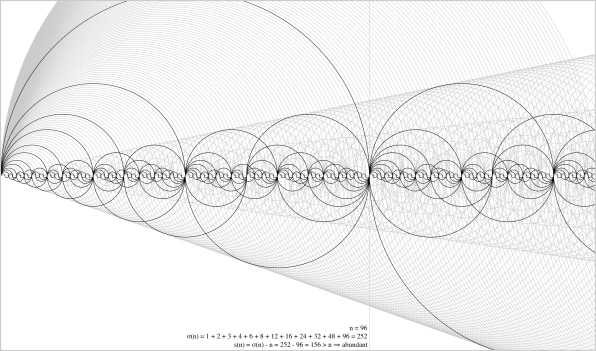
Above, Jason Davies, a data visualisation specialist and computer scientist, created a graphic for the to render the unique relationships between prime numbers.
The natural number, e, found throughout nature particularly in functions with growth, when composed in mathematical functions, creates a recursive spiral, that has cyclic repetition.

Part of trying to break cryptographic algorithms, cryptanalysis, involves using loopholes to reduce complexity, for example using lattice reduction hypercubes:

The speed of light is not technically infinite, arguably. You can think of it as occupying space with no time component from its frame of reference but Physicists argue it too is finite.
Certainly the universe could potentially contain some properties which are infinite and some which are not. Astronomers theorise that a point with infinite density—called a singularity—lies at the centre of black holes.

If the universe is full of finite cycles, do these cycles repeat indefinite? Is time infinite.
Some Physicists theorise time itself loses all meaning at the end of some incomprehensibly long epoch in the age of the universe.
Buddhism sees the universe as infinite in time and space, and filled with an infinite number of worlds like our own.
Maybe it's just unknowable. The legend has it that the Buddha refused to answer whether the Cosmos Finite in Space? Is the Universe Finite in Time? Is the Self Different From Body? Does the Buddha Exist After Death?
The endless knot is is an important symbol in both Jainism and Buddhism. It is an important cultural marker in places significantly influenced by Tibetan Buddhism such as Tibet, Mongolia, Tuva, Kalmykia, and Buryatia. It is also found in Celtic and Chinese symbolism.


I like to think of it as cyclically infinite despite any finite properties. What do you think?
But infinity is a purely abstract concept. In fact, Mathematics that delves deeply into it seems to be filled with paradoxes.
Whatever mathematical based system we use be it base 10 or base 64, we get not just repetition but patterns of repetition and cycles.
We use prime numbers to create secure communication protocols and yet efforts are underway to develop quantum computer that can crack even these. There are even patterns in prime numbers:
Above, Jason Davies, a data visualisation specialist and computer scientist, created a graphic for the to render the unique relationships between prime numbers.
The natural number, e, found throughout nature particularly in functions with growth, when composed in mathematical functions, creates a recursive spiral, that has cyclic repetition.
Part of trying to break cryptographic algorithms, cryptanalysis, involves using loopholes to reduce complexity, for example using lattice reduction hypercubes:
The speed of light is not technically infinite, arguably. You can think of it as occupying space with no time component from its frame of reference but Physicists argue it too is finite.
Certainly the universe could potentially contain some properties which are infinite and some which are not. Astronomers theorise that a point with infinite density—called a singularity—lies at the centre of black holes.
If the universe is full of finite cycles, do these cycles repeat indefinite? Is time infinite.
Some Physicists theorise time itself loses all meaning at the end of some incomprehensibly long epoch in the age of the universe.
Buddhism sees the universe as infinite in time and space, and filled with an infinite number of worlds like our own.
Maybe it's just unknowable. The legend has it that the Buddha refused to answer whether the Cosmos Finite in Space? Is the Universe Finite in Time? Is the Self Different From Body? Does the Buddha Exist After Death?
The endless knot is is an important symbol in both Jainism and Buddhism. It is an important cultural marker in places significantly influenced by Tibetan Buddhism such as Tibet, Mongolia, Tuva, Kalmykia, and Buryatia. It is also found in Celtic and Chinese symbolism.
I like to think of it as cyclically infinite despite any finite properties. What do you think?
Comments (46)
Hi PaulS
I am surprised by your examples as they do not really seem to test the idea of infinity.
The fact that a mathematical equation can be fed into itself to produce spiraling, (fractal-like), outcomes, doesn't say that there is a finite limit to such spiraling.
I should also point out that even nature has straight lines, and the conceptual ones marking the 3 dimensions could potentially run to infinity.
There are various purely conceptual infinities such as the never ending set of numbers. But in practical terms there are only two infinities that might potentially be real. One is the size of the universe; the other, as you point out, is Time.
One scientific suggestion is the traditional Big Bang: Big Crunch theory, (which was based on observation, but was also put forward to preserve the mathematical basis for our understanding of the physical universe). This suggested that the Universe was no bigger than the expanding ball of matter which emerged from a point in space, and has been growing outwards ever since (but this still limits the concept of the universe to a finite size - even if it is increasing at a supposed rate). This also had the effect of giving time a start point, till it was pointed out that this would break determinist principles. So the
Bang: Crunch: Bang cycle
was introduced to restore the possibility of an eternity of existence, and avoid the need for God as creator. Only Steven Hawking, as far as I'm aware, has seriously suggested a spontaneous start to existence, (incurring the wrath of the determinists), and even then he used the conceptual trick of balancing matter and antimatter to preserve the balance of mathematical equations.
The Big Bang idea was that the maximum size of the universe would be reached when gravity started pulling material back into the centre as a Big Crunch. Yet the objectors put forward the following argument....
if you were on the edge of the universe and could see the empty space beyond it, wouldn't that location be real and therefore wouldn't space be infinite even if physical matter hadn't yet reached it? In addition, why shouldn't there be other material beyond the ball of our universe, that occupies other parts of infinity?
'No' said the purists.... the totality of existence must be contained within the space occupied by physical matter, and it must be impossible to have existence beyond it, otherwise the maths of the Big Bang won't work, and something would potentially be required to put the 'infinite framework for space' in place - and nothing physical could achieve that.
So the idea of curved space came about... yet the 9 year results of the WMAP experiment showed that
"... the Universe is flat with a 0.4% margin of error, and that Euclidean geometry probably applies".... which effectively said that the universe was infinite.
There was also the evidence of the calculated size of the universe, (at over 96 billion light years - which was far bigger than could be achieved by expansion at the speed of light); plus the discovery that expansion of the universe seemed to be accelerating, (which not only seemed break the Bang:Crunch model, but also potentially proved that spontaneous (non-deterministic events) must be real.
Since then, there have been ways to preserve the determinist model, by either providing an entirely different mechanism for universe creation, (of which there is zero evidence), or the argument that the increasing redshift might simply be evidence that the universe has entered the crunch cycle.
While the latter is the only one to argue for a finite universe which is supported by evidence, it is surprising that so much alternate evidence continues to arise to reinforce the argument for infinities.
. Only nothingness can be infinite; somethingness is bound to be finite. Only out of nothingness is infinite expanse of life, existence, possible - not out of somethingness.
. This universe is infinite because is made of cosmic consciousness.
. God is both the creator and the creation. This infinite universe outisde and this infinite consciousness inside.
Quoting Anand-Haqq
Please provide some reasoning to support this.
What is cosmic to you?
What is consciousness?
Put them together and tell me what is cosmic consciousness?
They are not meant do be. They are supposed to be examples of the finite, so that is good to hear.
Quoting Gary Enfield
Not really. That is just abstraction we all picked up from Math diagrams. Just because I say, "yeah that line can just go on forever" doesn't mean it actually can.
Quoting Gary Enfield
I've seen so many theories that use duct tape fudges to avoid indeterminism, that I can't help but feel the universe may very well be indeterministic.
The only "fudge" that seems to so hard to avoid that many Physicists have embraced it is indeterminism itself. Maybe it's not fudge.
Quoting Gary Enfield
Because most people learn at school to throw the infinity symbol around with such impunity, but if you ask them what comes after infinity, they can just say, nothing comes after infinity, it's infinite.
But that doesn't really deal with the profound implications of the infinite, and all the paradoxical baggage that comes with it. It's just not feasible to continue arguing for the infinite when the tools we use really only bolt the idea of infinity to the end.
Maybe this is a place to start
Infinitary logic:
https://en.wikipedia.org/wiki/Infinitary_logic
I would prefer to get a better grasp on the finite first myself, but maybe it would be of interest to you.
Are you pointing out anything more than that we set up infinities using recursion?
Nope, not meant to be anything more than that. I'm wondering whether the universe itself is similar to the cycles within it, seemingly finite but infinitely repetitive.
Consider the following...
Everything that has mass in the Universe is unique in that it occupies it's own unique space and is affected by differing forces (no matter how tiny the difference). If we can agree on this, then what exactly does "two" mean? How can there (technically) be two of anything? And if this is the case, mathematics, although an interesting and utilitarian system, has no basis in reality what-so-ever.
So considering finite and infinite are sort of like debating the exact size of a Unicorn's horn.
So a long but not infinite series of spirals with ever reducing size then. It's finite.
Maybe that is the nature of space time. Who knows!
Had it been The Buddha's way, he would have just whacked you over the head!
I can only conclude that “infinity” is a figment of rational thought. Any notion that there is infinity other than this is beyond us to determine. Because everything about our existence indicates finiteness. I think there is confusion between endless sequences and infinite sequences. These may seem equivalent in thought, but when applied to existence they throw up weird philosophical conundrums. Suggesting they cannot realistically be applied in that way.
Hi PaulS
Quoting Paul S
That's true, but equally those who only believe in the finite must provide a reason why a line like this would have to stop.... and they don't. That's why they said that the dimension lines must contain a subtle curve - allowing them to go on forever, but always bending round on themselves to form a circle.
Yet the 9 year results of the WMAP survey has largely ended that notion.... until contrary evidence arises.
Quoting Paul S
I agree... yet to be precise, I have not met/encountered any physicist who espouses true 'randomness and spontaneity' - say in QM results etc. who is prepared to stray outside the realms of mathematics - which is essentially deterministic. This is a real dilemma for them... yet the heirarchy of their discipline is so heavily geared towards a belief in determinism that they would find their careers limited by any serious argument in the favour of non-determinism.
This was the core of my recent topic about the use of Probabilities. Did you see it?
Quoting Paul S
To ask what comes after infinity suggests that there is somehow an end to infinity - when there can't be. However I am persuaded by the argument that potential infinities can be limited, either by having a start point and then continuing to infinity after that; or the reverse - the ending of an infinity for some reason.
It is because the accelerating expansion of the universe was deemed to have ended the previously eternal sequence of the Bang:Crunch cycle that this could be argued as proof of the existence of non-determinist factors.... because the only way to change an eternal cycle is to introduce a spontaneous or truly random factor...... thank you Mr.Finipolscie for that one.
Thanks
Perhaps, and I confess ignorance about WMAP and what it does. I know what it is but it's just something I don't get too involved with. I can't help but feel they missing something
I will say though that the universe is expanding, but they seem to just then postulate something like dark energy is causing it and they measure that.
If the universe is infinite (in this cycle), I would have thought it would not ever need to expand or accelerate, it would just be, as in be infinite. But it isn't just as it is, It's accelerating, and I don't see enough proof for me to accept it's not a cycle coming to a slow end as it's collapsing back in on itself. Maybe it's just a flat elastic band and is now contracting. I can't escape from my belief that the universe is cyclical and possibly infinite in its cycles, but that this cycle will end,
My feeling about WMAP is that I would inevitably someone devoted to refuting its work or looking for fallacies in it if I studied it in depth as it works at scales I struggle to accept, it makes assumptions that I would need to investigate and not believe in at first.
Quoting Gary Enfield
Probably, but to be fair, it is difficult to get anything practical done without using determinism. Even if the universe is indeterministic, determinism is a wonderful tool.
Indeterminacy is a key part of quantum mechanics. But, the Physicists who work on it, are working at the level of a particles' apparent indeterminacy, such as electron spin. It boils down to a probability distribution on a set of outcomes of a measurement on some observable like an electrons spin.
Before quantum mechanics, those who worked on instrumentation essentially worked with indeterminacy in their work, as they had to deal with errors in accuracy, which meant allotting a confidence in results. Statisticians use confidence intervals in their work.
If you consider statistics a branch of Math, I would argue indeterminacy has been around in Math for a long time.
Quoting Gary Enfield
Send me the link and I'll look forward to reading it. I better get back to work now though. I'll get to it.
Quoting Gary Enfield
That is a nice one! And indeed if it is a potentially infinite series of cycles, maybe it is this spontaneous factor that stops them.
Isn't the extent of Earth's (finite!) surface unbounded (infinite)? Also, whether an expanding torus or Möbius-like loop, what would it even mean to conceive of the universe as bounded by ... non-universe / nothing / nonbeing (à la "North of the North Pole")?
I think you can conceive of anything as infinite at the abstract level. I prefer to constrain my definition of infinity to quanta.
Perhaps we're in dire need of a genius the likes of Newton or Einstein to shed light on what is a vexing issue insofar as I'm concerned. I probably won't live long enough to watch the breakthrough being announced on CNN or BBC but I'm rooting for all the young ones of the planet - someone must have what it takes to crack the problem.
:lol:
A few years ago a researcher at UNC showed, theoretically, that in fact singularities do not form; the final collapse is halted as a new form of matter is produced. As far as I know (and I have been on the lookout for any such news) the result has held up.
https://phys.org/news/2014-09-black-holes.html
Hi PaulS
Here is the link to the other debate
https://thephilosophyforum.com/discussion/10091/do-probabilities-avoid-both-cause-and-explanation
The above may assist you in understanding my following comments on this quote
Quoting Paul S
I think that your point about determinism being a necessary factor in our analysis, is an excellent one to make. However in my opinion, it should be used as a yardstick, and where we find that deviances from that 'strict line' are unexplainable within established principles, scientists should be honest about that, and recognise that it may be evidence for non-deterministic behaviour.
As you will see from the other topic, probabiliities are at the centre of many false claims by scientists pretending that their 'inconvenient' experimental results show determinism, when logically the very use of probabilities denies any known cause.
Hi Photios
Quoting Photios
I agree, because there are very few real life circumstances where infinities might occur.
It may be possible for Finite things to exist within the context of an Infinity - but not the other way round.
Any suggestion that it might be that way should be challenged.
Thanks Gary. I will check it now. Before reading, I will add that probability density functions are used not merely because that's how the outcome is described. It's more to do with practicality. Due to Heisenbergs uncertainty principle, the momentum of a particle cannot be accurately determined if we know its position, and when the particles are fired off one by one, it does "appear" to be probabilistic, but it's a debate that is not settled. De Broglie and Bohm would have contended that there is a kind of pilot wave creating what looks like a probabilistic system, when as they see it, it's wave behaviour caused by an unknown to Physics wave that travels with the particle. The Many worlds proponents would say it's the alternate realities that overlap our reality at the time the particle is detected, and what we are seeing is the universe splitting or branching, the pattern is like a wake left behind by this in their eyes, and not from probability as such, although they see every outcome as playing out so there is some universal probability playing out in their eyes, a universal wave function.
The more I think about it, the more I think Paul Dirac was right. The particle interferes with itself. So its wave like behaviour and not probabilistic. But I don't deny that our reality could be indeterministic. We may never know.
The mathematics that in particular delves into infinity is set theory. There are no known contradictions in axiomatic set theory.
That's not a good place to start. Infinitary logic is a special topic in mathematical logic that is not so much directed to the basic notions of infinity in mathematics. To understand the basic notions of infinity in mathematics, one would turn to axiomatic set theory, in which definitions of 'finite' and 'infinite' are formulated and in which theorems about infinite sets are proven.
:up:
Basically the whole universe needs to be as seemingly symmetrical as a solar system when in fact it's all 'coming off wrongly' and temporary solar systems are emerging at the edges. Further, solar systems are assymetrical, but harmonious in a way that simulates perfect symmetry.
I.e. the planets tilt and draw fall under an assymetrical category, when spin alone would fall under a symmetrical category; it can't go on forever, it will sooner wobble out- or explode.
Only the space the universe expands within is infinite.
I have never encountered a sign that announces me the end of space.
I'm not aware of any force that is 100% unimpeded by other forces. This would mean that all forces eventually degrade when they hit something. These forces would include visible light, ultraviolet, infrared, etc.
There is not a single section of the night sky that is truly open. Some celestial bodies are bright because they are closer to the Earth. But even the blackness we see is comprised entirely of celestial bodies; they are just so far away that we detect no discernible amount of light. We are looking at an impermeable wall of obstructions with no way to see what is behind the wall.
Because these celestial bodies are (eventually) crowding out our view in every possible direction, we have no way to see or detect things that are very far away from Earth. This creates the illusion that the universe is finite and we are somewhere near the center.
I would still assume that the universe continues infinitely beyond what we can see, because I don't have a credible excuse for why it would come to an end. For all we know, the most interesting parts of the universe are right outside the limits of human detection. This could leave us ultimately ignorant about even the most basic and common characteristics of the universe.
How do you know? Because it's still expanding? :chin:
I imagine that space is expanding because of prospected counter force of super spacial phenom, like a gestalt.
I think this is probably correct. You cant draw a straight line on a ball. It would look straight to you if you exist inside or on the surface of the ball but not if you can only see the ball from the outside.
If you exist on its surface and can't access the 'inside volume.' and our universe is a very very big ball, then to us, it may seem flat and infinite, even when using our best tech.
I admit this is just armchair, rather simplistic musing but it may also be true.
Danke! :blush:
Yea, I've heard of that - space folding - before. We're, it seems, in the dark and hence none of these hypotheses have been falsified/confirmed. I spoke too soon, oui?
It's impossible to meet edges. you'll always have day/night cycle to some degree, out of solar systems, is just on route to a point. If you goto a star billions of light-years away you'll see Sol as a star exactly the same range. Stars block out a cubic center and instate random event horizon.
If time is infinite then this means there is infinite number of past events.
if there is infinite number of past event then how is it possible that we have reach the present?
Therefore infinite time is impossible.
Since infinite time is impossible the universe is not infinite because otherwise there would be no time for manifestation of all events in the universe infinite in magnitude.
Therefore universe is infinite only if time is infinite.
Therefore logically space is finite.
"According to The Elijah Price/Mr. Glass Principle, at least one actual infinity exists."
I know nothing about Mr Glass or Elijah, but the thesis is provable in set theory, provided you accept that the employment of axioms is inevitable in any science. It's known as the "axiom of infinity": For any natural number n, there exists at least one set with n members. At first glance, this doesn't look as if it had much to do with infinity. But perpend.
Let's say you choose the number 9. Well, there must exist at least the set of the numbers from 1 to 9, otherwise the number 9 would have no meaning. But if you have a set of 9 members, the total number of subsets formable would be 2^9; and from those you could form a further subset, with a cardinality of 2^2^9, and they would form a further subset... and so on ad infinitum.
That is not the axiom of infinity.
The statement that for any natural number n there is a set with n members is a trivial theorem, not even an axiom.
The axiom of infinity is that there exists a set such that 0 is a member and for any x, if x is a member then xu{x} is a member ['u' there stands for binary union].That axiom, with other axioms, implies that there exists an infinite set, and implies that there exists a set (which is infinite) whose members are all and only the natural numbers.