
‘God does not play dice’
Paul S 2021-02-22
For reference, Albert Einstein's God was a God of philosophy, not religion. When asked many years later whether he believed in God, he replied: ‘I believe in Spinoza’s God, who reveals himself in the lawful harmony of all that exists, but not in a God who concerns himself with the fate and the doings of mankind.’
Einstein once wrote that ‘God does not play dice’ when responding to a letter from the German physicist Max Born. Born argued that at the heart of quantum mechanics is randomness and uncertainly.
Whereas physics before quantum mechanics had basically been
[math]f(x) ? y[/math]
afterwards it's more like
[math]f(x) ? ?y(y?Y)[/math]
, where Y is a set of possible outcomes.
You could argue that at the heart of Einstein's statement about dice is his belief that the universe is deterministic. Einstein was basically saying that there exists some y in the set Y that is the outcome but this outcome is not chosen with any true randomness, - its selected through some as yet ununderstood underlying mechanical property of the universe which is not random; perhaps responding to Born's interpretation that there exists some y in the set Y, but that y is at least partly randomly selected or that its behavior is indeterministic.
(I'm grossly simplifying and the y in this case has some weight attached to it also, so that not every member in the set has an equal probability of being selected, and the function is represented as a probability density function, but that's not my question here,)
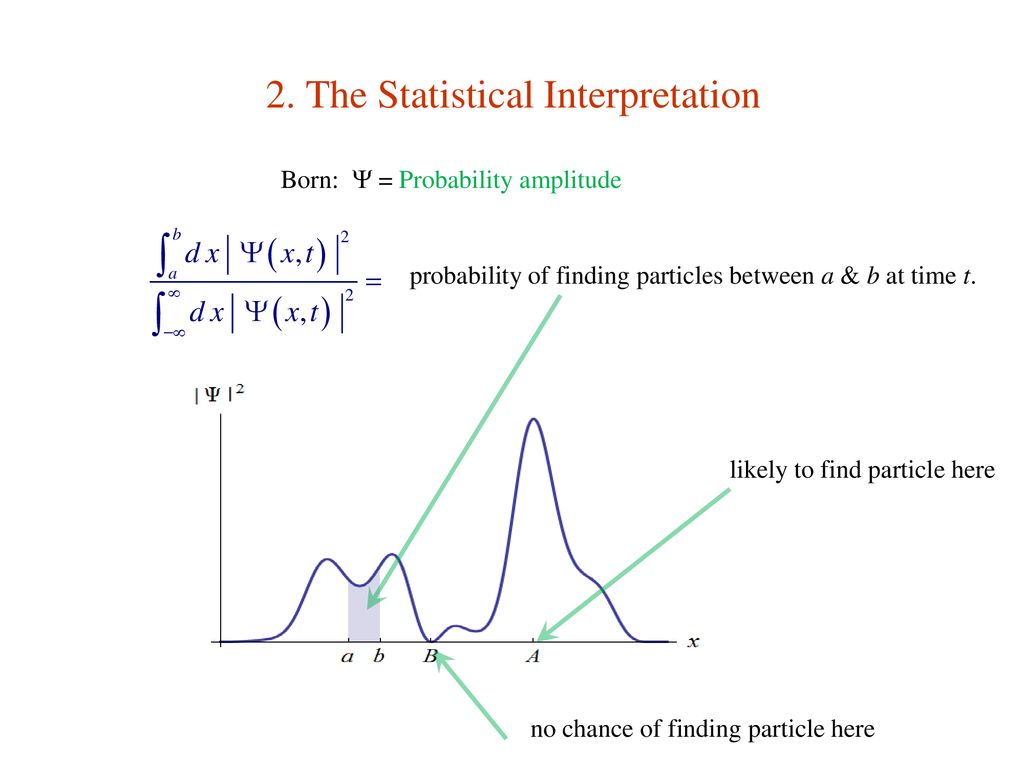
Above is an example of Born's statistical interpretation of quantum mechanics. Einstein would have argued that no matter which point is selected, even if its not in the largest (most probable) area, there is still some other underlying deterministic reason why this value would emerge beyond just a throw of the dice, whereas Born would say it was part randomly selected. It's the probability amplitude that made Einstein uncomfortable.
[b]My question
Do you believe the universe is inherently deterministic or indeterministic (and why)?[/b]
(Do you believe God/the universe/your chosen deity plays dice?)
Edit:
For Tim Wood, yes it's open ended. You can describe 'you' as in the whole, or how different parts of your nervous system are interacting, or you can break down the distinct parts of a process you identify as deterministic or indeterministic from whatever perspective you want to project.
Einstein once wrote that ‘God does not play dice’ when responding to a letter from the German physicist Max Born. Born argued that at the heart of quantum mechanics is randomness and uncertainly.
Whereas physics before quantum mechanics had basically been
[math]f(x) ? y[/math]
afterwards it's more like
[math]f(x) ? ?y(y?Y)[/math]
, where Y is a set of possible outcomes.
You could argue that at the heart of Einstein's statement about dice is his belief that the universe is deterministic. Einstein was basically saying that there exists some y in the set Y that is the outcome but this outcome is not chosen with any true randomness, - its selected through some as yet ununderstood underlying mechanical property of the universe which is not random; perhaps responding to Born's interpretation that there exists some y in the set Y, but that y is at least partly randomly selected or that its behavior is indeterministic.
(I'm grossly simplifying and the y in this case has some weight attached to it also, so that not every member in the set has an equal probability of being selected, and the function is represented as a probability density function, but that's not my question here,)
Above is an example of Born's statistical interpretation of quantum mechanics. Einstein would have argued that no matter which point is selected, even if its not in the largest (most probable) area, there is still some other underlying deterministic reason why this value would emerge beyond just a throw of the dice, whereas Born would say it was part randomly selected. It's the probability amplitude that made Einstein uncomfortable.
[b]My question
Do you believe the universe is inherently deterministic or indeterministic (and why)?[/b]
(Do you believe God/the universe/your chosen deity plays dice?)
Edit:
For Tim Wood, yes it's open ended. You can describe 'you' as in the whole, or how different parts of your nervous system are interacting, or you can break down the distinct parts of a process you identify as deterministic or indeterministic from whatever perspective you want to project.
Comments (92)
But what do you, Tim Wood, (believe or) understand to be happening when you throw the dice? From the moment you receive the dice in your hands to the moment the dice have stopped rolling, what aspects of the event are indeterministic?
It seems that structurally, spacetime with the distribution of matter in it is a mathematical structure that exists timelessly, all at once. Does that make the universe deterministic or indeterministic? On one hand, it is deterministic in the sense that everything that will ever happen already exists and cannot change. On the other hand, if QM is right, it is indeterministic in the sense that it is not possible to logically derive a single outcome from initial conditions and laws of physics (laws of physics being regularities in the structure of spacetime and distribution of matter in it), which means that a single future state cannot be predicted from past states. If many-worlds interpretation of QM is right, it is deterministic in the sense that it is possible to predict all future states from past states (since all possible outcomes are realized) but indeterministic in the sense that it is not possible to predict the single future state that we will observe (since all the other possible future states are realized in parallel worlds which cannot interact with each other and we cannot predict in which world we will end up).
Why not constrain yourself with determinism through the eyes of Baruch Spinoza, start from there, if you like or have time to do so?
Almost like we are in a movie, but just because we know the ending, we don't necessarily know the various plots and subplots yet, as if we still could potentially change the plot but no matter how much we change it we cannot change the ending, the ending that only light and the other waves know as they ripple through here.
It is impossible to tell at this stage of science if existence is deterministic because perturbing a system in order to measure it changes the state of the system. If you measure a matter wave at a particular location, everything around it including what is beyond the context of measuring device gets driven out of its corresponding state and into an alternative state in a thus far unfathomably complex process. Theory will have to be advanced enough to register the full range of singular and plural effects before we can discern if happenings are at base chaotic. We may never know if this is even possible.
From my reading, I get the impression that quantum occurrences must be more deterministic than modeled by graphs of total statistical probability.
I feel that if there is a probability distribution than can describe possible states of a system for waves (superposition) that is indeterministic, then that makes our lives indeterministic from a point of view. Our brains are also electrical and light literally moves around in waves inside our minds too. It would make make our thinking indeterministic too?
Determinism is often contrasted with free will.
In my assessment, it would make the measurement of those physical processes in terms of current quantum mechanics extremely probabilistic, but the processes themselves are more deterministic, though perhaps not absolutely deterministic. We shall see. The fate of free will hangs in the balance lol
I doubt the human mind could be approximated on any meaningful level without a vast statistical quantum network, so that maybe the creation of AI is the only true way could hope to understand it.
Quoting Enrique
I know, I wish I could share a lol about that part. It's very sad indeed.
I suppose the opposite of a system that tries to control the free will of its people, is people who constrain their free will wilfully, using their own discipline and rote devotion to managing their will formally and precisely, logically, Vulcan in short.
Undetermined, in some basic sense. There's always an element of serendipity, of chance, of what C.S. Pierce called 'tychism'. Within it there are also laws, principles and regularities, but they're not absolute or inviolable.
Einstein was a staunch scientific realist, who wanted to believe that there is a way things truly are, and that it is the task of science to discern that. He couldn't accept that reality was not completely determined by laws, and also questioned the inclusion of the 'role of the observer' which became part of the fabric of quantum mechanics. That's why he asked the rhetorical question, "Does the moon still exist when nobody's looking at it?' - the implied answer being, of course it does! But he was still obliged to pose the question.
My question (as to both questions):
What difference does it make to how we live, what we do?
If he plays dice, nothing is different than it has been. If he doesn't, nothing is different than it has been.
Sub specie aeternitatus the 'inflationary-relativistic' universe is deterministic. Sub specie durationis the 'planck-scale' universe is indeterministic. ("Why?" vide Epicurus-Lucretius, Spinoza, Schrödinger-Heisenberg-Everett, Meillassoux ...)
Speculatively speaking, of course, I believe 'the dice themselves' are eternally rolling – determined – and that the number of dice and number of sides (i.e. size) of each die are indeterminate. (vide Rovelli, Deutsch, Tegmark ...)
Quoting Ciceronianus the White
:fire:
:death: :flower:
Quoting 180 Proof
Yes, but indeterministic in the context of measurement.
A nice Buddhist like take on it!
And also in the context of ontology: vacuum fluctuations, spontaneous symmetry-breaking (Noether's Theorem), quantum tunneling, radioactivity, etc.
I tend to agree with you but it's not fully settled, and my never be. Is it not the case that space / space-time must be quantised if determinism has to break down at a certain point, and that leaves the paradox of what is space made of? Then even smaller quanta come back into relevance, ontologically speaking.
Not much of a journey as we remain in the same place in either case.
The jury is still out. LQG hasn't panned out yet. (Rovelli)
Paradox? No, it's only an apparent one speaking in folk-terms (non-mathematically, classically); like time, "space" – void – isn't "made of" any thing.
I don't believe it will, or maybe I just don't want it to.
When you ask what something is 'made of' you presume it has constituents or elements - which surely must be in question with respect to space. The nature of the existence of space - whether it is inherently real, or whether it is in part constituted by cognition - is still an open, and possibly an unanswerable, question.
Yes. I should have stated "..what is space made of, if anything".
I'm beginning to lean, I suspect very dangerously, close to Einstein's view on the matter because it appears that ignorance of deterministic systems and truly indeterministic systems can't be told apart by us. Take the example in your OP - dice - which are, if you really look at it, deterministic phenomena - if one has complete knowledge of the initital state of the dice and also of the nature of the force that you apply as your roll the dice, you can predict the outcome with 100% accuracy - and yet they behave as if they're truly indeterministic processes when in fact they aren't as explained above.
To make the long story short, if you encounter a probabilistic phenomenon then you won't be able to tell for certain whether it's actually indeterministic or that it's deterministic and it just so happens that you don't have enough information to make an accurate prediction because both these situations will present themselves to you probabilistically.
My two cents.
I agree that Einstein would see a dice roll as deterministic, and he was using the analogy more to say that he doesn't believe God would allow true randomness or indeterminism to play a part in the roll so to speak. But the act of rolling a die manifests from the central nervous system so the question is whether that the human mind and central nervous system is deterministic or not. But if the human mind and nervous system are deterministic, you can't escape from the reality that free will would be an illusion.
That's an intriguing twist in the plot but I think robotic hands can also manage "random" dice rolls...I'm not sure though.
I don't see why not if you have a source of "true" randomness like an unstable electrical field for example. But you could argue then that it would be the electrical field calling the shots, not the robot and its not for sure that there is truly such a thing as true randomness, but it is claimed.
Well, how about this then. Imagine two tables X and Y.
At table X is a person who has complete information of the initial states of dice, the force fae will apply on the dice, and the role of the surface of the table but fae uses this knowledge to simulate randomness. In other words, the person at table X deliberately causes each possible outcome of the dice roll to be 1/6.
At table Y is a person who is faced with true randomness of the dice in which case, again, the probability of each outcome of a dice roll is 1/6.
You are the observer. Can you tell the difference between tables X andY based on the outcomes of the dice roll?
Maybe not. There are tests of randomness but I don't think they are that useful, they can spot something that is deterministic if it makes no effort to use randomness from the results. Reasonably random results adhere to a distribution that can be detected using the Chi-square test for example.
But I don't think its that interesting to consider if you can be tricked or not.
My point is somewhat along the lines Descartes' deus deceptor idea which I believe has modern incarnations mutatis mutandis or so I'm led to believe. I wonder if Albert Einstein ever thought of that. All I can say is it can't be ruled out with any acceptable degree of confidence. The indeterminism we encounter in our lives could be divine mischief/deception.
But you really are going deeper into the unknown there. There will always be philosophical questions.
I keep one quote in my profile that I think applies here.
“I believe that ideas such as absolute certitude, absolute exactness, final truth, etc. are figments of the imagination which should not be admissible in any field of science. On the other hand, any assertion of probability is either right or wrong from the standpoint of the theory on which it is based. This loosening of thinking (Lockerung des Denkens) seems to me to be the greatest blessing which modern science has given to us. For the belief in a single truth and in being the possessor thereof is the root cause of all evil in the world” ? Max Born
We may be in a universe nested in another universe as a simulation for all we know. Nothing can ever be truly ruled out. We deceive ourselves everyday. Half of life is probably self deception. To a degree, I think we get out what we put in, in terms of mantras. If we dwell on the notion that we are being deceived or toyed with on some level by a higher power, it can become a self fulfilling prophecy.
In some quantum experiments, it is possible to both play dice and predict the measured outcome with certainty. For example, suppose I prepare a quantum coin as heads-up. I then flip the coin, i.e., transform it into a superposition of heads-up and heads-down. Without measuring the coin orientation (which, if I did, would be equally likely to be heads-up or tails-up), I then flip the coin a second time. Now I measure the coin orientation and find that it is heads-up. Further, on repeating the experiment I find the coin always oriented heads-up after two flips. I can similarly design an experiment where the outcome of the double-flip is always tails-up (when initially heads-up). In each case, the outcome is completely determined by the coin's initial state and evolution.
Note that the measured outcome of the second coin flip would be unpredictable for someone who did not have knowledge of the coin's initial state and evolution. In this case, what seems like playing dice from that person's perspective is predictable with certainty from a broader and more informed perspective.
A - Yes.[/b]
... Anyway :smirk:
Quoting TheMadFool
I suggest more close reading and study of the Ethics, III & IV (Preface), because your suggestion here is clearly mistaken. "Whence evil" for Spinoza? Human psychology (proximally); not onto(theo)logy (ultimately). Summary.
For Spinoza, Descartes' "deus deceptor" (i.e. uncertainty, non-necessity) is merely an inadequate idea – a deity/demon which 'transcends' nature (i.e. cartesian dual / second substance, or substance 'beyond' substance) – among natura naturata (i.e human modes) and not immanent to – is not necessitated by – natura naturans. Einstein reads Spinoza correctly in so far as he does so sub specie aeternitatus; however, he fails to discern, or accept, that the sub specie durationis reading of Deus, sive Natura also could be simultaneously true as Spinoza argues, and thus Einstein misinterprets time as merely "a persistent illusion" (contra Spinoza).
"God does not play dice" in so far as the "God" he refers to is cartesian & transcendent (e.g. biblical); apparently, Einstein conflates this deity/demon with the spinozist immanent deus when objecting to the implied incompleteness of relativistic (deterministic) physics, misrecognizing nature itself – natura naturans – as the "dice" themselves (i.e. quantum indeterminancy e.g. MWI). David Bohm (re: hidden variables) would make a career of attempting to correct, or extend, 'einsteinian determinism' ... almost in spinozist fashion.
Are you asking if indeterministic events are determined?
Quoting Enrique
Sound deterministic to me.
Any time you use prior conditions to explain subsequent conditions, you are implying determinism (observing/perturbing a system changes the system).
As a matter of fact, we can't really help thinking this way. As a matter of fact, reasoning is deterministic. Reasons determine conclusions. If they didn't, then what reason would you have for believing what you believe?
'If we dwell on the notion that we are being deceived or toyed with on some level by a higher power, it can become a self fulfilling prophecy.' I think that this is an important issue, because the belief in free will is essential to finding that freedom rather than feeling that we are puppets, unable to create our own destiny. This deterministic perspective can come from the belief in a higher power or from within the determinism of hard materialism.
One idea which I believe is interesting in relation to understanding of causality is the idea of synchronicity. It is not an actual model of causation, but of meaningful coincidences. It is important for aiding the individual in understanding patterns within our lives, and perhaps through tuning into these patterns we can gain greater understanding of where we are and who we are individually.This may give us the consciousnes with which to find our true pathways in the grander scheme of life. Jung spoke of how these synchronicities often arise in critical moments in life. Personally, I have experienced these, including precognitive dreams, and have found them useful in understanding symbolic patterns in situations where I often felt almost powerless. Understanding symbolic dimensions can provide a way of seeing stories unfolding in life and how we can become the authors creating our own destinies more consciously.
Then you're not flipping it.
Quoting TheMadFool
He was never a atheist. He was considered a form of theist, he would have seen the deception as God like.
Quoting Jack Cummins
It came in the form of premonitions for me, when I was in danger.
Quoting Harry Hindu
You're making the assumption that the human brain and nervous system is deterministic.
Quoting 180 Proof
I might have to read up on that,
I agree that “ everything that will ever happen, already exists” but disagree that it “cannot change”. Everything that might exist, exists in potential only, and that which actually does exist, is in a state of constant change.
The light on the surface of the Sun is a little over 8 minutes in the past from Earths perspective and the light here and now on Earth won’t reach the next closest star for about 4 1/4 years into the future, from Earth’s perspective. Past, present and future, exist in a continuous unbroken stream and it all depends on one’s position in the space/ time continuum, as to what may be observed.
Future states may be predicted from past states. Take the position of the Earth in relation to the Sun for example. Every 365 days, the Earth is back to the starting point in it’s orbit. The position of Mars may be predicted and a rocket ship may be sent there! However, things like how a woman might react to any given situation, may not be predicted with accuracy!
Your very first post in TPF and you came to my thread. Good.
Your first post mentioned ahem-19. Bad
(Let's leave any talk of that baggage at the door?)
Kudos for mentioning non linear dynamics.
For those not familiar with the concept of non linear dynamics just think of a pendulum with hinges, like you would see rocking back and forth in a grandfather clock. But instead of a single straight rod, it has hinges. As it rocks, the hinges move and it turns out that from any one point where you start it in motion, the pattern it traces out is greatly different than even a tiny change. It is all about the butterfly effect and how chaos quickly emerges from something with just a very simple initial input.
BUT, it's arguably still technically deterministic. Any slight vibration around a hinge, or a tiny difference in force means the path the hinges trace will be radically different, but it's still all based off the assumption that the conditions themselves are ever so slightly different.
Einstein would argue that, with theoretical knowledge of the electrons at ay one time, in the system, their spin and position, that the start point is exact, that the pendulums are truly identical, that any minor perturbance of air is precisely the same. That the local effects of the Earths magnetic field throughout are the same etc. then they will trace the same pattern
It's just that its obviously impossible for us to set the conditions for both pendulums to be in the exact state and trace the exact same path. It will never happen. Ever. But we are not comparing two pendulums, or 2 periods of a pendulums, given the seemingly same starting conditions and conditions throughout. What we are considering is whether the pendulum in all is non linearity is indeterministic.
It is essentially deterministic provided that quantum mechanics is deterministic and we may never know the answer to that. Really the question of whether non linear dynamics is deterministic is just another way of formulating whether God plays dice, but thanks for brining up non linear systems. It's the most fruitful I think to answer this question.
Some posters mentioned before that "What does it matter if I can fool you into thinking its indeterministic" and that point is particularly interesting in the context of non linear systems.
But it can't be both really. If any part of the universe is deterministic, it all is really, as the nonlinearity or chaos rapidly escalates and the system becomes very tangential to what it otherwise might have, even if it is inconsequential things, the state is fundamentally altered, everything is connected through space-time. You use the many worlds interpretation to describe a deterministic system and ironically, you are right in my opinion. The many minds interpretation may be also, I can't recall.[s][/s]
.
That's what's so interesting. It's quite possible we are either
a) At the whim of a supreme gambler
b)[ b]In one of many parallel realities.[/b]
And there would seem to be a high probability it's one of those.
I lean more towards a) Indeterminism for all it's flaws. There's something elegant about Ensemble and Copenhagen interpretations that no matter how much I try to find my own answer they pull me back in and say to me that this is the way. The Copenhagen interpretation is not really formally defined and as I recall I lean more towards Bohr than Heisenberg in terms of what they bring to the theory. Einstein did reluctantly accept Ensemble as his preferred take, and it's a fine choice in my book. It's agnostic about determinism, and minimalist given that it doesn't try to define the unknown or unknowable. Born's statistical interpretation is a thing of beauty. Copenhagen is decidedly indeterministic and why Einstein could never truly get on board with it. There is a paradox for a Physicist accepting indeterminism, because it just deepens the rabbit hole. Arguably, it slaps you in the face and tells you there is no bottom to the rabbit hole, and some things are just unknowable. Kind of like a stop sign, "No complete answer for you at this time."
Quoting Present awareness
Not exactly, the Sun is moving in orbit around the galaxy, and up and down through the galactic plane like a revolving frill. The Earth is on that journey and really our solar system moves in a vortex. The sun moves and all the planets rotate around it as it does. We never truly go back to the same point, we just perceive it from the Gregorian calendar. It may very well be indeterministic too and certainly non linear.
Though it's speculative to generalise, women are thought to have, in general, more connectedness between the hemispheres of their brain, so the fuzzy emotional part works more in tandem with the reasoning part.
Agreed. However, I was not referring to the same point in space, but rather the same starting point (season) in relation to the next orbit of Earth around the Sun. The Sun itself is traveling thru the galaxy and the galaxy is moving away from other galaxies, as you mention. The motion of stars, planets and galaxies follow predictable patterns nevertheless.
Sounds like you believe we live in a simulation.
There is no determination needed necessarily. Information as a concept is entirely abstract, it's just labels on things, we separate something into the object and the meta information that defines it or makes its rules, but it's just as likely if not more so that it does what it does. There is an attractive force, attraction takes place, the definition of how the attractiveness works is abstract and not based in reality necessarily at all. The universe doesn't calculate how to evolve, the moving parts interact with each other do what they do.
Even from a simulation point of view, it's proven more efficient for computers to mimic reality for physics, to replicate real life collisions as opposed to just computing the information.
Information alone as a means of solving a problem is never going to be as efficient. If I want to know where billiard ball A will end up if I slam it with billiard ball B at a certain angle, assuming I have the capability to be exact, I know where it will B from experiment with friction, momentum, static forces etc. all built in out of the box. A supercomputer can only approximate that.
Quoting tim wood
You can look it up. Getting back to determinism: If we had an exact copy of the universe with every condition the same in space and time present for when we hit ball A with ball B, same electron spin for every electron etc. etc, every hair of material on the table, the air pressure to the most infinitesimal level and on and on, would the results be the same? If yes, that's a deterministic universe.
If no, it's indeterministic, there is some element of pure chance involved. Or maybe more precisely, if its indeterministic, we could say that there exists no other universe like ours. There can't be a copy.
Hope that helps.
It's not something one can easily go out and prove.
Why not?
The device is flipping it. You can make a deterministic device to flip something, at least deterministic at the macro level, so then it's just a question of the determinism or lack of with the coin, and it's environment. Can you make it land in the same place to the namometer? That would be more of a challenge, regardless of how the flipper is and the smoothness of the surface, the polish of the coin etc? But to just make it land on heads is not too difficult, even more a human, with the right discipline and conditions for the experiment. But it's questionable whether humans are deterministic to do it with the same accuracy as a machine can.
I'm using the below definitions.
Determinism is the philosophical view that all events are determined completely by previously existing causes.
https://en.wikipedia.org/wiki/Determinism
UNCOUNTABLE NOUN [oft adjective NOUN]
Determinism is the belief that all actions and events result from other actions, events, or situations, so people cannot in fact choose what to do.
https://www.collinsdictionary.com/dictionary/english/determinism
the theory that everything that happens must happen as it does and could not have happened any other way
https://dictionary.cambridge.org/dictionary/english/determinism
Sorry I wasn't trying to be patronising. I didn't sleep enough.
If were infinite, with infinite matter disbursed within it, the chance of any human experience being a Boltzmann Brain would be equal to the probability that it was the experience of a human who was born on Earth.
Quantum phenomena are not random, they're stochastic. The universe would then be determined by its finite nature, and would have a finite number of outcomes. Under the "many worlds" hypothesis, where in all possible quantum outcomes occur in an ever dividing set of universes, I suppose we sink back into a more deterministic system, since the output of possible new universes is determined by what comes before.
In a certain sense, all existence is deterministic. There is an infinite potentiality of what could be, and existence is the reduction of all those possibilities to what is. What isn't, is excluded.
With that in mind, quibbling over the randomness of particles just doesn't seem that big a deal. Potential outcomes of being have already been bottlenecked on an infinite scale into what is.
That's not certain but some theories do model the phenomena that way, or stochastically.
Quoting Count Timothy von Icarus
Quoting Count Timothy von Icarus
Spoken like a true proponent of the many worlds interpretation?
Pity it came just two years after Einstein's death, and I wonder what he would have thought of the theory. I think he may have had concerns about it needing some universal wave function that defines each of the many worlds behind the scenes, that has never been observed. He may have seen it as a bit speculative, given that he could never reconcile himself with the Copenhagen interpretation.
I can't help but feel that (ironically) all the determinism based interpretations avoid indeterminism by simply "making stuff up". It is a cool theory, but one we really would have a hard time ever verifying!
I don't see the question of your OP as merely a practical one (but perhaps you do?) A quantum coin can be represented by a qubit, just as a classical coin can be represented by a bit. Just as we can pseudo-randomize a bit via an algorithm, so we can psuedo-randomize a qubit by an appropriate transformation such that if the qubit were measured it would be equally likely to return a 0 or a 1. But the qubit's state is not truly random, as evidenced by the fact that the same transformation can be applied to the qubit a second time, and the original state of the qubit is restored.
I don't really distinguish between practical and theoretical. But what is proven is then in the realm of experimental physics in that case.
We have not proven whether the universe is fundamentally deterministic or not. But if any of it is indeterministic then it all is, if you get me, because if you have a chain of events in a system that is deterministic but for one part, then the overall outcome is indeterministic. That's what I'm trying to get at.
I wasnt talking about the nervous system and brain. I was talking about reasoning.
Its not an assumption that reasoning is that act of using reasons to support your conclusions.
I didn't just pull the assertion out of my ass. I had a reason to make that assertion, just like you have reasons to support your assertions. Those reasons determine your assertions.
Here you are providing reasons as to why something is impossible or possible. So it seems that what is possible or not is determined by some prior set of circumstances.
All you have to do is go back and read all your posts and you will see that thinking deterministically is inescapable. You will always provide reasons and prior conditions as the means of supporting your conclusions and subsequent conditions.
Everytime you make an argument about how things are for everyone, even if they disagree with you, and provide reasons for those arguements you are supporting the idea of determinism.
Agreed, we don't have proof.
Regarding Einstein's view as described in your OP:
Quoting Paul S
Einstein viewed nature as ultimately intelligible. To paraphrase Einstein, the Born rule works, "but does not really bring us any closer to the secret of the 'old one.'"
That's not what determinism at all, is as I understand it.
Exactly.
No, but I find Many Worlds the most philosophically interesting.
From a practical standpoint, I highly doubt we will approach anything like a "Grand Theory of Everything." I appreciate the positivist project from a pragmatic standpoint. It's damn useful, and the answers science gives are interesting. However, I'm definitely not a follower of Dewey and the pragmatists in terms of my epistemology.
I suppose there are other ways to think of determinism. "Reality" in any sense can't exist without understanding. You need something having some sort of experience. As Sausser said: "a one word language is impossible." You need differentiation to have meaning. It's a pretty redundant statement, but I think it gets to an essential point about the basis of what has to exist for anything to be said to exist. You need an interpreter in there to provide differentiation. So you could say the universe is determined by the very loose requirements of meaning.
Such ideas are naturally associated with religious doctrines, but that is mainly because of the way that Christian doctrine absorbed Greek philosophy through the early Greek-speaking theologians.
Atomism tended to identify 'the unmade' with the purported indivisible and imperishable constituents of manifold phenomena, a view ultimately derived from Democritus. But now the status of the atom is itself in doubt, constituted as they are by the ever more elusive minutiae of mathematical physics or conceived in terms of 'excitations of fields'.
So I wonder if modernity has lost sight of the question of what is made, constituted or conditioned and of how it is derived from what is uncreated. I think by seeking to trace the chain of material causation backwards through its evolution there is an attempt to arrive at some primordial state, but whether this can be subject of conceptual analysis is an elusive point. Mysticism tends to arrive at an understanding of ‘the unborn’ through means other than the conceptual i.e. ‘non-conceptual wisdom’, which is not even on the map, as far as Western philosophy is concerned.
Quoting Count Timothy von Icarus
:clap: Bravo, a succinct statement of a fundamental truth.
I don't really like the pursuit of a theory of everything. I don't feel we are in any way enlightened enough as a species to be there and I'd be a bit disappointed if the bar was set that low.
I really like the question of determinism vs indeterminism though.
Quoting Count Timothy von Icarus
I mentioned it to a friend out of boredom years ago, someone who ordinarily wouldn't have had any interest. I then explained why it's not really outlandish and why in fact some Physicists have no choice really but to give it credit since it is deterministic and a solid theory as these theories go, since so many Physicists are hellbent on rejecting indeterminism.
Anyway, I found she was intrigued by it because she just liked the idea that there was some version out there that made all the right moves, which I found entertaining. It's interesting that quantum mechanics throws such conundrums that you are kind of stuck between a rock and a hard place if you just want the universe as conventional as Science once imagined it to be.
But for determinism to be correct, it does appear from a Physics standpoint, that the universe is either such that we either have no genuine free will (which doesn't make any real sense to me) / or at least that our free will is just a one possible combination of an unfathomably large set of possibilities that we live through, which as you know is what Many worlds gets at, maybe many minds too.
And for indeterminism to rule, many would argue that we would have to be living in some kind of simulation anyway, God's simulation as I see it.
I never liked Many Worlds at first, thinking of it as a bit twilight zone but there is of course more to it and it deals with the determinism problem better than any other deterministic theory I would argue.
Quoting Count Timothy von Icarus
That's a good point and something I think of sometimes too.
Maybe it's time it made a comeback then, since we know now that we can create matter from photons.
Quoting Wayfarer
Modernity has lost sight of a lot of things.
'The uncreated' is not necessarily any kind of particle or object. But as we're so used to construing everything in terms of particles and objects, we don't know how else to think about it.
Quoting Paul S
There's a saying that 'desperate problems call for desperate remedies'. So what is the desperate problem that the many-worlds solution is a remedy for? I asked this question on Physics Forum and there was neither clarity nor unanimity in the responses I received.
Suffice to say that the problem that Everett's interpretation sets out to solve is that of the 'collapse of the wave function'. And that problem is that in quantum physics, the sub-atomic object has no definite location until it is measured by the observer; it is represented only by a range of possibilities, but it can't be said to exist apart from as a range of probabilities until it is observed. Meaning that the observer now has to be regarded as part of the experiment, which collapses not only the wave function, but the supposed absolute separation between observing subject and observed object, which, in turn, undermines the fundamental tenet of realism, which is the mind-independence of the object of investigation. That is the problem in a nutshell.
So Everett's bizarre thought experiment suggests that this collapse never occurs at all, which requires that there be as many worlds as there are observers. And even though it sounds bizarre, it attracts a lot of people because it suggests a kind of 'sliding doors' picture of the world, where all kinds of alternative realities can play out. It's intuitively conformable with sci fi memes.
The Multiverse is Rotting Culture
I think that's true. I would agree but the creation of matter from light may be part of it.
Quoting Wayfarer
Looks about right. How would you refute the Ensemble interpretation?
, or even further the Copenhagen interpretation. I would be curious to get your take on it, since I lean towards those interpretations (for now) especially the former. Though the latter might be a better one to refute for interest sake, as ensemble makes less assumptions.
Quoting Wayfarer
For me it's intuitive for the reason you mentioned before - No need for a collapsing wave function.
On the determinism side, it is the best looking theory in my view. It just feels a bit ghostly - an interference pattern caused by parallel realities as it were. And yet, why not? It might just be that way. It's less outlandish than other theories I have seen that attempt to fudge away indeterminacy, that's for sure.
I think Everett’s interpretation is preposterous. I often refer back to this column https://www.scientificamerican.com/article/hugh-everett-biography/
Quoting Paul S
Reasons are causes. Conclusions are events. Conclusions are determined by your reasons. Seems like it fits perfectly with how you understand determinism.
To be fair insanity has befallen on those working heavily in fields on the question of determinism, quantum mechanics and infinity. The latter has certainly driven some mathematicians stark raving mad.
I see the math symbols and my brain freezes. Hah. In any case, I think the question is quite interesting and can be tackled in numerous ways, as has been done.
Speaking very broadly, we have this innate structure or tendency to look for causal interactions, X being necessary for Y to occur, or emerge or whatever. Some knowledgeable in physics propose Everett's Many World hypothesis, there is determination, as the collapse happens in other universes. We have Loop Quantum Gravity, which I don't understand and then String Theory, which I understand least of all.
In many cases determinism is saved - putting aside the Copenhagen interpretation - or is looked for. As a "mysterian" myself, I tend to favor the view that we simply lack the cognitive capacity to know if the universe is deterministic or not. It's entirely possible that any of these theories gets vindicated or a new one comes in that shows us that determinism is maintained.
Maybe. But I don't think this proves much. Why? Because we have, to some extent, free will. Some may say that this is impossible, because physics. Yeah ok. I'm sorry, particles, atoms and anything else found in the subatomic world play no role in freedom: clearly new complexity emerges.
Can anyone begin to outline how light waves manifest themselves as colours in the world? It's not possible. Yet we see them, clearly: red, blue, green, yellow etc. Some may deny it, but that's like saying 2+2=5.
The same with freedom. If the basic constituents of the universe were called something else and had different properties maybe we wouldn't exist or maybe another life form might arise. It doesn't matter. The universe already had the potential for choice in it, beyond a certain level of complexity.
So is the universe deterministic at bottom? I don't know how this makes sense given that we are here to ask these questions. Shouldn't the universe simply stay at the level of elementary particles, given determinism? In any case, I think we don't have the capacity to know any clear answer to this question.
There is no collapse in Many Worlds, which is one of the benefits out forward by proponents. All outcomes happen.Quoting Manuel
A deterministic theory Many Worlds implies no free will. You play out your life in this reality. You have no real control. Any alternate decision couldn't have been made in this reality and is in one of the other of many worlds.
Quoting Manuel
Our brains are based on all these particles and atoms, photons, electrical signals etc. soul outside of what we would call the human soul, if they behave deterministically, then we are deterministic.
Maybe our connection with our spirit gives us our indeterminism, in that we have to accept some connection to the universe to be indeterministic. We lost that connection and we become deterministic like glorified automatons.
Quoting Manuel
Different frequencies of light produce different colours.
Quoting Manuel
Maybe not.
I don't know how to quote properly here yet. So thanks for correcting my Many Worlds explanation, I should've looked it up instead of relying on my memory. It's appreciated.
Let's adopt Many Worlds then. Sure. Other me's can and actually do every possible action, within the framework allowed by our bodies. In this world I raise my left arm, in another world "I" raise my left arm, in yet another "I" raises both arms, etc. But in this world, the only one available to me, I can't do these things simultaneously. Since I don't know about the other me's, nor can they influence me (if I understand Sean Carroll's version), how am I not free?
"...if they behave deterministically, then we are deterministic" That's the argument I don't follow. Why? Do particles have reasons, goals or motives in any intelligible sense? Particles themselves are not happy, ugly or painful, yet we can be happy, we see pain, we see the ugly and the beautiful. We can say these things about manifest objects, but not particles.
"Different frequencies of light produce colours"
Yes. Is there anything *in* the light frequencies that are colourful? No. Colours are produced by frequencies of light interacting with our mind/brains, and maybe other things we aren't cognizant of, but that doesn't explain the experience of seeing a blue ocean or a red rose. At least, I don't see it as an explanation that makes sense. It happens yes, but it doesn't make sense.
But if you tend to side with eliminitavists like Dennett or the Churchlands, that's a whole different story.
No. Insanity has befallen on you as you have exhibited a tendency to be intellectually dishonest and inconsistent in your venture to prove determinism to be false.
All you have done is provide reasons for indeterminism to be the case, but all you have shown is that this reasons determine whether or not indeterminism to be the case. In effect, indeterminism is a paradox.
Just highlight it or select the text you want, a little small quote button will appear, click on it.
Or you can just type it like this:
Quoting Manuel
Because another branch breaks off every time you make a decision based on your apparent free will, you live in the reality of one frame (for lack of a better word) at a time in Many Worlds. But Many worlds is not a theory I support. It's too speculative and it just seems inefficient, like the universe would be wasting a lot of energy recording events that are so unlikely that it seems pointless, but maybe that's just me. I've said before in other posts, and I maintain that doing away with indeterminism in theories seems to introduce outlandish fudge. If people cannot accept the consequence of an indeterminant universe (the likelihood that )
It's interesting and its popular with proponents of determinism.
Quoting Manuel
We can say exactly that about these objects. If a particle behaves deterministically, we do not say it has no free will. We say it behaves deterministically - the result of its actions are predetermined the moment its makes an action. If the universe is deterministic, then there is an unbroken chain of events that lead to that particles behavior and all others leading all the way back to some big bang if there was one, and since we are composed of these things, we would also adhere to these laws and everything we do not would be linked back to the past. Many people don't believe they have a soul , that they are simply the sum of their parts and in an indeterministic universe, they see themselves as deterministic beings.
Indeterministic theories say that there is interference or intervention into the outcome of the particles action so that the particle at any one time behaves spontaneously in its action, there are no copies of the universe. There is just one, and (with the Copenhagen interpretation) only once the action has completed, does the probability wave function collapse and the outcome of the particle's action manifests itself. (At lease most indeterministic theories imply wave function collapse, some have other explanations like an unseen pilot wave as seen in Bohmian mechanics / Pilot wave theory - another interesting theory that is gaining popularity).
Quoting Manuel
Yeah, pretty much, but the color is arbitrary. We may have evolved our visual system to integrate into this world. In that case, factors like the luminosity and spectrum given off by the sun might have played a role in our evolution deciding that the the very thin slice of visible light we perceive is all we needed. Gamma rays are not as ever present in our lives so perhaps we didn't need to evolve to detect them .We evolved a a sense of physical touch and perceive temperature from nervous system already, so perhaps we didn't need to evolve to see infrared, i.e. there wa not need for us to evolve to see infrared light or visualize heat sources.
Quoting Manuel
I don't side with any one Philosopher on all things, but I will say from what I know of eliminitavism, they are right on that I think. Abstract thought is just that - the creative fabrication of abstraction. It is not true reality. It is just a part of who we are / how we evolved.
Some schools of Buddhism believe nostalgia is abstract, that we create it ourselves. We don't really feel it, we project or abstract it out of an emotional association with positive memories. The emotion we felt at the time is real, and the memory is real, but the emotion we feel when we conjure it into our memory is abstract, which might be why we don't feel the same way when we conjure it, its almost like tricking our minds into feeling happy about it. I can't remember which Buddhist text it came from but when I read it, I felt it might be the case. But that's my view.
You had exhibited that you didn't understand what it meant in the first place, which was a bit intellectually lazy of you.
You seem to be upset that I called you out on not knowing what you were talking about.
Quoting Harry Hindu
I'll give you credit for reminding me of this
I'm not saying I'm comfortable about the indeterministic argument for quantum mechanics. It is what is is I guess.
I believe our human sprit makes us indeterministic, but not in a way that can be explained by underlying physical observable nature.
This is why I lean towards the ensemble interpretation The Copenhagen interpretation may go a bit too far in that it introduces paradoxes.
In the end, this is a hard argument to resolve anyway. We are all unique in our own way and have our own subjective interpretation.
I'll just state my final position. The ensemble interpretation is the only theory I can get behind right now as it is agnostic about the question of determinism vs indeterminism.
Copenhagen is indeterministic which I can tell you do not favor.
Many Worlds is deterministic.
Ah, I see. Yes we do, you're right, but it's probably not the correct use of these words "determined", "free" and so on, as it incorporates human elements into the universe. If the universe were deterministic, it would be misleading to say "The universe has no choice or lacks freedom." But this is just word play on my part.
Quoting Paul S
Perhaps. But I don't think it's too controversial to say that this arbitrary aspect of colour is the most important things for people, it's part of what makes our experience of the world rich, irrespective of how
they are instantiated in nature.
Quoting Paul S
Then our disagreement is plain and perhaps irreconcilable. Reality is an honorific word. We don't say that's the real deal or the real truth meaning that there are two kinds of deals or two kinds of truth, we are just using the word "real" to emphasize something.
Science, if the theories are on track, aims to tell us how the world is mind-independently. That's different from saying the manifest image is an illusion, it's a representation. And this in turn is different from saying that science tells us how the world is "in itself" - I don't think science achieves that. But that last point is debatable.
I suspect the topic of consciousness and illusion will get us stuck.
But is it not right and humble to honor reality? Without instruments we, whether by design or evolution, only perceive a thin slice of the reality around us, not a mind those things beyond our ability to yet perceive, or those things that may forever be beyond our horizon. We are only human. We can deceive ourselves by thinking we are beyond reality, when the contrary may be more accurate.
Measurement, when done right is a Philosophers tool. But ultimately, yes, it's just a tool. And it can only take us so far.
Quoting Manuel
I agree. But the world would still be beautiful if the spectrum was shifted a bit to the right towards UV, more detail in flowers etc. that we cannot see now. I was just making the point that the colors are labels we put on things solidly in the middle of certain chunks of the spectrum. You won't see too many diagrams with A labelled as cyan and B labelled as Blue because it could be confusing. But in truth, there are no colors. We abstract them as a part of the full visible spectrum. We quantize them when, strangely enough they may not even be truly quantizable. In principle there exists infinitely many distinct spectral colors
I think it makes sense to be proud of, and be humbled by, what science has achieved. Whether you are speaking about any part of physics or astronomy or anything else, it's remarkable we have achieved this much, given who we are. On the other hand, we can only appraise or appreciate physics or astronomy, within the context of the world we experience.
If it were not for our conceptions of "strange", "massive", "puzzling", "beautiful", "elegant" and so forth, science would be meaningless: just a set of numbers on a piece of paper or a computer screen.
Quoting Paul S
I mean, I think it depends on what you take "just" to imply. Sure, we can only see a portion of the colours we can detect with our instruments and knowledge. Yes, what we call "red", might be "blue" for me and "like blood" for you. That's not pertinent to our appreciation of colours. Whatever the word "cyan" represents to you, to me is the most beautiful colour, one that I would be quite sad if it disappeared.
Likewise with music. You can say sound is "just" acoustic waves. They "just" happen to be pleasant to us. It's "auditory cheesecake" as Pinker called it. But if that's what you say to yourself when you listen to your favorite song, then we have very different conceptions of what reality encompasses, mind-independent or not.
I don't have a problem with anything you wrote. I'm not saying I have a problem with abstract thought. It's a part of who we are. I was just pointing out that it is just that, abstraction. Yes, it is beautiful, as a petal that comes from a flower - the flower being humanity.
That's interesting. I don't intend to sound polemical, I'm actually curious, what would you mean by "concrete"?
I never used that word.
I exhibited no such thing. You exhibited a misunderstanding of what I was saying. So I had to show you that my explanation fit your definition of determinism - a definition that I agree with. You didn't respond to that - hence your intellectual dishonesty.
Quoting Paul S
What is the indeterministic argument for QM? Again, if a theory is providing reasons for some observation, then the theory is deterministic.
You did !
Quoting Harry Hindu
Your definition, as I recall it, was fallacious, but I don't want to over dwell on it. I'm not that pedantic
I don't think so!
Quoting Harry Hindu
I think you're conflating 2 different arguments.
Indeterminism can be composed of partly deterministic parts. I don't see a logical fallacy in that.
I used your definition. Are you paying attention?
Quoting Paul S
I do.
And you contradicted yourself again:
Quoting Paul S
If any of it is indeterministic then it all is, right? There would be no deterministic parts if any of it was indeterministic.
You obviously are not paying attention. You can't even remember what you wrote.
Quoting Harry Hindu
Ok,
Well let's say (sorry I had a toke) I stack a big group of deterministic tiles (let's just say I conceded and that's what they are) and I know that for this deterministic tile, it will hit the next deterministic tile and it will fall etc. I can put just one non deterministic tile in the group of tiles, that may or may not fall, and if you replay knocking these tiles down as dominoes over many times, you will have a very non deterministic outcome overall!, when you add up all these different results.
All you have done here is show that each instance in time is unique, yet similar to other instances in time. Each state-of-affairs is determined by prior states-of-affairs, its just that each state-of-affairs is unique and not the same as other states-of-affairs, yet they can be similar enough to be predictable, depending on what we are focusing our attention on.
It's not that the world is non-deterministic. It is deterministic as each state-of-affairs is determined by prior states. Our ignorance of all the intricate details of each state-of-affairs can lead us to believe that some state is not deterministic, but it is simpy our ignorace of the difference between some known state-of-affairs in the past and the state-of-affairs in the future that we are trying to predict that is similar, yet slightly different in some relevent way to the one in the past that makes our prediction fail.
Indeterminism isn't some real aspect of reality. It is only an idea in the minds of humans that has no reality beyond the minds of humans. It is an idea that stems from our ignorant view of reality.
That's not proven.
Quoting Harry Hindu
Neither is that.
Either case is essentially coming form a partially "ignorant view of reality". We simply don't know.
If on the other hand, you are making a point that, for you, in your opinion, which is not necessarily at all based in fact, that the question of determinism vs indeterminism is not of fundamental importance, then that is your opinion.
I don't think there's any more minimalist a term to conceive of, than this as an expression of the fundamental truth of the workings of the universe and our place in it.
Ok, explain what what an indeterministic event would look like. What does it actually mean for some event to be indeterministic? All you will be able to do is provide reasons/causes for some event to be indeterministic and you would then be head-deep in contradictions and paradoxes - that the indeterministic event was actually determined by some prior set of circumstances. Try it.
I can just repost with
"Ok, explain what what a deterministic event would look like. What does it actually mean for some event to be deterministic? All you will be able to do is provide reasons/causes for some event to be deterministic and you would then be head-deep in contradictions and paradoxes. Try it."
Go ahead, and I'll let you know how it too throws up apparent paradoxes.
Observe how you reason. You use reasons to reach conclusions. The reasons determine the conclusions you reach.
How about the concept of free will. You are privy to a certain amount of information at any given moment. That information determines the decisions you can make. You cannot make a decision with information that you don't have. Later, you may acquire new information after you made the decision, but that doesn't mean you would have made a different decision at the time you made it. You would make a different decision now, but the moment of decision is past.
Yes, that's determinism.
To make the case for reasoning being indeterministic we have to assume that there is some neural influence that doesn't behave deterministically, some flakiness - some element of eccentricity and unreliability, like a misfiring neuron.
Then you probably have to accept that this flakiness is sourced from some as yet unknown extra-universal source (exists outside of our universe itself), or that maybe our universe itself is not a singular entity as we perceive it but is a collection of universes and that the flakiness is completely independent of the universe of the stimulus that stimulates it. We don't know. It just comes down to whatever sits right with you. There is no proof or even legitimate evidence for either determinism or indeterminism really.