
The fabric of our universe
Paul S 2021-02-21
Something that's been on my mind quite a bit lately is something some people devote their entire lives to, the question of what space is made of if anything.
There is an intuitive tendency to regard space as nothingness, possible learned from out childhoods in school. Because we at the very least (most of us) had some understanding of manned space or robotic probe missions, and through the concept of nothingness, emptiness, zero (all technically abstract concepts), we build an intuition that space is nothingness or emptiness or a void. But that is entirely learned.
It's actually not proven that there is such a void. Increasingly, physicists are becoming more convinced that space is quantised, that is to say it has a structure of its own, that it's finite if you zoom in enough so to speak. In the quest for the fabled theory of everything (a kind of reconciliation of the physics of macroscopic objects like tennis balls - general relativity - and quantum mechanics, the theory of how infinitesimally small things like electrons and photons behave), gravity seems to be the linchpin generally focussed on, probably since it is arguably the least understood of the fundamental forces. Popular theories of gravity like loop quantum gravity and string theory attempt to theorise the nature of our universe and the fabric of space or spacetime with it.
I feel drawn to want to put my philosophers hat on in this regard and draw on my intuition and that of the greater well of all human intuition throughout the ages, and I cannot help being captivated by the notion that platonic solids are at the heart of the fabric of our reality.
Platonic solids can be traced back at least to neolithic times, and they seem to be embedded in human consciousness. I want to believe there is some primordial connection here that humankind has with the universe and that its not simply just Math for the sake of Math. I like to surrender to my intuition in this case and go out on a limb and accept that there is something more going on.
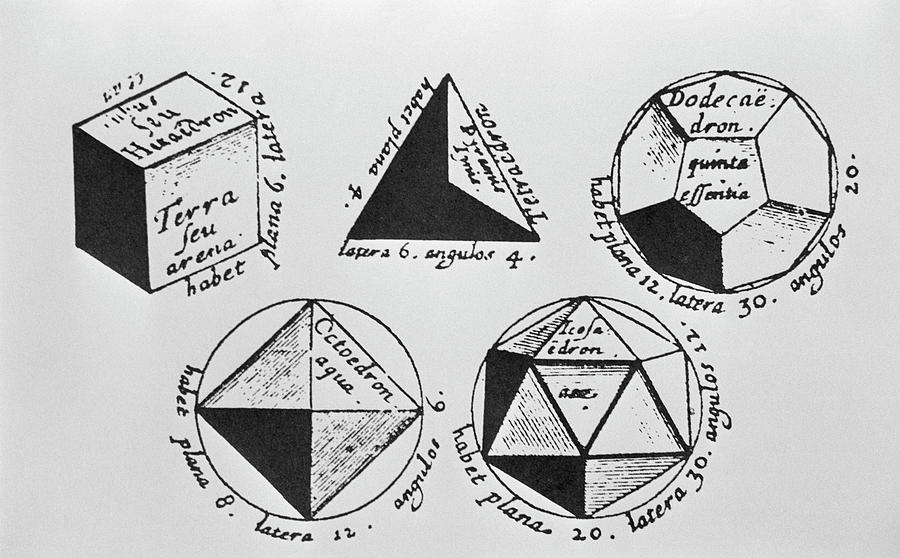
If you got something like the Science and Chemistry education I did, you learned that the structure of an atoms is dependent on the number of electrons in the shells and the natural symmetry of atoms stems from electron repulsion so they space themselves apart in certain ways, but platonic solids can be arranged in configurations which match the structure of atoms very nicely, and although it's not pursued as mainstream theory of what space is made from or its structure, this model just seems to make sense and in some primordial level it 'agrees' with me. The argument essentially boils down to the idea that nested sequences made up of one or multiple platonic solids embody the structure or fabric of space. Maybe the fabric of space is flexible and these sacred platonic solids can be flexed or bent out of shape to respond high energy physics experiments for example. Dr. Robert Moon and Laurence Hecht are behind the proposal. It's work that was submitted in 1987 and has since been relegated by other theories but I can't help thinking this is how it really is.
If you're interested, my musings and magnetism pulled me towards this guys video which I enjoyed. He himself looks like he is enchanted to the idea and I think he is right.
https://www.youtube.com/watch?v=O9w-ny6Xxn0
Or you can get a flavour for the treatise here:
https://larouchepub.com/eiw/public/1987/eirv14n43-19871030/eirv14n43-19871030_026-new_hypothesis_shows_geometry_of.pdf
Issue of EIR Volume 14, Number 43, October 30, 1987
© 1987 EIR News Service Inc. All Rights Reserved. Reproduction in whole or in part without permission
My question to anyone reading is:
Edit:

When I look at this beautiful painting, I find it hard to believe or universe is anything less impressive.
After all, we are children of this universe.
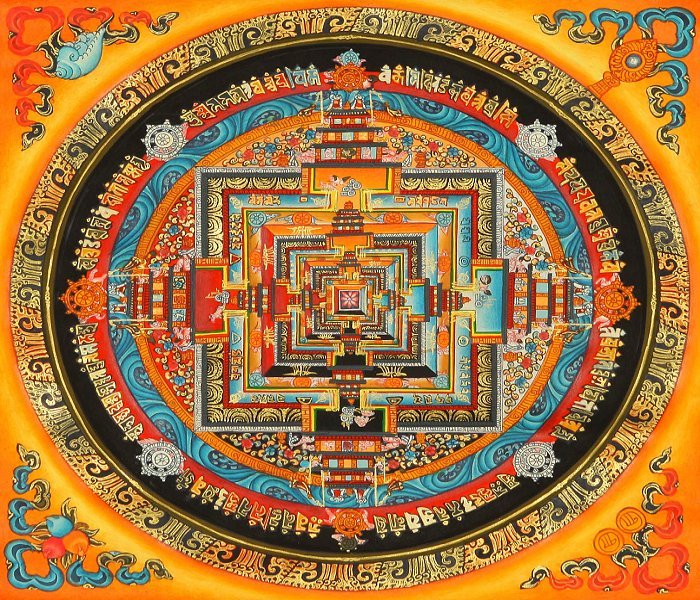
Kalachakra ('Wheel of Time' or 'Circle of Time') is the universal symbol of Buddhism, representing the teaching of the Buddha and symbolizes the perfect creation. Eight spokes of the Kalachakra wheel mark the directions in time and each one is ruled by a deity and having a unique quality.
This powerful symbol (also known as the Kalachakra Sand Mandala) is a powerful symbol imparts healing and peace to all beings on this planet and to the planet itself. We can see complex, beautiful patterns, their perfection and symbols rich in meaning. It is also a 2D representation of the five-story palace of the Kalachakra deity, in which totally 722 deities reside.
Kala ('time') is not linear but the flow of all events (past, present, future). Chakra ('wheel') is with no beginning and no end. - [https://www.ancientpages.com/2017/02/19/11-ancient-sacred-indian-symbols-explained/]
There is an intuitive tendency to regard space as nothingness, possible learned from out childhoods in school. Because we at the very least (most of us) had some understanding of manned space or robotic probe missions, and through the concept of nothingness, emptiness, zero (all technically abstract concepts), we build an intuition that space is nothingness or emptiness or a void. But that is entirely learned.
It's actually not proven that there is such a void. Increasingly, physicists are becoming more convinced that space is quantised, that is to say it has a structure of its own, that it's finite if you zoom in enough so to speak. In the quest for the fabled theory of everything (a kind of reconciliation of the physics of macroscopic objects like tennis balls - general relativity - and quantum mechanics, the theory of how infinitesimally small things like electrons and photons behave), gravity seems to be the linchpin generally focussed on, probably since it is arguably the least understood of the fundamental forces. Popular theories of gravity like loop quantum gravity and string theory attempt to theorise the nature of our universe and the fabric of space or spacetime with it.
I feel drawn to want to put my philosophers hat on in this regard and draw on my intuition and that of the greater well of all human intuition throughout the ages, and I cannot help being captivated by the notion that platonic solids are at the heart of the fabric of our reality.
Platonic solids can be traced back at least to neolithic times, and they seem to be embedded in human consciousness. I want to believe there is some primordial connection here that humankind has with the universe and that its not simply just Math for the sake of Math. I like to surrender to my intuition in this case and go out on a limb and accept that there is something more going on.
Platonic solids.If you got something like the Science and Chemistry education I did, you learned that the structure of an atoms is dependent on the number of electrons in the shells and the natural symmetry of atoms stems from electron repulsion so they space themselves apart in certain ways, but platonic solids can be arranged in configurations which match the structure of atoms very nicely, and although it's not pursued as mainstream theory of what space is made from or its structure, this model just seems to make sense and in some primordial level it 'agrees' with me. The argument essentially boils down to the idea that nested sequences made up of one or multiple platonic solids embody the structure or fabric of space. Maybe the fabric of space is flexible and these sacred platonic solids can be flexed or bent out of shape to respond high energy physics experiments for example. Dr. Robert Moon and Laurence Hecht are behind the proposal. It's work that was submitted in 1987 and has since been relegated by other theories but I can't help thinking this is how it really is.
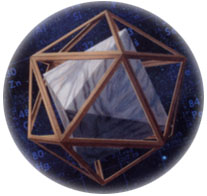
A platonic solid nested inside another.If you're interested, my musings and magnetism pulled me towards this guys video which I enjoyed. He himself looks like he is enchanted to the idea and I think he is right.
https://www.youtube.com/watch?v=O9w-ny6Xxn0
Or you can get a flavour for the treatise here:
https://larouchepub.com/eiw/public/1987/eirv14n43-19871030/eirv14n43-19871030_026-new_hypothesis_shows_geometry_of.pdf
Issue of EIR Volume 14, Number 43, October 30, 1987
© 1987 EIR News Service Inc. All Rights Reserved. Reproduction in whole or in part without permission
My question to anyone reading is:
What do you think of this [Edit for Sophiscat: not a theory, more of a conjecture on the nature of space]? Do you think space has structure or is simply a void?
If space has some structure, then what does it truly mean to split the atom or use an atom smasher to create other elements that have short lives but violate typical structure?
Are we punching holes in sacred geometry itself? Are we even punching through to another dimension, punching through the fabric of space like trying to rip down the curtains of the theatre and see what's behind?
Edit:
Could this be what the structure of space really looks like in 2D, (we could imagine an endless 3d ocean of these platonic solids within platonic solids of various configurations and sizes) if you zoomed in enough?
Does our ancient culture contain information of the true nature of our reality?
When I look at this beautiful painting, I find it hard to believe or universe is anything less impressive.
After all, we are children of this universe.
Kalachakra ('Wheel of Time' or 'Circle of Time') is the universal symbol of Buddhism, representing the teaching of the Buddha and symbolizes the perfect creation. Eight spokes of the Kalachakra wheel mark the directions in time and each one is ruled by a deity and having a unique quality.
This powerful symbol (also known as the Kalachakra Sand Mandala) is a powerful symbol imparts healing and peace to all beings on this planet and to the planet itself. We can see complex, beautiful patterns, their perfection and symbols rich in meaning. It is also a 2D representation of the five-story palace of the Kalachakra deity, in which totally 722 deities reside.
Kala ('time') is not linear but the flow of all events (past, present, future). Chakra ('wheel') is with no beginning and no end. - [https://www.ancientpages.com/2017/02/19/11-ancient-sacred-indian-symbols-explained/]
Comments (25)
Our thoughts themselves need to resemble reality to be objective
Good thread
Thanks.
But space may not necessarily be infinitely divided. Proponents of quantised space (for example those who believe in loop quantum gravity) believe it cannot. We don't have the technology to find out, and there is also a fundamental limit to how small something can be measured in length. It's called Planck length and is the smallest possible measurement of length we can measure that makes any real sense. It is also the the theoretical limit for which two electrons can be pressed together before they collapse into a tiny black hole. But it doesn't mean it's the smallest possible length. As I said, that's unproven.
Physicists can "see"what an atom looks like from microscopy, (by zapping an atom with lasers and magnifying the interference pattern with an electrostatic lens), but that's not going to happen at something the size of a Planck length, which is trillions upon trillions of times smaller than even a proton inside an atom. We may never know!
Well what holds a compactified infinity is its limits, hence infinity is limited by the finite. I don't see how the tangible can be so extremely textual without it having infinite parts. A mind blowing idea is that if the world is eternal the only limit of the infinite past is the ever moving present, which goes on and on itself towards infinity. So time's limit is a potential infinite "not yet". That's how I understand time, but perhaps time is a digression from Platonic shapes in 3d space. I'm sorry. I was thinking in terms of Minkoski geometry
The non-existence of empty space may not even be talked about because it doesn’t exist. However, by not being there, room for that which IS there, is abundant and endless.
Quoting Paul S
The linked article is about a "geometrical model of the atomic nucleus for the periodic table and the arrangement of extranuclear electrons." It doesn't talk about the structure of space.
Well, what is there to think about? There is no theory, at least none in what you wrote. Yes, some theorists are working on theories of quantized space, but in order to discuss those one would need to actually understand them. And that understanding won't come from a few trippy pictures.
Space consists of relations and relational structures: distance, direction, shape, size, volume. Molecules consist of both directional and distance/energy relations between atoms, giving them shape. Atomic structures consist of distance/potential energy relations between sub-atomic particles - namely, between protons and electrons. And particles consist of interacting wavefunctions of valence and potentiality: a prediction of attention and effort required for a particular event to interact with it.
Space, as I understand it, can be BOTH a void and a structure - just not at the same time. It’s actually either, depending on the interacting relational structures. So a neutrino can move through space and most solid structures as if through a void, yet there are ways of detecting interaction.
So there is a lot of weight behind the idea that it is potentially infinite, yet finite at anyone time, and quantised as opposed to discreet.
That's a fair point, and I wanted to spur your own opinion as to the actual questions I asked. Since this is a philosophy forum, I didn't feel it appropriate to load in Physics papers. It was intended to be more an open ended question outside of pure Physics with some pretty pictures as you pointed out ad the ad hominem level, where we talk what you think the nature of space and time is. Yes, I believe they are pictures, well done!
Quoting SophistiCat
Edited the OP for you. Its more conjecture, and limited in scope.
Crystallographic dihedral groups is how I see the structure of space and perhaps spacetime at an intuitive level. There is no paper I can direct you that carries any more weight than what I present as it's entirely theoretical. When it comes to experimental physics at the macroscopic level of special or even general relativity I would be happy to present full theories and research by experts in the field if I feel I understand them but the truth is, I don't really take loop quantum gravity or string theory that seriously as its so deep in theory as to be speculative. Unlike relativity, it lacks an empirical means to verify its truth. Also, loop quantum gravity doesn't really tackle time as I understand it.
Quoting Possibility
I sometimes think of space as like a wake that follows with energy and matter, so that space isn't some uniform entity that exists throughout the universe, but only exists where there is energy or matter. Other times, I think it's truly continuous and not at all quantised, that it's just emptiness. It's why I wanted to spur conversation, to see if anybody has any opinions on what exactly it is if anything other than nothingness.
Why? Why not tiny elephants instead? What feeds your intuition? Is it anything to warrant a second thought?
Quoting Paul S
I don't think you and I understand "theoretical" in the same sense. Loop quantum gravity is theoretical. A random, uninformed guess is... a random, uninformed guess.
The way I currently see it, empty space doesn't exist, only fields consisting in amorphous, fluctuating concentrations that seem to be quantized in various ways and which create waves as they interact. I'm not familiar with theories of quantum gravity, but as far as I know gravitational fields are the farthest reaching we have observed, those that interfere across the greatest distances, so solar systems are like components in a holistic structure analogous to the mutual tension between particles within atoms. Even outer space has a structure due to the interference interactions of gravitational fields.
As fields interfere, amounting to the motions within and amongst them, they generate shape. These shapes are not absolutely three dimensional, four dimensional, or any precise dimension, but rather amorphous in an extremely complex way, though within some conditions they get close enough to a specific dimension that we can model them as such.
From what we know so far of gravity, I think it can be modeled effectively with spacetime. The microscopic concentrations of substance that form interference patterns at various scales, quantum etc., can be stretched into all kinds of different dimensional forms, but in some circumstances match specific kinds of dimensionality very closely, such as a three dimensional crystal or a four dimensional wave packet in the double-slit experiment.
The tricky aspect of modeling dimensionality is that causation proceeds backwards as well as forwards: I'm referring to what are called advanced and retarded waves (for a discussion on the topic I found informative, look at this thread in the philosophy of science section: Determinism, Reversibility, Decoherence and Transaction. The full range of possible field interactions is atemporal, and I'm not aware that scientists have a grasp of how single concentrations of substance propagate at a huge range of different rates simultaneously, or while interfering in reverse so to speak.
I'm not sure what sense to make of neutrinos that move through conventional matter at the speed of light while not interacting with it, or where dark matter and energy fit into the picture.
Tiny elephants are not very optimal to represent the various configurations of atoms. Nested platonic solids are but I'm open to your projection and preference for tiny elephants ;)
It's a bit like saying that sausages are the fundamental structure of nutrition. Why sausages and not pizza, you fail to ask? Why the 5 platonic solids and not the 17 wallpaper patterns?
I thought you were talking about the structure of space (whatever you think that means). But if you don't mind, I would like to change my vote from elephants to turtles. Turtles all the way down!
I don't know what it means or if there is any structure. You could at least have attempted to not go full asymmetric and represented it with sea urchins.
That being said, I have met elephants and they are the most emotional creatures I have ever met. I like to think I can feel emotion from a being but I can't prove that, in any meaningful way without using something like tiny elephant logic.
Exactly. You need to put the sausages on the pizza. Only then may satori be achieved by the devoted supplicant.
Someone on another thread posted this:
https://en.wikipedia.org/wiki/Significance_of_numbers_in_Judaism
I think when anyone studies numerology however, they will find there is no consensus on any number or relationship between numbers whatsoever. And the same probably applies to shapes. That is my personal opinion. I think it's all relative. There is no guarantee that the outside world should accord with our "primordial subconscious", but I appreciate where you are coming from
Yes, but no matter what number base we use, there are three perceived dimensions at least for humans, and mammals, with a 4th which is akin to a master reference dimension that governs the others, time. There are potentially more dimensions but we perceive three. This number is intrinsic to our existence, with the 4th. being like the flow for the river for experience.
Numbers are used to measure volume or force or speed. Plato's tradition did think human aesthetic should be reflected in the world, but you need to defend that with argument
The platonic solids offer a symmetry that also maps well to dimensionality. A tetrahedron with its four vertices and four sides could encode coordinates in time.
But I see it's beauty as the canvas of space for atoms or molecules or both. Perhaps we could think of these polyhedral shapes as all having a time component even, since they all have even numbers of sides and vertices leaving an extra vertex or side for time, that pulls and stretches the atoms with length contraction from high speeds of t from relativity.
Or maybe they could represent molecules too since molecules demonstrate similar patterns. Think of an oxygen atom at one vertex of a tetrahedron, with two hydrogen representing the others, and the fourth representing the effect of time on this molecule. Maybe using nested platonic solids, both atoms and molecules could be represented this way to build up the structure.
If we were to think of space-time as a vast volumetric ocean of little tetrahedrons that can make up vastly more complex solids, with each one stretched and contorted for the curvature of large gravitational bodies just waiting to be filled in frame by frame or little tetrahedron by tetrahedron with the structure of atoms and molecules. We could go further and imagine the edges between the vertices alone with no volume and no area as the paths traversed by a photon of light at this quantum space-time level.
It's just speculation. I am not a God and I have no God complex, but I do like to imagine the mind of a creator sometimes.